Appearance
Introduction
This site offers a point-by-point look at what the CES Letter claims. The aim is to give you a careful way to read this kind of document: separating what is stated from what is implied, and checking both against the available evidence.
What Is the CES Letter?
The CES Letter is a 138-page compilation of questions, criticisms, and concerns about the truth claims of The Church of Jesus Christ of Latter-day Saints. First published online in 2013 and revised in 2017, it presents the criticisms framed as sincere questions from a truth-seeker and covers:
- Book of Mormon historicity, anachronisms, and translation
- The Book of Abraham
- Polygamy and polyandry
- The priesthood ban
- Temple practice and Freemasonry parallels
- Science: evolution, the Fall, the age of the earth
- Church history and transparency
For documented background on the document's origin, audience, and revision history, see CES Letter Background.
Is the CES Letter new?
Most of the CES Letter's claims have been on the record, and answered, faithfully and in print, for decades, and in some cases for over a century.
What's new about the CES Letter is how it arrived, not what it says. It was first posted on an ex-Mormon Reddit page in 2013, then spread through faith-crisis blogs, YouTube videos, and online discussion groups until it became one of the most widely shared online summaries of criticism of the LDS Church.
Essentially, the CES Letter is internet-era packaging of older criticisms.
| Claim | First raised | Answered |
|---|---|---|
| Witnesses unreliable / Smith family "money-diggers" | 1834 (Howe, Mormonism Unvailed) | 1838 (Joseph Smith[1]), 1953 (P. Nibley[2]), 1981 (Anderson[3]) |
| Polygamy / polyandry | 1842 (Bennett, History of the Saints) | 1842 (Joseph Smith[4]), 1905 (J.F. Smith[5]), 2005 (Bushman[6]) |
| View of the Hebrews parallels | 1902 (Riley); popularized 1945 (Brodie) | 1909 (Roberts[7]), 1964 (Palmer & Knecht[8]) |
| Egyptologist verdicts on the Book of Abraham | 1912 (F.S. Spalding) | 1912 (Roberts[9]), 1968 (H. Nibley[10]), 2000 (Gee[11]) |
| Multiple First Vision accounts | 1967 (Walters) | 1969 (Jessee[12]), 1970 (Allen[13]), 2012 (Harper[14]) |
| DNA and the Book of Mormon | 2002 (Murphy) | 2003 (Whiting et al.[15]), 2008 (Stephens & Meldrum[16]) |
None of these claims were new when the CES Letter compiled them in 2013.
The most direct precursor compilation is the Tanners' Mormonism: Shadow or Reality? (1972), the comprehensive twentieth-century work through which most CES Letter footnotes route.
There are some genuinely hard questions in the CES Letter. The bulk of it isn't those. The CES Letter relies on compressed claims, selective framing, and allegations that are easy to make but slow to verify.
Example Criticisms
Two examples follow. They are not meant to prove every point this site will make, but to illustrate the pattern in miniature: a claim sounds devastating when compressed into a sentence or a chart, but looks different once the sources, chronology, definitions, and missing context are restored. In both cases, the issue is not whether the CES Letter mentions real facts (it often does) but whether those facts are framed to lead the reader to a conclusion stronger than the evidence supports.
Example 1: "Over 100,000 Changes" to the Book of Mormon
The claim:
"As part of the over 100,000 changes to the Book of Mormon, there were major changes made to reflect Joseph's evolved view of the Godhead."[17]
The number, "over 100,000 changes," is meant to make the reader assume widespread doctrinal rewriting. The CES Letter doesn't name a source for it: no scholar, no edition, no counting method is given within the document itself.[17:1] Six words are enough to drop the claim; tracing the figure, identifying its likely source, and explaining what it actually counts takes the rest of this section. Most plausibly, the number traces to the Critical Text Project of Royal Skousen, the BYU linguist who has spent more than three decades reconstructing the Book of Mormon's textual history from manuscripts and printed editions.[18] His published variant count is the most thorough in print and matches the "100,000+" figure closely. What goes unstated is what the number actually counts.
What the "100,000" is mostly counting
Skousen's published breakdown, drawn from his decades of full-time manuscript and print-edition examination, looks like this:[18:1]
| Category | Count |
|---|---|
| Punctuation | 41,619 |
| Capitalization | 19,455 |
| Spelling and ampersands | 15,577 |
| Chapter and verse numbers | 9,677 |
| Common-word spelling | 7,982 |
| Typos | 2,087 |
| Paragraphing | 1,420 |
| Scribal slips | 1,780 |
| Other accidentals (periods for numbers, "chapter" insertions, etc.) | 6,911 |
| Total accidentals | 106,508 |
| Deliberate editorial changes | 3,837 |
(The categories above simplify Skousen's full breakdown; the source URL has every category line by line.)
Of roughly 270,000 words across the whole book, 3,837 are deliberate editorial changes, about 1.4% of the text.[18:2] The remaining 102,000+ are punctuation marks, capitalization fixes, spelling standardization, paragraphing, and typesetting corrections, the kind of cleanup any unpunctuated dictation needs before it can be printed.
No trickery is needed to explain that count: it's what happens when you take a text dictated aloud, with almost no punctuation, and prepare it for repeated publication. The Original Manuscript looks like what you'd expect from oral dictation: long streams of words, minimal punctuation, non-standard spellings. See it for yourself at the Joseph Smith Papers.[19]
A representative example
The 17 "changes" between 1 Nephi 1:1 in the Printer's Manuscript and the modern edition look like this:
| Printer's Manuscript | Modern Edition |
|---|---|
| "I Nephi haveing been born of goodly parents therefore I was taught somewhat in all the learning of my father & haveing seen many afflictions in the cours of my days nevertheless haveing been highly favored of the Lord in all my days yea haveing had a great knowledg of the goodness & the mysteries of God therefore I make a record of my procedings in my days" | I, Nephi, having been born of goodly parents, therefore I was taught somewhat in all the learning of my father; and having seen many afflictions in the course of my days, nevertheless, having been highly favored of the Lord in all my days; yea, having had a great knowledge of the goodness and the mysteries of God, therefore I make a record of my proceedings in my days. |
Of the seventeen "changes" in this verse, every one is punctuation, capitalization, or spelling. That ratio holds verse after verse.
The wording changes that do exist
There are also phrase and wording changes within the substantive 3,837. Most are stylistic, a small number are doctrinally meaningful:
| Verse | Original | Modern Edition |
|---|---|---|
| 1 Nephi 2:6 | "in a valley beside a river of water" | "in a valley by the side of a river of water" |
| Omni 1:28 | "a strong and a mighty man" | "a strong and mighty man" |
| 3 Nephi 13:9 | "our Father which art in heaven" | "our Father who art in heaven" |
And the four 1837 "Son of" insertions in 1 Nephi, plus the 1840 wording change at 2 Nephi 30:6 and one related 1837 edit at Alma 5:48:
| Verse | Original | Modern Edition |
|---|---|---|
| 1 Nephi 11:18 | "the mother of God" | "the mother of the Son of God" |
| 1 Nephi 11:21 | "the Lamb of God, yea, even the Eternal Father" | "the Lamb of God, yea, even the Son of the Eternal Father" |
| 1 Nephi 11:32 | "yea, the Everlasting God, was judged of the world" | "yea, the Son of the everlasting God, was judged of the world" |
| 1 Nephi 13:40 | "the Lamb of God is the Eternal Father" | "the Lamb of God is the Son of the Eternal Father" |
| 2 Nephi 30:6 | "a white and a delightsome people" | "a pure and a delightsome people" |
| Alma 5:48 | "the Son of the Only Begotten of the Father" | "the Son, the Only Begotten of the Father" |
These are the substantive edits at the heart of the CES Letter's claim. They're real; they were personally made by Joseph Smith in the 1837 and 1840 editions, and the Church's official Topics page on changes to the Book of Mormon describes them straightforwardly.[20] Skousen, after reviewing every variant in every edition, classifies the four 1 Nephi insertions as "clarification rather than doctrinal revision" and his Critical Text Project actually recommends restoring the original 1830 readings on the grounds that the original phrasings are theologically sound when properly read.[18:3]
A clean first draft
What's often missing from the "100,000 changes" framing is how the dictation itself looked. The Book of Mormon is roughly 270,000 words, produced in around 60 working days, with no outline, no notes, and no evidence of revision to earlier sections as later ones were dictated.[21]
The eyewitnesses who were physically present describe a process incompatible with covert authorship or rewriting. The mechanics of that process (Joseph dictating from a seer stone inside a hat, with a scribe writing each line back for confirmation) are documented separately on the Book of Mormon Translation page. Emma Smith, in 1879 (by then estranged from the Brighamite Church and under no institutional pressure to defend Joseph), described it this way:
"In writing for your father I frequently wrote day after day, often sitting at the table close by him, he sitting with his face buried in his hat, with the stone in it, and dictating hour after hour with nothing between us." Asked whether Joseph could have used a hidden manuscript or book, she answered: "He had neither manuscript nor book to read from." And on whether he revised earlier sections as he went: "your father would dictate to me hour after hour; and when returning after meals, or after interruptions, he could at once begin where he had left off."[22]
David Whitmer, who watched the dictation as a young man, described an immediate verification loop: scribe writes, reads back, Joseph confirms, the next character appears.[23] Oliver Cowdery, who wrote the bulk of the text, said simply: "I wrote with my own pen the entire book of Mormon (save a few pages) as it fell from the lips of the prophet" (modernized from "intire" and "Save").[21:1]
The "100,000 changes" framing obscures all of that. The 270,000-word content, dictated without going back to rework earlier chapters, witnessed in turn by family and scribes who maintained their accounts for the rest of their lives, has remained stable across nearly two centuries of publication. Compared to the New Testament textual tradition, Skousen notes the variant inventory is far smaller: "There are many more variants per word in the New Testament text — and many more highly debated variants."[18:4]
The full edit history is documented and checkable. Both manuscripts are publicly available at the Joseph Smith Papers. Anyone can compare the 1830 text to the current edition variant by variant.
"Over 100,000 changes" sounds like 100,000 rewrites. In practice it's mostly 100,000 editing marks — punctuation, spelling, and typesetting cleanup of an unpunctuated dictation — plus about 3,800 deliberate edits, of which a small handful are doctrinally meaningful. The doctrinally meaningful ones, including all four 1837 "Son of" insertions and the unchanged trinitarian-sounding passages, are engaged in detail at Godhead Changes.
Example 2: Book of Mormon Place Names "Copied" from a Local Map
The claim:
"Many Book of Mormon names and places are strikingly similar to many local names and places of the region where Joseph Smith lived."[24]
The argument has two versions worth distinguishing. The narrow version, foregrounded in the CES Letter, is that Joseph Smith borrowed names from a specific local map or gazetteer, exhibited in the 1983 Vernal Holley overlay below. The broader version, closer to the position serious historians like Dan Vogel argue, is that Joseph's 19th-century American mental world plausibly produced names that resemble those around him without requiring a literal map. This introduction addresses the narrow version because that's what the CES Letter prints. The broader environmental-borrowing argument is treated more fully on the Geography topical page.
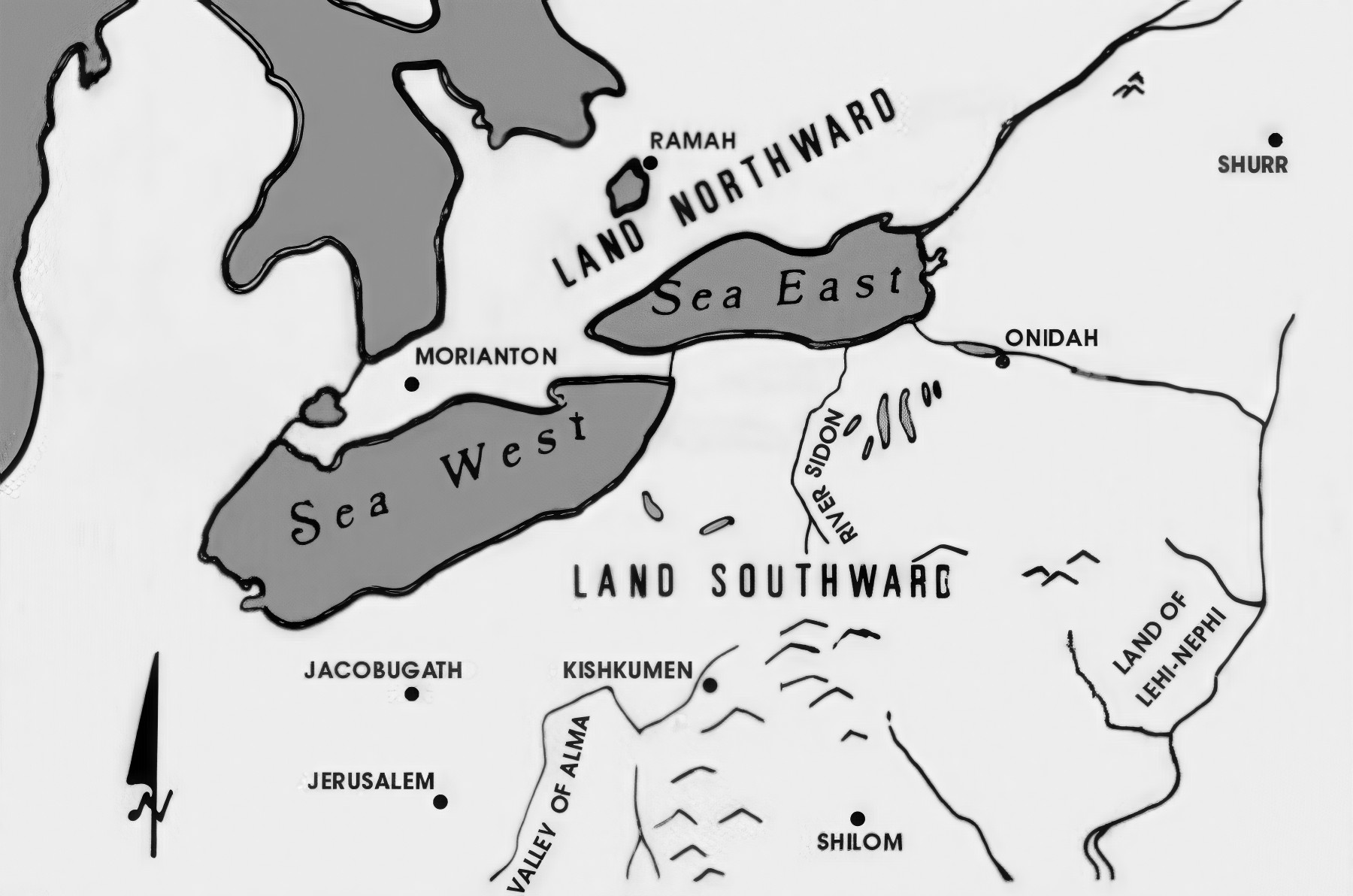
Similarity is easy to find when you go looking for it
The Book of Mormon contains 337 proper names, 188 of which are unique to it (not in the Bible).[25] North America contains tens of thousands of place names. If you search a large dataset for partial matches, you will find some, whether or not there's a real relationship. That's a textbook example of selective matching: choosing the hits, ignoring the misses, and presenting the hits as if they prove a pattern.[26]
Specific issues with the map argument
When the Holley overlay is examined carefully, four problems surface, most thoroughly catalogued by FAIR and by L. Ara Norwood's 1989 FARMS Review rebuttal, the foundational scholarly response to Holley.[26:1][27]
- Chronology problems. At least ten of the proposed source names did not exist by their cited names in 1829. Tecumseh (Ontario) was renamed in 1912, eighty-two years after the Book of Mormon was published. Mantua (Ohio) was incorporated in 1898. Angola (New York) was renamed in 1854. Antioch (Ohio) was founded in 1837. Joseph cannot have borrowed from places that didn't yet exist by those names.[26:2]
- Biblical names. Of the 22 names in Holley's table, at least eight are unambiguously biblical: Antioch, Boaz, Jerusalem, Jordan, Noah, Shiloh, Sodom, Ramah. These existed throughout the English-speaking world because of biblical tradition, not because of Joseph's local geography. Finding them on a North American map proves nothing.[26:3]
- Geographic incoherence. The internal geography of the Book of Mormon doesn't match Holley's overlay. Jacobugath should be in the "northernmost part of the land" (3 Nephi 7:12); Holley places it in the south. Morianton should be near the "east sea" (Alma 50:13); Holley puts it inland. Ramah and Cumorah are explicitly the same hill in Ether 15:11; Holley separates them by 280 miles.[26:4]
- Circular reasoning. As FAIR puts it: "We cannot legitimately use the location of American cities to create a Book of Mormon map that we then use as evidence that the Book of Mormon used the location of American cities to construct its map."[26:5]
After removing post-1830 names and biblical names, the remaining genuinely puzzling pre-1830 sound-alikes are a small handful, fewer than ten, and none with a tight geographic fit to the Book of Mormon's internal landscape. The argument's force comes from looking at the overlay as a whole and ignoring the screens; the screens deflate it.
Names Joseph Smith couldn't have known
Several Book of Mormon names appear in ancient Hebrew and Semitic sources Joseph demonstrably could not have accessed.
Not all Book of Mormon names have known ancient parallels. Some (Curelom, Cumom, Ziff, Senine, Senum, Antion) remain unattested in any ancient Near Eastern source. The point is the asymmetry within the names that have been examined, not the proportion of all names that have been confirmed. The scholars cited below are mostly Latter-day Saints publishing in BYU-affiliated journals (the Interpreter, BYU Studies Quarterly, Journal of Book of Mormon Studies), but the underlying primary sources (ostraca at Elephantine, altars at Marib, ossuaries at Batn el-Hawa) are public and verifiable, so the interpretive chain from "this inscription exists" to "Joseph could not have known this" is reader-checkable.
Alma. Used in the Book of Mormon as a male name. It was attested as a male Hebrew name only after the 20th-century discovery of the Bar Kokhba documents from the Cave of Letters in Israel (c. AD 132), recording the deed of "Alma son of Judah."[28] A subsequent 1st-century BC/AD Jerusalem ossuary inscription, "Judah son of Alma", pushes the male-name attestation back further. Joseph died in 1844; the documentary evidence was not unearthed until decades later. Crucially, "Alma" was not a normal masculine name in Joseph Smith's region in 1800s America: in Rappleye and Hansen's 2024 Ancestry.com search of births between 1780 and 1820 connected to Wayne County, New York, or the surrounding region, only 4 of 42 records listing male Almas turned out to be actual males.[29]
Sariah. Lehi's wife. A female Hebrew name absent from the Bible, attested at Elephantine (5th century BC, in a fully-preserved ostracon recovered from Storeroom 2293 of the Aramaic archive at Elephantine in Upper Egypt). The 2019 ostracon publication eliminated earlier scholarly objections that the name appeared only in restored fragments: "Seraiah daughter of [...]" is now intact, no restoration required.[30]
Mulek. A different evidence category: there's no inscription bearing the name. The argument is etymological: Mulek connects to the Common Semitic root mlk ("to reign / king") and is plausibly a hypocoristic (shortened form) of the biblical Malchiah. The BYU Book of Mormon Onomasticon (citing Hugh Nibley, John Tvedtnes, John Gee, Robert F. Smith, and Janne Sjodahl) documents the etymological case.[31] That's plausibility, not attestation.
Nahom. The strongest single geographic correlation in this introduction. 1 Nephi 16:34 says Lehi's family camped at "the place which was called Nahom" where Ishmael was buried, then turned eastward (1 Nephi 17:1). In 1988, German archaeologists excavating near Marib in modern Yemen recovered three limestone altars dedicated by "Bi'athtar... of the Nihm tribe", dated to the 8th–7th centuries BC.[32] Two caveats: the inscription reads NHM (Semitic was written without vowels; the consonantal root corresponds to a tribal name, not a verbatim toponym), and the geographic correlation (that the Nihm tribal area sits at approximately the latitude where, after traveling south through Arabia, Lehi's family would have needed to turn east to avoid the Empty Quarter, near the "only fertile area in over a thousand miles of coastline") involves an inferential chain (NHM tribe area → Lehi's "Nahom" → eastward turn at Bountiful) that depends on assumed routes. Even with those caveats, what remains is concrete: a place-name root in a region Joseph Smith could not have known about, at a latitude consistent with the narrative the text describes. Terryl L. Givens characterizes the find as "the most impressive find to date corroborating Book of Mormon historicity."[32:1] His phrasing is partisan, but the underlying inscription, dating, and tribal-territory mapping are public archaeological data anyone can check.
These are not isolated cases. A peer-reviewed catalog by Tvedtnes, Gee, and Roper (2000) documents sixteen Book of Mormon names confirmed in ancient Hebrew inscriptions (Sariah, Alma, Abish, Aha, Ammonihah, Chemish, Hagoth, Himni, Isabel, Jarom, Josh, Luram, Mathoni, Mathonihah, Muloki, Sam), none of which appear in the English Bible.[33]
So the contrast cuts both ways. The Holley map argument, that Joseph borrowed names from a 19th-century New York map, fails its own screens. And the deeper-time evidence runs in the opposite direction: a meaningful subset of Book of Mormon names is consistent with ancient Near Eastern origin and not consistent with environmental borrowing, including Alma in a 1st-century AD ossuary, Sariah in a 5th-century BC Egyptian ostracon, and the NHM tribal name at altars in 8th–7th-century BC Yemen. Joseph could not have read any of them.
The map case is built on loose sound-alikes, post-1830 place names, biblical names that prove nothing, and a geography that doesn't match the Book of Mormon's own internal text. The deeper-time evidence — ancient parallels for some names, including the NHM tribal name in southern Arabia — runs in the opposite direction.
What This Site Covers
Those were two examples of a broader pattern that runs through much of the CES Letter: a fact is presented, key context is missing, and the implication feels stronger than what the evidence actually supports.
This site goes topic by topic, supplies the missing context, and lets you judge for yourself:
- Book of Mormon: historicity, DNA, anachronisms, and geography
- Book of Mormon Translation: seer stones, Urim and Thummim, and the dictation process
- First Vision: multiple accounts, contradictions, and late appearance
- Book of Abraham: papyri, facsimiles, and source texts
- Polygamy & Polyandry: Joseph Smith's marriages and D&C 132
- Prophets: Adam-God, blood atonement, and the priesthood ban
- Kinderhook Plates: translator claims
- Testimony & Spiritual Witnesses: competing claims and reliability
- Priesthood Restoration: late appearance and backdating
- Witnesses: credibility, second sight, and James Strang
- Temples & Freemasonry: Masonic connections and temple changes
- Science: evolution, the Fall, and discredited claims
- Other Concerns: transparency, finances, and anti-intellectualism
- Conclusion: putting the pieces together
Each topical page shows the CES Letter's claim, addresses the strongest version of the underlying critique (not just the CES Letter's framing), works through the evidence, and links to scholarly sources and primary documents so you can verify the work yourself.
A Note from the Author
My name is Landon.
I'm an active, faithful Latter-day Saint. I'm also analytical by nature. I've always treated questions as part of faith, not a failure of it.
This site exists because I've watched the CES Letter manufacture doubt out of vague claims and citations that most readers won't have time to verify. My job here is to put the evidence back in front of you.
I've never met Jeremy Runnells, the author of the CES Letter. Based on the interviews I've watched, he seems sincere and guided by his convictions. It's easy to forget people's humanity when all we see is text on a screen. There is good in Jeremy, and I will never attack him personally.
If you are struggling with doubts, read the Book of Mormon. Pray about it. There is power in that book. It remains the single biggest obstacle for critics: how did it come to be? That is the central question. A 270,000-word book, dictated in a matter of weeks, witnessed by people who maintained their testimonies throughout their lives, and containing names, structures, and internal complexity that Joseph Smith, or any of his contemporaries, could not have produced by ordinary means, cannot be waved away with easy explanations.
You can reach me at landon@cesletteranswers.org.
Joseph Smith, "Answers to Questions," Elders' Journal 1, no. 3 (July 1838): 42–43. Direct response to Hurlbut/Howe-derived "money-digger" accusations: "Was not Joseph Smith a money-digger? Answer: Yes, but it was never a very profitable job for him, as he only got fourteen dollars a month for it." ↩︎
Preston Nibley, The Witnesses of the Book of Mormon (Salt Lake City: Stevens & Wallis, 1953). Compilation of statements from the Three and Eight Witnesses with biographical sketches and primary-source documentation; one of the earliest book-length faithful treatments of the witness testimonies. ↩︎
Richard Lloyd Anderson, Investigating the Book of Mormon Witnesses (Salt Lake City: Deseret Book, 1981). Documents over two hundred separate witness affirmations across the witnesses' lifetimes, many made under hostile cross-examination. Anderson was a Professor of Church History and Doctrine at BYU. ↩︎
Joseph Smith, ed., Affidavits and Certificates, Disproving the Statements and Affidavits Contained in John C. Bennett's Letters (Nauvoo, IL: J. Smith, 1842) — broadside published August 1842 and reprinted across Times and Seasons 3, nos. 22–24 (August–September 1842). Contains rebuttal affidavits from Sidney Rigdon, Hyrum Smith, William Law, and others responding directly to Bennett's History of the Saints. ↩︎
Joseph Fielding Smith, Blood Atonement and the Origin of Plural Marriage (Salt Lake City: Deseret News Press, 1905). Earliest comprehensive faithful defense of Joseph Smith's plural marriage; written largely in response to RLDS denials of Joseph's involvement in the practice. ↩︎
Richard Lyman Bushman, Joseph Smith: Rough Stone Rolling (New York: Alfred A. Knopf, 2005). Bushman is Howard W. Hunter Visiting Professor of Mormon Studies at Claremont Graduate University and Gouverneur Morris Professor Emeritus of History at Columbia University. Addresses Joseph Smith's plural marriage and polyandry directly across multiple chapters; widely regarded as the standard scholarly biography. ↩︎
B.H. Roberts, New Witnesses for God, 3 vols. (Salt Lake City: Deseret News, 1909). Comprehensive defense of the Book of Mormon, including engagement with environmental-borrowing theories such as the View of the Hebrews parallels. ↩︎
Spencer J. Palmer and William L. Knecht, "View of the Hebrews: Substitute for Inspiration?" BYU Studies 5, no. 2 (Winter 1964): 105–113. Direct point-by-point response to View of the Hebrews parallels claims. ↩︎
B.H. Roberts, Defense of the Faith and the Saints, vol. 2 (Salt Lake City: Deseret News, 1912). Same-year contemporaneous response to F.S. Spalding's Joseph Smith Jr., As a Translator — Roberts engaged the Egyptologist verdicts and the Book of Abraham historicity question directly. ↩︎
Hugh Nibley, "A New Look at the Pearl of Great Price," serialized in Improvement Era (January 1968 onward); later expanded in The Message of the Joseph Smith Papyri: An Egyptian Endowment (Salt Lake City: Deseret Book, 1975) and subsequent volumes. Nibley was Professor of Ancient Scripture at BYU. ↩︎
John Gee, A Guide to the Joseph Smith Papyri (Provo, UT: FARMS, 2000). Gee holds a PhD in Egyptology from Yale and is the William (Bill) Gay Research Professor at the BYU Maxwell Institute. ↩︎
Dean C. Jessee, "The Early Accounts of Joseph Smith's First Vision," BYU Studies 9, no. 3 (Spring 1969): 275–294. Earliest scholarly faithful treatment of the multiple First Vision accounts; Jessee was a senior researcher at the LDS Church Historical Department. ↩︎
James B. Allen, "Eight Contemporary Accounts of Joseph Smith's First Vision—What Do We Learn from Them?" Improvement Era 73 (April 1970): 4–13. Allen was assistant Church Historian and a professor of history at BYU. ↩︎
Steven C. Harper, Joseph Smith's First Vision: A Guide to the Historical Accounts (Salt Lake City: Deseret Book, 2012). Pre-CES Letter book-length scholarly treatment of the multiple-accounts question; Harper is Professor of Church History and Doctrine at BYU and a former managing historian of the Joseph Smith Papers. ↩︎
Michael F. Whiting, "DNA and the Book of Mormon: A Phylogenetic Perspective," FARMS Review 15, no. 2 (2003): 24–57. The same volume includes John M. Butler, "A Few Thoughts from a Believing DNA Scientist," and D. Jeffrey Meldrum and Trent D. Stephens, "Who Are the Children of Lehi?" — three direct responses to Murphy 2002 published within a year of his essay. ↩︎
Trent D. Stephens and D. Jeffrey Meldrum, Who Are the Children of Lehi? DNA and the Book of Mormon (American Fork, UT: Cedar Fort, 2008). Book-length faithful treatment of Book of Mormon DNA issues; both authors hold PhDs in biological sciences (Meldrum, Anatomy; Stephens, Anatomy and Embryology). ↩︎
Runnells, CES Letter (2017), "Book of Mormon," no. 11, p. 25. The same "over 100,000 changes" figure also appears in the "Conclusion," p. 128. In both places the superscript is a clickable hyperlink that points to an internal redirect on the CES Letter's own site, not to a primary source — the PDF itself contains no footnote section, with all "sources/notes" deferred entirely to a single online page. No scholar, edition, or counting method is named within the document itself. ↩︎ ↩︎
Royal Skousen, "Changes in the Book of Mormon," Interpreter: A Journal of Mormon Scripture 11 (2014): 161–176. https://interpreterfoundation.org/journal/changes-in-the-book-of-mormon/ — Skousen is a faithful Latter-day Saint and Professor of Linguistics and English Language at Brigham Young University; his Critical Text Project of the Book of Mormon (begun 1988, hosted at https://criticaltext.byustudies.byu.edu/) has cataloged textual variation across all manuscripts and editions. His published breakdown gives 106,508 accidental changes (punctuation, capitalization, spelling, paragraphing, typesetting) and 10,365 substantive changes, of which only 3,837 are deliberate editorial changes by an editor (the remainder are unintentional, name-spelling, and homophone variants). Skousen's classification of the 1 Nephi changes is "examples of clarification rather than doctrinal revision." On the New Testament comparison: "There are many more variants per word in the New Testament text — and many more highly debated variants." ↩︎ ↩︎ ↩︎ ↩︎ ↩︎
"Original Manuscript of the Book of Mormon, circa 12 April 1828–circa 1 July 1829" (https://www.josephsmithpapers.org/paper-summary/original-manuscript-of-the-book-of-mormon-circa-12-april-1828-circa-1-july-1829/1) and "Printer's Manuscript of the Book of Mormon, circa August 1829–circa January 1830" (https://www.josephsmithpapers.org/paper-summary/printers-manuscript-of-the-book-of-mormon-circa-august-1829-circa-january-1830/1), The Joseph Smith Papers. ↩︎
"Changes to the Book of Mormon," Church History Topics, The Church of Jesus Christ of Latter-day Saints. https://www.churchofjesuschrist.org/study/history/topics/changes-to-the-book-of-mormon — describes the 1837 changes as "over a thousand minor corrections" plus "a few important clarifications," and characterizes the "mother of God" → "mother of the Son of God" edit as a clarification. ↩︎
"Why Is the Timing of the Book of Mormon's Translation So Marvelous?" Scripture Central KnoWhy (citing John W. Welch's calculation of approximately 60 working days; total word count 269,510). https://scripturecentral.org/knowhy/why-is-the-timing-of-the-book-of-mormons-translation-so-marvelous — Cowdery's original quotation, cited via Welch's compilation, reads: "wrote with [his] own pen the intire [sic] book of Mormon (Save a few pages) as it fell from the Lips of the prophet." Modernized for readability above; primary source is Cowdery's Defence in a Rehearsal of My Grounds for Separating Myself from the Latter Day Saints (1839). ↩︎ ↩︎
Emma Smith, "Last Testimony of Sister Emma," interview by Joseph Smith III, The Saints' Herald 26 (1 October 1879): 289–290. Compiled with other primary statements at Witnesses of the Book of Mormon: https://witnessesofthebookofmormon.org/other-witnesses/emma-hale-smith/statements/ ↩︎
David Whitmer, An Address to All Believers in Christ (Richmond, Missouri: self-published, 1887), pp. 12–13. https://archive.org/details/anaddresstoallb00whitgoog/ — note: this same volume contains Whitmer's later disagreements with Joseph Smith and the Brighamite leadership (he denounces what he sees as institutional drift and argues some revelations were tampered with). His translation testimony, which is cited here, remained consistent with statements he had given publicly for decades and is independent of those later disputes. ↩︎
Runnells, CES Letter (2017), "Book of Mormon," no. 7, p. 13. ↩︎
Sharon Black and Brad Wilcox, "188 Unexplainable Names: Book of Mormon Names No Fiction Writer Would Choose," Religious Educator 12, no. 2 (2011): 119–133. https://rsc.byu.edu/vol-12-no-2-2011/188-unexplainable-names-book-mormon-names-no-fiction-writer-would-choose — Sharon Black is an associate teaching professor in BYU's School of Education; Brad Wilcox is a BYU Religious Education professor. Counts 337 proper names in the Book of Mormon, 188 of which are unique to it (not in the Bible). ↩︎
"Theory of Book of Mormon place names from area around Joseph Smith's home," FAIR. https://www.fairlatterdaysaints.org/answers/Theory_of_Book_of_Mormon_place_names_from_area_around_Joseph_Smith's_home — comprehensive critique of Holley's overlay covering the chronology problems, biblical-name problems, geographic incoherence, and circular-reasoning point. Specific post-1830 names by their Holley-cited names: Antioch OH (1837); Antioch WV (1880); Conneaut/Comner ON (1865); Ephraim QC (1866); Mantua OH (1898); Minoa NY (1895); Morin QC (1852); Angola NY (1854); Tecumseh ON (1912); Jacobsburg OH (only on 1831 maps). ↩︎ ↩︎ ↩︎ ↩︎ ↩︎ ↩︎
L. Ara Norwood, review of Book of Mormon Authorship: A Closer Look by Vernal Holley, Review of Books on the Book of Mormon 1, no. 1 (1989): 80–88. https://scholarsarchive.byu.edu/msr/vol1/iss1/10/ — the first peer-reviewed scholarly rebuttal of Holley's gazetteer-based claims; identifies multiple chronological errors directly. ↩︎
Yigael Yadin, Bar-Kokhba: The Rediscovery of the Legendary Hero of the Second Jewish Revolt Against Rome (New York: Random House, 1971), p. 176. Primary publication of the deed of "Alma son of Judah" recovered from the Cave of Letters in Israel. ↩︎
Neal Rappleye and Allen Hansen, "More Evidence for Alma as a Semitic Name," Interpreter: A Journal of Latter-day Saint Faith and Scholarship 62 (2024): 415–428. https://interpreterfoundation.org/journal/more-evidence-for-alma-as-a-semitic-name/ — Rappleye and Hansen are Latter-day Saint researchers writing in Interpreter. Documents the Bar Kokhba attestation (citing Yadin 1971, p. 176), the Jerusalem Batn el-Hawa ossuary inscription, and the result of an Ancestry.com search for male Almas born 1780–1820 connected in some way to Wayne County, New York, or the surrounding region (only 4 of 42 returned records turned out to be actual males). See also "ALMA," Book of Mormon Onomasticon (BYU Religious Studies Center): https://onoma.lib.byu.edu/index.php/ALMA ↩︎
Neal Rappleye, "Revisiting 'Sariah' at Elephantine," Interpreter: A Journal of Latter-day Saint Faith and Scholarship 32 (2019): 1–8. https://interpreterfoundation.org/journal/revisiting-sariah-at-elephantine/ — documents the fully-preserved Storeroom 2293 ostracon "Seraiah daughter of [...]." Building on Jeffrey R. Chadwick, "Sariah in the Elephantine Papyri," Journal of Book of Mormon Studies 2, no. 2 (1993): 196–200, https://scholarsarchive.byu.edu/jbms/vol2/iss2/13/. Primary publication: Bezalel Porten and Ada Yardeni, Textbook of Aramaic Documents from Ancient Egypt, vol. 4 (Jerusalem: Hebrew University, 1999), 4:211 (D9.14, c. 450–400 BCE). ↩︎
"MULEK," Book of Mormon Onomasticon, BYU Religious Studies Center / Maxwell Institute. https://onoma.lib.byu.edu/index.php/MULEK — citing Hugh Nibley, John A. Tvedtnes, John Gee, Robert F. Smith, and Janne M. Sjodahl on the Common Semitic mlk root and the possible hypocoristic of biblical Malchiah (Jeremiah 38:6). Royal Skousen is also referenced in the entry, primarily on textual variants. All cited scholars are Latter-day Saint researchers. ↩︎
Warren P. Aston, "A History of NaHoM," BYU Studies Quarterly 51, no. 2 (2012): 78–98. https://byustudies.byu.edu/article/a-history-of-nahom — documents the three Bar'an temple altars (8th–7th centuries BC) recovered near Marib, Yemen, dedicated by Bi'athtar of the Nihm tribe. The "only fertile area in over a thousand miles of coastline" phrase is from Aston's article. Terryl L. Givens characterizes the find as "the most impressive find to date corroborating Book of Mormon historicity" in By the Hand of Mormon: The American Scripture That Launched a New World Religion (Oxford: Oxford University Press, 2002), p. 120 — Givens is a faithful Latter-day Saint scholar of religion (formerly Endowed Chair in Religion and Literature at the University of Richmond) publishing through Oxford University Press. ↩︎ ↩︎
John A. Tvedtnes, John Gee, and Matthew Roper, "Book of Mormon Names Attested in Ancient Hebrew Inscriptions," Journal of Book of Mormon Studies 9, no. 1 (2000): 40–51. https://scholarsarchive.byu.edu/jbms/vol9/iss1/11/ — peer-reviewed catalog of sixteen Book of Mormon names attested in ancient Hebrew inscriptions, none of which appear in the English Bible. All three authors are Latter-day Saint researchers affiliated with FARMS / the BYU Maxwell Institute. ↩︎