Translator Claims
The claim:
"Joseph Smith claimed to have translated three ancient records. The Book of Abraham: proven a fraud. The Kinderhook Plates: found to be a hoax. The Book of Mormon: the only one of the three for which we do not have the original. I'm sure he was only wrong on two out of three."[1]
The section ends with the line the whole argument is built to deliver:
"After all, wouldn't you buy a third car from a man who had already sold you two clunkers?"[2]
Put plainly, the move runs like this. Joseph said he could translate ancient documents. Two of his attempts, the critics say, can be checked and both flunked. The third, the Book of Mormon, supposedly cannot be checked at all: the gold plates are gone. Two strikes, so doubt the third. That is a car dealer's pitch, not an argument about any one case, and it is meant to be felt rather than examined.
So examine it. The whole pitch rests on a ranking: the Book of Mormon is the shaky one at the back of the lot, the case nobody can verify. Reverse that ranking and the argument falls over. Sort Joseph's translation projects by how much evidence stands behind each one, and the Book of Mormon comes out in front, not in the back row where the CES Letter's bundle parks it. It is the strongest work he ever produced, with the fullest paper trail, the longest list of witnesses, and the most ancient features confirmed by scholars who came later. The "third car" turns out to be the pick of the lot.
The pitch starts from real facts. Joseph did claim to translate; his whole prophetic identity stood on it. The Book of Abraham papyri we have do not match what Joseph published. Joseph really did handle the forged Kinderhook plates. The translation really was done with a stone in a hat. But none of it gives the car-dealer argument the thing it needs.
"Translation" did not mean to Joseph what it means to us
Everything in the bundle depends on one word, and on a meaning it never argues for. When a modern reader hears "translate," he pictures a scholar turning a foreign language into English by skill, the way you would translate French. Joseph never claimed to do that, and his contemporaries never described it that way.
For Joseph, "translation" meant producing scripture "by the gift and power of God." Sometimes that meant reading words off an instrument, as with the Book of Mormon. Sometimes it meant revelation sparked by an object he was looking at. Sometimes it meant inspired changes to a Bible already in English, with no foreign source at all. The Joseph Smith Papers, the scholarly project that has published his documents, defines it directly: "translation" in his usage refers to works "translated 'by the gift and power of God,' that is, by a revelatory or inspired process and not by natural means."[3]
That single distinction guts the test the CES Letter is running. It scores Joseph on a test he never signed up for: render the source language correctly. His own clearest case proves the point. When Joseph produced his revision of the Bible, the Church's own description says he "did not employ Hebrew and Greek sources, lexicons, or a knowledge of biblical languages." He worked from an English King James Bible and dictated inspired changes to scribes.[4] That project became canonized scripture, yet there is no source language anywhere in it to pass or fail. The bundle skips it, because a project with no test to take would show the reader how much these projects varied.
The two "clunkers" are not what the pitch says they are
Look at the two cases the bundle counts as failures, and neither is the clean loss the metaphor needs.
Take Kinderhook first, the supposed hoax Joseph fell for. In 1843, three men forged some brass plates as a trap and brought them to Joseph. The records closest to the event are consistent about what he did with them: he looked at them, reached for ordinary scholarly tools (a Hebrew dictionary and an Egyptian-language reference document his clerks had made), never set a scribe to work, left no translation manuscript, made no claim of revelation, and dropped the whole thing inside a week. The definitive study of the episode reads the sources as uniform on this: "[T]here is no mention of Joseph Smith using the Urim and Thummim or a seer stone or divine revelation of any kind in any of the sources close to the event."[5] There was no sustained translation here at all. The first "clunker" got a look, not a sale. (The full Kinderhook story lives in the sister article.)
The Book of Abraham is harder. But "proven a fraud" is not what the record says either. The Church's own Gospel Topics Essay engages the difficulty openly and lays out the serious responses to it.[6] And the text itself holds material nothing in Joseph's world could have handed him. Two examples make the point.
The Book of Abraham names a place called "Olishem." That name appears nowhere in Joseph's Bible, in any commentary he could have read, or anywhere else in print by 1835. It surfaces in ancient Akkadian inscriptions, the records of a king named Naram-Sin, written in cuneiform, a script nobody could read until scholars cracked it in 1857, thirteen years after Joseph was dead. The inscriptions naming the place entered published scholarship in 1928, and archaeologists tied it to a real site only in 2013.[7] Every step on the way to that name, the decipherment, the publications, the digs, came too late to reach him.
The second example is the Apocalypse of Abraham, an ancient Jewish text that survives only in an old Slavic language. It shares striking, specific parallels with the Book of Abraham: Abraham rejecting his father's idols, an attempt to sacrifice Abraham, a heavenly vision, a council of gods. By the time it existed in English at all, in 1898, the Book of Abraham was fifty-six years in print and its translator fifty-four years in his grave.[8] Joseph could not read it, because there was nothing for him to read.
None of that proves the Book of Abraham start to finish; the full case lives in the Papyri, Anachronisms & Source Texts, and Facsimiles articles. The point the bundle needs settled here is smaller: the Book of Abraham remains a live dispute, with strong arguments on each side. And two maybes do not make a verdict on a third book.
The third "car" is the best one on the lot
Now the third car itself, the one you were told to refuse sight unseen.
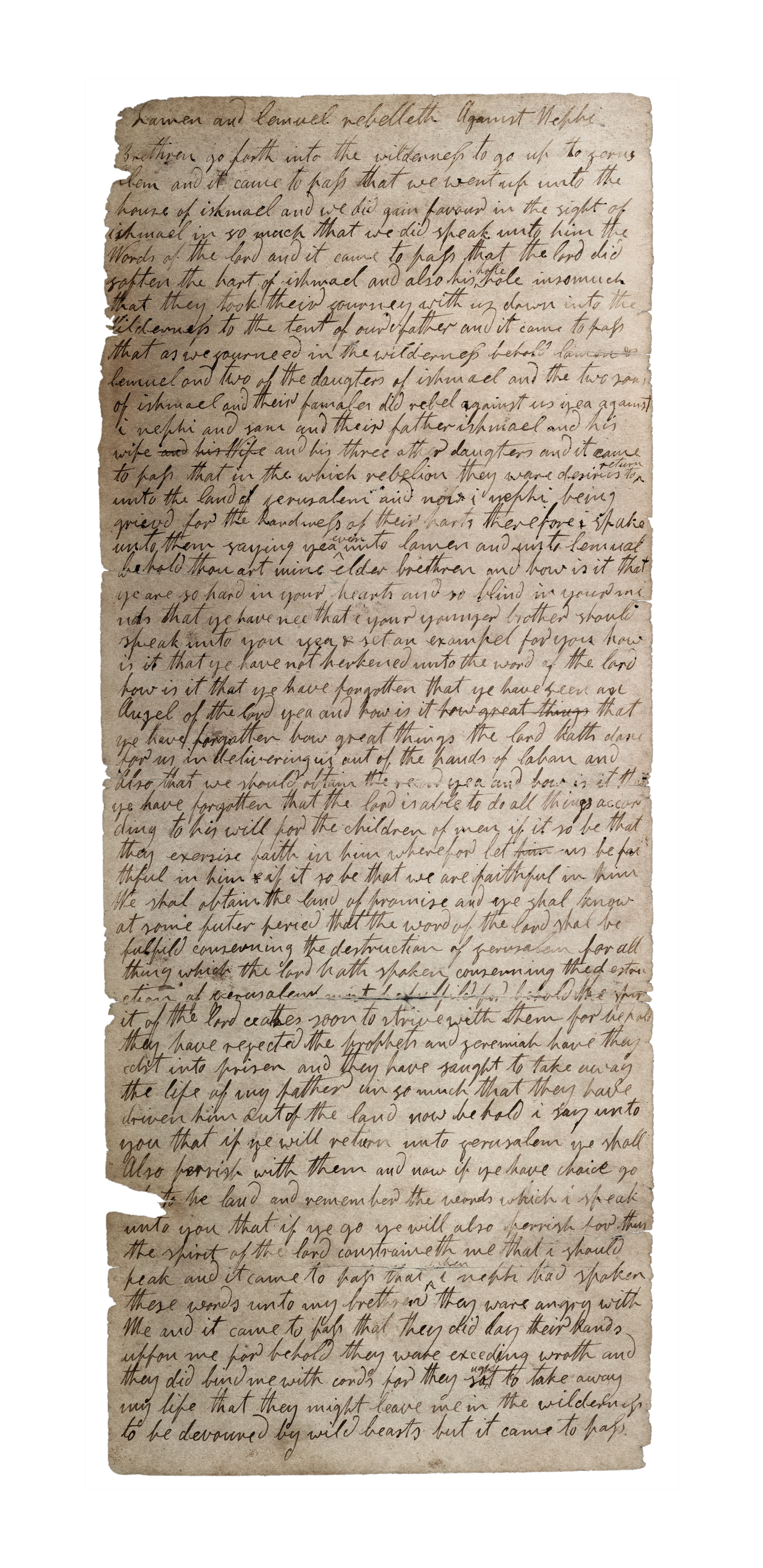
The Book of Mormon runs 269,510 words. Joseph dictated it in about sixty working days in 1829, with nothing on paper ahead of time, and nobody writing in his day turned out a book that size at anything near that pace.[9]
He dictated it in the open. His wife Emma served as one of his scribes and sat across the table from him. Years later, after she had separated from the Church and had nothing to gain, she said it flatly: "He had neither manuscript nor book to read from… If he had had anything of the kind he could not have concealed it from me."[10] There was no hidden book in the room, and the people who watched for hours said so.
And the text itself carries marks of the ancient world that Joseph could not have planted. It contains chiasmus, an elaborate mirror-image poetic structure of ancient Hebrew writing that scholars did not even notice in the Book of Mormon until 1967. It carries Hebrew grammar patterns under its English. It uses ancient names later dug out of the ground: Nahom, a real burial site in Arabia confirmed by inscribed altars found in Yemen in the 1990s, sitting exactly where the book says, at the one spot where its opening journey turns east. These are not in his Bible, and they were not available to a farmer in 1829 New York.
All of which flips the bundle's ranking on its head. We genuinely do not have the gold plates, which Joseph said he gave back to the angel, and that is the grain of truth in "we don't have the original." But we do have the manuscripts Joseph's scribes wrote as he dictated, publicly available and studied for decades. We have eleven men who signed published statements that they saw or handled the plates, and not one ever took it back. And we have a text that keeps turning up ancient features no one could fake in 1829.
The CES Letter also mocks the method itself, "a rock in a hat," and the stone's origin in Joseph's early treasure-hunting. The full answer lives in the Seer Stones article, but the look of the method has no bearing on what came out of it. The real question is how a 23-year-old farmer dictated 269,510 words of consistent scripture in sixty working days, and no naturalistic answer the bundle ever names explains that.
The Abraham papyri, not Kinderhook
The Book of Abraham holds the hardest piece. The surviving papyri were recovered in the 1960s, and Latter-day Saint and other Egyptologists agree the fragments are Egyptian funeral texts, not the words of Abraham. Then came 2018. Brian Hauglid, the most qualified Latter-day Saint expert on the original Book of Abraham manuscripts, publicly stated that he had changed his mind and now agreed with the leading critical scholar's fully naturalistic reading of those documents, a reading with no revelation in it anywhere.[11] That is a real concession. The full engagement is in the Papyri article.
But the concession reaches less far than the bundle needs. It is about the Book of Abraham and nothing but the Book of Abraham. One scholar's judgment about Egyptian funeral fragments says nothing about the Book of Mormon or its eleven witnesses. And the Book of Abraham can be a hard case and still hold content, like Olishem and the Apocalypse of Abraham parallels, that resists a naturalistic answer. "Hard" is not "settled."
One piece of the Kinderhook record counts against Joseph. In May 1843, Charlotte Haven, a non-Mormon visitor, wrote in a letter what a Mr. Moore told her Joseph had said about the plates: if Moore could leave them, "he thought that by the help of revelation he would be able to translate them."[12] His prophetic gift did not flash a warning the instant he saw the forgery. A gift for revelation is not a gift for spotting fakes, and Joseph never claimed the second one. But thinking he could translate something is a long way from actually doing it, and he never did. He looked, he tried ordinary tools, and he walked away with nothing.
The witnesses to the Book of Mormon are not airtight either. The Three Witnesses described seeing the plates through an angelic vision; David Whitmer himself said, "[W]e were in the spirit when we had the view... but we were in the body also."[13] A skeptic can push on the visionary part. What he cannot easily push on is the rest: eleven men in total, several of whom said they hefted the physical plates in plain daylight, none of whom ever recanted across fifty years and bitter breaks with the Church. The full treatment is in the Witnesses section.
The car you can inspect most
For the pitch to work, you have to accept the seller's own ranking, that the Book of Mormon is the one purchase you can never inspect. But that is the one you can inspect most closely of all. You can read the manuscripts. You can read the eleven signed testimonies still printed in the front of every copy. You can open the book and find chiasmus, Hebrew grammar, and Nahom sitting where archaeology later confirmed it. Three records are on the table. Which one can you actually open and check?
The Book of Mormon is the anchor when these questions get hard. A 23-year-old with little schooling dictated roughly 270,000 words in about sixty working days, no outline, no notes, no going back to fix earlier pages, and no one among the dozen people who watched ever called it a trick. No natural explanation of the book has lasted, and the discoveries since 1829 have favored it. One difficult scholarly judgment about some Egyptian fragments is a maybe about a different book.
So take the dealer's own question. Would you buy a third car from a man who sold you two clunkers? The question is rigged. One "clunker" was never sold, because Joseph puzzled over the forged plates briefly and walked off without translating them. The other turns out to hold parts its builder had no tools to make, names and texts buried in the ancient world and dug up long after he died. And the third car is still the one piece of evidence the pitch was designed to talk you out of examining.
Judge the dealer's reputation however you like. The car is parked right there. Open the hood.
Want the full case, including the strongest arguments the critics make and every source? Read the in-depth version.
Runnells, CES Letter (2017), "Kinderhook Plates & Translator Claims," pp. 72–73. ↩︎
Runnells, CES Letter (2017), "Kinderhook Plates & Translator Claims," p. 73. ↩︎
"Joseph Smith as Revelator and Translator," Revelations and Translations Series Introduction, Joseph Smith Papers Project. https://www.josephsmithpapers.org/intro/revelations-and-translations-series-introduction. The introduction's framing — that "translation" in Joseph's usage refers to revelatory rather than conventional linguistic work — is the official documentary baseline for understanding Joseph's translation projects. ↩︎
"Joseph Smith Translation of the Bible," The Church of Jesus Christ of Latter-day Saints. https://www.churchofjesuschrist.org/study/history/topics/joseph-smith-translation-of-the-bible. Direct Church description: Joseph "did not employ Hebrew and Greek sources, lexicons, or a knowledge of biblical languages to render a new English text… he used a copy of the King James Bible as the starting point for his translation, dictating inspired changes and additions to scribes." ↩︎
Don Bradley and Mark Ashurst-McGee, "'President Joseph Has Translated a Portion': Joseph Smith and the Mistranslation of the Kinderhook Plates," in Producing Ancient Scripture: Joseph Smith's Translation Projects in the Development of Mormon Christianity, ed. Michael Hubbard MacKay, Mark Ashurst-McGee, and Brian M. Hauglid (University of Utah Press, 2020), chapter 17, pp. 452–523. Direct quotations are taken from the authors' shorter 2016 treatment, "Joseph Smith and the Kinderhook Plates," in A Reason for Faith: Navigating LDS Doctrine and Church History, ed. Laura Harris Hales (Provo, UT: BYU Religious Studies Center; Salt Lake City: Deseret Book, 2016), 93–115, at 110, available in PDF at https://rsc.byu.edu/sites/default/files/pub_content/pdf/Joseph_Smith_and_the_Kinderhook_Plates.pdf. ↩︎
"Translation and Historicity of the Book of Abraham," Gospel Topics Essays, The Church of Jesus Christ of Latter-day Saints. https://www.churchofjesuschrist.org/study/manual/gospel-topics-essays/translation-and-historicity-of-the-book-of-abraham. The Church's official engagement with the BoA difficulty, including the catalyst theory, missing-scroll theory, eyewitness testimony of larger papyri than survives, and the concession that the surviving fragments do not match the BoA text. ↩︎
For Olishem/Ulisum, see John Gee, "Has Olishem Been Discovered?" Journal of the Book of Mormon and Other Restoration Scripture 22:2 (2013): 104–107; Stephen O. Smoot, "'In the Land of the Chaldeans': The Search for Abraham's Homeland Revisited," BYU Studies Quarterly 56:3 (2017): 7–37. The Ulisum attestations occur in Naram-Sin Akkadian campaign inscriptions documented in the published Assyriological literature beginning with C. J. Gadd and Leon Legrain, eds., Ur Excavations, Texts I: Royal Inscriptions (Oxford: Oxford University Press, 1928), with additional attestations continuing to surface in subsequent excavations. The Bassetki statue (a famous Naram-Sin artifact whose inscription commemorates the nine-battle victory and Akkadian deification rather than naming Ulisum) was excavated from northern Iraq in 1974 and published in 1976; it does not bear the Ulisum reference but is referenced here as a marker of the continuing recency of the Naram-Sin corpus. Oylum Höyük field identification with ancient Ulisum in 2013 (Atilla Engin). ↩︎
First English translation by E. H. Anderson and R. T. Haag, "The Book of the Revelation of Abraham," Improvement Era (August 1898) — Latter-day Saint magazine. G. H. Box's better-known English translation, with J. I. Landsman, appeared circa 1918 (London: Society for Promoting Christian Knowledge). The original survives only in Old Slavonic recensions, transmitted partly within the Tolkovaja Paleja. No English text was available to Joseph Smith. ↩︎
John W. Welch, "Timing the Translation of the Book of Mormon: 'Days [and Hours] Never to Be Forgotten,'" BYU Studies Quarterly 57, no. 4 (2018): 10–50. https://byustudies.byu.edu/article/timing-the-translation-of-the-book-of-mormon-days-and-hours-never-to-be-forgotten/. The standard scholarly reconstruction of the Book of Mormon translation timeline. 269,510-word total, ~60 working days, 10–20 wpm rate. ↩︎
Emma Smith, interview by Joseph Smith III, February 1879, published in Saints' Herald 26 (October 1, 1879): 289–290. The "neither manuscript nor book to read from" testimony is the most-cited primary source on Joseph's translation method. ↩︎
Brian Hauglid, public Facebook statement, November 9, 2018, quoted and discussed in Jeff Lindsay, "A Precious Resource with Some Gaps," Interpreter: A Journal of Latter-day Saint Faith and Scholarship 33 (2019): 13–104. https://interpreterfoundation.org/journal/a-precious-resource-with-some-gaps/. Hauglid's statement consists of multiple consecutive sentences in a single Facebook post: "For the record, I no longer hold the views that have been quoted from my 2010 book in these videos. I have moved on from my days as an 'outrageous' apologist. In fact, I'm no longer interested or involved in apologetics in any way. I wholeheartedly agree with Dan's excellent assessment of the Abraham/Egyptian documents in these videos." The article's blockquote uses four-dot ellipsis to indicate the sentence boundary between the first sentence and the fourth sentence; the bracketed [Vogel] in the second blockquoted sentence identifies "Dan" as the documentary scholar Dan Vogel. ↩︎
Charlotte Haven, letter of May 2, 1843, in "A Girl's Letters from Nauvoo," Overland Monthly (December 1890). Haven, a non-Mormon visitor to Nauvoo, wrote the day after Clayton's third-person Kinderhook journal entry. Joseph's reported statement, as the letter carries it: "and if Mr. Moore could leave them, he thought that by the help of revelation he would be able to translate them." The report is thirdhand (Joseph to Moore to Haven); Bradley and Ashurst-McGee judge the picture it gives plausible rather than certain, and identify the carrier as most likely George Moore, a Unitarian minister from Quincy (Haven wrote "Joshua Moore"). The full passage and its conditional grammatical structure are documented in the Kinderhook Plates sister article. ↩︎
David Whitmer to Anthony Metcalf, April 2, 1887, in Anthony Metcalf, Ten Years Before the Mast (Malad City, ID: 1888), 73–74; also in Lyndon W. Cook, ed., David Whitmer Interviews: A Restoration Witness (Orem, UT: Grandin Book, 1991), 246–247. "Of course we were in the spirit when we had the view, for no man can behold the face of an angel, except in a spiritual view, but we were in the body also, and everything was as natural to us, as it is at any time." The full discussion of the Three Witnesses' experience lives in the Witnesses section's Credibility Concerns article. ↩︎