Seer Stones
The claim:
"Unlike the story I've been taught in Sunday School, Priesthood, General Conferences, Seminary, EFY, Ensigns, Church history tour, Missionary Training Center, and BYU... Joseph Smith used a rock in a hat for translating the Book of Mormon."[1]
"In other words, Joseph used the same magic device or 'Ouija Board' that he used during his treasure hunting days."[2]
"...while the gold plates were covered, placed in another room, or even buried in the woods. The gold plates were not used for the Book of Mormon we have today."[3]
"How could it have been expected of me and any other member to know about and to embrace the rock in the hat translation when even these two faithful full-time professors of religion at BYU rejected it as a fictitious lie meant to undermine Joseph Smith and the truth claims of the Restoration?"[4]
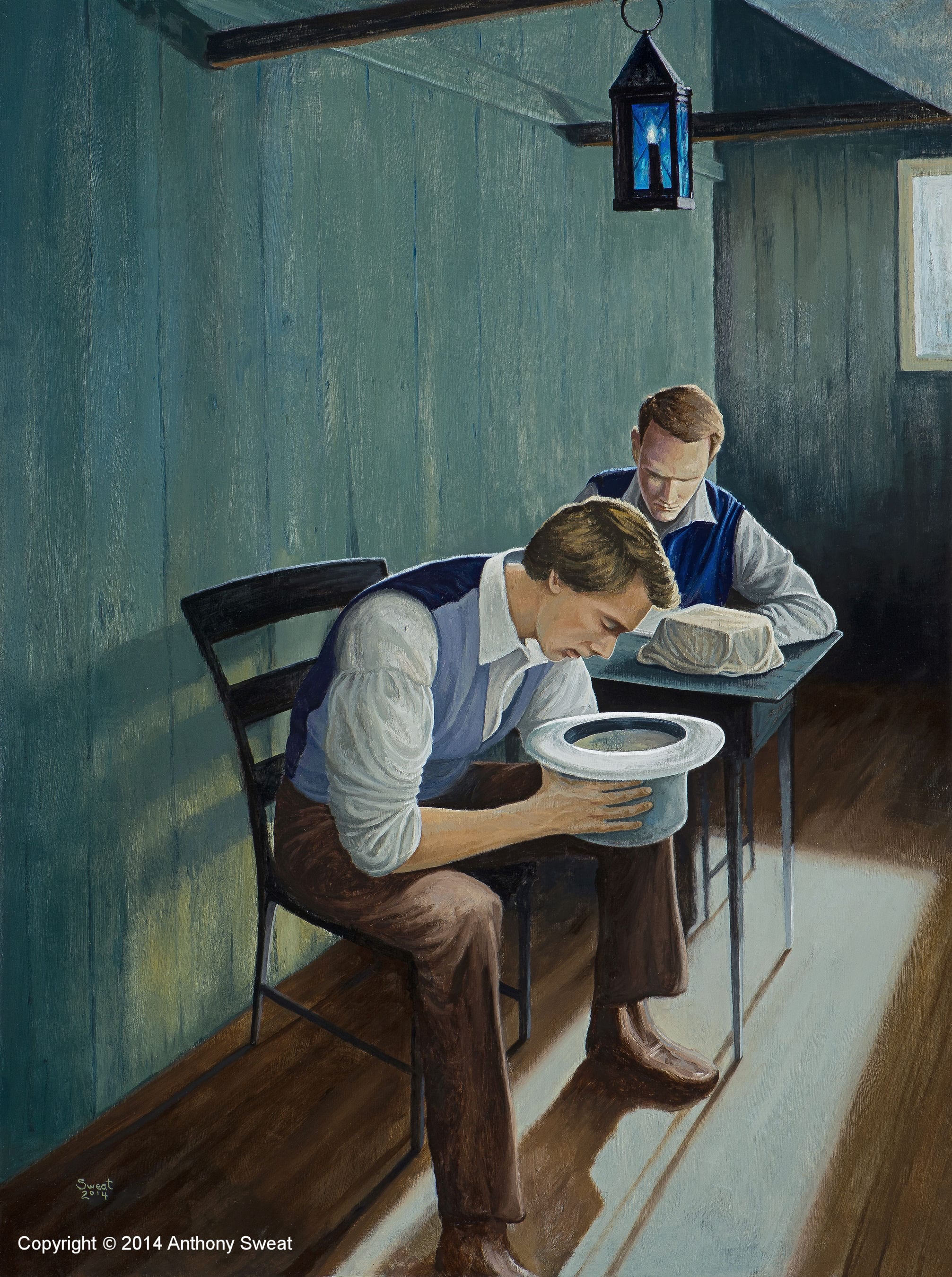
In early America, many ordinary families believed certain small, smooth stones let a gifted person see things hidden from normal view. People called them seer stones. Joseph Smith translated some portion of the Book of Mormon by putting one into his hat and reading words off it with his face buried in the brim, while the gold plates often sat off to the side. The CES Letter builds four claims on that history:
- The Church kept the stone-in-hat story from its members until a 2013 essay finally admitted it.
- The stone was the same "magic" rock Joseph had used to hunt buried treasure, no better than a Ouija board.
- The gold plates went unused during the dictation (covered, set in another room, at times buried in the woods), so whatever Joseph was dictating did not come from them.
- Even two of BYU's own religion professors dismissed the stone-in-hat account as fiction invented to make Joseph look bad.
Together the claims describe a Church caught hiding the strange truth about its own founding book. A real prophet, the argument goes, would not have worked this way, and a true Church would not have kept it quiet.
Parts of that story are true.
But two facts undo the picture: the method was never hidden, and the method itself is the single hardest thing about the Book of Mormon for a critic to explain.
It was never hidden, because the Church kept printing it. The stone-in-hat method ran in the Church's own Ensign magazine in 1977, and a future Church President repeated it there in 1993, two decades ahead of the essay the CES Letter treats as a forced confession.
And it is hard to explain because of how the dictation actually worked:
- Face in the hat, no curtain, an open room: the method left Joseph no way to read from the hidden text every fraud theory depends on.
- The eyewitnesses with the least reason to protect him (his wife, a man who spent fifty years publicly criticizing the Church, a brother-in-law who never joined) told the same story to the end of their lives.
- The dictation itself ran at roughly triple a working novelist's sustained pace, and the manuscript shows no sign of planning or revision.
What the CES Letter gets right
It gets three things right: the artwork, the lesson manuals, and the two BYU professors.
First, the artwork misled people. For most of the twentieth century, the paintings of the translation that hung in chapels, visitors' centers, and on Ensign covers showed Joseph studying the plates directly, often with his finger tracing the engravings. That is not how it happened, and members who built their mental picture from those paintings ended up with the wrong one.
Second, the lesson manuals under-emphasized the stone. Even while the Church was publishing the real method in other places, the curriculum most members actually sat through week to week kept showing the tidier plates-on-the-table version.
Third, the BYU-professors line is not invented. In 2000, two religion professors, Joseph Fielding McConkie and Craig Ostler, published a book through the Church's own Deseret Book that dismissed the stone-in-hat account as "fiction created for the purpose of demeaning Joseph Smith."[5] They were wrong, as the rest of this article shows, but the CES Letter did not make them up.
So the grievance underneath the section is legitimate. Latter-day Saints who first met the stone-in-hat method through a critic, rather than through their own Church, have a fair reason to feel that something went sideways in how this was taught. The bigger charge stacked on top of it is that the Church discovered the method, hid it, and only confessed in 2013. That part does not hold up.
It was never actually hidden
The CES Letter's central story is that the seer stone was a secret until the Church was forced to "admit" it in a 2013 essay. The publication record does not allow that.
The method was printed in the Church's own flagship magazine, the Ensign, in September 1977, where a BYU professor quoted an eyewitness describing how "Joseph Smith would put the seer stone into a hat and put his face in the hat, drawing it closely around his face to exclude the light."[6]
Sixteen years later, in 1993, an Apostle of the Church, Russell M. Nelson, who would later become its president, quoted that same eyewitness description again in the same magazine, in an article adapted from a talk he gave at a 1992 seminar for new mission presidents.[7] That is twenty years before the essay the CES Letter calls the Church's first confession. An Apostle was teaching the stone-in-hat method, in print, to the men who train the Church's missionaries.
It kept appearing after that, too. The Church published the first official photograph of the brown seer stone in 2015, and its official narrative history, Saints, laid the method out in plain words in 2018: "He would put the seer stone in his hat, place his face into the hat to block out the light, and peer at the stone."[8] The 2013 essay sits in the middle of a run of Church publications that began in 1977, thirty-six years earlier, not at the start of one.
That fact also dissolves the McConkie and Ostler line. When those two professors called the account "fiction" in 2000, an Apostle had already taught it openly in the Ensign seven years earlier. Their book was a minority opinion that the Church's own publications already contradicted, not the voice of the Church. What actually happened is narrower than a single false story handed down from the top. The Church's apostles and historians were candid about this for decades, while parts of its lesson materials and its chapel art lagged behind. That gap was a real failure, and the Church has since closed it. (The fuller publication timeline and the McConkie-Ostler episode are laid out in the in-depth version.)
"A magic device or Ouija Board"
The CES Letter's most provocative charge is the comparison to a Ouija board. Set the seer stone next to an occult parlor game and a modern reader's instinct about "magic" objects does the rest. The charge leans on a quiet assumption: because Joseph had used the stone hunting for treasure before 1827, his later use of it in translation must be tainted by that past.
Joseph grew up in a folk-religion culture where ordinary, churchgoing families used divining rods to find water and believed certain stones could "see" hidden things. He found a chocolate-brown stone around 1822 and used it for several years in paid treasure-hunting expeditions, and in 1826 he was even brought before a New York court on a charge connected to that work.
The Ouija-board framing misses a pattern that runs straight through the Bible: God has always worked through the ordinary cultural tools his people already held.
- Moses's rod. When God called Moses, He asked, "What is that in thine hand?" The answer was a shepherd's staff, an everyday tool (Exodus 4:2). That same ordinary rod became the instrument that parted the Red Sea and brought water from a rock. God did not hand Moses a new holy object. He took the stick already in his hand.
- The high priest's stones. Ancient Israel inquired of God using the Urim and Thummim, sacred stones set in the high priest's breastplate (Exodus 28:30). Outside the covenant, consulting objects for answers would have been called divination. Inside it, the same kind of practice was sanctioned and holy.
- Casting lots. To choose Saul as king, and even to choose the apostle who replaced Judas, God's people cast lots (1 Samuel 10; Acts 1), a practice that looks like fortune-telling on its face but was a recognized way of asking God to decide.
The pattern is steady: God meets people inside the culture they already live in and puts its familiar forms to sacred use. The historian Richard Bushman, who has studied this more closely than almost anyone, put the balance exactly right: "Biblical Christianity was the overwhelming influence in the Book of Mormon and the Doctrine and Covenants. Folk magic was in the mix but was not the basic ingredient."[9]
So a farm boy in 1820s New York using a seer stone was unremarkable for his time and place. The treasure years turned up no buried gold at all. Then the same stone produced a 270,000-word book of scripture. (The tainted-origins argument, the 1826 court record, and the full biblical pattern are treated in the in-depth version.)
The method rules out the fraud theories
Every detail the CES Letter treats as humiliating (the hat, the open room, the stone) is exactly what makes a forged or invented Book of Mormon nearly impossible to explain.
Emma Smith was one of Joseph's first scribes and watched the dictation from feet away. She spent the last three and a half decades of her life outside the Utah church, with nothing to gain by defending it, and three months before she died she told her son: "He had neither manuscript nor book to read from. If he had had anything of the kind he could not have concealed it from me."[10] She also remembered the day Joseph stopped suddenly, "pale as a sheet," and asked her whether Jerusalem had walls around it.[11] A man writing his own scripture does not interrupt himself to ask his wife about the geography of the holy city.
With his face buried in the hat and no curtain between him and the scribe, there was nowhere to hide a manuscript, a book, or any notes. Every theory critics have built to explain the Book of Mormon as a fraud requires Joseph to have been secretly reading from something: a stolen manuscript, another book, pre-written pages. The documented method rules all of them out at once. There was no hidden text in the room, and a dozen people who watched for hours over weeks said so.
One scribe even tested it. Early on, Martin Harris quietly swapped Joseph's stone for a similar-looking rock, to see whether Joseph was just reciting lines he had memorized. When the work resumed, Joseph "paused for a long time and then exclaimed, 'Martin, what is the matter, all is as dark as Egypt.'"[12] The text would not come from the wrong stone. Whatever was happening, Joseph was not reading from his own memory.
A made-up book dictated openly in front of a dozen people, across two households and sixty working days, should have produced at least one person who later said, "I was there, I saw the trick." Big frauds leak, and the bigger they are, the more likely someone talks. This one never leaked. Three of the closest witnesses ended up with no stake in protecting Joseph's church, and not one of them ever took back what they said about the translation:
- Emma raised her children in a rival church and never reconciled with Brigham Young, yet to the end she called the Book of Mormon "of divine authenticity."[10:1]
- David Whitmer left in 1838, never came back, and spent fifty years as a public critic. In an 1887 book that faults Joseph Smith by name on point after point, his detailed description of the stone-in-hat method stands unchallenged.[13]
- Michael Morse, Joseph's brother-in-law, watched the process and described it accurately in 1879. He never joined the Church at all and had no reason to prop up its story.[14]
A hostile witness, a man who left for good, and an outright non-believer all describe the same method. Across sixty years of interviews and published accounts, where is the one who came away calling it a trick?
Finally, the sheer speed. Joseph dictated roughly 270,000 words in about sixty working days, around 4,500 words a day, with no outline, no drafts, and no going back to revise what he had already said.[15] A strong professional novelist, working with notes and the freedom to rewrite, manages maybe a third of that pace. Joseph kept it up while resuming where he had left off after meals, and the manuscript shows no rewriting of earlier sections to match later ones. (The dictation rate, the witness record in full, and the manuscript evidence are laid out in the in-depth version.)
Then why the plates at all?
The third claim in the CES Letter is that the plates were barely used. And if the words appeared on the stone for Joseph to read, then what, exactly, were the gold plates for during the dictation?
It is a fair question. The person who has pressed it hardest is not a critic but the faithful historian Richard Bushman, who has wrestled with it in his own scholarship.[16] The mechanics, taken at face value, do not obviously require the plates to be open on the table while Joseph read from the stone.
There are serious answers. The plates appear to have been used more directly in the earliest stretch of translation. They were the physical object that eleven formal witnesses saw, and that eight of them handled. That testimony would have no anchor if the plates were not real. And the witnesses describe the stone displaying a text that stayed until it was written correctly, then vanished, which sounds like words being received from a source rather than spun out of Joseph's own head. On that reading the plates are the ancient record being transmitted, not a prop. Still, no scholar claims this question is fully tied up. It is a real tension inside the faithful account. (The several proposed answers are weighed in the in-depth version.)
The embarrassment counts in Joseph's favor
The CES Letter's whole case here runs on dignity. A rock in a hat is undignified. Treasure-digging is disreputable. A "magic device" is beneath a real prophet. The argument needs you to feel embarrassed.
A con man with a 270,000-word manuscript to read from hides the manuscript. He does not bury his face in a hat in front of his wife, his scribes, his neighbors, and a non-believing brother-in-law, then dictate for hours with nothing between them. The less respectable the method looks, the less it looks like a literary scheme and the more it looks like exactly what the witnesses said it was.
Which is why it all comes back to the book itself. Whatever you make of the hat, the stone, and the old artwork, the thing they produced is still sitting there: a 270,000-word book with its own consistent history and geography, dictated through April, May, and June of 1829, roughly sixty working days. There is no credible natural explanation for how it exists. Emma was asked, near the end of her life, whether her husband could have hidden a book or papers from her. He could not have, she said, if he tried. The method the CES Letter offers as the scandal is the very thing that makes a hidden source impossible.
Want the full case, including the strongest arguments the critics make and every source? Read the in-depth version.
Runnells, CES Letter (2017), "Book of Mormon Translation," p. 29. ↩︎
Runnells, CES Letter (2017), "Book of Mormon Translation," p. 29. The complete sentence: "In other words, Joseph used the same magic device or 'Ouija Board' that he used during his treasure hunting days." ↩︎
Runnells, CES Letter (2017), "Book of Mormon Translation," p. 29. ↩︎
Runnells, CES Letter (2017), "Book of Mormon Translation," p. 31. ↩︎
Joseph Fielding McConkie and Craig J. Ostler, "The Process of Translating the Book of Mormon," chapter in Revelations of the Restoration: A Commentary on the Doctrine and Covenants and Other Modern Revelations (Salt Lake City: Deseret Book, 2000), pp. 89–98. Verified quotes: "Such an explanation is, in our judgment, simply fiction created for the purpose of demeaning Joseph Smith and to undermine the validity of the revelations he received after translating the Book of Mormon"; "Finally, the testimony of David Whitmer simply does not accord with the divine pattern"; "If Joseph Smith translated everything that is now in the Book of Mormon without using the gold plates, we are left to wonder why the plates were necessary in the first place." Verified original publication form via the Joseph Smith Foundation's hosted PDF. ↩︎
Richard Lloyd Anderson, "By the Gift and Power of God," Ensign (September 1977): 79. Author identified as "professor of history and ancient scripture at Brigham Young University." The article reproduces David Whitmer's seer-stone-in-hat description verbatim and discusses both the Nephite interpreters and the seer stone. https://www.churchofjesuschrist.org/study/ensign/1977/09/by-the-gift-and-power-of-god ↩︎
Russell M. Nelson, "A Treasured Testament," Ensign (July 1993). Byline: "By Elder Russell M. Nelson of the Quorum of the Twelve Apostles." Provenance: "Adapted from an address given 25 June 1992 at a seminar for new mission presidents, Missionary Training Center, Provo, Utah." Nelson quoted David Whitmer's full seer-stone-in-hat description verbatim. https://www.churchofjesuschrist.org/study/ensign/1993/07/a-treasured-testament ↩︎
Saints, Volume 1: The Standard of Truth, 1815–1846 (Salt Lake City: The Church of Jesus Christ of Latter-day Saints, 2018), Chapter 6, "The Gift and Power of God." Direct quote: "He would put the seer stone in his hat, place his face into the hat to block out the light, and peer at the stone." https://www.churchofjesuschrist.org/study/history/saints-v1/06-the-gift-and-power-of-god?lang=eng ↩︎
Richard Lyman Bushman, "Joseph Smith and Money Digging," in A Reason for Faith: Navigating LDS Doctrine and Church History, ed. Laura Harris Hales (Provo: BYU Religious Studies Center; Salt Lake City: Deseret Book, 2016), 1–6, at 4. Quotation verified via Scripture Central KnoWhy, "Did a Magic World View Influence the Coming Forth of the Book of Mormon?" https://scripturecentral.org/knowhy/did-a-magic-world-view-influence-the-coming-forth-of-the-book-of-mormon ↩︎
Emma Smith Bidamon, interview by Joseph Smith III, February 1879. Published as "Last Testimony of Sister Emma," The Saints' Herald 26, no. 19 (October 1, 1879): 289–290. Reprinted in Dan Vogel, ed., Early Mormon Documents, 5 vols. (Salt Lake City: Signature Books, 1996–2003), 1:539–543. ↩︎ ↩︎
Emma Smith, interviewed by Edmund C. Briggs at Nauvoo in 1856; recounted in Edmund C. Briggs, "A Visit to Nauvoo in 1856," Journal of History 9, no. 4 (October 1916): 454; reprinted in John W. Welch and Erick B. Carlson, eds., Opening the Heavens: Accounts of Divine Manifestations, 1820–1844 (Provo, UT: BYU Press; Salt Lake City: Deseret Book, 2005), 129. Briggs records Emma recalling that Joseph "stopped suddenly, pale as a sheet," asked "Emma, did Jerusalem have walls around it?" and, told yes, replied, "Oh! I was afraid I had been deceived." Briggs published the recollection sixty years after the conversation. ↩︎
Martin Harris statements compiled in Andrew Jenson, "Martin Harris," Historical Record 6 (1887); Edward Stevenson, Reminiscences of Joseph the Prophet (Salt Lake City, 1893); and Vogel, Early Mormon Documents, vol. 2. The substitute-stone test is recorded in Kenneth W. Godfrey, "A New Prophet and a New Scripture: The Coming Forth of the Book of Mormon," Ensign (January 1988). https://www.churchofjesuschrist.org/study/ensign/1988/01/a-new-prophet-and-a-new-scripture-the-coming-forth-of-the-book-of-mormon ↩︎
David Whitmer, An Address to All Believers in Christ (Richmond, MO: David Whitmer, 1887), 12. Whitmer left the Church in 1838 and never returned; he gave more than 60 interviews 1878–1888 and never recanted. ↩︎
Michael Morse, interview by William W. Blair, The Saints' Herald 26 (June 15, 1879): 190–191. Reproduced in Vogel, Early Mormon Documents. Morse, a non-believer brother-in-law of Joseph, never became a Latter-day Saint. ↩︎
John W. Welch, "Timing the Translation of the Book of Mormon: 'Days [and Hours] Never to Be Forgotten,'" in Opening the Heavens: Accounts of Divine Manifestations, 2nd ed. (Provo: BYU Studies, 2017), pp. 79–125; also published in BYU Studies Quarterly 57, no. 4 (2018). https://byustudies.byu.edu/article/timing-the-translation-of-the-book-of-mormon-days-and-hours-never-to-be-forgotten. Establishes 269,510 words in approximately 60 working days within an 85-calendar-day translation period (April 7 – June 30, 1829), with daily output of approximately 4,500 words and dictation rate of 10–20 words per minute. Welch and his wife Jeannie conducted experimental replication finding 20 wpm "quite possible." Direct Welch quote: Joseph articulated coherent text "with no time for research, for collocating scattered scriptural phrases, for keeping track of numerous threads, for developing an array of characters and their stylistic voices, or for composing coherent accounts." Welch describes the pace using terms including "stunning," "rapid-fire," and "phenomenal," and quotes Richard Turley's characterization: "stunning: about eight pages a day — remarkable even for skilled translators." The word "blistering" appears in the Scripture Central Evidence "Rapid Translation" summary characterization of Welch's broader work (see [17]). ↩︎
Richard Lyman Bushman, Joseph Smith's Gold Plates: A Cultural History (New York: Oxford University Press, 2023). ISBN 978-0197676523. The most recent authoritative scholarly treatment. Verified table of contents includes "Translator: Joseph Smith, 1823–1829" (ch. 2), "Art: 1833–2023" (ch. 7), and "Instruction: 1893–2023" (ch. 8). Bushman's translation-method discussion appears in chapter 2; the artwork-history chapter is directly relevant to the CES Letter's collage critique. https://global.oup.com/academic/product/joseph-smiths-gold-plates-9780197676523 ↩︎
Scripture Central Evidence, "Rapid Translation." https://scripturecentral.org/evidence/book-of-mormon-evidence-rapid-translation. Direct quote: "by 'any standard' the pace was 'blistering.'" Givens describes the speed as "truly prodigious." ↩︎