Mark Hofmann
The claim:
"In the early to mid-1980s, the Church paid hundreds of thousands of dollars in expensive and valuable antiquities and cash to Mark Hofmann — a con man and soon-to-be serial killer — to purchase and suppress bizarre and embarrassing documents into the Church vaults that undermined and threatened the Church's story of its origins. The documents were later proven to be forgeries."[1]
"The lack of discernment by the Brethren on such a grave threat to the Church is troubling."[1:1]
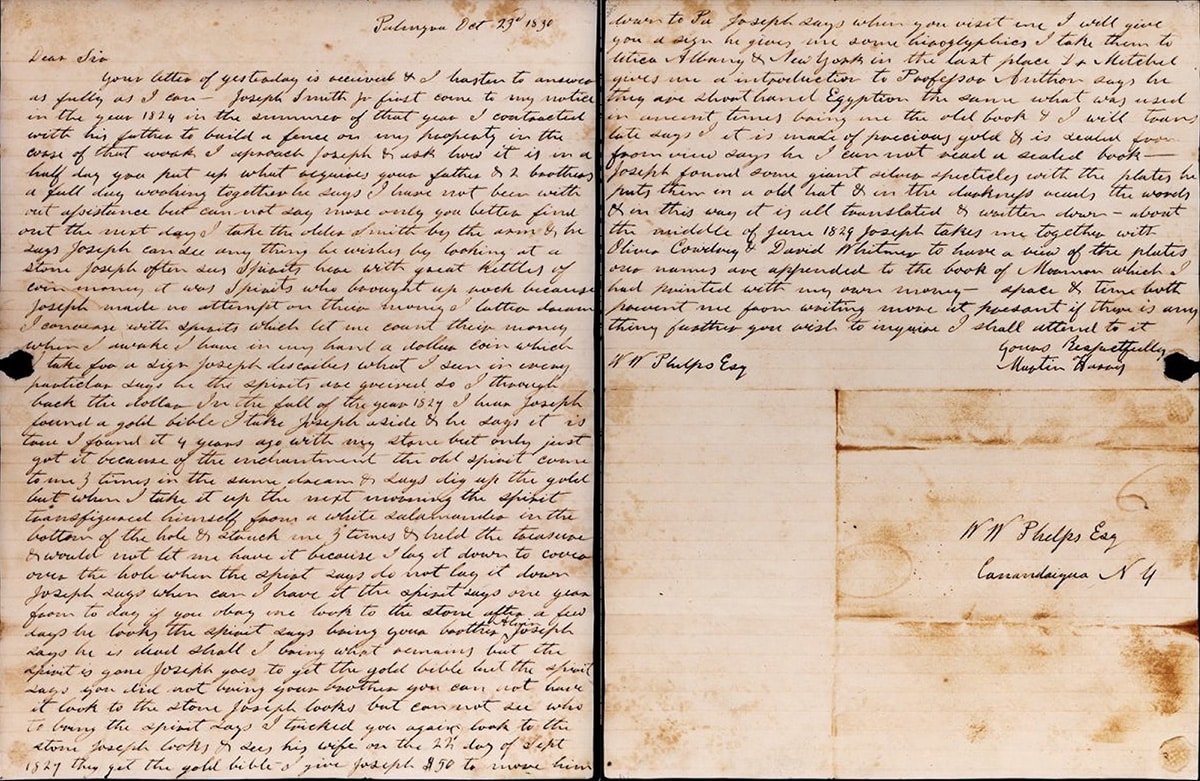
In the early 1980s, a Salt Lake City rare-documents dealer named Mark Hofmann forged historical documents, several of them about Latter-day Saint origins, and sold them. His most famous fake, the Salamander Letter, claimed to be an 1830 letter from Martin Harris, a Book of Mormon witness, describing the recovery of the golden plates in folk-magic terms, with a white salamander instead of the angel. Church leaders bought some of his documents and did not realize they were fakes. If prophets could not sense that a forger was lying to them about Joseph Smith, the CES Letter asks, what is prophetic authority actually worth?
Senior leaders of the Church were deceived. They held forged documents in their hands and did not know. But two of the surrounding accusations are simply wrong on the record. The central question starts from an idea about prophets that the Church has never put its name to. What discernment was promised to be, and who else Hofmann fooled, make the affair look very different from a referendum on whether God leads the Church.
To keep his fraud from collapsing, Hofmann built two pipe bombs and killed two people on the morning of October 15, 1985: Steven F. Christensen, a 31-year-old husband, father, and serving bishop who had helped authenticate one of the forgeries, and Kathy Sheets, a woman who had nothing to do with any of it and was killed only to throw investigators off the trail.[2] [3] A third bomb went off early in Hofmann's own car the next day, maiming him and starting the investigation that finally unraveled everything. He pleaded guilty to two counts of second-degree murder in January 1987 and is serving a life sentence.[4]
The Church's own essay on the affair calls those two deaths its greatest tragedies.[5] Any account that leads with the Brethren, the Church's senior leaders, instead of with the two coffins has its priorities backward from the start.
The man who fooled everyone
The Brethren were not singled out. The CES Letter leaves that part out. Hofmann fooled essentially the entire American establishment whose whole job was to catch people exactly like him.
He was not a clever signature-faker. He sourced real period paper from the blank pages of old books, mixed his own iron-gall ink from a recipe he reconstructed, and invented a chemical treatment that artificially aged it. He studied dead men's handwriting until experts who knew the genuine articles could not spot his fakes.[3:1] [6] The professional body of forensic document examiners, the people who do this for a living, later voted him the best forger caught in the past 1,200 years.[7]
The Federal Bureau of Investigation's document laboratory examined the Salamander Letter and called it genuine.[6:1] [7:1] The Library of Congress put his most ambitious forgery, the Oath of a Freeman, through a scientific study, found nothing wrong, and nearly paid $1.5 million for it; the American Antiquarian Society then held it for two months and reported "no anomalies."[8] [9] Kenneth Rendell, one of the world's foremost handwriting experts and the man who had cracked the forged Hitler Diaries the year before, examined the Salamander Letter and reported "no indication that the document is a forgery."[10] [11] Dozens of professional historians, Latter-day Saint and not, treated the forgeries as real history.[12]
Gordon B. Hinckley, the First Presidency counselor who oversaw the Church's acquisition of historical documents, said afterward: "I frankly admit that Hofmann tricked us. He also tricked experts from New York to Utah, however. We bought those documents only after the assurance that they were genuine."[13] He was right. The forgeries were not detectable by anything available in 1984. They were finally exposed by brand-new forensic chemistry that two examiners, George Throckmorton and William Flynn, had to invent after the murders forced an investigation.[6:2] [14]
That answers one question and only one. The FBI never claimed God told them the letter was real. The Brethren do claim a spiritual gift the FBI does not. So the harder question is still standing.
What "discernment" was actually promised to be
The deeper charge assumes prophets carry a kind of spiritual radar that should have gone off when an apostle sat across a desk from a man selling lies about Joseph Smith. The trouble is that the scriptures never promise that radar. They promise something narrower, and they say so directly.
The gift the Church calls "the discerning of spirits" comes from Doctrine and Covenants 46:23, and the name describes its job.[15] It is the ability to tell whether a spirit, a doctrine, or a message is from God, not the ability to read a stranger's hidden crimes. Moroni 7 develops the same idea: discernment sorts what is of God from what is of the devil.[16] Hofmann never walked in claiming a revelation. He came in as a credentialed dealer with an appointment about buying old paper. He was not making a spiritual claim for the gift to test.
And the scriptures go further than just leaving that gap open. They state it. In a revelation given directly to Joseph Smith, the Lord tells Joseph himself:
"But as you cannot always judge the righteous, or as you cannot always tell the wicked from the righteous, therefore I say unto you, hold your peace until I shall see fit to make all things known unto the world concerning the matter."[17]
That is God telling a prophet, in writing, that prophets cannot always see through people. The whole canon backs the same pattern. Joshua and the elders of Israel were fooled by the Gibeonites' faked supplies and false story, and the text notes pointedly that they "asked not counsel at the mouth of the Lord."[18] The apostles were suspicious of the newly converted Paul and needed a separate revelation to trust him.[19]
The episode that fits closest is inside the Restoration's own history. The Kinderhook Plates were a deliberate hoax: in 1843, local forgers etched an invented script into brass plates and planted them in a mound, where they were dug up as a genuine find. A visiting minister who took them at face value carried them to Joseph Smith. Joseph examined them and offered a partial translation. He did not catch the hoax. Chemical analysis in 1980 confirmed the plates were nineteenth-century fakes.[20] [21] The same kind of physical-document fraud fooled the same prophetic office. It does not make the Hofmann affair painless. It shows that the Latter-day Saint canon mapped the limits of prophetic discernment long before Hofmann was born, and that he falls squarely inside those limits rather than breaking them.
This is not a recent excuse, either. Joseph Smith taught that "a Prophet is not always a Prophet," only "when he is acting as such."[22] An 1831 revelation has the Lord say he gave his servants his words "in their weakness, after the manner of their language" (D&C 1:24). The doctrine that prophets are fallible men in ordinary matters has been on the record the entire time.
Two of the accusations are just wrong
The CES Letter also makes two flat factual claims, and the documentary record contradicts both.
The Church did not buy the Salamander Letter. Steven Christensen, a private collector, bought it from Hofmann in January 1984 for $40,000.[11:1] He spent more than a year having it forensically tested by leading experts, and only then donated it to the Church as a gift.[23] The claim that "the Church paid hundreds of thousands of dollars" to purchase this letter has the buyer wrong.
The Church did not suppress it. Sixteen days after receiving the letter, on April 28, 1985, the Church printed its full text in the Church News, the complete document, not a summary.[11:2] [24] [25] That was more than five months before the bombings and nearly two years before anyone proved it was a forgery, at a moment when the Church and almost everyone else still believed it was authentic. An institution hiding a damaging document does not publish the whole thing in its own newspaper. The "buy it to bury it" story cannot survive its own timeline.
There is more the in-depth version untangles, including the Hinckley "dishonesty" charge, which turns out to be imprecise memory in a chaotic situation rather than the deliberate deception alleged, and the McLellin Collection, a cache Hofmann invented to squeeze money out of creditors, which never existed as he described it.
What Elder Oaks said in 1985
The worst of it is a talk. In August 1985, four months after the Salamander Letter reached the Church and two months before the murders, Elder Dallin H. Oaks spoke about it at a symposium. His narrow point, that the word "salamander" in the 1820s could mean a fire-spirit rather than a lizard, was historically sound.[26] But he wrapped it in a frame that treated public skepticism of the letter as itself unsophisticated, asking "why all the excitement?" and telling members to be "more sophisticated" in what they believed about the coverage.[26:1]
The letter was a forgery. The "excitement" was warranted, and the people worrying were right. To his credit, Oaks published a long public accounting in 1987 that admitted the Brethren had been deceived along with everyone else.[23:1]
On the morning of the bombings, hours after killing two people, Hofmann kept a routine ten-minute appointment with Oaks about documents.[23:2] Did an apostle feel nothing in the presence of a man who had just committed murder? The intuition behind that question is that the spiritual world should have been louder in that room. But scripture never promised that texture of experience either. Joshua felt nothing unusual sitting with the Gibeonites. The apostles felt nothing that cleared Paul. The canon's promise is bounded, and the meeting fits inside those bounds, even though the feeling of it does not fully settle.
One of the skeptics the talk treated as unsophisticated was a critic of the Church, Sandra Tanner. In 1984, she had published a specific, testable objection to the Salamander Letter, pointing out that its content tracked Mormonism Unvailed, an anti-Mormon book from 1834, too closely to be coincidence.[27] [28] She turned out to be right; when Hofmann eventually confessed, he admitted he had used that book as his template.[29] No Latter-day Saint historian engaged her argument seriously at the time. That was not corruption, but it was a failure of attention.
The book he couldn't forge
The Hofmann affair was a homicide case that happened to expose a forgery ring, and the Latter-day Saint documents were only a slice of his output. He forged and sold signatures of George Washington, Abraham Lincoln, and Mark Twain; he even forged "a previously unknown poem in the hand of Emily Dickinson."[30] [3:2] The Brethren stood in the same position as the FBI and the Library of Congress: institutions handling material the tools of the day could not flag as fake.
Each Latter-day Saint document had been built to attack a specific origin claim: folk-magic beginnings for the Book of Mormon, an alternate line of succession, a hostile early apostle. When the chemistry revealed the ink, every one of those manufactured attacks vanished at once, and the real questions returned to exactly where they had always stood. No forgery overturned a single doctrine of the Church.
This article shares a frame with its neighbors in this section. Adam-God and Blood Atonement both turn on the rule that a prophet's personal mistake never automatically becomes the Church's binding doctrine, and the priesthood and temple ban shows that same framework absorbing an institutional error far larger than this one. Hofmann is the looser case of the four, because what discernment includes is more open to argument than what makes a doctrine official.
Hofmann was the most accomplished forger of his century, and he aimed his best work at the roots of the Restoration. He could fabricate a letter claiming to reframe how the Book of Mormon came forth. He never forged a line against the book itself, because there was nothing to forge. The text was already on the public record, in print since 1830, dictated in a single pass of about sixty working days and never substantively reworked, and vouched for by witnesses who held to their testimony for the rest of their lives. A man who deceived the FBI and the Library of Congress could not lay a finger on it.
Want the full case, including the strongest arguments the critics make and every source? Read the in-depth version.
Runnells, CES Letter (2017), "Prophets," pp. 66–68. The Hofmann subsection of the Prophets section. ↩︎ ↩︎
Richard E. Turley Jr., Victims: The LDS Church and the Mark Hofmann Case (Urbana: University of Illinois Press, 1992). The official scholarly account, written by then-Managing Director of the Family History Department with full Church Historian's Office cooperation. Comprehensive treatment of the bombings, the forgery operation, the investigation, and the Church's involvement, including Hinckley's pattern of meetings with Hofmann and the Joseph Smith III Blessing trade with the RLDS Church. Available: https://archive.org/details/victimsldschurch0000turl ↩︎
Linda Sillitoe and Allen Roberts, Salamander: The Story of the Mormon Forgery Murders (Salt Lake City: Signature Books, 1988; rev. 2006). The standard scholarly history of the affair, including a forensic appendix by George Throckmorton ("A Forensic Analysis of Twenty-One Hofmann Documents") documenting the chemistry that exposed Hofmann. ↩︎ ↩︎ ↩︎
"Mark Hofmann," Wikipedia, https://en.wikipedia.org/wiki/Mark_Hofmann. Documents Hofmann's biography (his Salt Lake City upbringing, his mission to Bristol, England, his private loss of faith, and his presentation as a faithful member), his forgery career, the Anthon Transcript trade, Charles Hamilton's "He fooled me — he fooled everybody" admission, Dean Jessee's authentication of the Anthon Transcript, and the January 1987 guilty plea. ↩︎
"Hofmann Forgeries," Church History Topics, The Church of Jesus Christ of Latter-day Saints, https://www.churchofjesuschrist.org/study/history/topics/hofmann-forgeries?lang=eng. The Church's own accounting of the affair. It leads its reckoning with the human cost — "The greatest tragedies connected to the Hofmann forgeries are the deaths of Kathy Sheets and Steven Christensen" — notes that Hofmann "deceived not only Church leaders and historians with his forgeries but also his family and friends, archivists and librarians, and other experts," and describes the provenance-verification and publication reforms Church archives adopted after the exposure. ↩︎
"How Two Document Examiners Solved the Case of the Salamander Letter," Western Forensic Document Examiner, https://www.westernforensicdocumentexaminer.com/document-examiners-solved-salamander-letter-case/. Accessible technical explanation of George Throckmorton and William Flynn's forensic methodology — the iron-gallotannate microcracking pattern, the sodium hydroxide protocol, and the gum arabic insight that produced the alligator-skin effect. ↩︎ ↩︎ ↩︎
"Tales of Hofmann: Forgeries, Deceit Continue to Intrigue 20 Years Later," Deseret News, October 15, 2005, https://www.deseret.com/2005/10/15/19917491/tales-of-hofmann-forgeries-deceit-continue-to-intrigue-20-years-later/. Source for the Southwestern Association of Forensic Document Examiners "best forger in 1,200 years" assessment, the institutional authentication list (Library of Congress, American Antiquarian Society, FBI, University of California, McCrone Research Institute), the "hundreds of forgeries and lies" career tally, and the circumstances of both deaths, including Kathy Sheets picking up the package left in front of her home. ↩︎ ↩︎
"Oath of a Freeman," Wikipedia, https://en.wikipedia.org/wiki/Oath_of_a_Freeman. The Library of Congress Conservation Office's scientific study found nothing inconsistent with mid-seventeenth-century attribution; the American Antiquarian Society had possession of the document for two months and reported "as far as we know, there are no anomalies." ↩︎
"Famous Forgery, The Oath of a Freeman, Heads to Auction in June," Fine Books & Collections, https://www.finebooksmagazine.com/news/famous-forgery-oath-freeman-heads-auction-june. Reports that the Library of Congress turned the Oath down in June 1985 "because of questions about its price, provenance and title" after its Conservation Office "revealed no evidence that would contravene a mid-seventeenth century date for the broadside," and that the American Antiquarian Society examined the document for two months in summer 1985, found "no anomalies," and offered $250,000 for it that September. ↩︎
Kenneth W. Rendell, Forging History: The Detection of Fake Letters and Documents (Norman: University of Oklahoma Press, 1994). Rendell — the same examiner who broke the Hitler Diaries case — authenticated the Salamander Letter; his subsequent published account documents the deception. ↩︎
"Salamander letter," Wikipedia, https://en.wikipedia.org/wiki/Salamander_letter. Documents the letter's purported content (a Martin Harris letter to W. W. Phelps dated 1830), Christensen's January 6, 1984 purchase from Hofmann for $40,000 with intent to authenticate and donate, the April 28, 1985 Church News publication of the letter's full contents, and Kenneth Rendell's examination conclusion that there was "no indication that the document is a forgery." ↩︎ ↩︎ ↩︎
Richard P. Howard, "Why Were Scholars Misled? What Can We Learn From This?" Dialogue: A Journal of Mormon Thought 21, no. 2 (Summer 1988): 148–153. https://www.dialoguejournal.com/articles/why-were-scholars-misled-what-can-we-learn-from-this/. Documents the broad scholarly deception including major Latter-day Saint and non-Latter-day Saint historians. ↩︎
Sheri L. Dew, Go Forward with Faith: The Biography of Gordon B. Hinckley (Salt Lake City: Deseret Book, 1996), p. 432. Source for Hinckley's "I frankly admit that Hofmann tricked us. He also tricked experts from New York to Utah, however." ↩︎
"Forger Caught by Rheology of Biopolymer Gum Arabic," Cambridge Polymer Group, https://www.campoly.com/blog/forger-caught-rheology-biopolymer-gum-arabic/. Peer-accessible polymer-chemistry explainer for how Hofmann's microcracking was detected. ↩︎
Doctrine and Covenants 46:23, https://www.churchofjesuschrist.org/study/scriptures/dc-testament/dc/46. "And to others the discerning of spirits." The canonical Latter-day Saint passage on discernment as a spiritual gift. ↩︎
Moroni 7:12-19, https://www.churchofjesuschrist.org/study/scriptures/bofm/moro/7. On discerning good from evil — the broader Latter-day Saint framing of discernment as the capacity to distinguish what is of God from what is not. ↩︎
Doctrine and Covenants 10:37, https://www.churchofjesuschrist.org/study/scriptures/dc-testament/dc/10. "But as you cannot always judge the righteous, or as you cannot always tell the wicked from the righteous, therefore I say unto you, hold your peace until I shall see fit to make all things known unto the world concerning the matter." Direct scriptural statement that even prophets cannot always tell the wicked from the righteous, given in revelation directly to Joseph Smith. ↩︎
Joshua 9, the deception of Joshua and the Israelites by the Gibeonites. Verse 14 specifies the Israelite leaders "asked not counsel at the mouth of the Lord" — a biblical pattern of prophet-deception by physical fraud (faked provisions, false claims about geography). ↩︎
Acts 9:10–17, the Apostles' initial suspicion of Saul of Tarsus despite his genuine conversion; recognition required specific revelation through Ananias. ↩︎
William Clayton, journal, May 1, 1843, recording Joseph Smith's initial examination and partial translation of the Kinderhook Plates ("Prest J. has translated a portion"), as quoted in James B. Allen, No Toil nor Labor Fear: The Story of William Clayton (Provo, UT: BYU Press, 2002), 393, and reproduced in Don Bradley and Mark Ashurst-McGee, "Joseph Smith and the Kinderhook Plates," in A Reason for Faith: Navigating LDS Doctrine and Church History, ed. Laura Harris Hales (Provo, UT: BYU Religious Studies Center; Salt Lake City: Deseret Book, 2016), 98, https://rsc.byu.edu/sites/default/files/pub_content/pdf/Joseph_Smith_and_the_Kinderhook_Plates.pdf. ↩︎
Stanley B. Kimball, "Kinderhook Plates Brought to Joseph Smith Appear to Be a Nineteenth-Century Hoax," Ensign (August 1981), https://www.churchofjesuschrist.org/study/ensign/1981/08/kinderhook-plates-brought-to-joseph-smith-appear-to-be-a-nineteenth-century-hoax. Documents the 1980 chemical analysis (D. Lynn Johnson, Northwestern University) confirming the Kinderhook Plates were nineteenth-century forgeries, corroborating Wilbur Fugate's confession. ↩︎
Joseph Smith journal, February 8, 1843, kept by Willard Richards: "visited with breth[r]en & Sisters from. Michigan 'A Prophet is not always a Prophet' only when he is acting as such." Journal, December 1842–June 1844; Book 1, 21 December 1842–10 March 1843, p. 170, The Joseph Smith Papers, https://www.josephsmithpapers.org/paper-summary/journal-december-1842-june-1844-book-1-21-december-1842-10-march-1843/178. The expanded first-person form was published in History of the Church 5:265 and Teachings of the Prophet Joseph Smith, p. 278. ↩︎
Dallin H. Oaks, "Recent Events Involving Church History and Forged Documents," Ensign (October 1987), https://www.churchofjesuschrist.org/study/ensign/1987/10/recent-events-involving-church-history-and-forged-documents. The Ensign's own attribution: "From a talk given at Brigham Young University, 6 August 1987." Oaks's post-exposure public accounting; acknowledges the Brethren were among many deceived; addresses the Salamander Letter, the October 15, 1985 meeting, and the discernment question explicitly. ↩︎ ↩︎ ↩︎
"Church reaction to the Hofmann forgeries," FAIR, https://www.fairlatterdaysaints.org/answers/Church_reaction_to_the_Hofmann_forgeries. Timeline of the Church's handling of the Salamander Letter: Christensen donated the letter on April 12, 1985, President Hinckley accepting the donation, and the Church News published its full text on April 28, 1985, with a statement from President Hinckley noting that its authenticity remained uncertain. ↩︎
Sarah Allen, "CES Letter Rebuttal — Part 34: Mark Hofmann," FAIR, December 15, 2021, https://www.fairlatterdaysaints.org/blog/2021/12/15/29961. Detailed point-by-point rebuttal of the CES Letter Hofmann section, including the chronology of the Salamander Letter's purchase, donation, and Church News publication, and the documentation of Hinckley's pattern of meetings with Hofmann. ↩︎
Dallin H. Oaks, "Reading Church History," address at the Church Educational System Doctrine and Covenants Symposium, Brigham Young University, August 16, 1985. Full text available at https://archive.org/details/reading_church_history_1985_oaks. Includes the 1820s philological point about salamander, the "be more sophisticated" line, and the broader apologetic framing. ↩︎ ↩︎
Sandra Tanner, "Is It Authentic?" Salt Lake City Messenger 53 (March 1984). Sandra Tanner's first published textual objection to the Salamander Letter, based on parallels to Eber Howe's 1834 Mormonism Unvailed. Available via Utah Lighthouse Ministry, https://archive.utlm.org/onlinebooks/trackingappendixbthruf.htm. Issue number per H. Michael Marquardt's A Tanner Bibliography 1959-2022. ↩︎
Jerald Tanner and Sandra Tanner, Tracking the White Salamander (Salt Lake City: Utah Lighthouse Ministry, 1986), https://archive.utlm.org/onlinebooks/trackingch1.htm. The Tanners' detailed account of their textual analysis of the Salamander Letter, the March 1984 "Is It Authentic?" objection, and the parallels to Howe's Mormonism Unvailed. ↩︎
Jerald Tanner and Sandra Tanner, "Hofmann Talks!" Salt Lake City Messenger 64 (September 1987), https://www.utlm.org/newsletters/no64.htm. Reproduces Hofmann's post-plea interviews with the Salt Lake County Attorney's Office, published as Hofmann's Confession: "the idea for the white salamander derived from the toad in A. D. [Eber D.] Howe's book. Salamander, from my reading of folk magic, seemed more appropriate than a toad" (transcript pp. 440, 445). Asked whose copy of Mormonism Unvailed he owned, Hofmann answered, "I had a Xerox copy published by the Tanners" (p. 444). The same interviews record his admission that he never even attempted to find a McLellin collection (p. 521). ↩︎
"Mark Hofmann Timeline," Debunking-CESLetter, https://debunking-cesletter.com/prophets-1/mark-hofmann-timeline/. Documents the breadth of Hofmann's non-Latter-day Saint output: he "forged and sold signatures of many famous non-Mormons," including Washington, both Adamses, Lincoln, Twain, Boone, Brown, Jackson, Hale, Hancock, Key, Milton, Revere, Standish, and Gwinnett, and "also forged a previously unknown poem in the hand of Emily Dickinson." ↩︎