Urim and Thummim
The claim:
"A rock he found digging in his neighbor's property in 1822 and which he later used for treasure hunting – a year before Moroni appeared in his bedroom and 5 years before he got the gold plates and Urim and Thummim?"[1]
And this, from a passage arguing that Martin Harris, one of the Book of Mormon's Three Witnesses, also backed two later self-proclaimed prophets, James Strang and Gladden Bishop:
"Like Strang, Bishop claimed to have plates, a Urim and Thummim, and that he was receiving revelation from the Lord. Martin was one of Gladden Bishop's witnesses to his claims."[2]
The strange thing about this charge is that the CES Letter never actually argues it. The phrase "Urim and Thummim" shows up only four times in the whole letter, each time in passing.[3] The real argument is the one running underneath the letter's section on how the Book of Mormon was translated, and it depends on a quiet assumption that the CES Letter never says out loud.
The assumption goes like this. "Urim and Thummim" means one specific object: a pair of stones set in a frame, found with the gold plates, the respectable instrument in the official paintings. "Seer stone" means a different object: a plain brown stone Joseph Smith found in the ground in 1822 and once used to hunt for buried treasure, the embarrassing one. Set those two side by side as rivals, and the gap between the polished version the Church showed and the homely one that supposedly happened starts to look like a cover-up.
That whole picture rests on one idea: that "Urim and Thummim" was the name of a single instrument. It was not. From the earliest days of the Church the phrase worked as a category, an umbrella term covering more than one revealing instrument, the way "vehicle" covers both a truck and a motorcycle. Once you see that, the supposed gap between the two objects stops being a gap at all. This is the vocabulary side of the translation question. A companion page, Seer Stones, takes on the method itself, which stone Joseph used and how, and the two are worth reading together.
Yes, the name came later
There is a real fact the critic can build on.
In the surviving records from Joseph's earliest years, nobody calls the translation instrument "Urim and Thummim." They call it "spectacles," "two stones," "the interpreters." The biblical phrase first appears in a surviving document in 1832, a few years after the translation was finished. So the word genuinely did get attached to the instrument after the fact. A critic who stops there has the timing right.
What that timing does not show is the thing the argument needs it to show. The word arriving later is not the same as the Church swapping out one instrument for another and hiding the switch. To get from the first claim to the second, you need the two objects to be rivals and you need the truth to have been concealed. Both of those fall apart the moment you look at what "Urim and Thummim" actually meant and at what the Church was openly publishing the whole time.
"Urim and Thummim" was never one object
The phrase is not original to Mormonism. It is an old biblical term, in the Hebrew Bible for roughly three thousand years before Joseph Smith was born. In the Old Testament, the Urim and Thummim were a stone-based instrument the high priest of Israel carried to ask God questions and receive answers. A reader who only knew the phrase from the CES Letter would never guess it had any history outside the Church at all.
Two details from that ancient background matter here. The instrument worked through stones, and it was tied to light. The Hebrew word behind "Urim" most likely comes from a root meaning "lights," and an old Jewish tradition held that the letters on the priest's breastplate stones would glow in answer to a question.[4] Stones and light: hold on to those two features.
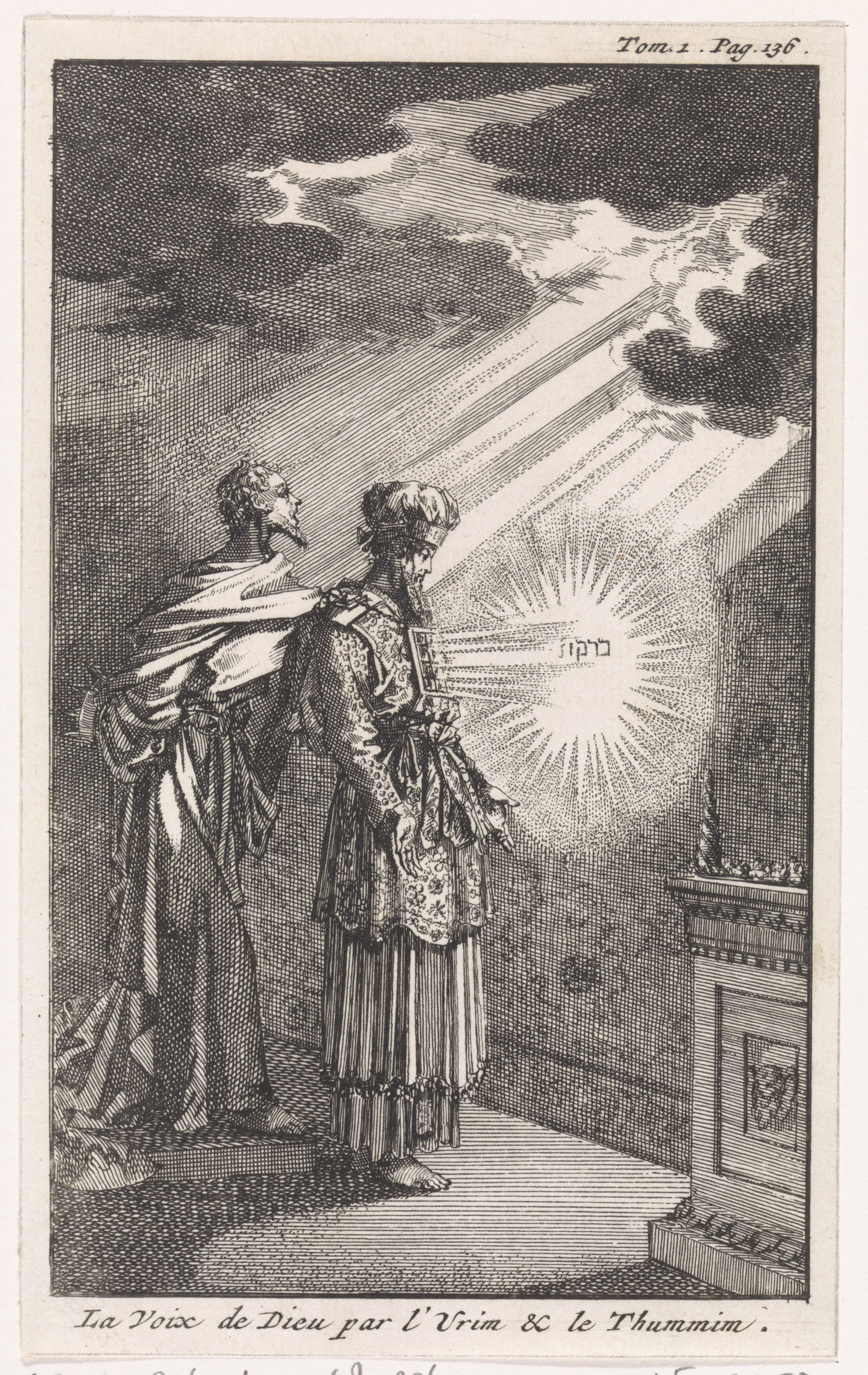
Now compare what the Book of Mormon says about its own translation instrument, written and printed in 1829 and 1830, before any Latter-day Saint borrowed the biblical word. The book never calls the instrument "Urim and Thummim." Its own word is "interpreters." But read how it describes them. They are "two stones which were fastened into the two rims of a bow," "prepared from the beginning, and were handed down from generation to generation, for the purpose of interpreting languages."[5] Only a person God commands can use them: "no man can look in them except he be commanded... And whosoever is commanded to look in them, the same is called seer."[6] Elsewhere the book ties them to light, a stone that will "shine forth in darkness unto light."
Line that up against the biblical instrument and the same features keep appearing. Stones. Light. A sacred object passed down across generations. Operated only by an authorized person. The Book of Mormon's interpreters fit the biblical Urim and Thummim category point for point, and they fit it on the printed page in 1830, years before anyone thought to use the biblical name.
So when Latter-day Saints did start calling the instrument "Urim and Thummim" in the 1830s, they were not slapping a fancy label on an embarrassing rock. They were noticing that the instrument the Book of Mormon already described belonged to a category the Bible already named. The brown seer stone fits the same category for the same reasons: a stone, used by an authorized seer, to receive revelation. Calling both of them "Urim and Thummim" is just how categories work. There is no sleight of hand in it.
The "hidden until 2013" story does not survive the record
The strongest form of the CES Letter's charge is one of timing. It treats December 2013, when the Church published an essay openly describing the seer stone, as the moment the Church finally admitted what it had kept quiet. For that to be the admission date, every earlier mention has to disappear. The trouble is that the record before 2013 is full of them.
Start near the beginning. Oliver Cowdery was the man who sat across from Joseph and wrote down most of the Book of Mormon as Joseph dictated it. In a published letter in 1834, five years after the translation, Cowdery wrote that Joseph translated "with the Urim and Thummim, or, as the Nephites would have said, 'Interpreters.'"[7] That single sentence is the whole apologetic position, the biblical word and the Nephite word named as two labels for the same thing, written by the chief scribe a century and a half ahead of the date the CES Letter calls the great admission.
The word entered public use even earlier. In an 1832 debate in Boston, two of Joseph's own missionaries, one of them his brother Samuel, were asked what they meant by "Urim and Thummim" and answered, "The same as were used by the prophets of old."[8] The first time the phrase appears in print, in an 1833 Church newspaper, the editor floats it carefully, grouping the "Interpreters, or spectacles" with terms "known, perhaps, in ancient days as Teraphim, or Urim and Thummim."[9] The word "perhaps" is right there on the page. Somebody floating a comparison out loud writes "perhaps." Somebody quietly installing a cover story does not.
And it never went underground after that. The umbrella reading stayed in the Church's own publications, openly, decade after decade. The Bible Dictionary bound into the back of every Church-issued Bible since 1979, the one in millions of members' scriptures and used in Sunday School and seminary, treats "Urim and Thummim" as a category of revealing instruments. "There is more than one Urim and Thummim," the entry says, and it traces them back a long way: "it would seem reasonable that such instruments were used from the time of Adam."[10]
In 1993, an apostle and future president of the Church, Russell M. Nelson, published an article in the Church's flagship magazine that quoted an eyewitness describing Joseph translating with the stone, word for word.[11] That was twenty years before the essay the CES Letter treats as the first confession. Where, in all of that, was the cover-up happening?
When the 2013 essay finally put it in plain institutional language, it was repeating what had been said all along: "These two instruments—the interpreters and the seer stone—were apparently interchangeable... in the course of time, Joseph Smith and his associates often used the term 'Urim and Thummim' to refer to the single stone as well as the interpreters."[12] Two instruments, interchangeable, both called by the one umbrella name, a reading that had sat on the record without a break since 1832. The CES Letter's timeline only works if you can erase every marker before 2013, and the markers refuse to erase. The full paper trail, decade by decade, is laid out in the in-depth version.
The 1829 wording we can't confirm
There is one revelation, now Doctrine and Covenants section 17, that is dated to June 1829 and that names "the Urim and Thummim." If that wording were solidly from 1829, it would be the cleanest proof that the term was in use during the translation itself. But it cannot quite carry that weight. The original 1829 page is lost. The earliest copy that survives was written out by a scribe no earlier than late 1834, by a man who sat on the committee revising the revelations for publication, and the Joseph Smith Papers editors note that some of its wording "does not fit an 1829 context, suggesting that version was modified from the original, although the degree of modification cannot be known."[13] In other words, the early Latter-day Saints sometimes went back and updated the wording of older revelations, and this looks like one of those cases. That practice is real, and it raises a fair question about how stable a revealed text is once it can be edited later. A faithful reader can hold the umbrella reading and still sit with that question. The in-depth version works through it carefully, along with the other strongest forms of the criticism.
The fair concession on the other side is about teaching, not concealment. For decades the lay side of the Church, the paintings in the chapels, the Primary lessons, the missionary materials, leaned on the clean image of Joseph studying the plates with the spectacle-like interpreters, and rarely showed the plain stone in the hat. Plenty of members grew up with the tidy picture and felt blindsided when they later met the fuller one. That gap was real and it cost people something. What the record does not support is the leap from "the lessons simplified it" to "the Church hid it," because the fuller account was sitting in the Bible Dictionary and the Church magazines the entire time. A simplified Sunday School picture and a buried secret are not the same thing.
The label, not the book
For all the attention it gets, the argument is smaller than it first looks. It is a dispute about which stone sat on the table and what word people used for it. But notice what it never touches: the book that came off that table.
Whatever instrument Joseph used at any given moment, the Book of Mormon is what stands on the record. Roughly 270,000 words, dictated out loud across about sixty working days, with no notes in front of him and no going back to rewrite the early chapters once the later ones arrived.[14] The terminology debate cannot reach that. If anything, the plainer you make the method, a man with his face in a hat and the plates set aside, the harder the finished book becomes to explain by ordinary means, because that method strips away every tool a forger would lean on.
Which stone produced the Book of Mormon is a genuine historical question, and the answer is that the same word covered more than one of them, openly, from the start. But that question runs around the edges of the book without touching its substance. Whatever was on the table, the book is still on the shelf, and it is still the thing no one has explained away.
Want the full case, including the strongest arguments the critics make and every source? Read the in-depth version.
Runnells, CES Letter (2017), "Kinderhook Plates & Translator Claims," p. 72. ↩︎
Runnells, CES Letter (2017), "Witnesses," p. 90. ↩︎
Runnells, CES Letter (2017): "Book of Mormon," p. 18 (the View of the Hebrews comparison chart entry "Breastplate, Urim & Thummim"); "Kinderhook Plates & Translator Claims," p. 72; "Witnesses," pp. 90 and 95 (the Gladden Bishop passage and the Strang bullet "Received the 'Urim and Thummim'."). ↩︎
Cornelis Van Dam, The Urim and Thummim: A Means of Revelation in Ancient Israel (Winona Lake, IN: Eisenbrauns, 1997), ISBN 978-0-931464-83-6 (original hardcover); paperback reprint ISBN 978-1-57506-406-2. Van Dam argues from the Hebrew root 'or ("light") that Urim means "lights"; from tom ("perfection," "completeness") that Thummim means "perfections"; and that the biblical evidence supports a light-based "appearance of light" reading rather than binary lot-casting. The quoted phrases are at p. 216 ("was something very lively and direct") and p. 217 ("[p]rophetic inspiration is the only revelatory means…"), as quoted in Scripture Central, KnoWhy #417, "Were Joseph Smith's Translation Instruments Like the Israelite Urim and Thummim?" (February 20, 2018), https://scripturecentral.org/knowhy/were-joseph-smiths-translation-instruments-like-the-israelite-urim-and-thummim. ↩︎
Mosiah 28:13–16: "And now he translated them by the means of those two stones which were fastened into the two rims of a bow. Now these things were prepared from the beginning, and were handed down from generation to generation, for the purpose of interpreting languages." ↩︎
Mosiah 8:13 (Book of Mormon, 1830 edition): "Now Ammon said unto him: I can assuredly tell thee, O king, of a man that can translate the records; for he has wherewith that he can look, and translate all records that are of ancient date; and it is a gift from God. And the things are called interpreters, and no man can look in them except he be commanded, lest he should look for that he ought not and he should perish. And whosoever is commanded to look in them, the same is called seer." ↩︎
Oliver Cowdery, "Letter I" to W.W. Phelps, Latter Day Saints' Messenger and Advocate 1, no. 1 (October 1834): 14. Digital text available through BYU's Mormon Publications digital collection and the Joseph Smith Papers digital catalog. Cowdery's "Day after day…" passage is the umbrella-equivalence statement; the "I wrote, with my own pen, the entire Book of Mormon" phrasing comes from Cowdery's later 1848 Kanesville statement (see [15]). ↩︎
Orson Hyde and Samuel Smith, debate at Julien Hall, Boston, August 5, 1832, as reported in Boston Investigator (August 10, 1832). Full transcript hosted at https://user.xmission.com/~research/central/hydesmith.htm. The exchange is generally regarded as the first known public (i.e., spoken-in-public-debate) Latter-day Saint use of "Urim and Thummim" associated with the Book of Mormon translation instrument. ↩︎
W. W. Phelps, "The Book of Mormon," The Evening and the Morning Star 1, no. 8 (January 1833): 58. The hedge "perhaps" appears verbatim in the published text. FAIR primary-source page (verbose URL): https://www.fairlatterdaysaints.org/answers/Source:Phelps:The_Evening_and_The_Morning_Star_1:58:through_the_aid_of_a_pair_of_Interpreters,_or_spectacles—(known,_perhaps,_in_ancient_days_as_Teraphim,_or_Urim_and_Thummim). ↩︎
LDS Bible Dictionary, "Urim and Thummim," https://www.churchofjesuschrist.org/study/scriptures/bd/urim-and-thummim. The Bible Dictionary has been bound into every Church-issued LDS Bible since the 1979 LDS edition of the King James Bible. ↩︎
Russell M. Nelson, "A Treasured Testament," Ensign (July 1993), https://www.churchofjesuschrist.org/study/ensign/1993/07/a-treasured-testament. The provenance line reads: "Adapted from an address given 25 June 1992 at a seminar for new mission presidents, Missionary Training Center, Provo, Utah." ↩︎
Gospel Topics Essay, "Book of Mormon Translation" (December 2013), https://www.churchofjesuschrist.org/study/manual/gospel-topics-essays/book-of-mormon-translation. "These two instruments—the interpreters and the seer stone—were apparently interchangeable and worked in much the same way such that, in the course of time, Joseph Smith and his associates often used the term 'Urim and Thummim' to refer to the single stone as well as the interpreters." ↩︎
Joseph Smith Papers, "Revelation, June 1829–E [D&C 17]" (paper-summary), https://www.josephsmithpapers.org/paper-summary/revelation-june-1829-e-dc-17/1. The JSP commentary documents: (a) the surviving manuscript, in the handwriting of Frederick G. Williams, was copied "[not before 25 Nov. 1834]" into Revelation Book 2, pp. 119–120 (brackets in the JSP source note); (b) John Whitmer copied the original revelation into Revelation Book 1 around March 1831, but "the page on which it was copied was removed at some point from that volume and is no longer extant"; (c) "some language used in the version copied into Revelation Book 2 does not fit an 1829 context, suggesting that version was modified from the original, although the degree of modification cannot be known." ↩︎
John W. Welch, "Timing the Translation of the Book of Mormon: 'Days [and Hours] Never to Be Forgotten,'" BYU Studies Quarterly 57, no. 4 (2018): 10–50, https://byustudies.byu.edu/article/timing-the-translation-of-the-book-of-mormon-days-and-hours-never-to-be-forgotten. Also in Welch, ed., Opening the Heavens: Accounts of Divine Manifestations, 1820–1844, 2nd ed. (Provo: BYU Studies, 2017). Welch documents 269,510 words across an estimated 57–63 working days available between April 7 and June 30, 1829. ↩︎
Oliver Cowdery, public testimony at conference held October 21, 1848, Kanesville, Iowa, recorded by Reuben Miller in his journal; first published in the Deseret News, April 13, 1859, p. 48. The statement as quoted here follows the rendering in Charles W. Penrose, "An Old Slander Revived and Refuted," Latter Day Saints' Millennial Star 70, no. 23 (June 4, 1908), https://scripturecentral.org/archive/periodicals/magazine-article/old-slander-revived-and-refuted. The Reuben Miller Journal is held in the Church History Library, Salt Lake City. For Miller's role as the principal recorder of Cowdery's reaffirmations, see Richard Lloyd Anderson, "Reuben Miller, Recorder of Oliver Cowdery's Reaffirmations," BYU Studies 8, no. 3 (1968): 277–293, https://byustudies.byu.edu/article/reuben-miller-recorder-of-oliver-cowderys-reaffirmations/. Cowdery's October 1848 Kanesville statement was given before the assembled conference congregation on his return to the Church after more than a decade outside it, about three weeks before his rebaptism on November 12, 1848. ↩︎