The Priesthood Restoration's Late Appearance
The claim:
The Priesthood Restoration section of the CES Letter opens with one sentence set apart on its title page, a line borrowed from a faithful Latter-day Saint historian:
"The late appearance of these accounts raises the possibility of later fabrication." – LDS Historian and Scholar Richard Bushman, Rough Stone Rolling, p. 75[1]
From there the section argues three things about timing:
- Nobody heard about angels restoring the priesthood until 1832 at the earliest, and the story only grew more detailed over time.[2]
- David Whitmer, one of the men who testified to the Book of Mormon, said late in life that word of an angelic ordination never reached him until the mid-1830s.[3]
- If Peter, James, and John gave Joseph Smith the higher priesthood in 1829, it makes no sense that a man named Lyman Wight ordained him to that same priesthood again in 1831.[4]
Put plainly, the charge is that the Church's story about how it got its priesthood authority is a tale that grew in the telling. The named angels, the specific dates, the dramatic visitations, none of it shows up early, so maybe none of it happened the way the Church now says.
A good deal of what the CES Letter reports here is true. The trail is thin, and the detailed story came late.
Thin and late do not add up to fabricated. The reason is a habit that repeats three separate times in this short section: each time the CES Letter reaches for its strongest source, it stops reading one step before that same source turns around and answers the worry.
Start with the quote that frames the whole section
That epigraph on the title page is doing almost all the work. It puts a believing Latter-day Saint historian forward as the opening witness for the prosecution, the scholar himself supposedly admitting the priesthood story might be invented.
The rest of that paragraph tells a different story. On the very page the CES Letter cites, Richard Bushman raises the fabrication idea in order to test it, and then knocks it down in the next breath:
"Did Joseph add the stories of angels to embellish his early history and make himself more of a visionary? If so, he made little of the occurrence."[5]
His answer is in the second sentence: a man who invents angels to make himself look more like a prophet does not then keep quiet about them for years. Bushman keeps going on that same page. It was Oliver Cowdery, Joseph's scribe for the Book of Mormon, who first told the John the Baptist story in public, not Joseph. And when Joseph did tell it in his 1838 history, the account "circulated without fanfare, more like a refurbished memory than a triumphant announcement." A few lines earlier Bushman had already offered his explanation for the quiet: Joseph's "reticence may have shown a fear of disbelief." It was the same reluctance that had kept Joseph silent with his own mother about the First Vision, then quiet with his father about Moroni right up until he was commanded to speak.[5:1]
So what the CES Letter puts on its title page is Bushman raising a possibility he is about to dismiss. End the quotation one sentence early and a careful historian weighing a question turns into a hostile witness against the Church. The section runs the same move twice more.
The conference minutes answer the Lyman Wight question
Take the question the CES Letter puts in capital letters: if Peter, James, and John already gave Joseph the higher priesthood in 1829, why did Lyman Wight ordain him to it again at a conference in June 1831?[4:1]
That conference left minutes, and they are the earliest Church record to mention a "high priesthood" ordination. The minutes list who ordained whom, in order. Joseph Smith ordained Lyman Wight to the high priesthood first, and four other men with him. Wight ordained Joseph afterward.[6] The CES Letter reproduces the back half of that exchange and drops the front. Whatever else a man is doing when he ordains Wight before Wight ordains him, he is not scrambling after an authority he lacks.
There is a reason these mutual ordinations were normal in the early Church, and it comes down to a difference between an office and a priesthood. The CES Letter borrows this question from Bushman too, quoting him raising the puzzle. The sentence Bushman writes immediately after, the one the CES Letter skips, is his own answer:
"The usual explanation is that Joseph meant to say 'high priest,' one of the offices in the Melchizedek Priesthood, not 'high priesthood.'"[7]
The idea is simpler than it sounds. Think of a priesthood as the authority itself and an office as a particular job within it, the way "holding a medical license" is different from "being named chief of surgery." Joseph already held the higher priesthood. What happened in June 1831 was the first time the Church organized the office of high priest.
Joseph said as much himself in 1841, years before anyone needed an excuse: "All priesthood is Melchizedek; but there are different portions or degrees of it."[8] One priesthood, with offices and degrees inside it. Being ordained to one of those offices is not the same as receiving the priesthood for the first time.
Bushman adds a further layer here, and it concedes something real about the vocabulary. The word "priesthood" is nearly absent from the earliest records, he notes, partly because it "was associated with Roman Catholicism and the old regimes of Europe." The revival churches many early converts had come out of "denounced priesthood as popish," their word for anything that looked Roman Catholic. Joseph himself "may not have realized that elders were part of the Melchizedek Priesthood already," so that his "experience may have outrun comprehension."[9] Those men were working inside a structure they could not yet name. But a vocabulary that arrives late is a different thing from an authority that arrives late.
That is twice now the CES Letter has quoted Bushman asking a question and dropped the answer he gives in the next line. The in-depth version lays out the conference minutes in full, including the witnesses on both sides of the office-versus-priesthood reading.
David Whitmer said more than the one thing the CES Letter quotes
The third pillar is David Whitmer, who was no outsider: one of the Three Witnesses, a man whose testimony Latter-day Saints still cite today. Late in his life he said he never heard that an angel ordained Joseph and Oliver until 1834, 1835, or 1836, and that he did not believe John the Baptist ever ordained them.[10] If that one statement were all we had from Whitmer, it would carry real weight.
It is not all we have. Whitmer lived eighty-three years and left a trail of statements and actions stretching across more than half a century, and almost all of it weighs against that late denial.
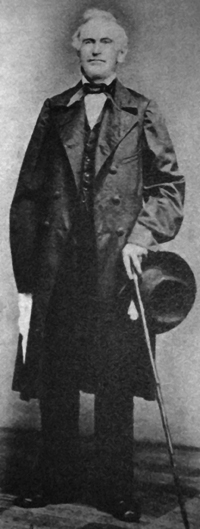
Whitmer was ordained a high priest in 1831. In 1834, Joseph designated him as a possible successor. In 1847, almost a decade after he was excommunicated, he was busy organizing his own "Church of Christ" built around priesthood offices. He wrote that he and others had been re-ordained and that two men "have been ordained High Priests." In 1869, he laid his hands on William McLellin and re-ordained him, still claiming priesthood authority of his own. In 1875 and 1876, he founded another small church with priesthood offices in it. For more than four decades, this is a man living inside priesthood structures, not a man who thought the whole thing was a hoax.
The piece that matters most dates from the middle of that span, and the CES Letter leaves it out. In 1861, standing at Oliver Cowdery's grave in Richmond, Missouri, Whitmer told a Latter-day Saint named David H. Cannon that he had heard Cowdery say:
"I know the Gospel to be true and upon this head has Peter, James, and John laid their hands and conferred the Holy Melchizedek Priesthood."[11]
That is Whitmer, twenty-four years before the late-life denial the CES Letter quotes, and twenty-three years after his own excommunication, publicly affirming that Peter, James, and John conferred the higher priesthood. The faithful scholar who documented this encounter, Kenneth Godfrey, grants that the records here are thinner than we would like and still concludes that Whitmer's late-life doubt "should not be accepted as true, especially in light of what he told Cannon."[11:1] To be precise about it, the 1861 statement is Whitmer reporting what Cowdery had said, and it concerns a different priesthood and different angels than the 1885 denial does.[12] That does not erase the later denial. It shows that Whitmer's testimony moved across his life, and that the flat denial belongs only to its final decade.
Even that final-decade denial is narrower than it first looks. In the same 1885 interview the CES Letter draws from, Whitmer affirmed that Joseph and Oliver did ordain each other as elders in 1829.[13] He never denied the ordinations happened. What he questioned, at the end of his life, was whether angels were the source. And his fullest late-life statement, an 1887 booklet, was not even written in his own hand. Its scribe, John J. Snyder, admitted he wrote it from notes as Whitmer dictated, then reshaped it through "constant changing (on my part)" until Whitmer approved it. By then Whitmer had spent decades building a rival theology and, as the historian H. Michael Marquardt put it, "pushed his views about the pure church further and further back."[14] [15]
So the late-life Whitmer is real, but he is one voice from a long life, and the younger Whitmer at Cowdery's grave is just as much David Whitmer as the older one. The in-depth version sets out the full timeline year by year. The broader puzzle of how to weigh any witness's late-life words against decades of earlier testimony is taken up across all eleven Book of Mormon witnesses in the article on credibility concerns.
The earliest history already names both priesthoods
The CES Letter says that even in 1832 there was no real claim of a priesthood restoration, just a vague "reception" of priesthood, with nothing about angels or named figures.[2:1] The document it is describing says more than that.
Joseph wrote his earliest history in the summer of 1832, partly in his own hand. It was never finished, and the part that survives breaks off before it would have told the priesthood story in full. But near the start, Joseph lists what he saw as the four great events of the Restoration, and two of them are priesthood events:
"thirdly the reception of the holy Priesthood by the ministring of—Aangels to adminster the letter of the Gospel… forthly a confirmation and reception of the high Priesthood after the holy order of the son of the living God"[16]
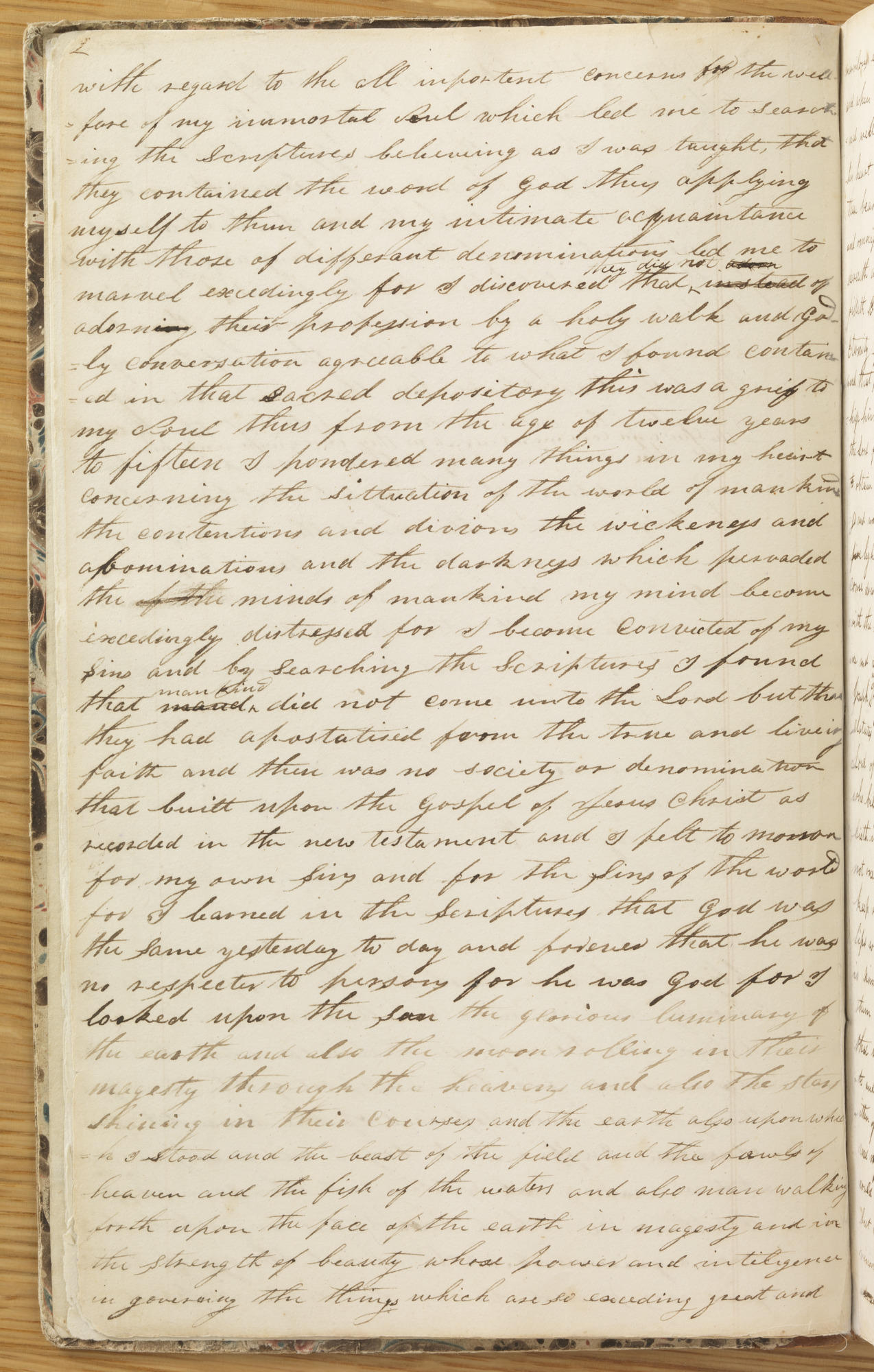
Two distinct priesthoods, the first of them expressly by angelic ministry, both written down in 1832. It is the same two-priesthood structure the Church would later canonize. The version of this quote the CES Letter works from keeps the first phrase and drops the second, the one about the "high Priesthood after the holy order of the son of the living God." Drop the second phrase and the 1832 history shrinks to one offhand aside. Restore it, and the earliest history Joseph ever wrote already lists both priesthoods, two to three years before the account critics say was invented. The fuller treatment of this document lives in the article on backdating and retrofitting.
Oliver Cowdery had every reason to recant, and never did
There is one more person the fabrication story needs, and he refuses to cooperate. If the priesthood narrative was built up after the fact, Oliver Cowdery had to be in on it, because he is the one who first published the detailed account.
Cowdery was excommunicated in 1838 and spent the next decade outside the Church, practicing law. He had every reason to walk the story back and no reason left to protect Joseph. He never did. In an 1846 private letter he wrote of standing "in the presence of John, with our departed brother Joseph, to receive the Lesser Priesthood—and in the presence of Peter, to receive the Greater…"[17] In 1848, he stood before the Kanesville, Iowa conference where he had asked to be taken back, and testified:
"I was present with Joseph when an holy angel from God came down from heaven and conferred, or restored, the Aaronic Priesthood… I was also present with Joseph when the Melchisedek Priesthood was conferred by the holy angels of God."[18]
Could a man the Church had cast out, with no one left to protect, have kept a lie going for ten years? Cowdery named the same figures and the same structure, in private letters to friends who had no stake in propping him up, right up to the end of his life. The fabrication theory has no room for him.
How thin the trail is
The soft spot in the faithful case is not any single document but the overall thinness of the trail.
Lay the priesthood restoration next to the Book of Mormon and the gap is obvious. The Book of Mormon has 588 printed pages, multiple scribes, eleven witnesses, a printer, and a hostile neighbor (Abner Cole) who tried to plagiarize it before it was even published. The First Vision has four written accounts from Joseph's own lifetime. The priesthood restoration has Joseph's brief 1832 list, Cowdery's letters from 1834 and 1835, and the fuller history from 1838, with the named figures, John the Baptist and Peter, James, and John, not appearing in print until those 1834-35 letters.
The critics also have a more serious argument than the CES Letter offers. Careful historians like Dan Vogel do not argue that Joseph and Cowdery sat down and consciously lied. Vogel argues something subtler: that the two men sincerely believed they had been commissioned by God, and that the specific details, the exact names and dates and locations, took shape gradually as the experience was retold and the young Church needed firmer footing.[19] That reading is coherent, and the faithful answer grants what it observes: the detailed published narrative really did come together between 1832 and 1835. The dispute is with the leap from "came together late" to "was made up." The in-depth version engages that scholarly case directly, along with the early documents, hostile newspapers, and persecution history that limited when the Saints could publish anything at all.
What tips the balance is that the gradual reading has to explain too much. It has to explain why Cowdery kept affirming the named figures across a decade of estrangement. Why Whitmer stood by Cowdery's testimony of apostolic priesthood at a graveside in 1861. Why Joseph's own 1832 history already lists both priesthoods. Why hostile newspapers in 1830 were already reporting that Cowdery claimed to have "conversed with Angels."[20] The pieces are scattered and quiet, but they are there, and they were there before the date the CES Letter says the story began.
The missing half of each quote
The section rests on three sources: Bushman, the June 1831 minutes, and David Whitmer. Each one says something the CES Letter does not quote. Bushman names the fabrication idea and then rejects it on the same page. The minutes show Joseph ordaining Wight before Wight ordained Joseph. Whitmer denied the angelic source at the very end of his life, but at Cowdery's grave decades earlier he repeated Cowdery's own testimony that the higher priesthood came from Peter, James, and John, and he never disputed the ordinations themselves. Put the missing half of each quote back, and the case for fabrication comes apart in your hands.
The faithful position that remains is narrower than the simplest Sunday-school telling but sturdier than the CES Letter's. The trail is thinner than for other foundational events. The detailed narrative did sharpen between 1832 and 1835. Those things are true. They just do not carry the reader to fabrication, because the substance of the claims (angelic authority, apostolic ordination, two priesthoods) sits in the record from 1829 forward, in friendly and hostile sources alike.
David Whitmer is the CES Letter's most important human source, and the Letter takes him from his last decade, years after he had set up a rival church and rebuilt his account of the early Restoration around it. The rest of his life points the opposite way. The same man sat in his father's house in 1829 while the Book of Mormon was being dictated, and testified with the other two witnesses that an angel had shown them the plates. He gave that account again and again and never once retracted it, even across the years when he doubted nearly everything else the Restoration claimed.
So a reader who finds this trail thin still has firm footing. The book Whitmer described came out of one sustained stretch of dictation by a farm boy with less than two years of formal schooling behind him. The priesthood question is harder, and it comes out on the Church's side once each source is read to the end. What Whitmer kept affirming through his worst years of doubt is what the whole story rests on: the Book of Mormon.
Want the full case, including the strongest arguments the critics make and every source? Read the in-depth version.
Runnells, CES Letter (2017), "Priesthood Restoration," section epigraph, p. 80. The epigraph is set apart on the section title page, before the numbered claims begin. ↩︎
Runnells, CES Letter (2017), "Priesthood Restoration," no. 1, p. 81. Includes the Bushman Rough Stone Rolling p. 75 block quote, which calls the 1832 history's priesthood mention "a glancing reference at best" and ends "The late appearance of these accounts raises the possibility of later fabrication." and the closing rhetorical question "Why did it take 3 plus years for Joseph or Oliver to tell members of the Church about the restoration of the priesthood under the hands of John the Baptist and Peter, James, and John?" ↩︎ ↩︎
Runnells, CES Letter (2017), "Priesthood Restoration," no. 2, p. 81. The CES Letter cites Early Mormon Documents, 5:137, which is the David Whitmer interview by Zenas H. Gurley Jr., January 14, 1885. ↩︎
Runnells, CES Letter (2017), "Priesthood Restoration," no. 6, pp. 83-84. Includes the Bushman Rough Stone Rolling pp. 157-158 block quote ending "If Joseph was already an elder and apostle, what was the necessity of being ordained again?" and the headline question, which the CES Letter sets in all-capital display type: "IF PETER, JAMES, AND JOHN ORDAINED JOSEPH SMITH TO THE MELCHIZEDEK PRIESTHOOD IN 1829, WHY DID LYMAN WIGHT ORDAIN JOSEPH SMITH TO THE MELCHIZEDEK PRIESTHOOD AGAIN IN 1831?" The emphasis inside the block quote is the CES Letter's, which prints "(emphasis added)" beneath it; the emphasized run begins at "why did contemporaries…" and continues through "…being ordained again?" The CES Letter sets the block quote in italic display type and marks its added emphasis by switching to upright roman; the bold here renders that emphasis. ↩︎ ↩︎
Richard Lyman Bushman, Joseph Smith: Rough Stone Rolling (New York: Knopf, 2005; Vintage paperback 2007), 75. The full p. 75 paragraph reverses itself within the same passage the CES Letter quotes. Bushman had already tied Joseph's silence about the First Vision to his mother and about Moroni to his father to the same trait: "His reticence may have shown a fear of disbelief." After raising the "possibility of later fabrication," Bushman writes: "Did Joseph add the stories of angels to embellish his early history and make himself more of a visionary? If so, he made little of the occurrence." He continues: "Cowdery was the first to recount the story of John's appearance, not Joseph himself"; the account "circulated without fanfare, more like a refurbished memory than a triumphant announcement." The priesthood-vocabulary discussion and the "experience may have outrun comprehension" line belong to pp. 157-159, not to this paragraph, and are cited separately below. ↩︎ ↩︎
"Minutes, circa 3-4 June 1831," Joseph Smith Papers. https://www.josephsmithpapers.org/paper-summary/minutes-circa-3-4-june-1831/2. The minutes record the order of ordinations: Joseph Smith Jr. ordains Lyman Wight, John Murdock, Reynolds Cahoon, Harvey Whitlock, and Hyrum Smith to the high priesthood; sixteen others are then ordained under Wight's hand, with Joseph Smith Jr. and Sidney Rigdon last, "under the hand of br. Lyman Wight"; John Corrill and Isaac Morley are ordained as assistants to the Bishop under Lyman Wight's hand. The minutes record the sixteen and the closing pair in a single entry with a single ordainer, which is the count Bushman renders as "eighteen others, including Joseph." ↩︎
Bushman, Rough Stone Rolling, 158. The sentence the CES Letter omits, immediately following the block quote it cites: "The usual explanation is that Joseph meant to say 'high priest,' one of the offices in the Melchizedek Priesthood, not 'high priesthood.'" Bushman frames the office-vs-priesthood reading as the standard scholarly resolution. ↩︎
Joseph Smith, "All priesthood is Melchizedek; but there are different portions or degrees of it," as given in Joseph Fielding Smith, comp., Teachings of the Prophet Joseph Smith (the familiar spelling quoted here) and in History of the Church. The underlying primary record is "Discourse, 5 January 1841, as Reported by William Clayton," 5, Joseph Smith Papers. Accessible discussion, printing the sentence with the manuscript spelling "Melchizedeck" and dating it to "a sermon given in 1841," in John S. Thompson, "Restoring Melchizedek Priesthood," Interpreter: A Journal of Latter-day Saint Faith and Scholarship 62 (2024): 272. ↩︎
Bushman, Rough Stone Rolling, 157-159, in the discussion of the June 1831 conference. On the vocabulary (157-158): "The term 'authority' frequently appeared, but not 'priesthood.' The absence of the word to this point may have been because of its generally negative associations for radical Protestants in Joseph's time. Priesthood was associated with Roman Catholicism and the old regimes of Europe. The radical religious tradition from which many Mormon converts came denounced priesthood as popish, emphasizing preaching rather than sacraments administered by priests." On comprehension (158-159): "Joseph may not have realized that elders were part of the Melchizedek Priesthood already and were being ordained to the office of high priest rather than receiving the powers of the high priesthood… In this case, experience may have outrun comprehension." ↩︎
David Whitmer, interview by Zenas H. Gurley Jr., January 14, 1885. Published in Dan Vogel, ed., Early Mormon Documents 5 (Salt Lake City: Signature Books, 2003), 137. Manuscript in LDS Church History Library. The interview is the source the CES Letter cites for claim 2. ↩︎
Kenneth W. Godfrey, "David Whitmer and the Shaping of Latter-day Saint History," in Stephen D. Ricks, Donald W. Parry, and Andrew H. Hedges, eds., The Disciple as Witness: Essays on Latter-day Saint History and Doctrine in Honor of Richard Lloyd Anderson (Provo, UT: Foundation for Ancient Research and Mormon Studies, 2000), 223-256. Godfrey reports the David H. Cannon graveside encounter at Oliver Cowdery's grave in Richmond, Missouri, in 1861: "Whitmer declared that he had heard Oliver say, 'I know the Gospel to be true and upon this head has Peter, James, and John laid their hands and conferred the Holy Melchizedek Priesthood.'" His assessment follows two sentences later in the same paragraph: "While the historicity of the restoration of priesthood authority is complex and the documentation not nearly as clear as we would prefer, certainly David Whitmer's testimony that casts doubt on the appearance of John the Baptist and Peter, James, and John should not be accepted as true, especially in light of what he told Cannon." (The copy consulted is reflowed and unpaginated; cf. the chapter at 223-256.) Confirmation in Sarah Allen, "The CES Letter Rebuttal, Part 43," FAIR Blog, January 21, 2022. ↩︎ ↩︎
The 1861 statement is not Whitmer's first-person testimony of priesthood reception; it is Whitmer reporting in 1861 what Cowdery had said to him at some earlier point — documentary recall of another person's statement, given at a thirty-two-year remove from the underlying 1829 events. In 1861 Whitmer was also inside a priesthood-structured framework he would later abandon (he had been organizing a "Church of Christ" with high priests since 1847), so affirming Cowdery's claim of apostolic conferral was internally consistent with his then-theology. And the two statements are not strictly identical: the 1861 statement is about Melchizedek conferral by Peter, James, and John; the 1885 statement is specifically about whether an Angel had ordained Joseph and Oliver to the Aaronic Priesthood. Different priesthood, different angels. None of this neutralizes the 1861 affirmation; it locates it precisely. ↩︎
David Whitmer, interview by Zenas H. Gurley Jr., January 14, 1885, in Dan Vogel, ed., Early Mormon Documents 5 (Salt Lake City: Signature Books, 2003), 137. The relevant exchange is reproduced and analyzed in Sarah Allen, "The CES Letter Rebuttal, Part 43," FAIR Blog, January 21, 2022, https://www.fairlatterdaysaints.org/blog/2022/01/21/43, citing Whitmer: "Joseph ordained Oliver Cowdery to be an Elder, and Oliver ordained Joseph to be an Elder in the Church of Christ." Allen notes that Whitmer affirmed the fact of 1829 ordinations even while disputing their angelic source. ↩︎
Marquardt, "David Whitmer," PDF 153. "By the end of his life, David had become fully active again as a believer in the restored Church of Christ and the Book of Mormon. As the years went on, Whitmer pushed his views about the pure church further and further back. By the time he dictated his final address, David had ceased to consider his seven years of faithful Church service in Ohio and Missouri worthwhile." Full citation: H. Michael Marquardt, "David Whitmer: His Evolving Beliefs and Recollections," in Newell G. Bringhurst and John C. Hamer, eds., Scattering of the Saints: Schism within Mormonism (Independence, MO: John Whitmer Books, 2007), 46-77. The page citation here is to the author's own PDF of the chapter, separately typeset and paginated as chapter 6 of his Church History Essays (2013), printed pp. 127-155: https://user.xmission.com/~research/mormonpdf/6davidwhitmer.pdf. ↩︎
David Whitmer, An Address to All Believers in Christ (Richmond, MO: David Whitmer, 1887). The colophon is dated as printed, "Richmond, Mo., April 1st, 1887." Internet Archive: https://archive.org/details/addresstoallbeli00whit. Marquardt describes it as a 75-page booklet; the last numbered page of the printed text is 76, and the Internet Archive scan runs to 102 images. ↩︎
"History, circa Summer 1832," Joseph Smith Papers. https://www.josephsmithpapers.org/paper-summary/history-circa-summer-1832/2. Manuscript in Joseph Smith Letterbook 1, most likely written between July 20 and September 22, 1832, partly in Joseph Smith's own hand and partly in the hand of scribe Frederick G. Williams. The history is six pages long and breaks off mid-narrative. The prospectus paragraph identifies four cardinal events of the Restoration including "the reception of the holy Priesthood by the ministring of—Aangels to adminster the letter of the Gospel" and "a confirmation and reception of the high Priesthood after the holy order of the son of the living God." Where the body quotes this passage, the bold on the second phrase is emphasis added; the manuscript has no emphasis. ↩︎
Oliver Cowdery to Phineas H. Young, March 23, 1846. Original in the Church History Library, MS 2646. Published in Ronald G. Watt, "Had You Stood in the Presence of Peter," Ensign, February 1977, 78-79. https://scripturecentral.org/archive/periodicals/magazine-article/had-you-stood-presence-peter-letter-oliver-cowdery-phineas-young-1846. Cowdery to Young: "I have been sensitive on this subject, I admit; but I ought to be so—you would be, under the circumstances, had you stood in the presence of John, with our departed brother Joseph, to receive the Lesser Priesthood—and in the presence of Peter, to receive the Greater, and looked down through time, and witnessed the effects these two must produce,—you would feel what you have never felt." The dashes are set tight in the source; where the body quotes the passage, the ellipsis elides "and looked down through time, and witnessed the effects these two must produce." ↩︎
Reuben Miller's record of Oliver Cowdery's October 21, 1848 testimony at the Kanesville, Iowa conference where Cowdery sought readmission to the Church; he was rebaptized weeks later. Published in Richard Lloyd Anderson, "Reuben Miller, Recorder of Oliver Cowdery's Reaffirmations," BYU Studies 8, no. 3 (1968): 277-93. https://byustudies.byu.edu/article/reuben-miller-recorder-of-oliver-cowderys-reaffirmations/. Miller's record contains Cowdery's explicit affirmation of both Aaronic and Melchizedek priesthood restorations. ↩︎
Dan Vogel, Joseph Smith: The Making of a Prophet (Salt Lake City: Signature Books, 2004). 715 pp. The most thorough developmental-hypothesis monograph. Argues priesthood-restoration narrative crystallized between 1829 and 1835 from earlier substance-claims, not as conscious fraud but as religious experience whose specific contours emerged from retrospective theological need. ↩︎
"The Golden Bible," Painesville Telegraph, November 16, 1830, 3. Eber D. Howe, editor (later co-author of Mormonism Unvailed, 1834). Excerpted in Dan Vogel, ed., Early Mormon Documents 2 (Salt Lake City: Signature Books, 1998), 508, as item 3 of the "Oliver Cowdery Addendum." Transcript at FAIR: https://www.fairlatterdaysaints.org/evidences/Source:Painesville_Telegraph:16_Nov_1830:Cowdery_pretends_to_have_a_divine_mission_and_conversed_with_angels. Reports that "the person here, who pretends to have a divine mission, and to have seen and conversed with Angels, is Cowdray," and that he "holds forth that the ordinances of the gospel, have not been regularly administered since the days of the Apostles, till the said Smith and himself commenced the work." ↩︎