Papyri
The claim:
"Originally, Joseph claimed that this record was written by Abraham 'by his own hand, upon papyrus' – a claim still prominent in the heading of the Book of Abraham. This claim could not be evaluated for decades as many thought the papyri were lost in a fire. The original papyrus Joseph translated has since been found and, as stated in the Church's July 2014 Translation and Historicity of the Book of Abraham essay, 'scholars have identified the papyrus fragments as parts of standard funerary texts…[that] date to between the third century B.C.E. and the first century C.E., long after Abraham lived.'"[1]
"Egyptologists have also since translated the source material for the Book of Abraham and have found it to be nothing more than a common pagan Egyptian funerary text for a deceased man named 'Hor' around first century C.E.… It has nothing to do with Abraham or anything Joseph claimed in his translation for the Book of Abraham."[2]
"Of all the issues, the Book of Abraham is the issue that has both fascinated and disturbed me the most.… It is the smoking gun that has completely obliterated my testimony of Joseph Smith and his claims."[3]
Joseph Smith said the Book of Abraham was Abraham's own writing on papyrus. Egyptologists have now read the papyrus he owned, the critics say, and it turns out to be an ordinary Egyptian funeral document for a dead priest named Hor, with nothing of Abraham in it. That, the argument goes, is the smoking gun: the source still exists, anyone can read it, and it is not what Joseph said it was.
Of every criticism answered on this site, this one is the hardest, and much of it is true. The recovered papyrus really is an Egyptian funerary text, and read as Egyptian, it does not contain the Book of Abraham. But two things the CES Letter skips change what the difficulty amounts to. First, the fragments scholars read are a fraction of what Joseph owned, and the long rolls witnesses described are gone. Second, what the book says about the ancient world kept proving true after Joseph died.
Right about the text, wrong about source
When the CES Letter says scholars have translated "the source material" and found a funerary text, it is right about the document and wrong about the word "source."
The recovered fragments are genuinely Egyptian funeral literature. Ten pieces of papyrus, mounted on stiff paper back in Joseph's day, ended up in the Metropolitan Museum of Art in New York. In 1967, the museum transferred them to the Church. Another fragment turned up around the same time in the Church Historian's Office, making eleven in all. Three of them come from a Book of Breathings, a short ritual text meant to grant a dead person breath in the afterlife, formally a Document of Breathing Made by Isis. It was prepared for a Theban priest named Hor, no later than the first half of the second century BC.[4] [5] The other eight come from a second scroll, a Book of the Dead copied for a woman named Tshemmin. Latter-day Saint and outside Egyptologists agree on what they say, and the Church says so plainly in its own essay on the subject: "None of the characters on the papyrus fragments mentioned Abraham's name or any of the events recorded in the book of Abraham."[6]
So far the CES Letter and the Church agree. The disagreement is over one quiet assumption packed into the word "source": that these eleven fragments are the thing Joseph translated from. That assumption is where the argument goes wrong.
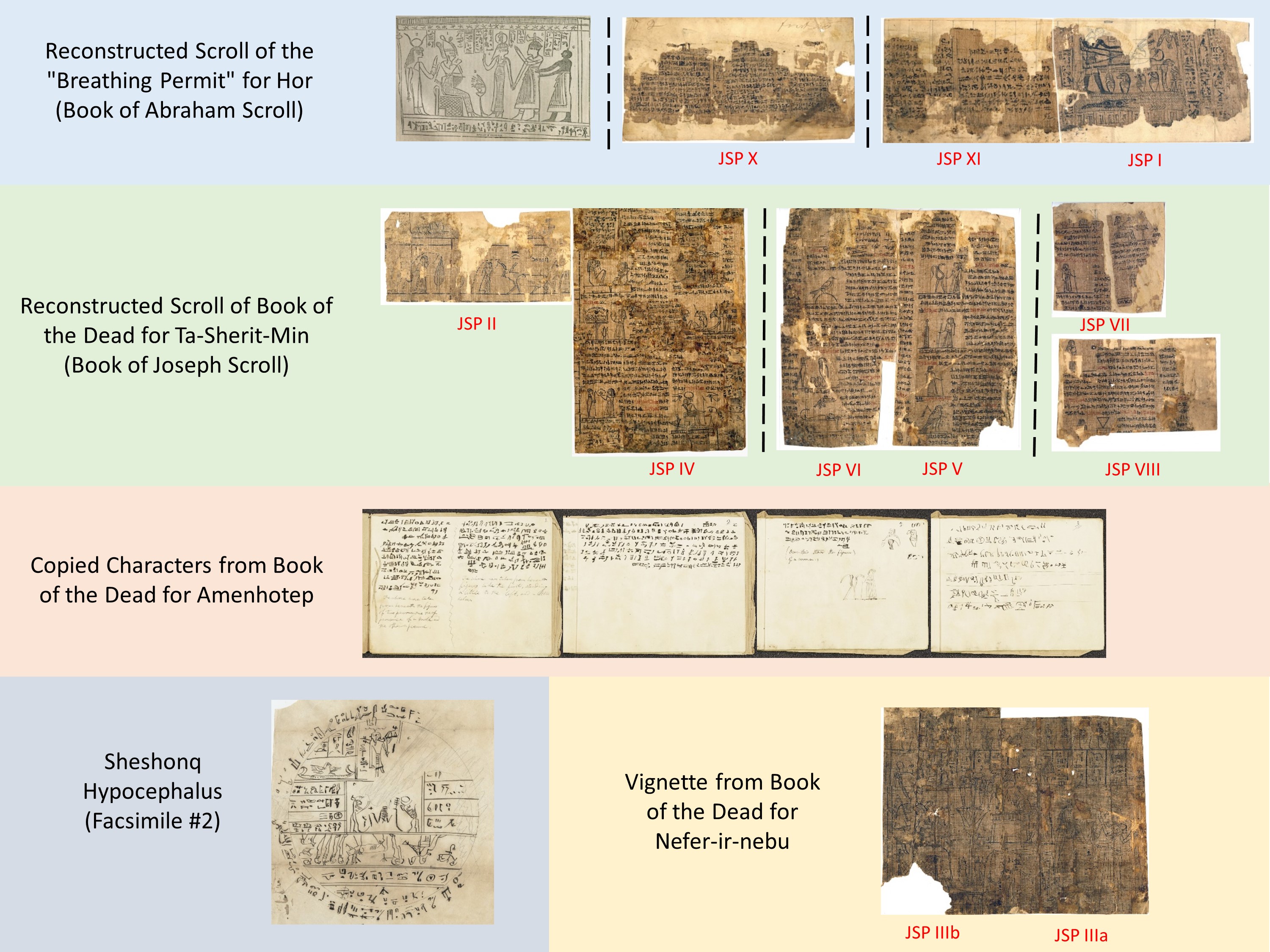
What Joseph actually owned, and what burned
Joseph Smith did not own eleven small fragments. He owned long rolls of papyrus, and the people who saw them said so repeatedly.
When Michael Chandler arrived in Kirtland, Ohio in 1835 with four Egyptian mummies and several rolls of papyrus, Joseph and others bought the whole lot. Over the next twenty years a stream of visitors, friendly and hostile alike, described long rolls unrolling across the floor. A non-Latter-day Saint woman named Charlotte Haven watched Joseph's mother open "a long roll of manuscript" in 1843.[7] Not every visitor was shown a roll. Josiah Quincy, a skeptical guest in 1844, got the mounted material instead: parchments kept under glass.[8] John Gee counts twenty-six eyewitness descriptions of these papyri from the years the Saints owned them, and Kerry Muhlestein has worked through that whole body of accounts.[9] [10] The Church's essay states the obvious conclusion: "Since only fragments survive, it is likely that much of the papyri accessible to Joseph when he translated the book of Abraham is not among these fragments."[6:1]
The rest met a worse end. After Joseph's death the collection was split up and sold, and most of it passed through a string of Midwestern museums. Historians believe the bulk of it burned in the Great Chicago Fire of 1871. The eleven fragments that came back in 1967 had been separated from the rest since 1856 and survived only because they were somewhere else. So the surviving fragments and the lost rolls are two different sets of papyri, separated for over a century. Which set did the Egyptologists read?
The distinction is not a technicality. To say "we have read the source and it is Hor's funeral text," you have to be sure the fragments we have are the part Joseph translated from. They are not the whole of what he had, and the witnesses describe long rolls that no longer exist. How much is missing is argued over. One faithful scholar estimates the Hor scroll alone is missing about forty feet; a pair of critics recalculated that the Hor scroll's interior could be missing as little as twenty-two inches.[11] [12] But even the smallest critical figure covers only the inside of one scroll. It says nothing about the second scroll, a third document that is entirely lost, or the long rolls that most likely burned in 1871. The full math is in the in-depth version.
"Long after Abraham lived" misunderstands how manuscripts work
The CES Letter leans hard on the dates. The fragments come from the third century BC to the first century AD, "long after Abraham lived." Abraham lived closer to 2000 BC. The implication is that the text cannot be ancient because the paper is too late.
That reasoning, applied anywhere else, would erase most of the ancient world. Every old text survives in copies made long after it was written. The oldest complete Hebrew Bible was copied around 1008 AD, a thousand years and more after the books inside it. The oldest complete Greek New Testament dates to about 350 AD, three centuries after the apostles. Plato survives in copies a thousand years younger than Plato. Nobody calls the Gospels a fourth-century invention because our best copy is fourth-century. A late copy of an old text is the normal condition of ancient literature, not a forgery. The date of the Hor papyrus tells you when that copy was made. It tells you nothing about when the text it carried was first composed.
There is even an Egyptian wrinkle the critics miss. Egyptian scribes used set phrases like "by his own hand" to name the original author of a text on copies made centuries later by other hands.[13] [14] A statue inscription from Syria, the Idrimi inscription, is written in the first person, "I," yet closes by naming the scribe who actually did the writing; it was dug up in 1939 and first published in 1949, more than a century after Joseph died.[15] [16] The faithful case turns on this convention: the heading on the Book of Abraham, "by his own hand, upon papyrus," fits an ancient way of crediting an author that Joseph had no way to know about. That does not prove the text is ancient by itself. It does dissolve the specific argument that a late date on the paper disproves an early date for the words.
How Joseph translated, and why the fragments don't settle it
Behind the CES Letter's argument is a picture of Joseph hunched over the Hor papyrus, reading Egyptian symbol by symbol like a scholar with a dictionary. If that picture were right, finding out the symbols say something about Hor and not Abraham really would be the end of it. But that is not how Joseph worked, on any of his projects.
Joseph never translated the way a trained linguist does. He produced the Book of Mormon by looking into a seer stone, not by studying Egyptian-style characters. He revised the Bible without any Hebrew or Greek manuscripts in front of him. The people who watched him work on the Book of Abraham described the same kind of process: Wilford Woodruff said the Lord was blessing Joseph "to translate… Ancient records & Hyeroglyphics," and Orson Pratt said he saw Joseph translate "by inspiration."[17] [18] Even Warren Parrish, a scribe who later turned against Joseph and had every reason to expose a fraud, said he "penned down the translation… as he claimed to receive it by direct inspiration of Heaven."[19] In Joseph's vocabulary, "translation" meant receiving a text by revelation, with the physical object serving as a prompt rather than something he decoded letter by letter.
The most common faithful explanation today is called the catalyst view: Joseph received the Book of Abraham as revelation prompted by the papyri rather than literally decoded from them. One Latter-day Saint scholar quotes a historian's apt summary of the method: Joseph "did not think of himself as God's stenographer. Rather, he was an interpreting reader, and God the confirming authority."[20] On that understanding, the funeral text on the surviving fragments is beside the point. The fragments would not be expected to "contain" the Book of Abraham in the first place, because the book never came from reading them as Egyptian. A fuller account of the translation question, and its real costs, is in the in-depth version.
What the text knows that Joseph couldn't have
Set the paper aside and look at the words. The Book of Abraham makes specific, checkable claims about the ancient world, and several of them turned out to fit discoveries made decades or a century after Joseph was dead.
The book mentions a place called "the plain of Olishem" (Abraham 1:10). No such place was known in 1835. Then an ancient inscription of the king Naram-Sin, published in 1928, was found to name a town called Ulisum in what is now northern Syria or southern Turkey. The name matches, the era matches, and the location is close. The cuneiform writing it is recorded in could not even be read until the 1840s and 1850s, after the Book of Abraham was printed.[21]
The book also says Egyptian priests tried to sacrifice Abraham on an altar. For over a century Egyptologists insisted Egyptians did not practice human sacrifice, and treated this as an obvious blunder. Then, in the 1960s, archaeologists excavating an Egyptian fortress in Nubia called Mirgissa found a ritual deposit with wax figures, a flint knife, and a decapitated human victim. Egyptologists have since confirmed in mainstream journals that human sacrifice did occur in Egyptian ritual.[22]
And an ancient Jewish text called the Apocalypse of Abraham contains striking parallels to the Book of Abraham: Abraham rejecting his father's idols, his near-sacrifice, a vision of heaven. It did not appear in English until 1898, more than fifty years after Joseph died.[23]
None of these by itself proves the Book of Abraham is ancient, and each has its caveats, which the in-depth version lays out in full. The pattern is what carries weight. The nineteenth century confidently called these claims impossible. The twentieth century, digging up evidence Joseph could not have reached, kept turning them from errors into matches. A made-up book is supposed to look worse as we learn more, not better.
The fragments aren't the Book of Abraham
The recovered fragments do not contain the Book of Abraham. Read as Egyptian, in their own language, they are Hor's funeral text and nothing more. Every qualified Egyptologist, Latter-day Saint included, reads them that way.[6:2] The missing-scroll defense, taken on its own, is mathematically contested, and on the tightest critical reading the inside of the Hor scroll could not have held a copy of the book.[12:1] [24] And the catalyst explanation is, plainly, a twentieth-century reframing. Joseph and his contemporaries described what he did with the ordinary word "translation," and the catalyst model openly reinterprets that language rather than matching how they first understood it.
The worst of it sits even closer to home. In 1835 and 1836, Joseph and his clerks produced a set of Egyptian-language documents, including an attempted "alphabet" and "grammar," and three manuscripts of the Book of Abraham with Egyptian characters drawn in the margins. The deepest difficulty is not the CES Letter's loose claim that the characters "match in chronological order." It is a narrow, well-documented finding that the first three verses of Abraham appear to depend on those alphabet documents.[25] [26] What makes it sting is who concluded it. Brian Hauglid, the Latter-day Saint scholar who edited the official scholarly edition of these very manuscripts, came out of a decade of close study and stated publicly that he agreed with the leading naturalistic critic's assessment.[27] A faithful expert with full access to the documents reached a hard conclusion. No reader gets to file that under hostile attack.
The faithful response makes a narrower set of points, none of them a complete answer. The character-and-grammar project Joseph and his scribe W.W. Phelps undertook reads more naturally as a separate effort to understand Egyptian alongside the revealed text than as the tool that produced it, partly because Phelps was already building this kind of cipher months before the papyri even arrived.[28] [29] Whatever its direction, the dependency reaches only three verses; it explains nothing about the remaining 28 verses of chapter one or the four chapters after it. And on the revelatory understanding of how Joseph worked, an alphabet built to study the script is a different thing from the source of the scripture. The full back-and-forth, including the strongest critical voices like Robert Ritner and the Kirtland documents in detail, is in the in-depth version.
What no criticism reaches
On one side: the surviving fragments are funeral literature, the missing-scroll math is contested, the catalyst model is a later reframing, and a faithful expert grants a narrow dependency in three verses. On the other side: those fragments are not the rolls Joseph owned, late paper never disproves an old text, Joseph never translated like a linguist on any project, and the words of the book keep matching things no one in 1835 could have known. Both columns are real. A smoking gun would have to settle the matter, and neither column does.
And if this is the thinnest ground in the case for Joseph Smith, it is worth naming the thickest. The papyri question does not have to be won here; it can stay open. What has never been answered is the rest of what Joseph translated, starting with the Book of Mormon: roughly sixty working days of dictation, straight through and never redrafted. Almost two centuries of trying have produced no natural account of how he did it.
So take the concession at full strength. The fragments are funerary. No first-person account from Joseph explains his method. A faithful scholar reads three verses as dependent on the alphabet documents. What is still standing, once all of that is on the table, is a text whose specific, falsifiable claims (a place called Olishem, Egyptian human sacrifice, an author-crediting formula from a genre Joseph never knew) kept turning out to fit discoveries made after the only man who could have faked them was dead. A debunked forgery does not behave that way. This is the part of the Book of Abraham the strongest criticism walks right past. For the figure-by-figure look at the facsimiles and the fuller ancient-evidence case, see the Facsimiles and Anachronisms & Source Texts pages.
Want the full case, including the strongest arguments the critics make and every source? Read the in-depth version.
Runnells, CES Letter (2017), "Book of Abraham," p. 37. ↩︎
Runnells, CES Letter (2017), "Book of Abraham," p. 37. ↩︎
Runnells, CES Letter (2017), "Book of Abraham," p. 50. ↩︎
Marc Coenen, "The Dating of the Papyri Joseph Smith I, X and XI and Min Who Massacres His Enemies," in Egyptian Religion: The Last Thousand Years, Part I: Studies Dedicated to the Memory of Jan Quaegebeur, ed. Willy Clarysse, Antoon Schoors, and Harco Willems (Leuven: Peeters, 1998), 1103–1115. Coenen's conclusion, as reproduced in the secondary literature, is that "the latest possible dating for P. Joseph Smith I, X and XI is in our opinion the first half of the second century BC." The 1998 print volume was not consulted directly for this article. ↩︎
Michael D. Rhodes, The Hor Book of Breathings: A Translation and Commentary (Provo, UT: FARMS, 2002). ↩︎
The Church of Jesus Christ of Latter-day Saints, "Translation and Historicity of the Book of Abraham," Gospel Topics Essays (2014, current revision), https://www.churchofjesuschrist.org/study/manual/gospel-topics-essays/translation-and-historicity-of-the-book-of-abraham?lang=eng. The original 2014 wording read "Mormon and non-Mormon Egyptologists agree"; the current essay reads "Latter-day Saint and non-Latter-day Saint Egyptologists agree." The CES Letter (p. 37) quotes the 2014 original wording. ↩︎ ↩︎ ↩︎
Charlotte Haven, "A Girl's Letters from Nauvoo," Overland Monthly 16 (December 1890): 624. ↩︎
Josiah Quincy, Figures of the Past: From the Leaves of Old Journals (Boston: Roberts Brothers, 1883), 386. ↩︎
John Gee, "New Light on the Joseph Smith Papyri," FARMS Review 19, no. 2 (2007): 245–259, https://scholarsarchive.byu.edu/msr/vol19/iss2/20/. Gee writes that "there are twenty-six eyewitness sources that describe the Joseph Smith Papyri" for the period "from 1835 to 1856," and corrects the popular account of the rediscovery: the Metropolitan Museum's published 1947 acquisition list already recorded "papyrus fragments of hieratic Books of the Dead, once the property of the Mormon leader Joseph Smith." ↩︎
Kerry Muhlestein, "Papyri and Presumptions: A Careful Examination of the Eyewitness Accounts Associated with the Joseph Smith Papyri," Journal of Mormon History 42, no. 4 (October 2016): 31–50, https://scholarlypublishingcollective.org/uip/jmh/article/42/4/31/222761/. See also the eyewitness-account compilation summarized at https://en.wikipedia.org/wiki/Eyewitness_accounts_associated_with_the_Joseph_Smith_Papyri. ↩︎
John Gee, "Some Puzzles from the Joseph Smith Papyri," FARMS Review 20, no. 1 (2008): 113–137; originally presented at the 2007 FAIR Conference, https://www.fairlatterdaysaints.org/wp-content/uploads/2011/11/2007-John-Gee.pdf. ↩︎
Andrew W. Cook and Christopher C. Smith, "The Original Length of the Scroll of Hôr," Dialogue: A Journal of Mormon Thought 43, no. 4 (Winter 2010): 1–42, https://www.dialoguejournal.com/articles/the-original-length-of-the-scroll-of-hor/. ↩︎ ↩︎
Stephen O. Smoot and John Gee, "By His Own Hand upon Papyrus," BYU Studies Quarterly 61, no. 4 (2022), https://byustudies.byu.edu/article/by-his-own-hand-upon-papyrus. ↩︎
Miriam Lichtheim, Ancient Egyptian Literature, Volume III: The Late Period (Berkeley: University of California Press, 1980), 125–151 ("The Setne stories"). Lichtheim renders the Setne passage "that Thoth wrote with his own hand"; the fuller rendering quoted in the body above follows Smoot and Gee, "By His Own Hand upon Papyrus" (cited above). On either rendering the Setne tradition parallels the "by his own hand upon papyrus" formula in the Book of Abraham heading. See also F. Ll. Griffith, Stories of the High Priests of Memphis (Oxford: Clarendon, 1900) for the original critical edition. ↩︎
Sir Leonard Woolley, Alalakh: An Account of the Excavations at Tell Atchana in the Hatay, 1937–1949 (Oxford: Society of Antiquaries, 1955); E.L. Greenstein and David Marcus, "The Akkadian Inscription of Idrimi," Journal of the Ancient Near Eastern Society 8 (1976): 59–96. ↩︎
Sidney Smith, The Statue of Idri-mi (Occasional Publications of the British Institute of Archaeology in Ankara 1; London, 1949), the original critical edition of the Idrimi inscription. ↩︎
Wilford Woodruff, journal entry, February 19, 1842, in Wilford Woodruff's Journal, ed. Scott G. Kenney (Midvale, UT: Signature Books, 1983), 2:155. ↩︎
Orson Pratt, "Personal Reminiscences and Testimony Concerning the Prophet Joseph and the Church, Etc.," a sermon delivered in the Tabernacle, Great Salt Lake City, July 10, 1859, in Journal of Discourses 7:176. ↩︎
Warren Parrish, letter to the editor, Painesville Republican, February 15, 1838 (letter dated February 5, 1838). Parrish was a disaffected former scribe at the time of writing. ↩︎
Stephen O. Smoot, "Joseph Smith Jr. as a Translator: The Book of Abraham as a Case Study," Interpreter: A Journal of Latter-day Saint Faith and Scholarship 64 (2025), https://scholarsarchive.byu.edu/interpreter/vol64/iss1/19/. ↩︎
Stephen O. Smoot, John Gee, Kerry Muhlestein, and John S. Thompson, "The Plain of Olishem," BYU Studies Quarterly 61, no. 4 (2022), https://byustudies.byu.edu/article/the-plain-of-olishem; John M. Lundquist, "Was Abraham at Ebla? A Cultural Background of the Book of Abraham," in Studies in Scripture, Volume 2: The Pearl of Great Price, ed. Robert L. Millet and Kent P. Jackson (Salt Lake City: Randall, 1985). ↩︎
Stephen O. Smoot, John Gee, Kerry Muhlestein, and John S. Thompson, "Human Sacrifice," BYU Studies Quarterly 61, no. 4 (2022), https://byustudies.byu.edu/article/human-sacrifice; Kerry Muhlestein, Violence in the Service of Order: The Religious Framework for Sanctioned Killing in Ancient Egypt (Oxford: BAR International Series 2299, 2011); Jean Vercoutter et al., Mirgissa I–III (Paris: Direction générale des relations culturelles, 1970–1976). ↩︎
E.H. Anderson and R.T. Haag, "The Book of the Revelation of Abraham," Improvement Era 1, no. 10 (August 1898): 705–714, continued in 1, no. 11 (September 1898); G.H. Box and J.I. Landsman, The Apocalypse of Abraham (London: Society for Promoting Christian Knowledge, 1918). For parallels see John A. Tvedtnes, Brian M. Hauglid, and John Gee, Traditions about the Early Life of Abraham (Provo, UT: FARMS, 2001). ↩︎
Robert K. Ritner, "'The Breathing Permit of Hor' Thirty-Four Years Later," Dialogue: A Journal of Mormon Thought 33, no. 4 (Winter 2000): 91–119, https://www.dialoguejournal.com/articles/the-breathing-permit-of-hor-thirty-four-years-later/. ↩︎
Christopher C. Smith, "The Dependence of Abraham 1:1-3 on the Egyptian Alphabet and Grammar," John Whitmer Historical Association Journal 29 (2009): 38–54. ↩︎
Brian M. Hauglid, "'Translating an Alphabet to the Book of Abraham': Joseph Smith's Study of the Egyptian Language and His Translation of the Book of Abraham," in Producing Ancient Scripture: Joseph Smith's Translation Projects in the Development of Mormon Christianity, ed. Michael Hubbard MacKay, Mark Ashurst-McGee, and Brian M. Hauglid (Salt Lake City: University of Utah Press, 2020), https://www.academia.edu/45379569/. ↩︎
Brian M. Hauglid, public Facebook statement, December 19, 2018: "I no longer hold the views that have been quoted from my 2010 book," and "I wholeheartedly agree with Dan [Vogel]'s excellent assessment of the Abraham/Egyptian documents." The statement is reproduced and discussed in Jeff Lindsay, "A Precious Resource with Some Gaps," Interpreter: A Journal of Latter-day Saint Faith and Scholarship 33 (2019): 13–104, https://interpreterfoundation.org/journal/a-precious-resource-with-some-gaps; see also "Brian M. Hauglid," Wikipedia, https://en.wikipedia.org/wiki/Brian_M._Hauglid. ↩︎
W.W. Phelps to Sally Phelps, May 26, 1835, with "A Specimen of some of the 'pure language'" on the verso. See Brian M. Hauglid, "The Book of Abraham and the Egyptian Project: A Knowledge of Hidden Languages," in Approaching Antiquity: Joseph Smith and the Ancient World, ed. Lincoln H. Blumell, Matthew J. Grey, and Andrew H. Hedges (Provo, UT: BYU Religious Studies Center, 2015), https://rsc.byu.edu/approaching-antiquity-joseph-smith-ancient-world/book-abraham-egyptian-project-knowledge-hidden-languages. ↩︎
"Sample of Pure Language, between circa 4 and circa 20 March 1832," Joseph Smith Papers, https://www.josephsmithpapers.org/paper-summary/sample-of-pure-language-circa-march-1832/1. ↩︎