Masonic Connections
The claim:
"Just seven weeks after Joseph's March 1842 Masonic initiation, Joseph introduced the LDS endowment ceremony in May 1842."[1]
From that timeline the CES Letter lines up the matching pieces (handshakes, signs, an apron, penalties) and asks why a ceremony supposedly revealed by God looks so much like the Masonic lodge meeting Joseph had just joined. Its centerpiece is the "Five Points of Fellowship," a set of ritual gestures. The CES Letter puts the temple wording directly above the Masonic wording, and the two are nearly word for word.[2]
The argument is simple. If the temple endowment came from God, it should not read like a ceremony Joseph picked up at a club seven weeks earlier. If it does, the CES Letter says, then Joseph built it himself out of Freemasonry.
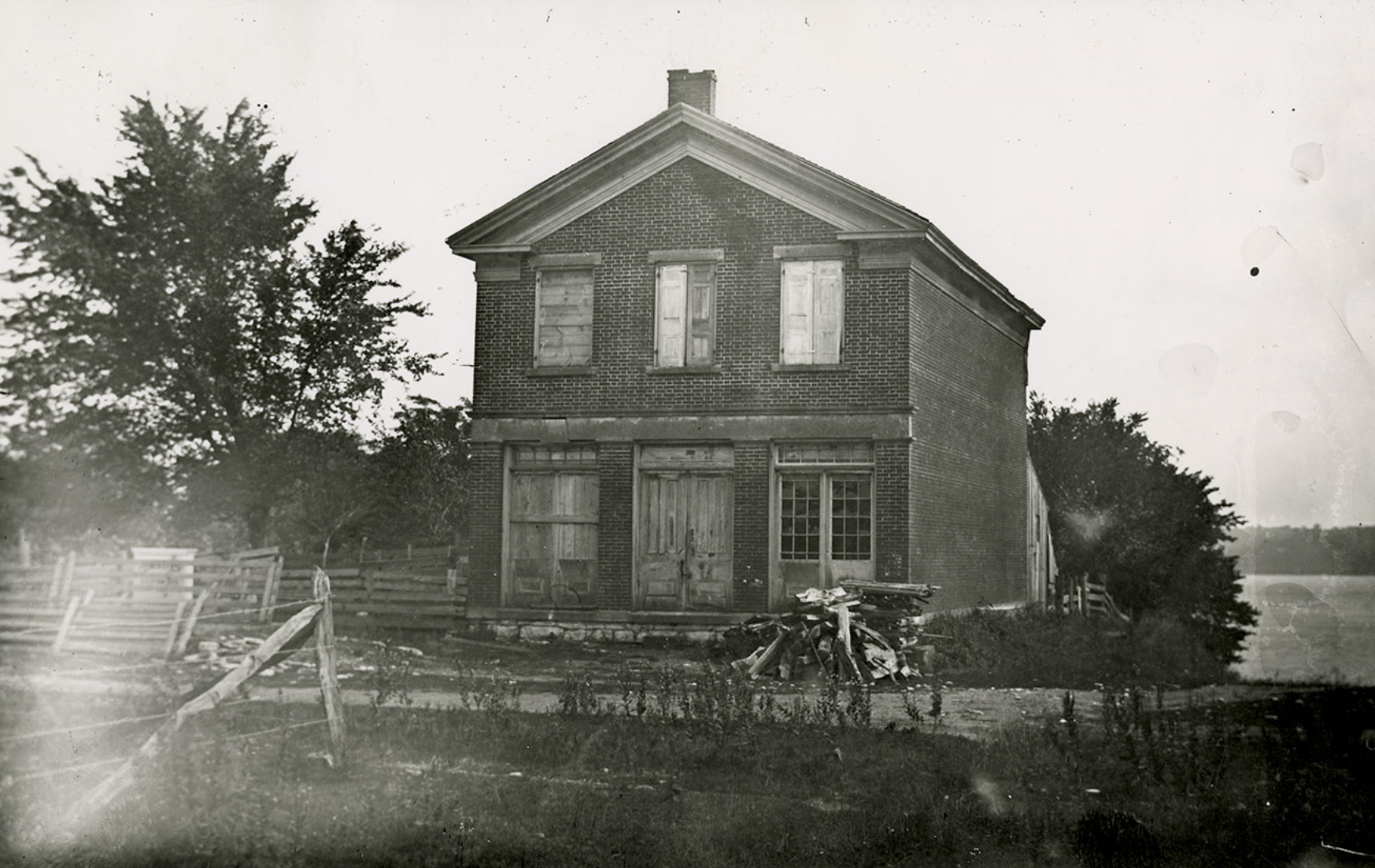
Much of that is true. Joseph Smith really was a Mason. The Nauvoo lodge minutes record him raised to Master Mason in March 1842. Seven weeks later he gave the first endowment to nine men, all of them Masons, in the upper room of his Red Brick Store, the same room where the lodge held its meetings.[3][4] And parts of that ceremony, the handgrips, the signs, the penalties, an apron, and the Five Points of Fellowship, do line up closely with the Masonry of Joseph's day. Scholars on both sides of this argument agree the resemblance is real, and so does this page.
Even the scholars who are skeptical of the Church stop well short of calling it a copy. David John Buerger's Dialogue history of the endowment is the standard critical account. He concluded that the endowment "cannot be explained as wholesale borrowing from Masonry; neither can it be explained as completely unrelated to Masonry."[5] Jeffrey Bradshaw, a Latter-day Saint scholar who has written the fullest faithful treatment of the question, works the same ground from the faithful side. He calls the temple and the lodge "distant cousins," sharing some Bible-rooted ancestry and some nineteenth-century borrowing on the surface.[6] A critic and a believer, starting from opposite ends, arrive at nearly the same description, and it is not plagiarism.
So the question is not whether the endowment has Masonic fingerprints on it. It does. The question is whether Joseph took the content of the temple from the lodge, or borrowed only a way of teaching and poured revealed content into it. Once you look past the surface, the borrowing story falls apart at four separate points.
Count the words, and the copying story shrinks
The numbers arrived in 2025. Plenty of writers had already described the similarities between the endowment and Masonic ritual. A Brigham Young University linguist named David Eddington decided to measure them instead. He ran the actual texts through a computer and counted how much the wording overlaps.[7] If Joseph copied the endowment from Masonry, the two should share a lot of language. They do not.
Two of Eddington's measures do the most work here. The first counts shared ideas, line by line. Its most generous version puts the overlap between the endowment and a nineteenth-century Masonic ritual at 17.2 percent. A stricter version drops it to 9.7 percent. Neither figure looks anything like the wholesale copying the CES Letter's questions point toward.
His second measure counts shared words rather than shared ideas.
The first comparison brings in the Odd Fellows, another fraternal lodge order of Masonry's era, with degrees and initiation rituals of its own. Eddington added their 1909 initiation ceremony to the study on purpose. He wanted, in his words, "a point of comparison with another initiation ceremony," and the Odd Fellows rite is one already known for resembling Masonry. On the shared-word measure, the Odd Fellows and the Masonic ritual overlap at 24.7 percent. The endowment and the Masonic ritual come in at 10.8 percent, less than half as much, counted the same way.
The second comparison points the same way, with one qualification. On that same shared-word measure, the endowment matches the Books of Moses and Abraham at 18.4 percent, well above its 10.8 percent match with the Masonic ritual. Joseph had translated both of those books, now part of the Pearl of Great Price, years before he ever entered a lodge. Eddington expected that result. The endowment text he worked from was missing part of the creation account, so he filled that section in himself from other online sources. Could copying from the lodge leave the lodge in second place? Even discounted for how the text was assembled, this one leans the other way. Eddington's own summary is careful about what all this means. Most writing on the subject dwells on the similarities, he notes, and without a fuller comparison that emphasis "may give the false impression of massive plagiarism on the part of Joseph Smith."[7:1]
The full breakdown, with every measurement and the methodology behind it, is in the in-depth version.
The temple language was there a decade before the lodge
The seven-week timeline drives the whole CES Letter section, and the timeline itself covers less than it seems to.
It is accurate for the gestures. The specific Masonic-style elements (the tokens, the signs, the penalties with their lodge wording, the Five Points of Fellowship) really do show up in Latter-day Saint practice for the first time in May 1842, after Joseph's initiation. That part of the timeline is fair, and there is no point disputing it.
What the seven-week frame crops out is everything that came before. The substance of the temple, named in plain scripture, had been building for more than ten years by the time Joseph entered the lodge. A few markers:
- In January 1831, a revelation promised the Saints they would be "endowed with power from on high," more than eleven years before the first endowment.[8]
- Through the 1830s, that promise was filled in step by step: a commandment to build the Kirtland Temple so the Lord could "endow those whom I have chosen with power from on high,"[9] the first washings and anointings in early 1836, baptism for the dead introduced in 1840.
- In January 1841, fourteen months before Joseph became a Mason, a revelation commanded the Nauvoo Temple by name and listed the ordinances it was built to house: "your anointings, and your washings, and your baptisms for the dead, and your solemn assemblies . . . wherein you receive conversations . . . for the glory, honor, and endowment of all."[10]
So the endowment was not a seven-week invention. It was the last layer on a decade of revealed temple teaching. Joseph added the Masonic-style gestures in 1842 to a body of doctrine that already existed, on paper, in scripture, years before any lodge meeting. Both things are true at once: the gestures are recent, the substance is old. The full chronology lays it out year by year.
The same shape shows up in places the lodge never went
What turns the whole question around is what sits underneath the Masonic-style gestures. Strip them away and the endowment still runs on a pattern: washing, anointing, sacred clothing, a new name, a series of covenants, and a step-by-step approach into God's presence. That pattern is not unique to Masonry at all. It turns up in ancient religious texts that describe initiation into sacred worship, and Joseph Smith had no documented access to any of them.
Take Cyril of Jerusalem, a Christian bishop writing around the year 350. His lectures walk a new convert through a ceremony that is startling to read next to the endowment: the candidate strips off old clothing, is anointed with oil, is washed, is clothed in a white robe called "the garment of salvation," is marked with a sign, and is given a new name.[11] Cyril's lectures reached complete English translation only in 1838, four years before the first endowment, in an Oxford scholarly series. Nothing in the record shows a copy reaching frontier Illinois, let alone Joseph's hands.
Or take the Mari Investiture Panel, a wall painting from a Babylonian palace made around 1800 BC. In the main scene the goddess Ishtar holds out the symbols of power to a king, inside a temple setting with palm trees and guardian figures. Bradshaw reads the whole panel as a picture of a temple ritual, with a garden courtyard, a procession, and guardians posted at each inner doorway. Archaeologists did not even dig it out of the ground until the 1930s, almost a century after Joseph's death.[12] He could not have known it existed.
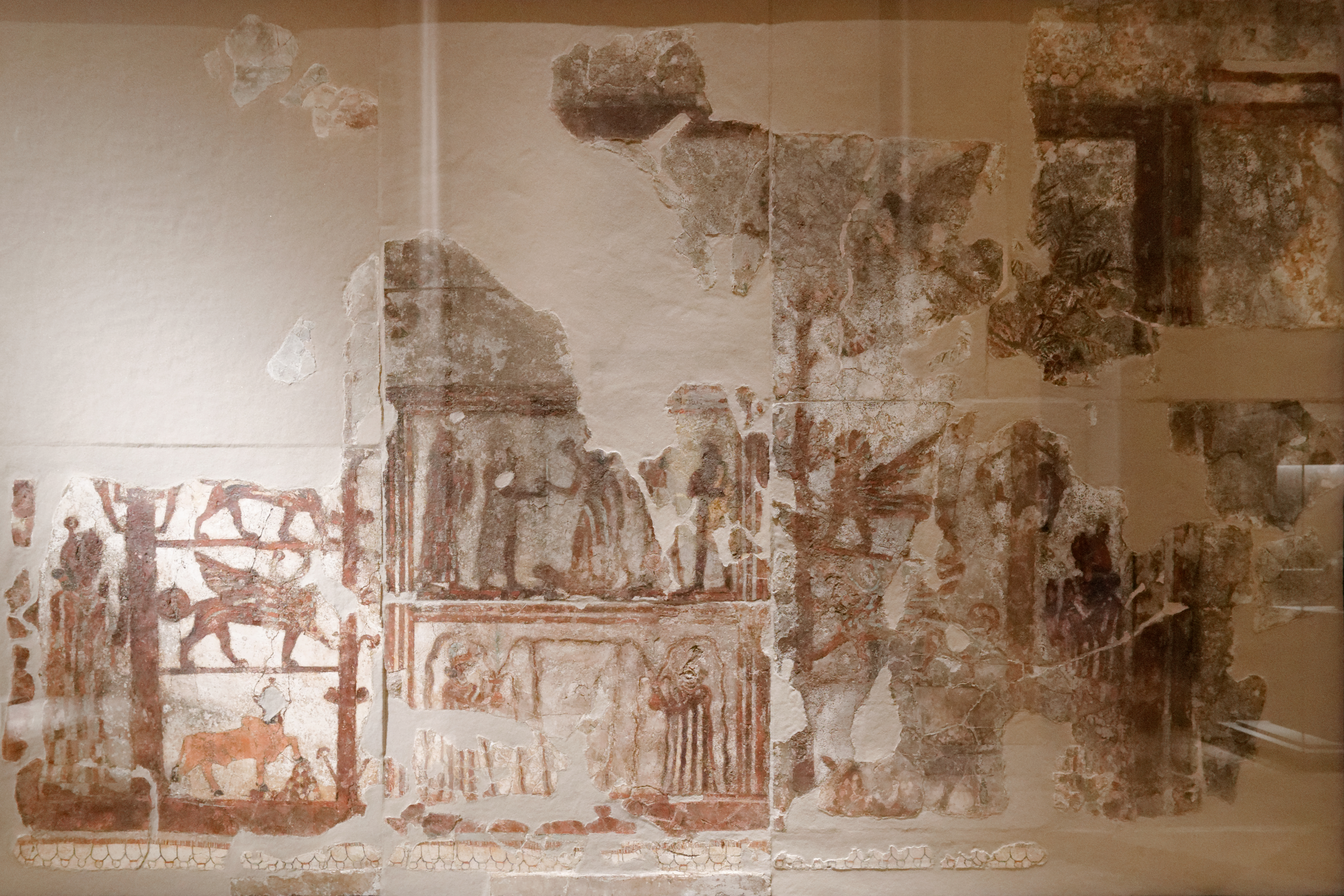
Reading those parallels as a preview of the temple endowment is a faithful reading rather than a neutral one, and a reader who does not share that faith may find them suggestive without finding them proof. What they do settle is narrower, and it is enough: the lodge is not the only place this shape exists. This is why the faithful answer splits form from content. The Masonry Joseph joined in 1842 was an eighteenth-century English fraternity, not an ancient one. Even Freemasonry's defenders admit, and the CES Letter agrees, that the lodge has no real link back to Solomon's temple. So the temple's deep pattern cannot have come through Masonry, because Masonry did not carry it. What the endowment shares with antiquity, it shares directly.
Greg Kearney, a Latter-day Saint who is himself a Master Mason, gets the blunt version of the question: did the temple endowment come from Freemasonry? His answer is "a qualified yes," and the qualification is the whole point. Joseph saw in the lodge an effective way to teach a sequence of covenants to ordinary people, many of them barely able to read, and he used that teaching method to deliver content that came from somewhere else entirely.[13]
The wider catalog of ancient parallels, from the Dead Sea Scrolls to early Christian and Jewish texts, is laid out in the in-depth version.
The closest match, and what became of it
The Five Points of Fellowship, the parallel the CES Letter leads with, is the place where the wording really does line up almost exactly. The temple text read "inside of right foot by the side of right foot, knee to knee, breast to breast, hand to back, and mouth to ear." The Masonic text read "foot to foot, knee to knee, breast to breast, hand to back, and cheek to cheek, or mouth to ear."[2:1] That is too close to be an accident, and waving it away would be its own kind of dodge. The form of that gesture was borrowed from Masonry.
Two things keep it from sinking the larger claim. First, the gesture and its meaning were not the same in the two settings. In the lodge it is the climax of a play about a murdered architect, and its lesson is loyalty between Masonic brothers. In the temple it was the moment a person was received by Christ. Same physical form, different meaning poured into it. Second, and more to the point, the Church removed the Five Points of Fellowship from the endowment in 1990, along with the symbolic penalties, the other element whose wording matched the lodge.[14] The single closest parallel the CES Letter can produce is for something that is no longer part of the ceremony. (Whether those 1990 changes are themselves a problem is a separate question, handled in the article on temple changes.)
One more thing cuts against the simplest faithful story. Joseph did not need to be formally initiated in 1842 to know what Masonic ritual looked like. His brother Hyrum had been a Mason since the mid-1820s, and other men close to him were Masons too, so he had been near Masonic content for fifteen years before he ever joined.[15] You cannot claim the endowment was developed in a sealed room with no Masonic influence in the air. The claim that holds is narrower: the substance of the temple, the creation, the Fall, the covenants made with God, the Atonement, came from years of revelation and scripture, not from the lodge, whatever gestures Joseph drew from Masonry along the way.
Distant cousins at most
The form is partly Masonic, and that has been true on every line of this page. The handgrips, the signs, the apron, the now-removed penalties and Five Points of Fellowship: Joseph drew those from the lodge he had joined. Against that sit four things the record shows. The temple language was in scripture for a decade before the lodge. Counting shared words, the Odd Fellows sit closer to Masonic ritual than the endowment does, and the endowment sits closer to the Books of Moses and Abraham than to the lodge. The deep pattern of the ceremony turns up in ancient texts there is no sign Joseph ever saw. And the one element that matched Masonry most closely is the one the Church took back out.
What is left in the temple when you subtract every borrowed gesture is the part that matters: the account of creation and the Fall, the covenants a person makes with God, the Atonement of Jesus Christ, and the return into God's presence. None of that is in Masonry at any level anyone has documented. Joseph borrowed a way of teaching from the lodge. He did not borrow what he taught.
Want the full case, including the strongest arguments the critics make and every source? Read the in-depth version.
Runnells, CES Letter (2017), "Temples & Freemasonry," no. 1, p. 107. ↩︎
Runnells, CES Letter (2017), "Temples & Freemasonry," p. 109. The CES Letter prints the two texts one above the other beneath an illustration captioned "MASTER GIVING THE GRAND MASONIC WORD ON THE FIVE POINTS OF FELLOWSHIP." ↩︎ ↩︎
"Minutes, 15–16 March 1842, as Recorded in Nauvoo Masonic Lodge Minute Book," Joseph Smith Papers. The minutes record Joseph Smith and Sidney Rigdon initiated Entered Apprentice on the evening of March 15, passed to Fellow Craft the morning of March 16, and Joseph raised to Master Mason at the 2 PM session that day, with Grand Master Abraham Jonas of the Grand Lodge of Illinois presiding. Jonas's written dispensation authorized the lodge to confer the degrees "as speedily as the nature of the case will admit." https://www.josephsmithpapers.org/paper-summary/minutes-15-16-march-1842-as-recorded-in-nauvoo-masonic-lodge-minute-book/3 ↩︎
"Temple Endowment," Church History Topics, The Church of Jesus Christ of Latter-day Saints. https://www.churchofjesuschrist.org/study/history/topics/temple-endowment?lang=eng ↩︎
David John Buerger, "The Development of the Mormon Temple Endowment Ceremony," Dialogue: A Journal of Mormon Thought 20, no. 4 (Winter 1987): 33–76. Buerger identifies tokens, signs, and penalties as the three categories of "very marked" overlap between the May 1842 endowment and contemporary Masonic ritual, while explicitly noting the absence of Masonic parallels for the creation/Fall narrative, major covenants, and washings/anointings. Buerger reproduces the June 1842 Heber C. Kimball letter to Parley P. Pratt with the verbatim wording "Thare is a similarity of preast Hood in Masonry. Br. Joseph Ses Masonry was taken from preasthood but has become degenerated. But menny things are perfect." https://www.dialoguejournal.com/articles/the-development-of-the-mormon-temple-endowment-ceremony-2/ ↩︎
Jeffrey M. Bradshaw, "An Important New Study of Freemasonry and the Latter-day Saints: What's Good, What's Questionable, and What's Missing in Method Infinite," Interpreter: A Journal of Latter-day Saint Faith and Scholarship 54 (2022): 223–332. Bradshaw's review of Bruno-Swick-Literski 2022, including the "distant cousins" framing. https://interpreterfoundation.org/journal/an-important-new-study-of-freemasonry-and-the-latter-day-saints-whats-good-whats-questionable-and-whats-missing-in-method-infinite/ ↩︎
David Eddington, "A Textual Comparison of Masonic Rites and the LDS Temple Endowment," Interpreter: A Journal of Latter-day Saint Faith and Scholarship 66 (2025): 311–326. Quantitative analysis using n-gram, vocabulary-overlap, and conceptual-similarity techniques across the 1931 Paden version of the LDS endowment, the 1866 Duncan Masonic ritual, the Pearl of Great Price (Books of Moses and Abraham), Cyril of Jerusalem's Mystagogical Catecheses, and the 1909 Odd Fellows rite. Core findings: 9.7–17.2% conceptual overlap between endowment and Masonic rite; 18.4% vocabulary overlap with the Pearl of Great Price; 24.7% Masonic-Odd Fellows vocabulary overlap; bigram similarity between endowment and Cyril higher than between endowment and Masonic rite. Methodological caveats: the 1931 Paden text is a publicly available proxy for an unavailable 1842 original; bigram comparison across translated texts is sensitive to translator vocabulary choices; vocabulary measures word-frequency overlap rather than ritual-form overlap; the Cyril comparison has a Christian-vocabulary confound on the bigram measure. https://interpreterfoundation.org/journal/a-textual-comparison-of-masonic-rites-and-the-lds-temple-endowment/ ↩︎ ↩︎
Doctrine and Covenants 38:32. Revelation given through Joseph Smith, January 2, 1831. https://www.churchofjesuschrist.org/study/scriptures/dc-testament/dc/38?lang=eng ↩︎
Doctrine and Covenants 95:8. Revelation given through Joseph Smith, June 1, 1833, commanding the Kirtland Temple. https://www.churchofjesuschrist.org/study/scriptures/dc-testament/dc/95?lang=eng ↩︎
Doctrine and Covenants 124:38–41. Revelation given through Joseph Smith at Nauvoo, Illinois, January 19, 1841 — fourteen months before Joseph's Masonic initiation. The Lord names anointings, washings, baptisms for the dead, and solemn assemblies as the ordinances to be revealed in the Nauvoo Temple. https://www.churchofjesuschrist.org/study/scriptures/dc-testament/dc/124?lang=eng ↩︎
Cyril of Jerusalem, Mystagogical Catecheses, c. 350 AD. Five lectures detailing Christian initiation: stripping, anointing with oil "from the very hairs of your head" (Lecture 20:2–4), triple immersion baptism, clothing in white robes (19:10–11), reception of a sealing sign, and a new name. F. L. Cross, ed., St. Cyril of Jerusalem's Lectures on the Christian Sacraments (Crestwood, NY: St. Vladimir's Seminary Press, 1977), is the standard modern English edition. ↩︎
Jeffrey M. Bradshaw, "Freemasonry and the Origins of Modern Temple Ordinances," Interpreter: A Journal of Latter-day Saint Faith and Scholarship 15 (2015): 159–237. Bradshaw documents the pre-1842 chronology of endowment-related teaching, including Joseph's November 1835 instruction to the Twelve about the necessity of an endowment, the Mari Investiture Panel as a Bronze Age Mesopotamian parallel, and the multiple primary-source attestations of the "Masonry came from priesthood" framework from Willard Richards, Benjamin Johnson, and Franklin D. Richards. Bradshaw 2015 (p. 162) addresses the silence of the endowed Masons: "none of the many contemporary Mormon Masons who remained faithful to the Prophet following their temple endowment expressed a concern that Joseph Smith had been untrue to his Masonic oaths by incorporating some Masonic elements into the endowment ceremony." https://interpreterfoundation.org/journal/freemasonry-and-the-origins-of-modern-temple-ordinances/ ↩︎
Greg Kearney, "The Message and the Messenger: Latter-day Saints and Freemasonry," paper presented at the FAIR Conference, August 2005. Kearney is a Latter-day Saint Master Mason. The 2005 paper is the source the CES Letter cites for the "no continuous functioning line from Solomon's Temple" admission; the CES Letter's "medieval stone tradesmen" quotation comes from a different FAIR source, "Similarities Between Masonic and Mormon Temple Ritual." The admission sits in the session's question-and-answer period, in reply to a question about whether Masonry came out of the endowment: "It would be if you believed that Freemasonry has a continuous historical line from King Solomon's Temple to the current. Unfortunately, there is no historical evidence to support a continuous functioning line from Solomon's Temple to the present." The verbatim text in Kearney's paper on Masonry's origins reads: "Freemasonry as we know it today can trace its origins only as far back as the medieval stone Masons guilds of the Middle Ages." https://www.fairlatterdaysaints.org/conference_home/2009-2005-fair-conferences/august-2005-fair-conference/the-message-and-the-messenger-latter-day-saints-and-freemasonry ↩︎
David John Buerger, The Mysteries of Godliness: A History of Mormon Temple Worship, 2nd ed. (Salt Lake City: Signature Books, 2002), chapters 7–8. Buerger documents the 1990 changes that removed the symbolic penalties and the Five Points of Fellowship at the veil, alongside earlier and later revisions. The 1990 dating is well-documented in contemporaneous Salt Lake Tribune coverage and in Buerger's book-length treatment. The Church History Topics page on "Adjustments to Temple Work" discusses the broader history of temple revisions but does not name 1990 specifically. https://www.signaturebooks.com/books/p/the-mysteries-of-godliness ↩︎
Joseph's pre-initiation exposure to Masonic content runs through multiple inner-circle associates fifteen years before his March 1842 initiation. Hyrum Smith joined Freemasonry between 1825 and 1827. Heber C. Kimball was a Mason before Joseph. John C. Bennett, an active Mason, was politically pushing Mormons toward Masonry. Buerger p. 42 lists prominent Mormons "all of whom were Freemasons prior to joining the Church," including Deputy Grand Master of Illinois James Adams, Heber C. Kimball, Newel K. Whitney, George Miller, John C. Bennett, John Smith, and Brigham Young. The pre-1842 LDS ritual development was therefore not strictly Masonry-independent in a cultural-availability sense, and this concession cuts genuinely against the simplest "fifteen years of Masonry-independent preparation" framing. See Buerger, "The Development of the Mormon Temple Endowment Ceremony," Dialogue 20, no. 4 (Winter 1987): 33–76, on the Hyrum/Kimball/Bennett biographical particulars. ↩︎