Transparency & Censorship
The claim:
"The dominant narrative is not true. It can't be sustained." — Richard Bushman, LDS Historian, Scholar, Patriarch[1]
The CES Letter opens its "Other Concerns" section with that one sentence in big type, and builds a case around it: the Church has hidden the embarrassing parts of its own past. It points to the seer stone, to the multiple First Vision accounts, to polygamy smoothed over in Sunday School manuals, to a few edited quotations, and to a 2013 change in the scriptures about the old priesthood and temple ban. The picture it paints is of an institution that covers things up and only admits them when it gets caught.
There is a real kernel here. The Church has not been uniformly open in every decade. Some of the specific edits the CES Letter catches are real edits. A member who grew up on the simplified Sunday-school version of Church history and then ran into the documented record could feel genuinely misled, and that feeling deserves to be taken seriously, not waved off.
But the case has one structural flaw, and it runs through every example. The CES Letter freezes the Church at a single moment, 2013, and prints that snapshot as if it were the whole story. Look closely at that particular year. December 2013 is when the Church published its essay disavowing the old racial teachings behind the priesthood ban. It was also smack in the middle of the years the Church was rolling out essay after essay on exactly the hard topics the CES Letter says it hides. And by 2013 the Church was already five years into publishing every surviving scrap of Joseph Smith's papers, free, online, to the editing standard of the U.S. National Archives. The letter caught a Church in the act of opening up and described it as a Church locking the door.
Read the quote on the cover all the way to the end
Start with that Bushman line on the cover, because it shows the move the whole section runs on.
Richard Bushman is not a critic. He is a faithful Latter-day Saint, an emeritus history professor from Columbia University, a stake patriarch, and the author of the scholarly biography of Joseph Smith that both critics and believers cite. He really did say "the dominant narrative is not true. It can't be sustained." He said it at a small fireside in 2016. But look at the sentence the CES Letter cuts off right before. Here is the full thought:
"I think for the Church to remain strong it has to reconstruct its narrative. The dominant narrative is not true. It can't be sustained. The Church has to absorb all this new information or it will be on very shaky grounds, and that's what it's trying to do."[2]
"And that's what it's trying to do." That closing clause carries the whole meaning, and it is exactly the clause that disappears. Bushman is not throwing in the towel. He is saying the old, simplified, correlation-era story of Church history, the version its lesson manuals taught, can't carry the full documented record, and then in the very same breath he praises the Church for fixing that. The Church is the hero of the sentence the CES Letter deletes.
People began misreading him as soon as the transcript circulated, and, as he later put it, "some people thought I had thrown in the towel and finally admitted the Church's story of its divine origins did not hold up."[3] On July 16, 2016, five weeks after the fireside, the Latter-day Saint scholar Daniel Peterson published a note from Bushman, with his permission, answering the misreading directly: "In my opinion, nothing in the new material overturns the basic thrust of the story. I still believe in gold plates. I don't think Joseph Smith could have dictated the Book of Mormon text without inspiration. I think he was sincere in saying he saw God."[4] Asked point blank, in a published interview, whether his decades of research had undermined his faith in Joseph Smith, he answered: "I can truthfully answer these uneasy people no."[5]
So the headline quote, read whole, says the opposite of what it is used to prove. Bushman and the CES Letter actually agree on one thing, that the simplified story needed reconstructing. They split on what that means. Bushman concludes the faith survives the harder, fuller history. The CES Letter concludes it doesn't.
The 2013 scripture change, and the essay published the same year
The CES Letter's lead example is a side-by-side. On one side it puts a sentence added in 2013 to the heading above Official Declaration 2, the 1978 revelation that opened the priesthood and temple to all worthy men:
"Early in its history, Church leaders stopped conferring the priesthood on black males of African descent. Church records offer no clear insights into the origins of this practice."[6]
On the other side it puts a 1949 First Presidency statement that said the opposite, in confident terms:
"It is not a matter of the declaration of a policy but of direct commandment from the Lord…"[7]
The charge writes itself. In 1949, the Church said the ban came by direct commandment from God. In 2013, the Church said the records reveal nothing about where the ban came from. So which is it, and isn't the 2013 version a quiet rewrite of history that pretends the 1949 claim never happened?
The juxtaposition is fair as far as it goes. The 1949 statement did claim a direct commandment. The 2013 heading does reframe that. What the CES Letter leaves out is when the 2013 heading was published and what came with it. That heading went into the scriptures in 2013. In December of that same year, the Church published its Race and the Priesthood essay on its own site, with the endorsement of the First Presidency and of the Twelve. Far from being two opposing acts by two different Churches, the heading and the essay are a single act: the heading is the short scriptural footnote, and the essay is the long, candid explanation behind it. The essay does not dodge the 1949 theology either. It names it and rejects it:
"Today, the Church disavows the theories advanced in the past that black skin is a sign of divine disfavor or curse, or that it reflects unrighteous actions in a premortal life; that mixed-race marriages are a sin; or that blacks or people of any other race or ethnicity are inferior in any way to anyone else."[8]
Quietly burying an old claim and publishing a website essay that rejects it by name are not the same move. The Church chose the second one. The CES Letter's argument only works if you read the heading by itself and never turn to the essay sitting right beside it.
What the 2013 essay concedes is heavy. The Church is admitting that for well over a century its leaders taught a racial theology that was simply wrong, and that the confident 1949 statement was wrong both about where the ban came from and about why. For a Church that believes in prophetic leadership, that is a hard thing to put in writing. But putting it in writing, on its own website, is how an institution corrects itself in public. A cover-up does the reverse. The deeper history of the ban itself, who started it and when, is its own subject, handled in Priesthood and Temple Ban.
The Church historian "admits censorship," read in full
The CES Letter's third sharp example quotes the man who was the Church's official Historian in 2013, Elder Steven E. Snow, and presents him as a hostile witness confessing the cover-up. The line it uses, with the CES Letter's own bold:
"I think in the past there was a tendency to keep a lot of the records closed or at least not give access to information. But the world has changed in the last generation—with the access to information on the Internet, we can't continue that pattern; I think we need to continue to be more open."[9]
The letter bolds only the first half. Read the whole sentence and the shape of it is unmistakable. Snow says three things in a row: we used to keep records closed; the world has changed and we can't keep doing that; we need to be more open, and we are. A man describing an ongoing cover-up does not talk like that. This is the Church's own Historian standing up and announcing that the old way is over, and he is the one ending it.
The rest of the same interview makes that even plainer. Snow also said, in the same conversation, "My view is that being open about our history solves a whole lot more problems than it creates," and "[W]e now have pretty remarkable transparency… I think in the long run that will serve us well."[9:1] The CES Letter keeps his diagnosis and cuts his cure, which sits in the very next clause.
What the Church was actually doing while it "hid" everything
So if the Church was supposedly hiding its history, look at what it was doing with its hands during these exact years.
The big one first. From 2001 to 2023, the Church ran the Joseph Smith Papers Project: a complete, scholarly publication of every known document Joseph Smith produced or that was written to him. Twenty-seven printed volumes, 18,822 pages, more than 7.4 million words, 49,687 footnotes, all of it free online and fully searchable, including his hardest diaries, letters, and revelations.[10] It was done to the editorial standard of the U.S. National Archives, the same standard used for the papers of Washington and Jefferson, and one outside historian called it "the gold standard in the field of historical documentary editing."[11] An institution hiding its founder does not spend twenty-two years and millions of dollars putting his every word on the internet for anyone to read.
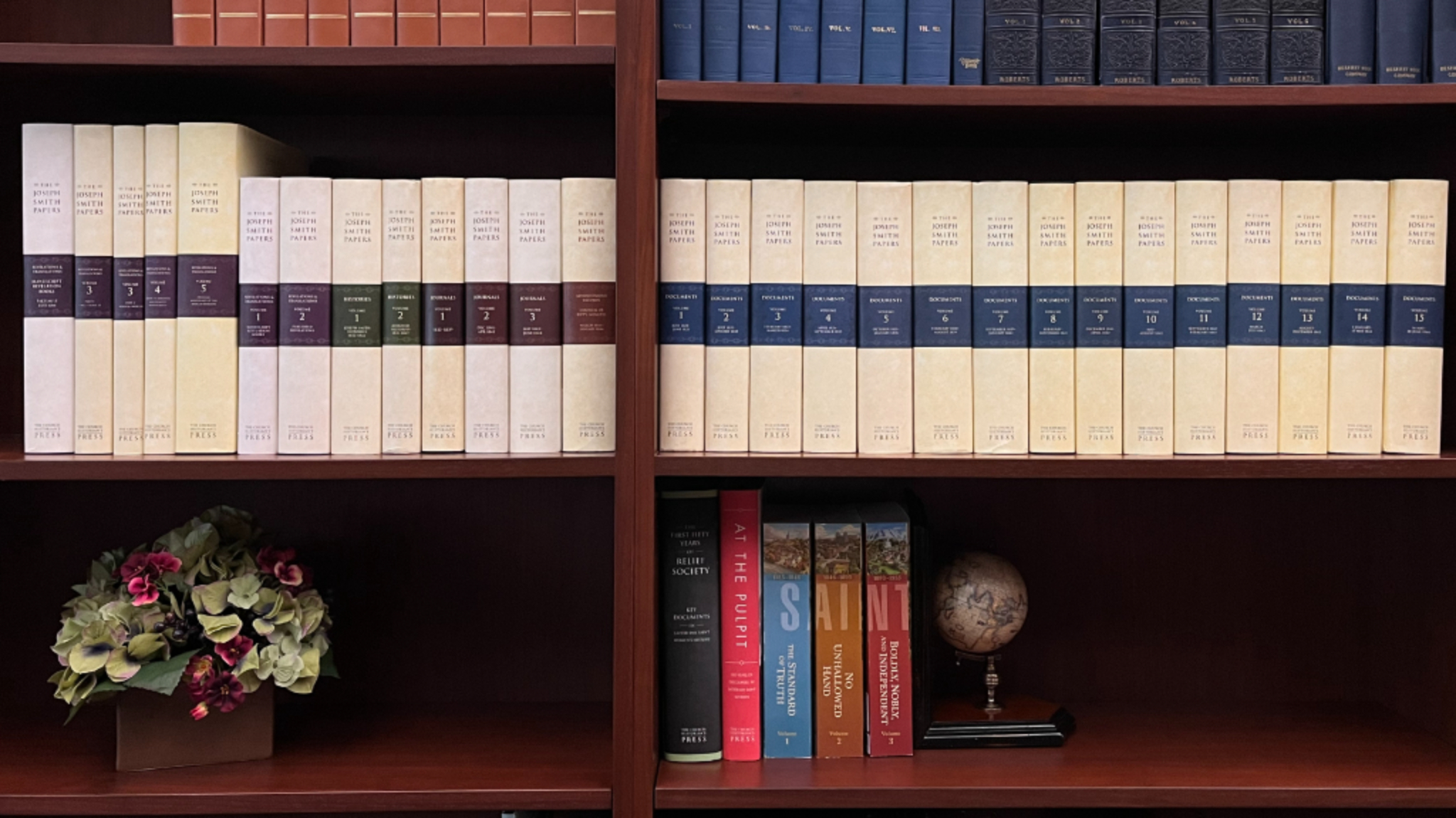
Next, the Gospel Topics Essays. Between November 2013 and October 2015, the Church published thirteen essays on its own website, approved by the First Presidency and the Quorum of the Twelve, taking on its most uncomfortable topics head-on.[12] The list reads almost exactly like the table of contents of the CES Letter: the seer stone and the hat, the multiple First Vision accounts, the priesthood ban, Joseph Smith's plural marriages including marriages to women already married to other men, the Book of Abraham and the papyri problem. The Church wrote candid, footnoted essays on the very things the CES Letter says it suppresses, and it did it during the same months the CES Letter was being written and revised.
Then came Saints, a four-volume narrative history of the Church published from 2018 to 2024, free, in fourteen languages, the first official multi-volume history in nearly a century.[13][14] It tells the story openly: the seer stone, plural marriage, polyandry, the Mountain Meadows Massacre, the priesthood ban, all of it, written for ordinary members and built right into the Church's teaching materials.
Line up the dates and the CES Letter's whole frame collapses. The letter first went out in April 2013 and was last updated in October 2017. That window sits right on top of the busiest stretch of all this openness: the essays came out in 2013 through 2015, the seer-stone photographs were published in an official Church magazine in 2015, the Joseph Smith Papers had already been in print since 2008. The 2017 update was free to engage any of it. It chose not to. A fuller timeline of everything the Church published in these years is laid out in the in-depth version.
About those edited manuals
The CES Letter also catches the Church editing a few specific quotations in its lesson manuals, and those examples are real.
There are three. A 1997 Brigham Young Sunday School manual changed his word "wives" to "[wife]" in two spots, and left out altogether his very real nineteenth-century teaching that linked plural marriage to becoming like God.[15] A 2012 Lorenzo Snow manual quoted his 1899 plea about tithing but cut three words with an ellipsis: the original asked "every man, woman and child who has means" to pay, and the manual dropped "who has means," turning a request aimed at those who could afford it into a flat command for everyone.[16][17] And a curated Church webpage about an early Relief Society president, Zina Huntington, told her story without ever mentioning that she had been sealed to Joseph Smith while married to another man, even though the Church's own genealogy records showed it plainly.
The Lorenzo Snow edit in particular changes the meaning of what he said, and a faithful member can reasonably wish the manual had left his words alone. Taken together they show something true: during the decades when the Church was focused on simple, faith-building lessons for a worldwide membership, it sometimes smoothed the rough, complicated parts of its own history out of its teaching materials. That is a real pattern.
It needs to be kept in proportion, though, for two reasons. First, the originals were never hidden. Brigham Young's sermon sits in a published 26-volume set anyone can read; Lorenzo Snow's full address is in the public conference record; Zina's sealing is in the Church's own genealogy index, which is exactly how the CES Letter knows about it. Second, the same Church that simplified those manuals turned around and published the Saints volumes and the Gospel Topics Essays, which lay out Brigham Young's plural-marriage teachings and the full story of women like Zina without any of the smoothing. The fuller treatment of each edit lives in the in-depth version and in the Joseph Smith's Marriages and Church Finances articles.
The long wait to teach it
The criticism that is left after all this context is not "the Church hid things." It is slower and harder to answer: the Church had the documents and the research in hand for decades, and waited a very long time to teach them.
That part is true, and the numbers are uncomfortable. A faithful scholar laid out the multiple First Vision accounts side by side in a Church-owned journal in 1969; the Church didn't build them into its standard curriculum until the 2013 essay, a 44-year gap. A landmark study showing the priesthood ban had no founding revelation came out in 1973; the essay disavowing the racial theology came in 2013, 40 years later. The seer stone was mentioned in Church magazines as far back as 1974, but the photographs weren't published until 2015. A fact can sit in a Church journal almost nobody reads and never once reach the member in the pew. For most of the late twentieth century, the average Latter-day Saint simply was not taught the seer stone in the hat, or the multiple First Vision accounts, or the full story of plural marriage, in the lessons they actually attended. The Church can be fairly faulted for being slow to fold these things into what it teaches everyone.
The most serious form of this comes from a faithful historian, not a critic. Patrick Mason, who holds an endowed chair in Mormon history and is himself a believing Latter-day Saint, has written that the disciplining of several scholars in 1993 sent a chilling message, and that for roughly a decade afterward young LDS scholars learned to keep their heads down on sensitive history.[18] He calls it a "lost generation." His point is hard precisely because he is faithful and can't be dismissed as having an axe to grind. He argues the Church's recovery since 2007 is real and substantial, and that some of the damage from those years still hasn't healed. A fair answer holds both halves of what he says, the recovery and the scar. His fuller case is taken up in Anti-Intellectualism.
One objection remains. The Church opened up partly because the internet made the old approach impossible, a point Elder Snow made openly. So you can read the whole turn as the Church reacting to pressure rather than acting on fresh revelation. That is a fair challenge. But reacting to changed conditions is what every living institution does, and Latter-day Saint scripture frames revelation as working exactly that way: God gives his people line upon line, "after the manner of their language, that they might come to understanding," and asks them to study a thing out and then bring it to him. When pressure produces real, public course-correction, that is not evidence against a living, revealing Church. It is closer to what you would expect one to look like.
One frame of a longer film
Take the six examples together and they turn out to share one trick. Each one freezes the Church at a single frame, around 2013, and prints the still photo as if it were the whole film. The film is of a Church in the middle of opening up: publishing its founder's every document, writing candid essays on its hardest topics, and producing a frank narrative history, all of it free, all of it while the CES Letter was circulating. The letter stopped updating in 2017. Run the film to 2024: what happens to its six examples? Keep both columns of the ledger. The real concessions, the edited manuals, the slow curricular catch-up, the scars of the 1990s, belong in the account. So does a religious-history transparency project no other major American faith has matched in our lifetime. The CES Letter shows you only the first column.
And when a few of these questions reach a place where the most honest answer is "we don't fully know yet," there is still something solid to stand on. The Book of Mormon was dictated in roughly sixty working days, about 270,000 words, by a young man who had little formal schooling, with no notes and no rewrites, and not one of the eleven witnesses ever took back his testimony, including the ones who left the Church angry at Joseph Smith.[19] The same Church that was sometimes slow to teach its own history also put that founding scripture through decades of line-by-line expert scrutiny and published the results in the open. An institution behaving like it has something to hide does not do any of that. This one keeps inviting the scrutiny instead of running from it.
Want the full case, including the strongest arguments the critics make and every source? Read the in-depth version.
Runnells, CES Letter (2017), "Other Concerns," p. 112. The cover-of-section page presents the Bushman quote in display type with his attribution: "Richard Bushman, LDS Historian, Scholar, Patriarch." ↩︎
Richard L. Bushman, "Faith Again" fireside, June 12, 2016, at Mark England's home. Transcript: Jonathan Ellis, "Transcript of Claudia and Richard Bushman's Remarks at Faith Again," Medium (July 21, 2016). https://medium.com/@jellistx/transcript-of-claudia-and-richard-bushmans-remarks-at-faith-again-e9d03bdea0e3. Bushman's full statement in context: "I think for the Church to remain strong it has to reconstruct its narrative. The dominant narrative is not true. It can't be sustained. The Church has to absorb all this new information or it will be on very shaky grounds, and that's what it's trying to do." ↩︎
Daniel C. Peterson, "Yet, again: Has Richard Bushman declared the 'dominant narrative' of Church history 'false'?" Patheos (March 2020). https://www.patheos.com/blogs/danpeterson/2020/03/yet-again-has-richard-bushman-declared-the-dominant-narrative-of-church-history-false.html. Reproduces the critic-supplied fireside transcript, Jim Bennett's context note, and Bushman's post-fireside "kerfuffle" statement: "some people thought I had thrown in the towel and finally admitted the Church's story of its divine origins did not hold up"; "As it is, I still come down on the side of the believers in inspiration and divine happenings—in angels, plates, translations, revelations." ↩︎
Richard L. Bushman, note to Daniel C. Peterson, published with permission in Peterson, "Richard Bushman and the fundamental claims of Mormonism," Patheos, July 16, 2016. https://www.patheos.com/blogs/danpeterson/2016/07/richard-bushman-and-the-fundamental-claims-of-mormonism.html. Clarifying his June 12, 2016 "Faith Again" fireside remarks. The note closes: "I believe pretty much the same things I did sixty years ago when I was a missionary." ↩︎
Richard L. Bushman, "Richard Lyman Bushman" (interview by Jed Woodworth), in Conversations with Mormon Historians, ed. Alexander L. Baugh and Reid L. Neilson (Provo, UT: Brigham Young University Religious Studies Center, 2015), 181–230. https://rsc.byu.edu/conversations-mormon-historians/richard-lyman-bushman. Asked repeatedly whether his historical research had shaken his faith in Joseph Smith, Bushman answered: "I can truthfully answer these uneasy people no." ↩︎
2013 Official Declaration 2 Header, in Doctrine and Covenants (Salt Lake City: The Church of Jesus Christ of Latter-day Saints, 2013 edition forward). The header reads: "Early in its history, Church leaders stopped conferring the priesthood on black males of African descent. Church records offer no clear insights into the origins of this practice." https://www.churchofjesuschrist.org/study/scriptures/dc-testament/od/2 ↩︎
First Presidency Statement, August 17, 1949, signed by President George Albert Smith, First Counselor J. Reuben Clark, and Second Counselor David O. McKay. Verbatim text in the form quoted by the CES Letter and reproduced widely in scholarly treatments. See W. Paul Reeve, Religion of a Different Color: Race and the Mormon Struggle for Whiteness (New York: Oxford University Press, 2015), and Lester E. Bush Jr., "Mormonism's Negro Doctrine: An Historical Overview," Dialogue: A Journal of Mormon Thought 8, no. 1 (Spring 1973): 11–68. ↩︎
"Race and the Priesthood," Gospel Topics Essay (December 6, 2013; updated October 2015). The Church of Jesus Christ of Latter-day Saints. https://www.churchofjesuschrist.org/study/manual/gospel-topics-essays/race-and-the-priesthood ↩︎
Richard E. Bennett and Dana M. Pike, "Start with Faith: A Conversation with Elder Steven E. Snow," Religious Educator 14, no. 3 (2013): 1–11. https://rsc.byu.edu/vol-14-no-3-2013/start-faith-conversation-elder-steven-e-snow. Other key passages from the same interview: "My view is that being open about our history solves a whole lot more problems than it creates"; "[W]e now have pretty remarkable transparency… I think in the long run that will serve us well"; on the Joseph Smith Papers: "That is a priority of the department, to get more and more out online." ↩︎ ↩︎
"Final Volume of Joseph Smith Papers Published, Completing Monumental Historical Work," Church Newsroom (June 27, 2023). https://newsroom.churchofjesuschrist.org/article/final-volume-joseph-smith-papers. Announcement includes the project's full scope: 27 volumes; 18,822 pages; 7,452,072 words; 49,687 footnotes; 1,306 journal entries; 643 letters; 155 revelations; June 27, 2023, the 179th anniversary of Joseph Smith's martyrdom. Project at https://www.josephsmithpapers.org/. ↩︎
Joseph Smith Papers Project, "About the Project" and "Endorsements." https://www.josephsmithpapers.org/articles/about-the-project. NHPRC endorsement (May 2004) — the documentary-editing arm of the U.S. National Archives. On the Miller funding: Tad Walch, "A $10M investment in Joseph Smith," Deseret News (July 23, 2023), https://www.deseret.com/faith/2023/7/23/23793106/a-10m-investment-in-joseph-smith/. Endorsements: Thomas P. Slaughter (University of Rochester): "the gold standard in the field of historical documentary editing." Laurel Thatcher Ulrich (Harvard, Pulitzer Prize winner): "The Church didn't want to hide anything about Joseph Smith. They felt confident that if the actual records, the primary sources, were available, responsible scholars would consult them." Laurie Maffly-Kipp (Washington University): "ranks with the best kinds of scholarly sources I've seen." ↩︎
"Gospel Topics Essays" index. The Church of Jesus Christ of Latter-day Saints. https://www.churchofjesuschrist.org/study/manual/gospel-topics-essays. Thirteen essays published between November 2013 and October 2015, "approved by the First Presidency and the Quorum of the Twelve Apostles." ↩︎
"First Volume of 'Saints' Now Available," Church Newsroom (September 4, 2018). https://newsroom.churchofjesuschrist.org/article/first-volume-saints-now-available. Saints, Volume 1: The Standard of Truth, 1815–1846. First official multi-volume Church history since B. H. Roberts's 1930 work. 14 languages; free digital, print, and audiobook formats. Director Matthew J. Grow: the team "presented the characters as three-dimensional, with struggles and triumphs, with flaws and with virtues." ↩︎
Saints, Volume 4: Sounded in Every Ear, 1955–2020 (Salt Lake City: The Church of Jesus Christ of Latter-day Saints, October 29, 2024). https://www.churchofjesuschrist.org/study/history/saints-v4. Engages correlation, the 1978 revelation, the September Six period, and the post-2007 institutional turn. ↩︎
FAIR, "Alleged whitewashing of polygamy in Church history." https://www.fairlatterdaysaints.org/answers/Mormonism_and_polygamy/Whitewashing_in_Church_history. Documents the Brigham Young manual's editorial conventions, including the bracket signal indicating editorial alteration. The "two instances of the term 'wives' were modified to '[wife],' with brackets included to notify the reader of the editorial change" framing. ↩︎
Lorenzo Snow, October 1899 General Conference Address, in Conference Report, October 1899, p. 28. The original includes the conditional clause: "I plead with you in the name of the Lord, and I pray that every man, woman and child who has means shall pay one-tenth of their income as a tithing." Available in archived Conference Reports. ↩︎
Teachings of Presidents of the Church: Lorenzo Snow (Salt Lake City: The Church of Jesus Christ of Latter-day Saints, 2012), Chapter 12, "Tithing, a Law for Our Protection and Advancement." https://www.churchofjesuschrist.org/study/manual/teachings-of-presidents-of-the-church-lorenzo-snow/chapter-12-tithing-a-law-for-our-protection-and-advancement. The manual reads: "I plead with you in the name of the Lord, and I pray that every man, woman and child … shall pay one-tenth of their income as a tithing." The ellipsis replaces "who has means." ↩︎
Patrick Q. Mason, "The September Six and the Lost Generation of Mormon Studies," Dialogue: A Journal of Mormon Thought 56, no. 3 (Fall 2023). https://www.dialoguejournal.com/articles/the-september-six-and-the-lost-generation-of-mormon-studies/. Mason holds the Leonard J. Arrington Chair of Mormon History and Culture at Utah State University; previously held the Howard W. Hunter Chair at Claremont Graduate University (2011–2018); PhD from the University of Notre Dame (2005); BA from BYU (1999); faithful Latter-day Saint. Mason argues the chilling effect was real, that the recovery is partial and uneven, that scars persist, and that the absence of certain critical perspectives in current LDS scholarship is a continuing cost of the years between 1993 and the early-2000s recovery. ↩︎
For documentation of the Book of Mormon translation timing, the dictation method, and the witness chain, see Royal Skousen's twenty-five-year Critical Text Project and the Joseph Smith Papers' Revelations and Translations Series, Volumes 3 and 5 (publishing the Printer's Manuscript and Original Manuscript). Grant Hardy, The Annotated Book of Mormon (Oxford University Press, 2023), is the Oxford-published annotated edition by a faithful scholar. ↩︎