Adam-God
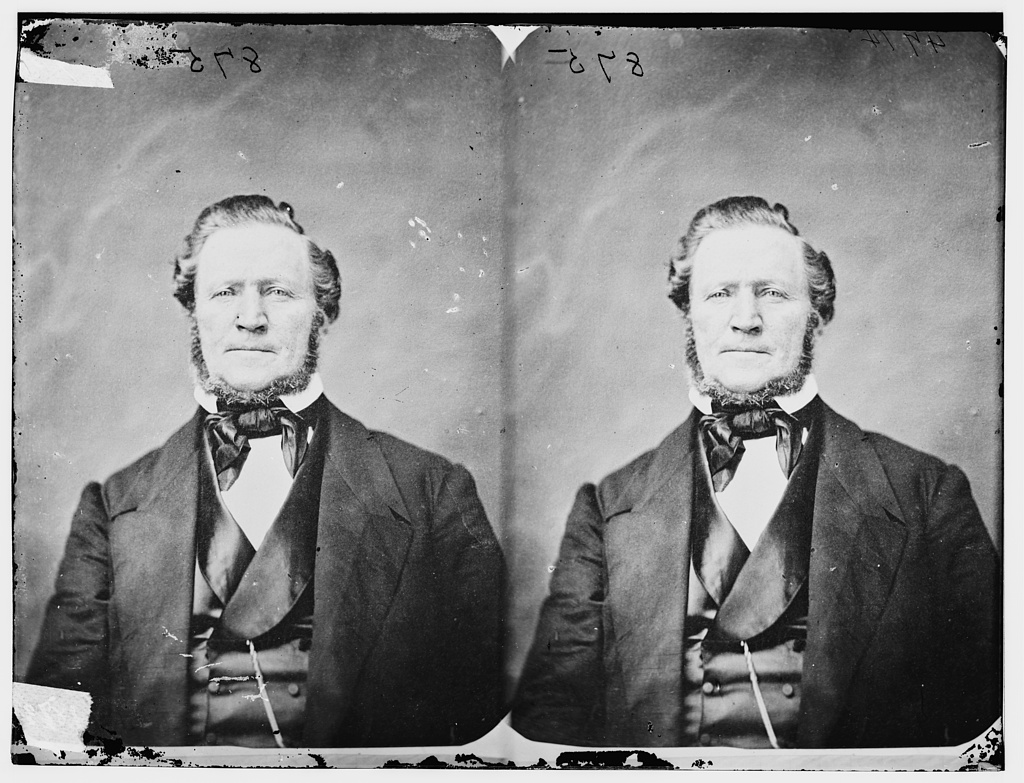
The claim:
"President Brigham Young taught what is now known as 'Adam–God theory.' He taught that Adam is 'our Father and our God, and the only God with whom we have to do.' Brigham not only taught this doctrine over the pulpit in conferences in 1852 and 1854 but he also introduced this doctrine as the Lecture at the Veil in the endowment ceremony of the Temple."[1]
"Yesterday's doctrine is today's false doctrine and yesterday's prophet is today's heretic."[2]
In plain terms, the charge comes in three parts:
- The Church's second president, Brigham Young, taught over the pulpit in 1852 and 1854 that Adam, the first man, was actually God the Father.
- He then had the same teaching written into the temple ceremony at St. George.
- Later presidents of the Church rejected that teaching outright and called it false.
If a prophet can teach something as truth that the Church later discards, the CES Letter reasons, no one can trust that the Church is led by God. So which prophet do you believe?
It is a fair question; the facts behind it are real. Brigham Young did teach this. But the answer rests on something the CES Letter never explains. The Church has always had a clear, public rule for deciding what counts as its official doctrine, and Adam-God failed it. The rule was in Latter-day Saint scripture decades before Brigham ever preached on Adam. One of Brigham's own apostles refused, publicly and for years, to accept the teaching. The Church's top council examined it in 1860 and declined to endorse it. A future president of the Church put in writing, in 1897, that it had never been accepted and that it bound no one. The correction the CES Letter treats as a modern reversal was underway while Brigham was still alive.
What Brigham actually taught
Brigham Young did teach that Adam was God, and he taught it more than once and more than casually.
In a sermon in 1852, he said of Adam, "He is our Father and our God, and the only God with whom we have to do."[3] More than two decades later, in 1873, he went further, describing the idea as "doctrine which I revealed to them, and which God revealed to me."[4] Those are the words the Church saves for true revelation. Brigham was not sharing a hunch; he was claiming God had told him directly.
He did more than preach it. In 1877, near the end of his life, he had a written version of the teaching read to people inside the St. George temple, as part of the temple ceremony.[5] That temple lecture gets its own section below. The CES Letter has this part right: Brigham taught Adam-God, and he taught it with conviction.
The rule was already in place
In this Church, a prophet's personal opinion does not automatically become binding doctrine, and there has always been a clear test for telling the two apart.
Before any teaching counts as the Church's official doctrine, it has to clear four bars. The president of the Church presents it as revelation from God. The apostles accept it. The members approve it in a churchwide vote, the practice the revelations call "common consent." And it has to square with the scriptures already on the books.
That test was not cooked up later to clean up the Adam-God mess. It went into Latter-day Saint scripture in 1830, in a revelation stating that "all things shall be done by common consent in the church."[6] Brigham's first Adam-God sermon was still twenty-two years away. The rule came first.
And Adam-God never passed it. The members never voted on it. The senior leaders never agreed on it. And it did not line up with what scripture already taught about God and Adam. Judged by the test the Church had carried since 1830, it never crossed the line into binding doctrine, however forcefully Brigham preached it.
It was never settled, even then
The CES Letter's picture only holds if everyone in Brigham's day accepted Adam-God and only later prophets turned against it. That is not how it went.
One of the most respected apostles of the time, Orson Pratt, opposed Adam-God in public almost from the start, and he never really gave in. Brigham pressed him hard, at one point threatening to take the matter to conference and have him voted a false teacher if he did not fall in line. Pratt still would not say he believed it.[7] A senior apostle openly disagreeing with the prophet, for years, is not the picture of settled doctrine.
The leaders even had a clean chance to make Adam-God official, and they passed it up. In 1860, the First Presidency, the Church's top governing body, took up the dispute in writing and chose to leave the question open rather than endorse it.[8] If it truly was the Church's doctrine, why did they let the chance go by?
Brigham himself was shakier on it than the CES Letter lets on. In an 1854 sermon on the very same subject, he hedged again and again, using the folksy phrase "I reckon" thirteen times and admitting the ideas were not really necessary for the people to know.[9] The prophet the CES Letter paints as dead certain was, in his own words, often just guessing.
The correction took decades, not a sudden flip
The CES Letter makes the rejection of Adam-God sound like a modern reversal, one prophet undoing another a century later. The real timeline runs differently.
The pushback began in Brigham's own lifetime and grew after his death. In 1897, Joseph F. Smith, a member of the First Presidency who would soon become president of the Church, wrote that Adam-God "was never formally or otherwise accepted by the Church" and was "in no sense binding."[10] That came seventy-nine years before the statement the CES Letter treats as the great reversal.
Then in 1916, the entire First Presidency and Quorum of the Twelve, the top fifteen leaders of the Church together, signed a formal declaration teaching the opposite of Adam-God: that God the Father, not Adam, is the literal Father of Jesus Christ and of all human spirits.[11] The one time the leaders spoke on the question with a single official voice, they spoke against Adam-God, and they did it sixty years before the statement critics point to.
The temple lecture
The lecture went into the ceremony at St. George in February 1877, and the temple still had its written copy in June 1892, when Church President Wilford Woodruff and his counselor George Q. Cannon told local leaders it was not necessary to teach the doctrine.[12] A sermon is something you can weigh and set aside. This was presented inside the most sacred setting the Church has, to the people who passed through that one temple, as part of their worship. Read the full account in the in-depth version.
The record never says when the lecture was retired; the documented trail ends with that 1892 counsel. The teaching itself had failed the Church's test long before then, so it never stood as binding doctrine even at the veil. But the gap between Brigham putting the lecture in and the Church letting it go was real, and it was not short. The system corrected the error. It just did not do so quickly.
The protections held
Boiled down, the episode asks one thing of a believer: that a prophet, fully convinced, can still be wrong about whether his own thinking is revelation. That sounds like a lot to grant, but it is written into Latter-day Saint scripture, in a revelation from 1831, years before Brigham's first Adam-God sermon, where the Lord speaks of servants who received his words "in their weakness," and adds that "inasmuch as they erred it might be made known."[13] Those guardrails went in at the foundation, so that one leader's mistake could never harden into the whole Church's doctrine.
So the episode proves the opposite of the point the CES Letter draws from it. Brigham Young was wrong, and he was sure of himself while he was wrong. But the system the CES Letter says broke down is the same system that caught the error: the rule written before the sermon, Orson Pratt's resistance, the 1860 decision not to make it official, the 1897 letter, the 1916 declaration. The Restoration has always been clear that its prophets are fallible men, and that the protections built around them exist for exactly this, to hold when one of them gets a hard question wrong. Adam-God was one of those moments, and the protections held.
Want the full case, including Brigham's hedging in his own words, the other leaders who pushed back, and every primary source? Read the in-depth version.
Runnells, CES Letter (2017), "Prophets," no. 1, p. 62. ↩︎
Runnells, CES Letter (2017), "Prophets," p. 63, the sentence concluding the Adam-God item. Variant forms recur on pp. 64 and 66. ↩︎
Brigham Young, discourse of April 9, 1852, Journal of Discourses 1:50–51 (Liverpool: F. D. & S. W. Richards, 1854). The discourse was scribed by George D. Watt and is preserved both in the Journal of Discourses and in independent journal entries by Wilford Woodruff, Hosea Stout, and Samuel Rogers. ↩︎
Brigham Young, discourse of June 8, 1873, Deseret News, vol. 22, no. 20 (June 18, 1873): 308. ↩︎
L. John Nuttall journal entry of February 7, 1877, recording the lecture as first delivered February 1, 1877, at the St. George Temple. Vault MSS 790, Journals of L. John Nuttall, 1857–1904, L. Tom Perry Special Collections, Harold B. Lee Library, BYU. Reprinted in David John Buerger, "The Adam-God Doctrine," Dialogue: A Journal of Mormon Thought 15, no. 1 (Spring 1982): 32–33. https://www.dialoguejournal.com/articles/the-adam-god-doctrine/ ↩︎
Doctrine and Covenants 26:2 (1830). ↩︎
Gary James Bergera, "The Orson Pratt-Brigham Young Controversies: Conflict Within the Quorums, 1853 to 1868," Dialogue: A Journal of Mormon Thought 13, no. 2 (Summer 1980): 7–49. https://www.dialoguejournal.com/articles/the-orson-pratt-brigham-young-controversies-conflict-within-the-quorums-1853-to-1868/. Bergera's article is the foundational scholarly documentation of Pratt's contemporaneous opposition to Adam-God, the negotiated 1860 public statement, and Pratt's continuing private dissent. ↩︎
First Presidency, public rebuttal of Orson Pratt's Seer, January 29, 1860. Published in Latter-day Saints' Millennial Star, Liverpool, September 22, 1860; reprinted in Messages of the First Presidency 2:222, and reissued verbatim by the First Presidency and Twelve on August 23, 1865. Quoted in Brown, "Brigham Young's Teachings on Adam," 7, and in Buerger, "The Adam-God Doctrine," 49 n. 35. ↩︎
Matthew B. Brown, "Brigham Young's Teachings on Adam," presented at the 2009 FAIR Conference, Sandy, Utah. https://www.fairlatterdaysaints.org/wp-content/uploads/2011/11/2009_Brigham_Youngs_Teachings_On_Adam.pdf. Brown is the most thorough faithful primary-source survey of Brigham's Adam discourses 1852–1877; he documents the "I reckon" usage, walks through the doctrinal evolution, and concludes that "some of Brigham Young's assumptions about Adam are not compatible with canonized scripture and so those particular teachings are not binding upon any Latter-day Saint" (p. 15). ↩︎
Joseph F. Smith to A. Saxey, January 7, 1897, LDS Church Archives. Quoted in Brown, "Brigham Young's Teachings on Adam," 14–15. Joseph F. Smith was a member of the First Presidency at the time and would become Church President in 1901. ↩︎
First Presidency and Quorum of the Twelve, "The Father and the Son: A Doctrinal Exposition," Improvement Era (August 1916): 934–942. Reprinted in the Ensign, April 2002: https://www.churchofjesuschrist.org/study/ensign/2002/04/the-father-and-the-son?lang=eng. The official statement: "God the Eternal Father, whom we designate by the exalted name-title 'Elohim,' is the literal Parent of our Lord and Savior Jesus Christ and of the spirits of the human race." Signed by all senior leadership and reprinted as a pamphlet by the Church. The document directly contradicts the central Adam-God claim and is the most authoritative formal repudiation in the timeline, sixty years before Kimball's 1976 statement. ↩︎
David John Buerger, "The Adam-God Doctrine," Dialogue: A Journal of Mormon Thought 15, no. 1 (Spring 1982): 14–58. https://www.dialoguejournal.com/articles/the-adam-god-doctrine/. Buerger's article is the standard scholarly reference for Adam-God's primary-source documentation. Faithful authors (Brown 2009) and critics alike cite Buerger as the foundational compilation of the 1852–1976 doctrinal trajectory, the Lecture at the Veil's introduction and wind-down, and the post-Brigham First Presidency reorientation. Brigham's post-1861 retreat from public advocacy is documented at p. 29 ("largely abandoned public efforts in support of the Adam-God doctrine after 1861"). ↩︎
Doctrine and Covenants 1:24–28 (November 1831). ↩︎