Appearance
Book of Abraham
The Book of Abraham is a short book of Latter-day Saint scripture that Joseph Smith said he translated from ancient Egyptian papyri (rolls of writing made from a reed plant) the Church bought in 1835. The roll he worked from was long. One eyewitness recalled that when it was unrolled on the floor it "extended through two rooms of the Mansion House."[1]
Most of that papyrus is gone, burned in the Great Chicago Fire of 1871 before anyone could photograph it. What survives is eleven small fragments, mounted on stiff paper, that the Metropolitan Museum of Art returned to the Church in 1967.[2] That number is the hinge of the whole dispute.
The CES Letter builds its argument on those eleven fragments. Egyptologists read them as ordinary funerary documents, texts meant to help a dead person in the afterlife, and the CES Letter calls that its "smoking gun" against Joseph Smith.[3] The strongest fragment is a Document of Breathing made for a Theban priest named Hor, dated no later than the early second century BC, long after Abraham lived.
The surviving fragments do not translate into the Book of Abraham. Latter-day Saint and non-Latter-day Saint scholars agree on that, and the Church's own magazine reported the funerary identification back in 1968.[4] No serious response disputes it.
Are the fragments even the source?
The CES Letter's leap is from "these fragments are funerary" to "the source was funerary." Those are two different claims, and the difference between them is most of Joseph's collection. The eyewitnesses described long rolls; the eleven mounted scraps are not those rolls.
The Church's own Gospel Topics essay on the papyri grants the point directly, noting that "much of the papyri accessible to Joseph when he translated the book of Abraham is not among these fragments." How much is missing is genuinely contested, with serious estimates running from a little to many times the surviving material; the detailed treatment of the papyri lays out the competing reconstructions with their real costs.
So treating eleven fragments as the same thing as Joseph's source quietly assumes the very point in dispute. The funerary identification tells us what eleven scraps say, not what filled the rolls that burned.
What a forger could not have known
The papyri question stays contested. What comes next is harder to dismiss.
A fabricated text can only contain what its author could reach. Joseph finished the Book of Abraham in 1835, in a frontier Ohio town, with a King James Bible and the books of his century. Yet the text keeps nailing specifics that came out of the ground only after he was dead, things nineteenth-century knowledge had no way to supply. (An "anachronism" usually means something dropped into the wrong period; here the surprise runs the other way, details that fit an ancient world Joseph could not study.)
Start with a place name. Abraham 1:10 sets a scene "at the head of the plain of Olishem," and no Bible or atlas Joseph could have opened carried that name. In 1974 a statue base from northern Iraq turned up naming a place Ulisum, and the writing system that recorded it remained undeciphered until 1857, a full thirteen years after Joseph was killed.[5] The match is argued rather than proven, weighed with its caveats in the anachronisms and source-texts article. But the natural source for the name simply was not available to copy.
Then the illustrations. Joseph published three drawings copied from the papyri, the facsimiles, each printed with his own explanation of the figures. In Facsimile 1 he labeled an idolatrous god "Elkenah," a name absent from the King James Bible. A Canaanite deity by that name turns up in inscriptions excavated in the twentieth century, the key one surfacing in 1946.[6]
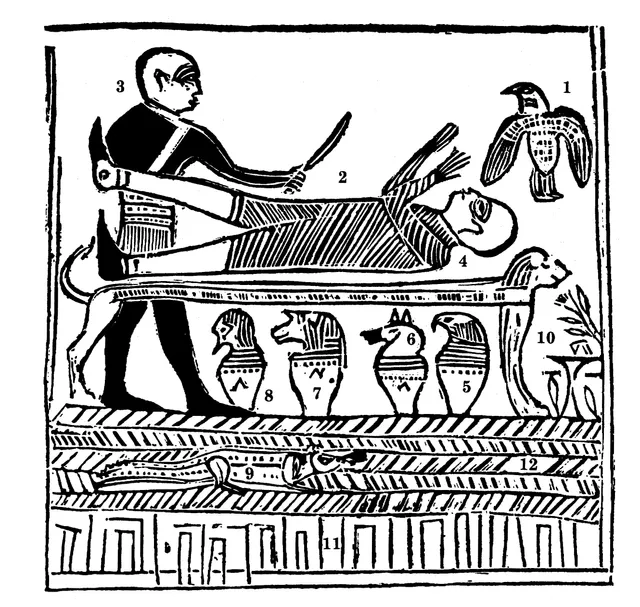
Facsimile 2 holds a second surprise. Joseph read four of its small figures as "this earth in its four quarters"; Egyptologists call them the four sons of Horus, the standard Egyptian sign for the four corners of the earth, the same idea. Even the chart in the CES Letter prints that reading.[7] Not every figure lines up so neatly, and the facsimiles article rates each one rather than overselling the set.
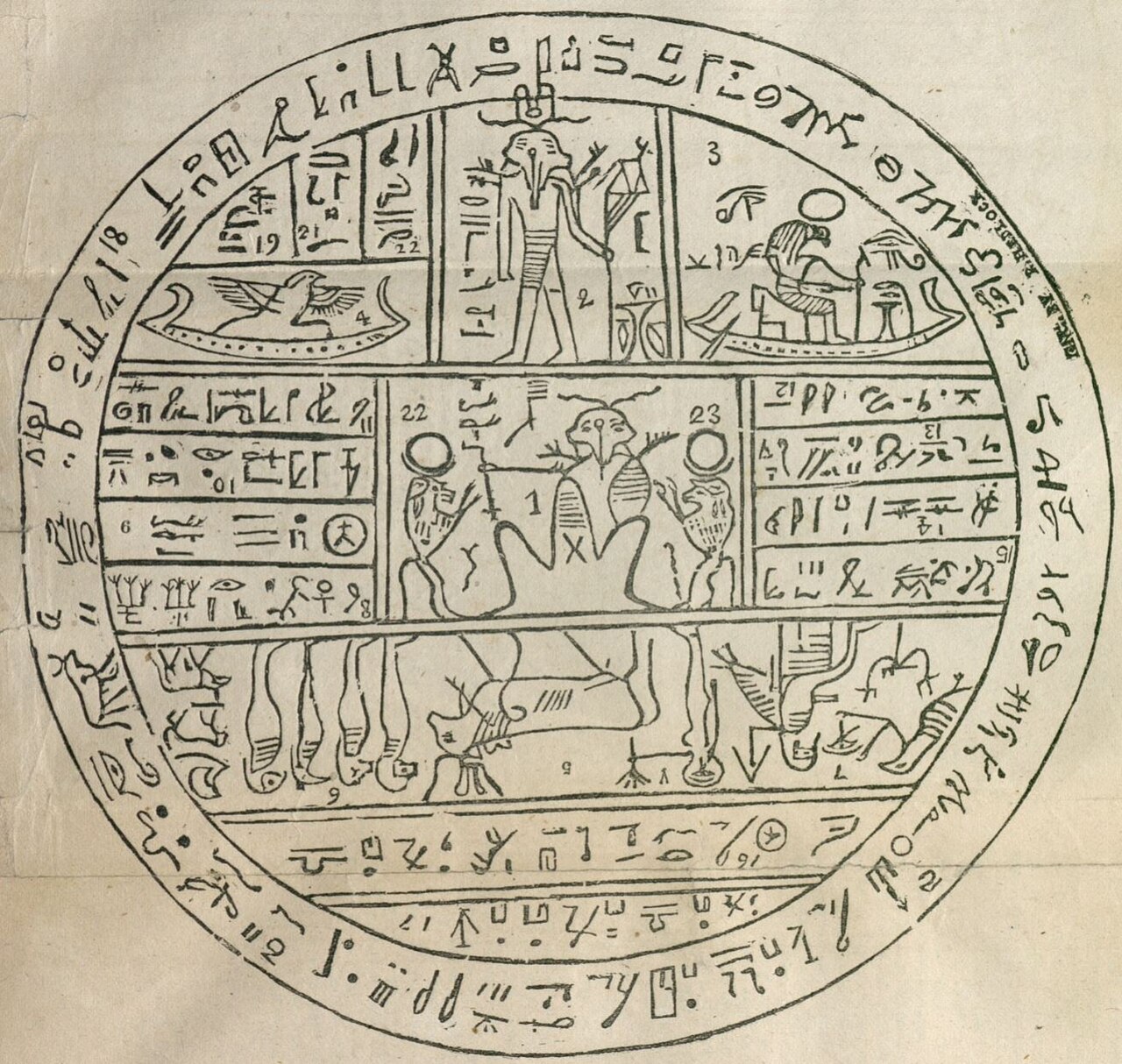
Then the astronomy. The CES Letter reads Abraham 3 as a Newtonian universe, an 1800s model later overturned.[3:1] But Abraham 3 has no gravity, no force laws, none of the machinery a man cribbing from popular science books would write. It describes an earth-centered system ordered by a divine throne, the shape of ancient Egyptian and Babylonian astronomy.[8] The CES Letter calls the chapter too modern. Its picture of the heavens is an ancient one.
And the stories. Ancient Jewish writings outside the Bible tell of Abraham nearly sacrificed by idolaters and rescued by an angel, and of Abraham teaching the Egyptians astronomy, the same beats that anchor Abraham 1 and Facsimile 1. Those texts reached English readers only in 1898 and later.[9] None of it sat on a shelf Joseph could reach.
Holding both at once
Two facts sit side by side. The fragments we can read are funerary. The book they are said to have produced still carries detail after detail that a young farmer in 1835 had no way to invent. The CES Letter holds up the first and looks past the second.
So the funerary label settles less than "smoking gun" suggests. The questions here are real, and not all of them are closed.
But the Book of Abraham was never where the faith stood or fell. That weight rests on the Book of Mormon, a 500-page record spoken aloud over a few months of 1829 with no document anywhere to copy from, and it is the ground that holds when the Abraham question gets hard. All this page asks is that you weigh both facts, because the best case for the book is made of things no one in 1835 could have faked.
Kerry Muhlestein has catalogued roughly 26 distinct eyewitness accounts of papyri in Joseph Smith's possession (1835–1856), from friendly, neutral, and hostile sources. The "two rooms of the Mansion House" description is preserved by Hugh Nibley: "one of them when unrolled on the floor extended through two rooms of the Mansion House." See the Papyri article for citations to Muhlestein 2016 and Nibley. ↩︎
The long rolls described by 1840s visitors burned in the Great Chicago Fire of 1871; the eleven mounted fragments returned by the Metropolitan Museum of Art in 1967 are physically distinct papyri, separated from the destroyed rolls since the 1856 sale of the collection. See the Papyri article. ↩︎
Runnells, CES Letter (2017), "Book of Abraham," pp. 36–50. The "smoking gun" line ("It is the smoking gun that has completely obliterated my testimony of Joseph Smith and his claims") appears on p. 50; the Newtonian-astronomy argument appears on pp. 46–47. ↩︎ ↩︎
Hugh W. Nibley, "Phase One," Improvement Era (January 1968), openly identifying the recovered fragments as standard Egyptian funerary literature (a Document of Breathing for the priest Hor and a Book of the Dead for a woman named Tshemmin); reprinted in Dialogue: A Journal of Mormon Thought 3, no. 2 (Summer 1968): 99–105. The rediscovery itself was reported in the same issue by Jay M. Todd, "Egyptian Papyri Rediscovered," Improvement Era 71, no. 1 (January 1968): 12–16. ↩︎
The place name Olishem (Abraham 1:10) is a proposed match for the Akkadian Ulisum named in an inscription of Naram-Sin of Akkad on the Bassetki statue, found in northern Iraq in 1974 and published in 1976; cuneiform was not read with confidence until the Royal Asiatic Society experiment of 1857. The identification is supported but not yet a settled consensus. See Stephen O. Smoot, John Gee, Kerry Muhlestein, and John S. Thompson, "The Plain of Olishem," BYU Studies Quarterly 61, no. 4 (2022), https://byustudies.byu.edu/article/the-plain-of-olishem, and the Anachronisms & Source Texts article. ↩︎
On Elkenah (Abraham 1:6; Facsimile 1) as a form of the Canaanite deity El qoneh ʾareṣ ("God who created the earth"), with the related Hittite Elkunirsha and worship documented across roughly 1,500 years, see Kevin L. Barney, "On Elkenah as Canaanite El," Journal of the Book of Mormon and Other Restoration Scripture 19, no. 1 (2010): 22–35. The Karatepe inscription was discovered in 1946; relevant Hittite material was published in the twentieth century. See the Facsimiles article. ↩︎
Stephen O. Smoot, John Gee, Kerry Muhlestein, and John S. Thompson, "The Four Sons of Horus (Facsimile 2, Figure 6)," BYU Studies Quarterly 61, no. 4 (2022), https://scholarsarchive.byu.edu/byusq/vol61/iss4/46/; Pearl of Great Price Central, "The Four Sons of Horus," https://pearlofgreatpricecentral.org/the-four-sons-of-horus-facsimile-2-figure-6/. ↩︎
Abraham 3 describes a geocentric, hierarchical cosmos ordered by proximity to a divine throne, with no force laws or gravitational mechanics, closer to ancient Egyptian and Babylonian astronomy than to Newtonian or post-Newtonian models. See Stephen O. Smoot, "'Created from This Material': Joseph Smith's Translation of the Cosmos in the Book of Abraham," and Kerry Muhlestein, "Encircling Astronomy and the Egyptians: An Approach to Abraham 3," Religious Educator 10, no. 1 (2009), https://rsc.byu.edu/study-faith/encircling-astronomy-egyptians-approach-abraham-3. Discussed in the Anachronisms & Source Texts article. ↩︎
Extra-biblical Abraham traditions (Abraham threatened with sacrifice by idolaters and delivered by an angel; Abraham teaching astronomy to the Egyptians) appear in ancient sources unavailable to Joseph Smith in 1835: the Apocalypse of Abraham reached English print in 1898, and the Demotic papyrus Leiden I 384 recounting Pharaoh's attempt to sacrifice Abraham was edited only in F.Ll. Griffith and Herbert Thompson's 1904–1909 edition. See the Anachronisms & Source Texts and Facsimiles articles. ↩︎