Appearance
CES Letter Background
The CES Letter is a privately authored document by Jeremy T. Runnells that compiles criticisms of the truth claims of The Church of Jesus Christ of Latter-day Saints. The current edition is dated "April 2013, Updated October 2017" and runs roughly 138 pages.[1] Most readers encounter it as a forwarded PDF or as a website.
The questions in the CES Letter deserve serious engagement. They have received it, for over a decade, in a continually growing body of faithful scholarship that this site is one node in. Before working through the topical responses, it helps to know what kind of document the CES Letter is: how it came to be, how it has changed, and who maintains it.
What does "CES" mean?
"CES" stands for the Church Educational System: the Church organization responsible for Seminaries and Institutes of Religion and for the Church's higher-education institutions, including Brigham Young University, BYU–Hawaii, BYU–Idaho, BYU–Pathway Worldwide, and Ensign College. CES describes its mission as "to develop disciples of Jesus Christ who are leaders in their homes, the Church, and their communities."[2]
The CES Letter is called the "CES Letter" because it was addressed to a CES employee. It is not a CES publication, not a Church publication, and not a curriculum produced by CES. The label describes the recipient, not the producer.
A "CES Director" is not the same thing as "the Church"
It is easy to hear "CES Director" and imagine the CES Letter was sent to Church headquarters or to a member of the First Presidency. The documented record does not support that.
The recipient is unnamed in the PDF, redacted in the Introduction as "[Name of CES Director Removed]."[3] Runnells's own contemporary account establishes that the recipient was a family acquaintance of his grandfather who happened to work for CES.[4] An employee of the Church Educational System, even one with the title "CES Director," has no doctrinal authority and does not speak for the Church.
| What a reader might assume | What the documented record describes |
|---|---|
| A formal institutional review | An informal outreach to a family acquaintance |
| An official Church response | A personal reply from one CES employee |
| A closed correspondence | A document drafted publicly on r/exmormon and offered as a shareable template |
It is also worth noting, in fairness to the choice itself, that Runnells did not select the recipient; his grandfather did. The grandfather, an active Latter-day Saint, evidently believed a CES employee acquaintance was a reasonable place to start. That expectation, in 2013, was not unreasonable; CES is the Church's most visible adult-facing teaching arm. The point of the table is descriptive: the document's title primes readers to expect institutional weight that the recipient, however well-intentioned, was not in a position to carry.
Worth Acknowledging
Nothing about the CES Letter is "CES-produced." It is not a Church Educational System publication, curriculum, or official statement. The "CES" in the title describes the recipient's employer, not the document's institutional pedigree. A reader encountering "the CES Letter" who infers institutional weight is being misled by the title alone.
Who wrote it?
Jeremy T. Runnells authored the CES Letter. He describes the document on its own title page as "My Search for Answers to My Mormon Doubts."[1:1]
The PDF's "About the Author" section (page 135) and the cesletter.org biographical page provide a short list of verifiable biographical facts: Runnells was born and raised in Southern California, is a seventh-generation Latter-day Saint of pioneer heritage, attained Eagle Scout rank, served as a returned missionary, attended BYU as an undergraduate, and was married in the San Diego Temple.[5][6] In Runnells's own account: "In February 2012, Jeremy experienced an awakening to the LDS Church's truth crisis, which subsequently led to a faith transition that summer."[5:1] Mission location, undergraduate degree subject, graduation year, and post-college profession are not stated in either source; this article therefore omits them.
A compilation, not a solo investigation
In his earliest public Reddit post about the CES Letter, March 26, 2013, posted to r/exmormon under the username u/kolobot, Runnells described what he had done as "compiled":
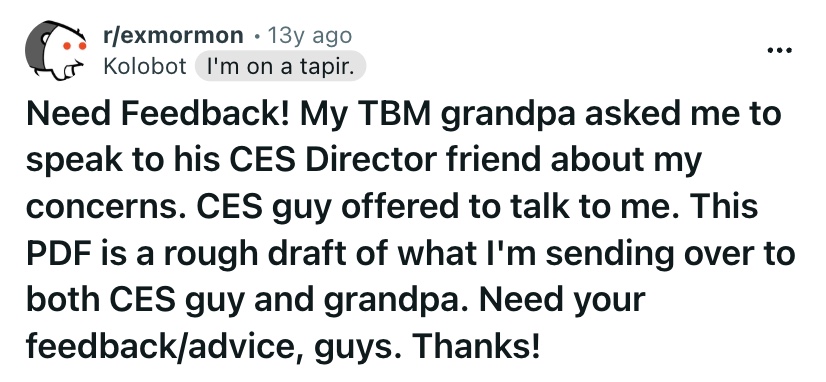
"My TBM grandpa asked me to speak to his CES Director friend about my concerns. CES guy offered to talk to me. This PDF is a rough draft of what I'm sending over to both CES guy and grandpa."[4:1]
A frequent Runnells refrain has been "I stand on the shoulders of giants," a phrase Maurine Proctor of Meridian Magazine records him using in a longer form: "It's not my information, and I stand on the shoulders of giants, the Tanners… They're the real hipsters."[7]
Years later, however, when others called the document "crowd-sourced," Runnells pushed back. In a Reddit comment dated December 15, 2021 in r/mormon, he wrote:
"I wrote that entire document myself from start to finish from March 22 - April 13, 2013. I asked for feedback on Reddit twice on my 90%+ completed drafts but none of the comments were useful or of substance to be constituted as having helped me write the letter."[8]
Both things can be true. The text-on-the-page composition is Runnells's; the substantive arguments largely are not. Most of the criticisms in the CES Letter were drawn from existing critical literature about the Church, most prominently Jerald and Sandra Tanner's Mormonism: Shadow or Reality?, and assembled into a single shareable package.[9][10] This does not by itself make any individual claim false; that is what the topical articles on this site address. It explains why the document ranges so widely. Whether any individual claim survives engagement is the work the topical articles do.
Pre-letter Reddit activity: the Kolobot account, July 2012 onward
By his own contemporary admission, Runnells had been an active anonymous critic of the Church on r/exmormon for roughly nine months before the CES Letter was sent. The original primary documentation lives in C. D. Cunningham's Public Square Magazine investigation:
"In July of 2012—many months prior to the letter being published—Runnells created a new Reddit account with the username u/kolobot that openly attacked the faith. By October 2012, Runnells was attempting through this anonymous profile to generate viral content with a letter to a senior church leader. This letter, published on October 10, 2012, was titled 'An Open Letter to Quentin L. Cook.'"[11]
"In November of 2012, Runnells's anonymous u/kolobot username admitted that he had 'left the church a few months ago.'"[11:1]
Maurine Proctor's Meridian Magazine companion piece independently records the same chronology: "July 2012: Runnells adopts anonymous moniker 'Kolobot' on ex-mormon Reddit, nine months before letter publication. October 10, 2012: As Kolobot, mocks Elder Quentin L. Cook's conference message about online faith-destroying voices."[7:1]
The Kolobot account also bore a Reddit profile "flair" reading "I'm on a tapir," which Cunningham characterizes as "a deeply embedded meme in anti-Latter-day Saint circles," itself indicating familiarity with that community before the CES Letter was drafted.[11:2]
This is not, in itself, a refutation of any argument the CES Letter makes. It is a fact about the document's frame. The Introduction presents a writer who began having doubts and assembled honest questions; the contemporary record shows a writer who, in his own anonymous words in November 2012, had already "left the church a few months ago," i.e., before he was approached about the CES Director and well before the CES Letter was written.
The origin story: official version and documented record
What the CES Letter says about itself
The PDF's Introduction (page 6) is direct about where the writer stands:
"Thank you for responding to my grandfather's request to answer my concerns and questions and for offering your time with me. I appreciate it. I'm interested in your thoughts and answers as I have been unable to find official answers from the Church for most of these issues… I'm just going to be straightforward in sharing my concerns. Obviously, I'm a disaffected member who lost his testimony so it's no secret which side I'm on at the moment. All this information is a result of over a year of intense research and an absolute rabid obsession with Joseph Smith and Church history."[3:1]
The "About the Author" page (135) closes the loop on the official narrative:
"In the spring of 2013, Jeremy was approached and asked by a CES Director to share his concerns and questions about the LDS Church's origins, history, and current practices. In response, Jeremy wrote what later became virally known as the CES Letter (originally titled Letter to a CES Director). The CES Director responded that he read the 'very well-written' letter and that he would provide Jeremy with a response. Unfortunately, no response ever came."[5:2]
Part of what makes the CES Letter rhetorically effective is that the framing is upfront, even disarming: a year of research, a disaffected member, an honest reply to a grandfather's request, no hidden agenda. The reader feels they are hearing from someone who has done the work and is asking the questions in good faith.
What the documented record shows
The earliest public trail of the CES Letter is a pair of Reddit threads posted by Runnells under the u/kolobot account on r/exmormon; both threads predate Runnells sending the CES Letter to the CES Director, which by Runnells's own later admission did not occur until late April 2013.[12]
| Date | Event | Source |
|---|---|---|
| July 2012 | Runnells creates the u/kolobot Reddit account; account is used to "openly attack the faith" for the next nine months. | Cunningham (Public Square, 2024)[11:3]; Proctor (Meridian, 2024)[7:2] |
| October 10, 2012 | u/kolobot posts "An Open Letter to Quentin L. Cook," satirizing Elder Cook's conference message about online faith-destroying voices. | Cunningham[11:4] |
| November 2012 | u/kolobot states publicly that he had "left the church a few months ago." | Cunningham[11:5] |
| Late February 2013 | Per Runnells's later account: "My grandfather approached me about the CES Director in late February 2013."[12:1] | BHR archive of Feb. 5, 2015 Reddit comment |
| Early March 2013 | Per Runnells: "The CES Director approached me in early March 2013." | BHR archive[12:2] |
| March 22, 2013 | Per Runnells's later self-account: he began composing the document on this date.[8:1] | BHR archive |
| March 26, 2013 | u/kolobot posts a "rough draft" PDF to r/exmormon asking for "feedback/advice." Thread title: "Need Feedback! My TBM grandpa asked me to speak to his CES Director friend about my concerns…" | Wayback / Mormonr timeline[13][4:2] |
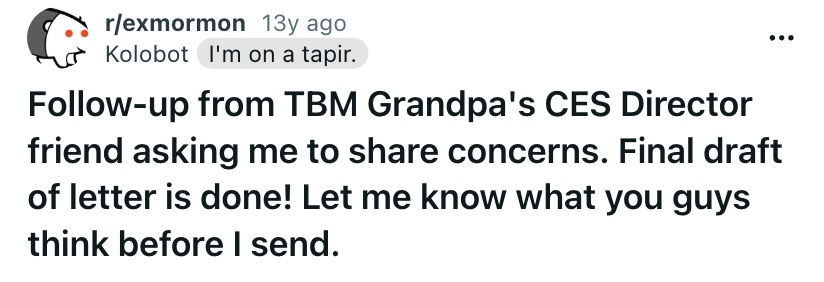
| April 12, 2013 | u/kolobot posts a "final draft" inviting users to "personalize it for yourselves to give to your TBM loved ones." | Wayback / Mormonr timeline[13:1][14] |
| Late April 2013 | Per Runnells: "I emailed the CES Director the PDF in late April 2013."[12:3] | BHR archive |
Two facts emerge from the timeline:
- The CES Letter was workshopped on the largest ex-Latter-day Saint discussion forum on the internet before it was sent to its named recipient. The "rough draft" was posted to r/exmormon on March 26, 2013. The "final draft" was posted on April 12. The PDF was emailed to the CES Director "in late April 2013."[12:4]
- The document was offered as a shareable template before it reached its stated recipient. The April 12 r/exmormon post invited users to "personalize it for yourselves to give to your TBM loved ones."[14:1] Two weeks before the named recipient received the CES Letter, a community of self-identified former members were already invited to forward the document under their own names to their believing relatives.
Worth Acknowledging
Drafting a document publicly before sending it to a named recipient is, by itself, a normal authorial practice. Many authors workshop drafts with editors, readers, or interested communities. Nothing about that is intrinsically suspicious. What the documented record establishes is more specific: by the time the CES Letter reached the named recipient, the document had already been offered as a shareable template to a community of self-identified former members, with a request that they forward it under their own names to believing relatives. Both modes, personal letter and circulated template, are factually true and coexist in the documented record. A reader's choice is whether to treat the introduction's first-page framing as the document's complete description of itself or as one register among several.
A 2024 Public Square Magazine investigation by Michael W. Peterson and Jacob Z. Hess, "Were these ever the sincere questions of an earnest truth seeker?", documents ten lines of evidence supporting the conclusion that the document's "sincere questions" frame was, from the beginning, more polished than reflective of how the document was produced. Their summation: "From beginning to end, however, the essay is nothing that it claims to be."[9:1] Maurine Proctor's Meridian Magazine companion piece walks through the same evidence in a more accessible register.[7:3]
This site does not adopt that summation as a wholesale verdict. Sincere belief and effective marketing are not mutually exclusive. The point here is the more modest one: a reader needs the documented record alongside the document's own framing in order to read it well.
Did the CES Director ever respond?
The PDF reports that the CES Director acknowledged receipt and offered to respond, but that no response ever came.[5:3] The CES Letter does not include any reply correspondence; the recipient is not named.
How the CES Letter has evolved
The CES Letter is not a static document. It has been continuously revised, retitled, and expanded across more than a decade. The version a reader downloaded in 2014 is not the same as the version a reader downloads today.
CES Letter 2.0 (December 2017)
In December 2017, Runnells released what he called "CES Letter 2.0." The cesletter.org/updates announcement, dated December 3, 2017 and now archived at the B. H. Roberts Foundation, summarized:
"The biggest and most substantial change in CES Letter 2.0 is the tone. There are no longer any tonal issues in the CES Letter."[15]
The document expanded from roughly 84 pages in the original[16] to roughly 138 pages in the 2.0 release.[17] Arguments were added, removed, and softened. The PDF available on cesletter.org today carries the title-page stamp "April 2013, Updated October 2017."[1:2] The 2.0 release is the version this site cites throughout.
INFO
Citations on this site of the form Runnells, CES Letter (2017), "Section," p. X always refer to the April 2013 / Updated October 2017 PDF edition, the version stamped on the title page of the local PDF copy committed to this repository. The document continues to be revised; this site's citations stay anchored to the October 2017 version unless explicitly noted.
A separate item worth naming: the document's subtitle changed in 2015 from "How I Lost My Testimony" to "My Search for Answers to My Mormon Doubts."[18] The 2017 PDF carries the post-2015 subtitle. The shift, from a personal-narrative framing ("how I lost") to an inquiry framing ("search for answers"), tracks the broader evolution from private correspondence to public apologetic.
Continuous revisions, no published changelog
Beyond the 2.0 release, the document has remained in continuous flux. There is no public changelog from cesletter.org tracking text-level changes. Researchers who track revisions rely on archive captures, side-by-side comparisons, and rebuttal sites, most prominently CESLetterFlip's "Changes to the CES Letter" page, which maintains before-and-after snapshots of paragraphs that have been altered, removed, or re-sourced over the years.[19]
The practical implication: the version of an argument a reader encountered may differ from the version a friend or family member encountered five years earlier. The topical articles on this site engage the October 2017 PDF version and note explicitly when an argument has been substantially modified.
The CES Letter Foundation
The CES Letter is no longer a private letter that leaked online. It is the public-facing output of a sustained organizational project.
The CES Letter Foundation is a Nevada-registered organization, EIN 47-4179614, originally granted IRS 501(c)(3) tax-exempt status effective June 2015.[20] The PDF advertises the Foundation directly on page 134, describing it as "a 501(c)(3) nonprofit organization dedicated to liberating and empowering doubting, unorthodox, and disaffected Mormon individuals, marriages, and families through knowledge and resources" and soliciting tax-deductible donations through cesletter.org/donate.[21]
| Item | Value |
|---|---|
| Legal name | Ces Letter Foundation |
| EIN | 47-4179614 |
| State of registration | Nevada |
| Tax-exempt status granted | June 2015[20:1] |
| Tax-exempt status, current | Reportedly lapsed (see below)[22][23][20:2] |
The lapse
The CES Letter Foundation's nonprofit status appears to have lapsed.
Ron C. Rhodes, writing in Interpreter: A Journal of Latter-day Saint Faith and Scholarship in 2024, examined the Foundation's IRS filings and reported: "its revenue was less than $50,000 from 2015 to 2019" and "its nonprofit status seems to have been revoked." Rhodes added the appropriate caveat that "it is possible, of course, that this problem is due to a mistake by the IRS or has been resolved and is not yet recorded on the website," and noted that, as of his article's publication, cesletter.org "continues to state that it is a 501(c)(3) nonprofit organization."[22:1]
The independent rebuttal site AntiAntiMormon, drawing on IRS and Nevada state filings, documents the bureaucratic mechanism:
"Both Nevada and the IRS eventually revoked the organization—Nevada for missing required annual reports, and the IRS for missing three consecutive tax years. From 2015 to 2019, the CES Letter foundation filed only three returns, all Form 990-N e-postcards… After 2019, the filings stop."[23:1]
ProPublica's Nonprofit Explorer corroborates: the Foundation has no Form 990 data on file, and the entry includes the standard ProPublica notice that "the organization is not listed in the IRS's most recent list of tax exempt organizations, but we have data associated with this Employer Identification Number."[20:3]
The fact pattern is bureaucratic, not accusatory: a small organization missed three consecutive Form 990 filings; the IRS revoked tax-exempt status accordingly; the website copy describing the Foundation as a current 501(c)(3) has not been updated to reflect that. "Tax-exempt since June 2015" is technically correct as a statement of the original grant. The reader can draw whatever inference they will.
Worth Acknowledging
The financial scale of the Foundation is modest. Reported revenues under $50,000 per year between 2015 and 2019 do not describe a wealthy organization.[22:2] Pointing out the lapsed filings is not a suggestion that the CES Letter is a profit-driven enterprise. The narrower point: the document is no longer a private email that leaked. It has institutionalization, donation infrastructure, a paperback edition (released alongside CES Letter 2.0 in December 2017), a website, podcast appearances, and continuous revisions. The faithful response ecosystem this site is part of also has institutionalization, donation infrastructure, and a marketing layer; that is how sustained intellectual projects on contested religious questions work, on both sides. Naming the Foundation's existence is not a critique of institutional sustenance per se; it is a correction to the genre label "private letter that leaked."
A shifting stated audience
Runnells has described the CES Letter's audience and purpose differently at different times. The progression is documented in his own contemporary statements.
| Date | Stated audience / purpose | Source |
|---|---|---|
| April 23, 2013 | "I wrote this for my kids who one day are going to ask their dad why he left the faith." | u/kolobot, r/exmormon comment[24] |
| April 23, 2013 (same day) | "You guys can do whatever you want with the Word document. Personalize it for yourselves to give to your TBM loved ones. It's yours." | u/kolobot, r/exmormon (captured in Mormonr timeline)[13:2] |
| July 26, 2015 | "It is meant for doubting members or TBMs who have accepted the possibility that the Church is not true… These folks are not my target audience because they're not ready for it. I'm looking for the doubters." | u/kolobot, r/exmormon[25] |
| November 2, 2015 | "The target audience is the fence-sitters." (per Cunningham; Sarah Allen transcribes the same comment as "the target audience are the fence sitters") | u/kolobot, r/exmormon (cited by Sarah Allen, FAIR, 2021; Cunningham, Public Square, 2024)[26][11:6] |
| October 26, 2015 | "I'm obsessed with alleviating suffering and helping to liberate the minds of human beings from a cult." | u/kolobot, r/exmormon[27] |
Most authors describe their audience differently as a work reaches readers they did not initially anticipate; the document went viral, and the self-description of who it was for evolved. The point of the table is more modest than "shifting purpose": the introduction's first-page framing, "I'm just sharing my concerns," is one register among several, and the later registers (a tool for doubters and fence-sitters; anti-cult activism) are also documented in his own contemporary words. A reader who has read only the introduction has only encountered the earliest register.
It is also true, and worth granting, that parents do write things they expect their adult children to read someday. The "letter to my children" framing is not invalidated because the document's audience grew. It is incomplete as a description of how the document has actually functioned across a decade.
You are joining a long-running conversation
A first-time reader of the CES Letter sometimes experiences the document as if encountering its arguments for the first time in human history. That impression is mostly false. By the time the CES Letter went viral in 2014–2015, faithful Latter-day Saint scholars had been responding to compilations of this kind, most prominently Jerald and Sandra Tanner's Mormonism: Shadow or Reality?, for decades.[10:1] Daniel Peterson's August 2014 FairMormon talk, the Givenses' The Crucible of Doubt (2014), Patrick Mason's Planted (2015), Jim Bennett's A Faithful Reply to the CES Letter from a Former CES Employee (2018), and Sarah Allen's 69-part FAIR series (2021–2022) are representative of the body of work that already existed before any reader picks up the document in 2026.[28][29][30][31][32] A 2024 wave added substantive investigative pieces by Cunningham, Peterson and Hess, Proctor, Rhodes, and Hales and Peterson, cited throughout the topical articles on this site.[11:7][9:2][7:4][22:3][33]
The ecosystem is not uniform, and not every faithful response has been well-judged. In November 2020, FAIR released a 16-video response to the CES Letter that was withdrawn in March 2021 after pushback from faithful scholars themselves: Grant Hardy, editor of the Maxwell Institute Study Edition of the Book of Mormon, called the videos "belligerent, sarcastic, sophomoric, inaccurate, demeaning, and offensive."[34] The withdrawal is itself a credibility-building feature: a response ecosystem with its own corrective voices is more trustworthy than one without.
The point of naming the ecosystem is narrow: when a reader picks up the CES Letter, they are not encountering a sealed argument that has never been engaged. They are joining a long-running conversation, and the reader can follow inline links from the topical articles to whichever voices in that conversation are most useful.
The institutional record is more complex than "concealment"
The CES Letter's framing repeatedly leans on the implication that the Church concealed difficult historical and doctrinal facts. The institutional record on this is more complicated than "concealment" captures.
What is straightforwardly true at the institutional level:
- The Joseph Smith Papers Project was officially established in 2001 and began publishing in December 2008. Its public-facing website launched in 2011. The final printed volume was published June 27, 2023: twenty-seven volumes across six document series, free online.[35] What the project makes available, in transcribed and high-resolution image form: the multiple First Vision accounts in Joseph Smith's own contemporaneous words, the seer-stone translation method, the plural marriages, the Kinderhook correspondence, the Book of Abraham translation manuscripts, the Kirtland and Nauvoo financial records, the journals, and the revelation manuscripts.
- The Gospel Topics Essays, published beginning November 2013, address race and the priesthood, plural marriage (in three essays), Book of Mormon translation including seer stones, translation and historicity of the Book of Abraham, First Vision accounts, and other topics: exactly the subject areas the CES Letter says were concealed. The Race and the Priesthood essay was first published in December 2013 and includes an explicit institutional disavowal of the older racial-theology justifications.[36][37]
- Saints: The Story of the Church of Jesus Christ in the Latter Days is the first official multi-volume Church history since B. H. Roberts's 1930 work. Four volumes published between September 2018 and October 2024 engage the seer stone, Joseph Smith's plural marriages, the multiple First Vision accounts, and Mountain Meadows directly.[38][39]
What is also straightforwardly true, and engaged in detail in the sister article Transparency & Censorship:
- The post-2007 transparency turn was responsive to historical conditions (internet-age accessibility, faithful scholarly dissent, the Mark Hofmann case, the visible failure of correlation-era apologetics), not unprompted institutional revelation. The course-correction itself is real and substantive, and naming its responsive character is part of the honest assessment.
- The 2013 Official Declaration 2 header is a curatorial choice the institution could have made differently; its companion Race and the Priesthood essay does the substantive disavowal that the header alone does not surface.
- Polygamy whitewashing in correlation-era curricular materials is documented: the Teachings of Presidents of the Church: Brigham Young (1997) manual changed "wives" to "[wife]" in two specific instances; the lds.org biographical page on Zina Huntington Young (in the form audited circa 2013–2017) was narrower than the same Church's FamilySearch genealogical record.
- Patrick Mason's 2023 Dialogue article documents a real 1993–2005 chilling effect that the post-2007 turn has not fully erased.
Both sides are true. The Church has moved meaningfully toward transparency on the topics the CES Letter raises; the visible turn happened in roughly the same period as the CES Letter's growth, because both responded to the same internet-era reality. At the same time, the curricular environment Latter-day Saints encountered in the late twentieth century was narrower than the documented record, and many members did encounter substantive complications for the first time as adults. The reader who wants the harder pieces of that story should follow the link to Transparency & Censorship, where each of the load-bearing items is engaged at length. The orientation point here is the simpler one: the post-2007 institutional output (Joseph Smith Papers, Gospel Topics Essays, Saints) addresses exactly the topics the CES Letter says were concealed, and a reader should know that body of work exists before encountering the "concealment" framing.
Why this orientation matters
A reasonable reader might ask: does the document's production history change the answers to its questions?
It does not. The topical articles on this site engage the substantive claims of the CES Letter on the merits: Book of Abraham translation, polygamy and polyandry, Book of Mormon archaeology, the First Vision accounts. Where the CES Letter is right about a historical detail, the topical articles say so. Where it overstates or omits, they document that. Whether the Book of Abraham translation maps to the Joseph Smith Papyri is a question that does not depend on whether the writer was a Reddit user in 2012.
What the orientation does is more limited: it gives the reader the document's actual genre. The Introduction's posture, "I'm just going to be straightforward in sharing my concerns. Obviously, I'm a disaffected member who lost his testimony"[3:2], disarms the reader by appearing to disclose more than is being disclosed. The cumulative weight of 138 pages of arguments hits with maximum impact when the reader is already in a posture of "this person is being honest with me." The same arguments still need answers when read with the documented record in mind, and the topical articles supply those answers.
Bottom line
The CES Letter is a privately authored, continuously revised, institutionally maintained compilation of criticisms of The Church of Jesus Christ of Latter-day Saints, drafted publicly on r/exmormon by Jeremy T. Runnells in March–April 2013, after roughly nine months of public anti-Latter-day Saint Reddit activity, and now packaged through a Foundation whose nonprofit filings have lapsed. The questions in it deserve serious answers, and this site provides them in the topical articles that follow. The substantive case for the Restoration's truth claims, anchored in the Book of Mormon, is engaged in those articles ahead.
Runnells, CES Letter (2017), title page. Subtitle: "My Search for Answers to My Mormon Doubts." Date stamp: "April 2013, Updated October 2017." ↩︎ ↩︎ ↩︎
"Church Educational System," The Church of Jesus Christ of Latter-day Saints. https://www.churchofjesuschrist.org/church-education?lang=eng ↩︎
Runnells, CES Letter (2017), "Introduction," p. 6 (addressed to "[Name of CES Director Removed]"). The "INTRODUCTION" header occupies the divider page (p. 5); the Introduction text appears on p. 6. ↩︎ ↩︎ ↩︎
Kolobot (Jeremy Runnells), "Need Feedback! My TBM grandpa asked me to speak to his CES Director friend about my concerns…," r/exmormon (Reddit), March 26, 2013; archived at the Wayback Machine. https://web.archive.org/web/20160425195653/https://www.reddit.com/r/exmormon/comments/1b12sr/need_feedback_my_tbm_grandpa_asked_me_to_speak_to/ ↩︎ ↩︎ ↩︎
Runnells, CES Letter (2017), "About the Author," p. 135 ("Unfortunately, no response ever came."). ↩︎ ↩︎ ↩︎ ↩︎
"Jeremy Runnells, personal bio on cesletter.org," B. H. Roberts Foundation — archive of the cesletter.org "About" content. The bio describes a "seventh generation Mormon of Pioneer heritage" (modernized in this article to "Latter-day Saint" per current Church usage). The bio confirms: Southern California upbringing, Eagle Scout, returned missionary, BYU alumnus, San Diego Temple wedding, February 2012 awakening, summer 2012 transition. The bio does not state mission location, undergraduate degree subject, graduation year, or post-college profession. https://bhroberts.org/records/qKBLnb-JcfBub/jeremy_runnells_personal_bio_on_cesletter_org ↩︎
Maurine Proctor, "Unveiling the Truth: The Real Story Behind the CES Letter," Meridian Magazine, August 6, 2024. https://latterdaysaintmag.com/the-ces-letter-were-these-ever-the-questions-of-an-earnest-truth-seeker/ ↩︎ ↩︎ ↩︎ ↩︎ ↩︎
"Jeremy Runnells affirms he wrote the CES Letter and it was not crowd-sourced," B. H. Roberts Foundation, referencing a Reddit comment by u/kolobot dated December 15, 2021 (r/mormon, "Evidences for the truth claims of the BOM you may have never heard of"). https://bhroberts.org/records/qKBLnb-cbd9dc/jeremy_runnells_affirms_he_wrote_the_ces_letter_and_it_was_not_crowd_sourced ↩︎ ↩︎
Michael W. Peterson & Jacob Z. Hess, "Were these ever the sincere questions of an earnest truth seeker? Ten lines of evidence that document the true origins and purpose of the 'CES Letter,'" Publish Peace (Substack), August 6, 2024. https://www.publishpeace.net/p/were-these-ever-the-sincere-questions ↩︎ ↩︎ ↩︎
Allen Wyatt, "Largely Shadow, Short of Reality," Interpreter: A Journal of Latter-day Saint Faith and Scholarship 59 (2023). https://interpreterfoundation.org/journal/largely-shadow-short-of-reality ↩︎ ↩︎
C. D. Cunningham, "The True Origins of the CES Letter," Public Square Magazine, August 12, 2024. https://publicsquaremag.org/faith/gospel-fare/ces-letter-calculated-deception-2/ ↩︎ ↩︎ ↩︎ ↩︎ ↩︎ ↩︎ ↩︎ ↩︎
Jeremy Runnells, comment on r/exmormon thread "So now that you have had time to process it, do you think that the CES letter is genuine?", February 5, 2015; quoted/transcribed at B. H. Roberts Foundation, "Jeremy Runnells recalls the circumstances and timing surrounding the creation of the CES Letter…" https://bhroberts.org/records/qKBLnb-H6hn7b/jeremy_runnells_recalls_the_circumstances_and_timing_surrounding_the_creation_of_the_ces_letter_and_the_fair_debunking_content_in_a_comment_on_reddit ↩︎ ↩︎ ↩︎ ↩︎ ↩︎
"CES Letter," Mormonr (Q&A with timeline) — comprehensive timeline of CES Letter creation, publication, and revisions, with primary-source citations for each event including Reddit thread URLs. https://mormonr.org/qnas/6ULsTb/ces_letter ↩︎ ↩︎ ↩︎
Kolobot (Jeremy Runnells), "Follow-up from TBM Grandpa's CES Director friend…Final draft of letter is done!…," r/exmormon (Reddit), April 12, 2013; archived at the Wayback Machine. https://web.archive.org/web/20150624152744/https://www.reddit.com/r/exmormon/comments/1c6dyx/followup_from_tbm_grandpas_ces_director_friend/ ↩︎ ↩︎
Jeremy Runnells, "CES Letter 2.0 launches on cesletter.org," cesletter.org/updates, December 3, 2017; archived at B. H. Roberts Foundation. https://bhroberts.org/records/qKBLnb-wyyaVb/ces_letter_2_0_launches_on_cesletter_org ↩︎
"CES Letter," Wikipedia. Confirms 84-page original; Tad R. Callister and Grant Hardy reaction quotes. https://en.wikipedia.org/wiki/CES_Letter ↩︎
"What Is the CES Letter?" Saints Unscripted, June 24, 2021 — provides the "138 pages" current-document figure. https://saintsunscripted.com/articles/what-is-the-ces-letter ↩︎
Sarah Allen, "The CES Letter Rebuttal, Part 1," FAIR, August 25, 2021 — documents the subtitle change from "How I Lost My Testimony" (2013) to "My Search for Answers to My Mormon Doubts" (2015). https://www.fairlatterdaysaints.org/blog/2021/08/25/ces-rebuttal-part-1-extended-version ↩︎
"Changes to the CES Letter," CESLetterFlip — text-level before-and-after change-tracking comparing different versions of the CES Letter. https://cesletterflip.com/the-ces-letter/changes-to-the-ces-letter/ ↩︎
"Ces Letter Foundation," ProPublica Nonprofit Explorer (EIN 47-4179614; tax-exempt status granted June 2015; "not listed in the IRS's most recent list of tax exempt organizations"). https://projects.propublica.org/nonprofits/organizations/474179614 ↩︎ ↩︎ ↩︎ ↩︎
Runnells, CES Letter (2017), "CES Letter Foundation," p. 134 ("CES Letter Foundation is a 501(c)(3) nonprofit organization dedicated to liberating and empowering doubting, unorthodox, and disaffected Mormon individuals, marriages, and families through knowledge and resources."). ↩︎
Ron C. Rhodes, "An Analysis of the Financial Incentives in Attacking the Restoration," Interpreter: A Journal of Latter-day Saint Faith and Scholarship 61 (2024): 361–374. https://interpreterfoundation.org/journal/an-analysis-of-the-financial-incentives-in-attacking-the-restoration ↩︎ ↩︎ ↩︎ ↩︎
"CES Letter Foundation," AntiAntiMormon — documents IRS revocation (three consecutive missed Form 990 filings) and Nevada state revocation (missed annual reports). https://antiantimormon.com/ces-letter-foundation/ ↩︎ ↩︎
Kolobot (Jeremy Runnells), comment on "Excellent letter to a CES Director setting out major issues," r/exmormon (Reddit), April 23, 2013; archived at B. H. Roberts Foundation. https://bhroberts.org/records/qKBLnb-6MTb1b/jeremy_runnells_states_he_wrote_ces_letter_for_my_kids_who_one_day_are_going_to_ask_their_dad_why_he_left_the_faith ↩︎
Kolobot (Jeremy Runnells), comment on "My Mom agreed to read CES letter and then didn't bother bc first page on site was asking for money," r/exmormon (Reddit), July 26, 2015; archived at B. H. Roberts Foundation. https://bhroberts.org/records/qKBLnb-NILXAc/runnells_identifies_the_target_audience_of_the_ces_letter_as_doubting_members_or_tbms_who_have_accepted_the_possibility_that_the_church_is_not_true ↩︎
Kolobot (Jeremy Runnells), r/exmormon comment, November 2, 2015. Cited verbatim and dated by Sarah Allen, "The CES Letter Rebuttal, Part 1: Manipulations & Dishonesty in the CES Letter," FAIR, August 25, 2021 (transcribed as "the target audience are the fence sitters"). https://www.fairlatterdaysaints.org/blog/2021/08/25/ces-rebuttal-part-1-extended-version. C. D. Cunningham, Public Square Magazine (August 12, 2024), transcribes the same Reddit comment as "The target audience is the fence-sitters." The minor transcription variance (verb agreement, hyphenation) does not change the substance. ↩︎
Kolobot (Jeremy Runnells), comment on "Someone I know published this…," r/exmormon (Reddit), October 26, 2015; archived at B. H. Roberts Foundation. https://bhroberts.org/records/qKBLnb-ulR8ic/jeremy_runnells_explains_why_he_went_full_time_with_the_ces_letter_project_and_that_he_is_obsessed_with_alleviating_suffering_and_helping_to_liberate_the_minds_of_human_beings_from_a_cult_in_a_comment_on_reddit ↩︎
Daniel C. Peterson, "Some Reflections on That Letter to a CES Director," 2014 FairMormon Conference, August 8, 2014. https://www.fairlatterdaysaints.org/conference/august-2014/reflections-letter-ces-director ↩︎
Terryl L. Givens & Fiona Givens, The Crucible of Doubt: Reflections on the Quest for Faith (Salt Lake City: Deseret Book, 2014). Builds on Terryl Givens, "Letter to a Doubter," Interpreter: A Journal of Mormon Scripture 4 (2013): 131–146. ↩︎
Patrick Q. Mason, Planted: Belief and Belonging in an Age of Doubt (Provo, UT: Neal A. Maxwell Institute for Religious Scholarship; Salt Lake City: Deseret Book, 2015). ↩︎
Jim Bennett, A Faithful Reply to the CES Letter from a Former CES Employee (self-published, September 2018; the work began as an online reply in 2015). https://www.goodreads.com/book/show/44075129-a-faithful-reply-to-the-ces-letter-from-a-former-ces-employee ↩︎
"Sarah Allen CES Response Posts," FAIR — index of the 69-part series (August 25, 2021 – August 17, 2022). https://www.fairlatterdaysaints.org/answers/Sarah_Allen_CES_Response_Posts ↩︎
Brian Hales & Michael Peterson, "Doubt in the Digital Age: How a Perfect Storm of Random Forces Inflated the CES Letter Beyond Its Merits," Public Square Magazine, December 30, 2024. https://publicsquaremag.org/media-education/news-media/ces-letter-perfect-storm-faith-doubt/ ↩︎
"CES Letter," Wikipedia. Records FAIR's November 2020 release and March 2021 withdrawal of the 16-video CES Letter response, including Grant Hardy's published critique ("belligerent, sarcastic, sophomoric, inaccurate, demeaning, and offensive"). https://en.wikipedia.org/wiki/CES_Letter ↩︎
"The Joseph Smith Papers," Wikipedia. Project officially established June 2001; first printed volume (Journals, Volume 1: 1832–1839) released December 2008; josephsmithpapers.org launched 2011; final printed volume (Documents, Volume 15) published June 27, 2023; 27 printed volumes across six document series (Journals, Documents, Revelations and Translations, Histories, Administrative Records, Legal Records). https://en.wikipedia.org/wiki/The_Joseph_Smith_Papers ↩︎
"Gospel Topics Essays," The Church of Jesus Christ of Latter-day Saints. Series began publication November 2013. https://www.churchofjesuschrist.org/study/manual/gospel-topics-essays?lang=eng ↩︎
"Race and the Priesthood," Gospel Topics Essays, The Church of Jesus Christ of Latter-day Saints. Original publication December 2013 (the live page header now reads "(2016)," reflecting a revision date; multiple secondary sources from December 2013 attest the original publication). https://www.churchofjesuschrist.org/study/manual/gospel-topics-essays/race-and-the-priesthood?lang=eng ↩︎
"Saints: The Story of the Church of Jesus Christ in the Latter Days," Wikipedia. First official Church history since B. H. Roberts's Comprehensive History of the Church (1930). Volume 1 (The Standard of Truth): September 4, 2018. Volume 2 (No Unhallowed Hand): February 12, 2020. Volume 3 (Boldly, Nobly, and Independent): April 22, 2022. Volume 4 (Sounded in Every Ear): October 29, 2024. https://en.wikipedia.org/wiki/Saints:_The_Story_of_the_Church_of_Jesus_Christ_in_the_Latter_Days ↩︎
Camille West, "New Church book 'The Standard of Truth' covers controversial topics," Church News, August 23, 2018. https://www.thechurchnews.com/2018/8/23/23214154/newest-church-book-brings-history-to-life-like-never-before-covers-controversial-topics-while-its-at/ ↩︎