Anti-Intellectualism
The claim:
The CES Letter argues that the Church discourages independent thinking and punishes intellectuals, citing Packer's "Mantle" talk, Dallin H. Oaks' comment that "it is wrong to criticize the leaders of the Church, even if the criticism is true," the September Six excommunications, the Strengthening Church Members Committee, and the phrase "when the prophet speaks the debate is over."[1] Combine the quotes, Runnells writes, and you get "policies and practices you'd expect to find in a totalitarian system such as North Korea or George Orwell's 1984; not from the gospel of Jesus Christ."[2]
Underneath the quotations the argument is simple. The Church, the critics say, tells its members to stop thinking, treats scholars as a threat, and runs a quiet machine for punishing anyone who looks too closely at its history. A church that welcomed hard questions and rigorous study would be the kind a thinking person could trust. This one, the argument goes, is not.
Every quote in that list is real. People really said those words, and a few of them are uncomfortable. There is no fabrication anywhere in it. The whole case rides on a single move, repeated over and over: take a real sentence, and show it to you without the paragraph, the audience, and the rest of the record that surround it. Put those back, and the picture changes almost completely.
Start with the strongest quote, the one they leave out
The most damning single line on this subject is one the CES Letter does not even use, and looking at why is the fastest way to see the whole pattern.
In 1945, a message went out to every congregation in the Church, printed as a script for the monthly home visit. It read: "When our leaders speak, the thinking has been done. When they propose a plan — it is God's plan."[3] If you wanted one sentence to prove the Church wants members to switch off their minds, that is the sentence. It is stronger than anything Runnells quotes.
Watch what happened to it. A local minister wrote to the President of the Church, George Albert Smith, upset about that line. The prophet wrote back, in December 1945, and did not defend it. He repudiated it:
"I am pleased to assure you that you are right in your attitude that the passage quoted does not express the true position of the Church. Even to imply that members of the Church are not to do their own thinking is grossly to misrepresent the true ideal of the Church."[4]
The same letter settled how the line got past the leadership. The passage, Smith wrote, "was not 'prepared' by 'one of our leaders'"; one or more of them, he went on, had "inadvertently permitted the paragraph to pass uncensored," which is to say it reached print without anyone in authority signing off on it.[4:1] So the best quote for the "stop thinking" thesis turns out to be a line no leader wrote, disowned in writing by the prophet within months. Every quote the CES Letter does use is missing context just like that. The only difference is that with this one, the correction is impossible to miss.
Packer's "Mantle" talk, with the room put back
The quote the case actually leans on hardest is Boyd K. Packer's line, "Some things that are true are not very useful." Read cold, it sounds like a senior leader telling people to bury inconvenient facts.
Two pieces restore it. The first is the room he was standing in. Packer gave that talk in 1981 to an audience of seminary and institute teachers, the Church employees whose job is teaching the faith to teenagers in a religion class.[5] He was not addressing historians at a scholarly conference. He was telling religion teachers how to handle Church history with fourteen-year-olds. The second is the sentence right after the famous one, which the CES Letter cuts. Packer immediately tells a story to explain himself: a historian's lecture had listed unflattering "facts" about a past Church leader that, stripped of their historical setting, painted the man falsely. What worried him was true facts arranged to mislead, the historical context cut away to leave the worst possible impression standing alone.
The CES Letter follows the Packer quote with a question. Joseph using a seer stone in a hat to translate, the multiple First Vision accounts, the polyandry: are those not "useful" truths the Church would rather hide? Every item on that list is something the Church has now published itself, on its own website, under the seal of the First Presidency, in its Gospel Topics Essays: the stone in the hat,[6] the multiple First Vision accounts,[7] and Joseph's plural marriages including the polyandry.[8] Why would a church covering these things up print every one of them under its own name?
There is a real catch here. For roughly a thirty-year stretch, Packer's talk did get used by some teachers and local leaders as a reason to skip the hard parts, and members who grew up on the smoothed-over version could feel blindsided when they later met the full record. The talk had that effect. What it could not do is prove the Church suppresses its history, because the Church went and published that history. The fuller treatment of each quote in the list, Oaks included, is in the in-depth version.
The Church that supposedly fears scholarship
Set the quotes down for a moment and look at what the institution actually does, because that is harder to spin than a sentence.
Its own scriptures are the first place to look, the ones Latter-day Saints read as the word of God. They do not hedge on learning. "Seek learning, even by study and also by faith."[9] "The glory of God is intelligence, or, in other words, light and truth."[10] A church whose scripture makes intelligence the very glory of God, and commands study as a religious duty, is a strange place to locate a war on the mind. A First Presidency leader put the same spirit plainly to students at Brigham Young University in 1969: "We are not so much concerned with whether your thoughts are orthodox or heterodox as we are that you shall have thoughts."[11]
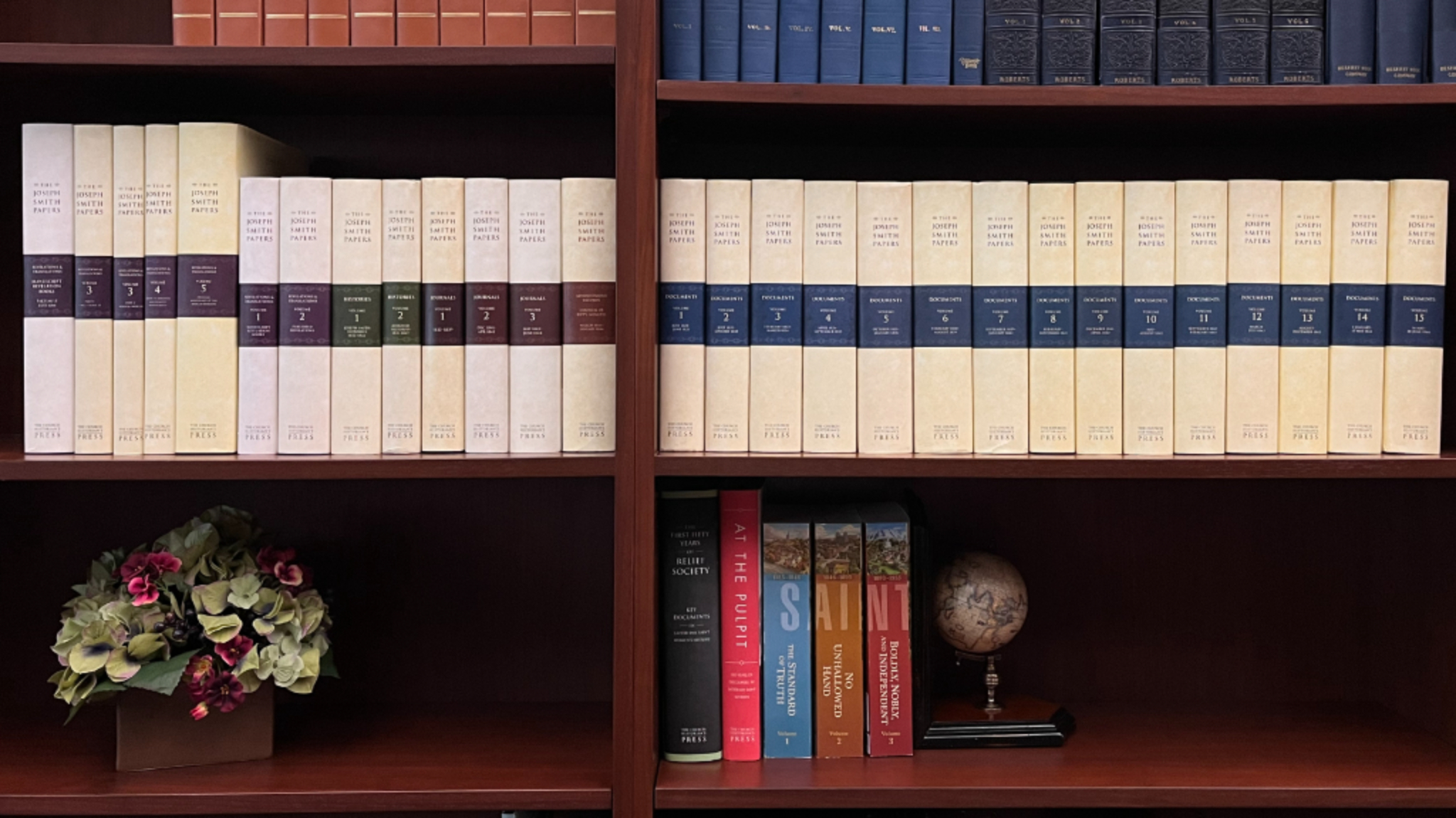
Then look at the spending. The Church runs four universities and an education system that enrolls more than a million students worldwide.[12] It poured twenty-two years and millions of dollars into the Joseph Smith Papers, a complete scholarly edition of everything its founder wrote or received, including his most difficult diaries and letters, twenty-seven volumes and more than seven million words, all free online.[13] It earned the National Archives' endorsement for its editorial rigor, and an outside historian called it "the gold standard in the field of historical documentary editing."[14] Hiding your founder and publishing his every private word are not things an institution does at the same time.
The most revealing fact is a number. In nearly every religion in America, the more education people get, the less they attend church. Among Latter-day Saints the line runs backward. The more school a member completes, the more likely they are to be in their pew on Sunday, with attendance climbing to seventy to eighty percent among those who have sixteen or more years of education.[15] The Pew Research Center finds the same reversal.[16] If the Church really did smother inquiry and drive its thinkers out, its most educated members would be the first to go. Instead they are the ones who stay. A tradition at war with the mind does not produce that curve.
The man who named the problem took it back
One more piece cuts the legs out from under the whole framing.
The phrase "anti-intellectualism in Mormon history" did not start with the CES Letter. It came from a 1966 essay by Davis Bitton, a faithful Latter-day Saint historian who later served as Assistant Church Historian. He surveyed the tradition and found some real anti-elite, anti-education streaks in it. But Bitton kept thinking about that essay for the rest of his career. In 2001, he published a second look at his own work, written as a wry third-person review of his younger self. He called the 1966 version "selective" and admitted that the result was "a caricature."[17] His mature conclusion was that Mormonism is not either/or on this question but both/and: genuine anti-intellectual strands living inside a tradition that is, at its core, deeply pro-intellectual. The CES Letter is still arguing a thesis the scholar who coined it walked back thirty-five years later.
The September Six
A real concession sits in the middle of this topic. In September 1993, six Latter-day Saint scholars and writers were excommunicated or disciplined within a single month, the group now called the September Six. A few months earlier, Boyd K. Packer had given an internal talk naming "the so-called scholars or intellectuals" as one of three dangers facing the Church.[18] Casting scholarship itself as an enemy is indefensible, and stringing it together with the discipline that followed is not paranoid. Something real happened here.
The most complete version of this concession comes from a believer. Patrick Mason, who occupies an endowed chair in Mormon history and worships as a Latter-day Saint himself, argues that the 1993 disciplines taught a generation of young scholars a chilling lesson: do rigorous work on sensitive history and it could cost you your membership. So they kept their heads down, and the field went quiet for the better part of a decade. Mason calls those years a "lost generation" of Mormon studies.[19] He refuses to wrap it up neatly, too. The recovery since has been real, he grants, but uneven and incomplete, with some of the damage from those years still unhealed. A churchgoing scholar saying all that, carefully and on the record, is not a witness anyone gets to brush off.
The timeline is the part that story leaves out. Three of the six were eventually restored to fellowship, one within three years, and one only after her death, three decades later. And the same institution that produced 1993 is the one that, starting around 2007, built the most aggressive history-transparency apparatus of any major American religion: the Joseph Smith Papers, the candid Gospel Topics Essays on its hardest topics, a frank multivolume history written for ordinary members. The Church Historian who oversaw much of that turn said the quiet part out loud in 2013: the old habit of keeping records closed could not continue, and being open "solves a whole lot more problems than it creates." The full record of that shift, and where its scars remain, is laid out in the in-depth version and the companion page on Transparency and Censorship. A few other leader statements, like Ezra Taft Benson's 1980 "Fourteen Fundamentals," raise their own genuine tensions that the in-depth version meets head-on.
Handed to the experts to dig
Pull back and the case resolves into two pieces: a wall of quotations with the context scraped off, and a real but bounded episode from the 1990s asked to speak for a whole institution across two centuries. Both pieces are true, and a full answer keeps both in view. The chilling effect was real; so were the four universities, the million students, and the seven million published words of Joseph Smith's papers running right alongside it. The verdict that fits the whole record is the one Bitton reached: anti-intellectual strands exist, inside a tradition that is fundamentally the opposite.
And there is a deeper irony the whole charge runs aground on. The thing at the center of this faith, the Book of Mormon, is not a book an anti-intellectual movement could even use. It is dense, ancient in its patterns, and layered enough that two centuries of scholars have built whole careers reading it closely: critical text projects, an Oxford-published annotated edition, journals that have run for sixty years. A tradition produces work like that only when it takes its founding scripture seriously enough to invite that much scrutiny, instead of demanding people look away. The Church handed its most sacred book to the experts and asked them to dig. That is the last move a movement afraid of thinking would ever make.
Want the full case, including the strongest arguments the critics make and every source? Read the in-depth version.
Runnells, CES Letter (2017), "Other Concerns," pp. 120–125. The anti-intellectualism subsection cites Boyd K. Packer's "The Mantle is Far, Far Greater Than the Intellect" (1981), Dallin H. Oaks's 1985 CES Symposium "Reading Church History" address and 2007 PBS interview, Quentin L. Cook's October 2012 General Conference, Dieter F. Uchtdorf's January 2013 CES devotional and October 2013 General Conference, Neil L. Andersen's October 2014 General Conference, N. Eldon Tanner's August 1979 Ensign "The Debate Is Over" First Presidency Message, the September Six (September 1993), the Strengthening Church Members Committee (1985), Boyd K. Packer's May 18, 1993 All-Church Coordinating Council address, and Richard Bushman's "the dominant narrative is not true" line (cover and p. 124). ↩︎
Runnells, CES Letter (2017), "Other Concerns," p. 125. Runnells writes: "Some things that are true are not very useful + Censorship + Deceptively altering past quotes + Prioritizing tithing before food and shelter + It is wrong to criticize leaders of the Church, even if the criticism is true + Spying and monitoring on members + Intellectuals are dangerous + 'us versus them' rhetoric + When the prophet speaks the debate is over + Obedience is the First Law of Heaven = Policies and practices you'd expect to find in a totalitarian system such as North Korea or George Orwell's 1984; not from the gospel of Jesus Christ." ↩︎
"Sustaining the General Authorities of the Church," Ward Teachers' Message, Improvement Era 48, no. 6 (June 1945): 354. Distributed to all wards as a script for monthly visiting-priesthood (ward teaching) lessons. Reproduced in full in the FAIR archived publication: https://www.fairlatterdaysaints.org/archive/publications/when-the-prophet-speaks-is-the-thinking-done. ↩︎
George Albert Smith, letter to J. Raymond Cope (minister, First Unitarian Society of Salt Lake City), December 7, 1945. Reproduced in full in "When the Prophet Speaks, Is the Thinking Done?", FAIR, https://www.fairlatterdaysaints.org/archive/publications/when-the-prophet-speaks-is-the-thinking-done, and in "A 1945 Perspective," Dialogue: A Journal of Mormon Thought 19, no. 1 (Spring 1986): 35–39 (underlining in the original omitted). The letter responds to Cope's concern about the June 1945 Ward Teachers' Message published in Improvement Era 48, no. 6 (June 1945): 354. ↩︎ ↩︎
Boyd K. Packer, "The Mantle is Far, Far Greater Than the Intellect," address to religious educators at a symposium on the Doctrine and Covenants and Church history (styled in the BYU Studies printing as the Fifth Annual Church Educational System Religious Educators' Symposium), BYU, August 22, 1981. Reprinted in Teaching Seminary Preservice Readings, Religion 370, 471, 475 (Salt Lake City: The Church of Jesus Christ of Latter-day Saints, official seminary preservice manual). https://www.churchofjesuschrist.org/study/manual/teaching-seminary-preservice-readings-religion-370-471-and-475/the-mantle-is-far-far-greater-than-the-intellect ↩︎
"Book of Mormon Translation," Gospel Topics Essays, 2013. https://www.churchofjesuschrist.org/study/manual/gospel-topics-essays/book-of-mormon-translation. Acknowledges the seer-stone-in-hat translation method. ↩︎
"First Vision Accounts," Gospel Topics Essays, 2013. https://www.churchofjesuschrist.org/study/manual/gospel-topics-essays/first-vision-accounts. Acknowledges the multiple First Vision accounts and engages their differences. ↩︎
"Plural Marriage in Kirtland and Nauvoo," Gospel Topics Essays, 2014. https://www.churchofjesuschrist.org/study/manual/gospel-topics-essays/plural-marriage-in-kirtland-and-nauvoo. Acknowledges the polyandry and the asymmetry between Joseph Smith's plural marriages and Emma Smith's awareness of them. ↩︎
Doctrine and Covenants 88:118. "Seek ye out of the best books words of wisdom; seek learning, even by study and also by faith." ↩︎
Doctrine and Covenants 93:36. "The glory of God is intelligence, or, in other words, light and truth." ↩︎
Hugh B. Brown, "An Eternal Quest—Freedom of the Mind," BYU devotional address, May 13, 1969. https://speeches.byu.edu/talks/hugh-b-brown/eternal-quest/ (audio only; BYU Speeches' text PDF at https://brightspotcdn.byu.edu/33/b4/85f307924e4ca01512072c8c8ba5/an-eternal-quest-freedom-of-the-mind-hugh-b-brown.pdf; reprinted in Dialogue: A Journal of Mormon Thought 17, no. 1, Spring 1984). Brown was First Counselor in the David O. McKay First Presidency at the time. ↩︎
"The Growth and Momentum of the Church Educational System," Church Newsroom, September 25, 2023, https://newsroom.churchofjesuschrist.org/article/growth-momentum-church-educational-system ("more than 1 million students in CES," Elder Clark G. Gilbert; "BYU–Pathway Worldwide's 70,000 students in over 180 countries"). The seminary and institute figures (427,642 and 384,095, 2023–24 all-time highs) are in the Church Newsroom's record-global-growth release, July 9, 2025, https://newsroom.churchofjesuschrist.org/article/church-of-jesus-christ-record-global-growth. The fall 2024 record of 117,204 in Church higher education is in Deseret News coverage of CES enrollment growth, November 23, 2024, https://www.deseret.com/faith/2024/11/23/enrollment-growth-at-latter-day-saint-universities-rebuts-narrative-about-young-adults-losing-faith/. ↩︎
"Final Volume of Joseph Smith Papers Published, Completing Monumental Historical Work," Church Historian's Press, June 27, 2023. https://www.churchhistorianspress.org/news/final-volume-of-joseph-smith-papers-published-completing-monumental-historical-work (project "commenced in June 2001"; 27 volumes, 1,306 journal entries, 643 letters, 155 revelations). The page, word, and footnote counts (18,822 pages, 7,452,072 words, 49,687 footnotes) are carried in the Church Newsroom release of the same day, quoting Elder Gerrit W. Gong: https://newsroom.churchofjesuschrist.org/article/final-volume-joseph-smith-papers. ↩︎
The Joseph Smith Papers endorsements page, https://www.josephsmithpapers.org/articles/endorsements, carries Thomas P. Slaughter (University of Rochester): "This project remains the gold standard in the field of historical documentary editing." The National Archives endorsement and the other assessments are carried in the Church Newsroom final-volume release, https://newsroom.churchofjesuschrist.org/article/final-volume-joseph-smith-papers: "the scholarly approach in these volumes was endorsed by the National Archives as meeting the most rigorous criteria for documentary editing"; Laurel Thatcher Ulrich (Pulitzer winner; 300th Anniversary University Professor, Emerita, Harvard): "The Church didn't want to hide anything about Joseph Smith"; Laurie Maffly-Kipp (Archer Alexander Distinguished Professor, Danforth Center, Washington University): "I would say it ranks with the best kinds of scholarly sources I've seen." ↩︎
Stan L. Albrecht and Tim B. Heaton, "Secularization, Higher Education, and Religiosity," and Stan L. Albrecht, "The Consequential Dimension of Mormon Religiosity," both in Latter-day Saint Social Life: Social Research on the LDS Church and Its Members, ed. James T. Duke (Provo, UT: BYU Religious Studies Center, 1998). https://rsc.byu.edu/latter-day-saint-social-life/secularization-higher-education-religiosity and https://rsc.byu.edu/latter-day-saint-social-life/consequential-dimension-mormon-religiosity. The education statistics (LDS males with post-high-school education at 53.5% vs. 36.5% for U.S. males; LDS females at 44.3% vs. 27.7%) are from the Secularization chapter; the attendance-by-education finding (weekly attendance for men rising from 34% at grade-school education to 80% at postgraduate; Table 8.34) is from Albrecht's Consequential chapter, whose p. 286 FAIR cites for its 70-to-80-percent summary. The "70 to 80 percent" sentence quoted in the body is FAIR's synthesis: "Education, Scholarship, and Mormonism," FAIR, https://www.fairlatterdaysaints.org/archive/publications/education-scholarship-and-mormonism. A later BYU study found the same direction: "BYU study links education to religious involvement," BYU Daily Universe, February 10, 2015, https://universe.byu.edu/2015/02/10/byu-study-links-education-to-religious-involvement/. ↩︎
"Latter-day Saints (Mormons)," Pew Research Center, Religious Landscape Study. https://www.pewresearch.org/religious-landscape-study/religious-tradition/latter-day-saint-mormon/. The attendance-by-education crosstab is from the 2014 wave: weekly attendance 66% (high school or less), 76% (some college), 85% (college), archived at https://web.archive.org/web/20191214181734/https://www.pewforum.org/religious-landscape-study/compare/attendance-at-religious-services/by/educational-distribution/among/religious-tradition/mormon/. Latter-day Saints with college degrees attend church at higher rates than those without — the inverse of the pattern observed in nearly every other American religious tradition. ↩︎
Davis Bitton, "Mormon Anti-Intellectualism: A Reply," FARMS Review of Books 13, no. 2 (2001): 59–62. https://scholarsarchive.byu.edu/msr/vol13/iss2/8/. Bitton was Emeritus Professor of History at the University of Utah and former Assistant Church Historian (1972–1982). ↩︎
Boyd K. Packer, address to the All-Church Coordinating Council, May 18, 1993. The talk was an internal address to a regular meeting of correlation department heads and General Authorities. The transcript was leaked rather than published; it has been widely reproduced on critical-side sites and the relevant text is referenced in faithful sources with caveats about its leaked status. Runnells cites the talk in CES Letter (2017), "Other Concerns," p. 124. ↩︎
Patrick Q. Mason, "The September Six and the Lost Generation of Mormon Studies," Dialogue: A Journal of Mormon Thought 56, no. 3 (Fall 2023). https://www.dialoguejournal.com/articles/the-september-six-and-the-lost-generation-of-mormon-studies/. Mason holds the Leonard J. Arrington Chair of Mormon History and Culture at Utah State University (since July 2019); he previously held the Howard W. Hunter Chair of Mormon Studies at Claremont Graduate University; PhD in history, University of Notre Dame (2005); BA in history, BYU (1999); faithful Latter-day Saint. Mason argues the excommunications "resulted in a lost generation of Mormon intellectuals," that "Things did get better in the early 2000s," and that even now "There are still whispers. Fear remains, even if we try to push it to the back of our minds." ↩︎