Church Finances
The claim:
"There is zero transparency to members of the Church. Why is the one and only true Church keeping its books in the dark? Why would God's one true Church choose to 'keep them in darkness' over such a stewardship? History has shown time and time again that secret religious wealth is breeding ground for corruption."[1]
"The Church used to be transparent with its finances but ceased disclosures in 1959."[2]
The CES Letter's money argument bundles several complaints into one. A wealthy church keeps its books hidden, the critics say, sits on a fortune, builds a luxury shopping mall, pays its leaders six-figure salaries, and squeezes tithing out of families too poor to feed themselves. A true church would not act like that. So either the Church is hiding something, or it is simply greedy.
Part of that is true, and here is which part. The Church did publish detailed finances for decades and then stopped in 1959, and it has never gone back to the old level of openness. At one point it hid the size of its investment fund from federal regulators on purpose, and got caught. Both of those are real, and the answer below owns them squarely rather than dressing them up. But almost every other piece of the package works the same way: it takes a true fact and then removes the context that explains it. Put the context back and the picture changes. The money the critics call greed sits next to a welfare and education ledger the Letter never shows you, and the stories about starving families turn out to leave out the part where the Church feeds them.
The broader charge that the Church hides its embarrassing history (the seer stone, the multiple First Vision accounts, polygamy) is a different question, handled in Transparency & Censorship. This page is about the money.
The family that was told to pay tithing, and fed
One story shows how the whole case is built.
The CES Letter quotes a December 2012 Ensign article about the Vigil family, recent converts in El Salvador who were struggling badly. Their bishop taught them about tithing, and his words are as hard as they sound:
"If paying tithing means that you can't pay for water or electricity, pay tithing. If paying tithing means that you can't pay your rent, pay tithing. Even if paying tithing means that you don't have enough money to feed your family, pay tithing. The Lord will not abandon you."[3]
Read alone, that is a church telling a hungry family to choose tithing over food. Damning. Except the same article, on the same page, contains one more sentence the CES Letter does not quote:
"The family received some commodities from the bishops' storehouse during their financial difficulties."[3:1]
That single sentence turns the whole story inside out. The Vigil family was never left to pay tithing and starve. They were told to keep their covenant. Then who was putting food on their table? A bishops' storehouse is exactly what it sounds like: a warehouse of food and basic goods that a bishop hands out, free, to members in need. The Vigils drew from one during their hardship.
Watch for that move, because it runs through the whole finances section. Find a true quote, cut the sentence next to it that changes its meaning, and present what is left. The Church runs more than 100 of those storehouses across the United States and Canada, alongside fast-offering funds a bishop can spend on a family's rent or utilities directly. Fast offerings are money members donate by skipping two meals a month, a stream separate from tithing, and the system runs primarily on volunteers. The CES Letter does mention the storehouse, once, in a mocking voice, as the excuse it imagines an apologist would offer, and it answers that if you take the bishop's food you are not self-reliant but Church-reliant. It leaves that part out: the storehouse was already in the story it is quoting. The family the Letter presents as told to starve is the family the Ensign says the storehouse fed. A nearly identical example from a 2017 General Conference talk works the same way: the Cordón story is quoted right up to its cliffhanger, and the resolution where the family's crisis is relieved is left off.
The mall, and where the money actually went
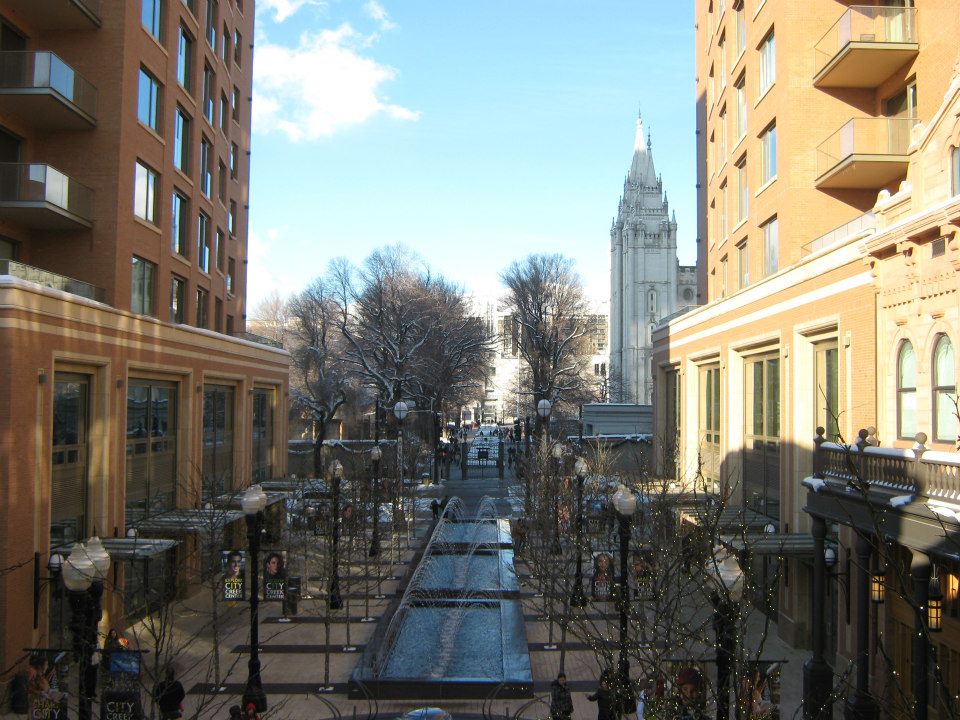
The most emotional argument in the section is City Creek, a $1.5 billion shopping and housing development the Church built in downtown Salt Lake City. The CES Letter sets that price tag against $1.4 billion the Church spent on humanitarian aid across 26 years, and treats the gap as proof of misplaced priorities: a "luxury megamall" while the world goes hungry.[4]
Two things are wrong with that, and they pull in opposite directions.
First, the mall was not built with tithing. In a 2003 General Conference, President Gordon B. Hinckley addressed this head-on: "tithing funds have not and will not be used to acquire this property. Nor will they be used in developing it for commercial purposes."[5] The money came from the Church's for-profit business arm and from the earnings on its investment reserves, not from the donation plate. This is not just an assurance you have to take on faith. James Huntsman sued the Church over this exact claim, arguing he had been deceived about how City Creek was funded. In January 2025 the Ninth Circuit Court of Appeals ruled against him 11 to 0, affirming judgment for the Church. Ten of the eleven judges reached the merits and found that Hinckley's statement matched how the project was actually paid for.[6]
Second, the comparison is rigged. That "$1.4 billion over 26 years" is one narrow line item, cash relief for disasters and similar emergencies, and it leaves out the storehouses, the welfare system, the roughly $1 billion a year the Church spends subsidizing its universities, and much more. The cleanest way to see how misleading it is: in 2024 alone, the Church reported $1.45 billion in charitable spending, across 3,836 projects in 192 countries.[7] One recent year of giving is larger than the entire 26-year figure the CES Letter holds up as evidence of stinginess. The two numbers do not measure the same thing, and that is the point: the 26-year line was never the Church's whole giving, and one year of the whole still beats it. (The chart tracking that giving year by year is in the in-depth version.)
City Creek itself was an urban-renewal project. The blocks across the street from Temple Square had been decaying, and the Church owned much of the land. Downtown leaders credited the development with reviving the city center, and in 2008, years before the center opened, the Sierra Club praised the project's plans for a walkable, transit-friendly design that saved energy and water.
"Six-figure salaries" and a church run by volunteers
The CES Letter says the Church takes in billions in tithing and pays its leaders "six figure church salaries." Both halves are slippery.
The salary number is roughly right for the small group it applies to. The Church's senior full-time leaders, the General Authorities, about 130 people, receive a living allowance estimated at around $173,000.[8] The Church's official statement is that this money comes "from proceeds of the Church's financial investments," not from tithing, and the stated reason is so that a man does not have to be independently wealthy to serve.[9] (That "investments, not tithing" line deserves a small asterisk, since the investments were themselves built largely from decades of tithing surplus, and a fair answer should say so rather than hide behind the technicality.)
What the framing hides is the comparison and the scale. There is no megachurch salary to set it against, because American churches do not have to publish what they pay their pastors, and the biggest names do not. So the only public figures are net worths, and a net worth is not the same measure as a yearly allowance. Joel Osteen's and Kenneth Copeland's personal fortunes are lifetime totals running from tens to hundreds of millions of dollars, far more than any allowance pays out. An apostle at the head of a church of 17 million receives a living allowance instead, a fixed yearly sum he draws while he serves and retires on, and it never becomes a fortune. And those 130 are the only paid clergy in the entire institution. The Church's roughly 30,000 congregations are led by bishops, who usually serve about five years while holding regular jobs, and by Relief Society presidents, youth leaders, and teachers, all giving their hours and all unpaid.[10] Hundreds of thousands of people run this church for free. "The Church has paid clergy" is true for about 130 people and false for everyone else.
The Ensign Peak settlement
The strongest version of the criticism is not about malls or salaries. It is about a fund called Ensign Peak Advisors, and a faithful answer cannot soften what happened there.
In 2019 a whistleblower revealed that the Church's investment arm had quietly grown to around $100 billion. The number by itself is defensible: large reserves can fund temples, missions, schools, and emergencies for generations, and prudent saving is a virtue the Church preaches. The problem was not the size. It was the hiding.
By law, an investor managing that much in stocks has to file public reports disclosing its holdings. From 2001 onward, Ensign Peak avoided that by creating 13 shell companies whose only job was to file the reports in smaller pieces, so no single filing showed how big the fund really was. In February 2023 the Securities and Exchange Commission settled charges over exactly this, and the order documents that the shell companies did no real work (they were filing fronts), and that the First Presidency and the Presiding Bishopric, the highest levels of Church leadership, approved the structure and each expansion of it. The motive, in the regulator's own account, was to keep the fund's size from drawing "unwanted attention."[11][12]
The clearest read on this comes from Sam Brunson, a tax-law professor teaching at Loyola University Chicago and an active member of the Church, who studied the order the day it came out. His assessment: "It's not that mistakes were made—it's that the church took deliberate action to do wrong."[13] The words come from inside the faith, and they should not be explained away. The Church paid the fine and stopped the practice, but the $5 million penalty against a $100-billion-plus fund is a rounding error, symbolic rather than painful. This was deliberate concealment, approved at the top.
Two smaller items belong in the same column. A Church manual quoted President Lorenzo Snow's 1899 plea on tithing but replaced the words "who has means" with an ellipsis, an edit that nudges a means-tested request toward a universal command; faithful members can fairly wish it had been left alone (details). And the CES Letter calls Hinckley's 2002 remark that financial information "belongs to those who made the contribution" dishonest, because tithe-paying members cannot see the books either. Dishonest is too strong for an unscripted answer to a foreign reporter. But the tension between what the Church says and what it discloses is real.
What sits opposite these concessions is the Church's response since. It began publishing detailed annual reports on its charitable giving, and it now files the investment disclosures it once dodged. It also acknowledged the SEC settlement publicly the day it broke. That is genuine movement, even if it is still narrower than what the Vatican or the Southern Baptist Convention publish. None of that zeroes the ledger out, and a faithful answer owns the debit column too.
Fallible people managed the money
The whole finances section comes down to two sets of facts, both real, and the CES Letter only lets you see one. The set it shows you is the genuine concessions: 1959, the shell companies, the symbolic fine, a curricular edit, a transparency record that is still partial. The set it keeps out of frame is everything it has to leave out to make its case: the storehouse sentence next to the Vigil quote, the resolution to the Cordón story, the funding mechanism a federal court examined and upheld. Also out of frame are the unpaid hundreds of thousands who actually run the Church, and a single recent year of giving that by itself outweighs the 26-year figure offered as proof of greed.
A fair reckoning has to weigh both sets of facts at once, not just the unflattering one. The bar the Church is failing to clear here is not one the CES Letter invented; it is one the faith holds over itself. The Book of Mormon describes a society in which "they had all things common among them; therefore there were not rich and poor" (4 Nephi 1:3). Laid alongside Zion, the present record falls short, the deliberate concealment included. But the book that teaches that standard is also the reason the shortfall does not crack the foundation. Whether Joseph Smith could have produced that book is a question no ledger touches, and the case for it is made elsewhere on this site. A church can conceal what it should have shown, disclose too little, and still be led by men who are handling something real. Fallible people managed the money. They did not invent the thing the money serves.
Want the full case, including the strongest arguments the critics make and every source? Read the in-depth version.
Runnells, CES Letter (2017), "Other Concerns," p. 116. ↩︎
Runnells, CES Letter (2017), "Other Concerns," p. 116. ↩︎
Aaron L. West, "Sacred Transformations," Ensign, December 2012. Tells the story of Amado and Evelyn Vigil, recent converts in El Salvador facing severe financial hardship. Bishop Orellana's tithing counsel is on the same page as the article's explicit statement: "The family received some commodities from the bishops' storehouse during their financial difficulties" (both passages appear on page 38 of the print issue). The article continues with the family's job-promotion story (Evelyn's promotion; Amado's employment), Evelyn's later job loss, and an ongoing journey of trust through repeated economic instability. https://www.churchofjesuschrist.org/study/ensign/2012/12/sacred-transformations?lang=eng ↩︎ ↩︎
Runnells, CES Letter (2017), "Other Concerns," pp. 116–117. ↩︎
Gordon B. Hinckley, "The Condition of the Church," April 2003 General Conference. The foundational public statement on City Creek financing: "But I wish to give the entire Church the assurance that tithing funds have not and will not be used to acquire this property. Nor will they be used in developing it for commercial purposes. Funds for this have come and will come from the commercial entities owned by the Church. These resources, together with the earnings of invested reserve funds, will accommodate this program." A paragraph break falls between "commercial purposes." and "Funds for this". Note that the en banc record in Huntsman renders the third sentence with "those commercial entities," a delivered-versus-published variance; the published talk reads "the." https://www.churchofjesuschrist.org/study/general-conference/2003/04/the-condition-of-the-church?lang=eng ↩︎
Huntsman v. Corporation of the President of The Church of Jesus Christ of Latter-day Saints, No. 21-56056 (9th Cir. en banc, January 31, 2025). Eleven-judge en banc panel; unanimous affirmance of summary judgment for the Church. The opinion reads Hinckley's April 2003 statement on its actual terms. The record showed that all funds allocated to City Creek came from earnings on invested reserves, approximately $1.4 billion in total, and that 2003 investment earnings of approximately $3.9 billion more than covered the January 1, 2004 allocation of $1.2 billion to the earmarked City Creek account. Ten of eleven judges reached the no-misrepresentation merits; the six-judge majority also held the church autonomy doctrine had no bearing on the case; a four-judge concurrence would have resolved it on church-autonomy grounds; the eleventh judge treated church autonomy as a threshold structural bar. https://cdn.ca9.uscourts.gov/datastore/opinions/2025/01/31/21-56056.pdf ↩︎
"A World of Caring: A Closer Look at the Church's Global Assistance Efforts," Church Newsroom, March 25, 2025 (the headline names the release; the underlying document is the 2024 "Caring for Those in Need" summary). $1.45B in expenditures; 3,836 projects; 192 countries and territories; 6.6M volunteer hours; $55.8M for global child nutrition initiative across 12 high-need countries; 591 food-security projects; 267 clean-water/hygiene/sanitation projects. Partnerships with UNICEF, World Food Program USA, Catholic Relief Services, Save the Children, CARE International, Helen Keller International, iDE, MAP International, Vitamin Angels. https://newsroom.churchofjesuschrist.org/article/2024-caring-for-those-in-need-summary ↩︎
"General Authority Compensation & Church Employment," The Widow's Mite Report. Faithful-aligned independent financial analysis project. Its 2026 estimates: a base living allowance of about $172,950, grossed up to $189,000 as an equivalent taxable salary to account for the roughly 25% of the allowance that is untaxed parsonage; about $200,000 including vehicle and per-child allowances; and a further $75,530 in health and retirement benefits. Payments "have historically risen by 3.1% each year, roughly matching long-term inflation." Counts 130 General Authorities (First Presidency and Apostles 15, General Authority Seventies 112, Presiding Bishopric 3). The report is the standard source for current compensation methodology and figures. https://thewidowsmite.org/comp/ ↩︎
"Do General Authorities get paid?" Church FAQ. The Church's official statement: "None of the funds for this living allowance come from the tithing of Church members, but instead from proceeds of the Church's financial investments." https://faq.churchofjesuschrist.org/do-general-authorities-get-paid ↩︎
"Paid and unpaid Church leaders," FAIR. Documents the 1996 stipend (~$50,000), the 2014 increase from $116,400 to $120,000, the Hinckley quote on stipend funding source, delivered over the pulpit in the October 1985 general conference ("the living allowances given the General Authorities, which are very modest in comparison with executive compensation in industry and the professions, come from this business income and not from the tithing of the people"), the Otterson observation about former businessmen, and the structure of unpaid local clergy at all levels of Church organization. https://www.fairlatterdaysaints.org/answers/Paid_and_unpaid_Church_leaders ↩︎
SEC Order 34-96951, February 21, 2023 — the actual settlement document in In the Matter of Ensign Peak Advisors, Inc., and the Corporation of the President of The Church of Jesus Christ of Latter-day Saints. Documents the thirteen LLCs, the senior-leadership approvals (¶1 defines "senior leadership of the Church" as the First Presidency and Presiding Bishopric), the motivation, and the legal violation. The Order's own vocabulary is "prevent disclosure," "sole purpose of filing Forms 13F," "more difficult to trace" and "convey the impression"; "shell" and "obscured" are the accompanying press release's words, not the Order's. The Order is entered "without admitting or denying the findings," which are "not binding on any other person or entity." https://www.sec.gov/files/litigation/admin/2023/34-96951.pdf ↩︎
"SEC Charges The Church of Jesus Christ of Latter-day Saints and Its Investment Management Company for Disclosure Failures and Misstated Filings," SEC Press Release 2023-35, February 21, 2023. Announces the $5 million settlement: $1M Church penalty + $4M Ensign Peak penalty. https://www.sec.gov/newsroom/press-releases/2023-35 ↩︎
Samuel D. Brunson, "The Church, the Investment Advisor, and the SEC," By Common Consent, February 21, 2023. Same-day faithful tax-law analysis of the SEC settlement reading the SEC Order's text directly. Brunson concludes: "It's not that mistakes were made—it's that the church took deliberate action to do wrong." https://bycommonconsent.com/2023/02/21/the-church-the-investment-advisor-and-the-sec/ ↩︎