Godhead Changes in the Book of Mormon
The claim:
"The Book of Mormon taught and still teaches a Trinitarian view of the Godhead. Joseph Smith's early theology also held this view. As part of the over 100,000 changes to the Book of Mormon, there were major changes made to reflect Joseph's evolved view of the Godhead."[1]
The CES Letter stacks two claims here. First, that the original 1830 Book of Mormon taught the Trinity, meaning it treated God the Father and Jesus Christ as one and the same being rather than two separate persons. Second, that Joseph Smith later changed his mind, came to see them as separate, and quietly edited the Book of Mormon to match, slipping those edits into a flood of "over 100,000 changes." All of it builds to the closing question: if Joseph had already seen the Father and the Son as two separate beings in the First Vision, why would his own book ever have taught otherwise?[2]
The edits the CES Letter points to are real. But two things knock the larger story down. The 100,000 figure is not what it sounds like. And the four verses at the center of the case were not dug up by some neutral survey of the text. They were handpicked by the critics themselves as the best they could find, and even at their best they cannot carry the weight placed on them, because the 1830 book they come from was already teaching a separate Father and Son in the very same chapter.
The 100,000 number, taken apart
The number does the persuading here, so look at what it counts. "Over 100,000 changes" sounds like a book that was rewritten beyond recognition. It is not.
That number comes from Royal Skousen, a Brigham Young University professor who has spent more than three decades on the Book of Mormon's text, examining every surviving manuscript page and every printed edition. His Critical Text Project is the most exhaustive study of the book's wording ever done, and it is where the "over 100,000" figure originates.[3]
Almost all of those changes are punctuation and capital letters. The original text was dictated out loud, with essentially no punctuation at all; the printer added the commas and periods in 1830, and later editions adjusted them. When you sort Skousen's catalogue, more than 106,000 of the "changes" are things like commas, periods, capitalization, and spelling tweaks ("labour" to "labor"). Counting a newly added comma as a "change to the Book of Mormon" is technically true and deeply misleading.
Strip those away and you are left with about 3,837 changes that were deliberate edits to the actual wording, out of roughly 270,000 words. That is around 1.4 percent of the text, and most of it is grammar cleanup. The four Godhead-related edits the CES Letter cares about are four of those 3,837. Skousen himself notes that the Book of Mormon's text has held up better than the New Testament's, which has far more disputed variants, and concludes that "no errors significantly interfere with either the message of the book or its doctrine."[3:1]
For a fuller breakdown of these numbers and the other textual changes the CES Letter raises, see the in-depth version and the related KJV Errors article.
Who put these four verses on the table
One detail resets the whole argument. The list of four verses did not come from Skousen or any Latter-day Saint scholar. It came from Jerald and Sandra Tanner, the late twentieth century's most prominent ex-Mormon writers. Jerald compared an 1830 copy with a modern edition line by line, marking every change he could find, and the Tanners presented these four as, in their words, "the four most important changes."[4]
That matters because of what it rules out. If the critics had combed the whole text and these four were the best showpiece they could assemble, then there is no larger hidden pattern waiting to be found. The scholar Brian Hales spells out the implication: if more damaging changes existed, "it is probable those would have been mentioned first."[4:1] These four verses are not the tip of an iceberg. By the critics' own selection, they are the whole iceberg.
So the real question narrows to whether these four specific edits show Joseph rewriting his theology. Look at exactly what changed.
What the four changes actually were
All four edits are in 1 Nephi, all made by Joseph Smith for the 1837 second edition, and all do the same small thing. Each one inserts the phrase "the Son of" in front of a title for Christ.[3:2] The 1830 column below is transcribed from the first edition exactly as Grandin printed it, spelling and commas included.[5] Skousen's reconstruction of the dictated text gives the same readings.[6]
| Verse | 1830 Edition | Current Edition |
|---|---|---|
| 1 Nephi 11:18 | "the mother of God" | "the mother of the Son of God" |
| 1 Nephi 11:21 | "the Lamb of God, yea, even the Eternal Father" | "the Lamb of God, yea, even the Son of the Eternal Father" |
| 1 Nephi 11:32 | "yea, the Everlasting God, was judged of the world" | "yea, the Son of the everlasting God was judged of the world" |
| 1 Nephi 13:40 | "the Lamb of God is the Eternal Father and the Saviour" | "the Lamb of God is the Son of the Eternal Father, and the Savior" |
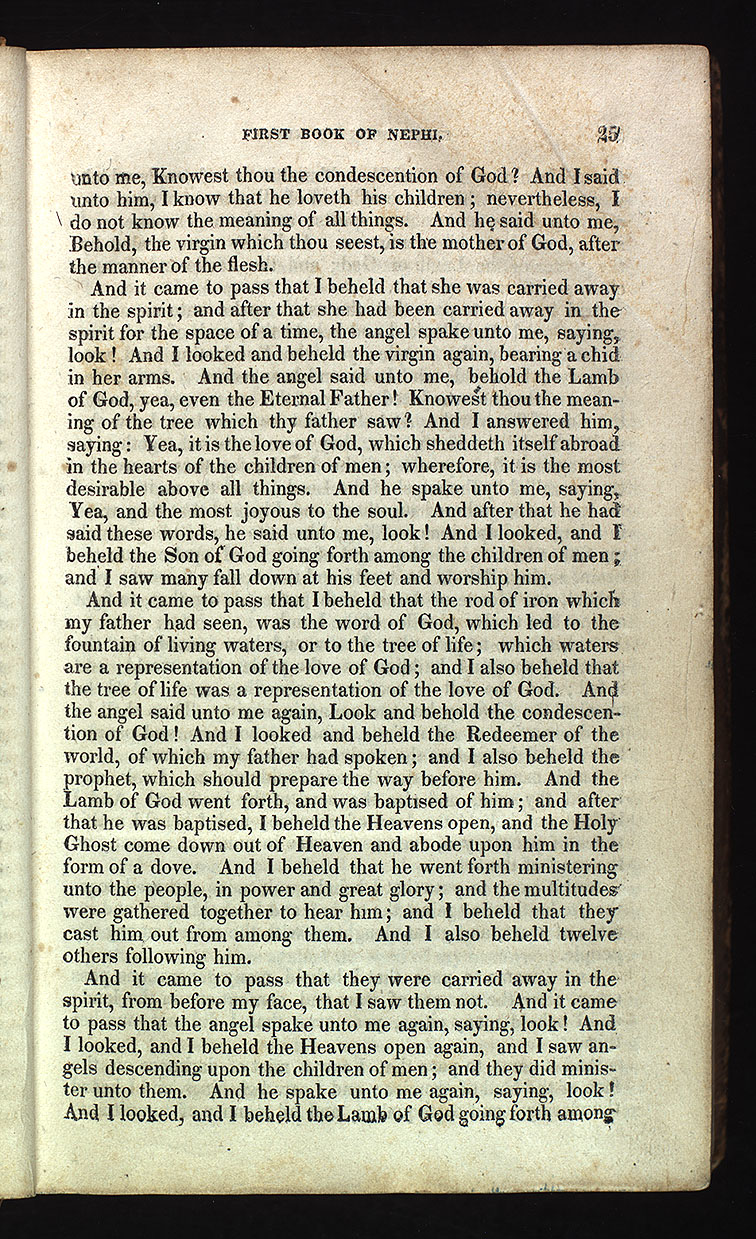
The original readings themselves are the first clue. They call Christ "the Eternal Father." For most modern readers that sounds like a flat contradiction, as if the book is confusing Jesus with God the Father. But in Latter-day Saint teaching, Christ legitimately carries the title "Father" in more than one sense. He is the Father as Creator of heaven and earth, acting under God the Father's direction. He is the Father of everyone spiritually reborn through accepting Him, who become "his sons and his daughters" (Mosiah 5:7). And He speaks and acts with the full authority of the Father, as His authorized representative.[7] The Book of Mormon teaches all three of these ideas in its own pages.
So the 1830 wording was accurate language that a modern reader could easily misread, not a theological mistake that needed correcting. The 1837 edits simply made it harder to misread. That is Skousen's own conclusion: "I view these four changes as examples of clarification rather than doctrinal revision."[3:3]
He even offers a likely trigger that has nothing to do with theology. The first edit changed "the mother of God," a phrase that sounds distinctly Catholic, into "the mother of the Son of God." Skousen suggests Joseph simply did not like "the Catholic sounding expression," and then adjusted the three nearby verses to match.[3:4]
That fits the 1830s setting. Alexander Campbell had gone after the Book of Mormon in print in 1831, ridiculing it for settling "all the great controversies" of the day, "the trinity" included, and Oliver Cowdery, who prepared the 1837 edition, had spent years answering him.[8] The fight over what the book said about God was still running while that edition was being prepared, which is reason enough to smooth a line that invited the wrong reading. The Catholic angle is Skousen's read on Joseph's motive, not anything Campbell wrote.
The 1830 text already taught a separate Father and Son
If the original Book of Mormon really taught that the Father and the Son were one and the same being, it would not contain passages showing them as two separate persons. But it does, those passages were in the 1830 text from the start, and Joseph never touched the titles that name them separately.
The clearest example sits inside the very chapter the CES Letter builds its case on. The disputed edits are at 1 Nephi 11:18, 21, and 32. But just three verses after verse 21, the 1830 text already reads, "I looked, and I beheld the Son of God going forth among the children of men" (1 Nephi 11:24). The title "Son of God" was right there in the original, in the same chapter, in the same vision. If Joseph were secretly teaching that the Father and Son were one being in 1829, why would he dictate "Son of God" at verse 24 while supposedly hiding that distinction at verse 21? The plain answer is that both titles apply to Christ in different senses, which is exactly what Latter-day Saint theology teaches. Critics almost never mention this verse.
The pattern runs through the whole 1830 book:
- 2 Nephi 31:11. The Father speaks as a separate voice: "And the Father said: Repent ye, repent ye, and be baptized in the name of my Beloved Son." A being cannot introduce his "Beloved Son" if he is that same Son.
- 3 Nephi 11:7. When the resurrected Christ visits the Nephites, a voice comes from heaven: "Behold my Beloved Son, in whom I am well pleased." Then Christ descends as a separate person while the crowd watches both. This is one of the clearest two-person scenes in all of scripture, and its staging reads the same in the 1837 revision and in the 1840 and 1842 editions.
- 3 Nephi 17 through 19. Again and again, Christ kneels and prays to the Father, and says "I go unto the Father." You do not pray to yourself or travel to yourself.
That last point closes the loop. In one of those prayers, Christ asks that His disciples "may be one" with Him in the same way He and the Father are "one" (3 Nephi 19:29; cf. 19:23). The disciples obviously do not melt into a single being with Christ, so the "oneness" He describes is a unity of love, will, and purpose. The text defines its own oneness language for us, right there on the page.[9]
The numbers back this up. The title "Son of God" alone appears 51 times across the Book of Mormon.[10] Ari Bruening and David Paulsen went looking for the other side of the ledger. Out of roughly 1,800 references to God they counted, only six flatly say the Father and the Son are the same person, which is the idea scholars call modalism. Two more said the same thing and were changed later. Bruening and Paulsen do not say which two those were, and what they were tallying was passages, not edits. Once the references that point neither way are set aside, they concluded, two-person passages outnumber one-person-sounding ones in the first edition by "at least 20 to 1."[9:1]
A book that was genuinely trying to teach that the two are one being would not, 51 times over, keep calling one of them "the Son."
Why the four edits run one way
The four edits do share one feature the critics are right to press. They all move in the same direction. Every one of them shifts a title from calling Christ "the Father" toward calling Him "the Son of" the Father. If you wanted to imagine Joseph scrubbing out Trinity-sounding language, this is the pattern you would expect to see.
There is more in the same vein. The timing lines up with a stretch of real development in Joseph's teaching in the mid-1830s, and his earliest written account of the First Vision, from 1832, mentions seeing "the Lord" without clearly naming two separate beings. Take that seriously; do not brush past it. The full critical case, argued at its strongest by the historian Thomas Alexander, gets a complete hearing in the in-depth version.[11]
But three facts keep the "directional" pattern from proving what it needs to prove. First, the edits stop after the first hundred or so pages, exactly the stretch where Skousen shows Joseph editing carefully before the demands on his time forced him to ease off. If this were a theological housecleaning, the bigger targets, the passages the CES Letter itself flags as Trinity-sounding, like Mosiah 15 and Alma 11, would have been on the list. Why did three successive editions leave those passages alone?
Second, the rest of that 1837 editing pass shows no parallel theological pattern at all; it is mostly typesetting fixes and grammar. And third, the underlying belief in a separate Father and Son was already on record well before 1837. A revelation Joseph recorded in February 1832 reads, "We beheld the glory of the Son, on the right hand of the Father" (Doctrine and Covenants 76:20), naming the two as distinct five years before the edits and published while the book was still new.[12] The First Vision account the critics lean on is from that same year, so 1832 produced both documents.
So even granting the critics their best feature, the evidence points toward Joseph clarifying language he already believed, not reversing a belief he used to hold.
What the 1830 readers already had
The first edition made the point on its own, years before any edit. The Father's voice speaks from heaven and names His Beloved Son, who descends as a separate person and invites the Nephites to feel the wounds in His hands. Elsewhere in the same first edition, the Son prays to the Father, tells the Nephites He is going to the Father, and the Father commands baptism in the name of His Beloved Son.
The critics' story asks a great deal of its author. A barely schooled farmer in his early twenties, dictating out loud without notes, invents the Trinity as he goes, forgets about it three verses later, keeps that lapse in place through 3 Nephi 11, and leaves it standing in every edition that followed. Joseph spoke the whole book onto paper in roughly 60 working days, and the Father and the Son stood apart in it from the first page.
The four verses the Tanners offered as their single best case do fit the pattern the critics describe. The book those verses came out of does not. Joseph made the changes in a published second edition, with the first still in circulation for anyone to compare. The doctrine was in the book before the edits were.
Further Reading
- Changes to the Book of Mormon, Church History Topics essay
- The Father and the Son (1916 Doctrinal Exposition), First Presidency and Quorum of the Twelve Apostles
- Royal Skousen, "Changes in the Book of Mormon", Interpreter 11 (2014): 161-176
- Brian C. Hales, "Changing Critics' Criticisms of Book of Mormon Changes", Interpreter 28 (2018): 49-64
Want the full case, including the strongest arguments the critics make and every source? Read the in-depth version.
Runnells, CES Letter (2017), "Book of Mormon," no. 11, p. 25. ↩︎
Runnells, CES Letter (2017), "Book of Mormon," no. 11, p. 27. "Assuming that the official 1838 first vision account is truthful and accurate, why would Joseph Smith hold a Trinitarian view of the Godhead if he personally saw God the Father and Jesus Christ as separate and embodied beings a few years earlier in the Sacred Grove?" ↩︎
Royal Skousen, "Changes in the Book of Mormon," Interpreter: A Journal of Mormon Scripture 11 (2014): 161-176. Originally presented at the FAIR conference, August 2002. https://interpreterfoundation.org/journal/changes-in-the-book-of-mormon/ ↩︎ ↩︎ ↩︎ ↩︎ ↩︎
Brian C. Hales, "Changing Critics' Criticisms of Book of Mormon Changes," Interpreter: A Journal of Mormon Scripture 28 (2018): 49-64. Hales documents that Jerald Tanner collated an 1830 edition against a 1964 edition, and quotes the Tanners' "four most important changes" characterization; the underlying source is Jerald and Sandra Tanner, Major Problems of Mormonism (Salt Lake City: Utah Lighthouse Ministry, 1989), 160, as quoted in Hales, n. 41. https://interpreterfoundation.org/journal/changing-critics-criticisms-of-book-of-mormon-changes/ ↩︎ ↩︎
The Book of Mormon, first edition (Palmyra, NY: E. B. Grandin, 1830). Diplomatic transcripts of the printed pages are published by the Joseph Smith Papers Project; the four passages discussed here appear on pp. 25, 26, and 32. https://www.josephsmithpapers.org/paper-summary/book-of-mormon-1830/31 ↩︎
Royal Skousen, ed., The Book of Mormon: The Earliest Text, 2nd ed. (New Haven: Yale University Press, 2022; orig. 2009). Reconstructed text of the 1829 dictation in clear-text format; the most authoritative source for original 1830 readings. ↩︎
"The Father and the Son: A Doctrinal Exposition by the First Presidency and the Twelve," June 30, 1916. Reprinted in Ensign, April 2002. https://www.churchofjesuschrist.org/study/ensign/2002/04/the-father-and-the-son?lang=eng ↩︎
Alexander Campbell, "Delusions," Millennial Harbinger 2 (February 7, 1831): 85-97. Reprinted as a pamphlet in Boston, 1832 — the first anti-Mormon book. Campbell mocked the Book of Mormon for deciding "all the great controversies" of contemporary Christianity, a list in which he included "the trinity." He does not mention "the mother of God" or Catholic idiom anywhere in the piece. Oliver Cowdery, who supervised the 1837 edition's editorial preparation, had spent six years responding to Campbell's polemics by the time the 1837 edition was set. ↩︎
Ari D. Bruening and David L. Paulsen, "The Development of the Mormon Understanding of God: Early Mormon Modalism and Other Myths," FARMS Review of Books 13, no. 2 (2001): 109-169. Identified approximately 1,800 deity references in the Book of Mormon and found antimodalist passages outnumber modalist-sounding ones by a wide margin. Direct rebuttal of Widmer 2000. https://scholarsarchive.byu.edu/msr/vol13/iss2/13/ ↩︎ ↩︎
Andrew C. Skinner, "The Doctrine of God the Father in the Book of Mormon," in A Book of Mormon Treasury: Gospel Insights from General Authorities and Religious Educators (Provo, UT: Religious Studies Center, Brigham Young University, 2003). Documents that "Son of God" appears 51 times in the Book of Mormon. Quotes Joseph Smith's 1844 statement: "I have always declared God to be a distinct personage, Jesus Christ a separate and distinct personage from God the Father, and that the Holy Ghost was a distinct personage and a Spirit: and these three constitute three distinct personages and three Gods." https://rsc.byu.edu/book-mormon-treasury/doctrine-god-father-book-mormon ↩︎
Thomas G. Alexander, "The Reconstruction of Mormon Doctrine: From Joseph Smith to Progressive Theology," Sunstone 5, no. 4 (July-August 1980): 24-33. Winner of the Mormon History Association best article award, 1980. Argues that pre-1835 LDS doctrine was "essentially trinitarian" and traces a development to distinct-beings theology by 1844. The strongest scholarly version of the theological-evolution thesis. ↩︎
Doctrine and Covenants 76:19-23, recorded February 16, 1832: "We beheld the glory of the Son, on the right hand of the Father...And now, after the many testimonies which have been given of him, this is the testimony, last of all, which we give of him: That he lives! For we saw him, even on the right hand of God." ↩︎