View of the Hebrews
The claim:
"There was a book published in 1823 Vermont entitled View of the Hebrews. . . . [34-item parallel chart] . . . Oliver Cowdery – also a Poultney, Vermont resident – was a member of Ethan's congregation during this time . . ."[1]
"While this does not prove that the Book of Mormon was plagiarized from the View of the Hebrews, it does demonstrate that key elements of the story of the Book of Mormon – i.e. Native Americans as Hebrew descendants, ancient records of natives preserved, scattering and gathering of Israel, Hebrew origin of Native American language, etc. pre-dated the Book of Mormon and were already among the ideas circulating among New England protestant Americans."[2]
The chart dresses up a short argument. A New England minister named Ethan Smith published a book called View of the Hebrews in 1823, seven years before the Book of Mormon. It argued that Native Americans were descended from the lost tribes of Israel. The CES Letter lays out a chart of thirty-four "parallels" between that book and the Book of Mormon, notes that Joseph Smith's future scribe Oliver Cowdery lived in the same Vermont town as Ethan Smith, and lets the reader draw the obvious conclusion: Joseph borrowed his book from Ethan's.
The idea that the Indians were Israelites really was in the air in Joseph Smith's America. But set the two books side by side and read what they actually say, and the borrowing story collapses, then reverses on itself. The Book of Mormon breaks with View of the Hebrews on almost every specific point a copier would have kept, and it leaves out the one piece of "evidence" Ethan Smith cared about most.
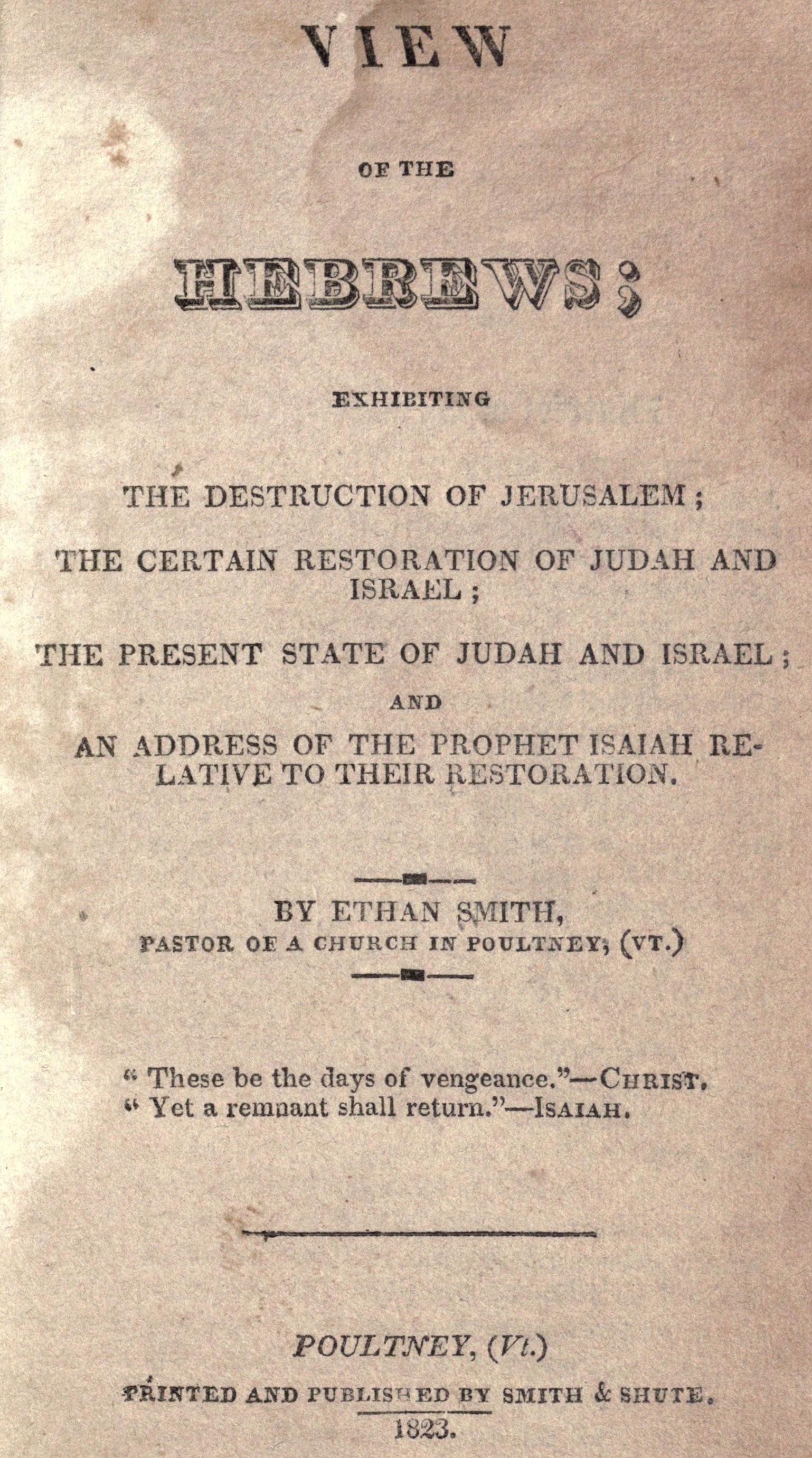
One fact frames the whole question. In 1996, Brigham Young University brought View of the Hebrews back into print in its entirety, with a scholarly introduction that puts both texts in the reader's hands and invites a line-by-line comparison.[3] That is a strange thing to do with a book you are supposed to be hiding.
The theme really was in the air
Ethan Smith did not invent the idea that the Indians were Israelites, and the Book of Mormon was not the first book to play with it. The notion had been circulating in English for almost two centuries before either was printed.[4][5] Thomas Thorowgood argued it in London in 1650. James Adair filled hundreds of pages with supposed Hebrew-Indian parallels in 1775. Elias Boudinot, who had presided over the Continental Congress, published the same thesis in 1816, seven years before View of the Hebrews. Cotton Mather, William Penn, and Roger Williams had all touched it earlier.[6]
That history matters because it quietly changes what the CES Letter's chart is even comparing. It is not really lining up View of the Hebrews against the Book of Mormon so much as lining up the standard nineteenth-century assumptions about where the Indians came from, ideas you could find in a dozen books, against a scripture that engages the very biblical themes those assumptions grew out of. The chart never explains why Ethan Smith, rather than Adair or Boudinot or any of the others, should be named as the source. Nothing singles him out except that someone, long after the fact, decided to build a list around his book.
The chart is built to hide the differences
A chart of thirty-four checkmarks in two columns feels overwhelming before you have examined a single item, and that feeling is doing most of the persuading. Look closely and the impression comes apart in three ways.
First, the chart pads its count by splitting one shared idea into many rows. Grant the single premise that ancient Hebrews reached the Americas, and a stack of "parallels" follows automatically: the scattering of Israel, the destruction of Jerusalem, the gathering of the lost tribes, a long migration, crossing many waters, and so on. Those are not nine separate matches. They are nine restatements of one idea, the same biblical story of Israel's scattering that both books are drawing from.
Second, a checkmark hides what is actually being compared. The chart marks "destruction of Jerusalem" in both columns. What it does not tell you is that View of the Hebrews is talking about the Roman destruction in A.D. 70, while the Book of Mormon is talking about the Babylonian destruction in 586 B.C. Different armies, different centuries, more than six hundred years apart. A checkmark smooths all of that down to a tidy match.
Third, the one detailed parallel the CES Letter actually annotates dissolves the second you trace it. Both books describe a man standing on a wall, crying woe to the city, who is then attacked: Samuel the Lamanite in the Book of Mormon, and a figure named Jesus son of Ananus in View of the Hebrews. It sounds specific until you notice that Ethan Smith did not write that story. He lifted it straight out of Josephus, the ancient Jewish historian whose works sat in countless American homes.[7] So the "parallel," at most, ties the Book of Mormon to a famous ancient story anyone could have known, not to anything original to Ethan Smith. There are other items on the chart, and the in-depth version walks through them, but they all share this shape: broad where they look specific, and borrowed from a common well rather than from each other.
Where the two books actually disagree
The criticism only ever shows you half the comparison. The CES Letter gives you the parallels and stops there. It never shows you the differences, and the differences are not small footnotes. They are the load-bearing claims of Ethan Smith's book, and the Book of Mormon contradicts them one after another.
John Welch catalogued more than eighty specific places where the Book of Mormon departs from or flatly reverses View of the Hebrews.[8] A few are enough to show the pattern. Ethan Smith has the migrants walk overland across the Bering Strait; the Book of Mormon puts them on a ship across the ocean. Ethan Smith has them settle north to south; the Book of Mormon runs south to north. Ethan Smith's heroes keep parchment records; the Book of Mormon's keep gold plates. Ethan Smith makes Moses the central figure; the Book of Mormon makes Jesus Christ the center and never mentions the Moses-figure Ethan Smith spends pages on.
Three of these are not the kind of thing a copier changes by accident. The Book of Mormon turns each one down flat.
Ethan Smith's single strongest piece of evidence is that Native Americans practiced circumcision, which to him proved Hebrew descent. A borrower quietly building the same case would have kept it. The Book of Mormon does the opposite: it declares outright that "the law of circumcision is done away" (Moroni 8:8). Ethan Smith's entire thesis is that the Indians are the ten lost tribes. The Book of Mormon goes out of its way to say they are not. The risen Christ tells the people in 3 Nephi that the ten tribes are somewhere else, "other sheep" he must still visit, separate from the very people he is standing among. And the chapter Ethan Smith makes the keystone of his whole argument, Isaiah 18, the one his title page's own contents line points to, never surfaces in the Book of Mormon, even though the Book of Mormon quotes more of Isaiah than almost any other source and reproduces whole chapters of it.[8:1]
Stop and feel the weight of that last one. If you were borrowing from a book, would you leave its best argument on the table? The Book of Mormon devotes page after page to Isaiah and pointedly skips the exact chapter its alleged source built everything on. Gregory Dundas, a non-Latter-day Saint scholar who writes from a "believing skeptic" position, put the whole pattern bluntly: a Joseph Smith borrowing from the book "would have had to exercise superhuman restraint in not using the many verses that the other book does cite," and he tells the reader to "try to imagine having as helpful a resource as A View of the Hebrews and then simply ignoring 99 percent of it."[9] The in-depth version lays out the full list and the comparison table.
The two facts the case rests on both fail
Underneath the chart, the CES Letter offers two hard claims that sound like documented history. Both fall apart on examination.
The first is that Oliver Cowdery "was a member of Ethan's congregation." Larry Morris went through the surviving Poultney church records, town records, and the Cowdery family's residence papers.[10] The timing simply does not work. Every documented contact between the Cowdery family and that church (1803, 1810, 1818) happened under a different minister, Reverend Leonard. Ethan Smith did not arrive in Poultney until 1821, three full years after the last of those contacts. And the family was indeed in Poultney when the book appeared in 1823; the missing person is Oliver himself, who likely lived in the neighboring town of Wells from 1820 to 1822 and left for New York around 1825. There is no record placing Oliver in Ethan Smith's congregation at all, and Oliver did not even meet Joseph until 1829. The "direct link" is an assertion the documents do not support. Could Oliver have heard of a local minister's book another way? Possibly. But "possibly" is not "was a member," and the in-depth version walks through why even the softer version struggles.
The second claim backfires hardest of all. The CES Letter leans heavily on B.H. Roberts, an early-twentieth-century Church leader and historian, quoting a passage where he describes the "cumulative force" of the parallels. The clear implication is that this respected insider concluded the Book of Mormon was a fraud.
He concluded no such thing. In the 1920s, Roberts wrote up the hardest case he could against the Book of Mormon, on purpose, so that Church leaders could prepare missionaries to answer it. He said so in plain words in his own cover letter, which the CES Letter never quotes: "What is herein set forth does not represent any conclusions of mine."[11] He called the document "awful," a scissors-and-paste compilation in Madsen's summary, and added, "I am taking the position that our faith is not only unshaken but unshakeable in the Book of Mormon."[11:1] He was playing the lawyer, building the prosecution's brief so his own side could rebut it, not a man confessing.
And he never stopped affirming the book. Across the very years in question, he rose in general conference to defend the Book of Mormon, declared at the 1930 Church centennial that it was revealed "by the power of God," and used the final conference address he ever gave to call it "one of the most valuable books that has ever been preserved."[11:2][12] A friend reported him saying, weeks before his death, that "Ethan Smith played no part in the formation of the Book of Mormon."[11:3] The CES Letter conscripts Roberts as its star witness. Read in full, he testifies for the other side. The in-depth version traces his testimony year by year.
Even outside scholars see two separate books
You do not have to take a believer's word for any of this. The scholars who have looked hardest at the question, including ones with no stake in the Church being true, keep arriving at the same place.
Elizabeth Fenton, an English professor at the University of Vermont with no Latter-day Saint connection, wrote the fullest recent academic study of how the two books relate. Her finding is striking: the Book of Mormon "does not present the lost tribes of Israel as the ancestors of American peoples and is in fact explicit in its rejection of that theory."[13] That is the exact reverse of Ethan Smith's central claim. In her telling, the Book of Mormon did not extend the Indians-as-Israelites theory; it helped kill it off. Richard Bushman, the leading academic historian of early Mormonism, reached the same verdict decades earlier in a book from a secular university press: "Nor is there evidence of heavy borrowing from View of the Hebrews, as some critics have said."[14] Two scholars, different faiths, different fields, converging independently on the same answer. The in-depth version covers their work in full.
The subtler version of the charge
The chart and the two facts are easy to take apart. The strongest version of this criticism is harder, and it has earned a real answer rather than a victory lap.
That stronger version drops the word "plagiarism" entirely. It says: never mind whether Joseph held View of the Hebrews in his hands. He grew up soaking in a culture saturated with the idea that the Indians were Israelites, and View of the Hebrews is just the clearest single book expressing that culture. On this reading, the Book of Mormon is a creative product of its environment.
The theme genuinely was widespread. The faithful case cannot shrug that off, and its weakest move is the old line that "a borrower would surely have included the strongest evidence," by itself, because a clever author might have left things out for his own reasons. So the environmental thesis does explain the broad, fuzzy overlap between the two books.
What it cannot explain is everything underneath the overlap. If Joseph were channeling his environment, the book should echo that environment's assumptions. Instead it contradicts them at nearly every specific turn, as we have seen, and it omits the very evidence a nineteenth-century author would have found most useful. And it contains things that environment could not have supplied at all. The clearest is Nahom: the Book of Mormon names a place along Lehi's route through Arabia where Ishmael was buried, and in 1988, archaeologists in Yemen dug up ancient altars carved with that very tribal name, NHM, dating to roughly Lehi's lifetime.[15] View of the Hebrews is a book about the Americas. It has nothing to say about Arabia, and it certainly could not have planted a real place-name in the Yemeni desert. The environmental thesis answers the easy half of the data and goes silent on the hard half.
The borrowing runs the other way
When all of it settles, the CES Letter gets exactly one thing right: both books talk about Hebrews coming to the Americas. So did Boudinot, Adair, Priest, Thorowgood, and a long line of writers stretching back almost two hundred years before Ethan Smith. The theme was never in dispute. It was already everywhere. The real question was always whether this book produced that one, and the record answers no. Borrowing means following your source, and the Book of Mormon walks away from Ethan Smith at every turn that matters: the migration route, the central figure, the direction of settlement, the record, the lost tribes, the keystone chapter. It drops his best evidence and carries details from the other side of the world he never knew.
And remember what the Book of Mormon is. Joseph dictated the whole of it, around 270,000 words, in roughly sixty working days, with earlier chapters never reopened.[16] The theory on offer asks us to believe that a man did that by stitching together a theological essay he contradicts throughout. The closest scholars, believing and not, keep reaching the simpler reading: the Book of Mormon did not repackage View of the Hebrews. Point for point, it answered it and overturned it.
Want the full case, including the strongest arguments the critics make and every source? Read the in-depth version.
Runnells, CES Letter (2017), "Book of Mormon," no. 8, pp. 16–20. ↩︎
Runnells, CES Letter (2017), "Book of Mormon," no. 8, p. 21. ↩︎
Charles D. Tate Jr., "Introduction," in Ethan Smith, View of the Hebrews (Provo, UT: BYU Religious Studies Center, 1996). https://rsc.byu.edu/view-hebrews/introduction ↩︎
Elizabeth Fenton, Old Canaan in a New World: Native Americans and the Lost Tribes of Israel (New York: NYU Press, 2020). https://nyupress.org/9781479866366/old-canaan-in-a-new-world/ ↩︎
Stephen D. Ricks, "Death Knell or Tinkling Cymbals?," review of The Use of the Old Testament in the Book of Mormon by Wesley P. Walters, Review of Books on the Book of Mormon 4, no. 1 (1992): 235–250. See also Scripture Central KnoWhy #502, "Is the Book of Mormon Like Any Other Nineteenth Century Book?" https://scripturecentral.org/knowhy/is-the-book-of-mormon-like-any-other-nineteenth-century-book ↩︎
Hal Hougey, "A Parallel"—The Basis of the Book of Mormon: B. H. Roberts' "Parallel" of the Book of Mormon to View of the Hebrews (Concordia, CA: Pacific Publishing Company, 1963), an early evangelical-critic version of the View of the Hebrews parallels argument with point-by-point lists of supposed parallels. Hougey's own survey opens by noting that "Such outstanding American religious leaders as Roger Williams, William Penn, Cotton Mather, and Jonathan Edwards had advocated this theory a century or more before the Book of Mormon was published in 1830." See B.H. Roberts Foundation, "Hal Hougey argues that Joseph plagiarized View of the Hebrews; gives list of parallels between View of the Hebrews and the Book of Mormon," https://bhroberts.org/records/0GBjH6-NCSKYg/. The CES Letter inherits its parallels-list approach from this longer evangelical-critical tradition rather than originating it. ↩︎
Flavius Josephus, The Wars of the Jews, 6.5.3. View of the Hebrews quotes this passage directly from Josephus; the wall-preacher narrative is not original to Ethan Smith. ↩︎
John W. Welch, "View of the Hebrews: 'An Unparallel,'" in Reexploring the Book of Mormon, ed. John W. Welch (Provo, UT: FARMS, 1992), 83–87. https://archive.bookofmormoncentral.org/sites/default/files/archive-files/pdf/welch/2015-10-28/22_view_of_the_hebrews_83-87.pdf. The expanded 1985 original circulated as a FARMS preliminary report: John W. Welch, Finding Answers to B. H. Roberts's Questions and "An Unparallel" (Provo, UT: FARMS, 1985; catalog code WEL-85d), https://archive.bookofmormoncentral.org/content/finding-answers-bh-robertss-questions-and-unparallel. Quotations follow the 1985 report's text. See also B.H. Roberts Foundation, "John W. Welch lists a variety of unparallels between View of the Hebrews and the Book of Mormon," https://bhroberts.org/records/gzzHJd-03DB4J/ ↩︎ ↩︎
Gregory Steven Dundas, Explaining Mormonism (Eugene, OR: Wipf and Stock, 2022), ch. 6, pp. 204–211. Dundas writes from a "believing skeptic" methodological position rather than as a partisan apologist. https://wipfandstock.com/9781666741834/explaining-mormonism/ ↩︎
Larry E. Morris, "Oliver Cowdery's Vermont Years and the Origins of Mormonism," BYU Studies 39, no. 1 (2000). https://scholarsarchive.byu.edu/byusq/vol39/iss1/7/ ↩︎
Truman G. Madsen, "B.H. Roberts and the Book of Mormon," in Book of Mormon Authorship: New Light on Ancient Origins, ed. Noel B. Reynolds (Provo, UT: BYU Religious Studies Center, 1982), 7–32. https://rsc.byu.edu/book-mormon-authorship/b-h-roberts-book-mormon ↩︎ ↩︎ ↩︎ ↩︎
FAIR, "B.H. Roberts and Studies of the Book of Mormon." https://www.fairlatterdaysaints.org/answers/Book_of_Mormon/B.H._Roberts_and_"Studies_of_the_Book_of_Mormon" ↩︎
Elizabeth Fenton, "Nephites and Israelites: The Book of Mormon and the Hebraic Indian Theory," in Americanist Approaches to the Book of Mormon, ed. Elizabeth Fenton and Jared Hickman (Oxford: Oxford University Press, 2019), 277–297. https://global.oup.com/academic/product/americanist-approaches-to-the-book-of-mormon-9780190221928 ↩︎
Richard Lyman Bushman, Joseph Smith and the Beginnings of Mormonism (Urbana: University of Illinois Press, 1984), 134–139. Bushman's analysis spans six pages of sustained engagement with the View of the Hebrews dependence question. See also B.H. Roberts Foundation, "Richard Lyman Bushman reviews the controversy surrounding View of the Hebrews and the Book of Mormon," https://bhroberts.org/records/jpNwrg-9hCb4h/ ↩︎
Warren P. Aston, "A History of NaHoM," BYU Studies Quarterly 51, no. 2 (2012): 78–98. https://byustudies.byu.edu/article/a-history-of-nahom/. Aston documents the 1988 German archaeological discovery of the first NHM altar at the Bar'an Temple, Marib, Yemen, and S. Kent Brown's 1999 LDS scholarly identification linking the inscription to the Book of Mormon's Nahom. ↩︎
John W. Welch, "Timing the Translation of the Book of Mormon: 'Days [and Hours] Never to Be Forgotten,'" BYU Studies Quarterly 57, no. 4 (2018): 11–50. https://archive.bookofmormoncentral.org/sites/default/files/archive-files/pdf/welch/2020-01-13/john_w._welch_byus_57.4._timing_the_translation_of_the_book_of_mormon_2018.pdf ↩︎