DNA and the Book of Mormon
The claim:
"DNA analysis has concluded that Native American Indians do not originate from the Middle East or from Israelites but rather from Asia. Why did the Church change the following section of the introduction page in the 2006 edition Book of Mormon, shortly after the DNA results were released?
'…the Lamanites, and they are the principal ancestors of the American Indians'
to
'…the Lamanites, and they are among the ancestors of the American Indians'
UPDATE: The Church conceded in its January 2014 Book of Mormon and DNA Studies essay that the majority of Native Americans carry largely Asian DNA. The Church, through this essay, makes a major shift in narrative from its past dominant narrative and claims of the origins of the Native American Indians."[1]
DNA is the objection critics treat as settled science. Scientists have read the DNA of Native Americans, and it comes back almost entirely Asian, not Israelite. The Book of Mormon says a family from Jerusalem sailed to the Americas around 600 BC and became a major branch of the Native American family tree. If that happened, the critics say, their Middle Eastern DNA should still be here. It is not. And right after the studies came out, the Church softened a line in the front of the Book of Mormon. It went from calling the Lehites the "principal" ancestors of the American Indians to merely "among" them, which sure looks like getting caught.
The DNA really is overwhelmingly Asian
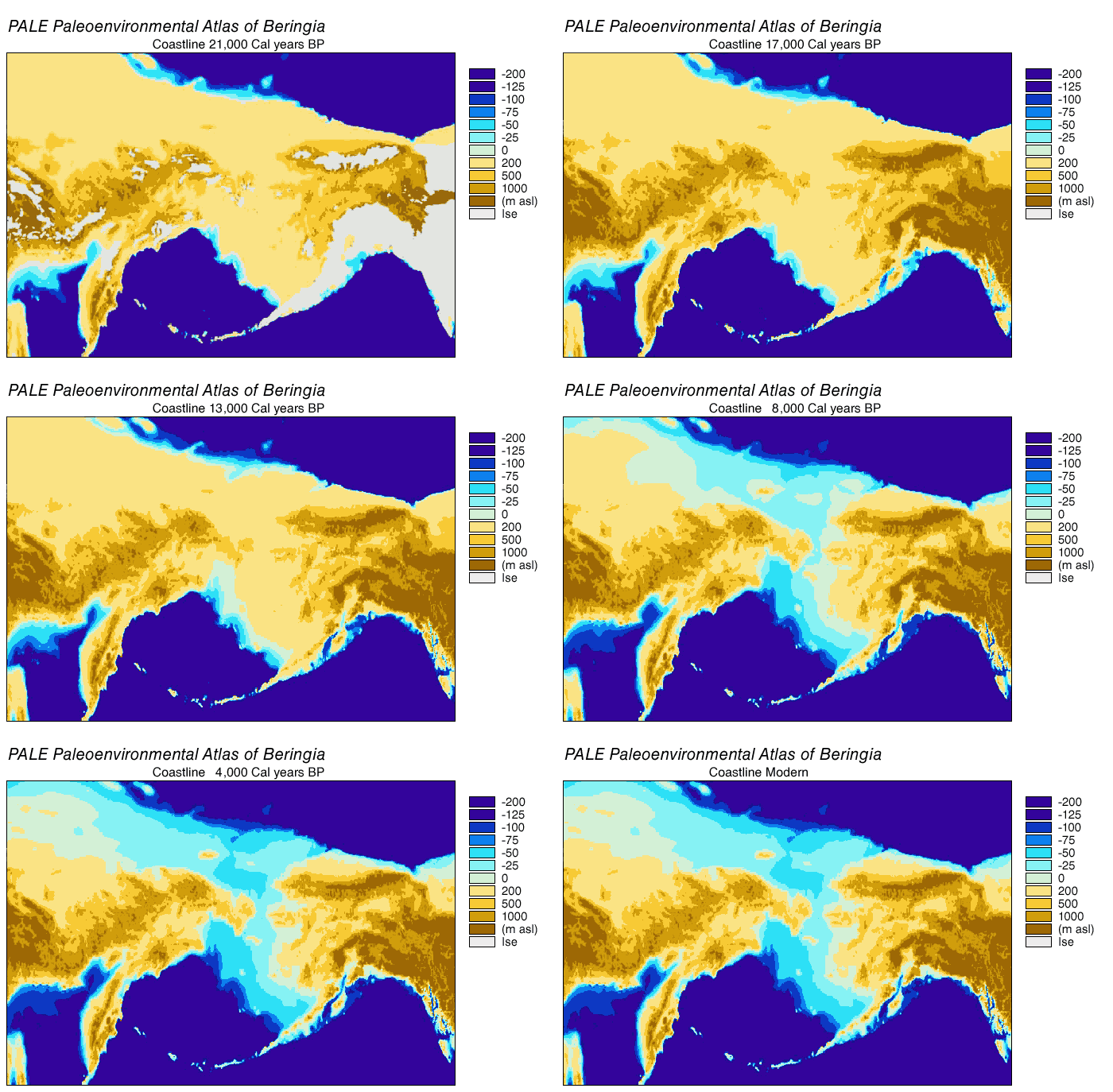
The science the critics point to is real and it is not in dispute. When you survey the DNA of Native American populations, the overwhelming majority of it traces back to Asia, to people who crossed from Siberia into the Americas roughly 15,000 to 25,000 years ago.[2] No serious Latter-day Saint scholar argues otherwise. The Church's own essay on the subject says it outright: "the majority of Native Americans carry largely Asian DNA."[2:1]
So the disagreement was never about that finding. It lives in the next step, the leap from "most Native American DNA is Asian" to "therefore the Book of Mormon is false." That leap turns out to rest on a mistake about what DNA can actually detect. Once you understand the mistake, the whole argument comes apart.
A whole civilization can vanish from the DNA record
The Phoenicians make the point cleaner than any argument can.
They were one of the great seafaring peoples of the ancient world. They planted colonies all around the Mediterranean, left behind cities and writing and a deep cultural mark. A population geneticist named Henry Harpending was a professor at the University of Utah and a member of the National Academy of Sciences (not a Latter-day Saint defending the faith, a secular scientist at a research university). He was asked a simple question. Suppose fifty Phoenicians had landed somewhere 2,600 years ago and mixed freely with the locals. What genetic trace would they leave today? His answer:
"I doubt that we would pick up [evidence of the Phoenicians] today at all… If they intermixed freely and widely… then the only trace would be an occasional strange stray haplotype. Even if we found such a haplotype we would probably assume it was the result of post-Columbian admixture."[3]
A documented, prosperous, sea-going civilization would be genetically invisible today in the very regions it settled. So if the Phoenicians vanish from the DNA record, then expecting one family out of Jerusalem to show up plainly after the same 2,600 years runs directly against what the science predicts.
And this is not a one-off thought experiment. Whole populations really have disappeared from the modern genetic record, and we only know they existed because scientists dug up their bones and read the DNA directly.
A group called the Saqqaq lived in Greenland for about 1,700 years and then vanished around 2,800 years ago, leaving no detectable descendants among living peoples of the Americas.[4][5] In a 2016 study, researchers recovered DNA from 92 pre-Columbian skeletons in South America. Every single one of the fine-grained genetic lineages they carried is absent from modern databases, including lineages still alive just 500 years ago.[6] Even Iceland, a country obsessive about keeping family records, has lost track of its own founders in the DNA. Roughly 60% of the lineages carried by the original Norse settlers cannot be detected in modern Icelanders, after only about a thousand years.[7]
If documented people who were there slip out of the genetic record this easily, then the missing trace of a small Israelite group from 600 BC stops looking like a smoking gun and starts looking like the ordinary course of things.
Why a small group disappears: the math of drift
Behind those examples sits a piece of real science you can understand rather than take on faith.
DNA is not passed down in a tidy, complete package. Each generation, the particular genetic markers a small founding group brought with them have a chance of simply not being handed on, the way a family surname dies out if a couple has only daughters. Over many generations, those odds compound, and rare markers tend to thin out and eventually vanish. Geneticists call this drift, and it hits small groups hardest. A handful of newcomers folded into a much larger existing population is the textbook case where their markers wash out.
This has been modeled directly. A study published in 2008 in a mainstream, non-Latter-day-Saint genetics journal simulated a migrating group entering a host population and tracked their DNA forward across about 2,000 years.[8] The result: in most of the people sampled, you would not find a single trace of the migrants' DNA, even though the migration definitely happened in the simulation. The authors put the lesson plainly:
"[I]t must be remembered that drift is stochastic and that historic genetic parameters are, for the most part, unknown. Thus, the absence of specific genetic data is not conclusive evidence against historic admixture."[8:1]
In ordinary words: because the process is partly random, not finding the DNA does not prove the people were never there. And the Lehites are about the worst case imaginable for this. The Book of Mormon's own description puts them at the losing end of every factor that controls whether DNA survives. The founding group was tiny, a single family of perhaps thirty people. The time span was enormous, 2,600 years. And they were absorbed into what was by far the largest host population, millions of people already in the Americas. Then they were battered by later catastrophes that wiped out countless lineages, including the roughly 90% population collapse after Europeans arrived.[2:2] Stack those together and a vanished Lehite signal is precisely what the math demands, whether the migration happened or not.
There is no "Israelite DNA" to search for in the first place
The critics' argument hides an assumption that does not survive a second look: that "Israelite DNA" is a known, defined thing scientists can hunt for in Native American populations. It is not.
The Church's essay illustrates this with a real example, the genealogy of Ugo Perego, a population geneticist who happens to be a multi-generation Italian. His own paternal DNA line belongs to a branch of haplogroup C, which is an Asian and Native American lineage, not a European one. As the essay notes, if Perego's family were to settle an empty island, future scientists studying his descendants "might conclude that the original settlers of that landmass were from Asia rather than Italy."[2:3]
The same trap waits for anyone scanning Native Americans for Lehi. We do not know what genetic markers Lehi carried, or his wife Sariah, or Ishmael's family who came with them. There is no sample of "Lehite DNA" anywhere to compare against. The search the critics imagine was performed (scanning Native Americans for Israelite markers and coming up empty) could never actually be run. Looking for what, exactly? You cannot fail to find something you were never able to define.
The "principal ancestors" change was a correction
That leaves the part that looks most like a confession: the Church changing "principal ancestors" to "among the ancestors" right around the time the DNA studies arrived.
Two facts dissolve it. First, that wording was never scripture. The original 1830 Book of Mormon had no introduction page at all. The line the critics quote was written in 1981 by an editor, as part of the front matter, the way a publisher writes a preface.[9] Correcting an editor's summary is a very different thing from changing the text of the book.
Second, "among the ancestors" is simply the more accurate description, and would have been more accurate no matter what DNA ever showed. The Book of Mormon itself never claims the Lehites were the only people in the Americas, and Latter-day Saint scholars had been saying so for the better part of a century. In the April 1929 general conference, Anthony Ivins, a member of the Church's governing First Presidency, said of the Book of Mormon from the pulpit:
"It does not tell us that there was no one here before them. It does not tell us that people did not come after."[10]
That was 1929, more than seventy years before anyone raised a DNA objection. The reading the critics treat as a panicked retreat was already the stated position of a senior Church leader three generations earlier. You cannot invent a defense decades before the attack exists.
The Book of Mormon's own text points the same way, and it was fixed in print in 1830, long before DNA could have shaped a single word of it. The book describes its "narrow neck of land" as a day-and-a-half's journey across, roughly thirty miles by ordinary travel estimates, which is regional geography, not a whole hemisphere.[11] It says the Lamanites grew "exceedingly more numerous" than the Nephites within two hundred years of Lehi leaving Jerusalem. From one founding family, that is biologically impossible unless they were mixing with people already there.[12]
And near the end, the prophet Mormon calls himself "a pure descendant of Lehi," a line that means nothing unless pure Lehite descent had become rare among his own people.[13] A small family absorbed into a much larger population was never a modern escape hatch; the book has described it that way from the start.
The Jaredites are the hard case
Everything above works cleanly for the Lehites and Mulekites, who arrive as small groups swallowed by a larger population. The Book of Mormon's other people, the Jaredites, are a tougher case. The text portrays them not as a tiny enclave but as a large, dominant civilization lasting well over a thousand years, ending in a final battle so vast that one survivor counts "nearly two millions" of his people already slain.[14] A group that big and that established does not leave the kind of small founding signal that drift quietly erases, so the cleanest version of the defense does not fully cover them.
What the faithful side can offer here is a set of reasonable possibilities rather than a tidy proof. Ancient records routinely inflate population and army numbers. That final war was itself a catastrophe that would have destroyed most Jaredite lines in a single generation. And any survivors still faced 2,500 more years of the same drift that thins every other lineage. Those are fair responses, but they are not airtight, and the Jaredite numbers do not sit as comfortably as the rest.
The timing of the introduction change has a similar edge: while the scholarship on "others in the land" runs back to the 1920s, the Church's official update did follow the criticism, and critics are right to notice that. Some of these questions are still being worked out rather than sealed shut. The in-depth version takes each of them up in full.
Why DNA can't settle this either way
Add it all up and the DNA argument points nowhere in particular. The science cannot rule the Book of Mormon out, because a migration this small and this old is invisible by the math. But it cannot prove the Book of Mormon either, because there is no Lehite sample to match. DNA simply has nothing to say here, for the critics or for the faithful. The real verdict is that this tool was never able to settle the question, and the "case closed" headline was never earned.
Which sends you back to where the real evidence always was: the book itself. A 23-year-old with almost no formal schooling dictated the Book of Mormon out loud in roughly sixty working days, and the scribes and family who watched never took back what they saw, even the ones who later left the Church.[15][16] That book holds its own internal geography consistent across hundreds of pages and carries ancient Hebrew patterns of writing. And it names real places on the Arabian Peninsula that were only confirmed by archaeology long after Joseph Smith was dead.[16:1] DNA was never going to decide any of that.
So the missing Lehite DNA is exactly what the science predicts, with or without a Book of Mormon. The book is still there, still unexplained, and DNA was never the tool that could explain it.
Want the full case, including the strongest arguments the critics make and every source? Read the in-depth version.
Runnells, CES Letter (2017), "Book of Mormon," no. 4, p. 11. ↩︎
"Book of Mormon and DNA Studies," Gospel Topics Essays, The Church of Jesus Christ of Latter-day Saints, 2014. https://www.churchofjesuschrist.org/study/manual/gospel-topics-essays/book-of-mormon-and-dna-studies?lang=eng ↩︎ ↩︎ ↩︎ ↩︎
Ugo A. Perego and Jayne E. Ekins, "Is Decrypting the Genetic Legacy of America's Indigenous Populations Key to the Historicity of the Book of Mormon?" Interpreter: A Journal of Latter-day Saint Faith and Scholarship 38 (2020): 355–390. https://interpreterfoundation.org/journal/is-decrypting-the-genetic-legacy-of-americas-indigenous-populations-key-to-the-historicity-of-the-book-of-mormon-2/ ↩︎
Morten Rasmussen et al., "Ancient Human Genome Sequence of an Extinct Palaeo-Eskimo," Nature 463 (2010): 757–762. https://www.nature.com/articles/nature08835 ↩︎
The Saqqaq culture is generally dated from c. 2500 BCE to c. 800 BCE — a duration of roughly 1,700 years — disappearing approximately 2,800 years before present. The Rasmussen et al. 2010 Nature paper sequenced a single individual approximately 4,000 years old (mid-Saqqaq); the population's overall span is the longer figure. See, e.g., Bjarne Grønnow, The Frozen Saqqaq Sites of Disko Bay, West Greenland: Qeqertasussuk and Qajaa (2400–900 BC): Studies of Saqqaq Material Culture in an Eastern Arctic Perspective (Museum Tusculanum Press, 2017), and the Wikipedia summary at https://en.wikipedia.org/wiki/Saqqaq_culture. ↩︎
Bastien Llamas et al., "Ancient Mitochondrial DNA Provides High-Resolution Time Scale of the Peopling of the Americas," Science Advances 2, no. 4 (April 2016): e1501385. https://pmc.ncbi.nlm.nih.gov/articles/PMC4820370/ ↩︎
Agnar Helgason et al., "Sequences From First Settlers Reveal Rapid Evolution in Icelandic mtDNA Pool," PLoS Genetics 5, no. 1 (2009): e1000343. https://journals.plos.org/plosgenetics/article?id=10.1371/journal.pgen.1000343 ↩︎
Andrew Stacey, Nathan C. Sheffield, and Keith A. Crandall, "Calculating Expected DNA Remnants from Ancient Founding Events in Human Population Genetics," BMC Genetics 9 (2008): 66. https://doi.org/10.1186/1471-2156-9-66 ↩︎ ↩︎
The 1830 Book of Mormon contained no preface beyond Joseph Smith's brief title-page text; chapter headings were added in 1920 (under James E. Talmage's direction), and the current preface (the introduction page including the "principal ancestors" wording) was added in 1981. The 1981 introduction was drafted by Bruce R. McConkie and approved by the Scriptures Publication Committee — chaired by Thomas S. Monson and including Boyd K. Packer and McConkie, with W. James Mortimer serving as executive secretary. See Royal Skousen's textual-criticism work (e.g., The Book of Mormon: The Earliest Text [Yale University Press, 2009]) for the publication history of the canonical text and its editorial additions; and "New Edition of the LDS Scriptures Now Available," Ensign (October 1981), and contemporary Deseret News coverage, for the committee's composition. ↩︎
Anthony W. Ivins, Conference Report, April 1929 (Salt Lake City: The Church of Jesus Christ of Latter-day Saints), 15. Quoted in "Book of Mormon and DNA Studies," Gospel Topics Essays, footnote 7. ↩︎
John L. Sorenson, "When Lehi's Party Arrived in the Land, Did They Find Others There?" Journal of Book of Mormon Studies 1, no. 1 (1992): 1–34. https://scholarsarchive.byu.edu/jbms/vol1/iss1/2/ ↩︎
Matthew Roper, "Nephi's Neighbors: Book of Mormon Peoples and Pre-Columbian Populations," FARMS Review 15, no. 2 (2003): 91–128. https://scripturecentral.org/archive/periodicals/journal-article/nephis-neighbors-book-mormon-peoples-and-pre-columbian-populations ↩︎
3 Nephi 5:20: "I am Mormon, and a pure descendant of Lehi." On the rhetorical force of this phrase, see Sorenson, An Ancient American Setting (1985), and Roper, "Nephi's Neighbors" (2003). ↩︎
Ether 15:2 (LDS edition): "He saw that there had been slain by the sword already nearly two millions of his people, and he began to sorrow in his heart; yea, there had been slain two millions of mighty men, and also their wives and their children." https://www.churchofjesuschrist.org/study/scriptures/bofm/ether/15 ↩︎
For documentation of the Three Witnesses and Eight Witnesses and their consistency under disaffection from the Church, see Richard Lloyd Anderson, Investigating the Book of Mormon Witnesses (Salt Lake City: Deseret Book, 1981); Steven C. Harper, "Evaluating Three Arguments Against Joseph Smith's First Vision," Mormon Historical Studies 9, no. 2 (Fall 2008); and the witnesses section on this site. ↩︎
On the production circumstances of the Book of Mormon, see John W. Welch, "The Miraculous Translation of the Book of Mormon," in Opening the Heavens: Accounts of Divine Manifestations, 1820–1844, ed. John W. Welch (Provo, UT: BYU Studies, 2005); see also the book-of-mormon-translation section on this site. ↩︎ ↩︎