The First Book of Napoleon
The claim:
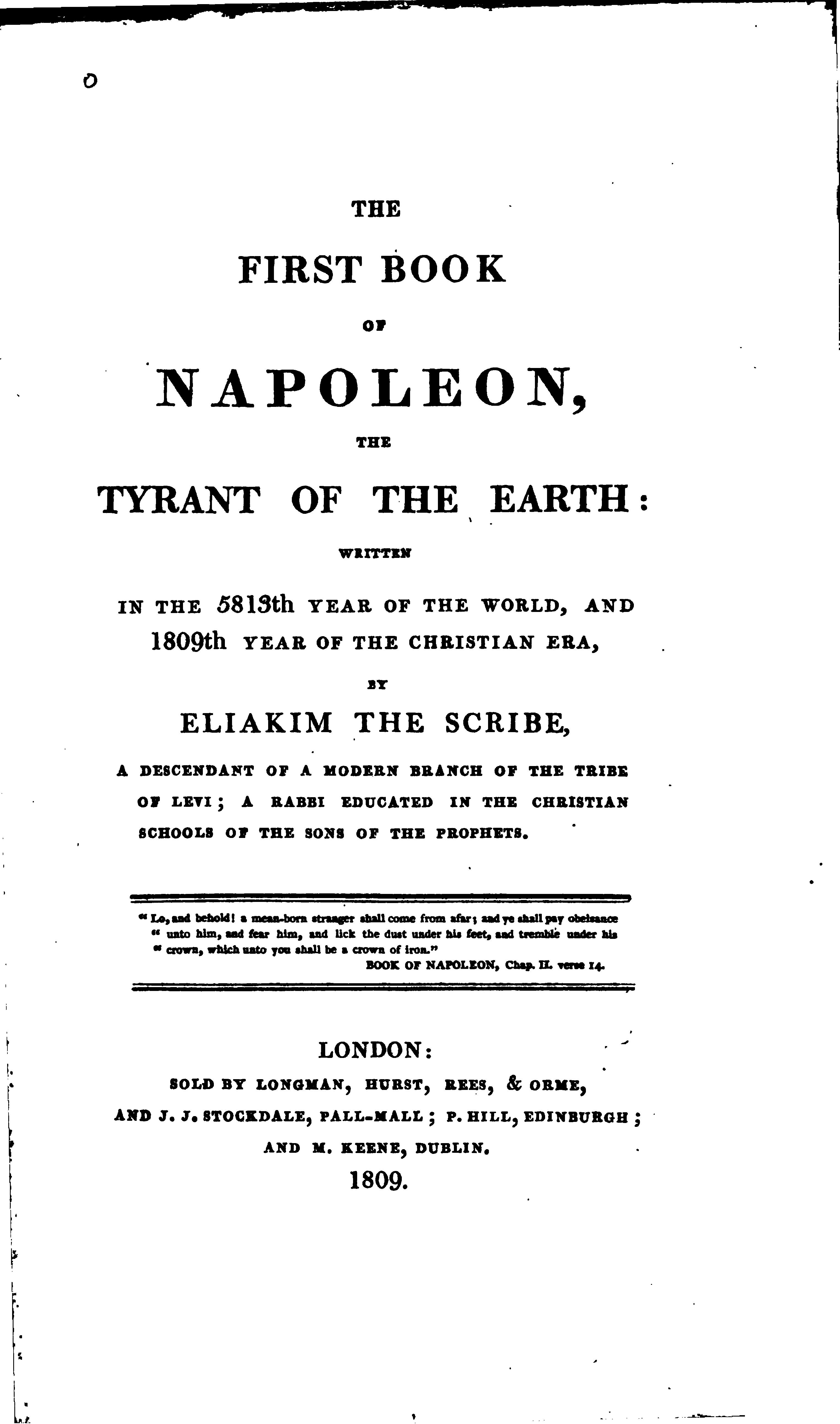
"Another fascinating book published in 1809, The First Book of Napoleon... When I first read this along with other passages from The First Book of Napoleon, I was floored. Here we have two early 19th century contemporary books written at least a decade before the Book of Mormon that not only read and sound like the Book of Mormon but also contain so many of the Book of Mormon's parallels and themes as well."[1]
The argument is one of resemblance. There is an old book, a short Scottish pamphlet about Napoleon Bonaparte printed in 1809, written in the cadence of the King James Bible. Read its opening lines and they do sound like the Book of Mormon, "it came to pass," "on the face of the earth," "the commandments of the Lord." The CES Letter prints a side-by-side of phrases from both books and lets the jolt of recognition do the rest. The implication is that a book sounding this much like the Book of Mormon, two decades older, must have shaped it.
The jolt is real. The opening of this pamphlet genuinely startles a reader who knows the Book of Mormon. But the computer study the CES Letter itself trusts ranks the pamphlet dead last among the era's Book of Mormon look-alikes, and the famous side-by-side was pieced together from phrases scattered across a sixth of the book.
The number the section never prints
A few pages earlier in the same letter, the CES Letter leans on a computer study to make its case about a different book, The Late War. Two brothers fed roughly a hundred thousand pre-1830 books through software that scored how much each one resembled The Late War, the book the study ranks as the Book of Mormon's strongest look-alike of the era.[2] The CES Letter trusts that study enough to build an argument on it.
So look at what that same study found for The First Book of Napoleon. On the study's own scale, the pamphlet scored 0.06. The Book of Mormon scored 0.24, four times higher. And a book the study swept up almost by accident scored 0.37, six times higher than the Napoleon book: The Book of Nullification, an anonymous 1830s tract about a tariff fight that no one has ever tied to anything.[3] By the critics' own instrument, the pamphlet the CES Letter holds up as a smoking gun sits at the very bottom of the pile, below a tariff pamphlet nobody connects to anyone. The section cites the study without ever printing that figure. If the score helped the argument, why leave it off the page?
The number alone should settle how much weight the example can bear. The rest is about why the side-by-side feels so convincing anyway.
How the side-by-side was built
The heart of the CES Letter's case is a column of phrases from each book, presented as if they march along in "the same order in the beginning portion" of each.[1:1] On the page it reads like one continuous passage echoing another. Look closer and the single passage dissolves into twelve separate fragments, fished out of the Napoleon book and joined with twelve sets of dots.
When you map those twelve fragments back to where they actually live, the picture falls apart. They come from ten different pages: the title page, both pages of the preface, the table of contents, and six pages spread across three different chapters, all within the first twenty-five pages of the book.[4] As the researcher Sarah Allen put it after tracing every one, the comparison "took 25 pages of the book to compile," so that "a full 1/6 of the book was used to recreate one incomplete paragraph of text."[5] What looks like a parallel passage is really a phrase hunt across a sixth of a book, with the gaps hidden behind the dots.
And the hunt was not even careful about staying in order. The very claim that the phrases run in the same order is false on its face: one of them is pulled from page 21 and set before a phrase taken from the table of contents near the front. To make the lists line up, the comparison reaches backward through the book whenever it needs to. (The full page-by-page map is in the in-depth version.)
Three places the comparison cheats
Stitching is one thing. Three of the individual pairings go further and bend the source text to manufacture a match that is not there.
The clearest is a flat contradiction dressed up as a similarity. One line of the chart pairs "small in stature" on the Napoleon side with "large in stature" on the Book of Mormon side. The Napoleon book is describing Napoleon, who was "small in stature." The Book of Mormon is describing the prophet Nephi, who was "large in stature." These are opposite words about opposite men.[6] A reader skimming the two columns catches "in stature" in both and never notices that one says small and the other says large. An opposite is being counted as a match.
The second is a word inserted from nowhere. The chart lists "Condemn not the (writing)" on both sides, the word in parentheses making it look like the same phrase sits in each book. But neither book actually contains that phrase. The Napoleon book says "condemn not the feebly imitative manner of writing." The Book of Mormon title page says "Condemn not the things of God." The only words the two truly share are "Condemn not the." The "(writing)" was added to bridge the gap and make a real parallel appear where there is only a stock three-word opening.[6:1]
The third is subtler. One Napoleon phrase, "because of the perverse wickedness of the people," is quoted as if it were a verse in the story, lined up against actual verses from the Book of Mormon. It is not a verse. It comes from the chapter summary in the book's table of contents, a one-line recap, where the author reached for a generic biblical phrase to sum up the chapter. The real verse it points to reads differently: "the wickedness and perverseness of the people."[6:2] A summary blurb is being passed off as scripture to tighten a match the narrative itself does not make.
None of this requires assuming bad intent. But a comparison that needs an antonym, an inserted word, and a table-of-contents blurb to hold together is telling you something about how thin the real overlap is.
Every shared phrase is a Bible phrase
One fact explains the whole resemblance, and the CES Letter never mentions it. Every phrase the two books share is also found in the King James Bible.
Researchers have gone through the shared phrases one by one and traced each to chapter and verse in the Bible.[7] "It came to pass" is the obvious case: it appears about 727 times in the King James Bible, where it translates a standard Hebrew storytelling formula.[8] "Upon the face of the earth," "the commandments of the Lord," "gold and silver," "Jerusalem," all of them are common Bible language. Neither book is handing phrases to the other. Each one is reaching, on its own, into the same Bible that sat in nearly every English-speaking home of the era.
This is exactly what you would expect, because writing in mock-Bible English was an entire fashion. The historian Eran Shalev, who teaches at the University of Haifa and has no tie to the Church, traced the trend across dozens of titles published between roughly 1750 and 1850.[9] The Napoleon pamphlet was one entry on that long list; so were several others the CES Letter never brings up. When two books both dress their stories in Bible language, they will of course share Bible phrases, the same way two hymns both borrow from the Psalms.
The technique of harvesting those common phrases and calling them evidence has a name in biblical scholarship. Samuel Sandmel coined "parallelomania" for the habit of overstating a similarity and then treating it as proof that one text came from another.[10] Run the same procedure on almost any two long English books and the parallels pile up. A phrase-hunt of this kind works as a genre detector, not a source detector. It notices that two books share an idiom, and it cannot tell where either book got it.
What no phrase-hunt can fake
The deepest answer, and the one a clever phrase-hunt cannot touch, is in the grammar underneath the words.
Anyone can copy the vocabulary. Stud a paragraph with "thee" and "thou" and "it came to pass" and it will pass for biblical. What gives a writer away is the layer below the words: the habits of sentence-building that a person picks up unconsciously from the books of his own century, and cannot reach back and borrow from a century he never read. Stanford Carmack, a linguist trained at Stanford, tested the Napoleon book against the Book of Mormon on exactly these buried features, and put its author, Michael Linning, in the lineup by name.[11]
The result is lopsided, and the details make it worse for the borrowing theory. Linning was no untrained farmer. He was a Glasgow-educated lawyer, he wrote a short book over weeks or months instead of dictating a long one in two months, and his text even survives in a handwritten copy from before the book was printed. Every advantage of education and time and revision was his. He still did not produce the Book of Mormon's grammar. On one old habit, using "which" for people ("the man which" instead of "the man who"), the Book of Mormon does it about 52 percent of the time and Linning manages about 5. On another (a particular passive form) the Book of Mormon sits near 46 percent and Linning near 15.[11:1] The Book of Mormon's grammar belongs to a form of English already more than a century stale when the King James Bible was printed, and the educated Scotsman writing in the very same biblical style came nowhere near it.
A separate study found the same gap from a different direction: when scholars ran the numbers on the surface biblical style itself, the Book of Mormon came out more like the King James Bible than the imitation books they measured, the opposite of what copying would produce.[12] (Both studies are laid out in full in the in-depth version.)
There is also the plain problem of how the book would have reached Joseph Smith at all. It was printed in Edinburgh, sold only by booksellers in Britain and Ireland, and the one substantial review of its day reported it was priced too richly to circulate even among ordinary Bible-reading Britons, let alone cross the ocean to a teenage farmer in New York.[13] No American copy, no library record, no bookshop listing from before 1830 has ever been found.[14] No critic of Joseph Smith named this book during his lifetime, though many hunted hard for sources. If the resemblance were this obvious, why did none of them find it? It surfaces as a candidate only in 2013.
The honest part
The genre is real, and it is reproducible. Shalev's work is solid scholarship from Yale and Oxford, and it shows that "sounding scriptural" was a learnable skill in the early 1800s, not a gift from heaven. Several ordinary authors, with no claim to revelation, wrote convincing King James English. That means the bare fact that the Book of Mormon sounds like scripture cannot, by itself, prove where it came from. Latter-day Saints have sometimes leaned too hard on that stylistic feel as if it were evidence on its own. It is not. The argument was never supposed to rest on the surface sound.
What matters is everything the genre cannot account for once you get past the sound. And even that concession needs one qualifier: the scholar whose work powers this whole criticism, Shalev, says plainly that there are "no direct ties connecting the Book of Mormon to pseudobiblicism," the scholarly name for that mock-Bible fashion, and that his thesis is about how readers received the book, not about how it was written.[9:1] The strongest academic on the critics' side does not claim what the CES Letter implies he claims.
A surface, not a source
Set the two books beside each other and the gap is not subtle. The First Book of Napoleon is a 22,500-word satire about one French general, written by a single Scottish lawyer. It offers no theology, invents no world that has to be kept straight, and reaches back no further than its own century. The Book of Mormon is roughly 270,000 words of scripture about a thousand-year civilization, centered on the risen Christ. Its geography holds steady through hundreds of pages, its narrators differ in ways you can measure, its phrasing follows Hebrew patterns that never appear in the King James Bible, and one of its place-names, Nahom, later turned up carved into ancient altars in Yemen.[15][16] The shared "parallels" cover a handful of common Bible phrases. The rest of the Book of Mormon owes the Napoleon book nothing.
Then there is the way the Book of Mormon was produced. Joseph Smith dictated the entire book out loud in roughly sixty working days. He was a young man with little schooling who kept no notes, worked from no outline, and left each earlier chapter as he had first spoken it while the dictation moved forward.[17] The pamphlet from Edinburgh cannot account for any of that, and no book he could plausibly have read does any better. The jolt of the opening lines is genuine, but it is only a jolt. What the section really demonstrates is that anyone can make one biblical-sounding book look stolen from another by hand-picking a dozen phrases and hiding where each one came from.
Want the full case, including the strongest arguments the critics make and every source? Read the in-depth version.
Runnells, CES Letter (2017), "Book of Mormon," no. 10, pp. 24–25. ↩︎ ↩︎
Chris and Duane Johnson, WordTree Foundation 4-gram study, presented at the ExMormon Foundation conference, October 2013. The study compared the 1830 Book of Mormon against approximately 100,000–130,000 pre-1830 books from Archive.org. The Johnsons reported that The Late War ranked in the "top 0.001%" by similarity to the Book of Mormon. Duane Johnson acknowledged on the project blog: "Certain baseline data such as the false positive rate of our tools are still lacking." The Johnsons have not published the methodology in any peer-reviewed venue, and as of 2014 had not responded to or defended their methodology against the McGuire and Schaalje critiques. http://wordtree.org/thelatewar/ (intermittent TLS issues; raw data on GitHub). ↩︎
Benjamin L. McGuire, "The Late War Against the Book of Mormon," Interpreter: A Journal of Mormon Scripture 7 (2013): 323–355. Detailed five-flaw critique of the Johnson 4-gram methodology, with quantitative data: 13.7% of shared 4-grams from copyright boilerplate; 0.27% of unique Book of Mormon 4-grams shared with The Late War; 57.3% of shared 4-grams also in the King James Bible; 1.4% Pride and Prejudice / Officer's Daughter overlap demonstrating false positives. McGuire reproduces the Uniform Match Score data from the Johnsons' WordTree blog at p. 330 ("The Late War transmitted textual influence to The Book of Nullification is highest (0.37), followed by The Book of Mormon (0.24)") and p. 349 ("The influence from The First Book of Napoleon on Hunt's The Late War was 0.06") — the figures originate with the Johnson study and McGuire is the published source that cites them for critical purposes. (The first published comparison putting The Book of Nullification 0.37 alongside the Book of Mormon's 0.24 was Metacannon, March 2014; see the Late War article for that strand.) McGuire is a Latter-day Saint writing in a faith-affirming journal; his critiques are independently verifiable from the Johnson study's own data. https://interpreterfoundation.org/journal/the-late-war-against-the-book-of-mormon/ ↩︎
"FBN Excerpt Comparison," Debunking the CES Letter. Debunking's bracket pins run i, ii, iii, v, 9, 9, 10, 12, 17, 19, 21, 25. Checked against the Archive.org page images, the four front-matter harvest pages are the title page, the two pages of Eliakim's preface, and the second contents page; the errata page (six printer's corrections) carries no fragment, and p. 25 holds the verse the table-of-contents summary phrase points at, not a harvested phrase. https://debunking-cesletter.com/book-of-mormon-1/first-book-of-napoleon-comparison/ ↩︎
Sarah Allen, "The CES Letter Rebuttal, Part 7," FAIR Blog, September 10, 2021. Allen documents that the CES Letter's first comparison "took 25 pages of the book to compile" and that "a full 1/6 of the book was used to recreate one incomplete paragraph of text." She also notes the Book of Mormon side spans "three chapters and the title page, 11 pages altogether, and it bounces all over the place," and observes that pseudo-biblical King James Bible-imitation writing "was pretty popular from approximately 1750 to approximately 1850, about 100 years." https://www.fairlatterdaysaints.org/blog/2021/09/10/the-ces-letter-rebuttal-part-7 ↩︎
Michael Linning [Eliakim the Scribe], The First Book of Napoleon, the Tyrant of the Earth: Written in the 5813th Year of the World, and 1809th Year of the Christian Era (Edinburgh, 1809). Full text at https://archive.org/details/firstbooknapole00gruagoog (full PDF and OCR; the OCR can be searched directly at https://archive.org/stream/firstbooknapole00gruagoog/firstbooknapole00gruagoog_djvu.txt). The phrase "perverse wickedness" appears in FBN's chapter 3 summary in the table of contents (a recap of chapter contents, repeated at the chapter head on p. 19) and at chapter 2, verse 13 ("the perverse wickedness of the Gauls," pp. 17–18). The body verse the chapter 3 summary points to (Ch. 3, v. 21, p. 25) reads: "And it pleased the Lord, as a punishment for the wickedness and perverseness of the people, to deliver into the hands of this man the dominion over many lands." Archive.org lists 161 total pages including front matter; the four-bookseller imprint (Longman, Hurst, Rees & Orme; J.J. Stockdale; P. Hill; M. Keene) appears on the title page. ↩︎ ↩︎ ↩︎
"Debunking the Connection between The First Book of Napoleon and the Book of Mormon," Heavy Metal Book of Mormon, June 25, 2019. Identifies thirteen shared phrases between FBN and the Book of Mormon and documents King James Bible chapter-and-verse provenance for each. Heavy Metal's stated conclusion: "Since a majority of the phrases found in the First Book of Napoleon and the Book of Mormon are also found in the Bible, there is no reason to believe that the First Book of Napoleon was a significant influence." Cites FBN 16:5 ("His nightly path is lighted by fiery spectres...") as an example of FBN's elaborate prose register, distinct from the Book of Mormon's plainer pseudo-biblical style; that characterization of the two registers is this article's summary, not Heavy Metal's own wording. Three of the list's FBN citations diverge from the 1809 printing as verified against the Archive.org OCR and page images: the only "blotted" passage sits at 9:2, p. 57 ("blotted him, and his people"), not 11:2; FBN 6:13 reads "gall and bitterness" (Heavy Metal's own list hedges it "gall and/of bitterness"); and the ch. 10 passage reads "morning vapour," not "dew" (Heavy Metal brackets it "dew [vapor]"); FBN 1:1 likewise prints "in these latter days." The FBN wordings quoted in this article follow the verified 1809 readings; that even a curated list holds inexact parallels only reinforces how far the two books' actual wordings sit apart. https://heavymetalmormon.com/2019/06/25/did-the-first-book-of-napoleon-inspire-the-book-of-mormon/ ↩︎
Robert F. Smith, "'It Came to Pass' in the Bible and the Book of Mormon," FARMS Preliminary Report (1980). Documents that "and it came to pass" translates the Hebrew narrative formula wayehi (consecutive imperfect of hayah, "to be"). The King James Bible uses "it came to pass" approximately 727 times; the Book of Mormon approximately 1,494 times in the original 1830 text. https://archive.bookofmormoncentral.org/sites/default/files/archive-files/pdf/smith/2019-01-04/robert_f._smith_it_came_to_pass_in_the_bible_and_the_book_of_mormon_1980.pdf. See also Donald W. Parry, "And It Came to Pass," in Preserved in Translation: Hebrew and Other Ancient Literary Forms in the Book of Mormon (Provo: BYU RSC). https://rsc.byu.edu/preserved-translation/it-came-pass ↩︎
Eran Shalev, American Zion: The Old Testament as a Political Text from the Revolution to the Civil War (New Haven: Yale University Press, 2013), ch. 3 ("'A Truly American Spirit of Writing': Pseudobiblicism, the Early Republic, and the Cultural Origins of the Book of Mormon"). The strongest non-Latter-day-Saint academic statement of the cultural-milieu argument. Shalev argues pseudo-biblical language "may have helped to ameliorate readers' reactions to and digestion of the Mormon Bible" (p. 114). Crucially, Shalev concedes "no direct ties connecting the Book of Mormon to pseudobiblicism" and frames "assessing the assertion that pseudobiblicism had actually participated in and contributed to the reception of the Book of Mormon" as "a daunting, not to say futile, task" (p. 115). His thesis is reception-conditioning, not production-source. https://yalebooks.yale.edu/book/9780300205909/american-zion/. Internet Archive borrowable copy: https://archive.org/details/americanzionoldt0000shal ↩︎ ↩︎
Samuel Sandmel, "Parallelomania," Journal of Biblical Literature 81, no. 1 (1962): 1–13. Originally delivered as the Society of Biblical Literature presidential address, December 27, 1961. The foundational methodological critique of finding parallels between texts without controlling for shared third sources, genre conventions, access, or specificity. PDF available at http://www.ediguys.net/index_files/parallelomania_sandmel.pdf ↩︎
Stanford Carmack, "Is the Book of Mormon a Pseudo-Archaic Text?" Interpreter: A Journal of Latter-day Saint Faith and Scholarship 28 (2018): 177–232. Carmack's 2018 study analyzed nearly ten syntactic and morphosyntactic features in four pseudo-biblical authors in depth — John Leacock (1774–1775), Richard Snowden (1793), Michael Linning (FBN, 1809), and Gilbert Hunt (1816) — comparing them against the King James Bible and the 1830 Book of Mormon. Linning-specific data: agentive of at ~15% (4 of 27 regular verbs); personal which at ~5% (2 instances); periphrastic did with one example; {-th} plural with two possible examples whose subjects Carmack judges "probably singular." Carmack's overall conclusions: "No pseudo-biblical author came close to what is found in the Book of Mormon"; "The Book of Mormon is uncorrelated with the King James Bible in this domain… negatively correlated with all four pseudo-biblical writings, usually strongly negatively correlated." An important academic-status caveat to surface: Carmack publishes almost exclusively in Interpreter (an LDS scholarly venue), and his corpus methodology — early-modern collocation searches in OED and EEBO databases — has not yet been substantively engaged by mainstream historical-linguistics journals as of the article's publication, eight-plus years on. Standard objections (statistical outliers in any large corpus; pseudo-biblical authors adopting archaic registers; database coverage gaps) are real. The lexical findings are the most resilient core because they make point claims about specific words; the grammatical-frequency claims are more dependent on corpus methodology not yet independently validated. The Joseph-1832 baseline (Carmack 2017) remains the cleanest sub-argument since it does not depend on the contested corpus methodology at all. https://interpreterfoundation.org/journal/is-the-book-of-mormon-a-pseudo-archaic-text/ ↩︎ ↩︎
Matthew Roper and Paul J. Fields, "Scriptural Style in Early Nineteenth Century American Literature," FAIR Conference, August 2014. Multivariate stylometric analysis (discriminant analysis, principal components analysis, nearest shrunken centroids) of the 1830 Book of Mormon, the King James Bible, and the pseudo-biblical texts The Late War (Hunt) and The American Revolution (Snowden) across four dimensions of King-James-Bible-style analysis; The First Book of Napoleon appears in their survey as a named example of the genre ("Notable examples of books written in this style are The First Book of Napoleon…"), not as one of the measured texts. Documents that the Book of Mormon is roughly 2x more similar to the King James Bible than the pseudo-biblical texts on non-contextual structural words; "almost identical" on archaic pronouns; and approximately seven times more similar on distinguishing phrases. On the Latin-style features: Snowden's and Hunt's texts use Latin-style possessives "over 400 times" and "almost 400 times" per 10,000 words respectively, while "the King James Bible and the Book of Mormon are at least half, or less than that amount"; on the separate embellishments measure, Snowden's text registers 250 per 10,000 words against the Book of Mormon's roughly 25, about one-tenth the rate. Their summary: "If Joseph Smith was 'influenced' by those books, his imitation of the King James style was better than theirs. Joseph Smith was either a literary genius, or a prophet, and we are all free to take our pick." https://www.fairlatterdaysaints.org/conference/august-2014/scriptural-style-in-early-nineteenth-century-american-literature ↩︎
"Michael Linning," Wikipedia. https://en.wikipedia.org/wiki/Michael_Linning. Linning was born September 24, 1774, the son of Thomas Linning and grandson of the Reverend Thomas Linning of Lesmahagow; he attended Glasgow College 1788–1793, was admitted as a Writer to His Majesty's Signet, and died February 17, 1838. His authorship of FBN is established by a pre-publication manuscript copy of the book at the State Library of New South Wales, which identifies him as the author. The 1810 British Critic review observed that the book's "elegantly printed" production placed it beyond the reach of ordinary British Bible-readers; The Nation in 1908 described FBN as "very curious as well as rare." Linning later proposed (1816) the National Monument of Scotland, serving as Secretary of the Royal Association of Contributors to the National Monument of Scotland, and patented (1837) a peat-to-fuel conversion process. The pseudonym "Eliakim" appears to be a reversed spelling (anadrome) of "Mikaile" (Michael), pairing the wordplay with the scribal pun. ↩︎
No American edition, bookshop listing, library catalog entry, or personal inventory from before 1830 has been documented for The First Book of Napoleon. The book was sold exclusively through British Isles booksellers (Longman, Hurst, Rees & Orme of London; J.J. Stockdale of London; P. Hill of Edinburgh; M. Keene of Dublin). The earliest known American printings are post-2010 print-on-demand reprints (Leopold Classic Library, Forgotten Books, etc.). See Sarah Allen, "The CES Letter Rebuttal, Part 7," FAIR Blog, September 10, 2021. https://www.fairlatterdaysaints.org/blog/2021/09/10/the-ces-letter-rebuttal-part-7. See also "First Book of Napoleon," Debunking the CES Letter. https://debunking-cesletter.com/book-of-mormon-1/first-book-of-napoleon/ ↩︎
Warren P. Aston, "A History of NaHoM," BYU Studies Quarterly 51, no. 2 (2012): 78–98. Documents the discovery of three limestone altars at the Bar'an temple near Marib, Yemen, inscribed with the South Arabian tribal name NHM. The altars date to roughly 800–700 BC; the tribal reference within (Naw'um of the Nihm tribe, grandfather of donor Bi'athtar) predates the altars by approximately fifty years, placing the Nihm tribe in roughly 850–750 BC. The Nihm tribal area lies in the mountains northeast of Sana'a, eastward from which is "the only fertile area in over a thousand miles of coastline" — corresponding to 1 Nephi 17:1's "nearly eastward" turn from Nahom to Bountiful. See also Warren P. Aston, "Newly Found Altars from Nahom," Journal of Book of Mormon Studies 10, no. 2 (2001): 56–61. ↩︎
John A. Tvedtnes, "Hebraisms in the Book of Mormon: A Preliminary Survey," BYU Studies 11, no. 1 (1970): 50–60. https://byustudies.byu.edu/article/hebraisms-in-the-book-of-mormon-a-preliminary-survey/. See also Donald W. Parry, "Hebraisms and Other Ancient Peculiarities in the Book of Mormon," in Echoes and Evidences of the Book of Mormon, ed. Donald W. Parry, Daniel C. Peterson, and John W. Welch (Provo: FARMS, 2002), 155–189. Documents the if/and conditional construction (~14 examples in the original 1830 Book of Mormon, ungrammatical in English, absent from the King James Bible, present in Hebrew via waw-consecutive); cognate accusatives ("dreamed a dream," "curse with a sore curse"); construct-state noun chains ("plates of brass," "rod of iron," "altar of stones," etc.); repeated possessive pronouns; adverbial phrases substituting for adverbs; and singular verbs with grammatically singular plural-meaning Hebrew nouns ("this people is"). Most of the if/and constructions were corrected to standard English in the 1837 edition. https://rsc.byu.edu/preserved-translation/it-came-pass and the FAIR Wiki Hebraisms hub: https://www.fairlatterdaysaints.org/answers/Hebraisms_in_the_Book_of_Mormon ↩︎
John W. Welch, "Timing the Translation of the Book of Mormon: 'Days [and Hours] Never to Be Forgotten,'" BYU Studies Quarterly 57, no. 4 (2018): 10–50. Documents that the Book of Mormon translation occupied between 57 and 63 actual working days from April 7 to June 30, 1829, producing approximately 269,510 words across 608 manuscript pages. Welch reports Skousen's finding: "There are very few signs of any editing or Joseph changing his mind about the translation." Eyewitness accounts collected by Welch: Oliver Cowdery told William Frampton (as recorded in 1901), "I wrote it (with the exception of a few pages) with this right hand… as the inspired words fell from the lips of Joseph Smith"; Emma Smith said in 1879 that Joseph "would dictate to me hour after hour; and when returning after meals, or after interruptions, he could at once begin where he had left off"; and in 1881, David Whitmer stated that "the translation at my father's occupied about one month, that is, from June 1st to July 1st, 1829" (Welch's n. 48 cites the Kansas City Daily Journal, June 5, 1881). Welch's own observation: Joseph had no time for "research, for collocating scattered scriptural phrases, for keeping track of numerous threads…." https://byustudies.byu.edu/article/timing-the-translation-of-the-book-of-mormon-days-and-hours-never-to-be-forgotten/ ↩︎