Book of Mormon and Archaeology
The claim:
"Archaeology: There is absolutely no archaeological evidence to directly support the Book of Mormon or the Nephites and Lamanites, who were supposed to have numbered in the millions."[1]
"We read about two major war battles that took place at the Hill Cumorah (Ramah to the Jaredites) with deaths numbering in the tens of thousands -- the last battle between Lamanites and Nephites around 400 AD claimed at least 230,000 deaths on the Nephite side alone. No bones, hair, chariots, swords, armor, or any other evidence of a battle whatsoever has been found at this site."[2]
"Compare the absent evidence of Book of Mormon civilizations to the archaeological remains of other past civilizations such as the Roman occupation of Britain and other countries. There are abundant evidences of their presence during the first 400 years AD such as villas, mosaic floors, public baths, armor, weapons, writings, art, pottery, and so on."[3]
The archaeology objection is a sweeping negative. The Book of Mormon describes millions of people, cities, wars, roads, and metalworking in the ancient Americas. If all of that really happened, the critics say, archaeologists should have dug up the proof by now, the way they dug up the Romans in Britain. They have not found a single Nephite city. So the people in the book must never have existed, which means Joseph Smith made them up.
That chain has one strong link, the missing city. But the headline claim, that there is "absolutely no" evidence, is simply false, and once you understand why archaeologists would not expect to find a labeled Nephite city in the first place, the whole comparison to Rome falls apart.
No Nephite city has been found
No archaeologist has dug up a city with a sign on it reading "Zarahemla." The Church has never taken an official position on where in the Americas the Book of Mormon happened.[4] The community of non-Latter-day-Saint scholars has not endorsed the book as real history. And one specific problem, which we will come back to at the end, has no clean answer yet.
So the critics are right that there is no smoking gun. What they get wrong is the leap from "no smoking gun" to "absolutely no archaeological evidence," and the assumption that we should expect a smoking gun at all.
Why "no labeled city" is the wrong test
Archaeology can only prove a civilization existed at a spot if three things line up: you know where to dig, the stuff they left behind survives in the ground, and someone has actually dug there. A 2019 peer-reviewed study laid out exactly this rule for reading silence in the dirt. Absence of evidence means something "only if the evidence is highly expected" in the first place.[5]
For the Bible, those three conditions hold. We have always known where Jerusalem and Jericho are, they were built in durable stone, and people have excavated them for two centuries. So when something is missing there, the silence itself is information.
For the Book of Mormon, all three conditions fail. We do not know where its cities were, so there is nowhere specific to dig. Its likely setting, the jungles of Central America, eats organic material like wood, cloth, and bone. And only a sliver of the region has ever been excavated. The point about how much is still hidden is not a guess. In 2018, a laser survey called LiDAR flew over one patch of Guatemalan jungle, about 800 square miles, and found more than 60,000 ancient Maya structures that nobody had ever recorded: houses, pyramids, roads, and fortresses, all sitting under the trees the whole time.[6]
Sixty thousand buildings, invisible from the ground, in one survey block, in a region scholars had studied for over a hundred years. If that much could hide for that long, what was the silence supposed to prove?
The Roman Britain comparison breaks down
The CES Letter's most vivid argument is the side-by-side with Rome: Roman ruins are everywhere in Britain, so where are the Nephite ones? It hits hard the first time you hear it. But it is comparing two things that are nothing alike.
Rome is the single most visible ancient civilization on earth. The Romans built in stone, ran a centralized empire that stamped the same coins and roads across three continents, carved inscriptions in a language Europe never stopped reading, and left two thousand years of scholars standing right on top of their cities, which we always knew the location of. The gap between Rome and the Book of Mormon was never about one being studied and the other ignored. Rome is simply the easiest case in all of archaeology, and the Book of Mormon is one of the hardest.
A fair comparison uses civilizations that were genuinely lost. The Olmec, who carved stone heads weighing many tons, were unknown to scholarship until the twentieth century.[7] Caral in Peru, a city with monumental pyramids, sat undiscovered until 1948.[8] These were real, enormous, and invisible to experts until recently. "Abundant evidence" turns out to be a recent, hard-won thing even for civilizations we now know cold.
And here is the part the comparison quietly skips. There is a massive ancient civilization in the right place and time: the Maya and their neighbors, with cities, roads, fortresses, and writing. The LiDAR surveys are mapping it right now. So the real question was never "where is the Mesoamerican civilization?" It plainly exists. The open question is the narrower one of whether the Nephites were among the peoples who built it, and whether specific sites can ever be matched to specific places in the book. The first question has a clear answer. The second is still open, which is a long way from "absolutely nothing is there." The Bible has its own version of this gap, by the way: the Exodus, with 600,000 men crossing the Sinai, has left no archaeological trace at the scale the text describes either, which is why the comparison cuts both ways. (The fuller biblical archaeology comparison is in the in-depth version.)
What has actually turned up
A smaller, fairer question than the labeled-city test is whether the sort of thing the book describes shows up where and when it ought to. Again and again, the answer is yes, and many of these finds were impossible to know about in 1830.
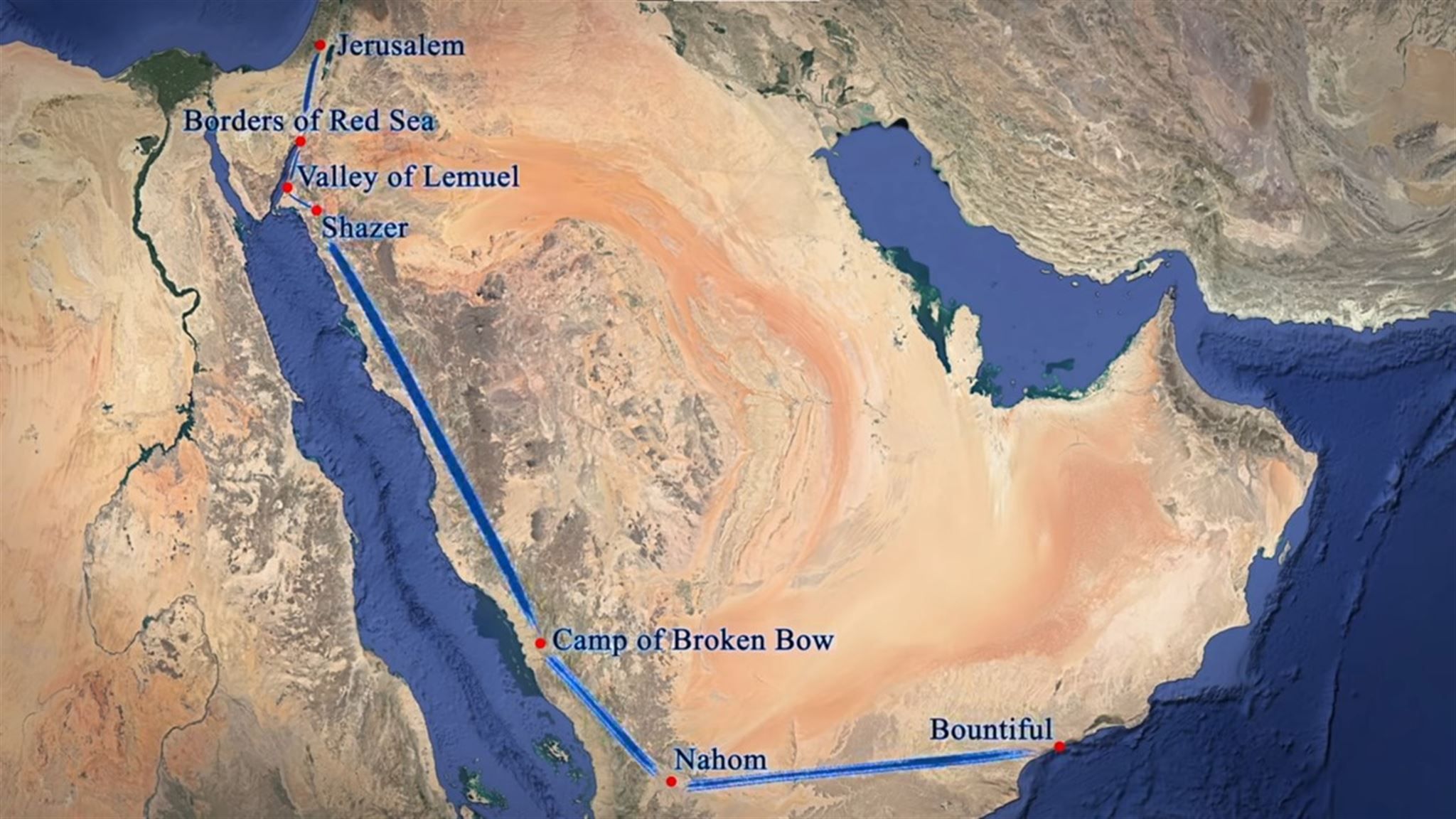
Nahom. This is the cleanest case, and it sits in the Old World where we can dig at known locations. The Book of Mormon says Lehi's family, traveling down the Arabian Peninsula after leaving Jerusalem, buried a man at "the place which was called Nahom," and then turned "nearly eastward" to reach the sea (1 Nephi 16:34; 17:1). The wording says Nahom was already named before they got there. Joseph Smith could not have known whether such a place existed; the deserts of Yemen were a blank to rural New York in 1829.
Then archaeologists dug. At a temple in Marib, Yemen, they found three altars carved with the tribal name NHM (ancient Hebrew and related languages were written without vowels, so NHM is the bare consonant skeleton of Nahom).[9] Working from the altars' inscriptions and their placement in the ruins, scholars first dated them to the sixth or seventh century BC; a later reanalysis moved them earlier, to the seventh or eighth, likely in place before Lehi's party ever passed through.[10] The temple itself had been in use since the ninth century BC.[11] The region around it holds the largest ancient burial ground in Arabia, matching the book's burial.[10:1] One detail is especially hard to wave off: from that exact spot, the only sensible direction to a fertile coast is east, and the fertile coastline you reach by going east sits within one degree of due east, just as the book says.[10:2][12] A name, a burial place, and a hard right turn east, all confirmed at one location by digging that began a full century after Joseph Smith died.
Cement at the right date. The book says that around 46 BC, after Nephites moved north into a land short on timber, they "became exceedingly expert in the working of cement" and built houses with it (Helaman 3:7-11). For a long time that sounded like a slip, since nobody pictured ancient Americans pouring cement. Then the archaeology came in. Mesoamerican structural cement appears and then explodes in use right around the first century BC, exactly the window the book names.[13][14] As the Latter-day Saint anthropologist John L. Sorenson put it, "No one in the nineteenth century could have known that cement, in fact, was extensively used in Mesoamerica beginning at about this time, the middle of the first century BC."[15]
Fortified warfare. The Book of Mormon describes Captain Moroni building cities defended with deep ditches, earthen embankments, palisades, and watchtowers (Alma 49-53). When the book came out, scholars pictured the ancient Maya as a peaceful people, and these war chapters looked invented. They no longer do. Archaeologists have since documented this exact engineering pattern, the ditches, the embankments, the narrow entrances, the towers, at more than twenty Maya sites, overturning the old peaceful-Maya picture in the direction the book had described all along.[16]
These are not the only examples. The book's roads sorted into local, regional, and long-distance tiers match the Maya causeway system; its mention of barley, once flagged as an error, was confirmed when pre-Columbian barley turned up in 1983; its odd phrase placing Jesus's birth in "the land of Jerusalem" rather than Bethlehem matches an ancient way of speaking found only in tablets dug up after 1887. The in-depth version walks through all of them. None of this locates Zarahemla. What it does is make "absolutely no archaeological evidence" impossible to say with a straight face.
The Ferguson story is not what the CES Letter says
The CES Letter builds its emotional case around one man, Thomas Stuart Ferguson, who it says was "the founder of BYU's archaeology division" and was "tasked by BYU and the Church in the 1950s and 1960s to find archaeological evidence to support the Book of Mormon," then gave up after seventeen years and called the book "fictional."[17] The famous quote is real, and his loss of faith was real and deserves respect. But three things in that framing are simply wrong, and they change what the story means.
First, Ferguson was not an archaeologist. He was a lawyer, with degrees in political science and law, an enthusiastic amateur who loved the field but was never trained in it. Science magazine's own headline about him begins, "How a Mormon lawyer transformed archaeology in Mexico."[18] So he was not the Church's archaeological expert; he was a hobbyist with a law degree.
Second, the organization he founded was never assigned to prove the Book of Mormon. Its actual written policy was the opposite: every field archaeologist was "explicitly instructed to do their work in a professional manner and make no reference to the Book of Mormon."[19] Ferguson personally hoped to find evidence, but the institution was built to keep professional archaeology and the Book of Mormon strictly separate.
Third, the timing matters. The thing that actually started Ferguson's doubts was not the dirt at all; it was the Joseph Smith papyri and the Book of Abraham, a separate issue handled in its own article. His archaeology disappointments piled on afterward. Treating him as a pure "the digging disproved it" story gets the order backward. One sincere man with deep field experience lost his faith, and other Latter-day Saint scholars with just as much experience looked at the same evidence and kept theirs.
The metallurgy problem
The single hardest archaeological problem is metallurgy, and stacking up positive finds does not make it go away.
The Book of Mormon does not just mention a sword or two. It describes an iron and steel industry: people working "in all manner of... iron and copper, and brass and steel, making all manner of tools" (Jarom 1:8; 2 Nephi 5:15). In 1984, a BYU anthropology professor named Raymond Matheny explained to a Salt Lake City symposium why that description is such a problem for the book. Smelting iron, he pointed out, is not a delicate thing that washes away. It requires furnaces running at extreme heat, and it leaves behind nearly indestructible junk: slag, the rocky waste fused in the process; the stone furnace foundations; the burned fuel residue. That kind of debris turns up at every major iron-working site in the ancient world, from Africa to Europe to Asia. In the pre-Columbian Americas, it has not been found.[20]
That is a genuine problem. The usual answers (the right site has not been dug yet; the book means less iron than it sounds like; "steel" is a loose translation) are partial patches at best, not a clean solution. There is no satisfying answer to Matheny. (The strongest form of every critical argument, including this one, the DNA question, and the broader pattern of Old World plants and animals, is laid out in full in the in-depth version.)
Still, an unsolved problem and a disproven claim are two very different things, and metallurgy belongs in the first category. Barley, cement, and fortified warfare were all once on this same list of "things the book got impossibly wrong," yet each one moved toward the book as the evidence came in.
Watch the direction, not the snapshot
The CES Letter dates to 2013, and its archaeology case treats that year's open questions as final answers. But the record kept developing after 2013, just as it had been developing since 1830, and the direction it has moved is the thing to watch.
Time is rough on fabrications. A fake written in 1829 cannot revise itself, so every find since then has been a test it might have failed, and the failures should multiply as the digging spreads. It has not worked out that way for the Book of Mormon. Cement passed when Mesoamerican archaeology dated the technology to the book's own window. Barley passed in 1983. Fortified cities passed when the peaceful-Maya picture collapsed. The millions the book describes passed when LiDAR counted sixty thousand unrecorded structures under one patch of jungle. Nahom passed when three altars bearing the name came out of a Yemeni temple. The book has not passed every test: there is still no Near Eastern DNA signal, no positively identified city, no trace of iron smelting. The case has not closed in either direction. But on the specific items the book can be tested against, the evidence has on balance kept moving the book's way.
The whole archaeology case, in the CES Letter's telling, is really just the one city nobody has found. But one unfound city is a thin thing to hang a verdict on. The Book of Mormon exists; it describes a world in specifics; and the archaeology has kept confirming them, at a desert grave in Yemen, and not only there. Explaining the missing city is easy: hardly anyone has dug, and nobody knows where to look. Explaining the book is the harder job, and each decade of digging has added to it.
Want the full case, including the strongest arguments the critics make and every source? Read the in-depth version.
Runnells, CES Letter (2017), "Book of Mormon," no. 6, pp. 11-12. ↩︎
Runnells, CES Letter (2017), "Book of Mormon," no. 6, p. 12. ↩︎
Runnells, CES Letter (2017), "Book of Mormon," no. 6, p. 12. ↩︎
"Book of Mormon Geography," Gospel Topics, The Church of Jesus Christ of Latter-day Saints. https://www.churchofjesuschrist.org/study/manual/gospel-topics/book-of-mormon-geography ↩︎
Efraim Wallach, "Inference from Absence: The Case of Archaeology," Palgrave Communications 5, article 94 (2019): 1-10. https://doi.org/10.1057/s41599-019-0307-9. The journal was renamed Humanities and Social Sciences Communications in June 2020; both names refer to the same publication. ↩︎
Marcello A. Canuto, Francisco Estrada-Belli, Thomas G. Garrison, Stephen D. Houston, Mary Jane Acuña, Milan Kováč, Damien Marken, Philippe Nondédéo, Luke Auld-Thomas, et al., "Ancient Lowland Maya Complexity as Revealed by Airborne Laser Scanning of Northern Guatemala," Science 361, no. 6409 (September 28, 2018): eaau0137. https://doi.org/10.1126/science.aau0137 ↩︎
Christopher A. Pool, Olmec Archaeology and Early Mesoamerica (Cambridge: Cambridge University Press, 2007); see also Richard A. Diehl, The Olmecs: America's First Civilization (London: Thames & Hudson, 2004). Both works survey the modern (post-19th-century) recovery of Olmec archaeology and the colossal stone heads. ↩︎
Ruth Shady Solís, Jonathan Haas, and Winifred Creamer, "Dating Caral, a Preceramic Site in the Supe Valley on the Central Coast of Peru," Science 292, no. 5517 (2001): 723-726. https://doi.org/10.1126/science.1059519. The Caral site dates to ~2627 BC, making it ~4,500 years old; identified by Paul Kosok in 1948, with full excavations beginning under Shady in the 1990s. ↩︎
Warren P. Aston, "Newly Found Altars from Nahom," Journal of Book of Mormon Studies 10, no. 2 (2001): 56-61, 71. https://scholarsarchive.byu.edu/jbms/vol10/iss2/9/ ↩︎
Neal Rappleye, "The Nahom Convergence Reexamined: The Eastward Trail, Burial of the Dead, and the Ancient Borders of Nihm," Interpreter: A Journal of Latter-day Saint Faith and Scholarship 60 (2024): 1-86. https://interpreterfoundation.org/journal/the-nahom-convergence-reexamined-the-eastward-trail-burial-of-the-dead-and-the-ancient-borders-of-nihm/. The 640 carved-face funerary stelae figure for the Wadi Jawf region appears at p. 18. ↩︎ ↩︎ ↩︎
Jochen Görsdorf and Burkhard Vogt, "Radiocarbon Datings from the Almaqah Temple of Bar'an, Ma'rib, Republic of Yemen: Approximately 800 cal BC to 600 cal AD," Radiocarbon 43, no. 3 (2001): 1363-1369. https://doi.org/10.1017/S0033822200038601 ↩︎
Warren P. Aston, Godfrey J. Ellis, and Neal Rappleye, eds., Into Arabia: Anchoring Nephi's Account in the Real World (Orem, UT: Interpreter Foundation / Eborn Books, 2024). https://interpreterfoundation.org/books/into-arabia/ ↩︎
Michael D. Coe and Stephen D. Houston, The Maya, 9th ed. (London: Thames & Hudson, 2015), 81. Source for the 300 BC-AD 250 Maya Late Preclassic structural cement chronology and the "explosion of activity" framing around 100 BC in the Northern Petén. ↩︎
David S. Hyman, Precolumbian Cements: A Study of the Calcareous Cements in Prehispanic Mesoamerican Building Construction (PhD diss., Johns Hopkins University, 1970). Findings summarized in "Book of Mormon Evidence: Cement," Scripture Central, https://scripturecentral.org/evidence/book-of-mormon-evidence-cement, with archived chapter excerpts at https://archive.bookofmormoncentral.org/sites/default/files/archive-files/pdf/book-mormon-central-staff/2016-08-26/knowhy_174_-_when_did_cement_become_common_in_ancient_america.pdf. ↩︎
John L. Sorenson, "How Could Joseph Smith Write So Accurately about Ancient American Civilization?," in Echoes and Evidences of the Book of Mormon, ed. Donald W. Parry, Daniel C. Peterson, and John W. Welch (Provo, UT: FARMS, 2002), 287, as quoted with attribution to Sorenson in Insights 22, no. 9 (2002) (full issue at https://scholarsarchive.byu.edu/insights/vol22/iss9/) and in Scripture Central, KnoWhy 174, endnote 12, https://archive.bookofmormoncentral.org/sites/default/files/archive-files/pdf/book-mormon-central-staff/2016-08-26/knowhy_174_-_when_did_cement_become_common_in_ancient_america.pdf. John W. Welch's wording in the same volume ("A Steady Stream of Significant Recognitions," 372-373) differs only slightly ("beginning largely at this time"). See also Matthew G. Wells and John W. Welch, "Concrete Evidence for the Book of Mormon," in Reexploring the Book of Mormon, ed. John W. Welch (Salt Lake City: Deseret Book; Provo, UT: FARMS, 1992), ch. 60 ("Recent research shows that cement was in fact extensively used in Mesoamerica beginning largely at this time"), https://scholarsarchive.byu.edu/cgi/viewcontent.cgi?filename=60&article=1065&context=mi&type=additional ↩︎
David L. Webster, Defensive Earthworks at Becán, Campeche, Mexico: Implications for Maya Warfare, Middle American Research Institute Publication 41 (New Orleans: Tulane University, 1976). https://core.tdar.org/document/69963/becan-an-early-lowland-maya-fortified-site ↩︎
Runnells, CES Letter (2017), "Book of Mormon," no. 6, pp. 12-13. ↩︎
Lizzie Wade, "How a Mormon lawyer transformed archaeology in Mexico—and ended up losing his faith," Science 359, no. 6373 (January 19, 2018): 264-268. https://www.science.org/content/article/how-mormon-lawyer-transformed-archaeology-mexico-and-ended-losing-his-faith ↩︎
Daniel C. Peterson, "On the New World Archaeological Foundation," FARMS Review 16, no. 1 (2004): 221-233. Reproduced at https://scripturecentral.org/archive/periodicals/journal-article/new-world-archaeological-foundation. The "make no reference to the Book of Mormon" instruction is documented in Stan Larson, Quest for the Gold Plates: Thomas Stuart Ferguson's Archaeological Search for the Book of Mormon (Salt Lake City: Freethinker Press, 1996), as quoted by Peterson; Peterson also discusses Ferguson's working relationships with Alfred Kidder and Gordon Willey at NWAF. ↩︎
Raymond T. Matheny, "Book of Mormon Archaeology" (presentation, Sunstone Theological Symposium, Salt Lake City, 1984). Reproduced in part at the Institute for Religious Research, "Does Archaeology Support The Book Of Mormon? (Full Version)," https://mit.irr.org/book-of-mormon-archaeology-full ↩︎