Anachronisms & Source Texts
The claim:
"The Book of Abraham teaches an incorrect Newtonian view of the universe. These Newtonian astronomical concepts, mechanics, and models of the universe have since been succeeded and substantially modified by 20th century Einsteinian physics."[1]
"86% of Book of Abraham chapters 2, 4, and 5 are King James Version Genesis chapters 1, 2, 11, and 12. Sixty-six out of seventy-seven verses are quotations or close paraphrases of King James Version wording."[2]
"Why are there anachronisms in the Book of Abraham? For example, the terms Chaldeans, Egyptus, and Pharaoh are all anachronistic. Additionally, Abraham refers to the facsimiles in 1:12 and 1:14. However, as noted and conceded above in the Church's essay, these facsimiles did not even exist in Abraham's time as they are standard first century C.E. pagan Egyptian funerary documents."[3]
"Facsimile 2, Figure #5 states the sun receives its 'light from the revolutions of Kolob.' We now know, however, that the process of nuclear fusion is what makes the stars and suns shine."[4]
"There is a book published in 1829 by Thomas Dick entitled The Philosophy of a Future State. Joseph Smith owned a copy of the book and Oliver Cowdery quoted some lengthy excerpts from the book in the December 1836 Messenger and Advocate."[5]
Olishem is a single word the CES Letter never mentions, and it may be the most awkward fact in the file. Abraham 1:10 places a sacrifice "upon the altar which stood by the hill called Potiphar's Hill, at the head of the plain of Olishem." The name appears in no Bible, no atlas, no nineteenth-century commentary Joseph Smith could have opened.
Nearly a century later it surfaced anyway. Cuneiform was undecipherable in Joseph's lifetime; the script was not read with confidence until 1857, thirteen years after he was killed.[6] In 1928, scholars published an Old Babylonian tablet excavated at Ur, UET I 275, preserving a campaign inscription of Naram-Sin of Akkad that names an Akkadian place called Ulisum.[7] So the name was not available to be borrowed.
The five claims above run on one engine: the Book of Abraham reads like a nineteenth-century product. The cosmology is supposedly too Newtonian, the prose too King James, the place names too modern, the theology too dependent on books Joseph could have read. Put them together and they imply a single verdict: Joseph Smith assembled the text from the materials of his own century and projected it backward onto Abraham. This article tests that verdict against what the text actually says, against what Near Eastern scholarship has recovered since 1844, and against what the timeline of Joseph's revelations and his library access really allows.
A note on scope. This article concerns the internal text of the Book of Abraham (BoA): its cosmology, its overlap with King James Version (KJV) Genesis, its vocabulary, and the alleged Thomas Dick borrowing. Two companion articles cover adjacent ground. The Facsimiles article takes the three printed images figure by figure, and the Papyri article takes up the manuscript-source question (the Hor Breathing Permit, the Kirtland Egyptian Papers, the missing-scroll and catalyst theories). Where the issues touch, as with the facsimile cross-references in Abraham 1:12, 14, or the catalyst theory's bearing on the source-text question, readers will find pointers in both directions.
Context and background
Some ground needs surveying before the arguments start.
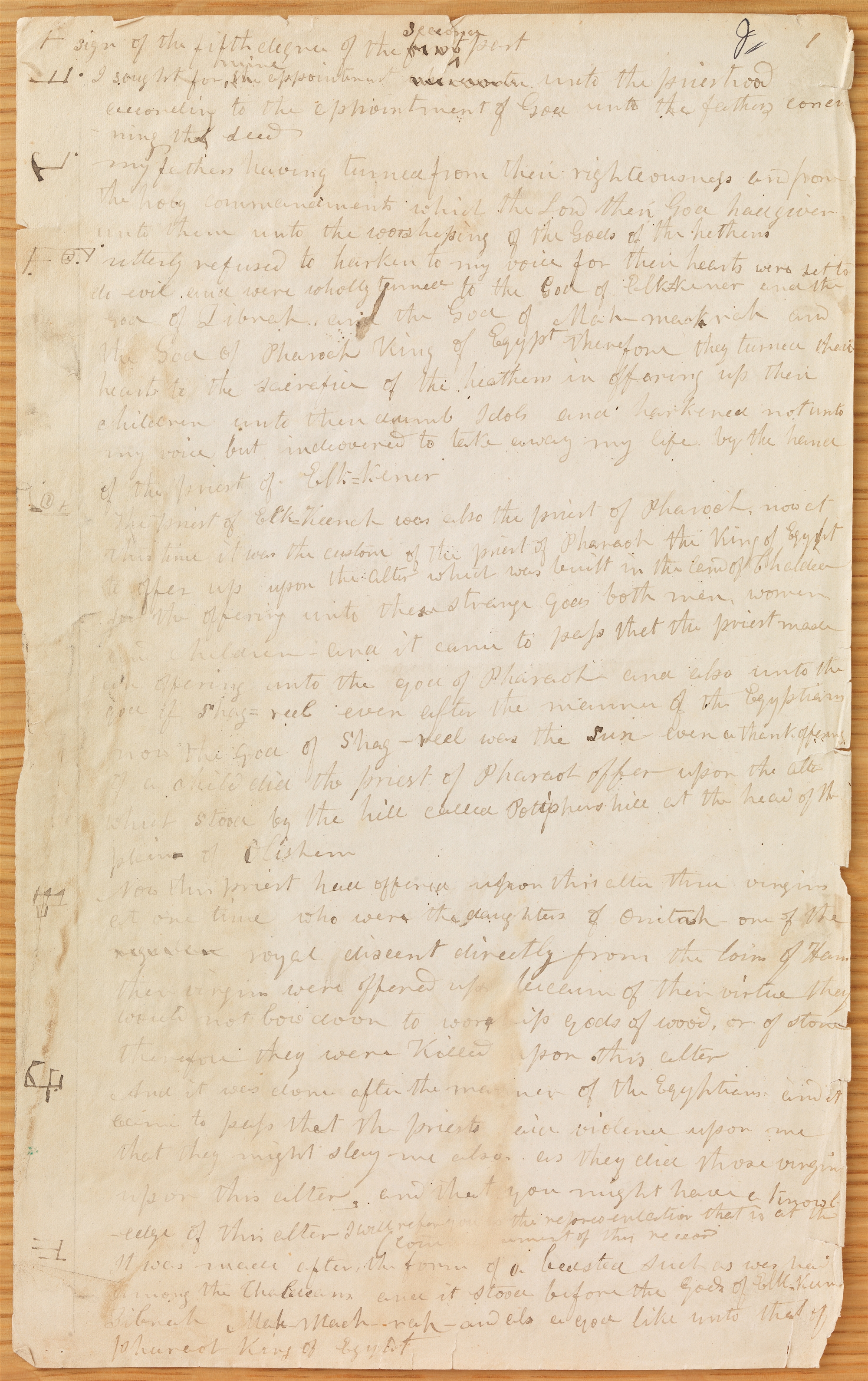
First, the Book of Abraham survives in multiple manuscript and printed forms. Joseph Smith began work on it in July 1835, shortly after the Egyptian papyri and mummies reached Kirtland on 3 July 1835, and the text he produced was published in Nauvoo in 1842.[8] The Kirtland-era manuscripts (1835), the Nauvoo-era Times and Seasons publication (March and May 1842), and the 1851 Pearl of Great Price, compiled after his death, are separate textual witnesses, and they differ from one another in places.[8:1] [9] So when the article asks what the Book of Abraham says, the answer sometimes depends on which manuscript you read. That becomes important on the Egyptus / Zeptah question below.
Second, the relevant scholarly fields have moved enormously since 1844. Champollion deciphered Egyptian hieroglyphs in 1822, when Joseph was sixteen, but serious Middle Egyptian scholarship was decades away in 1835.[10] Nearly every other text and artifact now central to the Book of Abraham debate surfaced after Joseph's lifetime:
| What became available | When |
|---|---|
| Cuneiform decipherment settled (Royal Asiatic Society experiment)[6:1] | 25 May 1857, thirteen years after Joseph's death |
| Book of Jubilees in English[11] | 1888 |
| Apocalypse of Abraham in English[12] | 1898 |
| Naram-Sin's inscription naming Ulisum, a possible match for Olishem (tablet UET I 275)[7:1] | published 1928; a second inscription published 2020 |
| Idrimi statue, an autobiography bearing a scribal colophon (a closing sign-off), an instructive parallel for the Book of Abraham's "by his own hand" superscription[13] | discovered 1939 |
| Genesis Apocryphon[14] | discovered 1947, published 1956 |
None of this existed in 1835. Every independent parallel that fits the text therefore needs its own explanation on the fabrication theory, because none of the underlying evidence had yet been recovered.
Third, the structure of the Book of Abraham itself matters. Abraham 1 (idolatry, attempted human sacrifice, divine deliverance, an Egyptian context) and Abraham 3 (cosmology, intelligences, a premortal council) have no parallel in the King James Bible. They hold the most distinctive content in the book. Abraham 2, 4, and 5 (Abraham's call, the creation account, the formation of man) overlap heavily with Genesis 1, 2, 11, and 12, the chapters the "86% paraphrase" claim is built on. So the criticism tracks the structure of the text: the heaviest paraphrase clusters exactly where parallel content exists, and the most distinctive material, Abraham's biographical narrative and his cosmological vision, has no Genesis to copy from. That asymmetry recurs throughout the analysis below.
The Newtonian cosmology claim
Citing LDS scholar Keith Norman and former CES instructor Grant Palmer, the CES Letter argues that Abraham 3 reflects nineteenth-century Newtonian astronomy, a model now superseded by Einsteinian physics, and so reflects Joseph Smith's environment rather than Abraham's.[1:1] [15] The argument's force depends on a hidden assumption: that the only two interpretive options are Newtonian or post-Einsteinian. Put a third option on the table, ancient cosmology, and the logic changes substantially.
What Abraham 3 actually describes
Abraham 3 does not describe a heliocentric, gravity-driven, infinite universe of the sort Newton, Laplace, and Thomas Dick taught. It describes a hierarchical, geocentric system grounded in observation:
"And the Lord said unto me: These are the governing ones; and the name of the great one is Kolob, because it is near unto me, for I am the Lord thy God: I have set this one to govern all those which belong to the same order as that upon which thou standest." (Abraham 3:3)
"And I, Abraham, had the Urim and Thummim, which the Lord my God had given unto me, in Ur of the Chaldees; And I saw the stars, that they were very great, and that one of them was nearest unto the throne of God; and there were many great ones which were near unto it." (Abraham 3:1–2)
The reference frame is explicit: "the earth upon which thou standest" (Abr. 3:3, 5–7). Hierarchy is set by orbital period (one revolution of Kolob equals 1,000 earth years; Abr. 3:4) and by relative proximity to "the throne of God" (Abr. 3:9). There are no force laws, no inverse-square gravitation, no orbital mechanics. The text is observational and hierarchical, closer to ancient Babylonian, Egyptian, and Hebrew astronomy than to anything in Newton's Principia or Dick's Philosophy of a Future State.[16] [17]
Geocentric framing alone is not decisive. A nineteenth-century author writing in Abraham's voice could have used phenomenological language to fit the persona, and Joseph already showed in Helaman 12:15 that he understood the heliocentric/geocentric distinction.[18] The case for authenticity here turns not on the reference frame but on a more specific feature discussed next: the encircling-governance concept, for which a nineteenth-century author would have had no model.
The Egyptian "encircling = governing" concept
The more specific feature of Abraham 3 is the link between proximity, encircling, and governance. In Egyptian cosmological thought, the circumpolar stars (ỉḫmw-sk, "those that do not perish") were imagined as encircling the celestial pole and were understood to govern lower celestial regions through that very proximity.[19] Abraham 3:9 says Kolob "is set nigh unto the throne of God, to govern all those planets," echoing the Egyptian conceit that encircling proximity is governance.[20]
Two qualifications belong here. Hierarchical celestial governance, higher bodies governing lower ones, was a widespread idea in ancient thought well beyond Egypt, so a generic "higher governs lower" parallel proves little. What is harder to explain is the sharper feature: a hierarchy in which proximity to a divine throne is the operative principle, paired with language that treats encircling and governing as the same kind of relation. That combination sits closer to the Egyptian ỉḫmw-sk concept than to anything in nineteenth-century natural theology. And the ỉḫmw-sk concept is preserved in Pyramid Texts and Coffin Texts whose systematic publication came decades after Joseph's death; the parallel, if it holds, is one Joseph could not have read about in any English source available to him.[21] [10:1]
"Borrows its light" as governance, not photons
Claim 7 isolates one phrase from the Facsimile 2 explanation, the statement that the sun borrows its light from Kolob, which the CES Letter treats as a now-falsified mechanical claim about photon transfer.[4:1] Read as twenty-first-century stellar physics, the phrase is incompatible with thermonuclear fusion. Read in its own ancient idiom, the sentence is more naturally about hierarchical authority than about physics.
In ancient Near Eastern thought, light often works as a metaphor for governing influence, for authority radiating from a higher order to a lower one. The same metaphor runs throughout scripture: Christ as "the light of the world" (John 8:12), the "light of Christ" described in the Doctrine and Covenants (D&C), the Latter-day Saint book of canonized modern revelations (D&C 88:7–13), and the imagery of authority radiating from a king's throne. Facsimile 2's explanation lives in that register: the sun "borrows" (receives delegated authority from) Kolob, which is "first in government."[20:1] [22]
Early Latter-day Saint sermons sometimes treated Abraham 3 in more physical terms, as cosmic geography rather than metaphoric governance. The metaphoric reading is an interpretive choice, and it was not the only reading in nineteenth-century LDS reception. What it does reflect is the ancient idiom in which proximity, light, and authority routinely overlap.
For figure-by-figure analysis of Facsimile 2, including the Semitic qlb etymology of "Kolob" ("heart, center, near"), see the Facsimiles article.
Comparison: three cosmological frames
| Feature | Newtonian (1687–1900) | Abraham 3 | Ancient Egyptian / Babylonian |
|---|---|---|---|
| Reference frame | Heliocentric / gravitational center | "the earth upon which thou standest" (Abr. 3:3, 5–7) | Geocentric, observational |
| Mechanism | Force laws (F = Gm₁m₂/r²) | Hierarchy by orbital period + proximity | Hierarchy by encircling + position |
| Primary descriptor | Mass, distance, acceleration | "Governing one," "set of stars," "borrows its light" | Encircling = governing (Egyptian ỉḫmw-sk) |
| Universe shape | Infinite, isotropic | Hierarchical, centered on "throne of God" | Hierarchical, centered on cosmic axis or polar god |
| Stars produce light by | Internal heat/gravitation (pre-fusion era theory) | "Borrow" relational language (governance) | Light as divine emanation |
Abraham 3 sits in the ancient Egyptian / Babylonian column, not the Newtonian one. The CES Letter's framing, that the only options are Newton or Einstein, omits the very frame the text most naturally fits.
What is and isn't in the text
The cosmological case for Abraham 3's antiquity rests on what the text does not contain. A nineteenth-century author working with Dick, Chalmers, and a popular astronomy textbook would naturally produce heliocentric mechanics, gravitational language, and infinite-universe imagery. None of those features appears in Abraham 3. What does appear (geocentric observation, hierarchy by proximity to a divine throne, "borrows light" as governance language) is not what nineteenth-century natural theology was producing.[16:1] [19:1] By itself this is suggestive rather than decisive: one independent line of evidence that the text reads more like ancient cosmological prose than like an 1830s author's imitation of it.
The KJV Genesis overlap
Claim 5 is the most concrete textual charge in the cluster: 86% of Abraham 2, 4, and 5, sixty-six of seventy-seven verses, closely parallels KJV Genesis 1, 2, 11, and 12.[2:1] [15:1] If the Book of Abraham is genuinely ancient, the CES Letter asks, why is so much of it phrased in seventeenth-century English?
The answer begins by conceding the overlap, and then asks what the overlap proves.
The actual figure
Sarah Allen, who re-counted the overlap with side-by-side verse comparisons, found the precise figure to be 64 of 77 verses, roughly 83%, not the 66 of 77 (86%) Palmer reported.[23] The difference is small but real. Wikipedia's article on Book of Abraham criticism cites a different figure for a narrower scope, about 75% of the wording for chapters 4 and 5 alone, which only confirms that the precise number depends on which chapters are in scope and how strict the "paraphrase" criterion is.[24]
Every credible count agrees on the substance: at least three-quarters of Abraham 2, 4, and 5 runs close to KJV Genesis. That textual relationship is real and warrants explanation rather than minimization.
Theological differences that matter
The "paraphrase" framing obscures what is happening underneath the surface vocabulary. Abraham 4–5 makes systematic, theologically weighty changes to Genesis 1–2, and the changes are not random.
| Genesis 1 (KJV) | Abraham 4 |
|---|---|
| "In the beginning God created the heaven and the earth" (Gen. 1:1) | "And then the Lord said: Let us go down. And they went down at the beginning, and they, that is the Gods, organized and formed the heavens and the earth" (Abr. 4:1) |
| "And God said, Let there be light" (Gen. 1:3) | "And they (the Gods) said: Let there be light" (Abr. 4:3) |
| "And God called the light Day" (Gen. 1:5) | "And the Gods called the light Day" (Abr. 4:5) |
| "And God made the firmament" (Gen. 1:7) | "And the Gods ordered the expanse, so that it divided the waters" (Abr. 4:7) |
| "So God created man in his own image" (Gen. 1:27) | "So the Gods went down to organize man in their own image" (Abr. 4:27) |
Two patterns hold across all of Abraham 4. First, the divine subject is plural, "the Gods," where Genesis renders the noun Elohim with singular verbs. Second, the verb of creation is "organized" rather than "created," reflecting a reading of Hebrew bārāʾ as to shape, form, set in order rather than to create from nothing.[25] These are doctrinal departures aligned with Joseph Smith's theology of plural Elohim and creation by organization rather than ex nihilo.[26]
Both readings have support in modern Hebrew Bible scholarship, which has progressively recognized them as authentically ancient. The grammatical tension between plural Elohim and singular verbs in Genesis 1 is one of the oldest puzzles in the Hebrew Bible. Twentieth-century comparative work in Ugaritic, Hittite, and Babylonian literature has clarified the resolution: an underlying divine council theology, sons of God deliberating with the chief deity, that is real and runs across the ancient Near East. Mark S. Smith's The Origins of Biblical Monotheism and Michael Heiser's work on the Hebrew divine council represent the present scholarly mainstream.[27] [28] The reading of bārāʾ as "shape, form, set in order" is now widely defended on the same footing. Gerhard May's Creatio ex Nihilo (1994) traced creation-from-nothing not to the Hebrew text of Genesis 1 but to later Hellenistic Jewish and early Christian polemic.[29] [30]
What was actually known in 1835
A careful skeptic will object that some of this was available in early-nineteenth-century America, and the objection is fair. Adam Clarke's widely circulated commentary discussed the plural form of Elohim and noted a plurality-of-persons reading of Genesis 1.[31] The Hebrew grammars used in Kirtland had arrived in November 1835, and formal instruction under Joshua Seixas, which began in late January 1836, treated the plural Elohim directly.[32] So the strict claim that the plural-Elohim reading was unknowable to Joseph is too strong. The defensible claim is narrower: the reading was available in scholarly Hebrew commentary but was not what a casual reader of KJV Genesis would naturally produce.
And the chronology cuts both ways. The earliest Abraham manuscript work dates to 1835, months before Joseph's documented Hebrew study under Seixas; the published Times and Seasons version (1842) postdates that study by years. The case is mixed. What still demands an explanation is systematicity. A casual reader exposed to Adam Clarke might keep a singular "God" with the occasional aside. Abraham 4–5 renders every divine action plural and every creation verb "organized" rather than "created," sustained across both chapters. That distribution looks less like incidental exposure to Hebrew commentary and more like a translator, or a revelator, treating the divine-council and bārāʾ-as-organize readings as the operative meaning of the underlying text.
Why KJV phrasing is expected, not damning
If revealed translation means rendering ancient content into the language available to the translator, then KJV phrasing in revealed scripture is expected, not anomalous. This is the same model the Church and LDS scholarship now apply to the Book of Mormon (BoM), the foundational scripture Joseph Smith published in 1830, which paraphrases KJV English wherever parallel content exists: the Isaiah passages, the Sermon on the Mount, and so on.[33] [34] The KJV-paraphrase argument proves as much against the Book of Mormon as against the Book of Abraham, so it is not a distinctive Book of Abraham problem.
The same symmetry constrains the defense. KJV register is consistent with both fabrication and revealed-translation models, so the surface-phrasing data discriminates between them only weakly, and the argument for authenticity has to stand on the systematic theological departures described above (plural Gods, bārāʾ as organize, divine-council deliberation, premortal intelligences) rather than on register. The Joseph Smith Translation (JST), Joseph Smith's 1830–1833 inspired revision of the Bible, works on the same principle: KJV as scaffolding, with revelatory adjustments at theologically significant points. Abraham 4–5 fits the pattern. The baseline is recognizable KJV Genesis; the modifications cluster where the theology is distinctive.[35] [36]
A source-critical complication
The paraphrase objection has a more sophisticated form. Modern Hebrew Bible scholarship divides Genesis 1–11 into multiple source strands (P, J, with later editorial combination). If the underlying Abraham text is genuinely ancient and independent of Genesis as we have it, why does it follow precisely the redacted, late-edited form of Genesis 1 that emerged from combining those strands, rather than some older or pre-redacted version?[37]
On a strict mechanical-translation model there is no fully satisfying answer. On the catalyst-theory or revealed-translation model, the model on which the papyri occasioned revelation rather than serving as a document for word-by-word rendering, the response is more direct: the Book of Abraham comes down to us by way of Joseph Smith's translation work, which used KJV Genesis (the only English form he had) as the baseline language for parallel content.[38] This is what the Gospel Topics Essay means when it calls the papyri "an occasion for meditation, reflection, and revelation."[39] The concession does not collapse the case that ancient material stands behind the published text. It does mean that case must rest on features that survive translation, such as place names, theological structure, and narrative motifs, rather than on surface phrasing.
The asymmetry the CES Letter omits
The 86% figure applies to Abraham 2, 4, and 5. It does not apply to Abraham 1 or 3, the chapters with the most distinctive and most foreign-sounding material in the book. Abraham 1 (idolatry rescue, Olishem geography, Egyptian context, attempted human sacrifice) and Abraham 3 (cosmology, intelligences, premortal council) have no Genesis parallel at all. The heaviest paraphrase clusters where parallel content exists; the most distinctive content, the material a fabricator would have to invent without a template, has no KJV to copy from. That is what we would expect of revelatory translation through familiar scriptural language. Pure plagiarism would produce an even spread of KJV-derived content across the whole book, and that is not what the distribution shows.
The "anachronisms": Chaldeans, Pharaoh, Egyptus
Claim 6 lists three terms critics consider anachronistic for the second-millennium-BC era of Abraham: Chaldeans, Pharaoh, and Egyptus.[3:1] Each calls for a different response, and in two of the three cases the answer is that the term is probably retrojective. Rather than defending every word as period-correct, the counter is to show that the same kind of scribal updating happens in Genesis without anyone calling Genesis a fabrication, and that the Book of Abraham carries positive geographic and cultural detail the fabrication hypothesis struggles to explain.
Chaldeans: probably retrojective, in Genesis and the Book of Abraham alike
The earliest hard textual attestation of the kaldu (Chaldeans) is roughly the ninth century BC.[40] [41] Abraham's putative era, somewhere between about 2200 and 1800 BC on scholarly estimates, predates that attestation by a millennium or more. So when Abraham 1:1 places Abraham "in the land of the Chaldeans," and Genesis 11:31 says Terah departed "from Ur of the Chaldees," both texts use a term that postdates Abraham's lifetime.
Stephen Smoot, writing on Abraham's homeland in BYU Studies in 2017, concedes the point plainly: the term's appearance only in the Neo-Assyrian period would seem to make its use in Genesis and the Book of Abraham anachronistic, and as things stand it remains a problem for the book's historicity, though in his judgment not a fatal one.[40:1] The term is best read as a translator's retrojection, the same way Pharaoh, Philistines, and Dan are retrojections in Genesis (see below). Ancient texts routinely apply later, familiar place-names to events that predate those names. That is how scribal transmission works, not evidence of forgery. Applied consistently, the "anachronism equals fabrication" rule would fail Genesis itself.
What the Book of Abraham does get right is the underlying geography. Smoot's 2017 BYU Studies article argues for a northern Ur, in upper Syria/Mesopotamia near Haran, rather than the famous southern Tell el-Muqayyar, whose identification with Abraham's Ur was cemented by Leonard Woolley's excavations there from 1922.[40:2] [42] The northern-Ur thesis fits Genesis 11:31 (Terah and Abraham journey from Ur "to go into the land of Canaan; and they came unto Haran," coherent only if Ur lies in the north) and the patriarchal traditions of Aram-naharaim and Paddan-aram for marriages and travel. The biblical historian John Bright observed that the patriarchal traditions show little evidence of southern Mesopotamian influence.[43]
The result: the term is probably retrojective in both Genesis and the Book of Abraham, but the geography the Book of Abraham points to (a northern Ur, with cultural and trade ties to Egypt and northern Syria) is consistent with second-millennium-BC reality.
Pharaoh: title and personal name
"Pharaoh" as a regnal title for the king of Egypt, the Egyptian per-aa, "great house," emerges as a designation for the ruler in the New Kingdom. Standard Egyptological reference works place the earliest confirmed use of per-aa for the king under the Eighteenth Dynasty, the strongest evidence coming from a letter to Akhenaten (c. 1353–1336 BC) and possible earlier use under Thutmose III (c. 1479–1425 BC).[44] In strict Egyptological terms, calling an Old Kingdom or Middle Kingdom ruler "Pharaoh" is anachronistic. By that same strict standard, Genesis 12:15 (Abraham's encounter with "Pharaoh" of Egypt), Genesis 39–50 (Joseph and "Pharaoh"), and the whole Pentateuch's use of Pharaoh for second-millennium-BC kings are all anachronistic. The standard applies to Genesis just as it does to the Book of Abraham: both reach us through scribal transmission and translation, both render the ruler's title with the word familiar to their later audience, and neither is a forgery on that account.
There is a separate, harder point about how the Book of Abraham uses Pharaoh in a way Genesis does not. Abraham 1:25 reads:
"Now the first government of Egypt was established by Pharaoh, the eldest son of Egyptus, the daughter of Ham …"
Here Pharaoh functions as a personal or dynastic name, the eponymous founder of Egyptian rule, rather than as a regnal title.[45] No Egyptian king-list names its founder "Pharaoh"; Manetho's Aegyptiaca lists Menes/Narmer as the founder of dynastic Egypt, not a figure called "Pharaoh." The apologetic literature points instead to the category of eponymous-founder traditions in ancient Near Eastern historiography (Mizraim/Egypt, Ham as the ancestor of African peoples in Genesis 10), in which a region or dynasty is traced to a named ancestor.[46] [47] The Book of Abraham's Pharaoh-as-founder fits that broader genre, but it remains a defensible reconstruction within the genre rather than a directly attested correspondence in Egyptian texts.
Egyptus, and the manuscript that says "Zeptah"
The "Egyptus anachronism" works differently from the other two, because here the book's textual history is the whole point. The Kirtland-era manuscripts (1835) read "Zeptah" (in Manuscript A, "Zep-tah") for Ham's wife and "Egyptes" for their daughter. The 1842 Times and Seasons publication harmonizes both as "Egyptus."[48] [8:2] The published name Egyptus is etymologically Greek, from Aigyptos, ultimately from the Egyptian Hwt-ka-Ptah, a name for Memphis. The Kirtland manuscripts give us a different, earlier reading.
Zeptah is etymologically Egyptian: sꜣ Ptḥ, "son of Ptah," with the feminine sꜣt Ptḥ, "daughter of Ptah."[48:1] The "son of Ptah" / "daughter of Ptah" name pattern fits Middle Egyptian phonology given the known s/z equivalence, and the BYU Studies authors note that the name and its feminine equivalent are attested during the likely time of Abraham. The pharaoh Siptah, who bore the name many centuries after Abraham, is a later instance of the pattern rather than a contemporary witness to it.[49]
So the assessment is layered. The published "Egyptus" form is Greek-derived and, read strictly, anachronistic to Abraham's era. The manuscript "Zeptah" form fits a documented Egyptian naming pattern. The CES Letter critiques the published form without engaging the manuscript evidence. This concession opens a real door: the canonical published form has been editorially reshaped from an earlier manuscript reading, and the catalyst-theory and revealed-translation models accommodate that by distinguishing what Joseph delivered as the published English text from what may stand behind it. Once again the case for ancient material rests on the underlying content, not on every detail of the published English being unmediated.
How Genesis handles the same problem
Genesis itself supplies the decisive comparison for the anachronism cluster. The Hebrew Bible (accepted as authentically ancient by every form of biblical Christianity, including the frame the CES Letter implicitly assumes) contains the same kinds of scribal updatings:
| Term | Where it appears | Anachronism |
|---|---|---|
| Pharaoh (as title) | Genesis 12, 39–50 | Title per-aa emerges ~1350 BC; used for Old/Middle Kingdom rulers (~2000 BC). |
| Chaldeans | Genesis 11:28, 31; 15:7 | First textual attestation ~9th century BC; used for Abraham's homeland (~2000 BC). |
| Philistines | Genesis 21, 26 | Philistine confederation arrived in the Levant ~12th century BC; used in patriarchal narratives. |
| Dan (as place name) | Genesis 14:14 | The city was renamed "Dan" only in the conquest period (Judges 18:29); used in Abraham's lifetime narrative. |
If Genesis can name "Pharaoh," "Chaldeans," "Philistines," and "Dan" by their later, familiar forms without that proving fabrication, the same holds for Egyptus, Pharaoh, and Chaldeans in the Book of Abraham. Both texts reach us through scribal transmission, and Joseph Smith rendered both into English with familiar KJV-era vocabulary. The criticism, applied consistently, dismantles the Bible too. And it is the same structural logic the CES Letter runs against Book of Mormon anachronisms (horses, steel, barley), where the inference again does more work than it can bear.[50] [36:1]
When the anachronism may vindicate the text: Olishem
Of everything in this article, the place name Olishem in Abraham 1:10 is the one most often cited as positive evidence, and it is the name this article began with. It is not a name from KJV Genesis. It appears in no nineteenth-century biblical commentary or historical work Joseph Smith could plausibly have read. It is unique to Abraham 1:10:
"...The priest of Elkenah was also the priest of Pharaoh. Now, at this time it was the custom of the priest of Pharaoh, the king of Egypt, to offer up upon the altar which was built in the land of Chaldea ... and also a god like unto that of Pharaoh, king of Egypt. ... the land of Ur, of Chaldea. ..." (Abr. 1:7–20, condensed)
"...the plain of Olishem." (Abr. 1:10)
Cuneiform was still unreadable when Joseph died.[6:2] Once it was deciphered, scholars published the inscriptions of Naram-Sin of Akkad (reigned c. 2254–2218 BC), whose campaign against Armanum and Ebla ran through a region that took in a site called Ulisum:
"Then, from the very mouth of the Euphrates, he smote the river(-bank) as far as Ulisum [u-li-si-imki], as well as the people whom Dagan had for the first time bestowed upon him, and they bear for him the burden of Ilaba his god."[51]
The campaign text survives in an Old Babylonian tablet copy excavated at Ur, UET I 275, published by C. J. Gadd and Leon Legrain in 1928; a second inscription naming Ulisum, found at Tulul al-Baqarat, was published in 2020.[7:2] John M. Lundquist proposed the Olishem–Ulisum identification in 1985.[52] In 2013, excavators at Oylum Höyük (in modern Kilis Province, southeastern Turkey, near the Syrian border) announced that their site was ancient Ulisum.[53] [54] Atilla Engin, the non-LDS archaeologist directing those excavations, has treated a connection with the Book of Abraham's Olishem as possible, though inconclusive.
The Olishem case comes together in stages. The phonetic correspondence between Olishem and Ulisum must hold (it is close, with standard Semitic sound correspondences). Naram-Sin's Ulisum must in fact sit at Oylum Höyük (Engin's identification, which awaits fuller excavation and independent assessment). And Naram-Sin's campaign region must plausibly be the geographic setting the Book of Abraham describes (it lies in northern Syria / southern Anatolia, consistent with the northern-Ur thesis). Each step is reasonable; chained together they produce a plausible identification rather than a definitive proof.
The BYU Studies authors say as much themselves, calling Ulisum "plausible and promising (though not yet definitive) evidence" for the Book of Abraham's Olishem.[53:1] That is the right framing. What is not in dispute is that cuneiform was undeciphered in 1835 and that the tablet copy preserving Naram-Sin's Ulisum text reached print only in 1928. If the identification holds, the Book of Abraham carries a place name pointing to a Bronze-Age Anatolian site that twentieth-century scholarship recovered, one independent line of evidence for ancient material in the text. A single data point, but not a trivial one.[55] If Joseph Smith invented the Book of Abraham in 1835, where did Olishem come from?
The facsimile cross-references in Abraham 1:12, 14
Abraham 1:12 reads: "I will refer you to the representation at the commencement of this record." Abraham 1:14 makes a similar reference to the figures in the facsimile. The CES Letter argues these self-references are anachronistic, since the surviving papyri are first-century-CE Egyptian funerary documents, not Abrahamic autographs.[3:2] (For the broader relationship between the surviving Hor papyrus fragments and the Book of Abraham, including the missing-scroll and catalyst theories that the Gospel Topics Essay treats as legitimate alternatives, along with the Semitic-adaptation theory, see the Papyri article.)
The cross-references call for explanation under any model of the text, and the literature resolves them in more than one way:
Editorial framing by Joseph as inspired translator. The references reflect Joseph's role as producer of the English text, pointing the reader to illustrations that accompany the published version. On this reading the cross-references are editorial markers, not authorial signatures: a feature of how the book reaches us, not a statement about Abraham's autograph.
Catalyst-theory framing. The Gospel Topics Essay outlines a model in which "Joseph's study of the papyri may have led to a revelation about key events and teachings in the life of Abraham … [T]he physical artifacts provided an occasion for meditation, reflection, and revelation."[39:1] On this model the facsimiles prompted revealed content rather than supplying a transparent ancient source. The cross-references in Abraham 1:12, 14 then read as features of the text-as-Joseph-produced-it, editorial mediation built into the form of the book.
Late-redactive transmission. Genesis itself carries numerous editorial glosses ("which is Bethel," Gen. 28:19; "which is Hebron," Gen. 23:19) that postdate the events they explain. If the Book of Abraham survives in late copies (as the Genesis tradition reaches us through later scribes), editorial cross-references are a normal feature of ancient textual transmission.
Of the three, this article works with the catalyst-theory framing (reading 2), for its narrative coherence and because the Gospel Topics Essay endorses it as one legitimate model. The Essay is careful, though, not to adjudicate between the catalyst model and a missing-scroll model; both are presented as viable, and the Papyri article walks through the missing-scroll case in more detail. For what "translation" meant to Joseph Smith across all of his scriptural projects (the Book of Mormon, the Joseph Smith Translation, the Book of Abraham), see the Translator Claims article.
A skeptical reader will press: catalyst theory makes the apparent anachronism manageable, but at the cost of being unfalsifiable. Any apparent anachronism can be recast as "the papyri prompted revelation"; any apparent ancient parallel can be recast as "the underlying ancient material survives translation." That objection has real force against catalyst theory as a complete explanatory framework.[56] The article does not lean on catalyst theory to establish ancient material. That case has to rest on positive evidence that survives translation, which the rest of this article aims to supply.
The Thomas Dick borrowing thesis
Claim 8 is the most specific environmental-influence argument: Joseph Smith owned a copy of Thomas Dick's Philosophy of a Future State (1829); the Church's Messenger and Advocate, then edited by Oliver Cowdery, reprinted a lengthy extract from the book in December 1836; and Klaus Hansen identifies parallels between Dick and the Book of Abraham: eternal matter, plural inhabited worlds, "intelligences," central throne-of-God cosmology.[5:1] [57] The implied conclusion: Joseph borrowed his cosmology from Dick.
The case is serious. The parallels Hansen identifies are not invented. The response concedes them and then shows why they fall short of establishing dependence.
The parallels Hansen identified
Hansen's published list:
- Dick: matter is eternal and indestructible; rejection of creatio ex nihilo. Joseph: "The elements are eternal" (D&C 93:33); "the Gods organized and formed the heavens and the earth" (Abr. 4:1); explicit rejection of ex nihilo in the King Follett discourse.[26:1]
- Dick: an infinity of stars, many populated by "various orders of intelligences" who progress toward perfection. Joseph: stars/planets populated by intelligences in various stages (Abr. 3:18–19, 22–23).
- Dick, as Hansen quotes him: "the systems of the universe revolve around a common centre...the throne of God." Joseph: Kolob "nearest unto the throne of God," with other stars in diminishing proximity (Abr. 3:2–3).
Hansen's own wording is modal: he wrote that the similarities "may be more than coincidental."[57:1] The CES Letter quotes the parallels without the modal qualifier, which makes Hansen sound more confident than he was.
Where Dick and Abraham systematically contradict
Edward T. Jones, in the only book-length scholarly comparison of Dick's and Joseph Smith's theologies (BYU MA thesis, 1969), studied ten volumes of Dick's writings and concluded that Joseph rejected most of what Dick believed most strongly while affirming what Dick most opposed, an inverse pattern hard to square with substantial dependence.[58]
Jones's specific theological contrasts:
| Topic | Thomas Dick | Joseph Smith / Book of Abraham |
|---|---|---|
| Nature of matter | Created ex nihilo by divine decree | "The elements are eternal" (D&C 93:33); creation by organization (Abr. 4:1) |
| Nature of God | "[A] spiritual uncompounded substance, having no visible form"[59] | "The Father has a body of flesh and bones as tangible as man's" (D&C 130:22) |
| Comprehensibility of God | "[F]or ever remain incomprehensible to all limited intelligences"[59:1] | "It is the first principle of the Gospel to know for a certainty the character of God" (Joseph)[60] |
| Spirit and matter | Mind and matter distinct (dualism) | "There is no such thing as immaterial matter. All spirit is matter" (D&C 131:7) |
| Number of Gods | Strict monotheism | Plural Elohim, "the Gods organized..." (Abr. 4–5) |
| Premortal humans | Not present in Dick's framework | Premortal intelligences who become embodied (Abr. 3:22–23) |
| Divine perfectibility of humans | Rejected | Asserted ("God himself was once as we are now, and is an exalted man")[60:1] |
On the topics where Dick had the most invested (strict monotheism, immaterial spirit, an incorporeal God, ex nihilo creation, the impossibility of human deification), Joseph went the opposite direction every time. Why would a borrower invert his source at every point the source held most firmly? The historian Erich Robert Paul reached a similar verdict: the similarities are too few to support the strong borrowing thesis, and Joseph likely did not benefit significantly from Dick as a primary source.[61] [62]
A skeptic can grant all this and still hold a softer thesis: Joseph could have selectively borrowed specific tropes (intelligences, throne-of-God hierarchy, eternal matter, plural inhabited worlds) without buying Dick's framework. The Jones/Paul argument refutes pure-Dick-derived theology; it does not by itself refute selective borrowing inside an inverted framework. What remains, then, are the surface parallels: eternal matter, intelligences, a hierarchical cosmos. And the parallels fall exactly where Dick is least original. These were ambient ideas in nineteenth-century natural theology (Chalmers, Watts, Pope, and many others). To establish Dick-specific borrowing takes more than thematic overlap with material that was everywhere in the era.[63]
The chronology of the eternal-matter doctrine
The hardest fact for a strong borrowing thesis is the chronology of Joseph Smith's eternal-matter doctrine. Doctrine and Covenants 93 was given 6 May 1833 and contains "The elements are eternal, and spirit and element, inseparably connected, receive a fulness of joy" (D&C 93:33).[26:2] The Messenger and Advocate ran its lengthy Dick extract in December 1836, three and a half years later.[64] Joseph's library inventory does show that he eventually owned a copy of Dick's book, but not when he acquired it.[63:1]
The chronology argument has real force, with a limit a skeptic will rightly press: Dick's book was published in 1829 and circulated widely in antebellum America, leaving a four-year window before D&C 93 in which Joseph or any of the leading brethren could have met Dick's ideas through intermediaries.[65] What the chronology establishes is that the dependency the strong thesis needs, Dick directly into Joseph's revelations, is hard to demonstrate from the documentary record. Against the softer thesis, that Joseph integrated Dick-style tropes already ambient in his culture, the case for his intellectual independence rests less on chronology and more on the systematic theological inversions tabulated above.
What borrowers actually do
If Joseph were borrowing wholesale from Dick to build the Book of Abraham, the result should look like nineteenth-century natural theology. In Dick's framework the cosmos is heliocentric, gravitational, and infinite; God is incorporeal and incomprehensible; spirit is immaterial; humans are utterly contingent and no candidates for divine nature. Not one of those features made it into the Book of Abraham. Instead the book gives us a geocentric reference frame, a hierarchical cosmos with encircling-governance language tied to ancient Egyptian astronomy, an embodied deity, eternal matter, and premortal intelligences progressing toward divine likeness. The features the CES Letter says Joseph borrowed from Dick are precisely the features that turn up in ancient sources Dick himself never accessed: divine council in Ugaritic and Hebrew, plural Elohim in Genesis 1, hierarchical Egyptian astronomy, premortal souls in the Apocalypse of Abraham and other pseudepigrapha (writings falsely attributed to ancient figures). The pattern fits revealed translation through familiar nineteenth-century English far better than it fits Dick-derived borrowing.[58:1] [61:1]
Later LDS-history writing points the same direction. In a 2009 blog essay, Benjamin Park argued a deliberate middle way: Dick was "most likely not" the source of Mormonism's eternal-matter doctrine, yet he "likely did provide a larger theological construct" within which such ideas could sit, and the sound posture is hesitance toward "wholesale associations as well as wholesale dismissals."[66] John L. Brooke, who in The Refiner's Fire (1994) presses the strong borrowing thesis, himself allows that other contemporary sources besides Dick may have been involved.[67] Even the strongest version of the case has retreated from the confident "Joseph plagiarized Dick" framing the CES Letter implies.
The middle position is the one Hansen actually held: parallels yes, direct dependence not established. May be more than coincidental.
Strongest critical arguments
The CES Letter does not carry the strongest versions of the critical case. Those come from professional scholars inside the Church and outside it, and they are taken up here on their own terms.
The Hauglid reorientation
Within Latter-day Saint scholarship itself, the serious challenge to traditional Book of Abraham interpretation comes from Brian M. Hauglid. It is framed by the 2018 Joseph Smith Papers volume on the Book of Abraham, which he co-edited with Robin Scott Jensen, and by The Pearl of Greatest Price: Mormonism's Most Controversial Scripture (Oxford University Press, 2019), which he co-authored with Terryl Givens.[9:1] [8:3] Both mark a shift in his published views toward a more critical assessment of the Book of Abraham as an ancient document in any straightforward sense. Hauglid has documented his own evolution in print, including a 2020 book chapter recounting how his understanding of Joseph Smith's translation work changed.[68] In The Pearl of Greatest Price and the 2020 chapter he engages whether the Book of Abraham is ancient at all in the sense traditional faithful readings have assumed; calling his position "a debate over translation method only" would understate what changed.
His reorientation does not by itself dissolve the positive-evidence case for ancient material in the text. The place-name correspondences, the theological structures, and the narrative motifs that survive in the published Book of Abraham are evidence the underlying material has ancient features, independent of which scholarly view of "translation" one adopts. John S. Thompson's response to Givens and Hauglid in Interpreter (2020) argues that the LDS tradition's understanding of "translation" is broader than the strict mechanical model and accommodates the manuscript and historical evidence without requiring Hauglid's level of critical reorientation.[34:1] Both views are within active LDS scholarly engagement, and the article need not settle which is correct to maintain that the cumulative ancient-parallel evidence is independent of either.
Robert Ritner's Egyptological case
Robert K. Ritner of the University of Chicago (d. 2021) brought full professional Egyptological credentials to his criticism of the Book of Abraham. His The Joseph Smith Egyptian Papyri: A Complete Edition (Smith-Pettit Foundation, 2011/2013) and his published response to the Church's 2014 Gospel Topics Essay anchor the Egyptological case against the book.[69] [70]
Ritner's strongest claims fall mostly in the territory of the Facsimiles and Papyri articles. On the issues this article covers, two of his points are most relevant.
The papyri-Abraham gap. Ritner argued that the Book of Abraham could not have come from the surviving Hor Breathing Permit fragments, which contain only a small portion of intact text bearing no relation to Abraham; on his reading most of the Book of Abraham would have to be invented rather than translated from those lines.[69:1] If the surviving papyri have no textual relationship to the Book of Abraham, then the catalyst-theory or revealed-translation models matter more, and Ritner regarded those models as ad hoc accommodations.
The Genesis-paraphrase pattern. Ritner read the heavy KJV-Genesis paraphrase in Abraham 4–5 as evidence of dependence on Genesis rather than independent ancient material. On the strict-textual reading this is correct, and the article has already conceded that surface parallel.
Ritner's primary expertise is Egyptian translation, and his most aggressive critiques fall on the papyri-translation question rather than on the broader question of ancient material in the text. On the issues this article covers (Olishem, divine council, Idrimi-style genre, Apocalypse of Abraham parallels), Ritner did not write extensively; those questions call for specialists in Akkadian, Hebrew Bible, Ugaritic, and pseudepigrapha rather than Egyptology alone.[53:2] [25:1] Each parallel stands or falls on its own merits.
Tvedtnes's etymologies have critics
Stephen E. Thompson's 1995 Dialogue article "Egyptology and the Book of Abraham" challenged several earlier LDS etymological reconstructions on phonological and methodological grounds, among them John Lundquist's Sumerian equations for Elkenah, Libnah, Mahmackrah, and Korash (with the pointed detail that the cuneiform name behind Lundquist's "Ma-mi-hi-rat" is properly read ma-mi-sar-ra-at and names a canal, not a deity) and the Olishem–Ulisum correlation as then argued.[41:1] The positive-evidence section later in the article presents Tvedtnes's etymologies without claiming they are all equally well supported. Some are relatively secure (Akkadian kakkab / Hebrew kôkāb for Kokaubeam). Others rest on more speculative specialist reconstruction (the Sokar + El proposal for Shagreel; the šn + nhh for Shinehah). Tvedtnes's catalog is cumulative evidence: some entries stronger than others, the overall pattern of Egyptian and Semitic correspondences more striking than any single reconstruction, and individual entries open to specialist debate.
What remains unsettled
Several questions remain open.
The exact mechanism of translation. The traditional faithful model treats Joseph as rendering an ancient document; the catalyst-theory model treats the papyri as a prompt for revelation; revisionist models treat the text as more loosely tied to ancient sources. The Gospel Topics Essay endorses a flexible framing that fits both the missing-scroll and catalyst models.[39:2]
The status of Abraham 1:12, 14's facsimile cross-references. Multiple frameworks (catalyst theory, late-redactive transmission, missing-scroll reading) can accommodate the cross-references. Each requires giving up a strict mechanical-translation model.
The strength of individual parallel claims. The Olishem identification is supported but not yet a settled scholarly consensus. The Egyptian ỉḫmw-sk parallel is suggestive but rests on a specific reading of cosmological imagery that some specialists would parse differently. The Idrimi-style autobiography-plus-colophon format is a documented ancient genre, but a generic one that includes texts unrelated to Abraham.[71] [72]
Kevin Barney's J-redactor / Semitic-adaptation hypothesis. Barney has proposed that the Book of Abraham reached Joseph in a form already adapted by a Hellenistic-Egyptian Jew who modified Egyptian visual material to fit a Jewish narrative.[73] This is scholarly speculation, not established fact; the article notes it as one available framing without resting on it.
The exact position of Ur of the Chaldees. The northern-Ur thesis (Smoot 2017) is the most defensible reading on present evidence, but Ur's exact location remains debated. FAIR (Faithful Answers, Informed Responses), the volunteer Latter-day Saint apologetics organization, concedes as much: "the question of Ur's exact location remains open."[74]
These open questions affect interpretation of the Book of Abraham. They do not by themselves settle the case in either direction.
Evidence supporting Church truth claims
The CES Letter's case for fabrication is a historical claim: a nineteenth-century author produced a text reflecting his environment. The natural test of any such claim is whether the text carries specific, falsifiable details the proposed environment cannot supply. The Book of Abraham carries several lines of independent evidence: not a single proof, but several distinct features, each hard to explain on a strict 1830s-fabrication model.
The lines are independent, each judged on its own merits, and the argument is not that stacking parallels multiplies confidence. Any one of them could be coincidence, generic genre, or an artifact of how scribal transmission and translation work. But the fabrication theory owes a separate naturalistic account for each, and those accounts get harder to sustain when one author would have had to produce multiple distinct features with independently obscure origins.
Two of the strongest lines were argued in full earlier and need only be gathered here. Olishem is the plausible, not yet proven, match between Abraham 1:10 and an Akkadian inscription that twentieth-century scholarship recovered; the cuneiform decipherment (1857), the tablet publication (1928), the Oylum Höyük field identification (2013), and the second inscription (2020) that support it all postdate Joseph Smith. And the divine-council theology of Abraham 4–5 is plural Gods and bārāʾ as "organized," applied systematically across the creation account as published in 1842: a rendering twentieth-century comparative scholarship has recognized as authentically ancient, not an inevitable product of an 1830s environment.[53:3] The lines that follow are new to this section.
Egyptian and Semitic etymologies
John Tvedtnes's catalog of Book of Abraham names with possible ancient parallels is, taken cumulatively (and with the Thompson 1995 caveats above), evidence the fabrication thesis has to absorb.[75]
| BoA name | Reference | Ancient parallel | When parallel became available |
|---|---|---|---|
| Olishem | Abr. 1:10 | Akkadian Ulisum, Naram-Sin inscription (~2250 BC) | Cuneiform deciphered ~1857; UET I 275 published 1928; second inscription published 2020; Oylum Höyük identified 2013 |
| Zeptah (Kirtland mss) | Abr. 1:23 | Egyptian sꜣ Ptḥ ("son of Ptah"); fem. sꜣt Ptḥ | Egyptian decipherable from 1822; specialized Egyptological work later |
| Elkenah | Abr. 1:6 | Hittite Elkunirsha / Phoenician El qōneh ʾrṣ | Phoenician El qn 'rs (Karatepe) discovered 1946; Hittite Elkunirsha published 20th c. |
| Mahmackrah | Facs. 1, fig. 7 | Lundquist's Sumerian equation via Deimel's deity list (contested; Thompson 1995 reads the name ma-mi-sar-ra-at, a canal name) | Deimel's deity list (1914); reading since contested |
| Shagreel | Abr. 1:9 ("the sun") | Egyptian Sokar + Semitic El (Tvedtnes; more speculative) | Specialist reconstruction |
| Kolob | Abr. 3:9; Facs. 2 | Semitic qlb ("heart, center, near"); see Facsimiles | Semitic root knowable; the cosmological-governance reading is later |
| Kokaubeam | Abr. 3:13 ("stars") | Hebrew kôkābîm; Akkadian cognate kakkab; Eblaite ~2400 BC | Hebrew knowable; Akkadian post-1857; Eblaite post-1974–75 |
| Shinehah | Abr. 3:13 ("the sun") | Egyptian šn (encircle) + nhh / heh (eternity) (Tvedtnes; more speculative) | Modern Egyptological reading |
| Raukeeyang | Facs. 1, fig. 12 | Hebrew rāqîaʿ "firmament" with non-standard transliteration | Hebrew knowable; formal study under Seixas began late January 1836 |
Tvedtnes summarizes that the names with arguable ancient correspondences far outnumber those for which no etymology can be established at present, which makes coincidence an improbable explanation.[75:1] "Arguable correspondence" varies in strength entry by entry: some etymologies are well supported, others contested. The pattern matters more than any single entry. The names cluster in Abraham 1, the chapter with no Genesis parallel and so no template a forger could lean on. Constructing a name like Elkenah that maps to the Hittite Elkunirsha / Phoenician El qōneh ʾrṣ deity from the resources available in 1835 Ohio is, on the documented record, hard to explain.[76]
Ancient Abrahamic narrative parallels
The Book of Abraham's distinctive narrative content (Abraham 1's idolatry rescue, attempted human sacrifice, and divine deliverance; Abraham 3's astronomical vision and divine-throne theophany) has no parallel in KJV Genesis. It does have specific parallels in extracanonical ancient Abrahamic literature, almost all of which was unavailable in English in 1835.
Apocalypse of Abraham (1st–2nd century AD; Hebrew or Aramaic original; survives in Slavonic). First popular English translation by E. H. Anderson and R. T. Haag in Improvement Era (1898); standard scholarly edition by G. H. Box and J. I. Landsman, 1918.[12:1] Specific parallels to Abraham 1–3:
- Father Terah's idolatry (Apoc. Ab. 1–8; cf. Abr. 1:5–7)
- Idolatrous priests / attempted human sacrifice (Apoc. Ab. 1; cf. Abr. 1:7)
- Divine deliverance by an angel (Apoc. Ab. 8; cf. Abr. 1:15–16)
- Vision of the cosmos and divine throne (Apoc. Ab. 18–22; cf. Abr. 3:1–10)
- Abraham as astronomer (Apoc. Ab. 6–7; cf. Abr. 3:11–18)[77]
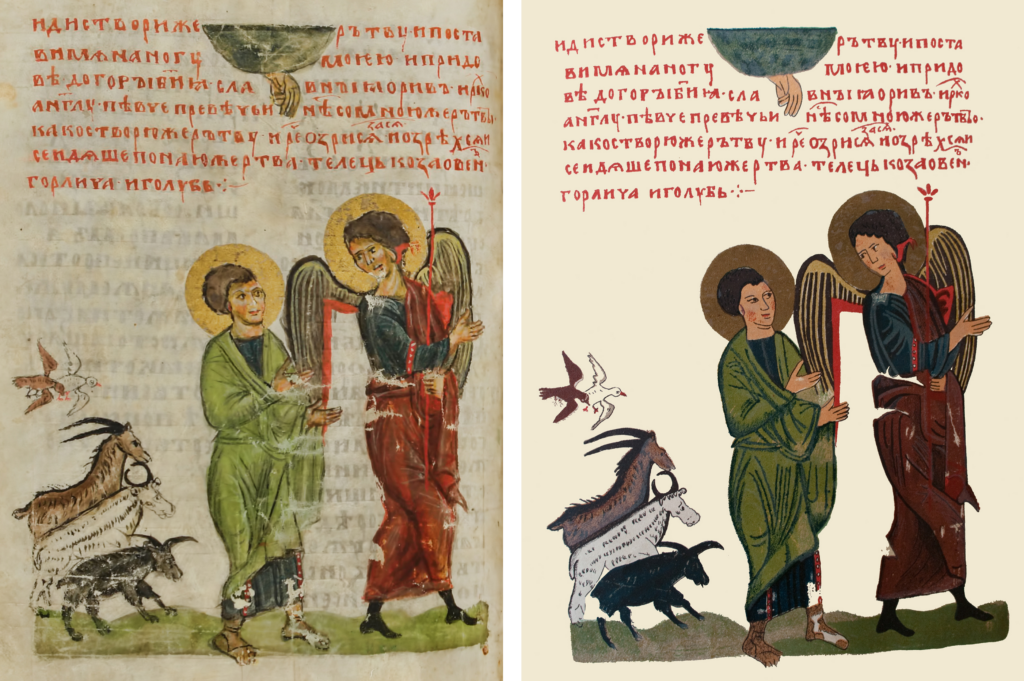
No formal English translation of the Apocalypse of Abraham appeared before 1898, but motifs from it were referenced in earlier scholarly Latin and German treatments and in nineteenth-century Bible commentaries. The strict claim, that the Apocalypse was completely unavailable to Joseph, is harder to defend than the narrower one, that it was not available in formal English translation in 1835. The narrower claim is what the documentary evidence supports.
Book of Jubilees (~150 BC; Hebrew original; survives in Ge'ez). First English translation by G. H. Schodde, 1888; standard scholarly edition by R. H. Charles, 1902.[11:1] Parallels: Terah's idolatry and Abraham's rejection (Jub. 11–12); Abraham as astronomer (Jub. 12:16–18); famine driving Abraham from Mesopotamia (Jub. 13).
Genesis Apocryphon (Aramaic, ~1st c. BC). One of the original seven Dead Sea Scrolls discovered in 1947; editio princeps by Avigad and Yadin, 1956.[14:1] Parallels: Abraham's journey with Sarai through Egypt (cols. 19–20); Abraham as astronomer/visionary (cols. 19, 22).
Pseudo-Eupolemus (~3rd c. BC, preserved in Eusebius's Praeparatio Evangelica). States that Abraham was a Chaldean astronomer who taught the Egyptians astronomy after migrating to Egypt, exactly the role Abraham plays in Abraham 3 and Facsimile 3.[78] (This is the parallel Joseph could in principle have read, since Eusebius was available in nineteenth-century editions; it is the weakest of the four for the "couldn't have known" framing, though the specific Pseudo-Eupolemus fragment was not widely commented upon.)
The compilation edited by Tvedtnes, Hauglid, and Gee, Traditions about the Early Life of Abraham (FARMS 2001), gathers over a hundred ancient and medieval Abraham texts in original languages and translation, including Pseudo-Philo, Tanna debe Eliyahu, Pirqe de Rabbi Eliezer, Genesis Rabbah, Sefer ha-Yashar, the Qur'an's Abraham material, and Falasha texts.[79] Most were unavailable in English in 1835, and many in any printed form until the twentieth century.
Across this body of ancient literature, recurring motifs (Terah's idolatry, attempted sacrifice, Abraham's astronomical knowledge, his teaching of Egyptians, deliverance by an angel) cluster around the Book of Abraham's distinctive content while appearing nowhere in Genesis. The Book of Abraham carries non-Genesis tradition that the rest of ancient Judaism preserved separately. A fabrication built from KJV Genesis alone could not produce that distribution. The Facsimiles article sets these same parallels against Facsimile 1's sacrifice scene specifically.
Genre conventions Joseph couldn't have known
The Book of Abraham's introductory line is "The Book of Abraham, written by his own hand, upon papyrus." This formula matches an ancient literary genre, first-person royal or heroic autobiography with a scribal colophon, that twentieth-century archaeology recognized as a documented ancient form.
The Idrimi statue, discovered by Sir Leonard Woolley at Tell Atchana (ancient Alalakh) in 1939, carries a 104-line cuneiform inscription on its base recording Idrimi of Alalakh's autobiography in the first person, closing with a colophon that names the scribe Sharruwa.[13:1] [71:1] The Idrimi inscription, along with the broader genre of first-person autobiographical inscriptions with scribal colophons, was archaeologically rediscovered nearly a century after Joseph Smith's death. The Book of Abraham's superscription is not anomalous in light of Idrimi; it fits a documented ancient Near Eastern convention.[72:1] (The genre is generic, including many texts unrelated to Abraham, so the parallel is one of category fit rather than unique correspondence.)
Human sacrifice in Egyptian context
Abraham 1:7–15 narrates priests of Pharaoh attempting to sacrifice Abraham on a stone altar in an Egyptian-influenced cultic setting. Whether human sacrifice occurred in ancient Egypt at all has, in Muhlestein and Gee's summary, "been variously debated and denied": published assessments have ranged from "no certain evidence for the practice of human sacrifice . . . from the Old Kingdom onwards" to "indisputable evidence" for it, and for a long stretch the Book of Abraham's setting was treated as implausible.[80] The archaeological answer came with the Mirgissa execration deposit, excavated by French Egyptologist Jean Vercoutter at the Middle Kingdom Egyptian fortress of Mirgissa in northern Sudan during the 1962–1969 archaeological campaigns.[81] The deposit contained "various ritual objects such as melted wax figurines, a flint knife, and the decapitated body of a foreigner slain during rites designed to ward off enemies."[80:1] [82]

Additional Middle Kingdom evidence is documented by Muhlestein and Gee: a Thirteenth Dynasty boundary stele from Abydos prescribing burning as the punishment for trespassing on sacred space, exactly the era Abraham 1 evokes, and Middle Kingdom royal inscriptions recording the ritual execution of foreigners.[80:2]
The skeptical end of that older debate was factually wrong about whether the underlying setting (foreign worshippers, idolatrous priests, attempted human sacrifice on an altar in a Middle Kingdom Egyptian context) was plausible. Twentieth-century excavation has shown that it was. The Book of Abraham's setting fits the archaeological evidence better than its early critics' denials did, though vindicating the setting is not the same as confirming the text. For the same evidence set against Facsimile 1's altar scene specifically, see the Facsimiles article.
Assessment
The CES Letter's source-text and anachronism case is, on close inspection, partly correct and largely overstated.
The concessions belong on the table first. Chaldeans is probably retrojective in the Book of Abraham, the same way it is retrojective in Genesis 11. The KJV-paraphrase parallel in Abraham 2, 4, and 5 is real and substantial: 83% by Sarah Allen's recalculation, with 86% being the high end on the loosest definition. The published "Egyptus" form is Greek-derived and reflects later editorial harmonization. Abraham 1:12 and 1:14's facsimile cross-references are textual features any honest reading must accommodate, and the most coherent accommodations (catalyst theory, late-redactive transmission, missing-scroll reading) all give up a strict mechanical-translation model. Brian Hauglid's reorientation toward a more critical view of the book is a real scholarly development from inside the LDS academy. Robert Ritner's Egyptological case is the strongest non-LDS academic critique.
What the CES Letter's framing misses, omits, or distorts comes into focus once the sources are opened. Genesis carries the same kinds of scribal updatings (Pharaoh, Chaldeans, Philistines, Dan), and no one treats those as grounds for calling Genesis a forgery. The "anachronism equals fabrication" inference, applied consistently, would cost the critic the Hebrew Bible. The KJV-paraphrase argument, applied consistently, indicts the Book of Mormon's Isaiah passages and Sermon on the Mount paraphrases; and since the article grants that KJV register fits fabrication and revealed translation about equally well, the paraphrase data settles little on the historicity question either way. Sarah Allen's corrected count is 83%, not 86%, a small drift but a characteristic one, given how the CES Letter's numbers tilt toward the strongest impression.
The Dick material follows the same pattern. Hansen's modal qualifier ("may be more than coincidental") matters, because he himself was not asserting confident dependence. D&C 93:33's eternal-matter doctrine (May 1833) predates the first documented engagement with Dick in the Church's press (the December 1836 Messenger and Advocate extract), which puts real pressure on a strong dependency model. And the systematic theological contrasts between Dick and Joseph, on every fundamental point Dick took most seriously, are inconsistent with wholesale borrowing, even if a softer selective-borrowing thesis remains a coherent skeptical position.
Set against that is the positive case: several independent lines of evidence, and a strict 1830s-fabrication model struggles with all of them. Olishem arguably maps to Akkadian Ulisum, attested in cuneiform deciphered after Joseph's death and identified with Oylum Höyük in a 2013 announcement (a promising rather than proven match). The Egyptian encircling = governing concept, the divine-council reading of Genesis 1 (with the Adam Clarke caveats), the Idrimi-style autobiographical genre, the Apocalypse of Abraham parallels, and the Mirgissa execration evidence are all features twentieth-century scholarship would recognize as authentically ancient. Most of the underlying evidence postdates Joseph by decades or centuries. An author of the 1830s equipped with KJV Genesis, popular astronomy, and Thomas Dick should produce zero post-1835 hits. The Book of Abraham produces several arguable ones, none individually decisive, and every one of them a separate bill the fabrication theory has to pay.
The Book of Abraham is not the cleanest faith-defending case in the Church's canon. The textual history is messier than the Book of Mormon's, the manuscript variants are real, the Chaldeans concession is plain, and the catalyst-theory and revealed-translation models stretch "translation" past the word-for-word rendering older assumptions took for granted.
So weigh what the fabrication thesis has to carry, and notice when the weights arrived. Cuneiform stayed unreadable until 1857. The tablet preserving Naram-Sin's Ulisum inscription was published in 1928, and a second inscription naming the site followed in 2020. The Apocalypse of Abraham reached English readers in 1898; the Genesis Apocryphon waited in a cave near the Dead Sea until 1947 and in print until 1956; the Idrimi statue surfaced in 1939; Mirgissa was excavated between 1962 and 1969. Every one of those doors opened after Joseph Smith was dead, most of them long after. If the Book of Abraham were a nineteenth-century construction, none of what lay behind those doors could have shaped it, and the matches behind them ought not to exist. Several do.
That asymmetry is the deeper version of the question the Book of Mormon poses, and the Book of Mormon remains the firmer ground; its own origin still resists every naturalistic account on offer, and the evidence for it has only accumulated with time. The Book of Abraham's case is denser, more technical, more textured than that. But it answers, in its own register, to the same test: a text that keeps fitting evidence its supposed author could not have reached.
Runnells, CES Letter (2017), "Book of Abraham," no. 4, p. 46. ↩︎ ↩︎
Runnells, CES Letter (2017), "Book of Abraham," no. 5, p. 47. ↩︎ ↩︎
Runnells, CES Letter (2017), "Book of Abraham," no. 6, pp. 47–48. ↩︎ ↩︎ ↩︎
Runnells, CES Letter (2017), "Book of Abraham," no. 7, p. 48. ↩︎ ↩︎
Runnells, CES Letter (2017), "Book of Abraham," no. 8, pp. 48–49. ↩︎ ↩︎
University of Hamburg CSMC, "The Decipherment of Cuneiform Writing," https://www.csmc.uni-hamburg.de/publications/mesopotamia/2015-05-08.html (canonical date for the 25 May 1857 Royal Asiatic Society fait accompli). ↩︎ ↩︎ ↩︎
The Ulisum campaign text survives in an Old Babylonian tablet copy from Ur, UET I 275: C. J. Gadd and Leon Legrain, eds., Ur Excavations, Texts I: Royal Inscriptions (Oxford: Oxford University Press, 1928), no. 275; English translation in Benjamin R. Foster, "The Siege of Armanum," Journal of the Ancient Near Eastern Society 14, no. 1 (1982): 31–32. A second inscription naming Ulisum, found at Tulul al-Baqarat, is published in Nashat Alkhafaji and Gianni Marchesi, "Naram-Sin's War against Armanum and Ebla in a Newly-Discovered Inscription from Tulul al-Baqarat," Journal of Near Eastern Studies 79, no. 1 (2020). All as cited in Stephen O. Smoot, John Gee, Kerry Muhlestein, and John S. Thompson, "The Plain of Olishem," BYU Studies Quarterly 61, no. 4 (2022), https://byustudies.byu.edu/article/the-plain-of-olishem. ↩︎ ↩︎ ↩︎
Robin Scott Jensen and Brian M. Hauglid, eds., The Joseph Smith Papers, Revelations and Translations, Volume 4: Book of Abraham and Related Manuscripts (Salt Lake City: Church Historian's Press, 2018); see editorial introduction at https://www.josephsmithpapers.org/intro/introduction-to-revelations-and-translations-volume-4. ↩︎ ↩︎ ↩︎ ↩︎
Terryl Givens with Brian M. Hauglid, The Pearl of Greatest Price: Mormonism's Most Controversial Scripture (New York: Oxford University Press, 2019). ↩︎ ↩︎
Jean-François Champollion, Lettre à M. Dacier (Paris, 1822); the founding text of modern Egyptology. ↩︎ ↩︎
R. H. Charles, The Book of Jubilees (London: Adam and Charles Black, 1902), https://archive.org/details/bookofjubileesor00char. First English translation by G. H. Schodde appeared in 1888. ↩︎ ↩︎
G. H. Box and J. I. Landsman, The Apocalypse of Abraham (London: SPCK; New York: Macmillan, 1918), https://archive.org/details/apocalypseofabra00boxg. First popular English translation by E. H. Anderson and R. T. Haag was published in Improvement Era (1898). ↩︎ ↩︎
Sir Leonard Woolley, "Excavations at Tell Atchana," Antiquaries Journal 19 (1939): 1–37; British Museum, Statue of Idrimi (1939,0613.101), https://www.britishmuseum.org/collection/object/W_1939-0613-101. ↩︎ ↩︎
Nahman Avigad and Yigael Yadin, A Genesis Apocryphon: A Scroll from the Wilderness of Judaea (Jerusalem: Magnes Press, 1956); the editio princeps of the Genesis Apocryphon (1QapGen), one of the original seven Dead Sea Scrolls discovered in 1947. ↩︎ ↩︎
Grant H. Palmer, An Insider's View of Mormon Origins (Salt Lake City: Signature Books, 2002), pp. 19, 25. ↩︎ ↩︎
Stephen O. Smoot, John Gee, Kerry Muhlestein, and John S. Thompson, "Abrahamic Astronomy," BYU Studies Quarterly 61, no. 4 (2022), https://byustudies.byu.edu/article/abrahamic-astronomy. ↩︎ ↩︎
John Gee, William J. Hamblin, and Daniel C. Peterson, "'And I Saw the Stars': The Book of Abraham and Ancient Geocentric Astronomy," in Astronomy, Papyrus, and Covenant (Studies in the Book of Abraham, vol. 3, Provo, UT: FARMS, 2005), https://scholarsarchive.byu.edu/mi/14/. ↩︎
Helaman 12:15: "And thus, according to his word the earth goeth back, and it appeareth unto man that the sun standeth still; yea, and behold, this is so; for surely it is the earth that moveth and not the sun." Book of Mormon (1830 ed.). ↩︎
Kerry Muhlestein, "Encircling Astronomy and the Egyptians: An Approach to Abraham 3," Religious Educator 10, no. 1 (2009); chapter version reprinted in By Study and by Faith: Selections from the Religious Educator, ed. Richard Neitzel Holzapfel and Kent P. Jackson (Provo, UT: BYU Religious Studies Center, 2009), https://rsc.byu.edu/study-faith/encircling-astronomy-egyptians-approach-abraham-3. ↩︎ ↩︎
Stephen O. Smoot, John Gee, Kerry Muhlestein, and John S. Thompson, "Kolob, the Governing One," BYU Studies Quarterly 61, no. 4 (2022), https://byustudies.byu.edu/article/kolob-the-governing-one. ↩︎ ↩︎
Allen, James P., The Ancient Egyptian Pyramid Texts, 2nd ed. (Atlanta: Society of Biblical Literature, 2015), historical introduction. Pyramid Text excavations under Maspero began at Saqqara in 1881, with initial transcriptions appearing in Recueil de Travaux from the 1880s onward; standard scholarly editions emerged in the 20th century (Sethe 1908–1922; Allen 2005/2015). ↩︎
Michael D. Rhodes, "The Joseph Smith Hypocephalus … Twenty Years Later," FARMS Preliminary Report (1997), discussing the "Light of Christ" (D&C 88:7–13) framework for hierarchical light/governance language. ↩︎
Sarah Allen, "The CES Letter Rebuttal — Part 18," FAIR (20 October 2021), https://www.fairlatterdaysaints.org/blog/2021/10/20/the-ces-letter-rebuttal-part-18. ↩︎
Wikipedia, "Criticism of the Book of Abraham," https://en.wikipedia.org/wiki/Criticism_of_the_Book_of_Abraham. The article cites about 75 percent of the wording from KJV Genesis 1–2 for Book of Abraham chapters 4 and 5 specifically (a narrower scope than Palmer's chapters 2, 4, 5 count). ↩︎
Stephen O. Smoot, "Council, Chaos, and Creation in the Book of Abraham," Journal of the Book of Mormon and Other Restoration Scripture 22, no. 2 (2013): 28–39, https://scripturecentral.org/archive/periodicals/journal-article/council-chaos-and-creation-book-abraham. ↩︎ ↩︎
Doctrine and Covenants 93:33: "The elements are eternal, and spirit and element, inseparably connected, receive a fulness of joy." Revelation given 6 May 1833. https://www.churchofjesuschrist.org/study/scriptures/dc-testament/dc/93. ↩︎ ↩︎ ↩︎
Mark S. Smith, The Origins of Biblical Monotheism: Israel's Polytheistic Background and the Ugaritic Texts (New York: Oxford University Press, 2001). ↩︎
Michael S. Heiser, "The Divine Council in Late Canonical and Non-Canonical Second Temple Jewish Literature" (PhD diss., University of Wisconsin–Madison, 2004); Heiser, The Unseen Realm (Bellingham, WA: Lexham Press, 2015). ↩︎
Gerhard May, Creatio ex Nihilo: The Doctrine of "Creation Out of Nothing" in Early Christian Thought, trans. A. S. Worrall (Edinburgh: T&T Clark, 1994). ↩︎
Daniel C. Peterson, "'Ye Are Gods': Psalm 82 and John 10 as Witnesses to the Divine Nature of Humankind," in The Disciple as Scholar: Essays on Scripture and the Ancient World in Honor of Richard Lloyd Anderson, ed. Stephen D. Ricks, Donald W. Parry, and Andrew H. Hedges (Provo, UT: FARMS, 2000), pp. 471–594. ↩︎
Adam Clarke, The Holy Bible … with a Commentary and Critical Notes, 8 vols. (London: J. Butterworth and Son, 1810–1826), commentary on Genesis 1:1, discussing the plural form of Elohim and a plurality-of-persons reading. Clarke's commentary was widely circulated in antebellum America. See discussion in Haley Wilson and Thomas Wayment, "A Recently Recovered Source: Rethinking Joseph Smith's Bible Translation," Journal of Undergraduate Research (BYU, 2017). ↩︎
Matthew J. Grey, "'The Word of the Lord in the Original': Joseph Smith's Study of Hebrew in Kirtland," in Approaching Antiquity: Joseph Smith and the Ancient World, ed. Lincoln H. Blumell, Matthew J. Grey, and Andrew H. Hedges (Provo, UT: BYU RSC, 2015), https://rsc.byu.edu/approaching-antiquity-joseph-smith-ancient-world/word-lord-original-joseph-smiths-study-hebrew-kirtland; "Certificate from Joshua Seixas, 30 March 1836," Joseph Smith Papers, https://www.josephsmithpapers.org/paper-summary/certificate-from-joshua-seixas-30-march-1836/1. ↩︎
Royal Skousen, "The Original Language of the Book of Mormon: Upstate New York Dialect, King James English, or Hebrew?" Journal of Book of Mormon Studies 3, no. 1 (1994): 28–38; Skousen, "Translating the Book of Mormon: Evidence from the Original Manuscript," in Book of Mormon Authorship Revisited, ed. Noel B. Reynolds (Provo, UT: FARMS, 1997). ↩︎
John S. Thompson, "'We May Not Understand Our Words': The Book of Abraham and the Concept of Translation in The Pearl of Greatest Price," Interpreter: A Journal of Latter-day Saint Faith and Scholarship 41 (2020): 1–48, https://interpreterfoundation.org/journal/we-may-not-understand-our-words-the-book-of-abraham-and-the-concept-of-translation-in-the-pearl-of-greatest-price/. ↩︎ ↩︎
"King James Bible Language," Debunking-CESLetter, https://debunking-cesletter.com/the-book-of-abraham-1/king-james-bible-language/. ↩︎
"Detailed Response to CES Letter, Book of Abraham," FAIR, https://www.fairlatterdaysaints.org/answers/Detailed_response_to_CES_Letter,_Book_of_Abraham. ↩︎ ↩︎
Richard Elliott Friedman, Who Wrote the Bible?, 2nd ed. (San Francisco: HarperOne, 1997). Standard treatment of the Documentary Hypothesis and the redacted form of Genesis 1–11. ↩︎
This response involves a genuine concession: the Book of Abraham as published is not a transparent window into a particular ancient source-text. It reaches the modern reader through Joseph Smith's translation work, which involved English language framed by KJV idiom — which is why the English translator's role is what produces the tracking with redacted Genesis. The underlying ancient material may or may not have followed that exact form. The catalyst-theory and revealed-translation models accommodate this distinction; a strict mechanical-translation model does not. ↩︎
"Translation and Historicity of the Book of Abraham," Gospel Topics Essays, The Church of Jesus Christ of Latter-day Saints, https://www.churchofjesuschrist.org/study/manual/gospel-topics-essays/translation-and-historicity-of-the-book-of-abraham. ↩︎ ↩︎ ↩︎
Stephen O. Smoot, "'In the Land of the Chaldeans': The Search for Abraham's Homeland Revisited," BYU Studies Quarterly 56, no. 3 (2017): 7–37, https://byustudies.byu.edu/article/in-the-land-of-the-chaldeans-the-search-for-abrahams-homeland-revisited. ↩︎ ↩︎ ↩︎
Stephen E. Thompson, "Egyptology and the Book of Abraham," Dialogue: A Journal of Mormon Thought 28, no. 1 (Spring 1995): 143–160, https://www.dialoguejournal.com/articles/egyptology-and-the-book-of-abraham/. ↩︎ ↩︎
C. Leonard Woolley, Ur of the Chaldees (London: Ernest Benn, 1929; revised editions 1938, 1950, 1982). Later editions remove explicit Abraham identification; see also "Ur of the Chaldees," FAIR, https://www.fairlatterdaysaints.org/answers/Book_of_Abraham/Anachronisms/Ur_of_the_Chaldees. ↩︎
John Bright, A History of Israel, 3rd ed. (Philadelphia: Westminster Press, 1981), p. 90 (cf. pp. 90–91), as quoted in Smoot, "'In the Land of the Chaldeans'" (2017), notes 101 and 106. ↩︎
Donald B. Redford, ed., The Oxford Encyclopedia of Ancient Egypt, 3 vols. (New York: Oxford University Press, 2001), s.v. "Pharaoh"; cf. also Wikipedia, "Pharaoh," https://en.wikipedia.org/wiki/Pharaoh, summarizing Erik Hornung and Redford on the title's history. The earliest unambiguous use of per-aa for the king appears in a letter to Akhenaten (c. 1353–1336 BC); possible earlier use under Thutmose III (c. 1479–1425 BC). ↩︎
This is the harder version of the Pharaoh criticism and worth naming candidly. The Book of Abraham's use of Pharaoh as a personal name (rather than a regnal title) has no directly attested Egyptological correspondence — Manetho's Aegyptiaca lists Menes/Narmer as the founder of dynastic Egypt, not a figure called "Pharaoh." What is defensible is that the category of eponymous-founder traditions in ancient Near Eastern historiography (Mizraim/Egypt, Ham as the ancestor of African peoples in Genesis 10) does include figures whose name doubles as the name of the region or dynasty they founded. The Book of Abraham's Pharaoh-as-founder fits that broader genre even though no Egyptian source independently confirms a personal name "Pharaoh." ↩︎
"Detailed Response to CES Letter, Book of Abraham" (FAIR), section on Pharaoh, https://www.fairlatterdaysaints.org/answers/Detailed_response_to_CES_Letter,_Book_of_Abraham; Pearl of Great Price Central, "Pharaoh," https://pearlofgreatpricecentral.org. ↩︎
John Stokes, "The Hamites: The Pre-Restoration Monotheism of the Children of Ham in the Book of Abraham," Interpreter: A Journal of Latter-day Saint Faith and Scholarship 56 (2023), https://interpreterfoundation.org/journal/the-hamites-the-pre-restoration-monotheism-of-the-children-of-ham-in-the-book-of-abraham/. Discusses the Hamite/Egyptian/Chaldean cluster and engages the eponymous-founder genre in ancient Near Eastern historiography. ↩︎
Stephen O. Smoot, John Gee, Kerry Muhlestein, and John S. Thompson, "Zeptah and Egyptes," BYU Studies Quarterly 61, no. 4 (2022), https://byustudies.byu.edu/article/zeptah-and-egyptes. ↩︎ ↩︎
Smoot, Gee, Muhlestein, and Thompson, "Zeptah and Egyptes," BYU Studies Quarterly 61, no. 4 (2022): the name Siptah (sꜣ Ptḥ, "son of [the god] Ptah"), "as well as its feminine equivalent 'daughter of [the god] Ptah' (sꜣt Ptḥ), is attested during the likely time of Abraham. It is also the name of an Egyptian king who lived many centuries after Abraham" — the pharaoh Siptah, whose late date makes him a later instance of the pattern rather than a contemporary parallel. ↩︎
Mormon Challenges, "Why are there Anachronisms in the Book of Abraham? Should be Expected," https://mormonchallenges.org/2013/02/05/anachronisms-book-of-abraham-challenge-7/. ↩︎
Translation of UET I 275 in Benjamin R. Foster, "The Siege of Armanum," Journal of the Ancient Near Eastern Society 14, no. 1 (1982): 31–32, as quoted in Smoot, Gee, Muhlestein, and Thompson, "The Plain of Olishem," BYU Studies Quarterly 61, no. 4 (2022). ↩︎
John M. Lundquist, "Was Abraham at Ebla? A Cultural Background of the Book of Abraham," in Studies in Scripture, Volume 2: The Pearl of Great Price, ed. Robert L. Millet and Kent P. Jackson (Salt Lake City: Randall Book, 1985), pp. 225–237. The founding identification of Olishem with Akkadian Ulisum. ↩︎
Stephen O. Smoot, John Gee, Kerry Muhlestein, and John S. Thompson, "The Plain of Olishem," BYU Studies Quarterly 61, no. 4 (2022), https://byustudies.byu.edu/article/the-plain-of-olishem. ↩︎ ↩︎ ↩︎ ↩︎
Atilla Engin, "Oylum Höyük İçin Bir Lokalizasyon Önerisi: Ulisum/Ullis/İllis," in Armizzi: Engin Özgen'e Armağan, ed. Atilla Engin, Barbara Helwing, and Bora Uysal (Ankara: Asitan Kitap, 2014), 136, as cited in Smoot et al., "The Plain of Olishem" (2022), note 9; the article reports that Engin has "favorably suggested a possible (though inconclusive) connection" between Olishem and Ulisum. ↩︎
"The Plain of Olishem," Pearl of Great Price Central, https://pearlofgreatpricecentral.org/olishem/. ↩︎
Catalyst theory is not meant to function as a one-stop solution to every difficulty — its role is as a framework for thinking about the translation process, not as a universal solvent for textual problems. The case for ancient material in the text must rest on positive evidence that survives translation: features that would be hard to invent regardless of mechanism. That is what the place-name, theological-structure, and narrative-motif arguments in the rest of this article aim to provide. ↩︎
Klaus J. Hansen, Mormonism and the American Experience (Chicago: University of Chicago Press, 1981), pp. 103–4. ↩︎ ↩︎
Edward T. Jones, "The Theology of Thomas Dick and Its Possible Relationship to that of Joseph Smith" (MA thesis, Brigham Young University, 1969), https://scholarsarchive.byu.edu/etd/4839/. ↩︎ ↩︎
Thomas Dick, The Philosophy of a Future State (New York: G. & C. & H. Carvill, 1829), 211 ("The Deity, being a spiritual uncompounded substance, having no visible form...") and 207 ("must for ever remain incomprehensible to all limited intelligences"), https://archive.org/details/philosophyoff00dick. ↩︎ ↩︎
Joseph Smith, King Follett discourse (7 April 1844), in Teachings of the Prophet Joseph Smith, comp. Joseph Fielding Smith (Salt Lake City: Deseret News Press, 1938), 345 (p. 349 in the archive.org scan, https://archive.org/details/teachingsofproph00smit). ↩︎ ↩︎
Erich Robert Paul, Science, Religion, and Mormon Cosmology (Urbana: University of Illinois Press, 1992). ↩︎ ↩︎
"Parallels to Thomas Dick's Writings," Debunking-CESLetter, https://debunking-cesletter.com/the-book-of-abraham-1/parallels-to-thomas-dick-writings/. ↩︎
"Thomas Dick's The Philosophy of a Future State," FAIR, https://www.fairlatterdaysaints.org/answers/Thomas_Dick’s_The_Philosophy_of_a_Future_State; "The Book of Abraham and Thomas Dick's Philosophy of a Future State," FAIR, https://www.fairlatterdaysaints.org/answers/The_Book_of_Abraham_and_Thomas_Dick's_Philosophy_of_a_Future_State. ↩︎ ↩︎
"Extracts from Dick's Philosophy," Messenger and Advocate 3, no. 3 (December 1836): 423–25. An unsigned editorial extract from Thomas Dick's Philosophy of a Future State; Oliver Cowdery was then the periodical's editor. ↩︎
The chronology doesn't establish full independence from Dick — absence of documented engagement before December 1836 is not the same as absence of any engagement, and the 1829–1833 window leaves four years in which Cowdery or any of the leading brethren could have encountered Dick's ideas through intermediaries before the May 1833 revelation. The 1836 periodical extract is consistent with Dick-as-confirmatory or Dick-as-prior-influence; the chronology alone doesn't fully decide between them. What it does establish is that the strong borrowing thesis — Dick directly into Joseph's revelations — is hard to demonstrate from the documentary record. ↩︎
Ben Park, "Joseph Smith, Thomas Dick, and the Tricky Task of Determining Influence," Juvenile Instructor blog, https://juvenileinstructor.org/joseph-smith-thomas-dick-and-the-tricky-task-of-determining-influence/. ↩︎
John L. Brooke, The Refiner's Fire: The Making of Mormon Cosmology, 1644–1844 (Cambridge: Cambridge University Press, 1994). ↩︎
Brian M. Hauglid, "'Translating an Alphabet to the Book of Abraham': Joseph Smith's Study of the Egyptian Language and His Translation of the Book of Abraham," in Producing Ancient Scripture: Joseph Smith's Translation Projects in the Development of Mormon Christianity, ed. Michael Hubbard MacKay, Mark Ashurst-McGee, and Brian M. Hauglid (Salt Lake City: University of Utah Press, 2020), 363–389. ↩︎
Robert K. Ritner, The Joseph Smith Egyptian Papyri: A Complete Edition (Salt Lake City: Smith-Pettit Foundation, 2011/2013). ↩︎ ↩︎
Robert K. Ritner, "'Translation and Historicity of the Book of Abraham' — A Response," 2014; PDF hosted at https://isac.uchicago.edu/sites/default/files/uploads/Translation and Historicity of the Book of Abraham.pdf (University of Chicago Institute for the Study of Ancient Cultures); also available via Institute for Religious Research, https://mit.irr.org/translation-and-historicity-of-book-of-abraham-response. ↩︎
British Museum object record W_1939-0613-101, Statue of Idrimi, https://www.britishmuseum.org/collection/object/W_1939-0613-101; see also "Statue of Idrimi," Wikipedia, https://en.wikipedia.org/wiki/Statue_of_Idrimi. ↩︎ ↩︎
John Gee, "Abraham and Idrimi," Journal of Book of Mormon Studies 22, no. 1 (2013): 34–39, https://scripturecentral.org/archive/periodicals/journal-article/abraham-and-idrimi. ↩︎ ↩︎
Kevin Barney, "The Facsimiles and Semitic Adaptation of Existing Sources," in Astronomy, Papyrus, and Covenant (Studies in the Book of Abraham, vol. 3, Provo, UT: FARMS, 2005); Scripture Central archive, https://scripturecentral.org/archive/books/book-chapter/facsimiles-and-semitic-adaptation-existing-sources. ↩︎
"Ur of the Chaldees," FAIR, https://www.fairlatterdaysaints.org/answers/Book_of_Abraham/Anachronisms/Ur_of_the_Chaldees. ↩︎
John A. Tvedtnes, "Authentic Ancient Names and Words in the Book of Abraham and Related Kirtland Egyptian Papers," 2005 FAIR Conference, https://www.fairlatterdaysaints.org/conference_home/august-2005/authentic-ancient-names-and-words. ↩︎ ↩︎
John Gee and Stephen D. Ricks, "Historical Plausibility: The Historicity of the Book of Abraham as a Case Study," in Historicity and the Latter-day Saint Scriptures, ed. Paul Y. Hoskisson (Provo, UT: BYU RSC, 2001), pp. 63–98, https://rsc.byu.edu/historicity-latter-day-saint-scriptures/historical-plausibility-historicity-book-abraham-case-study. ↩︎
Jeffrey M. Bradshaw, David J. Larsen, and Stephen T. Whitlock, "Moses 1 and the Apocalypse of Abraham: Twin Sons of Different Mothers?" Interpreter: A Journal of Latter-day Saint Faith and Scholarship 38 (2020): 179–290, https://journal.interpreterfoundation.org/moses-1-and-the-apocalypse-of-abraham-twin-sons-of-different-mothers/. Detailed scholarly comparison of the Apocalypse of Abraham and Joseph Smith's Abrahamic material. ↩︎
Pseudo-Eupolemus, fragment preserved in Eusebius of Caesarea, Praeparatio Evangelica 9.17.2–9; English translation in Edwin Hamilton Gifford, Eusebii Pamphili Evangelicae Praeparationis Libri XV (Oxford: Clarendon Press, 1903). ↩︎
John A. Tvedtnes, Brian M. Hauglid, and John Gee, eds., Traditions about the Early Life of Abraham (Provo, UT: FARMS, 2001), https://press.uchicago.edu/ucp/books/book/distributed/T/bo3648094.html. ↩︎
Kerry Muhlestein and John Gee, "An Egyptian Context for the Sacrifice of Abraham," Journal of the Book of Mormon and Other Restoration Scripture 20, no. 2 (2011): 70–77, https://scholarsarchive.byu.edu/jbms/vol20/iss2/6/. ↩︎ ↩︎ ↩︎
Jean Vercoutter, "Textes exécratoires de Mirgissa," Comptes rendus des séances de l'Académie des Inscriptions et Belles-Lettres 107, no. 1 (1963): 97–102; Vercoutter, "Trois campagnes de fouilles à Mirgissa en Nubie soudanaise (1963–1966)," Comptes rendus des séances de l'Académie des Inscriptions et Belles-Lettres 110, no. 2 (1966): 276–283; the deposit was excavated across the 1962–1969 archaeological campaigns directed by Vercoutter at the Middle Kingdom fortress of Mirgissa. ↩︎
Stephen O. Smoot, John Gee, Kerry Muhlestein, and John S. Thompson, "Human Sacrifice," BYU Studies Quarterly 61, no. 4 (2022), https://byustudies.byu.edu/article/human-sacrifice. ↩︎