Papyri
The claim:
"Originally, Joseph claimed that this record was written by Abraham 'by his own hand, upon papyrus' – a claim still prominent in the heading of the Book of Abraham. This claim could not be evaluated for decades as many thought the papyri were lost in a fire. The original papyrus Joseph translated has since been found and, as stated in the Church's July 2014 Translation and Historicity of the Book of Abraham essay, 'scholars have identified the papyrus fragments as parts of standard funerary texts…[that] date to between the third century B.C.E. and the first century C.E., long after Abraham lived.'
We know this is the papyrus that Joseph used for translation because the hieroglyphics match in chronological order to the hieroglyphics in Joseph's Kirtland Egyptian Papers, which contains his Grammar & Alphabet of the Egyptian Language (GAEL). Additionally, the papyrus were pasted onto paper which have drawings of a temple and maps of the Kirtland, Ohio area on the back and they were companied by an affidavit by Emma Smith verifying they had been in the possession of Joseph Smith."[1]
"Egyptologists have also since translated the source material for the Book of Abraham and have found it to be nothing more than a common pagan Egyptian funerary text for a deceased man named 'Hor' around first century C.E.… It has nothing to do with Abraham or anything Joseph claimed in his translation for the Book of Abraham."[2]
"Of all the issues, the Book of Abraham is the issue that has both fascinated and disturbed me the most.… It is the smoking gun that has completely obliterated my testimony of Joseph Smith and his claims."[3]
The papyri argument runs on a chain of specific assertions. Joseph Smith offered the Book of Abraham as a record Abraham wrote himself, on papyrus. The very papyrus he translated from, the CES Letter says, has been recovered. Egyptologists on all sides read that recovered material as ordinary funerary documents prepared for a priest named Hor, dated nearly two millennia after Abraham's lifetime. And Joseph's own Egyptian manuscripts supposedly confirm that those fragments were his working source. The verdict needs every link in the chain, and the CES Letter treats each one as already settled.
Start with what "the original papyrus" actually is. The long rolls Joseph Smith owned, the ones nineteenth-century visitors described unrolling across the floor, are believed to have burned in the Great Chicago Fire of 1871. The eleven mounted fragments recovered in 1967, ten of them transferred by the Metropolitan Museum of Art and one located at about the same time in the Church Historian's Office, are a different artifact: physically distinct papyri, separated from the destroyed rolls since 1856, recovered ninety-six years after the fire.[4] So when the CES Letter says Egyptologists have translated "the source material" and found it to be a funerary text, the first thing to notice is that the surviving fragments and the lost rolls are not the same papyri.
That distinction does not make the difficulty go away. The recovered fragments do not contain the Book of Abraham. The Kirtland Egyptian Papers (KEP), the set of Egyptian-language documents Joseph and his clerks produced in 1835–1836, appear to map specific Egyptian characters to specific verses of Abraham. The missing-scroll defense rests on contested arithmetic. And the "catalyst" framework that has become the most common faithful position is openly a twentieth-century reframing of language Joseph himself used. The difficulties are real, and the hardest of them was documented by a faithful Latter-day Saint scholar working on the Church's own critical edition.
None of the difficulties, alone or in combination, delivers the verdict the CES Letter announces.
- The recovered fragments are not the long rolls eyewitnesses described; the rolls burned in 1871, and the fragments had been separate from them since 1856.
- The Church itself printed the fragments months after their 1967 recovery, and the funerary identification followed within the year, not decades later under pressure.
- The documented dependency on the Kirtland Egyptian Papers covers three verses of a five-chapter book, and scholars dispute which direction it runs.
- And the verdict has to explain away the book's own text, which names a place, a practice, and a literary genre confirmed only by discoveries made after Joseph Smith died.
That last fact is the one no reading of the recovered fragments can reach.
For the figure-by-figure analysis of Facsimiles 1–3, see Facsimiles. For the cosmology, KJV-Genesis paraphrase, and anachronism arguments (Chaldeans, Pharaoh, Thomas Dick), see Anachronisms & Source Texts.
Context and background
On July 3, 1835, Michael Chandler arrived in Kirtland, Ohio with four Egyptian mummies and several rolls of papyrus.[5] They had been taken from a Ptolemaic-era catacomb near Thebes by the Italian excavator Antonio Lebolo (d. 1830) and consigned to Europe for sale; Chandler bought them from Lebolo's dealer and had them shipped to New York in April 1833, then toured the eastern United States exhibiting them.[5:1] On July 6, 1835, Joseph Smith and several associates purchased the four mummies and the rolls for $2,400.[5:2] Joseph's history recounts that once he began examining the papyri, "much to our joy [we] found that one of the rolls contained the writings of Abraham."[4:1] When the text reached print seven years later, its heading described the record as "purporting to be the writings of Abraham, while he was in Egypt, called the Book of Abraham, written by his own hand, upon papyrus."[6]
The translation work began immediately and ran in two periods. A Kirtland phase (July–November 1835) produced most of the surviving Book of Abraham manuscripts and the Egyptian-language documents. A Nauvoo phase (early 1842) saw Joseph publish the Book of Abraham across three issues of the Times and Seasons: two installments of text on March 1 and March 15, and a third issue on May 16 carrying Facsimile 3 with its explanation, the three woodcut facsimiles distributed among them.[7] [6:1] Joseph was killed in 1844 with the manuscript apparently incomplete (modern Abraham 5:21 is not a natural ending) and with no published account of his translation method.[7:1]
After Joseph's death the papyri passed to his mother Lucy Mack Smith, who exhibited them to visitors until her death in 1856. Emma Smith and her second husband, Lewis Bidamon, then sold the collection to Abel Combs, who split it: he gave a small portion to his housekeeper, Charlotte Weaver, and sold the majority to a museum in St. Louis. Weaver's descendants eventually sold their share to the Metropolitan Museum of Art in 1947.[8] [9] The pieces that survived to reach the Met were the ones Joseph Smith and his colleagues had glued to heavy paper backing in late 1837 or early 1838, some of them placed under glass to slow further deterioration.[8:1] The rest of the collection moved through a series of Midwestern museums, and historians believe most of it was destroyed in the Great Chicago Fire of 1871.[4:2]
In 1966, Aziz S. Atiya, a University of Utah professor, saw the original of Facsimile 1 among the Met's holdings while researching Coptic and Arabic papyri there; the museum had catalogued the fragments as Joseph Smith's when it acquired them in 1947, and its Egyptian curator used Atiya's Salt Lake City connections to approach the Church.[5:3] [10] In 1967, the museum transferred ten fragments to The Church of Jesus Christ of Latter-day Saints, and one more was located in the Church Historian's Office at about the same time, making eleven in all.[4:3] Within three months of the transfer, the Church published the recovery in its own Improvement Era magazine, and within the year the fragments had been identified in print as standard Egyptian funerary literature: a Document of Breathing Made by Isis (a "Book of Breathings," a late-Egyptian funerary text whose purpose was to restore breath to the dead) for a Theban priest named Hor, and a Book of the Dead, the Egyptian corpus of funerary spells, for a woman named Tshemmin.[11] [12] The dispute over what the recovered fragments mean has continued for nearly six decades since.
What the recovered fragments are
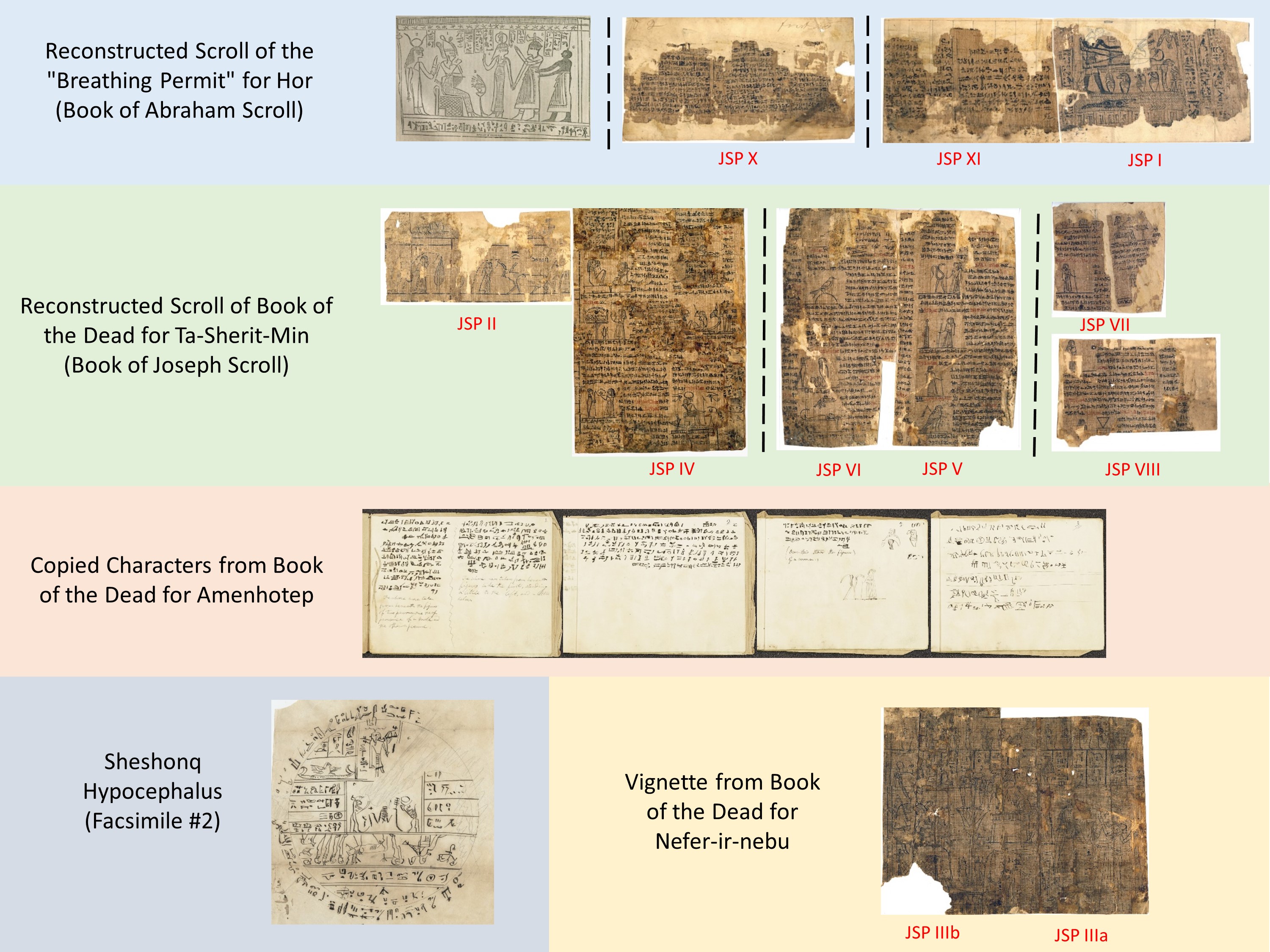
The eleven mounted fragments recovered in 1967 came from at least two distinct documents.[13] The strongest of them, designated Joseph Smith Papyri I, X, and XI, are portions of a Document of Breathing Made by Isis prepared for a Theban priest named Hor, son of Osorwer. The BYU Studies survey of the collection dates the Hor scroll to roughly 238–153 BC, and Marc Coenen's paleographic and onomastic comparison with other documents from the same priestly archive puts its latest possible date in the first half of the second century BC.[13:1] [14] It contained the source of Facsimile 1, a vignette showing a deceased man on a lion-couch surrounded by canopic jars and a hovering bird, followed by a short ritual text meant to grant Hor's spirit "breath" in the afterlife.[15]
A second group of fragments (PJS II–IX, IIIa–b) come from a Book of the Dead prepared for a woman named Tshemmin, also Theban, dating to the third or second century BC.[13:2] Two other documents Joseph possessed are not extant: the Hypocephalus of Sheshonq (a disc-shaped Egyptian amulet laid beneath a mummy's head, and the source of Facsimile 2) and the Scroll of Amenhotep, the "Valuable Discovery" referenced by Joseph and known today only from a nineteenth-century copy in Oliver Cowdery's hand.[13:3]
On the philological reading of the recovered fragments, Latter-day Saint and non-Latter-day Saint Egyptologists agree. Klaus Baer's 1968 Dialogue translation, Michael Rhodes's 2002 LDS-published edition of the Hor scroll, and Robert Ritner's 2011 critical edition all read the fragments substantially the same way: as standard Ptolemaic-era funerary literature.[12:1][15:1][16] The Gospel Topics Essay concedes this directly: "None of the characters on the papyrus fragments mentioned Abraham's name or any of the events recorded in the book of Abraham. Latter-day Saint and non-Latter-day Saint Egyptologists agree that the characters on the fragments do not match the translation given in the book of Abraham."[4:4]
That concession is real. The recovered Hor Book of Breathings, read as Egyptian funerary literature in its native register, does not contain the Book of Abraham.
What's missing
The eleven mounted fragments are not all the papyri Joseph Smith possessed. This is uncontested. The Gospel Topics Essay states it openly: "Eyewitnesses spoke of 'a long roll' or multiple 'rolls' of papyrus. Since only fragments survive, it is likely that much of the papyri accessible to Joseph when he translated the book of Abraham is not among these fragments."[4:5]
Nineteenth-century witnesses, friendly and hostile, repeatedly described long rolls of papyrus in Joseph's possession, and described them after the surviving pieces had already been glued to backing paper and put under glass in late 1837 or early 1838. Other visitors were shown the mounted fragments instead, and the two kinds of account are easy to tell apart.
- Charlotte Haven, a non-Latter-day Saint visitor (February 19, 1843), watched Lucy Mack Smith open "a long roll of manuscript" identified as "the writing of Abraham and Isaac, written in Hebrew and Sanscrit."[17]
- Josiah Quincy Jr., a skeptical visitor six weeks before the martyrdom (May 15, 1844), was shown parchments preserved under glass, the mounted material rather than a roll. Joseph identified them: "That is the handwriting of Abraham, the Father of the Faithful…this is the autograph of Moses, and these lines were written by his brother Aaron."[18]
- William I. Appleby, a Latter-day Saint convert (May 5, 1841), recorded viewing "four mummies, one male and three females, brought from Ancient Thebes in Egypt, saw the Rolls of Papyrus, and the writing thereon."[19]
- Hugh Nibley preserved the received tradition: "We are told that the papyri were in beautiful condition when Joseph Smith got them, and that one of them when unrolled on the floor extended through two rooms of the Mansion House."[20]
John Gee counts "twenty-six eyewitness sources that describe the Joseph Smith Papyri," spanning the years the Latter-day Saints owned them, from 1835 to 1856; Kerry Muhlestein has examined that body of accounts, friendly, neutral, and hostile, in detail.[10:1] [9:1] The witnesses do not agree on every detail. But the long-roll accounts were recorded after the surviving fragments were already backed and under glass, so they cannot refer to those small mounted pieces.
How much was originally there is a separate, and contested, question. John Gee applied Friedhelm Hoffmann's formula for calculating the original length of a wound scroll from its surviving end-fragments and concluded that the Hor scroll alone was missing roughly 1,250 cm, about 41 feet, of papyrus.[21] Andrew Cook and Christopher Smith challenged that reconstruction in Dialogue in 2010, arguing that Gee's measurements required "the papyrus to be impossibly thin," and recalculating that about 56 cm of papyrus could plausibly be missing from the scroll's interior.[22] Cook defended the math again in 2012.[23]
Gee's 41-foot estimate is contested, and Cook and Smith's roughly 56 cm (the lowest figure any critic defends) is, on its own, not enough to contain a hieratic copy of the canonized Book of Abraham. But that figure is restricted to the interior of the Hor scroll. It says nothing about the Tshemmin scroll's missing material, the entirely missing Scroll of Amenhotep, or the long rolls Haven, Appleby, and others described, which burned in 1871.
Nothing above rests on the missing-scroll defense; the claim is more modest. The eleven mounted fragments are not the totality of Joseph's collection, and any argument that treats them as identical to the source he translated from has to reckon with eyewitness, archival, and quantitative evidence that they are not.
Why the surviving fragments don't settle the question
Grant that the recovered fragments do not contain the Book of Abraham on a literal philological reading. Several features of the surviving manuscripts still keep them from functioning as a clean disproof.
Vignette-text separation in Ptolemaic Books of Breathings is well-documented. In the Document-of-Breathing genre to which the surviving fragments belong, the vignettes (illustrations) are not always tied to the adjacent text columns. John Gee's survey of the Egyptological literature on Late Period and Ptolemaic documents gathers the specialists on the point. Malcolm Mosher observes that "misalignment of the text and vignette of a spell can occur, with the text preceding the vignette, or vice versa," and that the problem "is more common in the Late Period"; Henk Milde's catalogue of vignette-research difficulties opens with "Spatial discrepancy between text and vignette."[21:1] Abraham 1:12–14 references "the representation at the commencement of this record." Modern critics treat this as a clean reference to the immediately adjacent Facsimile 1 vignette. But in Ptolemaic Book of Breathings practice, "the commencement of this record" might naturally point several columns away, or to a different scroll entirely in the same archive.
The fragments were mounted before most eyewitness reports. Joseph Smith and his colleagues glued the small surviving pieces to heavy paper in late 1837 or early 1838, backing sheets that carry a temple plan and plat sketches of northeastern Ohio townships, and put some of them under glass.[8:2] The long rolls Charlotte Haven, William Appleby, and others described in the 1840s were physically distinct from those already-mounted fragments. The two cannot be the same artifacts.
The hypocephalus and Scroll of Amenhotep are entirely lost. The original of Facsimile 2 (the Hypocephalus of Sheshonq) is not extant; the Scroll of Amenhotep is known only from a nineteenth-century copy.[13:4] The recovered fragments do not include every document Joseph identified, so any judgment about "what the papyri contained" drawn from the eleven extant pieces is necessarily partial.
None of this proves that the missing material contained the Book of Abraham. It establishes a narrower point: the surviving fragments cannot be treated as exhausting the question, and a purely fragment-based verdict on Joseph's translation source overstates what the fragments can show.
The Kirtland Egyptian Papers: the hardest test
The Kirtland Egyptian Papers sit at the center of the modern scholarly debate about the Book of Abraham. They are also where the sharpest critical argument comes from inside the Latter-day Saint academy.
What they are
The Kirtland Egyptian Papers (KEP) are a collection of Egyptian-language documents produced mostly in 1835–1836.[7:2] They include:
- Three "Egyptian Alphabet" documents (EA-A, EA-B, EA-C), the three character-and-English manuscripts in the KEP, each pairing Egyptian-looking characters with English explanations.
- The Grammar and Alphabet of the Egyptian Language (GAEL), begun in 1835: a 108-leaf ledger volume, only thirty-six pages of it inscribed, attempting a more systematic mapping of Egyptian characters to English meanings, organized into "degrees" and "parts" of speech.
- Three Book of Abraham manuscripts (Manuscripts A, B, and C) containing the English text of Abraham 1:1 through 2:18, with Egyptian characters in the left margins paired with paragraphs of English.
- Notebooks of copied Egyptian characters, including W.W. Phelps's "Notebook of Copied Egyptian Characters" from approximately early July 1835.[24]
The KEP are written primarily in W.W. Phelps's hand, with significant additions by Warren Parrish and Frederick G. Williams, and Joseph Smith's own handwriting on two of the documents.[7:3]
The strongest critical reading
The real case is not the CES Letter's broad claim that "the hieroglyphics match in chronological order." It is the much narrower and better-documented claim made by Christopher C. Smith in 2009 and revisited by Brian Hauglid in 2020: that Abraham 1:1–3 specifically shows textual dependency on the Egyptian Alphabet documents.[25] [26]
Smith's 2009 John Whitmer Historical Association Journal article argued that Abraham 1:1–3 reads as if "cobbled together from a series of dictionary entries":
This undoubtedly accounts for the choppiness and redundancy of these three verses, which stylistically are very different from the remainder of the Book of Abraham. Verse 3, for example, reads as though it has been cobbled together from a series of dictionary entries.[25:1]
The argument is empirical. The marginal Egyptian characters in the three Book of Abraham manuscripts come from the Hor Book of Breathings; the same characters appear, with the same explanations, in the Egyptian Alphabet documents; and the English of Abraham 1:1–3 contains compound formulations, single sentences stitched from multiple dictionary-entry-like glosses, that look like the output of a character-by-character procedure rather than fluent dictation.
The Joseph Smith Papers Project Volume 4 (Jensen and Hauglid, 2018), the standard critical edition of all the BoA and Egyptian-language manuscripts, places these documents side by side and documents the textual relationships across a 448-page volume.[7:4] [27] No first-person account from Joseph Smith explains the translation method. The introduction notes that "Smith's journal suggests that he and his clerks saw their study of the papyri as being divided into two separate but related projects" (the Egyptian-language work and the translating-the-records work) and that "It is unclear when in 1835 Joseph Smith began creating the existing Book of Abraham manuscripts or what relationship the Book of Abraham manuscripts have to the Egyptian-language documents."[7:5]
Hauglid's reorientation
Brian Hauglid produced A Textual History of the Book of Abraham in 2010 from the Maxwell Institute, a strictly documentary work cataloguing manuscript variants, and co-edited JSP Volume 4 with Robin Scott Jensen in 2018.[28][7:6] He is the credentialed Latter-day Saint scholar with the deepest documentary expertise on the Book of Abraham manuscripts. His earlier work was apologetic in framing. His post-2018 work is not.
In a Facebook statement dated December 19, 2018, Hauglid stated publicly that he no longer held the apologetic views he had previously defended and was no longer interested in apologetic projects. In the same statement he wrote that he "wholeheartedly agree[d] with Dan [Vogel]'s excellent assessment of the Abraham/Egyptian documents." Vogel's published assessment is that the Book of Abraham is a nineteenth-century pseudepigraphic composition, not a translation of an ancient text, so Hauglid's stated agreement is a strong statement, not a soft one.[29] In 2019, with Terryl Givens, he published The Pearl of Greatest Price: Mormonism's Most Controversial Scripture with Oxford University Press, a book that engages catalyst theory critically and treats the documentary record on its own terms.[30] In 2020, he contributed a chapter, "Translating an Alphabet to the Book of Abraham," to Producing Ancient Scripture (eds. MacKay, Ashurst-McGee, and Hauglid), arguing for genuine textual dependency between the Egyptian Alphabet documents and Abraham 1:1–3.[26:1]
This is the faithful case's single hardest concession. Hauglid is not Robert Ritner. He is the credentialed Latter-day Saint scholar who edited the standard critical edition of the BoA manuscripts and concluded, from inside the LDS academy and with full access to the documentary evidence, that Abraham 1:1–3 has demonstrable textual dependency on the Egyptian Alphabet documents.
The direction-of-dependence question
The dependency between the Egyptian Alphabet documents and Abraham 1:1–3 is documented. What is contested is the direction: whether the EA documents produced the BoA verses, or the BoA verses produced the EA documents.
Several pieces of evidence cut against the simple "EA documents are a translation key" reading.
W.W. Phelps's May 1835 letter to his wife Sally. Two months before the Egyptian papyri arrived in Kirtland in July 1835, Phelps wrote a letter dated May 26, 1835, on the back of which he set down "A Specimen of some of the 'pure language'": characters in one column, terms in another, explanations in a third.[31] Hauglid himself documented in his 2015 RSC chapter that "the three Egyptian alphabet documents (EA) employ the same characters as those found in the 'Specimen' letter (albeit with different explanations)" and that "the first page and a half of the EA documents contain characters not associated with the papyri."[32] Joseph's earlier "Pure Language" project runs back further still, to a March 1832 document, "A Sample of pure Language given by Joseph the Seer as copied by Br Johnson," archived in the Joseph Smith Papers.[33] The cipher-style methodology of paired columns (character, term, explanation) existed before the papyri arrived. The EA documents are continuous with that prior project. That reads more easily as Phelps's cipher methodology applied to a new script than as a pure decoding of newly arrived Egyptian.
Schryver's 90% statistical analysis (with caveats). William Schryver presented at FAIR (Faithful Answers, Informed Responses) in 2010 a database-driven analysis of the meaningful vocabulary in the three Egyptian Alphabet documents, comparing the words in those definitions against what already existed in Abraham 1–3 and against what came later in Abraham 4–5 (which paraphrases Genesis 1–2). His finding: over 90% of the meaningful vocabulary in the Egyptian Alphabet documents appears in Abraham 1–3, but it is "rarely attested, if at all, in Abraham 4 and 5 and Genesis 12 and 15."[34] Schryver concluded:
Analysis by substantial words strongly suggests a dependency of the Alphabet on a pre-existing text of much of the first three chapters of the Book of Abraham.… Most of the characters explained in the Egyptian alphabet documents are not Egyptian, and do not appear on the Egyptian papyri in question.… What we have here is a tool not intended to decipher Egyptian, but rather one intended to encipher the descriptive English text.[34:1]
If Schryver is right, the dependence runs from the BoA to the alphabet: the existing English text was used to construct it. The caveat is that his 2010 FAIR presentation has not been peer-reviewed, and Hauglid 2020 explicitly does not accept the reverse-dependency reading.[26:2] Schryver is one voice in the apologetic literature, not a settled finding. Jeff Lindsay's 2019 Interpreter review of JSP Volume 4 counts only four of the 62 characters given meanings across the GAEL and the Egyptian Alphabet documents as having a clear connection to a character on the actual papyri, with three more possible but less certain, though that count is itself contested by Hauglid and other scholars who read the documentary record differently.[35]
The Phelps prior-project lineage is the more defensible piece. Phelps's pure-language methodology predates the papyri's arrival; the EA documents extend it to the Egyptian script; the Phelps-led documentary record is the strongest evidence that the EA work was not a simple decoding of newly encountered Egyptian. The Schryver 90% claim and Lindsay's 7-of-62 count are auxiliary: they bolster the case if accepted, but they do not have to bear its weight, because each is contested by Hauglid and others working from inside the LDS academy.
Joseph's hand appears on only two of the KEP documents. Hugh Nibley summarized the handwriting analysis: "What strikes one first of all is the overpowering predominance of one hand and mind in the work — those of Phelps."[36] The GAEL, the largest KEP document, is "written primarily in Phelps's handwriting" with later additions in Parrish's hand.[7:7] By itself this does not establish that Phelps authored the methodology. Joseph routinely dictated documents that scribes wrote in their own hands, as he did with the Book of Mormon in Cowdery's hand. What it establishes is that the documentary evidence does not show Joseph executing the GAEL personally. Set beside the prior-project evidence (Phelps's May 1835 pure-language letter; the March 1832 sample), the real force of the point is methodological lineage. The handwriting alone would not get there.
So the faithful reading grants that some textual relationship exists between the EA documents and Abraham 1:1–3, while holding that the evidence is consistent with the EA work following Joseph's revealed text rather than producing it. The direction is contested; the documentary record can be read either way; and on either reading the rest of the Book of Abraham, the remaining 28 verses of chapter 1 plus chapters 2–5, remains unaccounted for by the simple "translation key" framework.
Taking stock of the difficulty
The matter is not closed. Hauglid's 2020 conclusion, that Abraham 1:1–3 has demonstrable textual dependency on the Egyptian Alphabet documents, is documentary, not impressionistic. In summary: some textual relationship between the EA documents and Abraham 1:1–3 exists; its direction is contested; the dependency, even read most critically, is narrow, three verses and not the remaining 28 verses of chapter 1 plus chapters 2–5; and neither reading explains the full production of the Book of Abraham.[37]
The translation-method question
The recovered fragments, on a literal reading, offer the Book of Abraham no source; the Egyptian Alphabet documents stand in some textual relationship to its first three verses. That leaves the method itself to explain: what Joseph was doing when he produced the text.
The faithful literature has floated several frameworks: missing-scroll, strict catalyst, modified catalyst (revelation plus editorial harmonization), Semitic-adaptation, and revelatory-dictation-with-incidental-papyri. Each addresses some difficulties and leaves others. Rather than tour every option, this article picks the lane the cumulative evidence most strongly supports and stays in it, costs included.
The lane this article takes: modified catalyst with editorial harmonization
The most defensible reading, given the documentary evidence, is a modified catalyst framework. (Catalyst theory holds that the papyri prompted a revelation rather than supplying a text to decode: the Book of Abraham came to Joseph from God, with the scrolls as the occasion.) The plain catalyst version is the Gospel Topics Essay's primary framing. The modified version adds one thing: the relationship between the revealed text and the physical papyri was substantive enough that Joseph (and his clerks, in 1842) could and did harmonize the published text with the surviving vignettes, including the cross-references in Abraham 1:12 and 1:14.[4:6] [38]
The framework has two parts.
The translation procedure was revelatory. Joseph translated by inspiration, consistent with all of his other translation work: the Book of Mormon via seer stone; the Joseph Smith Translation (JST), his 1830–1833 inspired revision of the Bible, produced without Hebrew or Greek manuscripts; D&C 7 from a parchment Joseph never possessed.[39] [40] [41] In Joseph's vocabulary, "translation" was a revelatory process that produced text from a divine source, with the physical artifact serving as a prompt rather than a transparent script. At this level catalyst theory refines Joseph's own self-understanding rather than contradicting it.[38:1]
The papyri-text connection was substantive enough to harmonize. The strict-catalyst claim, that the papyri provided no substantive connection to the BoA's content, does not survive Abraham 1:12 and 1:14, where the text cross-references the facsimiles. More plausibly, Joseph believed there was a real connection between the physical papyri and the revealed content, and post-revelation editorial harmonization between text and surviving vignettes occurred at points like the March 1842 Times and Seasons publication. That is more complex than strict catalyst, and the cost is real.
What this framework addresses, and what it costs
Modified catalyst explains why Joseph and his contemporaries described the BoA as a translation in conventional vocabulary (his "translation" did operate from a physical artifact, even when the procedure was revelatory); why all of his other revelatory translations (Book of Mormon, JST, D&C 7, Book of Moses) were non-conventional in the same way; why the recovered fragments are funerary literature on their own philological terms without requiring the BoA to be a transparent decoding of them; and why Hauglid's narrow EA/BoA 1:1–3 dependency can be accommodated without forcing the conclusion that the EA documents were the source of the text rather than a parallel project.[42]
The framework pays explanatory costs at three points. First, the harmonization problem itself: if Joseph believed the recovered papyri were "only a catalyst," why harmonize the BoA's text with the surviving vignettes (Abraham 1:12, 1:14)? Because "only a catalyst" is too strong. Joseph evidently believed the papyri were substantively connected to the revealed content. Modified catalyst lives with that; strict catalyst cannot. Second, the 1842 editorial-insertion question: the gloss "which signifies hieroglyphics" first appears in the March 1842 publication and is not in the 1835 manuscripts, which handles part of the cross-reference problem, but the broader Abraham 1:12 self-reference appears earlier and cannot be neatly dismissed as an 1842 addition.[38:2] Third, Abraham 1:1–3 narrow dependency: Hauglid's documentary finding remains. Modified catalyst does not erase it. It relocates it as a parallel pure-language project rather than a transparent decoding of Egyptian into English.
Frameworks this lane sets aside
- Strict catalyst. Cannot accommodate the Abraham 1:12/1:14 cross-references without strain. Not adopted.
- Strict missing-scroll. Cook and Smith's Dialogue analysis raises a real difficulty for Hor-scroll-interior versions of this claim (though it does not address the Tshemmin scroll, the Scroll of Amenhotep, or the long rolls destroyed in 1871). Not load-bearing here.
- Semitic adaptation as a free-standing framework. Kevin Barney's J-redactor proposal is documented as a genre. The Testament of Abraham, the Apocalypse of Abraham, and the Greco-Roman magical papyri tradition all show ancient Jewish adaptation of Egyptian material to Abrahamic narratives.[43] Two examples make the genre concrete. The Testament of Abraham (a 1st century CE Jewish work) demonstrably adapts the Egyptian Book of the Dead Chapter 125 psychostasy/judgment-scene vignette, with Osiris becoming Abel and the Egyptian gods becoming angels. Luke 16's Rich Man and Lazarus traces back to the Egyptian Setne Khaemwas tradition, with Osiris becoming Abraham and Amnte (the Egyptian underworld) becoming "Abraham's bosom."[43:1] [44] Barney's framework is engaged in figure-context in the Facsimiles sister article. It supplements modified catalyst rather than replacing it: it documents the genre-plausibility of finding Abrahamic content adjacent to Egyptian funerary vignettes, not the BoA's production process.
Joseph's translation procedure was revelatory
There is direct evidence that Joseph translated the BoA by revelation rather than by character-by-character philology.
- Wilford Woodruff (1842): "The Lord is Blessing Joseph with power to reveal the mysteries of the kingdom of God; to translate through the Urim & Thummim Ancient records & Hyeroglyphics."[45]
- Parley P. Pratt (1842): "The record is now in course of translation by the means of the Urim and Thummim."[46]
- Orson Pratt (1859): "I saw him translating, by inspiration, the Old and New Testaments, and the inspired book of Abraham from Egyptian papyrus."[47]
- Warren Parrish, the disaffected scribe: "I have set by his side and penned down the translation of the Egyptian Heiroglyphicks [sic] as he claimed to receive it by direct inspiration of Heaven."[48]
- The hostile Cleveland Whig (August 1835): described Joseph examining the papyrus through "spectacles," language some Latter-day Saint scholars (Smoot 2022) read as referring to Joseph's seer stone, though the report itself is hostile and ambiguous.[49] [41:1] (The original Urim and Thummim instruments associated with the Book of Mormon translation had been returned in mid-1829.[50])
Stephen Smoot supplies the frame: "Joseph Smith's conception of translation was, in many respects, expansive and idiosyncratic by contemporary standards." Smoot quotes Kathleen Flake approvingly: Joseph "did not think of himself as God's stenographer. Rather, he was an interpreting reader, and God the confirming authority."[38:3] [51]
If Joseph translated through revelation, consistent with all his other translation work, then the whole frame of the CES Letter's argument is misplaced. The CES Letter has the GAEL as Joseph's translation tool and the recovered fragments as his linguistic source. On the revelatory reading, the KEP is instead a separate post-translation project: an attempt by Joseph and his associates to understand the Egyptian script in light of the already-revealed text, not the procedure that produced the text. The reframing does not dissolve every difficulty; Hauglid's 2020 dependency at Abraham 1:1–3 still needs explanation. It relocates where the difficulty lives. The question becomes: what was the relationship between the revealed text of the Book of Abraham and the Egyptian-language project Joseph and Phelps undertook in parallel? Modified catalyst answers: parallel, not source-and-translation.
The Book of Mormon translation parallel is real but not dispositive. Joseph's other translations establish that his "translation" vocabulary was always revelatory rather than academic-linguistic. But the Book of Mormon was produced from an artifact, the gold plates, that Joseph claimed to possess, while the surviving fragments do not contain the BoA's content. So the modified-catalyst proposal (physical papyri prompted, revealed text harmonized to the visible vignettes) has to carry its own weight; the Book of Mormon, JST, and D&C 7 parallels support it without resolving the BoA case on their own.
The critical case in full
The CES Letter's papyri argument is a popularization of a deeper, older critical case. The scholars behind that case argue it harder and more carefully than the CES Letter does, and their versions are the ones that need answering.
Robert Ritner's specific arguments
Robert K. Ritner (1953–2021), professor of Egyptology at the University of Chicago, was the most credentialed non-Latter-day Saint critic of the Book of Abraham's papyrus claims. His work is the philological core of the modern critical case.
In the 2000 Dialogue article "The 'Breathing Permit of Hor' Thirty-Four Years Later," Ritner produced a revised transliteration of the Hor scroll building on Klaus Baer's 1968 work, endorsed Baer's estimate of the original papyrus width at about 150–155 cm (broadly consistent with Cook and Smith's reconstruction a decade later), and concluded:
There is no reasonable expectation of any further text and certainly nothing even vaguely resembling the alien narrative of The Book of Abraham. The true content of this papyrus concerns only the afterlife of the deceased Egyptian priest Hor.[52]
In 2011, Ritner published The Joseph Smith Egyptian Papyri: A Complete Edition through the Smith-Pettit Foundation, a book-length critical edition providing rigorous Egyptological readings of all the recovered fragments and the published facsimiles, presented as the most thorough non-LDS analysis of the JSP to date.[16:1] His 2014 essay-length response to the Gospel Topics Essay continues the same critique: the catalyst framework and the missing-scroll defense, in his judgment, do not preserve the Book of Abraham as a genuine ancient Egyptian text. They preserve it only as a nineteenth-century revelation that Joseph mistakenly believed was a translation of the surviving fragments.[53]
Ritner's specific arguments have to be met on their own terms.
- The recovered Hor fragments contain a Document of Breathing Made by Isis, not Abrahamic content, on any defensible Egyptological reading. This is uncontested: Latter-day Saint Egyptologists Michael Rhodes and John Gee produce substantially the same translation. The disagreement with Ritner is not about the philological reading of the recovered fragments but about whether that reading exhausts the question of Joseph's translation source.
- The catalyst framework is a 20th-century reframing of language Joseph himself used to describe a more conventional translation. Ritner is correct on this. The reply is not that the catalyst framework matches Joseph's own self-description, because it does not. It is that "translation" in Joseph's vocabulary was never conventional academic translation, whether for the Book of Mormon, the JST, D&C 7, or the BoA, and that modified catalyst refines Joseph's revelatory framework rather than contradicting it.
- The missing-scroll defense, evaluated on the Hor scroll interior alone, does not contain enough material for the BoA. Cook and Smith's analysis, which Ritner cites approvingly, limits what could be missing from the Hor scroll interior. But nothing in the response depends on the missing-scroll possibility; modified catalyst does the translation-method work.
Ritner's reading of the recovered fragments is sound on its own philological terms. It does not entail the broader "smoking gun" verdict the CES Letter draws from it. His analysis addresses what the surviving Egyptian text says; it does not by itself address the broader question of the Book of Abraham's relationship to the original papyri collection or to ancient Abrahamic traditions.
Other critical voices and faithful responses
Hauglid's reorientation, described above, is the concession that costs the faithful case the most, and it comes from inside the LDS academy. What changed his mind was a decade of close work on the documentary edition of the BoA manuscripts (JSP Vol. 4, 2018), during which the textual relationships between the Egyptian Alphabet documents and Abraham 1:1–3 became inescapable to him;[7:8] his 2019 OUP volume with Givens then engaged catalyst theory critically rather than apologetically;[30:1] his 2020 chapter argued the textual dependency itself, as a documentary rather than interpretive claim.[26:3] The modified-catalyst framework adopted here has room for his documentary finding: dependency at Abraham 1:1–3 is consistent with a parallel pure-language project that drew on the revealed BoA text rather than with the EA documents being the linguistic source of that text. Faithful Latter-day Saint scholars have responded directly. John S. Thompson's 2020 Interpreter article argues that Hauglid and Givens read the documentary record through a too-narrow conception of "translation."[54] Stephen Smoot's 2025 Interpreter article frames the BoA as resisting "simplistic categorization," with "compositional layers," a nineteenth-century translation layer overlaid on an underlying ancient text, drawing on Brant Gardner's methodology.[38:4] [55] Kevin Christensen's Interpreter essay on how different investigative approaches drive different conclusions about the Book of Abraham engages the same questions from a faithful framework.[56] Credentialed Latter-day Saint scholars disagree on how to read the documentary record; a careful reader has to weigh the evidence rather than appeal to consensus.
Christopher C. Smith's 2009 JWHA article originated the narrow-dependency argument, and his 2010 Dialogue piece with Cook is the most rigorous critical scroll-length reconstruction.[25:2] [22:1] Smith's 2009 argument is that Abraham 1:1–3 specifically shows stylistic evidence of being produced by a character-by-character procedure. The reply from the faithful side (Phelps prior-project lineage, Schryver, Gee) does not deny that some textual relationship exists. It denies that the evidence resolves the direction of dependence. Nothing in the critical case from inside the LDS academy cuts deeper than Smith's narrow-dependency argument, and the faithful side addresses it without refuting it cleanly.
Dan Vogel is the most prolific living naturalistic critic of the BoA's apologetic case. His 2021 Book of Abraham Apologetics: A Review and Critique takes on the apologetic literature as a whole, arguing that its framework works through ad hoc accommodation rather than a coherent positive case.[57] Vogel is right that the recovered fragments are funerary literature; right that Joseph used the language of conventional translation; right that the catalyst framework is a twentieth-century reframing. The verdict is another matter. Vogel reads the same evidence through a naturalistic frame that requires Joseph to have constructed the text from materials available to him in 1835; the modified-catalyst frame counts the cumulative ancient-content evidence (Olishem, Mirgissa, Apocalypse of Abraham parallels) as positive features the naturalistic frame has to explain. The naturalistic reading Vogel presses has not gone unanswered. Gee's An Introduction to the Book of Abraham (2017) and the BYU Studies 61/4 cluster (2022) are the synthesis-level faithful statements of the position he rejects, and Smoot's 2025 Interpreter article cites him in the course of arguing the opposite reading.[38:5] [58]
The falsifiability problem
The catalyst framework's falsifiability problem at Abraham 1:12 and 1:14 is handled by the modified-catalyst lane: Joseph believed the papyri were substantively connected to the revealed content, and the 1842 print run gave him and his clerks the occasion to bring the published wording into line with the vignettes in front of them. This costs the strict-catalyst position its cleanness, but it preserves the broader catalyst architecture in a form that survives Abraham 1:12/1:14 without requiring the BoA to have been transparently decoded from Hor's funerary text. That is a real cost, not an evasion.
Manuscript date vs. text date
One element of the CES Letter's argument deserves direct refutation. The papyri date to the 3rd century BC – 1st century AD. The CES Letter treats this as evidence the text of Abraham cannot be ancient: "These fragments date to between the third century B.C.E. and the first century C.E., long after Abraham lived."
This is a category error. Every ancient manuscript dates to after the underlying text it preserves.
- The oldest complete Hebrew Bible manuscript, the Leningrad Codex (c. 1008 AD), postdates the texts it contains by well over a thousand years. No one concludes that the Pentateuch was composed in the 11th century AD.
- The oldest complete Greek New Testament, Codex Sinaiticus (c. 350 AD), postdates the apostolic age by 300 years. No one concludes the Gospels were composed in the mid-4th century.
- Plato's dialogues (4th century BC) survive in manuscripts from the 9th century AD, over a millennium later than composition. No one calls them 9th-century Byzantine forgeries.
- Homer's Iliad and Odyssey (8th century BC) survive in complete form only in 10th–11th century AD manuscripts. The gap is similar.
- Most of Isaiah (8th century BC) was, until the Dead Sea Scrolls discovery in 1947, known only from medieval Hebrew manuscripts roughly 2,000 years after composition. The Great Isaiah Scroll (1QIsaᵃ, ~125 BC) closed the gap to about 600 years and showed substantive text-stable transmission across that time.[59]
The 3rd century BC – 1st century AD dating of the recovered Hor fragments is consistent with the fragments being a Ptolemaic-era copy of a much earlier Abrahamic source. Manuscript date is not text date.
Egyptian convention specifically used phrases like [n-]ḏr.t=f ḥꜥ=f ("with his own hand") and m ḏbꜥw=f ("written with his own fingers") to identify the ancient author of a text even on much later copies. The Kamose Stela (~1550 BC) records a letter from Apophis "by the hand of the ruler of Avaris" though scribes physically wrote the stela; the Setne Khaemwas tradition references writings "of which Thoth was the one who wrote it with his own hand"; the Idrimi Inscription (15th century BC Syria, excavated 1939, first published 1949) is an autobiographical "I" account that closes with a colophon naming the scribe Sharruwa as the man who physically wrote it. For fuller treatment of Idrimi as an autobiographical-inscription parallel, see the Anachronisms & Source Texts sister article.[60] [61] [62] [44:1] On one reading (the reading the cumulative ancient-content case rests on), the Book of Abraham's heading, "by his own hand, upon papyrus," fits this ancient Near Eastern authorial idiom.
The "by his own hand" defense carries a real cost. In 1835 American English, "by his own hand upon papyrus" most naturally means "Abraham personally wrote this text on this papyrus." That is what Joseph and his contemporaries would have meant. The ancient-idiom reading is a post-1939 (Idrimi) and post-1900 (the Setne tradition, published in Griffith) interpretive overlay, genuinely interesting only if there are independent reasons to think the text is ancient.[62:1] [63] [44:2] What the ancient-idiom defense does is establish that the heading is consistent with an ancient-Near-Eastern authorial convention, not that it proves ancient origin on its own. The cumulative ancient-content case (Olishem, Mirgissa, divine council, Apocalypse of Abraham parallels) is what gives the ancient-idiom reading its weight. Absent that case, the 1835 plain reading would be the natural one.
Joseph did not know the Egyptian [n-]ḏr.t=f ḥꜥ=f idiom. The Idrimi statue was excavated 95 years after his death; Egyptian was deciphered only in 1822 (Champollion); systematic Egyptological scholarship of authorial conventions matured in the mid-twentieth century. The defense claims less: the text of the Book of Abraham's heading uses a phrase that fits an ancient genre Joseph could not have known about. That is one piece of the cumulative case for ancient features, not a proof by itself.
Why the case isn't closed despite the difficulties
The recovered fragments hold funerary texts, not Abraham's record. The KEP-BoA dependency at Abraham 1:1–3 is real. The measurements behind the missing-scroll defense are disputed. The catalyst framework is a twentieth-century reframing with a falsifiability problem that requires modified-catalyst's editorial-harmonization complication to handle. Each is a genuine difficulty.
But the case for the Book of Abraham's authenticity was never a matter of refuting the strict-philological reading of the recovered Hor fragments. Several independent lines of evidence in the text of the Book of Abraham carry it: content Joseph could not have known about in 1835 because the relevant ancient texts and archaeological discoveries had not yet been recovered or deciphered. For full development of these parallels, see the Anachronisms & Source Texts and Facsimiles sister articles. The relevant features, tiered by strength:
Strong matches (specific archaeological discoveries unavailable in 1835):
- Olishem (Abraham 1:10). The Book of Abraham mentions "the plain of Olishem." A Naram-Sin (~2254–2218 BC) Akkadian inscription mentions a town called Ulisum near Ebla, in what is today northern Syria or southern Turkey: a match in name, era, and approximate location. Cuneiform was first systematically deciphered by Henry Rawlinson and Edward Hincks in the 1840s–1850s, after the BoA was published. The Naram-Sin inscription was first published critically by C.J. Gadd and L. Legrain in the Ur Excavations, Texts I volume (London: British Museum / Joint Expedition of the British Museum and University of Pennsylvania, 1928), 84 years after Joseph's death; Oylum Höyük was identified as the likely ancient Ulisum in 2013.[64] [65]
- Mirgissa human sacrifice deposit. The Book of Abraham has priests attempting the ritual sacrifice of Abraham, and the Explanation of Facsimile 1 names the altar as one for sacrifice "by the idolatrous priests." Nineteenth- and early-twentieth-century Egyptologists dismissed the scene as inconsistent with Egyptian religion, since the denial of Egyptian human sacrifice was textbook Egyptology into the 1960s. The Mirgissa execration deposit, which Jean Vercoutter excavated at the Egyptian fortress in Nubia in the 1960s and published in the Mirgissa excavation reports from 1970, contained ritual wax figurines, a flint knife, and the decapitated remains of a foreigner, interpreted as evidence of actual human sacrifice in an execration ritual. Robert Ritner, William Kelly Simpson, and Kerry Muhlestein subsequently confirmed in mainstream Egyptology journals that human sacrifice did occur in Egyptian religious practice, especially in execration rituals.[66]
Moderate matches (parallel materials available later, but with some 19th-century availability concerns):
- Apocalypse of Abraham parallels. The Apocalypse of Abraham, a 1st–2nd century CE Jewish work containing parallels to Abraham 1 (rejection of Terah's idolatry, near-sacrifice, deliverance) and Abraham 3 (heavenly ascent, divine throne vision, premortal existence of spirits), first appeared in English translation in the Improvement Era in August–September 1898, with a more rigorous English edition by G.H. Box and J.I. Landsman in 1918.[67] Both postdate Joseph's 1844 death by 54–74 years. Caveat: the broader Jewish-pseudepigraphal Abraham tradition (Pseudo-Philo, parts of Josephus's Antiquities), which contains the rejection-of-idolatry-and-deliverance narrative in less specific form, was available in 1835 in some editions. The strength of the Apocalypse of Abraham parallel rests on the specific shared features (heavenly ascent, divine throne vision, premortal existence of spirits) rather than the general rejection-of-idolatry narrative.
- Idrimi-genre autobiographical inscription. Abraham 1–2 is written as first-person autobiographical narrative, a genre well-attested in Middle Bronze Age Syria and Egypt and absent from any nineteenth-century Christian biographical or homiletic writing Joseph would have known. The closest formal parallel, the Idrimi Inscription (15th century BC Syrian autobiography on a statue), was discovered at Alalakh in 1939 by Sir Leonard Woolley and first published by Sidney Smith in 1949.[61:1] [62:2] Caveat: first-person narrative is a broad genre, and Idrimi is one specific exemplar. The match is structural rather than verbatim. It establishes that the autobiographical-inscription genre existed in Abraham's cultural neighborhood in his approximate era, not that the BoA's specific features tightly track Idrimi.
Suggestive matches (theological/cultural patterns confirmed by later discoveries):
- Divine council in Abraham 4–5. The plural-Gods framework of the BoA's creation account ("the Gods went down to organize man") was not standard Christian theology in 1842. It does match the Hebrew Elohim as a true plural and the divine council concept attested across Ugaritic (bn ʾilm), Phoenician, and earlier Akkadian sources. The Ugaritic tablets, the largest body of evidence for divine council religion, were not discovered until the 1929 excavations at Ras Shamra, 85 years after Joseph's death.[68] Caveat: nineteenth-century biblical criticism (Eichhorn, De Wette, and the broader precursors of the Documentary Hypothesis, the scholarly theory that the Pentateuch was compiled from multiple source documents) had already raised the plural-Elohim question. The Ugaritic evidence strengthens the plural-Elohim reading but does not by itself prove that Joseph's 1842 plural-Gods framework was unavailable to him without ancient Near Eastern data.
The case is not multiplicative. But its parts are independent of one another: the Olishem inscription, the Mirgissa deposit, and the Ugaritic tablets came out of three different disciplines, and none of them depended on any of the others. A fabrication account has to explain how Joseph guessed correctly on enough specific points across enough independent disciplines that the cumulative pattern becomes increasingly unlikely as the recoveries accumulate, even when each individual match is judged on its own terms.
The 1968 acknowledgment
One further clarification. The CES Letter frames the funerary-text identification of the recovered fragments as a reluctant twenty-first-century concession by the Church to mounting critical pressure. On the historical record, that framing is mistaken.
The Church received the surviving fragments from the Metropolitan Museum in November 1967. In February 1968, within three months of the acquisition, the Church's own Improvement Era published them, in Jay M. Todd's "New Light on Joseph Smith's Egyptian Papyri," with the fragments numbered for scholarly use.[11:1] The funerary identifications reached print the same year: Hugh Nibley's "Phase One" in the summer issue of Dialogue: A Journal of Mormon Thought treated the recovered material as Book of the Dead papyri, and Klaus Baer's translation of the Hor Book of Breathings followed that autumn.[20:1] [12:2] After the 1967 recovery, who put the funerary identification into print first? The funerary reading of the recovered fragments went into open print inside a year, and the Church put the fragments there itself. It was not a reluctant 2014 concession 46 years later.
Nibley's article both accepted the funerary reading and opened the faithful response to it, and the arguments the decades since have developed (the missing-scroll possibility, the catalyst-style framework, the broader case for ancient features in the BoA's text) grew out of that same 1968 engagement. The Church's posture from 1968 forward was not that the funerary reading discredited the Book of Abraham, but that it did not by itself settle the case. The apologetic groundwork was contemporaneous with the academic identification.
This does not change the philological reading of the fragments. It does correct the rhetorical framing that the Church spent decades hiding what was openly acknowledged from the moment the fragments came back.
Assessment
The Book of Abraham case is harder to defend than the Book of Mormon. No first-person account from Joseph Smith explains the translation method.[7:9] The recovered fragments are funerary documents, and no philological reading of them yields the BoA. The Kirtland Egyptian Papers show at least narrow textual dependency between the Egyptian Alphabet documents and Abraham 1:1–3, a finding documented from inside the LDS academy by Brian Hauglid in 2020, not only by external critics. The catalyst framework is openly a twentieth-century reframing of language Joseph and his contemporaries used to describe a more conventional translation, and its modified-catalyst refinement pays a real explanatory cost, post-revelation editorial harmonization, to accommodate the cross-references at Abraham 1:12 and 1:14. The missing-scroll defense, taken alone, is mathematically contested by Cook and Smith's Dialogue analysis of the Hor scroll interior. Robert Ritner read the recovered fragments correctly, as far as their own philology goes. And credentialed scholars, Latter-day Saint ones included, do not all agree on the apologetic case.
But the difficulty is not the smoking gun the CES Letter claims. That framing requires the cumulative ancient-content case to fail decisively, and it does not. The recovered fragments are not the totality of what Joseph possessed; eyewitnesses describe long rolls; the mounted fragments cannot be those rolls; and quantitative reconstructions, even on the most critical reading, leave substantial scope for material the recovered eleven fragments do not contain. The KEP-BoA dependency is narrow, three verses, and contested in direction; the strongest piece of the response is the methodological-lineage argument (Phelps's prior pure-language project, the May 1835 letter, the March 1832 sample) rather than the auxiliary statistical claims (Schryver, Lindsay), which remain contested. The modified-catalyst framework is consistent with the broader pattern of all of Joseph's other revelatory translations: D&C 7, the Book of Moses, the Book of Mormon via seer stone, none of which fit conventional linguistic translation.
What survives the difficulties is the cumulative ancient-content case in the text of the Book of Abraham. The nineteenth-century critical literature confidently dismissed the BoA's specific claims as historical impossibilities: Egyptians did not practice human sacrifice; "Olishem" was an invented place; Abraham's first-person autobiographical superscription was anachronistic; the plural-Gods creation framework was a nineteenth-century theological innovation. Twentieth-century archaeology and textual recovery reversed every one of those judgments, not by grasping at parallels but by primary documentary discoveries: the Mirgissa execration deposit excavated in the 1960s, the Naram-Sin/Olishem inscription published in 1928, the Idrimi inscription excavated in 1939 and published in 1949, the Ugaritic tablets in 1929, the Apocalypse of Abraham first in English in 1898. Each match is independently credible, none multiplicatively combinable; but several independent lines of evidence, each hard to explain on the fabrication theory, together point in a direction the recovered-fragments-are-funerary observation does not refute.
Grant all of it. Grant Hauglid's 2020 conclusion that Abraham 1:1–3 depends textually on the Egyptian Alphabet documents. Grant that no first-person account explains the method, that the recovered fragments are funerary, that the catalyst language is a later reframing. Then ask what remains: a text that names a place called Olishem where cuneiform later put one; that has Egyptian priests attempting human sacrifice, which Egyptology denied for a century; that opens with a first-person superscription in a genre no one had yet excavated. Each of those was a falsifiable claim, and each was checked against evidence that surfaced decades and a century after the only man who could have written the book was in his grave. A philological reading of the recovered fragments has nothing to say about any of it.
And the Book of Abraham never carried the Restoration's weight, which is why a reader can grant its difficulty in full, as the harder case in the canon, without being driven to a verdict against Joseph Smith. The prophetic claim is anchored elsewhere: in the convergence of all of Joseph's translation work, in the coherence of the Restoration, and above all in the Book of Mormon, dictated straight through in a few months, never redrafted as it went, and watched at close range by people who later quarreled with Joseph about almost everything and still never took back what they had seen. The papyri question, taken at its worst, leaves that book standing and still unexplained.
Runnells, CES Letter (2017), "Book of Abraham," p. 37. ↩︎
Runnells, CES Letter (2017), "Book of Abraham," p. 37. ↩︎
Runnells, CES Letter (2017), "Book of Abraham," p. 50. ↩︎
The Church of Jesus Christ of Latter-day Saints, "Translation and Historicity of the Book of Abraham," Gospel Topics Essays (2014, current revision), https://www.churchofjesuschrist.org/study/manual/gospel-topics-essays/translation-and-historicity-of-the-book-of-abraham?lang=eng. The original 2014 wording read "Mormon and non-Mormon Egyptologists agree"; the current essay reads "Latter-day Saint and non-Latter-day Saint Egyptologists agree." The CES Letter (p. 37) quotes the 2014 original wording. ↩︎ ↩︎ ↩︎ ↩︎ ↩︎ ↩︎ ↩︎
Paul Mitchell, "Tangled Afterlives: The Mummies and Papyri of the Joseph Smith Collection," Expedition 58, no. 2 (Penn Museum, 2016), https://www.penn.museum/sites/expedition/tangled-afterlives/. ↩︎ ↩︎ ↩︎ ↩︎
"A Translation," Times and Seasons 3, no. 9 (March 1, 1842): 704–706, transcribed in the Joseph Smith Papers, https://www.josephsmithpapers.org/paper-summary/book-of-abraham-and-facsimiles-1-march-16-may-1842/2. The 1842 heading reads "purporting to be the writings of Abraham, while he was in Egypt, called the Book of Abraham, written by his own hand, upon papyrus"; the canonical Pearl of Great Price heading drops "purporting to be." The same document's source note records three installments (1 March, 15 March, and 16 May 1842), the first two of which carry Book of Abraham text. ↩︎ ↩︎
Robin Scott Jensen and Brian M. Hauglid, eds., "Introduction to Revelations and Translations, Volume 4," in Revelations and Translations, Volume 4: Book of Abraham and Related Manuscripts (Joseph Smith Papers, Church Historian's Press, 2018), https://www.josephsmithpapers.org/intro/introduction-to-revelations-and-translations-volume-4. ↩︎ ↩︎ ↩︎ ↩︎ ↩︎ ↩︎ ↩︎ ↩︎ ↩︎ ↩︎
Kerry M. Muhlestein and Alexander L. Baugh, "Preserving the Joseph Smith Papyri Fragments: What Can We Learn from the Paper on Which the Papyri Were Mounted?" Journal of the Book of Mormon and Other Restoration Scripture 22, no. 2 (2013): 66–83. The study concludes that "in late 1837 or early 1838, pieces of papyri were glued to this and other papers and cut into smaller pieces, some of which were put under glass to preserve the papyrus fragments from further deterioration," and identifies the backing sheets as carrying a temple plan and plat sketches of northeastern Ohio townships. The same article records the provenance chain: "In 1856, Abel Combs purchased the Egyptian antiquities, including the framed fragments, from Emma Smith and her second husband, Lewis Bidamon," and "Combs gave the papyrus fragments to his housekeeper, Charlotte Weaver, whose descendants sold them to the Metropolitan Museum in 1947." ↩︎ ↩︎ ↩︎
Kerry Muhlestein, "Papyri and Presumptions: A Careful Examination of the Eyewitness Accounts Associated with the Joseph Smith Papyri," Journal of Mormon History 42, no. 4 (October 2016): 31–50, https://scholarlypublishingcollective.org/uip/jmh/article/42/4/31/222761/. See also the eyewitness-account compilation summarized at https://en.wikipedia.org/wiki/Eyewitness_accounts_associated_with_the_Joseph_Smith_Papyri. ↩︎ ↩︎
John Gee, "New Light on the Joseph Smith Papyri," FARMS Review 19, no. 2 (2007): 245–259, https://scholarsarchive.byu.edu/msr/vol19/iss2/20/. Gee writes that "there are twenty-six eyewitness sources that describe the Joseph Smith Papyri" for the period "from 1835 to 1856," and corrects the popular account of the rediscovery: the Metropolitan Museum's published 1947 acquisition list already recorded "papyrus fragments of hieratic Books of the Dead, once the property of the Mormon leader Joseph Smith." ↩︎ ↩︎
Jay M. Todd, "New Light on Joseph Smith's Egyptian Papyri," Improvement Era, February 1968, 40–41, cited at note 25 of the Gospel Topics Essay, whose text states that after the 1967 transfer the museum's fragments went to the Church, "which subsequently published them in the Church's magazine, the Improvement Era." Klaus Baer's 1968 Dialogue article refers independently to "the number assigned in the Era article (February 1968) by Green and Todd." ↩︎ ↩︎
Klaus Baer, "The Breathing Permit of Hôr: A Translation of the Apparent Source of the Book of Abraham," Dialogue: A Journal of Mormon Thought 3, no. 3 (Autumn 1968): 109–134. ↩︎ ↩︎ ↩︎
Stephen O. Smoot, John Gee, Kerry Muhlestein, and John S. Thompson, "What Egyptian Papyri Did Joseph Smith Possess?" BYU Studies Quarterly 61, no. 4 (2022), https://byustudies.byu.edu/article/what-egyptian-papyri-did-joseph-smith-possess. ↩︎ ↩︎ ↩︎ ↩︎ ↩︎
Marc Coenen, "The Dating of the Papyri Joseph Smith I, X and XI and Min Who Massacres His Enemies," in Egyptian Religion: The Last Thousand Years, Part I: Studies Dedicated to the Memory of Jan Quaegebeur, ed. Willy Clarysse, Antoon Schoors, and Harco Willems (Leuven: Peeters, 1998), 1103–1115. Coenen's conclusion, as reproduced in the secondary literature, is that "the latest possible dating for P. Joseph Smith I, X and XI is in our opinion the first half of the second century BC." The 1998 print volume was not consulted directly for this article. ↩︎
Michael D. Rhodes, The Hor Book of Breathings: A Translation and Commentary (Provo, UT: FARMS, 2002). ↩︎ ↩︎
Robert K. Ritner, The Joseph Smith Egyptian Papyri: A Complete Edition (Salt Lake City: Smith-Pettit Foundation, 2011). ↩︎ ↩︎
Charlotte Haven, "A Girl's Letters from Nauvoo," Overland Monthly 16 (December 1890): 624. ↩︎
Josiah Quincy, Figures of the Past: From the Leaves of Old Journals (Boston: Roberts Brothers, 1883), 386. ↩︎
William I. Appleby, journal entry for May 5, 1841 (recorded 1848), Church History Library. Quoted here from a published compilation of the eyewitness accounts rather than from the manuscript. ↩︎
Hugh W. Nibley, "Phase One," Dialogue: A Journal of Mormon Thought 3, no. 2 (Summer 1968): 99–105, at 105. ↩︎ ↩︎
John Gee, "Some Puzzles from the Joseph Smith Papyri," FARMS Review 20, no. 1 (2008): 113–137; originally presented at the 2007 FAIR Conference, https://www.fairlatterdaysaints.org/wp-content/uploads/2011/11/2007-John-Gee.pdf. ↩︎ ↩︎
Andrew W. Cook and Christopher C. Smith, "The Original Length of the Scroll of Hôr," Dialogue: A Journal of Mormon Thought 43, no. 4 (Winter 2010): 1–42, https://www.dialoguejournal.com/articles/the-original-length-of-the-scroll-of-hor/. ↩︎ ↩︎
Andrew W. Cook, "Formulas and Facts: A Response to John Gee," Dialogue: A Journal of Mormon Thought 45, no. 3 (Fall 2012): 1–10, https://www.dialoguejournal.com/articles/formulas-and-facts-a-response-to-john-gee/. Cook reiterates that "the two formulas are completely equivalent. They are both exact expressions of an Archimedean spiral and they yield precisely the same results, if correctly applied." ↩︎
"Notebook of Copied Egyptian Characters, circa Early July 1835," Joseph Smith Papers, https://www.josephsmithpapers.org/paper-summary/notebook-of-copied-egyptian-characters-circa-early-july-1835/6. ↩︎
Christopher C. Smith, "The Dependence of Abraham 1:1-3 on the Egyptian Alphabet and Grammar," John Whitmer Historical Association Journal 29 (2009): 38–54. ↩︎ ↩︎ ↩︎
Brian M. Hauglid, "'Translating an Alphabet to the Book of Abraham': Joseph Smith's Study of the Egyptian Language and His Translation of the Book of Abraham," in Producing Ancient Scripture: Joseph Smith's Translation Projects in the Development of Mormon Christianity, ed. Michael Hubbard MacKay, Mark Ashurst-McGee, and Brian M. Hauglid (Salt Lake City: University of Utah Press, 2020), https://www.academia.edu/45379569/. ↩︎ ↩︎ ↩︎ ↩︎
The 448-page extent of Revelations and Translations, Volume 4 comes from publisher-supplied trade metadata rather than a cataloger's collation: Andrew Hamilton's review for the Association for Mormon Letters, https://www.associationmormonletters.org/reviews/older-reviews/js-papers-project-revelations-and-translations-volume-4-book-of-abraham-and-related-manuscripts-reviewed-by-andrew-hamilton/, and the Open Library record for ISBN 9781629724805. ↩︎
Brian M. Hauglid, A Textual History of the Book of Abraham: Manuscripts and Editions (Provo, UT: Maxwell Institute, 2010), https://scholarsarchive.byu.edu/mi/77/. ↩︎
Brian M. Hauglid, public Facebook statement, December 19, 2018: "I no longer hold the views that have been quoted from my 2010 book," and "I wholeheartedly agree with Dan [Vogel]'s excellent assessment of the Abraham/Egyptian documents." The statement is reproduced and discussed in Jeff Lindsay, "A Precious Resource with Some Gaps," Interpreter: A Journal of Latter-day Saint Faith and Scholarship 33 (2019): 13–104, https://interpreterfoundation.org/journal/a-precious-resource-with-some-gaps; see also "Brian M. Hauglid," Wikipedia, https://en.wikipedia.org/wiki/Brian_M._Hauglid. ↩︎
Terryl Givens with Brian M. Hauglid, The Pearl of Greatest Price: Mormonism's Most Controversial Scripture (New York: Oxford University Press, 2019). ↩︎ ↩︎
W.W. Phelps to Sally Phelps, May 26, 1835, with "A Specimen of some of the 'pure language'" on the verso. See Brian M. Hauglid, "The Book of Abraham and the Egyptian Project: A Knowledge of Hidden Languages," in Approaching Antiquity: Joseph Smith and the Ancient World, ed. Lincoln H. Blumell, Matthew J. Grey, and Andrew H. Hedges (Provo, UT: BYU Religious Studies Center, 2015), https://rsc.byu.edu/approaching-antiquity-joseph-smith-ancient-world/book-abraham-egyptian-project-knowledge-hidden-languages. ↩︎
Hauglid, "The Book of Abraham and the Egyptian Project," 2015 (cited above). ↩︎
"Sample of Pure Language, between circa 4 and circa 20 March 1832," Joseph Smith Papers, https://www.josephsmithpapers.org/paper-summary/sample-of-pure-language-circa-march-1832/1. ↩︎
William J. Schryver, "The Meaning of the Kirtland Egyptian Papers, Part I" (FAIR Conference Presentation, August 2010), https://www.fairlatterdaysaints.org/conference_home/august-2010/the-meaning-of-the-kirtland-egyptian-papers-part-i. Schryver's presentation has not been peer-reviewed; Hauglid (2020) does not accept Schryver's conclusion that the GAEL was constructed from a pre-existing Book of Abraham text. Schryver is one voice in the apologetic literature. ↩︎ ↩︎
Jeff Lindsay, "A Precious Resource with Some Gaps," Interpreter: A Journal of Latter-day Saint Faith and Scholarship 33 (2019): 13–104, https://interpreterfoundation.org/journal/a-precious-resource-with-some-gaps. The character count is Lindsay's own, stated in his review of JSP Volume 4: "of the 62 characters assigned a meaning, only four … have a clear connection to a character on the papyrus, with three more characters … possibly, but with less certainty, being found on the papyrus." He concludes: "At best, then, it appears that only 7 of the 62 characters given meanings in the GAEL and the Egyptian Alphabet documents come from actual Egyptian." The count is contested by Hauglid's reading of the documentary record. ↩︎
Hugh Nibley, quoted in Hauglid, "The Book of Abraham and the Egyptian Project" (2015). ↩︎
Expanded in V2.1: "1. Some textual relationship between the EA documents and Abraham 1:1–3 exists. 2. The direction of that relationship is contested. Schryver, Gee, and the cumulative case for Phelps's prior pure-language methodology suggest the EA documents derive from the pre-existing BoA text. Hauglid 2020 and Christopher Smith 2009 read the dependency in the opposite direction. 3. The dependency, even read in the most critical direction, is narrow — the first three verses of Abraham 1. It does not establish that the rest of the Book of Abraham (the remaining 28 verses of chapter 1, plus chapters 2, 3, 4, and 5) was produced by the same character-by-character procedure. The remainder of the text shows no comparable dependency. 4. Neither reading explains the full production of the Book of Abraham. Even on the most critical reading, the rest of the text was produced by some other process — revelatory dictation, KJV-modeled production, or otherwise." This footnote carries the elaboration of the four-point summary moved from the V2.1 body of the KEP section's closing subsection. ↩︎
Stephen O. Smoot, "Joseph Smith Jr. as a Translator: The Book of Abraham as a Case Study," Interpreter: A Journal of Latter-day Saint Faith and Scholarship 64 (2025), https://scholarsarchive.byu.edu/interpreter/vol64/iss1/19/. ↩︎ ↩︎ ↩︎ ↩︎ ↩︎ ↩︎
For overview see The Church of Jesus Christ of Latter-day Saints, "Book of Mormon Translation," Gospel Topics Essays (2013), https://www.churchofjesuschrist.org/study/manual/gospel-topics-essays/book-of-mormon-translation?lang=eng. ↩︎
Doctrine and Covenants 7; see Stephen O. Smoot interview, "How Did Joseph Smith Translate the Book of Abraham?" From the Desk, https://www.fromthedesk.org/how-did-joseph-smith-translate-the-book-of-abraham-smoot/. D&C 7 is a brief revelation about a parchment Joseph never possessed; the article cites it as a parallel for the revelatory aspect of Joseph's translation work, not as a direct structural analog to the BoA. ↩︎
Stephen O. Smoot, "Did Joseph Smith Use a Seer Stone in the Translation of the Book of Abraham?" Religious Educator 23, no. 2 (2022): 64–107, https://rsc.byu.edu/vol-23-no-2-2022/did-joseph-smith-use-seer-stone-translation-book-abraham. Smoot argues that Joseph used the seer stone for the BoA translation in parallel with his use of it in producing the Book of Mormon. ↩︎ ↩︎
Expanded in V2.1 across two body subsections ("What this lane addresses" and "What this lane does not address cleanly"). The lane sets aside strict catalyst (cannot accommodate Abraham 1:12/1:14 cross-references without strain), strict missing-scroll (Cook and Smith's Dialogue analysis raises a real difficulty for Hor-scroll-interior versions, though it does not address the Tshemmin scroll, the Scroll of Amenhotep, or the long rolls destroyed in 1871), and Semitic adaptation as free-standing (Barney's framework documents the genre-plausibility of finding Abrahamic content adjacent to Egyptian funerary vignettes but does not by itself explain BoA production). This footnote carries the methodology-explaining elaboration moved from the V2.1 body of the "What this lane addresses / does not address cleanly" subsections. ↩︎
Kevin L. Barney, "The Facsimiles and Semitic Adaptation of Existing Sources," in Astronomy, Papyrus, and Covenant, ed. John Gee and Brian M. Hauglid (Provo, UT: FARMS, 2005), https://scripturecentral.org/archive/books/book-chapter/facsimiles-and-semitic-adaptation-existing-sources. ↩︎ ↩︎
Miriam Lichtheim, Ancient Egyptian Literature, Volume III: The Late Period (Berkeley: University of California Press, 1980), 125–151 ("The Setne stories"). Lichtheim renders the Setne passage "that Thoth wrote with his own hand"; the fuller rendering quoted in the body above follows Smoot and Gee, "By His Own Hand upon Papyrus" (cited above). On either rendering the Setne tradition parallels the "by his own hand upon papyrus" formula in the Book of Abraham heading. See also F. Ll. Griffith, Stories of the High Priests of Memphis (Oxford: Clarendon, 1900) for the original critical edition. ↩︎ ↩︎ ↩︎
Wilford Woodruff, journal entry, February 19, 1842, in Wilford Woodruff's Journal, ed. Scott G. Kenney (Midvale, UT: Signature Books, 1983), 2:155. ↩︎
Parley P. Pratt, editorial matter introducing the Book of Abraham excerpt, Millennial Star 3, no. 3 (July 1842): 47. The masthead of the issue carrying the passage reads "No. 3. JULY, 1842"; the passage is not in no. 4 (August 1842). ↩︎
Orson Pratt, "Personal Reminiscences and Testimony Concerning the Prophet Joseph and the Church, Etc.," a sermon delivered in the Tabernacle, Great Salt Lake City, July 10, 1859, in Journal of Discourses 7:176. ↩︎
Warren Parrish, letter to the editor, Painesville Republican, February 15, 1838 (letter dated February 5, 1838). Parrish was a disaffected former scribe at the time of writing. ↩︎
Cleveland Whig, August 1835. Discussed in Smoot, "Did Joseph Smith Use a Seer Stone" (2022). The hostile reporter's wording is ambiguous; Smoot reads "spectacles" as referring to Joseph's seer stone, but the report itself is hostile and the inference is contested. ↩︎
Joseph Smith returned the original Urim and Thummim instruments to Moroni in mid-1829, after the bulk of the Book of Mormon translation was complete. See Saints: The Story of the Church of Jesus Christ in the Latter Days, Volume 1: The Standard of Truth, 1815–1846 (Salt Lake City: The Church of Jesus Christ of Latter-day Saints, 2018), ch. 5–6; cf. D&C 17 and Richard L. Bushman, Joseph Smith: Rough Stone Rolling (New York: Knopf, 2005), 71. ↩︎
Kathleen Flake, quoted in Smoot 2025 (cited above), 369–370: Joseph "did not think of himself as God's stenographer. Rather, he was an interpreting reader, and God the confirming authority." Smoot endorses the framing. ↩︎
Robert K. Ritner, "'The Breathing Permit of Hor' Thirty-Four Years Later," Dialogue: A Journal of Mormon Thought 33, no. 4 (Winter 2000): 91–119, https://www.dialoguejournal.com/articles/the-breathing-permit-of-hor-thirty-four-years-later/. ↩︎
Robert K. Ritner, "'Translation and Historicity of the Book of Abraham' — A Response," 2014 (originally circulated by Smith-Pettit Foundation); see also Mormon Stories interview, "Robert Ritner," episodes 1339–1341, https://www.mormonstories.org/robert-ritner/. ↩︎
John S. Thompson, "'We May Not Understand Our Words': The Book of Abraham and the Concept of Translation in The Pearl of Greatest Price," Interpreter: A Journal of Latter-day Saint Faith and Scholarship 41 (2020): 1–48, https://interpreterfoundation.org/journal/we-may-not-understand-our-words-the-book-of-abraham-and-the-concept-of-translation-in-the-pearl-of-greatest-price/. ↩︎
Brant A. Gardner, Engraven Upon Plates, Printed Upon Paper: Textual and Narrative Structures of the Book of Mormon (Salt Lake City: Greg Kofford Books, 2023). Smoot 2025 explicitly draws on Gardner's compositional-layers methodology. ↩︎
Kevin Christensen, "Eye of the Beholder, Law of the Harvest: Observations on the Inevitable Consequences of the Different Investigative Approaches of Jeremy Runnells and Jeff Lindsay," Interpreter: A Journal of Mormon Scripture 10 (2014): 175–238, https://cdn.interpreterfoundation.org/jnlpdf/christensen-v10-2014-pp175-238-PDF.pdf. ↩︎
Dan Vogel, Book of Abraham Apologetics: A Review and Critique (Salt Lake City: Signature Books, 2021). ↩︎
John Gee, An Introduction to the Book of Abraham (Provo, UT: Religious Studies Center, BYU; Salt Lake City: Deseret Book, 2017). ↩︎
For the Great Isaiah Scroll dating and significance, see Eugene Ulrich and Peter W. Flint, Qumran Cave 1.II: The Isaiah Scrolls (Discoveries in the Judaean Desert XXXII; Oxford: Clarendon, 2010). For the Leningrad Codex and Codex Sinaiticus comparisons, see Emanuel Tov, Textual Criticism of the Hebrew Bible, 3rd ed. (Minneapolis: Fortress, 2012), and Bruce M. Metzger and Bart D. Ehrman, The Text of the New Testament: Its Transmission, Corruption, and Restoration, 4th ed. (New York: Oxford University Press, 2005). ↩︎
Stephen O. Smoot and John Gee, "By His Own Hand upon Papyrus," BYU Studies Quarterly 61, no. 4 (2022), https://byustudies.byu.edu/article/by-his-own-hand-upon-papyrus. ↩︎
Sir Leonard Woolley, Alalakh: An Account of the Excavations at Tell Atchana in the Hatay, 1937–1949 (Oxford: Society of Antiquaries, 1955); E.L. Greenstein and David Marcus, "The Akkadian Inscription of Idrimi," Journal of the Ancient Near Eastern Society 8 (1976): 59–96. ↩︎ ↩︎
Sidney Smith, The Statue of Idri-mi (Occasional Publications of the British Institute of Archaeology in Ankara 1; London, 1949), the original critical edition of the Idrimi inscription. ↩︎ ↩︎ ↩︎
F. Ll. Griffith, Stories of the High Priests of Memphis: The Sethon of Herodotus and the Demotic Tales of Khamuas (Oxford: Clarendon, 1900). ↩︎
Stephen O. Smoot, John Gee, Kerry Muhlestein, and John S. Thompson, "The Plain of Olishem," BYU Studies Quarterly 61, no. 4 (2022), https://byustudies.byu.edu/article/the-plain-of-olishem; John M. Lundquist, "Was Abraham at Ebla? A Cultural Background of the Book of Abraham," in Studies in Scripture, Volume 2: The Pearl of Great Price, ed. Robert L. Millet and Kent P. Jackson (Salt Lake City: Randall, 1985). ↩︎
C.J. Gadd and L. Legrain, Royal Inscriptions (Ur Excavations, Texts I; London: British Museum / Joint Expedition of the British Museum and University of Pennsylvania, 1928), 74–75 and Pl. LVI, the publication of the Naram-Sin inscription naming Ulisum. Douglas R. Frayne, Sargonic and Gutian Periods (2334–2113 BC) (RIME 2; Toronto: University of Toronto Press, 1993) is the standardized modern edition of the Sargonic royal inscriptions. ↩︎
Stephen O. Smoot, John Gee, Kerry Muhlestein, and John S. Thompson, "Human Sacrifice," BYU Studies Quarterly 61, no. 4 (2022), https://byustudies.byu.edu/article/human-sacrifice; Kerry Muhlestein, Violence in the Service of Order: The Religious Framework for Sanctioned Killing in Ancient Egypt (Oxford: BAR International Series 2299, 2011); Jean Vercoutter et al., Mirgissa I–III (Paris: Direction générale des relations culturelles, 1970–1976). ↩︎
E.H. Anderson and R.T. Haag, "The Book of the Revelation of Abraham," Improvement Era 1, no. 10 (August 1898): 705–714, continued in 1, no. 11 (September 1898); G.H. Box and J.I. Landsman, The Apocalypse of Abraham (London: Society for Promoting Christian Knowledge, 1918). For parallels see John A. Tvedtnes, Brian M. Hauglid, and John Gee, Traditions about the Early Life of Abraham (Provo, UT: FARMS, 2001). ↩︎
Stephen O. Smoot, John Gee, Kerry Muhlestein, and John S. Thompson, "The Divine Council," BYU Studies Quarterly 61, no. 4 (2022), https://byustudies.byu.edu/article/the-divine-council. For Ugaritic divine council scholarship see Mark S. Smith, The Origins of Biblical Monotheism: Israel's Polytheistic Background and the Ugaritic Texts (New York: Oxford University Press, 2001), and Michael S. Heiser, The Unseen Realm: Recovering the Supernatural Worldview of the Bible (Bellingham, WA: Lexham Press, 2015). ↩︎