Seer Stones
The claim:
"Unlike the story I've been taught in Sunday School, Priesthood, General Conferences, Seminary, EFY, Ensigns, Church history tour, Missionary Training Center, and BYU... Joseph Smith used a rock in a hat for translating the Book of Mormon."[1]
"In other words, Joseph used the same magic device or 'Ouija Board' that he used during his treasure hunting days."[2]
"...while the gold plates were covered, placed in another room, or even buried in the woods. The gold plates were not used for the Book of Mormon we have today."[3]
"How could it have been expected of me and any other member to know about and to embrace the rock in the hat translation when even these two faithful full-time professors of religion at BYU rejected it as a fictitious lie meant to undermine Joseph Smith and the truth claims of the Restoration?"[4]
A seer stone is a small, smooth stone that many early-American families believed a gifted "seer" could use to perceive things hidden from natural sight: lost objects, underground water, buried treasure. Joseph Smith owned at least two. The better known, a chocolate-brown stone, he found around 1822 while helping dig a well for Willard Chase near Palmyra, New York, and in the years that followed he was hired to hunt buried treasure with it.[5] That sideline eventually put him in front of a justice of the peace in 1826.[6]
When Joseph dictated the Book of Mormon to scribes, mostly between April and June 1829,[7] eyewitnesses describe two instruments. One was the Nephite interpreters, two clear stones set in silver bows that came with the gold plates. The other was that same brown seer stone, which he placed in a hat and looked into with his face pressed in to block the light. Early members came to call both instruments "Urim and Thummim," after the device the Bible's high priests used to inquire of God.[8] The CES Letter's charge is that the Church hid the hat method from its own members until 2013, and that a stone with a treasure-digging past discredits whatever came through it.
Emma Smith sat across the table while her husband dictated. She served as one of his earliest scribes, watched the work from feet away, and spent the last three and a half decades of her life outside the Utah church with nothing to gain by defending it. Three months before she died, she told her son: "He had neither manuscript nor book to read from. If he had had anything of the kind he could not have concealed it from me."[9]
She also recalled the day Joseph stopped suddenly, "pale as a sheet," and asked her whether Jerusalem had walls around it.[10]
The CES Letter's four pages answer that record mostly with rhetoric. The "Book of Mormon Translation" pages (28–31) make four interlocking claims:[11]
- The Church hid the seer-stone-in-hat method from members until 2013.
- The seer stone is a "magic device or Ouija Board" left over from "treasure hunting days."
- The gold plates served no purpose during translation.
- "Even BYU professors" rejected the seer-stone-in-hat account as a "fictitious lie."
Added up, they describe a Church that knew how the Book of Mormon was really produced and spent decades keeping members from finding out.
The argument arrives as a four-beat emotional arc. A long epigraph from Richard Bushman, the believing Latter-day Saint historian who wrote the standard scholarly biography of Joseph Smith, primes the reader for betrayal. The institutional roll-call ("Sunday School, Priesthood, General Conferences...") sets up the "rock in a hat" and "Ouija Board" reductions. A side-by-side image collage contrasts "what the Church portrayed" with "as it actually happened." A closing trump card quotes two BYU religion professors. By the time a reader reaches a single piece of historical evidence, the verdict has already been delivered by feeling rather than fact.[12]
Three parts of the indictment are true: chapel art misled members for decades; the correlated curriculum, the Church's centrally standardized lesson materials, under-emphasized the seer stone; and two BYU religion professors, Joseph Fielding McConkie and Craig J. Ostler, did publicly dismiss the seer-stone-in-hat account in 2000. But the four-page case also turns on a series of sleights: collapsing four or more instruments into a single "rock," treating treasure-finding and language-translation as the same kind of activity, recasting Bushman's careful question as a binary picture-swap, and presenting two BYU professors as the voice of a Church that an Apostle in the Ensign had already contradicted seven years earlier.
All four claims collapse against a record anyone can check. The short version:
- The method was never a secret. The Church's own Ensign described the stone and the hat in 1977, and an Apostle, Russell M. Nelson, taught it there again in 1993, two decades before the 2013 essay that supposedly forced the admission.
- The two BYU professors wrote a minority opinion that Apostle-authored Church publications had contradicted in print seven years before their book appeared.
- The plates had documented work to do: the earliest part of the translation appears to have involved them directly, they anchored the testimony of the formal witnesses who saw and, in eight cases, handled them, and on the witnesses' own descriptions they were the source the stone transmitted.
- The hat is the opposite of a scandal. A man dictating for hours with his face buried in a hat, in an open room, in front of family, scribes, and a non-believing brother-in-law, leaves no place for the hidden manuscript every fraud theory requires.
The rest of this article tests each claim against the full record: the eyewitness corpus, the publication timeline, the manuscript evidence, the legal record of the 1826 hearing, the biblical and ancient parallels, and what the documented method actually implies about where the Book of Mormon came from.
Context: the four-page section in plain view
The CES Letter's seer-stone section does almost no independent historical research. It makes only nine distinct factual citations across its four pages, and most of those point back to faithful Church or apologist sources: the FairMormon Bushman podcast, the Gospel Topics Essay, the Ensign, lds.org, President Uchtdorf's Facebook post, and FairMormon-hosted artwork.[13] What carries the argument is rhetoric and visuals: the Bushman epigraph, the institutional roll-call, the "Ouija Board" reduction, the side-by-side artwork dichotomy, the BYU-professors trump card. None of those moves rebuts the historical record so much as repackages it.
The framing's most effective move is to treat the seer-stone-in-hat method as a leaked secret. It was never secret.
The Church-published Ensign described it on page 79 of the September 1977 issue.[14] An Apostle and future President of the Church quoted David Whitmer's full description of it verbatim in the July 1993 Ensign, in an article adapted from a 1992 seminar for new mission presidents at the Provo Missionary Training Center (MTC).[15]
The Joseph Smith Papers Project began publishing translation-related material in 2008. The 2013 Gospel Topics Essay openly discussed both instruments. The October 2015 Ensign printed the first official photograph of the brown seer stone. The 2017 official Church video on Book of Mormon translation openly presents the seer stone and the hat. And Saints, Volume 1 (2018), the Church's official narrative history, puts it in plain prose: "He would put the seer stone in his hat, place his face into the hat to block out the light, and peer at the stone."[16]
So the claim that the Church hid this until 2013 does not last five minutes against the Ensign archive. But a narrower criticism does survive: the Church under-emphasized the seer-stone-in-hat method in correlated curriculum and chapel art for decades, even while publishing it in the Ensign and in apostolic talks. That criticism is true, it has more force than the false one, and this article engages it directly further down. The two must not be confused. The CES Letter reaches for the inflammatory version precisely because the accurate version cannot survive the publication record.
The CES Letter's misleading-artwork point is sound. From the mid-twentieth century forward, Church-commissioned paintings of the translation (Arnold Friberg, Del Parson's By the Gift and Power of God, Walter Rane, and dozens of similar images) showed Joseph studying the plates directly. Those paintings hung in chapels, visitors' centers, Ensign covers, and missionary materials for decades. Members who relied on chapel art and correlated curriculum to form a picture of the translation acquired an inaccurate one. Bushman himself, in the very FairMormon Podcast the CES Letter quotes, said: "I am not sure we need a lot of pictures in our chapels of Joseph looking into his hat, but we certainly should tell our children that is how it worked."[17] The Church has since corrected course. The grievance is real even though the conspiracy framing is not.
What the eyewitnesses actually said
The translation of the Book of Mormon is among the best-witnessed events in early Latter-day Saint history. Over 200 historical documents preserve accounts of the process, and at least twelve individuals personally observed it: scribes who wrote the words down, household members who watched for hours at a time.[18] Their accounts hold remarkably steady across the decades. No translation witness ever recanted, including the four major figures who later left or broke with the church Joseph founded.
Emma Smith served as one of Joseph's earliest scribes (December 1827 to early 1829) and was physically closer to the translation than almost anyone. Her 1879 interview with her son Joseph Smith III, given three months before her death and some thirty-five years after the polygamy-practicing Utah church had gone its way without her, is the most detailed firsthand account on record:
"He sat with his face buried in his hat, with the stone in it, and dictating hour after hour with nothing between us."[9:1]
"He had neither manuscript nor book to read from… If he had had anything of the kind he could not have concealed it from me."[9:2]
"When returning after meals, or after interruptions, he would at once begin where he had left off, without either seeing the manuscript or having any portion of it read to him. This was a usual thing for him to do."[9:3]
"Joseph Smith could neither write nor dictate a coherent and well-worded letter, let alone dictating a book like the Book of Mormon."[9:4]
Emma also identified the two instruments by name, in an 1870 letter to Emma Pilgrim: "Now the first that my husband translated, was translated by use of the Urim, and Thummim, and that was the part that Martin Harris lost, after that he used a small stone, not exactly, black, but was rather a dark color."[19] She confirmed the plates "often lay on the table without any attempt at concealment, wrapped in a small linen table cloth," and that she had "felt of the plates… tracing their outline and shape."[9:5]
The Jerusalem-walls episode the opening cited comes from an earlier interview, given to Edmund C. Briggs in 1856: Joseph "stopped suddenly, pale as a sheet, and said, 'Emma, did Jerusalem have walls around it?'" When she confirmed it did, he answered, "Oh! I was afraid I had been deceived."[10:1] A fraud writing his own text has no reason to ask that question. It came from a man whose text had just told him something he did not know.
Oliver Cowdery was the principal scribe for most of the translation (April 7 – June 1829). His December 1830 description spoke of "two transparent stones in the form of spectacles thro which the translator looked on the engraving & afterwards put his face into a hat & the interpretation then flowed into his mind."[20] In his October 1834 Messenger and Advocate letter, the most contemporaneous detailed account from a primary participant, written five years after translation completed, Cowdery wrote:
"Day after day I continued, uninterrupted, to write from his mouth, as he translated, with the Urim and Thummim, or, as the Nephites would have said, 'Interpreters,' the history or record called 'The book of Mormon.'"[21]
That single clause, "the Urim and Thummim, or, as the Nephites would have said, 'Interpreters'," is the documentary basis for the umbrella-term reading. Cowdery used "Urim and Thummim" as a covering term for the revelatory instruments, the Nephite interpreters included. The terminological flexibility the CES Letter treats as evidence of concealment is right there in Cowdery's own 1834 hand.
In October 1848, with his decade outside the Church ending, Cowdery rose before a conference congregation at Kanesville, Iowa, and testified once more:
"I wrote, with my own pen, the entire Book of Mormon (save a few pages) as it fell from the lips of the Prophet Joseph Smith, as he translated it by the gift and power of God, by the means of the Urim and Thummim, or as it is called by that book 'holy interpreters.'"[22]
David Whitmer was physically present during the Fayette translation in June 1829. He left the Church in 1838, never returned, founded a small splinter group, and lived as a critic of Brigham Young's Utah Church for fifty years. He gave more than sixty interviews between 1878 and 1888 and never once recanted the translation account. His 1887 An Address to All Believers in Christ, a text critical of Joseph published the year before his death, describes the method in detail:
"Joseph Smith would put the seer stone into a hat, and put his face in the hat, drawing it closely around his face to exclude the light; and in the darkness the spiritual light would shine. A piece of something resembling parchment would appear, and on that appeared the writing. One character at a time would appear, and under it was the interpretation in English."[23]
"Brother Joseph would read off the English to Oliver Cowdery, who was his principal scribe, and when it was written down and repeated to Brother Joseph to see if it was correct, then it would disappear, and another character with the interpretation would appear."[23:1]
Whitmer was no friendly witness in 1887. He had no institutional incentive to defend Joseph Smith's prophetic legacy on any point he could honestly contradict. He criticized Joseph by name in the same Address over polygamy, plural revelations, and several leadership decisions. Yet the seer-stone-in-hat description appears in that critical text unchallenged. This is the passage the CES Letter quotes only through McConkie and Ostler's hostile editorial frame, which labels Whitmer's account "fiction created for the purpose of demeaning Joseph Smith." A reader who meets Whitmer only through that nested quotation never reads what Whitmer actually wrote in his own 1887 Address.
Martin Harris served as scribe from mid-April 1828 (the lost-116-pages period, the early stretch of translation whose manuscript Harris borrowed and lost) and left at least 25 statements about his involvement.[24] He described the process: words "would appear and were read by the Prophet and written by [Martin], and when finished he would say, 'Written,' and if correctly written, that sentence would disappear and another appear in its place, but if not written correctly it remained until corrected, so the work was sure when finished."[25]
Harris also ran a striking experiment in early 1828. He "found a rock closely resembling the seerstone Joseph sometimes used in place of the interpreters and substituted it without the Prophet's knowledge." When translation resumed, "Joseph paused for a long time and then exclaimed, 'Martin, what is the matter, all is as dark as Egypt.'" Harris said he did this "to stop the mouths of fools" who had claimed that the Prophet had learned the sentences and was merely repeating them.[25:1] Whatever the substitution test establishes about the metaphysics of the seer stone, it is direct evidence that Joseph was not simply reciting memorized text. The text could not be produced from a substitute stone, and the swap was made without Joseph knowing.
Joseph Knight Sr. is the earliest extant eyewitness on the seer-stone-in-hat method. His reminiscence dates to roughly 1835–1847, decades earlier than Whitmer's published interviews:
"Now the way he translated was he put the urim and thummim into his hat and Darkned his Eyes then he would take a sentance and it would apper in Brite Roman Letters then he would tell the writer and he would write it then that would go away the next sentence would Come and so on. But if it was not Spelt rite it would not go away till it was rite, so we see it was marvelous."[26]
Knight's reminiscence is valuable for two reasons. First, it predates the late-Whitmer accounts by decades, which undercuts the standard skeptical move of dismissing every detailed account as memory-degraded. Second, Knight uses "urim and thummim" for the seer stone. The umbrella-term reading, then, is no 21st-century apologetic invention; it sits in Knight's own near-contemporaneous writing and in Cowdery's 1834 letter.
Elizabeth Ann Whitmer Cowdery (Oliver's wife, about fourteen years old during the Fayette translation) signed an 1870 affidavit prepared for William E. McLellin: "Joseph never had a curtain drawn between him and his scribe while he was translating. He would place the director in his hat, and then place his face in his hat, so as to exclude the light. I often sat by and saw and heard them translate and write for hours together."[27] Readers can weigh her age for themselves; it does not diminish the value of a direct eyewitness who watched and listened to the process again and again.
Michael Morse, a non-believer brother-in-law of Joseph, watched the process and in 1879 described how Joseph would put "the seer stone in a hat, then drew the brim over his face, and would dictate the writing to the scribe."[28] Morse never became a Latter-day Saint and had no reason to support the Church's narrative. His description matches the Latter-day Saint witness accounts in every relevant detail. He is the cleanest single piece of hostile-witness corroboration in the whole corpus.
Josiah Stowell, testifying under oath in 1830, stated that Joseph would "put his face into the crown, then drew the brim of the hat around his head to prevent Light."[29]
Key Point
The witnesses agree on the core details: Joseph placed a stone (either the Nephite interpreters or the seer stone) into a hat, pressed his face into it to exclude ambient light, and dictated text aloud to a scribe seated nearby. There was no curtain, no concealment, and no hidden manuscripts. Multiple people, among them a non-believer (Morse), a teenager (Elizabeth Cowdery), and a man who left the Church and founded a splinter movement (Whitmer), observed the process for hours at a time. The most-detailed accounts (Emma 1879, Whitmer 1887, Harris compilations) come decades after the events; but the earliest accounts (Cowdery December 1830, Cowdery 1834, Knight ca. 1835–1847) are consistent with the later descriptions, and no witness ever contradicted the core claims across independent testimonies spanning sixty years.

"Hidden until 2013": the publication record
The CES Letter's central narrative claim is that the Church concealed the seer-stone-in-hat method from members until forced to "admit" it in the December 2013 Gospel Topics Essay on Book of Mormon Translation.[30] The "UPDATE" block on page 29 of the CES Letter frames the 2013 essay, the 2015 Ensign photograph, the Uchtdorf Facebook post, and the FairMormon artwork as facts the Church "later admitted." The framing presupposes a prior cover-up.
The publication record does not support that presupposition. The seer-stone-in-hat method has appeared in Church-published, mainstream, and easily accessible material for decades.
1977: Richard Lloyd Anderson, "By the Gift and Power of God," Ensign (September 1977), p. 79. Anderson, identified as "professor of history and ancient scripture at Brigham Young University," reproduced David Whitmer's seer-stone-in-hat description verbatim in the Church's flagship English-language magazine: "Joseph Smith would put the seer stone into a hat and put his face in the hat, drawing it closely around his face to exclude the light." The article gives multiple witnesses' accounts and discusses both the Nephite interpreters and the seer stone, treating them as instruments used interchangeably.[14:1]
1993: Russell M. Nelson, "A Treasured Testament," Ensign (July 1993). The byline reads: "By Elder Russell M. Nelson of the Quorum of the Twelve Apostles." The provenance line reads: "Adapted from an address given 25 June 1992 at a seminar for new mission presidents, Missionary Training Center, Provo, Utah." Nelson, the future President of the Church, quoted Whitmer's full description verbatim, including the most rhetorically loaded passages: "spiritual light would shine," "piece of something resembling parchment would appear," "one character at a time." His framing sentence just before the quote: "The details of this miraculous method of translation are still not fully known."[15:1]
The 1993 article sat on the Ensign page, in print and online, where any member could read it. It was written as a teaching document for the Church leaders responsible for missionary training across the world. An Apostle and future Church President was teaching the seer-stone-in-hat method openly, in plain language, twenty years before the Gospel Topics Essay the CES Letter calls the Church's "admission."
1997: Neal A. Maxwell, "By the Gift and Power of God," Ensign (January 1997). Elder Maxwell's article repeats Martin Harris's account of words appearing on the instrument and stresses that Joseph translated "without referring to any other sources," in the eyewitness language of Emma, Whitmer, and Harris.[31]
2015: Richard E. Turley Jr., Robin S. Jensen, and Mark Ashurst-McGee, "Joseph the Seer," Ensign (October 2015). Three Church historians published the first official photograph of the brown seer stone, describing it as "a chocolate-colored stone with an oval shape" and recounting its provenance from Joseph through Oliver Cowdery, Phineas Young, Brigham Young, and ultimately Zina D. H. Young's donation to the Church. The article noted: "according to Joseph's contemporaries, he did this in order to better view the words on the stone."[32]
2018: Saints, Volume 1: The Standard of Truth, 1815–1846, Chapter 6, "The Gift and Power of God." The Church's official narrative history, written for general readership, describes the seer-stone-in-hat method as plain narrative fact: "He would put the seer stone in his hat, place his face into the hat to block out the light, and peer at the stone."[16:1]
Add to those five sources: the 2013 Gospel Topics Essay; the 2017 official Church video presenting the seer stone and the hat; and the Joseph Smith Papers Project, which began publishing in 2008 and is freely available online with the relevant translation-period documents indexed and searchable.
What kind of cover-up runs for four decades in the Church's own flagship magazine, under an Apostle's byline, with the photographs printed and the documents posted online for anyone to read?
Key Point
The "Church hid this until 2013" framing, narrowly defined as "no Church publication ever mentioned the method," collapses on contact with the Ensign archive. Anderson 1977 (a BYU professor in the Church's flagship magazine), Nelson 1993 (an Apostle, in the same magazine, adapted from a 1992 mission-presidents seminar), Maxwell 1997, Turley/Jensen/Ashurst-McGee 2015, Saints Volume 1 (2018), and Dirkmaat's 2024 Liahona article form a continuous publication record approaching five decades. The 2013 Gospel Topics Essay was a continuation of that record, not a concession of prior concealment. The harder version of the question is the bifurcation thesis (publications said one thing, correlated curriculum and chapel art said another), and that version is treated below.
The sharper version of the concealment argument is what we might call the bifurcation thesis. From the mid-twentieth century onward, academically-oriented venues such as the Ensign, BYU Studies, the Religious Studies Center, and the Joseph Smith Papers were comparatively candid about the historical record. Meanwhile the curriculum members met week to week (Sunday School manuals, Primary lessons, seminary, missionary discussions, visitors' centers, and above all chapel art) kept presenting an idealized plates-on-table picture. That split was not concealment in any criminal sense. It was a deliberate institutional choice, beginning in the 1960s, to standardize teaching materials around simplified narratives, with the academic refinement available in adjacent venues.
The gap between published academic-historical material and lay-curricular teaching was real. The chapel-art question Bushman raised was a pedagogical failure. The Church has since closed the gap. Members who felt misled by the distance between "the painting in the foyer" and "the historical record" are not being unreasonable. The institutional intent appears to have been pastoral simplification rather than concealment: Anderson 1977, Nelson 1993, Maxwell 1997, and the Joseph Smith Papers Project (founded in 2001, publishing from 2008) all show leadership and Church academics openly discussing the historical record while the visual curriculum lagged.[33] That concession grants the legitimate grievance without granting the conspiracy the CES Letter wants stacked on top of it.
Further Reading
- Gospel Topics Essay, "Book of Mormon Translation"
- Russell M. Nelson, "A Treasured Testament," Ensign (July 1993)
- Richard E. Turley Jr., Robin S. Jensen, and Mark Ashurst-McGee, "Joseph the Seer," Ensign (October 2015)
- Saints, Volume 1: The Standard of Truth, 1815–1846, "Chapter 6: The Gift and Power of God"
"Magic device or Ouija Board": the folk-magic question
The CES Letter's second-most-effective move is the "Ouija Board" framing: set the seer stone beside a parlor-game divination device and let the modern reader's reflex about "occult" objects do the rest. The framing presupposes that the stone's pre-1827 use in treasure-seeking discredits its post-1827 use in translation. That is genetic-fallacy reasoning, discrediting a thing by its origin rather than its substance, dressed up as a continuity argument. It misreads two things at once: how God has worked through culturally-familiar instruments across the biblical record, and what "magic" and "religion" even meant in early-American folk-religious context.
The folk-religion context
The cultural context is not exotic, and the Smith family was part of it. Joseph Smith lived in a folk-religion-saturated culture, and his family practiced what their neighbors practiced: divining-rod use, almanac-based weather prediction, the occasional ritual treasure hunt. Joseph obtained a chocolate-brown seer stone from Willard Chase's well around 1822, a story confirmed by Chase himself and by multiple witnesses, and used it for several years in treasure searches, paid in Josiah Stowell's case and alongside neighbors like William Stafford in others.[5:1]
Joseph answered a glass-looking charge (the period's legal term for claiming to see hidden things in a stone) in Bainbridge in 1826; the hearing is treated in its own section below.[6:1] Quinn's Early Mormonism and the Magic World View (1998) catalogued, with extensive primary-source documentation, the Smith family's involvement in the broader folk-magic milieu of early-American rural culture.[34]
"Magic" and "religion," though, are not the stable, mutually exclusive categories a modern reader instinctively assumes. The folklorist Eric Eliason has argued that the distinction between "religion" (the official, institutional, scripture-credentialed practice of the established churches) and "magic" (the folk practices of ordinary people) is a constructed polemical category, its boundary owing more to group identity, prestige, and power than to any intrinsic difference between the practices.[35] Anthropologists, folklorists, and historians of religion have spent the better part of a century dismantling it; the historian of religion Wouter Hanegraaff concludes that the magic/religion distinction "belongs to the domain of theological polemics" and "cannot claim any scholarly foundation."[36]
The seer-stone-using Smith family of 1820s western New York was not a deviation from "real religion." It was part of a broad pattern of folk-religious practice with continuous documentation back through medieval Europe and into the ancient world.
That observation matters two ways. First, it means the "magic device" label leans on a category the relevant scholarly literature treats with real skepticism. Calling the seer stone a "magic device" is a rhetorical move, not a historical description.
Second, it places Joseph inside a recognizable cultural pattern rather than outside one. In the language of his time he was a "village seer," a role with documented parallels across early-American rural communities. Mark Ashurst-McGee's award-winning Utah State MA thesis, "A Pathway to Prophethood: Joseph Smith Junior as Rodsman, Village Seer, and Judeo-Christian Prophet" (2000), traces his progression from rodsman to village seer to Judeo-Christian prophet within that inheritance.[37] Bushman, in Rough Stone Rolling and again in his 2023 Joseph Smith's Gold Plates: A Cultural History, places Joseph squarely within the folk-religious culture his family inhabited while carefully distinguishing cultural context from theological interpretation.[38][39]
The scriptural pattern: God redirects cultural materials
The deeper response to the "Ouija Board" framing is that Joseph's use of a culturally-familiar instrument for divine purposes is not an embarrassment to the biblical pattern. It is the biblical pattern. God has, throughout the Old and New Testaments, taken the cultural materials his people already possessed and redirected them for sacred purposes:
The golden calf and the cherubim. Israelites coming out of Egypt had been culturally formed by Egyptian temple worship, which featured Apis-bull and Hathor-cow imagery. Aaron's golden calf at Sinai represented a spillover of that imagery-impulse into worship of Yahweh, and God's response was not to ban physical imagery in worship but to redirect it. Cherubim flanked the Ark of the Covenant; a golden lampstand stood in the Holy Place; the Holy of Holies was overlaid in gold. The worship-impulse was reshaped, not eliminated.
Solomon's temple and Phoenician architecture. The temple Solomon built (1 Kings 6–8) drew openly on Phoenician architectural conventions: pillared porticos, carved cherubim and palm trees on the walls, the molten sea on twelve oxen. These forms were shared with Canaanite Baal-temple architecture. God did not require an architectural form invented from scratch; he commanded the sanctified use of an existing architectural vocabulary for Yahweh's house.
Aaron's rod and shepherd's tools. The "rod of Aaron" was not God-issued at Sinai. It was already in Moses's hand. Exodus 4:2 records God's question, "What is that in thine hand?", and Moses's answer: "A rod." The same rod that was a shepherd's working tool, and (in pharaonic-era Egypt) a magician's wonder-working prop, became the divine instrument of the plagues, the parted Red Sea, the rock at Horeb, and the bronze serpent of Numbers 21.
The Urim and Thummim, the casting of lots, and divine inquiry. Aaron's breastplate carried twelve gemstones used with the biblical Urim and Thummim for divine consultation (Exodus 28:30; Leviticus 8:8; Numbers 27:21). The lots cast for Achan (Joshua 7), for the selection of Saul as king (1 Samuel 10), and for the apostle replacing Judas (Acts 1) all use practices that, outside the covenant, would be classified as divination. Inside the covenant, they were sanctioned divine inquiry. The categorical distinction between "divination" (occult, forbidden) and "inquiry of the LORD by Urim" (legitimate, sacred) was a theological categorization superimposed on a practical continuum of similar techniques.
Bushman's framing is exact: "Biblical Christianity was the overwhelming influence in the Book of Mormon and the Doctrine and Covenants. Folk magic was in the mix but was not the basic ingredient."[40] The pattern is that God meets his children inside the cultural framework they already have and consecrates its existing forms for revelatory purposes. A New England farm boy in 1820s Manchester, New York, lived in a culture where neighbors believed stones could "see" hidden things and divining rods could locate underground water. Within that setting Joseph was unremarkable. Then he produced something the setting did not predict at all: an internally consistent ancient-style text of nearly 270,000 words, dictated in a matter of weeks, with no drafts, no outlines, and no reference materials consulted along the way.
The CES Letter's framing inverts the actual evidential pattern. The folk-magic-provenance objection works only if we expect God to bypass cultural materials and deliver revelation in some form disconnected from existing human practice. The biblical record sets the opposite expectation: a God who works through Moses's shepherd's rod, Solomon's Phoenician masons, Israelite breastplate-stones, lots cast in the Tabernacle, fish and loaves at Galilee, bread and wine in the upper room. The Restoration follows that pattern, not some exception to it. The seer stone's pre-translation track record in folk practice was unremarkable. Its post-translation track record was anything but.
Further Reading
- Eric Eliason, "Seer Stones, Salamanders, and Early Mormon 'Folk Magic' in the Light of Folklore Studies and Bible Scholarship," BYU Studies Quarterly 55, no. 1 (2016): 73–93
- Mark Ashurst-McGee, "A Pathway to Prophethood: Joseph Smith Junior as Rodsman, Village Seer, and Judeo-Christian Prophet," MA thesis, Utah State University (2000)
- Richard L. Bushman, Joseph Smith's Gold Plates: A Cultural History (Oxford UP, 2023)
The McConkie–Ostler chapter: a 2000 minority view, not the Church's voice
The CES Letter's closing trump card on page 31 is a long block-quote from Joseph Fielding McConkie and Craig J. Ostler, Revelations of the Restoration: A Commentary on the Doctrine and Covenants and Other Modern Revelations (Salt Lake City: Deseret Book, 2000), pp. 89–98. The two BYU religion professors dismissed David Whitmer's seer-stone-in-hat description as "fiction created for the purpose of demeaning Joseph Smith," argued that it "simply does not accord with the divine pattern," and asked: "If Joseph Smith translated everything that is now in the Book of Mormon without using the gold plates, we are left to wonder why the plates were necessary in the first place."[41]
Runnells closes the section with the rhetorical question: "How could it have been expected of me and any other member to know about and to embrace the rock in the hat translation when even these two faithful full-time professors of religion at BYU rejected it as a fictitious lie?"[4:1]
The trump card fails three ways
The argumentative weight is borrowed. McConkie and Ostler are not cited because their interpretation is correct; Runnells does not endorse it. They are cited because their existence, two BYU religion professors rejecting the seer-stone account in a Deseret Book publication, supplies what looks like institutional cover for the larger concealment argument. The move fails three ways: the theological question was real, the historical dismissal was wrong, and the episode proves the very bifurcation it gets deployed against.
First, the plates-purpose argument was not invented from scratch. It was a genuine theological challenge, the same one Bushman raises in the FairMormon epigraph the CES Letter quotes and elaborates in his 2023 Joseph Smith's Gold Plates: A Cultural History.[39:1] McConkie and Ostler were right that the seer-stone-in-hat method, taken at face value, leaves the plates' role under-specified.
Where they went wrong was the conclusion they drew: that the proper response is to deny the eyewitness record. The proper response is to accept the record and engage the theological tension on its own terms, which this article does in the plates-question section below. Treating the two professors as if they denied the history with no theological motive at all would be its own strawman.
Second, they were wrong on the historical record. They wrote in 2000. That was seven years after Russell M. Nelson, an Apostle and future Church President, had quoted David Whitmer's full seer-stone-in-hat description verbatim in the Ensign, in an article adapted from a seminar for new mission presidents.[15:2] It was twenty-three years after Richard Lloyd Anderson had described the same method in the Ensign in 1977.[14:2] Their dismissal of Whitmer's account as "fiction" was not a Church position; it was a minority opinion even in 2000.
Church-published Ensign articles had already contradicted it in print; the Joseph Smith Papers Project, founded the next year, and every official Church source on the topic since have overtaken it. The Gospel Topics Essay (2013), the Ensign photograph (2015), the official Church video (2017), Saints Volume 1 (2018), and the Dirkmaat Liahona article (2024) have superseded the McConkie/Ostler position so thoroughly that no serious Latter-day Saint scholar defends it today. The chapter stays in print; its translation argument is a historical artifact, not a live position.
Third, the episode does prove something, just not what the CES Letter says it proves. That two BYU religion professors could publish a Deseret Book chapter in 2000 calling the seer-stone account "fiction" is itself the single strongest piece of evidence for the bifurcation thesis. They were working inside the institutional teaching culture of the Church's religion academy as it then stood. They wrote what that culture taught; they did not invent their position.
The apostolic publication, Nelson 1993, said something different, but it had not yet penetrated the BYU religion department's working consensus. The distance between what the Apostle was teaching and what the religion-department professors were teaching is exactly what the bifurcation thesis predicts. The McConkie/Ostler chapter is evidence of an institutional failure.
The record supports something narrower than the unified false story the CES Letter implies. The Church's apostolic publications taught one thing while parts of its religious-education culture taught another, until the cumulative weight of the Joseph Smith Papers, the Gospel Topics Essays, and the Saints narrative history brought the two streams into alignment. That critique has force. It is also a different critique from the one the CES Letter makes, and one this article can grant without granting the conspiracy the CES Letter wants attached to it.
Latter-day Saints who first encountered the seer-stone-in-hat method through a critical source rather than through Church curriculum are right to feel that something went wrong in how this history was taught for several decades. That experience is real, and the CES Letter did not manufacture it; the CES Letter exploits it.
"The same magic device he used during his treasure hunting days": the 1826 hearing and the continuity question
The CES Letter's continuity argument runs in a single sentence on page 29: "Joseph used the same magic device or 'Ouija Board' that he used during his treasure hunting days." The claim has two parts. One is that the physical instrument of the translation was the same one Joseph had used for paid treasure-seeking before 1827. The other is that the epistemic procedure (stone in a hat, eyes excluded, Joseph reporting what he sees) was the same.
Both parts are true. The chocolate-brown stone Joseph found around 1822 in Willard Chase's well was the primary instrument for the post-116-pages translation that produced almost the entire Book of Mormon we have today.[5:2] The technique matched the one he had used across the four years of treasure-seeking before the 1827 retrieval of the plates. The Joseph Smith Papers, the Gospel Topics Essay, MacKay and Frederick's Joseph Smith's Seer Stones (2016), and Bushman's 2023 Joseph Smith's Gold Plates all affirm this directly.
The strong version of the criticism is therefore more measured than mockery: the same stone produced (a) zero verifiable buried-treasure recoveries across at least four years of paid practice, and (b) approximately 269,510 words of putatively divine scripture across sixty working days. What changed, and when, and how is the change distinguishable from a con artist abandoning a small grift for a larger one once the small grift had failed?
The 1826 hearing in Bainbridge, New York, is the legal record that bookends the treasure-seeking period. The Joseph Smith Papers Project's introduction to State of New York v. JS-A establishes the verified facts: Joseph was brought before Justice of the Peace Albert Neely on March 20, 1826; Neely's fee bill identified him as "the Glass Looker"; the published docket entry charged him as a "disorderly person and an Imposter" under New York's disorderly persons statute. The statute's relevant language covered "all persons pretending… to discover where lost goods may be found." The JSP commentary is precise about what that legal language presupposed:
"The use of the word 'pretending' reflected Enlightenment-era legal assumptions that the use of seer stones was categorically deceptive and fraudulent, regardless of whether the accused sincerely believed that they had access to uncommon powers."[6:2]
The outcome of the hearing is disputed. Albert Neely's docket entry indicates Joseph was found guilty; William D. Purple's 1877 reminiscence reports that he was "discharged" for insufficient evidence; Oliver Cowdery's 1835 account describes "honorable acquittal." The Joseph Smith Papers' editors are blunt about the limits of the evidence: "the lack of verifiable contemporary records renders tentative any conclusion about the case's outcome."[6:3] The constant across all three accounts is that Joseph appeared in court on a glass-looking charge, under a legal frame that treated such practices as inherently fraudulent regardless of belief.
The hearing establishes, beyond hostile rumor, that roughly eighteen months before claiming to receive the gold plates, Joseph was engaged in exactly the kind of paid seer-stone practice the translation period would replicate. The move from "Glass Looker" to "Translator" continued an existing practice; the radical change was in the output.
The prior-probability question, on its own terms
The hardest version of the continuity argument is not genetic-fallacy mockery; it is a base-rate objection. The skeptic asks: across hundreds of seer-stone-using folk practitioners in 1820s rural New England and upstate New York, none produced verifiable revelatory text. Joseph's claim is therefore an extreme outlier. What justifies a high prior probability that the next use of this particular stone produced 269,510 words of scripture?
The relevant base rate is not "the rate at which folk practitioners produce verifiable revelation," which is approximately zero.[42] It is "the rate at which God uses culturally-familiar instruments to deliver revelation when the cultural moment calls for it." On that base rate, the biblical record (Aaron's rod, Moses's bronze serpent, the breastplate Urim and Thummim, fishing nets at Galilee, fish and loaves) gives no warrant for the assumption that low base rates rule out specific instances. A rod that had performed no documented signs becomes the rod of the plagues. A shepherd boy's sling becomes the agent of Goliath's defeat. A folk-religion seer stone is structurally analogous. The base rate over instruments is the wrong unit of measurement.
The convergence of evidence in the output does the inferential work: a 269,510-word internally consistent dictated text in 60 working days; twelve-plus eyewitnesses with consistent core testimony across sixty years; four major defections from the Joseph-founded movement and zero whistleblowers; manuscript evidence inconsistent with cribbing; Early Modern English grammar (the vocabulary and syntax of the 1500s–1600s, two centuries before Joseph) inconsistent with 19th-century New England composition; Hebraisms (Hebrew syntactic patterns surfacing awkwardly in the English) inconsistent with a Bible-only English source; and specific historical claims (Nahom, Bountiful, Mesoamerican governance, Isaiah variants matching Dead Sea Scroll readings) that have aged better than 1829 critics believed possible.
Convergence does not prove divine origin. It forces the skeptic to specify which naturalistic mechanism, in detail, can produce the cross-domain pattern. None of these lines of evidence depends on the 1826 hearing's outcome; they depend on the manuscript, the witnesses, the dictation rate, and the lack of preparation, and the rest of this article documents each one.
Further Reading
- Joseph Smith Papers, "Introduction to State of New York v. JS-A"
- Church History Topics, "Joseph Smith's 1826 Trial"
- Michael Hubbard MacKay and Nicholas J. Frederick, Joseph Smith's Seer Stones (Provo: BYU RSC; SLC: Deseret Book, 2016)
The two instruments and the terminology evolution
A close reading of the CES Letter shows pp. 28–31 using "rock," "stone," "peep stone," "seer stone," "magic device," and "Ouija Board" interchangeably, as if all denoted one object. The history is more textured. Joseph possessed at least two seer stones (the chocolate-brown stone obtained around 1822 from Willard Chase's well, and a white or gray stone obtained earlier), used the Nephite interpreters that came with the plates, and according to a later Brigham Young statement eventually had as many as five.[5:3] The Nephite interpreters were a specific physical artifact, two stones set in silver bows attached to a breastplate, documented in detail across eyewitness descriptions from Joseph's family and inner circle.
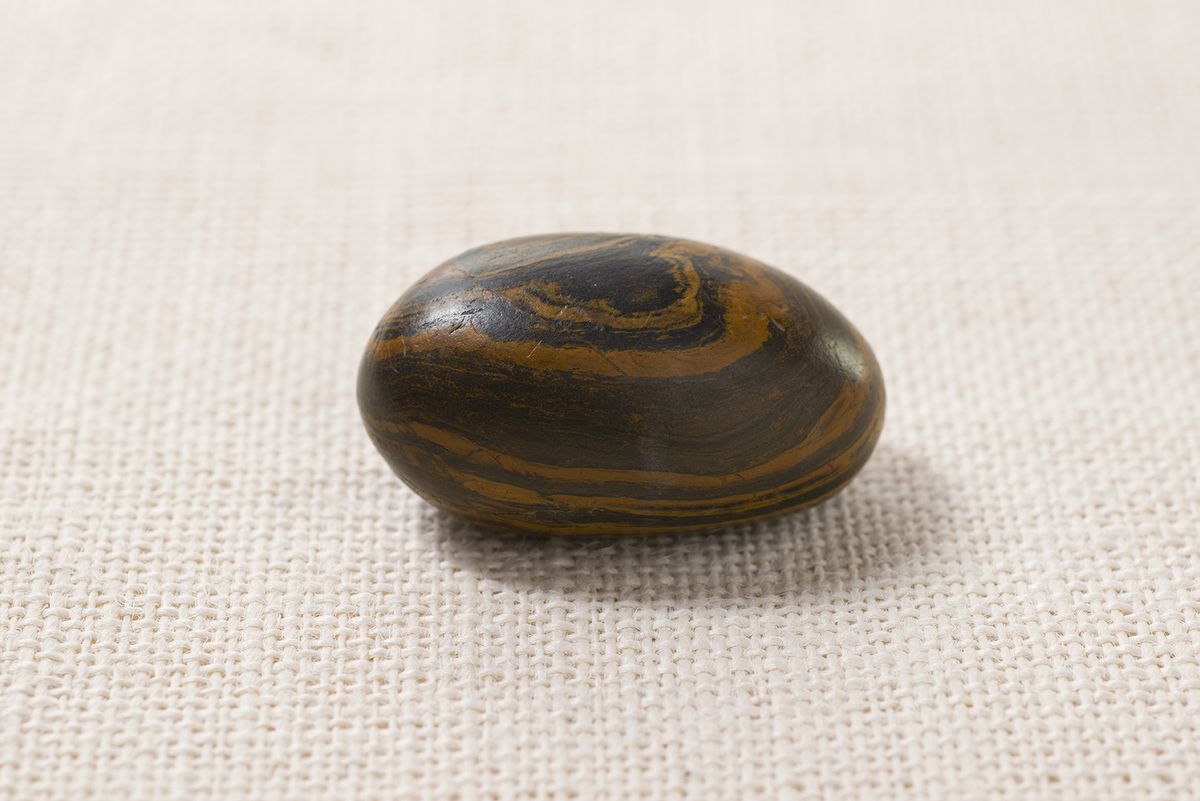
For the seer stone's distinct physical history, the brown-versus-white question, the chain of custody from Joseph through Oliver Cowdery to Brigham Young, and the full evolution of the term "Urim and Thummim" from a specific reference to the Nephite interpreters to an umbrella term covering both instruments, see the companion article on the Urim and Thummim.
The CES Letter's flat vocabulary collapses a four-or-more-instrument story into a one-stone story. The collapse matters because it is what enables the genetic-fallacy framing. If the only instrument is "the magic rock from Joseph's treasure-seeking days," the seer-stone-translation method looks like folk practice carried on unchanged.
The record shows otherwise: (a) Joseph received the Nephite interpreters with the gold plates as a specifically prophetic provision; (b) he used the interpreters for the lost 116 pages; (c) he moved to the brown seer stone, which he had used before, for "convenience" once the lost-pages crisis forced a restart; and (d) the term "Urim and Thummim" was being applied umbrella-fashion to both instruments by 1832–1833.[8:1]
Cowdery's October 1834 Messenger and Advocate letter explicitly equates "the Urim and Thummim, or, as the Nephites would have said, 'Interpreters,'" five years after translation finished.[21:1] Joseph Knight's reminiscence (ca. 1835–1847) speaks of "the urim and thummim" placed in a hat, evidently the seer stone, since the spectacle-form interpreters would not fit one.[26:1] By 1834 this was simply how participants talked.
The plates question: Bushman's most substantive challenge
The most substantive challenge in the seer-stones section is not Runnells's framing but Bushman's question, which Runnells reproduces in the opening epigraph: "What in the world are the plates for?"[17:1] If the seer stone produced the English text by displaying it directly to Joseph's eyes, what was the role of the gold plates during the actual dictation? Bushman returns to this in his 2023 Joseph Smith's Gold Plates: A Cultural History, treating it as a substantive theological problem internal to the Latter-day Saint tradition rather than a generic skeptical objection.[39:2]
McConkie and Ostler used the same question to dismiss the seer-stone-in-hat account as fictitious; without the plates being directly used, they wrote, "we are left to wonder why the plates were necessary in the first place."[41:1] We have already seen why their dismissal of the eyewitness evidence was wrong. But their question was not wrong. It names a legitimate theological tension.
What the plates were for: five answers
Five answers, each partial, together substantial: the plates were used directly early on; they anchored the witnesses; they fulfilled prophecy through Anthon; they were the textual source the stone transmitted; and they tied the revelation to a tangible ancient record.
First, the plates were used directly during the early translation. Truman Coe, a Presbyterian minister who interviewed Joseph and wrote about the translation in 1836, reported that Joseph translated "by putting his finger on one of the characters" and viewing the translation through the interpreters during portions of the work.[43] The lost 116 pages, the Book of Lehi material translated from April to mid-June 1828, appear to have come more directly through plates-and-interpreters work than the later Harmony translation that produced the text we have. Don Bradley's The Lost 116 Pages (2019) reconstructs aspects of this period in detail.[44]
So the claim that "the plates were never used," taken to cover every stage of translation, is too strong even on the witness record itself.
Second, the plates served the witness function the Book of Mormon's narrative requires. The book presents itself as a translation of an ancient record by a divinely-authorized prophet. The Three Witnesses (Oliver Cowdery, David Whitmer, Martin Harris) and the Eight Witnesses (Joseph Smith Sr., Hyrum Smith, Samuel H. Smith, Christian Whitmer, Jacob Whitmer, Peter Whitmer Jr., John Whitmer, Hiram Page) saw and, in the Eight's case, handled the plates. Without the plates as physical objects, those witness statements have no referent. The plates' tangibility underwrote a body of testimony that, by the standards of any other historical event of comparable age, was unusually detailed and stayed consistent across decades.[45]
Third, the plates fulfilled prophecy through Anthon. In February 1828, Martin Harris carried to Charles Anthon, a respected classics professor at Columbia College, a transcript of characters Joseph had copied from the plates. Anthon's later accounts in 1834 and 1841 describe it as "a singular scrawl" containing "Greek, Hebrew, and all sorts of letters, more or less distorted… arranged in perpendicular columns," with "a rude representation of the Mexican zodiac."[46] The visit was the documentary fulfillment of the Isaiah 29:11–12 prophecy that "the words of a book… shall be delivered to one that is learned, saying, Read this, I pray thee: and he saith, I cannot." The plates' physical existence was structurally necessary for the Anthon visit to happen at all, and that visit was Joseph's first concrete claim to be operating in the prophesied pattern.
The Anthon affair carries a complication. Anthon's two later letters (1834 to E. D. Howe; 1841 to T. W. Coit) describe him immediately suspecting fraud and warning Harris. Martin Harris's account runs the other way: Anthon authenticated the characters as "true characters" until he learned of the angel, then retracted in writing.
Both cannot be entirely correct. Historians from Stanley Kimball's 1970 survey of the primary sources to Richard Bennett's 2010 study have noted that the two accounts cannot be fully reconciled, with the open question being how far Anthon's later self-presentation was adjusted to protect his post-1830 academic reputation.[47] Michael Hubbard MacKay's treatment in Producing Ancient Scripture (2020) and the Joseph Smith Papers' handling of the surviving characters document are the most current.[48] Whatever the resolution, the affair establishes the threshold fact this section needs, that there were physical characters on the plates Joseph could see and copy, without having to settle the deeper Harris-versus-Anthon discrepancy.
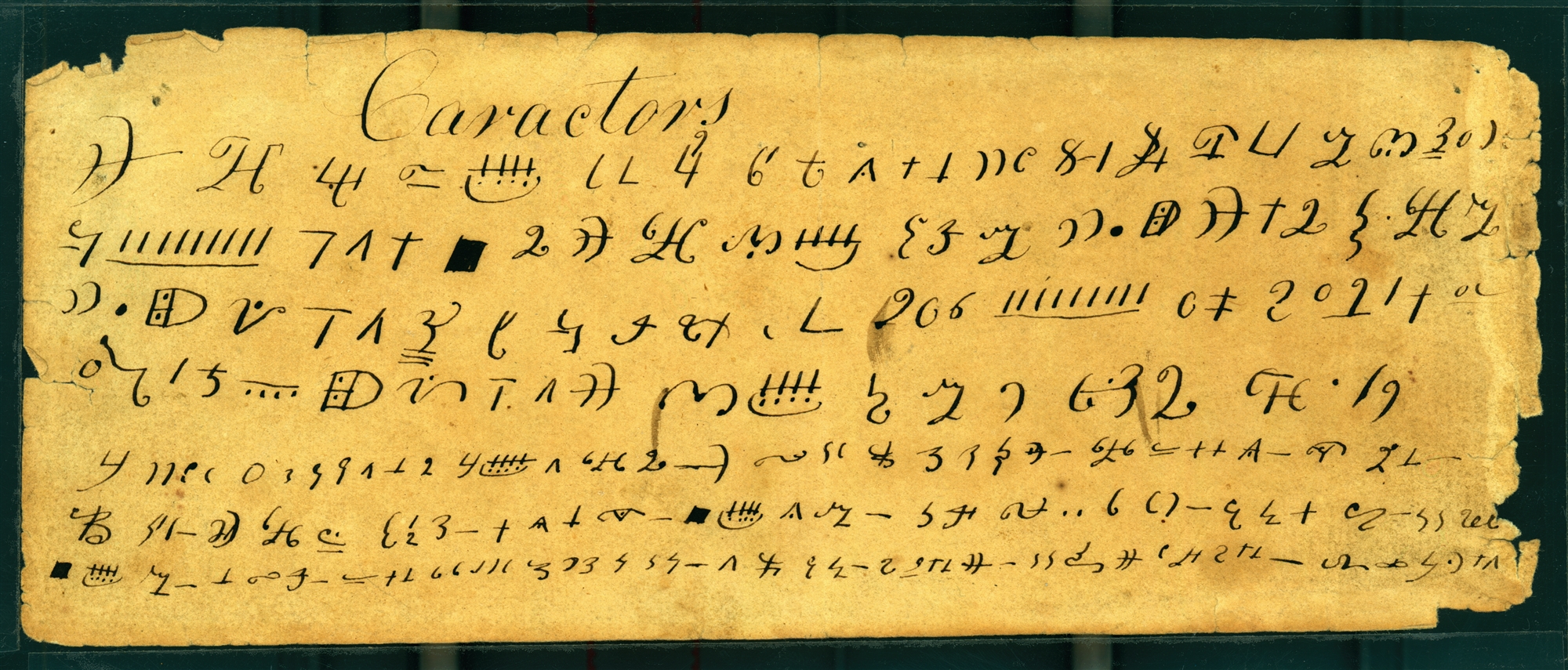
Fourth, the plates are evidence the seer stone was not the source of the text. If the seer stone simply originated the text from Joseph's mind or from a divine impression, the plates would indeed have no functional role in the translation event. But if the plates held an actual ancient record that the seer stone transmitted to Joseph through some divine mechanism, then the plates are not optional. They are the textual source.
The witnesses describe the seer-stone process as words appearing on parchment-like material, remaining until correctly transcribed, then vanishing. That is a description of receiving a text, not generating one. Joseph's reaction when Harris swapped in a different stone, "all is as dark as Egypt," points the same way: the text was not in his head, it was being transmitted through a specific instrument. The plates as the source of what was transmitted is the one model that fits the witness descriptions, the manuscript evidence, and the displayed-text language all together.
Fifth, the plates tied the revelation to a tangible ancient record. MacKay and Dirkmaat's documentary study frames the plates as the anchor of the record's historicity: their physical presence instilled confidence in Joseph and his household, and gave the witnesses something concrete to authenticate.[24:1] Joseph did not need to stare at them during dictation for them to matter: an ancient record being divinely transmitted into English required an actual ancient record to exist. The plates' presence in the household (wrapped in linen on the table, occasionally hidden in barrels of beans during persecution) was the concrete fact that anchored the textual transmission.
Those five purposes are the best available answer, and they are post-hoc explanation rather than a clean direct answer: the mechanics of dictation, taken at face value, do not require the plates to be in the room, and no scholarly treatment to date has fully resolved the tension. Readers will weigh the multiple-purposes response differently.
The strongest critical arguments
The CES Letter's section is pitched to the more rhetorical version of the criticism. The scholarly-critical version, represented by D. Michael Quinn, Dan Vogel, John Dehlin, LDS Discussions, and the academic critical literature, is sharper, more careful, and harder to dismiss; it is the version answered here, not the weaker one.
The continuity problem: same stone, same procedure, different output
We addressed the prior-probability core of this above, in the 1826 hearing section. The non-circular response is the convergence already catalogued there: the dictation rate, the witness corpus, the no-whistleblower record, the manuscript error-types (Skousen), the Early Modern English grammar (Carmack), the Hebraisms (Tvedtnes, Welch), and the vindicated historical claims.
Each item on that list has been contested in the scholarly literature in some form. The lateness problem affects parts of the witness corpus. The Hebraisms argument has been challenged on Isaiah specifically (David P. Wright's 1998 Dialogue article).[49] Carmack's Early Modern English findings are accepted by Skousen but treated more cautiously in Grant Hardy's survey of Skousen's three proposed translation models. Nahom is strong, though the best naturalistic counter is that south-Arabian tribal-name patterns may have been more accessible to 1820s research than the apologetic literature first assumed. No single convergence item is uncontested.
What the convergence does is force a coherent naturalistic account. Any one counter-argument may absorb one item; no single naturalistic mechanism has yet absorbed all of them at once. The cumulative weight is not in any single piece of evidence but in the cross-domain pattern. A skeptic can re-read each piece as compatible with a sufficiently sophisticated fraud-or-genius hypothesis: Joseph had six years to prepare from Moroni's first visit, he was steeped in Bible culture, he had a photographic memory, he was an unrecognized literary genius working in an oral-dictation idiom all his own.
The seer-stone-translation period produced an output the seer-stone-treasure-seeking period never did. That changed output is what shifts the prior. It does not erase the question; it drives the question into far more specific territory than any naturalistic account has managed to occupy.
The bifurcation problem: chapel art versus the published record
We addressed this above in the publication-record section. The Church-published Ensign described the seer-stone-in-hat method continuously from 1977 through 2015. But chapel art, Sunday School manuals, missionary discussions, and visitors' centers under-emphasized it for decades. That gap was real, and the CES Letter is right about the grievance it produced. This article concedes the legitimate version of the bifurcation thesis. It does not concede the conspiracy the CES Letter wants stacked on top.
Joseph and Oliver's silence: the strongest internal-evidence puzzle
The detailed seer-stone-in-hat descriptions come from Whitmer, Emma, Harris, Knight, Elizabeth Cowdery, and Morse, not from Joseph Smith's own surviving writings or from Oliver Cowdery's most public statements. Joseph's 1838 history (the canonical Joseph Smith—History) treats the translation as proceeding "through the medium of the Urim and Thummim" without distinguishing the Nephite interpreters from the seer stone. Oliver's 1834 Messenger and Advocate letter equates "Urim and Thummim" with "Interpreters" but does not separately describe the seer stone or the in-hat technique. If the seer-stone-in-hat method was a normal part of Joseph and Oliver's daily practice from April through June 1829, why does it appear in neither of their most public statements?
The best-supported answer is the umbrella-term reading: Joseph and Oliver used "Urim and Thummim" as a covering term for both instruments because they assumed readers already knew the practice. Cowdery's 1834 letter is the documentary evidence ("the Urim and Thummim, or, as the Nephites would have said, 'Interpreters'"), and Knight's reminiscence (ca. 1835–1847) uses "urim and thummim" for what is unmistakably the seer stone, since the spectacle-form interpreters would not fit a hat. The reading is the early record's own usage, not a later gloss.[50]
The residual puzzle is why the two did not describe the in-hat method more directly in public, and the umbrella-term reading is the best available bridge across it without fully dissolving it. The silence does not support the inference that the method never happened. The eyewitness corpus is multiply attested, includes a non-believer (Morse) and a witness hostile to Brigham Young (Whitmer), and contains an early account, Cowdery's December 1830 letter mentioning the hat, that predates the supposed late-witness reconstruction.
The eyewitness lateness problem
The most-detailed accounts (Emma 1879, Whitmer 1885–1888, Harris 1880s) come from fifty-plus years after the events. The cognitive science of memory tells us that the more time elapses, the more reconstruction creeps in. The lateness problem is a serious methodological concern, and a sharp skeptic can press harder: with sixty years and twelve-plus witnesses, you could in principle assemble any narrative you liked through selective quotation.[51]
Neither of the two responses is decisive alone; together they carry weight. First, the earliest attestations, Cowdery's December 1830 statement and Knight's ca. 1835–1847 reminiscence, already describe the in-hat method, consistent with the later accounts. Reconstructive memory typically adds detail over time; if the early accounts already carry the method, the late ones are corroborating rather than constructing. Second, the witnesses are not isolated but mutually corroborating. Twelve-plus independent witnesses across sixty years agreeing on the core mechanics is structurally different from one or two late accounts treated as definitive. The corpus has the kind of multi-attestation that historians of any other 19th-century event would call strong evidence.
The tight-control / loose-control dilemma
The seer-stone-in-hat method, taken at face value, implies tight control: words appear on parchment-like material, Joseph reads them, the words stay until correctly transcribed. But the Book of Mormon text contains long blocks of Isaiah and other biblical passages matching the 1769 King James Version (KJV), the 1611 English Bible in the edition Joseph used, italicized words that the KJV translators added for readability included. And it contains 19th-century grammar in Joseph's New England dialect alongside Stanford Carmack's documented Early Modern English forms.
Tight control predicts a clean, error-free, dialect-neutral translation. Loose control, in which Joseph supplies his own language for revealed concepts, predicts errors and dialect features. The actual text has both. So either the seer-stone process did not work exactly as the witnesses describe, or the tight-control-with-KJV-overlay model is correct (and owes a theological account of why God would dictate the 1769 translators' interpolations), or the translation ran on a mix of mechanisms no single model captures.[52] The dilemma is a real puzzle inside the framework of divine translation. It is not evidence against divine translation. A loose-control-with-KJV-overlay model is theologically compatible with prophetic translation; the open question is which model best fits the witness descriptions and the manuscript evidence together, and the scholarly literature leaves it open.
The Lucas-Neville revisionist denial: what it does and does not show
In 2023, James W. Lucas and Jonathan E. Neville published By Means of the Urim & Thummim: Restoring Translation to the Restoration, a faithful-but-revisionist book arguing that the seer-stone-in-hat reports were a "fake demonstration" or a misread historical record.[53] L. Hannah Stoddard and James F. Stoddard III had taken a similar line earlier in Seer Stone v. Urim and Thummim: Book of Mormon Translation on Trial (2019).[54] Brant Gardner's "Trust Us, We're Lawyers" (Interpreter 63, 2025: 135–168) is the major scholarly rebuttal: "By restricting the meaning of Urim and Thummim to the definition that facilitates the conclusion they want their readers to reach, they create a much more critical obfuscation than the one they accuse the historians of committing."[55]
Lucas-Neville and Stoddard-Stoddard are not the Church, and their denial says nothing on its own about whether the Church concealed the method in correlated curriculum.[56] The books themselves are telling in the other direction: the historical record is robust enough that even faithful Latter-day Saints who find the method theologically uncomfortable can dispute it only by rejecting the entire eyewitness corpus. The position defended here, with the Gospel Topics Essay, MacKay-Frederick, Bushman, and Spencer, affirms the method.
The hat as evidence: what the documented method makes hard to explain
Each detail the CES Letter mocks (the seer stone in the hat, the open-room dictation, the absence of notes or drafts, the twelve-plus eyewitnesses, the missing whistleblowers) is precisely what makes naturalistic theories of the book's origin hard to maintain. Taken together, those details form the record's strongest argument that the book is what it claims to be.
Face-in-hat eliminates the plagiarism theories
The documented method forecloses every 19th-century-source theory ever proposed for the Book of Mormon. Face-in-hat is a low-tech mechanical constraint. It is also the constraint that makes the plagiarism theories untenable.
| Theory | Requires | Why face-in-hat eliminates it |
|---|---|---|
| Solomon Spaulding manuscript theft | Joseph reading from a hidden manuscript during dictation | Face in hat; multiple eyewitnesses with hours of observation; no concealment possible |
| View of the Hebrews (Ethan Smith, 1825) plagiarism | Joseph consulting Smith's book during dictation | Face in hat; no source-text in the room; Emma's 1879 testimony explicit |
| The Late War / First Book of Napoleon (KJV-pseudobiblical sources) | Joseph's eye on a printed text during dictation | Face in hat; no source-text in the room |
| Sidney Rigdon collaboration | Rigdon supplying drafts during translation | Rigdon did not meet Joseph until December 1830, after the Book of Mormon was published |
| KJV cribbing | Joseph reading directly from a KJV during dictation | Oliver Cowdery purchased a Bible from E. B. Grandin in October 1829, after translation was complete[57] |
| Memorized prefab text | Joseph having pre-written and memorized 269,510 words | Mosiah-first sequence; forward references; no drafts; no source materials in the room |
Roger Nicholson's formulation captures the cumulative force: every plagiarism theory finally collapses into "Joseph the plagiarist who has a photographic memory."[58] The witnesses closest to the process (Emma, Oliver Cowdery, Martin Harris, the Whitmer family) consistently reported that no reference materials were used, a point reinforced by the absence of any such detail across more than 200 historical documents about the translation.[59] The Bible Joseph would later study closely enough to attempt his own translation of it, he did not even own during the Book of Mormon dictation. Emma was unequivocal: "He had neither manuscript nor book to read from. If he had had anything of the kind he could not have concealed it from me."[9:6]
Translation speed makes original composition implausible
The hard numbers from John W. Welch's day-by-day chronology (Opening the Heavens, 2nd ed. 2017):[7:1]
- Total words: 269,510 (1830 first edition)
- Translation period: April 7 – June 30, 1829 (85 calendar days)
- Working days actually available: approximately 60 working days, after subtracting interruptions, persecution, moves, and restarting from the lost 116 pages
- Daily output: approximately 4,500 words per working day
- Dictation rate: 10–20 words per minute (Welch and his wife conducted experimental replication and found 20 wpm "quite possible")[7:2]
Welch and other researchers have called the speed "blistering" by any standard; Terryl Givens calls it "truly prodigious."[60] Richard Turley, in a passage Welch quotes, calls the pace "stunning: about eight pages a day — remarkable even for skilled translators."[7:3] The familiar comparisons (the KJV: 47 scholars, 7 years; Tolkien: 12 years; Hugo: 17 years for Les Misérables) measure aggregate composition time. The yardstick that fits the Book of Mormon is the sustained dictation rate without revision. A working novelist at the rule-of-thumb professional pace of 1,500 words a day would need roughly 180 working days for a comparable-length novel, and would spend them with outlines, drafts, revisions, and full access to their own notes.
"Joseph articulated coherent text 'with no time for research, for collocating scattered scriptural phrases, for keeping track of numerous threads, for developing an array of characters and their stylistic voices, or for composing coherent accounts.'"[7:4]
Margot Hovley, herself a working LDS novelist, reflected on Joseph's pace from a practitioner's perspective in the Liahona in 2024:
"As an author, I have on rare occasion written that many pages in one day, and certain other authors do it routinely, but I could never maintain that pace for more than a couple of days—and only if I had nothing else to do whatsoever."[61]
The point Hovley draws out is the one Welch establishes from the manuscript record, now from inside the craft: even professional authors with full discretionary time cannot hold that pace past a couple of days, let alone for sixty consecutive working days while resuming where he had left off after meals and interruptions.
The witnesses, the no-whistleblower problem, and 60 years of consistency
A 269,510-word fabricated text, dictated openly in front of twelve-plus people across multiple households over sixty-plus working days by a 23-year-old farmer with limited formal education, would have produced somebody who later said: "I was there. I saw the trick." Frauds generate whistleblowers. The larger the fraud and the more witnesses involved, the more reliably they do.
This translation produced none. Across sixty years and four major defections from the Joseph-founded movement:
Emma Smith lived with Joseph for seventeen years and watched the dictation from feet away. She rejected Brigham Young's leadership outright, raised her children in the Reorganized Church (RLDS), and never reconciled with him. Three months before her death in 1879 she told her son that her belief in the Book of Mormon was "of divine authenticity — I have not the slightest doubt of it." With nothing to gain, she never wavered on this one point.[9:7]
Oliver Cowdery was excommunicated in 1838, lived outside the Church for ten years, and returned in 1848. He never recanted his translation testimony during that decade away, and he reaffirmed it publicly on his return, telling the October 21, 1848 Kanesville conference: "I wrote, with my own pen, the entire Book of Mormon (save a few pages) as it fell from the lips of the Prophet Joseph Smith, as he translated it by the gift and power of God…"[22:1]
David Whitmer, fifty years a critic outside the Church, gave more than sixty interviews between 1878 and 1888 and never recanted. His 1887 Address faults Joseph on point after specific point (polygamy, plural revelations, leadership decisions), yet the seer-stone-in-hat method appears in the same critical text unchallenged.[23:2]
Martin Harris left the Church in the 1830s, followed William E. McLellin, James Strang, and the Shakers, then returned to the Utah Church in 1870. Across decades of shifting allegiances he made at least 25 separate statements about the translation. Not one recants the basic process.[24:2]
Michael Morse, the non-believer brother-in-law of Joseph, confirmed the seer-stone-in-hat method in 1879. He never became a Latter-day Saint. He had no reason to prop up Joseph's narrative.[28:1]
Where is the whistleblower a fraud this size should have produced?
That pattern is anomalous in the documentary record of fraudulent religious movements. Sixty years and four major splits produced not one whistleblower. The one qualifier, Joseph and Oliver's silence on the in-hat method in their most public statements, was discussed above. It is a residual puzzle, not a recantation.
Manuscript evidence: what Skousen's tight-control work rules out
Royal Skousen's three-decade Critical Text Project at BYU has produced the most detailed analysis of the Original and Printer's Manuscripts in existence. The findings have settled into a specific shape: the manuscript evidence is consistent with oral dictation of a displayed text, not with composition or copying.[62][63]
What the manuscript evidence rules out:
Cribbing from a written source. The Original Manuscript (O) contains phonetic mishearings consistent with oral dictation; at 1 Nephi 13:29, the scribe wrote "and exceeding great many" where the dictation called for "an exceeding great many." The Printer's Manuscript (P) contains visual misreadings consistent with copying from a text. The two manuscripts carry different error types. A scribe copying from a written source would produce P's visual errors, not O's phonetic ones. O looks like a dictation product, not a copying product.[62:1]
Memorized recitation. Joseph viewed roughly 20–30 English words at a time before pausing for the scribe. A reciter would chunk by sentence or paragraph. The viewing-segment evidence fits a displayed text read aloud, not a recitation from memory.[62:2]
Improvisation of unfamiliar names. When unfamiliar Book of Mormon names first appear, the Original Manuscript shows them frequently crossed out and rewritten. The cleanest test case is "Coriantumr" (Helaman 1:15): no English word ends in "mr," so Joseph must have spelled out the individual letters for the scribe. An improviser inventing names defaults to English-pronounceable forms. A person reading exotic letters off a stone has to spell.[62:3]
Conscious revision after the fact. Skousen's thirty-five-plus years of work concluded that the changes between O and P are scribal copying errors, not authorial revisions. The text came out right the first time. That is not how human authors of long original works behave; even the cleanest professional drafts pass through multiple revisions before final form.[63:1]
Carmack's Early Modern English numbers
Stanford Carmack's culminating 2024 article in BYU Studies Quarterly documents a feature of the Book of Mormon that has, in the years since he began publishing on it, become very hard for naturalistic theories to explain. Strip away 150 years of editorial emendations from the original manuscript and the underlying grammar reflects 1500s–1600s English in patterns matching neither the King James Bible nor 19th-century New England dialect.[64]
- "Save it were" appears 77 times in the Book of Mormon. Documented only 5 times in pre-1829 English texts (all by British authors). First attested mid-17th century.
- Personal "they which" appears 100 times in the Book of Mormon's non-biblical sections. The pattern appears in only one pseudo-archaic text written in 1863 (after the Book of Mormon). (Carmack also documents 23 instances of object "they which" referring to persons, a separate, related Early Modern English category.)
- "Had spake" (leveled past participle): 13 instances in the Book of Mormon (12 as "had spake" plus one passive "had been spake"). Most heavily attested in 1600s English texts.
Carmack's analysis of personal-relative-pronoun usage matches "the second half of the 1500s and first decade of the 1600s, just before and during Shakespeare's time." Heavy finite complementation patterns appear "closest to late fifteenth- and sixteenth-century English usage, and certainly not like eighteenth- and nineteenth-century usage."[64:1] Carmack's conclusion: "The syntax and grammar of the text provide some of the most important evidence pointing to the Book of Mormon being the result of a revelation of words to Joseph Smith."[64:2]
These are non-biblical Early Modern English forms. They cannot have come from KJV cribbing, because they are not in the KJV. They cannot have come from Joseph's own grammar, because Carmack's analysis of Joseph's 1829–1832 personal writings shows he never produced these patterns naturally. The grammar predates him by 200-plus years. No naturalistic mechanism currently on offer explains how a 19th-century farmer produces 100 instances of a personal-relative-pronoun construction that did not exist in his dialect, was not in his Bible, and was so obscure it surfaces in only one other pseudo-archaic English text, written in the 1860s.
Carmack's strong tight-control reading is not universally accepted even among faithful scholars: Brant Gardner argues for a looser model, and Skousen's three proposed models of translation control (loose, tight, and iron-clad) are surveyed agnostically in Grant Hardy's BYU Studies treatment, which finds no model entirely satisfactory.[65][66][67] What is not in dispute is the underlying linguistic data.
Hebraisms and the combined-substrate problem
Carmack's Early Modern English findings tell only half the linguistic story. The Book of Mormon also contains documented Hebraisms, Hebrew syntactic patterns that read as awkward English until you recognize the underlying form. John A. Tvedtnes catalogued these in "The Hebrew Background of the Book of Mormon" (in Rediscovering the Book of Mormon, FARMS, 1991).[68] John W. Welch's discovery of chiasmus in Alma 36 (a 17-element A-B-C…C'-B'-A' inverted parallelism) is the single most-cited example.[69] Among the catalogued Hebraisms:
- Construct-state genitive chains ("plates of brass" rather than "brazen plates"): natural Hebrew word-order, awkward English.
- Cognate accusatives ("dreamed a dream," "feared exceedingly with great fear"): Hebrew grammatical form, awkward English.
- Conditional curse formulae following Deuteronomic patterns.
- If-and constructions (the use of "and" rather than "then" in conditional sentences): characteristic of Hebrew narrative syntax.
- Chiasmus: extended inverted parallelism, especially in Alma 36, Mosiah 5, and 1 Nephi 17.
A 23-year-old farmer in 1829 New York had no plausible mechanism for absorbing Hebrew syntactic patterns. Joseph did not study Hebrew until 1835–1836, in the Kirtland School of the Prophets, six years after the Book of Mormon was published. The Hebraisms were not features he could have known to insert. They sit in the text as features of a Hebrew-substrate translation, not an English original.
The Hebraisms argument has been challenged in part. David P. Wright's 1998 Dialogue article argued that Joseph's renderings of Isaiah reflect KJV dependence and are best explained as 19th-century interpolation rather than ancient-Hebrew substrate.[49:1] Faithful responses (Tvedtnes, Skousen) have engaged Wright's specific Isaiah claims directly. The broader catalogue (construct-state chains, cognate accusatives, if-and conditionals) survives the Isaiah-specific challenge, because it rests on non-Isaiah passages.
The combined-substrate problem makes naturalistic theories especially difficult. The English text carries both a Hebrew syntactic substrate (what you would get translating Hebrew into English) and an Early Modern English grammatical layer (vocabulary and syntax of the 1500s–1600s, predating Joseph by 200-plus years). Those two features come from entirely different linguistic sources, separated by centuries and cultures. A 19th-century author cribbing from any single source cannot produce both. A genuine ancient text rendered through inspired language, one that passes through an ancient Hebrew underlay and draws on a now-archaic English register, produces exactly this profile. No single scholar carries the combined anomaly; it emerges when the Tvedtnes/Welch Hebraisms work and the Skousen/Carmack Early Modern English work are read side by side.
Specific historical predictions later vindicated
The seer-stone process produced a text that makes specific historical claims about the ancient world. Some were ridiculed in 1830 as obvious anachronisms. In case after case, the 195 years of archaeological and linguistic discovery since have vindicated claims the 1830 critics believed could not be true. Other articles on this site treat the Book of Mormon's historical evidence in depth; what matters here is the cumulative pattern in what the seer-stone process produced.
Nahom (1 Nephi 16:34). Lehi's group buried Ishmael at "the place which was called Nahom." In 1988, German archaeologists excavating the Bar'an Temple at Marib, Yemen (ancient Sheba), unearthed three votive altars bearing the tribal name NHM, a name attested across the south Arabian kingdoms, dated to roughly 800–700 BC, with the tribal reference reaching back as far as 850 BC. The tribe was in place centuries before Lehi's family passed through; the location sits on the historically attested Frankincense Trail; and the geography matches 1 Nephi's description of a place where the trail "turns nearly eastward." S. Kent Brown of BYU published the first scholarly identification linking these altars to Nephi's Nahom in 1999.[70]
Joseph could not have known of NHM in 1829. The German excavations were more than 150 years away, and English-language scholarship on south Arabian tribal names was thin and out of reach for a New York farmer.
Bountiful's plausible site at Khor Kharfot, Wadi Sayq, Oman. 1 Nephi 17 describes a fertile, tree-rich, fruit-bearing coastal location east of Nahom where Nephi built a ship. Khor Kharfot in Oman, identified to match the description in the late 20th century by Warren and Michaela Aston, fits all the textual criteria: fertile, tree-bearing, accessible from inland on the Frankincense Trail, with deep-water harbor potential. The location was unknown in Anglophone scholarship in 1829.[71]
Dead Sea Scrolls Isaiah variants. The Book of Mormon's quotations of Isaiah (1 Nephi 20–21, 2 Nephi 7–8 and 12–24, Mosiah 14, 3 Nephi 22) contain variants from the King James Version that match the Great Isaiah Scroll (1QIsa^a) discovered at Qumran in 1947, variants that did not exist in the 1611 KJV that was the available reference text in 1829. The Book of Mormon was reading from a textual tradition that would not be physically discovered for another 118 years.[72] The companion article on KJV errors in the Book of Mormon treats the Isaiah-variant case in full detail.
Mesoamerican governance, fortifications, and agricultural cycles. Court structures (the judges-and-chief-judges system in Mosiah-Alma, paralleling Maya halach uinic governance), treason laws, agricultural cycles, and fortification practices (Captain Moroni's ditch-and-earthen-bank defenses topped with timber works match the pre-AD-300 earthworks excavated at Becan). None of this appeared in English-accessible scholarship in 1829.[73] The anachronisms article treats the broader pattern of 1830-era ridicule that later archaeology has reversed.
Reformed Egyptian. The Book of Mormon's claim of "reformed Egyptian," Egyptian script used to write a Semitic language, drew wide mockery in 1830. The consensus then held that an alphabet was either Egyptian or Hebrew, never both, never modified for cross-cultural use. Twentieth-century scholarship turned up multiple examples of Egyptian script used to write Semitic languages: Papyrus Amherst 63, a scroll of Israelite, Syrian, and Babylonian texts in Aramaic written in demotic Egyptian script, plus hieratic Egyptian inscriptions and ostraca from ancient Israel itself. The Egyptian-script-Semitic-language hybrid the book claims is now an attested category, not a 19th-century absurdity.[74]
These vindications are not seer-stone arguments as such. But they ground the broader claim: the Book of Mormon makes specific historical claims that have aged remarkably well across 195-plus years of subsequent discovery. The seer-stone process produced a text whose substance has, again and again, proved more historically grounded than the 1829 critics believed possible.
The Mosiah-first sequence and the forward-reference problem
Joseph translated Mosiah → Moroni first, then went back and translated 1 Nephi → Words of Mormon (the Small Plates) last. So the later books, Alma and Helaman and 3 Nephi, were dictated before the books they reference.[75]
A few examples of forward references, citations in the dictated-first material to passages Joseph had not yet dictated:
| Later passage (dictated first) | Earlier passage (dictated second) | What is referenced |
|---|---|---|
| Alma 36:22 | 1 Nephi 1:8 | Lehi's vision: God "sitting upon his throne, surrounded with numberless concourses of angels, in the attitude of singing and praising their God," quoted nearly verbatim in Alma 36:22 from a passage Joseph had not yet dictated |
| Alma 50:23 | 2 Nephi 5:27 | "living after the manner of happiness" |
| Alma 32:42 | 1 Nephi 8:11 | Tree-of-Life imagery: fruit "sweet above all that is sweet, and white above all that is white" |
| Helaman 14:2–6 | 2 Nephi 26:3 | Signs of Christ's birth |
Alan Goff's observation captures the structural difficulty: "It seems overly complicated to posit that a whole web of allusions to these tree of life images is created first and then later the coherent story that ties them all together."[76] Joseph was producing approximately 4,500 words a day while creating these intricate backward references to texts he would not dictate for weeks.
How does a dictating author quote, nearly word for word, a passage he has not yet composed?
A novelist can do forward references, but only with outlines, drafts, and revisions. Dickens famously planned his serialized novels with elaborate outlines. Tolkien rewrote The Lord of the Rings repeatedly to align cross-references between volumes. Joseph dictated the Book of Mormon with no outlines, no drafts, no revisions, and no way to consult what he had already dictated, and the forward references still come out theologically coherent and narratively tight. Original composition under the documented constraints cannot easily do this, and the references stand in the text regardless of one's view of its origin.
The biblical Urim and Thummim: ancient parallels Joseph could not have known
The eyewitness descriptions of the seer-stone process are not generic "magic" descriptions. Their specific features match the biblical Urim and Thummim tradition, and not the 18th-century Christian-commentary version Joseph could have reached, but the Jewish rabbinical tradition that was effectively closed to him.
Cornelis Van Dam's The Urim and Thummim: A Means of Revelation in Ancient Israel (Eisenbrauns, 1997), the first exhaustive scholarly study of the biblical Urim and Thummim since 1824, argues against the older "lot theory" (a binary yes/no oracle) and in favor of prophetic, light-based revelation through the breastplate stones. Some scriptural answers (1 Samuel 23:9–13, 2 Samuel 5:23–25) involve verbal revelation more complex than yes or no. The Hebrew "Urim" comes from 'or (light), "Thummim" from tom (perfection); both point to light-and-perfection revelation.[77]
Van Dam's reading is a minority position; the majority view still treats the biblical Urim and Thummim as some form of lot-casting device. His case is well-argued and carries a premier academic press, but it is not presented here as settled scholarship. See the Urim and Thummim sister article for the fuller treatment.
The rabbinical tradition is more striking. Targum Pseudo-Jonathan on Exodus 28:30: "you shall put into the breastplate the Urim, which illuminate their words and make manifest the hidden things."[78] Ramban (Nachmanides, 13th century): "Certain letters of the breastpiece lit up, and that lighted letters would then need to be arranged correctly by the high priest."[79] The Zohar (medieval Kabbalistic text) describes letters on the breastplate stones flickering with divine light to spell out God's answer.[80]
Compare David Whitmer's 1887 description of Joseph's seer-stone process: "in the darkness the spiritual light would shine. A piece of something resembling parchment would appear, and on that appeared the writing… in bright luminous letters."[23:3] Knight's reminiscence reads: "He would take a sentance and it would apper in Brite Roman Letters."[26:2]
Ancient Jewish traditions describe Urim-and-Thummim stones producing letters that illuminate or light up. Latter-day Saint witnesses describe seer-stone translation producing bright luminous letters or Brite Roman Letters. None of the relevant Jewish sources was within Joseph's reach in 1829: the standard English Targum Pseudo-Jonathan appeared in 1862, the English Zohar in 1934, Ramban's commentary in English only in 1971. The Christian-commentary view of the Urim and Thummim that he might plausibly have met was the lot-casting view, binary yes/no, which is not what the witnesses describe.[81]
So the pattern Joseph's witnesses describe, luminous letters lighting up on a stone that the prophet-figure reads, matches the non-Christian Jewish rabbinical tradition he had no plausible 1829 access to. The match could be coincidence. It could also be that Joseph was describing what he saw, and the ancient Israelite tradition was describing the same revelatory mechanism.
Cross-cultural parallels: the Mesoamerican zaztuno'ob and the divine bestowal of stones
The Maya aj-meen, ritual specialists in Mesoamerican folk religion, use zaztuno'ob, "clear stones" or "stones of light," for divinatory scrying. The practice is documented from at least the Early Classic period (250–600 CE) and persists in modern Maya communities. Maya shamans believe true zaztuno'ob are "gifts from the gods that have been intentionally placed along their paths for them to find."[82]
The Book of Mormon's own Ether 3 narrative parallels the pattern. The brother of Jared was given his stones (Ether 3:1, 23–24) directly by the Lord:
"Behold, these two stones will I give unto thee, and ye shall seal them up also with the things which ye shall write. For behold, the language which ye shall write I have confounded; wherefore I will cause in my own due time that these stones shall magnify to the eyes of men these things which ye shall write." (Ether 3:23–24)
Mark Alan Wright's "Nephite Daykeepers" (Interpreter 38, 2020: 291–306; first published as a book chapter in 2014) connects Nephite "seers" (Mosiah 8:13–18, Alma 37) to Mesoamerican daykeepers, ritual specialists who calibrate the calendar, intercede for the community, and use sacred objects (stones included) for revelatory purposes.[83] Mike Ash's 2025 FAIR conference presentation argues the Nephite interpreters parallel Mesoamerican ritual reflective-divination stones mounted in breastplates with light/dark symbolism.[84]
The cross-cultural record places the Joseph-Smith seer-stone practice inside a stable pattern: revelatory use of clear stones across several ancient cultures, Israelite (Urim and Thummim), Maya (zaztuno'ob), other Mesoamerican (the breastplate-mounted shiners Ash describes). Joseph had no English-language access to most of this material in 1829. An authentic ancient text would predict exactly this cross-cultural reach.
The hat: Don Bradley's Mosiah I parallel and the soft-felt hat description
The CES Letter mocks the hat as 19th-century occult absurdity. Don Bradley's The Lost 116 Pages: Reconstructing the Book of Mormon's Missing Stories (Greg Kofford, 2019) makes a striking observation. In Bradley's reconstruction of the lost Book of Lehi material, Mosiah I (the grandfather of Mosiah son of Benjamin) is portrayed using the Nephite interpreters under an animal skin or shroud while translating the Jaredite plates.[44:1]
Joseph's hat appears in the primary sources as an old soft felt hat; Martin Harris's 1859 description is "old" and "white." Stan Spencer's 2025 Interpreter article reviews the iconography and argues the actual hat was most likely a soft gray or off-white wool felt hat, the kind every farmer in 1820s western New York wore, flexible enough to bend around the face. Spencer treats the popular "stovepipe top hat" iconography as a satirical-period invention from anti-Mormon cartoons. He treats the more recent "beaver-skin" speculation as plausible only if the hat were a top-hat style (which the earliest accounts do not support), and he ultimately favors the soft-wool-felt reconstruction over either alternative.[85]
The hat's purpose was to interrupt normal vision and admit spiritual vision, and the choice of headwear (Joseph's own hat, presumably the nearest one to hand) is unremarkable for a man working on his father-in-law's farm. The hat is no ritual object, just a piece of available equipment put to the prosaic task of darkening the visual field.
Either way, the occult-absurdity framing collapses: the device was a piece of clothing, and the conceptual category (covering the translator to admit only spiritual vision) is documented in the Book of Mormon's own narrative tradition.
The Book of Abraham parallel: the seer stone is the standard pattern, not a one-off
Stephen O. Smoot's "Did Joseph Smith Use a Seer Stone in the Translation of the Book of Abraham?" (Religious Educator 23/2, 2022: 64–107) makes the cumulative case that Joseph also used a seer stone for parts of the Book of Abraham translation:
"I will argue that we should take seriously the real possibility that Joseph Smith used a seer stone in the translation of the Book of Abraham."[86]
If the same instrument served for additional canonical scripture, then the seer stone is the standard divine revelatory pattern Joseph worked within, not a one-off hack to be apologetically explained away. That drains still more force from the "Ouija Board" framing. The seer stone was Joseph's default revelatory instrument from 1828 through at least the 1830s, and its use across multiple translation projects marks it as part of his prophetic toolkit rather than an embarrassing artifact of an early stage he later outgrew.
Further Reading
- Royal Skousen, "How Joseph Smith Translated the Book of Mormon: Evidence from the Original Manuscript," Journal of Book of Mormon Studies 7, no. 1 (1998): 22–31
- Stanford Carmack, "Book of Mormon Grammar and Translation," BYU Studies Quarterly 63, no. 3 (2024)
- John W. Welch, "Timing the Translation of the Book of Mormon," in Opening the Heavens, 2nd ed. (BYU Studies, 2017)
- Stan Spencer, "Seeing with a Hat: How Joseph Smith Used a Hat in Translating the Book of Mormon," Interpreter 64 (2025): 451–532
- Don Bradley, The Lost 116 Pages: Reconstructing the Book of Mormon's Missing Stories (Greg Kofford, 2019)
Assessment
The seer-stone history is strange. The folk-magic context is uncomfortable. The 1826 trial is awkward. The artwork problem is real. The McConkie–Ostler episode was an institutional failure. The plates question is a substantive theological tension no scholarly treatment has fully resolved. The Joseph-Oliver silence on the in-hat method is a residual puzzle the umbrella-term reading addresses without dissolving.
But the CES Letter's pp. 28–31 do not describe the historical record accurately. The four-page emotional arc (Bushman epigraph, institutional roll-call, "Ouija Board," visual collage, McConkie/Ostler trump card) does the rhetorical work the record cannot. The Ensign archive itself refutes the "hidden until 2013" framing: Anderson 1977, Nelson 1993, Maxwell 1997, Turley/Jensen/Ashurst-McGee 2015, and Saints Volume 1 (2018) form a continuous run.
The "magic device or Ouija Board" framing leans on a magic/religion distinction the relevant literature treats with skepticism, skips the biblical pattern of God working through culturally-familiar instruments, and treats Joseph's village-seer inheritance as uniquely discrediting when nothing in scripture suggests revelation must bypass cultural materials. And the "BYU professors rejected it" trump card depends on the reader not knowing that an Apostle had taught the seer-stone-in-hat method openly seven years before McConkie and Ostler published their dismissal.
The true parts of the indictment are granted here without being inflated into a conspiracy: chapel art that misled members for decades, correlated curriculum that under-emphasized the method, the McConkie/Ostler episode as evidence of a failure of alignment between apostolic teaching and religion-department culture. The bifurcation thesis is the strongest version of the criticism, and it has been granted above in full: the gap existed, the art misled, the Church closed it. The concession costs the truth claims nothing. The conspiracy reading was never the supported one.
The documented method, the very details the CES Letter mocks, is itself the strongest evidence the record offers for the Book of Mormon's authenticity. Face-in-hat eliminates the standard plagiarism theories. The 4,500-words-a-day dictation rate, with no drafts and no notes, makes original composition implausible against any working novelist's pace; Margot Hovley wrote that even an experienced author "could never maintain that pace for more than a couple of days." Twelve-plus eyewitnesses across sixty years and four major defections produced zero whistleblowers.
Skousen's manuscript evidence fits oral dictation of a displayed text and not composition or copying. Carmack's Early Modern English findings document 100 instances of personal "they which" and 77 of "save it were," in grammatical patterns absent from Joseph's dialect, absent from his Bible, and so obscure they surface in only one other pseudo-archaic English text in the 1860s. The Mosiah-first sequence builds forward references (Alma 36:22 quoting 1 Nephi 1:8 nearly verbatim) that would require outlines, drafts, and revisions to produce naturally, none of which the witnesses report.
The bright-luminous-letters language of the witness accounts matches Targum Pseudo-Jonathan and a rabbinical tradition Joseph had no English access to in 1829. The Maya zaztuno'ob and Israelite Urim-and-Thummim parallels set the practice inside a stable cross-cultural pattern of clear-stone revelation he could have known almost nothing about.
This convergence does not, by itself, compel belief. A skeptic can grant that the production conditions were unusual and still read the unusualness as the signature of skilled fraud or some unrecognized natural phenomenon rather than divine origin. The convergence leaves the skeptic owing a mechanism, a specific and detailed account that produces every feature simultaneously. None has yet been named without falling back on a placeholder: Joseph the natural-genius plagiarist with a photographic memory, somehow absorbing materials he had no access to. Until one is, convergence rules out the standard naturalistic alternatives.
The convergence is strong evidence, not proof.
The documented method, then, reframes the inferential question. Naturalistic theories have to explain not just the existence of a 269,510-word text but the conditions the witnesses describe: a face in a hat, no notes, no drafts, twelve-plus people in an open room, sixty years of consistent testimony, not one whistleblower. They have not done it. That is not the same as proof, and it does not dissolve the hard questions: Bushman's plates question, the 1826 continuity question, the Joseph-Oliver silence. The evidence is strong; it is not everything.
The CES Letter's whole strategy runs on respectability: a rock in a hat is undignified, treasure-digging is disreputable, a "magic device" is beneath a real prophet. But the respectability test backfires. A con man with a 269,510-word manuscript hides the manuscript. He does not pick the one method that leaves his hands empty and his face in a hat for hours, with his wife, his scribes, his neighbors, and a brother-in-law who believed none of it sitting in the room. The less respectable the method, the less it looks like a literary scheme and the more it looks like exactly what the witnesses said it was. The method the CES Letter offers as the scandal is the very thing that makes a hidden source impossible. The more "unrespectable" the procedure, the more miraculous the result becomes, not less.
Emma said as much at the table a century and a half ago: asked whether her husband could have concealed a book or papers, she answered that he could not have hidden them from her if he had tried. That is what the hat is: not the embarrassment the CES Letter needs it to be, but the best evidence the record has to give.
Runnells, CES Letter (2017), "Book of Mormon Translation," p. 29. ↩︎
Runnells, CES Letter (2017), "Book of Mormon Translation," p. 29. The complete sentence: "In other words, Joseph used the same magic device or 'Ouija Board' that he used during his treasure hunting days." ↩︎
Runnells, CES Letter (2017), "Book of Mormon Translation," p. 29. ↩︎
Runnells, CES Letter (2017), "Book of Mormon Translation," p. 31. ↩︎ ↩︎
Michael Hubbard MacKay and Nicholas J. Frederick, Joseph Smith's Seer Stones (Provo: BYU Religious Studies Center; Salt Lake City: Deseret Book, 2016). https://rsc.byu.edu/book/joseph-smiths-seer-stones. The book treats the chocolate-brown stone (obtained ca. 1822 in Willard Chase's well-digging expedition) and the white stone (obtained earlier, perhaps 1820–21) as the two with strongest provenance, and traces the chain of custody for the brown stone from Joseph Smith → Oliver Cowdery → Phineas Young → Brigham Young → Church History Library. ↩︎ ↩︎ ↩︎ ↩︎
Joseph Smith Papers, "Introduction to State of New York v. JS-A." https://www.josephsmithpapers.org/paper-summary/introduction-to-state-of-new-york-v-js-a/1. Direct quote on the statute language: "The use of the word 'pretending' reflected Enlightenment-era legal assumptions that the use of seer stones was categorically deceptive and fraudulent, regardless of whether the accused sincerely believed that they had access to uncommon powers." See also Church History Topics, "Joseph Smith's 1826 Trial," https://www.churchofjesuschrist.org/study/history/topics/joseph-smiths-1826-trial?lang=eng ↩︎ ↩︎ ↩︎ ↩︎
John W. Welch, "Timing the Translation of the Book of Mormon: 'Days [and Hours] Never to Be Forgotten,'" in Opening the Heavens: Accounts of Divine Manifestations, 2nd ed. (Provo: BYU Studies, 2017), pp. 79–125; also published in BYU Studies Quarterly 57, no. 4 (2018). https://byustudies.byu.edu/article/timing-the-translation-of-the-book-of-mormon-days-and-hours-never-to-be-forgotten. Establishes 269,510 words in approximately 60 working days within an 85-calendar-day translation period (April 7 – June 30, 1829), with daily output of approximately 4,500 words and dictation rate of 10–20 words per minute. Welch and his wife Jeannie conducted experimental replication finding 20 wpm "quite possible." Direct Welch quote: Joseph articulated coherent text "with no time for research, for collocating scattered scriptural phrases, for keeping track of numerous threads, for developing an array of characters and their stylistic voices, or for composing coherent accounts." Welch describes the pace using terms including "stunning," "rapid-fire," and "phenomenal," and quotes Richard Turley's characterization: "stunning: about eight pages a day — remarkable even for skilled translators." The word "blistering" appears in the Scripture Central Evidence "Rapid Translation" summary characterization of Welch's broader work (see [60:1]). ↩︎ ↩︎ ↩︎ ↩︎ ↩︎
Gospel Topics Essay, "Book of Mormon Translation," churchofjesuschrist.org. Direct quote: "These two instruments — the interpreters and the seer stone — were apparently interchangeable and worked in much the same way, such that, in the course of time, Joseph Smith and his associates often used the term 'Urim and Thummim' to refer to the single stone as well as the interpreters." https://www.churchofjesuschrist.org/study/manual/gospel-topics-essays/book-of-mormon-translation?lang=eng ↩︎ ↩︎
Emma Smith Bidamon, interview by Joseph Smith III, February 1879. Published as "Last Testimony of Sister Emma," The Saints' Herald 26, no. 19 (October 1, 1879): 289–290. Reprinted in Dan Vogel, ed., Early Mormon Documents, 5 vols. (Salt Lake City: Signature Books, 1996–2003), 1:539–543. ↩︎ ↩︎ ↩︎ ↩︎ ↩︎ ↩︎ ↩︎ ↩︎
Emma Smith, interviewed by Edmund C. Briggs at Nauvoo in 1856; recounted in Edmund C. Briggs, "A Visit to Nauvoo in 1856," Journal of History 9, no. 4 (October 1916): 454; reprinted in John W. Welch and Erick B. Carlson, eds., Opening the Heavens: Accounts of Divine Manifestations, 1820–1844 (Provo, UT: BYU Press; Salt Lake City: Deseret Book, 2005), 129. Briggs records Emma recalling that Joseph "stopped suddenly, pale as a sheet," asked "Emma, did Jerusalem have walls around it?" and, told yes, replied, "Oh! I was afraid I had been deceived." Briggs published the recollection sixty years after the conversation. ↩︎ ↩︎
Runnells, CES Letter (2017), "Book of Mormon Translation," pp. 28–31. The seer-stones unit runs four pages and includes a long Bushman epigraph (p. 28), the institutional roll-call and "Ouija Board" framing (p. 29), the side-by-side artwork collage (pp. 29–30), the personal-grievance "gaslighted by revisionist Mormon apologists" passage (p. 30), and the McConkie/Ostler closing block-quotes (pp. 30–31). ↩︎
The four-beat emotional sequence — Bushman epigraph priming betrayal, institutional roll-call followed by reduction to "rock in a hat," visual collage of "Church version vs. real version," and the BYU-professors trump card — accomplishes the section's argumentative work before any historical evidence is engaged. This rhetorical structure is itself the section's most effective single feature. ↩︎
The PDF version of the CES Letter shows superscript numerals 1–9 across the seer-stones section (pp. 28–31). By their visible link text, six point to faithful Church or apologist material: the FairMormon Bushman podcast (1), the Gospel Topics Essay (4), the October 2015 Ensign (5), lds.org (6), President Uchtdorf's Facebook post (7), and FairMormon-hosted artwork (8); numeral 9 is the McConkie/Ostler chapter. The argumentative engine is rhetoric and visuals, not source-density. ↩︎
Richard Lloyd Anderson, "By the Gift and Power of God," Ensign (September 1977): 79. Author identified as "professor of history and ancient scripture at Brigham Young University." The article reproduces David Whitmer's seer-stone-in-hat description verbatim and discusses both the Nephite interpreters and the seer stone. https://www.churchofjesuschrist.org/study/ensign/1977/09/by-the-gift-and-power-of-god ↩︎ ↩︎ ↩︎
Russell M. Nelson, "A Treasured Testament," Ensign (July 1993). Byline: "By Elder Russell M. Nelson of the Quorum of the Twelve Apostles." Provenance: "Adapted from an address given 25 June 1992 at a seminar for new mission presidents, Missionary Training Center, Provo, Utah." Nelson quoted David Whitmer's full seer-stone-in-hat description verbatim. https://www.churchofjesuschrist.org/study/ensign/1993/07/a-treasured-testament ↩︎ ↩︎ ↩︎
Saints, Volume 1: The Standard of Truth, 1815–1846 (Salt Lake City: The Church of Jesus Christ of Latter-day Saints, 2018), Chapter 6, "The Gift and Power of God." Direct quote: "He would put the seer stone in his hat, place his face into the hat to block out the light, and peer at the stone." https://www.churchofjesuschrist.org/study/history/saints-v1/06-the-gift-and-power-of-god?lang=eng ↩︎ ↩︎
Richard L. Bushman, FAIR Podcast Episode 3 Part 1 (recorded July 2010, published October 2010), at the 47:25 timestamp. Episode runtime is 61:15 (Part 1); the "irksome point" segment from which the CES Letter quotes runs approximately 90 seconds (~46:30–48:30 within Part 1). Part 2 of the interview was published separately. The remainder of the interview includes Bushman's discussion of why the Book of Mormon is divine scripture and his own continued faith. https://www.fairlatterdaysaints.org/blog/2010/10/12/fair-podcast-episode-3-richard-l-bushman-p-1 ↩︎ ↩︎
Scripture Central Evidence, "Translation Witnesses." https://scripturecentral.org/evidence/translation-witnesses. Documents over 200 historical documents preserving translation accounts and at least 12 primary witnesses. ↩︎
Emma Smith Bidamon to Emma Pilgrim, 27 March 1870, Emma Smith Papers, Community of Christ Library-Archives, Independence, MO. Reproduced in Vogel, Early Mormon Documents, 1:532. ↩︎
Oliver Cowdery, December 1830 statement. Reproduced in Michael Hubbard MacKay and Gerrit J. Dirkmaat, "Firsthand Witness Accounts of the Translation Process," in The Coming Forth of the Book of Mormon: A Marvelous Work and a Wonder, ed. Dennis L. Largey, Andrew H. Hedges, John Hilton III, and Kerry M. Hull (Provo: BYU Religious Studies Center; Salt Lake City: Deseret Book, 2015), 61–79. Also in Vogel, Early Mormon Documents, vol. 2. ↩︎
Oliver Cowdery, "Letter I" to W.W. Phelps, Latter Day Saints' Messenger and Advocate 1, no. 1 (October 1834): 14. Cowdery's passage: "Day after day I continued, uninterrupted, to write from his mouth, as he translated, with the Urim and Thummim, or, as the Nephites would have said, 'Interpreters,' the history or record called 'The book of Mormon.'" (The "I wrote, with my own pen, the entire Book of Mormon" phrasing comes from Cowdery's later 1848 Kanesville statement, not this 1834 letter; see [22:2].) ↩︎ ↩︎
Oliver Cowdery, public testimony at conference held October 21, 1848, Kanesville, Iowa, recorded by Reuben Miller in his journal; first published in the Deseret News, April 13, 1859, p. 48. The statement as quoted here follows the rendering in Charles W. Penrose, "An Old Slander Revived and Refuted," Latter Day Saints' Millennial Star 70, no. 23 (June 4, 1908), https://scripturecentral.org/archive/periodicals/magazine-article/old-slander-revived-and-refuted. The Reuben Miller Journal is held in the Church History Library, Salt Lake City. For Miller's role as the principal recorder of Cowdery's reaffirmations, see Richard Lloyd Anderson, "Reuben Miller, Recorder of Oliver Cowdery's Reaffirmations," BYU Studies 8, no. 3 (1968): 277–293, https://byustudies.byu.edu/article/reuben-miller-recorder-of-oliver-cowderys-reaffirmations/. Cowdery's October 1848 Kanesville statement was given before the assembled conference congregation on his return to the Church after more than a decade outside it, about three weeks before his rebaptism on November 12, 1848. ↩︎ ↩︎ ↩︎
David Whitmer, An Address to All Believers in Christ (Richmond, MO: David Whitmer, 1887), 12. Whitmer left the Church in 1838 and never returned; he gave more than 60 interviews 1878–1888 and never recanted. ↩︎ ↩︎ ↩︎ ↩︎
Michael Hubbard MacKay and Gerrit J. Dirkmaat, "Firsthand Witness Accounts of the Translation Process," in The Coming Forth of the Book of Mormon: A Marvelous Work and a Wonder, ed. Dennis L. Largey, Andrew H. Hedges, John Hilton III, and Kerry M. Hull (Provo: BYU Religious Studies Center; Salt Lake City: Deseret Book, 2015), 61–79. https://rsc.byu.edu/coming-forth-book-mormon/firsthand-witness-accounts-translation-process. Catalogues the eyewitness statements (Emma, Whitmer, Harris, Knight, etc.) and the 25+ Martin Harris statements. ↩︎ ↩︎ ↩︎
Martin Harris statements compiled in Andrew Jenson, "Martin Harris," Historical Record 6 (1887); Edward Stevenson, Reminiscences of Joseph the Prophet (Salt Lake City, 1893); and Vogel, Early Mormon Documents, vol. 2. The substitute-stone test is recorded in Kenneth W. Godfrey, "A New Prophet and a New Scripture: The Coming Forth of the Book of Mormon," Ensign (January 1988). https://www.churchofjesuschrist.org/study/ensign/1988/01/a-new-prophet-and-a-new-scripture-the-coming-forth-of-the-book-of-mormon ↩︎ ↩︎
Joseph Knight Sr., Reminiscence, ca. 1835–1847, MS 3470, Church History Library, Salt Lake City. Transcribed in Dean Jessee, "Joseph Knight's Recollection of Early Mormon History," BYU Studies 17, no. 1 (1977): 29–39. Also in Vogel, Early Mormon Documents, vol. 4. ↩︎ ↩︎ ↩︎
Elizabeth Ann Whitmer Cowdery, Affidavit, 15 February 1870, prepared for William E. McLellin. Reproduced in Vogel, Early Mormon Documents, vol. 5. ↩︎
Michael Morse, interview by William W. Blair, The Saints' Herald 26 (June 15, 1879): 190–191. Reproduced in Vogel, Early Mormon Documents. Morse, a non-believer brother-in-law of Joseph, never became a Latter-day Saint. ↩︎ ↩︎
Josiah Stowell, testimony at Joseph Smith's July 1830 trial in Broome County, New York, as recorded in "Trial Report, 28 August 1832 [State of New York v. JS–C]," originally published in the Boston Christian Herald, 19 September 1832. The Joseph Smith Papers, https://www.josephsmithpapers.org/paper-summary/trial-report-28-august-1832-state-of-new-york-v-js-c/1. Stowell testified that Joseph "put a certain stone into his hat, put his face into the crown, then drew the brim of the hat around his head to prevent Light." ↩︎
Runnells, CES Letter (2017), "Book of Mormon Translation," p. 29. The "UPDATE" block on p. 29 frames the December 2013 Gospel Topics Essay, the October 2015 Ensign photograph, and the FairMormon artwork as facts the Church "later admitted." The framing presupposes prior concealment. ↩︎
Neal A. Maxwell, "By the Gift and Power of God," Ensign (January 1997). Discusses the translation process and the seer stone, citing the Martin Harris account of words appearing on the instrument. https://www.churchofjesuschrist.org/study/ensign/1997/01/by-the-gift-and-power-of-god ↩︎
Richard E. Turley Jr., Robin S. Jensen, and Mark Ashurst-McGee, "Joseph the Seer," Ensign (October 2015). The article includes the first official Church publication of a photograph of the brown seer stone. https://www.churchofjesuschrist.org/study/ensign/2015/10/joseph-the-seer ↩︎
The harder version of the question is whether the gap between apostolic teaching and religion-department/visual curriculum was deliberate but non-criminal — that is, whether Church leadership recognized the chapel art was incomplete and chose to maintain the simpler narrative because they judged it pastorally appropriate. On the available evidence, the answer is closer to correlation as systemic preference for simpler narratives than to recognized-and-chosen-to-conceal. The Hofmann affair sits in the background of any modern conversation about how the Church handled folk-magic context internally. In the early 1980s, forger Mark Hofmann produced documents — most famously the "salamander letter" — that purported to embed Joseph's prophetic origins in folk-magic narratives. Church leadership engaged the documents seriously enough to acquire some and consider their implications, until Hofmann's October 1985 bombings led to his arrest and the documents' exposure as forgeries. The cleanest reading is that leadership was familiar with the broader folk-magic-context literature — and engaged academic-historical material on it via BYU Studies, the Ensign, and eventually the Joseph Smith Papers — long before the lay curriculum reflected that material. This is consistent with the bifurcation thesis. It is not evidence of the deception thesis: the documents at the center of the Hofmann affair turned out to be forgeries, and the Church-historian treatment by Richard E. Turley Jr. shows the Church engaged with caution rather than enthusiasm. See Linda Sillitoe and Allen Roberts, Salamander: The Story of the Mormon Forgery Murders, rev. ed. (Salt Lake City: Signature Books, 2006), and Richard E. Turley Jr., Victims: The LDS Church and the Mark Hofmann Case (Urbana: University of Illinois Press, 1992). ↩︎
D. Michael Quinn, Early Mormonism and the Magic World View, Revised and Enlarged Edition (Salt Lake City: Signature Books, 1998), ISBN 9781560850892, 646 pp. The benchmark critical treatment of the Smith family's involvement in folk magic. Quinn's documentation of cultural context strengthens the Eliason/Bushman/MacKay argument that the magic/religion distinction is anachronistic. Quinn's interpretation — that the folk-magic context undermines Joseph's prophetic claims — is the steelman version of the CES Letter's "Ouija Board" framing. ↩︎
Eric Eliason, "Seer Stones, Salamanders, and Early Mormon 'Folk Magic' in the Light of Folklore Studies and Bible Scholarship," BYU Studies Quarterly 55, no. 1 (2016): 73–93. Drawing on the folklore-studies literature (including David Allred's work on Latter-day Saint folk practice), Eliason argues that magic and religion are "functionally and structurally very similar concepts whose differences have more to do with culturally constructed notions emerging from relationships of group identity, prestige, and power than they do from any intrinsic qualities of magic or religion." https://byustudies.byu.edu/article/seer-stones-salamanders-and-early-mormon-folk-magic-in-the-light-of-folklore-studies-and-bible-scholarship ↩︎
Wouter J. Hanegraaff, "The Study of Western Esotericism: New Approaches to Christian and Secular Culture," in New Approaches to the Study of Religion, Vol. 1: Regional, Critical, and Historical Approaches, ed. Peter Antes, Armin W. Geertz, and Randi R. Warne (Berlin: Walter de Gruyter, 2004), 513–14, as quoted in Scripture Central KnoWhy, "Did a Magic World View Influence the Coming Forth of the Book of Mormon?" https://scripturecentral.org/knowhy/did-a-magic-world-view-influence-the-coming-forth-of-the-book-of-mormon ↩︎
Mark Ashurst-McGee, "A Pathway to Prophethood: Joseph Smith Junior as Rodsman, Village Seer, and Judeo-Christian Prophet" (MA thesis, Utah State University, 2000). https://digitalcommons.usu.edu/etd/6873/. Award-winning thesis tracing Joseph's developmental progression from rod-using treasure-seeker to village seer to prophet. ↩︎
Richard Lyman Bushman, Joseph Smith: Rough Stone Rolling (New York: Knopf, 2005). The standard scholarly biography; places Joseph within his family's folk culture while distinguishing cultural context from theological interpretation. ↩︎
Richard Lyman Bushman, Joseph Smith's Gold Plates: A Cultural History (New York: Oxford University Press, 2023). ISBN 978-0197676523. The most recent authoritative scholarly treatment. Verified table of contents includes "Translator: Joseph Smith, 1823–1829" (ch. 2), "Art: 1833–2023" (ch. 7), and "Instruction: 1893–2023" (ch. 8). Bushman's translation-method discussion appears in chapter 2; the artwork-history chapter is directly relevant to the CES Letter's collage critique. https://global.oup.com/academic/product/joseph-smiths-gold-plates-9780197676523 ↩︎ ↩︎ ↩︎
Richard Lyman Bushman, "Joseph Smith and Money Digging," in A Reason for Faith: Navigating LDS Doctrine and Church History, ed. Laura Harris Hales (Provo: BYU Religious Studies Center; Salt Lake City: Deseret Book, 2016), 1–6, at 4. Quotation verified via Scripture Central KnoWhy, "Did a Magic World View Influence the Coming Forth of the Book of Mormon?" https://scripturecentral.org/knowhy/did-a-magic-world-view-influence-the-coming-forth-of-the-book-of-mormon ↩︎
Joseph Fielding McConkie and Craig J. Ostler, "The Process of Translating the Book of Mormon," chapter in Revelations of the Restoration: A Commentary on the Doctrine and Covenants and Other Modern Revelations (Salt Lake City: Deseret Book, 2000), pp. 89–98. Verified quotes: "Such an explanation is, in our judgment, simply fiction created for the purpose of demeaning Joseph Smith and to undermine the validity of the revelations he received after translating the Book of Mormon"; "Finally, the testimony of David Whitmer simply does not accord with the divine pattern"; "If Joseph Smith translated everything that is now in the Book of Mormon without using the gold plates, we are left to wonder why the plates were necessary in the first place." Verified original publication form via the Joseph Smith Foundation's hosted PDF. ↩︎ ↩︎
The fuller form of the response to the base-rate objection runs as follows. First, the skeptic's argument requires that revelatory specificity be predicted by base rates over instrument-type — but the biblical pattern is precisely that revelation is not predicted by instrument-type, so the base rate over instruments is the wrong unit of measurement. Second, the convergence of evidence in the output is the evidence that updates the prior, not evidence that bypasses the priors-question. A skeptic can grant that the production conditions are unusual and still conclude that the unusualness is evidence of skilled fraud or naturalistic phenomenon rather than divine origin. What the convergence does is force the skeptic to specify which naturalistic mechanism, in detail, can produce the cross-domain pattern. The non-circular response is therefore neither "the output exists, therefore the process was divine" (which is circular) nor "the prior was reasonable to assign in advance" (which the skeptic correctly denies). It is "the convergence of features in the output is evidence that updates a reasonable prior — which on the biblical pattern is not as low as the skeptic's instrument-type framing suggests — and this update is what the rest of this article documents." Honest readers will weigh the shift differently. What convergence does not tolerate is a placeholder hand-wave — "Joseph the natural-genius plagiarist with a photographic memory" — that is not a mechanism but a conjunction of unsupported conjectures, none of which has been operationalized into a falsifiable account. ↩︎
Truman Coe, "Mormonism," Ohio Observer, 11 August 1836. Reprinted with commentary in Milton V. Backman Jr., "Truman Coe's 1836 Description of Mormonism," BYU Studies 17, no. 3 (1977): 347–355. Coe was a Presbyterian minister who interviewed Joseph and reported that the translation proceeded "by putting his finger on one of the characters and imploring divine aid, then looking through the Urim and Thummim," with the import appearing "in plain English on a screen placed before him." The Coe report is suggestive that for the early translation period (the lost 116 pages), the plates may have played a more direct role than the seer-stone-only model assumes. ↩︎
Don Bradley, The Lost 116 Pages: Reconstructing the Book of Mormon's Missing Stories (Salt Lake City: Greg Kofford Books, 2019), ch. 14, "The Mosian Reform" (esp. the section "Acquiring the Jaredite Interpreters"). https://gregkofford.com/products/the-lost-116-pages. Bradley's reconstruction of the lost manuscript narrative includes the parallel that Mosiah I used the Nephite interpreters under an animal-skin or shroud during his translation of the Jaredite plates; the reconstruction draws on the Joseph Smith Sr. narrative and nineteenth-century reminiscences. ↩︎ ↩︎
Michael Hubbard MacKay and Gerrit J. Dirkmaat, From Darkness Unto Light: Joseph Smith's Translation and Publication of the Book of Mormon (Provo: BYU Religious Studies Center; Salt Lake City: Deseret Book, 2015). https://rsc.byu.edu/book/darkness-unto-light. Book-length scholarly treatment of the translation period; the chapter list includes "Translation and the Lost Book of Lehi," "Returning to the Translation," and "Oliver Cowdery and the Translation of the Book of Mormon," among others. ↩︎
Charles Anthon, letter to E. D. Howe, 17 February 1834, in E. D. Howe, Mormonism Unvailed (Painesville, OH: E. D. Howe, 1834), 269–272. See also Anthon to T. W. Coit, 3 April 1841. The quoted description is a composite of the two letters: "a singular scrawl" and "perpendicular columns" come from the 1834 Howe letter (which compares the closing figure to "the Mexican Calender given by Humboldt"); "all sorts of letters, more or less distorted, either through unskilfulness or from actual design" and "a rude representation of the Mexican zodiac" come from the 1841 Coit letter. ↩︎
Stanley B. Kimball, "The Anthon Transcript: People, Primary Sources, and Problems," BYU Studies 10, no. 3 (1970): 325–352, https://byustudies.byu.edu/article/the-anthon-transcript-people-primary-sources-and-problems; Richard E. Bennett, "'Read This I Pray Thee': Martin Harris and the Three Wise Men of the East," Journal of Mormon History 36, no. 1 (2010): 178–216. Both examine the discrepancy between Anthon's later self-presentation (the 1834 and 1841 letters) and Martin Harris's account of the 1828 visit. The two accounts cannot be entirely reconciled; Kimball reads Anthon's denials as those of "an uncritical, emotional man trying to rid himself of any connection" with a movement that embarrassed him. ↩︎
Michael Hubbard MacKay, "Performing the Translation: Character Transcripts and Joseph Smith's Earliest Translating Practices," ch. 4 in Producing Ancient Scripture: Joseph Smith's Translation Projects in the Development of Mormon Christianity, ed. Michael Hubbard MacKay, Mark Ashurst-McGee, and Brian M. Hauglid (Salt Lake City: University of Utah Press, 2020). For the Joseph Smith Papers' treatment of the surviving characters document, see https://www.josephsmithpapers.org/paper-summary/appendix-2-document-1-characters-copied-by-john-whitmer-circa-1829-1831/1 ↩︎
David P. Wright, "Joseph Smith's Interpretation of Isaiah in the Book of Mormon," Dialogue: A Journal of Mormon Thought 31, no. 4 (Winter 1998): 181–206. Argues that Book of Mormon Isaiah passages reflect KJV-dependence and 19th-century editorial choices rather than ancient-Hebrew substrate. The standard critical engagement of Tvedtnes-Welch on Isaiah specifically; faithful responses (Tvedtnes; Skousen) engage Wright's specific Isaiah claims directly. ↩︎ ↩︎
A secondary explanation worth noting is theological self-presentation: Joseph may have chosen, for self-presentation reasons, to emphasize the biblical "Urim and Thummim" name and the prepared-by-the-Lord-from-the-beginning frame rather than the seer-stone-found-in-a-well frame. This would not be deception (the method was known to participants, and Whitmer, Knight, Emma, and Harris were free to describe it openly, as they did). It would be rhetorical framing aimed at biblical legitimacy in a culture where the biblical reference was the operative theological vocabulary. The silence also sits in tension with the no-whistleblower argument made later in this article; the two claims need to be held together honestly. "No whistleblowers" is a claim about positive recantation — no one who had observed the translation later said "I was there, the method was a trick, I saw through it." It is not a claim about complete corroboration from every primary participant. Joseph and Oliver did not contradict the method (Cowdery's "Urim and Thummim, or, as the Nephites would have said, 'Interpreters'" uses umbrella-term language consistent with it), but they did not directly describe it in their most public statements either. The witnesses who did describe the method openly are Whitmer (hostile to Brigham Young's church), Emma (RLDS, not the Utah church), Harris (returned to Utah Church late in life), Knight, Elizabeth Cowdery, Morse (non-believer), and Stowell. The corroboration is multi-attested and includes hostile witnesses; the Joseph-Oliver silence is a residual puzzle the umbrella-term reading addresses but does not fully dissolve. The Lucas-Neville and Stoddard-Stoddard faithful-but-revisionist attempts to reject the seer-stone-in-hat record entirely have been thoroughly rebutted by Brant Gardner. ↩︎
Three details fill in the sharpened version of the objection. (1) Each witness has a theological agenda; (2) the Hofmann affair specifically demonstrated that even document experts can be fooled by deliberately-engineered "primary sources"; (3) reconstructive memory typically adds details over time. The first response in the body addresses this point: if the early accounts (Cowdery December 1830 and Knight ca. 1835–1847) already describe the method consistent with the later accounts, the late accounts are corroborating, not constructing. The "late-recollection-degraded" theory has to explain why the early accounts are already structurally consistent with the later ones. The selective-quotation worry has more bite for cases where the earliest evidence is silent and the late evidence is rich — which is the situation for some questions but not for the seer-stone method specifically. ↩︎
The Skousen-Carmack tight-control reading and the Gardner loose-control reading differ on more than a single technical question. Skousen's reading treats the witness descriptions as approximately literal: words appeared on parchment-like material, Joseph read them, the text was pre-formed in the seer stone's display. Gardner's reading, developed at book length in The Gift and Power: Translating the Book of Mormon (2011), treats the seer stone as a focusing aid for prophetic reception, with Joseph's mind supplying English vocabulary for divinely-transmitted concepts. The seer-stone-in-hat method is documented; what the method was actually doing is the subject of ongoing faithful-scholarly disagreement, and Skousen's three proposed models (loose, tight, iron-clad control), surveyed agnostically by Hardy, leave the question genuinely open. ↩︎
James W. Lucas and Jonathan E. Neville, By Means of the Urim & Thummim: Restoring Translation to the Restoration (Digital Legend Press, 2023). ISBN 1937735427. Faithful-but-revisionist work arguing the seer-stone-in-hat reports were a "fake demonstration." Rebutted in Gardner 2025. ↩︎
L. Hannah Stoddard and James F. Stoddard III, Seer Stone v. Urim and Thummim: Book of Mormon Translation on Trial (Joseph Smith Foundation, 2019). Earlier faithful-but-revisionist treatment that Lucas-Neville 2023 builds upon. ↩︎
Brant A. Gardner, "Trust Us, We're Lawyers: Lucas and Neville on the Translation of the Book of Mormon," Interpreter: A Journal of Latter-day Saint Faith and Scholarship 63 (2025): 135–168. https://interpreterfoundation.org/journal/trust-us-were-lawyers-lucas-and-neville-on-the-translation-of-the-book-of-mormon/. Verified direct quote (p. 141): "By restricting the meaning of Urim and Thummim to the definition that facilitates the conclusion they want their readers to reach, they create a much more critical obfuscation than the one they accuse the historians of committing." ↩︎
The bifurcation thesis stands on its own historical evidence, not on the existence of revisionist outliers. Gardner's review systematically demonstrates that the seer-stone-in-hat method is the position the historical evidence supports, even against a faithful attempt to deny it. The fact that the method is well-attested enough that its critics in the faithful camp are not primarily Church leadership (who have taught it openly since 1977) but a small set of revisionists is itself evidence that the historical record is solid enough to provoke faithful denial. The CES Letter's concealment claim and Lucas-Neville's denial are not contradictions of each other — they target different audiences and rest on different theories of evidence. ↩︎
Scripture Central Evidence, "No Notes or Reference Materials." https://scripturecentral.org/evidence/book-of-mormon-evidence-no-notes-or-references. Documents that Oliver Cowdery bought Joseph a Bible in October 1829 — months after the translation was complete — that no witness ever described Joseph consulting any text during dictation, and that it is "doubtful that Joseph Smith even owned a Bible" during the translation. The Grandin purchase detail: Cowdery bought the 1828 H. and E. Phinney quarto Bible at E. B. Grandin's Palmyra store on October 8, 1829; Kent P. Jackson, "Joseph Smith's Cooperstown Bible: The Historical Context of the Bible Used in the Joseph Smith Translation," BYU Studies 40, no. 1 (2001). https://byustudies.byu.edu/article/joseph-smiths-cooperstown-bible-the-historical-context-of-the-bible-used-in-the-joseph-smith-translation ↩︎
Roger Nicholson, "The Spectacles, the Stone, the Hat, and the Book: A Twenty-first Century Believer's View of the Book of Mormon Translation," Interpreter: A Journal of Latter-day Saint Faith and Scholarship 5 (2013): 121–190. https://interpreterfoundation.org/journal/the-spectacles-the-stone-the-hat-and-the-book-a-twenty-first-century-believers-view-of-the-book-of-mormon-translation/ ↩︎
Scripture Central Evidence, "Translation Witnesses." https://scripturecentral.org/evidence/translation-witnesses. Documents 200+ historical documents and 12+ primary witnesses with consistent core testimony. ↩︎
Scripture Central Evidence, "Rapid Translation." https://scripturecentral.org/evidence/book-of-mormon-evidence-rapid-translation. Direct quote: "by 'any standard' the pace was 'blistering.'" Givens describes the speed as "truly prodigious." ↩︎ ↩︎
Margot Hovley, "An Author's Perspective on the Translation of the Book of Mormon," Liahona (August 2024). https://www.churchofjesuschrist.org/study/liahona/2024/08/united-states-and-canada-section/05-an-authors-perspective-on-the-translation-of-the-book-of-mormon. Direct verbatim quote (verified via WebFetch): "As an author, I have on rare occasion written that many pages in one day, and certain other authors do it routinely, but I could never maintain that pace for more than a couple of days—and only if I had nothing else to do whatsoever." ↩︎
Royal Skousen, "How Joseph Smith Translated the Book of Mormon: Evidence from the Original Manuscript," Journal of Book of Mormon Studies 7, no. 1 (1998): 22–31. https://scholarsarchive.byu.edu/jbms/vol7/iss1/4/. Establishes that Original Manuscript errors are phonetic mishearings consistent with oral dictation, while Printer's Manuscript errors are visual misreadings consistent with copying; Joseph viewed approximately 20–30 words at a time (the 1998 article's narrowest formulation: "at least twenty words at a time") and spelled out unfamiliar names letter-by-letter. ↩︎ ↩︎ ↩︎ ↩︎
Royal Skousen, The Book of Mormon Critical Text Project (multi-volume, FARMS / BYU Studies / Yale UP), begun 1988. Project overview at https://byustudies.byu.edu/book-of-mormon-critical-text-project. On the 606 figure, Skousen's own summary of the Yale edition: "there are 606 changes in the Yale edition which have never appeared in any standard printed edition of the Book of Mormon, in neither the LDS nor the RLDS textual traditions." Royal Skousen, "The Original Text of the Book of Mormon and Its Publication by Yale University Press," Interpreter: A Journal of Mormon Scripture 7 (2013): 57–96. https://interpreterfoundation.org/journal/the-original-text-of-the-book-of-mormon-and-its-publication-by-yale-university-press ↩︎ ↩︎
Stanford Carmack, "Book of Mormon Grammar and Translation," BYU Studies Quarterly 63, no. 3 (2024): 49–82. https://byustudies.byu.edu/article/book-of-mormon-grammar-and-translation. Specific counts (verified verbatim against the article): 77 instances of "save it were"; 100 instances of personal "they which" in non-biblical sections, plus 23 instances of object "they which" referring to persons (37 total instances of object they); 13 instances of "had spake" (12 active "had spake" plus one passive "had been spake"). Direct quotes: "personal relative pronoun use" matches "the second half of the 1500s and first decade of the 1600s, just before and during Shakespeare's time"; "heavy finite complementation" appears "closest to late fifteenth- and sixteenth-century English usage, and certainly not like eighteenth- and nineteenth-century usage"; and, from the conclusion, "The syntax and grammar of the text provide some of the most important evidence pointing to the Book of Mormon being the result of a revelation of words to Joseph Smith." ↩︎ ↩︎ ↩︎
Grant Hardy, "The Book of Mormon Translation Process," BYU Studies Quarterly 60, no. 3 (2021). https://byustudies.byu.edu/article/the-book-of-mormon-translation-process. Hardy surveys the three theories of translation control Royal Skousen proposed from the manuscript evidence (loose, tight, and iron-clad) and treats the question agnostically, finding that no theory explains every feature of the text. The most measured faithful treatment of the translation-process question. ↩︎
Brant Gardner, The Gift and Power: Translating the Book of Mormon (Salt Lake City: Greg Kofford Books, 2011). https://gregkofford.com/products/the-gift-and-power. The book-length faithful treatment that argues for a more flexible/looser translation model than the Skousen-Carmack tight-control reading. At 400-plus pages, Gardner's argument is a substantial faithful-scholarly disagreement with Skousen and Carmack, not a minor technical correction. ↩︎
The principal methodological question about the Early Modern English findings is whether stripping a century and a half of editorial emendations recovers the text as dictated. The underlying counts (77 instances of "save it were"; 100 instances of personal "they which") survive most methodological adjustments, and Hardy's BYU Studies survey treats the larger translation-model question with substantial agnostic caution. ↩︎
John A. Tvedtnes, "The Hebrew Background of the Book of Mormon," in Rediscovering the Book of Mormon: Insights You May Have Missed Before, ed. John L. Sorenson and Melvin J. Thorne (Provo: FARMS, 1991), 77–91. Catalogues the construct-state genitive chains, cognate accusatives, conditional curse formulae, "if-and" constructions, and other Hebrew syntactic patterns that appear as awkward English in the Book of Mormon. ↩︎
John W. Welch, "A Masterpiece: Alma 36," in Rediscovering the Book of Mormon (Provo: FARMS, 1991), 114–131; see also John W. Welch, ed., Chiasmus in Antiquity (Provo: Research Press, 1981). Welch's discovery of the 17-element chiasmus structure of Alma 36 in 1967 is the canonical example of an extended Hebrew rhetorical structure in the Book of Mormon. ↩︎
Warren P. Aston, "A History of NaHoM," BYU Studies Quarterly 51, no. 2 (2012): 78–98. https://byustudies.byu.edu/article/a-history-of-nahom/. Verbatim: "The three altars were unearthed in 1988 by German archaeologists amid the ruins of the Bar'an temple near Marib, in modern-day Yemen." S. Kent Brown of BYU published the first scholarly identification linking the NHM altar inscriptions to the Book of Mormon's Nahom in 1999 (S. Kent Brown, "'The Place That Was Called Nahom': New Light from Ancient Yemen," Journal of Book of Mormon Studies 8, no. 1 [1999]: 66–68). The German archaeological reports on the Marib temple altars (Burkhard Vogt et al.) are the primary documentation. See also Warren P. Aston, Lehi and Sariah in Arabia: The Old World Setting of the Book of Mormon (Bloomington, IN: Xlibris, 2015). ↩︎
Warren P. Aston, Lehi and Sariah in Arabia: The Old World Setting of the Book of Mormon (Bloomington, IN: Xlibris, 2015). Identification of Khor Kharfot in Wadi Sayq, Oman, as a plausible candidate for Nephi's "Bountiful," matching the textual criteria of fertile, tree-rich, fruit-bearing coastal location east of Nahom on the Frankincense Trail. ↩︎
John A. Tvedtnes, John Gee, and Royal Skousen on Isaiah variants in the Book of Mormon matching the Great Isaiah Scroll (1QIsa^a) discovered at Qumran in 1947. Specific variants documented in Royal Skousen, Analysis of Textual Variants of the Book of Mormon, multi-volume Critical Text Project (BYU Studies and FARMS). Concrete example: Isaiah 48:11 / 1 Nephi 20:11. KJV Isaiah 48:11 reads "for how should my name be polluted?" while 1 Nephi 20:11 reads "for I will not suffer my name to be polluted" — preserving a first-person reading consistent with 1QIsa^a rather than the KJV's third-person rhetorical question. See John A. Tvedtnes, "The Isaiah Variants in the Book of Mormon" (FARMS preliminary report), comparing Book of Mormon Isaiah passages with the KJV, the Hebrew Bible, the Qumran scrolls, and other ancient versions. ↩︎
John L. Sorenson, Mormon's Codex: An Ancient American Book (Provo: Maxwell Institute / Salt Lake City: Deseret Book, 2013); John L. Sorenson, An Ancient American Setting for the Book of Mormon (Salt Lake City: Deseret Book / Provo: FARMS, 1985); Brant Gardner, Second Witness: Analytical and Contextual Commentary on the Book of Mormon, 6 vols. (Salt Lake City: Greg Kofford Books, 2007). On fortifications specifically: Scripture Central Evidence, "Fortifications," https://scripturecentral.org/evidence/book-of-mormon-evidence-fortifications, comparing David Webster's excavations at Becan, Campeche (a massive dry ditch and inner earthen embankment, fortified before AD 300, with wooden palisades atop the ridge) to the defenses described in the book of Alma, drawing on Sorenson's comparative analysis. ↩︎
Scripture Central Evidence, "Egyptian Writing," https://scripturecentral.org/evidence/book-of-mormon-evidence-egyptian-writing. Catalogs Semitic-language texts written in Egyptian script, including Papyrus Amherst 63 (thirty-five Israelite, Syrian, and Babylonian texts in Aramaic, all written in demotic Egyptian script) and hieratic inscriptions and ostraca from Arad, Lachish, and elsewhere in southern Israel. See also William J. Hamblin, "Reformed Egyptian," FARMS Review 19, no. 1 (2007): 31–35, https://scripturecentral.org/archive/periodicals/journal-article/reformed-egyptian-0, on the wider family of modified-Egyptian scripts carrying Semitic languages, from the Byblos Syllabic inscriptions ("a Semitic language written on metal plates in reformed Egyptian characters") to the demotic Aramaic of Psalm 20. ↩︎
Scripture Central Evidence, "Mosiah-First Translation." https://scripturecentral.org/evidence/book-of-mormon-evidence-mosiah-first-translation. Documents the scholarly consensus that Joseph translated Mosiah → Moroni first, then 1 Nephi → Words of Mormon last. Includes the catalog of forward references where later-dictated material refers to passages Joseph had not yet dictated. ↩︎
Alan Goff, "Positivism and the Priority of Ideology in Mosiah-First Theories of Book of Mormon Production," FARMS Review 16, no. 1 (2004): 31–32. Discussed in Scripture Central KnoWhy #503, "How Does the 'Mosiah-First' Translation Sequence Strengthen Faith?" https://scripturecentral.org/knowhy/how-does-the-mosiah-first-translation-sequence-strengthen-faith ↩︎
Cornelis Van Dam, The Urim and Thummim: A Means of Revelation in Ancient Israel (Winona Lake, IN: Eisenbrauns, 1997). First exhaustive scholarly treatment since 1824. Argues against the lot-theory and in favor of prophetic, light-based revelation through the breastplate stones. Cites 1 Samuel 23:9–13 and 2 Samuel 5:23–25 as biblical examples of complex verbal revelation. Van Dam's reading is a minority position within biblical scholarship; the majority view treats the Urim and Thummim as some form of lot-casting device. ↩︎
Targum Pseudo-Jonathan on Exodus 28:30: "you shall put into the breastplate the Urim, which illuminate their words and make manifest the hidden things." Cited in Cornelis Van Dam, The Urim and Thummim: A Means of Revelation in Ancient Israel (Winona Lake, IN: Eisenbrauns, 1997), 23. ↩︎
Ramban (Nachmanides, 13th century) on Exodus 28:30: "Certain letters of the breastpiece lit up, and that lighted letters would then need to be arranged correctly by the high priest." Discussed in Van Dam, The Urim and Thummim (1997), 32. ↩︎
Zohar (medieval Kabbalistic text). Discussed in Van Dam, The Urim and Thummim (1997), 32: the high priest's face shone if the luminous letters conveyed a favorable message. ↩︎
Targum Pseudo-Jonathan's standard English translation appeared in 1862 (J. W. Etheridge, The Targums of Onkelos and Jonathan Ben Uzziel on the Pentateuch, vol. 1). The Soncino-Sperling-Simon English Zohar (5 vols.) appeared 1931–1934. Ramban's commentary on the Pentateuch was translated into English by Charles B. Chavel beginning in 1971. None of these were accessible to Joseph in 1829. ↩︎
Scripture Central Evidence, "Mesoamerican Seer Stones." https://scripturecentral.org/evidence/book-of-mormon-evidence-mesoamerican-seer-stones. Documents the Maya aj-meen tradition of using zaztuno'ob (clear stones) for divinatory scrying, with parallels to Ether 3's account of the brother of Jared receiving stones from the Lord. Documents the practice from the Early Classic period (250–600 CE) onward. ↩︎
Mark Alan Wright, "Nephite Daykeepers: Ritual Specialists in Mesoamerica and the Book of Mormon," Interpreter: A Journal of Latter-day Saint Faith and Scholarship 38 (2020): 291–306. https://interpreterfoundation.org/journal/nephite-daykeepers-ritual-specialists-in-mesoamerica-and-the-book-of-mormon/. First published as a book chapter in Ancient Temple Worship: Proceedings of The Expound Symposium 14 May 2011, ed. Matthew B. Brown, Jeffrey M. Bradshaw, Stephen D. Ricks, and John S. Thompson (Orem, UT: The Interpreter Foundation; Salt Lake City: Eborn Books, 2014), 243–258. Connects Nephite "seers" (Mosiah 8:13–18, Alma 37) to Mesoamerican daykeepers — ritual specialists who use sacred objects including stones for revelatory purposes. ↩︎
Mike Ash, "A Mesoamerican Urim and Thummim," FAIR August 2025 Conference. https://www.fairlatterdaysaints.org/conference_home/august-2025-fair-conference/a-mesoamerican-urim-and-thummim. Argues that Nephite interpreters parallel Mesoamerican ritual reflective-divination stones mounted in breastplates with light/dark symbolism. ↩︎
Stan Spencer, "Seeing with a Hat: How Joseph Smith Used a Hat in Translating the Book of Mormon," Interpreter: A Journal of Latter-day Saint Faith and Scholarship 64 (2025): 451–532. https://interpreterfoundation.org/journal/seeing-with-a-hat-how-joseph-smith-used-a-hat-in-translating-the-book-of-mormon/. Treats the hat's mechanics in detail; debunks the stovepipe-top-hat iconography as a satirical-period invention; argues the actual hat was an "old" "white" (gray/off-white) soft felt farmer's hat, most likely wool felt, based on Martin Harris's 1859 description and the functional requirement that the hat be flexible enough to bend around the face. Spencer treats beaver-felt speculation as plausible only if the hat were a top-hat style, which the earliest accounts do not support, and ultimately favors a soft-wool-felt reconstruction. ↩︎
Stephen O. Smoot, "Did Joseph Smith Use a Seer Stone in the Translation of the Book of Abraham?" Religious Educator 23, no. 2 (2022): 64–107. https://rsc.byu.edu/vol-23-no-2-2022/did-joseph-smith-use-seer-stone-translation-book-abraham. Direct quote (p. 64): "I will argue that we should take seriously the real possibility that Joseph Smith used a seer stone in the translation of the Book of Abraham." Smoot's cumulative argument concludes that "the cumulative testimony from sources close to Joseph Smith leads to the conclusion that the Prophet likely used a seer stone as part of his translation of the Egyptian papyri." ↩︎