Urim and Thummim
The claim:
The CES Letter does not have a stated argument about "Urim and Thummim." It uses the phrase only four times in passing: in a View of the Hebrews comparison chart on page 18, in a rhetorical question on page 72 in the Kinderhook Plates section, and twice in the Witnesses section (pp. 90 and 95), where the plates-plus-instrument claims of two later prophetic claimants, James Strang and Gladden Bishop, are turned against the witnesses' credibility.[1] The two fullest passages, the Kinderhook question and the Bishop passage (Bishop was a self-proclaimed Mormon prophet whose claims Martin Harris briefly endorsed):
"A rock he found digging in his neighbor's property in 1822 and which he later used for treasure hunting – a year before Moroni appeared in his bedroom and 5 years before he got the gold plates and Urim and Thummim?"[2]
"Like Strang, Bishop claimed to have plates, a Urim and Thummim, and that he was receiving revelation from the Lord. Martin was one of Gladden Bishop's witnesses to his claims."[3]
In print in the October 1834 Latter Day Saints' Messenger and Advocate, Oliver Cowdery, the man who wrote most of the Book of Mormon from Joseph's dictation, described the instrument as "the Urim and Thummim, or, as the Nephites would have said, 'Interpreters.'"[4] Cowdery's sentence is the umbrella reading itself, the biblical term covering the Nephite instrument and its own native name. It was set down in the principal scribe's hand, five years after the translation, and a hundred and fifty years before the CES Letter dates the Church's "admission" of it. The phrase the CES Letter treats as a recent embarrassment was on the documentary record almost from the start.
That fact is the hinge, because the CES Letter's translation argument quietly depends on the opposite assumption. The Witnesses-section references treat "Urim and Thummim" as a marker of implausibility: Strang "Received the 'Urim and Thummim'" (p. 95), Bishop claimed plates plus a Urim and Thummim "Like Strang" (p. 90), and both men's claims are presented to undercut the witnesses' credibility by association. The argument is rhetorical: if Harris later validated Bishop's parallel claim of plates-plus-Urim-and-Thummim, his earlier validation of Joseph's parallel claim looks suspect (a credibility argument addressed in detail in the Witnesses article). The CES Letter never engages "Urim and Thummim" as a topic in its own right.
Yet the entire weight of its four-page translation argument (pp. 28–31) rests on a tacit, undefended framing in which "Urim and Thummim" denotes one specific instrument, the Nephite spectacles fastened to a breastplate, and "seer stone" denotes a different, embarrassing one, the chocolate-brown stone Joseph found in 1822. The two instruments are staged as opposites: the official-story instrument and the actually-used instrument, with the gap between them presented as the fingerprint of institutional concealment.[5]
That staging is the load-bearing move of the CES Letter's translation section, and the section never argues for it. The documentary record from 1832 onward shows Latter-day Saints using "Urim and Thummim" flexibly, as a category covering multiple revelatory instruments, continuously since the earliest days of the Church.[6] The question the CES Letter never asks is where the term came from, what it means inside the Bible and the Book of Mormon, and what happens to the "two instruments staged as opposites" framing once the actual history of the word is laid out.
Both halves of the supposedly hidden story, the plain stone and the flexible name, sat in the Church's own publications for decades before the 2013 essay.
- In 1977, the Church's Ensign magazine reproduced eyewitness David Whitmer's description of Joseph translating with the seer stone in his hat.
- Since 1979, the Bible Dictionary in the Church's own edition of the King James Bible has described the Urim and Thummim as a category of instruments, not one object.
- In 1993, Russell M. Nelson, then an apostle and later the Church's president, quoted the same Whitmer account at length in the same magazine.
The lesson manuals and the chapel art rarely featured any of this, and many members first learned the fuller story decades after it was printed. What that gap shows is uneven teaching, not a buried record. And whichever instrument sat on the table on a given day, the book it produced is the same book; the argument over the name never reaches the text.
A sister article, Seer Stones, addresses the method of translation: the eyewitness corpus, the publication record refuting the "hidden until 2013" claim, the McConkie-Ostler chapter, and the folk-magic context. This article addresses the vocabulary and the instrument-identity question. The two are complementary, and worth reading together.
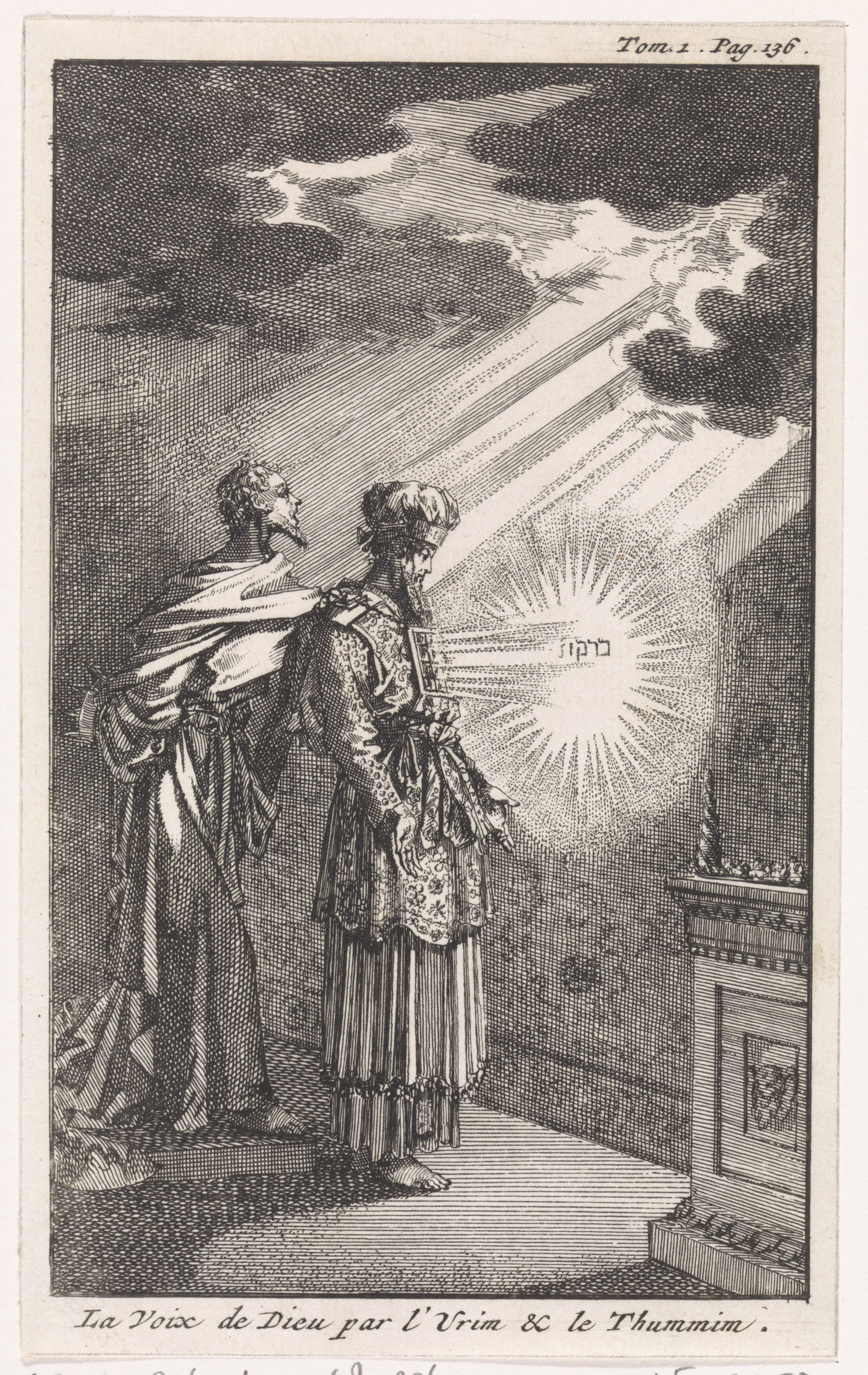
The biblical Urim and Thummim
"Urim and Thummim" is a biblical term with a roughly three-thousand-year textual history outside of any Latter-day Saint context. The reader who encountered it only through the CES Letter's four passing mentions would not learn this. The reader who opened a Bible would.
The term appears at seven principal points in the Hebrew Bible:
- Exodus 28:30: "And thou shalt put in the breastplate of judgment the Urim and the Thummim; and they shall be upon Aaron's heart, when he goeth in before the Lord: and Aaron shall bear the judgment of the children of Israel upon his heart before the Lord continually."
- Leviticus 8:8: "And he put the breastplate upon him: also he put in the breastplate the Urim and the Thummim."
- Numbers 27:21: Moses commissions Joshua: "He shall stand before Eleazar the priest, who shall ask counsel for him after the judgment of Urim before the Lord."
- Deuteronomy 33:8: "And of Levi he said, Let thy Thummim and thy Urim be with thy holy one."
- 1 Samuel 28:6: Saul, abandoned by God, "inquired of the Lord, the Lord answered him not, neither by dreams, nor by Urim, nor by prophets."
- Ezra 2:63 and Nehemiah 7:65: Post-exilic priests deferred questions of priestly genealogy "till there stood up a priest with Urim and with Thummim."
Modern scholarship adds two observations. First, the Hebrew root of Urim is plausibly 'or ("light," "lights"). Second, the biblical Urim and Thummim was a stone-based revelatory instrument carried in the high priest's breastplate, used for divine inquiry, with multiple ancient Jewish traditions describing the breastplate stones as illuminating in response to the priest's question.[7]
The standard scholarly reference on the biblical instrument is Cornelis Van Dam's The Urim and Thummim: A Means of Revelation in Ancient Israel (Eisenbrauns, 1997), the first book-length scholarly study of the topic since 1824. Van Dam, a Reformed (non-Latter-day Saint) Old Testament scholar publishing through a premier academic press in ancient Near Eastern studies, argued that the biblical evidence supports a light-based revelatory mechanism rather than the older binary lot-casting model, citing 1 Samuel 23:9–13 and 2 Samuel 5:23–25 as instances of Urim-and-Thummim-mediated answers more sophisticated than lot-casting. There "was something very lively and direct" about the instrument's revelatory process, he concluded, and "[p]rophetic inspiration is the only revelatory means that is known that can adequately account for the complexity and subtlety of some of the answers received."[7:1]
His reading is a minority position; the dominant scholarly view continues to treat the biblical UT as some form of binary lot-casting oracle. But it is well-argued, peer-reviewed, and from a top academic press, and it situates the biblical instrument inside a category that the Nephite interpreters and Joseph's seer stone fit naturally.[8]
Van Dam establishes less than a defender might want. The biblical Urim and Thummim is described as an oracular instrument. The Nephite interpreters and Joseph's seer stone function as translation instruments, producing English text from engraved characters. These functions are related but distinct. The biblical-pattern argument is therefore supplementary, not foundational: even if Van Dam is wrong about biblical function, the Book of Mormon's own description (two stones in a bow, divine preparation, light-mediated revelation, designated-seer operation) stands on its own. The biblical pattern strengthens the case but does not carry it.
Van Dam's reading is supported by ancient Jewish interpretive traditions. The Targum Pseudo-Jonathan on Exodus 28:30 describes the Urim as that which "illuminate[s] their words and make[s] manifest the hidden things"; Ramban (Rabbi Moshe ben Nahman, thirteenth century) described certain letters of the breastpiece lighting up, the high priest then arranging the lighted letters correctly; medieval Kabbalistic Zohar texts describe letters on the breastplate stones flickering with divine light.[9][10][11] The English translations through which a modern reader encounters these texts (Etheridge's Targum, 1862; Chavel's Ramban, 1971; the Soncino-Sperling-Simon Zohar, 1931–1934) postdate 1829 by decades or more. Joseph could not have read them.[12]
Independent biblical scholarship reinforces the broader pattern. A psephomancy (stone-based divination) ritual documented from Assur situates stone-mediated inquiry in the wider ancient Near East;[13] a peer-reviewed non-LDS Hebrew Bible study reads the UT as a real ancient Israelite revelatory instrument even under the Priestly editor's softening;[14] glowing-stone revelatory traditions run through Israelite, Jaredite (Ether 3), medieval European, and broader ancient Near Eastern lore;[15] and biblical law itself distinguished sanctioned divine instrumentation (Numbers 27:21) from prohibited divination (Deuteronomy 18:10–12), refusing to file the priestly oracle under "magic."[16] Matthew Roper has produced two short FARMS Insights essays applying the light-based reading to the LDS context.[17][18] Two standard reference works agree on the basic picture.[19][20]
The biblical Urim and Thummim is, in short, a documented ancient Near Eastern revelatory category with extensive scholarly literature, an ancient interpretive tradition of light-emitting breastplate stones, and a debated functional profile. None of this appears in the CES Letter.
Further Reading
- Cornelis Van Dam, The Urim and Thummim: A Means of Revelation in Ancient Israel (Eisenbrauns, 1997)
- Trevan Hatch, "Magic, Biblical Law, and the Israelite Urim and Thummim," Studia Antiqua 5/2 (2007)
- John A. Tvedtnes, "Glowing Stones in Ancient and Medieval Lore," Journal of Book of Mormon Studies 6/2 (1997)
- Wayne Horowitz and Victor (Avigdor) Hurowitz, "Urim and Thummim in Light of a Psephomancy Ritual from Assur (LKA 137)," JANES 21/1 (1992)
The Aaronic / Levitical priestly objection
Pressed one step further, the biblical-functional gap becomes a priesthood objection. The biblical Urim and Thummim was an Aaronic and Levitical instrument, housed in the high priest's breastplate and operated by descendants of Aaron in priestly office. Joseph Smith in 1827 was an unschooled farm boy with no priestly genealogy, and the Nephite prophets were not Levites either: Lehi was of the tribe of Manasseh (Alma 10:3). How can the biblical category be applied to a non-Aaronic, non-Levitical lineage?
The objection is real. The Latter-day Saint position treats priesthood as a divine appointment rather than a genealogical identity (Hebrews 7's Melchizedek priesthood "without father, without mother, without descent"; Alma 13 locating Nephite priesthood in that same order), notes that the biblical record itself includes non-Aaronic stone-mediated revelation (Moses; David through Abiathar in 1 Samuel 23:9–13), and treats the Restoration as opening a new dispensation in which earlier-prepared instruments are restored to use under divine commission rather than tribal lineage (Mosiah 28:14's interpreters "prepared from the beginning… for the purpose of interpreting languages").[21] The umbrella position is categorical (a class of stone-mediated revelatory instruments) rather than identical; the biblical analogy is partial, not total, and faithful Latter-day Saints can grant that without granting the larger CES Letter framing.
The Book of Mormon describes the instrument from inside the text
The Book of Mormon's own term for the Nephite translation stones is interpreters, not "Urim and Thummim." The biblical label is applied to the instrument by Latter-day Saints starting in 1832; the book itself, dictated and printed in 1829–1830, never uses the biblical term. That gap is real, and a sophisticated criticism could press it. The question is what the late arrival of the biblical name proves.
The internal description of the translation instrument occurs at four principal places:
- Mosiah 8:13. Ammon explains to King Limhi: "I can assuredly tell thee, O king, of a man that can translate the records; for he has wherewith that he can look, and translate all records that are of ancient date; and it is a gift from God. And the things are called interpreters, and no man can look in them except he be commanded, lest he should look for that he ought not and he should perish. And whosoever is commanded to look in them, the same is called seer."[22]
- Mosiah 28:13–16. "And now he translated them by the means of those two stones which were fastened into the two rims of a bow. Now these things were prepared from the beginning, and were handed down from generation to generation, for the purpose of interpreting languages."[23]
- Alma 37:21–25. Alma instructs his son Helaman to preserve "these directors" (the 1830 edition's reading; "directors" was changed to "interpreters" in the 1920 edition) and prophesies that through them "hidden things shall come to light, and secret works of darkness… shall be made manifest."[24]
- Ether 3:23–28. The Lord gives the Brother of Jared "two stones" and instructs him to "seal them up also with the things which ye shall write… For behold, the language which ye shall write I have confounded; wherefore I will cause in my own due time that these stones shall magnify to the eyes of men these things which ye shall write."[25]
Several features of these passages bear directly on the terminology question.
The instrument is described as two stones set in a bow. Mosiah 28:13 is verbally specific: "those two stones which were fastened into the two rims of a bow." This is the same physical configuration eyewitnesses described after 1830. Martin Harris's 1859 account described "two stones set in a bow of silver … about two inches in diameter, perfectly round," joined by a four-inch silver bar, the stones "white, like polished marble, with a few gray streaks."[26] The printer's manuscript was completed by August 1829 and the book was printed by March 1830, before Latter-day Saints adopted the biblical label.[27] Whatever happened to the terminology in 1832–35, the substantive description of the instrument was on the printed page in 1830, public and unalterable.
The instrument has multi-generational provenance. Mosiah 28:14: "prepared from the beginning, and were handed down from generation to generation, for the purpose of interpreting languages." The chain of custody runs from the Brother of Jared (Ether 3) through Mosiah I to King Mosiah II to Alma to Helaman, eventually deposited with the gold plates and recovered by Joseph through Moroni. This is the Book of Mormon's own narrative; it predates and predicts the external translation.
The instrument operates through divine commission, not magic. Mosiah 8:13 specifies that "no man can look in them except he be commanded": the instrument is not inherently powerful; it is divinely authorized for the use of a designated seer. This is the same distinction biblical law drew between sanctioned priestly Urim consultation (Numbers 27:21) and prohibited divination (Deuteronomy 18:10–12).[16:1]
The instrument is light-associated. Alma 37:25: "hidden things shall come to light"; Alma 37:23: "I will prepare unto my servant Gazelem, a stone, which shall shine forth in darkness unto light." The Hebrew root of Urim is 'or, "lights." Stan Spencer's 2015 Interpreter article argues that the 1830 reading "directors" in Alma 37:21,24 reflects the underlying Hebrew word urim (or a cognate), translated as "directors" because that captured the instrument's function, providing direction, per Numbers 27:21. The dual application of "director" / "directors" to both the interpreters and the Liahona produces a Hebrew wordplay linking both instruments to the biblical urim through their shared root, invisible to English readers including Joseph and his scribes. The 1920 editorial committee treated "directors" as a typographical inconsistency and standardized to "interpreters," accidentally erasing the wordplay Spencer identifies.[28]
A covered-eye parallel comes through Don Bradley's reconstruction of the lost 116 pages, not the printed Book of Mormon as we have it. Bradley's 2019 The Lost 116 Pages, drawing on period reminiscences (Lucy Mack Smith, Fayette Lapham's 1829 Joseph Smith Sr. interview, and other contemporaneous accounts), argues that the lost material described Mosiah I translating the Jaredite plates using the Nephite interpreters under an animal-skin or shroud, covering his head to admit only the spiritual vision through the stones.[29] This is a reconstructed internal parallel, not a Book-of-Mormon-internal datum. With it, the Nephite-internal background to Joseph's hat is supported by reconstructive evidence; without it, the four extant translation passages do not directly describe head-covering. Either way, the parallel is offered as inference, and a reader is free to find it persuasive or not.
The Book of Mormon's printed internal description, then, is of a divinely prepared two-stone instrument with multi-generational provenance, operated by a designated seer through divine commission, that produces light-mediated revelation of "hidden things." That description matches the biblical Urim and Thummim category at six independent points: stones, light, breastplate-association (in Joseph Smith—History 1:35), priestly/prophetic mediation, divine authorization, and multi-generational sacred custody. Adding Bradley's reconstruction of the lost 116 pages yields a seventh parallel, operation under cover, bringing the printed-plus-reconstructed description into close alignment with the biblical revelatory-instrument pattern.[30]
Key Point
The Book of Mormon's own term for its translation instrument is "interpreters," not "Urim and Thummim." But the physical description and theological framework of the Nephite interpreters (two stones set in a bow, divine preparation across generations, designated-seer operation, light-mediated revelation) match the biblical Urim and Thummim category at every printed-text point. The Latter-day Saint adoption of "Urim and Thummim" in 1832–33 recognized what any reader of the printed 1830 Book of Mormon could see: the book's own description of the Nephite instrument already fit the biblical revelatory-instrument category.
The CES Letter engages none of this. Its silence on the Book of Mormon's internal description of the interpreters is among the clearest signs that the letter's translation section argues past the source text it claims to be about.
How "Urim and Thummim" entered Latter-day Saint vocabulary
A critic's terminology argument, stated at its strongest, runs as follows. The term "Urim and Thummim" is unattested in the surviving 1827–1832 Latter-day Saint documentary record. Joseph and his associates used "spectacles," "two stones," "interpreters." The biblical term enters the surviving record in August 1832 (the Hyde-Smith Boston debate) and January 1833 (W.W. Phelps's Evening and Morning Star article) by analogy. Within two years it had displaced the secular vocabulary and was retroactively inserted into earlier revelations and into Joseph's 1838 history. The pattern is too tidy to be neutral linguistic drift.[31]
This is the steelman, sharper than anything in the CES Letter, and meeting it means walking through the documentary record itself.
The pre-1832 record: secular vocabulary
The pre-1832 documentary record describes the translation instrument with secular terms: "spectacles," "two stones," "stone spectacles," "two semi-transparent stones," "pair of spectacles," "interpreters." Of the twelve newspaper and primary-source accounts one survey catalogs from 1829 into 1832, eleven use only such secular terms; the remaining one, the August 1832 Boston Investigator, is the inflection point where the biblical term first appears in print.[32] Representative examples:
- Palmyra Freeman (1829): "pair of spectacles" placed "in a hat."[33]
- Alexander Campbell, "Delusions" (February 7, 1831, Millennial Harbinger): "stone spectacles, in a dark room, and in the hat."[34]
- Geauga Gazette (November 1830): "two semi-transparent stones."[35]
- Joseph Smith's 1832 history (his earliest extant autobiographical statement): "spectacles" (Joseph first wrote, then struck, the misspelled "spectticke").[36]
The pre-1832 vocabulary is consistent. This is the critic's strongest empirical foundation, and the concession is full: before August 1832, the surviving sources never once attach the biblical name to the instrument.
August 1832: the Boston Investigator (Hyde-Smith debate)
The first known public Latter-day Saint use of "Urim and Thummim" associated with the Book of Mormon translation appears in the August 10, 1832 Boston Investigator's report of the Hyde-Smith debate at Julien Hall, Boston, against the freethinker Abner Kneeland. Asked about the translation method, Orson Hyde and Joseph's brother Samuel Smith answered:
"Q. What do you mean by Urim and Thummim?
A. The same as were used by the prophets of old, which were two crystal stones, placed in bows something in the form of spectacles, which were found with the plates."[37]
The speakers are striking in themselves: two of Joseph's own missionaries, one of them his brother, using the term in public debate five months before it shows up in any surviving LDS publication; the terminology was already circulating in Joseph's inner circle by August 1832. So is the framing: "the same as were used by the prophets of old" is a direct claim that the Nephite instrument is the same category as the biblical Urim and Thummim. This is theological self-presentation, not euphemism.
January 1833: W.W. Phelps's Evening and Morning Star
The first published Latter-day Saint use of "Urim and Thummim" for the Nephite interpreters appears in the January 1833 issue of The Evening and the Morning Star in Independence, Missouri, edited by W.W. Phelps:
"translated by the gift and power of God, by an unlearned man, through the aid of a pair of Interpreters, or spectacles—(known, perhaps, in ancient days as Teraphim, or Urim and Thummim)" [emphasis added].[38]
Three features matter:
The hedge "perhaps" is on the page. Phelps is cautiously proposing the analogy, not asserting strict identity.
Phelps groups the Nephite interpreters with "Teraphim, or Urim and Thummim." The grouping is itself a category claim: Phelps names a class of stone-based revelatory devices (the biblical UT, the teraphim Hosea 3:4 mentions, the Nephite spectacles) and proposes that the Nephite instrument belongs to it. This is the umbrella reading in print in 1833, in the introducer's own qualified prose.
The Saints said it before they printed it. Hyde and Samuel Smith's August 1832 Boston use predates Phelps's January 1833 publication. The terminology was in oral circulation among Joseph's missionaries before it appeared in print. Phelps was articulating, with careful hedge, what the inner circle was already saying.
June 1829: D&C 17:1, what the surviving record can and cannot establish
The 1835 Doctrine and Covenants prints, as section 17, a revelation dated to June 1829, the one directing the Three Witnesses' future view of the plates and associated artifacts. The surviving canonical text reads:
"Behold, I say unto you, that you must rely upon my word, which if you do with full purpose of heart, you shall have a view of the plates, and also of the breastplate, the sword of Laban, the Urim and Thummim, which were given to the brother of Jared upon the mount, when he talked with the Lord face to face…"[39]
If the wording were verifiably 1829, this would be the cleanest pre-publication anchor for the term inside Joseph's own revelations. But the surviving manuscript history complicates the inference. The Joseph Smith Papers editors document that the surviving manuscript page of D&C 17 (in Revelation Book 2) was scribed by Frederick G. Williams not before November 25, 1834. Williams was a member of the committee charged with revising revelations for the 1835 D&C. John Whitmer copied the original revelation into Revelation Book 1 around March 1831, but "the page on which it was copied was removed at some point from that volume and is no longer extant." The JSP editors note that "some language used in the version copied into Revelation Book 2 does not fit an 1829 context, suggesting that version was modified from the original, although the degree of modification cannot be known."[40]
So the reading is mixed. We have a revelation dated June 1829 in the historical record. We have a surviving manuscript text from after November 1834. The original 1829 page is lost. The surviving D&C 17 text cannot be cleanly used as evidence that "Urim and Thummim" was operative vocabulary in June 1829.
What the surviving record can establish is the external-then-internal-record sequence in 1832–1833. The August 1832 Hyde-Smith Boston use shows the terminology in oral circulation among Joseph's inner-circle missionaries five months before any surviving LDS publication; the January 1833 Phelps article shows the term entering print with a "perhaps" hedge announcing the analogical extension on the page. By October 1834, Cowdery's Messenger and Advocate letter has the umbrella reading in his own hand within five years of translation. These are the strongest pre-1835-publication anchors that survive, and they are enough to rest on without straining the sources past what they can bear.
October 1834: Cowdery's explicit equivalence statement
Oliver Cowdery's October 1834 "Letter I" to W.W. Phelps in the Latter Day Saints' Messenger and Advocate contains the plainest equivalence statement in print, written by the principal scribe five years after translation:
"Day after day I continued, uninterrupted, to write from his mouth, as he translated, with the Urim and Thummim, or, as the Nephites would have said, 'Interpreters,' the history, or record, called 'The book of Mormon.'"[4:1]
Cowdery is explicit: we use the biblical term; the Nephites used "Interpreters," their own term for the same category. This is the apologetic position now associated with the December 2013 Gospel Topics Essay, written in 1834 by the man who watched Joseph translate.
He returned to it near the end of his life. At a conference held October 21, 1848 in Kanesville, Iowa, on his return to the Church after more than a decade outside it, and about three weeks before his rebaptism, Cowdery testified:
"I wrote, with my own pen, the entire Book of Mormon (save a few pages) as it fell from the lips of the Prophet Joseph Smith, as he translated it by the gift and power of God, by the means of the Urim and Thummim, or as it is called by that book 'holy interpreters.'"[41]
Fourteen years after the Messenger and Advocate letter, returning to the Church after a long alienation, Cowdery repeated the same umbrella formulation in a moment of public re-affirmation when he had nothing to gain by misrepresenting it.
Joseph Knight Sr., circa 1835–1847
A near-contemporary eyewitness reminiscence describes the seer stone (the chocolate-brown stone, not the spectacles) calling it "urim and thummim":
"Now the way he translated was he put the urim and thummim into his hat and Darkned his Eyes than he would take a sentance and it would apper in Brite Roman Letters then he would tell the writer and he would write it then that would go away the next sentance would Come and so on. But if it was not Spelt rite it would not go away till it was rite, so we see it was marvelous."[42]
Knight uses "urim and thummim" for the seer stone. The spectacle-form interpreters, with stones spaced roughly six inches apart, did not fit comfortably in a hat; the instrument Knight describes, placed into a hat, is the chocolate-brown seer stone. His reminiscence is contemporaneous, within a decade or so of translation, and corroborates the umbrella reading from the opposite direction: here the biblical term names the stone, not the spectacles.
April 1843: D&C 130:8–11, the term locked in as a category
On April 2, 1843, Joseph delivered the doctrinal teaching now canonized as D&C 130:
"8 The place where God resides is a great Urim and Thummim. 9 This earth, in its sanctified and immortal state, will be made like unto crystal and will be a Urim and Thummim to the inhabitants who dwell thereon, whereby all things pertaining to an inferior kingdom, or all kingdoms of a lower order, will be manifest to those who dwell on it; and this earth will be Christ's. 10 Then the white stone mentioned in Revelation 2:17, will become a Urim and Thummim to each individual who receives one, whereby things pertaining to a higher order of kingdoms will be made known; 11 And a white stone is given to each of those who come into the celestial kingdom, whereon is a new name written, which no man knoweth save he that receiveth it. The new name is the key word."[43]
This is the late-Joseph theological elaboration that locks "Urim and Thummim" in canonically as a category. The term names a class of revelatory instruments, not a Nephite-only artifact. By April 1843, the category-framework reading is on the canonical page in Joseph's own teaching. If the term named only the Nephite spectacles, what are glorified earths and celestial white stones doing under it?
The CES Letter does not mention D&C 130. The omission is diagnostic: the canonical text that most directly resolves the umbrella-term question is absent from the four-page section that depends on the strict-construction reading (that the term names the Nephite spectacles only).
The terminology timeline summarized
| Date | Source | What was said |
|---|---|---|
| 1827–July 1832 | Newspaper accounts; Joseph's 1832 history | "Spectacles," "two stones," "stone spectacles," "interpreters." No "Urim and Thummim." |
| Aug 10, 1832 | Boston Investigator (Hyde-Smith debate) | "The Urim and Thummim… the same as were used by the prophets of old" |
| Jan 1833 | Phelps, Evening and Morning Star | "Pair of Interpreters, or spectacles—(known, perhaps, in ancient days as Teraphim, or Urim and Thummim)" |
| Oct 1834 | Cowdery, Messenger and Advocate | "The Urim and Thummim, or, as the Nephites would have said, 'Interpreters'" |
| ca. 1835–1847 | Joseph Knight Sr. reminiscence | "He put the urim and thummim into his hat" (referring to the seer stone) |
| 1835 | D&C 17 publication (revelation dated June 1829; surviving manuscript scribed post-Nov 1834) | "The Urim and Thummim, which were given to the brother of Jared upon the mount" |
| 1838 | Joseph Smith's 1838 history (now JS-H 1:35) | "[T]wo stones in silver bows—and these stones, fastened to a breastplate, constituted what is called the Urim and Thummim…" |
| April 1843 | D&C 130:8–11 (revelation) | The phrase generalized as a category: future earths, individual white stones |
| Dec 2013 | Gospel Topics Essay, "Book of Mormon Translation" | "These two instruments—the interpreters and the seer stone—were apparently interchangeable… in the course of time, Joseph Smith and his associates often used the term 'Urim and Thummim' to refer to the single stone as well as the interpreters" |
The pattern is one of analogical extension with hedge language on the page, oral use running ahead of print, and eventual canonical generalization into a category framework, not covert label substitution. And it does not stop in 1843. The same umbrella reading runs forward, unbroken, into the official record of the next two centuries.
The umbrella reading stayed on the record, openly
The CES Letter's tacit framing depends on treating "Urim and Thummim" as a single specific instrument the Church covertly used to stand in for an embarrassing seer stone, and on dating the open admission of the seer stone to the December 2013 Gospel Topics Essay. The documentary record shows the opposite on both counts. Latter-day Saints used the term flexibly, as an umbrella covering multiple revelatory instruments, from the moment it enters the surviving record, and they kept saying so, in print, through every decade that followed.
The flexible reading appears across the formative sources already traced: Phelps's 1833 "Teraphim, or Urim and Thummim" grouping, Cowdery's 1834 explicit equivalence, Knight's 1835–1847 use of the term for the seer stone, and D&C 130's 1843 generalization to a category. It did not lapse after 1843. B.H. Roberts, in his 1930 Comprehensive History of the Church, wrote that the seer stone "possessed the qualities of Urim and Thummim, since by means of it—as described above—as well as by means of the Interpreters found with the Nephite record, Joseph was able to translate the characters engraven on the plates."[44] And from the late twentieth century forward, the umbrella reading and the seer-stone-in-hat method appear continuously in the Church's own apostolic and correlated publications, the very record the "hidden until 2013" framing requires to be empty.
Richard Lloyd Anderson, "By the Gift and Power of God," Ensign (September 1977). Anderson, identified as "professor of history and ancient scripture at Brigham Young University," reproduced David Whitmer's seer-stone-in-hat description verbatim, "Joseph Smith would put the seer stone into a hat and put his face in the hat, drawing it closely around his face to exclude the light," and discussed both the Nephite interpreters and the seer stone as instruments used interchangeably under the umbrella term. This was in the Church's flagship magazine, thirty-six years before the essay the CES Letter calls the moment of admission.[45]
LDS Bible Dictionary, "Urim and Thummim" (1979–present). Bound into every Church-issued Latter-day Saint Bible since 1979, present in every member's scriptures and used in every Sunday School and seminary class, the entry treats "Urim and Thummim" as a category of revelatory instruments: "There is more than one Urim and Thummim," it states, identifying Joseph Smith's as "the one used by the brother of Jared" and surmising that "it would seem reasonable that such instruments were used from the time of Adam." This is the curriculum saying exactly what the apologetic position now says.[46]
Encyclopedia of Mormonism, "Urim and Thummim" (Hoskisson, 1992). BYU's authoritative Latter-day Saint scholarly reference, articulating the umbrella reading.[47]
Russell M. Nelson, "A Treasured Testament," Ensign (July 1993). The byline reads "By Elder Russell M. Nelson of the Quorum of the Twelve Apostles"; the provenance line, "Adapted from an address given 25 June 1992 at a seminar for new mission presidents, Missionary Training Center, Provo, Utah." Nelson, the future President of the Church, quoted David Whitmer's full seer-stone-in-hat description verbatim, including the most rhetorically loaded passages: "spiritual light would shine," "piece of something resembling parchment would appear," "one character at a time." His own framing: "The details of this miraculous method of translation are still not fully known." An apostle taught the stone-in-hat method to the leaders responsible for training missionaries worldwide, twenty years before the Gospel Topics Essay, and the Church published it in its flagship English-language magazine. The information was not concealed; it was delivered through correlated channels.[48]
Gospel Topics Essay, "Book of Mormon Translation" (December 2013). The essay the CES Letter treats as the Church's first admission, confirming both the umbrella reading and the seer-stone-in-hat method: in the course of time, Joseph and his associates "often used the term 'Urim and Thummim' to refer to the single stone as well as the interpreters."[6:1]
"Joseph the Seer," Ensign (October 2015). The Church's first published photograph of the brown seer stone, with a detailed account of the terminology evolution and chain of custody.[49]
Saints, Volume 1: The Standard of Truth, 1815–1846, Chapter 6 (2018). The Church's official narrative history describes the translation through both the Nephite interpreters and the seer stone in the hat: "Often he found a single seer stone to be more convenient. He would put the seer stone in his hat, place his face into the hat to block out the light, and peer at the stone."[50]
Gerrit Dirkmaat, "The Miraculous Translation of the Book of Mormon," Liahona (March 2024). Continued open treatment in the Church's flagship international magazine.[51]
Across these nearly five decades of continuous official publication (the Ensign, the Bible Dictionary, the Encyclopedia of Mormonism, the Gospel Topics Essay, Saints, the Liahona) and back through B.H. Roberts in 1930 and the 1830s sources before him, the umbrella reading and the seer-stone-in-hat method were on the page. Richard Bushman's Joseph Smith's Gold Plates: A Cultural History (Oxford UP, 2023), the standard contemporary scholarly treatment, traces the same arc: how "Urim and Thummim" became the accepted label covering both instruments.[52] The Joseph Smith Papers, publishing translation-related material since 2008, document the textual history candidly, including the D&C 17 manuscript revision.[40:1] The "Urim and Thummim covers both instruments" reading is not a 21st-century apologetic retrofit forced on the Church by internet-era criticism. It is the position the Church has articulated, with uneven curricular emphasis, since at least 1977, and on the documentary record since 1834. Where in that record is the concealment supposed to have happened?
That qualifier, "uneven curricular emphasis," is a real concession. For half a century, the correlated curriculum (lesson manuals, Primary and missionary materials, chapel art, visitors' centers) privileged the spectacles-and-plates imagery over the stone in the hat, and many Latter-day Saints raised on it acquired an inaccurate picture of the translation process and of what "Urim and Thummim" meant. The CES Letter builds its concealment case on that gap.
Pastoral simplification vs. concealment
The CES Letter's central rhetorical move conflates two things: (a) the Church under-emphasized the seer-stone-in-hat method in correlated curriculum and chapel art, and (b) the Church concealed the seer-stone-in-hat method from members. (a) is documented and grantable. (b) requires more, and the publication record refutes it.
Chapel art (Friberg's Joseph Smith Translates the Book of Mormon, 1957; Del Parson's By the Gift and Power of God, 1996; Walter Rane's translation paintings, early 2000s) did systematically depict the gold plates without a hat. The most plausible drivers are pastoral simplification (the "Urim and Thummim with the plates" picture is theologically clean; the seer-stone-in-hat picture requires more explanation), aesthetic preference (the gold plates render more naturally in Friberg's nineteenth-century devotional idiom than a hat does), and institutional reticence about depicting sacred process to lay audiences who found the hat-stone process counterintuitive.[53] What is not in the documentary record is evidence of a coordinated decision to conceal the method.
Everything turns on whether the alternative information was hidden or available but not featured. The Bible Dictionary bound into every member's scriptures since 1979 carried the umbrella reading openly. The September 1977 Ensign quoted Whitmer's seer-stone-in-hat description verbatim; the 1992 Encyclopedia of Mormonism affirmed the umbrella reading; the July 1993 Ensign, written by a sitting apostle and future Church President, quoted Whitmer's full description; and the Joseph Smith Papers began publishing translation material in 2008. The signature of pastoral simplification is exactly that split: a simpler narrative featured in lay curriculum while the fuller account stayed openly available in apostolic publications, the Bible Dictionary, BYU's flagship reference work, and the Ensign. The under-emphasis took a toll, and members who felt deceived are not wrong to feel pain. But the move from "the curriculum simplified" to "the Church concealed" is the move the publication record does not support.
The strongest critical arguments
The CES Letter's terminology argument is, as noted, conspicuously weak next to what a sophisticated critic could write, and it would be a cheap victory to answer only the easy version. Five harder forms of the criticism deserve a direct response, plus a sixth that is less an argument than a description of how the bifurcation actually felt.
1. The retrofit argument: Phelps's "perhaps" as the smoking gun
The strongest standalone version of the retrofit argument: pre-1832 Latter-day Saint vocabulary in surviving sources was uniformly secular. Phelps's January 1833 "perhaps" hedge announces the category extension, but within twenty-four months the hedge is gone: by 1834 (Cowdery's Messenger and Advocate equivalence), by 1835 (the inserted/revised D&C 17 wording), by 1838 (the Joseph Smith History placing "what is called the Urim and Thummim" in Moroni's mouth in 1823, anachronistically), confident usage has replaced it. By 1843 the term has been canonically generalized to a category framework (D&C 130:8–11). The pattern is too tidy and too coincident with institutional incentives (distancing the translation instrument from the 1826 Bainbridge hearing that had examined Joseph as a "Glass Looker,"[54] claiming biblical respectability as the Church expanded into Ohio and beyond, allowing one biblical term to cover both the sacred Nephite interpreters and the embarrassing chocolate-brown seer stone) to be ascribed to neutral linguistic drift.[31:1]
The retrofit argument has real force. The timing is suggestive. Phelps's "perhaps" shows that even the introducer was tentative. All of that stands.
Its response is that the documentary trajectory shows category recognition, not concealment. Phelps's 1833 hedge documents that the analogy was understood at the moment of introduction as a category extension rather than strict identity. What happened to the hedge afterward is a separate question, and the hedge-to-confidence trajectory is the trajectory of an analogy gaining theological footing as the broader category framework matured into canonical doctrine (D&C 130:8–11), not the trajectory of a covert relabeling.[55]
The 1830 Book of Mormon describes the Nephite instrument as two stones set in a bow, divinely prepared across generations, light-associated, and operated by a designated seer (Mosiah 8:13; 28:13–16; Alma 37:21–25; Ether 3:23–28), the biblical Urim and Thummim category at every functional point. That description was on the printed page in 1830, before any vocabulary change. Phelps in 1833 was not retrofitting an alien category onto a non-fitting instrument. He was articulating the category the Book of Mormon's own description had already implicitly invoked.
The cross-cultural revelatory-stone parallels add a second consideration, with one caveat. The Targum Pseudo-Jonathan, Ramban, and the Zohar describe the biblical Urim and Thummim as letters that "illuminate" or light up on the breastplate stones, descriptions that match David Whitmer's 1887 account of "spiritual light would shine, A piece of something resembling parchment would appear, and on that appeared the writing. One character at a time would appear, and under it was the interpretation in English"[56] and his 1884 description of "an oblong piece of parchment, on which the hieroglyphics would appear, and also the translation in the English language, all appearing in bright luminous letters"[57] and Joseph Knight's "Brite Roman Letters."[9:1][10:1][11:1] The English translations of these rabbinic and medieval texts postdate 1829 by decades; Joseph could not have read them.[12:1]
The caveat: glowing-stone motifs appear cross-culturally in folklore generally, so the ubiquity cuts both ways. It shows the motif was available to a 19th-century farmboy through general folklore as well as through specifically rabbinic sources. What the rabbinic parallels add is not the availability of glowing-stone imagery but the specific match between Whitmer's "bright luminous letters" appearing one character at a time and the rabbinic picture of breastpiece letters lighting up, a closer correspondence than the general folkloric motif accounts for.
The retrofit argument therefore captures the surface pattern correctly (terminology adopted in 1832–33, generalized by 1843) but misreads what the pattern means. What looks like a relabeling campaign is a category being recognized.
2. The textual-revision argument: D&C 17:1 and the JSP commentary
The single strongest primary-source argument is the textual-history one. The June 1829 Three Witnesses revelation, in its surviving form, names "Urim and Thummim," but the surviving manuscript page was scribed by Frederick G. Williams not before November 25, 1834 (Williams was a member of the committee charged with revising revelations for the 1835 D&C). The original John Whitmer page from circa March 1831 was "removed at some point" from Revelation Book 1 and is no longer extant. The Joseph Smith Papers editors note that the surviving wording "does not fit an 1829 context, suggesting that version was modified from the original, although the degree of modification cannot be known." The 1833 Book of Commandments lacks "Urim and Thummim" wording that the 1835 Doctrine and Covenants inserts in some parallel passages.[31:2][40:2]
These textual facts are not in dispute. The response has three components.
Concede the editing facts directly. The 1835 D&C revisions did insert or modify wording in earlier revelations, and the Joseph Smith Papers editors document the changes. The 1829 D&C 17 manuscript is lost; the surviving manuscript dates to post-November 1834.
Read the editing process as harmonization rather than artifact substitution. The textual revisions can be read either as (a) substantive content change concealing earlier non-Urim-and-Thummim terminology, or (b) editorial harmonization aligning earlier revelations with the post-1833 standard biblical category once Joseph and his associates had settled on it. Reading (b) is the stronger one: the earlier 1829 sources describe the same physical instrument the post-1833 vocabulary calls "Urim and Thummim" (Cowdery's December 1830 "two transparent stones in the form of spectacles"; Joseph's 1832 "spectticke spectacles"). The revision is vocabulary, not artifact substitution.
Joseph's 1830s practice of revising revelations is documented and consistent with the period's continuing-revelation theology. The Book of Mormon's internal descriptions independently align with the biblical category, so inserting "Urim and Thummim" into 1829 revelations articulated the Book of Mormon's own implicit category rather than introducing an alien one.
Acknowledge the precedent question. Even granting the harmonization reading, the precedent question (what constrains future editing of revelations?) is uncomfortable. The 19th-century practice was a feature of the early Restoration's prophetic-revelation paradigm, not a perpetual policy, and modern Church practice treats the canonized text as fixed: Official Declarations 1 and 2 add new revelations rather than edit old ones. The Book of Mormon, textually fixed since 1830 with subsequent editions documenting only orthographic and grammatical refinements rather than content changes, is the firmer ground on questions of textual stability.[58][59]
The editing happened, the difficulty it creates is genuine, and the most charitable reading does not dissolve the precedent concern. Faithful Latter-day Saints can hold both that the umbrella-term reading is correct and that the early-Restoration editorial practice raises questions about prophetic-text stability deserving continued reflection.
3. The biblical-functional gap: oracle vs. translation
A sophisticated critic from biblical studies could press a different angle. The biblical Urim and Thummim, as scripture itself describes it (Numbers 27:21; 1 Samuel 28:6; Ezra 2:63; Nehemiah 7:65), is an oracular device used by the high priest to receive divine judgments. The Nephite interpreters function as translation instruments producing English text from engraved characters. The physical configurations differ too: the biblical UT was kept inside a pouch on the high priest's breastplate, while the Nephite interpreters were attached to the breastplate via a rod; the biblical UT functioned in a Temple setting through a high priest, while the Nephite interpreters and seer stone functioned in a farmhouse through a prophet with his face in a hat.
And defenders relying on Van Dam's "appearance of light" reading are relying on a minority position within biblical scholarship; the dominant view continues to treat the biblical UT as a binary lot-casting device.[8:1][14:1]
The functional and physical-configuration differences are real, and Van Dam's reading is a minority position. Grant both. The case never hung on the biblical pattern: the Book of Mormon's own description (Mosiah 8:13; 28:13–16; Alma 37:21–25; Ether 3:23–28) presents an instrument prepared "for the purpose of interpreting languages," and it did so in the 1830 first edition, before the biblical term arrived. The Latter-day Saint argument requires only that some category extension from biblical UT to the Nephite instrument is theologically intelligible, which the Book of Mormon's own description supports independent of the biblical scholarly debate.[60]
The LDS use of the biblical category covers a class of revelatory instruments that includes both oracular Urim and Thummim (as biblically described, however its mechanism is best read) and translation-aiding interpreters (as the Book of Mormon describes). The category extension is theologically substantive, the Book of Mormon's own description supports it independently, and the cross-cultural pattern of light-emitting revelatory stones is a supplementary consideration.
4. The faithful-revisionist denial: McConkie-Ostler, Stoddard-Stoddard, Lucas-Neville
A subtler version comes from inside faithful LDS scholarship itself. Joseph Fielding McConkie and Craig J. Ostler, in their 2000 Revelations of the Restoration, dismissed Whitmer's seer-stone-in-hat description as "fiction created for the purpose of demeaning Joseph Smith."[61] L. Hannah Stoddard and James F. Stoddard III's 2019 Seer Stone v. Urim and Thummim and James W. Lucas and Jonathan E. Neville's 2023 By Means of the Urim & Thummim extend the same strict-construction argument from a faithful-LDS position.[62][63]
The CES Letter cites McConkie-Ostler in its translation section, and a faithful skeptic who reads carefully will notice the citation does not require McConkie and Ostler to be theologically correct for the CES Letter's argument to work. The deployment is evidentiary, not authoritative: McConkie and Ostler are cited because prominent faithful LDS scholars at BYU were uncomfortable enough with the seer-stone-in-hat account to publish a 2000 book denying it. That, the argument goes, is itself evidence the Church's curricular silence on the method was driven by institutional discomfort rather than pastoral simplification.
That much is so: the strict-construction view of "Urim and Thummim" is a continuing minority position within faithful LDS scholarship spanning at least two decades, from McConkie-Ostler (2000) through Stoddard (2019) to Lucas-Neville (2023). But peer-reviewed scholarly responses now exist. Brant Gardner's review of Lucas-Neville in Interpreter 63 (2025): 135–168 systematically demonstrates that the seer-stone-in-hat method is the position the historical evidence supports, even against a faithful attempt to deny it. His clinching observation:
"By restricting the meaning of Urim and Thummim to the definition that facilitates the conclusion they want their readers to reach, they create a much more critical obfuscation than the one they accuse the historians of committing."[64]
Jeff Lindsay's companion peer-reviewed review in the same Interpreter 63 issue strengthens the rebuttal.[65] The strict-construction view has had its peer-reviewed engagement, and the broader scholarly consensus on the umbrella reading remains. The CES Letter is right that the McConkie-Ostler citation documents something real about institutional discomfort with the hat-stone process in some faithful LDS scholarship. What it cannot supply is the inferential leap from "some faithful scholars were uncomfortable" to "the Church concealed the method." Discomfort is documented; concealment is not. A continuing minority position is what scholarly inquiry looks like, not what concealment looks like.
5. Why "Urim and Thummim" became the canonical term
If Joseph used the seer stone for the bulk of dictation, as the eyewitness corpus indicates, why did "Urim and Thummim," the term most naturally associated with the Nephite spectacles, become the canonical Latter-day Saint label for the translation instrument? Why not "interpreters" or "seer stone"? A skeptic notices that "Urim and Thummim" is the biblically respectable term.
The biblical resonance was theologically meaningful for an early Restoration that understood itself as restoring a New Testament-and-Hebrew-Bible pattern of prophetic ministry, and the umbrella term was descriptively accurate because Joseph in fact used both instruments: the Nephite interpreters for the early lost-116-pages portion and the seer stone for substantial portions of the dictation that produced the printed 1830 Book of Mormon (see Seer Stones for the eyewitness corpus). A label committed to either "interpreters" alone (implying the spectacles-only narrative) or "seer stone" alone (erasing the Nephite-instrument narrative) would have been less faithful to the actual translation history than the umbrella term.[66]
For a reader who insists on the strict-construction reading, this will not satisfy. That reader is committed to a position the documentary record does not support. But the residual tension between the canonical term and the most-frequently-used instrument is real: the term is biblically borrowed, the borrowing privileged biblical resonance over Book-of-Mormon-internal vocabulary, and a faithful Latter-day Saint can hold both facts without granting the larger CES Letter framing.
6. The cumulative-narrative argument: 150 years of "Urim and Thummim with the plates"
The version that feels most right to members who experienced the bifurcation is not a conspiracy claim at all. It is a cumulative-experience claim. For any individual Latter-day Saint raised on the curriculum from the 1950s through the 2000s, the canonical translation narrative received from chapel art, Primary lessons, Sunday School manuals, missionary discussions, and visitors' centers was the Urim-and-Thummim-with-plates version. The seer stone was either not mentioned or appeared only in academic-historical venues most members did not read. The 2013 Gospel Topics Essay, the 2015 Ensign photograph, and Saints Volume 1 (2018) re-described the translation method to include the seer-stone-in-hat process. To a member who had received the canonical narrative for fifty years, the re-description felt like a substantive change.
The cumulative-experience claim is accurate as description, and the bifurcation is psychologically real. The pastoral-simplification reading (that Church leaders taught the simpler "Urim and Thummim with the plates" narrative because it was theologically clear, while leaving the historical-technical details to academic venues) explains the lived bifurcation without requiring deception. The CES Letter exploits those costs. But the costs are explained by pastoral simplification rather than concealment, and the difference matters.
The strongest single piece of correlated-curriculum counter-evidence is the LDS Bible Dictionary. Bound into every Church-issued LDS Bible since 1979 (present in every member's scriptures, used by every Sunday School class, every seminary class), the "Urim and Thummim" entry states the category reading outright: "There is more than one Urim and Thummim."[46:1] That sentence sat in the appendix of the member's own scriptures through every decade of the alleged concealment. The cumulative-narrative-was-suppressed argument has to engage the Bible Dictionary, or it has not engaged the curriculum it blames.
Even so, the Bible Dictionary entry was not widely emphasized in lay teaching. It was available, not featured. The bifurcation between the apostolic-publications-plus-Bible-Dictionary stream (which articulated the umbrella reading openly) and the lesson-manuals-plus-chapel-art stream (which privileged the spectacles imagery) was real. Members who experienced the gap as concealment did not imagine it. The claim here is narrower: the gap was pastoral simplification, not deception, and the documentary record refutes the conspiracy framing while granting the bifurcation thesis.
The translation product validates the process
A debate about which physical instrument Joseph used at any given moment, interpreters or seer stone or both, is downstream of the bigger question. Whatever instrument was on the table, the resulting Book of Mormon is what stands on the historical record. The terminology question matters for what it tells us about how Latter-day Saints have talked about translation; it does not determine whether the Book of Mormon is what it claims to be.
Whatever name the instrument carried, the product it left is measurable: 269,510 words dictated in roughly sixty working days; Early Modern English (EModE) syntactic features Joseph could not have known; Hebraisms invisible to English readers; a single dictated draft never substantively reworked; Old World archaeological convergences along the Frankincense Trail; and twelve-plus eyewitnesses with no whistleblowers. Seer Stones and the broader Book of Mormon section lay out the full case; for how the tight-control reading bears on the Book of Mormon's purported anachronisms, see Anachronisms.[67][68][58:1][69] Only one point is needed here: the terminology debate cannot reach the product.
Key Point
The CES Letter's terminology framing serves a deeper rhetorical move: making the translation method sound disreputable so the reader infers the product must be disreputable. The product is independent of the instrument. Whatever Joseph used at any given moment (Nephite interpreters, brown seer stone, white seer stone), the dictated text that reached the printer in 1830 is the same either way, and the sister Seer Stones article develops what that text contains.
The more "unrespectable" the method (stone in hat, no plates visible, no notes), the harder it becomes to explain the output by any naturalistic mechanism, because the method removes the very aids a naturalistic translation process would require: consulting plates, taking notes, drafting and revising. Take the CES Letter's reductive picture of the method seriously, and the production of the Book of Mormon becomes more miraculous, not less.
Assessment
The CES Letter's translation argument depends, structurally, on a tacit framing that treats "Urim and Thummim" and "seer stone" as opposites, one instrument for the official story and one for actual use, and finds institutional concealment in the gap between them. That framing has a particular weakness: it never engages "Urim and Thummim" as a topic. The phrase appears four times in passing across the entire letter, in contexts that presuppose the strict-construction reading without ever defending it.
The substantive concessions to the strongest version of the criticism are real. The biblical term entered the surviving LDS documentary record in August 1832 and January 1833, initially with a "perhaps" hedge that faded within twenty-four months. The June 1829 D&C 17 surviving manuscript was scribed post-November 1834, the original 1829 page is no longer extant, and the surviving wording cannot be cleanly used as evidence for the term's 1829 currency. The biblical-functional gap between oracle and translation is real, and Van Dam's "appearance of light" reading is a minority position within biblical scholarship.
The strict-construction view of "Urim and Thummim" has a continuous minority faithful-LDS tradition from McConkie-Ostler 2000 through Stoddard 2019 to Lucas-Neville 2023. And correlated curriculum from the 1950s through the 2000s did under-emphasize the umbrella reading and the seer-stone-in-hat method, even while the Ensign, the Bible Dictionary, and the Encyclopedia of Mormonism articulated them; the bifurcation between candid apostolic-and-academic publications and lay-curricular materials had real costs, and no one should be surprised that members took the gap for concealment.
What those concessions do not buy is the larger framing they are made to support. The umbrella reading is neither a covert relabeling nor a recent invention. Phelps introduces the analogy with a hedge in 1833; Cowdery names the equivalence in 1834; Knight applies the term to the seer stone within a decade of translation; and the reading runs openly through the published apostolic and correlated record for the next two centuries. The "hidden until 2013" story fails against that record on its own terms. The one inference the CES Letter never defends is the slide from under-emphasis to concealment.
The cleanest summary is the verbatim conclusion of the December 2013 Gospel Topics Essay: "These two instruments—the interpreters and the seer stone—were apparently interchangeable and worked in much the same way such that, in the course of time, Joseph Smith and his associates often used the term 'Urim and Thummim' to refer to the single stone as well as the interpreters." That is the position the documentary record supports, and it is the position an Apostle of the Church taught to mission presidents in 1992 and published in the Ensign in 1993.
For the harder questions (the textual-history facts about D&C 17:1, the 1830s editing of revelations, the precedent question about prophetic-text stability), clean resolutions do not exist; section 2 above gives the fullest answer available and leaves the discomfort standing. Underneath those questions the Book of Mormon itself holds still, its pages stable for nearly two centuries.
Which stone sat on the table at any given moment is a real historical question, and the umbrella reading is the documentary record's own answer. But it does not reach the thing the whole argument is meant to unsettle. The product does not depend on the instrument, the terminology evolution from 1832 forward is analogical extension rather than concealment, and the Book of Mormon itself, the text we can still open and examine, is untouched by the debate over which stone produced it. The vocabulary was borrowed; the book was not.
Further Reading
- Gospel Topics Essay, "Book of Mormon Translation"
- Russell M. Nelson, "A Treasured Testament," Ensign (July 1993)
- Joseph Smith Papers, "Revelation, June 1829–E [D&C 17]"
- Cornelis Van Dam, The Urim and Thummim: A Means of Revelation in Ancient Israel (Eisenbrauns, 1997)
- Brant A. Gardner, "Trust Us, We're Lawyers: Lucas and Neville on the Translation of the Book of Mormon," Interpreter 63 (2025): 135–168
- Stan Spencer, "What Did the Interpreters (Urim and Thummim) Look Like?" Interpreter 33 (2019): 223–256
For the eyewitness corpus on the translation method, the publication record refuting the "hidden until 2013" claim, the McConkie-Ostler chapter rebuttal in detail, the folk-magic context analysis, and the convergence-of-evidence case for Book of Mormon authenticity, see the sister article on Seer Stones.
Runnells, CES Letter (2017): "Book of Mormon," p. 18 (the View of the Hebrews comparison chart entry "Breastplate, Urim & Thummim"); "Kinderhook Plates & Translator Claims," p. 72; "Witnesses," pp. 90 and 95 (the Gladden Bishop passage and the Strang bullet "Received the 'Urim and Thummim'."). ↩︎
Runnells, CES Letter (2017), "Kinderhook Plates & Translator Claims," p. 72. ↩︎
Runnells, CES Letter (2017), "Witnesses," p. 90. ↩︎
Oliver Cowdery, "Letter I" to W.W. Phelps, Latter Day Saints' Messenger and Advocate 1, no. 1 (October 1834): 14. Digital text available through BYU's Mormon Publications digital collection and the Joseph Smith Papers digital catalog. Cowdery's "Day after day…" passage is the umbrella-equivalence statement; the "I wrote, with my own pen, the entire Book of Mormon" phrasing comes from Cowdery's later 1848 Kanesville statement (see [41:1]). ↩︎ ↩︎
Runnells, CES Letter (2017), "Book of Mormon Translation," pp. 28–31. The four-page section's image collage (paintings of Joseph studying gold plates labeled "Book of Mormon Translation that the Church Portrayed and Still Portrays to Its Members" versus paintings of Joseph with face in hat labeled "Book of Mormon Translation as it Actually Happened") is the rhetorical structure that operationalizes the strict-construction reading of "Urim and Thummim" without ever defending it. ↩︎
Gospel Topics Essay, "Book of Mormon Translation" (December 2013), https://www.churchofjesuschrist.org/study/manual/gospel-topics-essays/book-of-mormon-translation. "These two instruments—the interpreters and the seer stone—were apparently interchangeable and worked in much the same way such that, in the course of time, Joseph Smith and his associates often used the term 'Urim and Thummim' to refer to the single stone as well as the interpreters." ↩︎ ↩︎
Cornelis Van Dam, The Urim and Thummim: A Means of Revelation in Ancient Israel (Winona Lake, IN: Eisenbrauns, 1997), ISBN 978-0-931464-83-6 (original hardcover); paperback reprint ISBN 978-1-57506-406-2. Van Dam argues from the Hebrew root 'or ("light") that Urim means "lights"; from tom ("perfection," "completeness") that Thummim means "perfections"; and that the biblical evidence supports a light-based "appearance of light" reading rather than binary lot-casting. The quoted phrases are at p. 216 ("was something very lively and direct") and p. 217 ("[p]rophetic inspiration is the only revelatory means…"), as quoted in Scripture Central, KnoWhy #417, "Were Joseph Smith's Translation Instruments Like the Israelite Urim and Thummim?" (February 20, 2018), https://scripturecentral.org/knowhy/were-joseph-smiths-translation-instruments-like-the-israelite-urim-and-thummim. ↩︎ ↩︎
Van Dam's "appearance of light" reading is a minority position within biblical scholarship; the dominant view continues to treat the biblical Urim and Thummim as some form of binary lot-casting device. The article cites Van Dam for the availability of the light-based reading and for its Latter-day-Saint-relevant pattern, while acknowledging the scholarly debate is ongoing. For an example of the majority view, see Jonathan Stökl, "Ancient Israelite Divination: Urim ve-Tummim, Ephod, and Prophecy," TheTorah.com (2018), https://www.thetorah.com/article/ancient-israelite-divination-urim-ve-tummim-ephod-and-prophecy. ↩︎ ↩︎
Targum Pseudo-Jonathan on Exodus 28:30: "you shall put into the breastplate the Urim, which illuminate their words and make manifest the hidden things." Cited in Van Dam, The Urim and Thummim, p. 23. ↩︎ ↩︎
Ramban (Rabbi Moshe ben Nahman) on Exodus 28:30 describes certain letters of the breastpiece lighting up, the lighted letters then needing to be arranged correctly by the high priest. Paraphrase per Van Dam, The Urim and Thummim, cf. p. 32. English translation of Ramban: Charles B. Chavel, Ramban (Nachmanides): Commentary on the Torah, 5 vols. (New York: Shilo, 1971–1976). ↩︎ ↩︎
Zohar (medieval Kabbalistic, ca. thirteenth century) describing letters on the breastplate stones flickering with divine light. Cited in Van Dam, The Urim and Thummim, cf. p. 32. English translation: Harry Sperling, Maurice Simon, and Paul P. Levertoff, The Zohar (London: Soncino Press, 1931–1934). ↩︎ ↩︎
The English translations through which a modern reader encounters these rabbinic and medieval texts postdate 1829 by decades or more. Etheridge's first English translation of Targum Pseudo-Jonathan was published in 1862; Chavel's Ramban translation in 1971–1976; the Soncino-Sperling-Simon Zohar in 1931–1934. Joseph Smith could not have read these sources in English in 1829. For the broader question of what biblical and biblical-related sources Joseph did have access to in 1829 — primarily the King James Bible — see KJV Errors and the related articles in the Book of Mormon section. ↩︎ ↩︎
Wayne Horowitz and Victor (Avigdor) Hurowitz, "Urim and Thummim in Light of a Psephomancy Ritual from Assur (LKA 137)," Journal of the Ancient Near Eastern Society 21/1 (1992): 95–115, http://web.archive.org/web/20260120004222/https://janes.scholasticahq.com/article/2375-urim-and-thummim-in-light-of-a-psephomancy-ritual-from-assur-lka-137 (the journal's original Scholastica site is offline; link is to an archived copy of the article page). "Psephomancy" is divination using stones or pebbles; Horowitz and Hurowitz situate Israelite Urim-and-Thummim consultation within Mesopotamian stone-based divination ritual practices documented from Assur. ↩︎
Jonathan Stökl, "Ancient Israelite Divination: Urim ve-Tummim, Ephod, and Prophecy," TheTorah.com (2018), https://www.thetorah.com/article/ancient-israelite-divination-urim-ve-tummim-ephod-and-prophecy. The article identifies Stökl as "assistant professor at the Institute for Area Studies at Leiden University" at the time of publication; he later moved to King's College London. Stökl agrees that the biblical Priestly author softened the UT's earlier divinatory function, but treats it as a real ancient Israelite revelatory instrument. ↩︎ ↩︎
John A. Tvedtnes, "Glowing Stones in Ancient and Medieval Lore," Journal of Book of Mormon Studies 6/2 (1997): 99–123, https://scholarsarchive.byu.edu/jbms/vol6/iss2/6/. Catalogs glowing-stone revelatory traditions across Israelite, Jaredite (Ether 3), medieval European, and broader ancient Near Eastern cultures. ↩︎
Trevan G. Hatch, "Magic, Biblical Law, and the Israelite Urim and Thummim," Studia Antiqua 5/2 (2007), https://scholarsarchive.byu.edu/studiaantiqua/vol5/iss2/10/. Surveys the biblical-law distinction between sanctioned divine instrumentation (the priestly Urim and Thummim, per Numbers 27:21) and prohibited divination (Deuteronomy 18:10–12) — a distinction biblical law itself recognized. ↩︎ ↩︎
Matthew Roper, "Revelation and the Urim and Thummim," Insights 15/6 (Maxwell Institute / FARMS, 1995), https://scholarsarchive.byu.edu/insights/vol15/iss6/3/. ↩︎
Matthew Roper, "Teraphim and the Urim and Thummim," Insights 20/9 (Maxwell Institute / FARMS, 2000), https://scholarsarchive.byu.edu/insights/vol20/iss9/3/. ↩︎
Emil G. Hirsch, William Muss-Arnolt, Wilhelm Bacher, and Ludwig Blau, "Urim and Thummim," The Jewish Encyclopedia (1906), https://www.jewishencyclopedia.com/articles/14609-urim-and-thummim. Summarizes the biblical data, the rabbinic tradition, and the post-exilic loss of the oracle. ↩︎
Carol Meyers (Duke University), "Urim and Thummim," Bible Odyssey (Society of Biblical Literature). Peer-reviewed, public-facing introduction, published on the SBL's original Bible Odyssey site. The SBL relaunched Bible Odyssey in 2024, and the "Urim and Thummim" entry now posted there is a newer piece under a different byline; Meyers's original is no longer online. ↩︎
Hebrews 7 contrasts the Levitical priesthood with the Melchizedek priesthood — described as "without father, without mother, without descent" — and presents Christ as a priest "after the order of Melchizedek." Alma 13 in the Book of Mormon teaches the Melchizedek priesthood explicitly, locating Nephite priesthood in that order. Joseph Smith did not receive what Latter-day Saints call the Aaronic Priesthood until May 15, 1829 (per Joseph Smith—History 1:68–73), and the higher priesthood not until later that summer. The Latter-day Saint position is that priesthood is a divine appointment rather than a genealogical identity, and the underlying authority to mediate stone-based revelation under that priesthood derives from the divine commission, not from tribal lineage. The biblical record itself includes non-Aaronic stone-mediated revelation: Moses (a Levite but not Aaron's lineal descendant) receives the tables of stone written by the finger of God (Exodus 31:18); David (of Judah) inquires through the ephod's Urim and Thummim via Abiathar (1 Samuel 23:9–13). The Restoration paradigm treats the Nephite interpreters as instruments God prepared for translation work (Mosiah 28:14, "prepared from the beginning… for the purpose of interpreting languages"), distinct from the strictly priestly UT of Aaron's breastplate. Their categorical resonance with the biblical UT is what justifies the shared label, not their identity in priestly lineage. This is a substantive theological claim Latter-day Saints will not pretend is uncontested by traditional Christian theology, but it is the answer the position requires. ↩︎
Mosiah 8:13 (Book of Mormon, 1830 edition): "Now Ammon said unto him: I can assuredly tell thee, O king, of a man that can translate the records; for he has wherewith that he can look, and translate all records that are of ancient date; and it is a gift from God. And the things are called interpreters, and no man can look in them except he be commanded, lest he should look for that he ought not and he should perish. And whosoever is commanded to look in them, the same is called seer." ↩︎
Mosiah 28:13–16: "And now he translated them by the means of those two stones which were fastened into the two rims of a bow. Now these things were prepared from the beginning, and were handed down from generation to generation, for the purpose of interpreting languages." ↩︎
Alma 37:21–25 (1830 edition reads "directors" at 37:21 and 37:24; "directors" was changed to "interpreters" in the 1920 edition). For the 1920 editorial change, see Royal Skousen, Analysis of Textual Variants of the Book of Mormon, Part Four: Alma 17 to Alma 41 (Provo: BYU Studies, 2007); the 1920 committee treated "directors" as a typographical inconsistency and standardized to "interpreters." ↩︎
Ether 3:23–28 (Book of Mormon, 1830 edition). ↩︎
Martin Harris's 1859 description of the Nephite interpreters' physical dimensions is preserved most fully in the Joel Tiffany interview (Tiffany's Monthly, 1859). Harris described stones approximately two inches in diameter, perfectly round, about 5/8 inch thick at center, connected by a round silver bar approximately 3/8 inch in diameter and 4 inches long, total length approximately 8 inches, the stones "white, like polished marble, with a few gray streaks." Edward Stevenson's 1881 recollection of hearing Harris calls them "two clear stones" (Deseret Evening News, December 13, 1881), but as Stan Spencer notes, those "are not presented as Harris's words"; Spencer also observes that although the interpreters superficially resembled eyeglasses, "the stones were set much too far apart to be worn as such." For the full source-attribution analysis, see Stan Spencer, "What Did the Interpreters (Urim and Thummim) Look Like?" Interpreter: A Journal of Latter-day Saint Faith and Scholarship 33 (2019): 223–256, https://interpreterfoundation.org/journal/what-did-the-interpreters-urim-and-thummim-look-like/. Spencer credits the dimensional data to the 1859 Tiffany account. ↩︎
For the dating and integrity of the printer's manuscript, see Royal Skousen, The Original Manuscript of the Book of Mormon: Typographical Facsimile of the Extant Text (Provo: FARMS, 2001) and Royal Skousen, ed., The Printer's Manuscript of the Book of Mormon (Provo: FARMS, 2001). The 1830 first edition is digitally available through the Joseph Smith Papers, https://www.josephsmithpapers.org/paper-summary/book-of-mormon-1830/1. ↩︎
Stan Spencer, "Reflections of Urim: Hebrew Poetry Sheds Light on the Directors-Interpreters Mystery," Interpreter: A Journal of Latter-day Saint Faith and Scholarship 14 (2015): 187–207, https://interpreterfoundation.org/journal/reflections-of-urim-hebrew-poetry-sheds-light-on-the-directors-interpreters-mystery/. Spencer argues that the 1830 edition's "directors" reading reflects an underlying Hebrew word urim (or cognate), which the Septuagint also rendered as forms of photizo ("to shine") and deloi ("manifestations, revelations"). ↩︎
Don Bradley, The Lost 116 Pages: Reconstructing the Book of Mormon's Missing Stories (Salt Lake City: Greg Kofford Books, 2019), ISBN 978-1-58958-760-1, ch. 14, "The Mosian Reform," section "Acquiring the Jaredite Interpreters" (esp. pp. 248–262). Bradley's reconstruction of the Mosiah I translation under animal-skin or shroud is inferred from Lucy Mack Smith's reminiscences, Fayette Lapham's 1829 Joseph Smith Sr. interview, and other period accounts of the lost 116 pages — not from the printed Book of Mormon as we have it. The article cites Bradley as supportive (an inferential reconstruction from period sources) rather than as a Book-of-Mormon-internal datum. ↩︎
Scripture Central Evidence, "Parallels between the Interpreters and the Urim and Thummim," https://scripturecentral.org/evidence/book-of-mormon-evidence-parallels-between-the-interpreters-and-the-urim-and-thummim. See also Scripture Central Evidence, "Interpreters, Teraphim, and Urim and Thummim," https://scripturecentral.org/evidence/book-of-mormon-evidence-interpreters-teraphim-and-urimm-and-thummim. ↩︎
bookofmormonism.com, "'Urim and Thummim' and the Revision of History" (October 2021), https://bookofmormonism.com/2021/10/25/urim-and-thummim-and-the-revision-of-history/. The post is the most complete single critical compilation of the textual-history and terminology-evolution facts. The article engages it as the steelman version of the criticism the CES Letter does not make. ↩︎ ↩︎ ↩︎
"Before the Urim & Thummim: Pre-1833 Newspaper Accounts of Book of Mormon Translation," Wheat and Tares (January 26, 2023), https://wheatandtares.org/2023/01/26/before-the-urim-thummim-pre-1833-newspaper-accounts-of-book-of-mormon-translation/. The blog post catalogs "twelve distinct newspaper accounts of Book of Mormon translation between 1829 and 1832"; eleven use "spectacles," "two stones," "stone spectacles," "two semi-transparent stones," "pair of spectacles," or "interpreters" — never "Urim and Thummim" — and the post identifies the August 1832 Boston Investigator as "the first known public association of Urim & Thummim with the Book of Mormon translation." ↩︎
Palmyra Freeman (1829), as cataloged in Wheat and Tares (2023) and Vogel, Early Mormon Documents, vol. 2. ↩︎
Alexander Campbell, "Delusions" essay, published February 7, 1831 in Millennial Harbinger, as cataloged in Wheat and Tares (2023). Campbell's essay is one of the earliest extended critical treatments of the Book of Mormon and uses "stone spectacles, in a dark room, and in the hat" — not "Urim and Thummim." ↩︎
Geauga Gazette (November 1830), as cataloged in Wheat and Tares (2023). ↩︎
Joseph Smith, "History, circa Summer 1832," p. 5, Joseph Smith Papers, https://www.josephsmithpapers.org/paper-summary/history-circa-summer-1832/5. Joseph's earliest extant autobiographical statement uses "spectacles" rather than "Urim and Thummim"; in the manuscript Joseph first wrote the misspelled "spectticke," then struck it and wrote "spectacles" (the cancellation is preserved in the Joseph Smith Papers transcript). Joseph's documented English in his own hand in 1832 is a useful baseline for what his "actual English" looked like at the time, particularly when compared with the Early Modern English forms in the Book of Mormon dictation; see further The Late War and View of the Hebrews for the broader cross-translation comparison. ↩︎
Orson Hyde and Samuel Smith, debate at Julien Hall, Boston, August 5, 1832, as reported in Boston Investigator (August 10, 1832). Full transcript hosted at https://user.xmission.com/~research/central/hydesmith.htm. The exchange is generally regarded as the first known public (i.e., spoken-in-public-debate) Latter-day Saint use of "Urim and Thummim" associated with the Book of Mormon translation instrument. ↩︎
W. W. Phelps, "The Book of Mormon," The Evening and the Morning Star 1, no. 8 (January 1833): 58. The hedge "perhaps" appears verbatim in the published text. FAIR primary-source page (verbose URL): https://www.fairlatterdaysaints.org/answers/Source:Phelps:The_Evening_and_The_Morning_Star_1:58:through_the_aid_of_a_pair_of_Interpreters,_or_spectacles—(known,_perhaps,_in_ancient_days_as_Teraphim,_or_Urim_and_Thummim). ↩︎
Doctrine and Covenants 17:1, https://www.churchofjesuschrist.org/study/scriptures/dc-testament/dc/17. The revelation is dated June 1829; the surviving manuscript wording dates to post-November 1834 scribal work (see [40:3]). ↩︎
Joseph Smith Papers, "Revelation, June 1829–E [D&C 17]" (paper-summary), https://www.josephsmithpapers.org/paper-summary/revelation-june-1829-e-dc-17/1. The JSP commentary documents: (a) the surviving manuscript, in the handwriting of Frederick G. Williams, was copied "[not before 25 Nov. 1834]" into Revelation Book 2, pp. 119–120 (brackets in the JSP source note); (b) John Whitmer copied the original revelation into Revelation Book 1 around March 1831, but "the page on which it was copied was removed at some point from that volume and is no longer extant"; (c) "some language used in the version copied into Revelation Book 2 does not fit an 1829 context, suggesting that version was modified from the original, although the degree of modification cannot be known." ↩︎ ↩︎ ↩︎ ↩︎
Oliver Cowdery, public testimony at conference held October 21, 1848, Kanesville, Iowa, recorded by Reuben Miller in his journal; first published in the Deseret News, April 13, 1859, p. 48. The statement as quoted here follows the rendering in Charles W. Penrose, "An Old Slander Revived and Refuted," Latter Day Saints' Millennial Star 70, no. 23 (June 4, 1908), https://scripturecentral.org/archive/periodicals/magazine-article/old-slander-revived-and-refuted. The Reuben Miller Journal is held in the Church History Library, Salt Lake City. For Miller's role as the principal recorder of Cowdery's reaffirmations, see Richard Lloyd Anderson, "Reuben Miller, Recorder of Oliver Cowdery's Reaffirmations," BYU Studies 8, no. 3 (1968): 277–293, https://byustudies.byu.edu/article/reuben-miller-recorder-of-oliver-cowderys-reaffirmations/. Cowdery's October 1848 Kanesville statement was given before the assembled conference congregation on his return to the Church after more than a decade outside it, about three weeks before his rebaptism on November 12, 1848. ↩︎ ↩︎
Joseph Knight Sr., reminiscence, ca. 1835–1847, in Dean Jessee, "Joseph Knight's Recollection of Early Mormon History," BYU Studies 17, no. 1 (1977): 29–39, https://scholarsarchive.byu.edu/byusq/vol17/iss1/4/. ↩︎
Doctrine and Covenants 130:8–11 (revelation dated April 2, 1843), https://www.churchofjesuschrist.org/study/scriptures/dc-testament/dc/130. ↩︎
B.H. Roberts, A Comprehensive History of the Church of Jesus Christ of Latter-day Saints, 6 vols. (Salt Lake City: Deseret News Press, 1930), 1:129. Roberts wrote that the seer stone "possessed the qualities of Urim and Thummim, since by means of it—as described above—as well as by means of the Interpreters found with the Nephite record, Joseph was able to translate the characters engraven on the plates." ↩︎
Richard Lloyd Anderson, "By the Gift and Power of God," Ensign (September 1977), https://www.churchofjesuschrist.org/study/ensign/1977/09/by-the-gift-and-power-of-god. Anderson is identified as "professor of history and ancient scripture at Brigham Young University." ↩︎
LDS Bible Dictionary, "Urim and Thummim," https://www.churchofjesuschrist.org/study/scriptures/bd/urim-and-thummim. The Bible Dictionary has been bound into every Church-issued LDS Bible since the 1979 LDS edition of the King James Bible. ↩︎ ↩︎
Paul Y. Hoskisson, "Urim and Thummim," in Daniel H. Ludlow, ed., Encyclopedia of Mormonism (New York: Macmillan, 1992), https://eom.byu.edu/index.php/Urim_and_Thummim. ↩︎
Russell M. Nelson, "A Treasured Testament," Ensign (July 1993), https://www.churchofjesuschrist.org/study/ensign/1993/07/a-treasured-testament. The provenance line reads: "Adapted from an address given 25 June 1992 at a seminar for new mission presidents, Missionary Training Center, Provo, Utah." ↩︎
Richard E. Turley Jr., Robin S. Jensen, and Mark Ashurst-McGee, "Joseph the Seer," Ensign (October 2015), https://www.churchofjesuschrist.org/study/ensign/2015/10/joseph-the-seer. ↩︎
Saints, Volume 1: The Standard of Truth, 1815–1846 (Salt Lake City: The Church of Jesus Christ of Latter-day Saints, 2018), Chapter 6, "The Gift and Power of God," https://www.churchofjesuschrist.org/study/history/saints-v1/06-the-gift-and-power-of-god. Chapter 6 narrates Joseph's translation through both the Nephite interpreters and the seer stone in the hat. (Chapter 5, "All Is Lost," covers the lost-116-pages period.) ↩︎
Gerrit Dirkmaat, "The Miraculous Translation of the Book of Mormon," Liahona (March 2024), https://www.churchofjesuschrist.org/study/liahona/2024/03/united-states-and-canada-section/02-the-miraculous-translation-of-the-book-of-mormon. ↩︎
Richard Lyman Bushman, Joseph Smith's Gold Plates: A Cultural History (New York: Oxford University Press, 2023), ISBN 9780197676523. Bushman's culminating work on the gold plates, the seer-stone-in-hat translation, and how "Urim and Thummim" became the accepted label covering both instruments. ↩︎
Chapel art (Arnold Friberg's Joseph Smith Translates the Book of Mormon, Del Parson's By the Gift and Power of God, Walter Rane's translation paintings) systematically depicted the gold plates without showing a hat. The three plausible drivers are (a) pastoral simplification — the "Urim and Thummim with the plates" picture is theologically clean (a divinely prepared instrument, found with the plates, used by a prophet to read engraved characters), while the seer-stone-in-hat picture requires more explanation (what is a seer stone, how did Joseph have one in the first place, why is it in a hat, how does that relate to the Nephite instrument), and the simpler picture serves the catechetical purpose for a Primary class or a Sunday School lesson aimed at a doctrinal point; (b) aesthetic and devotional preference — the gold plates are a more visually compelling subject than a hat, and Friberg's pictorial vocabulary (luminous skies, robed prophets, a glowing volume) is a deliberate aesthetic continuous with nineteenth-century religious painting; (c) institutional reticence about depicting sacred process — some Latter-day Saint correspondence from mid-twentieth-century Church history acknowledges that the hat-stone process was harder to teach because lay members found it counterintuitive, bordering on uncomfortable, and that kind of institutional preference for the clearer narrative is real but distinct from the CES Letter's "concealment" framing. The same Church-published Ensign (Anderson 1977, Nelson 1993), the same Bible Dictionary bound into every member's scriptures (since 1979), and the same Encyclopedia of Mormonism (1992) had the umbrella reading on the page during the same decades when chapel art was depicting the spectacles. The chapel-art tradition reflects a curricular preference for one way of picturing the translation rather than a coordinated cover-up. ↩︎
Gordon A. Madsen, "Joseph Smith's 1826 Trial: The Legal Setting," BYU Studies 30, no. 2 (1990): Article 7, https://scholarsarchive.byu.edu/byusq/vol30/iss2/7/. Madsen analyzes the Bainbridge "Glass Looker" hearing in its proper legal-historical context. For the broader documentary record on the 1826 hearing, see also the Joseph Smith Papers Project. ↩︎
The hedge "perhaps" in Phelps's January 1833 article is significant not because the hedge remained the operative qualifier — by 1834 the hedge was gone — but because it documents that even at the moment of introduction, Phelps understood he was proposing a category extension rather than asserting strict identity. What happened to the hedge in subsequent years is a separate question: by 1843, with D&C 130:8–11, the category framework had been canonically extended even further (to future earths, individual white stones in the celestial kingdom), which is consistent with the umbrella reading rather than with the strict-construction reading. The hedge-then-confidence trajectory is real; it is the trajectory of an analogy gaining theological footing as the broader category framework matured into canonical doctrine, not the trajectory of a covert relabeling consolidating its grip. ↩︎
David Whitmer, An Address to All Believers in Christ (Richmond, MO: David Whitmer, 1887), https://archive.org/details/addresstoallbeli00whit. Public-domain text. The Address contains: "in the darkness the spiritual light would shine, A piece of something resembling parchment would appear, and on that appeared the writing. One character at a time would appear, and under it was the interpretation in English." Whitmer's Address is explicitly critical of Joseph Smith and the Brigham Young Utah Church on multiple points (polygamy, several leadership decisions, plural revelations) but affirms the seer-stone-in-hat translation method in detail. ↩︎
David Whitmer, interview with James H. Hart, March 1884, published as James H. Hart, "About the Book of Mormon," Deseret Evening News, March 25, 1884; transcribed in John W. Welch, ed., Opening the Heavens: Accounts of Divine Manifestations, 1820–1844, 2nd ed. (Provo: BYU Studies, 2017), document 91. Reprinted in Lyndon W. Cook, ed., David Whitmer Interviews: A Restoration Witness (Orem, UT: Grandin Book, 1991), cf. p. 76, and cataloged in Dan Vogel, Early Mormon Documents, vol. 5 (Salt Lake City: Signature Books, 2003). Whitmer described "an oblong piece of parchment, on which the hieroglyphics would appear, and also the translation in the English language, all appearing in bright luminous letters." The 1884 Hart interview phrasing ("bright luminous letters") differs slightly from the 1887 Address phrasing ("spiritual light would shine… One character at a time would appear"); both are Whitmer's own descriptions of the same translation process but were given on different occasions and recorded in different documents. ↩︎
Royal Skousen, "How Joseph Smith Translated the Book of Mormon: Evidence from the Original Manuscript," Journal of Book of Mormon Studies 7, no. 1 (1998): 22–31, https://scholarsarchive.byu.edu/jbms/vol7/iss1/4/. Skousen documents that Joseph viewed at least twenty words at a time on the seer stone, with letter-by-letter spelling of unfamiliar names. ↩︎ ↩︎
Royal Skousen, The History of the Text of the Book of Mormon, multi-volume (Provo: BYU Studies, 2014–2024). For the specific EModE feature documentation, see in particular Royal Skousen, Grammatical Variation, Parts 3 and 4 of The Nature of the Original Language (Provo: BYU Studies, 2018), ISBN 978-0-8425-2964-2. ↩︎
Even granting the biblical-functional gap, three secondary considerations bear on the criticism. First, 1 Samuel 23:9–13 and 2 Samuel 5:23–25 do describe Urim-and-Thummim consultation that goes beyond pure binary yes/no — David receives predictive verbal information in 23:11 ("He will come down") that exceeds binary inquiry, even if the broader context can be parsed as successive binary inquiries; the biblical record itself contains language pointing toward more-than-binary use. Second, Tvedtnes documents glowing-stone revelatory traditions across Israelite, Jaredite, medieval European, and broader ancient Near Eastern cultures — the light-emitting revelatory stone category is broader than the narrow biblical UT debate. Third, Hatch surveys biblical-law's distinction between sanctioned divine instrumentation (the priestly UT, per Numbers 27:21) and prohibited divination (Deuteronomy 18:10–12), undercutting the modern reader's instinct to collapse all stone-based inquiry into a single category of "magic." ↩︎
Joseph Fielding McConkie and Craig J. Ostler, Revelations of the Restoration: A Commentary on the Doctrine and Covenants and Other Modern Revelations (Salt Lake City: Deseret Book, 2000), pp. 89–98 (the "fiction" passage at pp. 95–96 per published transcriptions), ISBN 978-1573459846. The two BYU religion professors dismissed Whitmer's seer-stone-in-hat description in these words: "Such an explanation is, in our judgment, simply fiction created for the purpose of demeaning Joseph Smith and to undermine the validity of the revelations he received." They further asked: "If Joseph Smith translated everything that is now in the Book of Mormon without using the gold plates, we are left to wonder why the plates were necessary in the first place." ↩︎
L. Hannah Stoddard and James F. Stoddard III, Seer Stone v. Urim and Thummim: Book of Mormon Translation on Trial (Joseph Smith Foundation, 2019), https://josephsmithfoundation.org/store/product/seer-stone-v-urim-thummim-book-of-mormon-translation-on-trial-book/. Stoddard-Stoddard's argument is principally a sourcing-methodology critique — they argue that mainstream LDS historians selectively favor critical-of-Joseph sources on the seer-stone-in-hat method — rather than a wholesale denial of all eyewitness accounts. ↩︎
James W. Lucas and Jonathan E. Neville, By Means of the Urim & Thummim: Restoring Translation to the Restoration (Digital Legend Press, 2023), ISBN 978-1937735425. ↩︎
Brant A. Gardner, "Trust Us, We're Lawyers: Lucas and Neville on the Translation of the Book of Mormon," Interpreter: A Journal of Latter-day Saint Faith and Scholarship 63 (2025): 135–168, https://interpreterfoundation.org/journal/trust-us-were-lawyers-lucas-and-neville-on-the-translation-of-the-book-of-mormon/. The clinching quote appears at p. 141. ↩︎
Jeff Lindsay, "Through a Glass Darkly: Restoring Translation to the Restoration?" Interpreter: A Journal of Latter-day Saint Faith and Scholarship 63, Article 12 (2025), https://scholarsarchive.byu.edu/interpreter/vol63/iss1/12/. ↩︎
A sharper skeptic objects: "term flexibility WAS the strategy — the Church used 'Urim and Thummim' precisely because it could mean either instrument." The argument confuses descriptive flexibility with strategic deception. Flexible labels emerge whenever a category covers multiple instances; that is how categorical vocabulary works. Phelps's January 1833 "perhaps" hedge documented the analogical extension on the page in print. Cowdery's October 1834 letter explicitly named the equivalence ("the Urim and Thummim, or, as the Nephites would have said, 'Interpreters'"). Knight's 1835–1847 reminiscence used the term for the seer stone. The flexibility was documented in early Church sources, not strategically concealed. Strategic deception requires the alternative meaning to be hidden. The umbrella reading was on the page in 1833, in 1834, in the 1835–1847 Knight reminiscence, in B.H. Roberts's 1930 Comprehensive History, in the 1979 Bible Dictionary, in the 1992 Encyclopedia of Mormonism, and in the 1993 Ensign. Nothing was hidden by it; the vocabulary expansion was openly catalogued in successive published Latter-day Saint sources. ↩︎
John W. Welch, "Timing the Translation of the Book of Mormon: 'Days [and Hours] Never to Be Forgotten,'" BYU Studies Quarterly 57, no. 4 (2018): 10–50, https://byustudies.byu.edu/article/timing-the-translation-of-the-book-of-mormon-days-and-hours-never-to-be-forgotten. Also in Welch, ed., Opening the Heavens: Accounts of Divine Manifestations, 1820–1844, 2nd ed. (Provo: BYU Studies, 2017). Welch documents 269,510 words across an estimated 57–63 working days available between April 7 and June 30, 1829. ↩︎
Stanford Carmack, "Book of Mormon Grammar and Translation," BYU Studies Quarterly 63, no. 3 (2024): 49–82, https://byustudies.byu.edu/article/book-of-mormon-grammar-and-translation. Carmack's verbatim conclusion: "personal relative pronoun use" matches "the second half of the 1500s and first decade of the 1600s, just before and during Shakespeare's time"; "the Book of Mormon, as dictated, came to Joseph Smith as revealed words." Specific syntactic feature counts include 100 instances of personal "they which" relative pronouns (with 23 in object position referring to persons), 77 "save it were" formations, 13 "had spake" archaic past forms, and 26 "more part" phraseology instances. ↩︎
For the catalog of translation witnesses and their statements, see Brian C. Hales, "Curiously Unique: Joseph Smith as Author of the Book of Mormon," Interpreter: A Journal of Latter-day Saint Faith and Scholarship 31 (2019): 151–190, https://interpreterfoundation.org/journal/curiously-unique-joseph-smith-as-author-of-the-book-of-mormon/; John W. Welch, ed., Opening the Heavens: Accounts of Divine Manifestations, 1820–1844, 2nd ed. (Provo: BYU Studies, 2017); Michael Hubbard MacKay and Gerrit J. Dirkmaat, From Darkness Unto Light: Joseph Smith's Translation and Publication of the Book of Mormon (Provo: BYU Religious Studies Center, 2015), https://rsc.byu.edu/book/darkness-unto-light. Hales catalogs at least eleven named witnesses besides Joseph who personally observed the translation. ↩︎