Anachronisms in the Book of Mormon
The claim:
"Anachronisms: Horses, cattle, oxen, sheep, swine, goats, elephants, wheels, chariots, wheat, silk, steel, and iron did not exist in pre-Columbian America during Book of Mormon times. Why are these things mentioned in the Book of Mormon as being made available in the Americas between 2200 BC - 421 AD?"[1]
"Unofficial apologists claim victories in some of these items but closer inspection reveals significant problems. It has been documented that apologists have manipulated wording so that steel is not steel, sheep become never-domesticated bighorn sheep, horses become tapirs, etc."[2]
A complete iron sword, hardened into steel and roughly a meter long, is the item the list does not mention. Archaeologists working at Vered Jericho, about twelve miles east of Jerusalem, pulled it from a building dated to the late seventh or sixth century BC. That is Laban's era and Laban's region. Avraham Eitan's metallurgical analysis found that the iron had been deliberately hardened into steel, and it has been called the only complete sword of its size and type from the period yet found in Israel. The first sentence of 1 Nephi 4:9 describes a steel sword in exactly that place at exactly that time, and a generation ago the standard reply was that no such thing existed. It does.
One verse, one artifact, one dated context, and the claim can be checked. The CES Letter does the opposite. It compresses one of its signature criticisms into a one-paragraph rapid-fire list and a one-paragraph dismissal of "unofficial apologists": thirteen items, a single Wikipedia footnote, and a closing joke about tapirs carrying most of the rhetorical work.[1:1] The real picture is layered. Several items have been confirmed by mainstream archaeology since 1830. Several turn on documented linguistic principles the CES Letter never engages. A few are still unsettled. And one strand of the broader scholarly critique, the reverse anachronism pattern, raises a harder question than the CES Letter ever poses. This article answers the strongest form of each criticism, not the easiest.
Methodology
Three principles bear on how an anachronism claim should be weighed.
1. Translation anachronisms. Translate any ancient text into a modern language and the translator inevitably introduces words the original never had. The King James Version (KJV), the 1611 English Bible Joseph Smith used, repeatedly renders ancient oil lamps as "candles" (Job 18:6), though candles were not yet in use when those texts were written. Without the original Nephite document, there is no way to tell in every case whether a Book of Mormon term reflects what was physically present (a historical anachronism) or how it was rendered into English.[3] Invoked without limit, this framework is unfalsifiable; it has to be applied case by case, not as a blanket excuse.
2. Loan-shifting. Cultures meeting unfamiliar things routinely reach for words they already have. Gardner's worked example is the hippopotamus, literally a "river horse." Greek speakers named an unfamiliar Nile animal after a familiar one, and Latin borrowed the word whole. Maya speakers called the Spaniards' horses tzimin, a word that had meant "beast," and named the tapir tzimin che, "forest beast." The explorer DeSoto called the American buffalo simply vaca, cow, and the Delaware named the cow after the deer.[3:1] [4] [5] The phenomenon is well documented. Applying it to the Book of Mormon, though, requires a coherent account of who is doing the shifting, the question taken up in the trilemma section below.
3. Archaeological limitations. Mesoamerica's tropical soils destroy organic material fast. The youngest reliably dated fossil of any species is almost never the actual last individual. Paleontologists call that systematic under-reporting the Signor-Lipps effect.[6] Pre-Columbian cultivation of little barley was unknown to archaeology until 1983; Mesoamerican structural cement was not understood until David Hyman's 1970 study.[7] Absence of evidence is not evidence of absence. It is also not evidence of presence.
What the CES Letter Gets Right
The mainstream archaeological consensus does reject Book of Mormon historicity, and no archaeologist outside the Church has publicly come to the opposite conclusion. The Smithsonian Institution's official statement and Michael Coe's 1973 Dialogue article remain the professional baseline, and that consensus has not moved despite individual confirmations of specific items.[8] [9] The tension on several items is real. Horses, wheat, large-scale ferrous metallurgy in the Americas, and domesticated herds at scale do not match what mainstream archaeology has documented for pre-Columbian Mesoamerica. And some apologetic moves blurred distinctions that matter: pointing at Olmec ilmenite beads as the answer to Nephite iron and steel weapons was always category confusion.
What the CES Letter Gets Wrong
Wikipedia is the only cited source. Footnote 13 in the CES Letter PDF links to Wikipedia. No peer-reviewed archaeological study, no excavation report, no specialist publication is cited for any of the thirteen items.[1:2] Coe's foundational 1973 critique is not cited. Earl Wunderli's 2002 Dialogue critique of the Limited Geography Model is not cited. What the CES Letter draws on is the popularized criticism; the scholarly version goes unmentioned.
No engagement with Latter-day Saint scholarship at all. Sorenson, Gardner, the Journal of Book of Mormon Studies, the Interpreter, FAIR (Faithful Answers, Informed Responses, a volunteer Latter-day Saint apologetics organization), Evidence Central: none cited. The entire body of work is waved away in a single sentence about "manipulating wording."[3:2] [10]
No distinction between Jaredite and Nephite periods. The CES Letter lumps all thirteen items into "2200 BC - 421 AD" as though the Book of Mormon claimed they were present throughout that span. The text doesn't. It restricts elephants to Jaredite times (Ether 9:19), confines swine as livestock to Jaredite times (Ether 9:18), constrains steel to a five-mention pattern with nothing after roughly 400 BC, and limits chariots to three Nephite passages, all royal or diplomatic, never military.
No acknowledgment of items confirmed since 1830. Pre-Columbian barley. Mesoamerican cement at the Book of Mormon's stated date. Deliberately carburized steel in Israel at Laban's exact period. Pre-exilic Hebrew assembly worship. Curved swords in pre-Classic Mesoamerica. Hebrew names like Sariah and Alma, now attested in independently dated ancient sources. The CES Letter omits barley from its list, likely because including it would point straight at a confirmed Book of Mormon claim.
Animals
Horses
The conventional view holds that Equus went extinct in the Americas at the end of the Pleistocene, around 10,000 BC. The Book of Mormon mentions horses fourteen times across both the Jaredite (Ether 9:19) and Nephite records.[11]
Archaeological evidence for post-Pleistocene survival. Wade E. Miller of Brigham Young University, with co-authors from Mexico's UNAM and INAH research institutes, recovered horse specimens from stratified contexts at Rancho Carabanchel, San Luis Potosí, Mexico. The identified species (Equus cf. mexicanus, conversidens, and tau) are all extinct North American forms, which rules out contamination from post-Contact Spanish horses. Seven calibrated radiocarbon dates were obtained, five of them within Book of Mormon timeframes:[12]
| Date Range | Book of Mormon Period |
|---|---|
| 1660-1508 BC | Jaredite (Ether 9:19) |
| 1544-1424 BC | Jaredite |
| 548-400 BC | Lehite arrival (1 Nephi 18:25) |
| 73-226 AD | Late Nephite (3 Nephi 3:22) |
| 86-242 AD | Late Nephite |
| 253-542 AD | Pre-Columbian, post-BoM |
| 1025-1165 AD | Pre-Columbian, post-BoM |
Ancient DNA from permafrost sediments in the Yukon Flats of interior Alaska places horses there until at least 10,500 years before present, roughly 8500 BC, some 3,700 years later than the surviving bones and teeth alone had shown.[13] Horse remains from Brazil and Argentina have been reported surviving until about 5000 BC.[14]
The Miller study needs careful handling. The horse bones held too little collagen for direct radiocarbon dating, so organic material (charcoal) from the same stratigraphic layers was dated instead. In a rockshelter where bioturbation or percolating carbonic acid can mix strata, that indirect method is a real vulnerability. A faithful-but-skeptical analysis at A Careful Examination presses exactly this objection: the bones could be natural intrusions into younger layers.[15] The 1025-1165 AD date is itself paleontologically extraordinary, and the absence of any corresponding cultural integration (no horse imagery, no tack, no ritual deposits at any pre-Columbian Mesoamerican site) suggests the dating method has a problem.
The study appeared in the Texas Journal of Science, a regional journal, and four years on no mainstream paleontologist has cited it favorably. The fair framing is "promising preliminary evidence not yet independently confirmed," not "case closed." Even granting it, the Miller data documents post-Pleistocene survival of Equus, not domesticated herd-level use.
Loan-shifting (secondary). If actual Equus horses were absent in some periods, loan-shifting offers a documented mechanism. The Central American tapir reaches 6.5 feet and 600-plus pounds; Hans Krieg observed that tapir "movements as well as the shape... especially the high neck with the small brush mane... are much more like a horse's." This is one possibility among several, not the primary apologetic argument.[3:3] [4:1]
What the text actually says. Horses are never explicitly ridden. There is no cavalry warfare anywhere in the text, a striking departure from biblical, Egyptian, Assyrian, and Israelite practice. Horses are grouped with cattle as potential food during a siege (3 Nephi 3:22). In a book that runs 531 pages in the current edition, they appear only fourteen times.
Elephants
Elephants appear once (Ether 9:19), and only in the Jaredite record, conventionally dated from roughly 2200 to 600 BC. They are entirely absent from the Nephite record. A 19th-century fabricator drawing on popular images of "majestic ancient civilizations" would either sprinkle elephants throughout or avoid them entirely.[11:1] [16]
Late-survival evidence for North American proboscideans includes Columbian mammoth at Sandy, Utah (~3985 BC); American mastodon at Huntington, Utah (5080–5590 BC); American mastodon in Mexico (~7150 BC); gomphothere in Guatemala (~7500 BC); and Wrangel Island woolly mammoth in the Arctic to about 2000 BC.[17] Recent genomic work indicates the Columbian mammoth is more closely related to the Asian elephant than the Asian elephant is to the African; calling it "elephant" is taxonomically accurate.[18] Several Native American tribes preserved oral traditions of large creatures, which classicist Adrienne Mayor argues reflect "ancestral memories of Columbian mammoths."[19] [20]
Five sites bracket the late-survival evidence: four on the American mainland, one on Wrangel Island in the Siberian Arctic.
| Site | Region | Species | Date | Vs. Jaredite opening (2200 BC) |
|---|---|---|---|---|
| Sandy, Utah | North America | Columbian mammoth | ~3985 BC | predates by ~1,800 years |
| Huntington, Utah | North America | American mastodon | 5080–5590 BC | predates by ~2,900–3,400 years |
| Central Mexico | Mesoamerica | American mastodon | ~7150 BC | predates by ~4,950 years |
| Guatemala | Mesoamerica | gomphothere | ~7500 BC | predates by ~5,300 years |
| Wrangel Island | Siberian Arctic | woolly mammoth | ~2000 BC | within the period, but not the Americas |
Mainland American dates cluster in the 4000–7500 BC range, roughly 1,800 to 5,300 years before the Jaredite period opens. Wrangel Island falls inside the Jaredite period chronologically but sits in the Siberian Arctic, not the Americas. No proboscidean remains have been radiocarbon-dated to the Jaredite period in the Americas. Oral traditions across millennia are interesting but not probative on their own.
Cureloms and Cumoms
The untranslated terms cureloms and cumoms (Ether 9:19) are themselves significant. A translator meeting unknown species would leave them untranslated, which is exactly what happened. The pattern fits genuine ancient-document translation. (It also fits a fabricator deliberately adding ancient flavor, but that reading has to explain why the same fabricator translated the other animals in the same verse and used "whale" correctly elsewhere.) Plausible candidates include extinct American camelids (Camelops, Hemiauchenia) or other proboscidean species.[21] [16:1]
Cattle, Oxen, Sheep, Goats, and Swine
These animals are best taken as a group, since the same core explanation applies to all of them. Newcomers meeting an unfamiliar animal reach for the nearest familiar name, which is how the Miami came to label European sheep "looks-like-a-cow."[5:1] [11:2]
- Goats. The Book of Mormon distinguishes "goats" from "wild goats" (1 Nephi 18:25), an unusual textual detail a fabricator would be unlikely to include. The Red Brocket deer (Mazama americana), native to Mesoamerica, resembles goats in size and behavior.
- Swine. Peccaries (javelinas) are pig-like animals naturally describable as "swine." As livestock, swine appear only in the Jaredite record (Ether 9:18).
- Cattle and oxen. American bison, deer, and other large mammals could satisfy these terms in translation. When Europeans first met American bison, they often called them "cows," "cattle," and "oxen."
- Sheep. Mountain sheep (bighorn, Ovis canadensis) are native to the Americas. Mountain sheep bones with cut marks turned up at an Epiclassic site in Tula, Hidalgo (AD 750-900), evidence of sustained human use. The CES Letter's "never-domesticated bighorn sheep" framing presses a real distinction, and the distinction holds: documented use is not domestication. What the framing assumes is that "sheep" in the text has to name a domesticated animal rather than a translator's nearest available word.
The domesticated-animal cluster is one of the harder anachronisms. Loan-shifting is a documented linguistic phenomenon and the historical parallels are strong. But applying it to several animals at once raises the explanatory burden, and the underlying trilemma examined below stays unresolved. Each loan-shifted term is individually plausible; requiring five or six independent loan-shifts in a single text is a cumulative challenge.
Plants and Grains
Barley
In 1983, Daniel B. Adams reported domesticated little barley (Hordeum pusillum) at a pre-Columbian Hohokam site near Phoenix, Arizona. Confirmations followed at site after site:[22] [23] [24]
- Cloudsplitter Rockshelter, Kentucky
- Napoleon Hollow, Illinois (~2000-1500 BC)
- Gast Springs, Iowa (~800 BC)
- Multiple Oklahoma sites
- Basketmaker III Colorado
Vorsila L. Bohrer concluded that the evidence pointed to "a North American domesticated grain crop whose existence has not [previously] been suspected."[25] [26] Michael Dunn and William Green, neither of them Latter-day Saints, note that "extensive archaeological evidence also points to the cultivation of little barley in the Southwest and parts of Mexico."[27] [28] Why is barley, the one grain archaeology went on to confirm, the one grain missing from the CES Letter's anachronism list?
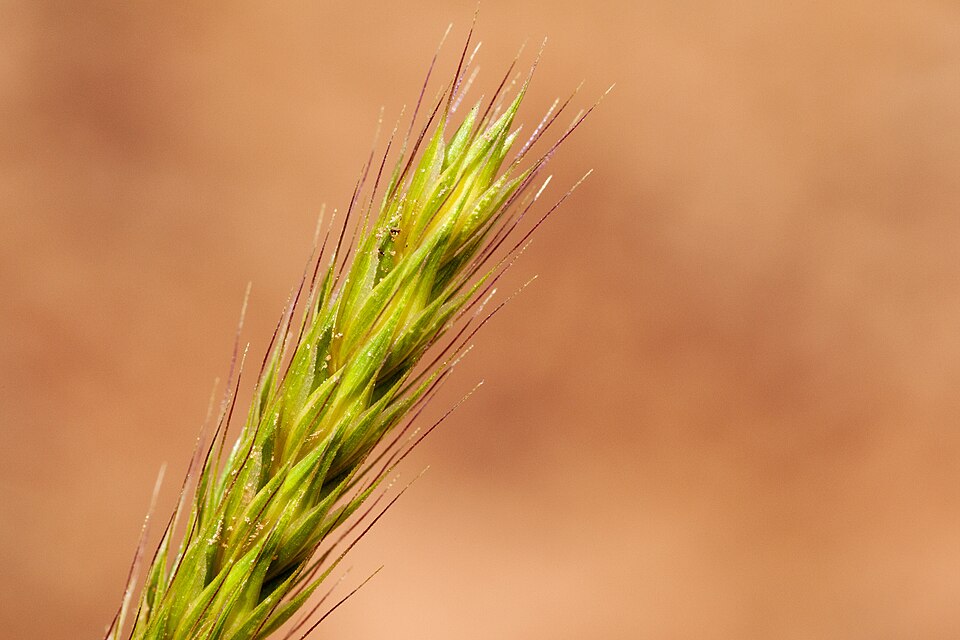
Hordeum pusillum (little barley) is a different species from Hordeum vulgare (Old World barley), the species Lehi's family from Jerusalem would have known. Finding a native New World barley removes the criticism that barley couldn't have existed in pre-Columbian America. But it is not the same as finding the specific Old World species Lehi's family would have cultivated. The discovery is consistent with the Book of Mormon's text without being a perfect bullseye.
The Book of Mormon's barley appears as both food (Mosiah 9:9) and as a unit of economic exchange (Alma 11:7). That dual role parallels ancient Mesopotamian practice, where barley served as both sustenance and standard monetary unit, a pattern not understood in detail until the Laws of Eshnunna were translated in the mid-twentieth century.[29]
Wheat
Wheat (Triticum) has not been archaeologically identified in pre-Columbian America. That gap is unresolved. Mosiah 9:9 lists "seeds of corn, and of wheat, and of barley" as separate cultivars, which means a translation-loan-shift defense has to operate three times in one verse: corn for maize, barley for Hordeum pusillum, wheat for amaranth or Chenopodium or some other native grain.[3:4] The translation argument is plausible but unverifiable, and no physical evidence currently exists. Wheat is the weakest item on the plant list.
Metals
Working vs. Smelting
Three categorically different technologies have to be kept apart:
- Iron-ore working: grinding, polishing, and shaping native iron-bearing minerals. Did exist in pre-Columbian America.
- Iron smelting: extracting metallic iron from ore, then forging it into tools and weapons. Did not exist in pre-Columbian America.
- Steel production: carburizing iron to create deliberately hardened steel. Did not exist in pre-Columbian America.
The Old World steel passages (Laban's sword, Nephi's bow) are well supported by archaeology. The New World iron and steel passages remain open, with the apologetic response markedly weaker.
Steel: Old World
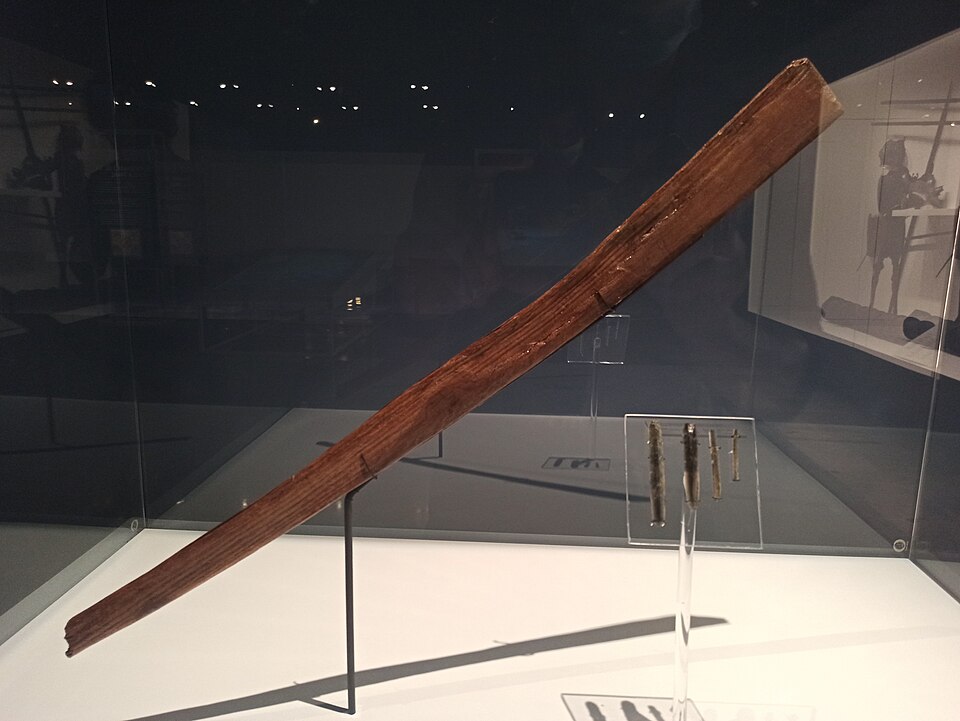
The Vered Jericho sword, which opened this article, is the anchor. Avraham Eitan's metallurgical analysis confirmed that "the iron was deliberately hardened into steel," and the blade, now held at the Israel Museum, has been called "the only complete sword of its size and type from this period yet discovered in Israel."[30] [31] [32] That establishes the category 1 Nephi 4:9 describes: deliberately carburized steel at Laban's exact period and region, demonstrably real. The gold-hilted parallel comes from Tutankhamun's tomb (14th century BC, some 700 years earlier), so the individual elements of Laban's sword are each attested in the broader ancient Near East, just not all in one exemplar.

The Vered Jericho blade is not an isolated outlier. Carburized-steel evidence runs back centuries before it:[33] [34]
- 14th century BC: Armenian smiths discover carburization
- 13th century BC: iron pick from Mt. Adir, northern Galilee, with full quench-hardened steel
- 11th century BC: carburized iron knife from a Philistine tomb
- 10th century BC: blacksmiths "intentionally steeling iron" throughout the Eastern Mediterranean
Nephi's "steel" bow (1 Nephi 16:18). The Hebrew word nehoshet (נחושת), translated "steel" in the KJV (2 Samuel 22:35), actually means bronze. Modern English translations such as the NIV, NRSV, and NKJV uniformly render it "bronze." (For the broader pattern of 1769-KJV translation choices carried into the Book of Mormon, see KJV Mistranslations.) Nephi's "steel" bow was likely a composite bow reinforced with bronze sheeting; Tutankhamun's tomb held twenty-seven such bows. Composite bows are vulnerable to climate swings, which explains why Nephi's broke during the transition from a Mediterranean to an Arabian climate.[35]
Constrained usage pattern. Steel appears only five times in the Book of Mormon, with no references after roughly 400 BC, consistent with a technology Lehi's family carried but did not sustainably reproduce in the New World.[34:1]
Iron and Steel: New World
Here the picture inverts. The New World iron and steel passages are unresolved. The Book of Mormon describes Nephites teaching "to work in all manner of wood, and of iron, and of copper, and of brass, and of steel" (2 Nephi 5:15), a later generation "making all manner of tools of every kind to till the ground, and weapons of war" (Jarom 1:8), and Jaredites who "did molten out of the hill, and made swords out of steel" (Ether 7:9). No pre-Columbian iron furnaces, slag heaps, forged iron tools, iron weapons, or other traces of a smelting culture have been found anywhere in the Americas. That is a genuine gap.
What pre-Columbian America did have was extensive iron-ore working. Ann Cyphers Guillén excavated a workshop at San Lorenzo, Veracruz, that yielded polished, perforated ilmenite iron-ore beads dating to about 1100 BC. The beads are thumb-sized, roughly two centimeters across, and multiply pierced; the holes were probably drilled with something harder than obsidian, possibly using wet quartz sand as an abrasive. The Olmec also produced concave iron-ore mirrors of magnetite and ilmenite.[36] [37] [38] [34:2]
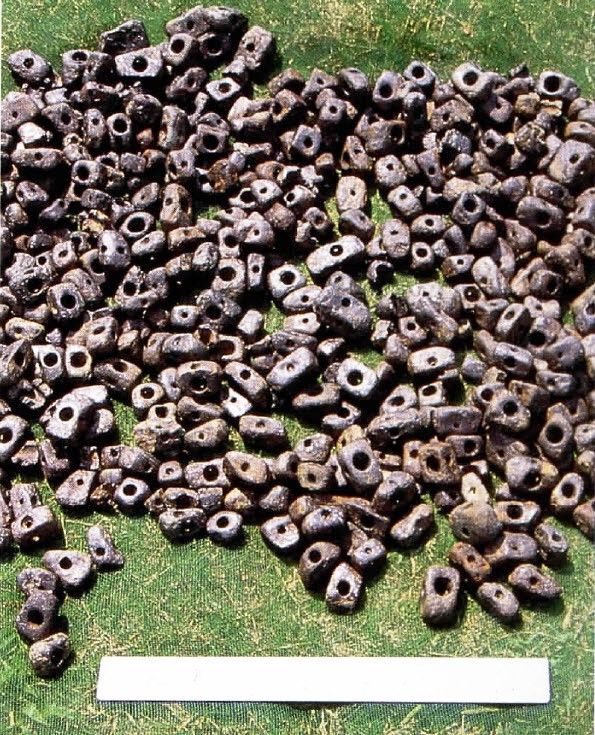
But ore-working is not smelting. Ground and polished beads show skilled craftsmanship; they do not show the extraction of metallic iron from ore in furnaces, nor the forging of tools and weapons. Apologetic literature that gestures at Olmec ilmenite as though it answered the Book of Mormon's iron-tools and iron-weapons passages is conflating categories. The verdict here matches the critics': for New World ferrous metallurgy, the evidence isn't there.
Ether 10:23 has the Jaredites "make gold, and silver, and iron, and brass, and all manner of metals" and also "dig it out of the earth," casting up "mighty heaps of earth to get ore, of gold, and of silver, and of iron, and of copper." Gold, silver, and iron sit in both lists, so the verse draws no clean line between what was mined and what was manufactured. Brass is the exception: it is made and never dug, which is metallurgically right, since brass is an alloy and has to be produced rather than pulled out of the ground.[34:3]
Textiles
Silk and Linen
The CES Letter assumes "silk" must mean Asian Bombyx mori silkworm silk. Sorenson documented "almost an embarrassment of riches" for the silk and linen of Alma 1:29.[39] [40] [41] Wild silk moths (Eucheira socialis and Gloveria psidii) produced actual silk in Mesoamerican regions. Ceiba (silk-cotton/kapok) produced fibers Diego de Landa called "silk" in 1566. Silkgrass (Achmea magdalenae) produced "genuinely silky cloth," and Mexican cotton was woven so finely that Spanish conquistadors compared it to silk. Wild silk also predates Chinese sericulture: Harappan sites in India (2450-2000 BC) yielded wild silk fibers.[42]
Pre-Columbian materials answering to "linen" include henequen (Agave fourcroydes), yucca, bark cloth from American fig trees, and cotton. Webster's 1828 dictionary defined "linen" first as cloth "made of flax or hemp," and then, as an adjective, as anything "resembling linen cloth; white; pale." That second sense is the one that allows semantic flexibility in translation.[41:1] [42:1]
Technology and Culture
Chariots
The Book of Mormon mentions chariots in only three passages (Alma 18:9-12; Alma 20:4-7; 3 Nephi 3:22), all between roughly 90 BC and AD 16.
Chariots are never mentioned in a battle context. Again, a stark departure from biblical, Egyptian, Assyrian, Hittite, and Israelite warfare. Book of Mormon chariots appear only in royal and diplomatic settings: Ammon prepares King Lamoni's "horses and chariots" for a state visit; Lamoni requests them for a diplomatic mission.[43] [3:5]
The litter/palanquin hypothesis. The Hebrew afiryon (אפריון, Song of Solomon 3:9) is translated "chariot" in the KJV but actually denotes a sedan chair carried by servants. Maya kings were "borne in litters, often made of simple rushes." The earliest known Mesoamerican litter depiction is on Izapa Stela 21 (~300-50 BC), contemporary with the Book of Mormon chariot references.[43:1] [44]
The litter hypothesis only handles the chariot side. The horse side still requires either the post-Pleistocene-survival hypothesis (Miller 2022, qualified above) or the loan-shifting hypothesis. Two contested hypotheses stacked together are weaker than either alone.
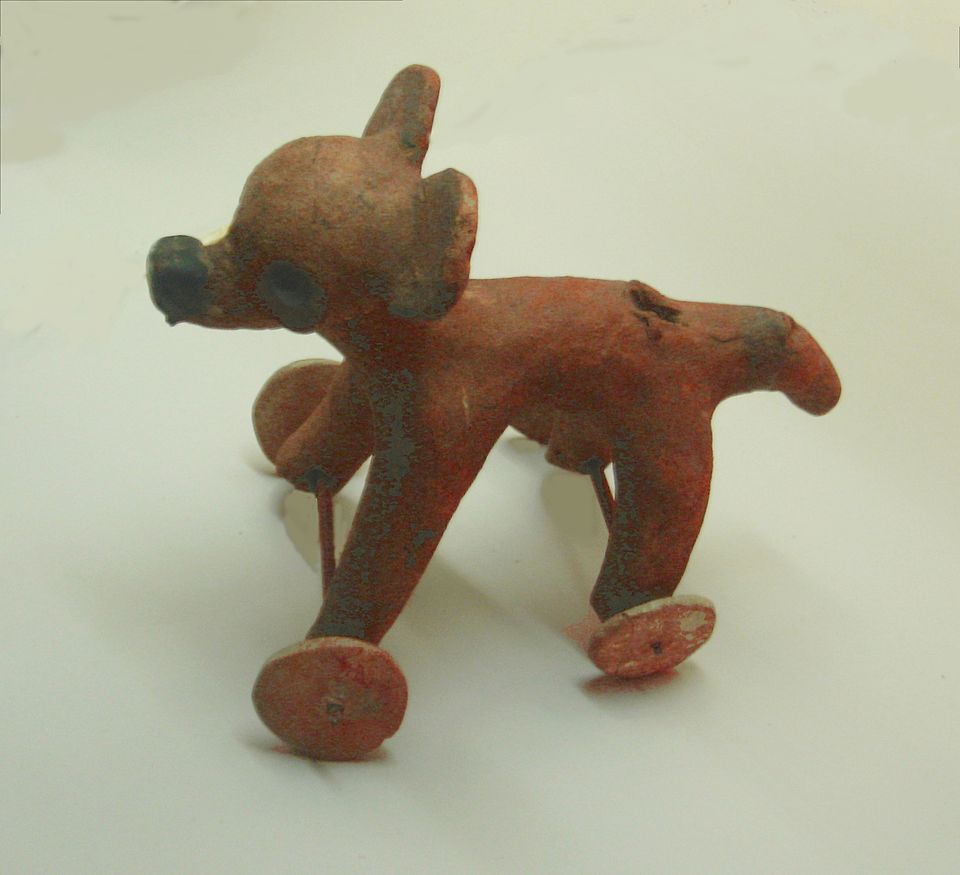
Wheeled figurines. Roughly one hundred wheeled clay figurines from Mesoamerica show that pre-Columbian peoples understood the wheel even if full-scale wheeled transport was not used.[45] [46] The CES Letter's separate listing of "wheels" alongside "chariots" inflates the count: the standalone word "wheels" in a pre-Columbian American context does not appear in the Book of Mormon text at all.
Cimeters (Curved Swords)
The Book of Mormon uses "cimeter" (an alternate spelling of "scimitar") for a curved blade in warfare (Enos 1:20; Mosiah 9:16; Alma 27:29; Alma 43:18). Curved weapons are now well attested in pre-Columbian Mesoamerica from pre-Classic times forward:[46:1] [47]
- 1500-900 BC: San Lorenzo (Olmec) monuments with curved weapons
- ~AD 450: Teotihuacan warriors with curved scimitar-like daggers
- ~AD 790: Bonampak murals with curved-blade weapons
- The macuahuitl: a hardwood base set with obsidian or flint blades along both edges
In the Old World, curved blades of the sickle-sword type are well attested across the ancient Near East and in pre-exilic Israel, and some biblical scholars hold that the Hebrew kidon, found in the Hebrew Bible and the Dead Sea Scrolls, refers to a scimitar.[46:2]
Coins / Weights and Measures
The Book of Mormon never mentions "coins." The word appears nowhere in the 1830 edition. It entered the apparatus printed around the text rather than the text itself. A reference index accompanying the 1841 edition was the first Latter-day Saint publication to file Alma 11 under coins, and the chapter headings composed for the 1920 edition summarized that chapter as "Nephite coins and measures." The current edition's heading drops the word and reads "The Nephite monetary system is set forth."[48] [49]
What Alma 11 describes is a weights-and-measures system: "the different pieces of their gold, and of their silver, according to their value" (Alma 11:4), named and standardized units with fixed exchange rates.
The terminology correction matters (the CES Letter criticizes a word that does not appear in the text), but it does not resolve the deeper question. Whether you call them "coins" or "weights," Alma 11 describes named, standardized precious-metal units with fixed barley-equivalent exchange rates. That is an Old World construct paralleling Mesopotamian practice. Pre-Columbian Mesoamerican economies generally ran on barter, with cacao beans, textiles, and copper axe-money as media of exchange. The terminology issue is resolved; the system question is not.
The Laws of Eshnunna parallel. John W. Welch identified striking structural parallels between the Nephite system and the Laws of Eshnunna (early 18th century BC, Mesopotamia):[50] [29:1] [51]
| Feature | Laws of Eshnunna | Alma 11 |
|---|---|---|
| Format | List of exchange equivalencies | List of exchange equivalencies |
| Opening phrasing | "1 kor of barley is (priced) at 1 shekel of silver" | "A senum of silver was equal to a senine of gold" |
| Primary conversion | Between barley and silver | Between barley and silver/gold |
| Purpose | Standardize daily wages | Standardize daily wages (judges) |
The parallel is a sharp, specific match within a broader genre of ancient Near Eastern weights-and-measures systems. Some of the genre's general features (barley as an economic unit; cf. Hosea 3:2) were available through biblical scholarship in 1829. The precise structural parallels were not: the format of equivalency lists, the dual-conversion logic, the daily-wage anchoring. The Laws of Eshnunna were not translated and made available to scholars until the mid-twentieth century.
Synagogues
Critics argue that synagogues did not exist before the Babylonian captivity (586 BC), so pre-exilic Nephites could not have had them.
Mainstream scholarship has weakened that objection. William J. Adams Jr. reports that Lee I. Levine, a leading scholar of synagogue history, has suggested synagogues did exist before the Babylonian captivity in the form of gate chambers, excavated at Beersheba, Gezer, Lachish, and Megiddo. Each of those gates, Adams notes, has at least one nearly square chamber lined with stone benches around the interior walls, and Levine's conclusion is that later synagogues closely mirror the architecture of the gate chambers. Several Old Testament passages (Hosea 2:11; Lamentations 2:6; Ezekiel 44:24) link Sabbath worship with the Hebrew moʿed, which Adams glosses "assembly, meeting."[52] [53] [54] The gate-chamber argument is influential but not unanimous. What is clear is that the older blanket claim of "no pre-exilic assembly worship" is no longer the field's default.
Pre-Columbian Semitic and Egyptian Inscriptions
Mesoamerica preserves multiple writing systems (Maya, Zapotec, Isthmian, Epi-Olmec), none deciphered as Semitic or Egyptian. No inscription in any Old World script has been confirmed at any pre-Columbian American site. Writing on stone is among the most durable archaeological evidence, and even brief contacts (the Norse at L'Anse aux Meadows) left identifiable traces.
Several partial responses exist, none of them complete:
- An evolved liturgical script. Mormon 9:32-34 states that the Nephites' written language had been "altered by us, according to our manner of speech" and that "none other people knoweth our language." If the Nephite script evolved into a form known only to Nephite record-keepers, mainstream Egyptologists would not be expected to recognize it.
- Population-level scripts. Day-to-day record-keeping might have used local scripts, with "Reformed Egyptian" reserved for sacred records on metal plates that were then buried.
- Papyrus Amherst 63. A 4th-century-BC Egyptian papyrus contains Aramaic-language texts written in Egyptian demotic script, a real ancient practice of recording Semitic content in modified Egyptian writing. This refutes the categorical claim that "Reformed Egyptian" is an absurd fabrication; the practice the Book of Mormon describes was attested in Lehi's broader cultural world. (See Archaeology.)
- Limited geography and preservation. Inscription-focused archaeology has not specifically targeted the proposed Book of Mormon region. See Geography for Limited Geography Model details.
- Brian Stubbs's Uto-Aztecan/Semitic loanword research is contested and has not been accepted by mainstream linguistics; noted here only for completeness.
This is one of the genuinely difficult items, and the apologetic responses are partial. The Papyrus Amherst 63 precedent removes the strongest form of the criticism but does not by itself confirm New World inscriptions. For the broader translation context, see Book of Mormon Translation.
Windows
Ether 2:23 has the Lord rejecting windows for the Jaredite barges: "ye cannot have windows, for they will be dashed in pieces." The text itself shows awareness that windows would not work. Glass beads date to the third millennium BC in Mesopotamia; translucent Egyptian Bronze Age glass is well documented. The brother of Jared's "white and clear" stones (Ether 3:1) fit known ancient glass technology.[55] [42:2]
The Strongest Critical Arguments
The CES Letter's version of the anachronism criticism is not its most formidable form. The sections below meet the stronger arguments, the ones the CES Letter never raises.
Coe 1973: The Cumulative Cultural Mismatch
Michael D. Coe, a Yale Mayanist, framed the foundational mainstream critique not as a list of specific items but as a cumulative cultural mismatch.[8:1] The Book of Mormon describes a literate (in Old World scripts), iron-using, wheat-growing, horse-using, sheep-and-cattle-herding, Hebrew-derived civilization. The mainstream archaeological record shows a non-literate (in Old World scripts), copper-and-gold-working, maize-growing, deer-hunting, jaguar-revering, obsidian-using, ball-court-building Mesoamerican civilization. "The picture of this hemisphere between 2,000 B.C. and A.D. 421 presented in the book has little to do with the early Indian cultures as we know them," he wrote.[56] Placed against his own itemized list, that judgment is aimed at the whole cultural picture rather than at any single detail. He put it bluntly: "The bare facts of the matter are that nothing, absolutely nothing, has ever shown up in any New World excavation which would suggest to a dispassionate observer that the Book of Mormon, as claimed by Joseph Smith, is a historical document relating to the history of early migrants to our hemisphere."[57]
This is categorically different from an item-by-item list. Even if every individual item were resolved, the cumulative cultural picture would still not match. The Limited Geography Model (LGM), the proposal that Book of Mormon events occurred within a limited Mesoamerican region rather than across the whole hemisphere, is the apologetic attempt to reconcile this: Nephite culture as a small enclave with limited cultural exchange. But the LGM has internal problems. The Hill Cumorah debate is unsettled, and no specific Mesoamerican site has been identified as a Nephite city. The enclave proposal can explain why Nephite-specific traces would be locally limited, but it does not explain why no Nephite-specific traces of any kind have turned up anywhere in the broader region. Several specific Coe-listed items have shifted in the Book of Mormon's favor since 1973 (cement, barley, fortifications, Eshnunna), yet the framework-level question survives those individual corrections. Item-by-item progress leaves it standing. For the full discussion, see Geography and Archaeology.
Reverse Anachronisms
Now the argument that runs the other direction. Critics observe that the Book of Mormon names Old World items while failing to mention items central to pre-Columbian Mesoamerican life: cacao (the dominant trade commodity, ritual drink, and elite currency), jaguar (the most important animal in Maya religion), obsidian (the foundation of Mesoamerican lithic technology and the cutting edge of the macuahuitl), turkey (the only large domesticated bird), the ritual ball game (the most widespread shared cultural practice across Mesoamerica for 3,000-plus years), and quetzal feathers. Earl M. Wunderli's Dialogue critique developed this further.[8:2] [58]
This is the single most challenging argument for a Mesoamerican setting. Forward-anachronism arguments can be neutralized by archaeological discovery, as barley, cement, and pre-exilic synagogues were. The reverse-anachronism argument cannot. We know cacao, obsidian, jaguar, and the ball game were central; their absence from the text is not a sampling artifact waiting to be filled in.
Obsidian is the most pointed absence. The Book of Mormon contains roughly sixty chapters of warfare narrative with detailed weapon catalogs: swords, cimeters, spears, shields, bows, arrows, slings, javelins, darts, breastplates, head-plates. In any actual Mesoamerican military history, obsidian (the cutting material of the macuahuitl, traded across the entire region) would be everywhere. The translation framework can hypothetically render obsidian as "stone" or "flint," but the Book of Mormon does not name those materials in weapons contexts either. Its weapons are described in metallic terms.
The reverse-anachronism pattern is a real, currently unresolved challenge for the Mesoamerican Limited Geography Model, and the partial responses (abridgment selectivity, translation framework, cultural distinctiveness) each run into known limits.[59] It is a stronger objection to the Mesoamerican model than the forward-anachronism problem is to historicity in general. Pointing out that a 19th-century American author would also have unexplained absences (no tobacco, scalping, teepees) is interesting but does not dissolve the Mesoamerican-fit problem. The two patterns are not symmetric: missing tobacco is expected if a 19th-century author was deliberately avoiding frontier stereotypes for an "ancient Hebrew" setting; missing obsidian is not what we would expect from an authentic Mesoamerican military history.
The Cumulative Loan-Shift Burden
The criticism also runs at the level of the pattern rather than the items one at a time. Each item asks for a different explanation: late survival or loan-shift for horses, nehoshet-as-bronze for "steel" bows, ceiba fiber or wild silk moths for silk, loan-shift for wheat, litters for chariots, weights-and-measures for "coins," several separate loan-shifts for cattle/sheep/goats/swine.[60] [61] The simpler account, that a 19th-century author described an imagined ancient civilization using the vocabulary of his own time, covers every anachronism with one hypothesis.
The right reply is to grant the description and resist the verdict. The cumulative-doubt argument is descriptively correct: the faithful case does require multiple independent special explanations, and that carries a real probabilistic cost. But confirmations have also accumulated (Eshnunna, cement at the right date, attested Hebrew names, Nahom in Yemen, the fortifications at Becán). The skeptical list of unresolved or contested items is at least as long as the confirmation list, and the tally does not, by itself, decide the question either way.
The Loan-Shifting Trilemma
The loan-shifting defense faces a logical trilemma. Who is doing the loan-shifting?[62]
Horn 1: The Nephite authors. The Nephites brought Old World animals and knowledge with them (1 Nephi 18:25 mentions horses upon arrival). Encountering a tapir, they might call it something, but not "horse," because they already had a "horse" concept.
Horn 2: Mormon or Moroni (the editor). Same objection. They would have known these were not horses.
Horn 3: Joseph Smith (the translator). This collides with the tight-translation model suggested by Royal Skousen's textual research. Skousen's evidence indicates much of the English wording was received rather than composed by Joseph Smith, including archaic Early Modern English forms not part of his dialect.
The Book of Mormon's own translation behavior sharpens the puzzle. "Whale" (Ether 2:24) correctly renders a marine mammal. "Cureloms" and "cumoms" (Ether 9:19) leave unknown animals untranslated. If the mechanism could produce accurate terms for known animals and leave unknowns untranslated, why would it produce "horse" for a non-horse?
No current translation model fully accounts for the pattern. The partial responses on offer, tight-vs.-loose translation as a false binary and documented translation inconsistency in human practice, acknowledge the puzzle rather than resolve it.[63] The phenomenon of loan-shifting is itself documented; the mechanism by which it entered the Book of Mormon text is an open question. For the broader treatment, see Book of Mormon Translation; for the tight-translation evidence specifically, see Seer Stones.
The Professional Consensus
The mainstream archaeological community does not accept Book of Mormon historicity. The Smithsonian Institution has stated it has "never used the Book of Mormon in any way as a scientific guide." The National Geographic Society reports nothing has been found "that has substantiated the Book of Mormon."[9:1] [64] No non-Latter-day Saint archaeologist has endorsed the Book of Mormon as historical.
Thomas Stuart Ferguson, a faithful Latter-day Saint, lawyer, and founder of BYU's New World Archaeological Foundation (NWAF), the BYU-affiliated Mesoamerican archaeology institution, spent seventeen years and significant Church funding searching specifically for Book of Mormon evidence in Mesoamerica. He concluded in 1976: "[Y]ou can't set Book of Mormon geography down anywhere—because it is fictional and will never meet the requirements of the dirt-archaeology."[65] Ferguson's conclusion deserves serious weight. He started faithful and stayed engaged for nearly two decades.
More durable than Ferguson's individual faith crisis is the institutional record. The NWAF has gone on operating as a respected research institution, training Mesoamericanists who publish in mainstream venues. It has not identified a single artifact, inscription, or site as Book of Mormon-related. Two things are true at once: the field-wide consensus has not shifted, and the track record of specific Book of Mormon items has been one of steady revision in the Book of Mormon's favor (barley, cement, steel at 600 BC, pre-exilic synagogue worship, Hebrew names, Nahom). Both have to be held together. For the full archaeological treatment, see Archaeology.
Evidence Supporting Book of Mormon Authenticity
The Direction of the List
Matthew Roper's 280-page study in Interpreter (2025) tracked every item ever claimed as an anachronism in the Book of Mormon, from 1830 to 2024.[66] [67]
Roper's count needs the same scrutiny it asks of the critics' lists. The study appeared in Interpreter, a faith-affirming journal; it has not been peer-reviewed by non-Latter-day Saint scholars; the 226-item denominator is curated by Roper himself, with significant judgment calls about what counts as "confirmed." Roper's "confirmed" category ranges from items now accepted by mainstream archaeology (cement, pre-exilic worship assemblies) to items where Latter-day Saint scholars have identified plausible parallels but mainstream consensus has not shifted. Neither numerator nor denominator is independent of apologetic priors.
The most defensible reading is that the data documents a direction (items move one way, from unconfirmed to confirmed) across a 195-year span. Treat the trajectory as suggestive, not as settled science.
With those caveats in view, Roper's own totals run as follows. He reports that 90.2 percent of alleged anachronisms remained unconfirmed in 1844, and that the figure now stands at 9.29 percent. His first-period counts behind that opening figure are ninety-three unconfirmed of 102 claimed, which works out a shade higher than the percentage he prints. The catalog grows to 226 items by 2024, of which he scores 174 confirmed, thirty-one partially confirmed, and twenty-one unconfirmed. He prints no figure for 1965, the boundary between his second and third phases. His second-phase counts, 122 unconfirmed of 168 claimed, put it near 73 percent.[66:1]
The unidirectional trajectory is the durable observation: items move from unconfirmed to confirmed, and no confirmed item moves back. John E. Clark of the New World Archaeological Foundation reviewed sixty items raised by three popular nineteenth-century critics and found that about 60 percent had been resolved in the Book of Mormon's favor: "The overall trend in the data over the past 175 years fits the expectations for the Book of Mormon as history rather than hoax." Clark was careful about how much that number can bear: his sixty items were a small slice of the criticisms in print, chosen to show which way things were moving rather than to stand in for the whole body of them.[68]
Cement at the Right Time
Helaman 3:7-11, dated to 46 BC in the Book of Mormon's chronology, reports that Nephite dissenters moved to "the land northward" and became "exceedingly expert in the working of cement." Mesoamerican structural cement appears suddenly in the archaeological record, beginning in the middle of the first century BC. John L. Sorenson put the alignment this way: "No one in the nineteenth century could have known that cement, in fact, was extensively used in Mesoamerica beginning at about this time, the middle of the first century BC."[69] Joseph Smith had no source for it. David S. Hyman's foundational 1970 study of Mesoamerican cement was 140 years away.[7:1] For the broader treatment of cement in Mesoamerica (including the dating breakdown and Sorenson's analysis), see Archaeology.
Pre-Columbian Barley
The 1983 discovery of domesticated Hordeum pusillum, and the later expansion of its known range across Iowa, Illinois, Kentucky, Oklahoma, and Colorado, confirmed that barley existed in pre-Columbian America in a form a translator could call "barley." With the species caveat above (pusillum is not Old World vulgare), this remains the cleanest example available of "the Book of Mormon was right and 19th-century critics were wrong."[22:1] [23:1]
Nahom (NHM Altars) in Yemen
The Book of Mormon identifies "Nahom" as a pre-existing place name where Ishmael was buried (1 Nephi 16:34). Three votive altars from the Bar'an Temple at Ma'rib, Yemen, excavated by the German Archaeological Institute, bear inscriptions naming the NHM tribal region (the consonantal root N-H-M, matching the Book of Mormon place "Nahom"). The region sits on the major incense trade route, with an eastward turn matching 1 Nephi 17:1, and later analysis pushed the altars back to the eighth or seventh century BC, in or just before Lehi's lifetime. What makes this case unusual is that the text names a place rather than inventing one.[70] [71] The full treatment, including Neal Rappleye's 2024 multi-line convergence analysis and the counterargument from Carsten Niebuhr's 1772 map, is in the Archaeology article.[72]
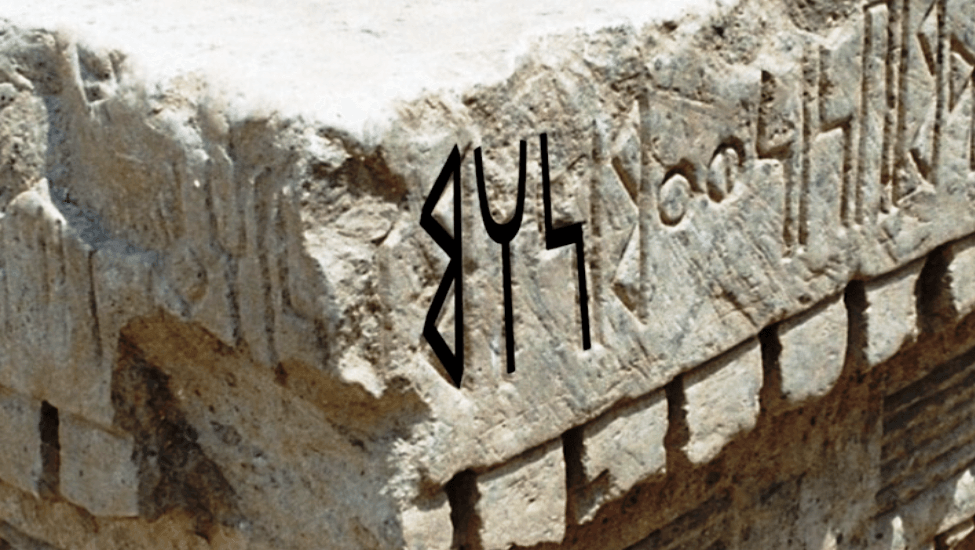
Hebrew Names: Sariah, Alma, Mulek
Sariah (Lehi's wife) was found on an Aramaic ostracon from a Jewish community in Elephantine, Egypt (fifth century BC). The decisive evidence is the Cairo Storeroom Ostracon 2293 (= TAD D9.14.5), preserving "śryh brt" ("Seraiah daughter of") with no textual restoration required.[73] [74] [75] Seraiah appears in the Hebrew Bible only as a masculine name. The Book of Mormon's use as a feminine form has been independently attested in Aramaic Jewish documents from exactly the right post-Lehi period.
Alma. Critics ridiculed "Alma" for over a century as a Latin feminine name implausibly hung on a Hebrew man. A Jewish document from the early second century AD attested ʿalmāʾ / "Alma" as a genuine Hebrew masculine personal name.[74:1] [76]
Mulek is now recognized as a hypocoristic (shortened form) for biblical Malchiah/Melchiah (Hebrew Mlkyh(w)). Malchiah appears in Jeremiah 38 as a son of King Zedekiah, exactly the figure the Book of Mormon claims escaped to the New World (Helaman 6:10; 8:21).[74:2]
The strongest cases, Sariah on the Elephantine ostracon and Mulek/Malchiah, are tight, independent, externally datable matches. The BYU Book of Mormon Onomasticon catalogs roughly forty Book of Mormon names with proposed ancient Hebrew, Egyptian, or Greek parallels.[75:1] The broader "names" claim should be treated as suggestive trajectory rather than confirmed match-count: phonetic matches involve interpretive judgment, and the catalog is curated by an LDS-affiliated source. But the strongest individual cases are not weakened by the softer tail of the broader list.
Mesoamerican Fortifications
Mesoamerican fortifications matching Alma 50's descriptions of earthen ridges, ditches, palisades, and towers are now well documented at Becán (Campeche, ~AD 100-300) and 50-plus other Late Preclassic sites, a category of evidence that simply did not exist when 19th-century critics first targeted Book of Mormon warfare. For the full archaeological treatment (including Webster's Becán dimensions, the 2016 PACUNAM LiDAR data, and the El Zotz watchtowers), see Archaeology.
Volcanic and Seismic Destruction in 3 Nephi
3 Nephi 8 describes catastrophic destruction at Christ's death (~AD 33-34): earthquakes, three days of darkness, cities sunk and burned. Bart J. Kowallis, a BYU geologist, analyzed this in BYU Studies and concluded that 3 Nephi's description requires both a volcano and a regional earthquake, with the best-fit scenario being a strike-slip fault zone near a coast with an active volcano nearby. Several lines support the fit. The Tacana volcano near Izapa erupted in the early Common Era; Popocatepetl erupted during the early to mid-first century AD; a stratospheric volcanic signal in Greenland ice cores in the early first century AD has been argued to correspond to the 3 Nephi destruction; and "three days of darkness" specifically matches volcanic ash-cloud behavior.[77] [78] [79] [80]
Self-Limiting Patterns
The strongest single member of this category is cement: the chronological alignment is precise and unmotivated by any pre-1970 source a fabricator could have reached. Several other features point the same way with less weight, since they have ordinary alternative explanations: elephants restricted to the Jaredite period (a 19th-century author following biblical chronology might confine exotic megafauna to early periods anyway); cureloms and cumoms left untranslated (a fabricator could also use untranslated terms for ancient flavor); no explicit cavalry warfare (striking for a 19th-century author drawing on biblical models, though biblical patterns do include royal chariots); steel constrained to specific contexts; chariots only in royal or diplomatic settings; horses rare in a text the current edition prints at 531 pages. The cumulative pattern points the same direction as the individual confirmations, but cement is the one piece carrying real weight.[3:6] [11:3] [81]
Assessment
The CES Letter presents thirteen items in a single sentence, cites only a Wikipedia article, and dismisses the scholarly responses with a joke about tapirs. That is not serious analysis. The real state of the evidence is a gradient, and it sorts into four buckets.
Resolved, or straw men in the first place. Coins (the Book of Mormon never says it; the underlying weights-and-measures system is a separate question, taken up below); barley (native barley confirmed in pre-Columbian America since 1983, with the species caveat); cement (confirmed, with chronological alignment); steel in the Old World (confirmed by the Vered Jericho sword for Laban's era); windows (the text itself rejects them on the Jaredite barges); cimeters (curved weapons attested in Mesoamerica from pre-Classic times).
Strong evidence. Silk (multiple pre-Columbian silk and silk-like materials documented); iron in the Old World (uncontested for Lehi's era); the strongest individual name attestations (Sariah on the Elephantine ostracon, Mulek as hypocoristic for Malchiah); Nahom / NHM (German archaeological confirmation in Yemen at the right date and place); the Eshnunna structural parallel; fortifications (Becán plus 50-plus Late Preclassic sites at the right period); pre-exilic Hebrew assembly worship.
Moderate evidence, real tension. Horses (Miller et al. 2022 reports post-Pleistocene dates but has not been accepted by mainstream paleontology; the textual restraint is notable); elephants (restricted to the Jaredite period, consistent with late megafauna survival, though a chronological gap remains); chariots (litter/palanquin hypothesis with archaeological support, but stacking it on the horse hypothesis is two contested hypotheses combined); cattle/sheep/goats/swine (loan-shifting is documented, but applying it to several animals raises the explanatory burden); the broader list of Hebrew name parallels (the strongest cases are tight; the rest involve more interpretive judgment); the weights-and-measures system behind Alma 11 (the Eshnunna parallel is strong; whether such a system fits Mesoamerica is not settled).
Genuinely difficult. Wheat (no pre-Columbian evidence; Mosiah 9:9 needs multiple loan-shifts in one verse); New World iron and steel smelting (no furnaces, no slag heaps, no forged ferrous tools; ore-working is not smelting); domesticated animal husbandry at scale (loan-shifting addresses terminology, not herd-level domestication); the reverse-anachronism pattern (the absence of cacao, jaguar, obsidian, turkey, and the ball game from a text purportedly set in Mesoamerica is real and unresolved); pre-Columbian Semitic or Egyptian inscriptions (none found, and inscribed stone is among the most durable evidence there is).
Read across those four columns and a single observation falls out: the list of specific alleged anachronisms has not grown as critics in 1830 might have predicted. It has shrunk, sharply. Items once treated as definitive disproofs have been quietly dropped: pre-Columbian barley, Mesoamerican cement at the right date, steel at 600 BC, pre-exilic Hebrew assembly worship, cimeters in pre-Classic Mesoamerica, the Eshnunna parallel, attested Hebrew names, Nahom in Yemen. That trajectory is the article's central positive observation, and it is the one the CES Letter's flat list reverses.
But the right-hand columns do not empty out. The field-wide consensus has not moved with the item-level trajectory. The professional archaeological community still does not accept Book of Mormon historicity, and the reverse-anachronism pattern, the loan-shifting trilemma, New World iron smelting, wheat, and pre-Columbian Semitic inscriptions all remain open. The sharpest of these is obsidian: sixty chapters of Mesoamerican warfare that never name the stone every Mesoamerican army actually fought with. No future excavation can resolve that one. The silence is in the text, and no dig reaches it.
Both halves of the ledger are true at the same time. The catalog of specific anachronisms has substantially shrunk; the framework-level question, whether the whole cultural picture fits a Mesoamerican setting, stays open. The anachronism debate cannot settle the historicity question by itself. It can only narrow the field of plausible explanations, and the narrowing has not emptied either column.
That leaves the sword we started with. A complete steel blade, at Laban's time and in Laban's region, sitting in a museum case: an item the critics' list still does not mention, answering a verse the critics once said could not be true. Not every item on the ledger resolves that cleanly, and several never will. But the direction of travel, item after item across nearly two centuries, has run toward the text and not away from it.
Further Reading
- Matthew Roper, "Anachronisms: Accidental Evidence in Book of Mormon Criticisms," Interpreter 65 (2025): 1-280
- Brant A. Gardner, "Anachronisms in the Book of Mormon," in A Reason for Faith (BYU RSC; Deseret Book, 2016)
- John E. Clark, "Archaeology, Relics, and Book of Mormon Belief," Journal of Book of Mormon Studies 14, no. 2 (2005)
- John E. Clark, "Archaeological Trends and Book of Mormon Origins," BYU Studies Quarterly 44, no. 4 (2005): 83-104
- Neal Rappleye, "Revisiting Sariah at Elephantine," Interpreter 32 (2019)
- John L. Sorenson, "How Could Joseph Smith Write So Accurately about Ancient American Civilization?" in Echoes and Evidences of the Book of Mormon (Provo, UT: FARMS, 2002), 287
- For the full archaeological picture, see Archaeology
- For Limited Geography Model debates, see Geography
- For DNA-related questions, see DNA and the Book of Mormon
- For translation-mechanism questions, see Book of Mormon Translation
Runnells, CES Letter (2017), "Book of Mormon," no. 5, p. 11. ↩︎ ↩︎ ↩︎
Runnells, CES Letter (2017), "Book of Mormon," no. 5, p. 11. ↩︎
Brant A. Gardner, "Anachronisms in the Book of Mormon," in A Reason for Faith: Navigating LDS Doctrine & Church History, ed. Laura Harris Hales (Provo, UT: BYU Religious Studies Center; Salt Lake City: Deseret Book, 2016), 33-44. https://rsc.byu.edu/reason-faith/anachronisms-book-mormon ↩︎ ↩︎ ↩︎ ↩︎ ↩︎ ↩︎ ↩︎
"Loanshifting: deer and tapirs," FAIR. https://www.fairlatterdaysaints.org/answers/Book_of_Mormon/Anachronisms/Animals/Horses/Loanshifting:_deer_and_tapirs ↩︎ ↩︎
John L. Sorenson, An Ancient American Setting for the Book of Mormon (Salt Lake City: Deseret Book; Provo, UT: FARMS, 1985), 294, quoted in "Book of Mormon/Animals/Cattle," FAIR, https://www.fairlatterdaysaints.org/evidences/Category:Book_of_Mormon/Animals/Cattle. The examples cited there include the Miami calling the buffalo "wild cows," the explorer DeSoto calling it "vaca, cow," the Delaware naming the cow after the deer, and the Miami labeling sheep "looks-like-a-cow." ↩︎ ↩︎
Philip W. Signor and Jere H. Lipps, "Sampling Bias, Gradual Extinction Patterns, and Catastrophes in the Fossil Record," Geological Society of America Special Paper 190 (1982): 291-296. ↩︎
David S. Hyman, Precolumbian Cements: A Study of the Calcareous Cements in Prehispanic Mesoamerican Building Construction (Baltimore: Johns Hopkins University, 1970). ↩︎ ↩︎
Michael D. Coe, "Mormons and Archaeology: An Outside View," Dialogue: A Journal of Mormon Thought 8, no. 2 (1973): 40-48. ↩︎ ↩︎ ↩︎
Smithsonian Institution, Statement Regarding the Book of Mormon (1979 revision; subsequently revised in 1998 to remove specific archaeological objections); see also John L. Sorenson, "An Evaluation of the Smithsonian Institution Statement Regarding the Book of Mormon" (FARMS, 1982/1995). https://archive.bookofmormoncentral.org/sites/default/files/archive-files/pdf/sorenson/2019-01-04/john_l._sorenson_an_evaluation_of_the_smithsonian_institution_statement_regarding_the_book_of_mormon_1982.pdf ↩︎ ↩︎
John L. Sorenson, Mormon's Codex: An Ancient American Book (Provo, UT: Maxwell Institute; Salt Lake City: Deseret Book, 2013). ↩︎
Matthew Roper, "Anachronisms: Accidental Evidence in Book of Mormon Criticisms — Chapter 1: Book of Mormon Animals," Interpreter: A Journal of Latter-day Saint Faith and Scholarship 65 (2025): 9-50. https://interpreterfoundation.org/journal/anachronisms-accidental-evidence-in-book-of-mormon-criticisms-book-of-mormon-animals ↩︎ ↩︎ ↩︎ ↩︎
Wade E. Miller, Gilberto Pérez-Roldán, Jim I. Mead, Rosario Gómez-Núñez, Jorge Madrazo-Fanti, and Isaí Ortiz-Pérez, "Post-Pleistocene Horses (Equus) from México," Texas Journal of Science 74, no. 1 (2022): 21-34. https://www.researchgate.net/publication/364544950 ↩︎
James Haile, Duane G. Froese, Ross D. E. MacPhee, et al., "Ancient DNA Reveals Late Survival of Mammoth and Horse in Interior Alaska," Proceedings of the National Academy of Sciences 106, no. 52 (2009): 22352-22357. ↩︎
Mario Pichardo, "Review of Horses in Paleoindian Sites of the Americas," Anthropologischer Anzeiger 62, no. 1 (2004): 11-35, at 28. ↩︎
"A short critique of pre-Columbian horses as evidence for the authenticity of the Book of Mormon," A Careful Examination, August 2023. https://faenrandir.github.io/a_careful_examination/short-critique-horses-bom/ ↩︎
Wade E. Miller, "Elephants in the Book of Mormon," in Science and the Book of Mormon: Cureloms, Cumoms, Horses & More (Laguna Niguel, CA: KCT & Associates, 2009), 47-53. ↩︎ ↩︎
Sergey L. Vartanyan, Khikmat A. Arslanov, Tatyana V. Tertychnaya, and Sergey B. Chernov, "Radiocarbon Dating Evidence for Mammoths on Wrangel Island, Arctic Ocean, until 2000 BC," Radiocarbon 37, no. 1 (1995): 1-6; cf. Vartanyan, Garutt, and Sher, "Holocene Dwarf Mammoths from Wrangel Island in the Siberian Arctic," Nature 362 (1993): 337-340. ↩︎
Eleftheria Palkopoulou, Mark Lipson, Swapan Mallick, et al., "A Comprehensive Genomic History of Extinct and Living Elephants," Proceedings of the National Academy of Sciences 115, no. 11 (2018): E2566-E2574. ↩︎
Adrienne Mayor, Fossil Legends of the First Americans (Princeton, NJ: Princeton University Press, 2005). ↩︎
"Traditions of Horses and Elephants," Evidence Central, Scripture Central. https://scripturecentral.org/evidence/traditions-of-horses-and-elephants-1 ↩︎
"Why Does the Book of Mormon Mention Elephants, Cureloms, and Cumoms?" KnoWhy, Scripture Central. https://scripturecentral.org/knowhy/why-does-the-book-of-mormon-mention-elephants-cureloms-and-cumoms ↩︎
Daniel B. Adams, "Last Ditch Archeology," Science 83 4, no. 10 (December 1983): 32. ↩︎ ↩︎
Anna F. Graham, Karen R. Adams, Susan J. Smith, and Terence M. Murphy, "A New Record of Domesticated Little Barley (Hordeum pusillum Nutt.) in Colorado: Travel, Trade, or Independent Domestication," KIVA 83, no. 4 (2017): 414-442. https://escholarship.org/uc/item/1v84t8z1 ↩︎ ↩︎
National Park Service, "Little Barley (Hordeum pusillum)." https://www.nps.gov/articles/000/little-barley-hordeum-pusillum.htm ↩︎
Vorsila L. Bohrer, "Domesticated and Wild Crops in the CAEP Study Area," in Prehistoric Cultural Development in Central Arizona: Archaeology of the Upper New River Region, ed. Patricia M. Spoerl and George J. Gummerman, Occasional Paper 5 (Carbondale: Southern Illinois University, Center for Archaeological Investigations, 1984), 252. ↩︎
Nancy B. Asch and David L. Asch, "Archeobotany," in The Hill Creek Homestead and the Late Mississippian Settlement in the Lower Illinois Valley, ed. Michael D. Conner, Kampsville Archeological Center Research Series, Vol. 1 (Kampsville, IL: Center for American Archeology, 1985), 115-170. ↩︎
Michael T. Dunn and William Green, "Terminal Archaic and Early Woodland Plant Use at the Gast Spring Site (13LA152) Southeast Iowa," Midcontinental Journal of Archaeology 23, no. 1 (1998), at 64. https://www.jstor.org/stable/20708423. KnoWhy #87, endnote 5, credits this page for the quoted sentence and describes the authors as non-Latter-day Saint scholars. ↩︎
"How Can Barley in the Book of Mormon Feed Faith?" KnoWhy #87, Scripture Central. https://scripturecentral.org/knowhy/how-can-barley-in-the-book-of-mormon-feed-faith ↩︎
John W. Welch, "Weighing and Measuring in the Worlds of the Book of Mormon," Journal of Book of Mormon Studies 8, no. 2 (1999): 36-45. ↩︎ ↩︎
Avraham Eitan, "Rare Sword of the Israelite Period Found at Vered Jericho," Israel Museum Journal 12 (1994): 61-62; see also A. Eitan, Excavations and Surveys in Israel 2 (1983): 106-107. ↩︎
"Laban's Steel Sword," Evidence Central, Scripture Central. https://scripturecentral.org/evidence/book-of-mormon-evidence-laban-s-steel-sword ↩︎
Hershel Shanks, "Antiquities director confronts problems and controversies," Biblical Archaeology Review 12, no. 4 (1986): 33, 35. This is the source Evidence Central credits for the assessment that the Vered Jericho blade is "the only complete sword of its size and type from this period yet discovered in Israel." The Israel Museum plaque language quoted on the same page is the shorter "iron hardened into steel." (Evidence Central prints the author's given name as "Hershall.") ↩︎
Herbert Maryon et al., "Early Near Eastern Steel Swords," American Journal of Archaeology 65, no. 2 (1961): 173-184. ↩︎
Matthew Roper, "Anachronisms: Accidental Evidence in Book of Mormon Criticisms — Chapter 3: Metals and Metallurgy," Interpreter 65 (2025): 93-112. https://interpreterfoundation.org/journal/anachronisms-accidental-evidence-in-book-of-mormon-criticisms-chapter-3-metals-and-metallurgy ↩︎ ↩︎ ↩︎ ↩︎
"Nephi's Steel Bow," Evidence Central, Scripture Central. https://scripturecentral.org/evidence/book-of-mormon-evidence-nephi-s-steel-bow ↩︎
Steven E. Jones, Samuel T. Jones, and David E. Jones, "Archaeometry Applied to Olmec Iron-ore Beads," BYU Studies Quarterly 37, no. 4 (1997): 129-142. https://scholarsarchive.byu.edu/byusq/vol37/iss4/8/ ↩︎
Luis M. Alva-Valdivia, Ann Cyphers, Maria de la Luz Rivas-Sánchez, Amar Agarwal, Judith Zurita, and Jaime Urrutia-Fucugauchi, "Mineralogical and Magnetic Characterization of Olmec Ilmenite Multi-Perforated Artifacts and Inferences on Source Provenance," European Journal of Mineralogy 29, no. 5 (2017): 851-860. https://www.researchgate.net/publication/317569649 ↩︎
"Olmec Iron," Evidence Central, Scripture Central. https://scripturecentral.org/evidence/book-of-mormon-evidence-olmec-iron ↩︎
John L. Sorenson, "Possible Silk and Linen in the Book of Mormon," in Reexploring the Book of Mormon: The FARMS Updates, ed. John W. Welch (Salt Lake City: Deseret Book, 1992), 162-164. The "embarrassment of riches" sentence is at p. 164; the KnoWhy above quotes it and credits it to that page at its endnote 27. ↩︎
"Silk," Evidence Central, Scripture Central. https://scripturecentral.org/evidence/book-of-mormon-evidence-silk ↩︎
"Did Book of Mormon Peoples Wear Silk and Linen?" KnoWhy, Scripture Central. https://scripturecentral.org/knowhy/did-book-of-mormon-peoples-wear-silk-and-linen. Endnote 6 reproduces the full Webster 1828 entry for "linen," which gives two noun senses and two adjective senses. ↩︎ ↩︎
Matthew Roper, "Anachronisms: Accidental Evidence in Book of Mormon Criticisms — Chapter 4: Ancient Culture," Interpreter 65 (2025): 113-152. https://interpreterfoundation.org/journal/anachronisms-accidental-evidence-in-book-of-mormon-criticisms-chapter-4-ancient-culture ↩︎ ↩︎ ↩︎
"What is the Nature and Use of Chariots in the Book of Mormon?" KnoWhy #126, Scripture Central. https://scripturecentral.org/knowhy/what-is-the-nature-and-use-of-chariots-in-the-book-of-mormon ↩︎ ↩︎
John L. Sorenson, An Ancient American Setting for the Book of Mormon (Salt Lake City: Deseret Book; Provo, UT: FARMS, 1985). ↩︎
John L. Sorenson, "Wheeled Figurines in the Ancient World" (Provo, UT: FARMS Preliminary Report, 1981). ↩︎
Matthew Roper, "Anachronisms: Accidental Evidence in Book of Mormon Criticisms — Chapter 2: Warfare in the Book of Mormon," Interpreter 65 (2025): 51-92. https://interpreterfoundation.org/journal/anachronisms-accidental-evidence-in-book-of-mormon-criticisms-chapter-2-warfare-in-the-book-of-mormon ↩︎ ↩︎ ↩︎
"Cimeters," Evidence Central, Scripture Central. https://scripturecentral.org/evidence/book-of-mormon-evidence-cimeters ↩︎
"Metal Money," Evidence Central, Scripture Central. https://scripturecentral.org/evidence/metal-money ↩︎
The 1920 edition was the first "issued in double-column pages, with chapter headings, chronological data, revised foot-note references, pronouncing vocabulary and index"; its heading to Alma 11 reads "Judges and their compensation—Nephite coins and measures—Zeezrom confounded by Amulek" (The Book of Mormon [Salt Lake City: The Church of Jesus Christ of Latter-day Saints, 1920], https://archive.org/details/bookofmormonacc00smit). The word "coins" occurs three times in that volume, all of them in the apparatus (chapter heading, table of contents, index) and none in the scriptural text. James E. Talmage edited the 1920 edition, and the 1981 edition supplied wholly new chapter summaries; see Royal Skousen, "Book of Mormon Editions (1830-1981)," Encyclopedia of Mormonism, https://eom.byu.edu/index.php/Book_of_Mormon_Editions_(1830-1981). The current heading reads "The Nephite monetary system is set forth" (https://www.churchofjesuschrist.org/study/scriptures/bofm/alma/11?lang=eng). ↩︎
John W. Welch, "The Laws of Eshnunna and Nephite Economics," Insights: An Ancient Window 18, no. 6 (December 1998): 2; reprinted in John W. Welch and Melvin J. Thorne, eds., Pressing Forward with the Book of Mormon: The FARMS Updates of the 1990s (Provo, UT: FARMS, 1999), 147-149. https://archive.bookofmormoncentral.org/node/267 ↩︎
Martha T. Roth, Law Collections from Mesopotamia and Asia Minor, Writings from the Ancient World 6 (Atlanta: Society of Biblical Literature, 1995), Laws of Eshnunna §1. ↩︎
William J. Adams, Jr., "Synagogues in the Book of Mormon," Journal of Book of Mormon Studies 9, no. 1 (2000): 4-13, 76. https://scholarsarchive.byu.edu/jbms/vol9/iss1/3/. The gate-chamber discussion, the four excavated sites, the benched-chamber description, and the moʿed gloss are all at p. 7. ↩︎
Lee I. Levine, "The Nature and Origin of the Palestinian Synagogue Reconsidered," Journal of Biblical Literature 115, no. 3 (1996): 425-448. This is the Levine study Adams cites for the gate-chamber proposal; see Adams, "Synagogues in the Book of Mormon," endnote 2. ↩︎
"Synagogues," Evidence Central, Scripture Central. https://scripturecentral.org/evidence/synagogues ↩︎
"Ancient Glass," Evidence Central, Scripture Central. https://scripturecentral.org/evidence/book-of-mormon-evidence-ancient-glass ↩︎
Coe, "Mormons and Archaeology," 42. ↩︎
Coe, "Mormons and Archaeology," 46. The "nothing, absolutely nothing" sentence is verbatim from Coe's original 1973 Dialogue article and has been quoted in his subsequent interviews and writings (including the 2011 Mormon Stories podcast). ↩︎
Earl M. Wunderli, "Critique of a Limited Geography for Book of Mormon Events," Dialogue: A Journal of Mormon Thought 35, no. 3 (2002): 161-197. ↩︎
Three partial responses are commonly offered. (1) The abridgment defense. Mormon was selecting religious and military material rather than producing a cultural ethnography, which could explain why peripheral items (cacao as a commodity, jaguar imagery in everyday life) might be omitted. The limit: this fails for obsidian, whose military significance an abridger working through sixty chapters of warfare narrative could not avoid, and for cacao, whose economic and ritual significance was pervasive enough that any chronicler would encounter it. (2) The translation framework. Unfamiliar terms might have been rendered generically — obsidian as "stone" or "flint," for example. The limit: this is unfalsifiable as a general move, and the Book of Mormon's weapons are not described in stone-tool terms either; they are described in metallic terms (swords, cimeters, breastplates). (3) Cultural distinctiveness. Nephite culture may have been substantially different from surrounding Mesoamerican cultures. The limit: this creates tension with the Mesoamerican model itself, which relies on overlap with Mesoamerican archaeology to argue for a Mesoamerican setting in the first place. Each response carries partial weight; none individually resolves the obsidian and cacao absences. ↩︎
Brent Lee Metcalfe, ed., New Approaches to the Book of Mormon: Explorations in Critical Methodology (Salt Lake City: Signature Books, 1993). ↩︎
Thomas W. Murphy, "Lamanite Genesis, Genealogy, and Genetics," in American Apocrypha: Essays on the Book of Mormon, ed. Dan Vogel and Brent Lee Metcalfe (Salt Lake City: Signature Books, 2002), 47-77. ↩︎
Royal Skousen, "How Joseph Smith Translated the Book of Mormon: Evidence from the Original Manuscript," Journal of Book of Mormon Studies 7, no. 1 (1998): 22-31. See also Skousen, The Original Manuscript of the Book of Mormon (Provo, UT: FARMS, 2001). ↩︎
Two partial responses can be offered, neither complete. First, the tight-vs.-loose translation question may be a false binary — Skousen's evidence demonstrates tight control over English phrasing without necessarily meaning tight control over every referential noun (a translator could receive a fixed English idiom while still selecting the appropriate noun from contemporary vocabulary). This is speculative as applied to the loan-shift problem specifically. Second, translation inconsistency is documented in human translation practice — translators have always treated different terms differently in the same document. This acknowledges the inconsistency rather than explaining the mechanism that produced it in the Book of Mormon's specific pattern of accurate "whale," untranslated "curelom," and (apparently) loan-shifted "horse." ↩︎
National Geographic Society, form-letter reply to public inquiries about the Book of Mormon, in the wording circulated from 1998 onward: "Archaeologists and other scholars have long probed the hemisphere's past, and the Society does not know of anything found so far that has substantiated the Book of Mormon." No primary scan of the letter is available online; quoted here from a reply dated October 27, 2004, reproduced in full at https://lifeafter.org/smithsonian/. An earlier reply dated April 26, 1989, is sometimes cited in its place, but its wording is different. ↩︎
Stan Larson, "The Odyssey of Thomas Stuart Ferguson," Dialogue: A Journal of Mormon Thought 23, no. 1 (1990): 55-93, at 79. ↩︎
Matthew Roper, "Anachronisms: Accidental Evidence in Book of Mormon Criticisms — Chapter 9: Concluding Observations," Interpreter 65 (2025): 239-280. https://interpreterfoundation.org/journal/anachronisms-accidental-evidence-in-book-of-mormon-criticisms-chapter-9-concluding-observations ↩︎ ↩︎
Wade Ardern, "Preface," in Matthew Roper, Anachronisms: Accidental Evidence in Book of Mormon Criticisms, Interpreter 65 (2025): vii-x. https://journal.interpreterfoundation.org/anachronisms-accidental-evidence-in-book-of-mormon-criticisms-preface/ ↩︎
John E. Clark, "Archaeological Trends and Book of Mormon Origins," BYU Studies Quarterly 44, no. 4 (2005): 83-104. https://scholarsarchive.byu.edu/byusq/vol44/iss4/10/. Clark's headline finding: "I found that about 60 percent of those criticisms have been resolved in favor of the book." Clark immediately cautions that "this exercise was meant, however, only as an indicator of trends rather than as a valid, statistical sample" and that the sixty-item set was "only about 3 percent of published criticisms, so the number of confirmations from that sample should not be taken as conclusively indicative of the whole." ↩︎
John L. Sorenson, "How Could Joseph Smith Write So Accurately about Ancient American Civilization?," in Echoes and Evidences of the Book of Mormon, ed. Donald W. Parry, Daniel C. Peterson, and John W. Welch (Provo, UT: FARMS, 2002), 287, as quoted with attribution to Sorenson in Insights 22, no. 9 (2002) (full issue at https://scholarsarchive.byu.edu/insights/vol22/iss9/) and in Scripture Central, KnoWhy 174, endnote 12, https://archive.bookofmormoncentral.org/sites/default/files/archive-files/pdf/book-mormon-central-staff/2016-08-26/knowhy_174_-_when_did_cement_become_common_in_ancient_america.pdf. John W. Welch's wording in the same volume ("A Steady Stream of Significant Recognitions," 372-373) differs only slightly ("beginning largely at this time"). See also Matthew G. Wells and John W. Welch, "Concrete Evidence for the Book of Mormon," in Reexploring the Book of Mormon, ed. John W. Welch (Salt Lake City: Deseret Book; Provo, UT: FARMS, 1992), ch. 60 ("Recent research shows that cement was in fact extensively used in Mesoamerica beginning largely at this time"), https://scholarsarchive.byu.edu/cgi/viewcontent.cgi?filename=60&article=1065&context=mi&type=additional ↩︎
"Book of Mormon Evidence: Nahom," Evidence Central, Scripture Central. https://scripturecentral.org/evidence/book-of-mormon-evidence-nahom. Carries the altar-dating revision (initially 6th-7th century BC, "pushed... back to the 7th-8th century BC (likely before or during Lehi's lifetime)") and the "at least four more inscriptions... dating from the 6th century BC to the 3rd century AD" persistence claim. ↩︎
Warren P. Aston, "Newly Found Altars from Nahom," Journal of Book of Mormon Studies 10, no. 2 (2001): 56-61, 71. https://scholarsarchive.byu.edu/jbms/vol10/iss2/9/ ↩︎
Neal Rappleye, "The Nahom Convergence Reexamined: The Eastward Trail, Burial of the Dead, and the Ancient Borders of Nihm," Interpreter: A Journal of Latter-day Saint Faith and Scholarship 60 (2024): 1-86. https://interpreterfoundation.org/journal/the-nahom-convergence-reexamined-the-eastward-trail-burial-of-the-dead-and-the-ancient-borders-of-nihm/. The 640 carved-face funerary stelae figure for the Wadi Jawf region appears at p. 18. ↩︎
Neal Rappleye, "Revisiting Sariah at Elephantine," Interpreter: A Journal of Latter-day Saint Faith and Scholarship 32 (2019): 1-8. https://interpreterfoundation.org/journal/revisiting-sariah-at-elephantine. Primary publication: Bezalel Porten and Ada Yardeni, Textbook of Aramaic Documents from Ancient Egypt, vol. 4: Ostraca and Assorted Inscriptions (Jerusalem: Hebrew University, 1999), TAD D9.14.5. ↩︎
John A. Tvedtnes, John Gee, and Matthew Roper, "Book of Mormon Names Attested in Ancient Hebrew Inscriptions," Journal of Book of Mormon Studies 9, no. 1 (2000): 40-51. https://scholarsarchive.byu.edu/jbms/vol9/iss1/11/ ↩︎ ↩︎ ↩︎
"SARIAH," Book of Mormon Onomasticon, Brigham Young University. https://onoma.lib.byu.edu/index.php/SARIAH ↩︎ ↩︎
"Book of Mormon Names," FAIR. https://www.fairlatterdaysaints.org/evidences/Book_of_Mormon/Language/Names ↩︎
Bart J. Kowallis, "In the Thirty and Fourth Year: A Geologist's View of the Great Destruction in 3 Nephi," BYU Studies 37, no. 3 (1997-98): 136-190. https://scholarsarchive.byu.edu/byusq/vol37/iss3/10/ ↩︎
Jerry D. Grover, Jr., Geology of the Book of Mormon (Vineyard, UT: self-published, 2014). ↩︎
Neal Rappleye, "'The Great and Terrible Judgments of the Lord': Destruction and Disaster in 3 Nephi and the Geology of Mesoamerica," Interpreter: A Journal of Mormon Scripture 15 (2015): 143-157. https://journal.interpreterfoundation.org/the-great-and-terrible-judgments-of-the-lord-destruction-and-disaster-in-3-nephi-and-the-geology-of-mesoamerica/ ↩︎
Richard B. Stothers, "Cloudy and clear stratospheres before A.D. 1000 inferred from written sources," Journal of Geophysical Research: Atmospheres 107, no. D23 (2002): 4718, doi:10.1029/2002JD002105. The attribution of any specific Greenland ice-core sulfate signal to the AD 33 event is contested in the volcanology literature; see Rappleye, "'The Great and Terrible Judgments of the Lord,'" for the apologetic interpretation. ↩︎
John E. Clark, "Archaeology, Relics, and Book of Mormon Belief," Journal of Book of Mormon Studies 14, no. 2 (2005): 38-49, 71-74. https://scholarsarchive.byu.edu/jbms/vol14/iss2/6/ ↩︎