KJV Italics in the Book of Mormon
The claim:
"When King James translators were translating the KJV Bible between 1604 and 1611, they would occasionally put in their own words into the text to make the English more readable. We know exactly what these words are because they're italicized in the KJV Bible. What are these 17th century italicized words doing in the Book of Mormon? Word for word? What does this say about the Book of Mormon being an ancient record?"[1]
The italics of the King James Version (KJV) mark the words its translators supplied on their own authority, words English grammar requires but the underlying Hebrew leaves implicit. The translators set them in a distinct typeface so readers could tell them from the translated text. The CES Letter's argument is that these 17th-century English additions appear word-for-word in the Book of Mormon's quotations of Isaiah and Malachi, and that a genuine ancient record would reflect the underlying Hebrew, not the choices of the King James translators. If their supplied words came along, Joseph Smith was copying a Bible, not translating an ancient record.
The CES Letter places this argument inside a broader question about "1769 King James Version edition errors" appearing in the Book of Mormon, then prints two side-by-side comparisons, Isaiah 9:1 / 2 Nephi 19:1 and Malachi 3:10 / 3 Nephi 24:10, with the KJV-italicized words bolded.[2]
In the Book of Mormon's Isaiah chapters, the KJV's flagged words go missing at roughly forty times the rate of the words around them. In 1831, a hostile Philadelphia newspaper sneered that Joseph Smith, if he wanted to be consistent, "should omit all the words in the Bible that were printed in Italic." The line was meant as ridicule. What the writer could not have known is that he had described, as mockery, the exact fingerprint a scholar would document 189 years later.
A man copying out of a Bible has no reason to single out one typographic class of words for deletion.
The King James Version is the base text
The Book of Mormon's biblical quotations follow the King James Version very closely. Royal Skousen's first finding in his Critical Text Project is that "the base text for the Isaiah quotations in the Book of Mormon is the King James Version of the Bible."[3] His 2019 collation with Stanford Carmack identified 36 passages quoted literally from the KJV, each containing at least one run of sixteen or more consecutive identical words, plus 83 looser paraphrastic quotations.[4] Within those 36 quotations, roughly 62% of the KJV's italicized words (262 of 425 cases) are retained unchanged.[4:1] Beyond the block quotations, Philip Barlow counted "more than fifty thousand phrases of three or more words, excluding definite and indefinite articles," common to the Bible and the Book of Mormon.[5]
No serious faithful scholar disputes any of this. The question this article addresses is not whether the KJV is the base text. It plainly is. The question is what the pattern of differences reveals about the underlying translation process.
The CES Letter's argument depends on a single empirical assumption: that KJV italicized words appear uniformly in the Book of Mormon. When scholars actually counted the data, they found the opposite. In 2 Nephi 16-17 (Isaiah 6-7), the KJV has 37 italicized words and 1,021 non-italicized words. The Book of Mormon omits 15 of the 37 italicized words (41%) but only 11 of the 1,021 non-italicized words (1%), a ratio of roughly 40 to 1.[6] Italicized words are not duplicated. They are disproportionately missing. Stan Spencer's published statistical conclusion is direct: "Such a strong association of variants with the KJV's italicized words is not attributable to chance."[7] That pattern, not the presence of some retained italics, is the actual story, and a copyist-from-the-KJV thesis cannot generate it.
What KJV Italics Actually Are
The history of the convention
The convention of marking translator-supplied words with a distinct typeface predates the KJV by nearly a century. Sebastian Münster (Basel) introduced small roman type for supplied words in his Latin Old Testament translation in the 1530s. Pierre Robert Olivetan, John Calvin's cousin, used smaller type for additions in his French Bible around 1535. Coverdale's Great Bible (1539) used brackets and smaller type for additions taken from the Vulgate.[8]
The first English Bible to use italic type for translator-supplied words was William Whittingham's 1557 Geneva New Testament. Whittingham explained the rationale in the preface: words "lacking" that "made the sentence obscure" were set "in such letters as may easely be discerned from the commun text."[9] The full Geneva Bible of 1560 elaborated: "whereas the necessitie of the sentence required any thing to be added (for suche is the grace and proprietie of the Ebrewe and Greke tongues, that it can not but ether by circumlocution, or by adding the verbe or some worde be vnderstand of them that are not wel practised therein) we haue put it in the text with another kynde of lettre, that it may easely be discerned from the common lettre."[10]
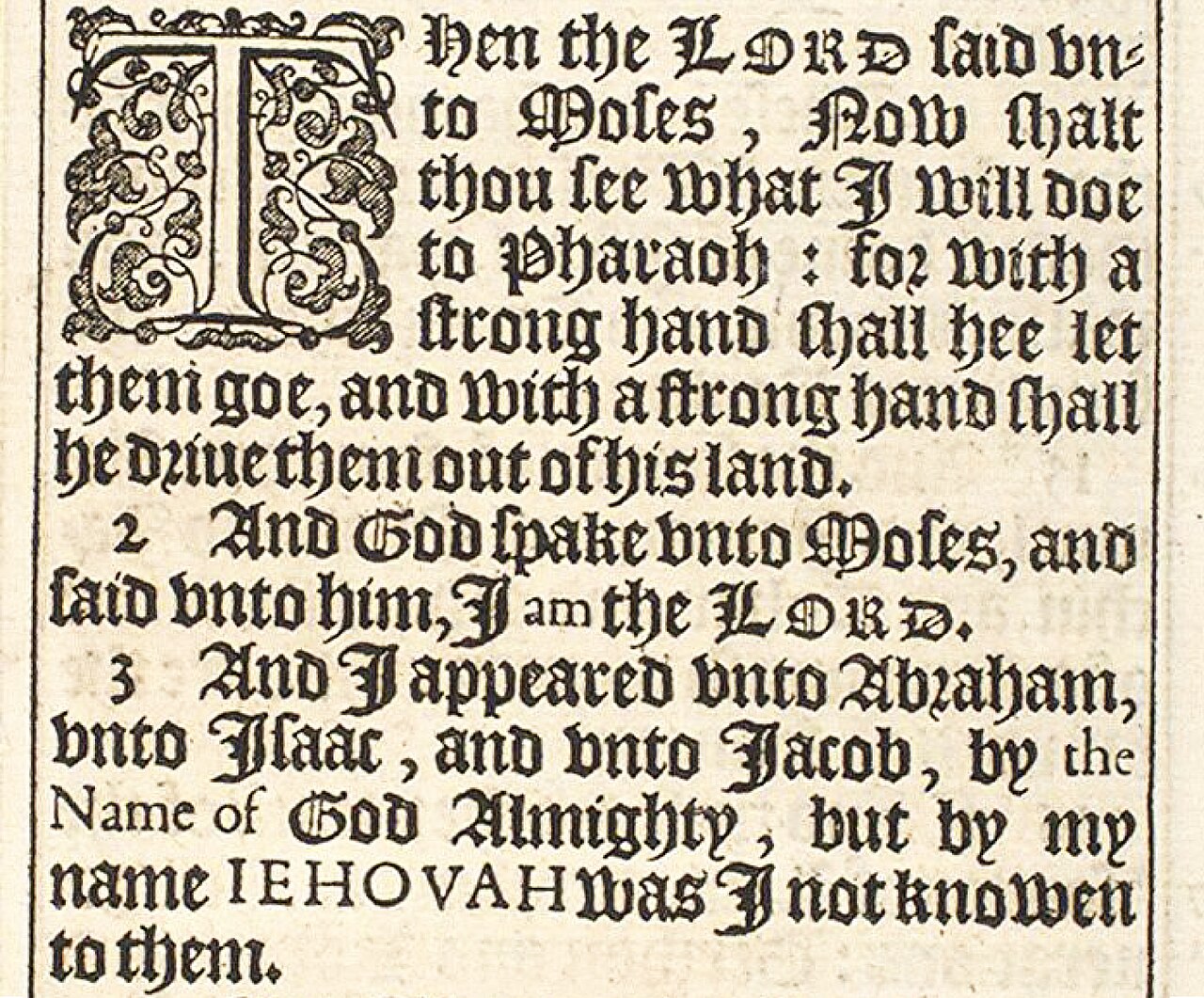
The Bishops' Bible (1568) followed the Geneva pattern. The 1611 King James Version, printed in black-letter, used smaller roman font rather than italics for supplied words; only when the base typeface shifted to roman did italic typography for supplied words become standard (the 1612 octavo KJV is among the earliest). The 1618 Synod of Dort, where Samuel Ward presented the KJV translation rules, formally codified the convention: words "necessary to insert into the text…were to be distinguished by another type, small roman."[11]
| Year | Edition / event | Italics development |
|---|---|---|
| ~1530s | Sebastian Münster (Basel) | Small roman type for supplied words in Latin OT |
| 1557 | Whittingham's Geneva NT | First English Bible with italic type for supplied words |
| 1560 | Geneva Bible (full) | Convention formalized in preface |
| 1568 | Bishops' Bible | Geneva pattern adopted |
| 1611 | King James Version | Smaller roman font in black-letter text |
| 1612 | First KJV octavo (roman type) | Italics for supplied words |
| 1618 | Synod of Dort | Convention formally codified |
| 1638 | Cambridge KJV | Italicization expanded |
| 1762 | Cambridge edition (Paris) | Italic usage extended |
| 1769 | Blayney Oxford KJV | Italicization significantly expanded |
| 1873 | Scrivener Cambridge Paragraph Bible | Systematizes; "manifest inconsistencies" remain |
| 1881-1885 | English Revised Version | Retains italics |
| 1946-1952 | Revised Standard Version | Abandons italic convention |
The Revised Standard Version (RSV), the 1946-1952 ecumenical revision committee under Luther Weigle, explicitly abandoned the italic convention as misleading, treating supplied words as "an essential part of the translation."[12] Modern scholarly translations such as the NRSV, NIV, ESV, and NET follow the RSV in dropping italics; the convention survives mostly in KJV-tradition Bibles.[13]
The five-category classification (Wayment & Yost)
Italicized words are not, in any meaningful sense, "errors." Thomas A. Wayment and Tyson J. Yost catalogued all 1,628 italicized words in the four Gospels of the 1828 H. & E. Phinney edition that Joseph Smith used for the Joseph Smith Translation (JST), his 1830–1833 inspired revision of the Bible. They sorted those words into five grammatical categories: implied pronouns, copular constructions (implied "to be" verbs), elliptical constructions, indefinite articles, and vocative constructions.[14]
For analytical purposes Wayment and Yost collapse the five categories into three groups:
| Group | Description | Count | % of total |
|---|---|---|---|
| A | Grammatically required to convey the source meaning in English | 1,410 | 87% |
| B | Based on textual variants between the KJV translators' source manuscripts and the modern Textus Receptus | 35 | 2% |
| C | "Foreign to Greek grammar": additions that actually alter the meaning of the source text | 183 | 11% |
Only Group C italics, about 11% of the total, actually alter meaning. The other 89% are scaffolding the English language requires. Removing all italicized words from a KJV passage does not produce the "true" Hebrew or Greek; it produces broken English. Hebrew has no copula, so "Woe me, for I am undone" cannot be translated into English without supplying the word is somewhere. A translator who refused to supply it in italics would still have to supply it, just without the typographic flag.[15]
Joseph Smith's own awareness
Critics sometimes argue that the faithful response requires Joseph Smith to have known what KJV italics meant, a difficult claim about a young man without formal education. The historical record is more interesting than that frame allows. W.W. Phelps wrote in the January 1833 Evening and the Morning Star:
"The book of Mormon, as a revelation from God, possesses some advantage over the old scripture: it has not been tinctured by the wisdom of man, with here and there an Italic word to supply deficiencies."[16]
A subsequent editorial in The Evening and the Morning Star (July 1833), likely written by Phelps as editor, made the same point: "The old and new testaments are filled with errors, obscurities, italics and contradictions, which must be the work of men."[17] These are not statistical observations. They are casual references that assume the reader already knows what italicized words signify. Within three years of the Book of Mormon's publication, members of Joseph Smith's circle were treating the KJV's italics as a topic of theological interest. Whatever the mechanism of the translation, contemporary awareness of the convention is documented in the historical record, and the direction of that awareness was that italicized words were typographically marked as the work of human translators, not as the original text.
Specht's foundational neutral assessment
The leading non-LDS scholarly history of the italics convention is Walter F. Specht's 1968 article in Andrews University Seminary Studies. Specht concluded that the practice "rests upon an idea that is almost impossible to carry out accurately and consistently."[18] Specht quotes Dewey Beegle's estimate that "from 75 per cent to 90 per cent of the italics in the King James Version are worthless." That does not mean the underlying words are wrong; it means the typographic flag is itself dispensable.[19] Specht's blunt verdict: "the idea of italicizing added words rests on a false understanding of what is meant by translation."[20]
This is decisive context. A leading non-LDS scholar of biblical translation, writing in 1968 with no LDS axe to grind, found that the KJV italic system is itself ill-conceived and inconsistently applied. Whatever the Book of Mormon's relationship to the KJV's italicized words, the assumption that those words constitute a clean diagnostic category for "translator inventions" was already untenable in mainstream scholarship sixty years ago.
The inconsistency of KJV italicization
Specht and Jackson, Judd & Seely document specific inconsistencies that matter for any argument premised on KJV italics being a stable category:
- John 11: zero italicized words in 1611; fifteen by 1638; sixteen by 1756.[21]
- Acts 13:6 vs. Luke 24:18: "whose name was Bar-jesus" italicized in Acts 13:6; "whose name was Cleopas" not italicized in Luke 24:18, on identical Greek construction.[22]
- Luke 17:27 vs. 17:29: "destroyed them all" italicized in v. 27; "destroyed them all" without italics in v. 29, on identical Greek (πάντας).[23]
- Luke 19:17 vs. 19:19: italicized "thou good servant"; non-italicized "thou wicked servant" two verses later (the wicked-servant address actually appears at v. 22 in modern editions, but Specht discusses the parallel construction at v. 19).[24]
- 1 Cor 9:22 (1873 edition): "men" and "things" italicized as additions beyond what the 1611 reading required.[25]
The implication is structural. The KJV's italic system was never applied consistently within a single edition, and the inconsistencies grew across editions. Any argument that "the Book of Mormon reproduces KJV italics" implicitly assumes a stability the system never had. Which italics? The 1611's? The 1638's? The 1769 Blayney's? Stan Larson's argument (discussed below) that the Book of Mormon reflects 1769-specific italicizations is a serious one, but it is also a much narrower argument than "Joseph copied KJV italics."
A subsidiary point about the CES Letter's first exhibit: in its 2 Nephi 19:1 column, the letter bolds the four KJV italics (shall, be, was, by) plus a fifth word, "Red," which is not italicized in any KJV edition. It is a Book of Mormon addition with no KJV counterpart at all. The letter's own prose does treat "Red" as a separate problem ("not found in any source manuscripts"), but the uniform bolding presents two different classes of variant, retained translator italics and new Book of Mormon material, as a single visual category. The "Red Sea" reading is taken up in the Isaiah 9:1 case study below.
The Statistical Picture
The CES Letter offers two examples and asks the reader to generalize. When scholars examined the full dataset, they found a more complex pattern, one that does not fit the simple-copying thesis the CES Letter implies. (A methodological note: most of the textual scholarship cited below comes from faithful Latter-day Saint researchers, including Royal Skousen, Stan Spencer, John Tvedtnes, Carol F. Ellertson, and Wayment & Yost. Their work is rigorous and has been engaged in print by critical scholars, but a reader weighing the evidence should know that the bulk of the published statistical analysis on this question has come from researchers writing within the faithful tradition. Wright, Larson, and the Joosten/Alter survey provide the principal independent counter-analyses, and those are engaged in detail below.)
Skousen's eight findings
Royal Skousen's Critical Text Project produced an authoritative summary of the relationship between Book of Mormon Isaiah and the KJV, distilled into eight findings (KnoWhy #39 and Skousen's underlying 1998 article):[26]
- The base text for the Isaiah quotations in the Book of Mormon is the King James Version.
- The Isaiah passages were dictated by Joseph Smith; no physical copy was given to Oliver Cowdery to copy from.
- The original Book of Mormon chapter divisions of the Isaiah quotations follow a larger thematic grouping, not the KJV chapter system.
- The original Book of Mormon text is closer to the King James Version than later printed editions.
- The majority of differences between the Book of Mormon text and the Isaiah text are not associated with italicized words in the King James Version.
- Corrections in the original manuscript give very little evidence for the hypothesis that Joseph Smith altered the text while reading from a KJV.
- Duplicate Isaiah quotations may help restore the original reading.
- The later JST used the 1830 edition of the Book of Mormon as a source for some Isaiah revisions.
Skousen's 1998 percentages for the Isaiah material: approximately 38% of KJV italicized words are changed in some way in Book of Mormon Isaiah, and 29% of the differences between Book of Mormon Isaiah and the KJV involve italics, leaving 71% unrelated to italics.[27]
His 2019 collation, The King James Quotations in the Book of Mormon, extends the count to all 36 quotations:[4:2]
| Collation scope | Differences involving italics | Italicized words changed |
|---|---|---|
| 1998 study (the Isaiah quotations) | 29% | approximately 38% |
| 2019 collation (all 36 quotations) | 163 of 712 (22.9%) | 163 of 425 (38.4%), 262 unchanged |
Skousen draws the conclusion himself: "less than a fourth of the textual differences can be assigned to the italics; and of all the cases of italics in the King James text, over three-fifths are left unchanged. Obviously, any theory that relies solely upon italics for determining the textual differences will be woefully inadequate."[4:3] The italics pattern is real but is one layer within a more complex textual relationship. Skousen's finding #5 is the central frame: italics are a meaningful subset of the variants, not the whole story.
Ellertson's variant catalog
Carol F. Ellertson's 2001 BYU master's thesis, applying Emanuel Tov's textual-criticism framework, gave the most comprehensive count to date. Across 433 Book of Mormon Isaiah verses she identified 216 verses (50%) containing 370 textual variants. The breakdown sorts those variants by the ancient textual tradition they align with: the Septuagint (the ancient Greek translation of the Hebrew Bible), the Dead Sea Scrolls recovered at Qumran, and the Masoretic Hebrew text behind the KJV.[28]
| Variant category | Count | % of total |
|---|---|---|
| Related to KJV italicized words | 119 | 32% |
| Aligning with the Septuagint | 76 | 21% |
| Aligning with Qumran (Dead Sea Scrolls) | 28 | 8% |
| Aligning with the Masoretic Text against KJV | 52 | 14% |
| Non-aligned (matching no known textual tradition) | 150 | 41% |
(Categories overlap; a single variant may align with multiple traditions.) Ellertson also breaks the 119 italics-related variants down by what happened to the italicized words: 51 replace them with other words, 9 keep them and insert additional words around them, and 59 omit them altogether.[28:1] Her conclusion is that the Book of Mormon Isaiah qualifies as an "independent" or "non-aligned text" under Tov's framework: a text that cannot be fully derived from any single known source, including the KJV.[29] The italics story accounts for roughly a third of the picture. The 150 non-aligned variants are the largest single category, and the hardest single category for any pure-copying thesis.
Spencer's 40x finding
Stan Spencer's 2020 Interpreter article "Missing Words" produced the central statistical finding. Spencer focused on 2 Nephi 16-17 (Isaiah 6-7) as a controlled sample because the Book of Mormon's text of those chapters is well-attested in both the Original and Printer's Manuscripts and because the parallel KJV chapters are short enough to count exhaustively.
The raw numbers, verbatim from Spencer's data:[30]
| Word category | Total in KJV | Omitted in BoM | Omission rate |
|---|---|---|---|
| Italicized | 37 | 15 | 41% |
| Non-italicized | 1,021 | 11 | 1% |
A simple ratio of those rates is 41 ÷ 1 = 41, which Spencer rounds to "approximately 40 times." The sample runs slightly above the book-wide figure: "In these chapters, 41 percent of the KJV's italicized words have been omitted, compared to an average of 37 percent across all Book of Mormon Isaiah chapters."[31]
Spencer's statistical conclusion: "Such a strong association of variants with the KJV's italicized words is not attributable to chance."[7:1] The clustering of changes on typographically marked words is too strong, too specific, and too consistent across multiple chapters to be random noise. The italicized-word association is a real signal. As discussed below, the question of what process produced that signal is more contestable than the bare correlation.
Spencer further classifies the variants in 2 Nephi 16-17 into six sub-types: transmission errors and modernizations (7), italicized words omitted (12), italicized words transposed (1), italicized words replaced or expanded (4), non-italicized words replaced (1), and words added (4).[32] The italicized-word interactions are the dominant pattern, but they are not the only one. The four non-italicized additions are clues that some textual decisions are unrelated to italics.
The function-word confound (and what is and isn't resolved)
KJV italicized words are disproportionately short function words: articles, copulas, implied pronouns, prepositions. A 19th-century paraphraser reading the KJV aloud and improvising minor smoothing changes would naturally drop precisely the words KJV translators marked as italics, not because the paraphraser saw the italics, but because both the paraphraser and the KJV translators were responding to the same underlying linguistic feature. The 40x ratio could in principle reflect this "paraphraser convergence" rather than active italic-detection by the translation process.
Spencer's data implicitly responds to this but does not formally control for it. Non-italicized function words also exist throughout the KJV text (the KJV has thousands of non-italicized articles, copulas, and pronouns), and they are not omitted at remotely comparable rates; the 1% non-italicized omission rate aggregates content words and function words alike. The fair statement is that the 40x ratio is strong but not yet airtight. The available data shows the correlation is with italic status rather than word type alone, but a fully controlled analysis (comparing italicized "is" with non-italicized "is," and so on) remains an open item for the research agenda.[33]
This is one reason the 1831 Philadelphia Sun account (discussed below) matters despite its problems: independent corroboration of the omission pattern from a hostile source, even with caveats, takes some weight off the statistical argument.
Three Competing Explanations
The pattern is established. The harder question is what process produced it. Three scholarly hypotheses compete:
1. The Ancient Variants Hypothesis (B.H. Roberts, 1904)
B.H. Roberts proposed that Joseph Smith compared the brass plates text with the KJV during the translation and made superior changes reflecting actual ancient variant readings preserved on the plates. In Roberts's framing, the Book of Mormon's Isaiah readings were "superior [in] sense and clearness" to the KJV.[34] (Roberts developed this argument more fully in New Witnesses for God, vol. 3 (1909), the strongest primary source for his position.)
The problem: many Book of Mormon variants are not "superior." Some are ungrammatical (2 Nephi 16:5 reads "Woe me, for I am undone," dropping the italicized is, and later in the same verse drops the italicized am of "I am a man of unclean lips"). Some are unclear (2 Nephi 17:23: "which" replaces "it" and muddles the referent). Some look like attempts to fill gaps that miss. A model under which Joseph was actively comparing texts and choosing better readings predicts uniformly better readings, not the mixed pattern of dropped words and clumsy substitutions actually observed.
2. The Italics-Revision Hypothesis (Larson, Wright, Gardner)
Stan Larson, David P. Wright, and (more cautiously) Brant Gardner have argued at various points that Joseph Smith deliberately knew what KJV italics signified and targeted them for revision, viewing them as untrustworthy translator additions.[35] This hypothesis takes the 38% / 41% change rate as evidence of conscious editing.
The problem: a deliberate editorial program does not produce 60% retention. If Joseph knew what italics meant and disapproved of them, why did he leave more than half intact? And why do some "corrections" produce worse English than the KJV (the 2 Nephi 16:5 example again)? An editor consciously revising would not introduce ungrammatical readings he could trivially detect. The hypothesis also assumes Joseph knew what italics meant during the dictation period, which is at odds with the eyewitness testimony about the translation method (face in hat, no Bible consulted) and with the manuscript-physical evidence (hearing errors, not visual errors).
3. The Missing Words Hypothesis (Spencer, 2020)
Spencer's proposal: a prior translator (divine or angelic) prepared an English text of the brass plates using the KJV as a base but with italicized words excised, since those words had no equivalent in the underlying Hebrew. Joseph Smith, encountering this gapped text in vision, attempted to supply the missing words while dictating, sometimes succeeding, sometimes guessing wrong, sometimes leaving the gap.[36]
Spencer's framing in his own words:
"a prior translator filled that role, with Joseph Smith simply seeing in vision and dictating the work of the prior translator, and making minor edits as he dictated it."[37]
The Missing Words model accounts for what its competitors cannot:
- Why some italicized words are dropped: the prior translator removed them; Joseph did not restore them.
- Why some italicized words are retained: Joseph successfully guessed the right word, or the prior translator left them in (because they had partial Hebrew justification).
- Why some replacements are ungrammatical: Joseph's restoration attempts missed.
- Why the JST pattern differs: the JST is a different process (conscious revision with a physical Bible).
- Why later editions restored some readings: Joseph corrected several earlier omissions in the 1837 edition (including putting "is" back into "Woe is me"), suggesting the original omissions were unintentional rather than editorial choices.[38]
Spencer notes that of the 29 variants in 2 Nephi 16-17, "ten affect the degree of parallelism in the English text but are otherwise of little consequence," while "the remaining 10 variants are harmful to the sense or English grammar."[39] The data is consistent with a process that produces minor disruptions, not theological errors.
Specific case studies (Spencer's worked examples)
The strongest evidence for Spencer's model is the specific texture of the variants. A few examples:[40]
- 2 Nephi 16:5 (Isaiah 6:5): KJV has "Woe is me! for I am undone; because I am a man of unclean lips." The Book of Mormon reads "Woe me, for I am undone," dropping the italicized is, and also drops the italicized am of "I am a man," producing ungrammatical English at both spots. The 1837 edition restored both words, suggesting Joseph later recognized the gaps. A copyist would not produce this; an editor would not leave it; a translator working with a gapped text and dictating quickly would.
- 2 Nephi 16:7 (Isaiah 6:7): KJV has "and he laid it upon my mouth." The Book of Mormon: "and he laid upon my mouth," dropping italicized it and leaving an awkward gap.
- 2 Nephi 16:8 (Isaiah 6:8): KJV has "Here am I; send me." Book of Mormon: "Here I; send me," dropping the italicized am, an omission Spencer says "makes the English text awkward, at least"; the 1837 edition restored this word as well.
- 2 Nephi 17:11 (Isaiah 7:11): KJV has italicized it; the Book of Mormon replaces it with which, producing a confused referent.
- 2 Nephi 17:23 (Isaiah 7:23): KJV has italicized even; the Book of Mormon replaces it with yea, a substitution that does not improve the sense and is consistent with restoration-failure rather than deliberate revision.
- 2 Nephi 17:14-15 (Isaiah 7:14-15): the Book of Mormon adds words at locations not associated with KJV italics. The Italics-Revision Hypothesis cannot account for this, since there is nothing italicized to revise, but Spencer's hypothesis can: Joseph is also smoothing rough patches he perceives in the gapped text.
A skeptic can fairly press here. Ungrammatical results count as evidence for Spencer because his model reads them as failed guesses, but grammatical results would have counted too, as successful ones. Both outcomes confirm the hypothesis on its face, which is exactly the unfalsifiability concern Spencer himself acknowledges. The fair version of Spencer's case is not that ungrammatical results prove the model. They don't. It is that the clustering of slippage on italics-marked words specifically is what requires explanation. Oral dictation routinely produces minor slippage, but oral dictation by a person who has not seen the source text would not be expected to slip predominantly on words the original translators happened to italicize. That clustering is the part Spencer's model explains more economically than alternatives, even granting that the broader hypothesis remains hard to falsify.
Limitations of Spencer's model
Spencer's hypothesis deserves the same rigor as its competitors. Three limitations stand out: the retention rate, the prior translator's competence, and the risk of unfalsifiability.
The retention question. Roughly 60% of italicized words are retained in Book of Mormon Isaiah. Spencer's response is that some italicized words have partial Hebrew justification (the Hebrew implies them even if not explicit), and a translator working from Hebrew would retain those while excising only the ones that genuinely lacked Hebrew basis. This is internally consistent, but it does mean the prior translator's program was less clean than the headline framing suggests, and a defense adjusted that far starts to look ad hoc. A "retained italic" by definition had partial Hebrew justification (because it was retained), and a "removed italic" by definition lacked it (because it was removed). Without an independent criterion, the distinction is post-hoc.
The defender's reply is that Spencer's distinction is at least coherent with what mainstream Hebrew scholarship says about KJV italics generally. Wayment and Yost's classification of 87% of KJV italics as Group A "grammatically required to convey the source meaning" (with implicit Hebrew warrant in the form of Hebrew copular and pronominal structures) provides an independent check: it tells us most KJV italics do have implicit Hebrew justification. Spencer's claim that the translator retained Hebrew-justified italics and removed Hebrew-unjustified ones is what we would predict for any linguistically informed translator. The criterion is not made up to fit the data; it is what mainstream KJV-italics scholarship tells us italics actually are. Spencer has, however, published no verse-by-verse list of which retained italics he counts as "Hebrew-justified" and which removed italics he counts as "Hebrew-unjustified." Without that list, the distinction does carry residual ad hoc risk.
The prior-translator competence question. Why would a being with access to both Hebrew and the KJV start from the KJV and produce a gapped text rather than producing an independent translation? This is the question the next section answers in detail.
Unfalsifiability concerns. The hypothesis can accommodate many data points by adjusting what the prior translator did. This is an epistemological weakness even if the model fits the data. A model that explains everything risks predicting nothing. Spencer's response would be that the specific pattern of ungrammatical results, the JST contrast, and the 1831 newspaper account are nontrivial predictions that the model accommodates more naturally than its competitors. The unfalsifiability concern is not fully dispatched.
The Missing Words hypothesis remains the best-fit model for the italics data. It is not a closed case.
Why a KJV Template at All? Defending the Framework
Most of the difficulties below (Wright's near-verbatim correspondence, Larson's 1769 dating, the reproduced KJV mistranslations) get answered by a single argumentative move: the KJV was used as a base text or translation template for the biblical passages in the Book of Mormon. That move carries much of the argument's weight, and it has to be defended on its merits rather than invoked whenever a data point becomes uncomfortable.
What the Book of Mormon itself does and does not claim
Nowhere in the Book of Mormon does Nephi, Jacob, or Christ claim that the Isaiah or Sermon-on-the-Mount passages are independent fresh translations from the underlying ancient Hebrew or Aramaic. The text presents itself as scripture revealed by the gift and power of God, with biblical content quoted at length, but the English form in which that content appears is not the subject of any internal claim. The 1830 title page describes the book as translated "by the gift and power of God," a claim about agency, not about methodology. Faithful readers have historically assumed the biblical passages were independent translations, but that assumption is reader-supplied. The text itself does not assert it, and Joseph Smith's published statements about italics (above) imply the opposite: that he understood the KJV's italics as part of the existing biblical text being engaged, not as obstacles to a wholly independent rendering.
This matters because the "KJV-as-template" framework cannot be ruled out as theologically illegitimate by appeal to internal Book of Mormon claims. There are no such claims to violate.
Gardner's localization argument
Brant Gardner has proposed that KJV language in the Book of Mormon is best understood through the lens of translation theory. Drawing on the software localization model, Gardner argues that translation requires adapting content culturally for target audiences, not just linguistically. The Book of Mormon was "printed in 1830 and presented to a nineteenth-century audience"; KJV formatting "localized the new book as scripture for the reception audience."[41]
Gardner's "cultural translation" framework distinguishes vocabulary-level fidelity from meaning-level fidelity. Just as the French idiom "Quand on parle du loup" translates to "speak of the devil" (conveying identical meaning through different cultural reference points), the Book of Mormon's use of KJV Pauline language in passages like Moroni 7:44-47 represents functional translation: "the underlying meaning was probably similar to that communicated by Paul, but the actual language derives from the King James Version of Paul."[42]
The argument is straightforward and not exotic. For a 19th-century American audience steeped in the KJV's cadences, presenting Isaiah in any English other than KJV English would have functioned as a foreignizing move, introducing unfamiliar vocabulary into the most familiar passages of scripture, where readers would expect to recognize their own Bible.
Daniel Belnap makes the reception-side case: King James English was the register that "impose[d] a sense of tradition" on early 19th-century religious writing, and familiarity with it let readers "more readily accept the claims made by the book as both scripture and as an ancient record." His conclusion: "it is certainly through the KJV that many became prepared for the plain and most precious truths revealed through the Book of Mormon."[43] This connects to D&C 1:24, where the Lord states that revelation comes "in their weakness, after the manner of their language, that they might come to understanding."[44] That principle carries its own provenance: the Lord stated it in November 1831, in the revelation he designated as his own preface to the Doctrine and Covenants, within two years of the Book of Mormon's publication.
Base-text translation as standard scholarly practice
Using an existing translation as a base when rendering a related ancient text is not exotic. Martin Abegg, Peter Flint, and Eugene Ulrich's The Dead Sea Scrolls Bible (1999) used the NRSV as their base text, preserving its wording wherever the scroll manuscripts agreed and departing from it where they diverged.[45]
This analogy has limits. Abegg, Flint, and Ulrich are modern scholars who consciously chose this methodology, explained it in their preface, and could be questioned about it in print. The Book of Mormon's translation process is not analogous in that respect: Joseph Smith did not publish a methodological preface explaining a base-text choice, and faithful readers cannot interrogate the prior translator about why the KJV was used. The Abegg/Flint/Ulrich case is therefore not a perfect parallel. It is a proof of concept that base-text-as-template is a legitimate translation methodology, one that produces output visibly shaped by its base text while still preserving real differences where the underlying text demands them. Whether the Book of Mormon's specific implementation of that methodology is defensible is a question for the evidence within the text itself, not for the prima facie legitimacy of the general approach.
What the framework predicts
A useful test for any explanatory framework is what it actually predicts:
- Where the underlying ancient text agrees with the KJV's Hebrew source text, the translation should produce KJV English with minor variations (template fidelity).
- Where the underlying ancient text diverges (different verbal form, different conjunction, different word entirely), the translation should produce visible departures from the KJV.
- KJV mistranslations of obscure or marginal terms (animal names, ornamental terms, idiomatic constructions) should sometimes be preserved when the priority is audience recognition over scholarly correction.
- KJV translator-supplied words, the italics, should be selectively omitted when they have no Hebrew warrant, because they are typographically marked as exactly the kind of word a careful translator would re-evaluate.
These are testable predictions: the data should show near-verbatim agreement with the KJV across most words, scattered substantive variants where the underlying text differs, some preserved KJV errors (especially in obscure-term lists), and selective italics omission. As discussed throughout this article, this is approximately what the data does show.
The framework does not, however, explain which entity implemented it or why a divine translator would adopt it rather than producing an entirely independent rendering. Spencer's "prior translator" is a hypothesized agent inferred from textual patterns, not a revealed entity. The decisive evidence for one account over the other lies in features the framework alone cannot explain, such as Hebraisms, ancient-manuscript alignments, and archaic vocabulary not in the KJV. Those are what the affirmative-case section addresses.
The conclusion that holds is that the KJV-as-template framework is coherent and defensible on its merits, and it rests on four supports: it is consistent with internal Book of Mormon claims (which do not specify methodology), it aligns with documented scholarly translation practice (Abegg/Flint/Ulrich), it connects to revealed doctrine about adaptive language (D&C 1:24), and it makes testable predictions that match the data. But it is not, by itself, a positive proof of the Book of Mormon's authenticity. It is a framework within which the harder evidentiary work happens.
The 1831 Philadelphia Sun Account
A historical document is relevant to all three hypotheses. The Sun (Philadelphia), in its August 18, 1831 issue, published a hostile account apparently based on an interview with Martin Harris:
"Jo deposits them in his hat, applies spectacles, and refers Harris to a chapter in the Bible which he had learned by rote; and which he read from the plates, with surprising accuracy; and what astonished Harris most, was, that Jo should omit all the words in the Bible that were printed in Italic. And, if Harris attempted to correct Jo, he persisted that the plates were right, and the Bible was wrong."[46]
This is a hostile-press account from two years after publication. The reporter's framing is wrong on details (the plates were not "deposited in his hat"; Joseph used a seer stone, not "spectacles" in the conventional sense; "learned by rote" is the reporter's interpretation, not Harris's claim). But the specific factual claim that Joseph "should omit all the words in the Bible that were printed in Italic" corresponds exactly to the pattern Spencer identified statistically in 2020.
This account deserves more skeptical handling than its citation usually receives. A skeptical read raises three problems:
- Thirdhand at best. The account is filtered through a hostile journalist and a presumptive interview with Martin Harris that is not directly attested. The Sun printing is itself a reprint: the piece runs under the credit line "From the A. M. Intelligencer," which puts at least one more editorial hand between Harris and the surviving text.
- Selective citation. Quoting the reporter's italics observation as supportive evidence while rejecting his framing as wrong on details is exactly the move skeptics call motivated cherry-picking. Why is the reporter reliable on italics omission specifically while being unreliable on the surrounding mechanism?
- The account fits Italics-Revision better than it fits Spencer. The reporter's frame is that Joseph had "learned [the chapter] by rote" with the italics omitted: in other words, that Joseph deliberately memorized a KJV chapter and deliberately dropped italics. That is the Italics-Revision Hypothesis (Larson/Wright), which this article rejects on textual grounds. A faithful reader can re-read it through Spencer's prior-translator lens, but the Sun account does not adjudicate among the three hypotheses on its own.
The defensible weight of the Sun account is therefore something less than "corroborating evidence for Spencer." What it does reasonably establish is narrower: the omission phenomenon was visible enough in the dictation process that a hostile observer in 1831 found it striking and printed it. It is evidence that some italics-related anomaly was empirically present in the dictation, which means Spencer's statistical pattern is not an artifact of 21st-century counting methodology. But it does not by itself adjudicate among the three hypotheses. Its proper weight is that of a historical curiosity, suggestive but nowhere near decisive.[47]
The JST as Comparison Signature
The JST project, conducted from 1830 to 1833 with Sidney Rigdon as primary scribe, gives us a known case of Joseph consciously revising the KJV with a physical Bible in hand. Comparing the JST's italics handling to the Book of Mormon's is therefore informative. It tells us what conscious revision looks like, and what the Book of Mormon does not look like.
The JST data (Wayment & Yost)
Wayment and Yost's 2005 study counted all 1,628 italicized words in the four Gospels of the 1828 Phinney edition Joseph used for the JST and tabulated their fate:[48]
| Category | Words | Altered | Removed | Retained |
|---|---|---|---|---|
| A. Syntactic supplements | 1,410 | 29% | 20% | 51% |
| B. Variant-reading-based | 35 | 34% | 17% | 49% |
| C. Meaning-altering | 183 | 35% | 28% | 37% |
| Overall | 1,628 | 29% | 21% | 50% |
The most striking JST finding concerns Category C words, the 183 italicized words that "alter the meaning of the source text." These received "significantly greater attention," with 63% changed or removed, far higher than syntactic supplements (49% changed or removed).[49] Joseph's JST work concentrated heaviest on the most problematic italicized words, those actually altering meaning, not on grammatically necessary ones. This is what conscious editing produces: heightened attention to the words that distort meaning, lighter attention to grammatical scaffolding.
The JST methodology also shifted at John 6:1: before that point, scribes wrote out the entire NT text while Joseph dictated changes; after, Joseph marked his Bible and dictated only the changes. The frequency of changes drops dramatically after John 6 (only 17 italicized-word changes in 238 italicized words across the remainder of the Gospel, John 6:1 through 21:25).[50] This shift confirms the JST was a deliberate editing process whose method evolved as the work went on, visibly different in character from the Book of Mormon's continuous dictation.
Why the signatures differ
The Book of Mormon's italics omissions:
- Don't show JST-like categorical sophistication (no preference for meaning-altering italics over syntactic ones)
- Produce ungrammatical outputs that the JST consistently does not (the JST is grammatical because Joseph could see what he was editing)
- Operate at a flat 37-41% omission rate without the JST's selective discrimination
- Are not concentrated on Category C (the meaning-altering subset) the way the JST is
If the Book of Mormon were a Joseph-copying-the-KJV product, its italics pattern should resemble the JST pattern, since both would be Joseph engaging with the KJV. The two outputs do not match. The JST shows deliberate revision with a Bible in hand. The Book of Mormon shows omission with failed restoration by an operator who cannot see the source text, exactly what Spencer's Missing Words hypothesis predicts and exactly what the seer-stone-in-hat eyewitness testimony describes.
Kevin Barney has documented three converging lines of evidence for awareness of italics in Joseph's circle: the distribution of JST variants clustering around italicized words at roughly 30%, Joseph's marked Bible with crossed-out italicized words physically visible in Critical Text Project images, and Phelps's 1833 published statement.[51] What the JST proves is what Joseph's conscious revision of the KJV looks like. The Book of Mormon's biblical text shows none of those marks.
Engaging the Strongest Critical Arguments
The CES Letter's version of the italics argument is its weakest scholarly form. The strongest critical arguments come from David P. Wright, Stan Larson, the Joosten/Alter scholar survey, and structural observations across the literature.
Wright on the absence of synonymous variation
David P. Wright's 1998 Dialogue article (expanded in American Apocrypha 2002) makes a central argument that does not depend on italics at all: when two independent translations are made of the same Hebrew passage, they show wide lexical and syntactic variation while preserving identical meaning. Compare the KJV, RSV, JPS, NRSV, ESV, Robert Alter, and the NIV on any chapter of Isaiah, and they convey similar meaning through substantially different English phrasing. That is what independent translation looks like.[52]
The Book of Mormon's Isaiah does not show this. It follows the KJV nearly word-for-word with only scattered, micro-level changes. To demonstrate that biblical-style English can be produced without copying the KJV, Wright produced his own alternative translation of Isaiah 29:16 / 2 Nephi 27:27: "How perverse of you (or: You turn things upside down)! Can the potter be considered as the clay? Can a work say of its maker, 'He did not make me,' and can what is formed say to the one who formed it, 'He has no (creative) intelligence?'"[53] The fact that the Book of Mormon does not produce text of this kind in any of its long Isaiah quotations is, on Wright's view, the single strongest evidence for direct KJV dependence.
The near-verbatim KJV correspondence is, on its face, exactly what we would expect from KJV dependence. Wright's point is not merely that there are few differences. It is that the type of difference is wrong. An independent translation would show broad lexical variation; the Book of Mormon's differences are overwhelmingly micro-changes (omissions, single-word substitutions, minor grammatical shifts). This is the pattern we would expect from someone editing the KJV, not from someone independently translating Hebrew.
The KJV-as-template model defended above concedes Wright's descriptive point. The translation process used the KJV as its English rendering for passages where the brass plates and the KJV's Hebrew source substantially agreed, producing exactly the kind of near-verbatim correspondence Wright observes. The modifications appear precisely where the underlying text diverged. This is not what an independent translation looks like; it is what a template-based translation looks like.
The follow-on question becomes whether the modifications within that template show features (ancient manuscript agreements, non-random italics patterns, non-aligned variants, archaic vocabulary not in the KJV, internal Hebraisms) that resist a purely naturalistic editing model. The affirmative case below argues yes. Wright's synonymy argument is a real challenge to the independent-translation model; it is not a refutation of the template-based model.
Wright on English-polysemy variants
A subset of Wright's argument involves variants that appear to interact with the English of the KJV in ways linguistically impossible in Hebrew:
- Isaiah 2:10 / 2 Nephi 12:10: KJV has "for fear of the LORD…for the glory of his majesty" (English "for" = preposition "from before"). The Book of Mormon reads "for the fear of the Lord and the glory of his majesty shall smite thee," reinterpreting "for" as a conjunction ("because"). The Hebrew word mippene ("from the face of") cannot generate "because." This variant looks like a response to English ambiguity, not a Hebrew variant.[54]
- Isaiah 48:16 / 1 Nephi 20:16: KJV "from the time that it was, there am I" becomes "from the time that it was declared have I spoken." Appending the passive participle "declared" after "was" is not possible in Hebrew grammar.[55]
- Isaiah 51:17 / 2 Nephi 8:17: KJV "wrung them out" becomes "wrung out" used as an adjective, a construction without Hebrew correspondence.[56]
Some Book of Mormon variants do appear to interact with the English text in ways that do not correspond to plausible Hebrew variants. It means at least some 2 Nephi Isaiah variants demonstrably originated as English-level edits to the KJV, not as independent translations from Hebrew. Spencer's Missing Words hypothesis cannot account for these (they are not omitted italics but added English material), and the loose-translation framework absorbs the data: the translator is working through the English, not from the Hebrew directly.[57]
The position concedes that some BoM Isaiah variants are not products of access to ancient manuscripts; they are products of someone (the prior translator, in Spencer's framing) interacting with the KJV's English text. The benefit is explanatory adequacy: these variants no longer require a Hebrew explanation that does not exist in the manuscript record.
The decision facing a faithful reader is whether this kind of translation methodology is theologically acceptable. Three grounds say yes: (a) the doctrine of accommodation in D&C 1:24, (b) the absence of any internal Book of Mormon claim about translation methodology that this approach would violate, and (c) the established scholarly precedent for base-text translation discussed above. But the cost cannot be hand-waved. Wright's English-polysemy examples are this article's biggest open tension, and a reader who finds the loose-translation framework theologically unacceptable will find the Book of Mormon's Isaiah passages harder rather than easier to defend.
A complementary partial response: at least one of Wright's examples (Isaiah 48:16) involves Hebrew that is itself textually difficult. The Masoretic Text of Isaiah 48:16 has long been recognized by Hebrew scholars as corrupt or incomplete; modern translations differ widely on what the Hebrew actually says. Wright's confidence that the BoM reading "is not possible in Hebrew grammar" assumes a specific reconstruction of the underlying Hebrew that is not the only credible reconstruction. A defender can therefore (i) accept some English-level engagement (as above) for Isaiah 2:10 / 51:17 while (ii) flagging that Isaiah 48:16 is contested even on its Hebrew face. This is partial, not exhaustive; it does not eliminate Wright's point but it does narrow it.
The Joosten/Alter scholar survey
A blog-published scholar survey assembled ratings from four reviewers, including Jan Joosten (Regius Professor of Hebrew, Oxford; former editor-in-chief of Vetus Testamentum) and Robert Alter (Professor of Hebrew, UC Berkeley; translator of the Hebrew Bible), on a series of Isaiah passages where the Book of Mormon reproduces what mainstream scholarship considers KJV mistranslations.[58] The verses Joosten judges flatly wrong (0 on the survey's 0-4 accuracy scale) include:
| Verse | KJV reading | Joosten's correct reading |
|---|---|---|
| Isaiah 2:16 / 2 Ne 12:16 | "pleasant pictures" | "ships" (Egyptian loanword) |
| Isaiah 3:2 / 2 Ne 13:2 | "the prudent" | "the diviner" |
| Isaiah 3:3 / 2 Ne 13:3 | "eloquent orator" | "expert in charms" |
| Isaiah 9:1 / 2 Ne 19:1 | "grievously afflict" | "dealt with seriously/harshly" |
| Isaiah 11:3 / 2 Ne 21:3 | "of quick understanding" | "his smelling will be in the fear of the Lord" |
| Isaiah 49:5 / 1 Ne 21:5 | "though Israel be not gathered" | "and to him" (לו vs. לא scribal confusion) |
Isaiah 13:22, "dragons" / "jackals," also comes up frequently in this discussion. The survey's two numbers for that verse, "2, 0," attach to its two renderings: Joosten scores the KJV's "wild beasts" a 2 and its "dragons" a 0. The KJV's defense therefore rests on the Hebrew itself, where tannin genuinely covers more than one creature, rather than on any divided verdict among the reviewers. The case is real but weaker than the survey's other 0-rated verses, and it should not be packaged with them.[59]
The Book of Mormon reproduces every reading in the table. Joosten on "pictures": the word "means 'ships' (the word was borrowed from Egyptian, which the KJV translators had no access to)." Alter on "of quick understanding": "entirely wrong."[60]
The logical structure of the strongest critical case: if the translation process had access to the underlying Hebrew, it could have corrected these. The translation process did not correct these. Therefore the process did not have direct Hebrew access; it had access to KJV English.
No other critical argument is as strong, and the specific verses are where it gets decided. And the underlying phenomenon is not in dispute between camps: Skousen's own collation catalogues 19 King James translation errors carried into the Book of Mormon's quotations, 18 of them in Isaiah (rent and satyr among them), plus a dozen 16th- and 17th-century "cultural translations" such as candle for lamp and dry-shod.[4:4]
Two worked examples
"Pleasant pictures" (Isaiah 2:16 / 2 Nephi 12:16). The KJV reads "upon all the ships of Tarshish, and upon all pleasant pictures." The Hebrew word sekiyot is rare; the Egyptian-loanword reading "ships" was unavailable to KJV translators because the relevant Egyptian linguistic comparanda were not yet in scholarly circulation. A divinely-informed translator working from Hebrew alone might have reached "ships," but the KJV's "pictures" is what 1611 Hebraists could produce with the lexical tools available. The Book of Mormon reproduces "pleasant pictures."
What the Book of Mormon also does, however, is add a clause: "upon all the ships of the sea, and upon all the ships of Tarshish, and upon all pleasant pictures." The Septuagint (LXX) has "every ship of the sea." That reading was inaccessible in 1829 frontier New York, yet it agrees with the Book of Mormon's added clause. So the verse contains both an ancient-manuscript alignment (the LXX-favoring "ships of the sea") and a preserved KJV mistranslation ("pleasant pictures") in the same verse. This is not a "correction" of the KJV. It is an expansion that adds an LXX-aligned clause without removing the KJV's mistranslated final phrase. Both readings co-exist in the Book of Mormon, which is itself diagnostic: a process that simply copied the KJV would have only the KJV reading, and a process with full Hebrew access would have replaced "pictures" with "ships." Neither is what we observe.
The KJV-as-template framework absorbs this. Where audience reception was the priority, KJV phrasing was preserved even where the KJV is wrong; where the underlying ancient text had material the KJV lacked, the Book of Mormon expanded. The verse is the overall pattern in miniature.
"Dragons" / "jackals" (Isaiah 13:22). Even here the case is more mixed than the critics frame it. Tannin in Biblical Hebrew can refer to a sea monster, a serpent, or a jackal-like animal depending on context. KJV translators chose "dragons"; modern translations frequently prefer "jackals" in this Isaiah context, and Joosten rates "dragons" a 0. The Book of Mormon reproduces "dragons." What separates this verse from "pleasant pictures" is the underlying Hebrew. Sekiyot has a specific recoverable meaning the KJV missed; tannin requires choosing among senses the word actually carries, which makes "dragons" an archaic selection from an ambiguous range rather than a misreading of a known term. Whether it counts as a mistranslation depends on which Hebrew sense is correct in the specific Isaiah 13 context. Treating it as equivalent to the survey's unambiguous error cases overstates it.
Selective editing: farthing but not dragons
A separate critical sharpening (associated with Dan McClellan and others) argues that the Book of Mormon shows selective contextual editing: enough to change "farthing" (a British currency) to "senine" (a Nephite unit) at 3 Nephi 12:26 but not enough to fix "dragons" or "pleasant pictures." If the translation process can catch a Roman-currency anachronism, why does it not catch an Egyptian-loanword mistranslation?
The reply distinguishes the two cases by function. The "farthing" change is internal to the Book of Mormon's economic system: Christ is teaching the Nephites in their language, and rendering "farthing" (a 17th-century British currency unit, anachronistic for 33 AD New World listeners) into the Nephite "senine" preserves the parable's economic logic for the 19th-century reader. The change is within the translation process, not a correction of it. Animal identifications like "dragons" or ornamental terms like "pleasant pictures" do not have analogous in-text consequences; whether the reader pictures a dragon or a jackal does not change the doctrine being taught. Skousen's collation supports the two-track picture: the Nephite adaptations, senine for farthing among them, were "made without any consideration of italics," and italics figure in only 6.6% of the Sermon's changes overall.[4:5]
This is the accommodation principle at work: KJV mistranslations that are theologically inert (animal misidentifications, ornament names) are preserved because their preservation does not distort doctrine, while changes that affect internal narrative consistency (a Nephite Christ using British currency) are made. Whether this distinction is a clean principle or post-hoc rationalization is a fair question. The distinction is at least coherent, since the asymmetry is not arbitrary. But the critic is correct that the asymmetry exists, and any reader who finds the distinction strained is not being unreasonable. The companion articles on KJV errors and KJV mistranslations treat specific cases in further detail.
Larson on 1769-edition dating
Stan Larson's 1986 Trinity Journal article (expanded in his 1993 chapter in New Approaches to the Book of Mormon) examines eight test cases in 3 Nephi 12-14 (the Sermon at the Temple paralleling Matthew 5-7) and identifies passages where the Book of Mormon interacts specifically with italicizations present in the 1769 Blayney edition (or its derivatives) but absent or differently italicized in the 1611 and intermediate printings.[61]
According to Larson's argument:
- Matthew 6:5, 6:7, and 7:18 / 3 Nephi 13:5, 13:7, 14:18: the Book of Mormon drops italics he identified as specific to 1769 and later editions.
- Matthew 5:12: tense changes follow the 1769 reading.
If the Book of Mormon were translated from an ancient text, its English should not interact specifically with editorial choices made by Benjamin Blayney in Oxford in 1769. The fact that the Book of Mormon modifies or drops words italicized only post-1769 dates the English version to after 1769, that is, to the era of Joseph Smith's lifetime, not 421 AD.[62]
Skousen's 2019 collation, however, narrows Larson's list considerably. The clause-final are of Matthew 6:5 "was set in italics beginning in the 1660s," a century before Blayney, and the italicized doeth/doth of Isaiah 49:18 dates from the 1630s. Of the italics test cases, only Matthew 6:7 involves an italicization that actually post-dates 1769.[4:6] (The Matthew 7:18 item rests on secondary summaries of Larson's argument that this article has not verified against his primary text; see the Note on Sourcing.)
A worked example: Matthew 6:7 / 3 Nephi 13:7
Matthew 6:7 (KJV): "But when ye pray, use not vain repetitions, as the heathen do: for they think that they shall be heard for their much speaking."
The clause-final do was set in italics beginning in the 1770s. 3 Nephi 13:7 lacks it: "But when ye pray, use not vain repetitions, as the heathen, for they think that they shall be heard for their much speaking."[4:7]
This is the omission pattern the Book of Mormon shows at italicized words throughout, landing on an italicization that did not exist before the 1770s. The implication: the English of the Book of Mormon's Sermon interacts with editorial work done within Joseph Smith's own era, not just with the 1611 text.
The reply operates at three levels:
The prior-translator hypothesis can absorb this. If the prior translator was working with a post-1769 KJV (which is what was available in Joseph Smith's environment, the 1828 H. & E. Phinney edition being a derivative of the Blayney text), the resulting English would naturally reflect 1769-era italicizations. There is no theological problem with the prior translator using a contemporary KJV as base text; the only problem would be claiming the Book of Mormon's English directly reflects 421 AD, which no defender claims.
The dating evidence is thinner than the argument's reputation. Skousen's verdict on his own collation: the three italics cases "taken together, imply that the copytext for the Book of Mormon biblical quotations dates from after the 1760s," but Matthew 6:7 "is the only example involving italics that provides any support for dating the copytext." He calls the italics link overall "some relationship, although rather weak," and the sixteen word-difference examples "imply that the copytext could date up to a century earlier."[4:8] Spencer and others add that "1769 dependence" is partly a function of which specific KJV printing one compares against: American printings of the 1820s descended from Blayney but were not identical, and Joseph's actual 1828 Phinney edition is the closest available analogue.[63]
The implication for "prior translator" timing. Larson's argument does pressure the prior-translator concept: if the prior translator was using a post-1769 KJV as template, the prior translator was operating in the post-1769 era, a contemporary of Joseph Smith. This means the "prior translator" is best understood not as some ancient pre-Restoration translator but as a translation event coincident with the 1829 dictation. The prior-translator hypothesis remains coherent, but it is a hypothesis about a divine or angelic translator working within Joseph Smith's lifetime, not about an ancient figure.
What Larson gets right is structural: the Book of Mormon's English form interacts with post-1611 editorial features rather than with any ancient manuscript tradition. Even the italics added in the 1630s and 1660s are post-1611 editorial work, so the corrections above make the dating narrower without dissolving the observation. The strongest faithful framing is that the English form of the translation reflects a contemporary KJV template (because that is the language register through which the translation was rendered), while the underlying content has features that point elsewhere (the affirmative case below). Skousen's own summary verdict puts the copytext "after the 1660s, but not more precisely," with the three italics cases together suggesting a Bible of Joseph Smith's general era and exactly one italics datum tying it specifically to the post-1769 editions.[4:9]
A final caveat: the 1986 Trinity Journal version of Larson's argument is paywalled (Galaxie Software) and could not be verified directly for this article; specific examples attributed to Larson are drawn from the 1993 New Approaches expanded version and from secondary summaries. The italics-dating data itself now rests on Skousen's published collation rather than on those summaries, but a researcher reconstructing Larson's own eight test cases should verify against his primary text.
The Sermon at the Temple as a distinct case
Krister Stendahl, the late dean of Harvard Divinity School, is widely cited as having called the Sermon on the Mount in 3 Nephi "the Achilles heel" of the Book of Mormon. The original context is Stendahl's essay "The Sermon on the Mount and Third Nephi," in Truman G. Madsen's edited volume Reflections on Mormonism: Judaeo-Christian Parallels (BYU RSC, 1978).[64] The substantive observation that the Sermon at the Temple's KJV dependence is a major problem is real and Stendahl-attested. Larson and Wright develop the argument; Welch develops the reply.
The 3 Nephi Sermon is a harder case than the Isaiah passages for several reasons:
- Jesus is the speaker. He is not quoting brass plates; He is delivering His own sermon to the Nephites. There is no ancient-text intermediary to which to appeal.
- The KJV Matthew is twice-removed from any "original." It is a translation from Greek that itself records what Jesus said in Aramaic. Jesus spoke to the Nephites in 33 AD; Greek Matthew was written around AD 70-90; the KJV rendered that Greek in 1611; the Book of Mormon's English arrived in 1830. The chain requires real explanation when the Book of Mormon's English matches an English translation of a Greek text written decades after Christ spoke.
- The italics dimension is dating-relevant. Larson's 1769-edition italics drops are concentrated in the Sermon, not in Isaiah.
- The brass-plates defense does not apply. The Sermon at the Temple was delivered after Christ's resurrection; there is no plausible textual ancestry that would connect it to a pre-exilic Hebrew source.
The accommodation defense ("God used familiar language") is theologically strained when the speaker is the resurrected Christ. Why would Jesus reproduce 17th-century English mistranslations of His own words? The Missing Words hypothesis was developed for Isaiah; its application to 3 Nephi 12-14 is much less clear.
John W. Welch's Illuminating the Sermon at the Temple (FARMS 1999) is the central faithful response. Welch's chapter "The Sermon at the Temple and the Greek New Testament Manuscripts" makes the affirmative case from a specific data point: 3 Nephi 12:22 omits the phrase "without a cause" that the KJV's Matthew 5:22 includes. Welch documents that the omission is supported by Papyrus 64/67 (~AD 200), Codex Sinaiticus (4th century, original hand), Codex Vaticanus (4th century), the Latin Vulgate, Ethiopic texts, the Gospel of the Nazarenes, and church fathers Justin, Tertullian, Origen, and others.[65] The longer "without a cause" reading is now broadly recognized by mainstream NT textual critics as a later scribal addition softening Jesus's saying; the shorter, harsher reading is the original. 3 Nephi has the original. The KJV does not.
The 1820s American biblical-criticism context is documented in standard reference works on the history of New Testament textual criticism. Codex Sinaiticus was not rediscovered until 1844 (by Tischendorf), Codex Vaticanus was not generally accessible to scholars until the 1860s, and the principal Greek New Testament editions in American circulation in 1829 (chiefly Mill's 1707 Novum Testamentum and the Textus Receptus tradition derived from Erasmus) printed the longer "without a cause" reading without notes flagging it as a later addition.[66]
A caveat to the Welch argument: the eikei ("without a cause") variant was not entirely unknown in Joseph Smith's day. Adam Clarke's Commentary on the Bible (1810-1826) discussed the variant and noted that some manuscripts omitted it.[67] The strongest framing of the 3 Nephi 12:22 case is not "no one in 1829 could have known" but "the Book of Mormon aligns with what later became the scholarly consensus, against the KJV." That is still a meaningful alignment. It just is not magic.
The deeper question remains: a single textual variant, even a striking one, cannot undo verbatim correspondence across hundreds of words of the Sermon. Welch's "without a cause" is one substantive piece of counter-evidence, not a wholesale defense of the Sermon's KJV correspondence. Where that leaves the Sermon:
- The Sermon at the Temple's KJV verbatim correspondence is the single most difficult data point for the faithful position on biblical-passage authenticity.
- The "without a cause" omission and other potential alignment points (Welch develops a chiastic/liturgical analysis as well) are real partial counter-evidence.
- The accommodation/template framework is the available faithful position: Christ accommodated the eventual 19th-century reader's recognition of the sermon by allowing its English rendering to follow KJV phrasing.
- The cost of this position is theologically significant. It requires that the resurrected Christ's words to a non-Aramaic-speaking Nephite audience be rendered into KJV English with KJV stylistic choices preserved, including, occasionally, KJV mistranslations.
A reader weighing the Sermon at the Temple alone would be reasonable in finding it the hardest case in Book of Mormon textual criticism. The faithful position rests on (a) the accommodation framework being theologically acceptable and (b) the affirmative-case features (Welch's manuscript alignment, plus the Hebraisms and ancient-text features in the Book of Mormon as a whole) being weighty enough to balance the verbatim correspondence. A reader who finds the accommodation framework strained and the affirmative case underwhelming will not be persuaded by the Sermon at the Temple data alone.
McKeever's irrelevance-of-ignorance argument
Bill McKeever (Mormonism Research Ministry) has argued that defenders' invocation of Joseph Smith's biblical ignorance is structurally self-defeating. Lucy Mack Smith said Joseph had "never read the Bible through." Emma reported he didn't know Jerusalem had walls. Oliver Cowdery purchased a Bible in October 1829, after the Book of Mormon was completed. McKeever's flip: if Joseph translated from actual ancient plates, his personal biblical knowledge or ignorance should be irrelevant to the output. A genuine translation from gold plates would produce text derived from the plates, regardless of the translator's KJV literacy.[68]
This is a correct observation about the argument's structure, and the response has to operate at the same level.
A working content/form distinction
The translation process clearly involved Joseph's English-language faculty. The text shows Joseph's frontier-American grammar, occasional phonetic spellings, and characteristic 19th-century turns of phrase. This is not a problem for a "creative cultural translation" framework (Skousen's term); it is a problem for a strict word-for-word divine-dictation frame in which Joseph contributes nothing. The faithful position embraces the former and concedes the latter.
The defensible position requires a working distinction between content and form:
- Form (vocabulary, idiom, sentence structure, English-specific constructions) can plausibly reflect Joseph's 19th-century English faculty. This is what we would expect from any translation rendered for a 19th-century audience.
- Content (specific factual claims, narrative details, ancient-text alignments, structural features traceable to Hebrew or Egyptian rather than English) should not be derivable from Joseph's 19th-century English faculty alone.
The principle: linguistic features that 19th-century English speakers would not have generated naturally, and that align with independent ancient evidence, are evidence of ancient content; stylistic features that 19th-century speakers might have generated are evidence of form.
Applied to the italics question:
- Form features the 19th-century translator could have generated: KJV-style scriptural English, KJV-shaped Isaiah quotations with minor variations, even some English-polysemy variants (which Wright correctly identifies as English-level).
- Content features the 19th-century translator should not have generated: Hebraisms in the Earliest Text that 19th-century editors removed because they sounded ungrammatical (Skousen has documented these), specific Dead Sea Scrolls (DSS) / Septuagint alignments where the BoM lines up with the variant later confirmed by the Great Isaiah Scroll (1QIsaa) or the LXX, archaic Early Modern English (EModE) vocabulary (English of the 1500s–1600s, predating Joseph Smith by two centuries) not in the KJV at all, the "without a cause" omission aligning with manuscripts not yet discovered.
This distinction is not airtight. A determined skeptic can argue that some apparent "Hebraisms" might be coincidental products of any biblical-style English. The defensible claim is the more modest one: some features of the Book of Mormon are difficult to explain on the McKeever-style "Joseph just used the English he knew" account, and the cumulative weight of those features is what carries the affirmative argument. Joseph's English faculty shaped the form of the Book of Mormon, exactly as McKeever observes, but it does not remove the observation that some content features (LXX/DSS alignments, Hebraisms, archaic English vocabulary absent from the KJV) must come from somewhere other than that faculty alone.
The tight/loose translation dilemma
A structural critique runs across the critical literature: faithful responses appear to use "tight" and "loose" translation models opportunistically. Eyewitness accounts (Emma, Whitmer, Harris, Cowdery) describe a tight, word-for-word process. Skousen and Carmack find evidence in the Original Manuscript that supports tight control. But tight translation makes God the author of any KJV errors that appear in the text, a theologically awkward implication. Loose translation explains the KJV errors as products of Joseph's English-language vocabulary but undermines the strongest argument against simple copying (namely, that Joseph couldn't have introduced KJV text from memory).[69]
The tension is real. The most defensible coherent position: the translation was tight enough that Joseph wasn't editing freely (he wasn't choosing to insert "pictures" because he liked the word), but the divine-source text itself was a translation that used the KJV as a base register (Spencer's prior-translator model). On that account, the KJV-form passages came down from the prior translator already in KJV English, not from Joseph's vocabulary. The "tight" claim describes Joseph's relationship to the visioned text; the "loose" claim describes the prior translator's relationship to the underlying Hebrew. Different actors, different processes.
This is a coherent middle position, but it requires real argumentative work and introduces additional entities (the prior translator) inferred from textual patterns rather than established by independent evidence. The dilemma does not vanish. It gets relocated. The claim is not that the dilemma is resolved but that there is a coherent way to hold the data without contradiction, and that this middle position is more defensible than either pure-tight or pure-loose extreme.
The CES Letter's Two Worked Examples
Isaiah 9:1 / 2 Nephi 19:1, and the "Red Sea"
| Verse | KJV (Isaiah 9:1) | Book of Mormon (2 Nephi 19:1) |
|---|---|---|
| Italicized in KJV | "Nevertheless the dimness shall not be such as was in her vexation" | (carries over: "shall," "be," "was") |
| The contested addition | "...by the way of the sea, beyond Jordan, in Galilee of the nations." | "...by the way of the Red Sea beyond Jordan, in Galilee of the nations." |
The CES Letter highlights the four KJV-italicized words shall, be, was, and by shared between the two passages, presenting their presence as evidence of copying. (As noted earlier, "Red" is not a KJV italic; it is a Book of Mormon addition not present in the KJV at all. The letter's prose treats it as a separate problem, though its uniform bolding folds the two categories of variant into one visual class.)
On the four retained italics: these are precisely the kind of grammatically necessary function words that would render the verse unintelligible without them. "The dimness not such as in her vexation" is not coherent English. Their retention is consistent either with Joseph restoring obviously necessary words (Spencer's restoration mechanism) or with a prior translator retaining italicized words essential for basic readability (Spencer's two-tier mechanism). Neither hypothesis is challenged by their presence; both predict that grammatically essential italics will be retained more often than meaning-altering ones. The CES Letter's worked example, in other words, picks out exactly the category where retention is expected under faithful models, and presents it as a gotcha.
On the "Red Sea" addition: the word fits no simple explanation, critical or faithful. "Red" is not in the KJV, the Masoretic Text, the Septuagint, or the Great Isaiah Scroll (1QIsaa); it has no manuscript support in any known Isaiah tradition.[70] Geographically, the Red Sea is approximately 250 miles from the Galilee context Isaiah is describing. A simple-copying thesis cannot explain why "Red" would appear (the KJV does not contain it). A simple-divine-dictation thesis cannot explain why an inerrant Hebrew text would have a geographically displaced reading.
The CES Letter argues the "Red Sea" problem in three parts:
| The CES Letter's point | What the evidence shows |
|---|---|
| (a) Christ quotes this Isaiah passage in Matthew 4:14-15 without "Red" | Matthew's Greek follows the same Septuagint/Masoretic stream in which "Red" never appears, so (a) restates (b) rather than adding independent evidence to it |
| (b) "Red" sea "is not found in any source manuscripts" | Correct, and the same fact disarms the copying charge: a copyist reproduces his source, and no source contains the word |
| (c) The Red Sea is 250 miles away | Correct as geography. Whether the reading is a corruption, an audience-recognition expansion, or an authentic lost place name (Wilson's Sufah, below) is precisely the open question |
Wilson's Sufah proposal
The strongest faithful-side response is E. Jan Wilson's 2024 Interpreter article "Joseph Smith and the 'Red Sea' in 2 Nephi 19:1." Wilson (Ph.D. in Hebrew and Cognate Studies, with translations in Akkadian, Sumerian, Hebrew, Aramaic, Syriac, and Karshuni) proposes that the original Hebrew was not yam ("sea") but Sufah, a place name that appears in Numbers 21:14 (in the context of the Wars of the Lord, "the Red Sea/Suph in his wake"). Wilson argues that pre-Septuagint scribes, encountering an unfamiliar place name Sufah, corrupted it to the generic yam. KJV translators themselves rendered Sufah as "Red Sea" in Numbers 21:14, demonstrating that the Sufah / yam suph (Reed Sea / Red Sea) confusion was an active interpretive issue for English translators of Hebrew.[71] Wilson's own framing is appropriately modest: "This hypothesis, though speculative, satisfactorily explains the facts presented."[72]
Wilson's proposal deserves to be treated for what it is: interesting but speculative. The Hebrew text of Numbers 21:14 is itself textually difficult, and reading Sufah into Isaiah 9:1 has no direct manuscript support in the Masoretic Text, the Septuagint, or 1QIsaa. Wilson is constructing a possible Hebrew source text (Vorlage) that, if true, would resolve the BoM reading, but the construction is not anchored in any actual textual evidence.
Even if his Sufah reconstruction is correct, it does not adjudicate between divine-translation and naturalistic-expansion accounts: a 19th-century reader expanding "the way of the sea" with a familiar biblical place name could equally produce "Red Sea," the same gloss the KJV translators used at Numbers 21:14. Wilson's hypothesis tells us the variant could reflect an authentic ancient reading. It does not tell us that it must.
What can be said with confidence is narrower. "Red" is not a KJV italic, so it cannot help the simple-copying thesis; if anything, a copyist would not invent it. The underlying Hebrew at Numbers 21:14 is genuinely ambiguous, and the Sufah / "Red Sea" rendering is a real translator-attested phenomenon. Wilson has a substantive proposal that would explain the variant without requiring 19th-century invention, but the proposal lacks manuscript support and does not by itself establish that the BoM reading is ancient. The "Red Sea" addition remains a difficulty under any single-mechanism model. Both simple-copying and simple-divine-translation are uncomfortable with this verse; the KJV-as-template framework with audience-recognition expansion is the most defensible faithful framing, but it is a framing, not a proof.
The CES Letter's first exhibit thus packages two data points that pull against each other: retained italics that match the KJV, and "Red," which matches nothing, the KJV included. The first is offered as evidence of copying, the second as a blunder, but together they describe a text doing something more complicated than either charge allows.
Malachi 3:10 / 3 Nephi 24:10, and the seven italicized words
| KJV (Malachi 3:10) | Book of Mormon (3 Nephi 24:10) |
|---|---|
| "...and pour you out a blessing, that there shall not be room enough to receive it." | "...and pour you out a blessing that there shall not be room enough to receive it." |
The CES Letter notes that seven KJV italicized words appear identically in 3 Nephi 24:10: there, shall, be, room, to, receive, it. The implied argument is that this proves copying.
The narrative context is critical and the CES Letter ignores it. The Malachi chapters in 3 Nephi are not presented as brass-plates quotations. Malachi lived after Lehi's family left Jerusalem (Lehi departed around 600 BC; Malachi prophesied around 430 BC), and his words could not have been on the brass plates Nephi brought. The 3 Nephi context is the resurrected Christ speaking to the Nephites, quoting Malachi to a New World audience.
In this context, Christ is the speaker and can render the passage in whatever English He chooses. If the translation process used KJV language to render recognizable scripture for a 19th-century audience, Malachi spoken by Christ to the Nephites is a natural place to expect close KJV correspondence. There is no theological reason the resurrected Christ's English rendering of Malachi to a 19th-century reader would need to differ from the KJV. The "exact identical seven italicized words" gotcha works only if one assumes Christ should have provided a Hebrew-back-translation, an assumption the CES Letter does not defend.[73]
The CES Letter's framing also obscures the nature of the seven italicized words. Remove them and the passage reads: "pour you out a blessing…not…enough…" The italicized words are not optional embellishments. They are the grammatical scaffolding the English requires. Hebrew has no copula; "be" must be supplied. The Hebrew phrase rendered "to receive it" requires English elliptical completion. Specht and Wayment & Yost would both classify these as Group A grammatically required additions, not Group C meaning-altering ones.
The question has a harder version, though. Even granting that scaffolding is required, the specific word-choice match goes beyond mere grammatical necessity. Hebrew has no copula, but English has multiple ways to supply one: "There shall not be room enough" is one rendering; "There will not be sufficient space" is another; "There shall be insufficient room" is a third. The KJV translators happened to choose this specific phrasing in 1611. Why does the Book of Mormon match the specific KJV choice rather than another? This is Wright's absence-of-synonymy argument replayed on a single verse of Malachi.
This is exactly what the accommodation/template framework predicts. When audience reception was the priority, exact KJV phrasing was preserved even where other phrasings would be equally grammatical, because matching the specific KJV phrasing is what made the passage recognizable to a 19th-century audience as the Malachi 3:10 they already knew. But the specific-word-choice question is real even if the broader framing is weak.
The Malachi case, in short, is the weakest critical example in the entire CES Letter literature, not because the words don't match (they do, at every level, including specific-word-choice level) but because the structural premise of the gotcha (that a divine-translation process must produce a non-KJV English rendering) is exactly the question begged by the Christ-as-speaker context.
The Affirmative Case: Anti-Copying Evidence
The italics question runs both directions. The faithful response should not stop at defense; the same data set generates positive evidence for the Book of Mormon's authenticity that the simple-copying thesis cannot accommodate.
The 40x ratio is itself anti-copying evidence
Plagiarism produces uniform reproduction. A copyist working from a printed Bible has no reason to disproportionately treat one typographic class differently from another: italics are visually distinguishable but grammatically integrated, and removing them produces broken English. The 40x disparity is therefore an anti-plagiarism signature, the opposite of what copying generates. The CES Letter offers two retained-italics examples and ignores the 41% omission. The full statistic is the ratio, and the ratio refutes the simple-copying theory the CES Letter implies, regardless of which of the three competing hypotheses ultimately explains it.[74]
Tvedtnes's variant catalog: 59 BoM-favoring against 49 KJV-favoring
John A. Tvedtnes's 1984 study, "Isaiah Variants in the Book of Mormon," scored 234 substantive Book of Mormon Isaiah variants:[75]
| Verdict | Count |
|---|---|
| Favor the Book of Mormon (supported by ancient manuscripts against KJV) | 59 |
| Neutral | 126 |
| Favor the KJV | 49 |
A 19th-century farmer copying the KJV produces zero variants that favor a non-KJV reading. The Book of Mormon produces 59. The 59-to-49 favorable ratio is modestly above what chance would predict but is not overwhelming on its own; no formal statistical test of the margin has been published. Tvedtnes is also a faithful scholar publishing in a faithful venue (BYU RSC), and his classification of which variants "favor" the BoM is partly interpretive, so a neutral analyst might score the 234 variants somewhat differently. The qualitative significance lies in the specific manuscripts the favorable variants align with (1QIsaa, LXX, Targums, Vulgate), not in the bare ratio. Individual cases carry the evidentiary weight, not the aggregate.
The strongest individual cases (selected for being specifically anchored in ancient manuscript witnesses, not just rhetorically improved readings):[76]
- Isaiah 9:3 / 2 Nephi 19:3: BoM drops the negative ("and increased the joy" rather than "and not increased the joy"); the Hebrew Qere (marginal correction) deletes the negative; 20 Hebrew manuscripts agree with the BoM. This is striking because it reverses an apparent KJV negation in line with the Qere reading specifically.
- Isaiah 48:11 / 1 Nephi 20:11: KJV "how should my name be polluted?"; BoM "I will not suffer my name to be polluted." 1QIsaa, the Vulgate, and one Targum all support the BoM's first-person verb form.
- Isaiah 50:2 / 2 Nephi 7:2: BoM "and their fish to stink because the waters are dried up"; 1QIsaa and the LXX share the BoM's variant verb form (note that the reading carries both verbs, the KJV's "stink" and the variant "dried up," the same both-readings pattern as the ships-of-the-sea verse).
- Isaiah 51:15 / 2 Nephi 8:15: KJV "his name"; BoM "my name"; the LXX supports the BoM's first-person reading.
A few additional cases Tvedtnes catalogues (suggestive but individually weaker):
- Isaiah 2:11 / 2 Nephi 12:11: BoM adds an introductory conjunction; 1QIsaa and LXX both add the conjunction. (Suggestive, but a single conjunction is the kind of variant any paraphraser might produce; the alignment with 1QIsaa is the meaningful part.)
- Isaiah 10:29 / 2 Nephi 20:29: KJV "Ramah"; BoM "Ramath." BoM preserves the older feminine Hebrew suffix -ath; 1QIsaa originally wrote a similar shorter form and added a superscript correction to recover the older form.
- Isaiah 13:3: Tvedtnes calls the MT reading "gibberish"; the BoM preserves an intelligible reading reconstructible only by reversing a haplography (a scribal error in which a repeated letter or word is accidentally copied only once).
In 1830, the Dead Sea Scrolls were buried in a Qumran cave; the Septuagint was virtually inaccessible in English to a New York farmer; Hebrew Qere readings required Hebrew literacy Joseph demonstrably did not have. Yet the Book of Mormon repeatedly sides with the variant the ancient manuscripts later confirm. The cumulative weight of these specific cases, particularly the four strongest (9:3, 48:11, 50:2, 51:15), is what makes Tvedtnes's catalog evidentially significant, more than the bare 59-to-49 aggregate ratio.
"Ships of the sea": 2 Nephi 12:16 / Isaiah 2:16
The case that came up earlier as a Joosten-flagged KJV mistranslation is also a positive-case data point in a different respect. The full picture:[77]
- KJV (following MT): "upon all the ships of Tarshish, and upon all pleasant pictures."
- LXX (Septuagint): "every ship of the sea."
- 2 Nephi 12:16 (BoM): "upon all the ships of the sea, and upon all the ships of Tarshish, and upon all pleasant pictures."
The Book of Mormon contains all three readings. As discussed in the Joosten section above, this is not a "correction" of the KJV (the BoM keeps "pleasant pictures") but an expansion that adds an LXX-aligned clause. The LXX was inaccessible in 1829 frontier New York. Some scholars argue the Book of Mormon preserves an original three-part reading from which both the Hebrew and Greek traditions lost one element each; the Greek θαλάσσης ("of the sea") resembles Θαρσῆς ("of Tarshish"), making a scribal-error context plausible.[78] The presence of the LXX-aligned clause is striking precisely because Joseph could not have known about it, and the simultaneous retention of "pleasant pictures" is the cost of the audience-recognition framework. This single verse is a microcosm of the article's overall argument: ancient-manuscript alignments and KJV mistranslations co-exist in the same text, and any single-mechanism explanation will leave at least one feature unaccounted for.
"Without a cause": 3 Nephi 12:22 / Matthew 5:22
The Sermon at the Temple's strongest single data point against the copying thesis: 3 Nephi 12:22 omits "without a cause" from Matthew 5:22. The omission is supported by P64/P67, Sinaiticus, Vaticanus, the Latin Vulgate, the Ethiopic versions, the Gospel of the Nazarenes, and the church fathers Justin, Tertullian, and Origen.[79] Modern critical editions (NA28, UBS5) print the shorter reading. The longer "without a cause" softening is now widely recognized as a later scribal addition. Skousen's collation registers the same datum: the phrase, one word in the Greek (eikē), "is missing from the earliest Greek New Testament manuscripts."[4:10]
The caveat noted earlier remains: Adam Clarke's Commentary discussed the variant in the early 19th century, so it was not entirely outside the scholarly horizon of Joseph Smith's day. The strongest framing is that 3 Nephi aligns with what later became the scholarly consensus, against the KJV, not that it accessed manuscripts no one had seen. That alignment is meaningful even with the caveat.
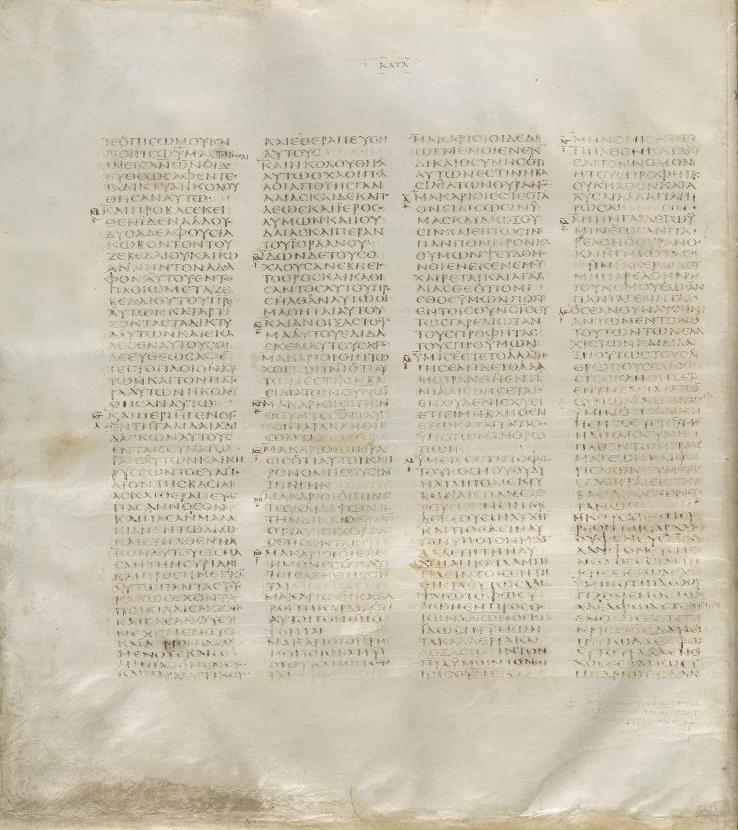
Skousen and Carmack on Early Modern English not in the KJV
A separate line of evidence comes from Royal Skousen and Stanford Carmack's two-decade Critical Text Project. The Book of Mormon contains a stratum of English vocabulary, phrases, and grammar that pre-dates the 1611 KJV: patterns whose Oxford English Dictionary attestations cluster in the 1530s through 1730s, with many features extinct by the time of the KJV. Skousen identifies over 90 archaic items: 41 vocabulary words, 25 phrases, 13 grammatical patterns, and 14 dialect features.[80]
| Archaic feature | Meaning in BoM | OED dates | In the KJV? |
|---|---|---|---|
| but if | "unless" (Mosiah 3:19) | 1393-1596 | No |
| to that | "until" (1 Nephi 18:9) | ~1460 to 1600s | No |
| cross (verb) | "contradict" (Alma 10:16) | 1589-1702 | No |
| depart (verb) | "divide / separate" (Helaman 8:11) | 1297-1677 | No; KJV translators specifically avoided this sense |
| beloved (transitive verb) | "to love" (Alma 26:9, 27:4) | 1604-1623 | No; Webster 1828 notes "Belove, as a verb, is not used" |
These features come from non-biblical passages of the Book of Mormon; the italics issue concerns the biblical passages. The archaic vocabulary evidence is therefore an indirect counter to the simple-copying thesis: it establishes that the Book of Mormon's English is not simply a derivative of the KJV. The process behind the non-biblical passages drew on linguistic resources beyond the KJV. Once we accept that the translation drew on something other than the KJV for the non-biblical text, the simple "Joseph copied the KJV" frame is finished. The question becomes how to characterize the resources the translation drew on, not whether such resources existed. Skousen and Carmack are themselves faithful scholars, and the EModE thesis has been contested in print; but the specific OED attestations are independent of confessional position, and the cluster of features, attested on both sides of 1611 yet absent from the KJV, remains evidentially significant.[81]
Skousen's Earliest Text recovers Hebraisms the printer's editions smoothed out
Royal Skousen's reconstruction of the original 1829-1830 dictation text, The Book of Mormon: The Earliest Text (Yale UP, 2009; 2nd ed. 2022), recovers readings that were "corrected" out of later editions because they sounded ungrammatical in 19th-century English but turn out to be authentic Hebraisms. The first edition of The Earliest Text incorporated over 600 corrections relative to standard editions, with about 250 affecting the text's meaning; the second edition added further corrections.[82]
Among these are constructions that 19th-century editors flagged as bad English and "fixed," but which, when restored, turn out to be Hebrew calques: emphatic repetition, "if…and" conditional structures (Hebrew im-clauses), construct chains, and other features documented in Skousen's Analysis of Textual Variants (6 parts, BYU Studies 2004-2009).[83]
Joseph Smith did not read Hebrew. He had not yet attended Joshua Seixas's Hebrew school in Kirtland (that was 1836, six years after the Book of Mormon's publication). He could not consciously generate Hebrew syntactic patterns and embed them in a dictated text, especially in ways that 19th-century proofreaders would later try to remove because they didn't sound English. The presence of Hebraisms that the original dictation contained but the printed editions edited out is positive evidence of an underlying Hebrew structure that the dictation tracked and that English editors did not understand. The broader case for ancient features in the Book of Mormon text (horses, steel, barley, and other items the CES Letter raises) is treated in the companion article on anachronisms.
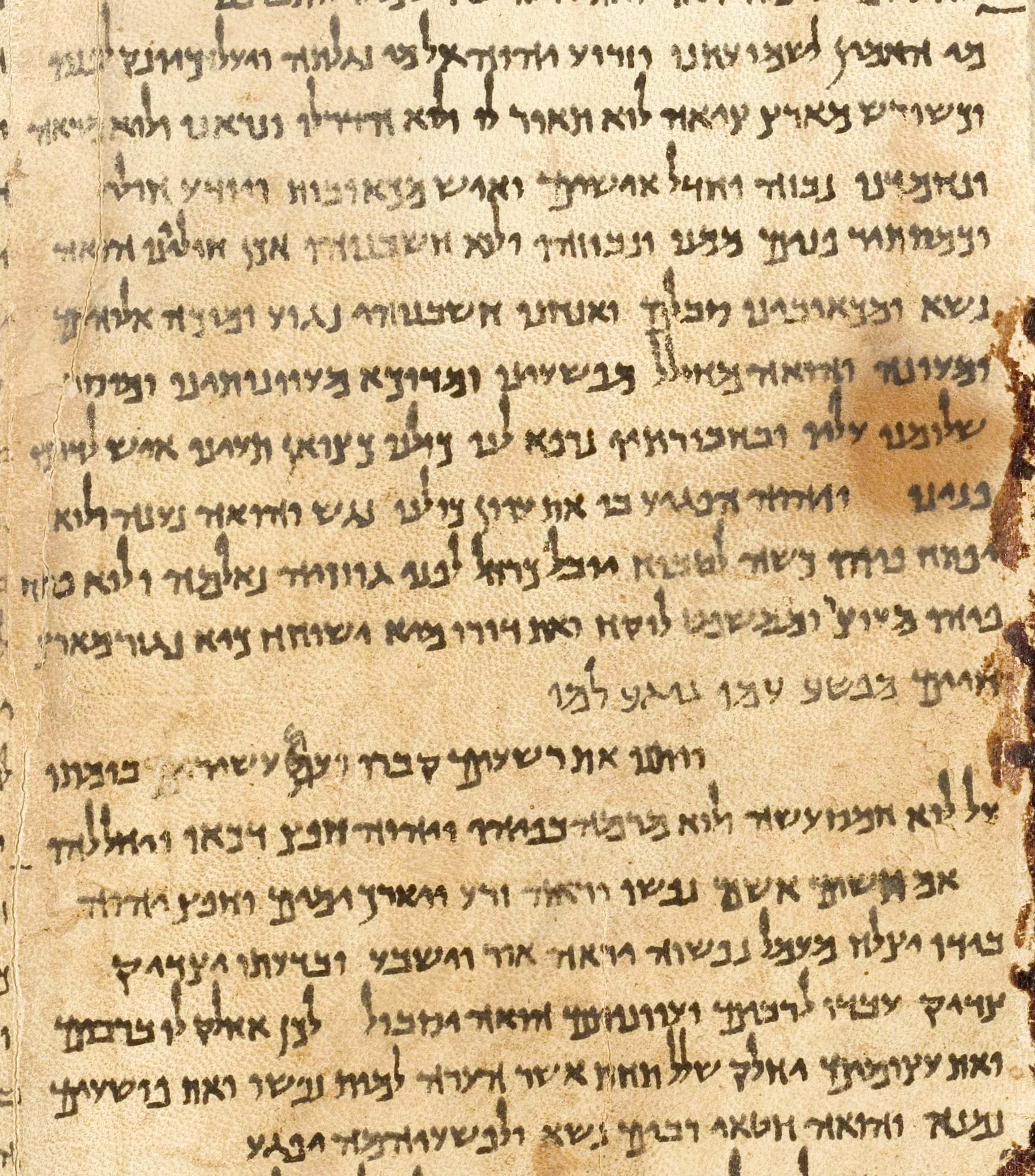
The JST signature divergence (revisited)
The Wayment & Yost JST data, presented earlier, also functions as anti-copying evidence: the pattern Joseph's conscious KJV revision actually produced (selective, grammatical, concentrated on meaning-altering italics) is the pattern the Book of Mormon's quotations conspicuously lack.[84]
Ellertson's 150 non-aligned variants
Ellertson's 150 non-aligned variants (matching no known textual tradition) are a category neither side can claim outright. Defenders emphasize that these variants could derive from a brass-plates text representing an otherwise unattested manuscript tradition. Critics note with equal logic that 150 variants matching nothing known is also consistent with someone making creative changes to the KJV, since invented variants would, by definition, match no ancient tradition.[85]
The non-aligned category cannot decisively adjudicate between hypotheses. What it does establish is that the Book of Mormon's Isaiah text is not simply the KJV with a few tweaks: the scale and character of its departures place it outside what textual critics would call a "dependent" text. That is a meaningful structural finding even when individual non-aligned readings are inconclusive.
Translation Method and the No-Bible Question
The eyewitness accounts of the Book of Mormon translation describe a process that does not include consulting a Bible. Emma Smith, in her 1879 "Last Testimony": Joseph "had neither manuscript nor book to read from"; he sat "with his face buried in his hat, with the seer stone in it, and dictating hour after hour."[86] Martin Harris reported that "sentences appeared" through the seer stone; Joseph "read those sentences aloud."[87] David Whitmer and Oliver Cowdery's accounts are consistent.[88]
The eyewitness record is heterogeneous in places. Emma's 1879 testimony was given to defend the Reorganized Church's succession claim against Brigham Young's polygamy and is more strongly worded than her earlier statements. Some accounts indicate that Joseph used the Urim and Thummim (the spectacles attached to the breastplate) for early portions and the seer stone for later portions. And the question of whether eyewitnesses were continuously present for every dictation session, including biblical-quotation portions, cannot be definitively answered from the surviving record. The strongest claim the eyewitness testimony supports is "no eyewitness reported Joseph using a Bible during dictation," which is a meaningful floor but not a proof that no Bible was ever consulted.
Spencer's observation: "Continuously removing his face from the hat to make use of a physical Bible would not have gone unnoticed" by the multiple witnesses across multiple sessions in two states.[89]
Manuscript-physical evidence reinforces the eyewitness picture and is independent of eyewitness reliability. Royal Skousen's analysis of the Original Manuscript shows that Oliver Cowdery's spelling errors are hearing errors ("an" for "and," "reed" for "weed," "beat" for "meet"), not visual copying errors that would result from reading from an open Bible.[90] If Cowdery had been copying from a Bible, standard biblical words would be spelled correctly because they were visible on the page. The Original Manuscript shows no consultative pauses or visible-text errors during the Isaiah chapters.[91]
The extant Isaiah portions of that manuscript, all in Cowdery's hand, carry his habitual misspellings (hoast, abhoreth, cloath) and "no sign of any influence from the King James spellings," which is why Skousen concludes that "the evidence is very strong that Joseph Smith dictated all three of these Isaiah passages."[4:11] This manuscript-physical evidence carries more weight than the eyewitness testimony alone, because it does not depend on whether eyewitnesses were continuously present. It also turns the statistical puzzle into a physical one: the dictation responded to a typographic feature of a book that these same pages show no one was reading from. If Joseph's face was in the hat, what was reading the italics?
Bible availability is its own question. Oliver Cowdery purchased a Bible in October 1829, after the Book of Mormon translation was complete in late June 1829.[92] Lucy Mack Smith stated Joseph "had never read the Bible through in his life" at age 18.[93] These facts are limits, not absolute claims. The Whitmer household where much translation occurred was a literate Christian family, and Bibles were ubiquitous in 1829 New York. The strongest claim is "no evidence Joseph used a Bible during dictation," not "no Bible existed in the vicinity." The stronger evidence against copying is the physical translation method, the manuscript hearing-errors, and the textual patterns themselves (the 40x ratio and ungrammatical results that no deliberate copier would produce).
Assessment
The CES Letter's argument about KJV italics in the Book of Mormon rests on two cherry-picked examples and a false empirical premise: that italicized words appear uniformly in the Book of Mormon text. They do not. The actual data tells a far more complex story.
What the data shows decisively: the italicized-word omission pattern is real. Italicized words are missing from Book of Mormon Isaiah at approximately 40 times the rate of non-italicized words, and Spencer's published conclusion that "such a strong association of variants…is not attributable to chance" is well-supported. The pattern is corroborated by an 1831 hostile-press account (with caveats), and is consistent with the JST signature divergence and the eyewitness translation method. A simple "Joseph copied from a Bible" thesis cannot generate the 40x ratio.
What the data shows probably: Spencer's Missing Words hypothesis is the best available account of the textual pattern. It explains the omissions, the retentions, the ungrammatical replacements, the JST contrast, and the 1831 newspaper observation more comprehensively than its competitors (Roberts's Ancient Variants Hypothesis or the Italics-Revision Hypothesis). It is not without difficulties. The prior-translator competence question, the retained-italics rate, unfalsifiability concerns, and the unresolved function-word confound are all real. But it outperforms the alternatives.
What the data leaves unresolved: the near-verbatim correspondence between Book of Mormon biblical passages and the KJV is extensive, and Wright's absence-of-synonymy argument is descriptively correct. The reproduction of confirmed KJV mistranslations is a real difficulty. Larson's 1769-edition dating argument is moderately strong. The Sermon at the Temple (3 Nephi 12-14) is where every faithful model is weakest: the brass-plates defense does not apply, and Welch's "without a cause" omission is real but partial. The tight/loose translation dilemma does not resolve neatly. Wright's English-polysemy examples force the faithful position to embrace some translator engagement with the KJV's English, with real theological cost. The accommodation framework and the selective-omission evidence pull in somewhat different directions and require careful articulation to hold together.
What the affirmative case adds:
- The 40x ratio itself is anti-copying evidence.
- Tvedtnes's catalog produces 59 Book of Mormon-favoring variants supported by ancient manuscripts Joseph could not have known (1QIsaa, LXX, Targums, Vulgate), with several specific cases (Isaiah 9:3, 48:11, 50:2, 51:15) carrying particular weight.
- The "ships of the sea" reading at 2 Nephi 12:16 matches the LXX against the KJV.
- The "without a cause" omission at 3 Nephi 12:22 aligns with Sinaiticus, Vaticanus, P64, the Vulgate, and the early church fathers against the KJV.
- Skousen and Carmack document over 90 Early Modern English features in the Book of Mormon that are not in the KJV at all, undermining the simple "Joseph copied the KJV" frame at its root.
- The Earliest Text edition recovers Hebraisms that 19th-century editors unknowingly removed because they sounded like bad English, features Joseph Smith could not have consciously generated.
- The JST signature divergence shows what Joseph's deliberate KJV revision actually looks like, while the Book of Mormon does not look like that.
The evidence that stands regardless: when an argument like the italics question runs this deep, at the level of detail Wright and Larson press, the larger picture stays firm. The features that point past 19th-century imitation are in the text itself, recovered by faithful and non-LDS scholarship alike. Hebraisms that 19th-century proofreaders tried to delete because they sounded like bad English. Readings that match the Septuagint and the Great Isaiah Scroll, neither of which a New York farmer could consult in 1829. Archaic vocabulary that died out before the KJV was printed. Joseph Smith could not have put any of it there: the Hebrew grammar was invisible to him, the confirming manuscripts lay undiscovered in caves and monastery libraries, and the archaic vocabulary had been dead for two centuries. The scribes who took the dictation down, for their part, never gave a different account of how it was done. The italics question does not unmake that record. It deepens it: the closer the text is read, the more layered it becomes.
The KJV-dependence of the Book of Mormon's biblical passages is extensive and real. No current model, whether Spencer's Missing Words, Gardner's localization framework, the accommodation principle, or the ancient-variants hypothesis, explains every feature of the data without residual tension. We understand the pattern better than we understand the mechanism. What can be said with confidence is that the data is far too complex for the CES Letter's simple "Joseph copied from a Bible" narrative.
There is a known case of Joseph Smith sitting down with a King James Bible and deliberately revising it: the JST. That work leaves a recognizable fingerprint. Heaviest attention on the meaning-altering italics. Grammatical results, because the editor can see the page. A method that visibly evolves as the project goes on. Set the Book of Mormon's italics beside it and the fingerprints do not match. The Book of Mormon shows a flat omission rate with no preference for the meaning-altering words, ungrammatical gaps an editor would have caught, and the signature of a process where the operator could not see the source text, which is exactly the process the witnesses describe and exactly the anomaly a hostile Philadelphia paper noticed in 1831. Whatever produced the Book of Mormon's biblical passages, it was not Joseph copying or revising the King James Bible. That is the one thing the italics actually rule out, and it is the one thing the CES Letter set out to prove. However the mechanism debate settles, copying gives you the Bible back.
Note on Sourcing
A few items in this article rest on sources that should be flagged for the reader's calibration:
Wright (1998/2002): the Dialogue article (vol. 31, no. 4, pp. 197-234) is open-access; the American Apocrypha expanded version (Signature Books, 2002, pp. 157-234) is available, but specific verse-level examples (Isaiah 2:10, 48:16, 51:17) in this article rely on the Dialogue primary text and on secondary summaries where direct verification of the American Apocrypha version was incomplete. The descriptive claims about absence-of-synonymy, the alternative translation of Isaiah 29:16 (verified at Dialogue p. 182), and English-polysemy variants are well-attested across the literature; the specific verse-level examples should be treated as accurate paraphrases.
Larson (1986 Trinity Journal): paywalled and not directly verified. Specific examples attributed to Larson are drawn from the 1993 New Approaches to the Book of Mormon expanded version and from secondary summaries; the italics-dating data itself is anchored to Skousen's published collation (BYU Studies Quarterly 59.1), which supersedes the secondary summaries on the Matthew 6:5 dating.
Stendahl "Achilles heel": widely cited but the original 1978 Stendahl essay should be checked for the exact wording before treating as a verbatim quote.
Sperry on italics: an earlier discovery brief described Sperry 1939 as arguing that the Book of Mormon differs from the KJV in nearly half of italicized verses. The 1939 Improvement Era article actually focuses on Deutero-Isaiah authorship, with italics mentioned only in a footnote as a topic for a future article. This article therefore does not cite Sperry on italics directly.
The 1820s American textual-criticism context: earlier drafts attributed claims about the limited state of biblical textual criticism in 1820s America (Sinaiticus 1844, Vaticanus accessibility 1860s, Mill's 1707 Novum Testamentum, Textus Receptus tradition) to Welch's 1999 chapter; direct verification at the cited URL did not locate those specific historical claims in the chapter text. The current article footnotes those historical claims to Metzger and Ehrman's The Text of the New Testament, and reserves the Welch citation for the manuscript-witness list, where Welch is the primary source actually being engaged.
Earliest Text correction counts: the publicly available description at Yale University Press references "over 600 corrections" with "about 250" affecting meaning for the original 2009 edition; granular numbers for the 2nd edition (e.g., specific sub-counts of "615 / 251 / 38 / 133" cited in some apologetic summaries) are not substantiated at the publisher's page and have been omitted from this article's body text.
These caveats do not undermine the article's main arguments, which rest on directly-verified primary sources (Spencer 2020, Skousen's published findings, Wayment & Yost 2005, Specht 1968, Jackson Judd & Seely 2011, Tvedtnes 1984, Ellertson 2001, Welch 1999, Wilson 2024). They are flagged so that any future researcher can confirm or refine specific citations.
Further Reading
- KJV Errors in the Book of Mormon: companion article addressing the reproduction of KJV translation errors.
- KJV Mistranslations in the Book of Mormon: detailed analysis of specific mistranslation claims.
- Book of Mormon overview: the broader section index.
- "Book of Mormon Translation," Gospel Topics Essay: official Church resource on the translation process.
- Stan Spencer, "Missing Words": the central scholarly article on this topic.
- Royal Skousen with Stanford Carmack, The King James Quotations in the Book of Mormon (FARMS / BYU Studies, 2019): the definitive collation; summarized in BYU Studies Quarterly 59.1.
- Royal Skousen, The Book of Mormon: The Earliest Text, 2nd ed. (Yale UP, 2022).
Runnells, CES Letter (2017), "Book of Mormon," no. 2, p. 9. ↩︎
Runnells, CES Letter (2017), "Book of Mormon," nos. 1-2, p. 9. The first numbered claim invokes "1769 King James Version edition errors" without supplying examples; the second presents the Isaiah 9:1 / 2 Nephi 19:1 and Malachi 3:10 / 3 Nephi 24:10 parallels. ↩︎
Skousen, "Textual Variants in the Isaiah Quotations," 369-390; KnoWhy #39. ↩︎
Royal Skousen, "The History of the Book of Mormon Text: Parts 5 and 6 of Volume 3 of the Critical Text," BYU Studies Quarterly 59, no. 1 (2020): 87-128, summarizing Royal Skousen with Stanford Carmack, The King James Quotations in the Book of Mormon, Part 5 of Volume 3 of the Book of Mormon Critical Text Project (Provo: FARMS / BYU Studies, 2019). https://scholarsarchive.byu.edu/byusq/vol59/iss1/5/ The collation method and the 36 quotations: pp. 90-93; the copytext dating and the Matthew 6:5 / 6:7 / Isaiah 49:18 italics dates: p. 97; the Original Manuscript Isaiah portions in Cowdery's hand: p. 98; the 712 / 163 (22.9%) and 425 / 163 (38.4%) statistics and the eikē variant: p. 100; the Sermon on the Mount adaptations and the 6.6% figure: pp. 102-3; the small-plates (30.6%) versus large-plates (9.0%) italics split: p. 103; the 12 cultural translations and 19 translation errors: pp. 103-4; the summary dating verdict ("dates after the 1660s, but not more precisely"): p. 107. ↩︎ ↩︎ ↩︎ ↩︎ ↩︎ ↩︎ ↩︎ ↩︎ ↩︎ ↩︎ ↩︎ ↩︎
The phrase count is Philip L. Barlow's: "More than fifty thousand phrases of three or more words, excluding definite and indefinite articles, are common to the Bible and the Book of Mormon." Barlow, Mormons and the Bible (New York: Oxford University Press, 1991), 27, quoted in Daniel L. Belnap, "The King James Bible and the Book of Mormon," in The King James Bible and the Restoration, ed. Kent P. Jackson (Provo: BYU RSC, 2011), 162-81. https://rsc.byu.edu/king-james-bible-restoration/king-james-bible-book-mormon For the New Testament side of the phrasing specifically, see Nicholas J. Frederick, "The Book of Mormon and Its Redaction of the King James New Testament," Journal of Book of Mormon Studies 27 (2018): 44-87. ↩︎
Stan Spencer, "Missing Words: King James Bible Italics, the Translation of the Book of Mormon, and Joseph Smith as an Unlearned Reader and Editor of a Visioned Text," Interpreter: A Journal of Latter-day Saint Faith and Scholarship 38 (2020): 49, 52. https://interpreterfoundation.org/journal/missing-words-king-james-bible-italics-the-translation-of-the-book-of-mormon-and-joseph-smith-as-an-unlearned-reader/ ↩︎
Walter F. Specht, "The Use of Italics in English Versions of the New Testament," Andrews University Seminary Studies 6, no. 1 (1968): 89-91. https://www.andrews.edu/library/car/cardigital/Periodicals/AUSS/1968-1/1968-1-06.pdf ↩︎
William Whittingham, preface to the 1557 Geneva New Testament, quoted in Specht, "The Use of Italics," 91. ↩︎
Preface to the 1560 Geneva Bible, quoted in Specht, "The Use of Italics," 92. ↩︎
Kent P. Jackson, Frank F. Judd Jr., and David Rolph Seely, "Chapters, Verses, Punctuation, Spelling, and Italics," in The King James Bible and the Restoration, ed. Kent P. Jackson (Provo: BYU RSC, 2011), 100. https://rsc.byu.edu/king-james-bible-restoration/chapters-verses-punctuation-spelling-italics ↩︎
Specht, "The Use of Italics," 93. The RSV translation committee abandoned italics on the grounds that the convention misled readers into thinking the marked words were less authoritative than the rest of the text, treating them instead as "an essential part of the translation." ↩︎
Specht, "The Use of Italics," 105-109, surveys the abandonment of the convention by mid-20th-century scholarly translations. The RSV's modern successors (NRSV, NIV, ESV, NET) likewise treat supplied words as part of the translation itself, with no typographic flag. ↩︎
Thomas A. Wayment and Tyson J. Yost, "The Joseph Smith Translation and Italicized Words in the King James Version," Religious Educator 6, no. 1 (2005): 53-54. https://rsc.byu.edu/vol-6-no-1-2005/joseph-smith-translation-italicized-words-king-james-version ↩︎
Wayment and Yost, "The Joseph Smith Translation," 54-58. Group A italics ("syntactic supplements") account for 1,410 of 1,628 italicized words in the four Gospels; only Group C words (183, or roughly 11%) are "foreign to Greek grammar" and actually alter meaning. ↩︎
W.W. Phelps, editorial in The Evening and the Morning Star 1, no. 8 (January 1833): n.p. Quoted in Wayment and Yost, "The Joseph Smith Translation," 51-52, and discussed in Kevin L. Barney, "KJV Italics," By Common Consent (blog), October 13, 2007. https://bycommonconsent.com/2007/10/13/kjv-italics/ ↩︎
Editorial in The Evening and the Morning Star 2, no. 14 (July 1833): 106. Quoted in Wayment and Yost, "The Joseph Smith Translation," 51. The author of the editorial is most likely W.W. Phelps, the periodical's editor; direct attribution to Joseph Smith personally is not established at this source. ↩︎
Specht, "The Use of Italics," 107. ↩︎
Dewey Beegle, quoted in Specht, "The Use of Italics," 107. ↩︎
Specht, "The Use of Italics," 107. ↩︎
Jackson, Judd, and Seely, "Chapters, Verses, Punctuation, Spelling, and Italics," 112-113. ↩︎
Specht, "The Use of Italics," 99; Jackson, Judd, and Seely, "Chapters, Verses, Punctuation, Spelling, and Italics," 113-114. ↩︎
Specht, "The Use of Italics," 96-97. ↩︎
Specht, "The Use of Italics," 97. Specht discusses Luke 19:17 vs. Luke 19:19; KJV Luke 19:22 ("thou wicked servant") shows the same parallel-construction inconsistency. The point is that identical Greek vocative constructions receive inconsistent italic treatment within the same passage. ↩︎
Specht, "The Use of Italics," 96. ↩︎
Royal Skousen, "Textual Variants in the Isaiah Quotations in the Book of Mormon," in Isaiah in the Book of Mormon, ed. Donald W. Parry and John W. Welch (Provo: FARMS, 1998), 369-390; summarized in KnoWhy #39, "Can Textual Studies Help Readers Understand the Isaiah Chapters in 2 Nephi?" Scripture Central. https://scripturecentral.org/knowhy/can-textual-studies-help-readers-understand-the-isaiah-chapters-in-2-nephi ↩︎
Spencer, "Missing Words," 50 n. 11 and 53 n. 14, both citing Royal Skousen, "Textual Variants in the Isaiah Quotations in the Book of Mormon," in Isaiah in the Book of Mormon, ed. Donald W. Parry and John W. Welch (Provo: FARMS, 1998), 382. Per n. 11, approximately 38% of the KJV's italicized words across the Book of Mormon's Isaiah quotations are "linked to differences"; per n. 14, 29% of the differences between Book of Mormon Isaiah and the KJV involve italicized words, leaving 71% of those differences unrelated to italics. The retained-italic rate of approximately 62% follows directly from the 38% figure. ↩︎
Carol F. Ellertson, "The Isaiah Passages in the Book of Mormon: A Non-Aligned Text" (MA thesis, Brigham Young University, 2001), 50-70. https://scholarsarchive.byu.edu/etd/4663/ The italics sub-breakdown (51 replaced, 9 expanded, 59 omitted) is at p. 59; the numbered summary at p. 70. ↩︎ ↩︎
Ellertson, "The Isaiah Passages in the Book of Mormon," 65. Ellertson concludes that the Book of Mormon Isaiah qualifies as a "non-aligned text" under Emanuel Tov's textual-criticism framework -- a text that cannot be derived from any single known source tradition. ↩︎
Spencer, "Missing Words," 49-52. The 2 Nephi 16-17 / Isaiah 6-7 sample contains 37 italicized words and 1,021 non-italicized words; the Book of Mormon omits 15 (41%) and 11 (1%) respectively. ↩︎
Spencer, "Missing Words," 49. ↩︎
Spencer, "Missing Words," 53-65. Spencer's actual six sub-types as published: transmission errors and modernizations (7); italicized words omitted (12); italicized words transposed (1); italicized words replaced or expanded (4); non-italicized words replaced (1); words added (4). ↩︎
A fully controlled study would compare omission rates of italicized "is" with non-italicized "is" of comparable frequency in the same chapters, italicized "the" with non-italicized "the," and so on; that study has not been published. A reader who reads "the strongest single piece of statistical evidence" should also read "and the formal control study has not yet been done." The available data shows the correlation is with italic status rather than word type alone, but the formal type-by-type control remains an open research item. ↩︎
B.H. Roberts, "Bible Quotations in the Book of Mormon, and Reasonableness of Nephi's Prophetic Foreshadowing of the Coming of Jesus the Christ," Improvement Era 7 (January 1904); developed more fully in Roberts, New Witnesses for God, 3 vols. (Salt Lake City: Deseret News, 1909). Discussed in Spencer, "Missing Words," 47-48. ↩︎
Stan Larson, "The Sermon on the Mount: What Its Textual Transformation Discloses Concerning the Historicity of the Book of Mormon," Trinity Journal 7, no. 1 (1986); expanded in Larson, "The Historicity of the Matthean Sermon on the Mount in 3 Nephi," in New Approaches to the Book of Mormon, ed. Brent Lee Metcalfe (Salt Lake City: Signature Books, 1993), 115-163. David P. Wright, "Joseph Smith's Interpretation of Isaiah in the Book of Mormon," Dialogue 31, no. 4 (1998): 197-234; expanded in American Apocrypha, ed. Dan Vogel and Brent Lee Metcalfe (Salt Lake City: Signature Books, 2002), 157-234. ↩︎
Spencer, "Missing Words," 53-67. Spencer presents the Missing Words Hypothesis as a descriptive inference from textual patterns: the data fits a model in which a prior translator excised italicized words from a KJV base text, and Joseph Smith attempted to supply missing words while dictating from a visioned text. ↩︎
Spencer, "Missing Words," 67. ↩︎
Spencer, "Missing Words," 81-82. Joseph corrected several earlier omissions in the 1837 edition, including putting "is" back into "Woe is me" at 2 Nephi 16:5. The pattern of later restoration suggests the original omissions were unintentional gaps rather than editorial choices. ↩︎
Spencer, "Missing Words," 53. ↩︎
Spencer, "Missing Words," 62-71. Specific examples of italicized-word interactions in 2 Nephi 16-17 (Isaiah 6-7). ↩︎
Brant A. Gardner, The Gift and Power: Translating the Book of Mormon (Salt Lake City: Greg Kofford Books, 2011), particularly the chapters on translation theory. See also Brant A. Gardner, "Joseph Smith's Translation Projects under a Microscope," Interpreter: A Journal of Latter-day Saint Faith and Scholarship 41 (2020). https://scholarsarchive.byu.edu/interpreter/vol41/iss1/18/ ↩︎
Gardner, The Gift and Power, on functional and cultural translation. Gardner's distinction between vocabulary-level and meaning-level fidelity allows for KJV phrasing in passages whose underlying meaning derives from a non-KJV ancient source. ↩︎
Daniel L. Belnap, "The King James Bible and the Book of Mormon," in The King James Bible and the Restoration, ed. Kent P. Jackson (Provo: BYU RSC, 2011), 162-81. https://rsc.byu.edu/king-james-bible-restoration/king-james-bible-book-mormon Belnap argues that King James English carried the weight of religious tradition for early 19th-century readers and that familiarity with it prepared them to receive the Book of Mormon as scripture tied to biblical history. ↩︎
Doctrine and Covenants 1:24: "These commandments…were given unto my servants in their weakness, after the manner of their language, that they might come to understanding." ↩︎
Martin Abegg, Peter Flint, and Eugene Ulrich, The Dead Sea Scrolls Bible: The Oldest Known Bible Translated for the First Time into English (San Francisco: HarperOne, 1999). Abegg, Flint, and Ulrich used the NRSV as their base text, preserving its wording wherever the scrolls agreed and departing from it where they diverged -- a standard textual-critical methodology that makes differences more visible by anchoring them against a known translation. The analogy to the Book of Mormon translation is partial -- Abegg, Flint, and Ulrich are modern scholars who consciously documented their methodology -- but it establishes base-text translation as a documented practice in mainstream textual scholarship. ↩︎
"Mormonites," The Sun (Philadelphia), August 18, 1831, printed under the reprint credit "From the A. M. Intelligencer"; cited and discussed in Spencer, "Missing Words," 62-63 and 80-82. Page images of the original printing are available via University of Utah digital exhibits at https://exhibits.lib.utah.edu/s/century-of-black-mormons/item/23483; the quotation above has been checked against the page-1 image, which also shows the reprint credit and, in the preceding sentence, the reporter's own memorize-and-omit theory of the dictation. ↩︎
Spencer, "Missing Words," 62-63 and 80-82. Spencer treats the Sun account as corroborating evidence for the omission pattern but appropriately notes the account's limitations: it is secondhand, the reporter's framing of the translation method is wrong on details, and the specific factual claim about italics omission is the only feature that aligns with the textual data. The article's treatment above adds a further skeptical caveat not fully developed in Spencer's discussion: the account's compatibility with Italics-Revision rather than uniquely with Spencer's Missing Words hypothesis. ↩︎
Wayment and Yost, "The Joseph Smith Translation," 55-60. ↩︎
Wayment and Yost, "The Joseph Smith Translation," 58-59. Category C words ("foreign to Greek grammar, sometimes altering meaning") showed 63% alteration or removal compared to 50% overall, indicating that Joseph's JST work concentrated heaviest on the most problematic italicized words. ↩︎
Wayment and Yost, "The Joseph Smith Translation," 60. The JST methodology shifted at John 6:1: before that point, scribes wrote out the entire NT text while Joseph dictated changes; afterwards, Joseph marked his Bible and dictated only the changes. Only 17 italicized-word changes appear in 238 italicized words across John 6:1-21:25. ↩︎
Kevin L. Barney, "KJV Italics," By Common Consent (blog), October 13, 2007. https://bycommonconsent.com/2007/10/13/kjv-italics/ Barney synthesizes three converging lines of evidence: distribution of JST variants clustering around italicized words at roughly 30%, Joseph's marked Bible with crossed-out italicized words physically visible in Critical Text Project images, and Phelps's January 1833 published statement. ↩︎
David P. Wright, "Joseph Smith's Interpretation of Isaiah in the Book of Mormon," Dialogue: A Journal of Mormon Thought 31, no. 4 (Winter 1998): 197-234. https://www.dialoguejournal.com/articles/joseph-smiths-interpretation-of-isaiah-in-the-book-of-mormon/ Wright's argument: independent translations show wide lexical and syntactic variation while preserving meaning; the Book of Mormon Isaiah follows the KJV nearly word-for-word with only scattered micro-level changes; this absence of synonymous variation is the strongest evidence for direct KJV dependence. ↩︎
Wright, "Joseph Smith's Interpretation," 182. Wright produces an alternative translation of Isaiah 29:16 / 2 Nephi 27:27 to demonstrate that biblical-style English can be produced without the KJV: "How perverse of you (or: You turn things upside down)! Can the potter be considered as the clay? Can a work say of its maker, 'He did not make me,' and can what is formed say to the one who formed it, 'He has no (creative) intelligence?'" ↩︎
Wright, "Joseph Smith's Interpretation," and Wright, "Isaiah in the Book of Mormon," in American Apocrypha, 157-234. Specific example of English-polysemy variant at Isaiah 2:10 / 2 Nephi 12:10. ↩︎
Wright, "Isaiah in the Book of Mormon," on Isaiah 48:16 / 1 Nephi 20:16. The underlying Hebrew of Isaiah 48:16 is itself textually contested -- the verse is widely recognized in Hebrew scholarship as one of the more difficult passages in Isaiah -- which qualifies but does not eliminate Wright's specific point about the BoM reading. ↩︎
Wright, "Isaiah in the Book of Mormon," on Isaiah 51:17 / 2 Nephi 8:17. ↩︎
Within a translation methodology where the KJV provides the medium of English rendering rather than serving as a separate document being consulted and edited, some English-level engagement with the KJV's wording is expected. That admission is consequential: it means the Book of Mormon's biblical passages are not pure translations from Hebrew; they are renderings filtered through 19th-century English, with the KJV's interpretive choices sometimes carried forward into the Book of Mormon's reading. The English-polysemy variants are the data point most directly diagnostic of this filtering — they show the translator engaging the KJV's English text at the lexical level rather than reaching past it to the Hebrew. ↩︎
"Scholar Survey: KJV Translation Errors in Book of Mormon Isaiah," A Careful Examination blog. https://faenrandir.github.io/a_careful_examination/scholar-survey-kjv-translation-errors-in-bom-isaiah/ Compiles ratings from Jan Joosten (Regius Professor of Hebrew, Oxford), Robert Alter (Professor of Hebrew, UC Berkeley), and two anonymous reviewers with Hebrew competence on a series of Isaiah passages where the KJV's English deviates from the underlying Hebrew. One precision: for Isaiah 49:5, Joosten's published comment judges the KJV reading wrong ("the Hebrew here has two alternate reading[s]… according to the context 'to him' is correct") without assigning an explicit numeral; the survey's author infers the 0. The other verses in the table carry explicit 0 ratings. ↩︎
"Scholar Survey: KJV Translation Errors in Book of Mormon Isaiah." The survey's published rating for Isaiah 13:22 / 2 Nephi 23:22 is "2, 0," the two numbers attaching to the verse's two renderings: Joosten scores "wild beasts" a 2 and "dragons" a 0 on the 0-4 accuracy scale. The Hebrew word tannin has lexical range covering serpents, sea-monsters, and jackal-like animals, depending on context; modern translations frequently prefer "jackals" here. ↩︎
Joosten and Alter quotations in "Scholar Survey: KJV Translation Errors in Book of Mormon Isaiah." ↩︎
Larson, "The Sermon on the Mount" (1986); Larson, "The Historicity of the Matthean Sermon on the Mount in 3 Nephi" (1993), 115-163. Larson examined eight test cases in 3 Nephi 12-14 and identified passages where the Book of Mormon interacts with italicizations specifically present in the 1769 Blayney edition (or its derivatives) but absent or differently italicized in the 1611 and intermediate printings. ↩︎
Larson's argument is that the Book of Mormon's English interacts with editorial choices made by Benjamin Blayney in Oxford in 1769, dating the composition of the Book of Mormon's English to after that point. The argument is not that the Book of Mormon claims its English originated in 421 AD (no defender claims this) but that the English form of the translation reflects post-1769 editorial decisions. ↩︎
Spencer, "Missing Words," and other defenders note that "1769 dependence" is partly a function of which specific KJV printing one compares against. American KJV printings in the 1820s descended from the Blayney text but were not identical; the 1828 H. & E. Phinney Bible Joseph used for the JST is the closest available analogue. ↩︎
Krister Stendahl, "The Sermon on the Mount and Third Nephi," in Reflections on Mormonism: Judaeo-Christian Parallels, ed. Truman G. Madsen (Provo: BYU RSC, 1978). Stendahl's "Achilles heel" framing of the Sermon at the Temple is widely cited in subsequent literature; whether the exact phrase is verbatim Stendahl or a paraphrase that has crystallized in citation is a question this article flags rather than resolves. ↩︎
John W. Welch, "The Sermon at the Temple and the Greek New Testament Manuscripts," in Illuminating the Sermon at the Temple and Sermon on the Mount (Provo: FARMS, 1999). https://scripturecentral.org/archive/books/book-chapter/sermon-temple-and-greek-new-testament-manuscripts Welch documents that the omission of "without a cause" at 3 Nephi 12:22 is supported by Papyrus 64/67, Codex Sinaiticus (original hand), Codex Vaticanus, the Latin Vulgate, Ethiopic versions, the Gospel of the Nazarenes, and church fathers Justin, Tertullian, and Origen. ↩︎
For standard textual-critical history of the period, see Bruce M. Metzger and Bart D. Ehrman, The Text of the New Testament: Its Transmission, Corruption, and Restoration, 4th ed. (New York: Oxford University Press, 2005), 152-194 (on Tischendorf's 1844 rediscovery of Codex Sinaiticus and the 1860s accessibility of Codex Vaticanus); 151-152 (on Mill's 1707 Novum Testamentum); 145-150 (on the Textus Receptus tradition derived from Erasmus). Welch's chapter "The Sermon at the Temple and the Greek New Testament Manuscripts" (in Illuminating the Sermon at the Temple) documents the manuscript witnesses for the shorter "without a cause" reading but does not itself develop the 1820s American context; the historical claims about the period derive from the standard textual-critical literature. ↩︎
Adam Clarke, Commentary on the Bible (London, 1810-1826), commentary on Matthew 5:22. Clarke discusses the eikei ("without a cause") textual variant and notes that some early manuscripts omit it. The variant was therefore not entirely unknown in Joseph Smith's day, even though the specific manuscripts (Sinaiticus, Vaticanus) were unavailable. ↩︎
Bill McKeever, "Joseph Smith's Alleged Ignorance of the Bible," Mormonism Research Ministry. https://mrm.org/joseph-smiths-ignorance McKeever argues that defenders' invocation of Joseph's biblical ignorance implicitly concedes that the translator's knowledge shaped the output -- a structural observation about the implicit framework defenders deploy. ↩︎
For the dilemma in its sharpest form, see "The King James Bible and the Book of Mormon," LDS Discussions. https://www.ldsdiscussions.com/kjv The tight-translation evidence is summarized in Royal Skousen's Critical Text Project; the loose-translation framing in Brant Gardner's The Gift and Power. The dilemma is that the two models do different argumentative work, and committing to one closes off the other. See also Stanford Carmack, "Joseph Smith Read the Words," Interpreter: A Journal of Latter-day Saint Faith and Scholarship 18 (2016): 41-64, for an extended faithful treatment of the tight-translation evidence. ↩︎
The word "Red" before "Sea" in 2 Nephi 19:1 is not present in the KJV, the Masoretic Text, the Septuagint, the Great Isaiah Scroll (1QIsaa), or any other known Isaiah manuscript tradition. See E. Jan Wilson, "Joseph Smith and the 'Red Sea' in 2 Nephi 19:1," Interpreter: A Journal of Latter-day Saint Faith and Scholarship 60 (2024): 183-196, which surveys the manuscript evidence for the verse. ↩︎
E. Jan Wilson, "Joseph Smith and the 'Red Sea' in 2 Nephi 19:1," Interpreter: A Journal of Latter-day Saint Faith and Scholarship 60 (2024): 183-196. https://interpreterfoundation.org/journal/joseph-smith-and-the-red-sea-in-2-nephi-191/ Wilson proposes that the original Hebrew was the place name Sufah (cf. Numbers 21:14), which pre-Septuagint scribes corrupted to the generic yam. ↩︎
Wilson, "Joseph Smith and the 'Red Sea' in 2 Nephi 19:1." Wilson's framing acknowledges that the proposal is "speculative" but argues it "satisfactorily explains the facts presented." ↩︎
The narrative context of 3 Nephi 24:10 differs structurally from 2 Nephi 19:1. The Malachi chapters in 3 Nephi are presented as the resurrected Christ speaking directly to the Nephites and quoting Malachi to them. There is no theological reason the resurrected Christ's English rendering of Malachi to a 19th-century reader would need to differ from the KJV; the speaker is choosing what English wording to use. ↩︎
Spencer, "Missing Words," 49-58. Plagiarism produces uniform reproduction; the 40x disparity is not what copying generates, regardless of which specific hypothesis explains it. ↩︎
John A. Tvedtnes, "Isaiah Variants in the Book of Mormon," in Isaiah and the Prophets, ed. Monte S. Nyman and Charles D. Tate Jr. (Provo: BYU RSC, 1984). https://rsc.byu.edu/isaiah-prophets/isaiah-variants-book-mormon Tvedtnes scored 234 substantive Book of Mormon Isaiah variants: 59 favor the BoM, 126 are neutral, 49 favor the KJV. Tvedtnes is a faithful scholar publishing in a faithful venue, and the classification of variants as "favoring" the BoM is partly interpretive; a neutral analyst might score the variants somewhat differently. ↩︎
Tvedtnes, "Isaiah Variants in the Book of Mormon." Specific examples discussed include Isaiah 2:11, 9:3, 10:29, 13:3, 48:11, 50:2, and 51:15. See also Donald W. Parry and Stephen D. Ricks, "The Great Isaiah Scroll and the Book of Mormon," Journal of Book of Mormon Studies 20, no. 2 (2011). https://scholarsarchive.byu.edu/jbms/vol20/iss2/7/ The four cases highlighted as strongest in this article (9:3, 48:11, 50:2, 51:15) are those with specific ancient-manuscript anchoring beyond rhetorical improvement. ↩︎
Dana M. Pike and David Rolph Seely, "'Upon All the Ships of the Sea, and Upon All the Ships of Tarshish': Revisiting 2 Nephi 12:16 and Isaiah 2:16," Journal of Book of Mormon Studies 14, no. 2 (2005). https://scholarsarchive.byu.edu/jbms/vol14/iss2/4/ The Book of Mormon contains both the KJV reading ("ships of Tarshish…pleasant pictures") and the LXX reading ("ships of the sea") -- a tripartite structure neither textual tradition preserves on its own. ↩︎
Pike and Seely, "'Upon All the Ships of the Sea,'" propose that the Greek θαλάσσης ("of the sea") and Θαρσῆς ("of Tarshish") are similar enough that an original three-part reading could have been lost in both the Hebrew and Greek transmission histories through scribal eye-skip or homoioteleuton. ↩︎
Welch, "The Sermon at the Temple and the Greek New Testament Manuscripts." See also "Without a Cause," Evidence Central, Scripture Central. https://scripturecentral.org/evidence/without-a-cause Modern critical Greek New Testament editions (NA28, UBS5) print the shorter reading. ↩︎
Royal Skousen and Stanford Carmack, The Nature of the Original Language of the Book of Mormon, vol. III of The History of the Text of the Book of Mormon (Provo: BYU Studies, 2018). See also Stanford Carmack, "The Implications of Past-Tense Syntax in the Book of Mormon," Interpreter: A Journal of Latter-day Saint Faith and Scholarship 14 (2015): 119-186; Carmack, "A Look at Some 'Nonstandard' Book of Mormon Grammar," Interpreter 11 (2014): 209-262; and "Archaic Vocabulary," Evidence Central, Scripture Central. https://scripturecentral.org/evidence/archaic-vocabulary ↩︎
Skousen and Carmack are themselves faithful scholars, and the EmodE thesis has been contested in print. See, for critical engagement, the discussions in Journal of Book of Mormon Studies and Interpreter responses; the underlying OED attestations are independent of confessional position even where the broader interpretive frame is debated. ↩︎
Royal Skousen, ed., The Book of Mormon: The Earliest Text, 2nd ed. (New Haven: Yale University Press, 2022). https://yalebooks.yale.edu/book/9780300263374/the-book-of-mormon/ The publisher's description references over 600 corrections, with about 250 affecting the text's meaning, with additional corrections in the 2nd edition. More granular sub-counts (e.g., specific numbers of restored unique phrases or recovered phraseology consistencies) referenced in some apologetic summaries are not substantiated at the Yale page and have been omitted from the body text. ↩︎
Royal Skousen, Analysis of Textual Variants of the Book of Mormon, 6 parts (Provo: BYU Studies and FARMS, 2004-2009). https://interpreterfoundation.org/books/atv ↩︎
Wayment and Yost, "The Joseph Smith Translation," 55-60; Spencer, "Missing Words," 82-84. The JST signature shows deliberate revision concentrated on Category C meaning-altering italicized words; the Book of Mormon signature shows mechanical omission with failed restoration. Different processes, different fingerprints. ↩︎
Ellertson, "The Isaiah Passages in the Book of Mormon," 60-65. The 150 non-aligned variants are an ambiguous category: defenders note that they could derive from a brass-plates text representing an unattested manuscript tradition; critics note that invented variants would also match no known tradition. ↩︎
"Last Testimony of Sister Emma," Saints' Herald 26 (October 1, 1879): 289-290. Emma's exact phrasing as cited in the Gospel Topics Essay reads "neither manuscript nor book to read from." See also "Book of Mormon Translation," Gospel Topics Essays, The Church of Jesus Christ of Latter-day Saints. https://www.churchofjesuschrist.org/study/manual/gospel-topics-essays/book-of-mormon-translation The 1879 Last Testimony was given to defend the Reorganized Church's succession claim against Brigham Young's polygamy practice and is more strongly worded than Emma's earlier statements; the eyewitness record is more textured than this single citation suggests. ↩︎
"Book of Mormon Translation," Gospel Topics Essays. ↩︎
David Whitmer's account in An Address to All Believers in Christ (Richmond, MO, 1887); Oliver Cowdery's accounts in his 1834-1835 Messenger and Advocate letters. Both are summarized in "Book of Mormon Translation," Gospel Topics Essays. ↩︎
Spencer, "Missing Words," 83. ↩︎
Royal Skousen, "Translating the Book of Mormon: Evidence from the Original Manuscript," in Book of Mormon Authorship Revisited, ed. Noel B. Reynolds (Provo: FARMS, 1997); cf. Royal Skousen, "How Joseph Smith Translated the Book of Mormon: Evidence from the Original Manuscript," Journal of Book of Mormon Studies 7, no. 1 (1998): 22-31. Cowdery's hearing errors include "an" for "and," "reed" for "weed," and "beat" for "meet" -- consistent with dictation, not visual copying. ↩︎
Skousen findings as summarized in KnoWhy #39: "Very little evidence that Joseph deliberately edited Isaiah while reading from a Bible." ↩︎
Kent P. Jackson, "Joseph Smith's Cooperstown Bible: The Historical Context of the Bible Used in the Joseph Smith Translation," BYU Studies 40, no. 1 (2001): 41-70. https://scholarsarchive.byu.edu/byusq/vol40/iss1/3/ Jackson documents Oliver Cowdery's October 8, 1829 purchase of the 1828 H. & E. Phinney quarto Bible at E. B. Grandin's Palmyra store. See also "KJV Italicized Text in the Book of Mormon," FAIR. https://www.fairlatterdaysaints.org/answers/KJV_italicized_text_in_the_Book_of_Mormon ↩︎
Lucy Mack Smith, Biographical Sketches of Joseph Smith the Prophet (Liverpool: S.W. Richards, 1853); cited in Spencer, "Missing Words," 83. ↩︎