View of the Hebrews
The claim:
"There was a book published in 1823 Vermont entitled View of the Hebrews. . . . [34-item parallel chart] . . . Oliver Cowdery – also a Poultney, Vermont resident – was a member of Ethan's congregation during this time . . ."[1]
"Did Ethan Smith's View of the Hebrews furnish structural material for Joseph Smith's Book of Mormon? It has been pointed out in these pages that there are many things in the former book that might well have suggested many major things in the other. Not a few things merely, one or two, or a half dozen, but many; and it is this fact of many things of similarity and the cumulative force of them that makes them so serious a menace to Joseph Smith's story of the Book of Mormon's origin."[2]
"While this does not prove that the Book of Mormon was plagiarized from the View of the Hebrews, it does demonstrate that key elements of the story of the Book of Mormon – i.e. Native Americans as Hebrew descendants, ancient records of natives preserved, scattering and gathering of Israel, Hebrew origin of Native American language, etc. pre-dated the Book of Mormon and were already among the ideas circulating among New England protestant Americans."[3]
In 1996, BYU's own Religious Studies Center reprinted View of the Hebrews in full. The supposed secret source, the embarrassing book the Church is said to have buried, was republished by a Church institution, edited by Charles D. Tate Jr., with a textual apparatus that hands the reader both texts and invites the side-by-side comparison.[4] No institution hides a book that way. Keep that fact in view first, because the CES Letter's whole View of the Hebrews section is built on the opposite premise.
That section devotes five pages to the argument that Ethan Smith's View of the Hebrews (1823, 2nd ed. 1825) served as a source or template for the Book of Mormon.[1:1] The case rests on three pillars and a graceful retreat. The pillars: a 34-item chart of thematic parallels presented as B.H. Roberts's own work; a biographical claim that Oliver Cowdery was "a member of Ethan's congregation"; and a long quotation from Roberts about the "cumulative force" of the parallels, presented as Roberts's settled view. The retreat, "while this does not prove that the Book of Mormon was plagiarized," disclaims the plagiarism implication while leaving the visual force of the chart in the reader's mind.[5]
This is the third and final response in the CES Letter's parallel-texts cluster. The other two, The Late War and The First Book of Napoleon, engage their dependence claims at the levels at which those claims operate: n-gram analysis, syntactic data, side-by-side construction. This one is different in form. The View of the Hebrews claim is a thematic-parallels argument rather than a text-overlap one, so the data that closes it is different too. The relevant evidence here is Welch's 84 differences (1985), Palmer and Knecht's hypergeometric Isaiah analysis (1964), Larry Morris's falsification of the Cowdery–Ethan Smith association (2000, 2007), the full documentary record of B.H. Roberts's lifelong Book of Mormon testimony, and the academic engagement of Elizabeth Fenton (2019, 2020), a non-Latter-day Saint literary scholar, and Richard Lyman Bushman (1984). Laid out together, every specific factual claim in the section either fails on examination or points the opposite direction from the conclusion it invites.
There is a stronger version of the criticism than the CES Letter's, and it needs stating in full. It is the environmental-influence thesis: that Joseph absorbed widely circulating 19th-century ideas about Native American origins, and that View of the Hebrews is the clearest single-volume expression of that environment.[3:1] This article takes that version up on its own terms. What it does not survive is what no naturalistic theory of the Book of Mormon survives: the contradiction of View of the Hebrews on every specific point a borrower would have copied, the omission of the source's strongest evidence, and the affirmative content (Nahom, complex chiasmus, Hebrew wordplay) that no book printed in Ethan Smith's century could supply.
Context and Background
What View of the Hebrews Actually Is
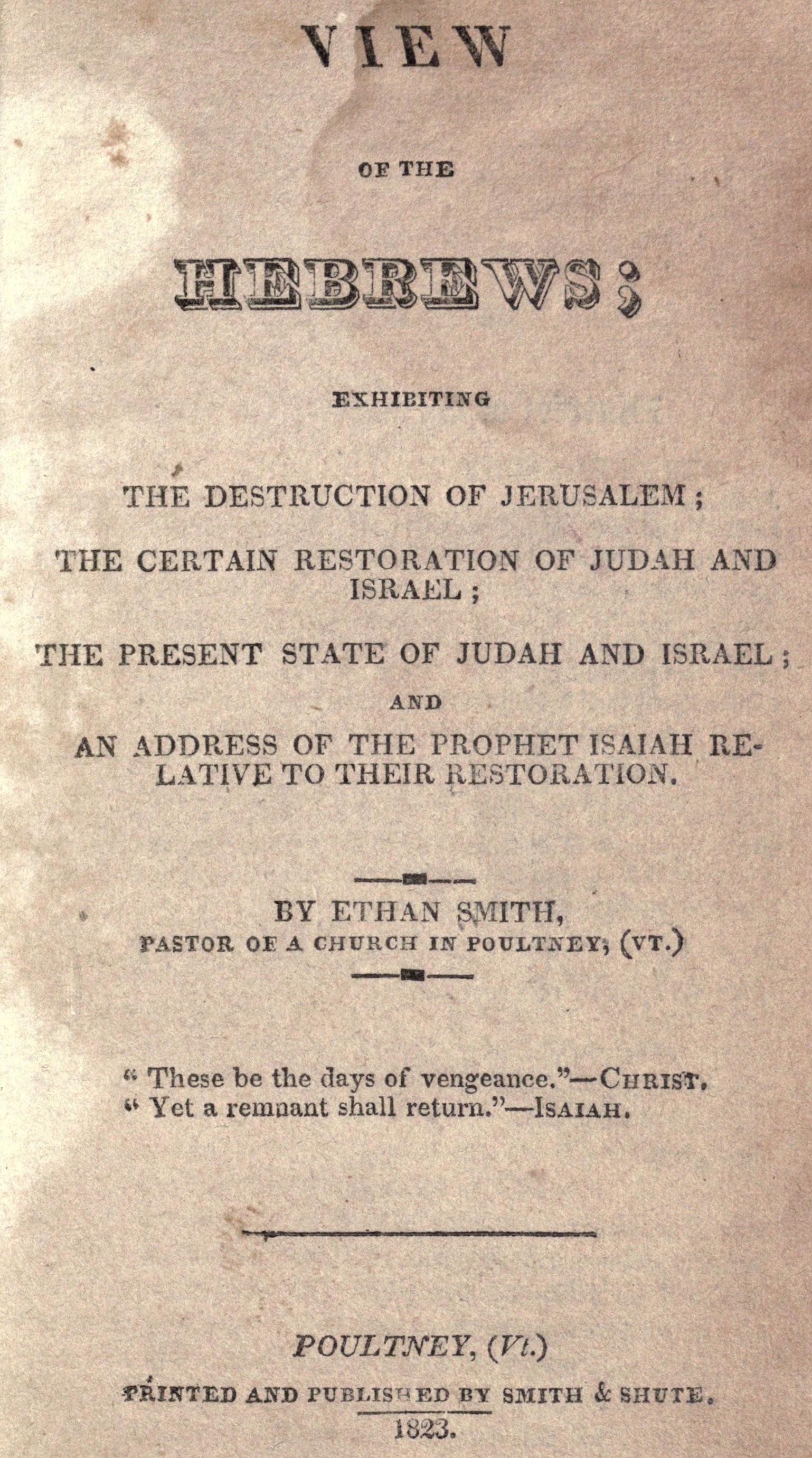
Ethan Smith (1762–1849) was a Congregationalist minister, a Dartmouth graduate, and a veteran New England pastor who published View of the Hebrews in Poultney, Vermont, in 1823, with an expanded second edition appearing in 1825.[4:1] The book is not a narrative. It is a sustained theological essay arguing that Native Americans descend from the Ten Lost Tribes of Israel, supported by biblical exegesis, quotations from classical Greek and Latin historians, ethnographic reports from missionaries and explorers, and comparisons between Native American customs and ancient Hebrew religious practices.[4:2]
The book's structure is straightforward. Chapter 1 recounts the destruction of Jerusalem, the Roman destruction of A.D. 70, drawing on Josephus and other classical sources. Chapter 2 argues "the certain restoration of Judah and Israel" from biblical prophecy. Chapter 3 (pp. 67–225, most of the book) assembles the evidence that the American Indians are the Lost Ten Tribes: circumcision, the Ark of the Covenant, Hebrew words allegedly preserved in Indian languages, Passover customs, priestly garments, tribal totems, and cities of refuge. Chapter 4, "An Address of the Prophet Isaiah Relative to the Restoration of His People," closes the book with an extended exegesis of Isaiah 18, the "land shadowing with wings" prophecy Ethan Smith reads as America's summons to gather Israel's remnant, and the chapter he treats as the linchpin of his entire interpretive case.[4:3][6][7]
The Book of Mormon is a different kind of document altogether: an approximately 270,000-word narrative history spanning roughly a thousand years, with hundreds of named characters, multiple interleaved storylines, complex internal chronology, theological discourses, war narratives, and embedded literary structures.[8] View of the Hebrews runs about 57,000 words by common estimate, so the Book of Mormon is roughly 4.7 times longer.[9] One is a scholarly brief; the other is a sacred history. As John Gee put it in his sustained engagement with the question, the genre gap matters because narrative composition cannot be reduced to thematic ingredients, and FAIR's overview of the dependence theory makes the same point about the structural mismatch.[10][11]
The Hebraic Indian Theory Was Everywhere
The idea that Native Americans descend from ancient Israelites was not Ethan Smith's invention but one of the most widely discussed speculative theories of the colonial and early Republic periods, with antecedents stretching back nearly two centuries before View of the Hebrews was printed.[12] Thomas Thorowgood published Iewes in America, or, Probabilities That the Americans Are of That Race in London in 1650, the first sustained Anglophone treatment of the theme.[12:1] James Adair's History of the American Indians appeared in 1775, devoting hundreds of pages to Hebrew-Indian parallels, including a catalog of supposed Hebrew terms preserved in Indian languages.[13] Elias Boudinot, former president of the Continental Congress, published A Star in the West; or, A Humble Attempt to Discover the Long Lost Ten Tribes of Israel in 1816, seven years before View of the Hebrews, arguing the same thesis from missionary reports and biblical prophecy.[14] Josiah Priest's The Wonders of Nature and Providence Displayed (1825) covered similar ground and was published in upstate New York.[15] Cotton Mather, William Penn, Roger Williams, and Jonathan Edwards had all advocated the theory a century or more before the Book of Mormon appeared.[16]
As Stephen Ricks observed, what seems distinctive about these parallels today "seemed less so in the early part of the nineteenth century, when these ideas flowed freely in published and unpublished forums."[17] So the CES Letter's chart is not, strictly speaking, a comparison between View of the Hebrews and the Book of Mormon at all. It is a comparison between standard 19th-century assumptions about Native American origins (drawn from a literature far broader than Ethan Smith's book) and a religious text engaging the same biblical themes those assumptions came from. The CES Letter never explains why View of the Hebrews specifically, rather than Adair, Boudinot, Priest, Thorowgood, or any of dozens of other writers in the same tradition, should be tagged as the source. It inherits the parallels-list approach from a longer evangelical-critical lineage reaching back at least to Hal Hougey's 1963 parallels booklet, not from any independent analysis of its own.[16:1]
When the View of the Hebrews Theory Actually Emerged
No contemporary critic of Joseph Smith ever accused him of borrowing from View of the Hebrews. During Joseph's lifetime, the prevailing critical theory was the Spalding manuscript hypothesis: the claim that the Book of Mormon derived from an unpublished novel by Solomon Spalding, an Ohio minister.[18] Alexander Campbell's 1831 critique attacked the book as reflecting 19th-century theological controversies but never mentioned View of the Hebrews.[19] E.D. Howe's Mormonism Unvailed (1834) systematized the Spalding theory with affidavits and circumstantial detail, and it too said nothing of Ethan Smith's book.[18:1] The View of the Hebrews theory was first proposed by I. Woodbridge Riley in 1902, fifty-eight years after Joseph Smith's death, and was popularized by Fawn Brodie in 1945.[20][21]
The Spalding theory itself collapsed in 1884, when the actual Spalding manuscript turned up in Honolulu, discovered by L.L. Rice and immediately seen by scholars and critics alike to bear no resemblance to the Book of Mormon.[22][23] Riley's hypothesis emerged in the immediate aftermath. The pattern of critics cycling from one source theory to the next as each collapses does not by itself disprove any individual theory, but it says something about the methodology.
This contemporary silence is interpretive context, not proof.[24] Critics cannot be expected to name a source they had never heard of, and View of the Hebrews was a regional theological essay whose circulation is hard to establish. What the silence does establish is narrower: the connection was not obvious to people who lived in the same time and place as both Joseph and Ethan Smith, critics actively hunting for sources included. Ethan Smith himself lived until 1849 and never once raised the issue or connected his work to the Book of Mormon. Howe and Campbell, with every motive to find a published source, reached instead for the unpublished Spalding manuscript, a narrative comparable in form to the Book of Mormon, and passed over View of the Hebrews's essay entirely. So the decisive argument against dependence is not the silence. It is the content analysis (84 differences, the Isaiah 18 omission, the Lost Tribes contradiction, the active reversal of View of the Hebrews's migration framework) developed below.
BYU Published View of the Hebrews Itself in 1996
Return to the fact this article opened with. The complete edition BYU's Religious Studies Center issued in 1996 reproduced the 1825 second edition of View of the Hebrews, with Charles D. Tate Jr.'s scholarly introduction and a textual apparatus built to make direct comparison easy.[4:4] Tate's framing leaves no ambiguity:
"These then are the books and articles that have argued for and against any connection between the Book of Mormon and VH. We present VH that follows and invite our readers to decide for themselves."[4:5]
For an institution supposedly concealing an embarrassing source, publishing it whole and pressing it into readers' hands for side-by-side reading is precisely the wrong move. Andrew H. Hedges, reviewing the BYU edition for Review of Books on the Book of Mormon in 1997, concluded that the side-by-side actually helps the Book of Mormon: the closer the two texts are read against each other, the harder the dependence theory is to sustain.[25]
Analysis
The Parallels Chart: What It Shows and What It Hides
The CES Letter's central exhibit is a 34-item comparison chart listing thematic elements allegedly shared between View of the Hebrews and the Book of Mormon, attributed to B.H. Roberts's Studies of the Book of Mormon (pp. 240–242, 324–344).[5:1] Each item gets a checkmark in both columns, building a visual impression of overwhelming correspondence. The format is built for accumulation rather than analysis: 34 rows of double checkmarks feel decisive before the reader has examined a single parallel in detail.[26]
Three rhetorical techniques do the work.
First, the chart inflates the count by atomizing a single shared premise into multiple entries. Grant the broad premise that ancient Hebrews migrated to the Americas, and a whole column follows from it automatically: "the destruction of Jerusalem," "the scattering of Israel," "the restoration of the Ten Tribes," "Hebrews leave the Old World for the New World," "religion a motivating factor," "migrations a long journey," "encounter seas of many waters," "Hebrew the origin of Indian language," "a unity of race (Hebrew) settle the land," and several more. These are not nine independent parallels. They are nine expressions of one shared assumption: that both books engage the same biblical tradition about Israel's scattering and gathering.[26:1] By item 12, the chart has shown twelve parallels that, at the level of premise, reduce to a single one.
Second, the binary checkmark format conceals the nature and degree of each parallel. A checkmark for "destruction of Jerusalem" does not tell the reader that View of the Hebrews discusses the Roman destruction of A.D. 70 (drawing extensively on Josephus and other classical sources) while the Book of Mormon describes the Babylonian destruction of 586 B.C. from an entirely different temporal and theological vantage. Different events, more than 650 years apart, viewed from different historical and religious standpoints. The checkmark flattens all of that. Likewise, a checkmark for "Messiah visits the Americas" does not distinguish View of the Hebrews's lengthy treatment of Quetzalcoatl as a Moses figure from the Book of Mormon's account of Christ's post-resurrection ministry, which never mentions Quetzalcoatl and shares none of the specific details View of the Hebrews attaches to him.[6:1]
Third, the chart treats widely circulated cultural commonplaces as though they were distinctive to View of the Hebrews. The theory that Native Americans descended from the Lost Tribes was not Ethan Smith's contribution to the conversation. It was mainstream in early 19th-century America, appearing in Adair, Boudinot, Priest, and many others.[17:1] Treating each commonplace as though it traveled specifically from View of the Hebrews into the Book of Mormon, rather than from a deeper underlying tradition into both, is the chart's biggest move. As Douglas Salmon documented in his 2000 Dialogue analysis, this is exactly the methodology Samuel Sandmel called "parallelomania" (the error of over-reading coincidental textual parallels as proof of dependence) in his 1961 Society of Biblical Literature presidential address (published 1962).[27][28]
The Strongest Specific Parallels
The chart's weakest items are the biblical commonplaces addressed above. But three specific parallels need closer examination, because they are the parallels apologists most often grant as more than generic.
A civilized group destroyed by a savage group. Both texts describe an advanced ancient people eventually overrun by a less civilized one. This is the parallel most often cited as specific to View of the Hebrews. The details diverge sharply once examined. View of the Hebrews follows the early-19th-century mound-builder myth: a sophisticated civilization (identified as the Ten Lost Tribes) built the Ohio Valley mounds and was destroyed around A.D. 1400 by the ancestors of living Native Americans.[6:2] The Book of Mormon describes a different civilization (descendants of a single family that left Jerusalem around 600 B.C.), destroyed in A.D. 385, from a different cause (internal wickedness and covenant violation, not simple military conquest), at a different time, within a different theological framework. The "civilized vs. savage" pattern was the default assumption of virtually every 19th-century writer who touched the mound-builders: Josiah Priest, Caleb Atwater, and Constantine Rafinesque all described essentially the same scenario from independent vantage points.[15:1] It was a mound-builder-myth commonplace, not a View of the Hebrews signature.
Buried records of an ancient people. View of the Hebrews mentions the possibility of discovering ancient records among Indian artifacts, specifically old parchment leaves "of a dark yellow" found folded inside a rawhide phylactery dug up on Indian Hill in Pittsfield, Massachusetts. The Book of Mormon describes gold metal plates buried in a stone box. View of the Hebrews's buried-record speculation is brief and tangential to its argument.[6:3] The Book of Mormon's plates are central to the entire narrative: described, witnessed, examined, and physically transmitted. The medium, the circumstances of preservation, and the narrative function are all different. And the idea of discovering ancient records was a standard motif in antiquarian literature of the period anyway; it was not invented by Ethan Smith and did not need him to carry it.[10:1]
A people who degenerated from civilization to savagery. This was the mound-builder myth, not a View of the Hebrews-specific idea. Nearly every 19th-century writer who discussed the mounds posited degeneration as the explanation for why the existing Native American tribes did not match the architectural sophistication of the earthworks.[6:4][29] The Book of Mormon's account of Lamanite degeneration differs from View of the Hebrews's in timing, cause, mechanism, and theological explanation. View of the Hebrews attributes the savage state to isolation from Hebrew civilization; the Book of Mormon attributes it to covenant rebellion and divine cursing, within a generational narrative spanning centuries.[6:5]
These are the strongest specific parallels, and they share one trait: each reflects the broadly circulating mound-builder myth of early 19th-century America, not details unique to View of the Hebrews. The question is whether such shared cultural assumptions point to View of the Hebrews as a specific source or to a shared intellectual environment both works draw on. Since View of the Hebrews gets the specific details of every one of these parallels wrong from the Book of Mormon's vantage, the evidence points to the environment.
The Wall-Preacher Parallel and Its Source
One of the chart's most specific items, and the only entry the CES Letter bothers to annotate at length, is the parallel between "A man standing on a wall warning the people saying, 'Wo, wo to this city…to this people' while subsequently being attacked.": Jesus son of Ananus in View of the Hebrews, Samuel the Lamanite in the Book of Mormon.[1:2] It sounds striking until you trace where the View of the Hebrews version comes from. The story of Jesus son of Ananus is lifted straight from Josephus's Wars of the Jews 6.5.3, one of the most widely read ancient histories in 19th-century America and available in dozens of English editions throughout the colonial and early Republic periods.[30] Ethan Smith is not the source of the wall-preacher narrative. He is quoting Josephus.
The parallel, to whatever extent it exists, is between the Book of Mormon and a famous ancient narrative relayed by Josephus, not between the Book of Mormon and View of the Hebrews as though Ethan Smith authored the wall-preacher story. Even at that level it requires real stretching. Jesus son of Ananus was an ordinary peasant who appeared at the Festival of Tabernacles and cried out against the city for seven years and five months before a Roman siege engine killed him. Samuel the Lamanite was a prophet sent by an angel, who prophesied of Christ's birth and death, stood on a city wall for a single episode in Helaman 13–16, and departed alive after stones and arrows failed to hit him. The shared elements (a man on a wall, prophesying woe) describe a biblical archetype (watchmen on walls appear in Isaiah 62:6, Ezekiel 3:17, and Habakkuk 2:1), not a unique narrative fingerprint.[10:2]
Two Parallels That Do Not Survive Scrutiny
Two additional items from the CES Letter's chart-style listings can be answered briefly.
Ethan/Ether. Critical lists sometimes pair the personal name "Ethan" (Ethan Smith) with the Book of Mormon's "Ether" as a phonological parallel. This is a coincidence of two short male names sharing two letters, with different etymologies and semantic fields (Ethan = Hebrew 'êthān, "ancient/enduring"; "Ether" is itself a biblical place name, at Joshua 15:42 and 19:7, which if anything further undercuts the Ethan link). Treating the pairing as a structural parallel dignifies it past anything the data supports. There is no serious version of the Ethan/Ether claim. It is the kind of phonological coincidence any two text corpora of sufficient length throw off by accident.
Joseph Sr.'s dream. Lucy Mack Smith's Biographical Sketches (1853) records that Joseph Smith Sr. had dreams during his religious-seeking years that some critics treat as parallel to View of the Hebrews's thematic content.[31] The chronological problem is decisive. Lucy's manuscript was composed in 1844–1845 and published in 1853, decades after the alleged dreams. The dreams she recalls (a "tree of life"–style dream, a "field" dream) were supposedly experienced decades before she recorded them, and they have far more in common with biblical-typological imagery (Lehi's vision in 1 Nephi 8 derives explicitly from the tree of life) than with anything in View of the Hebrews specifically. This is recall-mediated testimony, recorded roughly three decades after the alleged dreams and published in 1853, twenty-three years after the Book of Mormon. It cannot bear evidentiary weight on pre-1830 cultural exposure.
The 84 Differences
The CES Letter presents only parallels. It never mentions the differences. John W. Welch's 1985 study, circulated as the FARMS preliminary report Finding Answers to B. H. Roberts's Questions and "An Unparallel" and republished in Reexploring the Book of Mormon in 1992 under the title "View of the Hebrews: 'An Unparallel,'" catalogued "over eighty differences" between the two works, specific points where the Book of Mormon differs from or directly contradicts View of the Hebrews.[6:6] The exact count varies in subsequent citations between "over eighty" and "eighty-four"; for ease of reference this article will follow the conventional "84 differences" formulation while acknowledging the underlying count is approximate.[6:7]
The methodological framing matters more than any single quote from Welch. For a dependence theory the relevant question is not whether borrowers copy reverently or adapt creatively; both are documented practices across literary history. The relevant question is whether the specific pattern of similarities and differences between these two texts is better explained by dependence or by independence. Creative adapters do change major source-elements. But they also tend to preserve a source's distinctive interpretive contributions, the very things that make it recognizable as the source. A creative adapter of View of the Hebrews would likely have kept the Quetzalcoatl-Moses identification (Ethan Smith's most original move), the Isaiah 18 centerpiece argument (the anchor of his scriptural case), or at minimum the Lost Tribes framework (the thesis the whole book exists to argue). Welch's catalog of 84 differences shows the Book of Mormon doing the opposite: it drops the source's distinctive contributions and contradicts its central claims instead of adapting them.
Welch's own framing of the same observation:
"Should we conclude that Joseph Smith specifically took the main structural aspects of the Book of Mormon story from VH? To find that he did, one must find that he knew VH well and respected it deeply. If so, he should have followed it—or at least not contradicted it—on its major points. But contradict it he does, over and over again."[6:8]
The Saints Unscripted overview reaches the same diagnosis in plainer form: false-equivalence categorization, name-confusion (critics mixing up the biblical Book of Hebrews with View of the Hebrews), and the destruction-of-Jerusalem date asymmetry are exactly what the chart conceals.[32]
The core contrast is best laid out in a comparison table:
| Feature | View of the Hebrews | Book of Mormon |
|---|---|---|
| Genre | Theological essay/argument | Narrative history |
| Length | ~57,000 words | ~270,000 words |
| Jerusalem's destruction | Roman destruction, A.D. 70 | Babylonian destruction, 586 B.C. |
| Migration route | Overland via Bering Strait (dry land) | Transoceanic voyage by ship |
| Direction of settlement | North to south | South to north |
| Central figure | Moses (via Quetzalcoatl) | Jesus Christ |
| Record type | Yellowed parchment leaves | Gold metal plates |
| Isaiah usage | Short fragments; Isaiah 18 is centerpiece | Entire chapters; Isaiah 18 completely absent |
| Hebrew practices | Circumcision, ark, Passover, phylacteries, kosher laws, cities of refuge | None of these emphasized; circumcision explicitly rejected |
| Quetzalcoatl | Extensive treatment as Moses figure | Never mentioned |
| Date of civilized group's destruction | ~A.D. 1400 | ~A.D. 385 |
| Lost-tribes framework | Central thesis: Indians are the Lost Ten Tribes | Explicitly distinguishes its peoples from the Ten Tribes |
| New revelation | Explicitly denied: "we are to expect no new revelation from heaven" | Built on premise of continuous revelation |
| Theological method | Biblical exegesis + cultural observation | Prophetic narrative + revealed theology |
Welch's "84 differences" deserves the same scrutiny the CES Letter's "34 parallels" gets. Some of the 84 may reflect different facets of one underlying divergence rather than 84 fully independent points. Even a conservative consolidation leaves an overwhelming pattern, though. The Book of Mormon disagrees with View of the Hebrews on its most fundamental claims: the date and identity of the migration, the route, the direction of settlement, the central religious figure, the relationship to the Ten Tribes, the role of continuing revelation. Creative adaptation changes surface details and keeps what made the source worth adapting. What the Book of Mormon does instead is systematic disagreement on the foundational claims, paired with the omission of View of the Hebrews's most distinctive evidence. That is a different kind of pattern, and not the one creative-adaptation theories typically predict.
The Non-Parallels: Active Contradiction Goes Beyond Theological-Fitness
A sharp critic responds, fairly: a Christ-centered narrative claiming divine origin to a 19th-century revival audience would naturally omit circumcision, kosher laws, Passover customs, and other Mosaic-era practices. The Book of Mormon's Nephites are Christ-following pre-Christians, not continuous Mosaic-law observers, and 3 Nephi 15:4-8 has the resurrected Christ explicitly fulfill the Mosaic law in himself. On that theological framework, omitting Mosaic-era markers is the natural consequence of the Book of Mormon's own Christology, not source-concealment.[33] If the dispute were only about omission, theological-fitness alone would explain most of the data.
The harder problem for any dependence theory is that the Book of Mormon does not just omit View of the Hebrews's Mosaic-era content. It actively contradicts the source's central claims in places where theological fitness does not require contradiction.
Three contradictions stand out. Circumcision is the clearest case. View of the Hebrews's strongest Hebrew-cultural-marker argument is that Native American circumcision proves Israelite descent. The Book of Mormon does not merely omit circumcision; Moroni 8:8 declares that "the law of circumcision is done away," an explicit doctrinal repudiation that runs past any theological-fitness explanation. A borrower minimizing source-detection would have quietly dropped circumcision. The Book of Mormon loudly rejects it. The Lost Tribes framework is the second. View of the Hebrews's entire interpretive thesis is that Native Americans are the Lost Ten Tribes. The Book of Mormon, in 3 Nephi 15:15 and 17:4, has the resurrected Christ distinguish the Ten Tribes from the Nephite-Lamanite peoples outright: they are "other sheep" elsewhere, not the migrants Christ is presently among. That is not theological fitness. It is a flat contradiction of the source's central claim. The Bering Strait and Hebrew-language predictions are the third. View of the Hebrews predicts an overland Bering Strait crossing and Hebrew-language preservation as evidence of Israelite descent. The Book of Mormon's Lehite migration is a transoceanic ship voyage, and the record is kept in "reformed Egyptian" rather than Hebrew (Mormon 9:32-34): an active reversal of View of the Hebrews's key empirical predictions.
A borrower covering his tracks would have quietly omitted the Mosaic-era markers and let theology do the work. A creative adapter preserving distinctive contributions would have kept the Lost Tribes framework and the Bering Strait migration as the narrative skeleton. The Book of Mormon does neither. It omits the Mosaic-era markers, which theological fitness explains, and it also contradicts the source's central claims about who the migrants were and how they got there, which theological fitness does not. That second pattern, active contradiction of foundational source-claims, is the hard one for any dependence theory, including the strongest creative-adaptation versions.
The Non-Parallel Inventory
View of the Hebrews's longest chapter catalogs supposed Hebrew cultural markers among Native Americans: precisely the kind of "evidence" that View of the Hebrews itself treats as its strongest case.[7:1] FAIR's detailed cataloging documents at least fourteen specific items of View of the Hebrews's most distinctive Hebrew-cultural-marker evidence; the Book of Mormon includes none of them.[7:2] (Page references follow FAIR's catalog of the 1825 text; pagination differs across editions and reprints.)
- The Ark of the Covenant. View of the Hebrews (p. 68) argues extensively that Indians possessed imitations of the Ark: "The Indians have had their imitation of the ark of the covenant in ancient Israel." The Book of Mormon never mentions an ark of the covenant (only Noah's ark, in Ether 6:7).[6:9][7:3]
- Circumcision. View of the Hebrews (p. 69) claims "The American Indians have practised circumcision" as evidence of Hebrew descent. The Book of Mormon explicitly states "the law of circumcision is done away" (Moroni 8:8), actively contradicting View of the Hebrews's claim.[6:10][7:4]
- Hebrew religious terms. View of the Hebrews (p. 72) devotes significant space to claiming Indians used words like "Hallelujah," "Yohewah," and "Shilu," and at pp. 112–113 catalogs priestly titles "Ishtoallo" and "Sagan." The word "hallelujah" never appears in the Book of Mormon. "Jehovah" appears only twice: once in an Isaiah quotation (2 Nephi 22:2) and once in the book's final verse (Moroni 10:34).[7:5][6:11]
- 34 Hebrew-Indian word parallels. View of the Hebrews (pp. 90–91 in the 1825 edition) presents a table of 34 Indian words with supposed Hebrew equivalents. None of them bears even a remote resemblance to any of the 175 names Welch counts appearing for the first time in the Book of Mormon.[6:12]
- Tribal animal totems. View of the Hebrews (p. 81) connects animal emblems ("their wolf tribe; their tiger tribe; panther tribe") to Jacob's blessing of the twelve tribes (Genesis 49). The Book of Mormon makes no such reference.[7:6][34]
- Cities of refuge. View of the Hebrews (p. 81) emphasizes them as evidence of Mosaic law among Indians; the Book of Mormon contains no equivalent institution.[7:7]
- Passover customs. View of the Hebrews (p. 88) links Indian use of bitter herbs ("purifying themselves with bitter herbs and roots") to Passover. The word "Passover" never appears in the Book of Mormon.[7:8]
- Priestly garments. View of the Hebrews (p. 89) describes "white deer skin garments, seeming to answer to the ancient ephod." The Book of Mormon is silent on priesthood dress.[6:13]
- Kosher dietary laws. View of the Hebrews (p. 114) lists unclean animals and purification practices ("Eagles of every kind they esteem unclean food"). They appear nowhere in the Book of Mormon.[7:9]
- Pyramid architecture. View of the Hebrews stresses geometry in architecture, "perfect specimens of circles, squares, octagons" (p. 144; see also 147), and gives extensive descriptions of pyramids as impressive evidence (pp. 136, 154–156). The Book of Mormon ignores impressive architectural descriptions entirely.[7:10]
- Phylacteries. View of the Hebrews (p. 172) suggests they should appear among Indian artifacts. The Book of Mormon knows nothing of them.[7:11]
- Quetzalcoatl as Moses. View of the Hebrews (pp. 156–160) identifies Quetzalcoatl as a Moses figure with detailed symbolic attributes. The Book of Mormon never mentions Quetzalcoatl; Christ's visit in 3 Nephi shares none of View of the Hebrews's Quetzalcoatl-Moses details.[6:14]
- Fire and sun worship. View of the Hebrews (p. 72) discusses both at length as evidence of Hebrew influence. The Book of Mormon never references either practice.[7:12]
- Medicine bags. View of the Hebrews (p. 105) discusses the "sacred sack," or "medicine bag," as paralleling the ark. Absent from the Book of Mormon.[7:13]
As argued above, theological-fitness alone explains many of these omissions. The list above is therefore not the load-bearing element of the apologetic argument; that weight sits on the active-contradiction pattern. What the inventory does establish is the combined picture: the Book of Mormon omits all fourteen of these distinctive items and actively reverses the source's predictions on the migration route, language preservation, and Lost Tribes identification.
Gregory Steven Dundas, a non-Latter-day Saint scholar working in the "believing skeptic" register and writing for the academic press Wipf and Stock, framed the combined observation in 2022: a borrowing Joseph "would have had to exercise superhuman restraint in not using the many verses that the other book does cite," and the reader should "try to imagine having as helpful a resource as A View of the Hebrews and then simply ignoring 99 percent of it."[35] Jeff Lindsay's longstanding LDSFAQ overview develops a complementary version of the same point: a borrower preserving the source's interpretive framework would not have rejected its central thesis by name in 3 Nephi 15:15.[36]
The Isaiah 18 Test Case
No single comparison is more revealing than Isaiah 18. This chapter is the centerpiece of View of the Hebrews, the passage Ethan Smith gives his most sustained exegesis, identifying the "land shadowing with wings" as America itself.[6:15][37] It is arguably his most distinctive interpretive contribution and the scriptural warrant he returns to most often.
Isaiah 18 is completely absent from the Book of Mormon.[6:16][37:1]
The Book of Mormon quotes Isaiah at length (entire chapters reproduced with theological commentary across 1 Nephi, 2 Nephi, Mosiah, and 3 Nephi), yet it skips View of the Hebrews's single most important chapter without a trace. By FAIR's verse tabulation, View of the Hebrews engages about 95 Isaiah verses; the Book of Mormon engages about 362, nearly four times as many.[37:2] A borrower drawing from View of the Hebrews's thematic subset would have reached for Isaiah 18 as the strongest scriptural warrant available for a Hebrew-migration narrative. A creative adapter would have used it. So would an environmentally-influenced composer drawing on the broader cultural conversation. The Book of Mormon does not. If View of the Hebrews set the agenda, where is Isaiah 18?
This is not a difference on a peripheral detail. The Book of Mormon omits the most distinctive contribution of its alleged source while quoting nearly four times as much Isaiah overall. The omission is structural, not surface-level. A 362-verse Isaiah engagement that skips the source's centerpiece is the wrong empirical pattern for any version of the dependence theory.
The Statistical Evidence: Palmer and Knecht (1964)
Spencer J. Palmer and William L. Knecht published the first formal statistical treatment of the View of the Hebrews–Book of Mormon relationship in BYU Studies in 1964, and their test ran at the chapter level.[38][39] Counting every identifiable Isaiah reference, allusions included, they tabulated 116 references in View of the Hebrews against 361 in II Nephi (the Book of Mormon's densest Isaiah block), with 23 verses common to both. Ethan Smith's references touch 24 of Isaiah's 66 chapters; II Nephi's touch 22. Applying a hypergeometric distribution test suggested to them by Melvin W. Carter of the BYU faculty (a probability calculation measuring the chance of two independent samples drawing the same items from a shared finite pool), they asked how many shared chapters independent use would predict: about eight. The observed count was nine, "an insignificant variation from eight" and one that should occur about 46.46 percent of the time, while the odds against zero shared chapters were "approximately one in one million." Two authors independently mining Isaiah for Israel's scattering and gathering should overlap about this much, and sharing nothing at all would itself have looked deliberate. That was Palmer and Knecht's own observation: total avoidance would have been the suspicious pattern.
FAIR's later verse-level tabulation across the whole Book of Mormon sharpens the same picture.[37:3] It reports:
- Only 30 Isaiah verses appear in both works: 31.6% of View of the Hebrews's Isaiah verses and 8.3% of the Book of Mormon's.
- View of the Hebrews cites about 65 Isaiah verses not found in the Book of Mormon: 68.4% of its Isaiah content is unique to it.
- The Book of Mormon contains 332 Isaiah verses absent from View of the Hebrews: 91.7% of its Isaiah content is unique to it.
- Only ten Isaiah chapters are mentioned by both works; nineteen chapters appear in View of the Hebrews alone.
Palmer and Knecht themselves drew a restrained conclusion, closing, after weighing both Fawn Brodie's and G. T. Harrison's source theories, with the judgment that "neither Brodie nor Harrison has yet solved the enigma of Joseph Smith's inspiration."[38:1] The pattern is exactly what would be expected from two independent authors, both interested in Isaiah's prophecies about Israel's scattering and gathering, independently selecting passages relevant to their different argumentative purposes.
A reader with statistical training will raise an objection: neither author was sampling Isaiah randomly. Both were drawing from a thematically constrained subset (passages about Israel's scattering, the Lost Tribes, and the restoration), so the 1964 probability calculations should be treated as suggestive rather than decisive.[40] That objection is legitimate. But the direction of the correction matters, and it cuts the wrong way for a dependence theory. If both authors were drawing from the same thematically constrained pool, a shared source would push the predicted overlap upward: they would tend to pick the same passages from the same restricted set. What survives the correction is the qualitative observation. Only 30 of the 427 distinct Isaiah verses cited by one work or the other appear in both. Only ten chapters overlap. View of the Hebrews uses Isaiah in short fragments while the Book of Mormon reproduces whole chapters. And Isaiah 18, View of the Hebrews's scriptural centerpiece, is missing from the Book of Mormon entirely.
Selection-bias considerations make the Isaiah 18 omission more striking, not less. If both authors were drawing from a thematically constrained Isaiah subset, the chapter Ethan Smith centered as the entire scriptural warrant for Hebrew migration to America would be at the top of any borrower's selection priorities. An Isaiah engagement of that size that still omits the source's centerpiece is exactly the pattern no version of the dependence theory predicts.
The quotation methods differ just as sharply. View of the Hebrews cites Isaiah in short fragments, phrases and isolated verses pulled out to support specific argumentative points; FAIR's analysis describes it using "short segments of Isaiah (at most a few verses; often only a phrase or few words)."[37:4] The Book of Mormon, by contrast, "tends to quote large portions (i.e., complete chapters) of Isaiah and then provide commentary," reproducing whole chapters with sustained theological reflection.[37:5] The difference reflects the genre gap: an essayist quotes selectively to build a case; a prophetic record transmits the full text for its own covenantal and christological purposes.
The Parallelomania Framework
Douglas F. Salmon, writing in Dialogue in 2000, applied the concept of "parallelomania" (coined by Samuel Sandmel in his 1961 Society of Biblical Literature presidential address, published in JBL in March 1962) directly to the methodology that produces lists like the CES Letter's chart.[27:1][28:1] Sandmel defined the term as:
"that extravagance among scholars which first overdoes the supposed similarity in passages and then proceeds to describe source and derivation as if implying literary connection flowing in an inevitable or predetermined direction."[28:2]
Salmon pressed a battery of methodological questions at the parallel-hunting genre; three carry most of the load for the View of the Hebrews case. Any parallels argument must answer them to escape the parallelomania problem.
First, verbal agreement. Do the texts share distinctive phrasing, or only broad themes? In the case of View of the Hebrews and the Book of Mormon, there is essentially zero shared phrasing. The parallels are entirely thematic and operate at a high level of abstraction.[27:2] No reader has identified a sustained verbal match between the two texts; the chart's items are conceptual rather than textual.
Second, selection criteria. Why View of the Hebrews and not the dozens of other books expressing the Hebraic Indian theory? If the parallels stem from a widely shared cultural assumption rather than from a specific text, then naming View of the Hebrews as the source is arbitrary. The criterion a serious method requires, narrowing from a broad genre down to one specific text, is exactly what the CES Letter's chart never supplies.[27:3]
Third, contextual similarity. Are the parallels specific enough to distinguish dependence from coincidence? The broadest items on the chart ("destruction of Jerusalem," "two classes of people," "buried records") are so general they could apply to many texts in the same cultural milieu and many ancient sources besides.[27:4] (Salmon's published article articulates the parallelomania framework in general terms; the application to the specific View of the Hebrews–Book of Mormon comparison is this article's extension of his method.)
The parallels chart fails all three tests. There is no verbal agreement. There is no principled reason to privilege View of the Hebrews over Adair, Boudinot, Priest, Thorowgood, or any of dozens of other texts in the genre. And the parallels lack the specificity that would distinguish dependence from shared cultural context.
What gives Salmon's framework its real weight is that he applied it in both directions. He turned the parallelomania critique on critical parallels (the View of the Hebrews–Book of Mormon comparison) and on LDS apologetic parallels alike (the ancient Near Eastern correspondences proposed by Hugh Nibley and FARMS). His judgment of Nibley is blunt: "Nibley has usually employed parallels for the first use, castigated the second use, and ignored the third and fourth uses," a stinging critique of apologetic over-paralleling.[27:5] The framework is a methodological tool, not a partisan defense, which is exactly what makes its application here so difficult to dismiss. The critique of the parallel-finding method comes not from an apologist but from a scholar questioning the method itself, whichever side is wielding it.
B.H. Roberts: What He Actually Said
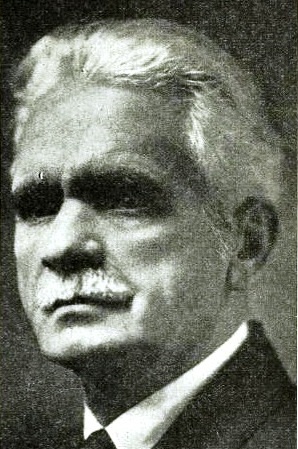
The single most consequential rhetorical move in the CES Letter's View of the Hebrews section is its handling of B.H. Roberts (1857–1933), one of the Seven Presidents of the First Council of the Seventy and the Church's most prominent intellectual of his era.[41] The CES Letter quotes Roberts's "cumulative force" passage as though it were Roberts's settled view, then closes by asking whether it is unreasonable "to question Joseph Smith's story of the Book of Mormon origins as Church Historian B.H. Roberts did."[3:2] The implication is that Roberts concluded against the Book of Mormon. The documentary record refutes that implication directly.
The Devil's-Advocate Methodology
Roberts produced two studies between 1921 and 1922 that the 1985 publication consolidated as Studies of the Book of Mormon: "Book of Mormon Difficulties: A Study" and "A Book of Mormon Study" (the latter systematically comparing View of the Hebrews and the Book of Mormon).[41:1][42][43] In 1927, Roberts condensed his findings into a short document titled "A Parallel," in his own words a "tabloid form [of] a few pages of matter" drawn from his 1921–22 Book of Mormon Study, listing 18 parallels in double columns, and sent it to Apostle Richard R. Lyman with a cover letter dated October 24, 1927.[44]
The CES Letter quotes the famous "cumulative force" passage as though it represented Roberts's conclusion.[2:1] It does not. Roberts's own cover letter for the study, the March 1923 letter to the First Presidency and the Quorum of the Twelve (verified verbatim from Madsen's 1982 BYU Religious Studies Center chapter), states it plainly:
"What is herein set forth does not represent any conclusions of mine."[41:2]
He further emphasized:
"This report [is] . . . for the information of those who ought to know everything about it pro and con, as well that which has been produced against it as that which may be produced against it. I am taking the position that our faith is not only unshaken but unshakeable in the Book of Mormon, and therefore we can look without fear upon all that can be said against it."[41:3]
Roberts's purpose was deliberately adversarial. He was building the strongest possible case against the Book of Mormon to prepare Church leaders for the arguments missionaries and members would meet in the field. He was known for the method his whole career. Truman G. Madsen documented that Roberts routinely confronted missionaries and students with hard arguments, pressing them to engage critical material rather than dodge it.[41:4] Madsen described the adversarial materials in unsparing terms:
"For ill-wishers to resurrect Roberts's similar 'Devil's Advocate' probings is not a service to scholarship, for they are manifestly dated. And it is a travesty to take such working papers as a fair statement of B. H. Roberts's own appraisal of the Book of Mormon."[41:5]
Madsen's 1983 Ensign treatment, written for a mass readership, was equally direct. Roberts himself called the 1922 study "awful" (Madsen's summary describes it as a scissors-and-paste compilation of data), and said in 1932 that he "had written it for presentation to the Twelve and the Presidency, not for publication."[42:1] When he laid his findings before the General Authorities in January 1922, he was asking them to build better defenses, not conceding the argument.
A faithful insider building the strongest possible version of the critical case is more rigorous than an external critic building the same argument, not less, because the insider has no motive to inflate it. Roberts could not gain by overstating the criticism. Every point he raised against the Book of Mormon was a point he then expected himself and his colleagues to answer; sharpening it past what the evidence supports would only have made his own task harder. The CES Letter's reading inverts that logic, treating a faithful insider's adversarial brief as a confession. Working papers their own author labels as a brief for the other side cannot be read as the author's own verdict. That is what "adversarial brief" means.
Roberts's Lifelong Testimony (1909–1933)
The CES Letter implies that Roberts concluded against the Book of Mormon. The full documentary record shows the opposite, across a continuous timeline of more than two decades of public Book of Mormon affirmations.
1909–1930: New Witnesses for God and Comprehensive History of the Church. Roberts published New Witnesses for God (an extended scholarly defense of the Book of Mormon's authenticity) and the multi-volume Comprehensive History of the Church in this period. Both treat the Book of Mormon as historically authentic throughout.[45][46] Davis Bitton's 1999 Journal of Book of Mormon Studies article documented the continuity of Roberts's published Book of Mormon engagement across this period.[45:1]
1928 General Conference. Roberts spoke on "the testimony of the scriptures of the western continents — the Book of Mormon — in relation to the resurrection of Christ," defending the book as "the word of God" and bearing his testimony from the pulpit.[47][48]
1930 Church centennial. Roberts declared:
"The Record of Joseph in the hands of Ephraim, the Book of Mormon, has been revealed and translated by the power of God, and supplies the world with a new witness for the Christ, and the truth and the fulness of the Gospel."[47:1][49]
1927–1932: The Truth, the Way, the Life. Roberts's magnum opus, drafted in this period and revised through 1932, treats the Book of Mormon throughout as revealed scripture. Bitton's survey observes that Roberts "continued to use the Book of Mormon in his preaching, his missionary work, and the two great works he completed during these years."[45:2][50]
1932: Rasha the Jew. Roberts published this fictional dialogue between a Jewish character and a Latter-day Saint missionary; the book closes with emphatic Book of Mormon testimony addressed to its Jewish readers.[51]
April 1933 General Conference (his final General Conference address, five months before his death). Roberts referred to the Book of Mormon as "that precious volume of scripture" and emphasized the prophecies it contained, calling it "one of the most valuable books that has ever been preserved, even as holy scripture."[47:2][41:6][52]
Madsen's mass-circulation 1983 Ensign assessment summarizes the documentary record:
"Elder B. H. Roberts to his last breath was a faithful witness of the most superb contemporary witness for Christ of them all — the Book of Mormon."[42:2]
Paul R. Cheesman's unpublished comparative study (1964, now in BYU's special collections) independently rejected the dependence claim; his own conclusion was that "Ethan Smith's book has a great value in authenticating the Book of Mormon."[53] BYU was doing the View of the Hebrews comparison internally well before the modern apologetic ecosystem existed; the comparison is not a defensive reaction to recent critics.
The Lloyd Diary and the Allen Recollection
The primary evidence marshaled against this lifelong-testimony record consists of two distinct secondhand reports that should be tracked separately. They are often conflated in discussions of Roberts's late-life views, but they come from different witnesses, at different times, and were committed to writing in very different ways.
The Wesley Lloyd diary (August 7, 1933). Wesley P. Lloyd recorded a conversation with Roberts on August 7, 1933, roughly seven weeks before Roberts's death, in which Roberts reportedly "swings to a psychological explanation" of the Book of Mormon and suggested that "the plates were not objective but subjective with Joseph Smith, that his exceptional imagination qualified him psychologically for the experience."[54][55]
The entry has documentary characteristics worth tracking, drawn from the BHR Foundation's primary-source timeline record (which reproduces the Lloyd diary from the L. Tom Perry Special Collections at BYU, MS 2312, Box 1, Folder 2):
- The diary is in Lloyd's wife's handwriting (Lucille Murdock Lloyd), not Wesley's own.[55:1][47:3]
- It was recorded after the conversation; the manuscript is annotated as a "Scribed Paraphrase" and "2nd Hand" account, not a contemporaneous transcript.[55:2]
- It contains some factual errors about the events Roberts described, suggesting reconstruction rather than verbatim recording.[56]
- Nothing like the "psychological explanation" framing appears in the 1922 study itself; John W. Welch, checking the diary's summary against the study, found "no such 'swinging' or 'showing' in the 'Study.'" The framing reaches us only through this single secondhand entry.[56:1]
- Roberts's actual published work from the same period, including his April 1933 final General Conference address months earlier, consistently affirms Book of Mormon authenticity.[41:7]
The Mark K. Allen recollection (1981/1984). A separate quote often cited as Roberts's late-life view does not come from the Lloyd diary at all. Mark K. Allen, secretary to the Eastern States Mission presidency under Roberts until 1928, told George D. Smith in conversations on August 27, 1981, and March 3, 1984, that Roberts had said:
"We're not through with the Book of Mormon. We've got problems. I could do Volume III of New Witnesses for God the other way and be just as convincing."[54:1]
George D. Smith published the Allen recollection in his 1984 Dialogue article on Roberts (p. 108, footnote 47).[54:2] This is a verbal recollection set down roughly half a century after the conversation it reports. Allen left his post as Eastern States Mission secretary in 1928, so the conversation must predate that, while the published account dates from 1981–1984. The Lloyd diary and the Allen recollection are distinct primary sources with different evidentiary weight: the diary was committed to writing within days of the conversation, though in another hand, while Allen's account waited decades.
Symmetric skepticism is essential. Both the Lloyd diary and the Allen recollection are secondhand sources recorded after the fact, Allen's far more so given the half-century gap between conversation and publication. Neither is corroborated by Roberts's own contemporaneous writing. Both carry less evidentiary force than first-person, contemporaneous documents like Roberts's 1928 General Conference address, his 1930 centennial declaration, or his April 1933 final General Conference remarks. They do not rule out authentic late-life private wrestling: Lloyd was Roberts's friend and former student, the conversation happened at Roberts's home, and Allen knew him professionally for years. But a scribed-paraphrase secondhand entry and a half-century-later recollection cannot, on their own, overturn an extensively documented decade of public and private Book of Mormon affirmation.
The Jack Christensen September 1933 Statement
A friend of Roberts, Jack Christensen, reported a September 1933 conversation with him, within weeks of Roberts's death (a recollection related to Truman Madsen in 1978):
"Ethan Smith played no part in the formation of the Book of Mormon."[47:4][57][58]
The same skepticism applies here. The Christensen statement is in the same evidentiary class as the Lloyd diary and the Allen recollection: secondhand, recorded after the fact, uncorroborated by Roberts's own contemporaneous writing. Granting weight to the Lloyd or Allen reports requires granting comparable weight to this one. Dismissing one secondhand source while elevating another is precisely the move a careful reader should refuse. All three are suggestive; none is decisive.
So the argument does not depend on which secondhand source is "right." It turns on the surrounding documented record. Roberts's 1909 New Witnesses for God, his 1928 General Conference address, his 1930 centennial declaration, his 1927–1932 Truth, Way, Life, his 1932 Rasha the Jew, and his April 1933 final General Conference address are first-person, contemporaneous, public-record evidence of sustained affirmation. Two secondhand reports cannot bear the weight the CES Letter loads onto them against that record. And the Christensen statement, taken alone, cannot bear the opposite weight an apologetic reading might want either. All three are interpretive context for the documented public record, not substitutes for it.
The CES Letter's One-Sided Reading
The CES Letter's handling of Roberts presents an incomplete picture in four specific ways:
- The disclaimer is omitted. The CES Letter quotes Roberts's adversarial passage ("the cumulative force of them") as though it were his personal conclusion. Roberts's explicit cover-letter disclaimer ("what is herein set forth does not represent any conclusions of mine") is never quoted or paraphrased in the View of the Hebrews section.[2:2]
- The "private advisory" framing implies suppression. The CES Letter describes Roberts's research as "meant only for the eyes of the First Presidency and the Quorum of the Twelve and was never intended to be available to the public," implying institutional concealment.[59] But advisory documents prepared for leadership are routine institutional practice, the same as for corporate boards, government bodies, and academic faculties. Roberts was asked to prepare critical analysis as a leadership briefing. The framing recasts a normal advisory function as something furtive.
- The lifelong testimony is omitted entirely. The CES Letter never mentions New Witnesses for God, Comprehensive History of the Church, the 1928 General Conference defense, the 1930 centennial declaration, The Truth, the Way, the Life, Rasha the Jew, the April 1933 final General Conference address, or the Christensen September 1933 statement.[47:5][42:3] The CES Letter selects one adversarial passage from Roberts's working papers and omits more than a decade of contrary documentation.
- The closing rhetorical question implies a conclusion Roberts did not reach. The CES Letter's closing, "is it unreasonable to question Joseph Smith's story of the Book of Mormon origins as Church Historian B.H. Roberts did?", implies that Roberts concluded against the Book of Mormon. The full record is more complicated. Roberts questioned in order to prepare better defenses, and continued affirming the Book of Mormon publicly and in writing throughout the period in question.[3:3]
George D. Smith, writing in Dialogue in 1984, read the same record the other way: Roberts harbored "deepseated ambivalence" about the Book of Mormon, and the Lloyd diary and the Allen recollection together reflect authentic late-life doubts.[54:3] On Smith's reading, public testimony and private wrestling coexisted across Roberts's last decade: the public record affirmed the Book of Mormon while private and secondhand reports captured real intellectual difficulty with the questions his 1922 study raised. That reading stands on real documents. The Lloyd diary exists, the Allen recollection exists, and Roberts's frustration with the institutional response to his 1922 questions is documented. But Smith's reading does not establish what the CES Letter implies. Smith does not claim Roberts concluded against the Book of Mormon; he claims Roberts kept wrestling. The distance between "wrestled with hard questions" and "concluded against the work" is the whole point, and the evenhanded verdict is that Roberts wrestled hard and went on affirming the Book of Mormon all the way through.
Thomas G. Alexander's 1986 Dialogue review of the 1985 Studies found additional problems in Roberts's manuscript itself (specifically the genetic fallacy and the fallacy of composition), noting that the work was draft material, never finalized for publication, and controversial precisely because it was presented without adequate context.[60] The CES Letter inherits those problems by leaning on Roberts's adversarial materials as though they were his settled views.
Brigham D. Madsen, the former Latter-day Saint historian who edited the 1985 Studies for the secular University of Illinois Press, clarified his own role in a 1993 Dialogue follow-up. He described an editor's "explicit duty" as "selecting and arranging the material" and "placing it in perspective through an introduction," and promised not to "inject any personal judgments or conclusions."[61] So even the editor of the 1985 publication, often presumed hostile by readers of the CES Letter framing, confined himself to selection and arrangement, not interpretation. The interpretive gloss the CES Letter leans on is the CES Letter's own, not Madsen's. Kevin Christensen's 2014 Interpreter article on the CES Letter's methodology made the related point that Runnells uses Roberts's Studies selectively without engaging Welch's "An Unparallel" or "Answering B.H. Roberts's Questions," observing that he "presents his information as though making an equation: Runnells (or anyone) + Questions + Facts = Inevitable Final Negative Conclusion."[62]
The Cowdery Connection
What the CES Letter Claims
The CES Letter states:
"Reverend Ethan Smith was the author of View of the Hebrews. Ethan Smith was a pastor in Poultney, Vermont when he wrote and published the book. Oliver Cowdery – also a Poultney, Vermont resident – was a member of Ethan's congregation during this time and before he went to New York to join his distant cousin Joseph Smith."[1:3]
The CES Letter calls this a "direct link" that "demonstrates that Joseph is very likely to have been aware of the theme and content of that book."[1:4] The vocabulary ("was a member," "direct link," "demonstrates") claims established documentary fact. The documents do not cooperate.
What the Documents Show
Larry E. Morris conducted the fullest documentary search into the alleged Cowdery–Ethan Smith connection, publishing his findings in BYU Studies in 2000 and presenting further analysis at the FAIR Conference in 2007.[63][64] Morris worked through the surviving Poultney Congregational Church records, town records, and Cowdery family residence documents. His findings undermine the CES Letter's claim at every point.
Timing problem. The Cowdery family's documented contact with the Poultney Congregational Church falls in 1803, 1810, and 1818, all under a different pastor, Reverend Mr. Leonard, who served the congregation from 1803 to 1821.[63:1] Ethan Smith did not become minister of the Poultney church until 1821. Every documented contact between the family and the church predates his arrival by at least three years.
Residence problem. Morris's documentary sequence runs: the family in Middletown, Vermont, from 1809, a Williamson, New York, interlude from about 1810 to 1813, Middletown again until 1817 or 1818, then Poultney by 1818, where the family remained into the mid-1820s.[63:2] The family was in Poultney, then, when View of the Hebrews was published there. The gap in the record is Oliver himself, who was likely residing in Wells, Vermont, not Poultney, from 1820 to 1822.[65]
No documentary evidence during Ethan Smith's tenure. Morris searched Poultney church records and found no mention of the Cowdery name during Ethan Smith's tenure (1821 onward). No surviving document links Oliver Cowdery to the Congregational Church or to Ethan Smith's writings during the period when View of the Hebrews was being written, published, or circulated.[63:3]
The 1818 baptism. Keziah Cowdery (Oliver's stepmother) had three daughters baptized in the Poultney church in 1818, three years before Ethan Smith arrived as pastor. This is the most recent documented Cowdery contact with the congregation, and it predates View of the Hebrews entirely.[63:4]
Morris's conclusion:
"The theory of an Ethan Smith-Cowdery association is not supported by the documents and it is unknown whether Oliver knew of or read View of the Hebrews."[63:5]
The CES Letter states as simple fact that Cowdery "was a member of Ethan's congregation." The historical record does not support it. We cannot prove the negative, that Oliver never encountered View of the Hebrews, but there is zero positive evidence of any encounter, and the documented timeline makes the claimed membership unlikely. Mormonr's comprehensive synthesis reaches the same place: no historical evidence that Cowdery attended Ethan Smith's congregation, no documentary support for any associated print-shop work, and no foundation for the "direct link" the CES Letter asserts.[66]
The CES Letter also tags Oliver as "his distant cousin Joseph Smith," a careful insinuation. The two were third cousins once removed through Joseph's mother, with no evidence either man knew of the relationship, and they had not met before Oliver became Joseph's scribe in April 1829, well after the translation had begun.[66:1][67] The "cousin" framing implies a biographical connection the documentary record does not support.
The version of the Cowdery argument that survives Morris's search does not require documented church membership at all. Poultney was a small town, and a major publication by its most prominent minister would have been locally notable. Even without attending Ethan Smith's services, Oliver or his family may have absorbed View of the Hebrews's ideas through general community awareness during his Vermont years. That is possible. But "possible" is not "demonstrated," and the CES Letter's language ("was a member," "direct link," "demonstrates") claims far more than the evidence supports.
Three things constrain even this softer version. First, give the proximity point its full due: the Cowdery family was living in Poultney when the book was published there, and Oliver's stepmother and half-sisters had been members of the town's Congregational Church since 1818, the same church Ethan Smith took over in 1821. The person the record never places there is Oliver: likely living in neighboring Wells from 1820 to 1822, never documented in Ethan Smith's congregation, and gone to New York around 1825. The "small-town awareness" theory still needs Oliver in Poultney during years the record does not put him there. Second, View of the Hebrews was a regional publication, and how far its initial print run traveled is itself uncertain. Third, no contemporary critic of the Book of Mormon (Howe (1834), Campbell (1831), and the rest, all actively hostile) ever cited a Cowdery–Ethan Smith connection. Had it been locally known, they would have used it. The softer reading is genuinely speculative. The CES Letter's reading is the falsifiable factual claim, and it has been falsified.[64:1][66:2]
A Non-LDS Scholar's Assessment
Elizabeth Fenton, a University of Vermont English professor with no Latter-day Saint affiliation, has produced the most sustained recent non-LDS academic engagement with the relationship between View of the Hebrews and the Book of Mormon.[68][12:2] Her work matters precisely because she is a literary scholar writing inside American literary studies rather than Mormon Studies. Her conclusions cannot be dismissed as apologetic.
Fenton 2019: "Nephites and Israelites"
Fenton's 2019 chapter in Americanist Approaches to the Book of Mormon (Oxford University Press), co-edited with Jared Hickman, analyzes the textual relationship between the Hebraic Indian theory and the Book of Mormon directly.[68:1] Her central claim, quoted from the chapter:
The Book of Mormon "does not present the lost tribes of Israel as the ancestors of American peoples and is in fact explicit in its rejection of that theory."[68:2]
This is the exact opposite of View of the Hebrews's central thesis. View of the Hebrews argues that all Native Americans descend from the Lost Ten Tribes; the entire scriptural and ethnographic apparatus of Ethan Smith's book exists to establish that single equation. The Book of Mormon distinguishes its peoples from the Ten Tribes. In 3 Nephi 15:15 and 17:4, the resurrected Christ tells the Nephites that the Ten Tribes are elsewhere, "other sheep" he must also visit, distinct from the Nephite-Lamanite peoples he is presently among.[68:3] The book's migrant groups are from the tribes of Manasseh (Alma 10:3) and Judah (the Mulekites), not from the Ten Tribes. It describes at least three separate migrations (Jaredites from Mesopotamia, Lehites from Jerusalem, Mulekites also from Jerusalem) rather than View of the Hebrews's single migration of the Ten Tribes. And it implies other non-Israelite populations already in the land when the Lehites arrive.
Fenton's broader argument extends the textual observation:
The Book of Mormon "continually disrupts its own chronology and, often through its revision of the Hebraic Indian theory, resists the collapsing of sacred and national histories into a uniform line."[68:4]
Her finding is that the Book of Mormon is structurally adversarial to View of the Hebrews's framework. Where View of the Hebrews collapses Israelite sacred history into American national history (the Ten Tribes are the Indians; America is the land of Isaiah 18), the Book of Mormon refuses that collapse. The Indians are not the Ten Tribes. America is not the land Isaiah 18 prophesies about. The lost-tribes story remains separate from the migration story.
Fenton 2020: Old Canaan in a New World
Fenton expanded the 2019 chapter into a book-length intellectual history in 2020: Old Canaan in a New World: Native Americans and the Lost Tribes of Israel, published by NYU Press in its North American Religions series.[12:3] The monograph traces the Hebraic Indian theory in Anglophone America from Thorowgood (1650) through Adair, Boudinot, and Ethan Smith into the post-Book-of-Mormon era. Her argument there is that the Book of Mormon helped terminate the Hebraic Indian theory rather than continue it: by separating lost-tribes narratives from indigenous-peoples narratives, it hastened the theory's decline in 19th-century American religious culture.[12:4][69]
This thesis was assessed as compelling in Matthew W. Dougherty's 2023 peer-reviewed review of Old Canaan in a New World in the Maxwell Institute's Mormon Studies Review. Dougherty's verbatim summary of Fenton's argument:
"After the 1830 publication of the Book of Mormon, she argues, narratives about the Lost Tribes were increasingly separated from narratives about Indigenous peoples."[69:1]
Dougherty's overall assessment:
"The overall argument of the book is compelling, but its limited engagement with early Mormon millennialism weakens its account of this theory's decline."[69:2]
Dougherty grants that Fenton's central thesis, that the Book of Mormon disrupted rather than extended the Hebraic Indian theory, is well-supported by her textual analysis, even as he registers some methodological qualifications about her treatment of Mormon millennialism.[69:3] That peer-reviewed validation, in the Maxwell Institute's flagship journal of Mormon Studies, anchors Fenton's reading inside the academic Mormon Studies field, not only within the American literary studies field where she publishes.
What Fenton's Analysis Establishes, and What It Does Not
Fenton is a literary scholar, not a historian of religion, and her analysis is of the Book of Mormon's textual relationship to the Hebraic Indian theory: what the book says about itself relative to View of the Hebrews's framework. Her finding that it rejects that framework is a textual observation, not a verdict on authorship. A skeptic could fairly argue that a 19th-century author distanced his narrative from the lost-tribes framework deliberately, to make it seem more original. Fenton's evidence does not, by itself, rule that out.
It is still significant for the CES Letter's specific argument, though. The chart depends on the assumption that the Book of Mormon and View of the Hebrews share a common framework the parallels point to. Fenton shows that the framework is not shared at all; the Book of Mormon's is set against View of the Hebrews's.[68:5] Whatever one concludes about authorship, the Book of Mormon is not a repackaging of Ethan Smith's thesis. It is a rejection of it. Kevin Christensen's 2020 Interpreter response to the Fenton/Hickman volume develops this implication at length, tracing how Fenton's reading constrains the dependence thesis even from a believing-scholar vantage.[70]
Bushman's 1984 Direct Engagement
Richard Lyman Bushman addressed View of the Hebrews directly in his 1984 University of Illinois Press monograph Joseph Smith and the Beginnings of Mormonism (pp. 134–139).[71] Bushman's two key conclusions on the View of the Hebrews question are quoted from the BHR Foundation's primary-source timeline of Bushman's analysis:
"[I]t would be a mistake to see the book as an imitation of these earlier works."[71:1]
"Nor is there evidence of heavy borrowing from View of the Hebrews, as some critics have said."[71:2]
Bushman is a believing Latter-day Saint, and a skeptic can fairly note that his verdict here is not institutionally neutral. But the 1984 monograph came out from University of Illinois Press, a secular academic publisher with peer review outside the Mormon Studies field, and his professional reputation for honesty on hard historical questions is the relevant signal about his independence: the treatment of plural marriage, treasure-seeking, and the seer-stone in Rough Stone Rolling is not what an institutional apologist would write.[72] More to the point, Bushman's verdict is triangulated by Fenton's, and Fenton is a non-Latter-day Saint literary scholar at the University of Vermont publishing through Oxford and NYU Press. Two academics with different institutional positions, denominational backgrounds, and disciplinary methods arriving at the same conclusion (independence) is far more credible than either reaching it alone.
Bushman's reasoning is grounded in theological and historical specifics that View of the Hebrews and the Book of Mormon do not share. Lehi was not of the Lost Ten Tribes (which is View of the Hebrews's entire framework). Lehi left Jerusalem 125 years after the Assyrian captivity that displaced the Ten Tribes (rather than during it, as View of the Hebrews would predict). The Book of Mormon emphasizes Christ's redemption rather than Mosaic-law continuity (which is View of the Hebrews's primary cultural-evidence focus).[71:3][73] Bushman's analysis spans six pages of sustained engagement, not a passing footnote.
Every academic reading that engages the dependence question head-on lands the same way. Fenton (a non-LDS literary scholar publishing with Oxford and NYU Press), Dougherty (a peer-reviewed reviewer in the Maxwell Institute's flagship journal), Bushman (the leading academic Mormon historian, publishing with University of Illinois Press), Bushman's Rough Stone Rolling (2005, Knopf) sustaining the same conclusion in his fuller biography, and Cheesman (in unpublished 1964 work now held in BYU's special collections) all cut toward Book of Mormon independence.[74] The CES Letter has yet to engage any of them.
The Strongest Critical Arguments
The CES Letter's specific argument is not the strongest form of the View of the Hebrews criticism.
The Environmental-Influence Thesis
The most defensible version of the critical case does not claim direct plagiarism. It argues that Joseph Smith operated within a cultural environment saturated with the Hebraic Indian theory and that View of the Hebrews represents the clearest single-volume expression of ideas that shaped the Book of Mormon's conceptual environment.[3:4] The CES Letter itself sneaks this framing in at the end of the section as a fallback from the plagiarism implication.[3:5]
Dan Vogel is the most sophisticated scholarly defender of this position. His framework, articulated across Indian Origins and the Book of Mormon (1986) and his subsequent biographical and source-critical work including Joseph Smith: The Making of a Prophet (2004), treats Joseph Smith as a creative composer drawing on widely available 19th-century cultural materials.[75][76] Vogel does not argue for direct plagiarism from View of the Hebrews. His argument is more substantial than that: it is that the combination of available materials (View of the Hebrews + Adair's History of the American Indians + Boudinot's Star in the West + Priest's Wonders of Nature and Providence + the mound-builder myth of contemporary American antiquarianism + the Smith family's documented treasure-seeking and folk-magical religiosity + Methodist and Presbyterian revivalist enthusiasm + biblical typology of the Joseph narrative + the King James Bible's Isaiah passages on Israel's scattering and gathering) explains the Book of Mormon as a creative synthesis. View of the Hebrews is one ingredient in that synthesis on Vogel's reading, not the source.[75:1]
This argument has real force, and it is not the same as the CES Letter's chart-style claim. The mound-builder myth was pervasive in early 19th-century America; the Smith family's documented treasure-seeking and folk-religious practices are well-attested in primary sources; Methodist and Presbyterian revivalism in early-1800s upstate New York is documented.[15:2] The cultural environment claim is not contested. The question is what work the cultural environment claim does once granted, and whether the specific content of the Book of Mormon matches what Vogel's framework predicts.
The strongest response runs in three steps.
First, the Book of Mormon contradicts its alleged environment on virtually every specific point. If Joseph absorbed ideas from his culture, the resulting text should reflect those assumptions. Instead the Book of Mormon reverses View of the Hebrews's migration route (a transoceanic ship voyage rather than a Bering Strait dry-land crossing), reverses the direction of settlement (south-to-north rather than north-to-south), distinguishes its peoples from the Ten Tribes (3 Nephi 15:15, 17:4, against View of the Hebrews's central thesis), centers on Jesus Christ rather than Moses (and never mentions Quetzalcoatl, View of the Hebrews's Moses figure), records on gold metal plates rather than yellowed parchment leaves, dates the civilized group's destruction to A.D. 385 rather than ~A.D. 1400, uses "reformed Egyptian" rather than predicting Hebrew-language preservation, explicitly rejects circumcision (Moroni 8:8) which is View of the Hebrews's strongest Hebrew-cultural-marker evidence, omits View of the Hebrews's distinctive Hebraic content wholesale (Ark, phylacteries, kosher laws, cities of refuge, priestly garments, Passover customs, tribal totems), is built on continuous revelation when View of the Hebrews explicitly denies new revelation, and skips Isaiah 18, View of the Hebrews's keystone scriptural argument, entirely.[6:17] The pattern is not selective borrowing. It is systematic disagreement.
Second, the shared themes reduce to biblical commonplaces, not View of the Hebrews-specific content. Once the analysis separates what is distinctive to View of the Hebrews from what is distinctive to the underlying biblical tradition (Israel's scattering and gathering, the Lost Tribes motif, the lost-records motif), the residue of genuine View of the Hebrews–Book of Mormon overlap is small. Both books engage the same biblical tradition because they are both engaging biblical themes. That is not evidence of textual dependence between them. As John Gee argued above, narrative composition cannot be reduced to thematic ingredients.[10:3] Two essays on the Sermon on the Mount share Sermon-on-the-Mount themes by virtue of engaging the source, not by virtue of being related to each other.
Third, the Book of Mormon contains content no environmental thesis can explain. Nahom (the Yemen votive altars discovered in 1988 with NHM inscriptions matching Lehi's burial location for Ishmael); complex multi-level chiasmus, an inverted A-B-B-A literary parallelism characteristic of ancient Hebrew texts, with Alma 36 placing Christ at the structural center; Hebrew wordplay that works only in the source language (Jershon = "place of inheritance"; Alma; Sariah at Elephantine); internally consistent geography across 270,000 words; statistically distinguishable authorial voices; and the explicit "reformed Egyptian" record-language claim that contradicts View of the Hebrews's prediction. These are positive evidence of authentic ancient origin, and no 19th-century environmental thesis predicts any of them. The section "Evidence Supporting the Book of Mormon's Independent Origin" below develops the evidence in detail.
The environmental thesis explains the broad thematic overlap between the two books. It does not explain why the Book of Mormon contradicts its alleged environment on every specific point, why it omits View of the Hebrews's strongest evidence, or why it carries positive ancient features no 19th-century author could have known. The thesis is partially answered rather than fully refuted, but the gaps it leaves are decisive.
The Cumulative-Weight Argument
The CES Letter's implicit argument is that even if no single parallel is decisive, the cumulative pattern of similarities (publication proximity, the Cowdery connection, structural parallels, Roberts's study) builds a persuasive circumstantial case.[1:5][2:3]
Cumulative reasoning is a legitimate evidentiary principle. Individually inconclusive pieces of evidence can be collectively compelling when each piece carries real weight. The question is whether the individual pieces here do carry weight.
Here, each piece, when examined, turns out to point in the wrong direction for the CES Letter's case:
- The 34 parallels are biblical commonplaces shared with dozens of other texts, not View of the Hebrews-specific content. The 84 contradictions Welch documents point away from dependence.[6:18]
- Publication proximity in the same state and adjacent counties is a small effect when Vermont was densely populated and printing-active in the 1820s, and no documentary evidence places a copy of View of the Hebrews in Joseph's hands.
- The Cowdery connection is unsupported by the Poultney church records. Morris 2000/2007 documents this thoroughly.[63:6][64:2]
- Roberts's "cumulative force" passage was an adversarial exercise; his lifelong testimony continued to affirm the Book of Mormon. The CES Letter has the polarity of Roberts's view exactly reversed.[41:8][47:6]
- The 1842 Times and Seasons citation is more easily explained as Joseph treating View of the Hebrews as independent corroboration of his already-published claims than as evidence of secret borrowing.[77]
A cumulative case built from evidence that individually points the wrong way does not gain strength by multiplication. What weakens the CES Letter's cumulative argument is not the principle of cumulative reasoning but the quality of the individual pieces.[27:6] Roberts himself, the scholar the CES Letter invokes, noted "the cumulative force" of the parallels as part of his adversarial exercise. But he also catalogued the differences, and across the full documented record he kept affirming the Book of Mormon's divine authenticity for the rest of his life.[47:7] The CES Letter borrows his prosecution brief while dropping the larger context of his life's work.
The Genre Rebuttal and Its Limits
A critic might respond to the genre-difference argument by noting that nobody claims genre-level plagiarism, only thematic inspiration. An author can read a theological essay and write a narrative on its ideas.[54:4]
This is logically true but empirically empty in this case. The question is not whether it is possible to draw narrative inspiration from an essay but whether the specific evidence supports that this happened. Given the 84 contradictions, the absent non-parallels, the Isaiah 18 omission, the statistical independence of the Isaiah selections, and the lack of any verbal agreement, the evidence points decisively away from dependence.[6:19][38:2]
Welch's observation stands: a dependence theory requires that Joseph Smith knew View of the Hebrews well and respected its claims. If so, he should have followed it on its major points, or at least not contradicted them. He contradicts them repeatedly.[6:20]
The "Many Books Made One Book of Mormon" Form
The synthesis form of the critical case is not "the Book of Mormon copied View of the Hebrews." It is "the Book of Mormon synthesizes ideas from View of the Hebrews + The Late War + The First Book of Napoleon + the King James Bible + Apocrypha + Adair + Boudinot + Priest + the broader pseudo-biblical genre."[78] This synthesis form is harder to refute than any single-source theory because (a) it does not require establishing that Joseph had any single text in front of him, (b) it accommodates the Book of Mormon's distinctive features as creative synthesis, and (c) any specific contradiction with one source can be attributed to compositional choice. It is the version worth meeting directly.
The synthesis form has two real responses, both empirical rather than methodological.
First, the production circumstances constrain what synthesis can plausibly explain. A synthesis theory requires Joseph to have read View of the Hebrews + The Late War + The First Book of Napoleon + Adair's History of the American Indians + Boudinot's Star in the West + Priest's Wonders of Nature and Providence + the King James Bible (extensively) + the Apocrypha + the broader mound-builder antiquarian literature, and to have absorbed enough of all of them to weave them into a coherent 270,000-word dictated narrative across roughly 60 working days, around 4,500 words a day, with no notes, no manuscripts, and no going back to rework earlier sections as later ones developed.[8:1][79] Brian Hales's Interpreter studies gathered contemporary descriptions of Joseph's capabilities at the time: Jonathan Hadley (August 1829) called him "very illiterate"; W.W. Phelps (pre-June 1831) described him as "a person of very limited abilities in common learning"; the Palmyra Reflector (February 1831) wrote that "his mental powers appear to be extremely limited";[80] his father-in-law Isaac Hale described him in 1834 as "not very well educated"; his mother Lucy Mack Smith said he "seemed much less inclined to the perusal of books than any of the rest of our children."[79:1] The synthesis theory must therefore claim either that these contemporary descriptions are wrong (against a consistent multi-source record) or that the production circumstances were not what the witnesses describe (against a consistent multi-witness record of the dictation). Neither is a comfortable place to stand.
Second, the synthesis form inherits the mutual-undermining problem developed in The Method Is Broken below. The three proposed sources are so unlike one another (a theological essay about the Ten Lost Tribes, a War of 1812 schoolbook in pseudo-biblical English, and a Scottish political satire about Napoleon) that each borrowed-from-one-of-them theory declares the other two coincidence. Folded into "synthesis," the claims stop undermining one another only by requiring the production-circumstances burden above to carry all three texts at once rather than just one.
What synthesis cannot do is escape the empirical constraints. Unfalsifiability gives the theory rhetorical resilience but does not give it explanatory power. A theory that accommodates both the parallels (as borrowing) and the differences (as creative synthesis) does not make testable predictions about what the Book of Mormon's actual content should look like. It accommodates whatever the Book of Mormon turns out to be. That is not the same as explaining it.
Evidence Supporting the Book of Mormon's Independent Origin
Joseph Smith Cited View of the Hebrews Publicly in 1842
Twelve years after the Book of Mormon's publication, while editing the Times and Seasons, Joseph Smith cited View of the Hebrews by name, with author, location, and specific page references.[77:1]
The primary source is Times and Seasons 3:15 (June 1, 1842), p. 814. The Joseph Smith Papers project confirms Joseph's editorial responsibility for this issue: "Joseph Smith assumed the editorship of the newspaper beginning with its 1 March 1842 issue" and took "responsibility for all of the published content, including this 1 June issue."[77:2] The relevant editorial passage reads:
"In order to this, we shall here make an extract from an able work: written exclusively on the subject of the Ten Tribes having come from Asia by the way of Bherings Strait, by the Rev. Ethan Smith, Pultney, Vt."[77:3]
The same column then cites two specific View of the Hebrews page numbers verbatim:
"It is said by Calmet, that the above texts are the very passages of Scripture, which the Jews used to write on the leaves of their phylacteries...—Smith's view vf [sic] the Hebrews. p. 220."[77:4]
"...also, xi. chap. 13–21, and Exodus, chap. 13 —13—11,—16 inclusive, to which the reader can refer, if he has the curiosity to read this most interesting discovery."[77:5]
The extract's second page citation comes a few sentences later, attached to an anecdote about a buried Indian book:
"Dr. West of Stockbridge, relates that an old Indian informed him, that his fathers in this country, had not long since, been in the possession of a book, which they had for a long time, carried with them, but having lost the knowledge of reading it, they buried it with an Indian chief— View of the Hebrews, p. 223."[77:6]
Three identifying details (author, publishing location, page numbers) and an open invitation to "refer" to the work. This is the behavior of someone publicly engaging a source, not someone quietly looting it. Bruce D. Blumell, a senior historical associate at the Church Historical Department writing in the September 1976 Ensign "I Have a Question" column (the earliest official Church response to the View of the Hebrews theory), put the implication directly:
"If the Prophet had originally used Ethan Smith's book to help him write the Book of Mormon, almost certainly he would not have later published a quote from it to illustrate a point, since plagiarists normally keep their sources a secret."[81]
Blumell's fuller argument rests on a series of specific observations: there is no documentary evidence Joseph knew View of the Hebrews before 1842; if he had, he would not have called attention to it in 1842; "out of the multitude of ideas and events in the Book of Mormon and in the View of the Hebrews there are several broad similarities, but many more significant differences"; and the line later scholarship has quoted most:
"Everything that is common or even vaguely similar between the Book of Mormon and the View of the Hebrews could have been borrowed more easily from the Bible or from prevailing beliefs at that time."[81:1]
The episode has documented complications. By 1842, View of the Hebrews was nineteen years old and obscure, the Book of Mormon was twelve years old and established, no contemporary critic had drawn the connection, and the active critical threat was the Spalding manuscript theory, not View of the Hebrews. Citing Ethan Smith's book in 1842 carried minimal risk of inviting a plagiarism charge no critic had yet made.[82] There is also an intermediary question. Blumell notes that the extract came through an 1833 book that itself quoted View of the Hebrews, rather than from Ethan Smith's book directly; Tate identifies the intermediary as Josiah Priest's American Antiquities.[81:2][4:6]
So the claim here is narrow. The 1842 citation refutes the specific framing that "Joseph anxiously concealed his source." A man hiding a dependence on Ethan Smith's book does not name the book, the author, the location, and the page numbers in his own newspaper. The episode is suggestive of independence, not decisive proof of it. Blumell's 1976 framing captures both its force and its limit.
The Translation Process
The translation timeline constrains what kinds of dependence are even plausible. The bulk of the Book of Mormon was dictated between April 7 and June 30, 1829, roughly 60 actual working days once documented interruptions are subtracted (farm chores, revelations, priesthood restoration, travel, visitors).[8:2][83] The output ran to about 269,510 words; spread over roughly 60 working days, that is a sustained pace near 4,500 words a day.
Multiple witnesses confirmed that Joseph dictated without manuscripts or books before him. Oliver Cowdery testified in 1848 that he "wrote, with my own pen, the entire Book of Mormon (save a few pages) as it fell from the lips of the Prophet Joseph Smith."[84] Emma Smith testified that Joseph dictated "without either seeing the manuscript or having any portion of it read to him" when resuming after breaks; asked whether he had "a book or manuscript from which he read, or dictated," she answered, "He had neither manuscript nor book to read from," and, asked whether he could have had one without her knowing it, "If he had had anything of the kind he could not have concealed it from me."[85] The stone-in-hat translation method, described by multiple witnesses (Emma Smith, David Whitmer, Martin Harris, Joseph Knight Sr.) and acknowledged in the Gospel Topics essay on Book of Mormon translation, makes physically consulting a reference book during dictation impractical: Joseph's face was pressed into the hat, blocking out extraneous light.[83:1][86]
Cowdery's Bible was purchased from Palmyra bookseller E.B. Grandin on October 8, 1829, months after the translation was completed in late June 1829.[87] The casual version of any "Joseph copied from text X during dictation" theory has to explain how the text was physically present in a method documented to leave no room for it. Brian C. Hales's 2019 Interpreter analysis of Joseph's documented capabilities concluded that "if Joseph Smith created the Book of Mormon from his own intellect, his efforts as an author stand out as curiously unique," a finding that bears on any dependence thesis at the production-circumstances level.[79:2]
The dictation evidence directly refutes the direct-plagiarism thesis. It does not directly refute the environmental thesis, the idea that Joseph absorbed View of the Hebrews's concepts earlier and drew on them from memory. But the translation process is a real obstacle for any version of dependence: sustaining 4,500 words a day of coherent narrative (internal consistency across roughly 270,000 words, hundreds of names, multiple timelines, dense theology) is extraordinary regardless of where the ideas came from.[83:2] Royal Skousen's three decades on the Book of Mormon Critical Text Project established that the original manuscript shows no substantive revisions to earlier sections as later ones were dictated; the 1830 first edition is essentially a printed transcript of a clean first draft.[88]
Bushman 1984: Direct Academic Verdict
The plainest academic statement on the dependence question comes from Richard Lyman Bushman's 1984 monograph Joseph Smith and the Beginnings of Mormonism, and it bears repeating in the positive case. Bushman's two verbatim conclusions:
"[I]t would be a mistake to see the book as an imitation of these earlier works."[71:4]
"Nor is there evidence of heavy borrowing from View of the Hebrews, as some critics have said."[71:5]
This is academic Mormon historiography from a respected secular university press, written decades before the CES Letter, on the very question the CES Letter raises.[71:6] Bushman's analysis spans pages 134–139, six pages of engagement rather than an aside, and concludes that direct literary influence between View of the Hebrews and the Book of Mormon is unlikely on the merits.
Features That No 19th-Century Source Can Explain
The Book of Mormon contains features that strain any 19th-century composition theory, not just the View of the Hebrews dependence theory but any naturalistic explanation. They matter here because they are elements View of the Hebrews cannot account for and no known 19th-century source could have supplied.
Nahom and the NHM altars. The Book of Mormon places a location called "Nahom" along Lehi's Arabian trail, where Ishmael was buried (1 Nephi 16:34). In 1988, German archaeologists excavating the Bar'an Temple at Marib, Yemen, unearthed three votive altars bearing the tribal name NHM.[89][90] The altars date to the 7th–8th century B.C., likely before or during Lehi's lifetime; Aston's final dating puts them at 800–700 B.C., a century or more before Lehi's day. The dedicatory inscription on one names the dedicator as a member of the Nihm tribe: "Bi'athtar, son of Sawdum, son of Naw'um, the Nihmite."[90:1] S. Kent Brown of BYU published the first scholarly identification of this NHM with the Book of Mormon's Nahom in 1999, in the Journal of Book of Mormon Studies, eleven years after the discovery.[89:1][91] The Hebrew root nḥm relates to mourning, repentance, and consolation, which fits the burial context for Ishmael (1 Nephi 16:34).[90:2]
The 1988-vs-1999 split matters: discovery in 1988 by German archaeologists with no Book of Mormon connection at the time, then LDS scholarly identification in 1999. Both dates postdate Joseph Smith by more than 150 years. Terryl Givens, in his Oxford University Press study By the Hand of Mormon, called the NHM altars "the first actual archaeological evidence for the historicity of the Book of Mormon."[92]
View of the Hebrews deals exclusively with the Americas. Its entire argumentative scope is Native Americans as Lost Tribes. The Old World Arabian leg of Lehi's journey (1 Nephi 16–18) is not a domain View of the Hebrews covers at all. The Nahom evidence cannot be a residue of View of the Hebrews influence because View of the Hebrews has no Arabian content. For a fuller treatment of Nahom and other archaeological evidence bearing on the Book of Mormon, see the Book of Mormon and Archaeology article.
Complex chiasmus. John W. Welch discovered chiasmus in the Book of Mormon in 1967, while serving a mission in Germany.[93] His foundational 1969 BYU Studies article documented the pattern across nine examples, Alma 36 among them; his 1991 chapter "A Masterpiece" later made Alma 36 the canonical case.[93:1] Alma 36's chiasm spans the whole chapter, with Christ's atonement at the structural center. Welch calls it "a masterpiece of composition" in which "the chiasmus allows Alma to place the very turning point of his entire life exactly at the turning point of the chapter: Christ, because of the effects of the future atonement, belongs at the center of both."[93:2][94] Boyd F. Edwards and W. Farrell Edwards's 2004 BYU Studies statistical analysis found that "the four strongest chiasms in the Book of Mormon are unlikely to have appeared in it by chance," Alma 36 chief among them.[95]
Chiasmus is a Hebrew literary form, and the English-language study of it in Joseph Smith's day was specialist and obscure. John Jebb's Sacred Literature (1820) gave the form an early treatment, John Forbes's The Symmetrical Structure of Scripture followed in 1854, and the foundational systematic study, Nils Lund's Chiasmus in the New Testament, appeared only in 1942, more than a century after the Book of Mormon.[93:3] Nothing in that scholarly line is known to have circulated in Joseph Smith's frontier environment. Earl M. Wunderli's 2005 Dialogue article challenged the strongest version of the Alma 36 claim, and debate over the precise complexity of individual chiasms remains active.[96] But the core observation is not seriously contested: the Book of Mormon contains complex chiastic structures consistent with ancient Hebrew forms, and View of the Hebrews contains nothing comparable. For a fuller treatment of chiasmus and other Hebraisms, see the KJV and Isaiah in the Book of Mormon article.
Hebrew wordplay. The Book of Mormon contains wordplay that works only in Hebrew, not English, which means an English speaker unaware of Hebrew etymology could not have built it on purpose.
- Jershon ("place of inheritance" from Hebrew yarash). The Hebrew root yrš (yarash) means "to take possession of" or "to inherit." Alma 27:22 reads: "this land Jershon is the land which we will give unto our brethren for an inheritance," preserving a play between the place name and its Hebrew sense. The wordplay works only in Hebrew. Matthew L. Bowen's 2016 Interpreter article, "'They Were Moved with Compassion' (Alma 27:4; 53:13): Toponymic Wordplay on Zarahemla and Jershon," is the canonical treatment.[97] The BYU Onomasticon entry on "Jershon" supplies the etymological grounding.[98]
- Alma as a male personal name attested in Bar Kokhba documents. Yigael Yadin's 1961 excavation in the Cave of Letters near the Dead Sea recovered Bar Kokhba-era letters dated to ~A.D. 132, one bearing the personal name 'almā' ben yehudah, "Alma son of Judah."[99][100] The discovery and publication came over a century after Joseph Smith's death. (Some scholars reinterpret the name as Aramaic ՙallima', "strong, powerful"; the more conservative claim is simply that "Alma" is attested as a male name in ancient Semitic documents.) "Alma" is also attested in Eblaite (3rd-millennium B.C. Syrian) documents.[101]
- Sariah at Elephantine. The 5th-century B.C. Aramaic Papyrus C-22 from the Elephantine collection lists a female donor as "Sariah daughter of Hoshea son of Ḥarman" (śry[h br]t hwšʿ br ḥrmn), dated to 419 B.C.[102][103] Sariah does not appear as a female name in the Bible, so Joseph Smith could not have drawn Lehi's wife's name from biblical sources. Jeffrey R. Chadwick's 1993 Journal of Book of Mormon Studies article concluded the discovery was "far too late for Joseph Smith to have known of the female name Sariah in Papyrus C-22."[102:1]
These names match Semitic-language patterns confirmed by archaeological finds that postdate both View of the Hebrews and the Book of Mormon by decades or centuries. And note the direction. View of the Hebrews predicted Hebrew place and personal names surviving among Indians as a sign of Hebrew descent; Ethan Smith specifically expected "Halleluyah," "Yohewah," and "Shilu" to turn up in Indian languages.[7:14] None of those appear in the Book of Mormon. The Hebrew names that do appear (Jershon, Sariah, Alma) are not the kind View of the Hebrews predicted.
Reformed Egyptian. The Book of Mormon says its records were kept in "reformed Egyptian" (Mormon 9:32), explicitly noting that neither Hebrew nor Egyptian was preserved in pure form. This contradicts View of the Hebrews's prediction. View of the Hebrews expected Hebrew-language preservation among Indians as evidence of Hebrew descent; the Book of Mormon's record-language framing is the reverse. A 19th-century author drawing on View of the Hebrews would have aligned the record language with the Hebrew-preservation prediction. Instead the Book of Mormon contradicts the source on a foundational, easily-checkable claim.[104]
The broader practice of adapting Egyptian writing systems for non-Egyptian languages is well-attested in ancient Near Eastern scribal practice: Demotic Egyptian appears alongside Aramaic in bilingual documents, and Demotic-script systems for non-Egyptian languages are documented throughout the period.[10:4] The "reformed Egyptian" concept is broadly consistent with ancient practice, even though the exact phrase appears in no known ancient text.
The Method Is Broken
The View of the Hebrews theory is not the only parallel-text theory the CES Letter advances. It also presents The Late War and The First Book of Napoleon as additional proposed sources. These three texts share almost nothing in common except that someone has found "parallels" with the Book of Mormon in each of them.
The CES Letter presents them as a cumulative case, but they function as mutually undermining theories. If the Book of Mormon's narrative framework came from View of the Hebrews, then the Late War and Napoleon parallels are coincidental noise. If its language came from The Late War, then the View of the Hebrews parallels are irrelevant. If its rhetorical structure came from The First Book of Napoleon, the other two theories are false. The three theories cannot all be true, and the fact that the same parallel-finding method produces equally "striking" results when applied to radically different source texts is itself evidence against the method. When a method generates apparent dependence between any two pseudo-biblical or biblical-themed texts, the method is detecting genre conventions or shared cultural background rather than literary dependence.[27:7]
The CES Letter wants the rhetorical force of three proposed sources without paying the methodological cost of having three. Each weakens the others. The real cumulative lesson is not "any of these three could be the source." It is that a parallel-finding method loose enough to produce apparent dependence between the Book of Mormon and any of three radically different texts cannot be trusted in any single case. The Interpreter Foundation's "Estimating the Evidence" Episode 12 reaches the same structural conclusion through Bayesian reasoning: a method that returns equally striking results for a theological essay, a war chronicle, and a Scottish satire has no signal-to-noise ratio worth a conclusion.[105]
BYU Published View of the Hebrews Itself
End where the article began: with the 1996 edition. Tate's apparatus did more than reprint the 1825 View of the Hebrews; it published a guide to the prior scholarly debate (Riley 1902, Brodie 1945, Roberts 1985, Welch 1985, Madsen 1982) and set the republication squarely inside that debate.[4:7] Tate's own framing is unambiguous:
"These then are the books and articles that have argued for and against any connection between the Book of Mormon and VH. We present VH that follows and invite our readers to decide for themselves."[4:8]
Andrew H. Hedges, reviewing the edition in 1997, called Tate's introductory essay "a masterpiece in historiography"[106] and repeated the judgment given at the outset: read closely together, the two texts make the dependence theory harder, not easier, to sustain.[25:1] Any reader who wants to weigh the dependence claim can now do so with both texts in hand.
The Church Educational System does not hide View of the Hebrews. It reprinted the book and invited the comparison three decades ago. From Blumell in 1976 through Tate in 1996 to Welch's "An Unparallel" and the present literature, the record is nearly fifty years of official-Church and BYU engagement with the hypothesis, which makes "a question the Church has avoided" a hard charge to support.[81:3][4:9][6:21]
Assessment
The View of the Hebrews dependence thesis fails at every level of analysis the CES Letter raises.
At the level of specific content, the two books disagree on the destruction of Jerusalem (Roman vs. Babylonian), the migration route (Bering Strait vs. ocean voyage), the direction of settlement (north-to-south vs. south-to-north), the central religious figure (Moses/Quetzalcoatl vs. Christ), the record medium (yellowed parchment leaves vs. gold plates), the dating of the civilized group's destruction (~A.D. 1400 vs. A.D. 385), the role of new revelation (denied vs. central), and the relationship to the Lost Tribes (central thesis vs. explicit rejection). The Book of Mormon omits View of the Hebrews's most distinctive evidence (circumcision, the Ark, Hebrew religious words, Passover customs, Quetzalcoatl, pyramid architecture, kosher laws, priestly garments, phylacteries, Isaiah 18) while actively contradicting the source's foundational claims about circumcision, new revelation, and the Lost Tribes framework. The strongest specific parallels (civilized vs. savage groups, buried records, degeneration) turn out to be the broadly circulating mound-builder myth, not View of the Hebrews-specific content.
At the level of statistical analysis, the Isaiah overlap between the two books is consistent with coincidence, not dependence: only 30 of the 427 distinct Isaiah verses cited across the two works appear in both, only ten Isaiah chapters overlap, and the centerpiece of View of the Hebrews's scriptural argument (Isaiah 18) is completely absent from the Book of Mormon.[37:6] Palmer and Knecht's 1964 hypergeometric test found the chapter overlap almost exactly what independent use of a shared source predicts, with the odds against zero overlap near one in a million.[38:3]
At the level of biography, the Cowdery connection is unsupported by documentary evidence. Larry Morris's 2000 BYU Studies and 2007 FAIR Conference research demonstrated that the Cowdery family's Poultney church contacts predate Ethan Smith's pastorate by at least three years, that the family did not reside in Poultney during the relevant period, and that no surviving document links Oliver Cowdery to Ethan Smith's congregation.[63:7][64:3]
At the level of scholarly authority, B.H. Roberts did not conclude what the CES Letter implies. He disclaimed the adversarial passages it quotes ("what is herein set forth does not represent any conclusions of mine"), called the work "awful," kept affirming the Book of Mormon across the whole contested period (1909–1933), defended it in his 1928 General Conference address and 1930 centennial declaration, devoted his magnum opus The Truth, the Way, the Life to its divine origin, and bore testimony of it in his April 1933 final General Conference address months before his death.[41:9][42:4][47:8][45:3] The Lloyd diary and the Allen recollection add real complexity to the question of his late-life private views, but two secondhand sources, a paraphrased diary in another hand and a half-century-later verbal recollection, cannot bear the interpretive weight the CES Letter asks of them. The Christensen September 1933 statement points the other way: "Ethan Smith played no part in the formation of the Book of Mormon."[47:9]
At the level of methodology, the parallels chart fails every test for textual dependence that the parallelomania framework requires: no verbal agreement, no principled reason to privilege View of the Hebrews over Adair, Boudinot, Priest, or Thorowgood, and insufficient specificity to distinguish dependence from shared cultural context.[27:8] Sandmel's 1962 critique of the methodology applies to the CES Letter's chart with full force.[28:3]
At the level of academic verdict, non-LDS academic engagement consistently cuts toward Book of Mormon independence: Bushman 1984 ("[I]t would be a mistake to see the book as an imitation of these earlier works. Nor is there evidence of heavy borrowing"), Fenton 2019/2020 (the Book of Mormon "is in fact explicit in its rejection of [the lost tribes] theory" and helped terminate the Hebraic Indian theory), Dougherty 2023 (peer-reviewed validation of Fenton's thesis in Mormon Studies Review), and Dundas 2022 (imagining "as helpful a resource as A View of the Hebrews" and a borrowing Joseph "simply ignoring 99 percent of it"). The CES Letter has yet to engage any of these voices.
Of the critical arguments, the environmental-influence thesis holds up longest, and it does explain the broad thematic overlap between the two books. But it cannot explain why the Book of Mormon contradicts its alleged cultural environment on virtually every specific claim, why it omits the very evidence most useful to a 19th-century author building a Hebrew-Indian narrative, or why it carries features (Nahom, complex chiasmus, Hebrew wordplay, Sariah at Elephantine, an internally consistent geography) that no 19th-century source could have supplied.
The CES Letter is right about one thing: both books discuss Hebrew connections to the Americas. So did Adair (1775), Boudinot (1816), Priest (1825), Thorowgood (1650), and dozens of other writers reaching back nearly two centuries before View of the Hebrews was printed. The question was never whether the theme was "in the air." It plainly was. The question is whether View of the Hebrews specifically generated the Book of Mormon, and the evidence (Welch's 84 differences, Palmer and Knecht's statistics, Morris's Cowdery falsification, Bushman's "no evidence of heavy borrowing," Fenton's "explicit rejection of that theory," Dougherty's peer-reviewed validation, the 1842 Times and Seasons citation, and the affirmative content View of the Hebrews cannot touch) points the other way at every turn.
Which leaves the witness the CES Letter chose for itself. It builds its case on B.H. Roberts, quotes his "cumulative force" line, and asks whether it is unreasonable to doubt the Book of Mormon "as Church Historian B.H. Roberts did." But Roberts wrote on the very page the CES Letter draws from that "what is herein set forth does not represent any conclusions of mine." He called the study "awful," a scissors-and-paste compilation assembled as a brief for the other side. And in the years that followed he defended the Book of Mormon in general conference, declared it revealed "by the power of God" at the 1930 centennial, made it a pillar of his magnum opus, and called it "one of the most valuable books that has ever been preserved" in the last conference address of his life. A friend reported him saying, weeks before his death, that "Ethan Smith played no part in the formation of the Book of Mormon." The CES Letter drafts Roberts as its chief witness. Taken whole, the record makes him a witness for the other side. Examined closely, the evidence the View of the Hebrews theory leans on keeps testifying against it.
Further Reading
For the CES Letter's parallel claims about other proposed 19th-century sources, see The Late War and The First Book of Napoleon. For a detailed treatment of chiasmus, Hebraisms, Early Modern English, and KJV-derived language in the Book of Mormon, see KJV and Isaiah in the Book of Mormon. For a comprehensive overview of all Book of Mormon claims in the CES Letter, see the Book of Mormon overview.
Runnells, CES Letter (2017), "Book of Mormon," no. 8, pp. 16–20. ↩︎ ↩︎ ↩︎ ↩︎ ↩︎ ↩︎
Runnells, CES Letter (2017), "Book of Mormon," no. 8, p. 21, quoting B.H. Roberts, Studies of the Book of Mormon, ed. Brigham D. Madsen (Urbana: University of Illinois Press, 1985), 240. ↩︎ ↩︎ ↩︎ ↩︎
Runnells, CES Letter (2017), "Book of Mormon," no. 8, p. 21. ↩︎ ↩︎ ↩︎ ↩︎ ↩︎ ↩︎
Charles D. Tate Jr., "Introduction," in Ethan Smith, View of the Hebrews (Provo, UT: BYU Religious Studies Center, 1996). https://rsc.byu.edu/view-hebrews/introduction ↩︎ ↩︎ ↩︎ ↩︎ ↩︎ ↩︎ ↩︎ ↩︎ ↩︎ ↩︎
Runnells, CES Letter (2017), "Book of Mormon," no. 8, pp. 17–20. The 34-item chart is attributed to Roberts, Studies of the Book of Mormon, pp. 240–242, 324–344. ↩︎ ↩︎
John W. Welch, "View of the Hebrews: 'An Unparallel,'" in Reexploring the Book of Mormon, ed. John W. Welch (Provo, UT: FARMS, 1992), 83–87. https://archive.bookofmormoncentral.org/sites/default/files/archive-files/pdf/welch/2015-10-28/22_view_of_the_hebrews_83-87.pdf. The expanded 1985 original circulated as a FARMS preliminary report: John W. Welch, Finding Answers to B. H. Roberts's Questions and "An Unparallel" (Provo, UT: FARMS, 1985; catalog code WEL-85d), https://archive.bookofmormoncentral.org/content/finding-answers-bh-robertss-questions-and-unparallel. Quotations follow the 1985 report's text. See also B.H. Roberts Foundation, "John W. Welch lists a variety of unparallels between View of the Hebrews and the Book of Mormon," https://bhroberts.org/records/gzzHJd-03DB4J/ ↩︎ ↩︎ ↩︎ ↩︎ ↩︎ ↩︎ ↩︎ ↩︎ ↩︎ ↩︎ ↩︎ ↩︎ ↩︎ ↩︎ ↩︎ ↩︎ ↩︎ ↩︎ ↩︎ ↩︎ ↩︎ ↩︎
FAIR, "View of the Hebrews Non-Parallels." https://www.fairlatterdaysaints.org/answers/Book_of_Mormon/Authorship_theories/View_of_the_Hebrews/Non-parallels ↩︎ ↩︎ ↩︎ ↩︎ ↩︎ ↩︎ ↩︎ ↩︎ ↩︎ ↩︎ ↩︎ ↩︎ ↩︎ ↩︎ ↩︎
John W. Welch, "Timing the Translation of the Book of Mormon: 'Days [and Hours] Never to Be Forgotten,'" BYU Studies Quarterly 57, no. 4 (2018): 11–50. https://archive.bookofmormoncentral.org/sites/default/files/archive-files/pdf/welch/2020-01-13/john_w._welch_byus_57.4._timing_the_translation_of_the_book_of_mormon_2018.pdf ↩︎ ↩︎ ↩︎
The ~57,000-word figure for View of the Hebrews is a common estimate rather than a published scholarly count; see "View of the Hebrews," The CES Letter: A Closer Look, https://debunking-cesletter.com/book-of-mormon-1/view-of-the-hebrews/ ("It contains around 57,000 words"). The Book of Mormon side of the ratio uses Royal Skousen's 269,510-word count of the earliest text (see Welch, "Timing the Translation"). ↩︎
John Gee, "The Wrong Type of Book," in Echoes and Evidences of the Book of Mormon, ed. Donald W. Parry, Daniel C. Peterson, and John W. Welch (Provo, UT: FARMS, 2002), 307–329. https://scripturecentral.org/archive/books/book-chapter/wrong-type-book ↩︎ ↩︎ ↩︎ ↩︎ ↩︎
FAIR, "View of the Hebrews theory of Book of Mormon authorship." https://www.fairlatterdaysaints.org/answers/View_of_the_Hebrews_theory_of_Book_of_Mormon_authorship. The hub aggregates FAIR's three main View of the Hebrews pages — overview, scripture-use analysis, and non-parallels — as a single integrated reference. ↩︎
Elizabeth Fenton, Old Canaan in a New World: Native Americans and the Lost Tribes of Israel (New York: NYU Press, 2020). https://nyupress.org/9781479866366/old-canaan-in-a-new-world/ ↩︎ ↩︎ ↩︎ ↩︎ ↩︎
James Adair, History of the American Indians (London: Edward and Charles Dilly, 1775). ↩︎
Elias Boudinot, A Star in the West; or, A Humble Attempt to Discover the Long Lost Ten Tribes of Israel (Trenton, NJ: D. Fenton, S. Hutchinson, and J. Dunham, 1816). ↩︎
Josiah Priest, The Wonders of Nature and Providence Displayed (Albany, NY: E. and E. Hosford, 1825). ↩︎ ↩︎ ↩︎
Hal Hougey, "A Parallel"—The Basis of the Book of Mormon: B. H. Roberts' "Parallel" of the Book of Mormon to View of the Hebrews (Concordia, CA: Pacific Publishing Company, 1963), an early evangelical-critic version of the View of the Hebrews parallels argument with point-by-point lists of supposed parallels. Hougey's own survey opens by noting that "Such outstanding American religious leaders as Roger Williams, William Penn, Cotton Mather, and Jonathan Edwards had advocated this theory a century or more before the Book of Mormon was published in 1830." See B.H. Roberts Foundation, "Hal Hougey argues that Joseph plagiarized View of the Hebrews; gives list of parallels between View of the Hebrews and the Book of Mormon," https://bhroberts.org/records/0GBjH6-NCSKYg/. The CES Letter inherits its parallels-list approach from this longer evangelical-critical tradition rather than originating it. ↩︎ ↩︎
Stephen D. Ricks, "Death Knell or Tinkling Cymbals?," review of The Use of the Old Testament in the Book of Mormon by Wesley P. Walters, Review of Books on the Book of Mormon 4, no. 1 (1992): 235–250. See also Scripture Central KnoWhy #502, "Is the Book of Mormon Like Any Other Nineteenth Century Book?" https://scripturecentral.org/knowhy/is-the-book-of-mormon-like-any-other-nineteenth-century-book ↩︎ ↩︎
E.D. Howe, Mormonism Unvailed (Painesville, OH: Telegraph Press, 1834). ↩︎ ↩︎
Alexander Campbell, "Delusions," Millennial Harbinger 2, no. 2 (February 7, 1831): 85–96. Reprinted as Delusions: An Analysis of the Book of Mormon (Boston: Benjamin H. Greene, 1832). ↩︎
I. Woodbridge Riley, The Founder of Mormonism: A Psychological Study of Joseph Smith, Jr. (New York: Dodd, Mead and Company, 1902). ↩︎
Fawn M. Brodie, No Man Knows My History: The Life of Joseph Smith (New York: Alfred A. Knopf, 1945). ↩︎
The Spalding manuscript was discovered in Honolulu in 1884 and examined by scholars who confirmed it bore no resemblance to the Book of Mormon. See FAIR, "The Spalding Theory of Book of Mormon authorship." https://www.fairlatterdaysaints.org/answers/The_Spalding_Theory_of_Book_of_Mormon_authorship ↩︎
The 1884 Honolulu discovery of the Spalding manuscript by L.L. Rice, and the immediate scholarly recognition that the manuscript bore no resemblance to the Book of Mormon, marked the practical end of the Spalding theory's credibility, though scattered defenders persisted into the 20th century. See FAIR, "The Spalding Theory of Book of Mormon authorship," https://www.fairlatterdaysaints.org/answers/The_Spalding_Theory_of_Book_of_Mormon_authorship. ↩︎
The "absence of accusation is not proof of independence" caveat deserves explicit acknowledgment: a skeptic can fairly respond that the View of the Hebrews connection was not obvious in the 1830s because View of the Hebrews was an obscure regional theological essay with a limited circulation, not because the connection didn't exist. Critics gravitated to the Spalding theory because Spalding's manuscript was thought to be a narrative source — comparable in form to the Book of Mormon. View of the Hebrews was less visible, not less plausible as a source. This is a fair point. Critics cannot be expected to identify a source they were unaware of. What contemporary silence does establish is narrower: the connection was not obvious to the people who lived in the same time and place as both Joseph and Ethan Smith. The Smith family of Joseph the Prophet was not connected with the Smith family of Ethan the minister. The View of the Hebrews comparison required scholars to look past genre differences and focus on thematic parallels, something that did not happen until Riley's work in 1902 — fifty-eight years after Joseph Smith's death. Charles Tate Jr., introducing BYU's 1996 republication of View of the Hebrews, traces this historical sequence in detail (Tate, "Introduction," BYU Religious Studies Center, 1996). ↩︎
Andrew H. Hedges, review of Charles D. Tate Jr., ed., View of the Hebrews, Review of Books on the Book of Mormon 9, no. 1 (1997). https://scholarsarchive.byu.edu/msr/vol9/iss1/13/ ↩︎ ↩︎
Runnells, CES Letter (2017), "Book of Mormon," no. 8, pp. 17–20. The chart's rhetorical techniques — atomization of a single shared premise into multiple checkmarks, binary checkmark format concealing within-parallel divergence, treatment of widely circulated cultural commonplaces as VoH-specific — are analyzed in detail in this article's "Parallels Chart" section. ↩︎ ↩︎
Douglas F. Salmon, "Parallelomania and the Study of Latter-day Scripture: Confirmation, Coincidence, or the Collective Unconscious?" Dialogue: A Journal of Mormon Thought 33, no. 2 (2000): 129–156. Salmon applied the parallelomania framework to both critical parallels (VoH–BoM) and apologetic parallels (ancient Near Eastern correspondences proposed by Nibley/FARMS), critiquing the methodology on both sides. https://www.dialoguejournal.com/articles/parallelomania-and-the-study-of-latter-day-scripture-confirmation-coincidence-or-the-collective-unconscious/ ↩︎ ↩︎ ↩︎ ↩︎ ↩︎ ↩︎ ↩︎ ↩︎ ↩︎
Samuel Sandmel, "Parallelomania," Journal of Biblical Literature 81, no. 1 (1962): 1–13. Sandmel's Society of Biblical Literature presidential address, delivered December 27, 1961, and published in 1962, coined the term and provided the methodological framework Salmon later applied to Latter-day Saint scripture studies. http://www.ediguys.net/index_files/parallelomania_sandmel.pdf ↩︎ ↩︎ ↩︎ ↩︎
The 19th-century mound-builder myth — that the Mississippi Valley earthworks were built by a sophisticated lost civilization (often identified as Israelite or Phoenician) destroyed by the ancestors of contemporary Native Americans — was a mainstream speculative theory before professional archaeology established Native American authorship of the mounds. See Robert Silverberg, Mound Builders of Ancient America: The Archaeology of a Myth (Greenwich, CT: New York Graphic Society, 1968), for a comprehensive history of the myth and its eventual displacement by 19th-century scholarship. ↩︎
Flavius Josephus, The Wars of the Jews, 6.5.3. View of the Hebrews quotes this passage directly from Josephus; the wall-preacher narrative is not original to Ethan Smith. ↩︎
Lucy Mack Smith, Biographical Sketches of Joseph Smith the Prophet, and His Progenitors for Many Generations (Liverpool: S. W. Richards, 1853). Lucy's account, composed 1844–1845 and published 1853, records dreams attributed to Joseph Smith Sr. that some critics treat as paralleling View of the Hebrews. The source is recall-mediated retrospective testimony, composed roughly three decades after the alleged dreams and published twenty-three years after the Book of Mormon. The "tree of life" dream Lucy describes more naturally derives from biblical typology (cf. Genesis 2:9, Revelation 22:2) and the Book of Mormon's Lehi vision (1 Nephi 8) than from anything specific to Ethan Smith's text. ↩︎
Saints Unscripted, "Is The Book of Mormon plagiarized from View of the Hebrews? Ep. 39." https://www.youtube.com/watch?v=F_rmKtHctZw. The video covers the false-equivalence fallacy in the parallels chart, the name-confusion between "Book of Hebrews" and "View of the Hebrews," and the destruction-of-Jerusalem date asymmetry (Roman A.D. 70 vs. Babylonian 586 B.C.). ↩︎
The omission of Mosaic-era markers is the place where the apologetic argument has often been weakest. A clever 19th-century author building a Christ-centered narrative would have arrived at exactly the same omissions for theological-fitness reasons alone. That objection has real force, and the apologetic case must engage it directly rather than rest on "a borrower would have included the strongest evidence." The body argument therefore concedes that theological-fitness explains many of the omissions, and rests the load-bearing case on the active-contradiction pattern (circumcision actively rejected in Moroni 8:8, Lost Tribes framework actively rejected in 3 Nephi 15:15, Bering Strait migration actively reversed in the transoceanic ship voyage) — not on the omissions themselves. The omission inventory is independently consistent with theological-fitness; it becomes evidentially significant only in combination with the active contradictions, because together they show a pattern that neither careful copying nor creative adaptation predicts. ↩︎
Ethan Smith's foundational claim in View of the Hebrews — the thesis the book exists to argue — is that the Indians "descended from the ancient ten tribes" of Israel. The verbatim formulation appears at View of the Hebrews pp. 59–60: "Their variety of traditions, historical and religious, do wonderfully accord with the idea, that they descended from the ancient ten tribes." See FAIR's "View of the Hebrews Non-Parallels" page for the verbatim citation. ↩︎
Gregory Steven Dundas, Explaining Mormonism (Eugene, OR: Wipf and Stock, 2022), ch. 6, pp. 204–211. Dundas writes from a "believing skeptic" methodological position rather than as a partisan apologist. https://wipfandstock.com/9781666741834/explaining-mormonism/ ↩︎
Jeff Lindsay, "Was the Book of Mormon plagiarized from the View of the Hebrews?" LDSFAQ (Mormanity). Lindsay's longstanding online FAQ resource catalogs the genre, content, and structural differences between the two texts and addresses the selective-borrowing objection directly. ↩︎
FAIR, "Analysis of Scripture Use: VoH vs. BoM." https://www.fairlatterdaysaints.org/answers/Book_of_Mormon/Authorship_theories/View_of_the_Hebrews/Analysis_of_scripture_use ↩︎ ↩︎ ↩︎ ↩︎ ↩︎ ↩︎ ↩︎
Spencer J. Palmer and William L. Knecht, "View of the Hebrews: Substitute for Inspiration?" BYU Studies 5, no. 2 (1964). https://scholarsarchive.byu.edu/byusq/vol5/iss2/5/ ↩︎ ↩︎ ↩︎ ↩︎
The hypergeometric distribution is a discrete probability distribution that describes the probability of k successes in n draws from a finite population of N without replacement. Palmer and Knecht ran the test over Isaiah's 66 chapters: their footnote 5 classifies each chapter of Isaiah as appearing in View of the Hebrews (Q) or not (R), with Q + R = N (the total number of Isaiah chapters), and computes how many of II Nephi's 22 chapters should land among View of the Hebrews's 24 under independence. The expectation is about eight shared chapters; they observed nine. See Palmer and Knecht 1964, footnote 5, which credits Melvin W. Carter of the BYU faculty with suggesting the test and working out the probability. ↩︎
The objection: the hypergeometric test as Palmer and Knecht ran it treats Isaiah's 66 chapters as a uniform pool both authors draw from independently, but neither author was sampling at random. Both were drawing from a thematically constrained subset of Isaiah — passages about Israel's scattering, the Lost Tribes, the restoration, and the Hebraic-American connection — and the thematically relevant portion of the book (of its 66 chapters, or of its roughly 1,292 verses) is much smaller than the whole. If both authors are drawing from the same constrained subset, the baseline overlap probability changes substantially. This objection is methodologically legitimate. The 1964 paper's specific probability calculations should be treated as suggestive rather than decisive. But independent authors drawing from the same thematic pool would also share some overlap, and the corrected analysis still cuts against the dependence theory because a shared source would push predicted overlap upward, not downward (see the body text above). ↩︎
Truman G. Madsen, "B.H. Roberts and the Book of Mormon," in Book of Mormon Authorship: New Light on Ancient Origins, ed. Noel B. Reynolds (Provo, UT: BYU Religious Studies Center, 1982), 7–32. https://rsc.byu.edu/book-mormon-authorship/b-h-roberts-book-mormon ↩︎ ↩︎ ↩︎ ↩︎ ↩︎ ↩︎ ↩︎ ↩︎ ↩︎ ↩︎
Truman G. Madsen, "B.H. Roberts after Fifty Years: Still Witnessing for the Book of Mormon," Ensign 13, no. 12 (December 1983): 10–19. https://scripturecentral.org/archive/periodicals/magazine-article/b-h-roberts-after-fifty-years-still-witnessing-book-mormon ↩︎ ↩︎ ↩︎ ↩︎ ↩︎
B.H. Roberts, Studies of the Book of Mormon, ed. Brigham D. Madsen (Urbana: University of Illinois Press, 1985). The 1985 publication consolidated Roberts's two unpublished 1921–22 manuscripts ("Book of Mormon Difficulties: A Study" and "A Book of Mormon Study") plus the 1927 "A Parallel" condensation. The publication came 52 years after Roberts's death; the manuscripts had been kept in family hands and then in BYU archives. ↩︎
B.H. Roberts, "A Parallel" (1927), manuscript. See B.H. Roberts Foundation, "Roberts's October 24, 1927 cover letter to Apostle Lyman," https://bhroberts.org/records/gzzHJd-6W3jgg/. The cover letter describes "A Parallel" as "tabloid form [of] a few pages of matter" drawn from his earlier 1921–22 Book of Mormon Study. ↩︎
Davis Bitton, "B.H. Roberts and Book of Mormon Scholarship," Journal of Book of Mormon Studies 8, no. 2 (1999), Article 10. https://scholarsarchive.byu.edu/jbms/vol8/iss2/10/ ↩︎ ↩︎ ↩︎ ↩︎
B.H. Roberts, New Witnesses for God, 3 vols. (Salt Lake City: Deseret News, 1909). Volumes 2 and 3 directly address the Book of Mormon's authenticity through scriptural, historical, and apologetic argument; the work's title invokes the Book of Mormon as a "new witness" — the central affirming framing Roberts maintained throughout his career. ↩︎
FAIR, "B.H. Roberts and Studies of the Book of Mormon." https://www.fairlatterdaysaints.org/answers/Book_of_Mormon/B.H._Roberts_and_"Studies_of_the_Book_of_Mormon" ↩︎ ↩︎ ↩︎ ↩︎ ↩︎ ↩︎ ↩︎ ↩︎ ↩︎ ↩︎
B.H. Roberts, address at the April 1928 General Conference of The Church of Jesus Christ of Latter-day Saints, on "the testimony of the scriptures of the western continents — the Book of Mormon — in relation to the resurrection of Christ." See FAIR's "B.H. Roberts and Studies of the Book of Mormon" for documentation of the address's contents. ↩︎
B.H. Roberts, address at the April 1930 Church Centennial. The verbatim quote is preserved in FAIR's "B.H. Roberts and Studies of the Book of Mormon" page documenting Roberts's lifelong testimony of the Book of Mormon. ↩︎
B.H. Roberts, The Truth, the Way, the Life: An Elementary Treatise on Theology, ed. John W. Welch, 2nd ed. (Provo, UT: BYU Studies, 1996). Roberts's magnum opus, drafted 1927–1932, was published posthumously after Roberts's death; it engages the Book of Mormon's claims throughout as scripture. See Bitton 1999 on Roberts's continued use of the Book of Mormon across the two great works of his final decade. ↩︎
B.H. Roberts, Rasha the Jew: A Message to All Jews (Salt Lake City: Deseret News Press, 1932). The work is a fictional dialogue addressed to a Jewish audience defending the Book of Mormon alongside the Bible. ↩︎
B.H. Roberts, address at the April 1933 General Conference, his final General Conference address — roughly five months before his death on September 27, 1933. His last public discourses came later, at an interfaith congress in Chicago; he died three weeks after the last of them. The address referred to the Book of Mormon as "that precious volume of scripture" and "one of the most valuable books that has ever been preserved, even as holy scripture." See Madsen 1982/1983 and FAIR's Roberts page. ↩︎
Paul R. Cheesman, "View of the Hebrews," unpublished manuscript, 1964, HBLL Special Collections, Brigham Young University, BX 8608 .A1a no. 168. See B.H. Roberts Foundation, "Unpublished study by Paul R. Cheesman comparing View of the Hebrews and the Book of Mormon rejects claims that the latter is dependent on the former," https://bhroberts.org/records/gzzHJd-FycFrj/ ↩︎
George D. Smith, "Is There Any Way to Escape These Difficulties? The Book of Mormon Studies of B.H. Roberts," Dialogue: A Journal of Mormon Thought 17, no. 2 (1984): 94–111. https://www.dialoguejournal.com/articles/is-there-any-way-to-escape-these-difficulties-the-book-of-mormon-studies-of-b-h-roberts/. The "We've got problems...I could do Volume III of New Witnesses for God the other way and be just as convincing" quote appears at p. 108 in Smith's article, attributed in footnote 47 to Mark K. Allen, secretary to the Eastern States Mission presidency under Roberts (until 1928). Smith documents the source as: "Conversation with author, 27 Aug. 1981 and 3 March 1984. Allen was secretary to Eastern States Mission President Rolapp until 1928." The "psychological explanation / plates not objective but subjective" content, by contrast, is from Smith's reproduction of the Wesley P. Lloyd diary entry of August 7, 1933, on Smith's p. 109. The two passages are distinct primary sources within Smith's article and should not be conflated. ↩︎ ↩︎ ↩︎ ↩︎ ↩︎
Wesley P. Lloyd, journal entry, August 7, 1933. L. Tom Perry Special Collections, Harold B. Lee Library, Brigham Young University, MS 2312, Box 1, Folder 2. The manuscript is in the handwriting of Lucille Murdock Lloyd (Wesley's wife) and is annotated as a "Scribed Paraphrase / 2nd Hand" account written after the conversation. See B.H. Roberts Foundation, "Wesley Lloyd reports on conversation with B.H. Roberts," https://bhroberts.org/records/HB4aQb-V8sLhc/ ↩︎ ↩︎ ↩︎
John W. Welch, "B. H. Roberts's 'Study of the Book of Mormon,'" annotated question-and-answer treatment, note 18: "Brother Lloyd was a careful reporter, but still, inadvertent errors happen. . . . But there is no such 'swinging' or 'showing' in the 'Study.'" The same note documents the entry's factual slips (it dates the 1922 study later than it was written, misstates its page count, and has the study sent to President Grant when it never was). Reprinted at https://www.lightplanet.com/mormons/response/qa/roberts.htm ↩︎ ↩︎
Jack Christensen's recollection of his September 1933 conversation with Roberts is preserved through Truman G. Madsen's documentation chain — see Madsen, "B.H. Roberts and the Book of Mormon" (1982 BYU Religious Studies Center chapter) and Madsen 1983 Ensign, both cited above. The statement is secondhand and reported after the fact — sharing the same evidentiary limitations as the Lloyd diary — but points in the opposite interpretive direction on the question of Roberts's late-life view of the View of the Hebrews hypothesis. ↩︎
The Christensen September 1933 statement is preserved through Madsen's documentation chain and is reproduced in independent secondary sources including Debunking the CES Letter's discussion of Roberts's late-life position. The statement's evidentiary status — secondhand, recorded after the fact — parallels the Lloyd diary and the Allen recollection; the three secondhand sources triangulate in opposite directions on Roberts's late-life private view, which is precisely why none of them can bear the interpretive weight either side would like to place on them. ↩︎
Runnells, CES Letter (2017), "Book of Mormon," no. 8, pp. 20–21. ↩︎
Thomas G. Alexander, review of Studies of the Book of Mormon by B.H. Roberts, Dialogue: A Journal of Mormon Thought 19, no. 4 (1986). Alexander identified the genetic fallacy and the fallacy of composition in Roberts's manuscript itself. https://www.dialoguejournal.com/articles/b-h-roberts-and-the-book-of-mormon-studies-of-the-book-of-mormon/ ↩︎
Brigham D. Madsen, "B.H. Roberts's Studies of the Book of Mormon," Dialogue: A Journal of Mormon Thought 26, no. 3 (Fall 1993): 77–86. Madsen, the 1985 Studies editor, clarifies his editorial methodology: he intended to follow "the explicit duty of any editor" by "selecting and arranging the material" and "placing it in perspective through an introduction," and promised not to "inject any personal judgments or conclusions." https://www.dialoguejournal.com/wp-content/uploads/sbi/articles/Dialogue_V26N03_87.pdf ↩︎
Kevin Christensen, "Eye of the Beholder, Law of the Harvest: Observations on the Inevitable Consequences of the Different Investigative Approaches of Jeremy Runnells and Jeff Lindsay," Interpreter: A Journal of Mormon Scripture 10 (2014): 175–238. https://interpreterfoundation.org/journal/eye-of-the-beholder-law-of-the-harvest-observations-on-the-inevitable-consequences-of-the-different-investigative-approaches-of-jeremy-runnells-and-jeff-lindsay/. Christensen specifically critiques Runnells's selective use of Roberts's Studies and his failure to engage John W. Welch's "An Unparallel" / "Answering B.H. Roberts's Questions" work. (Christensen dates the Welch paper 1984 in his body text and 1985 in an appendix; the actual report, Finding Answers to B. H. Roberts's Questions and "An Unparallel," circulated as a FARMS preliminary report in 1985, and "An Unparallel" was republished in Reexploring the Book of Mormon in 1992. The substance of Christensen's point — that Runnells fails to engage Welch — does not depend on the contested year.) ↩︎
Larry E. Morris, "Oliver Cowdery's Vermont Years and the Origins of Mormonism," BYU Studies 39, no. 1 (2000). https://scholarsarchive.byu.edu/byusq/vol39/iss1/7/ ↩︎ ↩︎ ↩︎ ↩︎ ↩︎ ↩︎ ↩︎ ↩︎
Larry E. Morris, "The Cowdery Controversies," FAIR Conference (2007). https://www.fairlatterdaysaints.org/wp-content/uploads/2011/11/2007-Larry-Morris.pdf ↩︎ ↩︎ ↩︎ ↩︎
Morris's documentary review of the Cowdery family residence sequence — Middletown, Vermont, from 1809, a Williamson, New York, interlude from about 1810 to 1813, Middletown again to 1817–1818, then Poultney from 1818 into the mid-1820s, with Oliver himself likely in Wells from 1820 to 1822 — is documented across his 2000 BYU Studies article and his 2007 FAIR Conference presentation. Both rely on contemporary tax, census, and land records from Vermont and New York. See Morris 2000 and Morris 2007. ↩︎
Mormonr, "The Book of Mormon and View of the Hebrews." https://mormonr.org/qnas/vFzgdj/the_book_of_mormon_and_view_of_the_hebrews ↩︎ ↩︎ ↩︎
Oliver Cowdery met Joseph Smith for the first time in April 1829, when Cowdery — having boarded with the Smith family in Manchester, NY while teaching school — traveled to Harmony, PA to meet Joseph. Cowdery began serving as scribe on April 7, 1829. The Book of Mormon translation had already begun before this meeting. See the Joseph Smith Papers project's chronological documentation, https://www.josephsmithpapers.org/. ↩︎
Elizabeth Fenton, "Nephites and Israelites: The Book of Mormon and the Hebraic Indian Theory," in Americanist Approaches to the Book of Mormon, ed. Elizabeth Fenton and Jared Hickman (Oxford: Oxford University Press, 2019), 277–297. https://global.oup.com/academic/product/americanist-approaches-to-the-book-of-mormon-9780190221928 ↩︎ ↩︎ ↩︎ ↩︎ ↩︎ ↩︎
Matthew W. Dougherty, review of Old Canaan in a New World: Native Americans and the Lost Tribes of Israel by Elizabeth Fenton, Mormon Studies Review 10, no. 1 (2023): article 18. https://scholarsarchive.byu.edu/msr2/vol10/iss1/18/ ↩︎ ↩︎ ↩︎ ↩︎
Kevin Christensen, "Table Rules: A Response to Americanist Approaches to the Book of Mormon," Interpreter: A Journal of Latter-day Saint Faith and Scholarship 37 (2020): 67–96. https://interpreterfoundation.org/journal/table-rules-a-response-to-americanist-approaches-to-the-book-of-mormon/ ↩︎
Richard Lyman Bushman, Joseph Smith and the Beginnings of Mormonism (Urbana: University of Illinois Press, 1984), 134–139. Bushman's analysis spans six pages of sustained engagement with the View of the Hebrews dependence question. See also B.H. Roberts Foundation, "Richard Lyman Bushman reviews the controversy surrounding View of the Hebrews and the Book of Mormon," https://bhroberts.org/records/jpNwrg-9hCb4h/ ↩︎ ↩︎ ↩︎ ↩︎ ↩︎ ↩︎ ↩︎
Bushman's institutional context deserves honest acknowledgment. Bushman is a believing Latter-day Saint, has served as a member of the Church Educational System's Religious Education advisory board, and has been associated with the Maxwell Institute and BYU's Religious Studies Center. A skeptic can fairly note that his verdict on the View of the Hebrews question is not institutionally neutral. Three considerations cut against treating that institutional context as decisively undermining his verdict, however: (1) Joseph Smith and the Beginnings of Mormonism was published by University of Illinois Press — a secular, non-Latter-day Saint academic publisher subject to peer review by reviewers outside the Mormon Studies field. (2) Bushman's professional reputation across his career rests on intellectual honesty about difficult Mormon historical questions; his treatment of plural marriage, treasure-seeking, and the seer-stone in Rough Stone Rolling (Knopf, 2005) is not what an institutional apologist would write, and that reputational track record is the relevant signal about his methodological independence. (3) Bushman's verdict on View of the Hebrews is triangulated by Fenton's verdict — and Fenton is a non-Latter-day Saint literary scholar at the University of Vermont publishing through Oxford University Press and NYU Press. Two academics with different institutional positions, denominational backgrounds, and disciplinary methods reaching the same conclusion (independence) is more credible than either reaching it alone. ↩︎
Bushman's specific theological grounding for the independence conclusion at pp. 134–139 of Joseph Smith and the Beginnings of Mormonism engages the textual claims of both works at the level of doctrine, chronology, and migration narrative. The 125-year temporal gap between the Assyrian captivity (722 B.C.) and Lehi's departure (~600 B.C.) is the specific chronological mismatch Bushman notes against any "Lehi as Lost Ten Tribes" reading. See Bushman 1984, 134–139. ↩︎
Richard Lyman Bushman, Joseph Smith: Rough Stone Rolling (New York: Alfred A. Knopf, 2005). Bushman's full-length biography sustains the same independence conclusion regarding View of the Hebrews that the 1984 monograph reached, though the 1984 work's six pages of direct engagement (pp. 134–139) is more substantive on the View of the Hebrews question specifically. ↩︎
Dan Vogel, Indian Origins and the Book of Mormon (Salt Lake City: Signature Books, 1986). Vogel's framework treats Joseph Smith as a creative composer drawing on widely available 19th-century cultural materials — including View of the Hebrews, Adair's History of the American Indians, Boudinot's Star in the West, Priest's Wonders of Nature and Providence, the broader mound-builder myth, the Smith family's folk-religious context, and the King James Bible — rather than copying from any specific text. ↩︎ ↩︎
Dan Vogel, Joseph Smith: The Making of a Prophet (Salt Lake City: Signature Books, 2004). The standard naturalistic biographical treatment of Joseph Smith, integrating Vogel's source-critical framework with Smith family folk-religious context, treasure-seeking documentation, and the broader cultural-synthesis case for Book of Mormon authorship. ↩︎
"Extract," Times and Seasons 3, no. 15 (June 1, 1842): 813–814. https://www.josephsmithpapers.org/paper-summary/times-and-seasons-1-june-1842/16. The Joseph Smith Papers project confirms Joseph Smith's editorial responsibility for the issue. The extract may have come via Josiah Priest, American Antiquities (1833), which itself quoted View of the Hebrews; see Blumell 1976 and Tate 1996. ↩︎ ↩︎ ↩︎ ↩︎ ↩︎ ↩︎ ↩︎
Eran Shalev, American Zion: The Old Testament as a Political Text from the Revolution to the Civil War (New Haven: Yale University Press, 2013). Chapter 3, "A Truly American Spirit of Writing: Pseudobiblicism, the Early Republic, and the Cultural Origins of the Book of Mormon," establishes that pseudo-biblical writing flourished as a literary genre c. 1740–1850. Shalev does not argue for direct textual dependence on any specific work; his thesis is cultural influence rather than plagiarism. Shalev is a non-Latter-day Saint historian at the University of Haifa. ↩︎
Brian C. Hales, "Curiously Unique: Joseph Smith as Author of the Book of Mormon," Interpreter: A Journal of Latter-day Saint Faith and Scholarship 31 (2019): 151–190. https://interpreterfoundation.org/journal/curiously-unique-joseph-smith-as-author-of-the-book-of-mormon/. Hales compares Joseph Smith's documented capabilities against six criteria — author age, education, book word count, complexity, composition timeline, methodology — and finds his production of the Book of Mormon "curiously unique" relative to documented authorial baselines. ↩︎ ↩︎ ↩︎
Brian C. Hales, "Joseph Smith's Education and Intellect as Described in Documentary Sources," Interpreter: A Journal of Latter-day Saint Faith and Scholarship 59 (2023): 1–32. https://journal.interpreterfoundation.org/joseph-smiths-education-and-intellect-as-described-in-documentary-sources/. The primary sources: Jonathan Hadley, "Golden Bible," Palmyra Freeman (August 11, 1829); W. W. Phelps, quoted in E. D. Howe, Mormonism Unvailed (1834), 273; Abner Cole, "Gold Bible, No. 3," Palmyra Reflector (February 1, 1831). ↩︎
Bruce D. Blumell, "I Have a Question: Would you respond to the theories that the Book of Mormon is based on the Spaulding Manuscript or on Ethan Smith's View of the Hebrews?" Ensign (September 1976). Blumell was a senior historical associate in the Church Historical Department. https://www.churchofjesuschrist.org/study/ensign/1976/09/i-have-a-question/would-you-respond-to-the-theories-that-the-book-of-mormon-is-based-on-the-spaulding-manuscript-or-on-ethan-smiths-view-of-the-hebrews ↩︎ ↩︎ ↩︎ ↩︎
A skeptic can fairly point out that the conceal-versus-reveal calculus had completely shifted by 1842, so citing the work openly was a low-cost rhetorical move regardless of whether Joseph had originally consulted it. The episode therefore rules out the strongest version of the source-concealment thesis (the version where Joseph treats View of the Hebrews as a dangerous source). It does not rule out the weaker thesis that Joseph absorbed View of the Hebrews's ideas at some earlier point and treated the book in 1842 as independent corroboration of his already-published claims. ↩︎
Scripture Central, "Why Is the Timing of the Book of Mormon's Translation So Marvelous?" https://scripturecentral.org/knowhy/why-is-the-timing-of-the-book-of-mormons-translation-so-marvelous. See also John W. Welch, "The Miraculous Timing of the Translation of the Book of Mormon," in Opening the Heavens: Accounts of Divine Manifestations, 1820–1844, ed. John W. Welch (Provo, UT: BYU Press, 2005). ↩︎ ↩︎ ↩︎
Oliver Cowdery, public testimony at conference held October 21, 1848, Kanesville, Iowa, recorded by Reuben Miller in his journal; first published in the Deseret News, April 13, 1859, p. 48. The statement as quoted here follows the rendering in Charles W. Penrose, "An Old Slander Revived and Refuted," Latter Day Saints' Millennial Star 70, no. 23 (June 4, 1908), https://scripturecentral.org/archive/periodicals/magazine-article/old-slander-revived-and-refuted. The Reuben Miller Journal is held in the Church History Library, Salt Lake City. For Miller's role as the principal recorder of Cowdery's reaffirmations, see Richard Lloyd Anderson, "Reuben Miller, Recorder of Oliver Cowdery's Reaffirmations," BYU Studies 8, no. 3 (1968): 277–293, https://byustudies.byu.edu/article/reuben-miller-recorder-of-oliver-cowderys-reaffirmations/. Cowdery's October 1848 Kanesville statement was given before the assembled conference congregation on his return to the Church after more than a decade outside it, about three weeks before his rebaptism on November 12, 1848. ↩︎
Emma Smith, interview with Joseph Smith III, "Last Testimony of Sister Emma," The Saints' Herald 26, no. 19 (October 1, 1879): 289–290. ↩︎
"Book of Mormon Translation," Gospel Topics Essay, The Church of Jesus Christ of Latter-day Saints. https://www.churchofjesuschrist.org/study/manual/gospel-topics-essays/book-of-mormon-translation. The official Church essay describes the stone-in-hat method and the multiple witnesses who described it. ↩︎
The October 8, 1829 purchase of a Bible by Oliver Cowdery from Palmyra bookseller E.B. Grandin is documented in surviving Grandin store records and is established in Royal Skousen's analysis of the Critical Text Project. See Skousen, Analysis of Textual Variants of the Book of Mormon, vol. 1 (Provo, UT: FARMS, 2004). ↩︎
Royal Skousen, Analysis of Textual Variants of the Book of Mormon, vols. 1–6 (Provo, UT: FARMS / BYU Studies, 2004–2009), and The History of the Text of the Book of Mormon (Provo, UT: BYU Studies, 2014–2024). Skousen's three decades of work on the Book of Mormon Critical Text Project established that the original manuscript shows no substantive revisions to earlier sections as later ones were dictated. ↩︎
Warren P. Aston, "A History of NaHoM," BYU Studies Quarterly 51, no. 2 (2012): 78–98. https://byustudies.byu.edu/article/a-history-of-nahom/. Aston documents the 1988 German archaeological discovery of the first NHM altar at the Bar'an Temple, Marib, Yemen, and S. Kent Brown's 1999 LDS scholarly identification linking the inscription to the Book of Mormon's Nahom. ↩︎ ↩︎
Scripture Central, "Book of Mormon Evidence: Nahom." https://scripturecentral.org/evidence/book-of-mormon-evidence-nahom ↩︎ ↩︎ ↩︎
S. Kent Brown, "'The Place That Was Called Nahom': New Light from Ancient Yemen," Journal of Book of Mormon Studies 8, no. 1 (1999): 66–68. Brown's article presented the first scholarly identification of the NHM altars at the Bar'an Temple in Yemen with the Book of Mormon's Nahom — eleven years after the 1988 German archaeological discovery. ↩︎
Terryl L. Givens, By the Hand of Mormon: The American Scripture That Launched a New World Religion (Oxford: Oxford University Press, 2002), 120. Givens identifies the NHM altars as "the first actual archaeological evidence for the historicity of the Book of Mormon." ↩︎
John W. Welch, "Chiasmus in the Book of Mormon," BYU Studies 10, no. 1 (1969): 69–84. See also John W. Welch, "A Masterpiece: Alma 36," in Rediscovering the Book of Mormon, ed. John L. Sorenson and Melvin J. Thorne (Provo, UT: FARMS, 1991). On the English-language study of chiasmus before and after the Book of Mormon, see John Jebb, Sacred Literature (London, 1820); John Forbes, The Symmetrical Structure of Scripture (Edinburgh: T. & T. Clark, 1854); and Nils W. Lund, Chiasmus in the New Testament (Chapel Hill: University of North Carolina Press, 1942). ↩︎ ↩︎ ↩︎ ↩︎
John W. Welch, "A Masterpiece: Alma 36," in Rediscovering the Book of Mormon, ed. John L. Sorenson and Melvin J. Thorne (Provo, UT: FARMS, 1991). Welch describes Alma 36 as containing chiasmus that places "the very turning point of [Alma's] entire life exactly at the turning point of the chapter: Christ, because of the effects of the future atonement, belongs at the center of both." ↩︎
Boyd F. Edwards and W. Farrell Edwards, "Does Chiasmus Appear in the Book of Mormon by Chance?" BYU Studies 43, no. 2 (2004): 103–130. The analysis concludes that "the four strongest chiasms in the Book of Mormon are unlikely to have appeared in it by chance"; for Alma 36, the strongest of them, it computes 99.98 percent certainty that the structure appeared by design. ↩︎
Earl M. Wunderli, "Critique of Alma 36 as an Extended Chiasm," Dialogue: A Journal of Mormon Thought 38, no. 4 (2005): 97–112. https://www.dialoguejournal.com/articles/critique-of-alma-36-as-an-extended-chiasm/. Wunderli's article challenges the strongest version of the Alma 36 chiasm claim, registering the ongoing scholarly debate over the precise complexity of individual Book of Mormon chiasms. ↩︎
Matthew L. Bowen, "'They Were Moved with Compassion' (Alma 27:4; 53:13): Toponymic Wordplay on Zarahemla and Jershon," Interpreter: A Journal of Mormon Scripture 18 (2016). ↩︎
BYU Book of Mormon Onomasticon, "Jershon." The Onomasticon catalogs proper-name etymologies for the Book of Mormon's 337 proper names, 188 of them unique, with "Jershon" derived from Hebrew yrš / yarash meaning "to take possession of" or "to inherit." https://onoma.lib.byu.edu/ ↩︎
Yigael Yadin, "The Expedition to the Judean Desert," Israel Exploration Journal 12, nos. 3–4 (1961–62). The Bar Kokhba letters from the Cave of Letters were excavated in March 1961. ↩︎
For the male personal name 'almā' ben yehudah attested in the Bar Kokhba documents, see Hugh Nibley's 1973 review of Yadin's work, and the BYU Onomasticon entry on "Alma." Some scholars have reinterpreted the name as Aramaic ՙallima' ("strong, powerful"); the more conservative claim is that "Alma" is attested as a male name in ancient Semitic documents. See also "Personal Name Alma at Ebla," BYU Religious Studies Center, https://rsc.byu.edu/vol-1-no-1-2000/personal-name-alma-ebla, on the additional Eblaite attestation. ↩︎
Terrence L. Szink, "Personal Name 'Alma' at Ebla," Religious Educator 1, no. 1 (2000). https://rsc.byu.edu/vol-1-no-1-2000/personal-name-alma-ebla. Szink documents the attestation of "Alma" as a personal name in Eblaite (3rd-millennium B.C. Syrian) cuneiform documents, providing additional ancient support beyond the Bar Kokhba attestation. ↩︎
Jeffrey R. Chadwick, "Sariah in the Elephantine Papyri," Journal of Book of Mormon Studies 2, no. 2 (1993): 196–200. https://scholarsarchive.byu.edu/jbms/vol2/iss2/13/. Aramaic Papyrus C-22 from the Elephantine collection (5th century B.C.) lists "Sariah daughter of Hoshea son of Ḥarman"; the donation is dated to 419 B.C. Sariah does not appear as a female name in the Bible. ↩︎ ↩︎
The Elephantine Papyri are a corpus of Aramaic papyri from a Jewish military colony at Elephantine (Egypt) in the 5th century B.C., recovered in excavations beginning in the late 19th and early 20th centuries. The C-22 text containing "Sariah daughter of Hoshea" is part of this corpus. See A.E. Cowley, Aramaic Papyri of the Fifth Century B.C. (Oxford: Clarendon Press, 1923), the standard scholarly edition. ↩︎
For broader scholarly context on adapted Egyptian writing systems for non-Egyptian languages — Demotic-script Aramaic documents, Egyptian-script writing systems for foreign languages — see John Gee, "The Wrong Type of Book," in Echoes and Evidences, 307–329; and the broader Egyptological literature on Demotic and bilingual scribal practice. ↩︎
Kyler Rasmussen, "Estimating the Evidence, Episode 12: On Hebraic Views and Late Wars," Interpreter Foundation (2021). The episode applies Bayesian reasoning to the same parallel-finding evidence and reaches similar structural conclusions about the methodology's signal-to-noise ratio. https://interpreterfoundation.org/estimating-the-evidence-12/; series index at https://interpreterfoundation.org/category/estimating-the-evidence/ ↩︎
Andrew H. Hedges's 1997 Review of Books on the Book of Mormon review of Tate's BYU edition described Tate's introductory historiographical essay as "a masterpiece in historiography." See Hedges 1997 review at https://scholarsarchive.byu.edu/msr/vol9/iss1/13/. ↩︎