Kinderhook Plates
The claim:
The CES Letter opens its "Kinderhook Plates & Translator Claims" section with paired epigraphs designed to function as a self-contained indictment:
"I insert fac-similes of the six brass plates found near Kinderhoook…I have translated a portion of them, and find they contain the history of the person with whom they were found. He was a descendant of Ham, through the loins of Pharaoh, King of Egypt, and that he received his Kingdom from the Ruler of heaven and earth."
— JOSEPH SMITH, JR., History of the Church, Vol. 5, Chapter 19, p. 372[1]
"Kinderhook Plates Brought to Joseph Smith Appear to be a Nineteenth-Century Hoax."
— August 1981 Ensign[2]
The body of the section then quotes Richard Bushman's Rough Stone Rolling ("Church historians continued to insist on the authenticity of the Kinderhook Plates until 1980 when an examination conducted by the Chicago Historical Society, possessor of one plate, proved it was a nineteenth-century creation"),[3] reproduces facsimiles of the six bell-shaped plates, and arranges the History of the Church first-person passage and the Ensign concession in a two-column visual labeled "JOSEPH SMITH'S TRANSLATION" and "THE HOAX UNCOVERED."[4]
The two bullet-point claims that follow read in their entirety:
"The plates were named after the town in which they were found - Kinderhook, IL. A farmer claimed he dug the plates out of a mound. They took the plates to Joseph Smith for examination and he translated a portion."[5]
"Not only did Joseph not discern the fraud, he added to the fraud by 'translating' the fake plates. The LDS Church now concedes it's a hoax. What does this tell us about Joseph Smith's gift of translation?"[6]
The Kinderhook portion of the section makes four claims:
- Joseph Smith said, in his own recorded words, that he had translated a portion of the plates and found on them the history of a descendant of Pharaoh.
- The plates were a nineteenth-century hoax, made to bait him.
- Church historians insisted the plates were authentic until 1980, when outside testing proved them fake.
- A prophet who could not tell a forgery from an ancient record, and who "translated" it anyway, cannot be trusted as a translator of anything.
Added up, the claims describe a translation gift that failed when tested by a fake, and a Church that hid the failure for as long as it could. It reads like an open-and-shut case.
In the spring of 1843, three men in Kinderhook, Illinois, a village about seventy-five miles downriver from Nauvoo, cut six small bell-shaped plates out of metal, etched them with invented characters using beeswax and acid, aged them with a homemade rust, and planted them in a nearby Indian mound.[7][8] On April 23, 1843, Robert Wiley, a local merchant who had told neighbors he dreamed of buried treasure, led a public dig that "discovered" the plates beside human bones.[8:1]
Within days the plates were carried to Nauvoo and shown to Joseph Smith. His dealings with them over the following week, recorded in a clerk's journal, a handful of private letters, two newspaper notices, and one broadside, are the entire documentary core of the dispute. Decades later the forgers confessed. In 1980, metallurgical testing settled the question of authenticity, and in 1981 the Church's own magazine published both the hoax finding and the documentary correction.[9]
The sentence the entire case rests on, Joseph Smith saying in his own voice, "I have translated a portion of them," is not something Joseph ever wrote or said. The contemporaneous source is a journal entry by his clerk William Clayton, and Clayton wrote it in the third person: "Prest J. has translated a portion." Mid-century editors compiling the History of the Church recast the clerk's secondhand paraphrase as first-person autobiography after Joseph was dead.
The quote at the rhetorical center of the CES Letter's Kinderhook section is a posthumous rewrite, and the Church said so, in print, in its own magazine, in 1981.
That single fact reframes the whole argument. The remainder of the CES Letter section bundles the Kinderhook conclusion with the Book of Abraham and Book of Mormon to deliver its "two clunkers and a third car" verdict, material handled in the Translator Claims sister article.[10]
This article examines the Kinderhook portion. The argument depends almost entirely on the reader treating that History of the Church first-person quote as Joseph Smith's own words, and treating the 1981 Ensign article as a forced, late, embarrassed admission. Both readings fall apart on contact with the documentary record. Joseph never wrote or spoke that first-person passage. His own contemporaneous journal says nothing about translating the plates. The non-Mormon visitor Charlotte Haven, writing the day after Clayton's entry, recorded (at second hand, through the man who carried the plates) Joseph saying conditionally that if the plates were left with him he thought he might be able to translate them by revelation: future tense, conditional, explicitly contingent on inspiration he had not yet received.
The closest description the record supports is brief examination, a single-character lookup in his own flawed reference grammar, an expectation of possible translation, no revelation, and the matter dropped over weeks. That is neither a confident prophetic translation nor an immediate rejection of the plates as a fraud. And the Church's Ensign publicly identified the plates as a nineteenth-century hoax in August 1981, thirty-two years before the CES Letter's first edition, in an article that also identified the very documentary chain the CES Letter quietly reproduces. Fugate, the forger who eventually confessed, kept the secret until the late 1870s, decades past Joseph's death; men holding proof of a prophet's public fraud do not stay quiet that long.
Parts of the CES Letter's account are simply true. Joseph engaged a forged document at face value, used his own flawed reference grammar to match a single character, and gave a tentative description of the plates' content that turned out to be wrong. The CES Letter stretches those facts well past what the documentary record will bear.
Both halves of the CES Letter's second bullet are, on a careful reading, descriptively true. Joseph did not discern the fraud on the spot, and Joseph did, in a tentative and bounded sense, "translate" by reading off a definition matched to one character in his Grammar and Alphabet of the Egyptian Language (GAEL), the 1835 Egyptian-language manuscript he and his clerks had compiled.[11][12] The article's argument is not that these halves are false but that they do not lead to the CES Letter's conclusion.
Joseph's failure to discern the hoax is a real limit on his prophetic discernment in this episode; it is not equivalent to fraud or to a structural failure of his translation gift. His tentative GAEL match is a real instance of Joseph using a flawed working document on a forged source; it is a different activity from the sustained revelatory dictation that produced the Book of Mormon and Book of Abraham. So the answer to "what does this tell us about Joseph Smith's gift of translation?" is that Joseph engaged genuine and forged source material differently.
The forged document produced one tentative match and no sustained translation. The genuine source material produced canonized scripture.
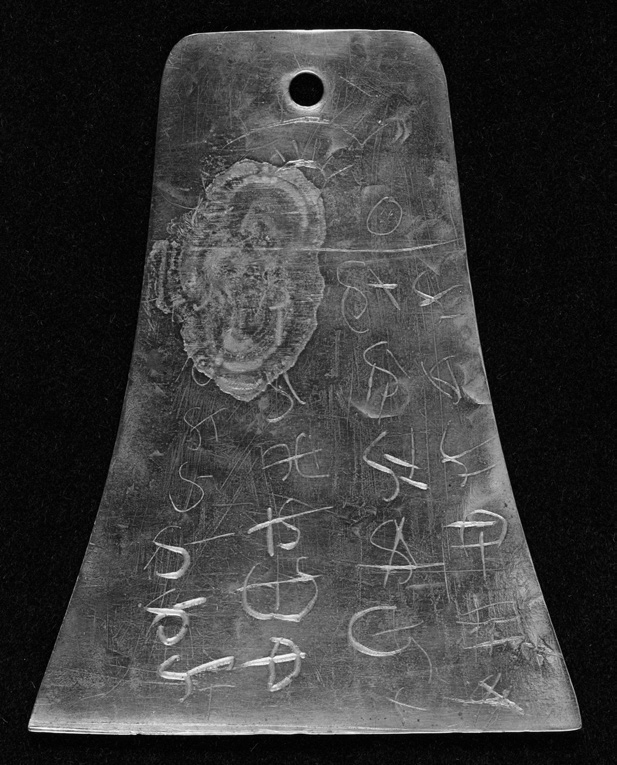
What the Kinderhook Plates were
Each plate was bell-shaped and nearly three inches in height, with a hole near the top and a single ring connecting the set; the ring broke as the plates came out of the ground.[8:2] Both faces carried inscriptions, part illustration and part what looked to a nineteenth-century eye like an ancient script.[8:3] Wiley's solo preliminary dig had struck "a flat rock that sounded hollow beneath"; the group excavation found the plates and bones several feet down.[8:4][13] Two local Latter-day Saints were in the crowd; Wilbur Fugate later recalled that when the plates surfaced, one of them "leaped and shouted for joy."[8:5]
The plates reached Nauvoo within days, carried by a Mr. Moore, most likely George Moore, a Unitarian minister based in Quincy.[8:6][14] Moore had seen Joseph's transcript of Book of Mormon characters the previous June, which likely explains why he took the new find to the prophet.[8:7] The plates were in Joseph Smith's hands by May 1, when William Clayton saw them at the Smith home. The record of the following week is unusually layered for so small an episode: Clayton's journal entry (May 1), a sketch of one plate in Brigham Young's journal (May 3), Parley P. Pratt's letter to his cousin John Van Cott (May 7), Joseph's own journal (May 7), and a letter one of the May 7 group, apparently not a Latter-day Saint, sent to the New York Herald.[15]
The plates were a hoax. No party to the historical debate contests this.
Fugate confessed in letters to James T. Cobb, the first dated April 8, 1878, the second June 30, 1879. The later letter, published in Wilhelm Wyl's 1886 Mormon Portraits, calls the plates "a HUMBUG, gotten up by Robert Wiley, Bridge Whitton and myself," made "by way of a joke" at the expense of the Latter-day Saints.[7:1] W. P. Harris, who had watched the dig, had written privately back in 1855 that Whitton admitted the fabrication to him; that letter surfaced in print only in 1912.[16]
In 1980, Northwestern University materials scientist D. Lynn Johnson conducted destructive metallurgical analysis on the surviving plate with the permission of the Chicago Historical Society. His conclusions, published in the August 1981 Ensign, confirmed nineteenth-century manufacture: brass alloy of approximately 73 percent copper and 24 percent zinc, characters produced by acid etching rather than engraving, and chemical signatures (nitric acid residues, modern-alloy impurity patterns) inconsistent with ancient origin.[9:1]
No one in this dispute defends the plates. The question was never authenticity; it is what Joseph Smith did with them, what he said about them, and what the documentary record actually shows.
The smoking gun that isn't: Clayton's paraphrase versus the History of the Church rewrite
The History of the Church first-person passage that anchors the CES Letter's case has a documentary history, and Joseph Smith wrote none of it. The passage is the product of a standard nineteenth-century editorial practice that converted clerical paraphrase into first-person autobiography after Joseph's death.
The chain begins with William Clayton's journal entry of May 1, 1843. Clayton, Joseph's personal clerk and one of the most reliable contemporary documentarians in Nauvoo, recorded the following:
"I have seen 6 brass plates which were found . . . by some persons who were digging in a mound. They found a skeleton. . . . The plates were on the breast of the skeleton—This diagram shows the size of the plates being drawn on the edge of one of them. They are covered with ancient characters of language containing from 30 to 40 on each side of the plates. Prest J. has translated a portion and says they contain the history of the person with whom they were found & he was a descendant of Ham through the loins of Pharaoh king of Egypt, and that he received his kingdom from the ruler of heaven & earth."[17]
The grammatical structure is unmistakably third-person. Clayton is the speaker; "Prest J.," President Joseph, is the subject. He "has translated a portion." This is a clerk reporting his understanding of what Joseph said in conversation, in the same register Clayton uses throughout his journal to record dozens of other secondhand reports about Joseph's activities and statements.
The History of the Church version, in Volume 5, page 372, reads in the first person:
"I insert fac-similes of the six brass plates found near Kinderhook, in Pike county, Illinois, on April 23, by Mr. Robert Wiley and others, while excavating a large mound. They found a skeleton about six feet from the surface of the earth, which must have stood nine feet high. The plates were found on the breast of the skeleton, and were covered on both sides with ancient characters. I have translated a portion of them, and find they contain the history of the person with whom they were found. He was a descendant of Ham, through the loins of Pharaoh, king of Egypt, and that he received his kingdom from the Ruler of heaven and earth."[18]
The rewrite is what the History of the Church compilers did with thousands of pages of source material. The "History of Joseph Smith" project, begun under Joseph's supervision in 1838 and carried on by Church historians after his death, collected clerical journals, official correspondence, sermons, and contemporaneous reports and rendered them into a continuous first-person autobiographical narrative as though Joseph himself had written them. The convention was standard nineteenth-century compiler practice. "In his own words" was a presentation choice, not a documentary claim.
Stanley B. Kimball walked through this exact case in his 1981 Ensign article: although the Kinderhook account "appears to be the writing of Joseph Smith, it is actually an excerpt from a journal of William Clayton," and the words "I have translated a portion" originally read "President J. has translated a portion."
Of the practice itself Kimball wrote that "It was not uncommon in the nineteenth century for biographers to put the narrative in the first person when compiling a biographical work, even though the subject of the biography did not actually say or write all the words attributed to him."[9:2] Brian Hauglid, in his 2011 chapter in No Weapon Shall Prosper, summarizes Kimball's judgment the same way: the change was "unfortunate" but "not an uncommon practice in the nineteenth century."[19]
This matters for the 138 years between the 1843 source event and the 1981 Ensign documentary correction. The version of the Kinderhook story that Latter-day Saint readers encountered in their own institutional materials was the first-person one, not Clayton's third-person original.[20] The altered passage was republished in the Deseret News in September 1856, reprinted in the Millennial Star of January 15, 1859, and, in Kimball's word, "unfortunately, was finally carried over into official Church history" when the 1909 book edition appeared, propagating from there through B. H. Roberts's History of the Church volumes.[9:3][21] The recovery to the correct documentary chain came in the Church's own magazine. For most of the intervening century, nobody flagged the first-person quote as a clerical paraphrase.
The CES Letter quotes the rewritten passage. It does not engage Clayton's original entry. It does not mention the documentary chain. It does not cite the Joseph Smith Papers, the Bradley/Ashurst-McGee scholarship, or the Stanley Kimball Ensign article that already corrected the documentary record in 1981, even though it cites the Ensign headline directly.
The two texts side by side make the issue visible:
| Source | Date | Voice | Text |
|---|---|---|---|
| William Clayton's journal | May 1, 1843 (contemporaneous) | Third-person clerk | "Prest J. has translated a portion and says they contain the history of the person with whom they were found & he was a descendant of Ham through the loins of Pharaoh king of Egypt"[17:1] |
| History of the Church Vol. 5, p. 372 | Compiled 1856 onward; published 1909 | First-person rewrite | "I have translated a portion of them, and find they contain the history of the person with whom they were found. He was a descendant of Ham, through the loins of Pharaoh, king of Egypt"[18:1] |
Key Point
The first-person quote at the rhetorical center of the CES Letter's Kinderhook section started as William Clayton's contemporaneous third-person clerical paraphrase and reached print as Joseph's autobiography through editors working after his death. The Church publicly identified this documentary chain in the Ensign in 1981, and Clayton's original wording has been quoted in print ever since. The Joseph Smith Papers project (launched in 2001, publishing volumes from the late 2000s onward) has made Joseph's own journal and its editorial annotations freely available online. None of this material is hidden, contested, or obscure. It is in plain view, and the CES Letter quotes the rewritten passage anyway.
Once the textual centerpiece of the critical case is correctly identified as a clerical paraphrase rendered into first person by mid-century editors, the argument depends entirely on Clayton's third-person reading of one event, and even that reading describes a brief, bounded, ordinary character-comparison rather than a sustained prophetic translation.
What Joseph Smith's own journal says about May 1, 1843
Joseph Smith kept a journal, with multiple scribes recording day-by-day activities, throughout the period of the Kinderhook affair. Willard Richards was the principal journalist for the Journal, December 1842–June 1844 volumes that cover the episode.[22]
Joseph's own journal entry for May 1, 1843, the same date as Clayton's third-person paraphrase about Joseph having "translated a portion," reads in its entirety:
"Monday May 1.
18331843 rode out. fore noon & afte[r]noon."[23]
That is the whole entry. The "1833" is a scribal slip, corrected to 1843. No mention of the Kinderhook plates. No translation claim. No reference to Ham or Pharaoh. No notation that he had spent any part of the day examining brass plates. Joseph rode out, forenoon and afternoon.
Joseph's journal in this period is sparse, and the one-line May 1 entry is typical of it. By itself the silence proves only that his journal contains no record of a translation event that day. The contrast is what matters: his other translation projects generated extensive contemporaneous journal references, scribal records, and correspondence.
Joseph's only direct reference to the plates appears in his journal entry for May 7, 1843:
"forenoon visited by several gentlemen concerning the plates which were dug out of a mound near quncy [Quincy] sent by Wm Smith to the office for Hebrew Bible & Lexicon—"[24]
That is the full extent of Joseph Smith's documented engagement with the Kinderhook plates in his own journal: a visit from several gentlemen, and a Hebrew Bible and lexicon sent for (the abbreviated wording leaves it open whether William Smith or the journal-keeper Willard Richards was the one sent).[24:1] No record of a translation, a manuscript, a scribe, a seer stone, a Urim and Thummim, a public claim of revelation, or even sustained discussion. The Joseph Smith Papers editors, working from the entire documentary record, summarize the situation in their footnote to this entry:
"No further mention of the plates is made in JS's journal after this 7 May entry, and no translation endorsed by JS has been located, suggesting that whatever JS initially thought about the plates, he soon lost interest in them."[25]
The Joseph Smith Papers project is the standard documentary edition of Joseph Smith's papers, edited under Mark Ashurst-McGee and a team of credentialed historians and published by the Church Historian's Press. Its editorial assessments are the conclusions of the most rigorous documentary scholarship available on Joseph Smith, not apologetic talking points. The editors' word is "suggesting," a careful inference from the absence of further documentation rather than a hard conclusion. Read carefully, that language points to brief examination, no sustained translation manuscript, and a topic that dropped from Joseph's documentary footprint after May 7, 1843. The fuller timeline is more nuanced than "lost interest" allows.
Charlotte Haven's May 2 letter: Joseph said he might translate them, if revelation came
Charlotte Haven was a young non-Mormon woman from New Hampshire who spent the spring of 1843 in Nauvoo visiting her brother and writing detailed letters home about her observations of Joseph Smith and Latter-day Saint life.[14:1] Her letters were later published in Overland Monthly in December 1890 under the title "A Girl's Letters from Nauvoo."[26] She is a valuable witness for the Kinderhook affair: outside the faith community, with no incentive to soften Joseph's claims, writing on May 2, 1843, the day after Clayton's third-person journal entry.
Her information about Joseph, though, came at a remove. She records what Mr. Moore, the man who carried the plates to Nauvoo, told her household about his exchange with Joseph; Bradley and Ashurst-McGee class her report as third-hand (Joseph to Moore to Haven) and note her tendency toward overstatement, including a plate size roughly double the real one.[8:8]
Haven describes Moore's call at her household, plates in hand:
"His last call on us was last Saturday [April 29] and he brought with him half a dozen thin pieces of brass, apparently very old, in the form of a bell about five or six inches long. They had on them scratches that looked like writing, and strange figures like symbolic characters. They were recently found, he said, in a mound a few miles below Quincy."[14:2]
She then reports what Moore said Joseph said on being shown the plates:
"When he showed them to Joseph, the latter said that the figures or writing on them was similar to that in which the Book of Mormon was written, and if Mr. Moore could leave them, he thought that by the help of revelation he would be able to translate them."[14:3]
The grammar of Haven's report carries the weight. Joseph, as the report reached her, said:
- "If Mr. Moore could leave them": a conditional. The translation would happen if Moore left the plates.
- "He thought that": a tentative epistemic frame. Joseph did not state; he expressed an opinion.
- "By the help of revelation": an explicit external requirement. Joseph did not claim he had already translated; he claimed translation would require revelation he had not yet received.
- "He would be able to translate them": future-tense potential, not past-tense achievement.
Every feature of Joseph's reported statement points away from a completed prophetic translation and toward a tentative, conditional possibility. This is the language of a person uncertain whether revelation will come, hopeful but unprepared to commit to a result, explicitly waiting on divine assistance that had not yet arrived. It is not the language of a person who has already produced a translation. Bradley and Ashurst-McGee read the letter the same way: it "does not describe how Joseph Smith translated from the Kinderhook plates, but it does purport to tell how he initially expected to translate: by revelation."[8:9]
Haven closed her letter (written, again, the day after Clayton's journal entry) with the speculative observation that "a sequel to that holy book may soon be expected."[14:4] No sequel ever appeared. The translation Joseph said he might be able to produce if Moore left the plates and if revelation came was never produced. The hopeful, contingent expectation Haven recorded simply did not materialize.
Three features of Haven's account weigh against the faithful reading.
First, Joseph reportedly said the Kinderhook characters resembled "that in which the Book of Mormon was written," the reformed Egyptian of the Book of Mormon plates. The Kinderhook plates were modern fabrications using characters invented or copied by amateur hoaxers, with no relationship to any genuine Egyptian, Demotic, or proto-Egyptian script. Joseph's impressionistic identification of the Kinderhook characters as similar to Book of Mormon characters is an embarrassment to the extent that it suggests his notion of what "reformed Egyptian" looked like was based on contemporary impressions rather than any verified ancient script.
Second, Joseph said he might be able to translate the plates "by the help of revelation," placing the Kinderhook plates, in some sense, in the same prophetic-translation category as the Book of Mormon and Book of Abraham. The "purely secular linguistic exercise" framing has to reckon with Joseph's own openness, on the day, to applying his prophetic gift if it arrived.
Third: on the May 2 letter's account, Joseph did not recognize the plates as a fraud. He thought translation was possible. He held the door open to it. His discernment failed him here, and the failure should not be minimized. Joseph engaged the plates as a sincere amateur enthusiast who did not see through the forgery, and his openness to applying his prophetic gift to a fraudulent document shows that prophetic discernment did not arise spontaneously and automatically.
Joseph thought translation was possible. He did not claim it had happened. Both facts are true at once, and only one of them is exculpatory.
The conditional structure remains the central point against the CES Letter's framing. Joseph said he might be able to translate the plates if Moore left them and if revelation came. He did not say he had translated them. He produced no translation. The plates were not left with him in any sustained way. Whatever revelation he hoped for did not arrive, or did not direct him to translate. The matter eventually dropped. The record shows brief engagement, an expectation of possible translation, no manuscript, no scribe, and a topic left to fade, not a confidently delivered, finished translation that the Church then defended for over a century.
The CES Letter never mentions Charlotte Haven; neither her name nor her letter appears anywhere in it. A non-Mormon letter from the very week of the supposed translation, recording Joseph saying only that he thought he might translate the plates if revelation came, is simply absent from the CES Letter's account. The letter's weight should not be overstated in the other direction either: the report is third-hand, Moore's accuracy as a relay cannot be checked, and Bradley and Ashurst-McGee conclude that the revelation-first scenario it sketches is plausible but that "the available sources do not settle this with certainty."[8:10]
What Joseph actually did: the GAEL one-character match
Don Bradley and Mark Ashurst-McGee reconstructed the actual mechanics of Joseph Smith's engagement with the Kinderhook plates. Their findings, first presented by Bradley at the 2011 FAIR Conference and developed across multiple subsequent publications, culminated in their 70-page chapter in Producing Ancient Scripture (University of Utah Press, 2020), the most complete scholarly account of the Kinderhook incident in print.[8:11][27]
In 1835, in connection with the Book of Abraham translation work, a working document was compiled that came to be known as the Grammar and Alphabet of the Egyptian Language. The bound volume is in the hand of Joseph's clerk W. W. Phelps, with a small number of entries by Warren Parrish, and it belongs to the larger body of Egyptian-language papers Joseph and his scribal circle produced in Kirtland.[28] The GAEL is a 108-leaf bound volume, only 34 pages of which are inscribed, attempting to map a series of Egyptian-looking characters to English meanings, organized into "degrees" and parts of speech.
It is not a working scholarly grammar of Egyptian. Modern Egyptologists, both Latter-day Saint (Michael Rhodes, John Gee, Kerry Muhlestein) and non-Latter-day Saint (Robert Ritner, Klaus Baer), agree that the GAEL's character-meaning mappings do not correspond to actual Egyptian linguistic content. By all credentialed assessment, it is an idiosyncratic working document of nineteenth-century origin, produced for purposes that remain contested in Latter-day Saint scholarship; see the Papyri article in the Book of Abraham section for the full treatment.
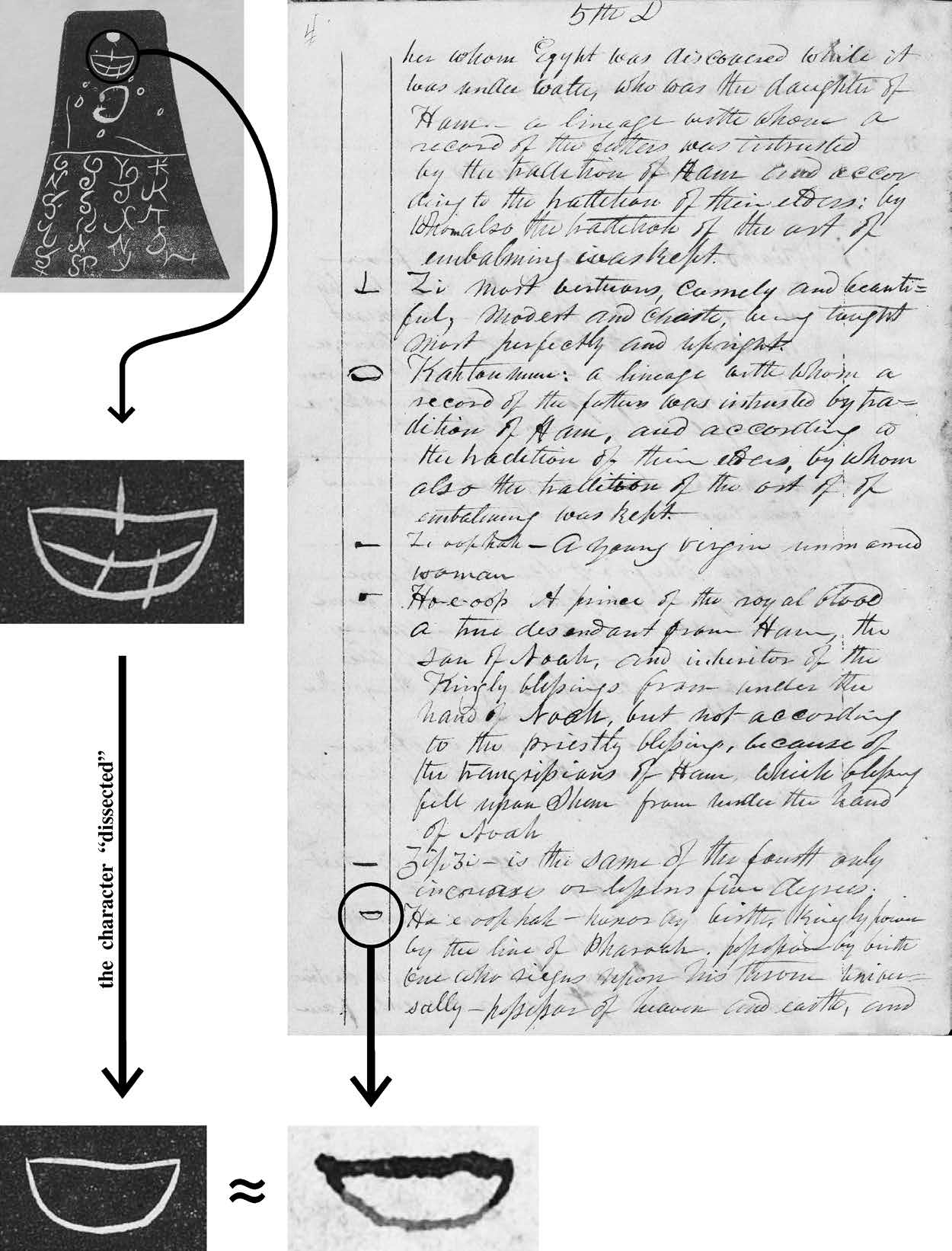
Bradley and Ashurst-McGee identified that the content of Clayton's journal report ("the history of the person with whom they were found & he was a descendant of Ham through the loins of Pharaoh king of Egypt, and that he received his kingdom from the ruler of heaven & earth") closely matches the GAEL's existing definition for a specific character. The character, named "Ha e oop hah" in the GAEL, carries this interpretation (spelling as in the 1835 manuscript):
"honor by birth, kingly power by the line of Pharoah. possession by birth one who riegns upon his throne universally—possessor of heaven and earth, and of the blessings of the earth."[29]
Compare this GAEL definition to Clayton's report of what Joseph said about the plates:
| GAEL definition (1835) | Clayton's journal report of what Joseph said (May 1, 1843) |
|---|---|
| "honor by birth, kingly power by the line of Pharoah… possessor of heaven and earth, and of the blessings of the earth." | "the history of the person with whom they were found & he was a descendant of Ham through the loins of Pharaoh king of Egypt, and that he received his kingdom from the ruler of heaven & earth." |
The match is not approximate. The same conceptual content, "the line / loins of Pharaoh" and "possessor / ruler of heaven and earth," appears in both texts. The GAEL definition supplies the substance of what Clayton attributed to Joseph's "translation." Rather than an independent revelatory translation, this is Joseph identifying a character on the Kinderhook plates that visually resembled the "Ha e oop hah" character in his existing GAEL, looking up the corresponding definition in the same document, and reading it off as the meaning of the Kinderhook character.
Bradley and Ashurst-McGee identify a specific candidate for the character Joseph matched: a roughly boat-shaped figure, relatively large and prominently placed at the top of one of the plates, on the one plate side whose heading carries two large characters rather than the usual illustrations. It closely resembles the "Ha e oop hah" character on the fourth page of the GAEL.[8:12]
One of the men present at the May 7 examination, apparently not a Latter-day Saint, described the method in a letter to the New York Herald, writing under the pseudonym "A Gentile":
"He compared them in my presence with his Egyptian alphabet, which he took from the plates from which the Book of Mormon was translated, and they are evidently the same characters. He therefore will be able to decipher them."[30]
The aside about the Book of Mormon is a bystander's confusion: the "Egyptian alphabet" volume belonged to the Book of Abraham work, and Bradley and Ashurst-McGee suggest the correspondent conflated the two because Joseph was so much better known for the Book of Mormon.[30:1] The description of the method, though, is unambiguous, down to the future tense of the expected deciphering. "He compared them." Not "he translated them." Joseph performed a visual character comparison between the plates and his existing Egyptian Alphabet, the GAEL, and reported the GAEL's pre-existing definition as the meaning of the matched character. The method was secular philology rather than revelatory translation. It is a structurally different activity from the seer-stone translation that produced the Book of Mormon: different tool, different process, different output.
The "From the Desk" Q&A interview with Bradley and Ashurst-McGee summarizes the reconstruction:
"In fact, the Egyptian Alphabet includes a character that resembles a prominent character on the plates and this character in the Egyptian Alphabet has an English interpretation that substantially overlaps what Clayton wrote about the translation of the plates."[31]
The engagement lacked every marker of Joseph's prophetic translation projects. He did not use a seer stone. He did not use the Urim and Thummim. He did not invoke divine revelation as the translation method. Bradley and Ashurst-McGee write: "there is no mention of Joseph Smith using the Urim and Thummim or a seer stone or divine revelation of any kind in any of the sources close to the event."[8:13] He assigned no scribe to take sustained dictation. No translation manuscript exists in any hand: not Joseph's, not Clayton's, not Phelps's, not Parrish's, not Richards's, not anywhere in the documentary record. He produced no sustained text. No located sermon, letter, or revelation of his refers to the plates again across the fourteen months between May 7, 1843 and his death on June 27, 1844.
The manuscript-absence point is best framed as a contrast in what each activity should have produced, not bare absence of evidence.[32] Joseph's prophetic translation projects (Book of Mormon, Book of Abraham, Joseph Smith Translation) produced sustained scribal manuscripts because that is what sustained revelatory dictation produces. The Kinderhook engagement produced no manuscript because the activity was structurally different: a character comparison using a working aid, not sustained revelatory dictation. The comparison is "no sustained translation effort attempted" versus "sustained translation effort attempted, manuscript produced, text canonized." The Kinderhook engagement falls cleanly on the first side of that line.
The Joseph Smith Papers editorial assessment registers the same observation: "no translation endorsed by JS has been located."[25:1] This is the conclusion of the team that has spent two decades cataloging every scrap of paper Joseph Smith produced or was associated with. They have read everything. No Kinderhook translation manuscript exists not because one disappeared, but because one was never produced.
Joseph's own journal supplies the confirming detail. The May 7 entry's closing clause, "sent by Wm Smith to the office for Hebrew Bible & Lexicon," places secular reference books at the examination itself.[24:2] Joseph had taken up Hebrew seriously in the winter of 1835–36, studying under the Jewish educator Joshua Seixas in Kirtland, and he kept language study up for the rest of his life; a month after the Kinderhook examination he opened a sermon with "I will turn linguist."[8:14] The books sent for at the examination were the tools of that ongoing study. The presence of a lexicon tells us what Joseph was attempting: ordinary linguistic study with the tools he had.
The contrast between Joseph's documented translation methods is sharp.
| Project | Method | Duration | Tools | Output |
|---|---|---|---|---|
| Book of Mormon | Revelatory dictation | ~60 working days | Seer stone (Urim and Thummim with Martin Harris) | 269,510 words; multiple scribes; published 1830 |
| Joseph Smith Translation | Inspired biblical revision | 1830–1833 (active); 1844 (final additions) | Direct revelation; KJV Bible | ~3,400 modified verses; Book of Moses |
| Book of Abraham | Translation connected to papyri | 1835 (Kirtland phase); 1842 (Nauvoo phase) | Revelation; papyri; scribes | Published scripture (canonized) |
| D&C 7 | Revelation about a parchment | 1829 | Revelation only (no physical document) | Canonized D&C section |
| Kinderhook Plates | Secular philology, character matching | ~5 days, then silence | GAEL; Hebrew lexicon | Nothing: no manuscript, no scribe, no publication |
The Kinderhook line is structurally distinct. No claimed prophetic gift, no scribe, no sustained dictation, no manuscript, no published text. One tentative character match using a working document, by a method Joseph approached as secular philology rather than divine revelation. The narrower argument is that the Kinderhook engagement is a window into Joseph's philological character-matching method specifically: the kind of activity that produced the GAEL and that, applied to a hoaxed document, produced an incorrect "translation."[33] His prophetic translations used a different method, revelatory dictation, with sustained scribal output and canonized text.
Further Reading
The Bradley/Ashurst-McGee 2020 chapter "President Joseph Has Translated a Portion: Joseph Smith and the Mistranslation of the Kinderhook Plates," in Producing Ancient Scripture (University of Utah Press), is the definitive scholarly treatment of the Kinderhook incident, documenting the GAEL match in detail and reconstructing the documentary chain. The shorter accessible version of the same argument, Bradley and Ashurst-McGee, "Joseph Smith and the Kinderhook Plates," in A Reason for Faith (BYU Religious Studies Center / Deseret Book, 2016), is freely available at rsc.byu.edu/reason-faith/kinderhook-plates. Brian Hauglid's pre-Bradley scholarly treatment, "Did Joseph Smith Translate the Kinderhook Plates?" in No Weapon Shall Prosper (BYU Religious Studies Center / Deseret Book, 2011), is at rsc.byu.edu/no-weapon-shall-prosper/did-joseph-smith-translate-kinderhook-plates.
The 1980 chemical analysis and the August 1981 Ensign
By 1980, the surviving Kinderhook plate had been in non-Mormon hands for over a century. After Joseph's death in 1844 the plates passed through several hands; by the late nineteenth century five of the six had been lost; a single surviving plate eventually entered the holdings of the Chicago Historical Society.
Wilbur Fugate's confession identified the plates as a hoax he had personally helped fabricate with Wiley and Whitton, and it was in print in Wilhelm Wyl's Mormon Portraits by 1886.[7:2] W. P. Harris's April 25, 1855 letter recording Whitton's admission appeared in the Journal of the Illinois State Historical Society in 1912.[16:1] By the early twentieth century, then, the documentary case for a hoax was in print twice over. That, plus the absence of any ancient cultural context for nineteenth-century-style brass artifacts in early Illinois mound burials, was already substantial reason for suspicion.
The 1980 destructive testing converted suspicion into conclusive proof. Stanley B. Kimball, a Latter-day Saint historian on the faculty of Southern Illinois University, coordinated arrangements with the Chicago Historical Society for Northwestern University to perform destructive metallurgical analysis on the surviving plate. Professor D. Lynn Johnson of Northwestern's Department of Materials Science and Engineering conducted the analysis using a scanning electron microscope, a scanning auger microprobe, X-ray fluorescence, and microscopic examination.[9:4]
Johnson's findings were unambiguous. The plate was a true brass alloy of approximately 73 percent copper and 24 percent zinc, a chemical signature characteristic of mid-nineteenth-century manufacture. The characters were produced by acid etching rather than engraving, with nitric acid residues remaining in the etched grooves. The metal contained few visible impurities, inconsistent with the irregular impurity patterns characteristic of ancient metallurgy.[9:5] Kimball stated the overall assessment in his 1992 Encyclopedia of Mormonism entry: "There thus appears no reason to accept the Kinderhook plates as anything but a frontier hoax."[34]
Kimball's article, "Kinderhook Plates Brought to Joseph Smith Appear to Be a Nineteenth-Century Hoax," was published in the official magazine of The Church of Jesus Christ of Latter-day Saints, the Ensign, in August 1981.[9:6] The lengthy nine-page article included:
- A historical narrative of the plates' 1843 arrival in Nauvoo, Joseph's brief examination, and the subsequent dispersal of the plates.
- A detailed account of the 1980 chemical and metallurgical testing.
- The forgers' confessions (Whitton 1855 to Harris; Fugate 1878–79 to Cobb).
- A direct correction of the documentary chain. Kimball wrote that although the History of the Church account "appears to be the writing of Joseph Smith, it is actually an excerpt from a journal of William Clayton," and that "the words 'I have translated a portion' originally read 'President J. has translated a portion.'" He traced the third-to-first-person rewrite through the History of the Church compilation process, attributing the convention to nineteenth-century editorial practice.[9:7]
- A clear institutional assessment. "Joseph Smith needs no defense—he simply did not fall for the scheme."[9:8]
This is the article the CES Letter cites only by its headline. The CES Letter quotes the title, "Kinderhook Plates Brought to Joseph Smith Appear to Be a Nineteenth-Century Hoax," and treats it as a forced concession that contradicts the History of the Church first-person quote. What the Ensign article actually contains, in its body, is a direct correction of the History of the Church rewrite, an explicit acknowledgment that the first-person quote is editorial fiction derived from Clayton's third-person original, and a clear institutional assessment that Joseph "did not fall for the scheme."[9:9]
The CES Letter's framing requires the reader to imagine that the Church covered up the Kinderhook hoax for 138 years before being forced to concede in 1980 by chemical testing. The actual record is that:
- In August 1981, in the Ensign, the Church publicly identified the plates as a nineteenth-century hoax.
- In the same article, the Church publicly identified the History of the Church first-person quote as a posthumous editorial rewrite of Clayton's third-person paraphrase.
- The same magazine lineage that had printed a defense of the plates' authenticity in 1962 (Welby Ricks, in the Improvement Era) printed the hoax identification in 1981.
- The article was published 32 years before the CES Letter's first edition (April 2013) and 36 years before the October 2017 update.
The CES Letter quotes the Ensign headline. It does not engage the article's content. Anyone reading the CES Letter and following the citation chain to the Ensign itself encounters a Church-published 1981 article that already corrects most of the CES Letter's documentary claims.
The correction also came late, and it was prompted by the chemistry rather than by the documents. From 1843 to 1981, the position in the Church's own publications was authenticity: the 1843 notices, the reprints of the rewritten first-person quote, the 1909 History of the Church edition, the 1962 Ricks defense. Nothing in the documentary case required a scanning electron microscope. Fugate's confession had been in print since 1886, the Harris letter since 1912, and William Clayton's journal had been accessible to Church historians for over a century. The documentary correction could have been published in the 1920s, the 1940s, the 1960s. It was not, and without the chemistry the 1962 defense might have stood considerably longer.
The CES Letter's framing alleges something more than slowness: concealment in some active or willful sense, ended only by forced confession. The correction was slower than it should have been; that much stands. Active concealment is a different charge, and the record does not support it. No one forced the Church to publish the 1981 article: it ran voluntarily, nine pages long, in the Church's own magazine, and it corrected both the previous Church-magazine position and the documentary chain; institutional self-correction in that form is rare in the history of religious movements.[9:10] It matters, too, that the History of the Church was an editorial compilation, never canonized scripture; the distinction between a compiler's first-person convention and revealed text is one Latter-day Saint theology already draws. A correction arriving decades late is a failure of diligence, not a cover-up.
From defending the plates (1962) to declaring the hoax (1981)
The Welby Ricks article in the September 1962 Improvement Era, the Church's official magazine of the period, was an institutionally-credentialed defense of the Kinderhook plates' authenticity. Ricks was president of BYU's archaeology society at the time, and his article appeared in the Church's flagship publication. That combination puts it well beyond a personal opinion piece in a marginal forum: an institutional Church-magazine position, advanced by a credentialed Latter-day Saint authority figure, in the magazine of record.[35]
Kimball's 1981 Ensign article never engaged Ricks by name. It simply occupied the same institutional ground with the opposite conclusion, in effect reversing the position the Church's magazine of record had printed nineteen years earlier.[9:11] That is how institutional self-correction usually happens in practice: not as a formal retraction naming its predecessor, but as the corrected position running in the same kind of forum that hosted the prior one once the evidence makes the old position untenable.
The CES Letter, citing Bushman, frames the period from 1843 to 1980 as "Church historians [continuing] to insist on the authenticity of the Kinderhook Plates." That framing has limited evidentiary weight when held against the actual Church-magazine record:
- 1843 (Times and Seasons): Initial announcement of the plates' arrival in Nauvoo. Times and Seasons, in the May 1, 1843 issue, reported on the plates and noted that "Mr. Smith has had those plates, what his opinion concerning them is, we have not yet ascertained," a careful editorial hedge in the Church's own newspaper, on the same day Clayton's third-person journal entry recorded that Joseph "has translated a portion," that did not commit to a translation result.[36]
- 1843 (Nauvoo Neighbor): A broadside on June 24, 1843 announced a forthcoming publication of the translation. The translation was never produced.[37]
- 1856 (Deseret News): The altered first-person version republished, September 3 and 10, 1856.[9:12]
- 1859 (Millennial Star): Reprinted the rewritten first-person History of the Church version of the Clayton paraphrase.[21:1]
- 1909 (History of the Church book form): The first-person Kinderhook passage was published in B. H. Roberts's editorial compilation.[18:2]
- 1962 (Improvement Era): Welby Ricks's defense of authenticity.[35:1]
- 1981 (Ensign): Stanley Kimball's correction. The plates publicly identified as a nineteenth-century hoax.[9:13]
- 2015 (Joseph Smith Papers): The journal covering the episode published in the Journals series, with editorial annotations identifying the documentary chain; the project, launched in 2001 and producing volumes from the late 2000s onward, has made Joseph's own journal and related papers freely available online.[25:2]
- 2020 (Bradley/Ashurst-McGee chapter): The full scholarly reconstruction of the GAEL match published in Producing Ancient Scripture.[8:15]
- 2024 (Church History Topics): The Church's official Church History Topics page on the Kinderhook plates explicitly identifies the plates as a hoax, notes that "Wilbur Fugate admitted that he, Robert Wiley, and a local blacksmith forged the plates," and confirms that "chemical and metallurgical analysis of the one surviving plate confirms the artifact was not an ancient production." The page states that Joseph "evidently did not attempt a revelatory translation."[38]
The institutional record is one of slow but eventual correction, with the 1981 Ensign article as the inflection point and the Joseph Smith Papers and Bradley/Ashurst-McGee scholarship deepening the corrected position over the subsequent four decades. The CES Letter's framing, which treats the 1981 correction as forced and embarrassed, depends on the reader not engaging the Ensign article's actual content.
The forgers' confessions: a thirty-five-year silence
If the Kinderhook hoax had successfully tricked Joseph Smith into producing a public, sustained, embarrassing translation of fake plates, the forgers had every reason to expose him immediately. Joseph was a controversial public figure throughout the 1840s, opposed by the Nauvoo Expositor in June 1844, targeted by extralegal violence culminating in his murder on June 27, 1844, and, after his death, the subject of decades of polemical anti-Mormon literature in which any documented case of a fraudulent prophetic claim would have been a central piece of evidence. (The dynamic of a forger setting a trap for the prophetic office recurs in modern Latter-day Saint history in the Mark Hofmann affair of the 1980s, where the discernment question is sharpened by similar documentary dynamics.)
The forgers said nothing.
Bridge Whitton's admission survives in a letter W. P. Harris wrote on April 25, 1855, eleven years after Joseph's death, though that letter remained unpublished until 1912.[16:2] Wilbur Fugate first confessed to James T. Cobb in a letter dated April 8, 1878, and repeated the confession in a fuller letter of June 30, 1879, thirty-five years after the Nauvoo episode.[7:3] Fugate's confession is direct: the plates were
"a HUMBUG, gotten up by Robert Wiley, Bridge Whitton and myself. … None of the nine persons who signed the certificate knew the secret, except Wiley and I."[7:4]
Fugate also walked through the fabrication: "Bridge Whitton cut them out of some pieces of copper; Wiley and I made the hieroglyphics by making impressions on beeswax and filling them with acid and putting it on the plates. When they were finished we put them together with rust made of nitric acid, old iron and lead, and bound them with a piece of hoop iron, covering them completely with the rust."[7:5] (Fugate remembered the sheets as copper; the 1980 analysis showed the surviving plate to be brass, an alloy of copper and zinc.[9:14]) The aged bundle was then buried ahead of Wiley's staged "discovery."
The thirty-five-year delay before Fugate's confession is itself documentary evidence. If the forgers had successfully tricked Joseph into a public translation that exposed his prophetic claim as fraudulent, the natural response would have been a contemporaneous exposure during Joseph's lifetime, when the political stakes were highest and the embarrassment to Joseph's prophetic mission would have been most damaging. Fugate did not produce his confession until Joseph had been dead for thirty-four years. If the trap had closed the way the CES Letter imagines, why did the men who set it wait a generation to claim the catch?
The simplest explanation is the one Bradley and Ashurst-McGee offer: there was nothing to expose during Joseph's lifetime, because Joseph had not produced the kind of public, sustained, embarrassing translation that would have justified exposure. Joseph examined the plates briefly, made a tentative GAEL-based character match, recognized that no sustained inspiration was coming, and let the matter drop. The trap was set, but Joseph did not engage in a way that would close it.
Fugate's own account of Joseph's behavior, in a passage often cited by critics, reads:
"We understood Jo Smith said [the plates] would make a book of 1200 pages but he would not agree to translate them until they were sent to the Antiquarian society at Philadelphia, France, and England."[7:6]
The grammar matters here too. Fugate reports what Joseph "said," and the report is that Joseph would not agree to translate them until they had been sent to learned societies at Philadelphia and in France and England. This is the language of a person refusing to commit to a translation until external authentication was provided. Even from a hostile witness, the report is that Joseph asked for independent authentication before committing to translation work, the opposite of the confidently-translating prophet the CES Letter's framing requires.
Brian Hauglid reads the episode accordingly: "Perhaps Joseph inspected the plates and tried to translate them but received no revelation, and, recognizing the stupor of thought, lost interest and moved on to other things." Or perhaps "both Joseph the scholar and Joseph the prophet tried to do something with the plates, but nothing really came of either approach." Either way, "apparently Joseph did not go far enough for the conspirators to spring the trap."[19:1]
Times and Seasons and the silence of the Church's own newspaper
The Times and Seasons of May 1, 1843 (the same date as Clayton's third-person journal entry, in the Church newspaper published by Apostles John Taylor and Wilford Woodruff) carried a brief notice about the plates. The notice described their physical characteristics and reported: "Mr. Smith has had those plates, what his opinion concerning them is, we have not yet ascertained."[36:1] The same notice added that "The gentleman that owns them has taken them away, or we should have given a fac simile": the owner was not even leaving the plates in Nauvoo long enough for the paper to cut a facsimile.[36:2]
The grammatical subject of the hedge is Joseph's opinion, not the plates' authenticity. The "not yet" plainly contemplates that Joseph's opinion would eventually be known. The Church's own paper, on May 1, 1843, expected an opinion or translation to emerge; alongside the Nauvoo Neighbor broadside seven weeks later, this is documentary evidence of expectation. Had Joseph already produced a sustained translation that day, the Times and Seasons would have been the natural forum for reporting it; the paper instead said not yet. That is consistent with no sustained translation having been produced as of May 1, and consistent with an expectation of one to come. The fact that one never came is the decisive observation.
The June 24, 1843 Nauvoo Neighbor broadside that announced a forthcoming publication of the Kinderhook translation is the strongest single piece of evidence against a flat "Joseph immediately dismissed the plates" reading.[37:1] The broadside reproduced facsimiles of all twelve faces of the six plates and declared:
"The contents of the Plates, together with a Fac-Simile of the same, will be published in the 'Times and Seasons,' as soon as the translation is completed."[37:2]
The broadside came from the press of the Latter-day Saint community newspaper, with editorial proximity to Joseph and his clerical staff, announcing, seven weeks after the May 1–7 examination, that a translation was coming. The fair read is that someone in Joseph's circle, plausibly Joseph himself, expected a translation to materialize. That expectation is on the record, and it complicates any framing that has Joseph closing the door on the plates immediately after May 7.
Whether a translation was actually in progress is another question. The broadside announced what was expected. The translation never appeared. Across the next twelve months, from late June 1843 to Joseph's death in June 1844, no manuscript was produced, no scribal work was assigned, no published text appeared in the Times and Seasons, the Nauvoo Neighbor, the Millennial Star, or any other Latter-day Saint publication.
The expected publication did not materialize. Whatever Joseph or his circle anticipated in late June 1843, the actual production of a translation never occurred.
The more nuanced timeline the broadside supports runs something like this. Joseph engaged the plates briefly in early May 1843, made a tentative GAEL character match, and his close circle held the door open through late June 1843 to the possibility of a forthcoming translation. No revelation engaged the document, no scribal work was undertaken, and the matter quietly faded after that. That timeline is closer to the record than an immediate loss of interest, and it is just as far from a confidently produced, sustained translation that the Church then defended for 138 years.
The silence after May 7, 1843
The total documentary footprint of Joseph Smith's engagement with the Kinderhook plates after May 7, 1843, the date of his last journal entry referencing them, is silence.
- No further journal entries reference the plates. Joseph's journal, December 1842–June 1844, with entries kept by Willard Richards and other scribes, contains no further mentions.[22:1][25:3]
- No scribal work on a Kinderhook translation manuscript has been located. Joseph's clerks produced extensive manuscript material across the Nauvoo period; no Kinderhook-translation manuscript has surfaced in any documentary collection.[25:4]
- No sermon by Joseph Smith between May 7, 1843 and his death on June 27, 1844 is known to reference the plates. None has been located in the surviving records of his Nauvoo discourses.[8:16]
- No known correspondence references the plates. Joseph's outgoing and incoming correspondence across the relevant fourteen-month period contains no located references.[8:17]
- No mention of the plates appears in Joseph's last words, last sermons, or last writings.
- No Kinderhook translation appeared in Times and Seasons, the Nauvoo Neighbor, or any other Latter-day Saint publication.
The same Joseph Smith who left an extensive documentary footprint for the Book of Mormon (witnesses, scribes, manuscripts, multiple printings) and the Book of Abraham (manuscripts, Times and Seasons publication, canonization) leaves no documentary footprint at all for the Kinderhook plates after the brief May 1843 examination. Joseph died fourteen months later on June 27, 1844, fourteen months that would have been more than sufficient to dictate a Kinderhook translation manuscript using his documented translation methods (seer stone, scribe, sustained dictation), had he been engaged in such an effort. He produced nothing.
The pattern, not any single document, is the evidence. Joseph's translation gift, when applied to source material that yielded substantive output, produced the kind of extensive documentary record we expect from sustained creative or revelatory work. Applied to the Kinderhook plates, his gift produced a single tentative character match using a secular reference document, recorded in a clerk's journal as a brief paraphrase, and was not pursued further. The simplest reading is that Joseph engaged the plates briefly using available linguistic tools, found nothing that resembled the kind of revelatory access he experienced with genuine source material, and moved on. The pattern matches a man with a real and selective gift who recognized when the gift was not engaging.
The strongest single documentary fact for the faithful position is the absence of sustained process. The Joseph Smith Papers team, after cataloging Joseph's entire documentary record, has located no translation he endorsed, no assigned scribe, no manuscript, and no recorded revelatory event tied to the plates. That absence is not the same as no engagement at all: Joseph examined the plates, made a tentative GAEL match, sent for a lexicon, and his close circle expected a translation into late June. It is a difference in kind: the scribe, the sustained dictation, the manuscript, and the canonized text that accompanied his revelatory translations are all missing from the Kinderhook record. The CES Letter's framing requires Joseph to have produced a sustained translation. He did not.
Engaging the strongest critical version
The CES Letter's argument, as presented, is significantly weaker than the strongest academic-critical version of the Kinderhook case. A serious critic (one who has read Bradley and Ashurst-McGee, consulted the Joseph Smith Papers, and engaged Hauglid 2011 and the Ensign 1981 article) would not quote the History of the Church first-person passage uncritically. They would acknowledge that the quote is Clayton's paraphrase, that the rewrite was standard nineteenth-century editorial practice, and that Joseph's own journal does not contain the passage. They would acknowledge that Joseph used secular tools rather than revelation. They would acknowledge that no manuscript was produced and that Joseph's documentary engagement with the plates fades after May 7, 1843. They would acknowledge that the Church publicly identified the plates as a hoax in 1981.
But they would still argue that the Kinderhook incident is bad evidence for Joseph Smith's translation reliability.
The strongest critical move 1: Joseph engaged a forged document at face value.
Even granting the documentary corrections, the strongest critical reading goes like this. Six brass plates with strange characters were brought to Joseph Smith. A man in his position (a prophet who claimed to be the world's only living translator of ancient records, who had built an entire religious community on the authenticity of his prophetic translation gift) had three plausible responses available: decline to engage; identify the plates as a fraud; or investigate authentically and produce a verified translation.
Joseph did none of these.
He took the plates, used his GAEL to look up a single character, produced a tentative translation matching one of his existing definitions, and only then, when no sustained inspiration came, dropped it. The defense ("he just used secular tools") is not actually a defense. It concedes that Joseph engaged a fraudulent document at face value, treating it as if it were a meaningful Egyptian artifact, and produced a tentative match using his own (also flawed) reference tool. That is not the response of a man with a divinely-given gift of translation. That is the response of an amateur enthusiast.
The Church's own Church History Topics page admits the difficulty in muted form. It lists three possibilities about Joseph's interest level, presenting them as "unconfirmed by historical accounts": that Joseph suspected the plates were a forgery; that Joseph experienced a "stupor of thought" when attempting translation; or that Joseph approached the plates as a curious amateur with scholarly rather than prophetic interest.[38:1] The first option is faith-promoting (Joseph saw through the fraud); the second is faith-promoting (Joseph received divine warning); the third, that Joseph was an amateur enthusiast, is what the documentary record actually supports, and it is the option that most directly challenges a triumphalist prophet-translator framing.
Joseph examined the plates with apparent confidence. He used secular reference tools. He produced a tentative character match that was wrong, because the plates were a hoax and the GAEL was not a working grammar. Claims that he saw through the fraud at once, or that a stupor of thought turned him away, have no documentary support; the Church's own topic page lists them as unconfirmed possibilities.[38:2]
Still, Joseph's documented behavior is consistent with him being a curious amateur linguist in addition to being a prophet. The Doctrine and Covenants explicitly teaches that revelation comes through study and faith, not as automatic supernatural discernment (D&C 9:7–9). Joseph studied languages in earnest from his Kirtland Hebrew schooling onward, and he openly stated the ambition: "I am determined to persue the study of languages untill I shall become master of them… I am determined to make this my object."[31:1] His engagement with the Kinderhook plates as an amateur philologist using his existing GAEL and a Hebrew lexicon fits this documented pattern.
Bradley and Ashurst-McGee's characterization (Joseph as "an enthusiastic, yet amateur, linguist") is the right framing.[8:18] The claim is more modest: his documented amateur engagement with the Kinderhook plates does not discredit his revelatory translation work, which used different methods, claimed different sources, and produced different outputs.
The strongest critical move 2: "Translated a portion" still says he translated something.
The Bradley/Ashurst-McGee response to the History of the Church rewrite is, in essence: don't read it as Joseph's first-person claim, read it as Clayton's paraphrase. Clayton wrote "Prest J. has translated a portion," and Clayton was a reliable secretary. But that paraphrase still says Joseph translated something. The translation Joseph produced (per Clayton's third-person record) was: "the history of the person with whom they were found & he was a descendant of Ham through the loins of Pharaoh king of Egypt, and that he received his kingdom from the ruler of heaven & earth."
That is a translation claim. It may be a small translation, one character matched to a GAEL definition, but it is a claim. Joseph said the plates contained X content. The fact that the plates were a hoax means Joseph was wrong about their content. The fact that he used the GAEL means his method was unreliable. Both are damaging to the broader claim that Joseph could translate ancient records.
A critic could put it this way: "I'm willing to grant that the History of the Church first-person quote is a nineteenth-century rewrite. I'm willing to grant that Joseph used secular tools. None of that changes the fact that Joseph said the plates were authentic ancient Egyptian artifacts, and Joseph said they contained genealogical content involving Ham and Pharaoh, and Joseph was wrong on both counts. The defense that he was 'just doing secular linguistic work' doesn't help: it shows that his secular linguistic work, like the GAEL, was useless for actual Egyptian."
Yes, Joseph attempted a tentative translation. Yes, Joseph was wrong about the content of the plates. Yes, the GAEL is not a working scholarly grammar of Egyptian. None of that is in dispute here.
The relevant point is that Joseph's tentative GAEL-based "translation" of the Kinderhook plates is structurally different from his revelatory translations of the Book of Mormon and Book of Abraham. The Book of Mormon was 269,510 words dictated in approximately 60 working days, with no notes, no outline, no substantive revisions, and witnessed scribal records of the translation process.[39] The Book of Abraham contains material (Olishem, divine council theology, Apocalypse of Abraham parallels) that is difficult to source in Joseph's early-nineteenth-century environment.[40][41] The Kinderhook "translation" was a single character match using a secular reference document: no manuscript, no scribe, no claim of revelation, no published outcome.
Treating a single-character GAEL lookup as a "translation" of equivalent weight to Joseph's prophetic translations is the central category mistake in the CES Letter's "two clunkers and a third car" framing. They are not the same activity. The Doctrine and Covenants teaches that translation by the gift and power of God requires study, faith, and revelation (D&C 9:7–9). Joseph applied study without sustained revelation, and he produced a tentative match that turned out to be wrong. That is not a failure of the prophetic gift but a demonstration of the difference between scholarly study and revelatory translation, the same difference Joseph himself drew: "a prophet is not always a prophet," only when acting as such.[42]
The strongest critical move 3: The GAEL connection cuts against the Book of Abraham.
This is the strongest version of the criticism, and it is the one the CES Letter does not actually make. A serious critic would point out: the GAEL is the same document Joseph and his clerks produced in connection with the Book of Abraham translation work. If Joseph used the GAEL to "translate" a Kinderhook character, and the GAEL is incorrect about Egyptian, then the Kinderhook incident demonstrates that the GAEL was useless for actual Egyptian, with implications for the Book of Abraham translation method.
The GAEL was used in connection with both Kinderhook (1843) and the Book of Abraham working documents (1835). Its character-meaning mappings do not decode Egyptian; Egyptologists of every stripe agree. And the Kinderhook incident is direct documentary evidence that Joseph's GAEL-based character matching produced a wrong result when applied to a document he could not separately verify.
The Kinderhook incident establishes that the GAEL did not function as a working grammar of Egyptian. A character-by-character GAEL approach to Egyptian is documentably unreliable. It does not show that the Book of Abraham was produced by character-by-character GAEL decoding. The most defensible LDS scholarly framework, sketched by Bradley and Ashurst-McGee as one possibility, expanded by Stephen Smoot, and consistent with Kerry Muhlestein and John Gee's positions, is that the Book of Abraham was produced by revelation (in Joseph's own usage of "translation by the gift and power of God"), with the GAEL functioning as a working aid or scaffolding for Joseph's process rather than as the engine of the translation.[43]
On this reading, call it the catalyst or retrospective-mapping framework, Joseph's revelatory translation produced the text; the GAEL was a working document Joseph used to think about Egyptian as a curious nineteenth-century philologist might.[8:19]
The Kinderhook episode is consistent with that catalyst framework. Joseph received plates whose characters he could not decode by revelation (no sustained inspiration came), so he reached for the working aid, the GAEL, matched a character, read off the existing definition, and stopped when no revelation engaged the document further. That is a direct documentary illustration of the GAEL functioning as a working aid rather than as a translation engine. The Book of Abraham, on the catalyst reading, looks structurally different: there, sustained revelation did engage the source material, sustained dictation did occur, manuscripts and canonized text were produced. The GAEL was present in both projects. The revelatory engagement was not.
The Kinderhook incident is evidence about the GAEL-as-decoder hypothesis, and it refutes that hypothesis.
It is also consistent with, though it does not by itself establish, the catalyst/retrospective-mapping framework, on which the GAEL was a working aid Joseph used in a process whose actual engine was revelation. The Book of Abraham case stands or falls on whether the catalyst framework can hold up against the documentary record of the Book of Abraham itself, including Brian Hauglid's November 2018 public statement that he "wholeheartedly agree[d] with Dan [Vogel]'s excellent assessment of the Abraham/Egyptian documents in these videos," a strong statement from the most credentialed LDS documentary editor on the BoA manuscripts in the direction of a more naturalistic reading.[44] That is a difficult question, and it is taken up in detail in the Papyri article.
The Papyri, Anachronisms & Source Texts, and Facsimiles articles carry the full Book of Abraham treatment. The Kinderhook incident does not refute the Book of Abraham. It also does not settle it.
Its actual effect is to constrain the space of defensible apologetic framings: any Book-of-Abraham apologetic that treats the GAEL as a working Egyptian decoder is not consistent with the Kinderhook documentary record. The catalyst/retrospective-mapping framework, by contrast, is at least consistent with the Kinderhook evidence, and it remains the most defensible faithful reading available, even though, as the Papyri article documents in detail, it is not without explanatory costs of its own.
The strongest critical move 4: The 1981 Ensign came after the testing forced it.
A critic could argue: the 1981 Kimball Ensign article, valuable as it is, came only after the 1980 destructive testing made the hoax inescapable. Had the chemical analysis not occurred, had Bradley and Ashurst-McGee not done their documentary work in 2011 and 2020, the History of the Church first-person quote would still be circulating without correction. That is not a credit to Church historiography.
This is fair as far as it goes, and it should be granted: the documentary chain was not widely understood until the 1981 Ensign article, and the first-person quote misled generations of readers inside and outside the Church.
The reply is more limited but still stands. First, Stanley Kimball's 1981 Ensign article did identify the documentary chain explicitly, 39 years before the Bradley/Ashurst-McGee chapter. The correction was institutional and on the official record at that time. Second, the Joseph Smith Papers project, launched in 2001 and producing volumes from the late 2000s onward, has made the original sources widely available. Joseph's own journal and its editorial annotations are on josephsmithpapers.org, and Clayton's wording has been in print since 1981. Anyone with internet access in 2026 can verify the documentary chain in five minutes.
Third, the CES Letter was first published in 2013, 32 years after the Kimball Ensign article identified the documentary chain, and after the Joseph Smith Papers project had been publishing primary documents for years. The CES Letter's continued reliance on the History of the Church first-person quote is an editorial choice, not a forced conclusion. A more careful critic would have engaged Kimball, Hauglid, and Bradley/Ashurst-McGee.
Where the strongest critical case runs out of evidence
Even the strongest version of the critical case has known limits, which the documentary record makes visible.
The "Joseph translated" claim fails to produce a translation. If Joseph thought he could translate the plates, where is the translation? The Nauvoo Neighbor broadside (June 24, 1843) announced a forthcoming translation. The Times and Seasons (May 1, 1843) reported that Joseph's opinion of the plates was "not yet ascertained." A real translation effort by a man whose entire prophetic identity was tied up with ancient records, and who had a captive audience expecting a sequel to the Book of Mormon, should have produced something. It produced nothing.
Joseph let the matter drop. That is hard to square with the "fraud" hypothesis. A fraud would have produced something: a few pages of text, a public announcement of significant new revelation, anything to maintain the mystique. Joseph produced silence.
The hoax fabricators waited decades to claim victory. If the hoax had successfully tricked Joseph into a public translation, Wilbur Fugate had every reason to expose him in 1844 (when Joseph was being targeted by the Nauvoo Expositor and other anti-Mormon forces) or in the years immediately following Joseph's death. Instead, Fugate's confession came in 1878, thirty-four years after Joseph's death, when the political stakes were low. The 1855 Harris letter recording Whitton's admission was private correspondence that did not surface publicly until 1912. This is consistent with there being nothing to expose during Joseph's lifetime.
Joseph used secular tools, which is consistent with sincere amateur curiosity. Had Joseph been faking a prophetic translation, why would he use a Hebrew lexicon and the GAEL openly in front of witnesses? The use of secular tools (especially the GAEL, which by 1843 had been around for eight years and was associated with Joseph's other linguistic work) is more consistent with sincere scholarly curiosity than with fraudulent self-presentation. A fraud trying to maintain a prophetic image would not have publicly used a lexicon. He would have closed the door, "received revelation," and produced a manuscript.
The 1980 chemical analysis confirmed what the documentary record had suggested all along. Joseph himself effectively concluded the matter by ceasing to engage with the plates after May 7, 1843. Fugate's 1878–79 confession (published in 1886) and Whitton's 1855 confession (recovered 1912) had been on the public record for decades, and in Fugate's case nearly a century, before destructive testing was performed. The chemical analysis converted longstanding suspicion to conclusive proof; it did not generate the conclusion from nothing.
The translation pattern: substance versus silence
One more comparison puts the episode in place: Joseph Smith's response to authentic source material across his prophetic career, next to his response to the Kinderhook plates.
Cases of substantive engagement. The gold plates: sustained engagement, multiple witnesses (Three Witnesses, Eight Witnesses, additional informal witnesses), 60-day translation, manuscript, publication, canonization. The Anthon transcript: Joseph copied characters and Martin Harris took them to Charles Anthon, substantive engagement. The Book of Abraham papyri: sustained engagement, scribes, manuscripts, Times and Seasons publication, canonization. The bones of Zelph (the 1834 Zion's Camp march): brief but recorded interpretation. The Bible (Joseph Smith Translation): sustained engagement over years, multiple scribes, complete revision in two manuscript volumes covering thousands of revised verses.
Cases of brief engagement and quick disengagement. The Kinderhook plates: brief examination, one-character GAEL lookup, no manuscript, no scribe, no canonization, complete silence after May 7, 1843. Various reported "ancient artifact" claims brought to Nauvoo by curiosity-seekers and would-be sellers (mentioned in passing in journals): generally not engaged at length.
The Kinderhook plates fit a documented pattern of brief engagement and quick disengagement that characterizes Joseph's response to source material that did not yield substantive content. When Joseph's translation gift engaged genuine source material, it produced sustained text. When it did not engage, he moved on. This is consistent with the gift being real and selective, and inconsistent with the gift being a fraud he confidently exercised on anything placed in front of him.
The contrast with the Book of Mormon is sharp. Where the Kinderhook plates produced one tentative match and silence, the Book of Mormon produced a complex internal chronology spanning a thousand years; Hebraisms (chiasmus, parallelism) Joseph could not have engineered;[45] geographic specificity now corroborated by Arabian Peninsula archaeology (the burial site Nahom);[46] internal theological consistency; multiple sustained witnesses (Three, Eight, informal); and a demonstrably oral-dictation production process with surviving manuscripts.[39:1]
Joseph staked his prophetic identity on the Book of Mormon, not on the Kinderhook plates. He himself said: "Take away the Book of Mormon and the revelations, and where is our religion? We have none."[47] The Kinderhook plates were a brief encounter that crossed Joseph's desk in May 1843. He examined them, attempted a one-character GAEL lookup, and there it ended. He did not canonize a "Book of Kinderhook." No located record shows him mentioning them again before his death.
The CES Letter's "two clunkers and a third car" framing collapses these categories. The Book of Mormon is not parallel to the Book of Abraham (different sources, processes, evidentiary trails); neither is parallel to the Kinderhook plates (which produced no manuscript and no canonized text). The Kinderhook plates produced no translation. The Book of Abraham produced a canonized text whose surviving documentary trail is genuinely contested, a question taken up in detail in the Papyri article and the Translator Claims sister article, both of which engage the "two clunkers" framing as a unit. The narrower job here is to establish what the Kinderhook documentary record will and will not support; the broader bundling is treated where it belongs.
Further Reading
For the Church's official current statement on the Kinderhook plates, see Kinderhook Plates, Church History Topics. For Stanley Kimball's 1981 Ensign article, which identified both the hoax and the documentary chain 32 years before the CES Letter, see Kinderhook Plates Brought to Joseph Smith Appear to Be a Nineteenth-Century Hoax. For the Bradley/Ashurst-McGee documentary reconstruction in shorter form, see Joseph Smith and the Kinderhook Plates in A Reason for Faith.
Bottom-line assessment
The Kinderhook plates were a hoax. This is uncontested. Wilbur Fugate, Robert Wiley, and Bridge Whitton fabricated six bell-shaped metal plates with acid-etched characters in the spring of 1843 and buried them in a nearby Indian mound in advance of a staged "discovery"; within days the plates were in Nauvoo, where the question became whether Joseph Smith would attempt a translation. The 1980 destructive metallurgical analysis at Northwestern University, published in the August 1981 Ensign, confirmed nineteenth-century manufacture using brass alloy, acid-etching characters, and chemical signatures inconsistent with ancient origin. The fact of the hoax is not at issue.
The issue is what Joseph Smith did with the plates and what the documentary record actually shows.
The CES Letter's case depends on three claims the documentary record will not support.
| The CES Letter's case requires | What the record shows |
|---|---|
| Joseph claimed in his own first-person voice that he had translated a portion of the plates. | The History of the Church first-person passage is a posthumous editorial rewrite of Clayton's contemporaneous third-person paraphrase, a documentary chain identified by Stanley Kimball in the Ensign in 1981 (32 years before the CES Letter's first edition) and confirmed by Bradley and Ashurst-McGee in 2020.[9:15][8:20] |
| Joseph produced a sustained translation that the Church defended for 138 years until chemistry forced a concession. | Joseph's own journal is silent on May 1, 1843; Haven's letter records only a conditional hope ("if Mr. Moore could leave them … by the help of revelation"); the Times and Seasons said his opinion was "not yet ascertained"; and no manuscript, scribal record, or canonized text was ever produced.[23:1][14:5][36:3][25:5] |
| The Kinderhook episode is structurally parallel to the Book of Mormon and Book of Abraham translations. | Those projects involved sustained dictation, scribes, manuscripts, claimed revelation, and canonized publication; the Kinderhook engagement involved a single-character GAEL match, no manuscript, no scribe, no claimed revelation, and no published outcome.[8:21][33:1] |
The record supports a more measured account. Joseph Smith engaged the Kinderhook plates briefly as an amateur philologist using available secular reference tools (the GAEL and a Hebrew lexicon). He matched a single boat-shaped character at the top of one of the plates to a similar character ("Ha e oop hah") on the fourth page of the GAEL. He read off the GAEL's pre-existing definition ("honor by birth, kingly power by the line of Pharoah… possessor of heaven and earth") and Clayton recorded that Joseph "has translated a portion" describing content that closely matched that definition.
Joseph did not claim revelation. He used no seer stone or Urim and Thummim. He took no scribe and produced no manuscript. He approached the plates with the openness of a curious investigator and the limits of an amateur, including the limit that he did not recognize the plates as a fraud.
He thought translation was possible by revelation; the Nauvoo Neighbor broadside in late June indicates his close circle still expected a translation seven weeks later. No revelation engaged the document, no scribal work was assigned, no manuscript was produced, and the subject vanished from the record. The Joseph Smith Papers editorial team summarizes the trajectory cautiously: "no translation endorsed by JS has been located, suggesting that whatever JS initially thought about the plates, he soon lost interest in them."[25:6]
The hard core of the affair is narrow but real: Joseph engaged a forged document at face value, used a flawed reference grammar, and gave a tentative description that was wrong because the plates were junk and the GAEL does not decode Egyptian. What the documentary record will not support is the CES Letter's stronger framing: that Joseph confidently produced a translation, that the Church covered up the hoax for 138 years, or that the Kinderhook episode discredits Joseph's prophetic translation gift. Joseph's prophetic translations (the Book of Mormon, the Book of Abraham, the Joseph Smith Translation) used different methods, claimed different sources, and produced sustained scriptural text. The Kinderhook plates produced one tentative character match, no manuscript, and silence.
The Church publicly identified the plates as a nineteenth-century hoax in the Ensign in August 1981. The same article identified the documentary chain the CES Letter quietly elides. The Joseph Smith Papers project, launched in 2001 and producing volumes from the late 2000s onward, has put Joseph's own journal and its editorial annotations online for anyone to read. The Bradley/Ashurst-McGee chapter in Producing Ancient Scripture (2020) is the standard scholarly treatment. The Church's current Church History Topics page is unambiguous: the plates were a hoax, the forgers confessed, and Joseph "evidently did not attempt a revelatory translation."[38:3]
The CES Letter's framing requires the reader to encounter none of this material. Once the documentary record is engaged, the case the CES Letter actually makes (Joseph confidently translated; the Church covered up; therefore his translation gift is unreliable) does not survive contact with the primary sources.
The plates were built as bait. "We read in Pratt's prophecy that 'Truth is yet to spring out of the earth,'" Fugate confessed. "We concluded to prove the prophecy by way of a joke."[7:7] Then Joseph took the bait only as far as a curious amateur would: he looked one character up in a book on his shelf, said the content might be translatable if revelation came, sent for a lexicon, and waited for an inspiration that never arrived. No manuscript. No scribe. No sequel to the Book of Mormon. After May 7, 1843, nothing.
Fugate sat on his confession for thirty-five years, until Joseph had been dead for more than three decades, because there was no public, sustained, fraudulent translation to expose. The same gift that, applied to genuine source material, produced canonized scripture in roughly sixty working days produced from these forged plates a single mismatched character and then went quiet. The trap was set, and it never closed.
Runnells, CES Letter (2017), "Kinderhook Plates & Translator Claims," p. 70. The cited source — "Joseph Smith, Jr., History of the Church, Vol. 5, Chapter 19, p. 372" — is a posthumous editorial rewrite of William Clayton's contemporaneous third-person journal entry, as established by Stanley B. Kimball, "Kinderhook Plates Brought to Joseph Smith Appear to Be a Nineteenth-Century Hoax," Ensign 11, no. 8 (August 1981): 66–74, and confirmed in Don Bradley and Mark Ashurst-McGee, "President Joseph Has Translated a Portion: Joseph Smith and the Mistranslation of the Kinderhook Plates," in Producing Ancient Scripture: Joseph Smith's Translation Projects in the Development of Mormon Christianity, ed. Michael Hubbard MacKay, Mark Ashurst-McGee, and Brian M. Hauglid (Salt Lake City: University of Utah Press, 2020), 452–523. ↩︎
Runnells, CES Letter (2017), "Kinderhook Plates & Translator Claims," p. 70. ↩︎
Runnells, CES Letter (2017), "Kinderhook Plates & Translator Claims," p. 71, citing Richard L. Bushman, Joseph Smith: Rough Stone Rolling (New York: Knopf, 2005), 490. ↩︎
Runnells, CES Letter (2017), "Kinderhook Plates & Translator Claims," p. 71. ↩︎
Runnells, CES Letter (2017), "Kinderhook Plates & Translator Claims," no. 1, p. 71. ↩︎
Runnells, CES Letter (2017), "Kinderhook Plates & Translator Claims," no. 2, p. 72. ↩︎
Wilbur Fugate, letters to James T. Cobb: April 8, 1878 (unpublished; Theodore Albert Schroeder Papers, Wisconsin Historical Society, Madison) and June 30, 1879, the latter published in Wilhelm Wyl, Mormon Portraits, or the Truth about Mormon Leaders from 1830 to 1886 (Salt Lake City: Tribune Printing and Publishing Co., 1886), 207–8. Quotations as printed in Stanley B. Kimball, "Kinderhook Plates Brought to Joseph Smith Appear to Be a Nineteenth-Century Hoax," Ensign 11, no. 8 (August 1981): 66–74: the plates were "a HUMBUG, gotten up by Robert Wiley, Bridge Whitton and myself"; "None of the nine persons who signed the certificate knew the secret, except Wiley and I"; "We read in Pratt's prophecy that 'Truth is yet to spring out of the earth.' We concluded to prove the prophecy by way of a joke." On the letters' dates, archive, and publication, see Bradley and Ashurst-McGee, "Joseph Smith and the Kinderhook Plates" (2016), 95–97 and notes 2, 5, and 12. ↩︎ ↩︎ ↩︎ ↩︎ ↩︎ ↩︎ ↩︎ ↩︎
Don Bradley and Mark Ashurst-McGee, "President Joseph Has Translated a Portion: Joseph Smith and the Mistranslation of the Kinderhook Plates," in Producing Ancient Scripture: Joseph Smith's Translation Projects in the Development of Mormon Christianity, ed. Michael Hubbard MacKay, Mark Ashurst-McGee, and Brian M. Hauglid (Salt Lake City: University of Utah Press, 2020), 452–523. The 70-page chapter is the definitive scholarly treatment of the Kinderhook incident. The authors' argument, in both its 2020 and shorter 2016 forms, documents (1) the documentary chain from Clayton's third-person paraphrase to the History of the Church first-person rewrite; (2) the GAEL match for the Ham/Pharaoh content; (3) the secular-tools framing (GAEL plus Hebrew lexicon, no seer stone, no Urim and Thummim, no claim of revelation); (4) the absence of a sustained translation manuscript; and (5) the absence of any claim of revealed translation in the sources close to the event. Direct quotations in this article are taken from the shorter treatment, Bradley and Ashurst-McGee, "Joseph Smith and the Kinderhook Plates," in A Reason for Faith: Navigating LDS Doctrine and Church History, ed. Laura Harris Hales (Provo, UT: BYU Religious Studies Center; Salt Lake City: Deseret Book, 2016), 93–115, which is available in PDF at https://rsc.byu.edu/sites/default/files/pub_content/pdf/Joseph_Smith_and_the_Kinderhook_Plates.pdf — "there is no mention of Joseph Smith using the Urim and Thummim or a seer stone or divine revelation of any kind in any of the sources close to the event" and "an enthusiastic, yet amateur, linguist" are at p. 110; the third-hand assessment of Haven's letter and "the available sources do not settle this with certainty" at p. 105; the discovery narrative at pp. 93–95; the boat-shaped-character analysis at pp. 107–9. ↩︎ ↩︎ ↩︎ ↩︎ ↩︎ ↩︎ ↩︎ ↩︎ ↩︎ ↩︎ ↩︎ ↩︎ ↩︎ ↩︎ ↩︎ ↩︎ ↩︎ ↩︎ ↩︎ ↩︎ ↩︎ ↩︎
Stanley B. Kimball, "Kinderhook Plates Brought to Joseph Smith Appear to Be a Nineteenth-Century Hoax," Ensign 11, no. 8 (August 1981): 66–74. https://www.churchofjesuschrist.org/study/ensign/1981/08/kinderhook-plates-brought-to-joseph-smith-appear-to-be-a-nineteenth-century-hoax. Kimball reports that Professor D. Lynn Johnson of Northwestern University's Department of Materials Science and Engineering performed destructive metallurgical analysis on the surviving Kinderhook plate using scanning electron microscopy, scanning auger microprobe, X-ray fluorescence, and microscopic examination. The plate was determined to be "a true brass alloy of approximately 73 percent copper, 24 percent zinc," consistent with mid-nineteenth-century manufacture, with characters produced by acid etching rather than engraving. The article also identifies the History of the Church first-person quote as a posthumous editorial rewrite of William Clayton's contemporaneous third-person journal entry ("Although this account appears to be the writing of Joseph Smith, it is actually an excerpt from a journal of William Clayton"). It does not engage Welby Ricks's 1962 Improvement Era defense of the plates' authenticity by name, but its hoax finding displaced that position in the Church's magazine of record. ↩︎ ↩︎ ↩︎ ↩︎ ↩︎ ↩︎ ↩︎ ↩︎ ↩︎ ↩︎ ↩︎ ↩︎ ↩︎ ↩︎ ↩︎ ↩︎
Runnells, CES Letter (2017), "Kinderhook Plates & Translator Claims," p. 73. The "wouldn't you buy a third car from a man who had already sold you two clunkers" framing closes the section. ↩︎
Joseph did not, on the documentary record, discern the fraud immediately — Charlotte Haven's account (engaged in detail in the "Charlotte Haven's May 2 letter" section) shows Joseph's openness in early May 1843 to the possibility that the plates were authentic and translatable. Joseph did, in a tentative and bounded sense, "translate" — Clayton's third-person paraphrase records Joseph offering content that closely matched a definition in his existing GAEL working document. The full elaboration of how these two facts coexist with the article's central claim — that the Kinderhook engagement is structurally different in kind from Joseph's sustained revelatory translations — is the work of the subsequent sections, especially the GAEL-match section and "The strongest critical move 2." ↩︎
"Detailed response to CES Letter, Kinderhook Plates & Translator Claims," FAIR, https://www.fairlatterdaysaints.org/answers/Detailed_response_to_CES_Letter,_Kinderhook_Plates_%26_Translator_Claims. ↩︎
"The Kinderhook Plates," Mormonr, https://mormonr.org/qnas/a9l1T/the_kinderhook_plates, summarizing primary documentation of the plates' fabrication, discovery, examination in Nauvoo, and subsequent dispersal. See also "Kinderhook Plates," Church History Topics, churchofjesuschrist.org, https://www.churchofjesuschrist.org/study/history/topics/kinderhook-plates?lang=eng. ↩︎
Charlotte Haven, letter, May 2, 1843. Published in "A Girl's Letters from Nauvoo," Overland Monthly (December 1890). https://bhroberts.org/records/0yAxfr-07lXyI/charlotte_haven_describes_her_encounter_with_the_kinderhook_plates. Haven's letter records: "When he showed them to Joseph, the latter said that the figures or writing on them was similar to that in which the Book of Mormon was written, and if Mr. Moore could leave them, he thought that by the help of revelation he would be able to translate them." Haven wrote "Joshua Moore," but the carrier was most likely George Moore, the Unitarian minister from Quincy she names in later letters; the name may have been miswritten by Haven or mistranscribed by her publisher (Bradley and Ashurst-McGee [2016], 94 and note 7). Bradley and Ashurst-McGee also note Haven's occasional tendency toward overstatement: her "five or six inches" is roughly twice the surviving plate's actual size (2016, 105 and note 58). ↩︎ ↩︎ ↩︎ ↩︎ ↩︎ ↩︎
Clayton: journal, May 1, 1843 (quoted in this article). Brigham Young: journal, May 3, 1843, "I took this [sketch at right] at Joseph Smiths house found near Quincy," with the sketch of one plate; reproduced in Sarah Allen, "Letter For My Wife Rebuttal, Part 11: The Early Church – The Kinderhook Plates," FAIR Blog, April 6, 2023, https://www.fairlatterdaysaints.org/blog/2023/04/06/letter-for-my-wife-rebuttal-part-11-the-early-church-the-kinderhook-plates. Parley P. Pratt: letter to John Van Cott, May 7, 1843, Church History Library; quoted in Bradley and Ashurst-McGee, "Joseph Smith and the Kinderhook Plates" (2016), 98 and note 25. The New York Herald correspondent: see the "A Gentile" letter cited below. ↩︎
W. P. Harris, letter to Mr. Flagg, April 25, 1855; published in "A Hoax," Journal of the Illinois State Historical Society 5 (July 1912): 271–73. Harris had been present at the dig and initially believed in the discovery; his letter reports that Bridge Whitton later admitted the fabrication to him. See Bradley and Ashurst-McGee, "Joseph Smith and the Kinderhook Plates" (2016), 95 and note 13; on Whitton's admission to Harris, Sarah Allen, "Letter For My Wife Rebuttal, Part 11: The Early Church – The Kinderhook Plates," FAIR Blog, April 6, 2023, https://www.fairlatterdaysaints.org/blog/2023/04/06/letter-for-my-wife-rebuttal-part-11-the-early-church-the-kinderhook-plates. ↩︎ ↩︎ ↩︎
William Clayton, journal, May 1, 1843, as quoted in James B. Allen, No Toil nor Labor Fear: The Story of William Clayton (Provo, UT: BYU Press, 2002), 393, and reproduced in Bradley and Ashurst-McGee, "Joseph Smith and the Kinderhook Plates," in A Reason for Faith, ed. Laura Harris Hales (Provo, UT: BYU Religious Studies Center; Salt Lake City: Deseret Book, 2016), 98. The entry reads in the third person ("Prest J. has translated a portion") and was rewritten into first person by mid-nineteenth-century History of the Church compilers. ↩︎ ↩︎
History of the Church, Vol. 5, p. 372 (1909 first book-edition publication; B. H. Roberts seven-volume edition published 1902–1932). The first-person rewrite ("I have translated a portion of them") replaces Clayton's contemporaneous third-person paraphrase ("Prest J. has translated a portion"). This documentary chain is identified explicitly in Kimball, "Kinderhook Plates" (1981), and confirmed in Bradley and Ashurst-McGee, "President Joseph Has Translated a Portion" (2020). ↩︎ ↩︎ ↩︎
Brian M. Hauglid, "Did Joseph Smith Translate the Kinderhook Plates?" in No Weapon Shall Prosper: New Light on Sensitive Issues, ed. Robert L. Millet (Provo, UT: BYU Religious Studies Center; Salt Lake City: Deseret Book, 2011), 93–103. https://rsc.byu.edu/no-weapon-shall-prosper/did-joseph-smith-translate-kinderhook-plates. Summarizing Kimball, Hauglid notes the third-to-first-person rewrite was "unfortunate" but "not an uncommon practice in the nineteenth century to write narrative in the first person when producing a biographical work." ↩︎ ↩︎
The first-person quote was published in the Deseret News (September 3 and 10, 1856), the Millennial Star (1859), and the History of the Church book form (1909; B. H. Roberts's seven-volume edition, 1902–1932), and circulated through church books, periodicals, and pulpit references throughout the late nineteenth and early twentieth centuries — Orson Pratt's 1851 pamphlet series, for example, republished the plate facsimiles as evidence for the Book of Mormon (Bradley and Ashurst-McGee [2016], 95 and note 11). The documentary chain (Clayton paraphrase → editorial first-person rewrite) was not widely understood in the membership. The current scholarly position — that the first-person passage was always a clerical paraphrase rendered into autobiographical voice by mid-century editors — represents a recovery from an institutional default that ran for over a century. (This footnote elaborates a body sentence; the substantive concession is carried at full weight in the body of the 1981 Ensign section.) ↩︎
Millennial Star 21, no. 3 (Liverpool, January 15, 1859), reprinting the rewritten first-person History of the Church version of Clayton's paraphrase. See documentation in Kimball, "Kinderhook Plates" (1981). ↩︎ ↩︎
"Historical Introduction," Journal, December 1842–June 1844, Book 2, Joseph Smith Papers, https://www.josephsmithpapers.org/paper-summary/journal-december-1842-june-1844-book-2-10-march-1843-14-july-1843/1. Willard Richards was the principal scribe for the volumes covering the Kinderhook episode. ↩︎ ↩︎
Joseph Smith, journal entry, May 1, 1843, in Joseph Smith Papers, Journal, December 1842–June 1844, Book 2, p. 186. https://www.josephsmithpapers.org/paper-summary/journal-december-1842-june-1844-book-2-10-march-1843-14-july-1843/194. The complete entry: "Monday May 1. 1833 1843 rode out. fore noon & afte[r]noon." (The "1833" is a scribal slip corrected to 1843.) ↩︎ ↩︎
Joseph Smith, journal entry, May 7, 1843, in Joseph Smith Papers, Journal, December 1842–June 1844, Book 2, p. 195. https://www.josephsmithpapers.org/paper-summary/journal-december-1842-june-1844-book-2-10-march-1843-14-july-1843/203. The Kinderhook portion of the entry reads: "forenoon visited by several gentlemen concerning the plates which were dug out of a mound near quncy [Quincy] sent by Wm Smith to the office for Hebrew Bible & Lexicon—". Bradley and Ashurst-McGee note that the abbreviated entry can be read as either William Smith or Willard Richards being the one sent for the books (Bradley and Ashurst-McGee [2016], 106). ↩︎ ↩︎ ↩︎
Editorial footnote to Joseph Smith, journal entry, May 7, 1843, in Joseph Smith Papers, Journal, December 1842–June 1844, Book 2, p. 195. The full editorial assessment: "No further mention of the plates is made in JS's journal after this 7 May entry, and no translation endorsed by JS has been located, suggesting that whatever JS initially thought about the plates, he soon lost interest in them." ↩︎ ↩︎ ↩︎ ↩︎ ↩︎ ↩︎ ↩︎
Overland Monthly 16 (December 1890): 630, publishing Charlotte Haven's letters home from her 1843 Nauvoo visit under the title "A Girl's Letters from Nauvoo." ↩︎
Don Bradley, "President Joseph Has Translated a Portion: Solving the Mystery of the Kinderhook Plates," presentation at the 2011 FAIR Conference (August 2011). The presentation was the original public unveiling of Bradley's GAEL-match findings. Available at https://www.youtube.com/watch?v=XQ1eoW7-q9k. ↩︎
Robin Scott Jensen and Brian M. Hauglid, eds., Joseph Smith Papers, Revelations and Translations, Volume 4: Book of Abraham and Related Manuscripts (Salt Lake City: Church Historian's Press, 2018). Documents the Grammar and Alphabet of the Egyptian Language (GAEL) and the Egyptian Alphabet documents in the standard critical edition. ↩︎
The GAEL interpretation for the character "Ha e oop hah" reads in full, with the manuscript's spellings: "honor by birth, kingly power by the line of Pharoah. possession by birth one who riegns upon his throne universally—possessor of heaven and earth, and of the blessings of the earth." It appears on the fourth page of the GAEL manuscript (1835), in the hand of W. W. Phelps. Quoted in Bradley and Ashurst-McGee, "Joseph Smith and the Kinderhook Plates," in A Reason for Faith: Navigating LDS Doctrine and Church History, ed. Laura Harris Hales (Provo, UT: BYU Religious Studies Center; Salt Lake City: Deseret Book, 2016), 107 (https://rsc.byu.edu/reason-faith/kinderhook-plates); documented at length in Bradley and Ashurst-McGee, "President Joseph Has Translated a Portion" (2020). ↩︎
"A Gentile," letter to James Gordon Bennett, May 7, 1843, as published in "Late and Interesting from the Mormon Empire on the Upper Mississippi," New York Herald, May 30, 1843; quoted in Bradley and Ashurst-McGee, "Joseph Smith and the Kinderhook Plates" (2016), 106 and note 59. The pseudonymous correspondent was one of the group present on May 7 and, by his chosen pen name, apparently not a Latter-day Saint; Bradley and Ashurst-McGee decline to identify him further, and they suggest his "Egyptian alphabet … took from the plates from which the Book of Mormon was translated" remark conflates the Book of Mormon with the Book of Abraham, the project the GAEL actually belonged to, because Joseph was far better known for the former. ↩︎ ↩︎
"Did the Kinderhook Plates Really Fool Joseph Smith?" From the Desk Q&A interview with Mark Ashurst-McGee and Don Bradley, https://www.fromthedesk.org/kinderhook-plates/. Documents the GAEL character match, the Hebrew lexicon reference, and Joseph's broader linguistic ambition: "I am determined to persue the study of languages untill I shall become master of them… I am determined to make this my object." ↩︎ ↩︎
A careful reader will note that the absence of a manuscript, by itself, does not prove no translation work occurred — a single-character GAEL lookup would not produce a manuscript even on the most engaged reading. The argument has to be sharper than bare "absence of evidence." Joseph's prophetic translation projects produced sustained scribal manuscripts because sustained revelatory dictation is what produces them; the Kinderhook engagement produced no manuscript because the activity was structurally different — a brief character comparison using a working aid, not sustained revelatory dictation. The right comparison is "no sustained translation effort attempted" versus "sustained translation effort attempted, manuscript produced, text canonized." ↩︎
A careful critic will rightly note that the table above compares different methodologies — the 1828–1830 Book of Mormon work with the spring 1843 Kinderhook encounter, separated by fifteen years and a developing relationship to Joseph's various translation projects. The methodologies were genuinely different. Joseph used a seer stone for the Book of Mormon; he openly used reference works (the GAEL, a Hebrew lexicon) for the Kinderhook examination, and the GAEL was associated with his Book of Abraham work as well. The article is not arguing that the Book of Mormon's success refutes any concern that arises from the Kinderhook engagement. The narrower argument is that the Kinderhook engagement is a window into Joseph's philological character-matching method, while his prophetic translations used a different method — revelatory dictation. They are different projects evaluated on different terms. ↩︎ ↩︎
Stanley B. Kimball, "Kinderhook Plates," in Encyclopedia of Mormonism, ed. Daniel H. Ludlow (New York: Macmillan, 1992). https://eom.byu.edu/index.php/Kinderhook_Plates. Kimball's later encyclopedia entry restates and tightens the conclusion of his 1981 Ensign article: "There thus appears no reason to accept the Kinderhook plates as anything but a frontier hoax." ↩︎
Welby W. Ricks, "The Kinderhook Plates," Improvement Era 65, no. 9 (September 1962): 636–637, 656, 658, 660. The 1962 Improvement Era article defended the plates' authenticity. Ricks was president of BYU's archaeology society at the time. The article was superseded in effect by Stanley Kimball's 1981 Ensign article, which never engages Ricks by name but reversed the position in the same magazine lineage. ↩︎ ↩︎
Times and Seasons 4, no. 12 (May 1, 1843): 186. The full hedge sentence reads: "Mr. Smith has had those plates, what his opinion concerning them is, we have not yet ascertained." The same notice adds: "The gentleman that owns them has taken them away, or we should have given a fac simile" (both sentences as quoted in Kimball, "Kinderhook Plates," 1981). The grammatical subject of "not yet ascertained" is Joseph's opinion of the plates, not the plates' contents — a careful editorial hedge in the Church's own newspaper on the same day Clayton's third-person journal entry recorded that Joseph "has translated a portion." ↩︎ ↩︎ ↩︎ ↩︎
"A Brief Account of the Discovery of the Brass Plates Recently Taken from a Mound near Kinderhook, Pike County, Illinois," broadside, Nauvoo Neighbor press, June 24, 1843. The broadside reproduced facsimiles of the twelve faces of the six plates and declared: "The contents of the Plates, together with a Fac-Simile of the same, will be published in the 'Times and Seasons,' as soon as the translation is completed." Quoted in Bradley and Ashurst-McGee, "Joseph Smith and the Kinderhook Plates" (2016), 95 and notes 4 and 10. ↩︎ ↩︎ ↩︎
"Kinderhook Plates," Church History Topics, churchofjesuschrist.org, https://www.churchofjesuschrist.org/study/history/topics/kinderhook-plates?lang=eng. The current official Church position. The page identifies the plates as a hoax, notes the forgers' confessions, confirms the metallurgical analysis, and states that Joseph "evidently did not attempt a revelatory translation as he had done with the Book of Mormon plates, but rather appears to have compared the symbols on the Kinderhook plates with other ancient artifacts in his possession." ↩︎ ↩︎ ↩︎ ↩︎
John W. Welch, "Timing the Translation of the Book of Mormon: 'Days [and Hours] Never to Be Forgotten,'" BYU Studies Quarterly 57, no. 4 (2018): 10–50. https://byustudies.byu.edu/article/timing-the-translation-of-the-book-of-mormon-days-and-hours-never-to-be-forgotten/. Welch reconstructs the Book of Mormon translation timeline (April 7 – June 30, 1829) and concludes that the actual translation work occupied "not many more than the equivalent of about 60 actual working days." ↩︎ ↩︎
The place name "Olishem" appears in Abraham 1:10 and corresponds phonologically and chronologically to "Ulisum," an Akkadian toponym attested in an inscription of Naram-Sin (c. 2250 BC) — a piece of archaeological evidence not available to nineteenth-century researchers. See John M. Lundquist, "Was Abraham at Ebla?" in Robert L. Millet and Kent P. Jackson, eds., Studies in Scripture, Vol. 2: The Pearl of Great Price (Salt Lake City: Randall Book, 1985); "The Plain of Olishem," Pearl of Great Price Central (Book of Mormon Central team), August 1, 2019. https://pearlofgreatpricecentral.org/olishem/. ↩︎
Stephen O. Smoot, "Council, Chaos, and Creation in the Book of Abraham," Journal of Book of Mormon and Other Restoration Scripture 22, no. 2 (2013): 28–39. https://scholarsarchive.byu.edu/jbms/vol22/iss2/4/. Documents the Book of Abraham's divine council theology and ancient Near Eastern parallels not available in Joseph Smith's environment. ↩︎
Latter-day Saint Perspectives Podcast Episode 127 (December 23, 2020): Mark Ashurst-McGee on the Kinderhook Plates. Laura Harris Hales interview. https://ldsperspectives.com/2020/12/23/kinderhook-plates/. Ashurst-McGee describes Joseph's translation method here as "secular" — performed "while referencing dictionaries" with witnesses present — and quotes Joseph's framing: "a prophet is not always a prophet" — only when acting prophetically. ↩︎
Bradley and Ashurst-McGee offer this reading as one possibility in their 2016 chapter (pp. 101–2): Joseph "received initial impressions of some concepts in the Book of Abraham as he and his scribes attempted to figure out the papyri for themselves," with those concepts then recorded in the Egyptian-language documents — that is, the GAEL as a record made alongside and after the revelatory impressions rather than the procedure that generated them. They stress that the documents "remain a subject of great controversy." The catalyst reading has known explanatory costs of its own. Strict catalyst has a falsifiability problem at Abraham 1:12 and 1:14, where the published text explicitly cross-references the facsimiles, and modified catalyst (which handles the cross-references) adds explanatory complexity. The Kinderhook incident does not relieve those costs. It is consistent with the catalyst reading on the narrow question of whether the GAEL functioned as a translation engine, while leaving the broader Book of Abraham case to be evaluated on its own evidence. See the Papyri article for the full treatment. ↩︎
Brian M. Hauglid, public Facebook comment responding to a November 9, 2018 post by Dan Vogel: "I no longer hold the views that have been quoted from my 2010 book in these videos," and "I wholeheartedly agree with Dan's excellent assessment of the Abraham/Egyptian documents in these videos." The statement is reproduced and discussed in Jeff Lindsay, "A Precious Resource with Some Gaps," Interpreter: A Journal of Latter-day Saint Faith and Scholarship 33 (2019): 13–104. https://interpreterfoundation.org/journal/a-precious-resource-with-some-gaps. Hauglid's broader documentary judgment is also developed in his chapter "Translating an Alphabet to the Book of Abraham: Joseph Smith's Construction of an Ancient Egyptian Lexicon," in Producing Ancient Scripture: Joseph Smith's Translation Projects in the Development of Mormon Christianity, ed. Michael Hubbard MacKay, Mark Ashurst-McGee, and Brian M. Hauglid (Salt Lake City: University of Utah Press, 2020). For the full engagement with Hauglid's documentary judgment in the Book of Abraham context, see the Papyri article in the Book of Abraham section. ↩︎
John W. Welch, "Chiasmus in the Book of Mormon," BYU Studies 10, no. 1 (1969): 69–84. https://byustudies.byu.edu/article/chiasmus-in-the-book-of-mormon/. Documents extensive chiastic structure in the Book of Mormon (notably the seventeen-element chiasm of Alma 36), a Hebrew literary form Joseph could not have engineered without trained knowledge of biblical poetics. ↩︎
S. Kent Brown, "'The Place That Was Called Nahom': New Light from Ancient Yemen," Journal of Book of Mormon Studies 8, no. 1 (1999): 66–68. Documents the archaeological identification of the Nihm tribal area in Yemen, including pre-Islamic altars dating to roughly the time of Lehi's journey, as a corroboration of 1 Nephi 16:34's reference to "the place which was called Nahom." ↩︎
Joseph Smith, statement recorded in History of the Church, Vol. 2, p. 52: "Take away the Book of Mormon and the revelations, and where is our religion? We have none." ↩︎