Translator Claims
The claim:
The CES Letter's "Kinderhook Plates & Translator Claims" section pivots from its Kinderhook documentary case (handled at length in the Kinderhook Plates sister article) into a bundling argument that incorporates the Book of Abraham by reference and concludes with a rhetorical close on the Book of Mormon. The bundling paragraphs read in full:
"Joseph Smith made a claim that he could translate ancient documents. This is a testable claim. Joseph failed the test with the Book of Abraham. He failed the test with the Kinderhook Plates.
With this modus operandi and track record, how can I be expected to believe that Joseph translated the keystone Book of Mormon? And that he translated with a rock in a hat?
That the gold plates that ancient prophets went through all that time and effort of making, engraving, compiling, abridging, preserving, hiding, and transporting were useless? Moroni's 5,000 mile journey lugging the gold plates from Mesoamerica (if you believe the unofficial apologists) all the way to New York to bury the plates, then come back as a resurrected angel, and instruct Joseph for 4 years only for Joseph to translate instead using just a…rock in a hat?
A rock he found digging in his neighbor's property in 1822 and which he later used for treasure hunting – a year before Moroni appeared in his bedroom and 5 years before he got the gold plates and Urim and Thummim?
Joseph Smith claimed to have translated three ancient records. The Book of Abraham: proven a fraud. The Kinderhook Plates: found to be a hoax. The Book of Mormon: the only one of the three for which we do not have the original. I'm sure he was only wrong on two out of three."[1]
The section closes, in red display type, with the sentence the entire argument is engineered to deliver:
"After all, wouldn't you buy a third car from a man who had already sold you two clunkers?"[2]
The bundle is all wiring. The passage strings Abraham, then Kinderhook, then the seer stone in the hat into a single chain, so that the weak links pull down the strong one; the argument sits in the chain, not in any one case. Two failures and one record we supposedly cannot check, therefore doubt the third: that is the inductive generalization the passage invites the reader to make on its own, which is exactly why it survives even where its individual claims are contested.
So reverse the chain. Order Joseph's translation projects by the strength of the evidence behind each, and the Book of Mormon does not sit at the weak end where the bundle quietly files it. It sits at the strong end. The Book of Mormon is the best-attested production in Joseph Smith's prophetic corpus, not the most doubtful one. An argument that drags it down by association with two contested cases has the chain pointed backwards. The case the rhetoric treats as the unverifiable third is the one with the most documentary evidence, the longest witness record, and the most ancient features later scholarship has been able to confirm.
This article takes apart that wiring rather than re-litigating each case. The Kinderhook documentary chain belongs to the sister article; the Book of Abraham case lives in Papyri, Anachronisms & Source Texts, and Facsimiles. The job here is the bundle itself: three projects of fundamentally different kinds forced into one frame, Joseph scored against a translation standard he never claimed, and the verdict pinned on the case with the strongest evidence behind it.
Some of what the CES Letter says here is true, and more than a little. Joseph did claim to translate, and he built his prophetic identity around it. The Book of Abraham papyri do not match the published text. Brian Hauglid, the Latter-day Saint documentary editor closest to those manuscripts, aligned publicly in 2018 with Dan Vogel's fully naturalistic reading. The Kinderhook engagement happened. The seer stone went into a hat, exactly as the Gospel Topics Essay describes. But none of it delivers what the bundling argument needs it to deliver.
The false equivalence at the structural center
The CES Letter's argument is a syllogism. It can be reconstructed:
- Premise 1: Joseph Smith made the same kind of claim about three ancient records: that he could translate them by his prophetic gift.
- Premise 2: Two of the three are independently verifiable. The Book of Abraham has been compared against extant papyri and "failed." The Kinderhook Plates are a known hoax that Joseph nonetheless engaged with as if they were genuine.
- Premise 3: The third (Book of Mormon) cannot be verified against its source artifact because the gold plates are not available for examination.
- Conclusion: A translator who fails two of three verifiable claims should not be trusted on the unverifiable third.
The argument rests on three assumptions the CES Letter never defends. The first, call it the homogeneity assumption, is that all three projects involve the same kind of activity judged by the same kind of standard. The second, the verification assumption, is that the Book of Abraham case and the Kinderhook case are both closed, both clear failures. The third, the inductive assumption, is that a pattern across two cases licenses the verdict on the third.
The car metaphor is the engine that carries all of this in compressed form: three cars, one seller, two clunkers, an invitation to refuse the third. Each feature of the picture smuggles in a claim that does not survive a look.
Start with the "three discrete products." They are not the same kind of thing. Joseph Smith's translation work spanned at least five distinct projects (the Book of Mormon, the Joseph Smith Translation (JST) of the Bible, the Book of Abraham, the Account of John (Doctrine and Covenants 7), and the brief Kinderhook engagement), and the methods, source materials, outputs, and paper trails varied widely across them.[3] The Joseph Smith Papers project names that variation outright: "Translation refers to works such as the Book of Mormon that Joseph Smith said were based on sacred, ancient texts and translated 'by the gift and power of God,' that is, by a revelatory or inspired process and not by natural means."[3:1] The standard scholarly volume on the subject, Producing Ancient Scripture: Joseph Smith's Translation Projects in the Development of Mormon Christianity (University of Utah Press, 2020), gives that variation seventeen chapters.[4]
Now the "single seller." The metaphor assumes the seller's reliability transfers across products the way commercial reliability does. It does not. A salesman selling three cars makes the same commercial claim three times over. Joseph, across his five-or-more projects, was claiming different kinds of things: a direct revelatory dictation from a physical artifact, an inspired revision of an existing English Bible, a revelation about a parchment he never held, a brief secular comparison of characters using a working reference document. He was not selling commodities. He was making claims that varied in kind, and inductive reasoning across claims that differ in kind is not how credibility actually works.
Finally the "two demonstrable failures." Neither case is the settled loss the metaphor needs. From primary sources, the sister article shows that with the Kinderhook plates Joseph engaged briefly, reached for secular tools (the Grammar and Alphabet of the Egyptian Language (GAEL), Joseph's 1835 Egyptian-language manuscript, alongside a Hebrew lexicon), produced no manuscript, used no scribe, claimed no revelation, and let the matter drop inside a week.[5] The first "clunker" was approached, glanced at, and set down. There was no sustained translation event for the bundle to point at. The Book of Abraham case is genuinely contested rather than "proven a fraud": the Gospel Topics Essay engages the catalyst and missing-scroll theories openly (the papyri as prompt for revelation; the source scroll lost), and the text carries material (Olishem, the Apocalypse of Abraham parallels, divine council theology) that scholars could only identify against ancient sources Joseph had no way to reach in the 1830s.[6][7][8]
And the "inductive extension." The frame assumes two weak data points stack into a strong cumulative case. They do not. Two contested cases, each disputed on its own terms, cannot add up to a confident verdict against a third that carries its own positive evidence. If the Book of Abraham is only weakly settled, and the Kinderhook engagement was a different kind of thing than sustained prophetic translation, the bundle has lost its premises, and the cumulative force the whole metaphor depends on dissolves back into the weak parts it was assembled from.
What "translate" actually meant for Joseph Smith
The whole bundle leans on a quiet assumption about the word "translation." It assumes the word means what a modern reader takes it to mean: rendering a foreign-language source into English by linguistic skill. Joseph Smith never claimed that. From the start, "translation" for him named the act of producing scripture by the gift and power of God, with the source text serving sometimes as something to decode directly, sometimes as a catalyst for revelation, sometimes as a referent he never physically held. Score him against a conventional-translation standard and you are testing him against a standard he never adopted.
That broader sense runs straight through the period record: Joseph's contemporaries, his canonical revelations, the standard scholarly volume on his translation projects, and the Joseph Smith Papers' own framing all carry it.
The Joseph Smith Papers' direct framing
The Joseph Smith Papers introduction to its Revelations and Translations Series, the documentary baseline for everything Joseph did under the heading of revelation and translation, states the framework plainly:
"Translation refers to works such as the Book of Mormon that Joseph Smith said were based on sacred, ancient texts and translated 'by the gift and power of God,' that is, by a revelatory or inspired process and not by natural means."[3:2]
The introduction goes on to specify that the word does not cover "conventional translations, such as Smith's exercises in the study of Hebrew." So Joseph's translation projects, in his own usage and his contemporaries', are not three runs of one activity that a critic can score uniformly against a philological yardstick. They are works of revelation that took different shapes depending on the source material and the circumstances. Even the introduction's own enumeration runs past the CES Letter's three: the Book of Mormon, the Account of John (D&C 7), the "new Translation" of the Bible, and the Book of Abraham. Widen the lens to the scholarly literature and the count grows again, with the Pure Language project and the Anthon transcript episode joining the list. Joseph engaged in far more than the three the CES Letter bundles, and the methods varied widely across them.
Translation as a gift of the Spirit
The anchoring scholarly frame is Christopher James Blythe's "By the Gift and Power of God: Translation among the Gifts of the Spirit," in Producing Ancient Scripture (University of Utah Press, 2020). Blythe argues that early Latter-day Saints understood translation not as linguistic decoding but as a spiritual gift, one of the gifts of the Spirit named in 1 Corinthians and the Doctrine and Covenants, in the same family as prophecy, glossolalia (speaking in tongues), healing, and visions.[9] Samuel Morris Brown's Joseph Smith's Translation: The Words and Worlds of Early Mormonism (Oxford University Press, 2020) gives that view its fullest book-length treatment, arguing that Joseph's translations were "more metaphysical than linguistic," efforts to reach ancient meanings through revelation rather than to decode foreign-language source texts.[10] Stephen O. Smoot's 2025 Interpreter essay, "Joseph Smith Jr. as a Translator: The Book of Abraham as a Case Study," is the most recent scholarship to take the "translator claims" framing head-on. Smoot argues that Joseph functioned as translator and revelator at once, and that Joseph's projects cover a conceptual range of translation he himself never clearly defined.[11]
Smoot refuses both extremes. He will not dismiss the Book of Abraham as pure nineteenth-century invention, and he will not accept it as an untouched ancient document. The text holds "both ancient and modern elements," neither pure pseudepigrapha (a text composed under an ancient name by a later author) nor pristine ancient autograph. He quotes Kathleen Flake with approval: Joseph "did not think of himself as God's stenographer. Rather, he was an interpreting reader, and God the confirming authority."[11:1] On Kinderhook he is just as direct: Joseph's 1843 engagement with the forged plates "appears to have been attempted through non-revelatory means rather than by inspiration," setting it apart from his scriptural translation work[11:2] and matching the Bradley/Ashurst-McGee reconstruction laid out in detail in the sister article.
The framework decides what the variation means. If translation is a gift, exercised differently as the source material and circumstances change, then variation across projects is exactly what you would expect. If instead it is a fixed linguistic procedure run identically over any text, the variation starts to look like a tell, and the bundling argument finally has its premise. The framework Joseph and his contemporaries actually described is the first one.
The seership framework: Sight and Power to Translate
Smoot's BYU Studies Quarterly article "Sight and Power to Translate: Revelatory Translation, Seership, and Joseph Smith's Scriptural Productions" works out the same seership framework across Joseph's several translation projects. Its central thesis is that Joseph and the early Saints drew no hard line between "revelation" and "translation"; the two were functionally one, both expressions of his role as a seer endowed with divine power.[12]
The contemporary witnesses talk about his translation work in precisely that register. Wilford Woodruff wrote in 1842 that "[t]he Lord is Blessing Joseph with power to reveal the mysteries of the kingdom of God," marveling that God had given him the ability "to translate through the Urim & Thummim Ancient records and Hieroglyphics as old as Abraham or Adam."[13] Warren Parrish, a scribe to the Book of Abraham translation writing as a hostile witness after he had left the Church, recalled having "penned down the translation of the Egyptian Hieroglyphicks as he claimed to receive it by direct inspiration of Heaven."[14] Orson Pratt credited Joseph with "the gift of translation by the inspiration of the Holy Ghost," a gift that produced "the Scriptures… the Book of Mormon… the Book of Abraham."[15] This is not modern apologists recasting the record. It is the vocabulary Joseph's own contemporaries, friendly and hostile alike, used for what he was doing.
D&C 9: Joseph's own framework, in 1829
The most direct primary source on the method Joseph claimed is Doctrine and Covenants section 9, the revelation given to Oliver Cowdery after Oliver's own attempt to translate the Book of Mormon failed. The Church essay "Oliver Cowdery's Gift" notes that Oliver had been promised, "If you desire of me, to translate even as my servant Joseph." Oliver tried; "[h]is efforts quickly came to naught." The revelation explained why:
"You must study it out in your mind; then you must ask me if it be right, and if it is right, I will cause that your bosom shall burn within you."[16]
The revelation is canonical, dated 1829, and predates by roughly two centuries any modern recasting of Joseph's translation theology. Translation, in his framework, was not a passive mechanical process. It demanded study, faith, and revelation together. That complicates the bundle on two fronts. First, it builds human effort and divine revelation into the same act, with the proportion shifting from case to case, which is the variation the homogeneity assumption has to deny. Second, it puts the seer-stone-in-hat method inside a theology that reads "Joseph studies, prays, and receives revelation," not "Joseph touches a document and prophetically decodes it." Mocking the look of the method, then, has to reckon with the framework Joseph actually claimed rather than a cartoon of it.
Further Reading
The standard scholarly volume on Joseph's translation projects is Producing Ancient Scripture: Joseph Smith's Translation Projects in the Development of Mormon Christianity, ed. Michael Hubbard MacKay, Mark Ashurst-McGee, and Brian M. Hauglid (University of Utah Press, 2020). The volume's seventeen chapters cover the Book of Mormon, the Joseph Smith Translation, the Book of Abraham, the Account of John (D&C 7), the Pure Language project, and the Kinderhook plates, with leading LDS and non-LDS scholars contributing. Brant Gardner's review essay Joseph Smith's Translation Projects under a Microscope characterizes the volume as "currently the most important single work examining the whole of Joseph Smith's translation projects." For Joseph's own framing, see the Revelations and Translations Series Introduction at the Joseph Smith Papers.
The translation projects, side by side
"Three ancient records" is a selection, not a survey. Joseph undertook more translation projects than three, and they differ from one another in method, source material, output, and paper trail in ways the homogeneity assumption cannot afford to admit. Set them side by side and the differences are hard to miss.
| Project | Source material | Method | Output | Documentary trail |
|---|---|---|---|---|
| Book of Mormon | Gold plates (returned to Moroni after translation; eleven witnesses signed published statements) | Seer stone and Urim and Thummim; sustained dictation; multiple scribes | 269,510 words across 588 printed pages; published 1830 | Original Manuscript (~28% extant), Printer's Manuscript (essentially complete), 1830 first edition; eyewitness accounts by Emma Smith, Oliver Cowdery, Martin Harris, David Whitmer |
| Joseph Smith Translation | King James Bible (no source-language texts) | Inspired revision; dictation to scribes | ~3,400 modified verses across the Old and New Testaments; the Book of Moses (canonized in the Pearl of Great Price) | Multiple manuscript versions in scribes' hands; documented across 1830–1833 with later additions |
| Book of Abraham | Egyptian papyri (eyewitness accounts of much larger collection than survives; 2.5% extant per Muhlestein) | Revelation connected to papyri; scribes; multi-year intermittent work | Five chapters of canonized scripture; three printed facsimiles | Kirtland Egyptian Papers; Book of Abraham manuscripts; 1842 Times and Seasons publication |
| D&C 7 ("Account of John") | A parchment Joseph never possessed | Revelation only (no physical document) | One canonized D&C section | Joseph Smith Papers manuscript; canonized 1835 |
| Kinderhook Plates | Forged brass plates (Wilbur Fugate, Robert Wiley, Bridge Whitton fabricated, 1843) | Secular philology: character matching using GAEL and Hebrew lexicon | Nothing: no manuscript, no scribe, no publication, no canonized text | Single GAEL character match per Bradley/Ashurst-McGee; one paragraph in Clayton's clerk-journal; silence after May 7, 1843 |
These outputs follow from the kinds of work that produced them. Sustained revelatory dictation leaves sustained scribal manuscripts: the Book of Mormon, the JST, the Book of Abraham. Revelation about a referent Joseph never held leaves a single revelation text, as with D&C 7. Brief secular character-matching against a reference document leaves no manuscript and no canonized text at all, as with Kinderhook. These are differences you can see in the output, not distinctions invented after the fact. The bundle treats the projects as one activity. The documentary record refuses to.
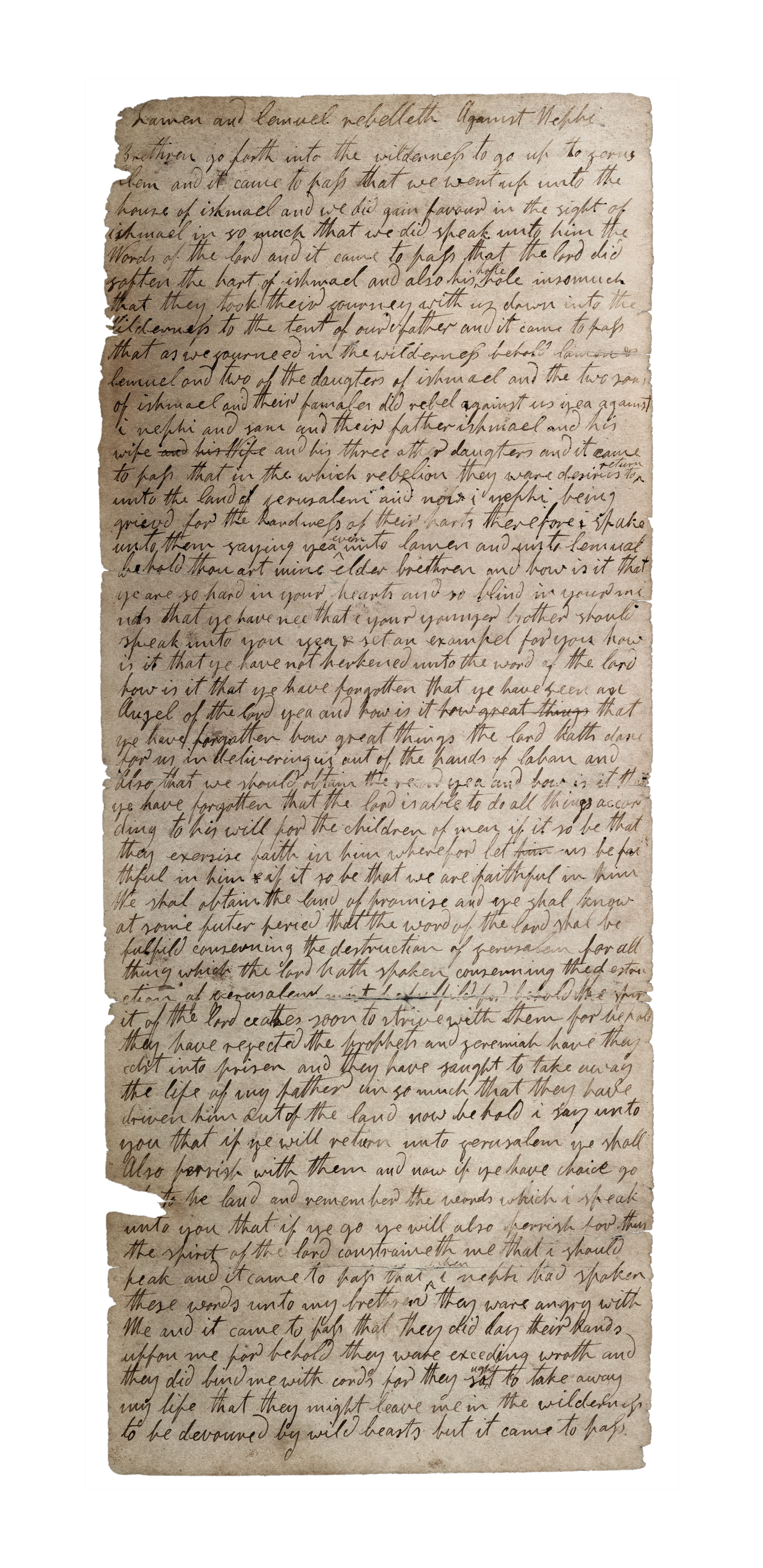
The Joseph Smith Translation is the cleanest single counterexample to the CES Letter's "translator test." The Church's own description leaves no room to misread it: Joseph "did not employ Hebrew and Greek sources, lexicons, or a knowledge of biblical languages to render a new English text." Instead, "he used a copy of the King James Bible as the starting point for his translation, dictating inspired changes and additions to scribes."[17] Apply the CES Letter's frame here ("Joseph claimed he could translate ancient documents, a testable claim, and failed the test") and it collapses, because there is no source language to test against. Joseph dictated changes to an English Bible, and the result was canonized scripture, the Book of Moses. Yet the JST never appears in the bundle. Including it would put the variation on display, and the variation is the thing the bundle needs the reader not to see.
The Account of John (D&C 7) disproves a different assumption: that "translation" for Joseph required holding a source text in hand. The Joseph Smith Papers historical introduction is explicit: "No account suggests that JS had this parchment in his possession; rather, he obtained the English translation of the parchment 'by the Urim and Thummin.'"[18] D&C 7 is a translation of a document Joseph never possessed, and it is canonized scripture. It could not exist at all if Joseph's working definition of "translation" were the one the homogeneity assumption attributes to him, rendering an existing manuscript from one language into another.
The Kinderhook row is where the bundle most needs the homogeneity assumption, so look closest there. Bradley and Ashurst-McGee, whose 2020 chapter in Producing Ancient Scripture is the definitive treatment of the episode, read the documentary record as uniform:
"[T]here is no mention of Joseph Smith using the Urim and Thummim or a seer stone or divine revelation of any kind in any of the sources close to the event."[5:1]
The Joseph Smith Papers editorial assessment agrees: "no translation endorsed by JS has been located, suggesting that whatever JS initially thought about the plates, he soon lost interest in them."[19] Joseph looked, reached for secular philology rather than revelatory translation, and walked away. No sustained translation event ever occurred. The bundle files Kinderhook as a "failed translation" alongside the Book of Abraham; the documentary record puts it in a different category altogether.
The hard version of the critique
The CES Letter's version is the popular form of a critique that exists in a much harder form among serious naturalistic readers. A careful critic does not write "proven a fraud" without engaging the catalyst theory, does not call the Book of Abraham "gibberish" without engaging Olishem and the Apocalypse of Abraham parallels, does not say "we don't have the original" without reckoning with the Original Manuscript. Beating the popular version proves nothing.
Joseph did claim to translate
The CES Letter's descriptive premise is correct. Joseph Smith claimed in his own voice, and his contemporaries reported him claiming, that he translated ancient records. He built his prophetic identity around being a translator, and the revelation dated the day the Church was organized described him as "a seer & Translater & Prop[h]et."[3:3] In the Wentworth letter he said he had "translated" the Book of Mormon; in the Times and Seasons he presented the Book of Abraham as "A Translation Of some ancient Records that have fallen into our hands, from the Catecombs of Egypt."[20] That framing was Joseph's, not his defenders'.
The apologetic move, "translation didn't mean to Joseph what it means to us," has a real pressure point. If Joseph himself reached for the word "translation," and his contemporaries took it at face value, then the scholarly recasting is at least partly after the fact. Grant that. But grant the other half too: even articulated in hindsight, the framework rests on differences in output and method you can actually measure. The 60-day Book of Mormon dictation ran to 269,510 words. The Kinderhook engagement produced a single paragraph. Those are facts about what got made, not labels applied afterward.
The Book of Abraham papyri don't match
This one is real. The Joseph Smith Papyri, recovered in 1966 and 1967, have been examined by Latter-day Saint and non-Latter-day Saint Egyptologists alike, and the verdict is uniform: the surviving fragments are nineteenth-dynasty (or later) funerary texts, not the Book of Abraham. The Gospel Topics Essay states the mismatch outright: "None of the characters on the papyrus fragments mentioned Abraham's name or any of the events recorded in the book of Abraham,"[6:1] and "Latter-day Saint and non-Latter-day Saint Egyptologists agree that the characters on the fragments do not match the translation given in the book of Abraham."[6:2]
The two apologetic responses, the catalyst theory and the missing-scroll theory, each carry a real cost. The catalyst theory has to account for Abraham 1:12 and 1:14, where the published text cross-references Facsimile 1, a vignette from the surviving papyri. The missing-scroll theory has to account for the Kirtland Egyptian Papers (KEP), the ~1835–1836 set of Egyptian-language documents produced alongside the translation, which show Joseph and his clerks working from characters on the surviving fragments. Each has a defensible reply; each reply adds explanatory weight.
The full case lives elsewhere: the catalyst engagement, the missing-scroll evidence (Muhlestein's 2.5% figure, the eyewitness reports of papyri far larger than what survives), and the positive content (Olishem, the Apocalypse of Abraham, divine council theology) are all worked out in Papyri, Anachronisms & Source Texts, and Facsimiles. Only one thing needs settling here: the Book of Abraham is a genuinely contested case, not a proven fraud. And "genuinely contested" does not mean "the apologetic case is winning." It means the verdict is not in.
The Hauglid 2018 statement is real
Brian Hauglid is the most credentialed Latter-day Saint documentary editor of the Book of Abraham manuscripts: co-editor with Robin Scott Jensen of Joseph Smith Papers, Revelations and Translations, Volume 4: Book of Abraham and Related Manuscripts (2018), and a contributor to Producing Ancient Scripture. On November 9, 2018, he posted publicly on Facebook:
"For the record, I no longer hold the views that have been quoted from my 2010 book in these videos.... I wholeheartedly agree with Dan [Vogel]'s excellent assessment of the Abraham/Egyptian documents in these videos."[21]
This is the hardest fact the apologetic case on the Book of Abraham has to carry. In Vogel's published reading, the book is a nineteenth-century composition put out under Abraham's name, with no ancient original behind it, and what Hauglid's "wholehearted" agreement endorses is that reading of authorship and origin, not some quibble over the GAEL.[22] The full engagement is left to the Papyri article. For the bundle, the point is narrower than the concession itself. The statement bears on the Book of Abraham, and only on it. It reaches neither the Book of Mormon, nor the JST, nor D&C 7, and granting it does not grant the bundling.[23]
Nor does it supply the missing homogeneity premise. A verdict of nineteenth-century pseudepigrapha on one text squares with the Kinderhook record as Bradley and Ashurst-McGee reconstruct it, and with everything the Original Manuscript, the witnesses, and the 60-day dictation establish about the Book of Mormon. Grant the concession whole, and the three projects are still three different kinds of work, not one gift failing two tests.
The Kinderhook engagement happened
No sustained prophetic translation of the Kinderhook plates ever happened, but Joseph did engage them, and the engagement belongs in the record at full weight. Charlotte Haven's May 2, 1843 letter passes along, at third hand (Joseph to Mr. Moore to Haven), the report that "if Mr. Moore could leave them, he thought that by the help of revelation he would be able to translate them."[24] That is future-tense, conditional, contingent on access, and it reaches us at two removes. It is not a claim of completed translation. As reported, though, Joseph did not say he doubted he could translate them. He said he would, given the chance. Even hedged, it is still a claim of prophetic translation capacity. The trap had been set, and Joseph stepped toward it rather than away.
Take the documentary corrections from the sister article without discount, then: Joseph used secular tools, produced no manuscript, dropped the matter. Even so, the criticism still stands. His prophetic discernment did not flag the plates as forged the moment he saw them. He thought translation was possible. He did not catch the fraud on contact.
That is a real limit. Prophetic gifts are not automatic fraud-detectors. Joseph's own framework, in D&C 9:7–9, says revelation comes through study and faith, not instant supernatural certainty. So the Kinderhook episode marks a limit on his discernment of forgery, which is a different thing from a limit on prophetic translation. The same gap shows up again, a century and a half later, in the Mark Hofmann forgeries that fooled the Church's leaders. None of this turns a brief secular character-match into the sustained translation the bundle needs it to be.
The witnesses' testimony is contested
The Three Witnesses (Cowdery, Whitmer, Harris) and Eight Witnesses (Smith and Whitmer family members) are central to the apologetic case for the gold plates. The CES Letter's "we don't have the original" framing is supposed to be answered by "but we have the witnesses' testimony."
The critic presses, and fairly: the Three Witnesses' experience was a vision. David Whitmer's own late-life statement reads, "[W]e were in the spirit when we had the view, for no man can behold the face of an angel, except in a spiritual view, but we were in the body also."[25] Martin Harris sometimes reached for "eye of faith" language, in reports that come secondhand and through hostile intermediaries. The Eight Witnesses' testimony is stronger in plain physical terms, since they reportedly handled the plates, but the Eight were members of the Smith and Whitmer families, and that closeness to Joseph lowers their evidentiary weight in some critical readings.
The witnesses' testimony is more textured than the tidiest apologetic summaries let on, and the full treatment sits in the Witnesses section. The load-bearing fact is simply that the testimony exists, was never recanted, and forms part of a cumulative case for the Book of Mormon.
The cumulative-pattern argument survives the corrections
Taken seriously, the criticism is structural, not rhetorical: across Joseph's complete translation corpus (the Book of Mormon, the JST, the Book of Abraham, D&C 7, the Pure Language project, Kinderhook, the Anthon transcript episode of February 1828, and the Greek Psalter incident with Henry Caswall), his "translations" succeed when nothing can check them (Book of Mormon source unavailable, JST not really a translation, D&C 7 no source) and turn awkward when source evidence exists (Book of Abraham papyri, Kinderhook plates, possibly the Caswall Greek Psalter incident). That, the critic says, is the signature of a translator whose "gift" does not survive contact with verifiable material.
The full response waits for the Book of Mormon section below; the short version is that the actual pattern runs differently: his prophetic translation gift produces sustained scriptural text when it meets genuine source material, does not engage forged material at all, and yields, in catalyst-style projects, ancient content the nineteenth-century world cannot account for. The cumulative case for the prophetic-translation reading is not the unfalsifiability of the claims. It is the content of the texts themselves, which is precisely where the naturalistic reading runs into the most trouble.
The Book of Abraham, in brief
The full Book of Abraham case lives in three companion articles: Papyri handles the catalyst theory, missing-scroll theory, Kirtland Egyptian Papers, and Hauglid's documentary judgment; Anachronisms & Source Texts handles Olishem, the Genesis-anachronism comparison, and the Thomas Dick allegation; Facsimiles handles the figure-by-figure scoring and the human-sacrifice / masked-priest defenses.
The bundle needs only a narrow point made against it here, not the whole case re-argued: that "proven a fraud" begs the question. The narrow point is that the Book of Abraham carries specific content Joseph had no way to know in his 1830s world. Three pieces of it do most of the work.
Olishem: the Naram-Sin inscription
Abraham 1:10 names "Olishem" as a place near Ur of the Chaldees where idolatrous priests offered human sacrifice. The name does not appear in the King James Bible, in any 19th-century commentary, in any biblical-history work Joseph could plausibly have read, or in any source available in 1835. It is unique to this single verse in the Book of Abraham.
The match is real but contested. The proposed identification rests on a small set of Akkadian inscriptions and on a Bronze-Age site reached by an Akkadian campaign, and its phonetic and geographic fit is plausible without being airtight. Naram-Sin's inscriptions name Ulisum, and the proposed match with Olishem follows standard Semitic sound rules but does not line up cleanly across every consonant. Non-Latter-day Saint scholars working the Akkadian-period geography do not all accept the Oylum Höyük identification. What Olishem earns is interest, not a verdict.
What holds firm is the chronology. Cuneiform was not deciphered until 1857, thirteen years after Joseph's death. Naram-Sin of Akkad (reigned roughly 2254–2218 BC) left inscriptions, among them campaign records reaching the Bronze-Age site of Ulisum in northern Syria or southern Anatolia. Those Ulisum inscriptions entered the published Assyriological literature only with Gadd and Legrain's 1928 Ur Excavations, Texts I, with further attestations surfacing in later excavations. The most famous Naram-Sin artifact, the Bassetki statue, came out of northern Iraq in 1974 and was published in 1976. It carries no Ulisum reference itself; it marks how recently the Naram-Sin corpus was still surfacing. In 2013, Turkish archaeologists at Oylum Höyük tied that site to ancient Ulisum.[7:1]
Lay the dates end to end. Joseph dictates "Olishem" in 1835. Cuneiform is cracked in 1857. Ulisum enters the published record in 1928 and keeps being re-attested afterward. The field identification at Oylum Höyük arrives in 2013. Every one of those is a separate door that had to open before anyone could so much as read the name Ulisum, and every door was shut tight for the whole of Joseph's life. The full case, contested identification and rival geographies included, lives in the Anachronisms & Source Texts cross-link.
Apocalypse of Abraham: first English translation, 1898
The Apocalypse of Abraham is a Jewish apocalyptic text dated to 70–150 AD. It survives only in Old Church Slavonic translations and contains striking parallels to the Book of Abraham: Abraham's conflict with idolatry (including his rejection of his father's idol worship), an attempted sacrifice of Abraham, a heavenly ascent, a cosmic vision, divine council theology, and a celestial hierarchy.[8:1]
The crucial fact is the date. The first English translation did not appear until August 1898, in Improvement Era, decades after both the Book of Abraham's publication and Joseph Smith's death.[8:2] G. H. Box's better-known 1918 translation came twenty years later still. Earlier German scholarly editions existed, but between the text's obscurity in nineteenth-century America and the plain impossibility of Joseph reading Old Slavonic recensions in 1842, direct knowledge is not a live option.
Key Point
The Apocalypse of Abraham reached English for the first time in August 1898, in Improvement Era, a Latter-day Saint magazine, more than half a century after the Book of Abraham was on the page. The parallels with the Book of Abraham (Abraham's conflict with idolatry, the attempted sacrifice, the cosmic vision, the celestial hierarchy) are systematic, not surface-level. There is no plausible mechanism for Joseph Smith to have read the Apocalypse of Abraham in 1842. The naturalistic hypothesis can absorb the parallels by appealing to common Jewish/early-Christian midrashic traditions or independent reasoning from biblical data, but the direct-borrowing route is closed by the dates.
Divine council theology
The Book of Abraham's creation account in Abraham 4–5 shows plural Gods deliberating before the creation, a divine council. That tracks a pattern of ancient Near Eastern thought, Egyptian, Mesopotamian, and biblical, whose detailed scholarly reconstruction had to wait for the twentieth century. Stephen O. Smoot's article "Council, Chaos, and Creation in the Book of Abraham" argues that the account "fits nicely in an ancient Near Eastern cultural background and has strong affinities with the depiction of the cosmos found in the Hebrew Bible and other ancient Near Eastern texts (especially Egyptian and Mesopotamian)."[26]
Divine council theology in the ancient Near East was reconstructed by scholars across the late 19th and 20th centuries from Ugaritic, Hebrew, and Akkadian sources. It was not part of the available 1830s theological vocabulary in any form Joseph could have accessed. The Gospel Topics Essay describes Abraham 3:22–23 as having "a poetic structure more characteristic of Near Eastern languages than early American writing style."[6:3]
What this establishes for the bundle
The point here is only that "proven a fraud" begs the question. Proving the Book of Abraham authentic belongs to the full Book of Abraham articles; here, the question-begging is enough. The text holds content Joseph could not have known. The catalyst and missing-scroll theories cost something, but they earn their keep. "Proven a fraud" is not a reading of the documentary record. It is a short-circuit that works only on a reader who never opens the apologetic literature.
The bundle needs the Book of Abraham to be a settled loss. It is instead a contested case with serious evidence on both sides, and conceding the real difficulty leaves the bundle exactly where it was: without its second premise.
Further Reading
The full case for the Book of Abraham (including engagement with Brian Hauglid's documentary judgment, the Kirtland Egyptian Papers, the catalyst and missing-scroll theories, and the positive content) lives in the Papyri, Anachronisms & Source Texts, and Facsimiles articles. The Gospel Topics Essay Translation and Historicity of the Book of Abraham is the official Church engagement with the difficulty. For the broader scholarly literature, see Terryl Givens with Brian Hauglid, The Pearl of Greatest Price: Mormonism's Most Controversial Scripture (Oxford University Press, 2019), and Stephen O. Smoot's 2025 Interpreter article "Joseph Smith Jr. as a Translator: The Book of Abraham as a Case Study."
The Book of Mormon: the case the entire bundling argument depends on
The CES Letter needs the Book of Mormon to be the weakest link in the chain, "the only one of the three for which we do not have the original." Strip away the suggestion that it is the one case nobody can check, and the two contested data points, the Book of Abraham and Kinderhook, have nothing to stack into.
But the framing has the evidentiary structure upside down. The positive evidence for Joseph's translation gift concentrates in the Book of Mormon, not away from it, and the part of the case the bundle never engages begins with the timeline.
269,510 words in approximately 60 working days
First, the timeline. John W. Welch's 2018 BYU Studies Quarterly article "Timing the Translation of the Book of Mormon" assembles the documentary record into a tight chronological reconstruction. The translation was dictated between approximately April 7, 1829 (when Oliver Cowdery began as principal scribe in Harmony, Pennsylvania) and late June 1829 (when the manuscript was completed at the Whitmer farm in Fayette, New York). Subtracting travel days, days when no scribe was available, and verified non-translation days from this window leaves "not many more than the equivalent of about 60 actual working days" available for the dictation.[27]
The text dictated in those roughly 60 working days runs to 269,510 words, what would become 588 printed pages in the 1830 first edition. Assuming a standard continuous workday, that implies a sustained rate near 10–20 words per minute, hours a day, across about two months. Welch quotes Elder Neal A. Maxwell on the pace: "One marvel is the very rapidity with which Joseph was translating." Even a "ninety-day maximum estimate is a phenomenally short time range," Welch writes, and the actual reconstruction comes in closer to 60 days.[27:1]
The long novels of the 1820s took years of drafting, outlining, revision, and editing; Ivanhoe and Last of the Mohicans, the kind of book Joseph would have known by reputation, were built that way. No writer of his generation produced a 269,510-word work in anything like 60 working days, outline or no outline. When Welch's team tried the pace themselves, reading aloud from a fully prepared text, they found about 20 words per minute possible but exhausting to sustain hour after hour. Joseph had no prepared text.
Dictation window vs. gestation window
A serious skeptic will point out that the 60-working-day window is the dictation window, not the gestation window. Joseph reported the Moroni visions in 1823; the gold plates story was circulating in Smith family conversation by 1827; the lost 116 pages were dictated in 1828.[28] The "23-year-old farmer with no preparation" line collapses two different windows into one.
That distinction is fair. The 60 working days is real. The "no notes and no revisions" claim holds for the dictation period, since Skousen's manuscript study shows essentially clean first-draft dictation. And Joseph had been living with the gold plates story for at least two years before the April 1829 dictation began. "Joseph thought about ancient Americans for years" is an account anyone could give. What the gestation hypothesis still owes is an account of the dictation itself: 269,510 words of internally consistent prose, with chiasmus, Hebraisms, ancient names later attested by archaeology, divine council theology, a geography that stays self-consistent across the whole book, and statistically distinguishable authorial wordprints, dictated in approximately 60 working days without notes or substantive revisions, in conditions where any pre-existing manuscript would have been visible to multiple scribes and witnesses present in the room. However the gestation question is resolved, the dictation window stays a hard constraint. The production rate, the textual cleanness, and the density of the content all sit beyond any naturalistic mechanism the bundle has bothered to name.
Key Point
269,510 words. ~60 working days. April through June 1829. A 23-year-old farmer with limited formal education, dictating to scribes in conditions where any pre-existing manuscript or notes would have been visible to those present. None was visible. None has ever surfaced. The timeline is documented across friendly and hostile contemporary sources. The arithmetic implies a sustained translation rate of 10–20 words per minute for hours daily across roughly two months. The bundling argument never confronts it. Welch's 2018 reconstruction in BYU Studies Quarterly is the standard scholarly source.
A clean first draft
Royal Skousen's decades-long Book of Mormon Critical Text Project established that the Book of Mormon was essentially a clean first draft. The Original Manuscript shows scribal errors (spelling variants, occasional dropped words) but no substantive revisions of the text. Joseph dictated forward without going back to revise earlier sections.[29]
That is not what naturalistic explanations predict. Oral composition with rehearsal, conscious literary construction, even a memorized prepared text: every one of them should leave some trace of revision, restructuring, or backtracking under the pressure of a 60-day dictation. The Original Manuscript leaves none.
Emma Smith's eyewitness testimony
Emma Smith, who served as scribe and sat in the same room during translation, testified directly:
"He had neither manuscript nor book to read from… If he had had anything of the kind he could not have concealed it from me."[30]
Emma's interview ran in Saints' Herald on October 1, 1879. It is among the most-cited primary sources on the translation method, and for good reason: she was close to Joseph, present during the work, and she later separated from the Church without ever taking back a word of it. She also described how, returning after meals or interruptions, he would at once begin where he had left off, without seeing the manuscript or having any of it read back to him. The Gospel Topics Essay on Book of Mormon Translation cites these accounts directly.[31] Her testimony stayed consistent across her interviews and across her life. She did not soften it as her relationship with the Church soured. She did not recant after Joseph died.
Joseph never produced a second comparable work
Joseph lived fifteen more years after the Book of Mormon appeared in March 1830, and his output over that time was large: sermons, canonized D&C revelations, the Lectures on Faith, the Wentworth letter, the King Follett Discourse, the Book of Moses, the Book of Abraham, the JST. What never reappeared is a second sustained, multi-narrative prose work on the scale and complexity of the first. The Doctrine and Covenants is a collection of separately dictated revelations, not a continuous narrative. Nothing in the corpus matches the Book of Mormon as an internally consistent multi-narrative work of 269,510 words across the 1830 first edition's 588 printed pages.
If Joseph held a literary gift large enough to invent the Book of Mormon as nineteenth-century fiction, sustained narrative across a large cast with a self-consistent geography, that particular gift should have surfaced again somewhere in fifteen years. It never did. The Book of Mormon stands alone in his corpus as an integrated literary production of that scale.
Internal features Joseph could not have known
The Book of Mormon contains specific features that subsequent scholarship has tied to the ancient Near East, in ways unavailable to Joseph in his 1820s information environment.
Chiasmus. John W. Welch first noticed chiasmus, the inverted A-B-B-A parallelism characteristic of ancient Hebrew poetry, in the Book of Mormon while serving as a missionary in Germany in 1967. His 1969 BYU Studies article "Chiasmus in the Book of Mormon" laid out dozens of these structures, with Alma 36 the most extensive and tightly built: a 17-element chiasm running the length of Alma's conversion narrative.[32] Nothing about it is casual. Alma 36 is too tight, too self-contained, and too thematically integrated to fall out by accident. Chiasmus as a Hebrew form had been studied in the early nineteenth century by John Jebb and Thomas Boys, but neither work circulated widely in frontier New York, and the Book of Mormon's examples are far more elaborate than the surface parallelism those volumes describe.
Hebraisms. Donald W. Parry's 2002 chapter in Echoes and Evidences of the Book of Mormon (FARMS) catalogs systematic Hebrew syntactical features running through the text: cognate accusatives ("dreamed a dream"), construct chains, conditional clauses with no "if/then," patterns that read as stilted English yet track precisely with Hebrew syntax. The 1830 first edition carries them in higher density than later editions, which smoothed some away for readability, so the residue of a Semitic-language source shows most clearly in the earliest unedited form. Joseph had no formal training in biblical Hebrew before 1836, under Joshua Seixas in Kirtland, well after the dictation was finished.[33]
Ancient Hebrew names attested in archaeology after 1829.
Alma: a Semitic male name attested in second-century AD Bar Kokhba documents, excavated in the Judean desert in 1960–1961 by Yigael Yadin. Critics had once flagged the name as anachronistic, "Alma" reading as feminine in nineteenth-century English, and the Bar Kokhba evidence vindicates the Book of Mormon's male Alma. The most recent scholarship is Neal Rappleye and Allen Hansen, "More Evidence for Alma as a Semitic Name," Interpreter 62 (2024).[34]
Sariah: Lehi's wife. The name turns up in the Elephantine papyri (fifth-century BC Aramaic-Egyptian Jewish documents), a direct Hebrew-Aramaic match, confirmed by Jeffrey R. Chadwick, "Sariah in the Elephantine Papyri," Journal of Book of Mormon Studies 2:2 (1993). Those papyri were acquired and excavated across the late nineteenth and early twentieth centuries, well after Joseph Smith's death.[35]
Nahom: 1 Nephi 16:34 names "the place which was called Nahom" as a burial site on the Lehite journey through Arabia. Inscribed altars excavated at the Bar'an Temple in Marib (modern Yemen), published by the German Archaeological Institute, carry the tribal name nhmyn, usually translated "Nihmite," in pre-Islamic South Arabian script. The altars date to the 7th–8th century BC, before or during Lehi's lifetime. And the Book of Mormon's geography, running south-southeast down the Arabian peninsula and then turning eastward at Nahom toward the coast, matches the real ancient trade route at the real ancient location.[36][37]
Each of these stands on its own; together they form a pattern. Joseph could not have reached any of them from where he stood in the nineteenth century.
Internal geographic consistency. John L. Sorenson's Mormon's Map (FARMS, 2000) rebuilds the Book of Mormon's internal geography from textual references alone, the distances, directions, landmarks, and travel times, and finds a self-consistent landscape a few hundred miles in length, with coherent topography, roughly 340 miles of it from the city of Nephi to the boundary of the land northward. Holding a geography that intricate together in dictation, without notes, is the mark of an author who prepared extensively. Joseph prepared none.[38]
Distinct authorial wordprints. Stylometric studies of the Book of Mormon are still contested in academic statistics circles. John L. Hilton's 1990 BYU Studies article applied stylometric "wordprint" analysis to the Book of Mormon and concluded it was "statistically indefensible" to propose Joseph Smith, Oliver Cowdery, or Solomon Spalding as the author of the tested Nephi and Alma texts, which carry wordprints unique to themselves and statistically independent of each other.[39] In 2008, Matthew Jockers, Daniela Witten, and Craig Criddle published a counter-study using nearest-shrunken-centroid and discriminant-function-analysis techniques arguing for Sidney Rigdon, Solomon Spalding, and possibly Oliver Cowdery as the underlying authors.[40] G. Bruce Schaalje, Paul Fields, Matthew Roper, and others responded with critiques of the Jockers methodology, arguing that the candidate-author set excluded Joseph Smith himself and that the technique systematically biased toward attributing the text to whichever candidates were in the input set.[41] What the contested literature does suggest at minimum is that the text does not collapse trivially into a single nineteenth-century stylistic fingerprint, even by methods critics have used to argue for naturalistic authorship.
Eyewitnesses to the translation method and the gold plates
The translation method is not contested between faithful and critical scholars: Joseph dictated with his face in a hat containing a seer stone, with the gold plates physically present (often covered) in the room. The Gospel Topics Essay on Book of Mormon Translation describes the method openly:
"Joseph placed either the interpreters or the seer stone in a hat, pressed his face into the hat to block out extraneous light, and read aloud the English words that appeared on the instrument."[31:1]
What gives this method evidentiary weight is the witness density:
Three Witnesses (Oliver Cowdery, David Whitmer, Martin Harris) signed a published statement that they saw an angel and the gold plates and heard the voice of God. None retracted. All three left the Church in tension at various points; none recanted the testimony. David Whitmer reaffirmed it explicitly in 1881: "I have never at any time denied that testimony or any part thereof… I do again affirm the truth of all of my statements, as then made and published."[42]
Eight Witnesses (Joseph Smith Sr., Hyrum Smith, Samuel Smith, Christian Whitmer, Jacob Whitmer, Peter Whitmer Jr., John Whitmer, Hiram Page) signed a published statement that they handled the plates physically. All eight died affirming the testimony.
Eyewitnesses to the seer-stone translation method: Emma Smith, Oliver Cowdery, Martin Harris, David Whitmer, and several Whitmer family members all gave detailed firsthand descriptions of Joseph dictating with face in hat, with no manuscript, sustained for hours.
As granted earlier, the Three Witnesses' experience involved a vision alongside physical examination, in Whitmer's words "but we were in the body also." Even so, at least eleven men signed testimonies of having seen the gold plates, the Three additionally affirming an angel, and several more eyewitnesses described the translation method itself. Not one of them withdrew a word. The published testimonies still appear in every printing of the Book of Mormon.
The seer stone in context
The CES Letter's mockery of the seer stone ("a rock in a hat"), and its stress on the stone's pre-prophetic origin (1822, treasure hunting), gets a brief answer here, though the full treatment belongs to the Book of Mormon Translation section's Seer Stones article.
The Gospel Topics Essay states the chronology outright: Joseph found the seer stone "years before he retrieved the gold plates" and used it for various purposes, including, briefly, treasure-seeking. The Church frames the arc developmentally, with Joseph moving from folk-religious treasure-seer to prophet-translator, the translation drawing on tools already in his world: seer stones and the Urim and Thummim.[31:2]
The mockery runs on three sub-arguments, and none reaches the output. The chronology argument (1822, before Moroni) points at something documented and unhidden, which Gospel Topics states plainly. The redundancy argument (if a stone could do the work, the gold plates were "useless") is a non-sequitur, because the plates were never the medium of translation but the source of the text being translated. The implausibility argument (a hat is ridiculous) is an aesthetic reaction, not a logical one; it invites embarrassment at the method without saying why a hat is any more implausible than any other revelatory medium.
The question is whether the output (roughly 270,000 words of internally consistent ancient-feeling literature in about 60 working days) is explicable on naturalistic grounds. The aesthetics of the method are not the argument.
"We don't have the original"
"The only one of the three for which we do not have the original" is one of the bundle's more important moves, because it sounds modest while doing heavy lifting. The passage uses "the original" two ways at once, and the slippage works only if the reader never notices it is happening.
The slogan compresses a serious point. Grant that the Original Manuscript and the Printer's Manuscript exist and record what Joseph dictated. Those manuscripts are evidence of the dictation, not of the source. They tell us what Joseph said; they do not tell us that what he said answers to an ancient text on gold plates. Verifying a translation in the strict philological sense means having the source, and Joseph's contemporaries did not have it, since the plates were returned to Moroni after the work. Neither do we. That much is true.
But artifact comparison is not the only way to verify an ancient source. The content of the translated text can do it too. The Book of Mormon carries chiasmus, Hebraisms, ancient names attested only in post-1829 archaeology (Alma in the Bar Kokhba documents, Sariah at Elephantine, Nahom at the Bar'an Temple in Marib), a geography internally consistent across the current edition's 531 pages, and wordprints statistics can still tell apart. Each is a content-level feature the translation either has or lacks, and each is testable. The verification runs text-content against the ancient world rather than source-artifact against translated-text, but it is still verification, and across nearly two centuries since publication it has cut toward authenticity.
Granting all of that, "the original" of the Book of Mormon, in the textual sense the CES Letter pretends does not exist, could just as well mean any of three things:
The Original Manuscript (OM): ~28% extant. Written by scribes (chiefly Oliver Cowdery, with portions in Emma Smith's, Christian Whitmer's, and other hands) as Joseph dictated. It shows scribal errors but no substantive revisions, the signature of dictation rather than composition.[29:1][43]
The Printer's Manuscript (PM): ~100% extant. Copied by Oliver Cowdery from the Original for use by the Grandin printer in 1829–1830. The PM has been digitized by the Joseph Smith Papers project and is freely available.[43:1]
The 1830 first edition: Extensively preserved across libraries, archives, and private collections; subject to decades of textual criticism in the Skousen Critical Text Project.
The Book of Mormon, then, carries a heavier documentary trail than the Book of Abraham, where the OM and PM are extensive primary sources, and a vastly heavier one than the Kinderhook plates, which produced no manuscript whatsoever. "We don't have the original" rides on the gap between "the metal plates" and "the textual record," and that gap closes as soon as it is pointed out.
The asymmetry actually runs the other way. The Book of Abraham's "original," the papyri Joseph translated from, was by the eyewitness record far larger than the eleven mounted fragments that survived the Great Chicago Fire of 1871; Muhlestein's reconstruction puts the survivors at roughly 2.5% of the original collection.[44] The Kinderhook "original" exists, with one plate held by the Chicago Historical Society, but the plates are forgeries. So the CES Letter's "we have the original for the other two but not the Book of Mormon" has it backwards. We hold a robust witness chain to gold plates we cannot physically examine, and we lack a robust witness chain to papyri we partly possess. Of the three records in the bundle, which one can a reader actually sit down and check?
Key Point
We do have the original manuscripts of the Book of Mormon. The Original Manuscript (~28% extant) and the Printer's Manuscript (essentially complete) are publicly available through the Joseph Smith Papers project. They have been studied for decades by Royal Skousen's Book of Mormon Critical Text Project. You can read them yourself. What we don't have is the gold plates, the source artifact, which Joseph said he returned to the angel. Eleven witnesses signed published statements affirming they had seen and handled the plates. None ever recanted. "We don't have the original" trades on the reader's confusion between the metal source artifact and the textual record. The Book of Mormon's textual record is robust.
The track record reconsidered
The "two clunkers and a third car" framing assumes Joseph's three bundled projects can be scored uniformly against one translation standard. They cannot, and the fuller documentary record sorts each into a different category:
| Project | What Joseph claimed | What he used | What he produced | The bundling's framing | What the documentary record shows |
|---|---|---|---|---|---|
| Book of Mormon | Translation by gift and power of God | Seer stone / Urim and Thummim | 269,510 words in ~60 days | "We don't have the original" | OM (~28% extant) + PM (~complete) + 1830 first edition + eleven witnesses + features Joseph couldn't have known |
| Joseph Smith Translation | Inspired revision by prophetic calling | KJV Bible + revelation (no source-language tools) | ~3,400 modified verses + Book of Moses | Not in the CES Letter's bundle | Multiple manuscript versions; published Book of Moses |
| Book of Abraham | Translation connected to papyri | Revelation (catalyst or missing scroll) | Five chapters of canonized scripture | "Proven a fraud" | Genuinely contested case; Hauglid 2018 statement; positive content (Olishem, Apocalypse of Abraham, divine council) |
| D&C 7 | Revelation about John's parchment | Revelation only (no physical document) | One canonized D&C section | Not in the CES Letter's bundle | Translation of a document Joseph never possessed; canonized scripture |
| Kinderhook Plates | No revelatory claim made | Hebrew lexicon + GAEL | Nothing: no manuscript, no scribe, no publication | "Failed the test" | Brief secular philology; one paragraph in Clayton's clerk-journal; silence after May 7, 1843 |
Kinderhook was no "failed translation" running parallel to the Book of Abraham. It was secular philology, character-matching against a working reference document, that left no manuscript and was dropped inside a week. That first "clunker" was never sold.
"Proven a fraud" overstates a contested case: the apologetic frameworks (catalyst theory, missing-scroll theory) buy coherence at a price, and the text holds specific content (Olishem, the Apocalypse of Abraham parallels, divine council theology) that resists naturalistic explanation.
And the Book of Mormon is not the unverifiable third case at all. Its textual record and witness chain outrun anything else in Joseph's corpus, and its ancient features keep being confirmed by archaeology and textual criticism. The "third car" is the one that comes with the paperwork.
Engaging the cumulative-pattern argument
The cumulative-pattern criticism returns here at full inventory. Across Joseph's whole translation corpus, the critic argues, the "translations" succeed when nothing can falsify them and turn awkward when source evidence is on hand. "Two out of three" is its popular form; the careful inventory runs the complete corpus and ends in the claim that Joseph's reliability tracks the falsifiability of what he claimed.
The reformed bundling
A skeptic who has done the reading does not drop the bundle once the homogeneity assumption is challenged. The skeptic reformulates it: Joseph claimed prophetic translation in every case; the cases where verification is possible are awkward (the Book of Abraham papyri, the Kinderhook engagement); and the case where verification is impossible (the Book of Mormon, no plates to examine) is unfalsifiable in that same direct way. It grants the variety and still closes the trap.
The pivot against it is narrow but decisive. The Book of Mormon is not unfalsifiable in the way the reformed bundle assumes. It has its own internal verification structure. The Original Manuscript and Printer's Manuscript record the dictation; eleven witnesses signed published testimonies; the text holds together across 269,510 words; and it carries specific ancient features (chiasmus, Hebraisms, Alma at Bar Kokhba, Sariah at Elephantine, Nahom in Yemen, divine council theology) that lay outside Joseph's nineteenth-century reach. A naturalistic reading predicts the text should betray nineteenth-century origins on close examination. A prophetic reading predicts it should show ancient features Joseph could not plausibly have known. So far, the verification favors authenticity. It is text-content measured against the ancient world rather than source-artifact against translated text, but it is verification all the same.
And the point carries across projects. Grant that the Book of Abraham is the hard case; it still contains content that resists naturalistic explanation. Olishem's proposed match, Ulisum, sits in Akkadian cuneiform no scholar on earth could read before 1857, and the inscriptions naming it entered print only in 1928, generations after Joseph's death. The Apocalypse of Abraham parallels sit in a text whose first English translation came in 1898, fifty-six years after the Book of Abraham was published. The divine council theology matches ancient Near Eastern patterns scholars would not reconstruct in detail until the twentieth century. The reformed bundle files the Book of Abraham as a case where verification went against Joseph. In fact verification cuts both ways there: the philological side against him, the content side toward him.
The cumulative-content response
The answer to both the popular and the reformed bundle is the same, and it turns on content. Across Joseph's corpus, what narrows the field of viable explanations is the content of the texts he produced, not the falsifiability of the claims he made.
The Book of Abraham contains Olishem (Naram-Sin's Akkadian inscriptions, with cuneiform itself not deciphered until 1857 and Ulisum entering the published Assyriological record in 1928); Apocalypse of Abraham parallels (first English translation 1898); divine council theology (an ancient Near Eastern picture worked out by twentieth-century scholars). These are predictions the model didn't have to make and that turned out right.
The Book of Mormon contains chiasmus (Hebrew literary form not widely available in 1829 frontier New York); Hebraisms (Hebrew syntax patterns); the names archaeology later surfaced (Alma, Sariah, Nahom); a geography that holds together across the whole text; statistically distinct authorial wordprints. None of these were predicted by the naturalistic hypothesis; all of them are accounted for by the prophetic-translation hypothesis.
The "post-hoc categories" objection cuts both ways, and that is the part critics tend to skip. The argument is that apologetic categories (catalyst theory, missing-scroll theory, "secular philology" for Kinderhook) are inventions bolted on after the fact to soak up each new finding. Fair enough. But the naturalistic case does exactly the same thing. Every time the Book of Mormon turns out to hold a feature Joseph could not have known (chiasmus in 1969, Olishem after the 1857 cuneiform decipherment and the 1928 Ulisum attestation, the Apocalypse of Abraham parallels in 1898, Sariah at Elephantine in 1893 and 1993, Nahom in Yemen in the 1990s, divine council scholarship across the twentieth century), the naturalistic account has to bolt on a category of its own: "Joseph somehow had access." It is no more innocent of retrofitting than the apologetic side, with its "oral composition with rehearsal," its "mnemonic dictation," its "lucky guess on ancient names."
So the test cannot be which side invokes categories. It has to be substantive: taken whole, does the evidence fit the prophetic reading or the naturalistic one better? A 269,510-word text produced in 60 days by a 23-year-old farmer with little formal schooling, freighted with features it took twentieth-century scholarship to recognize, is harder to explain by natural means than by the gift Joseph claimed.
Kinderhook, read for what it shows, is evidence for how selective that gift was. Joseph looked, tried secular philology, and walked off, which is just what a real-but-selective gift would do. A confident fraud would have produced something, a few pages of "translation," a staged revelation, anything to keep the prophetic aura intact. What Joseph produced after May 7, 1843 was silence. Far from undercutting the framework he claimed, the episode confirms it: the gift engages real source material and goes quiet in front of a forgery.
No single item here is carrying the load alone. The combination, chiasmus and Hebraisms and ancient names and Olishem and the Apocalypse of Abraham and divine council theology and the 60-day timeline and the Original Manuscript and eleven witnesses, is not a stack of weak guesses propping each other up. Any one alone invites an answer; all of them together have never received one.
What the bundling argument actually requires the reader to believe
To accept the "two clunkers and a third car" verdict, the reader must accept:
- That "translation" means a single uniform academic-linguistic activity, even though Joseph Smith never claimed this and the Joseph Smith Papers' own framing of the projects rejects it.
- That three (in fact five or more) projects of plainly different kinds can be marked against a single standard, despite wide variation in method, source material, output, and documentary trail.
- That the Book of Abraham case is settled, even though the Gospel Topics Essay engages the catalyst and missing-scroll theories openly and the text contains content (Olishem, Apocalypse of Abraham parallels) Joseph had no plausible mechanism to access.
- That the Kinderhook engagement was a confident prophetic translation, even though Bradley and Ashurst-McGee's documentary reconstruction shows secular tools, no manuscript, no scribe, no claim of revelation, and a matter dropped within the week.
- That the Book of Mormon's textual record is unverifiable, even though the Original Manuscript (~28% extant) and Printer's Manuscript (~complete) are publicly available, eleven witnesses signed published testimonies, and Royal Skousen's Critical Text Project has documented the textual tradition across decades.
- That a farmer of twenty-three with scant formal education dictated 269,510 internally consistent words in approximately 60 working days, with no notes and no revisions, by accident or by a naturalistic mechanism the bundling argument never specifies.
- That chiasmus, the Hebrew syntax under the English, the names archaeology only later confirmed, and the Apocalypse of Abraham parallels are all coincidence, reaching Joseph through channels the naturalistic account has yet to name.
That is a lot of assumptions for a syllogism with three premises. The bundling argument's persuasive force depends on the reader not naming them.
Bottom line
The bundle fails because its three cases are not the same kind of activity. Kinderhook was brief secular philology that left no manuscript, so there was never a sustained translation event for the metaphor to point at. The Book of Abraham remains contested, not proven fraudulent, with the apologetic frameworks meeting the difficulty in the open and the text carrying content Joseph had no way to reach. And the Book of Mormon was never the uncheckable third case. Its dictation is the one Joseph's scribes documented page by page, and its text is the one that keeps testing ancient.
The hard parts are still hard, and they stay on the table. Brian Hauglid's 2018 statement is a serious scholarly judgment. The Three Witnesses' experience was a vision as well as a physical examination. The seer stone went into a hat, and that is simply the record. And none of it hands the bundle the move it most needs: the leap from two contested cases to a confident verdict on the Book of Mormon, a verdict the documentary record will not give.
Which returns the chain to where this article began. The CES Letter strung Abraham, then Kinderhook, then the seer stone together so the contested cases would sink the attested one, and filed the Book of Mormon at the weak end. Rank the projects on their records and the Book of Mormon sits at the other end: the case with the fullest textual record, a witness chain no other project approaches, and ancient features confirmed a century and more after his death. The strongest link, not the weakest.
So put the dealer's question again. Would you buy a third car from a man who had already sold you two clunkers? That question is rigged. The first "clunker" never left the lot: Joseph looked at the Kinderhook plates, tried a character match with secular tools, and dropped them without producing a translation. The second turns out to hold machining its supposed builder had no way to cut, the Olishem inscription, the Apocalypse of Abraham parallels, the divine council. And the third car is the very purchase the pitch exists to steer you past, because a close look is the one thing that ends the sale.
Judge the dealer by his reputation if you like. The car itself is sitting in plain view on the lot. Open the hood.
Further Reading
The full Kinderhook documentary case (including Bradley and Ashurst-McGee's reconstruction of the GAEL character match, Charlotte Haven's thirdhand letter report, the William Clayton journal vs. History of the Church rewrite, and the 1981 Ensign documentary correction) lives in the Kinderhook Plates sister article. The full Book of Abraham case lives across three companion articles: Papyri (catalyst theory, missing-scroll theory, Kirtland Egyptian Papers, Hauglid's documentary judgment), Anachronisms & Source Texts (Olishem, Genesis-anachronism comparison, Thomas Dick), and Facsimiles (figure-by-figure scoring, human-sacrifice and masked-priest defenses). The full Book of Mormon translation case lives in the Book of Mormon Translation section. The witnesses' testimony lives in Witnesses and Witnesses and the Spiritual Eye. For Joseph's own framework on translation, see Doctrine and Covenants 9 and the Joseph Smith Papers' Revelations and Translations Series Introduction.
Runnells, CES Letter (2017), "Kinderhook Plates & Translator Claims," pp. 72–73. ↩︎
Runnells, CES Letter (2017), "Kinderhook Plates & Translator Claims," p. 73. ↩︎
"Joseph Smith as Revelator and Translator," Revelations and Translations Series Introduction, Joseph Smith Papers Project. https://www.josephsmithpapers.org/intro/revelations-and-translations-series-introduction. The introduction's framing — that "translation" in Joseph's usage refers to revelatory rather than conventional linguistic work — is the official documentary baseline for understanding Joseph's translation projects. ↩︎ ↩︎ ↩︎ ↩︎
Michael Hubbard MacKay, Mark Ashurst-McGee, and Brian M. Hauglid, eds., Producing Ancient Scripture: Joseph Smith's Translation Projects in the Development of Mormon Christianity (Salt Lake City: University of Utah Press, 2020). The standard scholarly volume covering all of Joseph's translation projects across seventeen chapters by leading LDS and non-LDS scholars. Brant Gardner's review essay characterizes the volume as "currently the most important single work examining the whole of Joseph Smith's translation projects." See https://uofupress.com/books/producing-ancient-scripture/ and Gardner's review at https://interpreterfoundation.org/journal/joseph-smiths-translation-projects-under-a-microscope/. ↩︎
Don Bradley and Mark Ashurst-McGee, "'President Joseph Has Translated a Portion': Joseph Smith and the Mistranslation of the Kinderhook Plates," in Producing Ancient Scripture: Joseph Smith's Translation Projects in the Development of Mormon Christianity, ed. Michael Hubbard MacKay, Mark Ashurst-McGee, and Brian M. Hauglid (University of Utah Press, 2020), chapter 17, pp. 452–523. Direct quotations are taken from the authors' shorter 2016 treatment, "Joseph Smith and the Kinderhook Plates," in A Reason for Faith: Navigating LDS Doctrine and Church History, ed. Laura Harris Hales (Provo, UT: BYU Religious Studies Center; Salt Lake City: Deseret Book, 2016), 93–115, at 110, available in PDF at https://rsc.byu.edu/sites/default/files/pub_content/pdf/Joseph_Smith_and_the_Kinderhook_Plates.pdf. ↩︎ ↩︎
"Translation and Historicity of the Book of Abraham," Gospel Topics Essays, The Church of Jesus Christ of Latter-day Saints. https://www.churchofjesuschrist.org/study/manual/gospel-topics-essays/translation-and-historicity-of-the-book-of-abraham. The Church's official engagement with the BoA difficulty, including the catalyst theory, missing-scroll theory, eyewitness testimony of larger papyri than survives, and the concession that the surviving fragments do not match the BoA text. ↩︎ ↩︎ ↩︎ ↩︎
For Olishem/Ulisum, see John Gee, "Has Olishem Been Discovered?" Journal of the Book of Mormon and Other Restoration Scripture 22:2 (2013): 104–107; Stephen O. Smoot, "'In the Land of the Chaldeans': The Search for Abraham's Homeland Revisited," BYU Studies Quarterly 56:3 (2017): 7–37. The Ulisum attestations occur in Naram-Sin Akkadian campaign inscriptions documented in the published Assyriological literature beginning with C. J. Gadd and Leon Legrain, eds., Ur Excavations, Texts I: Royal Inscriptions (Oxford: Oxford University Press, 1928), with additional attestations continuing to surface in subsequent excavations. The Bassetki statue (a famous Naram-Sin artifact whose inscription commemorates the nine-battle victory and Akkadian deification rather than naming Ulisum) was excavated from northern Iraq in 1974 and published in 1976; it does not bear the Ulisum reference but is referenced here as a marker of the continuing recency of the Naram-Sin corpus. Oylum Höyük field identification with ancient Ulisum in 2013 (Atilla Engin). ↩︎ ↩︎
First English translation by E. H. Anderson and R. T. Haag, "The Book of the Revelation of Abraham," Improvement Era (August 1898) — Latter-day Saint magazine. G. H. Box's better-known English translation, with J. I. Landsman, appeared circa 1918 (London: Society for Promoting Christian Knowledge). The original survives only in Old Slavonic recensions, transmitted partly within the Tolkovaja Paleja. No English text was available to Joseph Smith. ↩︎ ↩︎ ↩︎
Christopher James Blythe, "'By the Gift and Power of God': Translation among the Gifts of the Spirit," in Producing Ancient Scripture: Joseph Smith's Translation Projects in the Development of Mormon Christianity, ed. Michael Hubbard MacKay, Mark Ashurst-McGee, and Brian M. Hauglid (Salt Lake City: University of Utah Press, 2020), chapter 2. The master scholarly frame for understanding "translation" in Joseph's context as a spiritual gift rather than a linguistic procedure. ↩︎
Samuel Morris Brown, Joseph Smith's Translation: The Words and Worlds of Early Mormonism (New York: Oxford University Press, 2020). The book-length scholarly treatment of Joseph's translation projects as a unified theological category. https://global.oup.com/academic/product/joseph-smiths-translation-9780190054236. ↩︎
Stephen O. Smoot, "Joseph Smith Jr. as a Translator: The Book of Abraham as a Case Study," Interpreter: A Journal of Latter-day Saint Faith and Scholarship 64 (2025): 345–376. https://interpreterfoundation.org/journal/joseph-smith-jr-as-a-translator-the-book-of-abraham-as-a-case-study/. The most recent scholarly engagement directly with the "translator claims" framing. ↩︎ ↩︎ ↩︎
Stephen O. Smoot, "Sight and Power to Translate: Revelatory Translation, Seership, and Joseph Smith's Scriptural Productions," BYU Studies Quarterly 64, no. 4 (2025). https://byustudies.byu.edu/article/sight-and-power-to-translate-revelatory-translation-seership-and-joseph-smiths-scriptural-productions/. Establishes the unified seership/gift framework Joseph applied across multiple translation projects. ↩︎
Wilford Woodruff journal entry, 1842, quoted in Smoot, "Sight and Power to Translate." "The Lord is Blessing Joseph with power to reveal the mysteries of the kingdom of God"; "to translate through the Urim & Thummim Ancient records and Hieroglyphics as old as Abraham or Adam." Woodruff journal, February 19, 1842. ↩︎
Warren Parrish, letter published in the Painesville Republican, February 15, 1838, written after Parrish had left the Church. "set by [Joseph's] side and penned down the translation of the Egyptian Hieroglyphicks as he claimed to receive it by direct inspiration of Heaven." Cited in multiple secondary sources including Smoot, "Sight and Power to Translate," and the Joseph Smith Papers project. ↩︎
Orson Pratt's homily on Joseph as seer/translator/revelator, quoted in Smoot, "Sight and Power to Translate." ↩︎
"Oliver Cowdery's Gift," Revelations in Context, https://www.churchofjesuschrist.org/study/manual/revelations-in-context/oliver-cowderys-gift. D&C 9 instruction: "You must study it out in your mind; then you must ask me if it be right, and if it is right, I will cause that your bosom shall burn within you." The revelation is canonical and dated to 1829, predating any modern apologetic recasting of Joseph's translation theology. ↩︎
"Joseph Smith Translation of the Bible," The Church of Jesus Christ of Latter-day Saints. https://www.churchofjesuschrist.org/study/history/topics/joseph-smith-translation-of-the-bible. Direct Church description: Joseph "did not employ Hebrew and Greek sources, lexicons, or a knowledge of biblical languages to render a new English text… he used a copy of the King James Bible as the starting point for his translation, dictating inspired changes and additions to scribes." ↩︎
"Account of John, April 1829-C [D&C 7]," Joseph Smith Papers. https://www.josephsmithpapers.org/paper-summary/account-of-john-april-1829-c-dc-7/1. "No account suggests that JS had this parchment in his possession; rather, he obtained the English translation of the parchment 'by the Urim and Thummin.'" ↩︎
Joseph Smith Papers, Journal, December 1842–June 1844; Book 2, 10 March 1843–14 July 1843, editorial annotation to May 7, 1843 entry: "No further mention of the plates is made in JS's journal after this 7 May entry, and no translation endorsed by JS has been located, suggesting that whatever JS initially thought about the plates, he soon lost interest in them." https://www.josephsmithpapers.org/paper-summary/journal-december-1842-june-1844-book-2-10-march-1843-14-july-1843/203. ↩︎
"Book of Abraham and Facsimiles, 1 March–16 May 1842," Times and Seasons 3 (March 1, 1842): 704, Joseph Smith Papers, https://www.josephsmithpapers.org/paper-summary/book-of-abraham-and-facsimiles-1-march-16-may-1842/2. The header's spelling ("Catecombs") is the original's. Joseph Smith became the paper's editor with this issue. ↩︎
Brian Hauglid, public Facebook statement, November 9, 2018, quoted and discussed in Jeff Lindsay, "A Precious Resource with Some Gaps," Interpreter: A Journal of Latter-day Saint Faith and Scholarship 33 (2019): 13–104. https://interpreterfoundation.org/journal/a-precious-resource-with-some-gaps/. Hauglid's statement consists of multiple consecutive sentences in a single Facebook post: "For the record, I no longer hold the views that have been quoted from my 2010 book in these videos. I have moved on from my days as an 'outrageous' apologist. In fact, I'm no longer interested or involved in apologetics in any way. I wholeheartedly agree with Dan's excellent assessment of the Abraham/Egyptian documents in these videos." The article's blockquote uses four-dot ellipsis to indicate the sentence boundary between the first sentence and the fourth sentence; the bracketed [Vogel] in the second blockquoted sentence identifies "Dan" as the documentary scholar Dan Vogel. ↩︎
The scope of the Hauglid 2018 statement matters: Vogel's published assessment — articulated across his Book of Abraham Apologetics: A Review and Critique video series and his print scholarship — is that the Book of Abraham is a nineteenth-century pseudepigraphic composition rather than a translation of an ancient text. Hauglid's "wholehearted" endorsement is a categorical claim about authorship and origin, not a narrow comment about the GAEL's role in the production process. A credentialed Latter-day Saint Egyptian-language documentary editor publicly aligning with the leading critical scholar's full naturalistic reading of the Book of Abraham is the hardest single concession in this article. The article will not pretend this is a small fact. The relevant move for the bundling article is narrower: this concession does not dissolve the Book of Mormon evidence; it does make the Book of Abraham case harder; and the article's structural point about the Kinderhook engagement (where the GAEL was used as a secular tool, not as a translation engine) does not depend on winning the broader Book of Abraham case. ↩︎
Jeff Lindsay, "A Precious Resource with Some Gaps," Interpreter: A Journal of Latter-day Saint Faith and Scholarship 33 (2019): 13–104. https://interpreterfoundation.org/journal/a-precious-resource-with-some-gaps/. Engages Brian Hauglid's documentary work on the Book of Abraham and Hauglid's November 9, 2018 Facebook statement aligning with Vogel. ↩︎
Charlotte Haven, letter of May 2, 1843, in "A Girl's Letters from Nauvoo," Overland Monthly (December 1890). Haven, a non-Mormon visitor to Nauvoo, wrote the day after Clayton's third-person Kinderhook journal entry. Joseph's reported statement, as the letter carries it: "and if Mr. Moore could leave them, he thought that by the help of revelation he would be able to translate them." The report is thirdhand (Joseph to Moore to Haven); Bradley and Ashurst-McGee judge the picture it gives plausible rather than certain, and identify the carrier as most likely George Moore, a Unitarian minister from Quincy (Haven wrote "Joshua Moore"). The full passage and its conditional grammatical structure are documented in the Kinderhook Plates sister article. ↩︎
David Whitmer to Anthony Metcalf, April 2, 1887, in Anthony Metcalf, Ten Years Before the Mast (Malad City, ID: 1888), 73–74; also in Lyndon W. Cook, ed., David Whitmer Interviews: A Restoration Witness (Orem, UT: Grandin Book, 1991), 246–247. "Of course we were in the spirit when we had the view, for no man can behold the face of an angel, except in a spiritual view, but we were in the body also, and everything was as natural to us, as it is at any time." The full discussion of the Three Witnesses' experience lives in the Witnesses section's Credibility Concerns article. ↩︎
Stephen O. Smoot, "Council, Chaos, and Creation in the Book of Abraham," Journal of Book of Mormon and Other Restoration Scripture 22, no. 2 (2013): 28–39. https://scholarsarchive.byu.edu/jbms/vol22/iss2/4/. Argues the Book of Abraham's depiction of creation "fits nicely in an ancient Near Eastern cultural background and has strong affinities with the depiction of the cosmos found in the Hebrew Bible and other ancient Near Eastern texts." ↩︎
John W. Welch, "Timing the Translation of the Book of Mormon: 'Days [and Hours] Never to Be Forgotten,'" BYU Studies Quarterly 57, no. 4 (2018): 10–50. https://byustudies.byu.edu/article/timing-the-translation-of-the-book-of-mormon-days-and-hours-never-to-be-forgotten/. The standard scholarly reconstruction of the Book of Mormon translation timeline. 269,510-word total, ~60 working days, 10–20 wpm rate. ↩︎ ↩︎
The gestation window of the Book of Mormon includes Joseph's 1823 Moroni visions, the Smith family conversation about the gold plates by 1827, the dictation of the lost 116 pages in 1828 (the Book of Lehi manuscript, lost when Martin Harris took it home), and the Anthon transcript episode (February 1828) in which Joseph copied characters from the plates and Martin Harris carried them to Charles Anthon in New York. Lucy Mack Smith's later memoir reports Joseph telling family stories about Lamanites' lifestyle, dress, and travels before any dictation began. Critics like Dan Vogel argue Joseph's earlier folk-religious "money-digging" period gave him narrative experience in framing pseudo-historical accounts. The "23-year-old farmer with no preparation" framing collapses two different windows — the dictation window (real, ~60 days) and the gestation window (longer, contested). The dictation/gestation distinction concedes a methodological imprecision in the popular framing while leaving the affirmative case structurally intact: two years of family conversation about gold plates does not generate Alma 36's seventeen-element chiasm or the Sariah-at-Elephantine match or the geographic consistency Sorenson reconstructs. ↩︎
Royal Skousen, The Original Manuscript of the Book of Mormon: Typographical Facsimile of the Extant Text (Provo, UT: FARMS, 2001); Royal Skousen, "How Joseph Smith Translated the Book of Mormon: Evidence from the Original Manuscript," Journal of Book of Mormon Studies 7, no. 1 (1998): 22–31; Royal Skousen, ed., The Book of Mormon: The Earliest Text (Yale University Press, 2009). The multi-volume Book of Mormon Critical Text Project established that the Original Manuscript shows the marks of dictation rather than draft revision. ↩︎ ↩︎
Emma Smith, interview by Joseph Smith III, February 1879, published in Saints' Herald 26 (October 1, 1879): 289–290. The "neither manuscript nor book to read from" testimony is the most-cited primary source on Joseph's translation method. ↩︎
"Book of Mormon Translation," Gospel Topics Essays, The Church of Jesus Christ of Latter-day Saints. https://www.churchofjesuschrist.org/study/manual/gospel-topics-essays/book-of-mormon-translation. The Church's official position on the translation method, including the seer-stone-in-hat method, eyewitness accounts, and the "gift and power of God" framing. ↩︎ ↩︎ ↩︎
John W. Welch, "Chiasmus in the Book of Mormon," BYU Studies 10, no. 1 (1969): 69–84. https://byustudies.byu.edu/article/chiasmus-in-the-book-of-mormon/. Identification of chiastic structures including Alma 36 as the most extensive 17-element chiasm. ↩︎
Donald W. Parry, "Hebraisms and Other Ancient Peculiarities in the Book of Mormon," in Donald W. Parry, Daniel C. Peterson, and John W. Welch, eds., Echoes and Evidences of the Book of Mormon (Provo, UT: FARMS, 2002), 155–189. Catalog of Hebrew syntactical features including cognate accusatives, construct chains, and conditional clauses. ↩︎
BYU Book of Mormon Onomasticon, "Alma," https://onoma.lib.byu.edu/index.php/ALMA. Establishes Alma as Hebrew/Semitic ʿlm ("youth/lad"), attested in the Bar Kokhba documents (~AD 132). Yigael Yadin excavated the Bar Kokhba documents from the Judean desert from 1960–1961. See also Neal Rappleye and Allen Hansen, "More Evidence for Alma as a Semitic Name," Interpreter: A Journal of Latter-day Saint Faith and Scholarship 62 (2024): 415–428. ↩︎
BYU Book of Mormon Onomasticon, "Sariah," https://onoma.lib.byu.edu/index.php/SARIAH. Establishes Sariah as feminine form of biblical Seraiah, attested as a Hebrew female name in the Elephantine papyri (D9.14.5 and C3.15.4). For the acquisition and excavation history of the Elephantine papyri — Charles Wilbour acquired the first cache in 1893 (later published 1953); Otto Rubensohn led systematic German excavations 1906–1908 — see "Elephantine Papyri" (overview and chronology); both dates fall well after Joseph Smith's death in 1844. See also Jeffrey R. Chadwick, "Sariah in the Elephantine Papyri," Journal of Book of Mormon Studies 2, no. 2 (1993): 196–200. ↩︎
BYU Book of Mormon Onomasticon, "Nahom," https://onoma.lib.byu.edu/index.php/NAHOM. NHM altars excavated at the Bar'an Temple in Marib, Yemen, dating to the 7th–8th century BC. See also S. Kent Brown, "'The Place That Was Called Nahom': New Light from Ancient Yemen," Journal of Book of Mormon Studies 8, no. 1 (1999): 66–68. ↩︎
Scripture Central, "Book of Mormon Evidence: Nahom," https://scripturecentral.org/evidence/book-of-mormon-evidence-nahom. Consonantal correspondence: NHM = NHM. Geographic correspondence: ~30 miles northeast of Sana'a, west of Mārib, at the eastward turn of the ancient incense trade route. ↩︎
John L. Sorenson, Mormon's Map (Provo, UT: FARMS, 2000). Reconstruction of the Book of Mormon's internal geography from textual references alone — distances, directions, landmarks, travel times. Demonstrates a self-consistent geography a few hundred miles in extent (roughly 340 miles from the city of Nephi to the land-northward boundary, by the book's own reconstruction). ↩︎
John L. Hilton, "On Verifying Wordprint Studies: Book of Mormon Authorship," BYU Studies 30, no. 3 (1990): 89–108. Stylometric "wordprint" analysis finding the tested Nephi and Alma texts statistically distinct from each other and inconsistent with Joseph Smith, Oliver Cowdery, or Solomon Spalding as author. ↩︎
Matthew L. Jockers, Daniela M. Witten, and Craig S. Criddle, "Reassessing Authorship of the Book of Mormon Using Delta and Nearest Shrunken Centroid Classification," Literary and Linguistic Computing 23, no. 4 (2008): 465–491. Argues for Sidney Rigdon, Solomon Spalding, and Oliver Cowdery as underlying authors using NSC and DFA techniques, rather than Joseph Smith. ↩︎
G. Bruce Schaalje, Paul J. Fields, Matthew Roper, and Gregory L. Snow, "Extended Nearest Shrunken Centroid Classification: A New Method for Open-Set Authorship Attribution of Texts of Varying Sizes," Literary and Linguistic Computing 26, no. 1 (2011): 71–88; Paul J. Fields, G. Bruce Schaalje, and Matthew Roper, "Examining a Misapplication of Nearest Shrunken Centroid Classification to Investigate Book of Mormon Authorship," Mormon Studies Review 23, no. 1 (2011): 87–111. Critiques Jockers et al. for excluding Joseph Smith from the candidate-author set and for systematic bias toward whichever candidates appear in the input set. ↩︎
"The Testimony of Eight Witnesses" and "The Testimony of Three Witnesses," printed in every edition of the Book of Mormon. David Whitmer, An Address to All Believers in Christ (Richmond, MO: David Whitmer, 1887). Richard Lloyd Anderson, Investigating the Book of Mormon Witnesses (Salt Lake City: Deseret Book, 1981). "Witnesses of the Book of Mormon," Church History Topics. https://www.churchofjesuschrist.org/study/history/topics/witnesses-of-the-book-of-mormon. ↩︎
"Original Manuscript of the Book of Mormon" and "Printer's Manuscript of the Book of Mormon," Joseph Smith Papers. https://www.josephsmithpapers.org/. Both manuscripts have been digitized and are publicly available. The Original Manuscript is approximately 28% extant; the Printer's Manuscript is essentially complete. ↩︎ ↩︎
Kerry Muhlestein, "Egyptian Papyri and the Book of Abraham," in No Weapon Shall Prosper, ed. Robert L. Millet (Provo, UT: BYU RSC; Salt Lake City: Deseret Book, 2011). https://rsc.byu.edu/no-weapon-shall-prosper/egyptian-papyri-book-abraham. Muhlestein estimates the surviving fragments represent approximately 2.5% of Joseph Smith's original papyri collection. ↩︎