Church Finances
The claim:
"There is zero transparency to members of the Church. Why is the one and only true Church keeping its books in the dark? Why would God's one true Church choose to 'keep them in darkness' over such a stewardship? History has shown time and time again that secret religious wealth is breeding ground for corruption."[1]
"The Church used to be transparent with its finances but ceased disclosures in 1959."[2]
The CES Letter compresses several distinct concerns into one rhetorical package. The Church built an "ESTIMATED $1.5 BILLION LUXURY MEGAMALL" while spending only "$1.4 billion" on humanitarian aid across 26 years (1985–2011);[3] President Hinckley made a "dishonest statement" in a 2002 German interview about who can see the Church's books;[4] the December 2012 Ensign told members to "pay tithing" even if it meant they couldn't "feed your family";[5] Elder Cordón "perpetuated" the same teaching in April 2017 General Conference;[6] General Authorities receive "annual six figure church salaries" funded by an estimated "$8,000,000,000" in annual tithing;[7] and the Church "deliberately omitted and replaced" Lorenzo Snow's 1899 tithing words with an ellipsis in its presidents-of-the-Church manual.[8]
It is the December 2012 Ensign story that does the most work in that package, and it contains, on the same page as the bishop's tithing counsel, one sentence the quotation drops: the Vigil family "received some commodities from the bishops' storehouse during their financial difficulties."[5:1][9] That single dropped line is the whole rhetorical maneuver in miniature. The Church did not hand the family any tithing-or-food choice. It told them to pay tithing while its own welfare system was supplying the family with food and household commodities. Restore the sentence and the "or starve" reading collapses, because the half of the system that does the supplying has been edited out.
The same maneuver recurs across all seven clusters. Each item is technically tethered to a real fact: the 1959 disclosure cessation is documented, City Creek is a real $1.5 billion development, the Hinckley exchange happened, Cordón did tell the story, General Authorities do receive a six-figure stipend, and the Teachings of Presidents of the Church: Lorenzo Snow manual does use an ellipsis where "who has means" once stood. None of these are fabrications. What the CES Letter does to each is excise the surrounding context: the funding mechanism, the talk's resolution, the welfare continuation, the comparative scale, the apostolic counter-text. Restore those, and the case contracts sharply. It does not disappear.
Some of it survives restoration, and a faithful response owns that part outright. Such a response cannot claim the Church has been uniformly transparent across every decade, or that every recent action has been exemplary. It hasn't. The 1915–1959 disclosure period was real; the Church published detailed annual financial reports and then stopped.[10] The 2023 Securities and Exchange Commission (SEC) settlement documented that the First Presidency and Presiding Bishopric explicitly approved 13 limited-liability companies (LLCs) from 2001 to 2019/2020 created, in the SEC Order's own words, "for the sole purpose of filing Forms 13F and preventing public disclosure" of the Ensign Peak portfolio; the SEC's press release called them shell companies that obscured the Church's holdings.[11][12] Sam Brunson, a Loyola University Chicago tax-law professor and active Latter-day Saint, read the order plainly: "It's not that mistakes were made—it's that the church took deliberate action to do wrong."[13] The Snow ellipsis is exactly the curricular edit the CES Letter describes. The Hinckley statement draws a contributor/world distinction the disclosure regime does not actually honor. Those are concessions, and they stay concessions.
This article restores the missing context cluster by cluster, answers the critics at their scholarly best (Brunson 2015, Quinn 2017, the SEC Order itself, and Brunson's real-time analyses of the settlement and the Ninth Circuit's Huntsman affirmance), lays out the institutional positive case, and settles on an assessment that takes the criticism seriously without buying the package. Sister articles cover adjacent ground: Anti-Intellectualism and Transparency & Censorship. The broader case for the Book of Mormon as the Restoration's anchor is made in the Book of Mormon section and not rehearsed here.
The 1959 disclosure cessation: the structural anchor
The CES Letter's structural framing, that the Church "used to be transparent with its finances but ceased disclosures in 1959," needs scholarly context before any specific claim can be evaluated. The 1959 cessation is real. And the strongest version of the critique is not an ex-Mormon polemic; it is the version Samuel D. Brunson, a Loyola tax-law professor and faithful Latter-day Saint, articulated in Dialogue: A Journal of Mormon Thought 48, no. 1 (Spring 2015).[10:1]
Brunson identifies four periods in the Church's twentieth-century financial-disclosure record:
- Experimentation (1915–1922). The Church's first sustained period of public financial reporting. Annual statements began appearing in 1915, the first of them reporting fiscal year 1914.
- Routinization (1923–1943). Annual public financial reports became settled institutional practice. The reports gave significant detail on revenue, expenditures, and asset categories.
- Magnification (1944–1951). Under J. Reuben Clark's influence, disclosure expanded substantially to include office-level expense categories whose totals covered General Authority living allowances, plus welfare-program asset disclosures. This is the high-water mark of LDS financial transparency in the twentieth century.
- Retreat (1952–1959). Disclosure narrowed, then ceased. Brunson dates the cessation to "the wake of significant deficit spending by the Church and of massive investment losses." He summarizes the pattern with characteristic precision: today the Church "appears to be content with the amount of revenue it can raise without being financially transparent."[10:2]
The 1959 cessation was therefore a real institutional break with a forty-five-year prior norm, not the abandonment of a never-existing practice. The Church had published detailed financials for forty-five years, with the most detailed phase reflecting J. Reuben Clark's personal initiative. Then it stopped during a financially difficult moment, and never resumed.
Key Point
The 1915–1959 disclosure period was real, sustained, and documented. The 1959 cessation came in a stretch of Church deficit spending and heavy investment losses. Brunson's conclusion is that the Church today "appears to be content with the amount of revenue it can raise without being financially transparent": a precise reading, and one that grants the critique its force.[10:3]
The legal default versus the institutional-practice question
The 1959 cessation operates within a broader US legal context the CES Letter elides. Internal Revenue Code §6033(a)(3)(A)(i) exempts churches from filing the Internal Revenue Service (IRS) Form 990. The lineage runs in three steps. Churches have been exempt from federal income tax since the modern income tax began in 1913, which created no filing duty for anyone. When the Revenue Act of 1943 first required tax-exempt organizations to file annual returns, religious organizations were exempted from that requirement, and the Tax Reform Act of 1969 narrowed the exemption to churches, their integrated auxiliaries, and conventions or associations of churches, which is the rule in force today.[14] The Catholic Church, the Southern Baptist Convention, Lakewood Church, and Kenneth Copeland Ministries are all equally exempt. The "the Church doesn't file 990s" complaint is structurally true of all major US religious organizations.
But the legal default does not address the institutional-practice question, and that is the question a careful critic will press. The Church's voluntary disclosure since 1959 is narrow next to what some comparable institutions choose to publish. The Holy See publishes consolidated annual financial statements through its Secretariat for the Economy, with expenditure broken out by mission area, and the Administration of the Patrimony of the Apostolic See publishes a separate annual statement of its own; the Southern Baptist Convention publishes a Cooperative Program allocation budget naming every receiving entity with both a percentage and a dollar figure, voted by messengers in open session.[15] Each is also exempt from Form 990; each discloses voluntarily anyway. The comparison is not one-sided. At its 2025 annual meeting the SBC rejected an amendment that would have required its entities to disclose Form 990-type detail such as executive compensation, resting on the First Amendment protections it had litigated decades earlier.[15:1] The Church is legally entitled to its US disclosure regime, and that regime since 1959 has been narrower than what those two institutions publish. Faithful members can reasonably wish the Church had voluntarily continued, or now resumed, something like the 1915–1959 disclosure practice on the Vatican or SBC pattern.
Brunson's point is more refined than "everyone has the same exemption." The Church did disclose voluntarily for forty-five years and then stopped, and his proposed solution is moderate: an external-auditor report (in place of the current internal Church Auditing Department report) as a measured improvement that respects denominational autonomy while restoring stakeholder accountability.[10:4] His critique is internal to the faith. Treating it as a hostile-external attack misreads both the source and the argument.
Further Reading
Samuel D. Brunson, "The Present, Past, and Future of LDS Financial Transparency," Dialogue: A Journal of Mormon Thought 48, no. 1 (Spring 2015). The single most rigorous scholarly treatment of the LDS financial-disclosure record. Brunson is a professor of tax law at Loyola University Chicago Law School and an active Latter-day Saint, writing as a faithful internal critic with direct expertise in the legal and accounting frameworks at issue. https://www.dialoguejournal.com/articles/the-present-past-and-future-of-lds-financial-transparency/
The "zero transparency" charge the CES Letter opens with does not hold up against the actual current disclosure record, though it fails in a different direction than the standard apologetic response usually goes. There is current disclosure: the Church Auditing Department reports each General Conference that funds have been received and expended in accordance with established procedures;[16] the Church's British charities file audited annual accounts with the Charity Commission, its Canadian entity files annually with the Canada Revenue Agency, and its Australian entity lodges an annual information statement and financial report with the ACNC, all publicly available;[17] the December 2019 Newsroom statement "How the Church of Jesus Christ Uses Tithes and Donations" lays out five expenditure categories;[18] the Church FAQ system addresses General Authority compensation and other specific topics directly;[19] consolidated SEC Form 13F filings have appeared since early 2020, the first covering the final quarter of 2019;[11:1] and the Caring for Those in Need annual reports starting with the 2021 report give detailed charitable-spending breakdowns.[20][21][22][23] But the disclosure that exists is partial: not full revenue and expense disclosure, not full balance-sheet disclosure, not full Ensign Peak portfolio composition, and not detailed General Authority compensation reporting. The accurate framing is limited but improving transparency, narrower than the voluntary reporting of the Vatican or the SBC: not "zero transparency," and not comprehensive transparency either.
City Creek and the $1.5 billion vs. $1.4 billion comparison
The CES Letter's most emotionally charged financial argument compresses a single-project cost into a single number, compares it against a 26-year humanitarian-aid total, then reads the difference as evidence of institutional greed. Each piece of the comparison fails on examination, and each fails in its own way.
The cost figure
City Creek Center is a real mixed-use development in downtown Salt Lake City, opened in 2012. The project includes residential housing, retail space, restaurants, an office tower, parking infrastructure, and a creek restoration that is the project's namesake.[24] The actual cost is not public information; most estimates put it around $1.5 billion, and that is the figure the CES Letter and faithful sources both use.[25][3:1]
The "$1.4 billion 1985–2011" comparison
The CES Letter's "$1.4 billion in 26 years of humanitarian aid" figure is a narrowly defined number, the Church's cash humanitarian-aid line, restricted to international disaster-relief and similar transfers, and it explicitly excludes the broader welfare-system spending surveyed below: bishops' storehouses (more than 100 across the United States and Canada, stocked with food and household essentials); Deseret Industries (employment training and donated goods); fast-offering assistance to members in financial hardship; family services counseling; employment resource centers; the higher-education subsidy (roughly $1 billion a year, Elder Bednar's figure as relayed by Aaron Miller, a BYU professor); seminary and institute support; missionary-program subsidization; and capital infrastructure including temple construction, meetinghouse construction, and operations.[26][27][18:1] Comparing a single-project cost against a narrowly-defined 26-year aid line is apples-to-oranges arithmetic.
The strongest factual rebuttal is single-year and single-line: the Church's 2024 Caring for Those in Need report documented $1.45 billion in charitable expenditures during 2024 alone, across 3,836 projects in 192 countries and territories with 6.6 million volunteer hours.[23:1] The Caring reports are broader in scope than the cash-humanitarian line the CES Letter cites, which is exactly the objection: the narrow line was never the Church's charitable spending, and the broad number for a single recent year still exceeds it.
The trajectory matters as much as the single number:
| Year | Caring Report total | Projects | Countries | Volunteer hours |
|---|---|---|---|---|
| 2021 | $906 million[20:1] | 3,909 | 188 | 6.8 million |
| 2022 | more than $1 billion[21:1] | 3,692 | 190 | 6.3 million |
| 2023 | $1.3 billion[22:1] | 4,119 | 191 | 6.2 million |
| 2024 | $1.45 billion[23:2] | 3,836 | 192 | 6.6 million |
This is roughly 60% growth in four years, with two caveats. First, the 2021 report was the first in the consistent annual-report series under the "Caring for Those in Need" framework, so the trajectory is partly an artifact of measurement onset under a new disclosure format. Second, $1.45 billion in annual deployment against a $100 billion+ reserve base is roughly 1.5% of the reserve. The growth is real, and both pieces of context belong beside it.
The Caring reports themselves are products of the post-2020 transparency turn; they began as the Church's institutional response to the December 2019 Nielsen whistleblower coverage. Whatever else can be said about post-2020 disclosure, each year of it has published more charitable-spending detail than the year before.
The funding mechanism, and the Ninth Circuit's 2025 examination of it
The "tithing money built a luxury mall" charge is the CES Letter's emotional core. The substantive answer requires engaging Hinckley's foundational April 2003 General Conference statement, the legal framework around it, and the Ninth Circuit's 2025 Huntsman en banc affirmance.
In April 2003 General Conference, Gordon B. Hinckley addressed the City Creek project directly:
"But I wish to give the entire Church the assurance that tithing funds have not and will not be used to acquire this property. Nor will they be used in developing it for commercial purposes.
"Funds for this have come and will come from the commercial entities owned by the Church. These resources, together with the earnings of invested reserve funds, will accommodate this program."[28]
The statement specifies the funding source: (1) commercial entities owned by the Church (City Creek Reserve, Inc., the project's master developer, alongside Property Reserve, Inc., the Church's broader commercial real-estate arm); and (2) earnings of invested reserve funds.[25:1] The statement is careful. It disclaims tithing acquisition and tithing-funded commercial development, while explicitly preserving "earnings of invested reserve funds," which can include returns on funds whose original source was tithing surplus accumulated over decades.
This funding mechanism is exactly what the Ninth Circuit examined in Huntsman v. Church. James Huntsman sued the Church for fraud under California law, alleging it had deceived him about tithing usage, specifically regarding City Creek. The case proceeded through the district court (summary judgment for the Church), a Ninth Circuit panel (divided), and the Ninth Circuit en banc (decided January 31, 2025).[29] The en banc court affirmed summary judgment for the Church, 11-0, with ten of the eleven judges reaching the no-misrepresentation merits and finding no actionable misrepresentation.
The court's substantive reasoning, summarized by Brunson the following week in his faithful tax-law analysis on By Common Consent, focused on Hinckley's actual words.[30] Hinckley explicitly acknowledged the use of "earnings of invested reserve funds." The record the court worked from ran as a chain. Ensign Peak's investments earned approximately $3.9 billion in 2003 alone, more than enough to cover the $1.2 billion it allocated on January 1, 2004 to an internal account earmarked for the project; those earmarked funds were themselves invested and grew to nearly $1.7 billion before any money was appropriated; and approximately $1.4 billion was appropriated in total between 2007 and 2012. On the declarations before the court, all of the funds allocated to City Creek came from earnings on invested reserves. The court therefore found Hinckley's statement consistent with the Church's actual funding mechanism: no current-year tithing dollars went to City Creek (technically true), and the earnings used were earnings on invested reserves (which Hinckley's statement explicitly acknowledged could include tithing-derived returns).
Key Point
The Ninth Circuit's 11-0 Huntsman v. Church en banc decision on January 31, 2025 affirmed summary judgment for the Church, holding that no reasonable juror could conclude it misrepresented the source of funds for City Creek. The court read Hinckley's April 2003 statement on its actual terms: tithing funds were not used "to acquire this property" or "in developing it for commercial purposes," with funds coming from commercial entities owned by the Church plus "earnings of invested reserve funds," language that explicitly preserves the use of returns on invested reserves.[29:1][28:1][30:1]
The legal outcome is not the end of the substantive question. The transparency tension the litigation surfaced outlives the verdict. The funding-mechanism distinction (current-year tithing dollars versus investment-earnings on tithing-derived reserves) is technical, and lay members do not necessarily understand it from Hinckley's 2003 statement alone. The litigation produced a legal finding (no actionable fraud) but not a transparency outcome (members can now see how City Creek was funded). Those are different findings, not in conflict, but the underlying tension is real and continues.
Urban context and outcomes
The "luxury megamall" label imports a particular interpretive frame. The actual decision context was urban revitalization. In early 2003, the Church bought the shopping mall directly south of Temple Square; because it already owned a majority of the land the mall stood on, that purchase brought the remainder under its control. Its stated purpose was revitalizing the area, on what it called a "compelling responsibility to protect the environment of the Salt Lake Temple." After three years of planning, it announced City Creek Center, a 20-acre mixed-use development of retail, office, and residential space, to replace the old mall and several other buildings on the site.[24:1]
The post-opening outcomes were measurable. In 2013, Salt Lake City Downtown Alliance executive director Jason Mathis gave an appraisal that was mixed rather than promotional: "In this community, the L.D.S. is such a powerful large entity, it will be more controversial and evoke strong feelings. But they're an interesting landlord. They're not worried about the next quarter. They have a much longer perspective than many other investors would have had."[25:2] Two years later he was categorical: "Main Street is thriving and it would not be if City Creek Center had not been built."[24:2] The Downtown Alliance's analysis covering March 2012 through 2017 reported that downtown retail sales increased 46%, retail employment increased 83%, and downtown hotel room bookings grew 62%; the project drew more than 16 million visitors in its first year, and by the Salt Lake Chamber's account an estimated $3.5 billion in additional local development followed.[31][25:3] In 2008, with the center still four years from opening, the Sierra Club had praised it "for employing new-urbanism practices by choosing locations and designing projects that are transit-oriented and encourage walkable communities and more efficient energy and water use."[25:4]
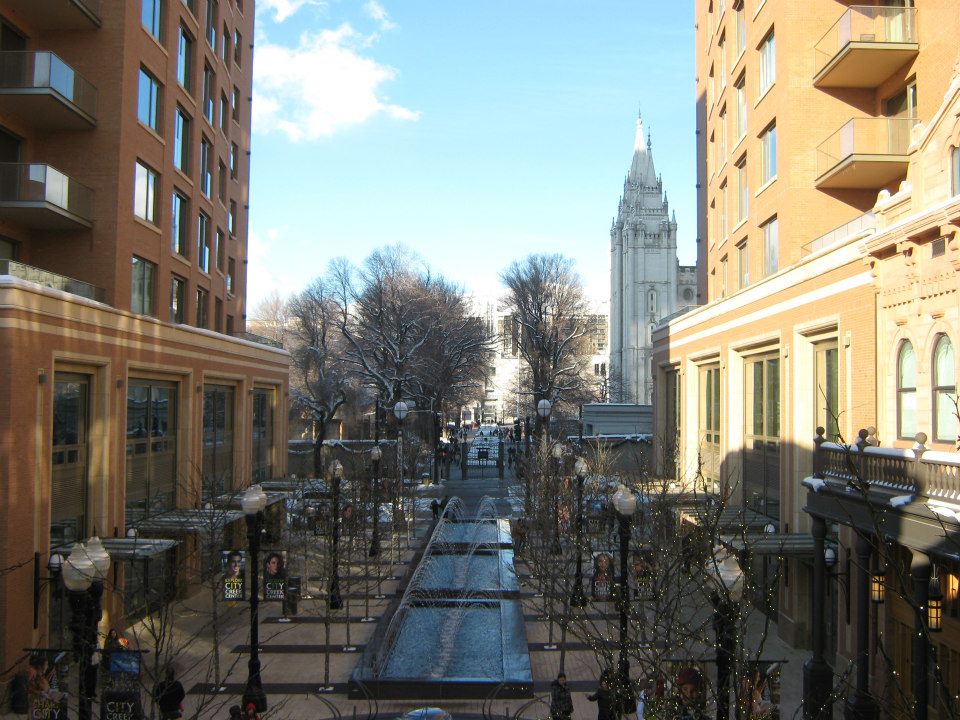
So the accurate summary has five parts. City Creek is a real development costing something near $1.5 billion; it was funded through the Church's commercial entities and earnings on invested reserves, not current-year tithing; Hinckley's 2003 statement explicitly preserved the use of earnings on invested reserves; the Ninth Circuit examined that mechanism in 2025 and found no actionable misrepresentation; and the development functioned as urban revitalization with measurable economic and environmental outcomes. Whether the project's priorities are spiritually inspiring is a separate question reasonable members can debate, and the CES Letter's sharpest stroke there is not an accounting claim at all but a contrast with real emotional force: Argentine Saints giving the Church the gold from their dental work toward the São Paulo Brazil Temple, set against a shopping center.[3:2] The factual "tithing built a luxury mall while the world starved" charge fails on the funding mechanism, on the comparison numbers, and on the post-2020 charitable trajectory.
The Hinckley 2002 ZDF interview: context restored, "dishonest" examined
The CES Letter reads a 2002 Hinckley interview as evidence of deception at the very top of the Church. The accuracy of the quoted exchange itself is not in dispute. What needs examination is the source identification, the surrounding context, and whether "dishonest" is the right characterization of what Hinckley said.
Source identification
The interview was conducted on January 29, 2002 by Helmut Nemetschek for ZDF German Television (Zweites Deutsches Fernsehen, the German public broadcaster), at 47 East South Temple, Salt Lake City, prior to the 2002 Salt Lake City Winter Olympics.[32] The accurate primary-source identification is ZDF/Nemetschek/January 29, 2002. The transcript is preserved at independent archives including wasmormon.org.[32:1]
Key Point
The 2002 Hinckley financial-transparency exchange was with ZDF German Television (Zweites Deutsches Fernsehen), interviewer Helmut Nemetschek, on January 29, 2002, prior to the Salt Lake City Winter Olympics. The transcript is preserved at wasmormon.org and other independent archives.[32:2]
The exchange in context
The full exchange:
Reporter: "In my country, the…we say the people's churches, the protestants, the catholics, they publish all their budgets, to all the public."
Hinckley: "Yeah. Yeah."
Reporter: "Why is it impossible for your church?"
Hinckley: "Well, we simply think that the…that information belongs to those who made the contribution, and not to the world. That's the only thing. Yes."[32:3]
The exchange was two questions of a thirteen-question interview that ranged across the Winter Olympics, Church growth, missionary work, the 1978 priesthood change, humanitarian aid, DNA and the Book of Mormon, and the responsibility of religions for peace in the world. The financial-transparency moment was brief, unscripted, and given to a foreign secular journalist before the Olympics, not a setting where the institution was preparing detailed policy defenses.
Examining "dishonest"
The charge that Hinckley's statement was "dishonest" requires unpacking. Strictly construed, the word requires the speaker to know one thing and assert another. Hinckley's words are ambiguous, and the more charitable reading is normative: that Church financial information is properly the concern of those who pay tithing rather than of the public press. On that reading he is articulating an institutional posture, not describing the disclosure regime, and a brief, unscripted moment with a foreign secular journalist is not the place to expect detailed policy precision.[33]
The stronger version of the objection, though, has to be conceded. As the exchange would have been received by ordinary viewers (the German journalist asking why the Church does not publish its budget, Hinckley contrasting "those who made the contribution" with "the world"), it implied an asymmetry between contributor access and public access. The actual disclosure regime does not honor that implied asymmetry: tithe-paying members, in fact, also cannot see the line-item books. Whatever Hinckley meant, his words as received reasonably implied an empirical claim about contributor access that the practice does not deliver. So the faithful position distinguishes two questions. Hinckley was not personally dishonest in that unscripted moment. But his phrasing surfaces a real tension between Church rhetoric ("contributors have priority") and Church practice (contributors also cannot see the books). The charge is too strong. The institutional tension underneath it is the live issue, and later sections press it.
The Vigil family and the bishop's-storehouse passage the CES Letter excises
The CES Letter presents a December 2012 Ensign passage as evidence that Church curriculum tells members to pay tithing instead of feeding their families. The quote is real and accurately rendered. What is also true is that the article carries, on the page being quoted, a sentence the CES Letter drops that reframes the entire moral logic of the story.
The original Ensign article
Aaron L. West, "Sacred Transformations," Ensign, December 2012, tells the story of Amado and Evelyn Vigil, recent converts in El Salvador facing severe financial hardship.[9:1] Bishop Orellana taught them about tithing during this period. His words, quoted by the CES Letter, were:
"If paying tithing means that you can't pay for water or electricity, pay tithing. If paying tithing means that you can't pay your rent, pay tithing. Even if paying tithing means that you don't have enough money to feed your family, pay tithing. The Lord will not abandon you."[9:2]
This is the spiritually demanding passage the CES Letter quotes, and it is real, printed in the December 2012 Ensign. The counsel is as demanding as it sounds, taken in isolation, and faithful members reading the December 2012 Ensign would have encountered it.
The sentence the quotation leaves out
On that same page, the article also contains this sentence:
"The family received some commodities from the bishops' storehouse during their financial difficulties."[9:3]
This single sentence transforms the moral logic of the story. The Vigils were never in the position the truncation invents. They were instructed to pay tithing while the Church's welfare system helped feed them. The bishops' storehouse, part of the broader Church welfare program, provided food and household commodities to the Vigil family during their hardship.
Key Point
The original December 2012 Ensign article on the Vigil family explicitly states: "The family received some commodities from the bishops' storehouse during their financial difficulties."[9:4] The CES Letter's excision of this single sentence is the rhetorical move that makes the "pay tithing or starve" reading possible. The sentence is in the original article on the same page as the bishop's tithing counsel.
The "pay tithing or starve" reading collapses the moment the storehouse line is restored to the quote's context. The Vigil story is not "starve in obedience." It is "pay tithing as a covenant, and the Church's welfare system supplies your family from the bishop's storehouse during your hardship." That is the actual coupled system, tithing-as-covenant and welfare-as-redistribution, that the CES Letter's version makes invisible by cutting one sentence.
The story's continuation
The Ensign piece tells the rest of the Vigil family arc as well. Evelyn received a job promotion. Amado found employment. Evelyn later lost her job, and they continued to pay tithing. What it describes is a journey of trust through repeated economic instability, with the Church's welfare system supporting the family through difficult periods, not a story of pure success-via-tithing.[9:5]
The CES Letter's own storehouse rejoinder
The CES Letter is not unaware of the storehouse. It raises the storehouse itself, once, in a mocked apologist's voice: "Well, God tested Abraham by asking him to sacrifice his son and besides, the Lord will take care of them through the Bishop's storehouse."[5:2] It then answers its own hypothetical with a dependency charge: "Begging the Bishop for food when you had the money for food but because you followed the above counsel and gave your food money to the Church you're now dependent on the Church for food money? If you give your food and rent money to the Church, you are not self-reliant…you are Church-reliant."[5:3] So the Letter pre-concedes that the mechanism exists. What it never tells the reader is that in the very story it is quoting, the storehouse was not a hypothetical at all. Who was feeding the family the CES Letter says was told to starve?
The dependency charge has a direct answer, and the design of the system supplies one. Storehouse access runs through a bishop who knows the family and issues the order form himself; fast offerings are a separate donation stream from tithing; and self-reliance classes and centers exist for the express purpose of moving members back to independence.[27:1] In the Vigil case the whole loop actually ran. The family paid tithing, received commodities, and returned to self-support, at least for a period ("Evelyn received a promotion, and Amado found a good job"), before the later job loss the article also records.[9:6] The loop is what participation in a covenant community looks like. The Letter's own phrase for it, "Begging the Bishop," treats receiving help from your own congregation as humiliating, and that is a rhetorical posture, not a fact about the program.
The section's real force, though, is the question the Letter puts in the same passage: "Would a loving, kind, and empathic God really place parents in the horrible position of having to choose whether to feed their children or pay what little they have to a multi-billion luxury megamall owning church that receives an estimated $8,000,000,000 in annual tithing receipts?"[5:4] That question deserves an answer, not a deflection. Two things answer it. The choice as posed is not the choice the article describes, because the storehouse sentence is in the article. And Elder David A. Bednar has answered it directly: the Church does not need the money in the first place.[34] What survives both is the residue this article has already granted at the bishop's counsel: read alone, that counsel is as demanding as it sounds, and no amount of restored context makes it comfortable.
The broader welfare safety net
The bishops' storehouse the Vigil family drew from is part of a much larger system the CES Letter does not mention.
- Bishops' storehouses. More than 100 across the United States and Canada, each stocked with canned and fresh food, toothpaste, diapers, and other essential hygiene items, and often compared to supermarkets without tills. Those in need present a completed order form from their bishop, who knows the family directly because the geographic ward structure makes him their neighbor.[27:2]
- Fast offerings. Members fast two meals on the first Sunday of each month and donate at minimum the cost of those meals as a separate offering, entirely distinct from tithing. Bishops have authority to write checks for rent, utilities, food, medical bills, and other immediate needs from this fund: help a bishop can extend directly.[27:3]
- Deseret Industries. Thrift operations providing employment training, donated goods, and structured pathways back to financial self-reliance for people facing barriers to employment.[27:4]
- Family Services. Counseling network covering mental health, family dynamics, addiction recovery, and other support services.[27:5]
- Self-Reliance Services. Classes and self-reliance centers on personal finance, education, and employment, with mentoring for job seekers and the self-employed. The program's stated goal is helping members move from welfare dependence to self-reliance.[27:6]
- Latter-day Saint Charities. The Church's humanitarian arm has distributed over $2.2 billion in aid across 197 countries since 1985, primarily to non-members.[18:2]

This system runs primarily on volunteer labor (Relief Society sisters, elders quorum members, Deseret Industries volunteers) with minimal overhead compared to government social-service systems, and direct assistance to families is funded through fast offerings, a stream separate from tithing. Faithful members understand tithing-and-welfare as a coupled system: tithe-paying members in genuine need receive direct help. The CES Letter presents the system as exclusively extractive; the welfare component is the redistributive complement.
The Bednar counter-text addresses exactly the implied counterfactual the CES Letter relies on. During the post-address Q&A at the National Press Club on May 26, 2022, Elder David A. Bednar responded directly to a journalist's question about tithing in poverty contexts: "The Church doesn't need their money, but those people need the blessings that come from obeying God's commandments."[34:1] Tithing, on that reading, is for the member's spiritual benefit, not the Church's financial necessity. That is the substantive faithful position, and it recurs at each of these scenes.
The Cordón story: the Monday-morning resolution the CES Letter omits
The CES Letter's second tithing-before-food scene is from April 2017 General Conference. Like the Vigil case, the quoted passage is real. Like the Vigil case, the CES Letter quotes the cliffhanger and stops.
Source identification
The talk is Valeri V. Cordón, "The Language of the Gospel," delivered in the Saturday Afternoon Session of the April 2017 General Conference (April 1, 2017), and verified at the Church's official URL.[35]
Key Point
The April 2017 Cordón talk is "The Language of the Gospel," delivered Saturday Afternoon Session, April 1, 2017. Its actual subject is how parents teach gospel principles through observable action more than verbal instruction, not "tithing-before-food" as a doctrinal teaching.[35:1]
The full story
Cordón's father owned a tailoring business in Central America. Civil conflict caused the business to collapse from approximately 200 employees to fewer than five, with the remaining workers operating from the family's home garage. During this crisis, young Cordón overheard his parents debating "whether they should pay tithing or buy food for the children."[35:2]
The CES Letter quotes through the cliffhanger:
"On Sunday, I followed my father to see what he was going to do. After our Church meetings, I saw him take an envelope and put his tithing in it. That was only part of the lesson. The question that remained for me was what we were going to eat."[35:3]
The next sentence in the talk, which the CES Letter omits, begins:
"Early Monday morning, some people knocked on our door."[35:4]
The visitors had an urgent sewing order and paid in advance. The financial crisis resolved.
The talk's actual subject
Cordón does not frame the experience as "starve in obedience" or "tithing-before-food as a doctrinal teaching." He frames it as a faith-promoting story about how parents teach by action. The talk's title and broader subject is "The Language of the Gospel," the contrast between teaching-through-words and teaching-through-action. Cordón says his father had asked him the same money question, "What are you going to do with your money?", through eight years of factory vacations; the single observable action of paying tithing during financial crisis was the more powerful teaching, in Cordón's telling, than years of asking.[35:5]
The CES Letter's truncation removes both the story's resolution and the talk's actual thesis. Restoring the resolution flips the moral logic; restoring the thesis explains why Cordón told the story at all. He told it as a personal narrative about how his father's faith-action shaped his understanding of the gospel, the kind of personal-testimony narrative that has been characteristic of General Conference talks for decades, and not as a doctrinal ruling that tithing takes precedence over food.
The Bednar counter-text from the May 2022 National Press Club Q&A applies here as well: tithing is for the member's spiritual benefit, not because the Church needs the money. The Cordón family in the narrative experienced relief through a Monday-morning customer order; faithful Latter-day Saints in financial crisis today experience relief through fast-offering assistance, bishops' storehouse access, and direct ward support.[34:2]
"$8 billion" and "six figure church salaries"
The CES Letter compresses two distinct claims into a single rhetorical package: the Church receives an estimated $8 billion in annual tithing, and General Authorities receive six-figure annual "church salaries" funded by that tithing. Both claims have defensible factual grounding and both substantially mislead by what they import.
The "$8 billion" estimate
The CES Letter's "$8,000,000,000" annual-tithing estimate is at the high end of published estimates. NBC News, reporting a 2012 Reuters analysis conducted with University of Tampa sociologist Ryan Cragun, put annual tithes and other donations at approximately $7 billion;[36] CBS still estimated $7 billion in contributions from 17 million members in 2023.[37] The $8 billion figure is plausible-but-high. The Church does not disclose annual tithing receipts directly, so all public estimates are inferences from auxiliary data points.
The number itself is not the rhetorical work the CES Letter does. The work is in the comparison: "$8 billion in annual tithing receipts" is positioned to imply institutional wealth-on-the-backs-of-the-poor. The answer to that is mostly a matter of where the money goes: the $1.45B annual charitable spending, the roughly $1B a year on higher education that Elder Bednar has described, the welfare system, the ~30,000+ congregations served, the global temple-construction program, the missionary support, and the operating costs of a 17-million-member global institution. A fair statement of the record: billions in annual tithing fund the operations of a 17-million-member global church, a charitable program past $1 billion a year, an education subsidy of the same size, and a global welfare system. They do not fund a luxury megamall.
The General Authority "stipend": funding source, scale, and comparison
"Six figure church salaries" imports two specific implications, and they need to be taken separately: (1) the funding source is tithing, and (2) the compensation level reflects megachurch-style wealth at scale.
Funding source. The Church's official FAQ on the topic is explicit:
"None of the funds for this living allowance come from the tithing of Church members, but instead from proceeds of the Church's financial investments."[19:1]
The FAQ's stated rationale is consistent with the structural design: "This practice allows for far more church members on a worldwide basis to be considered for a calling to serve as a General Authority, rather than limiting considerations to only those who may be financially independent."[19:2] That funding source, investment returns rather than tithing, has been the consistent Church position for decades. Hinckley said the same over the pulpit in the October 1985 general conference, naming the Church's business income as the source: the living allowances, "very modest in comparison with executive compensation in industry and the professions," come "from this business income and not from the tithing of the people."[38]
The "investment returns, not tithing" distinction is accurate at the moment of disbursement. But the distinction is technical at the moment of disbursement rather than substantive about institutional flows over time. Returns on tithing-derived reserves are still tithing-derived in any meaningful economic sense, the same flow-of-funds logic the Ninth Circuit examined in Huntsman.[39] Faithful members can hold this distinction without minimizing it.
The 2017 MormonLeaks document drop included a leaked Henry B. Eyring 2000 pay stub showing approximately $90,000 and a 2014 living-allowance memo confirming the increase from $116,400 to $120,000. Those documents corroborate the compensation figures without bearing on the funding-source question. The Church declined to confirm their authenticity, but the 2014 figure aligns with FAIR's separately documented information.[38:1][40]
Scale. The 2014 living-allowance figure of $120,000 is the last verified number in publicly-leaked documentation.[40:1] The Widow's Mite Report, applying documented annual rises of approximately 3.1%, estimates a 2026 base living allowance of about $173,000, which it grosses up to roughly $189,000 as a taxable-salary equivalent because about a quarter of the allowance is untaxed parsonage.[41] Non-cash benefits (housing arrangements, healthcare, retirement provision after release, transportation, hospitality and travel budgets) push the total package higher still; the same report adds roughly $75,500 in health and retirement value. Any single figure is a useful comparison anchor but does not capture the entire package.
Comparison framework. The substantive question is whether the General Authority stipend represents megachurch-style institutional wealth at scale. The comparison data:
| Leader | Organization | Estimated compensation / wealth |
|---|---|---|
| LDS General Authority | 17M-member global church | ~$173K base living allowance (uniform, from operating returns of accumulated reserves)[41:1][19:3] |
| Joel Osteen | Lakewood Church (43,000 attendance) | Takes no church salary; net worth estimated at $40M, or roughly $100M combined with Victoria Osteen[42][43] |
| Kenneth Copeland | Kenneth Copeland Ministries | Net worth estimated from several hundred million dollars to as high as $760 million[43:1] |
The rows are not the same measure. The Latter-day Saint figure is an annual allowance, the others lifetime net-worth estimates. That asymmetry is the point: the comparable independent-church figures accumulate personal fortunes, and the stipend does not.
An apostle leading a 17-million-member global church receives a fixed, uniform allowance, while the best-known independent-church figures in the United States hold personal fortunes measured in the tens or hundreds of millions of dollars. The "six figure salaries" charge makes sense only if the comparison frame is "average secular professional" rather than "religious leaders of comparable institutional scale." Within the comparable-religious-leadership frame, the Latter-day Saint stipend is dramatically below the benchmark. Michael Otterson, former Church Public Affairs Managing Director, observed that for some former businessmen who became General Authorities, the stipend "may literally be less than a tithe on what they previously earned."[38:2]
The unpaid-clergy structure
The "paid clergy" charge is technically true at the General Authority level (about 130 individuals globally) and false everywhere else in the system.
Across the Church's 30,000+ congregations, local leadership is entirely unpaid. Each ward (typically 200–500 members) has a bishop and two counselors, a Relief Society presidency, an elders quorum presidency, a Young Women presidency, a Young Men presidency, a Primary presidency, a Sunday School presidency, plus dozens of teachers, specialists, and clerks, all unpaid. Bishops give their hours on top of full-time secular employment, usually serving for a period of about five years. Stake presidents oversee groups of congregations, unpaid. Area Seventies oversee entire geographic regions, unpaid. The total unpaid Church leadership at all levels is in the hundreds of thousands of members at any given time.[38:3]
The "Church has paid clergy" charge flattens the distinction between full-time General Authorities (small number, fixed stipend, investment-funded, professional-class) and the actually-leading-the-Church local clergy (hundreds of thousands, unpaid, staffing thousands of congregations). The Church's clerical structure is dramatically less compensated per member than virtually any comparable American religious organization.
Key Point
Approximately 130 General Authorities receive a uniform living allowance, estimated at about $173,000 for 2026, funded from operating returns of accumulated reserves, not current-year tithing. Hundreds of thousands of bishops, stake presidents, Relief Society presidents, elders quorum presidents, Young Women presidents, Primary presidents, and other local leaders serve unpaid in approximately 30,000+ congregations worldwide. The "Church has paid clergy" charge holds at the GA level and is structurally false at every other level.[19:4][41:2][38:4]
The BYU subsidy: where Church money clearly goes
Beyond charitable spending and the welfare system, the Church's largest single-line "where the money goes" category is education. Elder Bednar has put the Church's higher-education spending at approximately $1 billion per year across BYU, BYU-Idaho, BYU-Hawaii, and Ensign College, a figure Elder Gilbert has since repeated and Aaron Miller, a BYU professor, relays. That is roughly a full year of Caring for Those in Need spending in 2022.[26:1]
The per-student subsidy is dramatic. Full-time Latter-day Saint undergraduate tuition at BYU is $6,888 for 2025–26, billed as $3,444 each for Fall and Winter semesters. The Widow's Mite Report, working from the BYU system's own audited financials, puts member tuition at 82% subsidized against an unsubsidized cost of roughly $36,500 a year: an implied transfer of about $29,900 per member student annually, or about $120,000 across four years. In 2024, $1.21 billion in tithing went to subsidizing the BYU collegiate system.[44]
The system scope:
- Universities. A combined 93,000 students across several universities and what is now Ensign College, renamed in 2020, shortly after the Church's own December 2019 accounting.[18:3]
- BYU-Pathway Worldwide. Named in that same accounting, bringing accredited US higher education within reach of students in developing countries who could not otherwise access it.[18:4]
- Seminary. Some 400,000 high school students worldwide.[18:5]
- Institute. 300,000 university students worldwide.[18:6]
The education subsidy is invisible in the CES Letter's "where does the money go" accounting. It is the largest single category of "caring for people" spending the Church does not include in the Caring for Those in Need annual reports, and it operates at a scale comparable to the entire annual humanitarian/welfare report. Including the education subsidy at Bednar's conservative $1 billion figure, the Church's documented "caring for people" spending is approximately $2.45 billion per year ($1.45B Caring + ~$1B education subsidy).
The Lorenzo Snow ellipsis: candid concession on the curricular edit
The last of the CES Letter's seven claim clusters is its most pointed factual claim about Church curricular practice. The claim is that the Teachings of Presidents of the Church: Lorenzo Snow manual deliberately omitted "who has means" from Snow's 1899 tithing address with an ellipsis, and that the omission shifted the rhetorical emphasis from a means-tested obligation to a categorical universal.[8:1]
The ellipsis is real
The original 1899 wording, as recorded in the October 1899 Conference Report that the manual itself cites, reads: "I plead with you in the name of the Lord, and I pray that every man, woman and child who has means shall pay one-tenth of their income as a tithing."[45] The Teachings of Presidents of the Church: Lorenzo Snow manual renders this as: "I plead with you in the name of the Lord, and I pray that every man, woman and child … shall pay one-tenth of their income as a tithing."[45:1] The ellipsis replaces the phrase "who has means."
This is a real curricular edit, and the omission is not innocuous. It is reasonable for a faithful member to wish the manual had kept the original wording. Whatever the editorial intent, dropping "who has means" leans the plea toward a universal command.
Snow's broader 1899 context
Snow's 1899 addresses on tithing were given during a period of acute Church financial difficulty. The Edmunds-Tucker Act of 1887 had escheated significant Church property; the Church had emerged from the Manifesto-era debt with substantial financial obligations; and the May 17–18, 1899 St. George Tabernacle addresses came as part of a renewed emphasis on tithing during this difficult moment.[46] The curricular-alteration reading of the same ellipsis, as a transparency-and-historical-presentation issue and not a finance issue, is engaged in Transparency & Censorship. Snow's broader teaching pattern included multiple statements emphasizing universality of tithing as a participation principle: "There is no man or woman who can not pay one tenth of what he or she receives," with his own example calling for $1 in tithing on $10 in income.[45:2] Snow encouraged members to approach bishops "with an open face" after paying tithing, and offered forgiveness for past non-payment. Sarah Allen at FAIR has defended the edit as a clarity crop that does not change the meaning, since "means" can simply mean income.[47]
That 1899 context is not, however, a complete defense of the curricular edit, and it should not be made to carry that weight. The omission stands as described above, universalizing lean included. A response that means to last engages the curricular choice directly instead of explaining it away.
Modern pastoral practice
The substantive faithful response is modern pastoral practice and the Bednar counter-text. The temple-recommend interview asks whether the member is a full-tithe payer, a question that invites a member-bishop conversation about what full means in the member's circumstances. The fast-offering and bishops' storehouse system is explicitly designed to assist tithe-paying members in financial crisis, the same coupled system the Vigil family experienced.[27:7]
David A. Bednar's May 2022 National Press Club Q&A is the substantive counter-text here:
"The Church doesn't need their money, but those people need the blessings that come from obeying God's commandments."[34:3]
Bednar's point, that tithing is for the member's spiritual benefit rather than the Church's financial necessity, directly addresses the "Church demands your money" implication the CES Letter imports. The substantive faithful position is not that the Snow ellipsis is unimportant. It is that the modern Church's pastoral practice and apostolic counter-text together establish that tithing is a covenant practice with member spiritual benefit as its primary purpose, with explicit institutional support for members in financial hardship.
Tithing as continuous religious practice
The CES Letter's dependency rejoinder, that a member who takes the bishop's food is not self-reliant but Church-reliant, assumes tithing is a peculiar modern demand of a wealthy institution. It is one of the oldest continuous religious practices in the Western tradition.
The biblical foundation is layered:
- Genesis 14:20. Abraham gives tithes to Melchizedek (~2000 BCE in traditional dating).
- Genesis 28:22. Jacob's covenant at Bethel: "And of all that thou shalt give me I will surely give the tenth unto thee."
- Leviticus 27:30. "All the tithe of the land...is the Lord's: it is holy unto the Lord."
- Numbers 18:21. Levites receive tithes from Israel.
- Deuteronomy 14:22–29. Annual tithe with explicit provision for the poor and the Levite; the redistributive function is built into the original framework.
- Malachi 3:8–10. "Bring ye all the tithes into the storehouse...and prove me now herewith, saith the Lord of hosts, if I will not open you the windows of heaven."
- Matthew 23:23. Jesus affirms tithing while emphasizing the "weightier matters of the law, judgment, mercy, and faith," subordinating the practice to relational priorities without discarding it.
The Latter-day Saint scriptural foundation is Doctrine and Covenants (D&C) 119, revealed July 8, 1838 at Far West, Missouri, which set the standing law: after an initial consecration of surplus property, members "shall pay one-tenth of all their interest annually" (D&C 119:4).[48] The Church History Topics page on tithing traces the practice from the earliest revelations through modern practice.[49]
Latter-day Saints did not invent tithing. The practice is older than the Hebrew Bible, codified by Moses, affirmed by Jesus, reinstated by direct revelation in the Restoration, and continues in the Latter-day Saint tradition as a covenant practice. It has been continuous religious practice in the Western tradition for approximately four thousand years.
Ensign Peak Advisors and the 2023 SEC settlement
The single hardest concession in the whole Church Finances case is on Ensign Peak Advisors and the 2023 SEC settlement. A faithful response cannot minimize what the SEC found.
What Ensign Peak is
Ensign Peak Advisors is the Church's primary investment management entity, named for the prominent Salt Lake Valley peak from which Brigham Young viewed the valley in 1847. Its stated purposes, drawn together from Hinckley's October 1995 general conference address,[50] Bishop Caussé's 2018 Church History Symposium address, and the Church's 2019 Newsroom statement, include:
- Long-term financial reserves to weather economic storms (temporal preparedness);
- Funding for capital obligations: temple construction, missionary support, education subsidies, humanitarian programs;
- Investment-returns-based funding of operating costs (including the General Authority living allowance per the FAQ);
- A temporal anchor supporting the Church's spiritual mission.[51][18:7]
Bishop Gérald Caussé's address to the 2018 Church History Symposium, "In the Lord's Way: The Spiritual Foundations of Church Financial Self-Reliance," is the most detailed Presiding Bishopric public statement on the institutional financial framework. Caussé emphasizes self-reliance, temporal preparedness, institutional stewardship, and prioritizing the spiritual mission over the financial.[51:1] Caussé on the reserve principle:
"the Church has acquired complete financial independence and is able to accomplish its mission without any type of debt"; funds "can be accessed in times of hardship to ensure the ongoing, uninterrupted work of the Church's mission, programs, and operations and to meet emergency financial needs."[51:2]
The "complete financial independence" claim is striking, and a careful reader will press the threshold-size question that follows from it. Caussé names "ongoing, uninterrupted work" through "times of hardship," covering catastrophic economic disruption, accelerating temple construction, missionary expansion, and capital obligations far in the future. That is a defensible faithful framing; the threshold-size question is fair without a clean answer, and the comparative-scale section below returns to it. The Church's scriptural warrant for the reserve is prudent stewardship, a principle the First Presidency's December 2019 statement anchored in the Parable of the Talents.[52]
The 2019 Nielsen whistleblower disclosure and Roger Clarke's WSJ admissions
David A. Nielsen, a former portfolio manager at Ensign Peak Advisors, filed an IRS whistleblower complaint received on November 21, 2019, alleging that Ensign Peak held approximately $100 billion in assets and that no religious, educational, or charitable distributions had been made in 22 years. The complaint alleged two specific outlays Nielsen considered illegitimate: approximately $600 million to prop up Beneficial Life, a Church-owned insurer, in 2009, and approximately $1.4 billion in installments to City Creek over a window the complaint dates 2009 to 2014.[52:1] Church officials confirmed the payments to the Wall Street Journal while denying they were illegal.[53] No public IRS action followed; the agency does not comment on whistleblower complaints.[37:1] Nielsen's brother Lars Nielsen served as media liaison and amplifier; the Washington Post and Religion Unplugged broke the story on the evening of December 16, 2019, and Newsweek co-published Religion Unplugged's reporting the next day.[52:2] Nielsen's first television interview about the fund's size was on CBS 60 Minutes, May 14, 2023.[37:2]
The 2019 disclosure was the first public confirmation of Ensign Peak's scale. The $100B+ amount is substantively true. What is contested is (a) whether the fund was illegitimate and (b) whether the secrecy was justifiable.
The legitimacy question turns on the deployment record, and Nielsen's charge was specific: no religious, educational, or charitable distributions in 22 years. The two outlays he identified, the Beneficial Life rescue and the City Creek installments, are not charitable distributions, so the charge is not empty. What it leaves out is the function the fund's own managers describe. In their first interview about Ensign Peak's operations, Roger Clarke and the officials who oversee it told the Wall Street Journal it was "a rainy-day account to be used in difficult economic times," and that as the Church continues to grow in poorer areas of the world like Africa, where members cannot donate as much, it will need Ensign Peak's holdings "to help fund basic operations."[53:1] Caussé's 2018 address says the same thing in institutional language. The fund's stated function is to underwrite operations the Church would otherwise fund from current receipts: General Authority stipends per the FAQ; temple construction (the global temple-construction program has accelerated dramatically since 2018 with the Russell M. Nelson administration's announcements); meetinghouse construction; missionary subsidization; the higher-education subsidy (roughly $1B a year, Elder Bednar's figure); the welfare-system infrastructure; humanitarian giving (the Caring for Those in Need annual reports); and operating reserves.[51:3]
Roger Clarke's 2020 Wall Street Journal admissions are first-person testimony from the head of Ensign Peak, and they bear directly on the deliberate-concealment question the SEC would later document legally. Clarke, whom the paper describes as the head of Ensign Peak, told the WSJ in February 2020 that "we've tried to be somewhat anonymous." Dean Davies, a member of the Presiding Bishopric, which oversees Ensign Peak, said the church does not publicly share its assets because "these funds are sacred" and "we don't flaunt them for public review and critique."[53:2] Clarke also tied the low profile to tithing itself. Church leaders, he believed, were concerned that public knowledge of the fund's wealth might discourage tithing: "Paying tithing is more of a sense of commitment than it is the church needing the money."[53:3]
These admissions, made to the WSJ in February 2020, three years before the SEC settlement, document what was, from inside Ensign Peak, a deliberate institutional posture of low public visibility. The SEC's February 2023 finding of deliberate disclosure obscuring did not, on this evidence, find something the Church did not already understand internally; the SEC found and legally documented what Clarke had openly described to a WSJ reporter three years prior. Clarke's words, sympathetically read, position the secrecy as sacred reverence rather than regulatory evasion. But the structural fact is that the secrecy was a deliberate institutional choice, owned at the highest levels of Ensign Peak management, and that the SEC found that deliberate posture to be in violation of disclosure law.
The 2023 SEC settlement: deliberate concealment
On February 21, 2023, the SEC announced a $5 million settlement with the Church and Ensign Peak Advisors: $1 million penalty against the Church plus $4 million penalty against Ensign Peak Advisors. The violation, per SEC Press Release 2023-35 and SEC Order 34-96951, was failure to file Form 13F disclosures of equity holdings from 1997 to 2019/2020 and the use of 13 shell LLCs to obscure portfolio composition.[12:1][11:2]
Form 13F requires investment managers exercising discretion over $100M+ in publicly-traded securities to file quarterly portfolio disclosures. Ensign Peak was over that threshold from its 1997 inception, when it already managed approximately $7 billion in Church assets.[11:3] From 2001 forward, it created 13 shell LLCs that filed Form 13F separately instead of as a single Ensign Peak filing, disaggregating the portfolio across multiple separate entities.
The structure of these LLCs is what Brunson, reading the SEC Order's text directly, characterized as legally meaningless in operations:
"The LLCs didn't actually control the investments. They and EPA signed Investment Management Agreements which formally allocated investment control to the LLCs, but, in spite of that, the SEC says, EPA exercised control over the LLCs. It looks like whenever EPA acquired new securities, it would assign those securities to one of the LLCs by the end of the relevant quarter."[13:1]
The shell LLCs had nominal investment-management agreements but operated as filing vehicles, not as actual investment managers. Each Clone LLC was set up with a "Business Manager" who, per the Order, "performed no functions for the Clone LLCs outside of signing the Form 13F signature pages each quarter," and who was selected for having a common name and a limited presence on social media.[11:4] They existed for one purpose: disaggregating portfolio reporting across entities so that no single 13F filing would show the size of the Ensign Peak portfolio.
The SEC Order documents that the First Presidency and Presiding Bishopric explicitly approved each LLC structure and expansion.[11:5][13:2] This is the critical institutional finding. The shell-LLC concealment was not the work of mid-level functionaries operating without senior oversight. Each of the thirteen, and each expansion of the arrangement, carried senior sign-off.
The SEC Order also documents the motivation. The growing size of the investment portfolio, per the Order, would bring "unwanted attention."[11:6] Brunson, reading the Order, put the origin plainly: "The First Presidency and/or the Presiding Bishopric worried that if it got out that the church had $7 billion in investments, it would lead to negative consequences."[13:3] The motivation was not regulatory complexity. It was deliberate concealment.
Sam Brunson, writing on By Common Consent on the day of the settlement, put his conclusion in one sentence:
"It's not that mistakes were made—it's that the church took deliberate action to do wrong."[13:4]
That is a believing tax scholar reading the SEC Order's actual text. The faithful response cannot soften this finding. The shell-LLC structure was deliberate. The First Presidency and Presiding Bishopric approved each LLC structure and expansion. The motivation was concealment. The Church paid the penalty and the practice ended, and neither of those facts converts the violation history into innocent regulatory error.
On Aaron Miller's "speeding ticket" comparison
Aaron Miller's August 2024 FAIR Conference address, overall an excellent and faithful overview of the post-2023 Church-finances controversies, characterizes the SEC settlement as comparable to "a speeding ticket where there's not a clearly posted sign," emphasizing legal ambiguity in the regulatory framework.[26:2] On this specific point, however, Brunson's reading of the SEC Order text is more direct: the Order documents a roughly 22-year Form 13F filing failure (1997–2019/2020) and, within it, an approximately 18-year shell-LLC concealment subset (2001–2019/2020) with First Presidency and Presiding Bishopric approval, and Roger Clarke's own 2020 WSJ admissions confirm that low public visibility was a deliberate institutional posture from inside Ensign Peak. That is structurally different from regulatory ambiguity.
The fine is symbolic, not deterrent
The CES Letter's framing on the fine itself is implicit; the substantive critic-side observation is that $5 million is approximately 0.005% of $100 billion. At that ratio the penalty registers as a gesture and not a deterrent. It reflects the SEC's enforcement framework for Form 13F violations (typically modest penalties even for systemic violations), not the substantive scale of the institutional concealment.
The fine should not be leaned on as the resolution. It is a procedural marker. The institutional-corrective signals matter separately: Ensign Peak changed course after the SEC first raised concerns in June 2019, filing its first consolidated 13F on February 14, 2020, covering the final quarter of 2019 (before the formal SEC settlement); the practice stopped; the SEC Order publicly documented the violation; the post-2020 Caring for Those in Need annual reports began. These corrective signals matter. But they leave the roughly 22-year filing failure, with the 18-year shell-LLC concealment within it, exactly as the SEC Order documents it.
Faithful concession framework
The faithful position on Ensign Peak and the SEC settlement is therefore layered:
- The SEC Order documents, in settled findings the Church chose not to contest, a deliberate structure from 2001 to 2019/2020 whose sole purpose was preventing disclosure, with First Presidency and Presiding Bishopric approval of each LLC structure and expansion.
- Roger Clarke's 2020 WSJ admissions confirm the deliberate-low-visibility posture from inside Ensign Peak.
- Brunson reads the Order as deliberate wrongdoing rather than error.
- The penalty was negligible relative to fund size.
- The institutional response (consolidated reporting from February 2020; Caring reports from 2021; SEC settlement publicly acknowledged; the Ninth Circuit's Huntsman affirmance in 2025) is real, and the corrective pattern has held.
- The post-2020 transparency turn is partial. Ensign Peak portfolio composition is now publicly visible through consolidated 13F filings, but Brunson's external-auditor proposal remains unimplemented and full revenue/expense disclosure has not arrived.
Comparative scale: endowments and per-capita reserves
The "$100 billion" headline is dramatic without context. Set beside comparable institutions, the number reads differently, and the comparison also has limits of its own.
The basic comparison data:
| Institution | Total reserves | Beneficiary population | Per-capita |
|---|---|---|---|
| Harvard | ~$56.9B endowment (FY2025)[54] | 24,317 students (Fall 2025) | ~$2.34M per student |
| Yale | $44.1B endowment (FY2025)[55] | 15,657 students | ~$2.82M per student |
| Norway Government Pension Fund | 21,268 billion kroner at end-2025, roughly $2.1–2.2T[56] | 5.63M citizens | ~$390K per citizen |
| LDS Church (estimated) | ~$100B+ | 17.0M total members of record (July 2023) | ~$5,882 per member |
Even adjusting to approximately five million weekly active members, the per-active-member figure is roughly $20,000, well below Harvard's per-student or Yale's per-student. Aaron Miller runs the same arithmetic and states his primary figures first: "Harvard, if you use just students, has $1.2 million saved up in investments per student. Yale has $1.3 million saved up per student. ... The Church is around $8,800 per capita, based on the math I was using, which involves some guessing."[26:3] He then stress-tests it by bending every assumption toward the critic, counting alumni for Harvard and Yale and shrinking the Church denominator to five million weekly actives, and even then he gets "$30,000 per member whereas Harvard has $139,000 per capita and Yale has $256,000 per capita."[26:4] One caution on mixing his numbers with the $100 billion headline: Miller pegs the fund at "$50 billion just as a guess" in the same talk, so his per-capita math and the $100B figure rest on different bases; his university figures use larger denominators than the current-year headcounts in the table above, so read his trio internally rather than against it.
A reserve-coverage analysis from Mormonr's "$100 Billion Fund" Q&A (Mormonr is a faithful-aligned project compiling 446 cited primary sources on the topic as of August 2026) frames the reserve in years of operating expenses. At current Church operating expenditure levels, $100B represents roughly 16–17 years of expenses. Harvard, Yale, and the Gates Foundation reserves cover roughly nine to ten years of operating expenses each: same order of magnitude.[57]
Where the comparison breaks down
The comparative-endowment defense has a real limit. Harvard's stewardship narrative is more transparent: the endowment funds academic operations (financial aid, faculty, research, libraries, facilities), and per-student calculations make sense in that context. The Latter-day Saint reserves serve "long-term capital obligations" (temple construction, missionary support, education subsidies, welfare infrastructure, emergency provision), but the stewardship narrative is less crisply articulated than Harvard's. Caussé 2018 provides the institutional account, but lay members do not have the same line-of-sight from "I gave tithing" to "this is how it is being deployed" that Harvard students or alumni have to endowment usage.
The candid response engages the purpose question instead of retreating to "trust the prophets." The Caussé framework (temporal preparedness, capital obligations, institutional self-reliance, mission stewardship) is more concrete than "we don't know what it's for," but the threshold-size question of what specifically the reserve should be is fair without a clean answer. The faithful position is that the Church's leadership exercises stewardship over the reserve in a way consistent with prophetic counsel and institutional preparedness, and that position can be held without dismissing the Brunson-style critique that more transparency about deployment would build trust.
Foreign-jurisdiction disclosures: where the "zero transparency" claim breaks
The CES Letter's "zero transparency" claim runs into the Church's actual disclosure record outside the United States. As Brunson puts it, "Some countries require churches to file annual financial reports. As a result, the LDS Church provides financial disclosure for its operations in those countries, but only in those countries."[10:5] Three registries show what that looks like in practice:
- United Kingdom. The Church's UK charities file audited annual accounts with the Charity Commission, on time five years running, with total income of £87.8 million for the financial year ending December 31, 2024. The accounts carry a statutory Independent Auditor's Report signed by a senior statutory auditor at Kreston Reeves LLP.[17:1]
- Canada. The Church of Jesus Christ of Latter-day Saints in Canada has been a registered charity since 1998, with five annual reporting periods on file through fiscal 2024, and the Canada Revenue Agency publishes the public portions of the annual return.[17:2] Brunson, reviewing Canadian reporting and noting that he is "not an expert in Canadian tax law," records the operative fact that the US church is not a qualified charity for these purposes, a structural fact whose consequence is that Canadian donations are not simply remitted to Salt Lake City.[58]
- Australia. The Australian entity has lodged both an Annual Information Statement and a downloadable Financial Report with the ACNC every year from 2020 through 2025, all but one lodged ahead of the due date (the 2022 statement arrived one day late).[17:3]
Sam Brunson's By Common Consent post "Church Finances in Canada and Australia" (November 4, 2022) works through what those filings reveal.[58:1] Brunson also relays Australian reporting that the Church "has massively overstated its humanitarian giving," on the basis of several years of leaked financial statements.[58:2] Foreign filings expose as much as they vindicate: they are also where critics find their ammunition, and that is part of the argument for disclosure, not against it.
So the "zero transparency" claim does not describe the foreign record. But the foreign filings do not answer the underlying Brunson critique either: that the Church could disclose more in the US without legal compulsion, and that voluntary disclosure would build institutional credibility comparable to what the Vatican and the Southern Baptist Convention already provide.[59] What the record supports is disclosure that is limited but widening: substantial where the law requires it, thin where it does not.
The post-2020 transparency turn: real but partial
The post-2020 transparency turn is genuine progress, and it is also partial. Both halves belong in the record.
The institutional pattern post-2019 has been measurable increase in disclosure:
- Annual Caring for Those in Need reports. Beginning with the 2021 report (covering FY2021), continuing through 2022, 2023, and 2024. Detailed charitable-spending breakdowns by category, country, and partnership.[20:2][21:2][22:2][23:3]
- December 2019 Newsroom statement. "How the Church of Jesus Christ Uses Tithes and Donations." Five expenditure categories: humanitarian aid, temples and family history, meetinghouses, missionaries, and education.[18:8]
- February 2023 SEC settlement transparency. The Church publicly acknowledged the settlement on the same day it was announced (February 21, 2023).[60]
- February 2025 Newsroom statement. "Stewardship of Tithing Funds: Recent Court Ruling Acknowledges Church Integrity," published February 27, 2025, after the January 31, 2025 Ninth Circuit en banc affirmance in Huntsman.[61]
- Consolidated SEC 13F filings since early 2020. The Ensign Peak portfolio is now publicly visible through quarterly Form 13F filings.[11:7]
- The Church FAQ system. Direct disclosure on specific questions (General Authority compensation, tithing usage, BYU funding, others).[19:5]
- The Church Newsroom topical pages. "Welfare and Self Reliance" and other topical pages with detailed institutional statements.[27:8]
This is real progress. It is not what existed in 2018. The Church's institutional response to the December 2019 Nielsen whistleblower coverage and the February 2023 SEC settlement was to publish more detail year-over-year, not less. The post-2020 turn parallels the post-2007 transparency turn on history (Joseph Smith Papers, Gospel Topics Essays, Saints multivolume), traced in Anti-Intellectualism and Transparency & Censorship; both began as institutional responses to scholarly and member pressure.
But the post-2020 turn is limited. The Caring reports give charitable spending: not full revenue and expense disclosure, not Ensign Peak portfolio composition (now visible through 13F filings, though that visibility came through SEC compulsion, not voluntary disclosure), not General Authority compensation specifics, not total tithing receipts. The Brunson 2015 external-auditor proposal remains unimplemented. Critics can fairly say the Church has started disclosing precisely the line items where the optics are favorable (charitable giving), while continuing to withhold the line items where the optics are challenging. The faithful response should not claim more disclosure than has actually occurred, and it should acknowledge, directly, that the Vatican and the Southern Baptist Convention publish more voluntary financial disclosure than the Latter-day Saint Church currently does.
The record shows real progress on a deliberate trajectory, still narrower than the comparative-institutional benchmark, with Brunson's external-auditor recommendation as a remaining open item that would build institutional credibility further if implemented.
Where the strongest critic-side voices come down
Brunson and Quinn have been cited throughout. The strongest internal-critic positions belong in one place, because a response is only as credible as the critique it is willing to engage.
Samuel D. Brunson, an active Latter-day Saint, holds a tax-law professorship at Loyola University Chicago Law School. His scholarship on LDS finances includes "The Present, Past, and Future of LDS Financial Transparency," Dialogue 48, no. 1 (Spring 2015), the single most rigorous treatment of the LDS financial-disclosure record.[10:6] Brunson's blog presence at By Common Consent covers the post-2019 events in real time: "Church Finances in Canada and Australia" (November 4, 2022),[58:3] "The Church, the Investment Advisor, and the SEC" (February 21, 2023, on the SEC settlement),[13:5] and "James Huntsman v. the Church: The End(?)" (February 6, 2025, on the Ninth Circuit affirmance).[30:2] Brunson is an internal critic with direct expertise in tax law and accounting frameworks. His critique is substantive, internal, and faithful, the strongest internal-faithful reading available, which is why his name recurs here.
D. Michael Quinn authored The Mormon Hierarchy: Wealth and Corporate Power (Salt Lake City: Signature Books, 2017), the 597-page Volume 3 of his hierarchy trilogy. The work is the most detailed scholarly history of LDS Church finances and corporate holdings 1830–1996, drawing on heavy primary-source archival research.[62] Quinn was a BYU professor whose 1993 excommunication followed his historical scholarship; his post-1993 scholarly output continued and remains primary-source-driven. Christopher C. Smith's review of Quinn 2017 in Dialogue 52, no. 4 (Winter 2019) provides a useful single-source summary.[63] Aaron Miller, a BYU professor, engages Quinn substantively rather than dismissing him, and that is the right instinct.
Further Reading
- Samuel D. Brunson, "The Present, Past, and Future of LDS Financial Transparency," Dialogue 48, no. 1 (Spring 2015). https://www.dialoguejournal.com/articles/the-present-past-and-future-of-lds-financial-transparency/
- D. Michael Quinn, The Mormon Hierarchy: Wealth and Corporate Power (Salt Lake City: Signature Books, 2017). https://www.signaturebooks.com/books/p/the-mormon-hierarchy-2
- Aaron Miller, "Church Finances: Recent Controversies and Broader Perspectives," FAIR Conference, August 2024. https://www.fairlatterdaysaints.org/conference_home/2020-2024-fair-conferences/august-2024-fair-conference/church-finances-recent-controversies-and-broader-perspectives
- "2024 Caring for Those in Need Summary," Church Newsroom. https://newsroom.churchofjesuschrist.org/article/2024-caring-for-those-in-need-summary
The posture toward the strongest critics, then, is engagement, not dismissal. Brunson writes from inside the faith; his internal critique is more substantive than any ex-Mormon polemical version. Quinn was no longer a member when he wrote The Mormon Hierarchy: Wealth and Corporate Power, but his archival work is rigorous and faithful scholars engage it directly. The CES Letter's polemical version of the criticism is weaker than the strongest internal-faithful version, and the most credible answer is the one that takes on the stronger of the two.
Bottom line
The CES Letter compresses substantive concerns about Church financial transparency into a polemical package whose specific factual claims are mostly anchored to underlying realities and consistently misrepresented in the rendering. Read the whole ledger and it has two columns and a trajectory, all three real.
In the debit column are the concessions a faithful response has to make and keep. The 1959 disclosure cessation is real, and the post-1959 US disclosure regime is partial, narrower than what the SBC and the Vatican choose to publish. The Ensign Peak shell-LLC structure was deliberate on the SEC's settled findings, approved by the First Presidency and Presiding Bishopric, and Roger Clarke's 2020 WSJ admissions confirmed the deliberate-low-visibility posture from inside Ensign Peak three years before the settlement. The Lorenzo Snow ellipsis is a real curricular edit. The Hinckley 2002 exchange creates real tension between the rhetoric ("contributors") and the practice (also no books for contributors). The $5 million in fines is symbolic against a $100 billion-plus portfolio.
In the credit column is the context the CES Letter excises to build its case. The Vigil family received bishops' storehouse assistance during their financial difficulties; the original Ensign article says so explicitly, on the same page as the bishop's tithing counsel. The Cordón story has a Monday-morning resolution the CES Letter omits. The City Creek funding mechanism (commercial-entity funds plus earnings on invested reserves, the mechanism the Ninth Circuit examined) was tested en banc in January 2025 and found consistent with Hinckley's April 2003 statement on its actual terms. The General Authority stipend is funded from operating returns of accumulated reserves, not current-year tithing, per the Church's official FAQ, though the underlying reserves themselves originated substantially from tithing surplus. The base living allowance, estimated at about $173,000, is dramatically below comparable religious-leadership pay; roughly 130 General Authorities are paid while hundreds of thousands of bishops, stake presidents, Relief Society presidents, and other local leaders serve unpaid in approximately 30,000+ congregations. And the 2024 Caring for Those in Need report documented $1.45 billion in single-year charitable spending across 192 countries and territories, a figure that exceeds the entire 1985–2011 cash-humanitarian total the CES Letter cites.
The post-2020 transparency turn is real and documentable. Consolidated SEC 13F filings, beginning in February 2020, make Ensign Peak's portfolio publicly visible. The Caring for Those in Need annual reports, 2021 through 2024, show charitable spending growing from $906M to $1.45B in four years. The January 2025 Huntsman en banc affirmance resolved the largest pending civil action over City Creek funding. The Church Auditing Department continues to report at each General Conference, and the Church FAQ system and Newsroom topical pages disclose more in 2025 than at any point since 1959. None of that erases the 22-year Form 13F filing failure, or the 18 years of shell-LLC concealment inside it. It is the present-tense record, and the trajectory runs forward rather than backward.
So the ledger does not balance to zero, and a faithful response should not pretend it does. Brunson read the SEC Order and concluded that "the church took deliberate action to do wrong." That sentence stands, unsoftened. What it is weighed against is not a slogan but a standard the tradition holds over its own institutions: the Zion communities of the Book of Mormon, where "they had all things common among them; therefore there were not rich and poor, bond and free, but they were all made free, and partakers of the heavenly gift" (4 Nephi 1:3). Measured against that horizon, the present record is plainly imperfect, the deliberate-concealment finding included. But the deployment that record documents, including $1.45 billion of giving in a single recent year against the $1.4 billion cash-humanitarian line the CES Letter stretches across twenty-six, is not the portrait of institutional greed the package was built to sell. A reader can hold the concession and the deployment in the same hand.
Runnells, CES Letter (2017), "Other Concerns," p. 116. ↩︎
Runnells, CES Letter (2017), "Other Concerns," p. 116. ↩︎
Runnells, CES Letter (2017), "Other Concerns," pp. 116–117. ↩︎ ↩︎ ↩︎
Runnells, CES Letter (2017), "Other Concerns," p. 117. ↩︎
Runnells, CES Letter (2017), "Other Concerns," p. 117. Quoting Aaron L. West, "Sacred Transformations," Ensign, December 2012, on the Vigil family. ↩︎ ↩︎ ↩︎ ↩︎ ↩︎
Runnells, CES Letter (2017), "Other Concerns," pp. 117–118. Quoting Valeri V. Cordón, "The Language of the Gospel," April 2017 General Conference. ↩︎
Runnells, CES Letter (2017), "Other Concerns," p. 118. ↩︎
Runnells, CES Letter (2017), "Other Concerns," p. 118. ↩︎ ↩︎
Aaron L. West, "Sacred Transformations," Ensign, December 2012. Tells the story of Amado and Evelyn Vigil, recent converts in El Salvador facing severe financial hardship. Bishop Orellana's tithing counsel is on the same page as the article's explicit statement: "The family received some commodities from the bishops' storehouse during their financial difficulties" (both passages appear on page 38 of the print issue). The article continues with the family's job-promotion story (Evelyn's promotion; Amado's employment), Evelyn's later job loss, and an ongoing journey of trust through repeated economic instability. https://www.churchofjesuschrist.org/study/ensign/2012/12/sacred-transformations?lang=eng ↩︎ ↩︎ ↩︎ ↩︎ ↩︎ ↩︎ ↩︎
Samuel D. Brunson, "The Present, Past, and Future of LDS Financial Transparency," Dialogue: A Journal of Mormon Thought 48, no. 1 (Spring 2015). Brunson is a professor of tax law at Loyola University Chicago Law School and an active Latter-day Saint. The article documents the 1915–1959 detailed-disclosure period, analyzes the 1959 cessation, and proposes external-auditor reporting as a moderate transparency improvement. https://www.dialoguejournal.com/articles/the-present-past-and-future-of-lds-financial-transparency/ ↩︎ ↩︎ ↩︎ ↩︎ ↩︎ ↩︎ ↩︎
SEC Order 34-96951, February 21, 2023 — the actual settlement document in In the Matter of Ensign Peak Advisors, Inc., and the Corporation of the President of The Church of Jesus Christ of Latter-day Saints. Documents the thirteen LLCs, the senior-leadership approvals (¶1 defines "senior leadership of the Church" as the First Presidency and Presiding Bishopric), the motivation, and the legal violation. The Order's own vocabulary is "prevent disclosure," "sole purpose of filing Forms 13F," "more difficult to trace" and "convey the impression"; "shell" and "obscured" are the accompanying press release's words, not the Order's. The Order is entered "without admitting or denying the findings," which are "not binding on any other person or entity." https://www.sec.gov/files/litigation/admin/2023/34-96951.pdf ↩︎ ↩︎ ↩︎ ↩︎ ↩︎ ↩︎ ↩︎ ↩︎
"SEC Charges The Church of Jesus Christ of Latter-day Saints and Its Investment Management Company for Disclosure Failures and Misstated Filings," SEC Press Release 2023-35, February 21, 2023. Announces the $5 million settlement: $1M Church penalty + $4M Ensign Peak penalty. https://www.sec.gov/newsroom/press-releases/2023-35 ↩︎ ↩︎
Samuel D. Brunson, "The Church, the Investment Advisor, and the SEC," By Common Consent, February 21, 2023. Same-day faithful tax-law analysis of the SEC settlement reading the SEC Order's text directly. Brunson concludes: "It's not that mistakes were made—it's that the church took deliberate action to do wrong." https://bycommonconsent.com/2023/02/21/the-church-the-investment-advisor-and-the-sec/ ↩︎ ↩︎ ↩︎ ↩︎ ↩︎ ↩︎
Internal Revenue Code §6033(a)(3)(A)(i), the church exemption from filing the IRS Form 990. The lineage is three-step: the Revenue Act of 1913 established the income-tax exemption but created no filing duty; the Revenue Act of 1943 (ch. 63, § 117(a), 58 Stat. 36–37) first required tax-exempt organizations to file annual information returns and exempted "religious organizations" from that requirement; the Tax Reform Act of 1969 narrowed the exception to "churches, their integrated auxiliaries, and conventions or associations of churches," the language in force today. Applies to all US religious organizations including the Catholic Church, the Southern Baptist Convention, and major megachurches. Statute text at https://www.law.cornell.edu/uscode/text/26/6033; history in Paul Arnsberger et al., "A History of the Tax-Exempt Sector: An SOI Perspective," IRS Statistics of Income Bulletin (Winter 2008), https://www.irs.gov/pub/irs-soi/tehistory.pdf, and Brunson 2015. ↩︎
Voluntary-disclosure comparators. Holy See: "Secretariat for the Economy – Holy See Consolidated Financial Statements 2024," Holy See Press Office, 25 November 2025, reporting a €1.6 million surplus and breaking out the €393.29 million allocated to the Apostolic Mission and Pontifical Funds by priority area (https://press.vatican.va/content/salastampa/en/info/2025/11/26/251126a.html); the Administration of the Patrimony of the Apostolic See publishes its own annual statement separately (https://www.vaticannews.va/en/vatican-city/news/2025-07/apsa-budget-shows-increased-profits-support-for-holy-see.html). Southern Baptist Convention: the Cooperative Program allocation budget, "a unified and comprehensive budget" voted by messengers, whose 2025–26 edition of $190 million names every receiving entity with a percentage and a dollar figure (https://www.sbc.net/missions/the-cooperative-program/about-the-cooperative-program/; entity detail via Baptist Press, https://www.baptistpress.com/resource-library/news/messengers-approve-190-million-cp-allocation-budget-business-and-financial-plan-other-items/). At the same 2025 meeting messengers rejected an amendment that would have required SBC entities to disclose Form 990-type information including top executive compensation. Iorg told messengers the convention had, "through Southwestern Seminary's leadership several decades ago, fought an extensive legal battle to establish that we have First Amendment protections from such invasive reporting as is required by the 990." ↩︎ ↩︎
"Every year in General Conference, the Church Auditing Department reads a statement assuring members that its finances have been handled in accord with accepted accounting practices and Church budgets, policies and procedures" (Brunson 2015, which also dates the audit report back at least to 1906, citing Conference Report, April 8, 1906, 91). https://www.dialoguejournal.com/articles/the-present-past-and-future-of-lds-financial-transparency/ ↩︎
National charity-regulator records for the Church's entities outside the United States. United Kingdom: The Church of Jesus Christ of Latter-day Saints (Great Britain), Charity Commission no. 242451 (also OSCR SC045978), reporting up to date and on time for five consecutive financial periods, total income £87,826,000 for the year ending 31 December 2024, with an Independent Auditor's Report signed for Kreston Reeves LLP, Chartered Accountants and Statutory Auditor, Canterbury (https://register-of-charities.charitycommission.gov.uk/en/charity-search/-/charity-details/242451/charity-overview). Canada: The Church of Jesus Christ of Latter-Day Saints in Canada, BN 826344632 RR 0001, registered since 23 June 1998, five annual reporting periods on file through fiscal 2024 (https://apps.cra-arc.gc.ca/ebci/hacc/srch/pub/dsplyRprtngPrd/826344632RR0001). Australia: The Church Of Jesus Christ Of Latter-day Saints Australia, ABN 84 114 483 091, an Annual Information Statement and a Financial Report lodged with the ACNC for every year 2020 through 2025, five of the six pairs ahead of the due date (the 2022 pair was due 29 June 2023 and submitted 30 June 2023) (https://www.acnc.gov.au/charity/charities/df8937d2-38af-e811-a95e-000d3ad24c60/profile). ↩︎ ↩︎ ↩︎ ↩︎
"How the Church of Jesus Christ Uses Tithes and Donations," Church Newsroom, December 2019. Issued just after the December 2019 whistleblower coverage. Five expenditure categories: humanitarian aid, temples and family history, meetinghouses, missionaries, and education. Includes Latter-day Saint Charities total ($2.2B+ in 197 countries since 1985, primarily to non-members), a combined 93,000 students at "several universities and a business college" (the business college was renamed Ensign College in 2020, after this statement), BYU-Pathway Worldwide named without enrollment or tuition figures, "some 400,000 high school students" in seminary and 300,000 university students in institute. https://newsroom.churchofjesuschrist.org/article/church-of-jesus-christ-finances ↩︎ ↩︎ ↩︎ ↩︎ ↩︎ ↩︎ ↩︎ ↩︎ ↩︎
"Do General Authorities get paid?" Church FAQ. The Church's official statement: "None of the funds for this living allowance come from the tithing of Church members, but instead from proceeds of the Church's financial investments." https://faq.churchofjesuschrist.org/do-general-authorities-get-paid ↩︎ ↩︎ ↩︎ ↩︎ ↩︎ ↩︎
"The 2021 Annual Report: How the Church of Jesus Christ Cared for God's Children," Church Newsroom. First report in the consistent annual-report series under the "Caring for Those in Need" framework (referenced 2020 figures as an implicit baseline). $906M, 3,909 projects, 188 countries, 6.8M volunteer hours. Documents 1.74 million people assisted through clean water/sanitation; 600,000+ students served via education; 80 million pounds of food donated; 11,329 "Welfare and Self-Reliance missionaries and long-term volunteers"; 2,800 addiction recovery program meetings per week in 30 countries and 17 languages. https://newsroom.churchofjesuschrist.org/article/2021-annual-humanitarian-welfare-report ↩︎ ↩︎ ↩︎
"The 2022 Report on How the Church of Jesus Christ Cared for Those in Need," Church Newsroom. More than $1 billion (the subhead reads "Expenditures exceeded US$1 billion," a floor rather than a point estimate), 3,692 projects, 190 countries and territories, 6.3M hours. https://newsroom.churchofjesuschrist.org/article/2022-annual-report-caring-for-those-in-need ↩︎ ↩︎ ↩︎
"How the Church of Jesus Christ Cared for Those in Need in 2023," Church Newsroom. $1.3B, 4,119 projects, 191 countries, 6.2M hours. https://newsroom.churchofjesuschrist.org/article/church-jesus-christ-caring-summary-2023 ↩︎ ↩︎ ↩︎
"A World of Caring: A Closer Look at the Church's Global Assistance Efforts," Church Newsroom, March 25, 2025 (the headline names the release; the underlying document is the 2024 "Caring for Those in Need" summary). $1.45B in expenditures; 3,836 projects; 192 countries and territories; 6.6M volunteer hours; $55.8M for global child nutrition initiative across 12 high-need countries; 591 food-security projects; 267 clean-water/hygiene/sanitation projects. Partnerships with UNICEF, World Food Program USA, Catholic Relief Services, Save the Children, CARE International, Helen Keller International, iDE, MAP International, Vitamin Angels. https://newsroom.churchofjesuschrist.org/article/2024-caring-for-those-in-need-summary ↩︎ ↩︎ ↩︎ ↩︎
"City Creek Center in Salt Lake City," FAIR. Documents the urban-revitalization context and the Church's stated motive, a "compelling responsibility to protect the environment of the Salt Lake Temple"; the Hinckley April 2003 statement; the Jason Mathis "Main Street is thriving" quote (via the Salt Lake Tribune, May 11, 2015); and the $209 million increase in 2012 downtown retail sales (via the New York Times, July 9, 2013). It names no funding entity and carries no Sierra Club material. https://www.fairlatterdaysaints.org/answers/City_Creek_Center_in_Salt_Lake_City ↩︎ ↩︎ ↩︎
"The City Creek Mall," Mormonr. Compiles primary sources on the project. Gives the cost as "not public information, but most estimates are around $1.5 billion"; identifies City Creek Reserve, Inc. as the "Master Developer" per the mall's own site and Property Reserve, Inc. as the Church's broader real-estate arm; carries the CBRE/Downtown Alliance figure that City Creek "brought over 16 million visitors into downtown" in its first year and the Taubman factsheet's "2,000 shopping center permanent jobs"; relays the Salt Lake Chamber's second-hand claim of $3.5 billion in further downtown investment; and quotes the Sierra Club's 2008 praise of the project and Jason Mathis's fuller 2013 appraisal via the New York Times. https://mormonr.org/qnas/NnxpG/the_city_creek_mall ↩︎ ↩︎ ↩︎ ↩︎ ↩︎
Aaron Miller, "Church Finances: Recent Controversies and Broader Perspectives," FAIR Conference, August 2024. A professor at BYU. Relays the ~$1B/year higher-education figure as Elder Bednar's ("We know, according to Elder Bednar–and Elder Gilbert has since repeated this number–that the Church spends around a billion dollars a year on higher education"), covering BYU, BYU-Idaho, BYU-Hawaii and Ensign College. Also the source of the "speeding ticket where there's not a clearly posted sign" characterization and of the per-capita comparison, which he introduces with his own hedge that the math "involves some guessing." https://www.fairlatterdaysaints.org/conference_home/2020-2024-fair-conferences/august-2024-fair-conference/church-finances-recent-controversies-and-broader-perspectives ↩︎ ↩︎ ↩︎ ↩︎ ↩︎
"Welfare and Self Reliance," Church Newsroom topical page. Documents the bishops' storehouse network ("Each storehouse—there are more than 100 across the U.S. and Canada—is filled with commodities such as canned and fresh food, toothpaste, diapers and other essential hygiene items. Those in need simply present the completed order form from their bishop"), Deseret Industries, Family Services, Self-Reliance Services (classes and self-reliance centers, no course length stated), and the operational structure of the Church welfare system. The page describes the fast-offering mechanic without using the term; the Addiction Recovery Program figures are pinned to
[^Caring2021]instead. https://newsroom.churchofjesuschrist.org/topic/welfare-and-self-reliance ↩︎ ↩︎ ↩︎ ↩︎ ↩︎ ↩︎ ↩︎ ↩︎ ↩︎Gordon B. Hinckley, "The Condition of the Church," April 2003 General Conference. The foundational public statement on City Creek financing: "But I wish to give the entire Church the assurance that tithing funds have not and will not be used to acquire this property. Nor will they be used in developing it for commercial purposes. Funds for this have come and will come from the commercial entities owned by the Church. These resources, together with the earnings of invested reserve funds, will accommodate this program." A paragraph break falls between "commercial purposes." and "Funds for this". Note that the en banc record in Huntsman renders the third sentence with "those commercial entities," a delivered-versus-published variance; the published talk reads "the." https://www.churchofjesuschrist.org/study/general-conference/2003/04/the-condition-of-the-church?lang=eng ↩︎ ↩︎
Huntsman v. Corporation of the President of The Church of Jesus Christ of Latter-day Saints, No. 21-56056 (9th Cir. en banc, January 31, 2025). Eleven-judge en banc panel; unanimous affirmance of summary judgment for the Church. The opinion reads Hinckley's April 2003 statement on its actual terms. The record showed that all funds allocated to City Creek came from earnings on invested reserves, approximately $1.4 billion in total, and that 2003 investment earnings of approximately $3.9 billion more than covered the January 1, 2004 allocation of $1.2 billion to the earmarked City Creek account. Ten of eleven judges reached the no-misrepresentation merits; the six-judge majority also held the church autonomy doctrine had no bearing on the case; a four-judge concurrence would have resolved it on church-autonomy grounds; the eleventh judge treated church autonomy as a threshold structural bar. https://cdn.ca9.uscourts.gov/datastore/opinions/2025/01/31/21-56056.pdf ↩︎ ↩︎
Samuel D. Brunson, "James Huntsman v. the Church: The End(?)," By Common Consent, February 6, 2025. Faithful tax-law analysis of the Ninth Circuit en banc decision. Brunson notes 10 of 11 judges reached the no-misrepresentation merits, and that the four-judge concurrence would have resolved the case on church-autonomy grounds. His own summary of the math: "in 2003, the church's investments increased by about $3.9 billion, more than enough to cover the $1.4 billion it allocated to City Creek with just earnings on reserves." The characterization of the eleventh judge as treating church autonomy as jurisdictional is Brunson's gloss; that concurrence says the doctrine is "not strictly jurisdictional in the technical sense" while insisting it operates as "a threshold structural bar." Concludes Huntsman has zero advantage in seeking Supreme Court review. https://bycommonconsent.com/2025/02/06/james-huntsman-v-the-church-the-end/ ↩︎ ↩︎ ↩︎
Isaac Riddle, "City Creek's impact on downtown growth by the numbers," Building Salt Lake, March 17, 2017, reporting Downtown Alliance data covering March 2012 through 2017: downtown retail sales increased 46%, retail employment increased 83%, and downtown hotel room bookings grew 62%. https://buildingsaltlake.com/downtown-growth-numbers/ ↩︎
Gordon B. Hinckley interview with Helmut Nemetschek, ZDF German Television (Zweites Deutsches Fernsehen), January 29, 2002, conducted at 47 East South Temple, Salt Lake City, prior to the 2002 Salt Lake City Winter Olympics. The interview was the German public broadcaster's pre-Olympics coverage; the financial questions are two of the thirteen the reporter asked. Transcript preserved at independent archives including wasmormon.org. https://wasmormon.org/gordon-b-hinckley-interview-transcript-zdf-german-television/ ↩︎ ↩︎ ↩︎ ↩︎
The charitable normative reading is one possible read of the exchange, not the most natural one. Hinckley's words ("information belongs to those who made the contribution, and not to the world") are syntactically ambiguous between normative ownership (whose business this is) and empirical access (who can practically see records). On the empirical reading, the framing implies an asymmetry between contributor access and public access that the Church's actual disclosure regime does not honor — tithe-paying members also cannot see line-item books. The faithful position therefore distinguishes two separate questions: (1) personal honesty in an unscripted moment with a foreign secular journalist, on which the evidence does not support the "dishonest" charge; and (2) the institutional tension between the framing as received and the disclosure practice, which is real and which the article's later sections engage substantively. The unscripted-moment qualifier matters here. A brief, unprepared exchange with a foreign secular reporter before the Winter Olympics is not the place to expect detailed policy precision; "belongs to" can plausibly read as normative ownership rather than empirical access. ↩︎
David A. Bednar, response during the post-address Q&A at the National Press Club Newsmaker event, Washington D.C., May 26, 2022. The quote — "The Church doesn't need their money, but those people need the blessings that come from obeying God's commandments" — was given in response to a journalist's question about tithing in poverty/war contexts during the Q&A media session, not in the prepared remarks. The Newsroom states that the published questions and responses are "edited for concision and clarity," so this is the Church's own rendering of the exchange rather than a raw transcript. The Q&A appearance is the cleanest verifiable apostolic counter-text to the "Church needs your money" implication the CES Letter imports. https://www.press.org/events/elder-david-bednar-mormon-faith-newsmaker; coverage at https://newsroom.churchofjesuschrist.org/article/elder-bednar-national-press-club-summary ↩︎ ↩︎ ↩︎ ↩︎
Valeri V. Cordón, "The Language of the Gospel," Saturday Afternoon Session, April 1, 2017 General Conference. The talk's actual subject is the contrast between teaching-through-words and teaching-through-action; the personal narrative about Cordón's father's tailoring business in Central America, the financial collapse, the tithing decision, and the Monday-morning visitors whose urgent sewing order was paid for in advance is presented as a faith-promoting story about parents teaching by observable action. https://www.churchofjesuschrist.org/study/general-conference/2017/04/the-language-of-the-gospel?lang=eng ↩︎ ↩︎ ↩︎ ↩︎ ↩︎ ↩︎
Peter Henderson, "Mormon church earns $7 billion a year from tithing, analysis indicates," NBC News, August 13, 2012, reporting an analysis by Reuters and University of Tampa sociologist Ryan Cragun that relied heavily on Church filings in countries requiring disclosure. The most-cited public estimate of annual Latter-day Saint giving; the article's own scope is "$7 billion annually in tithes and other donations." The CES Letter's "$8 billion" figure is at the high end of published estimates. https://www.nbcnews.com/news/investigations/mormon-church-earns-7-billion-year-tithing-analysis-indicates-flna939844 ↩︎
"Whistleblower David Nielsen speaks out after reporting the Mormon church to IRS in 2019," 60 Minutes, CBS, May 14, 2023. Broadcast in the wake of the SEC settlement, and framed by CBS as the first time viewers would "hear ... about its remarkable size from a former manager at the church's investment firm." Estimates $7 billion in annual contributions from 17 million members, and reports that "The IRS does not comment on whistleblower complaints." https://www.cbsnews.com/news/whistleblower-david-nielsen-speaks-out-after-reporting-mormon-church-to-irs-in-2019-60-minutes-2023-05-14/ ↩︎ ↩︎ ↩︎
"Paid and unpaid Church leaders," FAIR. Documents the 1996 stipend (~$50,000), the 2014 increase from $116,400 to $120,000, the Hinckley quote on stipend funding source, delivered over the pulpit in the October 1985 general conference ("the living allowances given the General Authorities, which are very modest in comparison with executive compensation in industry and the professions, come from this business income and not from the tithing of the people"), the Otterson observation about former businessmen, and the structure of unpaid local clergy at all levels of Church organization. https://www.fairlatterdaysaints.org/answers/Paid_and_unpaid_Church_leaders ↩︎ ↩︎ ↩︎ ↩︎ ↩︎
The Church's "investment returns, not tithing" framing is technically accurate at the moment of disbursement and was accepted by the Ninth Circuit in Huntsman v. Church for legal purposes. The cash stipend a General Authority receives this year is paid from current-year operating returns of accumulated reserves, not from current-year tithing receipts. The underlying reserves, however, were built up substantially from tithing surplus accumulated over decades — so returns on tithing-derived reserves are still tithing-derived in any meaningful economic sense. This is the same flow-of-funds logic that applies to City Creek: at the disbursement moment, the technical distinction holds; over institutional flows of time, the distinction is narrower than the framing implies. The honest framing is therefore that GA stipends are funded from operating returns of accumulated reserves; the underlying reserves originated substantially from tithing surplus; the Church's "investment returns, not tithing" statement is technically accurate at the disbursement moment but does not close the question about the ultimate source of the underlying capital. ↩︎
"MormonLeaks dumps four new documents about LDS Church," Deseret News, January 10, 2017. Coverage of the leaked Henry B. Eyring 2000 pay stub (~$90K) and the 2014 GA living-allowance memo confirming the $116,400 → $120,000 increase. The Church declined to confirm authenticity of the leaked documents but the 2014 figure aligns with FAIR's separate documentation. https://www.deseret.com/2017/1/10/20603771/mormonleaks-dumps-four-new-documents-about-lds-church/ ↩︎ ↩︎
"General Authority Compensation & Church Employment," The Widow's Mite Report. Faithful-aligned independent financial analysis project. Its 2026 estimates: a base living allowance of about $172,950, grossed up to $189,000 as an equivalent taxable salary to account for the roughly 25% of the allowance that is untaxed parsonage; about $200,000 including vehicle and per-child allowances; and a further $75,530 in health and retirement benefits. Payments "have historically risen by 3.1% each year, roughly matching long-term inflation." Counts 130 General Authorities (First Presidency and Apostles 15, General Authority Seventies 112, Presiding Bishopric 3). The report is the standard source for current compensation methodology and figures. https://thewidowsmite.org/comp/ ↩︎ ↩︎ ↩︎
"8 Richest Pastors in America," Beliefnet. Lists "Joel Osteen: Net Worth $40 Million" and reports Lakewood Church attendance grown to 43,000; also the source of the flat "Kenneth Copeland: Net Worth $760 Million" heading. These are net-worth estimates, not annual compensation. https://www.beliefnet.com/faiths/christianity/8-richest-pastors-in-america.aspx ↩︎
"A Look at Some of the Wealthiest Pastors," Universal Life Church. Gives Kenneth Copeland's net worth as "ranging from several hundred million dollars to as high as $760 million, though exact figures are impossible to independently verify," and puts the combined net worth of Joel and Victoria Osteen at roughly $100 million, noting that Osteen "has repeatedly stated that he does not take a salary from Lakewood Church." https://www.ulc.org/ulc-blog/a-look-at-some-of-the-wealthiest-pastors ↩︎ ↩︎
BYU full-time Latter-day Saint undergraduate tuition for 2025–26: $3,444 per semester, $6,888 for Fall and Winter together, per BYU Enrollment Services (https://enrollment.byu.edu/tuition). Subsidy figures from "BYU Tuition Subsidy," The Widow's Mite Report (https://thewidowsmite.org/byu-tuition/), which works from the BYU system's published campus financials for 2014–2024 and reports member tuition as 82% subsidized, an unsubsidized cost of roughly $36,500 a year, a four-year figure of roughly $120,000, and "$1.21B in tithing ... allocated to subsidize the cost of the BYU collegiate system" in 2024. ↩︎
Teachings of Presidents of the Church: Lorenzo Snow, "Chapter 12: Tithing, a Law for Our Protection and Advancement." Contains the rendering with the ellipsis at the disputed point: "I plead with you in the name of the Lord, and I pray that every man, woman and child … shall pay one-tenth of their income as a tithing." Also contains Snow's broader teaching on universal-applicability ("There is no man or woman who can not pay one tenth of what he or she receives"), the $10/$1 example, and the encouragement to approach bishops "with an open face." The original wording appears in Conference Report, October 1899, 28, the citation the manual's own note 18 gives. https://www.churchofjesuschrist.org/study/manual/teachings-of-presidents-of-the-church-lorenzo-snow/chapter-12-tithing-a-law-for-our-protection-and-advancement?lang=eng ↩︎ ↩︎ ↩︎
"125 years ago: How President Lorenzo Snow's renewed emphasis of tithing blessed the Church," Church News, May 1, 2024. Church-published narrative of the May 17–18, 1899 St. George Tabernacle addresses and the broader 1899 tithing-renewal period. It does not reach the October 1899 general conference statement. https://www.thechurchnews.com/history-archive/2024/05/01/lorenzo-snow-125-years-anniversary-tithing-st-george-tabernacle-faith/ ↩︎
"Tithing," FAIR; "The CES Letter Rebuttal — Part 62," Sarah Allen, FAIR Blog, June 8, 2022. Allen's response to the CES Letter's Lorenzo Snow alteration claim defends the edit as a clarity crop: "means" can "also refer simply to income," on which reading "President Snow was saying the same thing as the cropped quote," and "the meaning of the quote did not change at all from its edit." The FAIR "Tithing" page carries the general treatment of the practice and does not address the Snow edit. https://www.fairlatterdaysaints.org/answers/Tithing and https://www.fairlatterdaysaints.org/blog/2022/06/08/the-ces-letter-rebuttal-part-62 ↩︎
Joseph Smith Papers, Revelation, 8 July 1838-C [Doctrine and Covenants 119]. Primary source for the founding tithing revelation, dictated in a leadership meeting at Far West, Caldwell County, Missouri, and preserved in a copy made by Edward Partridge. The manuscript reads "one tenth" unhyphenated; the hyphenated "one-tenth" quoted above is the canonical D&C 119:4 rendering. https://www.josephsmithpapers.org/paper-summary/revelation-8-july-1838-c-dc-119/1 ↩︎
Church History Topics, "Tithing," The Church of Jesus Christ of Latter-day Saints. Official Church History Department overview of the practice from the earliest revelations through modern practice. https://www.churchofjesuschrist.org/study/history/topics/tithing?lang=eng ↩︎
Gordon B. Hinckley, "Of Missions, Temples, and Stewardship," October 1995 General Conference. The reserve framing: "We are only doing what we have suggested every family do. Should there come a time of economic distress, we would hope to have the means to weather the storm." (The separate "rainy day" and fixed-percentage language belongs to his April 1991 address, "The State of the Church.") https://www.churchofjesuschrist.org/study/general-conference/1995/10/of-missions-temples-and-stewardship?lang=eng ↩︎
Bishop Gérald Caussé, "In the Lord's Way: The Spiritual Foundations of Church Financial Self-Reliance," an address at the 2018 Church History Symposium, whose theme was "Financing Faith: The Intersection of Business and Religion," Conference Center Theater, March 2, 2018. The Presiding Bishop's most detailed public statement on Church financial principles, covering self-reliance, temporal preparedness, institutional stewardship, and the spiritual mission framework. Companion Ensign version: "The Spiritual Foundations of Church Financial Self-Reliance," July 2018. The Newsroom URL now redirects to an unrelated page; cite the archived capture: http://web.archive.org/web/20250426045956id_/https://newsroom.churchofjesuschrist.org/article/bishop-causse-church-finance-church-history-symposium-transcript-2018 ↩︎ ↩︎ ↩︎ ↩︎
Jon Swaine, Douglas MacMillan, and Michelle Boorstein, "Mormon Church has misled members on $100 billion tax-exempt investment fund, whistleblower alleges," Washington Post, December 16, 2019. The story that broke David A. Nielsen's IRS whistleblower complaint, "received by the IRS on Nov. 21," and the source of the two contested outlays: a $600 million "withdrawal" from Ensign Peak to Beneficial Life in 2009 and, per the complaint, "between 2009 and 2014, Ensign pumped $1.4 billion in several installments into the City Creek Center." It also quotes the response statement attributed to the Church's First Presidency, which calls the building of "a prudent reserve for the future" "a sound doctrinal and financial principle taught by the Savior in the Parable of the Talents and lived by the Church and its members." Religion Unplugged published its own reporting the same evening (9:14 p.m. ET, December 16), and Newsweek co-published Religion Unplugged's story on December 17. Deseret News's December 17 response coverage reports that Nielsen's twin brother Lars Nielsen posted supporting documents publicly and spoke to the Post. https://web.archive.org/web/20191218002517/https://www.washingtonpost.com/investigations/mormon-church-has-misled-members-on-100-billion-tax-exempt-investment-fund-whistleblower-alleges/2019/12/16/e3619bd2-2004-11ea-86f3-3b5019d451db_story.html ↩︎ ↩︎ ↩︎
Ian Lovett and Rachael Levy, "The Mormon Church Amassed $100 Billion. It Was the Best-Kept Secret in the Investment World.", Wall Street Journal, February 8, 2020. Roger Clarke, "the head of Ensign Peak," on "We've tried to be somewhat anonymous"; Dean Davies, "another member of the ecclesiastical arm that oversees Ensign Peak," on "these funds are sacred" and "we don't flaunt them for public review and critique"; Clarke on leaders' concern that public knowledge of the fund's wealth might discourage tithing, "Paying tithing is more of a sense of commitment than it is the church needing the money." Also reports that the whistleblower accused Ensign Peak of using tax-exempt donations to bail out two business ventures, a Church-owned life insurance company and City Creek, and that "Church officials confirmed to the Journal they had made these payments but denied they were illegal." In what the piece calls "their first-ever interview about Ensign Peak's operations," Clarke and the church officials who oversee the firm "said it was a rainy-day account to be used in difficult economic times," and that "as the church continues to grow in poorer areas of the world like Africa, where members cannot donate as much, it will need Ensign Peak's holdings to help fund basic operations." https://web.archive.org/web/20200208103846/https://www.wsj.com/articles/the-mormon-church-amassed-100-billion-it-was-the-best-kept-secret-in-the-investment-world-11581138011 ↩︎ ↩︎ ↩︎ ↩︎
Harvard University Endowment, FY2025 Fact Book, Harvard Office of Institutional Research and Analytics. Total endowment $56.9B for FY2025. University total degree-student headcount 24,317 as of Fall 2025 across undergraduate, graduate, and professional schools (the figure excludes non-degree and visiting students). https://oira.harvard.edu/factbook/fact-book-endowment/ ↩︎
"Yale reports investment return for fiscal 2025," Yale News, October 24, 2025: the endowment's value increased to $44.1 billion on June 30, 2025. Enrollment of 15,657 students (6,667 undergraduate + 8,990 graduate) per "Yale Facts," yale.edu. Per-student approximately $2.82M. The investments.yale.edu site does not itself publish the dollar figure. https://news.yale.edu/2025/10/24/yale-reports-investment-return-fiscal-2025 ↩︎
Norway Government Pension Fund Global, Norges Bank Investment Management. The fund reports its value in kroner: 21,268 billion kroner at the end of 2025. The dollar equivalent is rate-sensitive, roughly $2.1–2.2 trillion at early-2026 rates, and the per-citizen figure here uses that conversion. Population denominator 5,633,770 at the end of the first quarter of 2026, Statistics Norway (https://www.ssb.no/en/befolkning/folketall/statistikk/befolkning). The fund's own page states no population figure and does no per-citizen arithmetic. https://www.nbim.no/en/investments/the-funds-value/ ↩︎
"The $100 Billion Fund," Mormonr. Faithful-aligned compilation showing 446 cited primary sources as of August 2026 and covering Ensign Peak's history, scale, deployment, the Hinckley 1995 reserve framing, the Caussé 2018 framework, the comparative-endowment data, and the reserve-coverage analysis. https://mormonr.org/qnas/kQII1/the_100_billion_fund ↩︎
Samuel D. Brunson, "Church Finances in Canada and Australia," By Common Consent, November 4, 2022. Faithful tax-law reading of Canadian and Australian press reporting on Church finances, hedged throughout ("at least according to the article–I'm not an expert in Canadian tax law"). Gives the operative Canadian fact that "The US church is not a qualified charity for these purposes," and relays Australian reporting, based on several years of leaked financial statements, that the Church "has massively overstated its humanitarian giving." The post names no regulator: Charity Commission, CRA and ACNC do not appear in it, and its single "PwC" mention sits inside a quoted Australian newspaper passage describing the auditor of Utah-based Latter-day Saint Charities. https://bycommonconsent.com/2022/11/04/church-finances-in-canada-and-australia/ ↩︎ ↩︎ ↩︎ ↩︎
Carolyn Homer, "Options for Financial Transparency," By Common Consent, December 17, 2019. Faithful response to the December 2019 Washington Post / Newsweek whistleblower coverage. Considers various transparency options the Church could implement without legal compulsion, drawing on Brunson's framework but authored by Homer (Brunson is mentioned and quoted within the post but is not the author). https://bycommonconsent.com/2019/12/17/options-for-financial-transparency/ ↩︎
"Church Issues Statement on SEC Settlement," Church Newsroom, February 21, 2023. Same-day institutional acknowledgment of the SEC settlement. https://newsroom.churchofjesuschrist.org/article/church-issues-statement-on-sec-settlement ↩︎
"Stewardship of Tithing Funds: Recent Court Ruling Acknowledges Church Integrity," Church Newsroom, February 27, 2025. Issued approximately one month after the January 31, 2025 Ninth Circuit en banc affirmance in Huntsman v. Church. https://newsroom.churchofjesuschrist.org/article/stewardship-tithing-funds-court-ruling-acknowledges-church-integrity ↩︎
D. Michael Quinn, The Mormon Hierarchy: Wealth and Corporate Power (Salt Lake City: Signature Books, 2017). 597 pages. Volume 3 of Quinn's hierarchy trilogy. The most detailed scholarly history of LDS Church finances and corporate holdings 1830–1996. Quinn was a BYU professor whose 1993 excommunication followed his historical scholarship; his post-1993 scholarly output continued and remains primary-source-driven. https://www.signaturebooks.com/books/p/the-mormon-hierarchy-2 ↩︎
Christopher C. Smith, "Worthy of Their Hire? Mormon Leaders' Relationship with Wealth," review of D. Michael Quinn, The Mormon Hierarchy: Wealth and Corporate Power, Dialogue: A Journal of Mormon Thought 52, no. 4 (Winter 2019). Useful single-source summary of Quinn 2017's findings; gives the book's extent as 597 pp. and notes that narrative and endnote text span only 157 of them, the remainder being twenty-one appendices. https://www.dialoguejournal.com/articles/worthy-of-their-hire-mormon-leaders-relationship-with-wealth-d-michael-quinn-the-mormon-hierarchy-wealth-and-corporate-power/ ↩︎