Names of the Church
The claim:
"After revealing 'Church of Jesus Christ' on April 6, 1830, Joseph Smith made the decision on May 3, 1834 to change the name of the Church to 'The Church of the Latter Day Saints'. Why did Joseph take the name of 'Jesus Christ' out of the very name of His restored Church? The one and only true Church on the face of the earth in which Christ is the Head?"[1]
"Four years later on April 26, 1838, the Church name was changed to 'The Church of Jesus Christ of Latter Day Saints' and has remained ever since (except the hyphen was added later to be grammatically correct). Is it reasonable to assume that God would periodically change the name of his Church?... Why would Christ instruct Joseph to name it one thing in 1830 and then change it in 1834 and then change it again in 1838? Why would the name of Christ be dropped from His one and only true Church for 4 whole years?"[2]
As the CES Letter tells it, the Church was organized in 1830 under a name God had revealed, "Church of Jesus Christ"; in 1834, Joseph Smith took "Jesus Christ" out of that name; and in 1838, the name changed again, to the one the Church still uses. A name God had given, the CES Letter concludes, would not need three versions in eight years, and Christ's own Church would not spend four of those years with His name missing from its title.
The argument's first sentence is wrong. The 1830 name was not "Church of Jesus Christ." It was "Church of Christ."[3] "Jesus" did not enter the official designation until 1838.[4] So the 1834 change did not, as the CES Letter frames it, take "Jesus Christ" out of an existing name. It put "Latter Day Saints" where "Christ" had been, one element traded for another.[4:1][5]
This is not a contested historical question. The Articles and Covenants of the Church, the founding governance document, now Doctrine and Covenants (D&C) Section 20, the Latter-day Saint book of canonized modern revelations, opens: "The rise of the Church of Christ in these last days, being one thousand eight hundred and thirty years since the coming of our Lord and Savior Jesus Christ in the flesh, it being regularly organized and established agreeable to the laws of our country, by the will and commandments of God, in the fourth month, and on the sixth day of the month which is called April—"[3:1] The Joseph Smith Papers (JSP), the scholarly edition of Joseph Smith's documents, summarizes the matter without hedging: "The first name used to denote the church JS organized on 6 April 1830 was 'the Church of Christ.'"[6]
That error carries the rest of the argument, because it changes what the 1834 vote actually did. How do you take "Jesus Christ" out of a name that never contained it?
What the 1834 change did do is narrower, and it is the part with real weight. It removed "Christ" from the official name for a four-year stretch, until the April 26, 1838 revelation now canonized as D&C 115:4 established the current name: "thus shall my church be called in the last days, even The Church of Jesus Christ of Latter-day Saints."[7] Between May 3, 1834 and April 26, 1838, the official designation did not contain "Christ."
The CES Letter compresses the whole history into a single page: three names stacked in red display type, "1830: CHURCH OF JESUS CHRIST / 1834: THE CHURCH OF THE LATTER DAY SAINTS / 1838: THE CHURCH OF JESUS CHRIST OF LATTER DAY SAINTS"; a photograph of the Kirtland Temple inscription "HOUSE OF THE LORD / BUILT BY THE CHURCH OF THE / LATTER DAY SAINTS. A.D. 1834," and a string of rhetorical questions.[8] The compression is efficient. It is also lossy, and the rest of this article restores what it leaves out: the documented timeline, the conference minutes behind the 1834 vote, the Stone-Campbell naming context the CES Letter omits, David Whitmer's 1887 dissent, the 1837–38 Kirtland crisis that frames the timing of D&C 115, K. Shane Goodwin's "collaborative and revelatory" framework, the positive case from 3 Nephi 27, and a closing assessment.
Neighboring articles share territory with this one: Anti-Intellectualism; Church Finances; Transparency & Censorship. The post-2018 Nelson directive on the Church's correct name parallels the post-2020 transparency turn engaged in the Church Finances article; both are recent institutional course-corrections the CES Letter's 2017 framing does not engage. The naming question is anchored to the Book of Mormon throughout: 3 Nephi 27 establishes the scriptural standard for naming, and Mosiah 18:17 supplies the original 1830 name.[9][10]
The actual timeline
The CES Letter renders the naming history as three dates and a fourth parenthetical aside. The documentary record is more textured, and it shows iteration along the same lines that institutional naming has followed across the Restoration tradition and beyond.
| Date | Name | Mechanism | Source |
|---|---|---|---|
| June 1829 | "Articles of the Church of Christ" | Pre-organizational document drafted by Oliver Cowdery | Goodwin 2019; Joseph Smith Papers[4:2][11] |
| April 6, 1830 | The Church of Christ | Founding Articles and Covenants (now D&C 20:1) | D&C 20:1; JSP editorial summary[3:2][6:1] |
| 1831 | "Church of Jesus Christ," "Church of God" (informal) | Period documents (e.g., the February 1831 Partridge bishop's license) | Goodwin 2019[4:3] |
| May 3, 1834 | The Church of the Latter Day Saints | Kirtland conference vote: Sidney Rigdon motion, Newel K. Whitney second, "passed by unanimous voice" | JSP "Minutes, 3 May 1834"[12] |
| 1835 | "Church of Christ of Latter Day Saints" (hybrid) | Period publications including the Messenger and Advocate | FAIR; Goodwin 2019[13][4:4] |
| April 26, 1838 | The Church of Jesus Christ of Latter-day Saints | Revelation at Far West, MO (D&C 115:4) | D&C 115:4; JSP[7:1][14] |
| February 8, 1851 | (Hyphenated and capitalized form) | Legal incorporation by the provisional State of Deseret; the ordinance prints the modern legal form, with the capitalized "The" and the hyphenated "Latter-day" spelling already current in Church usage since the 1840s | Goodwin 2019[4:5] |
| 1921 | (Mid-verse "The" capitalized) | James E. Talmage's edition of the Doctrine and Covenants first printed the name in section 115 with the capital "The" | Church History Topics[15] |
| 1966–1967 | Style guide formalization | Editorial guidance distributed across Church publications | Church History Topics[15:1] |
| August 16, 2018 | Russell M. Nelson Newsroom statement | "The Lord has impressed upon my mind the importance of the name He has revealed for His Church" | Newsroom 2018[16] |
| October 2018 | "The Correct Name of the Church" | Sunday Morning Session of October 2018 General Conference | Nelson 2018[17] |
The CES Letter's three-date framing is technically accurate but rhetorically thin. It drops the June 1829 "Articles of the Church of Christ" that preceded organization,[4:6] the 1831 informal usages of "Church of Jesus Christ" and "Church of God,"[4:7] the 1835 hybrid "Church of Christ of Latter Day Saints" that appeared between the 1834 and 1838 transitions,[13:1] the 1851 State of Deseret incorporation that fixed the legal form of the name,[4:8] the 1921 Talmage edition that put a capital "The" into section 115,[15:2] and the August and October 2018 Nelson interventions.[16:1][17:1] The actual pattern is iterative refinement across nearly two hundred years rather than three arbitrary changes followed by silence.
Key Point
The Church was organized in 1830 as the "Church of Christ," and "Jesus" was not part of the name until 1838. The red display block in the CES Letter puts "CHURCH OF JESUS CHRIST" at 1830, and that entry is a verifiable factual error. The Articles and Covenants of the Church (now D&C 20:1) opens with "The rise of the Church of Christ in these last days," and the Joseph Smith Papers' editorial summary states unambiguously: "The first name used to denote the church JS organized on 6 April 1830 was 'the Church of Christ.'"[3:3][6:2]
The 1830 name was scripturally grounded
The 1830 name was not arbitrary. The Book of Mormon, published eleven days before the Church's organization on April 6, 1830, had already set the scriptural pattern for naming Christ's church.[18] Mosiah 18:17, describing the believers Alma the Elder organized at the Waters of Mormon, reads: "And they were called the church of God, or the church of Christ, from that time forward."[10:1] 3 Nephi 26:21 gives the same usage: "they who were baptized in the name of Jesus were called the church of Christ."[19] The 1830 founders took the name straight from the book they had just printed.
That grounds the 1830 name in the Restoration's own scriptural canon. The Articles and Covenants were the Church's first governance document, prepared by Joseph Smith building on Oliver Cowdery's June 1829 "Articles of the Church of Christ," and incorporated into the Doctrine and Covenants as canonical revelation.[6:3][11:1] The same April 6, 1830 revelation to Cowdery, now D&C 21:11, names the organization outright: "that you might be an elder unto this church of Christ, bearing my name—"[20] The 1830 name was the name the Lord used in the founding revelation directed to Oliver Cowdery on the day of organization.
The Lord did not reveal "Church of Jesus Christ" in 1830, as the CES Letter's display block implies. He revealed "Church of Christ," and the one word the 1834 vote gave up for "Latter Day Saints" was "Christ." That leaves the CES Letter a different argument from the one it makes, and a narrower one.
David Whitmer's objection, taken up in full below, has a stronger version that sets aside the "exclusive command" framing and presses instead on the cumulative pattern: pre-1834 revelations now in the Doctrine and Covenants consistently used "Church of Christ" (or "this church," or "my church") for the institution, which makes the 1834 vote a departure from a four-year pattern Christ Himself had used through Joseph Smith.[21] The pattern is real, and 1834 did override it in the official name. But it overrode the letterhead, not the doctrinal content of those revelations, which remained intact. The 1838 revelation then restored Christ to the official designation. The skeptic's observation is, in fact, the opening half of the course-correction reading: 1834 broke a four-year pattern, and 1838 mended it.
What the 1834 conference vote actually was
The CES Letter writes that "Joseph Smith made the decision on May 3, 1834 to change the name of the Church."[1:1] The primary record at the Joseph Smith Papers contradicts that framing directly. The official record of the May 3, 1834 Kirtland conference reads:
"…a motion was made by Sidney Rigdon, and seconded by Newel K. Whitney, that this church be known hereafter by the name of THE CHURCH OF THE LATTER DAY SAINTS."[12:1]
The mechanism the minutes describe is a parliamentary conference vote, each participant with a documented role:
- Location. Kirtland, Ohio.[12:2]
- Moderator. Joseph Smith Jr., presiding officer, not motion-maker.[12:3]
- Clerks. Frederick G. Williams and Oliver Cowdery, appointed at the start of the conference.[12:4]
- Motion. Sidney Rigdon, the resolution to change the name.[12:5]
- Second. Newel K. Whitney.[12:6]
- Vote. "passed by unanimous voice."[12:7]
- Follow-up resolutions. The conference further resolved that the conferences and churches abroad use the new title in making out and transmitting the minutes of their proceedings, and that the minutes be published in The Evening and the Morning Star.[12:8]
The procedural texture matters. This was not a unilateral executive decision. It was a deliberative body acting by a motion-second-vote sequence, with Joseph Smith presiding as moderator rather than as decision-maker. The Lord had already revealed in 1830, in D&C 26:2, that Church business proceeds "by common consent," and the 1834 conference is common-consent governance working exactly as described.[22] The CES Letter's image of Joseph Smith personally "removing" Christ's name compresses agency in a way the record does not support.
The 1834 change was administrative, not revelatory. No extant revelation directs it, and none is needed: 1834 was administrative deliberation by a body operating under D&C 26:2's "common consent" framework, and 1838 was the revelatory framework that integrated and finalized the iteration. Granting 1834's administrative nature sits comfortably inside the Latter-day Saint understanding of revelation rather than against it, since that understanding commits to iterative revelation that includes deliberation alongside divine confirmation, the pattern D&C 9:8 describes when it tells Oliver Cowdery "you must study it out in your mind."[23]
The doctrine-versus-administration distinction is a faithful interpretive framework, not a label the 1834 participants applied or a self-evident neutral reading of the record.[24] Grant the framework, and the 1834 record fits inside it without strain. Reject it, and what remains is an argument for the internal coherence of the faithful reading, not a claim about neutral historical consensus.
The Stone-Campbell Movement context
The CES Letter omits the most important context for the 1834 change. Well before 1834, "Church of Christ" was already claimed by multiple unrelated restorationist congregations across the same regions in which the early Latter-day Saints were working. The overlap was not theoretical: it produced postal confusion, doctrinal misidentification, and competing claims for converts in shared mission fields.
The Stone-Campbell Movement formed from the 1832 merger of Barton W. Stone's "Christians" (originating at Cane Ridge, Kentucky, in 1801) and Alexander Campbell's "Disciples of Christ" (originating in western Pennsylvania), and it used "Church of Christ" or "Disciples of Christ" for its local congregations across the western frontier.[25][26] The 1832 merger did not even resolve the naming question among Stone-Campbell congregations themselves. As the "Restoration Movement" entry summarizes that dispute: "Stone wanted to continue to use the name 'Christians,' while Alexander Campbell insisted upon 'Disciples of Christ'.… As a result, both names were used, and the confusion over names has continued ever since."[26:1] What the merger did do was multiply the restorationist congregations using "Church of Christ" across precisely the regions (Ohio's Western Reserve, Kentucky, and western Pennsylvania and Virginia) where the early Latter-day Saints were establishing branches.[26:2][27] By 1834, "Church of Christ" was a contested label with several claimants, and the Latter-day Saints were one of them.
This is where Sidney Rigdon's pre-conversion biography becomes substantive rather than incidental. His documented religious history before his November 1830 baptism places him inside the very movement that produced the naming overlap:[27:1]
| Date | Event |
|---|---|
| May 31, 1817 | Baptized at Peter's Creek Baptist Church, Library, Pennsylvania |
| Summer 1821 | Met Alexander Campbell with Adamson Bentley |
| 1821 | Joined Campbell's Reformed Baptist movement (the pre-merger forerunner of the Disciples of Christ) |
| January 28, 1822 | Arrived in Pittsburgh as minister at First Baptist Church |
| 1823 | Pittsburgh schism with Rev. John Winter |
| 1824–1826 | Preached Campbell's Restorationism in the Pittsburgh courthouse |
| 1826 | Pastor of Reformed Baptist congregation in Mentor, Ohio |
| November 14, 1830 | Baptized into Latter-day Saint Church in Mentor, Ohio after reading the Book of Mormon in 14 days |
The label that fits Rigdon precisely is "Reformed Baptist," a member of Campbell's pre-1832-merger movement, distinct from "Campbellite proper" (a derogatory term for the post-merger Stone-Campbell movement, which Rigdon had already left before the merger happened).[27:2] His nine years of pre-conversion experience were inside Campbell's pre-merger movement, whose congregations went by "Church of Christ" or "Disciples of Christ." His pastorates were in Pittsburgh and then in Mentor, Ohio, with the years 1824–1826 between them given to preaching Campbell's Restorationism in the Pittsburgh courthouse. When the May 3, 1834 conference debated the naming question, Rigdon was the participant who knew the landscape from the inside. His motion to adopt "Church of the Latter Day Saints" reflects exactly the practical knowledge his background would have given him.
Rigdon's role at the 1834 conference is the simplest naturalistic explanation for the change. He motioned the resolution; he had nine years inside the movement that created the overlap. The 1834 change tracks his pragmatic concerns and cultural identity rather than divine direction. But pragmatic deliberation and revelation are not mutually exclusive: 1834 was administrative deliberation in response to real pressures, and 1838 was the revelation that kept what the deliberation got right and restored what it had dropped.
David Whitmer's 1887 dissent
The strongest version of the criticism does not come from the CES Letter. It comes from David Whitmer's 1887 An Address to All Believers in Christ. The CES Letter does not invoke Whitmer in its naming section, but his Address is where the objection is hardest, and it is that version, not an easier one, that needs answering.[28]
Whitmer signed the testimony of the Three Witnesses, the statement that an angel showed the three men the plates, and every Book of Mormon printed since has carried it. He never recanted it; he reaffirmed it on his deathbed in January 1888.[28:1] His witness is one of the foundations of the Latter-day Saint claim that the Book of Mormon is what Joseph Smith said it was. The same David Whitmer wrote in 1887 about the 1834 name change, on page 73 of his Address:
"Now it is strange, it is marvelous, that the Latter Day Saints to-day consider this matter of changing the name of the church, and the leaders in 1834 dropping out the name of Christ, as a small thing and a light matter!… It is nothing short of trifling with a strict commandment of Almighty God, and setting at naught the decision of Christ himself when He decided this matter so plainly and so positively, when there were disputations regarding it."[29]
In an 1881 proclamation reprinted in the Address, Whitmer used a marriage analogy: as a wife takes her husband's name, the Church should take its head's name, Christ's.[28:2] He attributed the change to Sidney Rigdon's influence, writing on page 59: "Through the influence of Sydney [sic] Rigdon, Brother Joseph was led on and on into receiving revelations every year, to establish offices and doctrines which are not even mentioned in the teachings of Christ in the written word."[30] A parallel objection came from William McLellin, the former apostle who organized his own "Church of Christ" in 1847. McLellin cited Isaiah 65:15, "Ye shall leave your name for a curse unto my chosen: for the Lord GOD shall slay thee, and call his servants by another name", as a prophecy fulfilled by the 1834 change.[31]
A faithful answer cannot dismiss Whitmer. He is the Latter-day Saint movement's own primary witness. The same epistemic standard that authenticates his Book of Mormon testimony also authenticates his witness to events he personally observed in 1834. If Whitmer's Book of Mormon witness is reliable because he saw the plates, the critic can reply, then his witness to the 1834 name change is reliable because he was there too, and he says it was a violation of a strict commandment. Dismissing him as bitter and excommunicated turns on whoever reaches for it. Excommunication does not erase historical observation, and Whitmer's bitterness about the 1834 change actually strengthens the credibility of his Book of Mormon testimony, precisely because he was estranged when he reaffirmed it. A witness who reaffirms a story he could have used to settle scores by recanting is more credible, not less.
Whitmer's Address has two layers: his witness to events he observed in 1834, reliable as historical observation; and his 1887 interpretation of those events as commandment violation, an interpretive layer that post-dates the events by 53 years and rests on a premise the contemporary record does not document. The interpretation cannot be dismissed cheaply. Whitmer was at the founding, and his exclusive-command claim is itself a first-person witness about something he experienced, not abstract opinion.[32] What carries the response is that his contemporary 1830s documentary record contains no such exclusive-command claim (the framing first appears in the 1887 Address itself), and Joseph Smith, to whom any such command would have come, never recorded one in his own minutes, journals, or correspondence. The 1834 conference vote presided over by Joseph proceeded as if no exclusive command existed.
K. Shane Goodwin's 2019 BYU Studies Quarterly article addresses Whitmer's premise directly:
"[A]lthough Whitmer's claim undoubtedly refers to the Lord's command to the Nephites, there is no extant record of a direct command from the Lord in this dispensation to adopt the name 'Church of Christ.'"[4:9]
FAIR makes the same point: "There is no known revelation to support this claim, however, unless you count the Book of Mormon itself."[13:2] The Book of Mormon (Mosiah 18:17) authorizes "the church of God, or the church of Christ" as a designation, but it does not command the name exclusively. The 1830 name was scripturally grounded, and that grounding does not foreclose later iteration. Whitmer's interpretive claim that 1834 violated a "strict commandment" is not supported by an extant revelation prior to 1834.
Whitmer's account of the events of 1834 is accurate: he was in the room, the vote took place, and Christ's name left the official designation. His interpretation was sincere; he believed the change violated a divine commandment. But the interpretation rests on a premise, an exclusive divine command before 1834, that the contemporary 1830s record does not document. And 1834 remains something a faithful person can wish had not happened. Whitmer was not alone in his discomfort: 1837 Kirtland dissenters used the original "Church of Christ" name to claim continuity against Joseph Smith, and William McLellin and others later adopted "Church of Christ" as a marker of dissent.[33] The 1838 D&C 115:4 revelation is the divine framework that either corrected the 1834 mistake, integrated the 1834 contribution, or both.[7:2]
What was happening in Kirtland and Far West, 1837–38
The CES Letter treats the 1838 revelation as suspiciously late, eight years after the founding. The actual context makes the timing intelligible. D&C 115:4 was received April 26, 1838 at Far West, Missouri, in the middle of the most severe institutional crisis the Latter-day Saint movement faced before the Nauvoo period.
The crisis sequence:
- Summer 1837: Kirtland Safety Society failure. Joseph Smith's quasi-banking institution struggled for months and ceased operations by August 1837, in the middle of the broader Panic of 1837. Saints lost savings, with Joseph Smith's own losses among the heaviest. He and Sidney Rigdon were tried in absentia that October on charges of unauthorized banking. Joseph Smith's leadership credibility within Kirtland was directly threatened.[34][35]
- 1837–1838: Warren Parrish-led "Church of Christ" schism in Kirtland. Christopher James Blythe documents the schism through the apostle Thomas B. Marsh, who reported that the group "claimed themselves to be the old standard, called themselves the Church of Christ, excluded that of saints."[33:1] Keeping the 1830 name and dropping "Latter Day Saints," the dissenters were weaponizing the original name to claim apostolic continuity against Joseph Smith. A later account, from McLellin in 1847, claimed that the schism's entering its name on the county records "alarmed the Leaders of the Latter Day Saints, and they, in conclave assembled, altered their name, and called themselves the Church of Christ of Latter Day Saints, and hastened a man to get that recorded also."[33:2] McLellin was writing a decade after the fact, and the name he describes is the 1835 hybrid rather than the 1834 form. What he does capture is the pressure the record documents independently: the 1834 administrative change mattered most when dissenters tried to claim the original name.
- March 10, 1838: W. W. Phelps and John Whitmer excommunicated.[36]
- April 12, 1838: Oliver Cowdery excommunicated.[37]
- April 13, 1838: David Whitmer and Lyman E. Johnson excommunicated.[38] David Whitmer himself, the future author of the 1887 Address invoked above, was formally excommunicated thirteen days before D&C 115 was received.
- April 26, 1838: D&C 115 received at Far West, Missouri. The revelation did three things in one document: it established the official Church name ("The Church of Jesus Christ of Latter-day Saints"), designated Far West as a "holy and consecrated land," and commanded the cornerstone laying of a Far West temple for July 4, 1838.[7:3][39]
The skeptic reads this sequence as responsive consolidation: the 1838 "revelation" was Joseph Smith claiming divine authority to settle a dispute by establishing a name dissenters could not invoke. The Parrish faction used "Church of Christ"; D&C 115 makes "The Church of Jesus Christ of Latter-day Saints" official; dissenters lose the rhetorical leverage of the original name.
The reply that holds is revelation-amidst-crisis. Revelations in scripture frequently arise in response to circumstances: D&C 121–123 from the depths of Missouri persecution, D&C 132 from a specific question Joseph was asking, the Old Testament prophets concentrated in periods of national crisis. Revelation arriving in response to need is the pattern it has always followed. If responsive timing disqualifies a revelation, it disqualifies most of the Old Testament prophets and large portions of the D&C. The framework would prove too much, though, if every revelation were crisis-responsive, because then the skeptic could read the whole pattern as Joseph generating revelation under institutional pressure. The Word of Wisdom (D&C 89, February 1833), D&C 76 (February 1832), and the Articles of Faith are canonical counterexamples received in stable periods, which shows responsive revelation is one pattern in the record rather than the whole story.[40] So yes, the concession stands: the 1838 revelation arrived during institutional crisis. Responsive timing is not evidence that the revelation was generated by crisis; it is evidence that revelation can arrive in response to need.
Goodwin looks closely at D&C 115:3, the verse just before the canonical "thus shall my church be called," and notes that verse 3 already addresses "the Elders and people of my Church of Jesus Christ of Latter Day Saints, Scattered abroad in all the world." His argument: this language is the Lord confirming what the Saints were already calling themselves rather than first declaring it.[4:10]
The Saints' actual usage during the lead-up to D&C 115 bears this out. Goodwin documents George W. Robinson's March 1838 correspondence, weeks before D&C 115, using "Church of Jesus Christ of Latter Day Saints," the same form that would appear in D&C 115:4 the following month (Goodwin notes the surviving text is a copy Robinson made in mid or late April, so an anachronistic emendation cannot be fully excluded).[4:11] The 1838 revelation confirmed and finalized a name already emerging in the Saints' own usage rather than inventing one.
The 3 Nephi 27 scriptural standard
The Book of Mormon, published in 1830, eight years before D&C 115, established the scriptural standard for naming Christ's church. 3 Nephi 27 records the resurrected Christ addressing exactly this kind of dispute among the Nephite disciples:
"And the Lord said unto them: Verily, verily, I say unto you, why is it that the people should murmur and dispute because of this thing? Have they not read the scriptures, which say ye must take upon you the name of Christ, which is my name? For by this name shall ye be called at the last day; And whoso taketh upon him my name, and endureth to the end, the same shall be saved at the last day. Therefore, whatsoever ye shall do, ye shall do it in my name; therefore ye shall call the church in my name; and ye shall call upon the Father in my name that he will bless the church for my sake. And how be it my church save it be called in my name? For if a church be called in Moses' name then it be Moses' church; or if it be called in the name of a man then it be the church of a man; but if it be called in my name then it is my church, if it so be that they are built upon my gospel."[9:1]
This is the standard the 1838 revelation institutionalizes. The Book of Mormon was published in March 1830; the Church was organized in April 1830; the standard was in print eight years before D&C 115:4. The 1838 revelation implemented in the institutional name what the Book of Mormon had already taught.
The 3 Nephi 27 passage carries three elements that map directly onto the eventual 1838 name: the church must bear Christ's name (fulfilled by "Jesus Christ"), the church must be called in Christ's name to be Christ's church (fulfilled by D&C 115:4's "thus shall my church be called in the last days"), and the gospel-foundation requirement ("if it so be that they are built upon my gospel") ties naming to the broader doctrinal claim of the Restoration. The 1830 Saints had a Book of Mormon anchor for "Church of Christ" in Mosiah 18:17.[10:2] The 1838 Saints had a Book of Mormon standard for "Church of Jesus Christ," with Christ's full name, in 3 Nephi 27:7–8.[9:2]
What D&C 115 does
The April 26, 1838 revelation reads, in its first four verses:
"Verily thus saith the Lord unto you, my servant Joseph Smith, Jun., and also my servant Sidney Rigdon, and also my servant Hyrum Smith, and your counselors who are and shall be appointed hereafter; And also unto you, my servant Edward Partridge, and his counselors; And also unto my faithful servants who are of the high council of my church in Zion, for thus it shall be called, and unto all the elders and people of my Church of Jesus Christ of Latter-day Saints, scattered abroad in all the world; For thus shall my church be called in the last days, even The Church of Jesus Christ of Latter-day Saints."[7:4]
Two structural features of this passage matter.
First, verse 3 addresses "all the elders and people of my Church of Jesus Christ of Latter-day Saints, scattered abroad in all the world," using the full name before verse 4 declares it official. This is the textual feature Goodwin's "confirmative" reading rests on. In verse 3 the Lord addresses Saints by a name that already exists in usage; verse 4 then formalizes it as the official designation.[4:12]
Second, verse 4's structure, "For thus shall my church be called in the last days, even The Church of Jesus Christ of Latter-day Saints", combines elements from both earlier designations:
- "Church of Jesus Christ" preserves and expands the 1830 designation. The 1830 name was "Church of Christ"; the 1838 name adds "Jesus" to fulfill the 3 Nephi 27 specification that members "take upon you the name of Christ, which is my name."[9:3]
- "Latter-day Saints" preserves the 1834 designation. The 1834 conference adopted "Church of the Latter Day Saints"; the 1838 revelation retains "Latter-day Saints" as part of the integrated official name.[12:9]
The 1838 revelation did not abandon either earlier name. It synthesized them. Richard Lloyd Anderson, in the 1979 Ensign treatment Goodwin quotes, observes: "The final version of the Church's name was no radical shift from the previous practice of using both 'Christ' and 'Saints' in designating the restored Church and its members."[5:1][4:13] Community of Christ historian Mark A. Scherer, quoted by Goodwin, captures the synthesis: "To use the name 'Church of Jesus Christ' must have made the Missouri Saints jubilant since it incorporated the name they had learned in early New York. Adding 'the Latter Day Saints' no doubt satisfied the Kirtland Saints because it acknowledged their strong dispensationalism."[4:14] Dispensationalism here means the conviction that God has worked through a series of distinct eras, with the Restoration opening the last of them, which is what "Latter Day Saints" announces.
The 1834 deliberation contributed "Latter-day Saints." The 1830 designation contributed "Church of Christ," expanded to "Church of Jesus Christ." The 1838 revelation produced a name that integrates both: Christ-centered identity together with an eschatological mission, a claim about the last days and the Church's place in them. Could a name that keeps both of its predecessors be one more arbitrary change? D&C 115 is not "another arbitrary change" in a sequence; it is the divine framework that integrates the iteration into a single coherent designation fulfilling the standard set by 3 Nephi 27.
A simpler reading is also available: 1834 was a mistake, and 1838 corrected it. Christ's name should never have been removed in 1834; the 1838 revelation added it back. On that reading, "synthesis" is a euphemism for "course correction." Nothing in the doctrine of continuing revelation requires avoiding that reading. Administrative church decisions can be wrong, and revelation is the mechanism through which they are corrected. Scripture itself documents the pattern: Peter received revelation in Acts 10–11 to correct the early Church's exclusion of Gentiles; the 1890 Manifesto corrected plural marriage practice; the 1978 priesthood revelation corrected the priesthood-temple ban. Far from embarrassing the doctrine of continuing revelation, those corrections are textbook examples of it.
Both readings can hold at once. The 1834 vote was administratively wrong about removing Christ's name and it contributed a meaningful element, "Latter-day Saints," the 1838 revelation kept. Had 1834 not removed Christ's name, the 1838 revelation would not have needed to add it back.
Key Point
D&C 115:3 already references "my Church of Jesus Christ of Latter-day Saints, scattered abroad in all the world", using the full name before verse 4 declares it official. K. Shane Goodwin reads this as evidence that the Lord is confirming a name already in organic use among the Saints rather than first declaring it. George W. Robinson's March 1838 correspondence (weeks before D&C 115) apparently already uses "Church of Jesus Christ of Latter Day Saints." The April 1838 revelation, on this reading, was both declarative and confirmative: declarative of the official name and confirmative of usage that had been organically developing throughout 1837–38.[4:15]
The iterative-revelation framing is not vacuous. It makes substantive commitments the historical record could in principle have violated.[41] The actual Latter-day Saint sequence satisfies what an iterative reading would predict. The 1830 and 1838 names are both grounded in Book of Mormon scripture (Mosiah 18:17 and 3 Nephi 27:7–8), with the 1838 name fulfilling the 3 Nephi 27 standard the 1830 name approximated. Christ's name was absent for four years but was restored and expanded in 1838, and the final form has carried Christ's name continuously for 188 years. The official name has been stable since 1838, with the 1851 legal form and the 1921 capitalization refinements typographical rather than substantive. Convergence on scripture, preservation of central content, termination in stable form: that is a substantive observation about the record, and it is the kind of thing that could have come out otherwise.
Christ's name in the 1834–1838 period
The CES Letter's strongest factual point is the four-year window from May 3, 1834 to April 26, 1838 in which the official designation of the Church did not contain "Christ." This is real. What FAIR's statistical analysis of period publications shows is that the 1834 change did not erase Christ from how members described their own church.[13:3]
FAIR's analysis of the 1834–1837 Messenger and Advocate, the official Church publication during the period, found 33 occurrences of "Church of Christ" and zero of "Church of Jesus Christ"; the full 1838 name did not yet exist, so FAIR marks it not-applicable for that period. The 1837–1838 Elders Journal showed 10 "Church of Christ" against 1 "Church of Jesus Christ of LDS."[13:4] Period publications continued to anchor identity in Christ. The official name on the letterhead lacked Christ; the lived rhetoric inside the Church did not.
A broader FAIR analysis comparing self-identification across longer periods:[13:5]
| Publication | Period | "Church of Christ" | "Church of Jesus Christ" | Full official name |
|---|---|---|---|---|
| Evening and Morning Star | 1832–1834 | 115 | 1 | n/a |
| Times and Seasons | 1839–1846 | 118 | 13 | 24 |
| Journal of Discourses | 1839–1886 | 167 | 59 | 308 |
n/a: the full name did not exist until April 1838, so FAIR marks these cells "xx" rather than counting them. FAIR's table also carries two columns not reproduced here, "Latter-day Saints" used alone and the outsiders' label "Mormon Church."[13:6]
FAIR's summary: "This chart demonstrates that the members of the Church have always seen themselves as Christians and members of 'the Church of Jesus Christ.'"[13:7]
The 1835 Messenger and Advocate referred to the "Rise and progress of the church of Christ of Latter Day Saints", a hybrid form that captures the transitional reality.[42][13:8] Goodwin's point on the hybrid: "In reality, there is only a one-word difference (the name 'Jesus') between the 1835 hybrid name 'the Church of Christ of Latter Day Saints' and the April 26, 1838, name revealed to Joseph—'the Church of Jesus Christ of Latter Day Saints.'"[4:16] Strictly, the 1834 vote changed the official designation without changing how the institution understood itself, and even the official designation was applied inconsistently in published practice, as the 1835 hybrid shows.
The CES Letter's accompanying photograph of the Kirtland Temple inscription, "HOUSE OF THE LORD / BUILT BY THE CHURCH OF THE / LATTER DAY SAINTS. A.D. 1834", shows a real inscription, and it documents exactly the four-year window. The Kirtland Temple was constructed 1833–1836, precisely when the official letterhead lacked "Christ," and the cornerstone inscription reflects the official designation in use at that moment. It is evidence of the 1834–1838 window, not evidence against the 1838 restoration; a temple cornerstone cut in 1834 was naturally not re-cut to match the 1838 form.
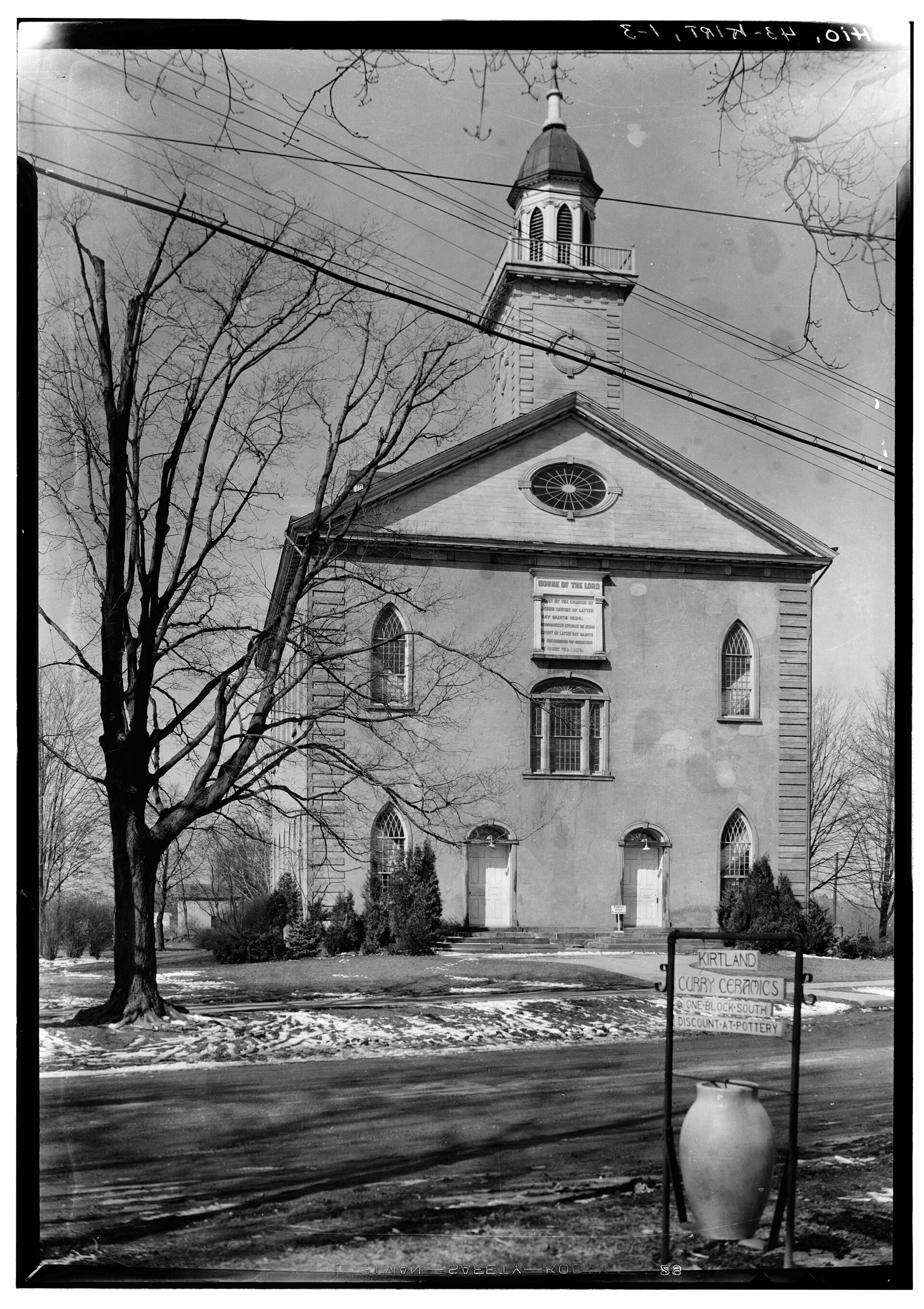
The position here is two-part. First, the official designation 1834–1838 lacked "Christ." That is real, and the CES Letter's "4 whole years" math is technically correct. Second, the Church's lived rhetoric during that window stayed centered on Christ: in period publications, in period correspondence, and in the hybrid forms that official Church publications used. The four-year window, in other words, is a window in which the official letterhead lacked Christ while everyone using that letterhead still understood their church as Christ's.
Four points put that window in proportion:
- The Church has existed officially since April 6, 1830, over 196 years as of this writing in 2026.
- The 1834–1838 "Latter Day Saints" period was four years, about 2 percent of the institution's existence.
- The 1838 revelation did not simply restore "Christ" to the name. It combined "Jesus Christ" (an expansion of the 1830 anchor, with "Jesus" added per 3 Nephi 27) with "Latter Day Saints" (the 1834 contribution) into a name both more Christ-centered and more institutionally specific than either earlier form.[7:5][4:17]
- If iterative revelation produces a final result better than either intermediate state, the iteration is hard to read as failure; it is the pattern revelation actually follows in scripture itself.[43]
"Better" here is measured against the 3 Nephi 27:7–8 standard the institution itself claims to follow: a church called by Christ's name, built upon Christ's gospel. By that standard the 1838 name is more complete than either earlier form: Christ's full name plus a last-days marker tying the institution to the dispensational framework the Restoration claims. Whitmer's reading invokes a stricter standard: any removal, even for a single conference vote, violates a strict commandment.[44] 3 Nephi 27 itself does not specify continuous-and-exclusive Christ-in-the-letterhead from founding; it specifies that the church must be called in Christ's name to be Christ's church. On Whitmer's narrow reading the 1834–1838 period fails that test. On a broader reading (informal usage anchoring identity in Christ, members partaking of the sacrament regularly in Christ's name, period publications overwhelmingly using "Church of Christ" terminology) the institution did not stop being called by Christ's name even when the letterhead changed. Whitmer's reading is not unreasonable, only the less well supported of the two by the lived historical record.
This is what continuing revelation looks like: human deliberation working toward truth, with God providing definitive resolution that vindicates the deliberative process by integrating its contributions rather than discarding them.
The 1851 Deseret incorporation and subsequent standardization
The CES Letter's three-date framing also omits the 1851 legal incorporation that fixed the Church's modern legal form. Its parenthetical concedes that the hyphen came later; it does not say when. On February 8, 1851, the provisional State of Deseret legislature passed a corporate ordinance incorporating the Church under the name in its modern legal form, "The Church of Jesus Christ of Latter-day Saints."[4:18] The hyphenated, lowercase-d "Latter-day" was a British-influenced spelling already in Church use by the 1840s (the first Millennial Star carried a hyphen in 1840, and the First Presidency's April 1849 General Epistle printed "Latter-day"); what the 1851 ordinance added was the capitalized definite article "The" as an official part of the name, and it remains part of the official designation today.[4:19][45] The 1921 edition of the Doctrine and Covenants, prepared under James E. Talmage's editorial direction, capitalized the mid-verse "The" in section 115's name, and updates in 1966–1967 then formalized style guidance across Church publications.[15:3]
The 1851 incorporation matters because it shows naming refinement continuing after 1838. The basic name has not changed since 1838, 188 years of stability, but punctuation, capitalization, and usage have been refined across multiple legal and editorial moments. The pattern across the entire history is iterative refinement of the same fundamental name.
Russell M. Nelson and "The Correct Name of the Church"
The CES Letter's 2017 update predates the most consequential modern intervention on this question: President Russell M. Nelson's August 16, 2018 Newsroom statement and his October 2018 General Conference talk "The Correct Name of the Church."
On August 16, 2018, the Church Newsroom published a statement under President Nelson's name:
"The Lord has impressed upon my mind the importance of the name He has revealed for His Church, even The Church of Jesus Christ of Latter-day Saints. We have work before us to bring ourselves in harmony with His will."[16:2]
The Newsroom statement signaled a phased rollout of the directive across Church communications: the formal name in first reference, "the Church" or "the Church of Jesus Christ" in subsequent references, and "Latter-day Saints" or "members of The Church of Jesus Christ of Latter-day Saints" rather than "Mormons."[16:3][45:1] On October 5, 2018, the choir formerly known as the Mormon Tabernacle Choir was renamed "The Tabernacle Choir at Temple Square," a high-visibility implementation of the broader directive.[46]
President Nelson's October 2018 General Conference talk made the doctrinal framework explicit. Delivered in the Sunday Morning Session and titled "The Correct Name of the Church":[17:2]
"Joseph Smith did not name the Church restored through him; neither did Mormon. It was the Savior Himself who said, 'For thus shall my church be called in the last days, even The Church of Jesus Christ of Latter-day Saints.'"[17:3]
Three features of Nelson's talk bear on the naming question. First, he cited the canonical scriptural anchors directly, D&C 115:4 and 3 Nephi 27:7–8.[17:4] Those are the two passages the positive case above rests on; Nelson's framing connects the Book of Mormon's scriptural standard to the modern Church's renewed emphasis. Second, he framed the renewed emphasis as a correction within an existing framework rather than a name change: "Instead, it is a correction. It is the command of the Lord."[17:5] The official name has been the same since 1838; the 2018 emphasis is on consistent usage, not on changing the form. Third, he made the pastoral case explicitly: "To remove the Lord's name from the Lord's Church is a major victory for Satan. When we discard the Savior's name, we are subtly disregarding all that Jesus Christ did for us—even His Atonement."[17:6] The talk closed with a covenantal invitation: "I promise you that if we will do our best to restore the correct name of the Lord's Church, He whose Church this is will pour down His power and blessings upon the heads of the Latter-day Saints, the likes of which we have never seen."[17:7]
The 2018 intervention is a modern-revelation response to the broader question the CES Letter raises. The CES Letter's question presupposes a Church that does not respond to its own naming history through revelation; the 2018 directive shows that it does exactly that.
Further Reading
Russell M. Nelson, "The Correct Name of the Church," October 2018 General Conference Sunday Morning Session. The full text and video are available at the Church's official site.[17:8] The talk cites D&C 115:4 and 3 Nephi 27:7–8 as the canonical anchors and frames the renewed emphasis as "a correction" within an existing framework rather than a name change. The August 16, 2018 Newsroom statement and accompanying style guidance lay out the implementation details across Church communications.[16:4][45:2]
Comparative cases: institutional name evolution is normal
The CES Letter treats name iteration as inherently disqualifying for a divinely-led institution. The comparative record across both ecclesial and secular institutions shows iteration is the norm, not the exception. One qualification first: a revelation-claiming institution iterating its name is not strictly analogous to a non-revelation-claiming institution doing the same, since the Latter-day Saint claim is that Christ Himself revealed the name through Joseph Smith.[47] What the comparative cases do settle, more modestly, is that name iteration during the founding period is normal across both secular and ecclesial contexts, meaning the bare fact of three names in eight years is not, by itself, evidence of anything unusual. The comparative cases supply background; the substantive Latter-day Saint claim has to be evaluated on its own terms.
The United States
The naming of the United States went through fourteen years of refinement across multiple foundational documents:
| Date | Name | Source |
|---|---|---|
| June 1775 | "United Colonies" in use when Congress appointed Washington commander in chief | National Constitution Center[48] |
| June 1776 | "United States of America" in Jefferson's Declaration draft | Library of Congress[49] |
| July 2, 1776 | Lee Resolution (presented June 7, adopted July 2) still uses "United Colonies" | National Constitution Center; National Archives[48:1][49:1] |
| July 4, 1776 | Declaration of Independence adopted | National Archives[49:2] |
| September 9, 1776 | Continental Congress formally adopts "United States of America" | National Archives[49:3] |
| 1777 | Articles of Confederation, Article I: "The Stile of this confederacy shall be, 'The United States of America.'" | National Archives[50] |
| 1789 | Constitution retains "the United States of America" | National Archives[50:1] |
No one argues the United States is therefore not a real nation. Iteration is normal for new institutions working out their identity.
Early Christianity
The biblical record itself shows the early Christian movement's name shifting over time. Acts uses multiple designations:
- Acts 9:2: "if he found any of this way", the Christian movement called "the Way"[51]
- Acts 19:9, 23; 22:4; 24:14, 22: continued "the Way" usage[51:1]
- Acts 11:26: "the disciples were called Christians first in Antioch"[51:2]
The name "Christian" itself arrived years after Pentecost, applied to the movement at Antioch most likely by outsiders rather than by self-designation in the earliest period. The biblical pattern itself is iterative. If the Latter-day Saint sequence (Church of Christ → Church of the Latter Day Saints → Church of Jesus Christ of Latter-day Saints) is suspect because it iterated, the early Christian movement (the Way → Christians) faces the same charge.
Community of Christ (2001): a Restoration-tradition case
In 2001, the Reorganized Church of Jesus Christ of Latter Day Saints became "Community of Christ." Christopher James Blythe documents the rename's framing: the new name "honors the church's early heritage, paying homage to the original Church of Christ name."[33:3] The Community of Christ even framed the rename in revelatory language, with the new name later verified by a revelation added to its own Doctrine and Covenants: "'Community of Christ,' your name, given as a divine blessing, is your identity and calling."[33:4]
The Community of Christ case carries weight because it is within the Restoration tradition. The CES Letter implicitly treats institutional name iteration as evidence against revelation. The Community of Christ, a Restoration-tradition denomination directly descended from the same 1830 founding, continues to refine its institutional name 171 years after the 1830 organization, and frames the refinement in revelatory language. If iteration is disqualifying for the Latter-day Saints, the same standard disqualifies the Community of Christ, which would mean disqualifying the entire Restoration tradition's response to its own naming history. Within that tradition, iterating the institutional name is simply what the family of churches has always done.
Grace Communion International (2009): an outside-the-Restoration case
The 2009 rename of the Worldwide Church of God to Grace Communion International followed major doctrinal shifts under Joseph W. Tkach Sr. beginning in 1988. The rename was framed as institutional re-identification reflecting fundamental theological transformation.[52] This is a comparative case from outside the Restoration tradition entirely: a Protestant institution iterating its name across a major doctrinal transition, the iteration treated as institutionally appropriate rather than disqualifying.
The pattern
The cases above cover the relevant comparative ground: a secular nation iterating across foundational documents; the New Testament biblical pattern itself documenting iterative naming; a Restoration-tradition denomination continuing to refine its institutional name into the twenty-first century; a Protestant denomination outside the Restoration tradition rebranding across major doctrinal change. The Latter-day Saint sequence is, by comparison, more coherent than many comparable cases: grounded in pre-existing scripture (Mosiah 18:17, 3 Nephi 26:21), addressing a documented practical naming-conflict problem with Stone-Campbell congregations, integrated by revelation in 1838, refined in punctuation and capitalization in 1851, and emphasized again in 2018 without changing the underlying form. Against that backdrop, three names in eight years looks less like a red flag and more like a founding institution doing what founding institutions do, with unusually tidy results.
Goodwin's "collaborative and revelatory" framework
The strongest current scholarly anchor on the faithful side is K. Shane Goodwin, "The History of the Name of the Savior's Church: A Collaborative and Revelatory Process," BYU Studies Quarterly 58, no. 3 (2019).[4:20] Goodwin's article is the modern reference work on the topic and supersedes the older Anderson 1979 Ensign Q&A as the lead citation. Its central thesis is captured in its title: the 1830→1834→1838→1851 sequence is "collaborative and revelatory," revelation arriving in increments alongside human deliberation.
BYU Studies Quarterly is a faithful Latter-day Saint scholarly journal, and Goodwin writes inside the Restoration tradition's doctrinal commitments: continuing revelation, prophetic authority, the inspired character of D&C 115. His "collaborative and revelatory" reading is faithful scholarship of unusually high rigor. It is not neutral consensus scholarship a skeptic is expected to accept on independent grounds. Goodwin's framework is the strongest faithful reading available, and it engages the historical record without selective omission: a faithful interpreter taken seriously, not a neutral historian whose conclusions a skeptic must accept.
Goodwin's framework rests on three theological commitments:
First, revelation is iterative rather than dictational. Goodwin invokes Elder David A. Bednar's metaphor that revelation operates both as immediate illumination and as gradual dawn.[4:21] This is consistent with D&C 98:12 ("he will give unto the faithful line upon line, precept upon precept") and Isaiah 28:10's similar pattern.[43:1][53] Revelation that arrives in increments is the documented scriptural pattern, not a degraded form of the real thing.
Second, revelation is collaborative, a synthesis of human and divine action. Goodwin quotes Blake Ostler's framing: revelation "is the synthesis of a human and divine event."[4:22] The 1830→1838 sequence reflects this synthesis: human deliberation at the 1834 conference, divine confirmation in 1838, both elements jointly producing the final integrated name.
Third, the 1838 revelation can be read as confirmative as well as declarative. Goodwin's reading of D&C 115:3, which uses "my Church of Jesus Christ of Latter-day Saints" one verse ahead of the official declaration, is that the Lord is ratifying usage already current among the Saints rather than introducing a new name. Goodwin asks directly: "Is verse 4 a declarative or a confirmative statement from the Lord Jesus Christ, or is it both?" His answer: "the Lord is sanctioning the name his small group of early Latter-day Saints had already been inspired to start using."[4:23]
The framework has room for each of the hard facts above: Whitmer's witness to 1834, the administrative character of the 1834 vote, Rigdon's motion, the four-year gap, the 1838 timing during institutional crisis. It integrates them into a coherent position: the sequence is how continuing revelation behaves when revelation is understood as iterative and collaborative rather than single-moment dictation. Goodwin notes Whitmer's 1887 framing was "not made contemporaneously," 53 years after the events, and reflects "less-than-optimal objectivity and apparent bitterness after he had distanced himself from the Church."[4:24] Goodwin does not dismiss Whitmer. He contextualizes him while engaging the substantive interpretive questions the Address raises on their merits.
Further Reading
K. Shane Goodwin, "The History of the Name of the Savior's Church: A Collaborative and Revelatory Process," BYU Studies Quarterly 58, no. 3 (2019). The most thorough faithful scholarly treatment of the topic available. Goodwin's "collaborative and revelatory" framework is the strongest current anchor for engaging the criticism, and it supersedes Richard Lloyd Anderson's 1979 Ensign Q&A as the lead citation. https://byustudies.byu.edu/article/the-history-of-the-name-of-the-saviors-church-a-collaborative-and-revelatory-process[^Goodwin]
The KnoWhy positive case from 3 Nephi 27
Scripture Central's KnoWhy #482 ("Why Must Christ's True Church Be Called after His Name?") frames the positive case as four interconnected principles drawn from 3 Nephi 27:[54] avoid disputations over doctrine (3 Nephi 27:3–4 records Christ settling a dispute over the church's name among the Nephites; names carry doctrinal weight); scripture already contains the answer (the 1830 Saints had Mosiah 18:17 in print before organization, the 1838 Saints had 3 Nephi 27:7–8, so the scriptural standard preceded both institutional moments); all actions must reflect Christ's name and authority ("everything they do should be a reflection of Christ's good name"[54:1]); and the Church must be built on Christ's true gospel (3 Nephi 27:8 ties naming to gospel-foundation, making the naming question inseparable from the doctrinal foundation question).
Names matter because identity matters. The Latter-day Saint commitment to Christ-centered self-reference reflects a covenantal commitment to taking Christ's name in a substantive sense, not just as a corporate label but as a daily commitment members reaffirm at the sacrament table each Sunday. The sacrament prayers in Moroni 4:3 and D&C 20:77, 79, together with the baptismal covenant in D&C 20:37, make the naming covenant explicit: members partake of the bread and water in remembrance of Christ and "always remember him, and keep his commandments which he hath given them, that they may always have his Spirit to be with them."[55][56] The KnoWhy frames Nelson's 2018 emphasis as a correction of an accumulated error rather than a name change.[54:2] The 1838 revelation established the official name; the 2018 directive emphasizes consistent usage of that already-established name.
Assessment
The CES Letter's argument compresses roughly a page of historical material into three dates, three names, a photograph, and a series of rhetorical questions. That efficiency, as the sections above have priced out piece by piece, costs the reader nearly everything that makes the history intelligible.
It opens with a verifiable factual error, since the founding name read "Church of Christ" and not "Church of Jesus Christ," a point settled by D&C 20:1 and the Joseph Smith Papers' editorial summary.[3:4][6:4] It compresses the agency of the 1834 change, where the Joseph Smith Papers' minutes document a motion-second-vote sequence with multiple participants, not a unilateral decision.[12:10] It omits the Stone-Campbell Movement context that supplies the practical pressure for the 1834 change,[25:1][26:3][27:3] the 1837–38 institutional crisis context that frames the timing of D&C 115,[33:5][4:25] the Book of Mormon scriptural anchors that ground both the 1830 and 1838 names,[10:3][19:1][9:4][7:6] and the post-2018 Russell M. Nelson framing that supplies the modern Church's own doctrinal-emphasis response.[16:5][17:9]
Alongside each of these corrections sits a layered set of plain concessions. David Whitmer's 1887 dissent is a real witness from a Three Witnesses signatory. Sidney Rigdon's pre-conversion experience supplies the simplest naturalistic explanation for the 1834 motion. The 1834 change was administrative rather than revelatory. Christ's name was absent from the official designation for four years. The 1838 revelation arrived during a documented institutional crisis. The doctrine-versus-administration framework that absorbs the 1834 vote is a faithful interpretive lens, not a self-evident neutral reading. Goodwin's "collaborative and revelatory" framework is the strongest faithful scholarly position, not neutral consensus a skeptic must accept. The iterative-revelation framing is falsifiable in principle, and the actual sequence satisfies its predictions: it converged on scripture, kept Christ at its center, and settled into a stable form.
Even a reader who rejects Goodwin's framework is left with the documented timeline. The Church's name originates in Book of Mormon scripture (Mosiah 18:17, 3 Nephi 26:21) and resolves by fulfilling a Book of Mormon scriptural standard (3 Nephi 27:7–8). Both of those passages were in print in 1830: eight years before D&C 115, and four years before the 1834 vote the CES Letter treats as the founding error. Whatever one concludes about the four-year window, the standard against which the whole sequence is measured predates every change in it. The 1830→1838 sequence is the institution bringing its name into line with scripture it already held.
Bottom line: The CES Letter compresses 196 years of iterative naming into three dates and a verifiable factual error: the 1830 name was "Church of Christ," not "Church of Jesus Christ." The 1834 change was administrative deliberation by a parliamentary conference vote responding to real Stone-Campbell naming overlap and Sidney Rigdon's pre-conversion familiarity with that landscape. The 1838 D&C 115:4 revelation either corrected a 1834 administrative mistake (the simplest reading) or integrated the 1834 contribution into a fuller form (the iterative reading); the article holds both as compatible. David Whitmer's 1887 witness is real and honored; his "exclusive command" framing first appears in 1887 rather than in the contemporary 1830s record. K. Shane Goodwin's "collaborative and revelatory" framework (a faithful reading from a faithful scholar, not neutral consensus scholarship) integrates the concessions into a doctrinal framing that fits the documented record under the assumption of continuing revelation. Whether the framework itself is correct is a separate question the skeptic need not concede; what stands independent of it is the timeline. Both scriptural standards the sequence answers to, Mosiah 18:17 and 3 Nephi 27:7–8, were in print before the 1834 change and the 1838 revelation alike. Russell M. Nelson's 2018 directive shows that modern revelation continues to address institutional naming. Every difficult piece of this history is named above, and none of them needed hiding.
Runnells, CES Letter (2017), "Other Concerns," p. 119. ↩︎ ↩︎
Runnells, CES Letter (2017), "Other Concerns," p. 120. ↩︎
Doctrine and Covenants 20:1. The Articles and Covenants of the Church, the Church's founding governance document, opens: "The rise of the Church of Christ in these last days, being one thousand eight hundred and thirty years since the coming of our Lord and Savior Jesus Christ in the flesh, it being regularly organized and established agreeable to the laws of our country, by the will and commandments of God, in the fourth month, and on the sixth day of the month which is called April—" https://www.churchofjesuschrist.org/study/scriptures/dc-testament/dc/20 ↩︎ ↩︎ ↩︎ ↩︎ ↩︎
K. Shane Goodwin, "The History of the Name of the Savior's Church: A Collaborative and Revelatory Process," BYU Studies Quarterly 58, no. 3 (2019): 4–41. The modern scholarly reference work on the topic. Goodwin frames the 1830→1834→1838→1851 sequence as iterative revelation arriving alongside human deliberation, reads D&C 115:3 as the Lord confirming a name already emerging organically among the Saints, and engages David Whitmer's 1887 dissent on the historical merits. https://byustudies.byu.edu/article/the-history-of-the-name-of-the-saviors-church-a-collaborative-and-revelatory-process ↩︎ ↩︎ ↩︎ ↩︎ ↩︎ ↩︎ ↩︎ ↩︎ ↩︎ ↩︎ ↩︎ ↩︎ ↩︎ ↩︎ ↩︎ ↩︎ ↩︎ ↩︎ ↩︎ ↩︎ ↩︎ ↩︎ ↩︎ ↩︎ ↩︎ ↩︎
Richard Lloyd Anderson, "What Changes Have Been Made in the Name of the Church? Its Full Designation Does Not Appear in the Revelations Until 1838 (D&C 115:4)," Ensign, January 1979. Anderson identifies three distinct phases (1830–1834 Church of Christ; 1834–1838 Church of the Latter Day Saints; 1838 onward Church of Jesus Christ of Latter-day Saints) and notes that "[s]ince American Christians, including Congregationalists and reformers, frequently designated themselves as 'The Church of Christ,' that title did not distinguish the restored gospel from a host of Protestant sects." https://www.churchofjesuschrist.org/study/ensign/1979/01/i-have-a-question/what-changes-have-been-made-in-the-name-of-the-church-its-full-designation-does-not-appear-in-the-revelations-until-1838-d-and-c-115-4 ↩︎ ↩︎
"Church of Christ," Topic entry, Joseph Smith Papers: "The first name used to denote the church JS organized on 6 April 1830 was 'the Church of Christ.'" https://www.josephsmithpapers.org/topic/church-of-christ. The document itself is "Articles and Covenants, circa April 1830 [D&C 20]," https://www.josephsmithpapers.org/paper-summary/articles-and-covenants-circa-april-1830-dc-20/1 ↩︎ ↩︎ ↩︎ ↩︎ ↩︎
Doctrine and Covenants 115:1–4. The April 26, 1838 revelation received at Far West, Missouri. Verse 4 reads: "For thus shall my church be called in the last days, even The Church of Jesus Christ of Latter-day Saints." https://www.churchofjesuschrist.org/study/scriptures/dc-testament/dc/115 ↩︎ ↩︎ ↩︎ ↩︎ ↩︎ ↩︎ ↩︎
Runnells, CES Letter (2017), "Other Concerns," p. 119. The display block on p. 119 stacks "1830: CHURCH OF JESUS CHRIST / 1834: THE CHURCH OF THE LATTER DAY SAINTS / 1838: THE CHURCH OF JESUS CHRIST OF LATTER DAY SAINTS" in red type, with a hyperlinked footnote 34 marker after the 1834 entry. The same page includes a photograph captioned "KIRTLAND TEMPLE" showing the inscription "HOUSE OF THE LORD / BUILT BY THE CHURCH OF THE / LATTER DAY SAINTS. A.D. 1834." ↩︎
3 Nephi 27:4–8. Christ's instruction to the Nephite disciples about the proper name of his church: "Have they not read the scriptures, which say ye must take upon you the name of Christ, which is my name?... how be it my church save it be called in my name? For if a church be called in Moses' name then it be Moses' church; or if it be called in the name of a man then it be the church of a man; but if it be called in my name then it is my church, if it so be that they are built upon my gospel." https://www.churchofjesuschrist.org/study/scriptures/bofm/3-ne/27 ↩︎ ↩︎ ↩︎ ↩︎ ↩︎
Mosiah 18:17. The Book of Mormon's first naming pattern, set during Alma the Elder's organization of believers at the Waters of Mormon: "And they were called the church of God, or the church of Christ, from that time forward." https://www.churchofjesuschrist.org/study/scriptures/bofm/mosiah/18 ↩︎ ↩︎ ↩︎ ↩︎
Goodwin documents Oliver Cowdery's June 1829 "Articles of the Church of Christ" — a pre-organizational document that established the "Church of Christ" naming pattern before the formal April 6, 1830 organization. See Goodwin 2019 for citation details. ↩︎ ↩︎
"Minutes, 3 May 1834," Joseph Smith Papers. The primary record of the Kirtland conference vote. Joseph Smith Jr. served as moderator; Frederick G. Williams and Oliver Cowdery served as clerks; Sidney Rigdon motioned the resolution; Newel K. Whitney seconded; the resolution "passed by unanimous voice." The minutes record the resolution that "this church be known hereafter by the name of THE CHURCH OF THE LATTER DAY SAINTS," a follow-up resolution recommending that the conferences and churches abroad use the new title in making out and transmitting the minutes of their proceedings, and a resolution that the minutes be signed and published in The Evening and the Morning Star. https://www.josephsmithpapers.org/paper-summary/minutes-3-may-1834/1 ↩︎ ↩︎ ↩︎ ↩︎ ↩︎ ↩︎ ↩︎ ↩︎ ↩︎ ↩︎ ↩︎
"Changes in the Name of the Church," FAIR. Includes statistical analysis of period publications (1834–1837 Messenger and Advocate: 33 "Church of Christ" appearances vs. 0 "Church of Jesus Christ," with the full 1838 name marked "xx" as not yet in use; 1837–1838 Elders Journal: 10 "Church of Christ" vs. 1 "Church of Jesus Christ of LDS"). FAIR's table carries five name-form columns, two of which this article does not reproduce ("Latter-day Saints" used alone and "Mormon Church"), and credits the counts to Ted Jones, FairMormon researcher, private communication (7 April 2007), updated 1 April 2010. FAIR states that "Christ only instructed Joseph through revelation to change the name of the Church once" (referring to 1838). https://www.fairlatterdaysaints.org/answers/Mormonism_and_church_organization/Changes_in_the_name_of_the_Church ↩︎ ↩︎ ↩︎ ↩︎ ↩︎ ↩︎ ↩︎ ↩︎ ↩︎
"Revelation, 26 April 1838 [D&C 115]," Joseph Smith Papers. Editorial context: revelation received at Far West, Missouri. Copied into Joseph Smith's Scriptory Book by George W. Robinson around the time the revelation was dictated. The revelation also approved Far West as a new gathering place for Zion and authorized temple construction beginning July 4, 1838. https://www.josephsmithpapers.org/paper-summary/revelation-26-april-1838-dc-115/1 ↩︎
"Name of the Church," Church History Topics, The Church of Jesus Christ of Latter-day Saints. Documents 1829–1834 "Church of Christ" with Oliver Cowdery's pre-organizational role; 1834 conference vote to "change the name of the Church to 'the Church of the Latter Day Saints'" with the aim of helping the Saints distinguish themselves from other groups using "Church of Christ"; the topic notes the new name also distanced the Church from the terms "Mormon" and "Mormonite" used by opponents; 1838 D&C 115 establishment near Far West; Talmage's 1921 D&C edition capitalizing the mid-verse "The"; 1966–1967 style guide formalization. https://www.churchofjesuschrist.org/study/history/topics/name-of-the-church ↩︎ ↩︎ ↩︎ ↩︎
"The Name of the Church," Church Newsroom, August 16, 2018. President Russell M. Nelson statement: "The Lord has impressed upon my mind the importance of the name He has revealed for His Church, even The Church of Jesus Christ of Latter-day Saints. We have work before us to bring ourselves in harmony with His will." https://newsroom.churchofjesuschrist.org/article/name-of-the-church ↩︎ ↩︎ ↩︎ ↩︎ ↩︎ ↩︎
Russell M. Nelson, "The Correct Name of the Church," General Conference, October 2018, Sunday Morning Session. Nelson cites D&C 115:4 and 3 Nephi 27:7–8 as canonical anchors. Key quotes include: "Instead, it is a correction. It is the command of the Lord"; "Joseph Smith did not name the Church restored through him; neither did Mormon. It was the Savior Himself who said, 'For thus shall my church be called in the last days, even The Church of Jesus Christ of Latter-day Saints'"; "To remove the Lord's name from the Lord's Church is a major victory for Satan"; "I promise you that if we will do our best to restore the correct name of the Lord's Church, He whose Church this is will pour down His power and blessings upon the heads of the Latter-day Saints, the likes of which we have never seen." https://www.churchofjesuschrist.org/study/general-conference/2018/10/the-correct-name-of-the-church ↩︎ ↩︎ ↩︎ ↩︎ ↩︎ ↩︎ ↩︎ ↩︎ ↩︎ ↩︎
The Book of Mormon's first copies were available for sale in late March 1830, with the fixed dated point being the Wayne Sentinel (Palmyra, NY) advertisement of 26 March 1830; the Church was organized eleven days later, on April 6, 1830. See "Copyright for Book of Mormon, 11 June 1829," and "Agreement with Martin Harris, 16 January 1830," Joseph Smith Papers. https://www.josephsmithpapers.org/paper-summary/copyright-for-book-of-mormon-11-june-1829/1 ↩︎
3 Nephi 26:21. "And they who were baptized in the name of Jesus were called the church of Christ." A second Book of Mormon usage of "church of Christ" naming, complementing Mosiah 18:17. https://www.churchofjesuschrist.org/study/scriptures/bofm/3-ne/26 ↩︎ ↩︎
Doctrine and Covenants 21:11. The April 6, 1830 revelation directed to Oliver Cowdery: "that you might be an elder unto this church of Christ, bearing my name—" https://www.churchofjesuschrist.org/study/scriptures/dc-testament/dc/21 ↩︎
The relevant pre-1834 revelations include D&C 21:11 (April 1830, "this church of Christ"), D&C 26:2 (July 1830, common consent), D&C 42 (February 1831, the "Law of the Church"), and D&C 84 (September 1832, priesthood). Across this four-year span, Joseph Smith's revelations consistently refer to the institution as "Church of Christ" or "this church" or "my church" — making the May 3, 1834 vote a departure from a continuous pattern Joseph himself had received in revelation rather than from a single revelation commanding the name exclusively. ↩︎
Doctrine and Covenants 26:2: "And all things shall be done by common consent in the church, by much prayer and faith, for all things you shall receive by faith. Amen." https://www.churchofjesuschrist.org/study/scriptures/dc-testament/dc/26 ↩︎
Doctrine and Covenants 9:8: "But, behold, I say unto you, that you must study it out in your mind; then you must ask me if it be right, and if it is right I will cause that your bosom shall burn within you; therefore, you shall feel that it is right." https://www.churchofjesuschrist.org/study/scriptures/dc-testament/dc/9 ↩︎
The distinction between "administrative deliberation" and "revelatory action" is a doctrinal framework articulated principally in modern Latter-day Saint thought — there is no contemporaneous statement from Joseph Smith, Sidney Rigdon, or any other 1834 conference participant on the May 3 minutes saying "this resolution is administrative, not revelatory." The framework supplies a coherent way to read inspired-leadership action as iterative rather than infallible, consistent with the Latter-day Saint tradition's commitments to continuing revelation, to "common consent" governance under D&C 26:2, and to the "study it out in your mind" pattern of D&C 9:8. This is confessional. The skeptic is not obligated to accept it; the article is making a faithful internal-coherence argument rather than a neutral historical-consensus claim. ↩︎
"History of the Disciples," Christian Church (Disciples of Christ). Documents the Stone-Campbell merger of 1832 in Lexington, Kentucky, "after about a quarter of a century of separate development." https://disciples.org/our-identity/history-of-the-disciples/ ↩︎ ↩︎
"Restoration Movement," Wikipedia. Provides comprehensive background on the Stone-Campbell movement, including the formation of "Disciples of Christ" (Alexander Campbell, western Pennsylvania) and "Christians" (Barton W. Stone, Kentucky), their 1832 merger (formalized at the Hill Street Meeting House in Lexington, Kentucky, with a handshake between Stone and "Raccoon" John Smith), the geographic distribution of congregations across Kentucky and the Ohio River valley, western Pennsylvania, and Virginia (now West Virginia), and the unresolved naming dispute that left both "Disciples of Christ" and "Church of Christ" in active use across the same regions where the early Latter-day Saints operated. https://en.wikipedia.org/wiki/Restoration_Movement ↩︎ ↩︎ ↩︎ ↩︎
"Sidney Rigdon," Wikipedia. Documents Rigdon's pre-conversion religious history: May 31, 1817 baptism at Peter's Creek Baptist Church, Library, Pennsylvania; Summer 1821 meeting with Alexander Campbell and joining the Disciples of Christ movement associated with Campbell; January 28, 1822 arrival in Pittsburgh as minister at First Baptist Church; 1823 Pittsburgh schism; 1824–1826 work as a journeyman tanner in Pittsburgh while preaching Campbell's Restorationism on Sundays in the courthouse; 1826 pastor of "the more liberal Baptist church" in Mentor, Ohio, in the Western Reserve; November 14, 1830 baptism into the Latter-day Saint Church in Mentor, Ohio. The Wikipedia article uses "Disciples of Christ (Campbell movement)" terminology rather than "Reformed Baptist"; the standard academic biography (Van Wagoner, Sidney Rigdon: A Portrait of Religious Excess, Signature Books, 1994) uses "Reformed Baptist" as a self-designation Campbell himself employed during the 1820s, which is the label this article retains for that pre-1832-merger phase. https://en.wikipedia.org/wiki/Sidney_Rigdon ↩︎ ↩︎ ↩︎ ↩︎
David Whitmer, An Address to All Believers in Christ (Richmond, MO: David Whitmer, 1887). The single most-cited critical primary source on the 1834 name change. Whitmer was one of the Three Witnesses to the Book of Mormon and never recanted his Book of Mormon testimony, reaffirming it on his deathbed in January 1888. Internet Archive: https://archive.org/details/anaddresstoallb00whitgoog. FAIR Primary transcription: https://www.fairlatterdaysaints.org/answers/Primary_sources/David_Whitmer/An_Address_to_All_Believers_in_Christ ↩︎ ↩︎ ↩︎
David Whitmer, An Address to All Believers in Christ (Richmond, MO: David Whitmer, 1887), pp. 73–74. "Now it is strange, it is marvelous, that the Latter Day Saints to-day consider this matter of changing the name of the church, and the leaders in 1834 dropping out the name of Christ, as a small thing and a light matter!… It is nothing short of trifling with a strict commandment of Almighty God, and setting at naught the decision of Christ himself when He decided this matter so plainly and so positively, when there were disputations regarding it." Internet Archive: https://archive.org/details/anaddresstoallb00whitgoog ↩︎
David Whitmer, An Address to All Believers in Christ (1887), p. 59. "Through the influence of Sydney [sic] Rigdon, Brother Joseph was led on and on into receiving revelations every year, to establish offices and doctrines which are not even mentioned in the teachings of Christ in the written word." Whitmer's attribution of broader institutional changes (not only the 1834 name change but later doctrinal developments) to Sidney Rigdon's influence is consistent across the Address. ↩︎
Isaiah 65:15 (KJV): "And ye shall leave your name for a curse unto my chosen: for the Lord GOD shall slay thee, and call his servants by another name." William McLellin cited this verse in his Ensign of Liberty (April 1847) as a prophecy he believed was fulfilled by the 1834 name change; see Christopher James Blythe, "Ye Shall Call the Church in My Name," Maxwell Institute, October 11, 2018. https://mi.byu.edu/blythe-church-names/ ↩︎
Whitmer's exclusive-command claim functions simultaneously as a 53-year-later interpretation and as a first-person witness statement, which is why the article cannot simply route around it as "post-estrangement interpretation." If a Three Witnesses signatory says "I was there in 1829 and the name was given by direct command of the Lord," that is a witness statement. The faithful response has to explain why we trust some of Whitmer's witness and not others — and the explanation rests on the contemporary 1830s documentary record (letters, minutes, correspondence with other Saints) preserving no such exclusive-command claim. The framing first appears in the 1887 Address itself, 57 years after the founding. Whitmer's own contemporary 1830s testimony, like the contemporary testimony of every other 1830 founder, treats "Church of Christ" as the right name without claiming exclusive divine command. ↩︎
Christopher James Blythe, "Ye Shall Call the Church in My Name: A Multi-Denominational History of Latter Day Saint Responses to 3 Nephi 27 (Or a Story of Church Names)," Maxwell Institute, October 11, 2018. Blythe documents the 1837 Warren Parrish-led "Church of Christ" schism as a key contextual driver for the 1838 D&C 115 revelation, traces the lasting denominational controversy generated by the 1834 change, and engages comparative cases including the 2001 Community of Christ rename. https://mi.byu.edu/blythe-church-names/ ↩︎ ↩︎ ↩︎ ↩︎ ↩︎ ↩︎
"Kirtland Safety Society," Glossary, The Joseph Smith Papers. The entry dates the society's founding to fall 1836 and its closure to late summer 1837 ("The institution closed before 3 September 1837"), notes the May 1837 financial panic that left most banks unwilling to accept or redeem the society's notes, and records that Joseph Smith and Sidney Rigdon were tried in absentia on charges of unauthorized banking on 24 October 1837. https://www.josephsmithpapers.org/topic/kirtland-safety-society ↩︎
"Kirtland Safety Society," Church History Topics, The Church of Jesus Christ of Latter-day Saints. The topic states that the society "struggled for months before ceasing operations by August 1837," that many Saints incurred financial setbacks "particularly Joseph Smith, whose losses were substantial," and that the society's difficulties "sparked dissension within the Church" and prompted a significant migration of faithful Saints to Missouri. https://www.churchofjesuschrist.org/study/history/topics/kirtland-safety-society?lang=eng ↩︎
"William Wines Phelps," Biographical Directory, The Joseph Smith Papers. The dated life-events list records "Excommunicated, 10 Mar. 1838," citing Minute Book 2, 10 Mar. 1838. The historical introduction to "Minutes, 13 April 1838" supplies the companion detail: after the three members of the Missouri presidency protested their removal by letter, "the high council read the letter and excommunicated Phelps and John Whitmer" the same day, while "[n]o action was taken against David Whitmer until 9 April, when he was notified of his 13 April trial." https://www.josephsmithpapers.org/person/william-wines-phelps ↩︎
"Minutes, 12 April 1838," p. 1, The Joseph Smith Papers. The record of Oliver Cowdery's church trial at Far West, Caldwell County, Missouri, at which Joseph Smith testified twice; "Partridge and his counselors decided to excommunicate Cowdery; the high council concurred." The editors pair the 12 April trial with the 13 April trials as "the culmination of ecclesiastical efforts to cull dissent and division within the church." https://www.josephsmithpapers.org/paper-summary/minutes-12-april-1838/1 ↩︎
"Minutes, 13 April 1838," p. 1, The Joseph Smith Papers. The record of the meeting at which the Zion presidency and high council considered the charges against Lyman Johnson and David Whitmer. Johnson's case was heard first and "the council excommunicated Johnson"; the council then turned to David Whitmer, read his letter, "and determined that he should be excommunicated." https://www.josephsmithpapers.org/paper-summary/minutes-13-april-1838/1 ↩︎
Steven C. Harper and Casey Paul Griffiths, "Historical Context and Background of D&C 115," Doctrine and Covenants Central. Documents the January 12, 1838 revelation directing the First Presidency to relocate from Kirtland to Far West, Joseph Smith's March 14, 1838 arrival at Far West, and the institutional crisis context surrounding the April 26, 1838 D&C 115 revelation. The revelation accomplished three things simultaneously: established the official Church name, designated Far West as "holy and consecrated land," and commanded the Far West temple cornerstone laying for July 4, 1838. https://doctrineandcovenantscentral.org/historical-context/dc-115/ ↩︎
The Word of Wisdom (D&C 89, February 1833) was received in a moment of relative institutional stability — fifteen months before the 1834 conference vote, four years before the Kirtland Safety Society collapse — with dietary content not responsive to any contemporaneous institutional crisis. The Articles of Faith (composed in 1842 in response to a journalist's inquiry) and D&C 76 (the "Vision," February 1832, addressing cosmological questions during a stable period) similarly arose without immediate crisis pressure. Not every revelation in the Doctrine and Covenants fits a crisis-responsive pattern, and the framework distinguishes the two cases: some revelations are responsive (D&C 115, D&C 121–123, D&C 132); some are not (D&C 76, D&C 89, the Articles of Faith). The existence of non-responsive revelations means the framework is not "Joseph always conveniently received revelation under pressure"; it is the documented scriptural pattern that revelation can arrive in response to need. ↩︎
The iterative-revelation framing predicts that the sequence of changes (a) converges toward fulfillment of pre-existing scriptural standards, (b) does not abandon the central confessional content the institution claimed to be founded on, and (c) terminates in a stable form rather than churning indefinitely. A sequence diverging from scripture (e.g., ending in "Church of Joseph Smith"), abandoning Christ entirely (excising his name from the institution's practice rather than briefly dropping it from the letterhead alone), or churning without termination across decades would falsify the framing. The framework is not "every sequence of changes counts as iteration"; it is "changes that converge on pre-existing scriptural standards, preserve central confessional content, and terminate in stable form fit the iterative-revelation pattern." ↩︎
Messenger and Advocate (Kirtland, OH), 1835. FAIR records that in 1835 "the official Church paper referred to the: 'Rise and progress of the church of Christ of Latter Day Saints'" — a hybrid form showing the 1834–1838 transition was gradual and incomplete. FAIR's note for the phrase cites W. W. Phelps to Oliver Cowdery, "Letter No. 8," Latter Day Saints' Messenger and Advocate 1, no. 9 (June 1835), 129–31. https://www.fairlatterdaysaints.org/answers/Mormonism_and_church_organization/Changes_in_the_name_of_the_Church. Goodwin observes: "In reality, there is only a one-word difference (the name 'Jesus') between the 1835 hybrid name 'the Church of Christ of Latter Day Saints' and the April 26, 1838, name revealed to Joseph—'the Church of Jesus Christ of Latter Day Saints.'" ↩︎
Doctrine and Covenants 98:12: "For he will give unto the faithful line upon line, precept upon precept; and I will try you and prove you herewith." https://www.churchofjesuschrist.org/study/scriptures/dc-testament/dc/98 ↩︎ ↩︎
Whitmer was not arguing "four years is too long" — he was arguing that any removal, even for a single conference vote, was a violation of strict commandment. On Whitmer's terms, the brevity of the window does not mitigate anything, because zero seconds of removal is the standard he derives from 3 Nephi 27. Both readings have textual grounding; Whitmer's standard is defensible on its own terms and the article says so; what it holds is that the broader reading (informal usage continuing to anchor identity in Christ; period publications overwhelmingly using "Church of Christ" terminology per FAIR's statistical analysis) is the one the lived historical record arguably supports. ↩︎
"Style Guide — The Name of the Church," Church Newsroom. Editorial guidance distributed post-2018 specifying first-reference and subsequent-reference forms (full name in first reference; "the Church" or "the Church of Jesus Christ" in subsequent references) and member-terminology guidance ("Latter-day Saints" or "members of The Church of Jesus Christ of Latter-day Saints" rather than "Mormons"). https://newsroom.churchofjesuschrist.org/style-guide ↩︎ ↩︎ ↩︎
"The Tabernacle Choir at Temple Square — FAQs," The Tabernacle Choir. Documents the October 5, 2018 announcement that the choir would discontinue use of the "Mormon Tabernacle Choir" name and adopt "The Tabernacle Choir at Temple Square," issued in connection with the broader 2018 directive on the Church's correct name. https://www.thetabernaclechoir.org/faqs.html ↩︎
The United States does not claim divine revelation about its name; the early Christian movement emerged organically; the Worldwide Church of God's 2009 rebrand was framed as institutional re-identification, not revelation. A non-revelation-claiming institution iterating its name is not strictly analogous to a revelation-claiming institution iterating its name — the Latter-day Saint claim raises the bar above what those comparative cases can settle. What the cases supply is more modest background: that name iteration during a founding period is normal, meaning the bare fact of three names in eight years is not, by itself, evidence of anything unusual. ↩︎
"United Colonies," National Constitution Center. Relays John C. Fitzpatrick's account that "the words United Colonies were used by the Congress when it appointed George Washington as commander in chief in June 1775"; quotes Richard Henry Lee's resolution still using "United Colonies"; and documents the September 9, 1776 formal Continental Congress adoption of "United States of America." The NCC page dates the Lee Resolution only to "a June resolution"; the National Archives supplies the precise sequence (presented June 7, 1776; adopted July 2, 1776). https://constitutioncenter.org/blog/today-the-name-united-states-of-america-becomes-offici ↩︎ ↩︎
Library of Congress / National Archives documentation of Thomas Jefferson's use of "United States of America" in his June 1776 draft of the Declaration of Independence, of the Lee Resolution (presented June 7, 1776; adopted July 2, 1776), and of the July 4, 1776 adoption of the Declaration. The Continental Congress formally adopted the name on September 9, 1776. https://www.loc.gov/exhibits/declara/declara4.html and https://www.archives.gov/founding-docs/declaration-history ↩︎ ↩︎ ↩︎ ↩︎
"Articles of Confederation (1777)," National Archives. Article I: "The Stile of this confederacy shall be, 'The United States of America.'" The 1777 Articles of Confederation formally adopted the corporate name that the 1789 Constitution retained. https://www.archives.gov/milestone-documents/articles-of-confederation ↩︎ ↩︎
Acts 9:2; 19:9, 23; 22:4; 24:14, 22 (KJV). The early Christian movement was known as "the Way" before the term "Christian" was first applied at Antioch (Acts 11:26). "And the disciples were called Christians first in Antioch." The biblical pattern itself documents iterative naming for the early Christian community. https://www.biblegateway.com/passage/?search=Acts+9%3A2&version=KJV ↩︎ ↩︎ ↩︎
"Grace Communion International," Wikipedia. Documents the 2009 rebrand from "Worldwide Church of God" following major doctrinal shifts under Joseph W. Tkach Sr. beginning in 1988. Comparative case from outside the Restoration tradition demonstrating that institutional name evolution is normal across Protestant denominations. https://en.wikipedia.org/wiki/Grace_Communion_International ↩︎
Isaiah 28:10 (KJV): "For precept must be upon precept, precept upon precept; line upon line, line upon line; here a little, and there a little." The Old Testament source for the iterative revelation pattern echoed in D&C 98:12. https://www.churchofjesuschrist.org/study/scriptures/ot/isa/28 ↩︎
"Why Must Christ's True Church Be Called after His Name?" Scripture Central KnoWhy #482, August 21, 2019. Connects 3 Nephi 27 to D&C 115:4 with four interconnected principles: avoiding doctrinal disputations, recognizing scripture's preceding answer, ensuring all actions reflect Christ's name and authority, and building the Church on Christ's true gospel. The KnoWhy explicitly invokes Nelson 2018, framing the "correct name" emphasis as correcting an error that "has crept into the Church over time" rather than as a name change. https://scripturecentral.org/knowhy/why-must-christs-true-church-be-called-after-his-name ↩︎ ↩︎ ↩︎
Moroni 4:3. The Book of Mormon sacrament prayer over the bread, including the covenantal language of taking Christ's name: "that they are willing to take upon them the name of thy Son, and always remember him, and keep his commandments which he hath given them, that they may always have his Spirit to be with them." https://www.churchofjesuschrist.org/study/scriptures/bofm/moro/4 ↩︎
Doctrine and Covenants 20:37, 77, 79. Verses 77 and 79 are the canonical sacrament prayers; verse 37 states the baptismal covenant of those "willing to take upon them the name of Jesus Christ." The naming question is doctrinally connected to the sacrament — members reaffirm the naming covenant each Sunday. https://www.churchofjesuschrist.org/study/scriptures/dc-testament/dc/20 ↩︎