Transparency & Censorship
The claim:
"The dominant narrative is not true. It can't be sustained." — Richard Bushman, LDS Historian, Scholar, Patriarch[1]
The CES Letter's "Other Concerns" section opens with this Bushman quote and builds a case that the Church systematically suppressed its history: hiding the seer stone, concealing multiple First Vision accounts, whitewashing polygamy in Sunday School manuals, rewriting Lorenzo Snow's words on tithing, reframing the priesthood and temple ban's documentary record in the 2013 Official Declaration 2 header, and using the closed-records pattern Steven E. Snow himself acknowledged in November 2013.[2]
The case is built around one year. In December 2013, the Church published the Race and the Priesthood Gospel Topics Essay, which disavowed the curse-of-Cain teaching outright. That same year, a new header was added to Official Declaration 2 (OD2), the 1978 revelation extending priesthood and temple blessings to all worthy male members, reading that "Church records offer no clear insights into the origins of this practice." The essay and the header were one institutional act, executed in stages across a single year. And they were executed in 2013: the very year the CES Letter was going viral, charging concealment of a history the Church was in the act of publishing.
That timing is the pattern in miniature, and it runs through the whole case. The transparency-and-censorship section rests on six load-bearing items: (1) the cover-of-section Richard Bushman quote; (2) the 2013 OD2 header juxtaposed against the August 17, 1949 First Presidency statement; (3) the curated lds.org biographical page on Zina Diantha Huntington Young; (4) the Teachings of Presidents of the Church: Brigham Young (1997) Sunday School manual's "wives" → "[wife]" alteration; (5) Steven E. Snow's November 2013 Religious Educator admission that "in the past there was a tendency to keep a lot of the records closed"; and (6) the Teachings of Presidents of the Church: Lorenzo Snow (2012) manual's ellipsis omitting "who has means" from Snow's 1899 General Conference address.[3]
Every one of the six is real. The 1949 First Presidency statement was published; its theological grounds are documented; the 2013 OD2 header does reframe what came before. The Brigham Young manual does change "wives" to "[wife]" in two places in Chapter 23. The Zina Huntington biographical page on lds.org (in the form audited circa 2013–2017) was a narrower curatorial choice than the same Church's FamilySearch genealogical record. Steven E. Snow did say, on the Church's own publication, that "in the past there was a tendency to keep a lot of the records closed." The Lorenzo Snow manual ellipsis is real and substantive: "who has means" is omitted, converting a conditional plea into an unqualified universal demand. None of these are fabrications.
What the CES Letter does, consistently across all six, is freeze the institution at a single moment. It strips the surrounding sentences from insider quotations, presents curatorial snapshots as permanent institutional posture, and excises the post-2007 institutional output. Restore each, and the case shrinks substantially. It does not vanish entirely. The 2013 OD2 header is a reframing of the 1949 First Presidency. Polygamy whitewashing in correlation-era manuals is documented. The Lorenzo Snow alteration is a meaningful curricular edit. Steven E. Snow's 2013 admission is the Church's own historian publicly acknowledging that the older closed-records pattern had become unsustainable.
Between roughly 2001 and 2024, however, the same institution voluntarily executed one of the most comprehensive religious-history transparency projects in modern American history.[4] The Joseph Smith Papers (JSP) Project, the scholarly edition of Joseph Smith's documents, published 27 volumes containing 18,822 pages, 7,452,072 words, and 49,687 footnotes, covering every known document produced by Joseph Smith or written to him directly, free online, endorsed by the National Historical Publications and Records Commission of the U.S. National Archives.[5][6] Thirteen Gospel Topics Essays (2013–2015) addressed exactly the topics the CES Letter says the Church suppresses, on the Church's own website under its own seal.[7] The first official multi-volume Church history since B. H. Roberts's 1930 work, the four-volume Saints published between 2018 and 2024, engages seer stones, polygamy, polyandry, Mountain Meadows, and the priesthood ban directly.[8][9] The Church's own Gospel Topics page on "Transparency about Church History" lists each of these as institutional commitments.[10] The CES Letter (April 2013, updated October 2017) describes a problem the Church was already actively solving at the moment the CES Letter went viral.
For each of the six items, the sections below restore the omitted context, engage the most rigorous scholarly form of the criticism (Patrick Mason's 2023 "Lost Generation" diagnosis, the 40-year gap between Lester Bush's 1973 Dialogue article and the December 2013 Race and the Priesthood essay, the documented chilling effect of 1993–2005), and lay out the institutional positive case across the post-2007 transparency turn.
Sister articles cover topics that bleed into this one: Anti-Intellectualism; Church Finances; Names of the Church; Priesthood and Temple Ban; Joseph Smith's Marriages; Polyandry; Mark Hofmann. The full Bushman corpus and September Six treatment are in Anti-Intellectualism; the financial framing of the Lorenzo Snow alteration is in Church Finances; the substantive race-and-priesthood content is in Priesthood and Temple Ban. The broader case for the book that anchors the Restoration is engaged in the Book of Mormon section.
The Church has not been a uniformly transparent institution in every decade or every leader's address. The 2013 header really does reframe the 1949 statement, and the same-year disavowal is severe: racial teaching that stood for more than a century was wrong.[11][12] The 1997 manual's bracket edits and the audited Zina Huntington page are documented curricular narrowing.[13][14] The tithing ellipsis removed "who has means" from a plea Lorenzo Snow had aimed at those able to pay.[15][16] The Church Historian's "in the past" admission was exactly that, an admission.[17] And scars remain from the 1993–2005 chilling effect Patrick Mason documented; the post-2007 turn has not erased them.[18]
The Bushman quote on the cover
The CES Letter heads its "Other Concerns" section with a single sentence in display type: "The dominant narrative is not true. It can't be sustained." (Richard Bushman, LDS Historian, Scholar, Patriarch).[1:1] The line is real. Bushman said it. But the surrounding paragraph the CES Letter does not show changes its meaning materially.
Bushman said it in a Q&A at the "Faith Again" fireside hosted at Mark England's home on June 12, 2016.[19] Asked whether the Church can accommodate multiple narratives, Bushman said:
"I think for the Church to remain strong it has to reconstruct its narrative. The dominant narrative is not true. It can't be sustained. The Church has to absorb all this new information or it will be on very shaky grounds, and that's what it's trying to do."[19:1]
The "and that's what it's trying to do" is the clause the CES Letter strips, and it is the clause that carries the meaning. Bushman is not announcing a loss of faith. He is diagnosing the distance between the correlation-era telling and the documented record, then commending the institution for actively closing that gap through the post-2007 transparency turn. The Church is the active subject of the corrective sentence Bushman immediately adds.
Bushman clarified as soon as the transcript began circulating. Discovering, as he later put it, that "some people thought I had thrown in the towel and finally admitted the Church's story of its divine origins did not hold up,"[20] he sent Daniel Peterson a note, published with his permission on July 16, 2016:[21]
"The whole church, from top to bottom, has had to adjust to the findings of our historians. We are all having to reconstruct. In my opinion, nothing in the new material overturns the basic thrust of the story. I still believe in gold plates. I don't think Joseph Smith could have dictated the Book of Mormon text without inspiration. I think he was sincere in saying he saw God."
In a July 2020 email answering a direct question about his current beliefs, quoted with his permission on the Latter-day Saint blog Ploni Almoni, Bushman said he had "misstated my position once in a fireside" and repeated the underlying point: "I believe pretty much the way I did when I was a missionary… the fundamental thrust of that history remains the same. God was working among the people I believe and we are the heirs of that great movement."[22]
Key Point
Richard Bushman is an active Latter-day Saint, Columbia University Gouverneur Morris Professor of History (emeritus), a stake patriarch, and the author of Joseph Smith: Rough Stone Rolling (Knopf, 2005), the most respected scholarly biography of Joseph Smith.[23] In his "Richard Lyman Bushman" interview chapter (with Jed Woodworth) in the BYU Religious Studies Center's Conversations with Mormon Historians, Bushman relates the question people ask him time after time, whether his research turned up anything that shook his faith in Joseph Smith, and answers: "I can truthfully answer these uneasy people no."[24] The "dominant narrative is not true" line is a methodological observation about correlation-era public packaging, not a denial of the Restoration's truth claims. Bushman and Runnells share the observation about the gap between simplified Church teaching and the documented historical record; they differ in the conclusions drawn from it.
The cartoon version of Joseph Smith taught in Sunday School was real: translated by direct revelation through gold plates only, with no seer stone in a hat; one First Vision account; no plural marriage to women already married to other men. A typical member who grew up on that simplified version for thirty years and then encountered the documented record could experience genuine disorientation.
Where Bushman and Runnells part company is the conclusion they draw from it. Bushman's conclusion is that the Restoration's claims come through the documented complications intact, and that the post-2007 response (the Joseph Smith Papers, the Gospel Topics Essays, Saints) is the engagement the moment required. Runnells concludes the truth claims do not survive.[25][26][27][5:1] The full corpus treatment of Bushman is in Anti-Intellectualism.
The 2013 Official Declaration 2 header and the 1949 First Presidency
The CES Letter's first item under "Church's Dishonesty, Censorship, and Whitewashing Over Its History" presents a side-by-side juxtaposition. On one side, the 2013 Official Declaration 2 header (with the CES Letter's own bold added):
"Early in its history, Church leaders stopped conferring the priesthood on black males of African descent. Church records offer no clear insights into the origins of this practice."[11:1]
On the other side, the August 17, 1949 First Presidency statement signed by President George Albert Smith, First Counselor J. Reuben Clark, and Second Counselor David O. McKay (CES Letter bold preserved):
"The attitude of the Church with reference to Negroes remains as it has always stood. It is not a matter of the declaration of a policy but of direct commandment from the Lord, on which is founded the doctrine of the Church from the days of its organization, to the effect that Negroes may become members of the Church but that they are not entitled to the priesthood at the present time. The prophets of the Lord have made several statements as to the operation of the principle […]"[28]
The 1949 statement continues with a Brigham Young curse-of-Cain quotation, articulates a premortal-conduct rationale ("the conduct of spirits in the premortal existence has some determining effect upon the conditions and circumstances under which these spirits take on mortality"), and concludes that "under this principle there is no injustice whatsoever involved in this deprivation as to the holding of the priesthood by the Negroes."[28:1]
The CES Letter's argument is that the 2013 OD2 header rewrites the historical record while claiming transparency: the 1949 First Presidency stated clear theological grounds; the 2013 header pretends those grounds don't exist.[29] The juxtaposition is exactly as the CES Letter prints it. The 1949 First Presidency statement did claim "direct commandment from the Lord." The 2013 OD2 header does reframe that. The reframing is substantive.
What the CES Letter omits is the rebuttal: the 2013 OD2 header was published the same year as the December 6, 2013 Race and the Priesthood Gospel Topics Essay.[12:1] These are not opposing institutional acts. They are the same post-2007 transparency turn.
The Race and the Priesthood essay's disavowal
The Race and the Priesthood essay is the central transparency-turn artifact for the priesthood-ban question, published on the Church's own website under the official seal. The disavowal sentence reads:
"Today, the Church disavows the theories advanced in the past that black skin is a sign of divine disfavor or curse, or that it reflects unrighteous actions in a premortal life; that mixed-race marriages are a sin; or that blacks or people of any other race or ethnicity are inferior in any way to anyone else."[12:2]
The essay also states: "Church leaders today unequivocally condemn all racism, past and present, in any form."[12:3] It explicitly disavows the curse-of-Cain theory, the curse-of-Canaan/Ham theory, the premortal-valiance theory, and the divine-disfavor framing: exactly the theological grounds the 1949 First Presidency had asserted.
Key Point
The 2013 OD2 header and the December 2013 Race and the Priesthood essay are the same institutional act. The header summarizes the essay's primary historical finding: there is no extant founding revelation that documents the ban's origin. The essay then engages the theological grounds the 1949 First Presidency had asserted and disavows them explicitly. The CES Letter's "OD2 dishonesty" argument requires reading the header in isolation from the same-year essay that quotes and disavows the 1949 statement's theological substance.
The CES Letter's 2017 update paragraph acknowledges the Race and the Priesthood essay's existence but treats the disavowal as further evidence of dishonesty: the Church is "effectively throw[ing] 10 latter-day 'Prophets, Seers, and Revelators' under the bus" as it "disavow[s]" the "theories" "that these ten men taught and justified – for 130 years – as doctrine and revelation for the Church's institutional and theological racism."[30] That is the stronger form of the objection: not hidden records, but disavowed prophets.
What was actually documented and not documented
The OD2 header's claim that "Church records offer no clear insights into the origins of this practice" collides directly with the 1949 First Presidency's "direct commandment from the Lord" sentence. The 2013 institutional output disavows the 1949 First Presidency's account of the ban's origin and the racial-theology justifications subsequently elaborated. The 1949 statement was wrong on both fronts.[31] There is no extant Joseph Smith revelation establishing the priesthood restriction.
The documented historical record:
- 1830–1847. Joseph Smith ordained Black men. Elijah Abel was ordained an Elder in 1836 and a Seventy in December 1836.[32] Walker Lewis was ordained an Elder in the summer of 1843 by William Smith.[32:1] In a private Church council on March 26, 1847, almost three years after Joseph Smith's June 27, 1844 death, Brigham Young praised Q. Walker Lewis: "We have one of the best Elders, an African."[32:2] (The 2015 update of the Race and the Priesthood essay added this quotation.) As late as 1847, the Church's senior leader still recognized a Black man's priesthood ordination as legitimate; the institutional racial restriction Young would formally announce in February 1852 was not yet operative as Church-wide policy.
- 1847–1852. Brigham Young first articulated the priesthood restriction in February 1849 and formally announced it in his February 5, 1852 address to the Utah Territorial Legislature.[32:3]
- 1852–1978. The ban operated as institutional policy. Theological justifications (curse of Cain, curse of Canaan/Ham, premortal valiance, divine disfavor) were elaborated post-hoc across the late nineteenth and twentieth centuries.[33]
- 1949. The First Presidency statement asserted that the ban was "direct commandment from the Lord" and articulated the curse-of-Cain and premortal-conduct theological framings.[28:2] The 1949 assertion is itself an institutional document, but it is a 1949 institutional response, not documentary evidence of an 1830s–1840s founding revelation.
- 1969. A different First Presidency statement (December 15, 1969, signed for the First Presidency by counselors Hugh B. Brown and N. Eldon Tanner under President David O. McKay) reaffirmed the restriction but stepped back from the 1949 statement's confident origin claim: it restated "the position of the Church," dropped the curse-of-Cain material, grounded the restriction in "reasons which we believe are known to God, but which He has not made fully known to man," and looked forward to the day "God reveals His will in this matter." The retreat was partial: the letter still quoted President McKay's teaching that the restriction "antedates man's mortal existence." But the change in register between 1949 and 1969 documents that the institutional withdrawal from the racial-theology grounds began before the 2013 essay. See Reeve 2015.[32:4]
- 1978. Spencer W. Kimball's June 1, 1978 revelation extended priesthood to "all worthy male members." Official Declaration 2 (June 8, 1978) is the canonical announcement.[34]
- 2013. The Race and the Priesthood essay engages the entire history and disavows the racial-theology justifications.[12:4]
The single most important faithful scholarly anchor for this history is W. Paul Reeve's Religion of a Different Color: Race and the Mormon Struggle for Whiteness (Oxford University Press, 2015), winner of three best-book awards.[32:5] Reeve documents the 1847–1852 transition in detail. The earlier anchor is Lester E. Bush Jr.'s "Mormonism's Negro Doctrine: An Historical Overview," Dialogue 8, no. 1 (Spring 1973): 11–68, a 219-footnote landmark that established that no documented Joseph Smith revelation founds the ban.[33:1] Published 40 years before the essay, Bush's documentation is closely tracked by the 2013 essay's primary historical findings.
What the disavowal concedes
The disavowal is severe, bounded, and overdue.[35] Severe: the Church is acknowledging that ten apostolic generations of First Presidency teachings, official statements, and institutional publications taught racial theology that was wrong. Subsequent institutional clarification of an earlier institutional position is the course continuing revelation takes under Doctrine and Covenants (D&C 1:24), the canonized modern revelation that frames God's commandments as given "after the manner of their language, that they might come to understanding."[36] Bounded: the disavowal addresses the racial-theology justifications (curse of Cain, premortal valiance, divine disfavor, mixed-race marriages as sin), not the policy itself across 1852–1978.[12:5] Overdue: Bush 1973 to December 2013 is a 40-year gap; Edward L. Kimball's 2008 BYU Studies article records that "[t]he possibility for changing the policy increased subtly" as scholarship undercut its supposed foundations (chief among that scholarship Bush's "exhaustive monograph-length study," which General Authorities read),[37] and the 2013 essay followed the 1978 revelation by another 35 years. The institutional response was real but slow; the post-2007 turn is the more substantive correction.
Further Reading
The Race and the Priesthood Gospel Topics Essay is at Race and the Priesthood. W. Paul Reeve's Religion of a Different Color (Oxford University Press, 2015) is the principal scholarly anchor. Lester E. Bush's foundational 1973 Dialogue article, the 219-footnote landmark documenting that no Joseph Smith revelation founds the ban, is at Dialogue 8:1. Edward L. Kimball's "Spencer W. Kimball and the Revelation on Priesthood" is in BYU Studies 47, no. 2 (2008). The substantive engagement is in the Priesthood and Temple Ban sister article.
The 1949 First Presidency was reconstructing, not reporting: making theological-historical claims about the ban's origin that they could not actually substantiate from the primary documentary evidence available to them. The 2013 OD2 header is the scriptural footprint of the Race and the Priesthood essay's primary historical finding, and the December 2013 essay's substantive disavowal addresses the 1949 statement's racial-theology grounds directly. The CES Letter's argument requires the isolation; restoring the essay restores the substantive disavowal the header alone does not surface.
The Zina Huntington biographical page
The second item is the lds.org biographical page on Zina Diantha Huntington Young, the third General Relief Society President. The CES Letter presents the documented chronology directly, and accurately as far as the dates go.
The chronology, drawn from the Joseph Smith Papers, Helen Mar Whitney's reminiscences, and standard polygamy scholarship:[38]
| Date | Event |
|---|---|
| January 31, 1821 | Zina born |
| March 7, 1841 | Zina married Henry Bailey Jacobs (officiated by Nauvoo mayor John C. Bennett) |
| October 27, 1841 | Zina sealed to Joseph Smith for eternity, approximately six months pregnant with Henry's child (officiated by her brother Dimick) |
| June 27, 1844 | Joseph Smith killed |
| February 2, 1846 | Zina united with Brigham Young "for time" |
| May 1846 | Brigham Young calls Henry Jacobs on mission to England |
| 1849 | Zina has a child with Brigham while still legally married to Henry |
| Later years | Zina becomes the third General Relief Society President |
The CES Letter then audits the lds.org biographical page (in the form audited circa 2013):[39]
- "In the 'Marriage and Family' section, it does not list Joseph Smith as a husband or concurrent husband with Henry Jacobs."
- "In the 'Marriage and Family' section, it does not list Brigham Young as a concurrent husband with Henry Jacobs."
- "There is nothing in there about the polyandry."
- "It is deceptive in stating that Henry and Zina 'did not remain together' while omitting that Henry separated only after Brigham Young took his wife and told Henry that Zina was now only his (Brigham) wife."
The CES Letter contrasts this with Zina's index file on the Church's own FamilySearch.org, which "clearly shows all of Zina's husbands, including her marriage to Joseph Smith."[39:1]
The argument is that lds.org's curated page conceals what the same Church's FamilySearch index shows. The contradiction is the smoking gun.
What the criticism gets right
The chronology dates are documented. The lds.org biographical page (in the form audited in the 2013–2017 window) was a narrower curatorial choice than the same Church's FamilySearch genealogical record showed. The criticism is structurally fair. This is the hardest concession in the polygamy curricular shaping case: the lds.org curated page on Zina Huntington reflected a correlation-era curricular environment in which plural marriage was generally taught as a sanitized practice with little public engagement of the polyandry, the marriages to women already married to other men, the marriages to teenagers, or the asymmetry with Emma. The post-2007 institutional output engages the case differently. But the audited window was real, and the curatorial choice was a documented narrowing.
What the criticism omits
What the CES Letter omits is the post-2007 institutional output that engages the Zina case openly. The October 2014 Plural Marriage in Kirtland and Nauvoo Gospel Topics Essay states explicitly:
"Following his marriage to Louisa Beaman and before he married other single women, Joseph Smith was sealed to a number of women who were already married. Neither these women nor Joseph explained much about these sealings, though several women said they were for eternity alone."[40]
The essay estimates the number of these sealings at 12 to 14 and offers several proposed explanations: bonds between Joseph's family and other families; Joseph's reluctance to enter plural marriage because of the sorrow it would bring Emma; faithful women's desire to be sealed by priesthood authority in an era of shorter life spans.[40:1] What the essay does not do is treat these sealings as concealable. It names them, identifies the category Zina occupies, and engages the question of why directly, on the Church's own website under the official seal, three years before the CES Letter's October 2017 update.
Saints, Volume 1: The Standard of Truth, 1815–1846 (September 4, 2018), the first official multi-volume Church history since B. H. Roberts's 1930 work, takes up the Zina case. The volume's preface states that "every scene, character, and line of dialogue is founded in historical sources, which are cited at the end of the book."[41] Saints engages plural marriage including marriages to women already married to other men, the asymmetry with Emma, and the documentary record that earlier curricular materials did not surface.[8:1]
The Joseph Smith Papers (2008–2023) publishes the underlying primary documents (Helen Mar Whitney's reminiscences, the contemporaneous family records, the institutional correspondence) at full scholarly editorial standards and free online.[5:2] What the lds.org devotional page narrowed, the JSP makes available in full.
The full substantive treatment of Joseph Smith's marriages, including the polyandry, the marriages to teenagers, and the asymmetry with Emma, is in Joseph Smith's Marriages and Polyandry.
The eternity-versus-time framework
Sarah Allen's CES Letter Rebuttal Part 60, published by FAIR (Faithful Answers, Informed Responses) on May 25, 2022, engages the criticism directly with attention to the decisive eternity-versus-time framework that the lds.org page partially preserved.[14:1] In the Latter-day Saint sealing framework, sealings can operate "for eternity only" (without civil marriage), "for time only" (civil marriage without eternal sealing), or both. As Allen writes: "Remember, sealings and marriages were different things in the 1840s… Sealings for time took precedence over—or overrode—secular civil marriages."[14:2] Zina's own statement, quoted in standard polygamy scholarship including Hales and Compton, is consistent:
"I was sealed to Joseph Smith for eternity… I meant for eternity."[42]
Her legal civil marriage was to Henry Jacobs. Her spiritual eternal sealing was to Joseph Smith. After Joseph's death, her "for time" union with Brigham Young was a different kind of relationship from her sealing to Joseph for eternity. The lds.org biographical page that the CES Letter audited had partial framing inside this eternity-versus-time distinction: it described Zina and Henry as "did not remain together" without engaging the polyandry framework.
This does not eliminate the criticism. The eternity-versus-time framework is doctrinal context Latter-day Saints recognize; for a non-LDS reader (or a member raised on simplified curricular materials), the framework was not surfaced on the page. Sarah Allen's rebuttal makes the same point in substance: Zina was "married civilly to Henry for time, but sealed to Joseph for eternity," and she "only had two husbands in this life—successively, not concurrently—and will have one husband in the next life."[14:3] The criticism is fair on the audited window; the substantive answer requires the post-2007 essays and Saints engagement that name the polyandry directly.
The Brigham Young Sunday School manual
Item three is the Teachings of Presidents of the Church: Brigham Young (1997) Sunday School manual, Chapter 23, "Understanding the New and Everlasting Covenant of Marriage." The CES Letter quotes:
"In the Church's Sunday School manual, Teachings of the Presidents of the Church: Brigham Young, the Church changed the word 'wives' to '[wife].'"[43]
The CES Letter then quotes Brigham Young's Journal of Discourses 11:269 verbatim: "The only men who become Gods, even the Sons of God, are those who enter into polygamy."[44] Brigham Young delivered the remarks in the Bowery in Great Salt Lake City on August 19, 1866.[44:1] The original is preserved in the Journal of Discourses, a public 26-volume compilation available online and in print. The 1997 manual does not print that sentence at all. Its two bracket edits fall elsewhere in the chapter, in counsel to fathers: "Set that example before your [wife] and your children" and "instruct his [wife] and children," each altered from Brigham Young's plural "wives" with brackets that signal an editorial change.[13:1]
What the criticism gets right
The 1997 manual does change "wives" to "[wife]" in two specific instances in Chapter 23.[13:2] The brackets are real signals of editorial alteration. The substantive shift is meaningful twice over: the singular "[wife]" recasts counsel Brigham Young gave to polygamous households, and the teaching that tied plural marriage to godhood is not in the manual at all, which is the CES Letter's second and more consequential point. The bracket convention preserves the sentence as a piece of editorial output but obscures the substantive nineteenth-century theology. The alteration is real.
What the criticism omits
The 1997 manual is a correlation-era artifact. Brackets are technically an academic-editing convention indicating editorial change. But using them in a Sunday School manual to narrow Brigham Young's polygamy from "wives" plural to "[wife]" singular obscures more than it discloses for the readers the manual was written for.[45] In a teaching context, the substitution functioned as sanitization.
Post-2007 Saints volumes engage Brigham Young's teaching on plural marriage directly without bracket-style alterations. Saints Volume 2: No Unhallowed Hand, 1846–1893 (February 12, 2020) covers the post-1852 public practice of plural marriage including Brigham Young's central role.[46] Saints Volume 3: Boldly, Nobly, and Independent, 1893–1955 (April 22, 2022) covers the Manifesto period.[47] The 2014 Plural Marriage in Kirtland and Nauvoo and December 2013 Plural Marriage and Families in Early Utah Gospel Topics Essays surface Brigham Young's teaching without curricular smoothing.[40:2][27:1] The 1997 manual is a documented curricular alteration; the post-2007 institutional output prints Brigham Young's teaching without the brackets.
The Lorenzo Snow tithing alteration
The fourth curricular-alteration item, filed by the CES Letter under its Church Finances section and gathered here because it completes the manual-editing pattern, is the Teachings of Presidents of the Church: Lorenzo Snow (2012), Chapter 12, "Tithing, a Law for Our Protection and Advancement." Snow's October 1899 General Conference Address came in the broader 1899 tithing-renewal period that began with his May 17–18, 1899 St. George Tabernacle addresses; the financial-extraction-versus-stewardship framing of the renewal as a whole is engaged in Church Finances. The CES Letter quotes Lorenzo Snow's October 1899 General Conference Address (Conference Report, October 1899, page 28):[16:1]
"I plead with you in the name of the Lord, and I pray that every man, woman and child who has means shall pay one-tenth of their income as a tithing."
The 2012 manual version reads:[15:1]
"I plead with you in the name of the Lord, and I pray that every man, woman and child … shall pay one-tenth of their income as a tithing."
The ellipsis replaces "who has means."
What the criticism gets right
The omission is real. The ellipsis is real. The substantive shift is real. The 1899 original includes "who has means" as a conditional: Snow is pleading with members who have the financial capacity to pay tithing. The 2012 manual ellipsis converts the conditional plea into an unqualified universal demand: every man, woman, and child shall pay one-tenth.
This is a meaningful curricular alteration. The conditional-to-unqualified shift is not editorial trivia; the original meaning is materially different from the manual rendering. Faithful members can reasonably wish this editorial choice had not been made. This is the harder part of the case to engage; it is not undercut by what follows.
What the criticism omits
The Lorenzo Snow alteration is one of three documented curricular alterations the CES Letter catalogs: the Brigham Young manual "wives" → "[wife]" (1997); the Zina Huntington lds.org biographical page (audited circa 2013–2017); and the Lorenzo Snow ellipsis (2012). Together they establish a correlation-era curricular pattern: an institutional tendency, during the period roughly 1960–2007, to translate primary-source material for monogamous, contemporary, faith-formation pedagogical purposes in ways that narrowed the original. A faithful response does not deny the pattern. It locates the pattern historically as a correlation-era artifact and documents the post-2007 institutional output (Joseph Smith Papers, Gospel Topics Essays, Saints) that does not reproduce it.
The financial framing of the Lorenzo Snow alteration (whether it serves institutional financial extraction at the expense of struggling members, or whether it is a pedagogical adaptation that loses precision but retains the broader teaching about tithing's spiritual centrality) is the proper subject of Church Finances.
Steven E. Snow's November 2013 announcement
The fifth item is the November 2013 Religious Educator interview with Steven E. Snow. The CES Letter quotes Snow with bold added:[48]
"I think in the past there was a tendency to keep a lot of the records closed or at least not give access to information. But the world has changed in the last generation—with the access to information on the Internet, we can't continue that pattern; I think we need to continue to be more open."
The passage is framed as Church Historian Steven E. Snow having "acknowledged the Church's censorship," pointing to the internet as "the contributing factor to the Church's inability to continue its pattern of hiding information and records from members and investigators."[48:1]
What the criticism gets right
Steven E. Snow served as Church Historian and Recorder from August 2012 to summer 2019, when LeGrand R. Curtis Jr. replaced him; Snow was designated emeritus general authority in October 2019.[49] He was a member of the First Quorum of the Seventy, acting under First Presidency authority. The publication is real: Richard E. Bennett and Dana M. Pike, "Start with Faith: A Conversation with Elder Steven E. Snow," Religious Educator 14, no. 3 (2013): 1–11.[17:1] The Religious Educator is a peer-reviewed journal published by the BYU Religious Studies Center. The quote is verbatim accurate. It is a substantial concession. The Church Historian, with First Presidency authority, on a Church-owned publication, acknowledged that the older institutional pattern was a tendency toward closed records.
What the criticism omits
Everything else Snow said in the same interview is missing. The diagnostic past-tense clause is the Church Historian's announcement of the corrective, not the description of an ongoing pattern.
Snow's full statement runs in three logical movements:
- Diagnostic past-tense clause: "In the past there was a tendency to keep a lot of the records closed or at least not give access to information."[17:2]
- Bridge clause: "But the world has changed in the last generation—with the access to information on the Internet, we can't continue that pattern."[17:3]
- Present-tense corrective clause: "I think we need to continue to be more open."[17:4]
The CES Letter selectively quotes the diagnostic past-tense clause and elides the bridge and corrective. The structure of Snow's statement is: we used to do X; the world has changed; we must do Y instead, and we are. Snow is announcing the change, not describing an ongoing problem.
Other Snow passages from the same interview reinforce this reading:
"My view is that being open about our history solves a whole lot more problems than it creates."[17:5]
"[W]e now have pretty remarkable transparency… I think in the long run that will serve us well."[17:6]
On the Joseph Smith Papers: "That is a priority of the department, to get more and more out online."[17:7]
Taken as a whole, the interview announces the post-2007 transparency turn. The CES Letter quotes the diagnosis of the old pattern and drops the corrective that follows it.
The institutional context Snow was announcing
The CES Letter dates Snow's quote to "November 2013." The same month, the Church published its first Gospel Topics Essay: "First Vision Accounts" (November 2013).[26:1] One month later, in December 2013:
- "Race and the Priesthood" essay (December 6, 2013)[12:6]
- "Book of Mormon Translation" essay (December 2013): the essay that explicitly acknowledges the seer-stone-in-hat translation method[25:1]
- "The Manifesto and the End of Plural Marriage" essay (December 2013)
- "Plural Marriage and Families in Early Utah" essay (December 2013)
By the time Snow gave the Religious Educator interview, the Joseph Smith Papers had been publishing for five years. The first JSP volume, Journals, Volume 1: 1832–1839, appeared in December 2008.[50] By November 2013, multiple journal and revelation volumes were already published. The Church History Library's public reading rooms had opened on June 22, 2009.[51] The transparency turn was already substantively underway when Snow gave the interview that announced it publicly.
Key Point
Steven E. Snow's November 2013 Religious Educator statement is the Church Historian's policy announcement of the transparency turn. Read as evidence of dishonesty, it has to be cut off at the diagnostic clause; read whole, it is the corrective being declared by the Church's own historian, on the Church's own publication, with First Presidency authority. The 2013 Gospel Topics Essays batch began the same month; the Joseph Smith Papers had five years of volumes already in print.[5:3][7:1] The CES Letter quotes Snow as a hostile witness; he is in fact the Church's own historian announcing the corrective.
In her 2019 Salt Lake Tribune retrospective on Snow's tenure, "Mission accomplished," Peggy Fletcher Stack credits his department with the completion of the Priesthood Restoration Site and with Saints, "the first new official church history in nearly a century," and quotes historian Matthew Bowman: what members saw under Snow "was greater openness, a willingness to engage forthrightly with multiple narratives of the Mormon past."[52] Snow's "in the past" clause is a real institutional concession that the older pattern was real, and his announcement that "we need to continue to be more open" is the policy commitment that produced the post-2007 institutional output. The CES Letter quotes the first without the second.
The post-2007 transparency turn
The CES Letter's six-item case is the snapshot of a Church in transition, frozen in 2013 as a permanent indictment. The institutional record from 2007 forward is the substantive context.
Joseph Smith Papers Project (2001–2023)
The Joseph Smith Papers Project is the institutional flagship of the post-2007 transparency turn. Its scope:[5:4][6:1] 27 print volumes across six series (Journals, Documents, Revelations and Translations, Histories, Administrative Records, Legal Records); 18,822 pages of fully annotated primary-source documentation; 7,452,072 words of transcribed and annotated content; 49,687 footnotes; 1,306 journal entries by Joseph Smith; 643 letters to and from Joseph Smith; 155 revelations transcribed from earliest manuscripts; 22 years of editorial work (founded June 2001, completed June 27, 2023, the 179th anniversary of Joseph Smith's martyrdom); 600+ contributors; free online at josephsmithpapers.org, fully searchable, with images of original manuscripts.
Project editors put each manuscript through "three independent levels of text verification," including a final check against the original.[6:2] In May 2004, the project received the endorsement of the National Historical Publications and Records Commission (NHPRC), the documentary-editing arm of the U.S. National Archives, signaling the same scholarly standard applied to the papers of Washington, Jefferson, Adams, Madison, and Hamilton.[6:3] Larry H. and Gail Miller funded the project for more than twenty years, beginning with $10 million in bonds.[6:4]
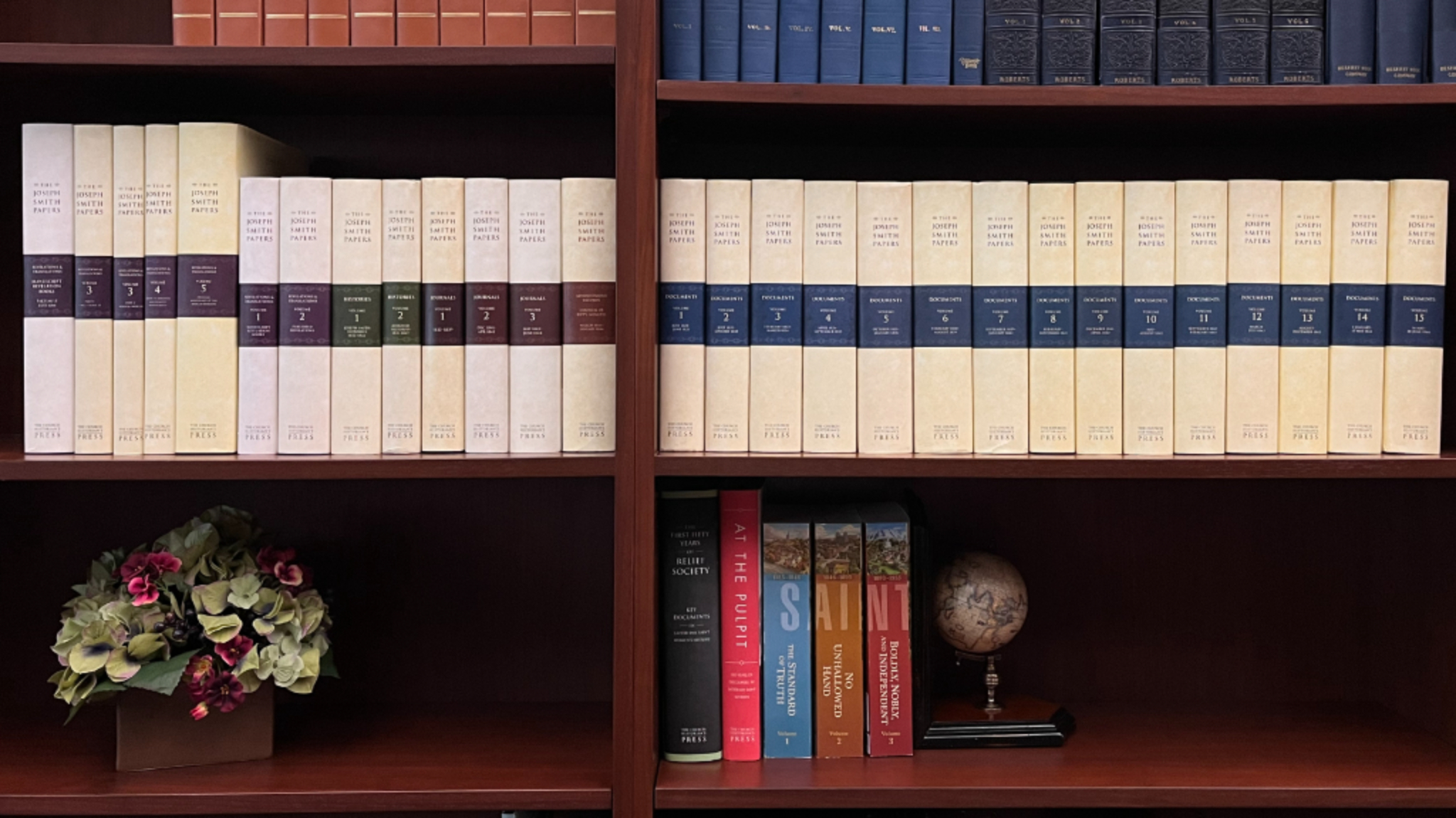
Scholarly endorsements:
"This project remains the gold standard in the field of historical documentary editing."[6:5] — Thomas P. Slaughter, professor of history, University of Rochester
"The Church didn't want to hide anything about Joseph Smith. They felt confident that if the actual records, the primary sources, were available, responsible scholars would consult them."[6:6] — Laurel Thatcher Ulrich, Pulitzer-winning Harvard historian
"I would say it ranks with the best kinds of scholarly sources I've seen."[6:7] — Laurie Maffly-Kipp, professor, Washington University
Elder Kyle S. McKay (Church Historian as of June 2023) summarized the institutional commitment: "Every document that we know of that was produced by or under the direction of Joseph Smith, or written to him directly, has been published with annotations."[53]
The Church History Department's June 2023 statement: "We know of no other modern religious leader whose life and papers have been examined and shared with such thoroughness. This project declares to the world that the history of the Church of Jesus Christ can withstand scrutiny and that Joseph Smith's life deserves to be studied."[54]
No institution bent on concealment spends twenty-two years putting 7.45 million words of its founder's papers, difficult diaries and letters included, through peer review and onto the open internet at National Archives standards. The CES Letter's case requires omitting this output entirely.
Gospel Topics Essays (2013–2015)
From November 2013 through October 2015, the Church released thirteen essays on its most controversial topics, under its own name, on its own website, each "approved by the First Presidency and the Quorum of the Twelve Apostles."[7:2] The sequence: First Vision Accounts (November 2013, engaging the multiple accounts directly);[26:2] Race and the Priesthood (December 6, 2013, disavowing the racial-theology justifications);[12:7] Book of Mormon Translation (December 2013, acknowledging the seer-stone-in-hat method);[25:2] The Manifesto and the End of Plural Marriage (December 2013); Plural Marriage and Families in Early Utah (December 2013); Book of Mormon and DNA Studies (January 2014); Peace and Violence among 19th-Century Latter-day Saints (May 2014); Translation and Historicity of the Book of Abraham (July 2014, engaging the papyri mismatch);[55] Plural Marriage in Kirtland and Nauvoo (October 2014, engaging the polyandry, the marriages to teenagers, the asymmetry with Emma);[40:3] Becoming Like God (~2014); Are Mormons Christian? (~2014); Joseph Smith's Teachings about Priesthood, Temple, and Women (October 2015); Mother in Heaven (October 2015).
The topics map almost exactly onto the sharpest critic concerns at the time the CES Letter was being assembled. The Church identified what was being asked and responded directly. Each essay is footnoted with primary sources and links to Joseph Smith Papers documents where applicable.
The CES Letter (April 2013, with October 2017 update) was being assembled and revised across exactly the years the Gospel Topics Essays were being published. The 2017 update could have engaged the post-2013 institutional output. It did not. The omission is a choice.
Saints multivolume narrative (2018–2024)
Saints is the first official multi-volume Church history since B. H. Roberts's 1930 work. Four volumes, free in 14 languages, available in print, on the Church History website, in the Gospel Library app, and as audiobooks: Volume 1, The Standard of Truth, 1815–1846 (September 4, 2018), engages Joseph Smith's seer stone use, plural marriages, treasure-digging, and the Book of Mormon translation directly;[8:2][41:1] Volume 2, No Unhallowed Hand, 1846–1893 (February 12, 2020), engages the trek west, the public practice of plural marriage, the Mountain Meadows Massacre, and the priesthood and temple ban's institutional development;[46:1] Volume 3, Boldly, Nobly, and Independent, 1893–1955 (April 22, 2022), engages the post-Manifesto period, the institutional consolidation, and the early-twentieth-century operation of the priesthood ban;[47:1] Volume 4, Sounded in Every Ear, 1955–2020 (October 29, 2024), engages correlation, the 1978 revelation, the September Six period, and the post-2007 institutional turn.[9:1]
The preface to Volume 1 states the editorial standard:
"Every scene, character, and line of dialogue is founded in historical sources, which are cited at the end of the book… Saints is not scripture, but like the scriptures, each volume contains divine truth and stories of imperfect people trying to become Saints through the Atonement of Jesus Christ."[41:2]
Director Matthew J. Grow described the editorial commitment: the team "presented the characters as three-dimensional, with struggles and triumphs, with flaws and with virtues" and weaves in "lesser known and potentially challenging topics."[8:3]
Saints openly discusses the topics the CES Letter says the Church hides: Joseph Smith's seer stone use in translation; Joseph's plural marriages including polyandry; treasure-digging; the Mountain Meadows Massacre; the priesthood and temple ban; the 1978 revelation lifting it. The volumes are written for general Church membership, with Sunday-school-curriculum integration built into the design.
Key Point
Saints is a coordinated, multi-volume, multi-language, free, official Church history that openly discusses every topic on the CES Letter's own list. The opposite of "whitewash" is the existence of Saints. The four-volume series spans 1815 through 2020 and was completed in October 2024, distributed widely in print, digital, and audiobook formats across 14 languages.[8:4][9:2]
Joseph Smith's seer stone in the Ensign (October 2015)
Richard E. Turley Jr., Robin S. Jensen, and Mark Ashurst-McGee published "Joseph the Seer" in the October 2015 Ensign, including photographs of Joseph Smith's chocolate-colored, oval seer stone, documenting his use of seer stones in addition to the Urim and Thummim, the stone-in-hat translation method, and the stone's provenance.[56] Companion publication: Michael Hubbard MacKay and Gerrit J. Dirkmaat, From Darkness unto Light (BYU Religious Studies Center / Deseret Book, 2015).[57]
The 2015 publication was not the Church's first acknowledgment of the seer stone. The four-decade publication trail before the photograph release: Friend (September 1974) described "an egg-shaped, brown rock for translating called a seer stone";[58] Ensign articles followed in September 1977 (Richard Lloyd Anderson), January 1988 (Kenneth Godfrey), July 1993 (then-Elder Russell M. Nelson, sitting Quorum-of-the-Twelve member, quoting David Whitmer's stone-in-hat account verbatim twenty years before the CES Letter), and January 1997 (Neal A. Maxwell);[58:1][59] the October 2015 Turley/Jensen/Ashurst-McGee article was the apex with photographs.[56:1] The CES Letter's "the Church hid the seer stone" framing requires omitting all five preceding articles. If the stone was a closely held secret, what was it doing in the Friend in 1974 and in the Ensign four times before the photographs? "The Church hid X" often means "I didn't know about X." Those are different things. But the gap between them is real.
Multiple First Vision accounts and polygamy publication trails
The First Vision multiple-accounts publication trail predates the November 2013 First Vision Accounts essay by 48 years:[58:2] Paul R. Cheesman's 1965 BYU master's thesis included the 1832 account;[60] Dean C. Jessee published the four texts side-by-side in BYU Studies (Spring 1969);[61] James B. Allen documented eight contemporary accounts in Improvement Era (April 1970);[62] Milton V. Backman Jr.'s Ensign (January 1985) covered four recitals;[63] Richard Lloyd Anderson's Ensign (April 1996) documented nine.[64] The November 2013 First Vision Accounts essay was the institutional-curricular integration: a 44-year gap between scholarly disclosure in BYU Studies (1969) and curricular integration (2013).[26:3]
The polygamy publication trail similarly predates the October 2014 Plural Marriage in Kirtland and Nauvoo essay by decades:[58:3] Improvement Era (November 1946, John A. Widtsoe); New Era (December 1973); Ensign (February 1977, Davis Bitton); Ensign (December 1978, D. Michael Quinn, before his 1993 excommunication); Ensign (June 1979, Dean Jessee) on Emily and Eliza Partridge "married to Bro. Joseph"; the 2007 Church lesson manual on plural marriage "revealed to Joseph Smith as early as 1831." The 2014 essay was the official-correlation curricular integration with full documentary engagement of polyandry, the asymmetry with Emma, and marriages to teenagers: the elements the earlier publications generally did not surface for general readers.
Church History Library
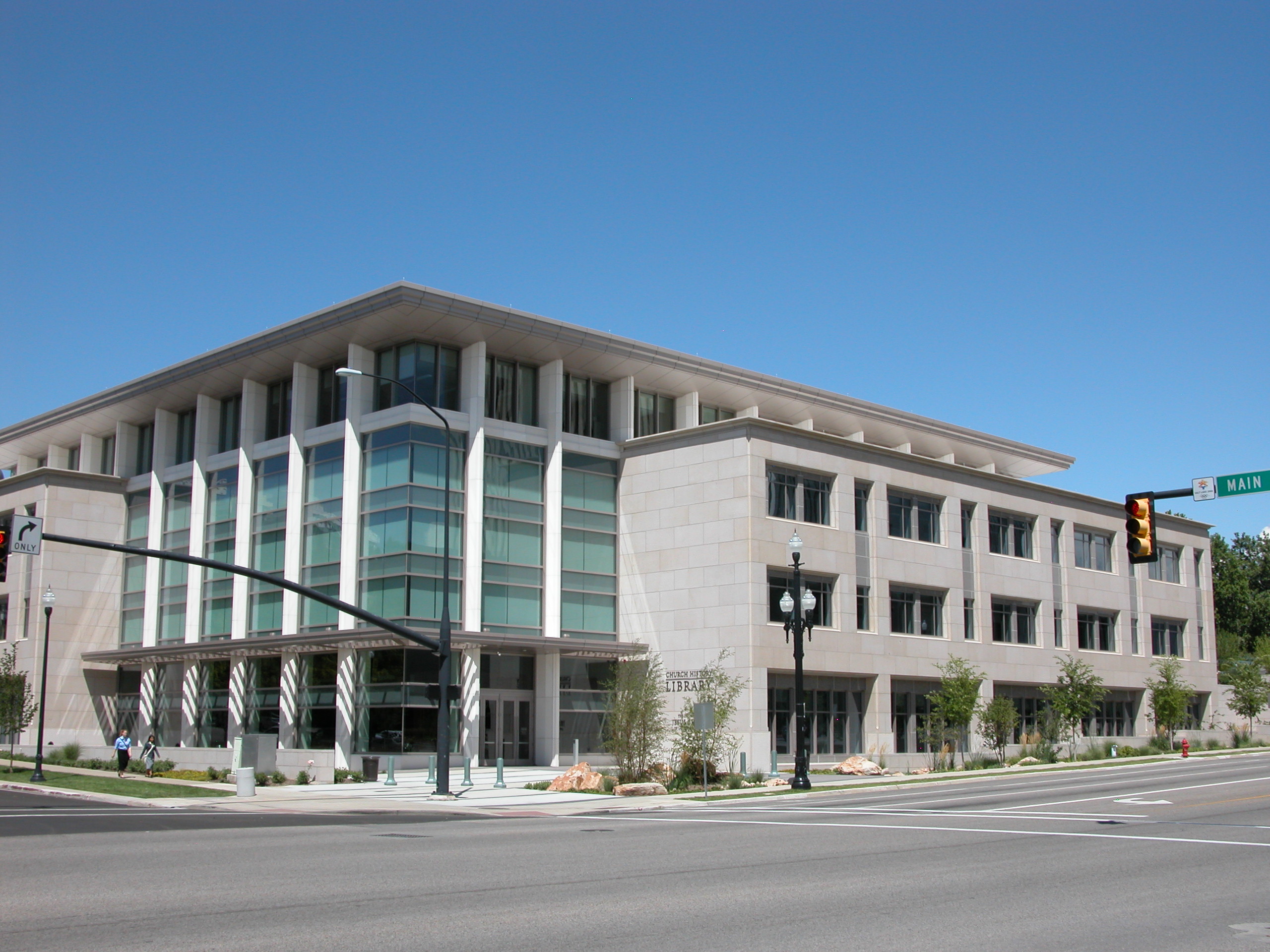
The Church History Library's public reading rooms opened on June 22, 2009.[51:1] The library houses the Church's archival collections: General Authority papers, missionary records, ward records, photographs, manuscripts, and institutional documentation. The 2009 opening represented a substantive expansion of public scholarly access to the Church's archival holdings. Tens of millions of pages of historical sources have been digitized and placed online through the Church History Library website and the Joseph Smith Papers.
"Transparency about Church History" Gospel Topics page
The Church's own authoritative statement of the institutional framework is the Gospel Topics page "Transparency about Church History."[10:1] The page lists the Joseph Smith Papers, Saints, the Gospel Topics Essays, and Church History Library digitization as transparency initiatives. It states the editorial commitment: the Church publishes Joseph Smith's documents "without redaction"; digitizes "tens of millions of pages of historical sources." It also names the access boundaries: temple records and details of sacred ceremonies; official minutes and correspondence of the presiding quorums and councils; confidential administrative materials (private papers of leaders and employees, financial and membership records); information gathered in confidential settings such as confessions or membership councils; and materials restricted by copyright or privacy regulations. These are the same boundaries any institutional archive maintains.
Combined institutional output
Set out in one table, the post-2007 output is one of the broadest transparency programs any major American religion has mounted in a generation:
| Project | Years | What it produces |
|---|---|---|
| Joseph Smith Papers | 2001–2023 | 27 volumes, 18,822 pages, 7.45M words, 49,687 footnotes at NARA standards[5:5] |
| Church History Library public reading rooms | 2009 | Public scholarly access to archival holdings[51:2] |
| Gospel Topics Essays | 2013–2015 | 13 essays on the hardest historical and doctrinal questions[7:3] |
| Ensign "Joseph the Seer" with photographs | 2015 | Photographs of Joseph Smith's seer stone[56:2] |
| Saints multivolume narrative | 2018–2024 | Four volumes of official history, free in 14 languages[8:5][9:3] |
| Snow tenure as Church Historian | 2012–2019 | The Church Historian's public case for openness[17:8] |
| "Transparency about Church History" page | ~2020 | Authoritative statement of the institutional framework[10:2] |
None of this combined output appears anywhere in the CES Letter's October 2017 update.
Further Reading
The Joseph Smith Papers Project is at josephsmithpapers.org, with editorial standards and NHPRC endorsement documented at the project's "About" page. The Gospel Topics Essays index is at Gospel Topics Essays. The Saints multivolume narrative is at Saints. Steven E. Snow's November 2013 Religious Educator interview "Start with Faith" is in Religious Educator 14, no. 3 (2013): 1–11. The Church's own framework statement is at Transparency about Church History.
The pre-2007 transparency context
The post-2007 turn has a prehistory. The institutional record before 2007 (the pre-Correlation pro-intellectual posture, the Arrington tenure, the post-Arrington tightening, the Hofmann case) is what the turn was correcting.
Leonard Arrington's tenure (1972–1980)
Leonard J. Arrington was called as the first professionally trained Church Historian in 1972. He held a PhD in economic history from the University of North Carolina and was a working professor of economics at Utah State University when called.[65] Arrington's mandate, as he understood it, was to professionalize the Church History Division and open its archives to scholarly research. Across his 1972–1982 tenure, Arrington's department:
- Hired professionally trained historians (Davis Bitton as Assistant Church Historian; James B. Allen, Glen M. Leonard, and others on staff).
- Produced The Story of the Latter-day Saints (Allen and Leonard, 1976), a substantive scholarly history written under Church History Division auspices.
- Opened the Church Archives to scholarly researchers under standardized access protocols.
- Sponsored monograph projects across the broader sweep of Latter-day Saint history.
This is the pre-Correlation pro-intellectual posture that David O. McKay's presidency had encouraged and that Arrington was operating within. Gregory A. Prince and Wm. Robert Wright's David O. McKay and the Rise of Modern Mormonism (University of Utah Press, 2005) documents the McKay-era openness toward intellectual inquiry that preceded the post-1972 institutional consolidation.[66]
The 1980–1982 transition
In 1980, opposition within senior Church leadership led to the History Division being "disassembled and moved to Brigham Young University," transferred to the Joseph Fielding Smith Institute at BYU.[65:1] By 1982, archival access tightened. Arrington remained employed by BYU but no longer in the same institutional configuration. The transition was a real institutional regression from the 1972 mandate.
Patrick Mason's 2023 Dialogue article "The September Six and the Lost Generation of Mormon Studies" documents the broader chilling effect that followed.[18:1] The 1982 archival tightening, the 1981 Packer "Mantle" address, the 1985 Oaks "Reading Church History" address (cross-link to Anti-Intellectualism for full treatment), the 1993 September Six disciplinary cluster, and the 1993 Packer "three enemies" framing combined to produce what Mason characterizes as a 1993–2005 "lost generation" of Mormon studies.
The Mark Hofmann case (1980–1987)
Mark Hofmann produced and sold a series of forged historical documents to the Church and to private collectors between 1980 and 1985: the "Anthon Transcript" (1980, sold to the LDS Church for more than $20,000), the "Joseph Smith III Blessing" (1981), and the "Salamander Letter" (January 6, 1984, sold to Steven Christensen for $40,000).[67] When his fraud was about to be exposed, Hofmann constructed pipe bombs that killed Steven Christensen and Kathy Sheets on October 15, 1985; he was arrested January 1986 and pleaded guilty to second-degree murder and theft by deception in January 1987.[67:1] The case partially explains the 1980s–1990s archival caution as a defensive reflex against forgery fraud, not concealment of authentic history. Senior leaders had purchased forgeries; the Church and the academic community had both been deceived.
The institutional response was substantive. The Church hired Richard E. Turley Jr., a young faithful lawyer-historian, who with approval from top leaders began opening the collection to outside researchers and wrote the definitive scholarly account: Victims: The LDS Church and the Mark Hofmann Case (University of Illinois Press, 1992).[68] Turley negotiated unusual editorial freedom, "go where the facts led him" with "final editorial control," and the book was published with a non-Church academic press.[68:1] Ronald W. Walker, longtime LDS historian, characterized the institutional shift after Hofmann: "It's been a revolution. We now understand we can approach difficult questions and do it successfully."[69] The same institutional framework that brought Turley in produced the Joseph Smith Papers, the Gospel Topics Essays, and Saints. The official Church Topics page on Hofmann Forgeries explicitly connects the case to JSP: "The publication and digitization of Joseph Smith's papers and many other important document collections has helped broaden the base from which to evaluate new discoveries."[70]
The full substantive treatment of the Hofmann case is in Mark Hofmann.
Snow's announcement in context
Steven E. Snow's November 2013 Religious Educator admission, "in the past there was a tendency to keep a lot of the records closed," describes this institutional history. The "past" Snow names is the 1980–2007 period: Arrington's department transferred to BYU in 1980; archival access tightened from 1982 forward; the September Six in 1993; the closed-records pattern that the post-2007 turn corrected. Snow's announcement that "we need to continue to be more open" is the public articulation of the policy commitment that produced the JSP, the Gospel Topics Essays, the Saints volumes, and the Church History Library digitization. What the CES Letter renders as the Church Historian's confession of ongoing institutional concealment is the Church Historian's public announcement that the older institutional pattern was being substantively replaced.
Where the criticism is strongest
Three parts of the criticism keep their force after every restoration above.
The decades-long curricular-integration gap
At its most rigorous, the criticism is not that the Church hid X but that it had access to documented findings for decades and did not fold them into core curriculum until much later. The pattern is a series of gaps, fourteen to sixty-eight years, between scholarly availability and institutional curricular integration, and it recurs across multiple cases: multiple First Vision accounts (Cheesman 1965, Jessee 1969 in BYU Studies, Allen 1970, Backman 1985, Anderson 1996, the 2013 essay, a 44-year gap from BYU Studies to curricular integration);[60:1][61:1][26:4] the priesthood ban's documentary record (Bush 1973 Dialogue → 1978 revelation → 2013 essay disavowal, 40 years to theological-grounds disavowal);[33:2][12:8] the seer stone (Friend 1974 through Ensign 1993, 2015 photographs, 2013 Book of Mormon Translation essay, 41 years to photograph release);[58:4][56:3] Joseph Smith's polygamy and polyandry (Improvement Era 1946 through multiple Ensign articles to the 2014 Plural Marriage in Kirtland and Nauvoo essay, 68 years to full curricular polyandry engagement).[58:5][40:4]
The recurrence is real. BYU Studies, the Ensign, Improvement Era, and the Friend are different curricular tiers from seminary, institute, and Sunday School manuals. A fact can be technically available in a Church-owned journal and still effectively invisible to a typical member who never read that issue. The 1981 Packer "Mantle" address, whose full treatment is in Anti-Intellectualism, supplied cover in parts of Church Educational System (CES) instruction for leaving these complications out of what lay members were taught in the late twentieth century. A typical Church member in 1985, 1990, or 2000 was generally not taught the seer-stone-in-hat translation method, the multiple First Vision accounts, the polyandry, or the full Book of Abraham complications in their core curriculum. The Church can be faulted for not building these details into its core curriculum sooner; the 2013 Gospel Topics Essays and the 2018–2024 Saints are the substantive curricular correction.
Mason 2023 and the lost generation
The chilling effect has its own faithful historian: Patrick Q. Mason, writing in "The September Six and the Lost Generation of Mormon Studies," Dialogue 56:3 (Fall 2023).[18:2] Mason earned his history doctorate at Notre Dame in 2005. His argument: the September 1993 discipline taught young LDS scholars to write carefully or to leave, and the field's "lost generation," roughly 1993 to 2005, was the result.[71]
Mason writes as a believer holding the Arrington Chair: a hostile critic could be discounted; he cannot be. His article grants that the post-2007 recovery is real and substantive, and then it prices what the 1993–2005 window cost anyway: Quinn, who in Mason's words "had not held a full-time faculty position for many years" when the Hunter Chair's donors ruled out "an excommunicant"; the perspectives missing from the field because the scholars who would have supplied them left; and his own verdict on the present: "There are still whispers. Fear remains, even if we try to push it to the back of our minds."[18:3] The biographical record adds Lavina Fielding Anderson, shut out of faithful institutional scholarly life until after her death.[72]
The full September Six treatment is in Anti-Intellectualism.
Was the post-2007 turn pressure-induced or independent revelation?
The critique's deepest form presses a harder question. The post-2007 turn is genuine, but the course-correction itself is the proof of the prior pattern. The Church changed because of pressure: internet-age accessibility, scholar dissent culminating in September Six, post-1990s information ecosystem, Mark Hofmann fallout, visible failure of correlation-era apologetics. On this reading, each course-correction tracks the historical conditions that prompted it rather than arriving as independent revelation. Snow says this directly: "the world has changed in the last generation—with the access to information on the Internet, we can't continue that pattern."[17:9]
But institution-responding-to-conditions is what every major institution does. The Catholic Church's aggiornamento of Vatican II (1962–1965) responded to mid-twentieth-century conditions. Mainline Protestant denominations' civil rights statements responded to the civil rights movement. Institutional self-correction is the norm of living traditions, not the exception. The faithful framework reads continuing revelation as operating through historical conditions: D&C 1:24 frames the iterative pattern ("after the manner of their language, that they might come to understanding")[36:1] and D&C 9:8 names the deliberative process ("you must study it out in your mind; then you must ask me if it be right").[73] The 1978 revelation and the post-2007 turn fit that iterative-deliberative pattern. Pressure that produces real course-correction is, within this framework, exactly how a living revelation tradition is expected to move.[74]
Patrick Q. Mason's Restoration: God's Call to the 21st Century World (Faith Matters, 2020) develops this framework theologically. Terryl L. Givens and Fiona Givens's The Crucible of Doubt (Deseret Book, 2014) explicitly acknowledges past suppression and frames post-2007 as authentic correction within the Restoration's iterative pattern.[75][76]
Comparison with other religious institutions
Historical opacity is not a Latter-day Saint invention, and the comparison with older and larger religious bodies runs in the Church's favor. The intellectual-freedom side of this comparison is drawn in Anti-Intellectualism.
The Vatican Apostolic Archives (renamed from "Vatican Secret Archives" in 2019) were opened to outside researchers only in 1881 by Pope Leo XIII, 1,851 years after the founding of the Catholic Church.[77] The Holy Office (Inquisition) archives remained restricted until 1998. The most recently opened records, those of Pius XII's pontificate (1939–1958), became available to scholars only in March 2020; everything after October 1958 remains closed. Rome kept an Index of Forbidden Books in continuous force from 1559 until Paul VI abolished it in 1966.
The Protestant comparison is partially a function of polity rather than transparency posture: most major Protestant denominations have far less centralized authority than the LDS Church and lack the institutional structure to commission a Joseph-Smith-Papers-equivalent. The fairer comparison is to other centralized churches with single founding figures of the nineteenth century: Christian Science (Mary Baker Eddy), Seventh-day Adventism (Ellen G. White), Jehovah's Witnesses (Charles Taze Russell). Each has the centralized institutional authority to produce a comprehensive scholarly edition of the founder's papers; none has produced anything approaching the Joseph Smith Papers' scope, free-online accessibility, NHPRC-endorsed editorial standards, or completion.
The empirical comparison stands: name another major religious institution with a single founding figure that has voluntarily published 18,822 pages of free, annotated primary-source documentation about its founder, plus thirteen essays directly engaging the institution's hardest historical and doctrinal topics, plus a four-volume narrative history written for general membership.
What the case leaves out
The material the CES Letter's transparency case leaves out:
- The Bushman quote in context. "And that's what it's trying to do," the clause Bushman immediately added, is excised. So are his own prompt clarifications ("I still believe in gold plates… I think he was sincere in saying he saw God") and in 2020 ("I believe pretty much the way I did when I was a missionary").[19:2][21:1][20:1]
- The simultaneity of the 2013 OD2 header and the December 2013 Race and the Priesthood essay, including the essay's full disavowal text (curse of Cain, premortal valiance, divine disfavor, mixed-race-marriages-as-sin) and the "Church leaders today unequivocally condemn all racism" framing.[11:2][12:9]
- The 2014 Plural Marriage in Kirtland and Nauvoo essay's polyandry engagement. The essay engages "women already married to other men," exactly the category Zina Huntington occupies, three years before the CES Letter's October 2017 update.[40:5]
- The post-2007 corrective output for the Brigham Young manual. Saints volumes and the 2014 Plural Marriage in Kirtland and Nauvoo essay engage Brigham Young's nineteenth-century teaching on plural marriage directly without the bracket-style move.[46:2][40:6]
- Steven E. Snow's full statement. The diagnostic past-tense clause is the announcement of the corrective. The bridge clause and present-tense corrective clause are excised. Other Snow passages from the same interview ("being open about our history solves a whole lot more problems than it creates"; "we now have pretty remarkable transparency") are omitted entirely.[17:10]
- The Joseph Smith Papers Project, the Gospel Topics Essays, and Saints multivolume narrative. 27 volumes / 18,822 pages / 49,687 footnotes / NHPRC-endorsed / completed 2023; 13 essays addressing exactly the topics the CES Letter says the Church suppresses; four-volume narrative history openly engaging seer stones, polygamy, polyandry, Mountain Meadows, the priesthood ban.[5:6][6:8][7:4][8:6][9:4]
- The four-decade seer stone publication trail (Friend 1974, Ensign 1977, 1988, 1993, 1997, 2015) and the 48-year First Vision multiple-accounts publication trail (Cheesman 1965, Jessee 1969, Allen 1970, Backman 1985, Anderson 1996, the 2013 essay). The 2015 Ensign photograph publication was the apex of a four-decade trail; the 2013 First Vision essay was the curricular integration of a 1969 scholarly disclosure.[58:6][59:1][56:4][26:5]
- The Mark Hofmann case as institutional catalyst, the Church History Library public reading rooms (opened June 22, 2009), and the "Transparency about Church History" Gospel Topics page: the connective tissue, and the Church's own authoritative statement of the institutional transparency framework.[67:2][68:2][51:3][10:3]
The "Church's dishonesty, censorship, and whitewashing over its history" framing the CES Letter constructs requires omitting all of these data points. Restore them, and the framing no longer describes the institution on the record.
Five questions a careful reader will still ask
A reader who arrives having read Reeve 2015, Bush 1973, Mason 2023, Bitton, and Bushman, and not only the CES Letter, will still want five answers.
Was the 1949 First Presidency wrong? Yes. The 1949 statement was wrong on multiple points the post-2013 institutional position corrects: wrong on origin (claiming the ban originated as "direct commandment from the Lord" when no extant founding revelation exists), wrong on the curse-of-Cain framing, wrong on the premortal-conduct rationale, wrong on the divine-disfavor framework. The 2013 Race and the Priesthood essay, under official Church approval, disavows each of these grounds. The doctrine-vs-opinion framework absorbs even First Presidency statements when they exceed their warrant: a First Presidency document is not, by its office alone, immune from later institutional correction. The disavowal is bounded. It corrects the theological speculation and the origin claim, not the historical fact of the policy across 1852–1978. The bounds qualify the yes; they do not withdraw it.
Were the polygamy whitewashing instances mistakes or intentional shaping? Intentional curricular shaping for the correlation-era period. Manuals for Relief Society and Priesthood lessons in a Church that does not practice polygamy were edited to translate Brigham Young's teaching for monogamous twenty-first-century use. The lds.org biographical page on Zina (in the audited window) was a curated devotional page, not a comprehensive scholarly biography. The post-2007 institutional output (the 2014 Gospel Topics Essay, 2018 Saints Vol 1) engages plural marriage and polyandry directly without bracket-style alterations.
Bushman's "dominant narrative": does this mean correlation-era teaching was wrong? The correlation-era simplification was inaccurate as a description of the documented historical record. It was not deliberately deceptive; it was curriculum: historical material adapted for faith formation. Bushman's prescription is that the institution must reconstruct toward a truer narrative; the post-2007 output is exactly that reconstruction.[19:3][21:2]
Pre-2007 vs post-2007: independent revelation or pressure-induced course-correction? Both. The institution responded to historical conditions (internet age, post-1990s information ecosystem, Hofmann fallout, scholarly dissent). Snow named the pressure himself. Continuing revelation operates through historical conditions; the post-2007 turn fits the iterative-revelation pattern.[17:11]
The September Six chilling effect: does the post-2007 turn fully resolve it? No. The costs on the record: Quinn's lost academic career, named by Mason; Lavina Fielding Anderson, excluded from faithful institutional scholarly life until her posthumous restoration, documented in the biographical record; and the critical perspectives Mason says the field still lacks.[18:4][72:1] Reconsideration after the fact says something good about the institution; it does not hand back what the people in question lost in the meantime. Cross-link to Anti-Intellectualism for the fuller engagement.
The Book of Mormon as anchor
Some transparency questions reach places where the candid answer is "we don't fully know": why exactly the priesthood ban began in 1847–1852; why the 1949 First Presidency made the claims they did; why the institutional course-correction was as slow as it was. Where the answers run out, one thing still stands firm. The Book of Mormon was translated in roughly 60 working days in 1829 by a 23-year-old with little formal schooling.[78] No substantive revisions despite nearly two centuries of textual scrutiny. No whistleblower from any of the eleven witnesses across more than fifty years of opportunity, even from those (David Whitmer, Martin Harris, Oliver Cowdery) who left the institutional Church in tension with Joseph Smith. It is the most tangible evidence for the Restoration's truth claims, and that evidence has only grown stronger over the two decades the post-2007 transparency turn has unfolded: Royal Skousen's twenty-five-year Critical Text Project; Grant Hardy's The Annotated Book of Mormon (Oxford University Press, 2023), the first Oxford-published annotated edition by a faithful scholar; the JSP Revelations and Translations Series Volumes 3 and 5, publishing the Printer's Manuscript and Original Manuscript with full editorial standards.[5:7]
For the transparency question specifically: the same institution that sometimes narrowed correlation-era curricular materials and acted slowly on the priesthood ban's documentary disavowal also voluntarily subjected its founding scripture to the most rigorous textual-critical scrutiny in the Restoration's history and published that scrutiny openly. The Book of Mormon's textual integrity, the witness chain, and the impossibility of accounting for the dictation naturalistically stand independent of the curricular-shaping pattern the criticism documents.
Assessment
The CES Letter's transparency-and-censorship case is structurally a snapshot freeze. Restore the same-year Race and the Priesthood essay to the 2013 OD2 header; restore the 2014 Plural Marriage in Kirtland and Nauvoo essay and Saints Volume 1 to the Zina Huntington page; restore the post-2007 Saints engagement of Brigham Young's plural-marriage teaching to the 1997 manual; restore the financial-stewardship debate (cross-link to Church Finances) and the broader curricular-pattern context to the Lorenzo Snow ellipsis; restore Steven E. Snow's full statement and the post-2007 institutional output the corrective produced. Far less of the case survives the restorations, but part of it does.
Set the concessions down first. The 2013 OD2 header is a reframing of the 1949 First Presidency, and the header itself is a curatorial choice the institution could have written more candidly. The disavowal in the Race and the Priesthood essay, published in December of the same year, is severe: the 1949 First Presidency was wrong on the ban's origin and on its racial-theology grounds. Polygamy whitewashing in correlation-era curricular materials is documented (Brigham Young manual brackets; Zina Huntington lds.org page; Lorenzo Snow ellipsis). Patrick Mason's 2023 Dialogue article documents a real 1993–2005 chilling effect that the post-2007 transparency turn did not fully erase, and Mason names institutional-personnel scars that persist. The 40-year and 44-year curricular-integration gaps are real. The post-2007 turn was responsive to historical conditions, not unprompted institutional revelation. Steven E. Snow's 2013 Religious Educator statement is, in itself, a concession that the closed-records habit was no longer workable.
Now set the other column of the ledger beside it. The Joseph Smith Papers run to 27 volumes, 18,822 pages, 7.45 million words, and 49,687 footnotes, completed in 2023, NHPRC-endorsed, free online, a documentary-editing effort with few peers anywhere in American religion.[5:8][6:9] Thirteen Gospel Topics Essays (2013–2015) addressed the hardest historical and doctrinal topics under the Church's official seal.[7:5] Saints (2018–2024) is the first official multi-volume Church history since B. H. Roberts's 1930 work: four volumes, fourteen languages, free, openly engaging seer stones, polygamy, polyandry, Mountain Meadows, the priesthood ban.[8:7][9:5] The Church History Library's public reading rooms have been open since June 22, 2009.[51:4] The case's clock stopped in October 2017, at the letter's last update. What is left of it when the record is allowed to run to 2024?
Bushman's diagnosis was accurate: the correlation-era simplified narrative could not be sustained, and the institution has been reconstructing toward a fuller engagement with the documented record. The post-2007 institutional output is the substantive reconstruction. An institution that voluntarily publishes its founder's hardest documents at National Archives standards, free to anyone, is not behaving like an institution with something to hide. It is behaving like an institution convinced that scrutiny favors it. The CES Letter (April 2013, October 2017 update) arrived in the middle of all of it. The record shows a tradition in active reconstruction, willing to concede the harder pieces and to put the documents in front of the reader.
Bottom line: The six items share one move: each freezes a moving target. The Church was mid-reform in 2013, and the CES Letter caught it at the freeze point and printed the still frame as the whole picture. Read the still frame as a still frame and the case requires three omissions: the 2013 OD2 header read apart from the Race and the Priesthood essay that disavows the 1949 First Presidency's grounds; curated devotional pages snapshotted as permanent posture; and the post-2007 apparatus that was already replacing the older closed-records pattern. An honest ledger keeps both columns. In one column go the conceded entries (the OD2 reframing, the polygamy curricular shaping, the Mason chilling-effect diagnosis, the decades-long curricular-integration gaps, the pressure-induced timing of the turn); in the other, the Joseph Smith Papers, the Gospel Topics Essays, the Saints volumes, and the Church History Library digitization, self-disclosure on a scale rare among American churches. The CES Letter balances only the first column. Balance both, and what stands is a tradition still reforming in public, inviting the scrutiny rather than fleeing it.
Runnells, CES Letter (2017), "Other Concerns," p. 112. The cover-of-section page presents the Bushman quote in display type with his attribution: "Richard Bushman, LDS Historian, Scholar, Patriarch." ↩︎ ↩︎
Runnells, CES Letter (2017), "Other Concerns," pp. 112–125. The transparency-and-censorship subsection (pp. 113–116) immediately precedes the Church Finances subsection (pp. 116–119); these are two distinct subsections within the broader "Other Concerns" section. ↩︎
Runnells, CES Letter (2017), "Other Concerns," pp. 113–118. The "Church's Dishonesty, Censorship, and Whitewashing Over Its History" subsection runs pp. 113–116 (OD2 header, Zina Huntington page, Brigham Young manual, and the CENSORSHIP/Snow item at p. 116); the Lorenzo Snow tithing alteration ("Dishonestly Altering Lorenzo Snow's Words and Teachings on Tithing") sits under the Church Finances subsection at pp. 118–119; this article gathers it into the transparency case because it is the CES Letter's fourth curricular-alteration exhibit. The Brigham Young manual item appears at pp. 115–116. ↩︎
The "one of the most comprehensive" claim is calibrated against three comparison categories. (1) Centralized churches with single founding figures of the nineteenth century: Christian Science (Mary Baker Eddy), Seventh-day Adventism (Ellen G. White), Jehovah's Witnesses (Charles Taze Russell). None has produced a comprehensive scholarly edition of the founder's papers at NHPRC-equivalent editorial standards, free online, with full annotations. (2) The Catholic Church: Vatican Apostolic Archives opened to outside researchers only in 1881; Holy Office archives remained restricted until 1998; the Pius XII pontificate records (1939–1958) opened only in March 2020; everything after October 1958 remains closed. No equivalent comprehensive scholarly edition exists for the documents of any medieval or early-modern Catholic founder or theologian at NARA-endorsed editorial standards. (3) Major Protestant denominations: lack the centralized institutional authority to commission such a project; absence of equivalents reflects polity rather than transparency posture. The fairest comparison is to category (1), where the Joseph Smith Papers' 27 volumes / 18,822 pages / NHPRC endorsement / free online / full annotations lacks an equivalent. The article's claim is a comparison-grounded "one of the most comprehensive in modern American religious history" rather than a categorical "the most" — the qualifier is intentional. ↩︎
"Final Volume of Joseph Smith Papers Published, Completing Monumental Historical Work," Church Newsroom (June 27, 2023). https://newsroom.churchofjesuschrist.org/article/final-volume-joseph-smith-papers. Announcement includes the project's full scope: 27 volumes; 18,822 pages; 7,452,072 words; 49,687 footnotes; 1,306 journal entries; 643 letters; 155 revelations; June 27, 2023, the 179th anniversary of Joseph Smith's martyrdom. Project at https://www.josephsmithpapers.org/. ↩︎ ↩︎ ↩︎ ↩︎ ↩︎ ↩︎ ↩︎ ↩︎ ↩︎
Joseph Smith Papers Project, "About the Project" and "Endorsements." https://www.josephsmithpapers.org/articles/about-the-project. NHPRC endorsement (May 2004) — the documentary-editing arm of the U.S. National Archives. On the Miller funding: Tad Walch, "A $10M investment in Joseph Smith," Deseret News (July 23, 2023), https://www.deseret.com/faith/2023/7/23/23793106/a-10m-investment-in-joseph-smith/. Endorsements: Thomas P. Slaughter (University of Rochester): "the gold standard in the field of historical documentary editing." Laurel Thatcher Ulrich (Harvard, Pulitzer Prize winner): "The Church didn't want to hide anything about Joseph Smith. They felt confident that if the actual records, the primary sources, were available, responsible scholars would consult them." Laurie Maffly-Kipp (Washington University): "ranks with the best kinds of scholarly sources I've seen." ↩︎ ↩︎ ↩︎ ↩︎ ↩︎ ↩︎ ↩︎ ↩︎ ↩︎ ↩︎
"Gospel Topics Essays" index. The Church of Jesus Christ of Latter-day Saints. https://www.churchofjesuschrist.org/study/manual/gospel-topics-essays. Thirteen essays published between November 2013 and October 2015, "approved by the First Presidency and the Quorum of the Twelve Apostles." ↩︎ ↩︎ ↩︎ ↩︎ ↩︎ ↩︎
"First Volume of 'Saints' Now Available," Church Newsroom (September 4, 2018). https://newsroom.churchofjesuschrist.org/article/first-volume-saints-now-available. Saints, Volume 1: The Standard of Truth, 1815–1846. First official multi-volume Church history since B. H. Roberts's 1930 work. 14 languages; free digital, print, and audiobook formats. Director Matthew J. Grow: the team "presented the characters as three-dimensional, with struggles and triumphs, with flaws and with virtues." ↩︎ ↩︎ ↩︎ ↩︎ ↩︎ ↩︎ ↩︎ ↩︎
Saints, Volume 4: Sounded in Every Ear, 1955–2020 (Salt Lake City: The Church of Jesus Christ of Latter-day Saints, October 29, 2024). https://www.churchofjesuschrist.org/study/history/saints-v4. Engages correlation, the 1978 revelation, the September Six period, and the post-2007 institutional turn. ↩︎ ↩︎ ↩︎ ↩︎ ↩︎ ↩︎
"Transparency about Church History," Gospel Topics. The Church of Jesus Christ of Latter-day Saints. https://www.churchofjesuschrist.org/study/manual/gospel-topics/transparency-about-church-history-questions. The Church's authoritative statement of the institutional framework. Lists the Joseph Smith Papers, Saints, the Gospel Topics Essays, and Church History Library digitization as transparency initiatives. Names the access boundaries (temple records and ceremony details; presiding quorums' minutes and correspondence; confidential administrative materials; confidential settings such as confessions or membership councils; copyright- or privacy-restricted materials). ↩︎ ↩︎ ↩︎ ↩︎
2013 Official Declaration 2 Header, in Doctrine and Covenants (Salt Lake City: The Church of Jesus Christ of Latter-day Saints, 2013 edition forward). The header reads: "Early in its history, Church leaders stopped conferring the priesthood on black males of African descent. Church records offer no clear insights into the origins of this practice." https://www.churchofjesuschrist.org/study/scriptures/dc-testament/od/2 ↩︎ ↩︎ ↩︎
"Race and the Priesthood," Gospel Topics Essay (December 6, 2013; updated October 2015). The Church of Jesus Christ of Latter-day Saints. https://www.churchofjesuschrist.org/study/manual/gospel-topics-essays/race-and-the-priesthood ↩︎ ↩︎ ↩︎ ↩︎ ↩︎ ↩︎ ↩︎ ↩︎ ↩︎ ↩︎
FAIR, "Alleged whitewashing of polygamy in Church history." https://www.fairlatterdaysaints.org/answers/Mormonism_and_polygamy/Whitewashing_in_Church_history. Documents the Brigham Young manual's editorial conventions, including the bracket signal indicating editorial alteration. The "two instances of the term 'wives' were modified to '[wife],' with brackets included to notify the reader of the editorial change" framing. ↩︎ ↩︎ ↩︎
Sarah Allen, "The CES Letter Rebuttal — Part 60," FAIR (May 25, 2022). https://www.fairlatterdaysaints.org/blog/2022/05/25/the-ces-letter-rebuttal-part-60. Engages the Zina Huntington case with the eternity-versus-time framework. Allen writes: "She was married civilly to Henry for time, but sealed to Joseph for eternity… The marriages do not overlap, and there is no evidence of any kind of sexual impropriety on any of their parts. … She only had two husbands in this life—successively, not concurrently—and will have one husband in the next life." ↩︎ ↩︎ ↩︎ ↩︎
Teachings of Presidents of the Church: Lorenzo Snow (Salt Lake City: The Church of Jesus Christ of Latter-day Saints, 2012), Chapter 12, "Tithing, a Law for Our Protection and Advancement." https://www.churchofjesuschrist.org/study/manual/teachings-of-presidents-of-the-church-lorenzo-snow/chapter-12-tithing-a-law-for-our-protection-and-advancement. The manual reads: "I plead with you in the name of the Lord, and I pray that every man, woman and child … shall pay one-tenth of their income as a tithing." The ellipsis replaces "who has means." ↩︎ ↩︎
Lorenzo Snow, October 1899 General Conference Address, in Conference Report, October 1899, p. 28. The original includes the conditional clause: "I plead with you in the name of the Lord, and I pray that every man, woman and child who has means shall pay one-tenth of their income as a tithing." Available in archived Conference Reports. ↩︎ ↩︎
Richard E. Bennett and Dana M. Pike, "Start with Faith: A Conversation with Elder Steven E. Snow," Religious Educator 14, no. 3 (2013): 1–11. https://rsc.byu.edu/vol-14-no-3-2013/start-faith-conversation-elder-steven-e-snow. Other key passages from the same interview: "My view is that being open about our history solves a whole lot more problems than it creates"; "[W]e now have pretty remarkable transparency… I think in the long run that will serve us well"; on the Joseph Smith Papers: "That is a priority of the department, to get more and more out online." ↩︎ ↩︎ ↩︎ ↩︎ ↩︎ ↩︎ ↩︎ ↩︎ ↩︎ ↩︎ ↩︎ ↩︎
Patrick Q. Mason, "The September Six and the Lost Generation of Mormon Studies," Dialogue: A Journal of Mormon Thought 56, no. 3 (Fall 2023). https://www.dialoguejournal.com/articles/the-september-six-and-the-lost-generation-of-mormon-studies/. Mason holds the Leonard J. Arrington Chair of Mormon History and Culture at Utah State University; previously held the Howard W. Hunter Chair at Claremont Graduate University (2011–2018); PhD from the University of Notre Dame (2005); BA from BYU (1999); faithful Latter-day Saint. Mason argues the chilling effect was real, that the recovery is partial and uneven, that scars persist, and that the absence of certain critical perspectives in current LDS scholarship is a continuing cost of the years between 1993 and the early-2000s recovery. ↩︎ ↩︎ ↩︎ ↩︎ ↩︎ ↩︎ ↩︎
Richard L. Bushman, "Faith Again" fireside, June 12, 2016, at Mark England's home. Transcript: Jonathan Ellis, "Transcript of Claudia and Richard Bushman's Remarks at Faith Again," Medium (July 21, 2016). https://medium.com/@jellistx/transcript-of-claudia-and-richard-bushmans-remarks-at-faith-again-e9d03bdea0e3. Bushman's full statement in context: "I think for the Church to remain strong it has to reconstruct its narrative. The dominant narrative is not true. It can't be sustained. The Church has to absorb all this new information or it will be on very shaky grounds, and that's what it's trying to do." ↩︎ ↩︎ ↩︎ ↩︎
Daniel C. Peterson, "Yet, again: Has Richard Bushman declared the 'dominant narrative' of Church history 'false'?" Patheos (March 2020). https://www.patheos.com/blogs/danpeterson/2020/03/yet-again-has-richard-bushman-declared-the-dominant-narrative-of-church-history-false.html. Reproduces the critic-supplied fireside transcript, Jim Bennett's context note, and Bushman's post-fireside "kerfuffle" statement: "some people thought I had thrown in the towel and finally admitted the Church's story of its divine origins did not hold up"; "As it is, I still come down on the side of the believers in inspiration and divine happenings—in angels, plates, translations, revelations." ↩︎ ↩︎
Richard L. Bushman, note to Daniel C. Peterson, published with permission in Peterson, "Richard Bushman and the fundamental claims of Mormonism," Patheos, July 16, 2016. https://www.patheos.com/blogs/danpeterson/2016/07/richard-bushman-and-the-fundamental-claims-of-mormonism.html. Clarifying his June 12, 2016 "Faith Again" fireside remarks. The note closes: "I believe pretty much the same things I did sixty years ago when I was a missionary." ↩︎ ↩︎ ↩︎
Richard L. Bushman, email of July 14, 2020, quoted with permission in "What Does Richard Bushman Believe About the Book of Mormon?," Ploni Almoni (July 2020). https://www.plonialmonimormon.com/2020/07/what-does-richard-bushman-believe-about-the-book-of-mormon.html. Bushman: "I said the history as we believe it is not true, by which I actually meant not accurate. We have had to correct lots of details in the Joseph Smith period. But the fundamental thrust of that history remains the same." ↩︎
Richard L. Bushman, Joseph Smith: Rough Stone Rolling (New York: Knopf, 2005). The most respected scholarly biography of Joseph Smith. Bushman is Columbia University Gouverneur Morris Professor of History (emeritus) and a stake patriarch. ↩︎
Richard L. Bushman, "Richard Lyman Bushman" (interview by Jed Woodworth), in Conversations with Mormon Historians, ed. Alexander L. Baugh and Reid L. Neilson (Provo, UT: Brigham Young University Religious Studies Center, 2015), 181–230. https://rsc.byu.edu/conversations-mormon-historians/richard-lyman-bushman. Asked repeatedly whether his historical research had shaken his faith in Joseph Smith, Bushman answered: "I can truthfully answer these uneasy people no." ↩︎
"Book of Mormon Translation," Gospel Topics Essay (December 2013). The Church of Jesus Christ of Latter-day Saints. https://www.churchofjesuschrist.org/study/manual/gospel-topics-essays/book-of-mormon-translation. The essay explicitly acknowledges the seer-stone-in-hat translation method. ↩︎ ↩︎ ↩︎
"First Vision Accounts," Gospel Topics Essay (November 2013). The Church of Jesus Christ of Latter-day Saints. https://www.churchofjesuschrist.org/study/manual/gospel-topics-essays/first-vision-accounts. The essay engages the multiple First Vision accounts directly. ↩︎ ↩︎ ↩︎ ↩︎ ↩︎ ↩︎
"Plural Marriage in The Church of Jesus Christ of Latter-day Saints," Gospel Topics Essays index. https://www.churchofjesuschrist.org/study/manual/gospel-topics-essays. Multiple essays on plural marriage including "Plural Marriage in Kirtland and Nauvoo" (October 2014); "Plural Marriage and Families in Early Utah" (December 2013); and "The Manifesto and the End of Plural Marriage" (December 2013). ↩︎ ↩︎
First Presidency Statement, August 17, 1949, signed by President George Albert Smith, First Counselor J. Reuben Clark, and Second Counselor David O. McKay. Verbatim text in the form quoted by the CES Letter and reproduced widely in scholarly treatments. See W. Paul Reeve, Religion of a Different Color: Race and the Mormon Struggle for Whiteness (New York: Oxford University Press, 2015), and Lester E. Bush Jr., "Mormonism's Negro Doctrine: An Historical Overview," Dialogue: A Journal of Mormon Thought 8, no. 1 (Spring 1973): 11–68. ↩︎ ↩︎ ↩︎
Runnells, CES Letter (2017), "Other Concerns," pp. 113–114. The CES Letter places the 2013 OD2 header alongside the August 17, 1949 First Presidency statement in side-by-side framing with bold emphasis added by Runnells. ↩︎
Runnells, CES Letter (2017), "Other Concerns," p. 114. The "UPDATE" paragraph engages the December 2013 Race and the Priesthood Gospel Topics Essay and frames the disavowal as further evidence of dishonesty. ↩︎
The 2013 First Presidency could have written the header more directly — "Church records do not include a founding revelation establishing this practice, and twentieth-century theological justifications offered for it have been disavowed." A formulation like that would have been both technically accurate and contextually candid. "Church records offer no clear insights into the origins of this practice" is shorter and gentler — and the choice to be shorter and gentler is itself a curatorial choice. The header sits alongside the December 2013 essay's substantive disavowal but does not, on its own face, surface that disavowal. The faithful response does not defend the header on a strict-sense distinction between "founding revelation" and "post-hoc justification" — most readers, including most Latter-day Saint members opening the Doctrine and Covenants, will not naturally draw that distinction. Naming the header as a curatorial choice rather than treating it as the only-possible scriptural-edition version of the correction is part of the honest assessment. ↩︎
W. Paul Reeve, Religion of a Different Color: Race and the Mormon Struggle for Whiteness (New York: Oxford University Press, 2015). Winner of the Mormon History Association Best Book Award; the John Whitmer Historical Association Smith-Pettit Award; and the Utah Division of State History Francis Armstrong Madsen Award. Reeve documents the 1847–1852 institutional transition in detail, including Brigham Young's March 26, 1847 statement at a private Church council praising Q. Walker Lewis ("We have one of the best Elders, an African") — almost three years after Joseph Smith's death. The Walker Lewis quotation was added to the 2015 update of the Race and the Priesthood Gospel Topics Essay. Walker Lewis was ordained an Elder by William Smith in the summer of 1843. The 1847 statement is significant because it documents that the institutional racial restriction Brigham Young would announce in February 1852 was not yet operative as Church-wide policy in 1847. ↩︎ ↩︎ ↩︎ ↩︎ ↩︎ ↩︎
Lester E. Bush Jr., "Mormonism's Negro Doctrine: An Historical Overview," Dialogue: A Journal of Mormon Thought 8, no. 1 (Spring 1973): 11–68. https://www.dialoguejournal.com/articles/mormonisms-negro-doctrine-an-historical-overview/. The 219-footnote landmark article documenting that the priesthood ban had no documented founding revelation; the 2013 Race and the Priesthood essay's primary historical findings track Bush's documentation closely. ↩︎ ↩︎ ↩︎
Official Declaration 2, in Doctrine and Covenants (June 8, 1978). The canonical announcement of the June 1, 1978 revelation. https://www.churchofjesuschrist.org/study/scriptures/dc-testament/od/2 ↩︎
The disavowal is bounded in two ways. First, it addresses theological justifications rather than the policy itself: institutions can disavow theological speculation; they cannot retroactively undo policies that were institutionally enacted across 126 years. Second, the disavowal is overdue: Bush 1973 published documentary findings showing the ban had no documented revelation, and the 1978 revelation was, in part, the institutional response to Bush's documentation; the 2013 essay followed the 1978 revelation by another 35 years. The institutional response was real but slow. ↩︎
Doctrine and Covenants 1:24. "Behold, I am God and have spoken it; these commandments are of me, and were given unto my servants in their weakness, after the manner of their language, that they might come to understanding." The iterative-revelation framework foundational to the doctrine-vs-opinion distinction. ↩︎ ↩︎
Edward L. Kimball, "Spencer W. Kimball and the Revelation on Priesthood," BYU Studies 47, no. 2 (2008). https://byustudies.byu.edu/article/spencer-w-kimball-and-the-revelation-on-priesthood/. The definitive faithful scholarly account of the June 1, 1978 revelation extending priesthood to "all worthy male members." Edward L. Kimball is Spencer W. Kimball's son. The article reconstructs the 1975–1978 institutional process and the June 1, 1978 Salt Lake Temple meeting. ↩︎
Zina Diantha Huntington Young chronology drawn from the Joseph Smith Papers, Helen Mar Whitney's reminiscences, and standard polygamy scholarship. See Brian C. Hales, Joseph Smith's Polygamy, 3 vols. (Greg Kofford Books, 2013); Todd Compton, In Sacred Loneliness: The Plural Wives of Joseph Smith (Signature Books, 1997); the Zina entry in the Joseph Smith Papers' biographical references; and FamilySearch.org family tree records. ↩︎
Runnells, CES Letter (2017), "Other Concerns," pp. 114–115. The Zina Diantha Huntington Young biographical-page audit appears with the chronology, the lds.org page critique, and the FamilySearch.org index file contrast. ↩︎ ↩︎
"Plural Marriage in Kirtland and Nauvoo," Gospel Topics Essay (October 2014). The Church of Jesus Christ of Latter-day Saints. https://www.churchofjesuschrist.org/study/manual/gospel-topics-essays/plural-marriage-in-kirtland-and-nauvoo. The essay engages Joseph Smith's marriages "to women already married to other men" — the polyandry — directly, three years before the CES Letter's October 2017 update. ↩︎ ↩︎ ↩︎ ↩︎ ↩︎ ↩︎ ↩︎
Saints, Volume 1: The Standard of Truth, 1815–1846 (Salt Lake City: The Church of Jesus Christ of Latter-day Saints, 2018), Preface. "Every scene, character, and line of dialogue is founded in historical sources, which are cited at the end of the book… Saints is not scripture, but like the scriptures, each volume contains divine truth and stories of imperfect people trying to become Saints through the Atonement of Jesus Christ." ↩︎ ↩︎ ↩︎
Zina D. H. Young, interview with RLDS elder John W. Wight, October 1, 1898, published as "Evidence from Zina D. Huntington Young," Saints' Herald 52 (January 11, 1905): 29; reproduced in Martha Sonntag Bradley and Mary Brown Firmage Woodward, Four Zinas (Signature Books, 2000), 114, and quoted in Brian C. Hales, Joseph Smith's Polygamy, and Todd Compton, In Sacred Loneliness. Pressed on whether she was Joseph's wife "for time and eternity," Zina answered two ways before settling it: "I meant for eternity." The eternity-versus-time framework distinction is foundational to faithful Latter-day Saint understanding of nineteenth-century plural sealings. ↩︎
Runnells, CES Letter (2017), "Other Concerns," pp. 115–116. The "Brigham Young Sunday School Manual" item references Teachings of the Presidents of the Church: Brigham Young and the "wives" → "[wife]" alteration. CES Letter quotes Journal of Discourses 11:269 verbatim. ↩︎
Brigham Young, remarks delivered in the Bowery, Great Salt Lake City, August 19, 1866 (reported by G. D. Watt), Journal of Discourses 11:266–72, at 269. "The only men who become Gods, even the Sons of God, are those who enter into polygamy." The Journal of Discourses (26 vols., 1854–1886) is the public compilation of nineteenth-century LDS sermons; available online at https://en.wikisource.org/wiki/Journal_of_Discourses. ↩︎ ↩︎
The bracket signal works for the scholar who notices it and goes to look up the Journal of Discourses original; it does not work for the typical Sunday School class consumer the manual was actually written for. The 1997 manual translated Brigham Young's substantive nineteenth-century teaching on plural marriage's connection to godhood for monogamous twenty-first-century use, in a way the typical curricular consumer would experience as the edited reading rather than as a flagged editorial alteration. ↩︎
Saints, Volume 2: No Unhallowed Hand, 1846–1893 (Salt Lake City: The Church of Jesus Christ of Latter-day Saints, February 12, 2020). https://www.churchofjesuschrist.org/study/history/saints-v2. Engages the trek west, the public practice of plural marriage, the Mountain Meadows Massacre, and the priesthood and temple ban's institutional development. ↩︎ ↩︎ ↩︎
Saints, Volume 3: Boldly, Nobly, and Independent, 1893–1955 (Salt Lake City: The Church of Jesus Christ of Latter-day Saints, April 22, 2022). https://www.churchofjesuschrist.org/study/history/saints-v3. ↩︎ ↩︎
Runnells, CES Letter (2017), "Other Concerns," p. 116. The "CENSORSHIP" item under the "Church's Dishonesty, Censorship, and Whitewashing Over Its History" subsection. CES bold added: "in the past there was a tendency to keep a lot of the records closed or at least not give access to information." ↩︎ ↩︎
Steven E. Snow served as Church Historian and Recorder from August 2012 until summer 2019, when LeGrand R. Curtis Jr. replaced him; Snow was designated emeritus general authority in October 2019. Member of the First Quorum of the Seventy. See Peggy Fletcher Stack, "Mission accomplished," Salt Lake Tribune (August 10, 2019), and Snow's official biographical entry at https://newsroom.churchofjesuschrist.org/leader-biographies/elder-steven-e-snow. ↩︎
Dean C. Jessee, Mark Ashurst-McGee, and Richard L. Jensen, eds., Journals, Volume 1: 1832–1839. The Joseph Smith Papers. Salt Lake City: Church Historian's Press, 2008. The first JSP volume published. ↩︎
Church History Library public reading rooms opened June 22, 2009. See https://history.churchofjesuschrist.org and Newsroom announcements. Public scholarly access to archival holdings. ↩︎ ↩︎ ↩︎ ↩︎ ↩︎
Peggy Fletcher Stack, "Mission accomplished: This leader got a more unvarnished LDS history to members, with the blessing of his bosses," Salt Lake Tribune (August 10, 2019). https://www.sltrib.com/religion/2019/08/10/lds-churchs-non/. Retrospective on Steven E. Snow's tenure as Church Historian. ↩︎
Elder Kyle S. McKay (Church Historian), quoted in "Final Volume of Joseph Smith Papers Published," Church Newsroom (June 27, 2023): "Every document that we know of that was produced by or under the direction of Joseph Smith, or written to him directly, has been published with annotations." https://newsroom.churchofjesuschrist.org/article/final-volume-joseph-smith-papers ↩︎
Church History Department statement read by Elder Kyle S. McKay at the June 27, 2023 completion event; in "Final volume of Joseph Smith Papers published on anniversary of martyrdom," Church News (June 27, 2023). https://www.thechurchnews.com/history/2023/6/27/23759796/joseph-smith-papers-final-volume-published-hyrum-smith-martyrdom-elder-david-a-bednar/. "We know of no other modern religious leader whose life and papers have been examined and shared with such thoroughness. This project declares to the world that the history of the Church of Jesus Christ can withstand scrutiny and that Joseph Smith's life deserves to be studied." ↩︎
"Translation and Historicity of the Book of Abraham," Gospel Topics Essay (July 2014). The Church of Jesus Christ of Latter-day Saints. https://www.churchofjesuschrist.org/study/manual/gospel-topics-essays/translation-and-historicity-of-the-book-of-abraham. Engages the papyri mismatch directly. ↩︎
Richard E. Turley Jr., Robin S. Jensen, and Mark Ashurst-McGee, "Joseph the Seer," Ensign (October 2015). Includes photographs of Joseph Smith's chocolate-colored, oval seer stone. Documents his use of seer stones in addition to the Urim and Thummim, the stone-in-hat translation method, and the stone's provenance. https://www.churchofjesuschrist.org/study/ensign/2015/10/joseph-the-seer ↩︎ ↩︎ ↩︎ ↩︎ ↩︎
Michael Hubbard MacKay and Gerrit J. Dirkmaat, From Darkness unto Light: Joseph Smith's Translation and Publication of the Book of Mormon (Provo: BYU Religious Studies Center / Salt Lake City: Deseret Book, 2015). The companion scholarly volume to the 2015 Ensign "Joseph the Seer" article. ↩︎
FAIR, "Alleged hiding of facts in Church history." https://www.fairlatterdaysaints.org/answers/Alleged_hiding_of_facts_in_Church_history. Catalogs Church-published references to seer stones (1974, 1977, 1988, 1993, 1997), multiple First Vision accounts (1965, 1969, 1970, 1985, 1996), Joseph Smith's polygamy (1946, 1973, 1977, 1978, 1979, 2007), and related plural-marriage teachings. FAIR's 1988 seer-stone entry is a Neal A. Maxwell book (Not My Will, But Thine, Deseret Book, 1988); the January 1988 Ensign reference in the body is Kenneth W. Godfrey, "A New Prophet and a New Scripture: The Coming Forth of the Book of Mormon," Ensign, January 1988, verified directly. ↩︎ ↩︎ ↩︎ ↩︎ ↩︎ ↩︎ ↩︎
Russell M. Nelson (then-Elder, Quorum of the Twelve Apostles), "A Treasured Testament," Ensign (July 1993). https://www.churchofjesuschrist.org/study/ensign/1993/07/a-treasured-testament. Nelson cites David Whitmer's 1887 An Address to All Believers in Christ and quotes the stone-in-hat description: "Joseph Smith would put the seer stone into a hat, and put his face in the hat, drawing it closely around his face to exclude the light; and in the darkness the spiritual light would shine. A piece of something resembling parchment would appear, and on that appeared the writing. One character at a time would appear, and under it was the interpretation in English." Published twenty years before the December 2013 Book of Mormon Translation Gospel Topics Essay, by a sitting Quorum of the Twelve Apostles member, in the Church's official magazine. ↩︎ ↩︎
Paul R. Cheesman, "An Analysis of the Accounts Relating Joseph Smith's Early Visions," BYU master's thesis, 1965. Included the 1832 First Vision account. Authorized Church Historian's office access. ↩︎ ↩︎
Dean C. Jessee, "The Early Accounts of Joseph Smith's First Vision," BYU Studies 9, no. 3 (Spring 1969): 275–294. Published the four First Vision texts side-by-side. ↩︎ ↩︎
James B. Allen, "Eight Contemporary Accounts of Joseph Smith's First Vision: What Do We Learn from Them?" Improvement Era (April 1970). Comparative chart of eight contemporary accounts. ↩︎
Milton V. Backman Jr., "Joseph Smith's Recitals of the First Vision," Ensign (January 1985). https://www.churchofjesuschrist.org/study/ensign/1985/01/joseph-smiths-recitals-of-the-first-vision. "Four surviving recitals of the First Vision." ↩︎
Richard Lloyd Anderson, "Joseph Smith's Testimony of the First Vision," Ensign (April 1996). https://www.churchofjesuschrist.org/study/ensign/1996/04/joseph-smiths-testimony-of-the-first-vision. Documenting nine contemporary accounts. ↩︎
Gregory A. Prince, Leonard Arrington and the Writing of Mormon History (Salt Lake City: University of Utah Press, 2016). 588 pages. Documents Arrington's call as the first professionally trained Church Historian (1972), his professionalization of the Church History Division, the production of The Story of the Latter-day Saints (Allen and Leonard, 1976), the 1980 transfer of the History Division to BYU (Joseph Fielding Smith Institute), and the 1982 archival tightening. ↩︎ ↩︎
Gregory A. Prince and Wm. Robert Wright, David O. McKay and the Rise of Modern Mormonism (Salt Lake City: University of Utah Press, 2005). Documents the McKay-era pre-Correlation pro-intellectual posture. ↩︎
Linda Sillitoe and Allen D. Roberts, Salamander: The Story of the Mormon Forgery Murders (Salt Lake City: Signature Books, 1988; revised ed. 2006). The definitive journalistic account of the Mark Hofmann case (1980–1987). Documents Hofmann's forgeries (Anthon Transcript, Joseph Smith III Blessing, Salamander Letter), the October 15, 1985 bombings, and Hofmann's January 1986 arrest and January 1987 guilty plea. ↩︎ ↩︎ ↩︎
Richard E. Turley Jr., Victims: The LDS Church and the Mark Hofmann Case (Urbana: University of Illinois Press, 1992). The definitive scholarly account of the Hofmann case. Turley negotiated unusual editorial freedom — "go where the facts led him" with "final editorial control" — and the book was published with a non-Church academic press. ↩︎ ↩︎ ↩︎
Ronald W. Walker, longtime LDS historian, quoted in Peggy Fletcher Stack's coverage retrospectively assessing the Hofmann case's institutional aftermath: "It's been a revolution. We now understand we can approach difficult questions and do it successfully." See Salt Lake Tribune coverage at http://www.sltrib.com/news/3059396-155/after-hofmann-forgeries-a-revolution-in. (The "Hofmann Forgeries" Gospel Topics page contains the connecting JSP/digitization quote separately documented at
[^ChurchTopicsHofmann]but does not contain the Walker "revolution" line.) ↩︎"Hofmann Forgeries," Church History Topics. The Church of Jesus Christ of Latter-day Saints. https://www.churchofjesuschrist.org/study/history/topics/hofmann-forgeries. Connects the Hofmann case to the Joseph Smith Papers: "The publication and digitization of Joseph Smith's papers and many other important document collections has helped broaden the base from which to evaluate new discoveries." ↩︎
Mason names specific scars. D. Michael Quinn (the most prolific Mormon historian of his generation, excommunicated September 1993) had, in Mason's words, "not held a full-time faculty position for many years" before the 2010–2011 Howard W. Hunter Chair search at Claremont Graduate University, and the chair's principal donors "did not consider an excommunicant to be an acceptable candidate for a position named after a Church president."[18:5] Mason himself recounts: "Only one of my former professors cautioned me against joining the [Dialogue] board, warning that any formal association with Dialogue would undermine an otherwise strong application to teach at BYU. I learned firsthand on two different occasions over the next few years that she was right."[18:6] Mason's broader point extends past Quinn personally: the institutional-donor pipeline still gates who can hold endowed Mormon-studies positions even at non-Church-affiliated institutions where LDS donors retain influence. Lavina Fielding Anderson — excommunicated September 1993 for her 1993 Dialogue "Contemporary Chronology" of LDS leadership-intellectual conflicts — was never reintegrated into faithful institutional scholarly life during her lifetime; her membership was restored posthumously in November 2024.[72:2] Beyond the named six, critical perspectives that should be present in current LDS scholarship remain underrepresented because the scholars who would have produced them left the field. ↩︎
Lavina Fielding Anderson, excommunicated in September 1993 for her Dialogue 26:1 (Spring 1993) "Contemporary Chronology" of LDS leadership-intellectual conflicts, continued attending her ward faithfully for approximately thirty years until her death on October 29, 2023, of respiratory failure secondary to pulmonary hypertension. See Peggy Fletcher Stack, "'September Six' writer-editor who was denied reentry into the LDS Church dies," Salt Lake Tribune (October 30, 2023), https://www.sltrib.com/religion/2023/10/30/september-six-writer-editor-who/. Anderson's 2019 application for rebaptism had been approved by her local lay leaders but rejected by the First Presidency. Her membership was restored posthumously in November 2024 — the First Presidency authorized the ordinance work, performed without her son's prior knowledge or participation. See Peggy Fletcher Stack, "'September Six' writer readmitted posthumously into the LDS Church," Salt Lake Tribune (November 21, 2024), https://www.sltrib.com/religion/2024/11/21/september-six-writer-readmitted/. ↩︎ ↩︎ ↩︎
Doctrine and Covenants 9:8. "But, behold, I say unto you, that you must study it out in your mind; then you must ask me if it be right, and if it is right I will cause that your bosom shall burn within you; therefore, you shall feel that it is right." The deliberative-revelation pattern. ↩︎
"Institution being prompted by the Spirit through historical conditions" and "institution course-correcting under social pressure" are not behaviorally distinguishable from institutional output alone. Both produce the same record: documented prior position, period of pressure, substantive corrective output. The article does not claim the institutional behavior alone proves continuing revelation. It claims that within the Restoration framework — committed to iterative revelation through conditions since D&C 1:24 in 1831 — conditions-prompted course-correction is what continuing revelation looks like. The faithful reading is downstream of prior commitment to the framework. ↩︎
Patrick Q. Mason, Restoration: God's Call to the 21st Century World (Faith Matters, 2020). Theological framework for understanding the post-2007 transparency turn as ongoing Restoration practice. ↩︎
Terryl L. Givens and Fiona Givens, The Crucible of Doubt: Reflections on the Quest for Faith (Salt Lake City: Deseret Book, 2014). Faithful framing — explicitly acknowledges past suppression and frames post-2007 as authentic correction within a Restoration framework that has always been iterative. ↩︎
Francis X. Blouin and William G. Rosenberg, Processing the Past: Contesting Authority in History and the Archives (Oxford University Press, 2011). Documents the history of religious archive access: the Vatican archives were opened to outside researchers only in 1881 by Pope Leo XIII, and the Holy Office archives remained restricted until 1998. The Index Librorum Prohibitorum was abolished in 1966. The 2019 renaming is Pope Francis's motu proprio "L'esperienza storica" (October 22, 2019), vatican.va; the March 2, 2020 opening of the Pius XII pontificate records is documented in America Magazine, "Vatican wartime archives ready for new batch of scholars" (March 2, 2020); the Vatican Apostolic Archive states that open records currently run "up to the end of the papacy of Pope Pius XII (October 1958)." ↩︎
For documentation of the Book of Mormon translation timing, the dictation method, and the witness chain, see Royal Skousen's twenty-five-year Critical Text Project and the Joseph Smith Papers' Revelations and Translations Series, Volumes 3 and 5 (publishing the Printer's Manuscript and Original Manuscript). Grant Hardy, The Annotated Book of Mormon (Oxford University Press, 2023), is the Oxford-published annotated edition by a faithful scholar. ↩︎