D&C 132 Contradictions
The claim:
"Many members do not realize that there is a set of very specific and bizarre rules outlined in Doctrine & Covenants 132 (still in LDS canon despite President Hinckley publicly stating that polygamy is not doctrinal) on how polygamy is to be practiced. It is the kind of revelation you would expect from the likes of Warren Jeffs to his FLDS followers... AGAIN, CONTRARY TO D&C 132, THE FOLLOWING SUMMARIZES HOW POLYGAMY WAS ACTUALLY PRACTICED BY JOSEPH SMITH..."[1]
Section 132 of the Doctrine and Covenants (D&C), the Latter-day Saint book of canonized modern revelations, was dictated in a single three-hour sitting on July 12, 1843. The reason it was written down at all was domestic: Hyrum Smith believed that if Joseph put the revelation on celestial marriage in writing, he could carry it to a resistant Emma and talk her into accepting it. He carried it to her, and came back reporting that he had never received "a more severe talking to in his life." That is the document the CES Letter holds up as a coercive, Warren-Jeffs-style "rulebook": proof, it says, that Joseph both authored morally suspect rules and then broke them.
So the reader is asked to draw two conclusions at once: the revelation is morally suspect, and Joseph couldn't keep the rules he claimed God gave him, so the rules must be a fabrication. Each conclusion has its own answer. Both fall apart when D&C 132 is read in full rather than in fragments.
This article focuses on the textual contradiction claim: the verses against the practice. The marriages themselves (ages, denials, DNA evidence, the angel-with-drawn-sword stories) are addressed in Joseph Smith's Marriages; the polyandrous sealings and the eternity-only framework are addressed in Polyandry.
Context and background
D&C 132 was dictated on July 12, 1843, in Joseph Smith's upstairs office at his Nauvoo store, with William Clayton serving as scribe. The dictation took roughly three hours and produced ten manuscript pages. The original was later destroyed by Emma Smith; what survives is the copy Joseph Kingsbury made at Bishop Newel K. Whitney's request the day after dictation.[2][3] The revelation was first published publicly in the Deseret News in 1852 and canonized in the 1876 edition of the Doctrine and Covenants, where it replaced the 1835 "Statement on Marriage."[3:1][4]
The full exchange is hard to square with a coercion device. Hyrum was confident: "[I]f you will write the revelation on Celestial marriage, I will take and read it to Emma, and I believe I can convince her of its truth, and you will hereafter have peace." Joseph was not: "you do not know Emma as well as I do." Joseph was right. Hyrum carried the freshly dictated revelation to Emma and returned reporting "he had never received a more severe talking to in his life, that Emma was very bitter and full of resentment and anger."[5] The day after that rejection, Joseph and Emma reached a negotiated settlement involving financial protection for Emma and ongoing emotional repair.[5:1]
Two facts about the revelation's chronology cut against the framing that Joseph composed D&C 132 in 1843 to justify behavior already underway:
The principles preceded the dictation by years. The section heading states that "evidence indicates that some of the principles involved in this revelation were known by the Prophet earlier" than the 1843 recording.[6] The Gospel Topics Essay supplies the date: "its early verses suggest that part of it emerged from Joseph Smith's study of the Old Testament in 1831."[7] Multiple later witnesses (W. W. Phelps, Orson Pratt, Joseph B. Noble, Benjamin F. Johnson, and Joseph F. Smith) recall the doctrine being taught privately during the 1830s, though most of these are retrospective recollections recorded decades after the events they describe.[8][9] What survives as genuinely contemporaneous documentation is one letter: W. W. Phelps's May 26, 1835 note to his wife Sally, eight years before the dictation, discussing eternal-marriage theology in writing within the Church's inner circle.[10]
A 2025 stylometric study strongly supports Joseph Smith's authorship. Paul Fields, Steve Densley, Matthew Roper, and Larry Bassist applied stepwise discriminant analysis to D&C 132 against the styles of Brigham Young, William Clayton, and other candidate authors. The statistical fingerprint matches Joseph Smith's other revelations, undercutting the conspiracy reading that Brigham Young or some later figure wrote the polygamy verses to legitimize the practice after the fact.[11][12]
A revelation dictated in one sitting at the request of a brother who wanted to talk his sister-in-law around is not the output of a years-long forgery committee. Neither is it a comprehensive rule code drafted from scratch. D&C 132 reads as what the chronology says it is: a recording of teachings already in circulation, written down when Emma's resistance made a written text useful.
What D&C 132 actually covers
D&C 132's 66 verses are not a polygamy rulebook with a few miscellaneous extras. They cover four overlapping subjects, only one of which addresses plural marriage at all:
| Subject | Verses | Practiced today? |
|---|---|---|
| Eternal marriage / new and everlasting covenant | 1–33 | Yes: every temple sealing |
| Restitution / authority of the prophets / Abrahamic precedent | 1, 28–40, 45 | Yes (sealing authority); plural marriage discontinued |
| Plural marriage rules (virgin, consent, exemption) | 34–35, 41–42, 51–65 | No: discontinued 1890–1904 |
| Personal instructions to Joseph and Emma | 51–56 | Historical only |
The section heading describes the revelation as "relating to the new and everlasting covenant, including the eternity of the marriage covenant and the principle of plural marriage."[6:1] Plural marriage is one element among several; the eternal-covenant framework is the larger frame. Verses 4, 6, and 15–19 establish that all marriages not sealed by proper authority "cannot, therefore, inherit my glory," which applies to monogamous and plural marriages alike. Verse 19 promises "thrones, kingdoms, principalities, and powers" and "a fulness and a continuation of the seeds forever and ever"; verse 55 adds "crowns of eternal lives" and verse 63 "exaltation in the eternal worlds." This is the doctrinal heartbeat of the section, and it grounds every temple sealing performed in the Church today, almost all of them monogamous.[13]
The CES Letter's seven contradiction claims all draw from the plural-marriage subset (vv. 34–66), and most depend on selective quotation that strips away the surrounding text.
Claim 1: Jacob 2 vs. D&C 132
What the CES Letter stacks together
The claim is that Jacob 2 in the Book of Mormon flatly prohibits polygamy, and that D&C 132 then reverses it. The CES Letter writes: "This would be consistent with the Book of Mormon prohibition on polygamy except in the case where God commands it to 'raise up seed.'"[1:1] The implied charge is that Joseph created a contradiction in his own canon, then exploited the "raise up seed" loophole to license his behavior.
The verse the CES Letter doesn't finish
Jacob 2:30, the verse the CES Letter half-quotes, reads in full:
"For if I will, saith the Lord of Hosts, raise up seed unto me, I will command my people; otherwise they shall hearken unto these things."
The verse reads as an explicit conditional clause embedded in the very text critics cite as the prohibition, not as a rhetorical flourish tacked onto an absolute ban. Jacob 2:23–28 establishes monogamy as the default and condemns the Nephites for "excus[ing] themselves in committing whoredoms, because of the things which were written concerning David, and Solomon" (v. 23). Then v. 30 closes the loop: God reserves the authority to command exceptions when He wills "raise up seed unto me."[14]
So the CES Letter's own sentence, "the Book of Mormon prohibition on polygamy except in the case where God commands it to 'raise up seed'," is an accurate description of what Jacob 2 says. The thing it presents as a contradiction with D&C 132 is the very structure D&C 132 inhabits.
Brian Baird's Mosaic levirate-marriage reading
Brian J. Baird's Interpreter article on Jacob 2 reads the chapter within a Mosaic legal context: specifically the levirate-marriage requirement, which obligated a man to marry his deceased brother's widow if she had no heir. That requirement, embedded in Deuteronomy 25:5–10 and operative throughout the Old Testament, was a commanded exception to default monogamy. Baird argues Jacob 2:30 invokes exactly this category. "Raise up seed" is the levirate technical phrase, and Jacob's audience would have heard the verse as preserving the Mosaic exception while condemning the Nephites' attempt to license their own polygamy by precedent, without divine command.[15]
This reading goes further than the usual "Jacob 2 has an exceptions clause" framing. It says Jacob 2 isn't merely tolerating exceptions; it operates within a legal-theological order in which commanded plural marriage was already part of the Lord's design. D&C 132 then invokes that same order in vv. 34–35 (Hagar) and vv. 38–39 (David's wives "given unto him of me, by the hand of Nathan, my servant, and others of the prophets who had the keys of this power").[3:2]
What Jacob 2 actually condemns
Two further textual points complete the harmonization. First, Jacob 2:24's condemnation, "David and Solomon truly had many wives and concubines, which thing was abominable before me," is hard to square with a flat-prohibition reading, because the Old Testament narratives never condemn David's plural marriages as such. The sin in the David case was the murder of Uriah and the taking of Bathsheba (2 Samuel 11–12). D&C 132:39 supplies the in-text resolution: "David's wives and concubines were given unto him of me, by the hand of Nathan, my servant, and others of the prophets who had the keys of this power; and in none of these things did he sin against me save in the case of Uriah and his wife."[3:3]
Second, Jacob 2:23 names what the Nephites were doing wrong: "they seek to excuse themselves in committing whoredoms, because of the things which were written concerning David, and Solomon his son." They were licensing their own polygamy by appeal to scriptural precedent, with no divine command behind it. That is unauthorized plural marriage, exactly the category D&C 132:38–39 sets apart from the authorized kind.[16]
The two texts thus sit in clean theological harmony: monogamy as default, plural marriage as commanded exception, and unauthorized polygamy condemned in both. The contradiction the CES Letter constructs requires reading Jacob 2 without v. 30 and reading D&C 132 without vv. 38–39.
Claim 2: Virgin requirement
What v. 61 actually says
The CES Letter argues that D&C 132 requires plural wives to be virgins, citing v. 61: "if any man espouse a virgin, and desire to espouse another." It then accuses Joseph of violating this rule by sealing to already-married women.
The full text of v. 61 reads:
"if any man espouse a virgin, and desire to espouse another, and the first give her consent, and if he espouse the second, and they are virgins, and have vowed to no other man, then is he justified; he cannot commit adultery for they are given unto him..."[3:4]
The verse describes one specific scenario, a man wanting to add a second wife to a current monogamous marriage where both wives are virgins, and pronounces him "justified" in that case. That is a sufficient condition (if these things hold, no adultery), not a necessary one (only these are permitted). The CES Letter reads it as the second; the text states the first.
This is not pedantic grammar. The same revelation, twenty-six verses earlier, endorses a counterexample.
The text's own counterexample (Hagar in vv. 34–35)
D&C 132:34 reads:
"God commanded Abraham, and Sarah gave Hagar to Abraham to wife. And why did she do it? Because this was the law; and from Hagar sprang many people. This, therefore, was fulfilling, among other things, the promises."[3:5]
D&C 132:35 then asks: "Was Abraham, therefore, under condemnation? Verily I say unto you, Nay; for I, the Lord, commanded it." Hagar was Sarah's Egyptian handmaid and concubine, not a virgin in the bridal sense the CES Letter takes v. 61 to require. Here the Lord commends a non-virgin plural marriage as fulfilling the covenant. If v. 61 were a universal "virgins only" requirement, Joseph would have written a revelation in which the same Lord both forbids and commands non-virgin plural marriages, twenty-six verses apart, in the same dictation.[17]
The simpler reading is that v. 61 is one prescription within a larger framework. As Laura Harris Hales observes, Heber C. Kimball, with Joseph's approval, married Sarah Noon, a previously married non-virgin woman whose first husband was absent. If v. 61 were universal, Joseph would have sanctioned a violation of his own revelation in one of his own apostles.[18] What the surrounding text shows (vv. 38–39 on David, vv. 34–35 on Abraham, vv. 64–65 on the Sarah/Hagar pattern) is a revelation distinguishing authorized plural marriages, given by divine command and performed by those holding the sealing keys, from unauthorized ones. The virginity prescription in v. 61 is one scenario inside that authorization framework, not the gate that controls it.
W. V. Smith's verse-by-verse academic commentary on D&C 132, the most thorough scholarly treatment, reads vv. 61–62 inside Joseph's immediate 1843 situation rather than as a universal restriction (cf. Textual Studies, on the plural marriage revelation's later verses). Craig L. Foster's Interpreter review signals the same larger frame in its title, "Much More than a Plural Marriage Revelation."[19][20]
Two counterexamples, one conclusion
The two counterexamples sit at different levels and converge. Hagar is internal to the revelation: D&C 132's own showcase example of commended plural marriage is to a non-virgin. Sarah Noon is internal to Joseph's practice: he approved Heber C. Kimball's marriage to a previously married, non-virgin woman. The same Joseph the CES Letter says was bound by a "virgins only" rule both wrote a counterexample into the text and sanctioned one in an apostle.
Claim 3: First-wife consent
The standard rule (v. 61)
D&C 132:61 includes the consent provision: "and the first give her consent, and if he espouse the second, and they are virgins... then is he justified."[3:6] The CES Letter reads this as establishing first-wife consent as the absolute rule, then accuses Joseph of violating it by marrying women without Emma's knowledge.
The exception (vv. 64–65): the Law of Sarah
The CES Letter does not quote D&C 132:64–65, where the same revelation describes what happens when the first wife refuses:
"And again, verily, verily, I say unto you, if any man have a wife, who holds the keys of this power, and he teaches unto her the law of my priesthood, as pertaining to these things, then shall she believe and administer unto him, or she shall be destroyed, saith the Lord your God; for I will destroy her... Therefore, it shall be lawful in me, if she receive not this law, for him to receive all things whatsoever I, the Lord his God, will give unto him, because she did not believe and administer unto him according to my word; and she then becomes the transgressor; and he is exempt from the law of Sarah, who administered unto Abraham according to the law when I commanded Abraham to take Hagar to wife."[3:7]
The "Law of Sarah" is the first-wife consent procedure. D&C 132:65 explicitly says the husband is exempt from that procedure if the first wife "receive not this law." The revelation contemplates and provides for the exact case the CES Letter calls a violation: the husband proceeds; the wife "becomes the transgressor"; the consent procedure does not block the marriage.
The clause sits in plain sight three verses below the consent rule, and it is the verse the CES Letter's argument depends on omitting. Whatever else the exception clause is (and it raises a real problem, taken up next), it sits in the same text the CES Letter is quoting to prove Joseph's contradiction. Leaving it out is fatal to the "specific rule violated" structure of the argument.[21]
The structural-coercion reading
Here the difficulty is real, and it is not the CES Letter's. Laura Brignone, in By Common Consent, argues that the Law of Sarah only looks like a consent procedure. She writes: "while verse 61 appears to require Emma's consent, verses 52–55 make it clear that Joseph will have plural wives whether Emma says yes or no... If she does not consent to plural marriage, she's a transgressor. If she's a transgressor, he does not need her consent to marry additional women."[22]
Brignone is right that the structure is procedurally asymmetric. In a genuine consent framework, refusal blocks the second marriage. In the Law of Sarah, refusal does not block the marriage; it transfers the spiritual responsibility. The framework presupposes a male holder of the keys, with the wife cast as the assenting or refusing party, and a modern reader is right to feel the asymmetry.[23] The Abrahamic-test frame in v. 51 ("I did it, saith the Lord, to prove you all, as I did Abraham") places Emma in Isaac's structural position rather than Abraham's, which sharpens the difficulty rather than dissolving it.[3:8]
Brignone's reading is stronger than the polemic. The coercive feel of the Law of Sarah is real. In 1843, Emma was being asked to consent to a covenant that would proceed whether she consented or not. What Brignone's reading leaves open is the live question: is the procedural asymmetry a feature of revelation under a 19th-century covenant frame, or evidence that the frame itself was humanly composed? That question, not the rule-breaking charge, is the genuine difficulty, and it stays open.
Emma's actual consent history
The CES Letter reduces Emma's experience to "Emma was unaware of most of Joseph's plural marriages, at least until after the fact." The real record is more textured, and in several places harder than either the CES Letter or the standard apologetic narrative allows.[1:2]
| Date | Event | Emma's posture |
|---|---|---|
| Apr 1841 | Louisa Beaman sealing | Unaware |
| Jul 1842 | Sarah Ann Whitney sealing (Bishop Whitney officiates) | Unaware; Joseph subsequently coordinates a meeting with Sarah Ann conditional on Emma's absence[24] |
| Mar 1843 | Partridge sisters sealed (first ceremony, secret) | Unaware |
| May 1843 | Partridge sisters re-sealed in Emma's presence | Consented at the ceremony[25] |
| May 1843 | Lawrence sisters sealed | Consented at the time |
| May 1843 onward | Partridge sisters bitter within hours; Emma never allowed the Partridge sisters to live with Joseph[25:1] | Consent partially withdrawn |
| Jul 12, 1843 | D&C 132 dictated; Hyrum reads to Emma | Severe rejection |
| Jul 13, 1843 | Joseph and Emma negotiate | Working agreement |
| 1844 onward | Mixed; Emma alternated between participation and resistance | Complicated |
| 1879 | Last Testimony interview, Saints' Herald | Emma denies plural marriage was ever taught[26] |
Three features of this timeline complicate the apologetic story. The Sarah Ann Whitney sealing (July 1842) preceded any Emma-consent by eight months and is documented by Joseph's own letter coordinating a meeting that depends on Emma being absent: "the only thing to be careful of; is to find out when Emma comes then you cannot be safe."[24:1] The Partridge sisters were re-sealed in May 1843 with Emma's consent, but Emily testified that Emma "never allowed us to live with him." Her consent reached the ceremony, not the marriage it implied.[25:2] And Emma's 1879 Saints' Herald "Last Testimony" ("He had no other wife but me; nor did he to my knowledge ever have") is documentary, contemporaneous to her, and irreconcilable with the marriages she clearly knew about.[26:1][27]
The Gospel Topics Essay summarizes: "Emma approved, at least for a time, of four of Joseph Smith's plural marriages in Nauvoo, and she accepted all four of those wives into her household. She may have approved of other marriages as well. But Emma likely did not know about all of Joseph's sealings."[7:1] Emily Partridge testified: Emma "consented to [the marriage] at the time... [then] she was bitter after that... After the next day you might say that she was bitter."[25:3] The record complicates any narrative, faithful or critical, that compresses Emma's consent into a clean four-marriage story.
So what does this consent history settle? It does not support the CES Letter's framing that Emma was "unaware" of "most" marriages with no documented consent; there is documented consent for at least four. It does not show that the Law of Sarah's procedural framework was actually satisfied in Emma's case; the Sarah Ann Whitney sealing predates any documented Emma-consent, and no reading of the consent rule has a comfortable place for it. What it does show is that the revelation's framework, anticipating both consent and refusal, fits the historical situation more closely than the "Joseph violated his own rules" reading allows. Whether that framework is morally adequate to the situation it anticipated is the question the structural-coercion reading leaves open.
The verse 56 forgiveness pivot
The "destruction" passage in vv. 51–55 does not stand alone in D&C 132. Two verses later, the same revelation pivots:
"And again, verily I say, let mine handmaid forgive my servant Joseph his trespasses; and then shall she be forgiven her trespasses, wherein she has trespassed against me; and I, the Lord thy God, will bless her, and multiply her, and make her heart to rejoice."[3:9]
Verse 56 names Joseph's "trespasses" outright, which is not language a self-justifying fabricator includes about himself in his own dictated revelation. The forgiveness, though, is sequenced rather than mutual: Emma forgives Joseph first, and her own forgiveness is made conditional on it ("and then shall she be forgiven"). A skeptical reader is right that this is not symmetric; Emma carries the absolving burden. The verse acknowledges Joseph's faults and still places the procedural step on her. Both halves are in the text.
What the verse does not support is the maximalist Warren-Jeffs reading the CES Letter constructs. The text it reads as menace also names Joseph as a man needing forgiveness for things he has done wrong. That cuts against the polemic. It does not dissolve Brignone's structural-coercion argument, which survives intact.
Claim 4: Emma "destroyed"
Verse 54 in context
The CES Letter's charge here is built on v. 54's warning to Emma: "But if she will not abide this commandment she shall be destroyed, saith the Lord; for I am the Lord thy God, and will destroy her if she abide not in my law." The Letter reads this as Warren-Jeffs-style coercion aimed at Emma.[1:3][3:10] The reading hinges on two questions: what does "destroy" mean, and is the language uniquely directed at Emma?
"Destroy" in 1828 Webster's
The 1828 American Dictionary of the English Language, the standard reference for American English at the time D&C 132 was dictated, defines "destroy" with a range that includes physical demolition but reaches well past it: "To demolish; to pull down; to separate the parts of an edifice... To ruin; to bring to naught; to annihilate... to cause to cease; to put an end to." The first sense is structural demolition; the entry then opens into ruin and cessation.[28]
The point is an anachronism correction, not a whitewash. "Destroy" in the 1843 revelatory English shaped by the King James Version (KJV), the 1611 English Bible Joseph Smith used, carried a broader range than it does in 2026 English. Modern readers hear "destroyed" as physical violence, especially against women, a connotation it did not carry the same way in 1843. Compare D&C 132:26: those who break the covenant "shall be destroyed in the flesh, and shall be delivered unto the buffetings of Satan." That destruction is not physical execution but a spiritual category: covenant cessation and post-mortal consequence.[29]
The Lord's own commentary on similar language reinforces the point. In D&C 19:6–11, He clarifies that "endless torment" does not mean torment without end. Verses 6–7 frame such language as "more express than other scriptures, that it might work upon the hearts of the children of men, altogether for my name's glory," and verse 10 gives the reason: "for Endless is my name"; verse 11 completes it: "Eternal punishment is God's punishment." Severe revelatory language carries spiritual rather than literal weight by design.[30]
The Webster's argument settles a narrow point: "destroy" in 1843 revelatory English does not map onto a Warren-Jeffs threat of physical execution. That correction stands, and it stops there. It does nothing to soften the structural-coercion reading of Claim 3, which turns on whether the procedural asymmetry is acceptable at all, regardless of how "destroy" is parsed.
The same warning issued universally
The destructive language is not uniquely directed at Emma. It appears throughout D&C 132 with universal application:
| Verse | Who is warned | What for |
|---|---|---|
| 4 | Joseph and "ye" generally | Not abiding the covenant ("damned") |
| 14 | Anyone | Things "not by me shall be shaken and destroyed" |
| 18 | Marriages without proper sealing | "cannot, therefore, inherit my glory" |
| 26 | Anyone who breaks the covenant ("he or she") | "Destroyed in the flesh" / "buffetings of Satan" |
| 41 | Plural wives who commit adultery | "Destroyed" |
| 52 | Plural wives who deceive about their purity | "Destroyed" |
| 54 | Emma if she "abide not" | "Destroyed" |
| 64 | Any wife refusing the law | "Destroyed" |
The destruction language is structural to the covenant, applied across the revelation to men and women alike. This symmetric distribution of covenant consequences does not make the procedural step (the husband-asks-the-wife-to-administer mechanism) symmetric. Both observations are true; neither dissolves the other.[29:1]
Claim 5: Polygamy preceded the formal revelation
The 1843 dictation context
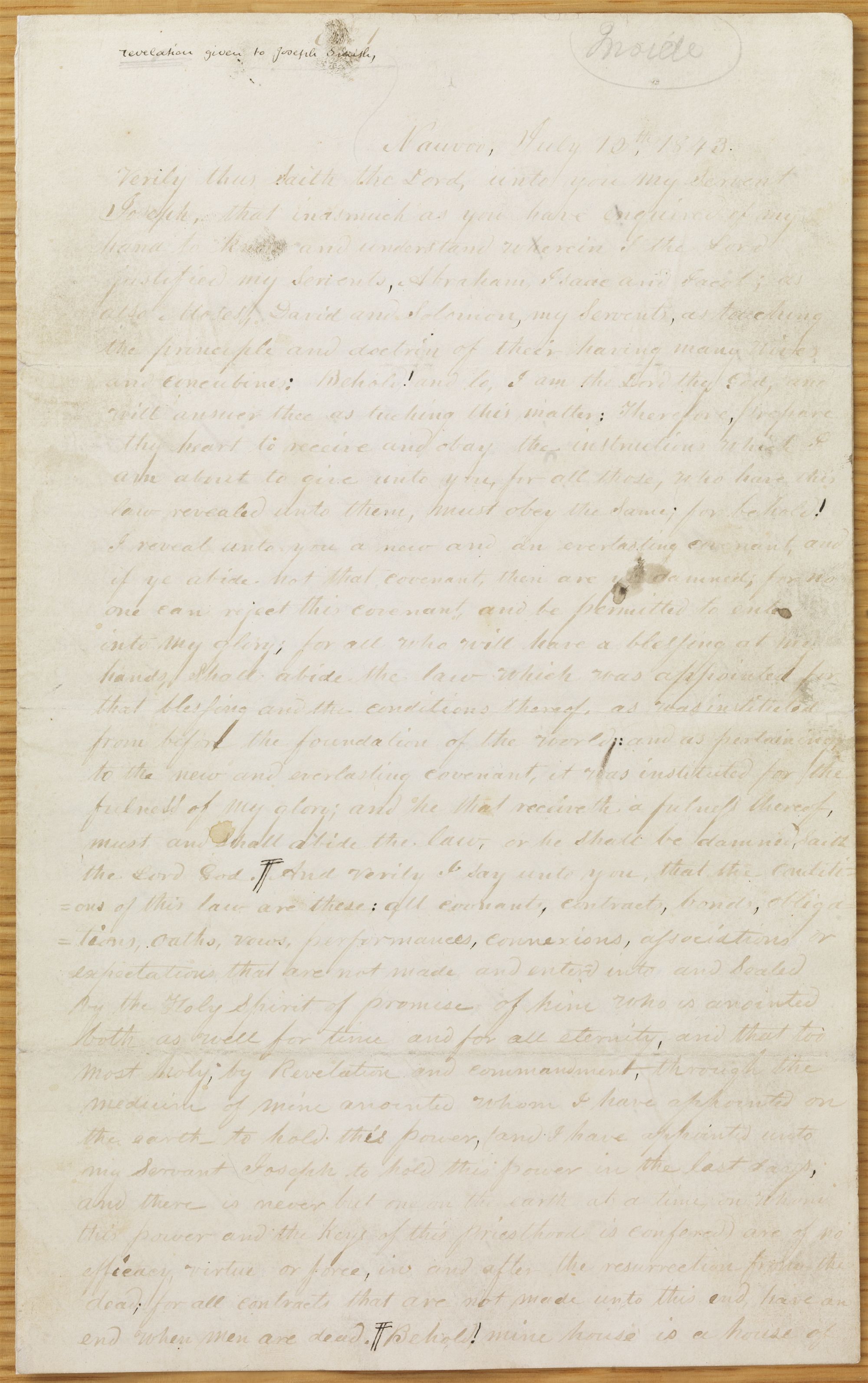
The CES Letter's chronological argument: D&C 132 was dictated July 1843; the sealing keys were restored April 3, 1836; Joseph was practicing polygamy in the mid-1830s; therefore Joseph's earliest plural marriages were unauthorized by any theological framework, and "Joseph's 'marriage' to Fanny Alger in 1833 was illegal under both the laws of the land and under any theory of divine authority; it was adultery."[1:4]
Pre-1843 origins, date-stamped
The argument requires assuming D&C 132 was the originating revelation rather than the recording of a doctrine taught for years prior. The record does place the doctrine's origins before the 1843 dictation. But the strength of the evidence varies sharply by date, and the sorting matters:
1831 Old Testament study (retrospective). The current section heading says the principles "were known by the Prophet earlier"; the Gospel Topics Essay: "its early verses suggest that part of it emerged from Joseph Smith's study of the Old Testament in 1831." The first verse of D&C 132 itself frames the revelation as a response to Joseph's question about Abraham, Isaac, Jacob, Moses, David, and Solomon.[2:1][7:2][3:11] These are official summaries; the underlying primary evidence is largely retrospective.
W. W. Phelps to Brigham Young (1861) and Joseph F. Smith (1883), recalling 1831. Phelps reported decades after the fact that on July 17, 1831, the Lord told Joseph: "It is my will, that in time, ye should take unto you wives of the Lamanites and Nephites."[8:1] Joseph F. Smith later (recorded 1883, published 1887): "The great and glorious principle of plural marriage was first revealed to Joseph Smith in 1831, but being forbidden to make it public... he confided the facts to only a very few of his intimate associates."[8:2] Both are 30- to 52-year-later recollections, not contemporaneous documents.
Orson Pratt, Joseph B. Noble, Benjamin F. Johnson, all retrospective. Pratt: "In the fore part of the year 1832, Joseph told individuals... the principle of taking more wives than one is a true principle, but the time had not yet come for it to be practiced."[9:1] Noble (1883): the doctrine was revealed "while he was engaged on the work of translation of the scriptures" but "the time for the practice of that principle had not arrived."[9:2] Johnson recalled learning in 1835 that "the ancient order of plural marriage was again to be practiced by the Church."[31] All from accounts recorded decades after the events.
W. W. Phelps to Sally, May 26 and September 16, 1835 (genuinely contemporaneous). "A new idea, Sally, if you and I continue faithful to the end, we are certain to be one in the Lord throughout eternity; this is one of the most glorious consolations we can have in the flesh." His September 16, 1835 letter extended the doctrine: "I have no right to any other woman in this world nor in the world to come, according to the law of the celestial kingdom."[10:1][32] These are written, dated documents from inside the Church's leadership circle in 1835, discussing eternal-marriage theology eight years before the dictation and months before the August 1835 D&C 101:4 statement. This is the strongest pre-1843 anchor in the documentary record.
So the picture sorts cleanly. The 1831 origins claim leans substantially on retrospective accounts. The 1835 evidence is contemporaneous and documented. By 1835 the doctrine was being discussed in writing among the Church's leaders; whether it was being discussed earlier rests on later recollections that may well be reliable but cannot be independently verified.
Practice before formalization
Even on the conservative reading, with the doctrine documented in writing by 1835, the eight-year gap to the 1843 dictation fits the broader Restoration pattern rather than breaking it. The Word of Wisdom (D&C 89, 1833) was revealed before it was broadly enforced. Kirtland and Nauvoo temple endowment elements were taught privately before being formalized in official writing. Joseph received the principle of baptism for the dead at the August 1840 funeral of Seymour Brunson, before the practice was formalized in D&C 124:29–36 (January 1841) and D&C 127–128 (1842).[33] The distinction between teaching a principle, practicing it, and recording the revelation in writing for canonization is ordinary Restoration practice, not a special plea invented for D&C 132. The plural marriage revelation itself ran the same course: it "was not written down until 1843" though its principles trace to 1831.[7:3]
The Fanny Alger question
The Fanny Alger relationship, placed by primary sources in late 1835 or early 1836 (though some accounts argue 1833), is thin in the documentary record and is treated more fully in Joseph Smith's Marriages. For the textual-contradiction question here, two points matter:
Brian C. Hales dates the ceremony Mosiah Hancock described to "late 1835 or early 1836." Benjamin F. Johnson's 1835 reference and the proximity to the April 3, 1836 sealing-keys restoration (D&C 110) cluster the relationship around the time the keys were restored, not five years before. The dating is contested.[34][35]
The authority question has a real two-sided literature. D. Michael Quinn pressed the case for an authority gap between Joseph's earliest plural marriages and the April 3, 1836 restoration of sealing keys (cf. Quinn, The Mormon Hierarchy: Origins of Power). Hales answers that the Alger union was most likely not an eternal sealing at all: "it seems more likely that priesthood authority was used to create a marriage that would be for time only," which did not require the keys restored at Kirtland.[36]
Bushman's Rough Stone Rolling line, "There is evidence that Joseph was a polygamist by 1835," is sometimes cited as a clean endorsement of the multi-stage development reading. His actual passage is more equivocal. He walks through the documentary problems (late-recollection testimony, ambiguity about whether a ceremony occurred, Cowdery's "dirty, nasty, filthy affair" line) and lands on how differently the parties understood events: Alger's story "was recorded as many as sixty years later by witnesses who had strong reason to take sides," though "they all agree that Joseph married Fanny Alger as a plural wife."[37] Bushman is therefore consistent with the multi-stage reading, not proof of it.
The concession, in one sentence: D&C 132 is not the originating revelation for Joseph's plural marriage practice. It is a recording, dictated retroactively, of a doctrine taught and practiced across several years. That does not prove fabrication. It is consistent with a doctrine received progressively, lived imperfectly, and finally written down when Hyrum needed something he could put in front of Emma.
Claim 6: The 1835 D&C statement on marriage
Cowdery's authorship
The 1835 Doctrine and Covenants contained a "Statement on Marriage" (Section 101 in that edition; usually quoted as 101:4) that explicitly disavowed polygamy:
"Inasmuch as this church of Christ has been reproached with the crime of fornication, and polygamy: we declare that we believe, that one man should have one wife; and one woman, but one husband, except in case of death, when either is at liberty to marry again."[4:1]
The CES Letter cites this as evidence Joseph was publicly contradicting his secret practice. The statement is accurately quoted; the question is who wrote it.
The Joseph Smith Papers' editorial introduction states: "The authorship of the statement is unclear, but it has generally been attributed to Oliver Cowdery."[4:2] W. W. Phelps may have been involved alongside Cowdery; both were involved in printing the 1835 D&C. The authorship attribution is not a faithful apologetic; it is the conclusion of the Church History Department's editorial team after manuscript review.
Joseph in Michigan when adopted
The Joseph Smith Papers further documents: "JS was in Michigan Territory with Frederick G. Williams at the time. He did not return until 23 August 1835." The August 17, 1835 conference accepted the marriage statement and a separate priesthood-government statement "to be 'attached to the book.'" Joseph returned six days after the conference adopted it.[4:3] He was therefore not present when it was read, voted on, or accepted.
Brigham Young's recollection
Brigham Young, in an 1869 statement, said: "Cowdry wrote it, and incisted on its being incerted in the Book of D.&C. contrary to the thrice expressed wish and refusal of the Prophet Jos. Smith."[4:4] Joseph F. Smith later (1878) added that Cowdery knew of the doctrine of plural marriage but took "liberties without license" in publishing the statement "without authority."[4:5]
Recent scholarship by Cheryl L. Bruno and Michelle B. Stone has questioned how reliable Joseph F. Smith's affidavit-shaped accounts of early plural marriage history are. Their Journal of Mormon Polygamy analysis of the William Clayton affidavits argues that Joseph F. Smith curated and sometimes shaped these later attestations to serve a particular narrative. That counsels caution about treating the Brigham Young / Joseph F. Smith later attestations as unmediated documentary evidence of Joseph Smith's contemporaneous opinion of the 1835 statement.[38]
Why Joseph retained it
This is the harder part, and the CES Letter is not the one pressing it. The "Cowdery wrote it" defense works for the document's origin. It explains nothing about its retention. Joseph was Church president from 1835 until his death in 1844, and the 1835 statement stayed in canon the whole time. He never publicly amended or retracted it across those nine years, even after polygamy was an open secret among Nauvoo insiders.
Two further facts sharpen it. The October 1842 Times and Seasons reprinted the 1835 statement under the heading "On Marriage," followed by two certificates carrying 31 signatures (12 men, 19 Relief Society women) declaring that the signers "know of no other rule or system of marriage than the one publised [published] from the Book of Doctrine and Covenants."[39] Several signers knew otherwise firsthand. Eliza R. Snow, who signed as Relief Society secretary, had been sealed to Joseph three months earlier, on June 29, 1842. Newel K. Whitney, who signed the men's certificate, had personally performed his daughter Sarah Ann's sealing to Joseph the following month; Sarah Ann's mother Elizabeth Ann signed the women's. The declaration's wording ("we know of no other rule or system of marriage") is an active claim, not a passive failure to disclose. And the "without authority" framing arrived late: Brigham Young's statement came in 1869, 34 years after the conference and 25 years after Joseph's death, and Joseph F. Smith's sermon in 1878, with no contemporaneous record of Joseph disavowing the 1835 statement, publicly or privately, before he died.
The retention is the part of this claim that stays uncomfortable. Nine years of canonical retention while Joseph privately taught the opposite is not explained by casual oversight. The least-strained reading is the layered one: that Joseph maintained a distinction between what the membership at large was being taught (overwhelmingly monogamy, accurately described by the 1835 statement) and what a small inner circle was being taught privately.[40] What the 1835 statement is not is a separate revelation Joseph dictated and then broke. It was a statement of belief drafted by a counselor without Joseph's contemporaneous authorship, adopted at a conference he was not attending, and kept in print for nine years for reasons the record only partly clarifies. The wider pattern of publicly denying a privately practiced polygamy, and the post-2007 institutional response to it, is engaged more fully in Transparency & Censorship.
Two additional 1835 D&C verses are cited alongside the marriage statement: 13:7 ("love thy wife with all thy heart, and shall cleave unto her and none else") and 65:3 ("wherefore, it is lawful that he should have one wife"). Neither is about polygamy in immediate context. D&C 13:7 (current D&C 42:22) sits in the Section on the Law of the Church and addresses marital fidelity generally. D&C 65:3 (current D&C 49:16) addresses Shaker celibacy doctrine; D&C 49 was given specifically in response to former Shaker Leman Copley, answering the Shaker rejection of marriage altogether rather than legislating monogamy. The current section heading for D&C 49 confirms the Shaker context.[41] Citing these as "anti-polygamy revelations" strips them of that context.
1876 removal
The 1835 statement was removed from the Doctrine and Covenants in the 1876 edition, replaced by D&C 132. The Joseph Smith Papers editorial introduction confirms: "The statement's explicit disavowal of polygamy led to its removal from the Doctrine and Covenants in 1876 when it was replaced by a July 1843 revelation explaining the concept of plural marriage."[4:6] The Church did not pretend the 1835 statement had not existed; it replaced it with the document that superseded it doctrinally.
Claim 7: Procreation-only justification
What v. 63 actually says
The CES Letter writes: "D&C 132:63 very clearly states that the only purpose of polygamy is to 'multiply and replenish the earth' and 'bear the souls of men.'" It then argues: "Why did Joseph marry women who were already married? These women were obviously not virgins, which violated D&C 132:61. Zina Huntington had been married seven and a half months and was about six months pregnant with her first husband's baby at the time she married Joseph; clearly she didn't need any more help to 'bear the souls of men.'"[1:5]
The argument depends on quoting v. 63 partially. The verse in full reads:
"But if one or either of the ten virgins, after she is espoused, shall be with another man, she has committed adultery, and shall be destroyed; for they are given unto him to multiply and replenish the earth, according to my commandment, and to fulfil the promise which was given by my Father before the foundation of the world, and for their exaltation in the eternal worlds, that they may bear the souls of men; for herein is the work of my Father continued, that he may be glorified."[3:12]
The verse names three purposes, not one:
- "Multiply and replenish the earth": procreation.
- "Fulfil the promise which was given by my Father before the foundation of the world": covenant fulfillment.
- "For their exaltation in the eternal worlds, that they may bear the souls of men": exaltation.
Reading v. 63 as procreation-only requires deleting clauses two and three. The Gospel Topics Essay summarizes the broader purpose-set: eternal marriage "was essential to inheriting the fulness that God desires for His children"; the revelation "declared that the 'continuation of the seeds forever and ever' helped to fulfill God's purposes"; and "the Lord promised participants 'crowns of eternal lives' and 'exaltation in the eternal worlds.'"[7:4]
Debunking-CESLetter, drawing on Brian C. Hales's research, lists four reasons for the practice across the revelation, "with the fourth being much more important than the others": restoration ("restitution of all things," vv. 40, 45), trial (vv. 32, 51), procreation (v. 63), and exaltation (vv. 63, 16–17). Exaltation is available only to the sealed, which "creates an undeniable problem if monogamy is the only celestial marital dynamic" given any imbalance in worthy men and women.[42]
Lucy Walker, recalling Joseph's actual contemporary teaching, stated: "Men did not take polygamous wives because they loved them... but because it was a command of God." The motivation Joseph articulated was theological obedience and exaltation, not procreation.[18:1]
The Zina-was-pregnant timing question
The CES Letter's Zina move is rhetorically powerful: she did not need help bearing souls because she was already pregnant. The response has two parts. First, v. 63's procreation purpose is one of three, not the gating condition for any sealing. Second, the eternity-only framework (engaged fully in Polyandry) decouples the timing of a sealing from the procreation purpose of v. 63, since eternity-only sealings did not involve mortal sexual relationships and were not mortal marriages in the cohabiting sense. The "she didn't need help bearing souls" line conflates v. 63's procreation purpose with the timing of the sealing. The sealing's timing is separately defensible only if the eternity-only framework is, and that framework is itself contested: Quinn argued the eternity-only category may have been a post-hoc construction, while Hales and the standard apologetic position argue it was genuine and contemporary. The textual-contradiction analysis here can do no more than note the disagreement.
The plausibility of the eternity-only framework, the close reading of dozens of marriage records, and the absence or presence of sexual evidence all live in Polyandry.
For the textual-contradiction question, the key point is that v. 63 itself couples procreation with exaltation. A man inventing rules to justify his behavior would not write a verse constraining plural marriages to any of the three named purposes, still less three purposes that make eternity-only sealings to married women textually defensible by the second and third clauses (covenant fulfillment and exaltation) but not the first (procreation). The CES Letter's argument needs v. 63 read narrowly enough that the polyandrous sealings appear to break it. Read in full, the verse is broad enough to hold them.
The strongest critical case
The serious critical scholarship on Joseph's plural marriage practice goes well past what the CES Letter offers, and it deserves a direct hearing here.
Todd Compton's In Sacred Loneliness
Todd Compton's In Sacred Loneliness: The Plural Wives of Joseph Smith (Signature Books, 1997) is one of the two most rigorous critical treatments in print, written by a believing Latter-day Saint who grew progressively troubled by what he uncovered.[43] Compton documents the lives of Joseph's 33+ plural wives in detail. His central thesis is that these women's stories show both genuine religious devotion and genuine pain, and that the faithful narrative compresses the pain to make the devotion carry more interpretive weight than it should.
On D&C 132's textual-versus-practice question, three of Compton's contributions bear directly:
The Lawrence sisters were orphans and financial wards of the Smith family. The sealing dynamic was complicated by their legal dependency. Even if vv. 64–65's exception clause provided procedural cover, the broader ethics of sealing one's wards is a category Compton presses on.[43:1]
The Partridge sisters were working in the Smith home. Their position as Emma's domestic help complicates the consent dynamics for everyone involved: for Emma, who supervised them, and for the Partridge sisters, whose employment under Joseph and Emma made the sealing inseparable from their material circumstances.[43:2]
The "destroyed" language reads harshly even on Compton's careful reading. Helen Mar Kimball's adolescent agony, quoted in the CES Letter, is not the only female voice that registered cost. The women's later silences and partial recantations are documented across multiple cases. Compton does not claim Joseph was a fraud; he claims the human cost of plural marriage was greater than faithful narratives usually allow.[43:3]
The right way to meet Compton is to grant his evidentiary work and contest his interpretation where the text and the broader documentary record point another way. The larger question of women's experiences in plural marriage is carried further in Joseph Smith's Marriages.
Newell and Avery on Emma
Linda King Newell and Valeen Tippetts Avery's Mormon Enigma: Emma Hale Smith (Doubleday, 1984; revised University of Illinois Press, 1994) is the sympathetic-but-candid biography that brought Emma's perspective forward in scholarly form.[44] Their treatment complicates the "Emma consented to four marriages" faithful narrative in three documentary ways:
Emma's "consent" came after the marriages had already secretly occurred. The Partridge sisters were sealed to Joseph in March 1843 before Emma knew. The May 1843 ceremony she attended was a re-sealing; Emily Partridge described it as the only way Emma could exercise any control over a process that had already happened without her.[44:1]
Emma's acceptance lasted hours. Emily Partridge: "she was bitter after that... After the next day you might say that she was bitter."[25:4] This is not deliberation followed by decision; it is brief capitulation followed by regathering.
Emma's consent to the re-sealing did not extend to married life. Emily Partridge again: "Emma knew that we were married to him, but she never allowed us to live with him."[25:5]
The faithful response is not to deny these facts but to notice that the revelation itself anticipates exactly this kind of fluctuation. The structure of vv. 51–56 (offer, test, refusal, forgiveness pivot) maps onto Emma's actual experience more closely than a rigid "Joseph violated his own rules" reading allows. The Gospel Topics Essay's acknowledgment that Emma's experience was "an excruciating ordeal" concedes as much.[7:5]
Bruno's Secret Covenants and recent critical scholarship
Cheryl L. Bruno's edited collection Secret Covenants: New Insights on Early Mormon Polygamy (Signature Books, 2024) is the most significant recent critical anthology on early Mormon polygamy. It includes essays by William Victor Smith on D&C 132's institutional impact, Don Bradley on early sealing chronology, Susan Staker, Mark Tensmeyer, and others, and represents the current state of the field.[45] Bruno and Stone's 2025 Journal of Mormon Polygamy article, "Crafting a Sacred Story: Joseph F. Smith and the William Clayton Affidavits," argues that the later affidavit-based narrative, including the Brigham Young / Joseph F. Smith framing of Cowdery's 1835 authorship, was shaped by Joseph F. Smith's curatorial decisions in ways that complicate its evidentiary status.[38:1]
For the textual-contradiction question, these Secret Covenants contributions take the Compton and Newell-Avery arguments another step. They are the current scholarly engagement with the Brignone-style structural concerns and with the Joseph F. Smith-shaped record. The critical scholarship has not stood still: current peer-reviewed work is sustaining and extending the harder case, past In Sacred Loneliness and Mormon Enigma.
The structural-coercion reading of the Law of Sarah
Brignone's By Common Consent essay states the strongest critical reading most cleanly: the Law of Sarah is structurally coercive regardless of Emma's particular consent history.[22:1] Claim 3 engaged this head-on; the structural asymmetry it conceded is real and uncontested here. The single point of pushback is that the covenant consequences (the destruction language) fall symmetrically on men and women; the procedure does not.
So the Brignone argument stands as the live form of the critical case, still open when the textual-contradiction argument is over.
Questions the sources leave open
Several questions don't have clean answers from either faithful or critical scholarship:
What authority did Joseph use for plural marriages before April 3, 1836? Both sides have been argued at book length; neither closes it.[36:1] Hales argues the Alger marriage was a priesthood marriage "for time only" that did not require the keys restored at Kirtland. Quinn argued for an authority gap (cf. Origins of Power). The Fanny Alger relationship is a hard case for the faithful position if dated to 1833 or even mid-1835; if dated to late 1835 or 1836, it clusters around the keys restoration.
Why was the 1835 D&C 101:4 statement retained for nine years of Joseph's life? The "Cowdery wrote it" defense addresses origin but not retention. The most plausible reading is the layered one (membership-at-large taught monogamy; small inner circle taught the pre-revealed doctrine of plural marriage), but it does not fully explain why Joseph never publicly amended the document during his lifetime.
Was the eternity-only framework genuine and contemporary, or partially constructed retroactively? Hales and the standard apologetic position argue genuine; Quinn argued for retroactive construction. The textual-contradiction analysis can flag this question but cannot resolve it; the close evidentiary work lives in Polyandry.
In what sense did Joseph "follow" his own revelation when Emma's consent was as troubled as the documentary record shows? The vv. 64–65 exception clause provides procedural cover, but the Law of Sarah's structural asymmetry is genuinely uncomfortable. The Sarah Ann Whitney case (July 1842), which preceded any documented Emma-consent, is the hardest single datum for any reading that places the Law of Sarah's procedure inside the actual practice.
What the mismatches actually mean
The CES Letter's argument leans on the cumulative weight of contradictions between D&C 132 and Joseph's practice. The polemic at its most aggressive, the reading that paints D&C 132 as a Warren-Jeffs-style fabrication Joseph designed to license himself, stumbles on features of the revelation itself. Two are especially hard for it to absorb.
The voice names the dictator's "trespasses." Verse 56's "let mine handmaid forgive my servant Joseph his trespasses" is language a self-justifying coercive fabrication does not include about itself in its own dictated text.
The text three times condemns the practice critics charge Joseph with. Verses 41–42 and v. 63 condemn women being "with another man" sexually outside the authorized framework, which is the very sexual-polyandry charge raised against the polyandrous sealings. A pure self-licensing fabrication aligns its rules to the author's behavior. D&C 132 instead condemns sexual polyandry, and Joseph's defenders argue the polyandrous sealings were eternity-only precisely to comply with that condemnation.
Both points tell against the fabrication reading, not against the more sophisticated critical positions, and the distinction matters. The middle position (the sincerely-received-but-humanly-mediated reading that Bushman engages, the non-LDS biographer Dan Vogel frames differently, and Bruno's anthology contributors carry forward) holds that Joseph genuinely believed he was receiving revelation while the resulting framework was shaped by his own assumptions, his 19th-century setting, and perhaps mistakes about how the doctrine was meant to be applied. Nothing here refutes that middle position. The claim is narrower: the textual-contradiction case the CES Letter builds is finished before it ever reaches that middle position.
The harder reading is the true one. D&C 132 is not a tidy rulebook from a benevolent author, and it is not the self-serving coercive justification the CES Letter portrays. Whether it is a real revelation imperfectly mediated, a sincere revelation carrying humanly introduced errors, or some configuration between the two, those questions sit one level beyond the textual-contradiction argument. And the textual-contradiction argument, taken on its own terms, requires a shorter D&C 132 than the one in the book.
The genuine difficulty
Six features of D&C 132 and its surrounding history remain difficult on any reading:
- The Law of Sarah's procedural asymmetry is real. A first wife's refusal reassigns the transgression to her rather than stopping the marriage, and nothing in the framework runs the other direction.
- Even corrected by the 1828 dictionary, "destroyed" is a hard word. Emma experienced it as harsh, and that is not a weakness in her but the predictable response of a person facing the most severe possible test of marital trust.
- Emma's consent history was complicated, episodic, and often withdrawn. The Whitney sealing came without her knowledge, the Partridge sisters were barred from living with Joseph after the re-sealing she approved, and her 1879 testimony denied the practice outright. None of these are clean.
- The 1835 statement on marriage stayed in canon for the last nine years of Joseph's life, unamended, while he privately taught the opposite.
- Joseph practiced plural marriage for years before the revelation governing it was written down.
- The 1842 Times and Seasons certificates were signed by Saints who were themselves secretly sealed, Eliza R. Snow among them.
The faithful position concedes that much of this is hard. What it contests is the textual-contradiction case, which depends, point after point, on quotations cut off just before the verses that reframe them, even as the deeper questions the best critical scholarship raises stay open.
The theology that endures
The plural marriage provisions of D&C 132 (vv. 34–66) were discontinued through the 1890 Manifesto and the 1904 Second Manifesto.[7:6][46] They are not currently practiced in the Church, and they are not part of the marriage doctrine taught to current members.
What remains, and what the CES Letter's framing quietly steps around, is the eternal-marriage covenant of vv. 1–33. That framework is the doctrinal foundation of temple sealing as practiced today:
The new and everlasting covenant of marriage (vv. 1–7, 19–20). Marriage sealed by the Holy Spirit of promise endures beyond death. Modern temple ordinances, performed by sealing authority traced to D&C 110's April 3, 1836 restoration, rest on this framework.[3:13]
The promise of exaltation (vv. 19–20). "Thrones, kingdoms, principalities, and powers, dominions" and "a fulness and a continuation of the seeds forever and ever" (v. 19), crowned by "Then shall they be gods" (v. 20): promises held today by every couple sealed in a temple.
Sealing authority as the operative key (vv. 7, 18, 26). The authority that binds in heaven, not the form of marriage, is the doctrinal centerpiece. Modern temple sealings are almost entirely monogamous; the framework still applies.
To work, the CES Letter's reading needs D&C 132 to be a polygamy revelation and little else. The text reads, and the Church has consistently read it, as an eternal-marriage revelation containing plural marriage provisions specific to one historical period, set inside a covenant framework that endures.[13:1] David O. McKay observed that section 132 "was regarding the eternity of the marriage covenant; it was not on polygamy," and that the section's core "pertains only to one man and one wife."[13:2]
To make the case it wants, the CES Letter would have to show that the eternal-marriage framework of vv. 1–33 is theologically incoherent or doctrinally novel. The case it actually makes, strategic quotation of the plural marriage rules in vv. 34–66, leaves that larger framework untouched.
Assessment
The CES Letter's claim is that Joseph Smith violated his own revelation by failing to follow the "specific and bizarre rules" of D&C 132. The claim succeeds rhetorically by selective quotation. Read against the full text, it falls apart.
On Jacob 2 vs. D&C 132: the contradiction the CES Letter constructs requires omitting Jacob 2:30 (the explicit exception clause) and D&C 132:38–39 (the in-text harmonization that distinguishes authorized from unauthorized plural marriage). With those verses back in, the two texts agree: monogamy as default, divinely commanded plural marriage as the exception both texts contemplate.
On the virgin requirement: D&C 132 itself supplies the counterexample (vv. 34–35, Hagar) that refutes the "virgins only" reading, and Joseph's contemporaneous approval of Heber C. Kimball's plural marriage to Sarah Noon (a non-virgin previously married woman) confirms it. Verse 61 is one prescription within a larger framework, not the gating condition the CES Letter requires it to be.
On first-wife consent: vv. 64–65, which the CES Letter does not quote, describe what happens when the first wife refuses, exempting the husband from the consent procedure. The rule the CES Letter says Joseph violated is qualified by the same revelation that contains it. Brignone's structural-coercion reading is the harder argument, and this article concedes the procedural asymmetry without dissolving it. That asymmetry, not the "Joseph violated his own rules" framing, is the real open question on this claim.
On Emma's "destruction": the same revelation that uses the word in v. 54 names Joseph's "trespasses" two verses later (v. 56) and pivots to forgiveness, with Emma carrying the sequenced absolving burden. The destruction language runs across the whole covenant (applied to Joseph himself in v. 4, to anyone in v. 26, to plural wives in vv. 41–42) rather than singling Emma out. The Webster's 1828 sense of "destroy" maps onto covenantal cessation, not physical violence. None of this softens the structural-coercion reading, but it does answer the specific Warren-Jeffs framing the CES Letter constructs.
On polygamy preceding the revelation: the principle was discussed in writing in the Church's inner circle by 1835 (the genuinely contemporaneous Phelps letters), with retrospective accounts placing private teaching as early as 1831. This pattern fits the broader Restoration practice (Word of Wisdom; baptism for the dead; temple endowment) where teaching preceded formalization.
On the 1835 statement: Cowdery's authorship is established by Joseph Smith Papers editorial review, not by faithful apologetics. The nine-year retention resists easy explanation; but the document is not a separate revelation Joseph dictated and then violated.
On the procreation-only purpose: v. 63 names three purposes, not one, and the CES Letter's argument requires deleting two of them. The Zina-was-pregnant move measures the sealing's timing against the procreation clause alone, a question that lives in the eternity-only-framework analysis cross-linked to Polyandry.
The most rigorous critics (Compton, Newell/Avery, Brignone, Bruno) raise real concerns. Most of them are about the human practice of plural marriage, Emma's particular experience, and the Joseph F. Smith-shaped later record, not about D&C 132's internal coherence. The textual contradictions the CES Letter constructs do not survive a full reading. The historical and emotional concerns the critics raise do.
So the contradiction the CES Letter assembles is not a property of the text. It is a property of the editing. It needs Jacob 2 read without v. 30 and D&C 132 read without vv. 38–39; it needs v. 61 detached from vv. 34–35 and v. 64; it needs v. 54 detached from v. 4 and v. 26; it needs v. 63 reduced from three purposes to one. If the contradiction lived in the text, why does producing it require shortening the text? Restore each omission and the contradiction closes. What is left over is not a fabricator's rulebook and not a coherent code from a tidy author. It is a revelation whose plural-marriage provisions were bounded to one historical period and discontinued, wrapped inside an eternal-marriage covenant of vv. 1–33 that still grounds every temple sealing performed today.
The textual-contradiction case fails. The deeper questions, the ones Brignone, Compton, Newell/Avery, and Bruno keep open, do not, and they are taken up where they belong, in Joseph Smith's Marriages and Polyandry. The argument the CES Letter actually prints does not reach them.
Runnells, CES Letter (2017), "Polygamy | Polyandry," pp. 55–58. ↩︎ ↩︎ ↩︎ ↩︎ ↩︎ ↩︎
"Historical Context and Background of D&C 132," Doctrine and Covenants Central. https://doctrineandcovenantscentral.org/historical-context/dc-132/ ↩︎ ↩︎
"Revelation, 12 July 1843 [D&C 132]," in Joseph Smith Papers. https://www.josephsmithpapers.org/paper-summary/revelation-12-july-1843-dc-132/1 ↩︎ ↩︎ ↩︎ ↩︎ ↩︎ ↩︎ ↩︎ ↩︎ ↩︎ ↩︎ ↩︎ ↩︎ ↩︎ ↩︎
"Appendix 3: Statement on Marriage, circa August 1835," in Joseph Smith Papers, editorial introduction. https://www.josephsmithpapers.org/paper-summary/appendix-3-statement-on-marriage-circa-august-1835/1 ↩︎ ↩︎ ↩︎ ↩︎ ↩︎ ↩︎ ↩︎
Brian C. Hales, "Emma Smith Struggles," josephsmithspolygamy.org. https://josephsmithspolygamy.org/history/emma-smith-struggles/ ↩︎ ↩︎
Doctrine and Covenants 132, section heading. The Church of Jesus Christ of Latter-day Saints. https://www.churchofjesuschrist.org/study/scriptures/dc-testament/dc/132?lang=eng ↩︎ ↩︎
"Plural Marriage in Kirtland and Nauvoo," Gospel Topics Essays, The Church of Jesus Christ of Latter-day Saints. https://www.churchofjesuschrist.org/study/manual/gospel-topics-essays/plural-marriage-in-kirtland-and-nauvoo ↩︎ ↩︎ ↩︎ ↩︎ ↩︎ ↩︎ ↩︎
"When did Joseph Smith receive the revelation on plural marriage?" FAIR. https://www.fairlatterdaysaints.org/answers/Question:_When_did_Joseph_Smith_receive_the_revelation_on_plural_marriage%3F ↩︎ ↩︎ ↩︎
Brian C. Hales, "The 1830s — Joseph Smith's Polygamy," josephsmithspolygamy.org. https://josephsmithspolygamy.org/history/polygamy-early-1830s/ ↩︎ ↩︎ ↩︎
Bruce A. Van Orden, "Writing to Zion: The William W. Phelps Kirtland Letters (1835–1836)," BYU Studies 33:3 (1993). https://byustudies.byu.edu/article/writing-to-zion-the-william-w-phelps-kirtland-letters-18351836/ ↩︎ ↩︎
Paul Fields, Steve Densley, Matthew Roper, and Larry Bassist, "Historical and Stylometric Evidence for the Authorship of Doctrine and Covenants 132," Interpreter: A Journal of Latter-day Saint Faith and Scholarship 67 (2025): 1–70. https://interpreterfoundation.org/journal/historical-and-stylometric-evidence-for-the-authorship-of-doctrine-and-covenants-132/ ↩︎
Daniel C. Peterson, "On the Authorship of Doctrine and Covenants 132," Patheos (Nov 2025). https://www.patheos.com/blogs/danpeterson/2025/11/on-the-authorship-of-doctrine-and-covenants-132.html ↩︎
Chad Nielsen, "Monogamy is the Rule, Part 2: Celestial Marriage and Plural Marriage," Times & Seasons (Nov 2024). https://timesandseasons.org/index.php/2024/11/monogamy-is-the-rule-part-2-celestial-marriage-and-plural-marriage/ ↩︎ ↩︎ ↩︎
Jacob 2:23–30, in The Book of Mormon. The Church of Jesus Christ of Latter-day Saints. https://www.churchofjesuschrist.org/study/scriptures/bofm/jacob/2 ↩︎
Brian J. Baird, "Understanding Jacob's Teachings about Plural Marriage from a Law of Moses Context," Interpreter: A Journal of Latter-day Saint Faith and Scholarship 25 (2017): 227–237. https://scripturecentral.org/archive/periodicals/journal-article/understanding-jacobs-teachings-about-plural-marriage-law-moses-context ↩︎
"Plural Marriage in the Book of Mormon," FAIR. https://www.fairlatterdaysaints.org/answers/Plural_marriage_in_the_Book_of_Mormon ↩︎
The article's argument here uses D&C 132:34's own theological reading of Genesis 16 — "Sarah gave Hagar to Abraham to wife... this was the law" — as evidence of D&C 132's internal coherence. That works for a textual-internal-coherence argument; it does not resolve the broader exegetical question of whether D&C 132's reading of Genesis 16 is the right one. Many Christian and Jewish readers see the Hagar episode as a tragedy produced by impatience with God's promise, not as a "fulfilling, among other things, the promises." The argument here is internal-textual, not biblical-exegetical. ↩︎
Laura Harris Hales, "Joseph Smith's Polygamy: Toward a Better Understanding," FAIR Conference, August 2015. https://www.fairlatterdaysaints.org/conference_home/august-2015/joseph-smiths-polygamy-toward-a-better-understanding ↩︎ ↩︎
William Victor Smith, Textual Studies of the Doctrine and Covenants: The Plural Marriage Revelation (Salt Lake City: Greg Kofford Books, 2018), on the plural marriage revelation's later verses. ↩︎
Craig L. Foster, "Much More than a Plural Marriage Revelation," Interpreter: A Journal of Latter-day Saint Faith and Scholarship 29 (2018): 219–226. https://journal.interpreterfoundation.org/much-more-than-a-plural-marriage-revelation/ ↩︎
"Emma Smith's reaction to Joseph Smith's plural marriages," FAIR. https://www.fairlatterdaysaints.org/answers/Emma_Smith's_reaction_to_Joseph_Smith's_plural_marriages ↩︎
Laura Brignone, "She Shall Believe or She Shall Be Destroyed: D&C 121 and 132," By Common Consent (Oct 28, 2021). https://bycommonconsent.com/2021/10/28/she-shall-believe-or-she-shall-be-destroyed-dc-121-and-132/ ↩︎ ↩︎
The honest faithful response has only one substantive contestation: the destructive consequence of refusal is the same destructive consequence the same revelation applies to Joseph in v. 4 ("if ye abide not that covenant, then are ye damned"), to anyone breaking the covenant in v. 26 ("destroyed in the flesh, and... delivered unto the buffetings of Satan"), and to plural wives who break their own covenants in vv. 41–42. The covenant's consequences are symmetric across men and women. What is asymmetric is the procedure. There is no symmetric clause: the wife cannot, for example, take a second husband if the first refuses to administer the law. The Abrahamic-test frame in v. 51 — "I did it, saith the Lord, to prove you all, as I did Abraham, and that I might require an offering at your hand, by covenant and sacrifice" — is sometimes deployed as a softening move. It should not be. The Genesis 22 binding-of-Isaac archetype the verse invokes is a test of the patriarch (Abraham), not of the bound son (Isaac). Brignone's reading places Emma in Isaac's structural position, not Abraham's. Naming the test "Abrahamic" sharpens the difficulty rather than dissolving it: Isaac's consent was not required for Abraham to proceed, and on the procedural-asymmetry reading, neither was Emma's. ↩︎
"Letter to Newel K., Elizabeth Ann Smith, and Sarah Ann Whitney, 18 August 1842," in Joseph Smith Papers. https://www.josephsmithpapers.org/paper-summary/letter-to-newel-k-elizabeth-ann-smith-and-sarah-ann-whitney-18-august-1842/1 ↩︎ ↩︎
Emily Dow Partridge Young, deposition in Temple Lot trial (1892), reproduced in Brian C. Hales, Joseph Smith's Polygamy, 3 vols. (Salt Lake City: Greg Kofford Books, 2013), and discussed at "Emma Smith and Plural Marriage," josephsmithspolygamy.org. https://josephsmithspolygamy.org/common-questions/emma-smith-plural-marriage/ ↩︎ ↩︎ ↩︎ ↩︎ ↩︎ ↩︎
"Last Testimony of Sister Emma," interview with Joseph Smith III, The Saints' Herald 26 (Oct. 1, 1879): 289–290. ↩︎ ↩︎
Three observations sharpen the timeline. (a) The Sarah Ann Whitney sealing is the marriage the apologetic narrative most needs to engage and most often skips — Bishop Newel K. Whitney personally married his daughter to Joseph, and the Joseph-to-Newel-and-Sarah-Ann letter coordinating a private meeting "when Emma comes [is absent]" makes plain that the Law of Sarah's procedural framework was not satisfied at the time of this sealing. (b) The Partridge sisters' situation shows that "consent" itself was layered: Emma assented to the May 1843 re-sealing but, by Emily's testimony, "never allowed us to live with him," which the faithful narrative compressing this into "Emma consented to four marriages" softens. (c) Emma's 1879 denial of polygamy entirely cannot be reconciled with the marriages she clearly knew about; the apologetic narrative must choose whether her earlier consent was real and her later denials false, or whether her later denials were the truth she had reconciled herself to and her earlier "consent" was the partial accommodation Newell and Avery describe. There is no clean reconciliation. ↩︎
Noah Webster, American Dictionary of the English Language (1828), s.v. "destroy." https://webstersdictionary1828.com/Dictionary/destroy ↩︎
"D&C 132 and Being 'Destroyed'," Debunking-CESLetter. https://debunking-cesletter.com/polygamy-polyandry-1/dc-132-and-being-destroyed/ ↩︎ ↩︎
Doctrine and Covenants 19:6–11. The Church of Jesus Christ of Latter-day Saints. https://www.churchofjesuschrist.org/study/scriptures/dc-testament/dc/19 ↩︎
Benjamin F. Johnson 1835 reference and other 1830s recollections discussed in "Hales–Quinn Dialogue," josephsmithspolygamy.org. https://josephsmithspolygamy.org/dialogues/hales-quinn/ ↩︎
"The Phelps Family," in We'll Sing and We'll Shout, BYU Religious Studies Center. https://rsc.byu.edu/well-sing-well-shout/phelps-family ↩︎
"Baptism for the Dead," Church History Topics, The Church of Jesus Christ of Latter-day Saints. https://www.churchofjesuschrist.org/study/history/topics/baptism-for-the-dead ↩︎
Brian C. Hales, "Fanny Alger and Joseph Smith's Pre-Nauvoo Reputation." https://mormonpolygamydocuments.org/wp-content/uploads/2015/01/JS1099.pdf ↩︎
"Did Joseph Smith marry Fanny Alger as his first plural wife in 1833?" FAIR. https://www.fairlatterdaysaints.org/answers/Question:_Did_Joseph_Smith_marry_Fanny_Alger_as_his_first_plural_wife_in_1833%3F ↩︎
Brian C. Hales, "Joseph Smith and Fanny Alger," josephsmithspolygamy.org (on the pre-1836 plural marriage authority question). https://josephsmithspolygamy.org/common-questions/fanny-alger/ ↩︎ ↩︎
Richard Lyman Bushman, Joseph Smith: Rough Stone Rolling (New York: Knopf, 2005), pp. 323–325. ↩︎
Cheryl L. Bruno and Michelle B. Stone, "Crafting a Sacred Story: Joseph F. Smith and the William Clayton Affidavits," Journal of Mormon Polygamy (2025). https://journalofmormonpolygamy.org/jmp/article/view/4 ↩︎ ↩︎
"On Marriage," Times and Seasons 3 (Oct. 1, 1842): 939–940. Two certificates (12 men; 19 women of the Relief Society, including Eliza R. Snow and Sarah M. Cleveland) appended to a reprint of the 1835 marriage statement. ↩︎
The layered reading: the 1835 statement was contextually a disavowal of the free-love spiritual-wifery rumors Cowdery and Phelps were dealing with in 1835, not contextually an exhaustive doctrinal statement on what could ever be revealed about marriage. Joseph kept the statement because it accurately described the public Church's marriage policy — even though it did not describe his own practice or the practice of those few he had taught the doctrine to. That reading is workable. It is not entirely comfortable. The article will not pretend it is. ↩︎
Doctrine and Covenants 49 (section heading and historical context noting the revelation was given in response to former Shaker Leman Copley). The Church of Jesus Christ of Latter-day Saints. https://www.churchofjesuschrist.org/study/scriptures/dc-testament/dc/49 ↩︎
"D&C 132," Debunking-CESLetter. https://debunking-cesletter.com/polygamy-polyandry-1/dc-132/ ↩︎
Todd Compton, In Sacred Loneliness: The Plural Wives of Joseph Smith (Salt Lake City: Signature Books, 1997). ↩︎ ↩︎ ↩︎ ↩︎
Linda King Newell and Valeen Tippetts Avery, Mormon Enigma: Emma Hale Smith, 2nd ed. (Urbana: University of Illinois Press, 1994). ↩︎ ↩︎
Cheryl L. Bruno, ed., Secret Covenants: New Insights on Early Mormon Polygamy (Salt Lake City: Signature Books, 2024). https://www.signaturebooks.com/books/p/secret-covenants ↩︎
"The Manifesto and the End of Plural Marriage," Gospel Topics Essays, The Church of Jesus Christ of Latter-day Saints. https://www.churchofjesuschrist.org/study/manual/gospel-topics-essays/the-manifesto-and-the-end-of-plural-marriage ↩︎