Joseph Smith's Marriages
The claim:
"Joseph Smith was married to at least 34 women, as now verified in the Church's 2014 polygamy essays.... Out of the 34 women, 7 of them were teenage girls as young as 14-years-old. Joseph was 37-years-old when he married 14-year-old Helen Mar Kimball, twenty-three years his junior. Even by 19th century standards, this is shocking.... Some of the marriages to these women included promises by Joseph of eternal life to the girls and their families, or threats that he (Joseph) was going to be slain by an angel with a drawn sword if the girls didn't marry him.... Today, Warren Jeffs is more closely aligned to Joseph Smith's Mormonism than the modern LDS Church is."[1]
The CES Letter's polygamy section makes four core claims:
- Joseph Smith married at least 34 women, a number the Church's own 2014 essay confirms.
- Seven were teenagers, and the youngest, Helen Mar Kimball, was 14, which the CES Letter calls shocking even by the standards of the 1800s.
- The marriages were obtained through spiritual coercion: promises of eternal life for the girls and their families, and Joseph's claim that an angel with a drawn sword would slay him if he did not proceed.
- Taken with his marriages to other men's wives and his public denials of the whole practice, this puts Joseph Smith closer to Warren Jeffs, the convicted leader of a Fundamentalist polygamous sect, than to the church Joseph founded.
The portrait those claims add up to is a religious predator, and on a first read it is hard to dismiss.
The strongest pieces of that portrait fall apart under the documentary record. DNA testing has ruled Joseph out as the biological father in every case ever attributed to him, six for six, including the one deathbed attribution that had stood for a century. His most aggressive enemies in his own day, men actively working to destroy him, accused him of nearly everything else on record and never once of sexually coercing a minor. If Joseph had been the predator the CES Letter describes, why did the men most eager to ruin him never say so? The women the CES Letter quotes as victims spent their adult decades defending the practice in print and under oath. The "34 wives" number fuses at least three categorically different kinds of sealings, and roughly two-thirds of them carry no evidence of conjugal relations at all. And the Warren Jeffs comparison, weighed on conduct rather than surface counts, collapses: Jeffs is a convicted child rapist with dozens of biological children from forced marriages; Joseph was never convicted of any sexual crime.
One courtroom episode shows how far the record sits from the portrait. In 1892 the Church had to prove in court that Joseph Smith really had practiced plural marriage. The occasion was the Temple Lot case, in which the Reorganized LDS Church (RLDS), the rival body led by Joseph's son Joseph Smith III, denied that Joseph had ever practiced polygamy, and defeating that denial required showing the marriages were real. So three of Joseph's plural widows were put under oath and asked, directly, about conjugal relations. One articulate, willing witness was never called: Helen Mar Kimball, alive, a published defender of the practice, and closer at hand than several of the women who did testify.[2] If the Church's lawyers had believed Helen's sealing included marital relations, she was the obvious witness to call. They did not call her, and the natural explanation is that the sealing at the center of the CES Letter's predator portrait involved no marital relations to prove. The woman the CES Letter uses to prove a predator is the woman the Church could not use to prove a marriage in the ordinary sense.
This article examines the marriages themselves: the number, the ages, the individual women, the public denials, the genetic evidence. The textual analysis of D&C 132, the Doctrine and Covenants section that authorized plural marriage, and the eternity-only framework governing the polyandrous sealings, are treated in sister articles.
Context and background
Joseph Smith's plural marriages began, by most scholarly reckonings, with Fanny Alger in 1835 or 1836 in Kirtland, Ohio.[3][4] The practice expanded substantially in Nauvoo, Illinois between 1841 and 1844, and ended with Joseph's murder at Carthage Jail in June 1844. Across that span he entered into between thirty and forty sealings with women besides his legal wife Emma; the precise count varies depending on how one categorizes the ambiguous cases.[5][4:1]
Three facts about the period frame everything that follows.
First, Joseph practiced plural marriage privately. Public confirmation in 1842 Illinois would have meant his arrest, since Illinois statutes criminalized bigamy, and likely mob violence against the Saints in Nauvoo.[6] The sealings were performed in private ceremonies, often with only the woman's immediate family present. No public marriage register documents them.
Second, the documentary record is fragmentary. Many sealings are known only from late-life affidavits or reminiscent accounts the women themselves gave decades after Joseph's death, typically in the context of the affidavits collected in 1869, the 1892 Temple Lot Case described in the introduction, or other sworn affidavits collected in the late 19th century.[7] No private journal of Joseph's documents the sealings comprehensively. Several proposed wives rest on a single late-life statement, which is exactly why Compton's count (33) and Hales's count (35) part ways at the margins.
Third, the theology Joseph was working in distinguished at least three kinds of sealing, and the record reflects those kinds rather than a single uniform "plural marriage." The CES Letter's "34 wives" count treats every sealing as the same relationship. Pulling those categories back apart is the first analytical step, and most of the section's case dissolves once it is taken.
Sealing typology: the categories the CES Letter collapses
In Joseph's restored sealing theology, a sealing was not the same thing as a conjugal marriage. The ordinance bound persons together for eternity; whether those persons cohabited or had conjugal relations in this life was a separate question. The 2014 Gospel Topics Essay says so plainly:
"Sealings for time and eternity included commitments and relationships during this life, generally including the possibility of sexual relations. Eternity-only sealings indicated relationships in the next life alone."[5:1]
Brian C. Hales's three-volume Joseph Smith's Polygamy (2013), the most exhaustive scholarly treatment ever published, identifies three working categories:[4:2][8]
| Type | Meaning | Sexual relationship? |
|---|---|---|
| Time-and-eternity | Full marriage in this life and the next | Yes for many; documented in approximately 10–12 of Joseph's sealings |
| Eternity-only | Afterlife bond only; no expectation of cohabitation in mortality | No documented evidence in any case |
| Dynastic / familial | Eternity-only sealing whose explicit purpose is binding two priesthood families together across generations | No documented evidence in any case |
Hales has compiled wife-by-wife evidence and concludes that roughly 10 to 12 of Joseph's approximately 35 sealings show evidence of conjugal relations (ten clearly documented, three more ambiguous).[8:1] The rest, about two-thirds of the total, carry no documentary evidence of conjugal relations and are best read as eternity-only or dynastic.
The three-category framework is Hales's framing, and it is contested at the edges. Compton reads several late affidavits with more openness to conjugal relations than Hales does, which is part of why the counts differ. D. Michael Quinn argued the eternity-only category itself was largely a post-hoc Utah-era reframing of an originally less-differentiated practice. The "approximately 10–12 with documented conjugal relations" figure is therefore better read as "approximately 10–12 sealings where the documentary record affirmatively supports conjugal relations; the record for the remaining sealings is mostly silent rather than affirmatively negative."[3:1][9]
The categories were nevertheless theologically real to the people in them. The one recorded sealing-ceremony revelation, for Sarah Ann Whitney (July 27, 1842), explicitly extends the covenant beyond mortality: the parties are to be "each other's companion so long as you both shall live... and also throughout eternity."[10] Helen Mar Kimball later described her own sealing as "for eternity alone"[11][5:2] and recalled that "at that time spiritual wife was the title by which every woman who entered into this order was called."[12]
The CES Letter's "34 wives" presentation flattens all of this. A reader sees 34 and registers 34 sexual partners, on a par with the "78 wives" in the Warren Jeffs chart on p. 59: wives with whom Jeffs had documented conjugal relations and dozens of children. The record does not support that equivalence.
The "34 wives" claim: what we actually know about counts
The CES Letter cites the Gospel Topics Essay as its authority for "at least 34 women." The Essay's body says the exact number "is unknown because the evidence is fragmentary"; its footnote puts careful estimates "between 30 and 40."[5:3]
The two most exhaustive scholarly tallies are these:
- Brian C. Hales (2013). 35 sealings documented to scholarly standards.[4:3]
- Todd M. Compton (1997). 33 sealings documented.[3:2]
The gap between the counts comes from disputed cases: uncorroborated late affidavits, second-hand attribution, cases Hales himself ranks weakest (Lucinda Pendleton Morgan Harris). These are not disagreements about whether dozens of marriages occurred. They are disagreements about whether two or three particular cases clear the evidentiary bar.[13]
What disappears inside the "34 wives" framing:
- Of those 34–35 sealings, roughly 10–12 carry documentary evidence of conjugal relations. The remaining ~22 do not, and read best as eternity-only or dynastic, though the documentary silence is silence, not affirmative evidence of non-relations.[8:2]
- About 11 of the 34 sealings were to women already married to living husbands. Those women went on living with their legal husbands and bore children to them; DNA testing has since excluded Joseph for every child tested (see "DNA evidence" below).[14] The polyandrous category gets full treatment in Polyandry.
- At least seven women refused. Sarah Pratt, Rachel Ivins Grant, Nancy Rigdon, and others declined, and Joseph accepted the refusals without excommunicating the women or threatening them with physical harm. (The Sarah Pratt case is more textured than a clean "no retaliation" line allows: after she publicly accused Joseph, he responded aggressively to counter the charge.)[4:4][15]
The "34 wives" count is the piece the section's case stands on. And it is the piece that most aggressively obscures what the record actually documents.
Key Point
The number "34" is technically defensible. What it elides is that Joseph's plural marriages were not 34 conjugal marriages. They were a smaller cluster of conjugal sealings (about 10–12) plus a larger cluster of eternity-only and dynastic sealings (about 22). Those are categories with explicit theological meaning in the sealing system Joseph was teaching.
The age question
Of Joseph's 34–35 plural sealings, seven were to women under 18. This is the cluster the CES Letter's "shocking even by 19th century standards" charge is built on, and Helen Mar Kimball, age 14, is its central example.
The actual data
The seven sealings to teenage women, ranked by age:[4:5][16]
| Wife | Age at sealing | Date | Notes |
|---|---|---|---|
| Helen Mar Kimball | 14 | May 1843 | Daughter of Apostle Heber C. Kimball; sealing arranged by her father; no evidence of cohabitation or conjugal relations |
| Nancy Winchester | 14 or 15 (debated) | 1842 or 1843 | Among the most poorly documented sealings |
| Fanny Alger | 16 | 1835 or 1836 | First plural wife; Mosiah Hancock 1896 ceremony account |
| Flora Ann Woodworth | 16 | Spring 1843 | |
| Lucy Walker | 17 | Spring 1843 | Lived in Smith home after her father's mission |
| Sarah Ann Whitney | 17 | July 27, 1842 | Sealed by her own father Newel K. Whitney; only sealing with a written ceremony revelation |
| Maria Lawrence | 17 | 1843 | Sister of Sarah Lawrence; foster daughter |
Five of the seven were 16 or 17. Helen at 14 is the youngest by a clear margin, and she is the case the CES Letter's argument turns on.
Comparison with 19th-century norms
The CES Letter asserts: "Even by 19th century standards, this is shocking." That is a strong empirical claim about historical norms, and it is the claim that does the rhetorical work, since it implies that even Joseph's own contemporaries would have recoiled at a 14-year-old sealing on age grounds.
The empirical record contradicts it, though the data have limits.
Craig L. Foster's peer-reviewed 2019 Interpreter study, drawing on U.S. Census records and 19th-century state law, documents the following:[17]
- The common-law minimum marriage age for girls in most states and territories was twelve, and as late as 1880 the legal age of consent in the majority of states was 10; in Delaware it was 7.
- As the Gospel Topics Essay puts it, "Marriage at such an age, inappropriate by today's standards, was legal in that era."[5:4]
- Census data from 1850 to 1880 show roughly 21 to 25 percent of white females aged 15–19 married in the West South Central region, and in the combined Mountain and Pacific regions 32.4 percent in 1860 and 27.5 percent in 1870.
David Keller's statistical work, published with Craig Foster and Gregory L. Smith in The Persistence of Polygamy (2010), argues the ages of Joseph's plural wives sat within the contemporary marriage-age distribution.[18] Kathryn M. Daynes's More Wives Than One, the standard demographic study of early Mormon marriage, places teenage marriage rates within general 19th-century American norms.[19]
These statistics establish that 14-year-old marriages were legal and occurred in 1843 Illinois. They do not establish that 14 was typical or unremarkable.[20] So the contextual case does not lean on the demographic data. What carries it is a silence in the hostile record.
None of Joseph's contemporaries (not the hostile dissenters, not the apostates, not the Sangamo Journal critics) complained about the ages in his plural marriages, so far as the surviving record shows. Bennett, Law, the dissident Nauvoo press: every conceivable line of attack was used against Joseph in his lifetime. Age was not one of them. Had a 14-year-old sealing been "shocking even by 19th-century standards," the enemies who attacked him on every other front would have made the charge.[20:1] (One qualifier: Bennett had his own Nauvoo seductions to hide, six or seven by his lodge confession as Hyrum Smith recalled it, so the silence may partly reflect mutual silence on both sides of the Bennett-Joseph conflict. Real, but not airtight.[21])
So the "shocking even by 19th-century standards" claim is not historically accurate as framed. The age sat within the range of contemporary practice, and the contemporaries best positioned to object did not.
Helen Mar Kimball: the hardest case
A 37-year-old man sealed to a 14-year-old does not stop being uncomfortable to a modern reader because 1840s law drew its lines elsewhere. The discomfort is real.
The sealing itself. In May 1843, Apostle Heber C. Kimball, Helen's father, proposed the sealing to Joseph after Joseph had taught Heber the principle of plural marriage. The proposal originated with Heber, not with Joseph approaching Helen.[2:1][22] Helen's own 1881 autobiographical letter, the document the CES Letter quotes, describes the proposal coming through her parents.
The "Abrahamic test" episode. Orson F. Whitney's biography of Heber preserves the famous account: Joseph asked Heber to give him Vilate, Heber's wife and Helen's mother; "Three days he fasted and wept and prayed"; then, when Heber led Vilate to the Prophet's house, Joseph wept, told him "that was all that the Lord required," and said he "had proved him, as a child of Abraham."[23] The episode is real and documented. It is not offered here as positive evidence of Joseph's character. A sincere divine commander does not need to put an apostle through three days of agony to test obedience, and the test framing comes to us through Whitney's narration of Joseph's response.[24] What the episode shows is how heavy the practice was on the people inside it, not what Joseph's motive was.
Helen's own words: "for eternity alone." Helen later described her sealing as "for eternity alone."[11:1][5:5] The phrase appears in her 1881 autobiographical poem, composed for her children and quoted in the distress section below. The Gospel Topics Essay corroborates the characterization, placing Helen's sealing among those "for eternity alone."[5:6]
No documented cohabitation or conjugal relations. Helen kept living with her parents Heber and Vilate after the sealing. She did not set up a household with Joseph. Her teenage complaints, most pointedly about being kept from dances, read like a teenager chafing at parental restrictions, not a wife describing married life. FAIR's source documentation notes that Helen "never describes in her journal or later writings being alone with the Prophet even once without a chaperone."[2:2]
A non-LDS scholar's read. Michael Marquardt, a non-LDS historian with no stake in defending Joseph, characterizes Helen's sealing as "a spiritual one unlike other wives who had sexual relations with the prophet."[2:3][25] That is a critical scholar reading the same record on its own terms.
The 1892 Temple Lot trial. The article opened on this fact, and it belongs in Helen's story too. When the Church needed a court to find that Joseph had practiced plural marriage with conjugal relations, three of his plural widows testified under oath about sexual relations. Helen (alive, articulate, a published defender of the practice, closer at hand than several who did take the stand) was not called.[2:4] The simplest reading is that there were no conjugal relations to testify to.
Brigham Young's "wait until 18" instruction. Utah Church leaders later instructed men to "wait to consummate their sealings to younger brides until they were at least eighteen."[2:5] That explicit line between the sealing ordinance and conjugal relations fits the eternity-only reading of Helen's case.
None of the above settles the modern moral weight of the fact that Helen was 14. The sealing involved no cohabitation and no conjugal relations, and at the same time the salvation-of-family framing under which Helen consented was structurally coercive in a way a 14-year-old cannot easily resist. Both halves hold. The defense is not that there was no power imbalance. It is that the power imbalance existed within a religious framework Helen herself, as an adult, defended in print.
Helen's adolescent distress: what the primary sources actually say
The CES Letter quotes Helen's "thorny path" passage from her 1881 autobiography, a private letter to her children written 38 years after the sealing. The poem describes the same period in terms a modern reader cannot easily set down.
The 1881 poem captures Helen's adolescent state of mind directly. She writes that her father "introduced to me this principle" and that Joseph himself came the next morning to "teach & explain the principle of Celestial marrage" with her parents present, then describes her sealing in lines that read as private adolescent grief rather than mature reflection:
"The step I now am taking's for eternity alone, / No one need be the wiser, through time I shall be free, / And as the past hath been the future still will be."[11:2]
The "for eternity alone" framing in Helen's own voice, together with the expectation that the sealing would not visibly change her life ("no one need be the wiser, through time I shall be free"), is the documentary record of how Helen at 14 understood her own sealing. Any account of her case has to engage it.
That salvation-of-family framing has primary-source attestation of its own. Its most pointed phrasing, "I would never have been sealed to Joseph had I known it was anything more than ceremony. I was young, and they deceived me, by saying the salvation of our whole family depended on it", comes from Catherine Lewis's hostile 1848 Narrative, presented as a third-party report, and is suspect on grounds of context and chain of reporting.[26] But the framing it describes is independently corroborated in Helen's authentic 1881 Autobiography, which records Joseph telling Helen that her sealing would "ensure your eternal salvation and exaltation & that of your father's household & all of your kindred."[11:3] That is the salvation-of-family framing in Helen's own writing.
None of this makes the adolescent record disappear. Helen suffered. The framing under which she consented, by her own adult description, was one in which Joseph told her that her family's exaltation hung on her acceptance. At 14, that was the choice put to her.
Helen's adult voice
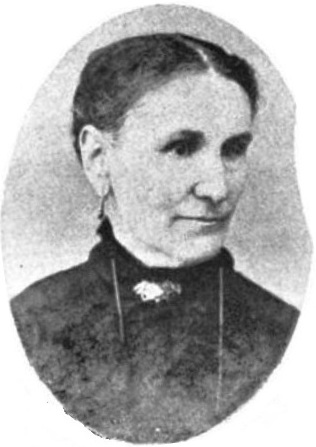
What the CES Letter does not quote is Helen's sustained adult public defense of plural marriage, and of her own sealing, across decades of published writing:
1882, Plural Marriage as Taught by the Prophet Joseph: A Reply to Joseph Smith Editor of the Lamoni Iowa Herald. Helen's published pamphlet defending plural marriage, written against RLDS denials. It is a doctrinal-historical defense answering the RLDS claim that Joseph never taught the principle.[27][2:6]
A widely-quoted 1884 affirmation, recorded in Augusta Joyce Crocheron's Representative Women of Deseret. In Crocheron's biographical sketch, a contemporaneous compendium of Latter-day Saint women's lives, Helen is recorded as having written: "I have encouraged and sustained my husband in the celestial order of marriage because I knew it was right."[28][2:7] (The line is sometimes misattributed to the 1882 pamphlet; the documented source is Crocheron's 1884 volume.)
1884, Why We Practice Plural Marriage. A longer doctrinal-historical defense, published the year she turned 56. She wrote: "I did not try to conceal the fact of its having been a trial, but confessed that it had been one of the severest of my life; but that it had also proven one of the greatest of blessings. I could truly say it had done the most towards making me a Saint and a free woman, in every sense of the word."[29]
The Woman's Exponent essays. Helen contributed dozens of essays defending plural marriage to the Woman's Exponent, the leading Latter-day Saint women's publication of the late 19th century, across the 1870s and 1880s.[30][2:8]
Her diary, 1884–1896. Hatch and Compton's edition of Helen's late-life diary covers her final twelve years and shows continued faith and active engagement with the Salt Lake Saints.[30:1]
The CES Letter lifts the most agonized passage from the most private of Helen's writings, a personal letter to her children, with no mention that the same woman defended the same practice in print for roughly thirty years. The adolescent distress is real, documented, and quoted in this article without softening. But the adult Helen is also a witness, and her voice on the question is the one the CES Letter leaves out.
Richard L. Bushman, the standard biographer of Joseph Smith, returned to the plural wives in a 2025 Times & Seasons twentieth-anniversary reflection on Rough Stone Rolling, and named them as the part of the book he most regrets underplaying: "They should have at least been named and given a place of their own in his history. I was wrong to think I could simply sample them."[31]
Polyandrous sealings: briefly
The CES Letter charges that 11 of Joseph's 34 sealings were to women already married to living husbands, and that this amounts to "polyandry" in the sexual sense. The categorical and case-by-case analysis lives in Polyandry; only the high-level points relevant to the marriages themselves are summarized here.
The dominant pattern is eternity-only sealing. The women continued living with their legal husbands after the sealing. They bore children to those husbands. Every DNA-tested case excludes Joseph; where testing has resolved an actual father, as with Josephine Lyon in 2019, that father was the legal husband. Complaints from first husbands are nearly absent from the record. In several documented cases, Ruth Vose Sayers being the clearest, the legal husband knew about and assented to an eternity-only sealing for the perceived spiritual good of his wife.[9:1]
Hales's central claim on the question is blunt: "There is no solid documentation supporting the position that Joseph Smith engaged in sexual polyandry... demonstrating its existence could be done rather easily by quoting a single credible supportive statement, if such existed. ... No evidence of this type has been found."[9:2]
The major critical biographers (including the non-LDS Dan Vogel) and the leading apologetic biographer (Hales) agree on the absence of polyandrous sexual relations in any documented case, even as Quinn and others dispute that the eternity-only category itself operated in 1843 with the precision modern apologetic writing assigns it.[9:3] That convergence between Hales and the most rigorous non-LDS biographers is not a full settlement, but it is enough to undercut the CES Letter's assumed sexual reading.
For the full treatment, see Polyandry: the eternity-only framework, the timeline of Orson Hyde's mission to Palestine (which the CES Letter implies was engineered for spousal access), and the case-by-case analysis of all eleven women.
DNA evidence
If the CES Letter's portrait were correct, a decade of predatory sexual exploitation of dozens of young women, the record should hold biological children. There would be plural-wife pregnancies logged by midwives, Smith children acknowledged after Joseph's death, perhaps oral tradition handed down through plural-wife descendants. Several such candidates exist as historical claims. Every one of them has now been DNA-tested.
Geneticist Ugo A. Perego, a senior scientist at the Sorenson Molecular Genealogy Foundation from 1999 to 2012, has systematically tested every paternity claim from a plural marriage that the historical record produced. The published rulings:[14:1][32]
| Candidate | Mother (plural wife) | Year ruled | Result |
|---|---|---|---|
| Mosiah Hancock | Clarissa Reed Hancock | 2007 | Ruled out |
| Oliver Buell | Presendia Huntington Buell | 2007 | Ruled out |
| Moroni Llewellyn Pratt | Mary Ann Frost Pratt | 2005 | Ruled out |
| Zebulon Jacobs | Zina Diantha Huntington Jacobs | 2005 | Ruled out |
| Orrison Smith | Fanny Alger | 2005 | Ruled out |
| Josephine Lyon | Sylvia Sessions Lyon | 2019 | Windsor Lyon's biological daughter |
Perego's finding on Josephine Lyon, published in 2019, is the most consequential of the six. Josephine had been the strongest candidate by a wide margin: her mother Sylvia Sessions told her on her deathbed in 1882 that she was Joseph's daughter, and that statement had stood for over a century as the most direct primary-source attribution. Autosomal DNA testing (the kind that detects relatedness through any ancestral line, not only father to son) of Josephine's grandchild against five great-grandchildren of Joseph Smith showed this:
"But none of the five Smiths shared any amount of autosomal DNA with Josephine's grandchild."[14:2]
Substantial shared autosomal DNA did turn up between Josephine's grandchild and descendants of Sylvia's legal husband Windsor Lyon, establishing Josephine as Windsor Lyon's biological daughter.
The cumulative finding: across every credible historical claim of a Joseph Smith biological child from a plural marriage that has surfaced for testing, DNA has confirmed none. Six tested cases is a finite set, and an undocumented child who left no historical trace would never have been a candidate at all. So the claim is precise: every historically attributed child has been ruled out, not that DNA has independently scanned all 35 sealings.
Even with that scope qualifier, the evidence is uniquely powerful, for two reasons. It is non-faith-based: a reader who distrusts every Latter-day Saint source can verify the genetic findings in the original Forensic Science International: Genetics study and the earlier journal reports; BYU Studies summarizes the same results. And the predatory-Joseph reading specifically predicts the opposite of what we find. A man running a decade-long pattern of sexual exploitation of dozens of women would have fathered children with at least some of them, and at least some of those children would have been historically attributed during the women's lifetimes. Where are the children? Joseph fathered none on the record, and no candidate remains untested.
The DNA evidence does not by itself answer every question about the plural marriages. But it is a hard datum that any predatory-motive theory has to explain, and no published critical treatment has explained it.
Public denials
This is the strongest single move in the CES Letter's section, and it is where the faithful case has the most to concede.
The pattern
Joseph and other Church leaders made public statements denying polygamy in years when Joseph was privately practicing it. The pattern is documented and undeniable. The most-cited examples:
The October 1, 1842 Times and Seasons affidavit. Two certificates published together over 31 signatures (12 men, 19 women), including the following:[33]
- Eliza R. Snow, who signed the women's certificate as its Secretary, sealed to Joseph on June 29, 1842, three months earlier.
- Newel K. Whitney, a signer of the men's certificate, who had performed his daughter Sarah Ann's sealing to Joseph on July 27, 1842, nine weeks earlier.
- Elizabeth Ann Whitney, Sarah Ann's mother, a Counsellor signing the women's certificate.
The men's certificate declared that the signers "know of no other rule or system of marriage than the one publised [published] from the Book of Doctrine and Covenants"; the women's, that they knew of "no system of marriage being practised in the church... save the one contained in the Book of Doctrine and Covenants." At the time that meant the 1835 Article on Marriage (Section CI of that edition), which explicitly affirmed monogamy: "we declare that we believe, that one man should have one wife; and one woman, but one husband, except in case of death."
The May 26, 1844 sermon. One month before his death, Joseph said:
"What a thing it is for a man to be accused of committing adultery, and having seven wives, when I can only find one. I am the same man, and as innocent as I was fourteen years ago; and I can prove them all perjurers."[34]
At the time of the sermon, Joseph had over 30 plural sealings.
Carefully worded denials throughout 1841–1844 appear in sermons, affidavits, Times and Seasons editorials, and private correspondence, where Joseph or other leaders denied "polygamy," "spiritual wifery," or "having seven wives" in language that was either technically true under a specific theological framing or simply false.
What was actually being denied
The CES Letter treats the denials as straightforward perjury. The defensive reading (and it is a defense, not a full exculpation) turns on what specific charge the denials were answering.
In 1841–1842, John C. Bennett, a former Quartermaster General of Illinois who had risen to Mayor of Nauvoo and counselor in the First Presidency, was actively spreading what he called "spiritual wifery."[35] Bennett's doctrine, as he privately taught it, let any man with sufficient priesthood take any consenting woman into "spiritual" sexual relations outside of any sealing or covenant. He used it to seduce multiple women and, per sworn 1842 affidavits, boasted of performing abortions to conceal the results.[21:1]
When Joseph excommunicated Bennett in May 1842 and publicly denounced "spiritual wifery," he was denying something he genuinely was not practicing: Bennett's adultery-with-religious-cover doctrine. The October 1, 1842 affidavit specifically denounced Bennett's system. In Joseph's own theological categories, celestial sealings performed by priesthood authority along the patterns revealed in D&C 132 were a different ordinance from Bennett's spiritual wifery, and the distinction was real.[35:1][36]
The carefully-worded pattern fits this categorical defense:
- Denials of having more than one wife: defensible if "wife" means "civilly registered wife."
- "I am the same man, and as innocent as I was fourteen years ago": a claim about Joseph's character and his denial of Bennett-style adultery, not about the existence of celestial sealings.
- The 1842 certificates denying any rule or system of marriage beyond the published Doctrine and Covenants: defensible if "rule or system" means Bennett's spiritual wifery.
The systematic-pattern reading
The categorical defense is technically defensible. It is also pastorally and morally inadequate. The public ear in 1842 Illinois did not parse "polygamy" and "spiritual wifery" into separate theological ordinances. When Joseph publicly denied "polygamy," the public heard a denial of any multiple-wife practice, and Joseph knew that was what they were hearing.
The most serious scholarly treatment of the denials is Cheryl L. Bruno's 2024 anthology Secret Covenants: New Insights on Early Mormon Polygamy (Signature Books), which collects contributions from a range of scholars on the documentary record of early Mormon polygamy.[37] The volume's editorial framing reads the denials not as discrete responses to specific accusations like Bennett's but as a systematic pattern of public concealment across roughly a decade, what Bruno describes as a habit of secrecy that reached beyond polygamy into other domains of Nauvoo governance (the Council of Fifty, the Anointed Quorum, the early temple endowment).
Bruno's analytical claim, fairly summarized: the public denials produced a documentary record contaminated by strategic concealment, and a careful historiography has to reckon with the fact that what the contemporaneous Nauvoo public record says about polygamy is structured deception. Even granting every contextual mitigation (bigamy's criminalization in Illinois, the threat of mob violence, the categorical distinction between celestial sealings and Bennett's spiritual wifery), the pattern of denial across nearly a decade is harder to defend than any single instance.
Compton's In Sacred Loneliness makes a similar structural observation about the concealment pattern, working from the women's own contemporaneous and reminiscent writings.[3:3]
Where that leaves the assessment:
- The denials happened. The affidavit, the May 1844 sermon, the carefully-worded statements throughout: all documented.
- Joseph induced others to participate. Eliza R. Snow, the Whitneys, and other signatories knew the affidavit was misleading.
- The categorical defense is theologically real but publicly inadequate. Bennett's spiritual wifery genuinely was something Joseph was not practicing, and celestial sealings genuinely were a different ordinance. But the public did not parse the distinction, and Joseph did not clarify it publicly.
- The contextual defense is real but does not remove the moral problem. Polygamy was illegal in Illinois; public confirmation in 1842 would have meant Joseph's arrest and likely violence against the Saints. That situates the deception. It does not make it admirable.
- Bruno's systematic-pattern argument has force. A pattern of denial sustained for nearly a decade, running beyond polygamy into the broader secrecy of Nauvoo governance, outlasts every contextual mitigation.
Joseph was dishonest with the public about his most controversial practice. The dishonesty served real purposes (legal protection, communal protection, theological category-keeping), but it was dishonesty by any common-language standard, and the defense is contextual, not categorical. A reader who concludes that the public denials are a real moral problem with Joseph's prophetic record is not misreading the evidence. The difficulty has to be set against the whole of Joseph's mission rather than pretended away.
Joseph's reluctance: the angel-with-drawn-sword tradition
The CES Letter's portrait is of a willing predator using religious cover. The record left by the women themselves describes a different man: one who repeatedly refused the command to practice plural marriage, and who described being driven to comply by what he experienced as direct angelic confrontation.
The angel-with-drawn-sword tradition is multiply attested. Hales's catalog identifies some twenty accounts from nine witnesses, four of them Joseph's plural wives:[38][5:7]
- Mary Elizabeth Rollins Lightner, in her 1902 signed statement: "The angel came to him three times, the last time with a drawn sword and threatened his life."[39] In her 1905 Brigham Young University address, given in her 80s, Lightner recounts Joseph telling her in his own first-person voice, that is, Lightner is quoting Joseph's account of the encounter to her, not reporting her own angelic visitation: "the angel came to me three times between the years of 1834 and 1842 and said I was to obey that principle or he would slay me."[39:1]
- Zina Diantha Huntington Jacobs, whose 1881 Deseret News account describes "how an angel came to hi[m] with a drawn sword."[38:1]
- Eliza R. Snow, though Hales flags her account (and Benjamin F. Johnson's) as possibly repeating information gathered from other people.
- Helen Mar Kimball.
- Lorenzo Snow (who "quotes the Prophet directly" in Hales's reading), Erastus Snow, Benjamin F. Johnson, Joseph Lee Robinson, and Joseph F. Smith complete the nine witnesses.[38:2]
The Gospel Topics Essay confirms the basic outline: "an angel appeared to him three times between 1834 and 1842," and during the third appearance "the angel came with a drawn sword, threatening Joseph with destruction unless he went forward and obeyed the commandment fully."[5:8]
What the tradition does and doesn't establish
Two features of these accounts matter most. First, the angel reportedly threatened Joseph, not the women. The CES Letter's framing, "an angel with a drawn sword if the girls didn't marry him", inverts the actual content. The angel was Joseph's commander, not a weapon aimed at potential wives.[38:3] Second, the accounts come from women defending the practice. No one extracted these from a hostile witness; the women were repeating, decades later, what Joseph had told them about coming to terms with the doctrine.
The behavioral signature of these accounts is that of someone reluctant, at least at the start. A man who fabricates a doctrine for predatory access does not also generate a multi-decade body of corroborating accounts in which he describes refusing the doctrine for years before complying.
But the tradition has real limits. The twenty accounts are mostly late reminiscent statements from within a shared religious community; in Hales's own catalog, all but one are "recounted at least twenty to thirty years after the event."[38:4] They are not contemporaneous documentation from 1834–1842, and not strictly independent in the epistemic sense.[40][37:1] The tradition also covers only the onset period (1834–1842), while the bulk of Joseph's sealings fall in 1842–1844, so the "reluctant prophet compelled by an angel" framing does not stretch across every later decision he made.
And there is an asymmetry here. If the angel tradition mitigates Joseph's responsibility for accepting the doctrine, then by parallel logic the salvation-of-family framing under which Helen and other young wives consented mitigates the meaningfulness of their consent. Both can be partly true. But a faithful reading cannot run the compulsion frame on Joseph's side while treating the women as fully autonomous agents on the other. Either both compulsion frames are partly real, or neither is.
So the tradition establishes a narrower point. At the outset, in 1834–1842, Joseph experienced what he described to his closest associates as direct angelic command, documented in the women's reminiscent attestations. It does not stretch across every later decision he made, and it does not work as a clean exoneration. A predator does not produce a body of accounts in which he describes himself as compelled. But a believer in revelation also lacks a clean answer to why the command, once accepted, produced the specific pattern of practice (the secrecy, the public denials) that it did.
The strongest critical case
The CES Letter's version of this argument is not its strongest form. Careful scholars working from the same record have built a more serious case and reached darker conclusions, and a faithful treatment has to answer that case, not just the pamphlet version of it.
Compton's documentation of women's distress
Todd M. Compton's In Sacred Loneliness: The Plural Wives of Joseph Smith (1997) remains the standard secular biography of the 33 wives Compton documents.[3:4] Compton is not the CES Letter's polemicist; he is a careful historian whose book is sympathetic, footnoted, and methodologically rigorous. He acknowledges the eternity-only category at length and does not flatten the sealings into one uniform "polygamy."
Where Compton parts from Hales is in his moral framing. He documents women's distress at a level the CES Letter does not approach, and several of those primary sources are worth setting down directly rather than summarizing away.
Helen Mar Kimball's adolescent record. As quoted above in the Helen section, Helen's 1881 Autobiography records Joseph telling her the sealing would "ensure your eternal salvation and exaltation & that of your father's household & all of your kindred," the salvation-of-family framing described in the Helen section as structurally coercive.[11:4] (The most pointed phrasing of that framing in critical scholarship comes from Catherine Lewis's 1848 hostile Narrative, not Helen's own writing; the structural framing is in Helen's own 1881 voice.)[26:1]
Zina Diantha Huntington Jacobs. Compton documents Zina's lifelong struggle with the practice. In Compton's account, Zina had turned Joseph's proposals aside more than once before her marriage to Henry Jacobs; only afterward did she accept the eternity-only sealing. In her diary, she recorded her continued grief over the configuration of her relationships across the rest of her life.[3:5] Compton's chapter draws on the diary edited by Marilyn Higbee Bradford and additional materials in the Church History Library.
Vilate Kimball's spiritual struggle. Heber C. Kimball's wife, Helen's mother, left letters preserved in the Heber C. Kimball collection at the Church History Library documenting her own response to the plural-marriage doctrine and the Abrahamic-test episode. Vilate's letters express the kind of anguish the apologetic literature has historically softened.[3:6]
Emily Dow Partridge. Emily's 1885 autobiography and her 1892 Temple Lot trial testimony contain candid accounts of her ambivalence, especially around Emma's discovery of the original secret sealing and the May 1843 re-sealing in Emma's presence.[4:6][3:7]
Compton's analytical claim is that the religious framework Joseph offered did not erase the personal cost the practice imposed on the women, and that the apologetic tradition has often minimized that cost for the sake of theological tidiness. Compton is right about the distress, and it should not be minimized. Helen Mar Kimball, even in her published 1884 defense, called her sealing "one of the severest" trials of her life. The women's later affirmative testimonies are not testimonies that the practice was easy. They are testimonies that the women understood it as religiously meaningful despite the cost.
Where Compton is incomplete is in the other direction: his framing leans on the agonized period and underplays the mature reflective one.[41] The record holds both, and so should the reading of it. Compton documents real distress; the women also produced real adult defenses; both must be quoted; neither resolves into the other. The 2024 Secret Covenants anthology contains further engagement with eternity-only sealings and women's distress that builds on Compton's framework.[37:2]
Sarah Ann Whitney letter (August 18, 1842)
The August 18, 1842 letter from Joseph in hiding to Newel K. Whitney, Elizabeth Ann Smith Whitney, and their daughter Sarah Ann (whom Joseph had sealed three weeks earlier on July 27) is among the most difficult documents in the entire historical record.[42]
The verbatim transcription from the Joseph Smith Papers, with original spelling preserved and bracketed editorial clarification where the manuscript departs from modern orthography:
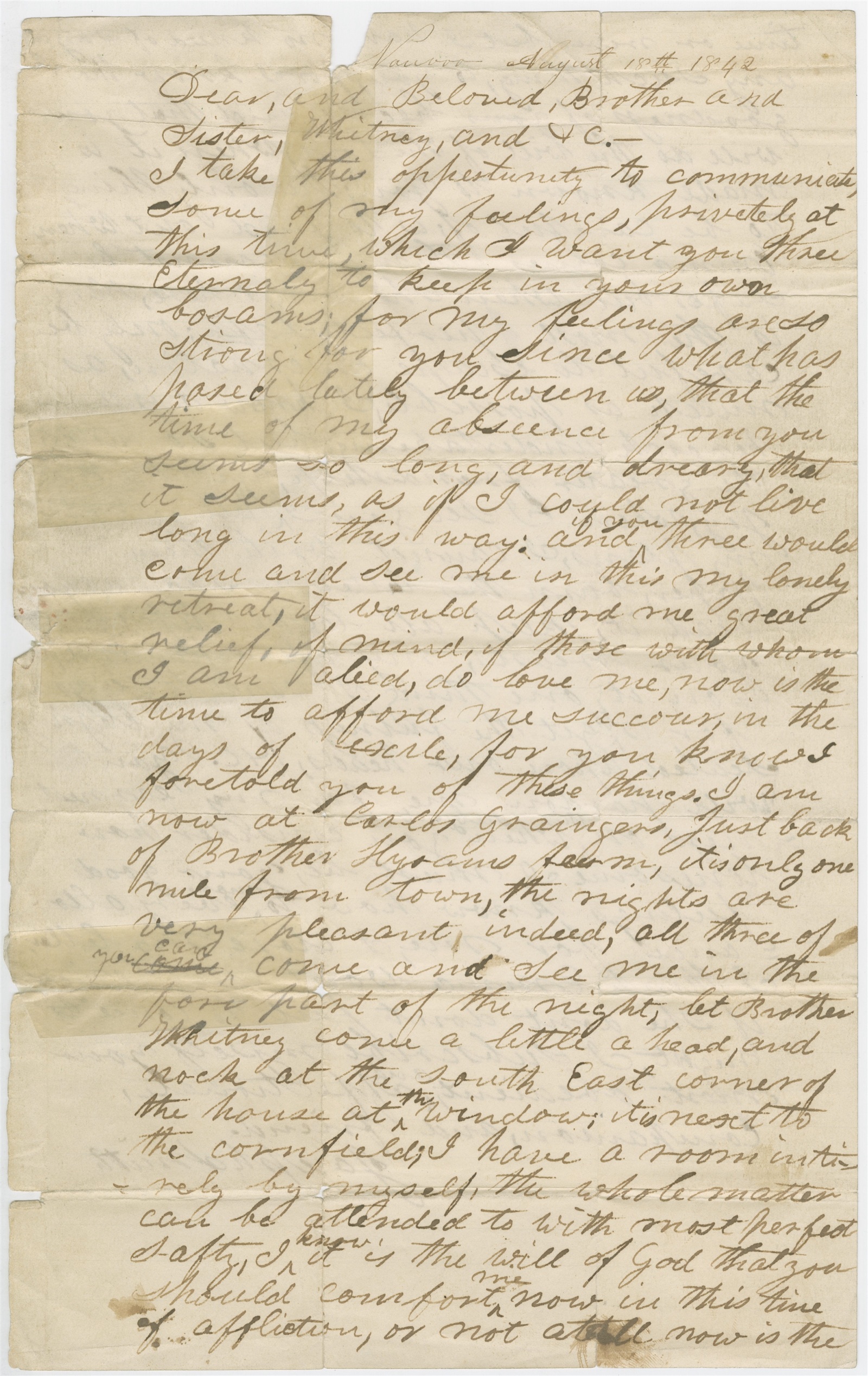
"...my feelings are so strong for you since what has pased lately between us... the time of my abscence from you seems so long, and dreary, that it seems, as if I could not live long in this way: and if you three would come and see me in this my lonely retreat, it would afford me great relief... I have a room intirely by myself, the whole matter can be attended to with most perfect saf[e]ty, I know it is the will of God that you should comfort me now in this time of affliction... the only thing to be careful of; is to find out when Emma comes then you cannot be safe, but when she is not here, there is the most perfect safty: only be careful to escape observation, as much as possible, I know it is a heroick undertakeing; but so much the greater frendship, and the more Joy."[42:1]
The letter exists, the language is what it appears to be, and no defense erases what it says. Joseph was managing visits to Sarah Ann (and her parents) at his hiding place during the Bennett extradition crisis, and he was actively timing those visits for when Emma was not present. The phrase "but when she is not here, there is the most perfect safty" is the rhetorical fulcrum. Joseph is explicitly casting his wife's presence as the threat the Whitneys need protection from, and her absence as "perfect safety."
The defensible readings of the letter span a range.
Most defensive reading. Joseph was hiding from Missouri authorities and managing visits with multiple sealed wives plus his legal wife Emma at a time when Emma did not yet know about the Sarah Ann sealing. Newell and Avery, Emma's biographers, read the letter the same way: "This letter clearly indicates that Emma was unaware of Joseph's marriage to Sarah Ann."[43] On this reading the letter is concealment of the sealing's existence from Emma, not concealment of an attempted sexual encounter. The Whitney sealing had been performed openly within the Whitney family, with Sarah's father Newel officiating, and Compton reads the requested visit as a family and religious occasion: "This is not just a meeting of husband and plural wife; it is a meeting with Sarah's family, with a religious aspect. ... Three days later, on August 21, Newel and Elizabeth Whitney were sealed to each other for time and eternity."[9:4]
Hales lists Sarah Ann among the ambiguous cases, not among the ten with documented evidence of conjugal relations; his own Sarah Ann page states "No evidence of sexuality has been found."[9:5]
Limit of the defensive reading. Even granting all that, the letter shows Joseph actively concealing his interactions with Sarah Ann from his wife and naming his wife specifically as the obstacle to "safety." The frame of the concealment (Emma's physical absence, not merely her ignorance, being the prerequisite) admits more than information-management. If the sealing was eternity-only and the visit would have been an innocent family meeting, the Whitneys could simply have been told not to mention the sealing while Emma was present. The need to coordinate physical absence specifically suggests Joseph expected his interactions with Sarah Ann would have looked visibly different from ordinary family visits, at minimum in tone, and possibly in more.
The critical reading. Joseph was a married man asking a 17-year-old girl he had recently sealed in secret to come to his hiding place when his wife was away, while explicitly framing his wife as the threat to "safety." In modern terms the optics are impossible to fully defend, and a modern reader's first reaction, that this looks bad, reads the letter correctly.
The letter is authentic, and it belongs in the weighing. The faithful response is not to claim it looks fine. It is to say plainly that it looks bad, that its text has no fully defensive reading, and that the contextual frame limits the difficulty without dissolving it.
Newell and Avery on Emma
Linda King Newell and Valeen Tippetts Avery's Mormon Enigma: Emma Hale Smith, the award-winning Emma biography first published in 1984 and reissued by University of Illinois Press, is the canonical source on Emma's experience of the plural-marriage practice.[43:1]
Drawing on family papers, contemporaneous letters, and reminiscent accounts, Newell and Avery document this:
- Emma repeatedly discovered secret sealings she had not been told about.
- Emma extracted promises from Joseph to abandon the practice; Joseph broke them.
- Emma physically removed plural wives from her home, most notably the Partridge sisters, whom she successfully sent away after they had been sealed twice (the second time in a ceremony Emma believed was the first).
- Emma's relationship with the Partridge sisters never recovered.
- Emma never accepted plural marriage doctrinally; after Joseph's death she publicly denied that he had ever practiced it, a position the RLDS Church (where Emma's son Joseph III led) institutionalized.
Emma suffered, and her suffering was real and rational. Her opposition was not faithlessness; it was a credible response to repeated deception by her husband. The apologetic tradition has at times minimized Emma's perspective in favor of theological frameworks that read her doubt as a failure of faith, and that minimization is a real credibility error.
What Newell and Avery do not erase: Emma was also, throughout, a believing wife who never abandoned Joseph or cursed his memory after his death. Her opposition to plural marriage was not opposition to Joseph as a prophet. Her experience was not one-dimensional rejection but an oscillation between consent and revocation, struggle and faith. The Partridge sisters were originally sealed in March 1843 without Emma's knowledge; in May 1843 Emma asked Joseph to take additional plural wives "of her own choosing" and selected the Partridge sisters herself, apparently unaware they had already been sealed two months earlier; a second ceremony followed in May with Emma's consent for the existing sealings.[43:2] Emma's experience held both rejection and ambivalent participation. The history is messy, and flattening it in either direction, faithful exoneration or critical indictment, misreads the record.
What we don't know
The plural marriages leave a real but incomplete documentary footprint. Joseph never wrote a comprehensive private account of his sealings. Emma destroyed papers after his death. The Smith descendants in the RLDS line kept a denial-of-polygamy tradition that obscured more than it illuminated. The women who outlived Joseph spoke decades later, often under institutional pressure (LDS or RLDS) to defend or deny the practice.
What stays unrecoverable:
- The conversations between Joseph and the women at the moments of proposal and sealing.
- Joseph's private internal experience of receiving and accepting the doctrine.
- The full content of Joseph's communications with Emma about specific sealings.
- The lived experience of the eternity-only sealings. What Helen Mar Kimball understood her sealing to mean during her late teens, before her 1846 marriage to Horace Whitney, is largely closed to us.
These gaps do not close. The reconstruction is partial, and the parts that cannot be known have to be left that way.
What the women themselves said as adults
The CES Letter quotes Helen Mar Kimball's "thorny path" passage from a private 1881 letter and stops there. It does not quote a single adult plural wife affirming her own sealing. Yet adult affirmations from the participants themselves are the most extensive primary-source category on this question, and the adolescent and contemporary distress accounts have already been set down directly in the Compton section above.
A representative sample of that adult voice:
Lucy Walker (sealed at 17): "He counselled me to pray to the Lord, which I did, and thereupon received from him a powerful and irresistible testimony of the truthfulness and divinity of plural marriage." Her sworn statements (1892 Temple Lot testimony, and a 1902 affidavit) defend the practice in detail. Lucy lived until 1910.[44][45]
Eliza R. Snow (sealed at 38): wrote and published extensively in defense of plural marriage; her Personal Writings show no retraction or regret across more than 40 years of subsequent writing. After Joseph's death she became one of the most influential women in the Church, leading the Relief Society for nearly two decades.[46]
Emily Dow Partridge (sealed at 19): testified under oath at the 1892 Temple Lot trial about her sealing. She did not retract; she did not call Joseph predatory. Her sworn testimony is one of the most rigorous primary sources on the conjugal-vs-eternity-only question for the 1843 cluster.[4:7]
Mary Elizabeth Rollins Lightner: her 1905 BYU address, given in her 80s, defended the practice and Joseph specifically. It is among the most cited primary sources for the angel-with-drawn-sword tradition.[39:2]
Helen Mar Kimball Whitney: two book-length defenses (1882, 1884) plus decades of Woman's Exponent contributions across the 1870s and 1880s.[27:1][29:1][30:2][28:1]
The asymmetry between the CES Letter's selection and the actual primary-source corpus is striking. The CES Letter's case rests on the recollected anguish of one 14-year-old, quoted from a few passages of Helen's 1881 private letter. The affirmative case rests on dozens of adult women's published, sworn, and reminiscent affirmations spanning the rest of their lives. If the women's own testimony is the evidence, why does the CES Letter quote Helen's private grief and never her thirty years of published defense? This is not a hidden corpus. It is the bulk of the primary-source record on Joseph's plural marriages, and the CES Letter's choice to omit it is one of the strongest signs that the section is rhetorical rather than evidentiary.
Key Point
The CES Letter quotes Helen's adolescent anguish; the historical record contains decades of adult published defenses by the same women. The asymmetry is the section's central distortion. (The adolescent distress is also real and documented; see the Compton section above. The adult voices do not cancel the contemporary distress, and a fair account quotes both.)
Warren Jeffs comparison
The CES Letter's most visually charged page is the side-by-side chart setting Joseph Smith next to Warren Jeffs (p. 59):
| Metric | Joseph Smith | Warren Jeffs |
|---|---|---|
| Number of wives | 34 | 78 |
| Age of youngest wife | 14 | 12 |
| Other men's wives | 11 | 21 |
| Mother/daughter pairs | 1 | 7 |
| Biological sister wives | 8 | 56 |
| Under age 18 wives | 7 | 24 |
The chart's design makes the categories look commensurable, as if Joseph Smith and Warren Jeffs were doing the same kind of thing at different scales. The CES Letter follows it with the assertion: "Today, Warren Jeffs is more closely aligned to Joseph Smith's Mormonism than the modern LDS Church is."[1:1]
The decisive refutation, and the one that carries the central weight here, is Bennett's non-accusation:
Joseph's most aggressive enemies, who had every incentive to make the worst possible charge, did not accuse him of sexually coercing a minor. (The age section above traced the parallel silence on marriage ages.) Bennett knew everyone in Nauvoo and was actively trying to destroy Joseph by 1842. His History of the Saints deployed every angle of attack available: lying, theft, treason, sexual license among adult women. (The abortion allegations in the Nauvoo record attach to Bennett's own practice: sworn 1842 affidavits record him boasting that he "had frequently destroyed and removed infants before their time.")[21:2] He did not accuse Joseph of statutory-style sexual contact with Helen Mar Kimball or any other young wife. Neither did William Law's Nauvoo Expositor, the document that set off the chain of events leading to Joseph's death, nor the Sangamo Journal critics. Bennett's silence on age-based sexual coercion is the strongest single piece of evidence against the predatory reading.[20:2]
(One caveat: Bennett had seductions of his own to conceal, and 19th-century legal frameworks did not criminalize statutory-style sexual contact at modern ages. Better framed as "Bennett did not accuse Joseph of coercion" than as "Joseph was never charged with a sexual crime.")
Beyond the Bennett-silence argument, the chart hides several categorical differences:
Convicted criminal record. Warren Jeffs is a convicted child rapist, sentenced in 2011 to life plus 20 years for two counts of sexual assault of a child (Texas v. Warren Steed Jeffs, 2011), on the strength of his own audio recordings of the assaults. There is no comparable evidence of any Joseph Smith sexual offense anywhere in the record.
Documented children. Joseph: zero biological children from any plural wife across all six DNA-tested paternity claims, the deathbed-attributed Josephine Lyon case included (scope qualifier in the DNA section above).[14:3] Jeffs: dozens of biological children from forced child marriages, documented in court records.
Doctrinal continuity. The modern LDS Church teaches Joseph's restored gospel, including the celestial sealing ordinance Joseph practiced, but does not practice plural marriage. Jeffs's Fundamentalist LDS Church (FLDS), a polygamist sect that broke from the mainstream Church a century after Joseph's death, teaches doctrines, racial and abuse doctrines among them, that the LDS Church explicitly rejects. The "more closely aligned" claim has no doctrinal substance.
The Salt Lake Tribune, sympathetic to neither the LDS Church nor the FLDS Church, ran its own Smith–Jeffs comparison during the 2011 trial. It granted the surface parallels critics see, then let the contrasts stand. Legal historian Sarah Barringer Gordon told the Tribune that Jeffs "inherited a great deal of religious power and has spent his life exploiting it," and the piece quoted Hales on Joseph's plural wives: "none of them claimed they were victimized or beguiled by the prophet."[47]
The comparison does not analyze anything. It manufactures equivalence. The chart works by listing commensurate-sounding numerical categories without commensurate underlying behaviors. The CES Letter chart cites only cesletter.org/polygamy/54 as its source, because there is no scholarly source for the comparison: no scholar working from the actual record has produced one.
The genuine difficulties
A faithful response to the CES Letter on this section has to concede directly the points the CES Letter is right about:
- Helen Mar Kimball was 14. The age is real. No defense lightens the modern moral weight of that fact. Foster and Hales contextualize it; they do not dissolve it. Helen's own 1881 account has Joseph putting the condition to her directly: her family's exaltation hung on her answer.
- Public denials happened. The 1842 affidavit was signed by people who knew it was misleading. The 1844 "only one wife" sermon was made amid 30+ sealings. Carefully-worded denial is still denial, and the Bruno 2024 systematic-pattern argument extends the difficulty across roughly a decade rather than letting it shrink to a few discrete moments.
- Several women later described distress. Helen's "thorny path" passage is real. So is Heber's three-day fast. So is Emma's anguish, Zina's lifelong sorrow, Vilate's spiritual struggle. Compton documents the distress at length, and those primary sources are quoted directly above rather than summarized away.
- Joseph proposed without Emma's knowledge in many cases. Several wives were sealed before Emma was told, the Partridge sisters who lived in the Smith home among them.
- The Sarah Ann Whitney letter (Aug 18, 1842) asks Sarah to come to Joseph's hiding place specifically when Emma is not home, and explicitly frames Emma's presence as the threat to "safety." The letter is authentic, its language means what it says, and no reading erases it.
- The "promise of eternal salvation for your family" framing is structurally coercive even if every individual promise was theologically sincere. A 14-year-old does not freely consent in any modern sense to a sealing she has been told her family's exaltation depends on, and that framing appears in Helen's own 1881 account, not only in hostile retellings.
- The angel-with-drawn-sword tradition has limits. It rests on late reminiscent accounts within a religious community, covers only the 1834–1842 onset period, and cannot be deployed as Joseph's exoneration in the same breath that the salvation-of-family framing implicates the women's consent.
Assessment
The CES Letter's case here is built on a genuine fact (a 14-year-old sealing) and a series of selective omissions: the eternity-only category, the absence of cohabitation, the adult Helen's published defenses, the DNA evidence, the women's affirmative testimonies, Joseph's reluctance, the refusals he accepted, the demographic context. The fact is real. The omissions are extensive. The Warren Jeffs comparison is the device that papers over the gap between the fact and the omissions, by collapsing all the sealings into a single number that can be set next to Warren Jeffs's number.
The fuller reconstruction produces a more difficult and less satisfying picture than either the CES Letter's "religious predator" or the apologetic tradition's "this was easy." Taken individually, the defensible points hold:
- Joseph practiced plural marriage as a doctrinal restoration he believed God had commanded.
- He delayed for years and described being compelled by repeated visionary experiences, though the corroborating accounts are late and reminiscent and the angel narrative covers only the onset period.
- He performed sealings in three categories (time-and-eternity at about 12, eternity-only, and dynastic), though Hales's typology is contested and the silence for ~22 sealings is silence rather than affirmative evidence.
- He proposed to women who refused, and he accepted the refusals.
- He produced no biological child that any tested paternity claim can attach to him, and the testing has reached every claim the record ever produced.
- Most of the women who outlived him defended the practice as adults across decades of published writing, even while documenting that it had cost them deeply. Several left contemporaneous and reminiscent records of distress that no account can credibly minimize.
These points are individually defensible. They do not stack into a clean cumulative vindication, and they are not offered as one.
What the evidence does foreclose is the specific CES Letter framing: that Joseph operated as a sexual predator concealing predatory behavior under religious cover, that he was "more closely aligned with Warren Jeffs than with the modern LDS Church," that the practice produced victims whose distress was truer testimony than their adult reflections. The evidence forecloses that framing categorically.
Joseph was not Warren Jeffs.
Jeffs was convicted of raping children and fathered dozens of children through forced marriages, denounced by the very women who knew him; Joseph was a man practicing what he understood as a hard divine command, who fathered no child any historical record attributes to him, whom the women defended as adults across decades, and who left no documentary trace of the sexual-predator pattern the CES Letter assumes. The two do not belong on the same chart, and putting them there is the misdirection that makes the rest of the section work.
The remaining difficulty is the moral weight of the fact that Joseph practiced and concealed a marriage system that imposed real costs on his wife and on at least some of his plural wives, justified by revelations he sincerely believed but could not publicly confirm. A reader can weigh Joseph's prophetic record and judge the difficulty heavy. The faithful position weighs it against the totality of Joseph's mission (the First Vision accounts, the doctrinal restoration, the establishment of a church now numbering nearly 18 million members, and above all the Book of Mormon) and concludes that the difficulty does not undo the larger truth claim. That weighing is genuinely hard, and it is exactly the work the CES Letter's selective rhetoric is built to short-circuit.
Which returns the question to the witness it opened on. In 1892 the Church declined to put Helen Mar Kimball on the stand to prove conjugal relations, because, on the simplest reading, there were none to prove. The most direct test we have of the predator thesis is the testimony of the people who were actually there (the women, under oath, in court, across decades in print), and that testimony runs the other way. The same is true of the book at the center of Joseph's claim. The witnesses to the Book of Mormon's coming forth described what they saw and produced no whistleblower among them. On the hardest questions about Joseph Smith, the documentary record keeps turning on what the eyewitnesses said, and on the marriages as on the plates, the eyewitnesses did not say what the predator thesis needs them to.
For related coverage, see D&C 132 Contradictions for the textual analysis of the revelation that authorized plural marriage, and Polyandry for the case-by-case treatment of the eleven sealings to women with living husbands.
Runnells, CES Letter (2017), "Polygamy | Polyandry," pp. 51–55, 59, with comparison chart on p. 59. ↩︎ ↩︎
"Helen Mar Kimball: Circumstances of Her Plural Marriage," FAIR. https://www.fairlatterdaysaints.org/answers/Joseph_Smith/Polygamy/Plural_wives/Helen_Mar_Kimball/Circumstances_of_her_plural_marriage and the FAIR Helen Mar Kimball hub at https://www.fairlatterdaysaints.org/answers/Helen_Mar_Kimball ↩︎ ↩︎ ↩︎ ↩︎ ↩︎ ↩︎ ↩︎ ↩︎ ↩︎
Todd Compton, In Sacred Loneliness: The Plural Wives of Joseph Smith (Salt Lake City: Signature Books, 1997). Compton's chapter 16 (Helen Mar Kimball) catalogs the adolescent record drawn on in this article. ↩︎ ↩︎ ↩︎ ↩︎ ↩︎ ↩︎ ↩︎ ↩︎
Brian C. Hales, Joseph Smith's Polygamy, Volume 1: History (Salt Lake City: Greg Kofford Books, 2013). Companion site: https://josephsmithspolygamy.org/ On the refused proposals: https://josephsmithspolygamy.org/womans-choice/ ↩︎ ↩︎ ↩︎ ↩︎ ↩︎ ↩︎ ↩︎ ↩︎
"Plural Marriage in Kirtland and Nauvoo," Gospel Topics Essays, The Church of Jesus Christ of Latter-day Saints, October 2014. https://www.churchofjesuschrist.org/study/manual/gospel-topics-essays/plural-marriage-in-kirtland-and-nauvoo ↩︎ ↩︎ ↩︎ ↩︎ ↩︎ ↩︎ ↩︎ ↩︎ ↩︎
"Joseph Smith, John C. Bennett, and the Extradition Attempt, 1842," BYU Religious Studies Center. https://rsc.byu.edu/joseph-smith-prophet-seer/joseph-smith-john-c-bennett-extradition-attempt-1842 On bigamy's criminality, cf. the Illinois criminal code of 1833. ↩︎
The 1892 Reorganized Church v. Church of Christ at Independence ("Temple Lot") case is the legal proceeding in which the LDS Church needed to establish that Joseph had practiced plural marriage with conjugal relations to defeat the RLDS claim that he had not. Three of Joseph's plural widows testified: Emily Dow Partridge Young, Malissa Lott Willes, and Lucy Walker Kimball. Court records and analysis: https://josephsmithspolygamy.org/ ↩︎
Brian C. Hales, "Did Plural Marriages Include Sexual Relations?," Joseph Smith's Polygamy. https://josephsmithspolygamy.org/common-questions/plural-marriages-sexual/ The page identifies ten wives with documented evidence of sexual relations and three ambiguous cases (Eliza R. Snow, Sarah Ann Whitney, Hannah Ells), concluding that "less than half of Joseph Smith's polygamous unions were consummated"; counting some of the ambiguous cases yields the figure of roughly twelve in Hales's print treatments (cf. Hales, Joseph Smith's Polygamy, vol. 1). This article uses the 10–12 range to capture both. ↩︎ ↩︎ ↩︎
Brian C. Hales, "Sarah Ann Whitney," Joseph Smith's Polygamy, https://josephsmithspolygamy.org/plural-wives-overview/sarah-ann-whitney/ (the August 18, 1842 letter with the Newell/Avery and Compton readings); the Hales–Quinn dialogue on sexual polyandry, https://josephsmithspolygamy.org/dialogues/hales-quinn/; and D. Michael Quinn, "Evidence for the Sexual Side of Joseph Smith's Polygamy" (expanded paper, December 31, 2012), https://mormonpolygamydocuments.org/wp-content/uploads/2016/05/Quinns-FINAL-RESPONSE.pdf ↩︎ ↩︎ ↩︎ ↩︎ ↩︎ ↩︎
"Revelation, 27 July 1842," The Joseph Smith Papers. https://www.josephsmithpapers.org/paper-summary/revelation-27-july-1842/1 ↩︎
Helen Mar Kimball Whitney, 1881 Autobiography, in Jeni Broberg Holzapfel and Richard Neitzel Holzapfel, eds., A Woman's View: Helen Mar Whitney's Reminiscences of Early Church History (Provo: BYU Religious Studies Center, 1997). Appendix one (full text) at https://rsc.byu.edu/womans-view/appendix-one ↩︎ ↩︎ ↩︎ ↩︎ ↩︎
Todd Compton, "Helen Mar Kimball Smith Whitney" (essay/review responding to the In Sacred Loneliness chapter, available at the author's site). http://toddmcompton.com/revhmk5.html and Todd Compton, "A Trajectory of Plurality: An Overview of Joseph Smith's Thirty-three Plural Wives," Dialogue: A Journal of Mormon Thought. https://www.dialoguejournal.com/articles/a-trajectory-of-plurality-an-overview-of-joseph-smiths-thirty-three-plural-wives/ ↩︎
Brian C. Hales, Joseph Smith's Plural Wives After the Martyrdom (Ensign Peak Foundation). https://ensignpeakfoundation.org/wp-content/uploads/2013/07/Joseph-Smith’s-Plural-Wives-after-the-Martyrdom.pdf ↩︎
Ugo A. Perego, "Using Science to Answer Questions from Latter-day Saint History: The Case of Josephine Lyon's Paternity," BYU Studies 58, no. 4 (2019): 143. https://byustudies.byu.edu/article/using-science-to-answer-questions-from-latter-day-saint-history The underlying study: "Resolving a 150-Year-Old Paternity Case in Mormon History Using DTC Autosomal DNA Testing of Distant Relatives," Forensic Science International: Genetics 42 (2019): 1–7. Earlier exclusions were published in Journal of Mormon History 31, no. 2 (2005) and John Whitmer Historical Association Journal 27 (2008). ↩︎ ↩︎ ↩︎ ↩︎
"Threats / Promises of Salvation," Debunking-CESLetter. https://debunking-cesletter.com/polygamy-polyandry-1/threats/ ↩︎
"Marriages to Young Women," FAIR. https://www.fairlatterdaysaints.org/answers/Joseph_Smith/Polygamy/Marriages_to_young_women ↩︎
Craig L. Foster, "Assessing the Criticisms of Early-Age Latter-Day Saint Marriages," Interpreter: A Journal of Latter-day Saint Faith and Scholarship 31 (2019). https://interpreterfoundation.org/journal/assessing-the-criticisms-of-early-age-latter-day-saint-marriages/ ↩︎
Craig L. Foster, David Keller, and Gregory L. Smith, "The Age [of] Joseph Smith's Plural Wives in Social and Demographic Context," in Newell G. Bringhurst and Craig L. Foster, eds., The Persistence of Polygamy: Joseph Smith and the Origins of Mormon Polygamy (Independence: John Whitmer Books, 2010), 152–183; announced with a draft at David Keller, "Timely Statistics Vindicate the Prophet," FAIR Blog (Dec 18, 2010), https://www.fairlatterdaysaints.org/blog/2010/12/18/timely-statistics-vindicate-the-prophet See also Keller, "19th century nuptiality and anti-Mormon propaganda," FAIR Blog (Nov 5, 2009), https://www.fairlatterdaysaints.org/blog/2009/11/05/nuptiality-and-propagand ↩︎
Kathryn M. Daynes, More Wives Than One: Transformation of the Mormon Marriage System, 1840–1910 (Urbana: University of Illinois Press, 2001). https://www.press.uillinois.edu/books/?id=p075605 ↩︎
The regional census figures (roughly 21–25% in the West South Central region, 32.4% and 27.5% in the combined Mountain and Pacific regions) are from 1850–1880 census data and apply to the 1840s only by inference; the minimum-legal-age statistics show what was permitted, not what was median. The body uses these statistics as the floor of the legal range and the upper-end of demographic prevalence, not as evidence that 14 was unremarkable. The argument-from-silence (no Nauvoo contemporary criticized Joseph on age grounds, so far as the surviving record shows) is the load-bearing piece of the contextual case, not the demographic data. ↩︎ ↩︎ ↩︎
"John C. Bennett and Joseph Smith's Polygamy: Addressing the Question of Reliability," Mormon Polygamy Documents. https://mormonpolygamydocuments.org/john-c-bennett-joseph-smiths-polygamy-addressing-question-reliability/ See also "Bennett Alleged Abortions": https://mormonpolygamydocuments.org/abortions/ ↩︎ ↩︎ ↩︎
"Helen Mar Kimball," Debunking-CESLetter. https://debunking-cesletter.com/polygamy-polyandry-1/helen-mar-kimball/ ↩︎
Orson F. Whitney, Life of Heber C. Kimball, an Apostle: The Father and Founder of the British Mission (Salt Lake City: Kimball Family, 1888), chapter on the early Nauvoo period containing the "Abrahamic test" episode. ↩︎
The Whitney biography records that Heber spent three days fasting in agonized indecision and then "led his darling wife to the Prophet's house" to comply, at which point Joseph wept and told him "that was all that the Lord required." The same documentary record is consistent with an alternative reading — a request that proceeded until its consequences became real, then was abandoned. Apologetic writing sometimes deploys the episode as evidence of Joseph's non-predatory character on the grounds that the test was withdrawn before Vilate was actually delivered; this article does not, because the documentary record does not unambiguously support that interpretive use. ↩︎
Michael H. Marquardt, The Rise of Mormonism: 1816–1844 (Longwood, FL: Xulon Press, 2005), 609. Marquardt characterizes Helen Mar Kimball's sealing as "a spiritual one unlike other wives who had sexual relations with the prophet" — a non-LDS critical historian's reading of the documentary record. ↩︎
Catherine Lewis, Narrative of Some of the Proceedings of the Mormons (Lynn, MA: Catherine Lewis, 1848), p. 19. Catherine Lewis was a non-LDS apostate (or, in some characterizations, a hostile former associate) whose 1848 anti-Mormon pamphlet purports to record what Helen Mar Kimball had said to Lewis's mother. The "I would never have been sealed to Joseph had I known it was anything more than ceremony… they deceived me, by saying the salvation of our whole family depended on it" line appears in Lewis's Narrative and is widely quoted in critical scholarship; it is not, however, attested in any surviving Helen Mar Kimball Whitney autograph or signed text. The article does not lean on this passage as primary documentation of Helen's voice. FAIR's Helen Mar Kimball page flags the passage as suspect on grounds of hostile context and secondhand chain of reporting: https://www.fairlatterdaysaints.org/answers/Joseph_Smith/Polygamy/Plural_wives/Helen_Mar_Kimball/Circumstances_of_her_plural_marriage ↩︎ ↩︎
Helen Mar Kimball Whitney, Plural Marriage as Taught by the Prophet Joseph: A Reply to Joseph Smith Editor of the Lamoni Iowa Herald (Salt Lake City: Juvenile Instructor Office, 1882). Full text: https://archive.org/details/plural-marriage-as-taught-by-the-prophet-joseph ↩︎ ↩︎
Augusta Joyce Crocheron, comp., Representative Women of Deseret (Salt Lake City: J. C. Graham & Co., 1884), biographical sketch of Helen Mar Kimball Whitney containing the "I have encouraged and sustained my husband in the celestial order of marriage because I knew it was right" quotation. Quoted via FAIR's Helen Mar Kimball page. ↩︎ ↩︎
Helen Mar Kimball Whitney, Why We Practice Plural Marriage (Salt Lake City: Juvenile Instructor Office, 1884), 23–24. Full text: https://archive.org/details/whywepracticepl00whitgoog (the josephsmithfoundation.org entry carries only a catalog listing with a one-paragraph excerpt). ↩︎ ↩︎
Charles M. Hatch and Todd M. Compton, eds., A Widow's Tale: 1884–1896 Diary of Helen Mar Kimball Whitney (Logan: Utah State University Press, 2003). https://digitalcommons.usu.edu/usupress_pubs/36/ ↩︎ ↩︎ ↩︎
Chad Nielsen, "Richard Bushman Reflects on Rough Stone Rolling," Times & Seasons, September 17, 2025 (quoting Bushman's twentieth-anniversary reflections). https://timesandseasons.org/index.php/2025/09/richard-bushman-reflects-on-rough-stone-rolling/ ↩︎
"DNA Rules out Joseph Smith has descendants from polygamist wives," Joseph Smith Jr and Emma Hale Smith Historical Society. https://josephsmithjr.org/dna-rules-out-joseph-smith-has-descendants-other-wives/ Reprints Carrie A. Moore's 2007 Deseret Morning News report aggregating the five Y-chromosome exclusions (2005, 2007); the Josephine Lyon autosomal case was resolved in Perego's 2019 study. ↩︎
"Notice," Times and Seasons 3, no. 23 (October 1, 1842), pp. 939–940 (the affidavit denying that the Church taught any system of marriage other than the published Doctrine and Covenants). ↩︎
History of the Church, vol. 6, p. 411 (May 26, 1844). The full sermon, as redacted in the History of the Church, includes the "I can only find one" passage. ↩︎
"John C. Bennett and Plural Marriage at Nauvoo," FAIR. https://www.fairlatterdaysaints.org/answers/John_C._Bennett_and_plural_marriage_at_Nauvoo ↩︎ ↩︎
"Public Denials of Polygamy," Debunking-CESLetter. https://debunking-cesletter.com/polygamy-polyandry-1/public-denials/ and "Carefully Worded Denials in Nauvoo." https://debunking-cesletter.com/polygamy-polyandry-1/carefully-worded-denials-in-nauvoo/ ↩︎
Cheryl L. Bruno, ed., Secret Covenants: New Insights on Early Mormon Polygamy (Salt Lake City: Signature Books, 2024). https://www.signaturebooks.com/books/p/secret-covenants The volume's introduction and several contributing chapters develop the systematic-pattern reading of the public denials. A faithful review of the volume — discussing both its critical and faithful-leaning chapters — appears at Times & Seasons: https://timesandseasons.org/index.php/2024/09/secret-covenants-a-review/ Note: the volume is mixed-perspective and includes at least one faithful-leaning chapter (Tensmeyer) focused on rebutting modern online personalities who deny that Joseph practiced polygamy at all. The article does not cite Tensmeyer for the systematic-deception argument because that is not what that chapter is doing; the systematic-deception argument rests on Bruno's editorial framing and on Compton's parallel work. ↩︎ ↩︎ ↩︎
Brian C. Hales, Encouraging Joseph Smith to Practice Plural Marriage: The Accounts of the Angel with a Drawn Sword (Ensign Peak Foundation). https://ensignpeakfoundation.org/wp-content/uploads/2013/03/Encouraging-Joseph-Smith-to-Practice-Plural-Marriage-The-Accounts-of-the-Angel-with-a-Drawn-Sword.pdf ↩︎ ↩︎ ↩︎ ↩︎ ↩︎ ↩︎
Mary Elizabeth Rollins Lightner, 1902 signed statement and address at Brigham Young University, April 14, 1905. The 1902 statement contains the verbatim phrase "The angel came to him three times, the last time with a drawn sword and threatened his life"; the 1905 BYU address adds Lightner's own first-person account of receiving an angelic visitation. Both are quoted and contextualized in Hales, Encouraging Joseph Smith to Practice Plural Marriage (see [38:5]), and at https://josephsmithspolygamy.org/plural-wives-overview/mary-elizabeth-rollins/ ↩︎ ↩︎ ↩︎
Bruno 2024 and other critical readings note that the angel tradition may function as post-hoc theological framing the women adopted — a story that became foundational to their own self-understanding of their sealings and that was retold within a community shaped by that narrative. The accounts are corroborative within that community, but they are not independent in the strict epistemic sense the word usually implies; the earliest written accounts post-date Joseph's death by years. After the initial doctrinal acceptance Joseph was making decisions: approaching specific women, proposing specific sealings, selecting timing and circumstance. The angel narrative does not displace the agency Joseph exercised over those subsequent decisions. ↩︎
Helen wrote book-length defenses in 1882 and 1884, in her mid-fifties. Lucy Walker testified under oath in the 1892 Temple Lot case and was still swearing out affidavits at 76. Mary Elizabeth Rollins Lightner gave her BYU address at 87. Eliza R. Snow led the Relief Society for nearly two decades after Joseph's death. The mature voices are also testimony, and they are testimony from women who had had decades to reflect on what the practice had cost them. Compton's selective emphasis on the agonized period is a real interpretive choice, and it is the choice that downstream critical writing has built on. ↩︎
"Letter to Newel K., Elizabeth Ann Smith, and Sarah Ann Whitney, 18 August 1842," The Joseph Smith Papers. https://www.josephsmithpapers.org/paper-summary/letter-to-newel-k-elizabeth-ann-smith-and-sarah-ann-whitney-18-august-1842/1 The transcribed text quoted in this article preserves the Joseph Smith Papers' editorial conventions, including bracketed clarifications where the manuscript spelling departs from modern orthography. ↩︎ ↩︎
Linda King Newell and Valeen Tippetts Avery, Mormon Enigma: Emma Hale Smith, 2nd ed. (Urbana: University of Illinois Press, 1994). https://www.press.uillinois.edu/books/?id=p062919 ↩︎ ↩︎ ↩︎
Brian C. Hales, "Lucy Walker," plural-wives biography. https://josephsmithspolygamy.org/plural-wives-overview/lucy-walker/ and "Lucy Walker: Evidence of Sexuality." https://josephsmithspolygamy.org/common-questions/plural-marriages-sexual/lucy-walker-evidence-of-sexuality/ ↩︎
Lucy Walker Kimball, sworn affidavit (December 17, 1902) and public testimony reported in the Salt Lake Semi-Weekly Tribune (December 26, 1899). Aggregator entries: https://bhroberts.org/records/0nGjSv-0SC25k/lucy_walker_swears_affidvait_to_being_a_plural_wife_of_joseph_smith_and_bears_her_testimony_of_plural_marriage and https://bhroberts.org/records/q7W1rb-1abcnc/newspaper_report_of_lucy_walkers_public_testimony_of_joseph_and_polygamy ↩︎
Maureen Ursenbach Beecher, ed., The Personal Writings of Eliza Roxcy Snow (Logan: Utah State University Press, 2000). https://upcolorado.com/utah-state-university-press/personal-writings-of-eliza-roxcy-snow ↩︎
"Comparing Mormon Founder, FLDS Leader on Polygamy," Salt Lake Tribune. https://archive.sltrib.com/article.php?id=52371806&itype=CMSID ↩︎