Adam-God
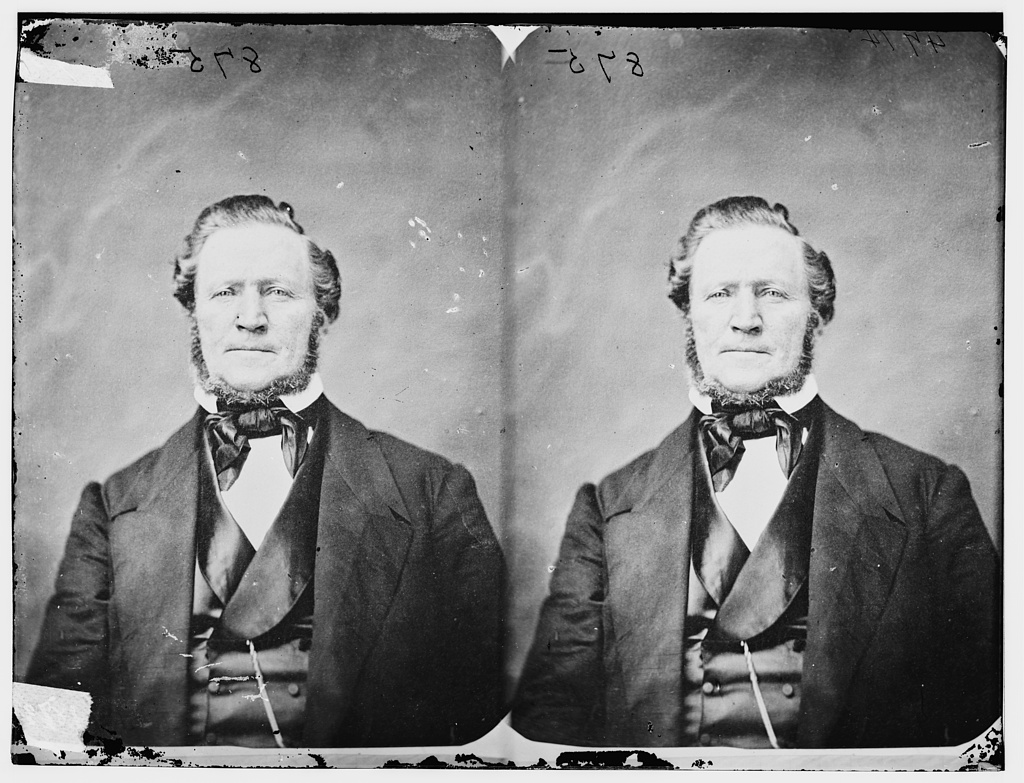
The claim:
"President Brigham Young taught what is now known as 'Adam–God theory.' He taught that Adam is 'our Father and our God, and the only God with whom we have to do.' Brigham not only taught this doctrine over the pulpit in conferences in 1852 and 1854 but he also introduced this doctrine as the Lecture at the Veil in the endowment ceremony of the Temple."[1]
"Yesterday's doctrine is today's false doctrine and yesterday's prophet is today's heretic."[2]
The two quoted passages make three claims:
- Brigham Young taught from the pulpit, in 1852 and again in 1854, that Adam is God the Father.
- He then introduced the same teaching into the Church's temple ceremony, as the Lecture at the Veil.
- The Church now condemns that same teaching as false doctrine: yesterday's prophet has become today's heretic.
Critics lead with the episode because of what it seems to imply: if a prophet could be wrong about God, while claiming revelation, what does prophetic authority still mean?
Adam-God is the name later given to a teaching Brigham Young, the Church's second President, returned to repeatedly from April 1852 until his death in 1877: that the Adam of Genesis is God the Father. In Brigham's telling, Adam had already lived and been exalted on another earth before this one, arrived in Eden as a resurrected man with one of his wives, begot the spirits of the human family, and later begot the body of Jesus. In 1877, months before his death, Brigham had a written form of the teaching read inside the endowment, the Church's most sacred temple ceremony, at the St. George Temple.
Adam-God never became the Church's doctrine. It was never canonized, and the rejection did not wait for the 1976 statement the CES Letter builds on:
- Senior apostles resisted it while Brigham preached it.
- A counselor in the First Presidency classified it in writing as non-binding in 1897.
- The First Presidency and Twelve, the Church's two presiding councils, taught the opposite doctrine over their signatures in 1916.
By the time President Spencer W. Kimball (1976) and apostle Bruce R. McConkie (1980) denounced it by name, the verdict was nearly eight decades old.
A century after Brigham wrote that lecture into the St. George endowment, Bruce R. McConkie pointed to the temple ordinance itself as the reason no Latter-day Saint should ever have been fooled by the teaching: anyone who has received the endowment, he said, "has no excuse whatever for being led astray by it." For a window of years, one operating temple taught, inside that very ordinance, the doctrine McConkie said the endowment refutes.
The CES Letter's primary-source citations here are accurate. Brigham Young taught the doctrine from the Tabernacle pulpit, published it under his name in the Deseret News, and described receiving it in unambiguous prophetic-revelation language. The question is what the episode shows about the Latter-day Saint prophetic framework: whether that framework was failing or functioning when it produced this result.
What Brigham Young actually said
Whether Brigham taught Adam-God is not the contest. The records are well-attested across multiple independent sources: George D. Watt's scribal record, Wilford Woodruff's journal, Hosea Stout's diary, Samuel Rogers' record, the Deseret News publication, and L. John Nuttall's reconstruction of the temple lecture. He said it, repeatedly, across twenty-five years.
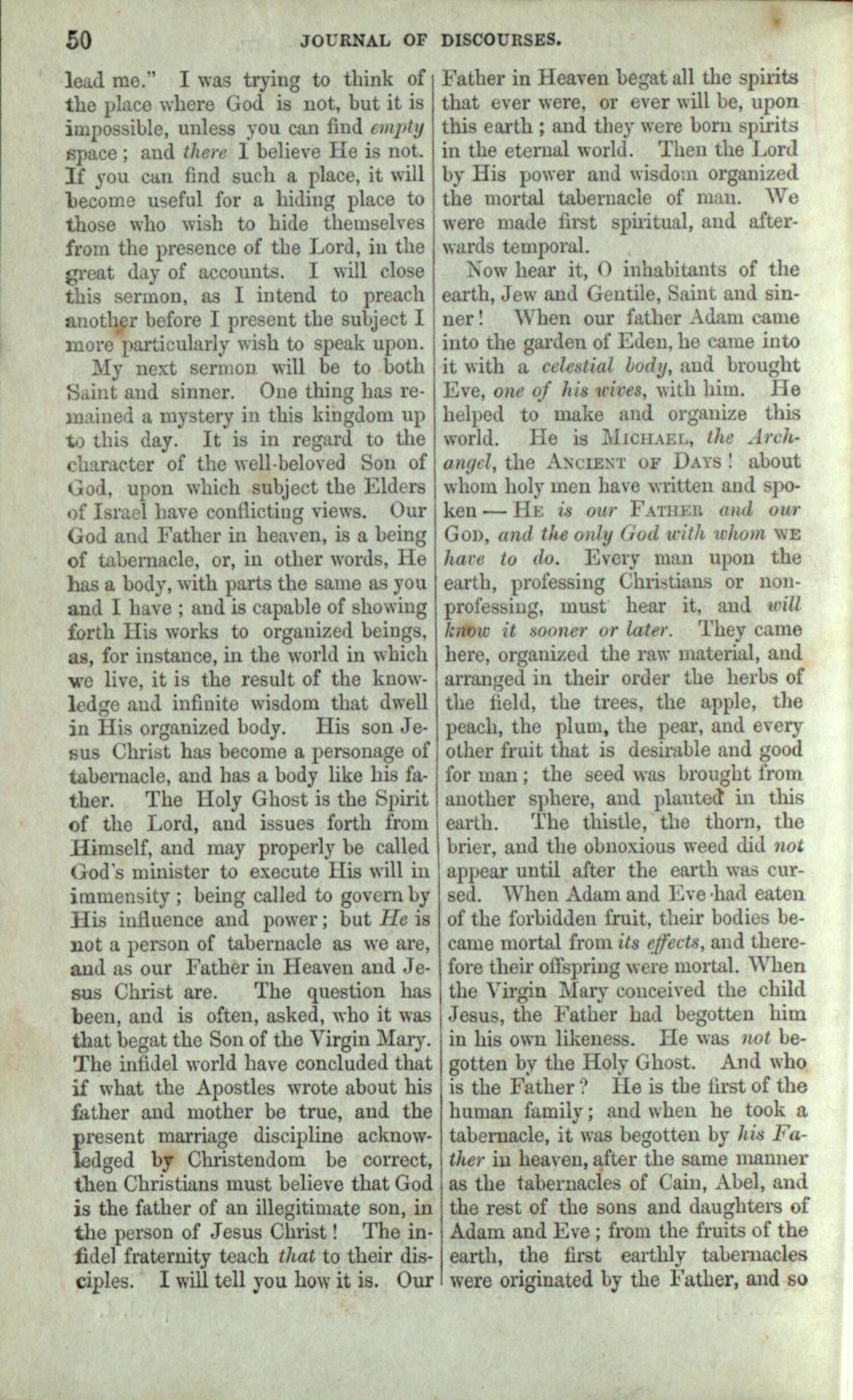
April 9, 1852 Tabernacle sermon (JD 1:50)
Brigham opened the discourse to settle an internal Elder dispute over whether Elohim or the Holy Ghost was the Father of Christ in the flesh.[3] His answer, scribed by George D. Watt and published in the Journal of Discourses (JD), the twenty-six-volume collection of early Latter-day Saint sermons printed between 1854 and 1886:
"When our father Adam came into the garden of Eden, he came into it with a celestial body, and brought Eve, one of his wives, with him. He helped to make and organize this world. He is Michael, the Archangel, the Ancient of Days! about whom holy men have written and spoken — He is our Father and our God, and the only God with whom we have to do . . . When the Virgin Mary conceived the child Jesus, the Father had begotten him in his own likeness. He was not begotten by the Holy Ghost."[4]
Wilford Woodruff's journal confirms the substance independently: "Adam is Michael or God And all the God that we have any thing to do with."[5]
Immediately after the Adam passage, Brigham added a line remarkable for its confidence: "I could tell you much more about this; but were I to tell you the whole truth, blasphemy would be nothing to it, in the estimation of the superstitious and over-righteous of mankind."[4:1]
June 1873 Deseret News
Twenty-one years later, after publishing additional discourses on Adam in the interval, Brigham took the subject up again in the New Tabernacle on June 8, 1873. The Deseret News ran the discourse on June 18. This is the citation the CES Letter relies on most heavily, and with good reason:
"How much unbelief exists in the minds of the Latter-day Saints in regard to one particular doctrine which I revealed to them, and which God revealed to me — namely that Adam is our father and God — I do not know, I do not inquire, I care nothing about it . . . Our Father Adam is the man who stands at the gate and holds the keys of everlasting life and salvation to all his children who have or who ever will come upon the earth . . . I could not find any man on the earth who could tell me this, although it is one of the simplest things in the world, until I met and talked with Joseph Smith."[6]
This is not casual speculation. Brigham used the explicit prophetic-revelation formula, "doctrine which I revealed to them, and which God revealed to me," placed Adam at the gate of salvation itself, and pinned the teaching to Joseph Smith. The "I do not know, I do not inquire, I care nothing about it" line is his frustration at the Saints' unbelief, not a hedge on the doctrine.
St. George Lecture at the Veil (1877)
Six months before his death, Brigham introduced a written form of the teaching into the St. George Temple endowment. L. John Nuttall recorded the lecture from its first delivery, on February 1, 1877:
"Adam was an immortal being when he came on this earth he had lived on an earth similiar [sic] to ours he had received his Priesthood and the Keys thereof, and had been faithful in all things and gained his resurrection and his exaltation and was crowned with glory immortality and eternal lives and was numbered with the Gods for such he became through his faithfulness, and had begotten all the spirit that was to come to this earth, and Eve our common Mother who is the mother of all living bore those spirits in the celestial world, and when this earth was organized by Elohim. Jehovah & Michael who is Adam our common Father . . . Father Adam's oldest son (Jesus the Saviour) who is the heir of the family is Father Adams first begotten in the spirit World."[7]
That crossed a categorical line. Pulpit speculation is one thing. Ordinance content is another.
The 1873 statement is the hardest to dismiss
Of the three primary documents above, the 1873 Deseret News discourse is the one the apologetic case absorbs least well.
The "Brigham was just speculating" reading works tolerably well for the 1854 sermon, where he used "I reckon" thirteen times and said outright, "I do not pretend to say that the items of doctrine and ideas I shall advance are necessary for the people to know."[3:1] It works less well for 1852. It does not work cleanly for 1873, where Brigham reached for the language the Church reserves for canonized revelation. "Doctrine which I revealed to them, and which God revealed to me" is structurally identical to the section headers in the Doctrine and Covenants (D&C), the Latter-day Saint book of canonized modern revelations. He did not say "I think" or "in my opinion." He claimed God-revealed authority and anchored the teaching to Joseph Smith.
If the apologetic framework requires that Brigham was "speaking as a man" precisely at the moment he claimed God-revealed authority, the framework risks becoming unfalsifiable, sorting outcomes by their later acceptability rather than applying a consistent rule. The plain reading is the right one: Brigham meant it. He believed Adam begot our spirits and the body of Jesus, that Adam had come to Eden already resurrected, and that God had revealed all of it to him.
The framework defended here claims something narrower: that no prophet's self-presentation, Brigham's included, has ever had the power to make a teaching binding. These limits are prospective, not retrospective, and the dates carry the point. D&C 26:2 ("all things shall be done by common consent in the church") was canonized in 1830. D&C 28:13 was canonized in 1830. D&C 107:27, requiring unanimity in the First Presidency and Twelve for binding decisions, was canonized in 1835. Twenty-two years before Brigham first preached Adam-God, the framework was already in scripture and already public. Apostle Orson Pratt, the 1860 First Presidency, and Joseph F. Smith in 1897 applied it to Adam-God in real time, seventy-nine years before Kimball's 1976 denunciation.[8]
The Lecture at the Veil
If the 1873 statement is the hardest, the temple lecture is close behind. The defense is real: the only copy the surviving record places on file was at one temple, the lecture fell out of use under Brigham's successors, and it was not part of the original endowment Brigham himself received from Joseph Smith. None of that dissolves the difficulty that Adam-God was introduced into temple ordinance at all.
What it included
The Nuttall reconstruction above shows the substance: Adam as a resurrected immortal being from another world, the begetter of all spirits, Jesus's Father in the spirit world; Elohim, Jehovah, and Michael as the trio that organized the earth, with Michael identified as Adam. This was Brigham's teaching in its fullest form, scribed at its first delivery on February 1, 1877, and still on file at the St. George Temple fifteen years later.[9] How regularly it was read across those years the record does not settle.
Why it matters that this entered temple ordinance
McConkie's 1980 devotional at Brigham Young University (BYU) made his case against Adam-God by appealing to the temple itself: "anyone who has read the Book of Moses, and anyone who has received the temple endowment, has no excuse whatever for being led astray by it."[10] Yet at St. George the endowment itself had carried that teaching: a written lecture, put in by Brigham in February 1877, a copy still on file in June 1892, and no surviving record of when it was finally taken out. Saints sealed under that lecture are not a hypothetical population.
How it was wound down
The institutional record:
- 1890–1891: In St. George stake high-council minutes (November 8 and December 13, 1890; May 15 and 22, 1891), Edward Bunker Sr. of Bunkerville, Nevada, taught that "erroneous teaching was given in the Lecture at the Veil" and that he "did not believe Adam was our God." The high council forwarded the matter to the First Presidency for review.[9:1]
- June 3, 1892: L. John Nuttall sent the First Presidency a memorandum on the lecture's origins, closing with the note that "[a] copy of the Lecture is kept at the St. George Temple, in which President Young refers to Adam in his creation, &c." He named no other temple.[11]
- June 11, 1892 (eight days later): At a St. George high-council meeting on the Bunker affair, Presidents Wilford Woodruff and George Q. Cannon declared "it was not necessary that we should [teach] or endorse the doctrine that some men taught that Adam was the Father of Jesus Christ", even while correcting Bunker's own theology. That is counsel to stop teaching the doctrine; no surviving directive orders the lecture itself withdrawn.[9:2]
- By 1902: Church President Joseph F. Smith was counseling that Adam-God "may properly be classed among the mysteries" and disapproving its public advocacy.[12]
- The end date is undocumented. Buerger is explicit: "It is not presently known when action was implemented relative to changing the St. George lecture before the veil." An 1888 Adam-God speech in the Logan temple was thought newsworthy enough to print, which Buerger reads as a hint the lecture may already have dropped from use by then; the lone claim of Adam-God content surviving later rests on one man's recollection of his 1902 Salt Lake endowment, content that was gone when he returned through the temple in 1904 or 1905.[9:3]
The record supports something slower and blurrier than either side allows. The post-Brigham First Presidency chose counsel over correction: counsel in 1892, formal classification as non-binding in 1897, published reinterpretation in 1902, and no recorded order striking the lecture at all. Later writers asserted the lecture ran continuously until about 1902–1905, but Buerger finds that claim undocumented and doubts the lecture was regularly given in the later years.[13] The institution let the doctrine fade where a clean correction would have cut it out, and those years count against the tidiness of any defense, including this one.
The original 1842 Nauvoo endowment Joseph Smith gave to Brigham separately distinguished Elohim and Michael/Adam.[3:2] The 1877 lecture was an amalgamation Brigham made, not an inherited element of the ordinance Joseph established. The system reverted to the form Joseph had taught. The endowment's wider textual history, this lecture included, has its own article: changes to the temple ceremony.
Contemporaneous resistance
The CES Letter's framing, "yesterday's prophet" pitted against "today's prophet", implies prophetic unanimity in 1852–1877 followed by reversal in 1976–1980. The actual record shows resistance to Adam-God almost immediately: from senior leaders, in writing, with Brigham still alive.
Orson Pratt
Orson Pratt, an apostle and the most prolific theological writer of nineteenth-century Mormonism, opposed Adam-God publicly from 1852 and continued for years. He published the opposition in The Seer (1853–54), distinguishing God from Adam/Michael and teaching that only Jesus was "begotten by the Father" physically.[14] Pratt was the same apostle who would oppose Brigham's racial reasoning in the 1852 Utah Territorial Legislature debate, a recurring pattern of internal dissent the "yesterday's prophet" framing flattens. Brigham repeatedly tried to bring Pratt into line. In 1857 he declared from the pulpit that Pratt "drowns himself in his own philosophy."[14:1]
Pratt did not actually recant the substance. At a January 27, 1860 council:
"I will be a free man. President Young condemns my doctrines to be fals[e]. I do not believe them to be fals."[14:2]
The public confession Pratt delivered in the Tabernacle two days later, on January 29, 1860 (the version the Quorum of the Twelve revised by roughly a quarter before publishing it that September), admitted a "stubborn disposition" and that he "ought to have yielded to the views of my brethren." On the doctrine itself he was careful, framing his position this way: "So far as revelation from the heavens is concerned, I have had none in relation to those points of doctrine."[15]
The pressure did not end there. On April 4, 1860, Young warned that unless Pratt yielded, the matter would go before conference and Pratt would be "voted as a false teacher, & your false doctrines discarded." Pratt's reply was deliberate: "I am willing you should publish what you have a mind to. I cannot retract from what I have said."[14:3]
Wilford Woodruff's journal entry of September 23, 1860, eight months after the supposed retraction, records Pratt telling Woodruff: "I do not believe as Brother Brigham & Brother Kimball do in some points of doctrine."[14:4] In private, Pratt had not moved. He stood down on dogmatism, not on his theology.
George Q. Cannon
George Q. Cannon, who served as Counselor in the First Presidency under Brigham's successors, later acknowledged that other senior leaders had felt Brigham overreached on doctrine specifically:
"Some of my brethren, as I have learned since the death of President Brigham Young, did have feelings concerning his course. They did not approve of it, and felt oppressed, and yet they dare not exhibit their feelings to him, he ruled with so strong and stiff a hand . . . In a few words, the feeling seems to be that he transcended the bounds of the authority which he legitimately held . . . [S]ome even feel that in the promulgation of doctrine he took liberties beyond those to which he was legitimately entitled."[16]
At the June 1892 St. George high-council meeting, Cannon joined President Woodruff in declaring that "[i]t was not necessary that we should [teach] or endorse the doctrine that some men taught that Adam was the Father of Jesus Christ. Counsel was given for the Elders to teach that which they Knew, not that which they did not."[9:4] At an 1898 Sunday School convention he stated: "Concerning the doctrine in regard to Adam and the Savior, the Prophet Brigham [Young] taught some things concerning that; but the First Presidency and the Twelve do not think it wise to advocate these matters."[9:5]
Wilford Woodruff
Woodruff's journal preserves a detailed contemporaneous record of the 1852 sermon, and nothing in it registers dissent.[5:1] By 1895, though, as Church President, he was telling members from the pulpit:
"Cease troubling yourselves about who God is; who Adam is, who Christ is, who Jehovah is. For heaven's sake, let these things alone. Why trouble yourselves about these things? . . . God is God. Christ is Christ. The Holy Ghost is the Holy Ghost. That should be enough for you and me to know . . . I say to the Elders of Israel, stop this."[17]
This is the prophet-president of the Church, less than two decades after Brigham's death, telling members to stop discussing the very theological claims Brigham had pushed.
The 1860 First Presidency public rebuttal
The First Presidency's January 29, 1860 public statement on Pratt's Seer errors was a perfect occasion to declare Adam-God binding doctrine and put Pratt outside the consensus. They declined:
"With regard to . . . Adam's having been formed 'out of the ground' and 'from the dust of the ground,' etc., it is deemed wisest to let that subject remain without further explanation at present; for it is written that we are to receive 'line upon line,' according to our faith and capacities, and the circumstances attending our progress."[18]
Given a chance to canonize Adam-God with Brigham as President of the Church, the institutional system walked away from it. If this was the Church's doctrine forming, why would its presiding council not simply say so?
John Taylor's silence
John Taylor, Brigham's apostolic successor and a substantial nineteenth-century theologian, published The Government of God in 1852, the same year as Brigham's first Adam-God sermon, and The Mediation and Atonement in 1882, without endorsing Adam-God, despite extensive treatment of Adam, Christ, and the Godhead in both works.[9:6] No record exists of Taylor publicly advocating Adam-God during Young's administration. The next Church President's published theology simply proceeded as if Adam-God did not exist.
Brigham's own hedging language
The 1873 statement is the high-water mark of Brigham's certainty. His own corpus, though, is internally inconsistent in ways the CES Letter omits. Across roughly 1,500 known discourses, only about twenty bring the subject up at all;[19][20] and Buerger finds that Brigham "largely abandoned public efforts in support of the Adam-God doctrine after 1861," with only a handful of major public restatements afterward, the 1873 Deseret News discourse and the 1877 Lecture at the Veil being the most consequential.[9:7]
The 1854 "I reckon" sermon
On October 8, 1854 (two and a half years after the 1852 sermon, eighteen years before the 1873 reaffirmation), Brigham opened an Adam-God discourse by framing it explicitly as personal speculation:
"I propose to speak upon a subject that does not immediately concern yours or my welfare . . . I do not pretend to say that the items of doctrine and ideas I shall advance are necessary for the people to know, or that they should give themselves any trouble about them whatever . . . I will tell you what I think about it, and as the [Southerners] say, 'I reckon.'"[3:3][21]
He used "reckon" thirteen times in that sermon, and applied it to the most theologically aggressive elements of the doctrine: Adam as a resurrected being with his wives, human spirits begotten by Adam and born of Eve, Adam himself planting the Garden of Eden.[3:4] Two and a half years after introducing the doctrine in 1852, Brigham was framing the same content as "I reckon." What kind of settled revelation gets preached as a guess?
Other instances of qualified language
In council remarks in January 1860, Brigham acknowledged ongoing uncertainty about the very doctrine the CES Letter presents as his settled, confident teaching:
"The trouble between Orson Pratt & me is I do not know Enough & he knows to[o] much. I do not know evry thing. There is a mystery Concerning the God I worship which mystery will be removed when I Come to a full knowledge of God."[22]
The day after the 1873 Deseret News discourse, in the Salt Lake School of the Prophets, he drew the distinction himself:
"[He] said there were many revelations given to him that he did not receive from the Prophet Joseph. He did not receive them through the Urim and Thummim as Joseph did but when he did receive them he knew of their truth as much as it was possible for him to do of any truth."[23]
Brigham drew a categorical line between his own revelatory mode and Joseph Smith's. He was not claiming for Adam-God the kind of certainty Joseph claimed for the canonized revelations of the Doctrine and Covenants.
Internal contradictions
The "preached a sermon . . . they may not call scripture" line the CES Letter cites from JD 13:95 sits in the same Brigham Young corpus as this:
"I am more afraid that this people have so much confidence in their leaders that they will not inquire for themselves of God whether they are led by Him. I am fearful they settle down in a state of blind self-security . . . Let every man and woman know, by the whispering of the Spirit of God to themselves, whether their leaders are walking in the path the Lord dictates, or not."[24]
And this:
"Can a Prophet or an Apostle be mistaken? Do not ask me any such question, for I will acknowledge that all the time, but I do not acknowledge that I designedly lead this people astray one hair's breadth from the truth . . ."[25]
Across his ministry Brigham carried all three positions at once: sermons that were in some sense scripture, members under obligation to verify by the Holy Ghost, and prophets who could err. Of the three, the CES Letter prints just one.
Joseph Smith's prior theology
Adam-God did not match what Joseph Smith had taught. The Church's pre-Brigham doctrine on Adam was already settled in canon by 1844, and that canonized teaching is what the post-Brigham Church reverted to.
The 1839 and 1840 priesthood discourses
In a discourse prepared for the October 1840 general conference in Nauvoo, nearly four years before his death, Joseph taught that Adam holds his presidency under Christ, not over Him:
"every man holding the Presidency of his dispensation, and one man holding the Presidency of them all, even Adam; and Adam receiving his Presidency and authority from the Lord, but cannot receive a fullness until Christ shall present the Kingdom to the Father, which shall be at the end of the last dispensation."[26]
His other recorded statements consistently place Adam as a high patriarchal figure under Christ, who in turn is under the Father. From a discourse of about July 1839:
"The Priesthood was first given to Adam; he obtained the First Presidency, and held the keys of it from generation to generation. . . . He is Michael the Archangel, spoken of in the Scriptures. Then to Noah, who is Gabriel; he stands next in authority to Adam in the Priesthood. . . . Christ is the Great High Priest; Adam next."[27]
D&C 27:11, 78:16, 116
The canonized scripture revealed through Joseph treats Adam as a patriarchal head, not as deity:
- D&C 27:11 (1830): "Michael, or Adam, the father of all, the prince of all, the ancient of days." Joseph Smith's own gloss on the title: "Ancient of Days appears to be his title because he is 'the first and oldest of all'", first and oldest human, head of the human family.[28]
- D&C 78:15–16 (1832): "[Christ] who hath appointed Michael your prince, and established his feet, and set him upon high, and given unto him the keys of salvation under the counsel and direction of the Holy One." Adam's keys are subordinate, "under the counsel and direction of the Holy One", placing him under Christ in the keys-of-salvation sequence, not above as supreme deity.
- D&C 116 (1838): Adam-ondi-Ahman, where Adam will gather the faithful in his patriarchal capacity, then "deliver up his stewardship to Christ" (cf. Daniel 7). A patriarchal-headship event, not a divine return.
Moses passages
The Book of Moses, revealed to Joseph between 1830 and 1831 and the source McConkie pointed to in 1980, distinguishes the Father from Adam directly. In Moses 1, God speaks to Moses about Adam as a created being, and Christ is named as a separate person ("by the word of my power, have I created them, which is mine Only Begotten Son"). In Moses 4 and 6, the Father, the Son, and Adam are unmistakably three.[29]
McConkie's 1980 BYU devotional grounded his rejection of Adam-God in exactly these texts: "anyone who has read the Book of Moses . . . has no excuse whatever for being led astray by it."[10:1] The text was canonized before Brigham preached Adam-God. Dennis B. Horne's six-part 2016 review of the theory at the Interpreter Foundation blog, three parts of it on McConkie, assembles McConkie's explanations alongside his private correspondence from those years, including the 1980 letters and the 1981 exchange with Eugene England quoted below.[30]
"Ancient of Days" as patriarchal title
The title "Ancient of Days" in Daniel 7 and D&C 27:11 is the closest the canonized scripture comes to assigning Adam a divine-sounding name. But Joseph Smith's own reading of it was patriarchal, not theological: Adam as "the first and oldest of all," the head of the human family, not the Eternal Father. Charles Penrose's 1902 patriarchal-headship reading of Brigham's 1852 sermon rests on a gloss Joseph Smith had already given.
The canonization framework
The CES Letter never engages the Latter-day Saint doctrinal-evaluation framework. But that framework existed in canon before Adam-God was preached, and it applies straightforwardly.
D&C 26:2, common consent
"And all things shall be done by common consent in the church, by much prayer and faith."[31]
D&C 26 was canonized in 1830, twenty-two years before Brigham's first Adam-God sermon. The rule predates the supposed violation. Adam-God was never submitted to the Church for a sustaining vote.
D&C 28:13, order in revelation
"For all things must be done in order, and by common consent in the church, by the prayer of faith."[32]
D&C 26:2 and 28:13 together have one effect: even revelations to the prophet do not become binding on the Church until presented for a sustaining vote. Joseph Smith himself submitted his revelations to the Church for ratification.
Why never canonized matters
Bruce R. McConkie spelled out the principle's administrative core:
"Administrative affairs of the Church are handled in accordance with the law of common consent. This law is that in God's earthly kingdom, the King counsels what should be done, but then he allows his subjects to accept or reject his proposals."[33]
The Church's Doctrine and Covenants student manual extends the point past officer sustainings: "Not only are Church officers sustained by common consent, but this same principle operates for policies, major decisions, acceptance of new scripture, and other things that affect the lives of the Saints."[33:1]
Harold B. Lee stated the rule plainly: "The only one authorized to bring forth any new doctrine is the President of the Church, who, when he does, will declare it as revelation from God, and it will be so accepted by the Council of the Twelve and sustained by the body of the Church."[34]
The Church's 2007 Newsroom statement is the modern explicit articulation:
"Not every statement made by a Church leader, past or present, necessarily constitutes doctrine. A single statement made by a single leader on a single occasion often represents a personal, though well-considered, opinion, but is not meant to be officially binding for the whole Church . . . With divine inspiration, the First Presidency . . . and the Quorum of the Twelve Apostles . . . counsel together to establish doctrine."[35]
Adam-God was never declared as revelation by a President of the Church to be voted on, never accepted as such by the Twelve, never sustained by the body of the Church, and never canonized.
Joseph F. Smith Saxey letter (1897): "in no sense binding upon the Church"
The doctrinal status of Adam-God was settled within the lifetime of Saints who had heard Brigham preach it. Joseph F. Smith (then a member of the First Presidency, later Church President) wrote on January 7, 1897, in consultation with Wilford Woodruff:
"[In his April 1852 discourse] President Young no doubt expressed his personal opinion or views upon the subject. What he said was not given as a revelation or commandment from the Lord. The doctrine was never submitted to the councils of the Priesthood nor to the Church for approval or ratification and was never formally or otherwise accepted by the Church. It is therefore in no sense binding upon the Church nor upon the consciences of any of the members thereof . . . While I am not authorized to sit in judgment upon Pres[iden]t Young, I am at liberty to test the truth of his words or utterances by the revealed and accepted word of God. Anything uttered by man which is contrary to the Divine law must fall, while that only which is in harmony with it can remain, or stand."[36]
This statement predates Kimball's 1976 denunciation by seventy-nine years. The "yesterday/today" binary the CES Letter constructs requires the rejection to be a recent reversal. The record shows formal classification of Adam-God as non-binding beginning within twenty years of Brigham's death, written by a future Church President while Wilford Woodruff, who had personally heard Brigham preach in 1852, was sitting President.
Joseph F. Smith reiterated the framework in a February 27, 1902 letter to Bishop Edward Bunker, Jr.:
"It is certainly unwise for the Elders or any other member of the Church to advocate doctrines that are not clearly set forth in the revealed word of God . . . What is called the Adam God doctrine may properly be classed among the mysteries. The full truth concerning it has not been revealed to us; and until it is revealed all wild speculations, sweeping assertions and dogmatic declarations relative thereto, are out of place and improper. We disapprove of them and especially the public expression of such views . . . Christ is not Adam, nor is Adam Christ . . ."[12:1]
The repudiation timeline
The CES Letter folds a 124-year process of progressive clarification (1852–1976) into its yesterday-versus-today refrain. The record, year by year:
| Year | Source | Action |
|---|---|---|
| 1860 | First Presidency public statement on Pratt's Seer errors | Declines to canonize Adam-God: "deemed wisest to let that subject remain without further explanation at present"[18:1] |
| 1892 | Wilford Woodruff and George Q. Cannon, St. George high council (June 11) | Declare Adam-God "not necessary" for elders to teach or endorse[9:8] |
| 1895 | Wilford Woodruff, discourse of April 7 | "Cease troubling yourselves about who God is; who Adam is . . . stop this"[17:1] |
| 1897 | Joseph F. Smith to A. Saxey | Adam-God "in no sense binding upon the Church"[36:1] |
| 1897 | First Presidency and apostles, reviewing the Fresno dispute (December 16) | Approve a mission president's published denial that Latter-day Saints worship Adam; counsel that "it is best to avoid bringing it up"[9:9] |
| 1902 | Charles W. Penrose, "Our Father Adam" | First major published re-interpretation, with implicit acknowledgment that Brigham's literal teaching was incorrect[37] |
| 1902 | Joseph F. Smith to Edward Bunker, Jr. | "Christ is not Adam, nor is Adam Christ"[12:2] |
| by ~1905 | Temple practice under Joseph F. Smith | Lecture at the Veil no longer in use; no record survives of when it was withdrawn[9:10] |
| 1909 | First Presidency, "The Origin of Man" | Adam as "a preexistent spirit, and like Christ he took upon him an appropriate body", incompatible with Brigham's resurrected-being model[38] |
| 1912 | First Presidency editorial in Improvement Era | "Speculations as to the career of Adam before he came to the earth are of no real value . . . Dogmatic assertions do not take the place of revelation"[39] |
| 1916 | First Presidency + Twelve, "The Father and the Son: A Doctrinal Exposition" | "God the Eternal Father, whom we designate by the exalted name-title 'Elohim,' is the literal Parent of our Lord and Savior Jesus Christ and of the spirits of the human race", signed by all senior leadership[40] |
| 1931 | Heber J. Grant, correspondence | Adam-God "is not scriptural or according to the truth"[9:11] |
| 1976 | Spencer W. Kimball, "Our Own Liahona," October General Conference | "We denounce that theory and hope that everyone will be cautioned against this and other kinds of false doctrine"[41] |
| 1980 | Bruce R. McConkie, "Seven Deadly Heresies," BYU devotional | Names Adam-God as the sixth deadly heresy: "anyone who has read the Book of Moses, and anyone who has received the temple endowment, has no excuse whatever for being led astray by it"[10:2] |
| 1981 | Bruce R. McConkie to Eugene England | "Brigham Young, contradicted Brigham Young, and the issue becomes one of which Brigham Young we will believe"[42] |
No document on this list matters more than the 1916 "The Father and the Son: A Doctrinal Exposition," signed by the entire First Presidency and Quorum of the Twelve. It affirmed directly that Elohim is the literal Parent of our Lord and Savior Jesus Christ and of the spirits of the human race, a flat contradiction of the central Adam-God claim, and it did so sixty years before Kimball's 1976 statement. Nowhere in the CES Letter does it appear.[40:1]
The strongest critical case
The case Buerger, Weber, and others have built is the serious one, and the framework defense has to meet it on its own ground rather than the CES Letter's.
Buerger's Mysteries of Godliness
David John Buerger's 1982 Dialogue article and 2002 book The Mysteries of Godliness are the standard scholarly references on Adam-God. Faithful authors such as Brown (2009) cite Buerger; the BYU Studies book review of Mysteries of Godliness treats him as the standard source.[9:12][43] His critical-but-academic case carries several points the apologetic position must absorb:
- Adam-God was endorsed by more than Brigham alone. Buerger documents at minimum eight General Authorities post-1852 who publicly or privately endorsed elements of Adam-God: George Q. Cannon (later distanced), Abraham H. Cannon, Heber C. Kimball, Wilford Woodruff (recorded the 1852 sermon without dissent, then signaled distance by 1895), Edward Stevenson, Lorenzo Snow, Franklin D. Richards, and Brigham Young Jr.[9:13] The framework defense rests on the unanimity test, with Pratt and fellow apostle Amasa Lyman dissenting, not on any claim that Brigham taught alone.
- Post-Brigham handling looked more like gradualist suppression than principled in-real-time correction. Decades passed between Brigham's death in 1877 and Penrose's first public re-reading in 1900–1902. The 1916 "Father and the Son" did not name Adam-God explicitly; the public denunciation did not arrive until Kimball in 1976. From a critical view, the institutional pattern looks like avoidance, then reframing, then denunciation, not an instant rejection of the error.
- The endowment lecture window matters. Saints who received the lecture at St. George between 1877 and its undocumented end got Adam-God in the most binding ritual setting the Church has. The "one temple, wound down under his successors" defense is real, but it does not erase the population of Saints who actually received the lecture.
Weber's Sunstone findings
Samuel R. Weber's 2019 Sunstone article documented fragments of Adam-God persisting in Church Educational System (CES) teaching decades after the Kimball denunciation. As a student in the mid-2000s, Weber attended a Logan Institute class whose instructor taught that Adam and Eve were physically begotten children of God, and he afterward found five more Logan Institute teachers who were familiar with the idea or appeared to believe it.[44] The point is that the doctrinal "removal" was incomplete: a top-down denunciation did not reach every classroom. That is true, even though the institutional position has been unambiguous since 1916.
The "if it was wrong, why didn't God correct Brigham immediately" question
The sharpest form of the critical case asks: if Adam-God was a revelation Brigham received, as he claimed in 1873, and the Church now rejects it, then either the revelation was real and the modern Church is wrong, or Brigham misidentified speculation as revelation. There is no third option that preserves prophetic authority in any uncomplicated sense.
Within the Latter-day Saint framework, the answer is the second: Brigham mistook his own theological exploration for revelation. That is a genuine concession, not a dodge.[45] It commits Latter-day Saints to a real proposition: that even a sincerely held revelatory experience by the Church President is not, on its own, enough to make a teaching binding doctrine. The system overrides the individual prophet's claim, by design, since 1830.
What the record leaves unresolved
Three loose ends remain: what Brigham finally meant, how widely the apostles privately agreed with him, and how far he had moved from Joseph.
- What Brigham actually meant in his most extreme passages is not fully recoverable. Penrose's 1902 patriarchal-headship reading does not handle Brigham's "Father had begotten Him in His own likeness" (1852) or "begotten all the spirit that was to come to this earth" (1877 lecture) as cleanly as the literal reading does. Most likely Brigham believed just what he said (Adam as the literal Father of human spirits and of Jesus's body), and the Church now rejects that teaching.
- How much of the apostolic body privately held Adam-God in the 1860s–1880s is not fully knowable. Cannon's post-Brigham reflection, "some even feel that in the promulgation of doctrine he took liberties beyond those to which he was legitimately entitled", suggests private dissent was wider than the public record. Brigham Young Jr.'s December 16, 1897 journal entry, "Adam is our father and God and no use to discuss it with Josephites or any one else," shows an apostle still holding the position the day the First Presidency and several apostles reviewed the Fresno dispute (a mission president had publicly denied that the Saints worship Adam) and declined to defend the doctrine.[9:14]
- The gap between Brigham's understanding and Joseph's prior theology is uncomfortable. Brigham received the original 1842 endowment from Joseph Smith, an endowment that distinguished Elohim and Michael/Adam. His 1877 amalgamation of those figures was Brigham's own departure from what Joseph had taught him. He didn't elaborate; he replaced.
The continuing-revelation framework
The CES Letter frames continuing revelation as a trap: if prophets never change, they're rigid; if they change, they were wrong before. The framing assumes a finished theological product that ought never to need correction. Latter-day Saint scripture assumes the opposite. Explicitly, and structurally, it anticipates progressive correction.
D&C 1:24–28, built-in expectation of error
The introductory revelation to the Doctrine and Covenants, given to Joseph Smith in November 1831, contains the most explicit statement in canonized scripture that prophetic communication is fallible:
"Behold, I am God and have spoken it; these commandments are of me, and were given unto my servants in their weakness, after the manner of their language, that they might come to understanding. And inasmuch as they erred it might be made known; And inasmuch as they sought wisdom they might be instructed; And inasmuch as they sinned they might be chastened, that they might repent."[46]
This was canonized twenty-one years before Brigham's first Adam-God sermon. The framework describes in advance the "weakness, after the manner of their language" the Adam-God episode displays, and promises that "inasmuch as they erred it might be made known," by later revelation and clarification. The same canonized expectation governs the separate question of failed or unfulfilled revelations: the "inasmuch as they erred" clause is the same provision Joseph wrote into D&C 1 in 1831 to anticipate corrections of his own statements, not a rule retrofitted afterward to handle Brigham.
"A prophet is a prophet only when acting as such" (Joseph Smith)
Joseph Smith had already put the rule in one sentence in 1843, nine years before Brigham's first Adam-God sermon:
"A prophet was a prophet only when he was acting as such."[47]
That category is Joseph's own. Brigham reaffirmed it ("How can you know whether [the members of the First Presidency] lead you correctly or not? . . . obtain this living witness, each for themselves"). Charles Penrose articulated it in 1912: "We do not believe in the infallibility of man. When God reveals anything it is truth, and truth is infallible. No President of the Church has claimed infallibility."[25:1] D. Todd Christofferson restated the institutional version in 2012:
"Doctrinal exposition may also come through the combined council of the First Presidency and Quorum of the Twelve Apostles. . . . At the same time it should be remembered that not every statement made by a Church leader, past or present, necessarily constitutes doctrine. It is commonly understood in the Church that a statement made by one leader on a single occasion often represents a personal, though well-considered, opinion, not meant to be official or binding for the whole Church. The Prophet Joseph Smith taught that 'a prophet [is] a prophet only when he [is] acting as such.'"[48]
McConkie's 1981 framing: "Brigham Young contradicted Brigham Young"
The cleanest statement of how to apply the framework to Adam-God is Bruce R. McConkie's 1981 letter to Eugene England:
"Yes, President Young did teach that Adam was the father of our spirits, and all the related things that the [polygamous] cultists ascribe to him. This, however, is not true. He expressed views that are out of harmony with the gospel. But, be it known, Brigham Young also taught accurately and correctly, the status and position of Adam in the eternal scheme of things. What I am saying is that Brigham Young, contradicted Brigham Young, and the issue becomes one of which Brigham Young we will believe."[42:1]
This is an apostle of the Church, in writing, applying the framework in the open. A previous prophet was wrong on this point; Brigham's self-contradiction and the standard works establish it; and the teaching that accords with canon is the one to believe. It is exactly the framework D&C 26 and 28 set up.
The system working: 1916 / 1976 / 1980 corrections
The 1916 "Father and the Son: A Doctrinal Exposition," the 1976 Kimball denunciation, and the 1980 McConkie devotional show the framework finishing what the 1860 First Presidency had begun. A teaching that did not pass through canonization, did not receive common consent, was not unanimous in the senior leadership, and was inconsistent with prior canonized scripture, was progressively classified as non-binding, then publicly repudiated. Binding status never attached: the filters that keep one leader's error out of the canon did their work. The same progressive-correction pattern runs through the priesthood and temple ban, where the racial folk-theological justifications were never canonized, were progressively distanced through the twentieth century, and were formally disavowed in the 2013 Gospel Topics Essay: the same prospective tests applied to a different episode, with the same structural result.
A 2025 Times & Seasons essay reflecting on Samuel Weber's research framed the episode in language faithful scholarship is increasingly comfortable with: Adam-God was "something of a revelatory detour," a "dead-end" (the word is Terryl Givens's), an instance of a Church President pursuing theological exploration the institutional framework ultimately classified as not the path the Church would walk. That is what the framework's safeguards are for.[49]
The "yesterday's prophet is today's heretic" charge
Why this is rhetorically effective
The line, "Yesterday's doctrine is today's false doctrine and yesterday's prophet is today's heretic", turns a process into a verdict. If doctrine can be corrected at all, every correction reads as betrayal, and the man corrected becomes a heretic by definition. What the binary cannot represent is the middle category the Adam-God record actually documents: a teaching preached in earnest, weighed against the canon's own tests, and classified as non-binding while its preacher still presided.
Why it misframes the actual Latter-day Saint doctrinal architecture
The framing needs three things to be true, and the record supports none of them:
- That Adam-God was "doctrine" in 1852–1877. By the standards the Church used then and uses now, it was not: no canonization, no common-consent vote, no unanimity in the senior leadership. Joseph F. Smith said so in writing in 1897: "in no sense binding upon the Church".
- That the rejection arrived only lately. The paper trail says otherwise: formal classification of Adam-God as non-binding began in 1860 (First Presidency declining to canonize it in the public Pratt rebuttal), continued in 1892 (the Woodruff-Cannon "not necessary" counsel at St. George), and was formal by 1897 (Saxey letter), 1909 (Origin of Man), 1912 (First Presidency editorial), and 1916 (Father and the Son). The 1976 Kimball statement arrived at the end of a process already 79 to 116 years old, not at its beginning.
- That binding-doctrine designations are made retrospectively. They are not. The canonization, common-consent, and unanimous-senior-leadership tests were canonized in the standard works before Adam-God was preached. The framework was available to apply in 1852. Pratt applied it. The 1860 First Presidency applied it. Joseph F. Smith applied it explicitly in 1897. The framework's prospective tests classified Adam-God as non-binding in real time.
What "binding doctrine" actually requires
The framework articulated in D&C 26:2, 28:13, and 107:27 (restated by Harold B. Lee, Bruce R. McConkie, the 2007 Newsroom statement, and D. Todd Christofferson in 2012) is consistent: a teaching becomes binding when the President of the Church declares it as revelation from God, the Council of the Twelve accepts it, the membership sustains it by common consent, and it squares with the standard works.[34:1][35:1][50][48:1] Adam-God passed none of those tests. The "yesterday's doctrine" framing depends on collapsing the gap between pulpit and canon, between a sermon preached with confidence and a teaching the Church has bound itself to.
The unanimity test in D&C 107:27 governs formal binding declarations by the First Presidency and Twelve, not private apostolic theological views. Buerger documents that several apostles privately endorsed elements of Adam-God in the late nineteenth century (Brigham Young Jr. was still maintaining the position in his journal as late as December 16, 1897) even while Joseph F. Smith was formally classifying it as non-binding.[9:15] The framework does not require unanimous private theological agreement. It requires that no teaching become binding without a unanimous formal declaration that it is binding, and Adam-God was never the subject of one.
What would falsify the apologetic position
The framework is falsifiable because its prospective tests have concrete failure conditions. Had Adam-God been canonized in the Doctrine and Covenants, the apologetic position would be untenable. Had Brigham submitted Adam-God for a sustaining vote and the body of the Church sustained it, the position would be untenable. Had the senior leadership unanimously issued a formal binding declaration endorsing Adam-God, the way the 1916 First Presidency and Twelve unanimously issued "The Father and the Son" against it, the position would be untenable. None of those things happened. The single unanimous declaration that would have satisfied the framework was issued on the opposite side of the question.
The difference between being wrong and being a fraud
The CES Letter's underlying inference runs from "Brigham was wrong about Adam-God" to "the prophetic office is fraudulent." That move requires a silent premise: that prophetic authority cannot survive prophetic error. Latter-day Saint scripture has disclaimed that premise since D&C 1:24 in 1831. Joseph Smith disclaimed it. Brigham disclaimed it. Penrose, Kimball, and Christofferson disclaimed it. The premise the CES Letter's argument needs is one Latter-day Saints have never held.
Assessment
Brigham Young was sincerely wrong on a specific theological point. He taught it from the Tabernacle pulpit. He published it under his own name in the Church's official newspaper, in prophetic-revelation language. He introduced a written form of it into the St. George Temple endowment as a Lecture at the Veil that Saints received as part of that ordinance, and he died still holding it. The 1873 Deseret News statement, "doctrine which I revealed to them, and which God revealed to me", is the reading the CES Letter gives, and it is the right reading of what Brigham believed about himself in that moment. The CES Letter is not making this up.
What the episode shows is not the failure of the Latter-day Saint prophetic framework. It is that framework doing its canonized work. D&C 1:24–28, already canon for twenty-one years when Brigham first preached Adam-God, described the Lord's servants as speaking "in their weakness, after the manner of their language," and promised that "inasmuch as they erred it might be made known." Nothing becomes binding without common consent (D&C 26:2 and 28:13) or without unanimity in the senior leadership (D&C 107:27), and the standard works themselves already placed Adam as a patriarchal head under Christ, not as the Eternal Father (the Book of Moses, D&C 27:11, D&C 78:15–16). The safeguards were in place, in canon, in advance. They held.
And the outcome followed those tests. Adam-God was contested by Pratt and others in real time. Handed the chance in 1860, the First Presidency left it out of the canon. Brigham himself kept hedging, "I reckon," "I do not know evry thing", against his own boldest statements. It was never submitted for common consent. The next President, Taylor, never took it up in print. Joseph F. Smith classified it formally as non-binding in 1897, and in 1916 the First Presidency and Twelve issued "The Father and the Son," affirming Elohim as the literal Parent of all spirits. Kimball denounced it publicly in 1976; McConkie articulated the framework openly in 1980 and 1981. The system the CES Letter argues failed is the system that produced that list.
What the episode commits a believer to
The temple Lecture at the Veil is where the critical reading is hardest to answer. Ordinance content carries weight pulpit speculation does not, and the wind-down was slow enough that nobody even recorded the date the lecture stopped. The episode commits Latter-day Saints to a proposition the CES Letter's framing cannot accept: that a prophet can preach in full sincerity and still not speak for God. Latter-day Saint scripture has affirmed that proposition since 1831, and the institutional safeguards exist precisely because the binding-doctrine determination has never been delegated to any one prophet's self-presentation, the Church President's included.
The Restoration's claim was never that prophets are infallible, but that God leads His Church through ordinary, fallible men, with safeguards around them real enough to bear weight when they have to. Few episodes in Latter-day Saint history have strained that claim harder, and Adam-God still never entered the canon. The institutional response across 1860, 1916, 1976, and 1980 ran the course the framework prescribes for a teaching that fails its tests. The same pattern holds for other contested teachings of the era: Brigham Young's blood-atonement rhetoric was never canonized, never sustained by any vote, never put into practice, and the same prospective tests classified it as non-binding too.
None of this was clean, and the framework was never built to make it clean. It was built to keep a mistaken teaching from hardening into binding doctrine, and that is what happened here. Adam-God was contested while Brigham still lived, classified as non-binding within twenty years of his death, and repudiated outright long before the CES Letter reached for it. The doctrine read at the veil in St. George is the same doctrine the endowment's own scripture had already ruled out. A church of infallible prophets could promise that no Brigham Young would ever preach an Adam-God. A church of fallible prophets inside a canonized framework can promise something more modest and, on the evidence of this episode, deliver it: that when a prophet errs, even about God, the error stays his, and never becomes the Church's.
Runnells, CES Letter (2017), "Prophets," no. 1, p. 62. ↩︎
Runnells, CES Letter (2017), "Prophets," p. 63, the sentence concluding the Adam-God item. Variant forms recur on pp. 64 and 66. ↩︎
Matthew B. Brown, "Brigham Young's Teachings on Adam," presented at the 2009 FAIR Conference, Sandy, Utah. https://www.fairlatterdaysaints.org/wp-content/uploads/2011/11/2009_Brigham_Youngs_Teachings_On_Adam.pdf. Brown is the most thorough faithful primary-source survey of Brigham's Adam discourses 1852–1877; he documents the "I reckon" usage, walks through the doctrinal evolution, and concludes that "some of Brigham Young's assumptions about Adam are not compatible with canonized scripture and so those particular teachings are not binding upon any Latter-day Saint" (p. 15). ↩︎ ↩︎ ↩︎ ↩︎ ↩︎
Brigham Young, discourse of April 9, 1852, Journal of Discourses 1:50–51 (Liverpool: F. D. & S. W. Richards, 1854). The discourse was scribed by George D. Watt and is preserved both in the Journal of Discourses and in independent journal entries by Wilford Woodruff, Hosea Stout, and Samuel Rogers. ↩︎ ↩︎
Wilford Woodruff Journal, April 9, 1852, LDS Church Archives. Images and transcript at the Wilford Woodruff Papers, https://wilfordwoodruffpapers.org/day-in-the-life/1852-04-09. Critical edition: Scott G. Kenney, ed., Wilford Woodruff's Journal (Midvale, UT: Signature Books, 1984), 4:128–129. ↩︎ ↩︎
Brigham Young, discourse of June 8, 1873, Deseret News, vol. 22, no. 20 (June 18, 1873): 308. ↩︎
L. John Nuttall journal entry of February 7, 1877, recording the lecture as first delivered February 1, 1877, at the St. George Temple. Vault MSS 790, Journals of L. John Nuttall, 1857–1904, L. Tom Perry Special Collections, Harold B. Lee Library, BYU. Reprinted in David John Buerger, "The Adam-God Doctrine," Dialogue: A Journal of Mormon Thought 15, no. 1 (Spring 1982): 32–33. https://www.dialoguejournal.com/articles/the-adam-god-doctrine/ ↩︎
Carries the elaboration moved out of the body abbreviating the prospective-vs-retrospective build-up. The 1860 First Presidency public Pratt rebuttal treated Adam-God as a question to leave open rather than to canonize, applying common consent and standard-works-compatibility prospectively rather than retrospectively. Joseph F. Smith's 1897 Saxey letter made the prospective classification explicit by quoting the framework's own canonized criteria — seventy-nine years before Kimball's 1976 denunciation. The tests that classified Adam-God as non-binding were all in the canon before Brigham's first Adam-God sermon: common consent (1830), order in revelation (1830), quorum unanimity (1835). That sequence is the structural difference between a prospective framework and retrospective apologetics. ↩︎
David John Buerger, "The Adam-God Doctrine," Dialogue: A Journal of Mormon Thought 15, no. 1 (Spring 1982): 14–58. https://www.dialoguejournal.com/articles/the-adam-god-doctrine/. Buerger's article is the standard scholarly reference for Adam-God's primary-source documentation. Faithful authors (Brown 2009) and critics alike cite Buerger as the foundational compilation of the 1852–1976 doctrinal trajectory, the Lecture at the Veil's introduction and wind-down, and the post-Brigham First Presidency reorientation. Brigham's post-1861 retreat from public advocacy is documented at p. 29 ("largely abandoned public efforts in support of the Adam-God doctrine after 1861"). ↩︎ ↩︎ ↩︎ ↩︎ ↩︎ ↩︎ ↩︎ ↩︎ ↩︎ ↩︎ ↩︎ ↩︎ ↩︎ ↩︎ ↩︎ ↩︎
Bruce R. McConkie, "The Seven Deadly Heresies," BYU devotional, June 1, 1980. https://speeches.byu.edu/talks/bruce-r-mcconkie/seven-deadly-heresies/. McConkie names Adam-God as the sixth deadly heresy and grounds his rejection in canon and ordinance. ↩︎ ↩︎ ↩︎ ↩︎
L. John Nuttall to Wilford Woodruff, George Q. Cannon, and Joseph F. Smith, June 3, 1892, L. Tom Perry Special Collections, Harold B. Lee Library, BYU. Cited in Buerger, "The Adam-God Doctrine," n. 69. The memorandum lists only the St. George copy of the lecture, indicating, though not proving, that the lecture was confined to St. George; it does not mention the Logan or Manti temples or the Salt Lake Endowment House. ↩︎
Joseph F. Smith to Edward Bunker, Jr., February 27, 1902. Quoted in Buerger, "The Adam-God Doctrine," 40–41. Joseph F. Smith had been Church President since October 1901; the letter names his counselors, John R. Winder and Anthon H. Lund, as joining in the counsel. ↩︎ ↩︎ ↩︎
Carries the elaboration of why the wind-down does not dissolve under the framework defense. What the record documents: the lecture written into St. George use in February 1877; Bunker's objections before the St. George high council in 1890–91; a copy still on file in June 1892 (Nuttall memorandum); the Woodruff-Cannon "not necessary" counsel that same month; and no record of the removal itself — "It is not presently known when action was implemented relative to changing the St. George lecture before the veil" (Buerger, p. 53). The circulating "until about 1902–1905" claim Buerger attributes to fundamentalist authors "without serious attempt at documentation," resting on one man's recollection of his 1902 Salt Lake endowment and his return through the temple in 1904 or 1905 (pp. 34, 53 nn. 75–76); Buerger doubts the lecture was regularly given across those years at all. The framework's tests are about whether a teaching ever crossed the binding-doctrine threshold (canonization, common consent, unanimous senior leadership, standard-works compatibility), and on those tests Adam-God never crossed. The years between the lecture's introduction and its undocumented end are a real institutional cost. What they are not is evidence that the framework failed — the framework's prospective tests had already classified the doctrine as non-binding while the lecture's copy still sat on file. ↩︎
Gary James Bergera, "The Orson Pratt-Brigham Young Controversies: Conflict Within the Quorums, 1853 to 1868," Dialogue: A Journal of Mormon Thought 13, no. 2 (Summer 1980): 7–49. https://www.dialoguejournal.com/articles/the-orson-pratt-brigham-young-controversies-conflict-within-the-quorums-1853-to-1868/. Bergera's article is the foundational scholarly documentation of Pratt's contemporaneous opposition to Adam-God, the negotiated 1860 public statement, and Pratt's continuing private dissent. ↩︎ ↩︎ ↩︎ ↩︎ ↩︎
Orson Pratt, remarks in the Tabernacle, January 29, 1860, published as revised by the Quorum of the Twelve in "Instructions to the Saints," Latter-day Saints' Millennial Star 22, no. 38 (September 22, 1860): 595–606. Record at https://bhroberts.org/records/06h81W-HUjVEc/. Bergera documents the quorum's review session, which removed approximately twenty-five percent of Pratt's remarks before publication, in "The Orson Pratt-Brigham Young Controversies," 32–33. ↩︎
George Q. Cannon, journal entry of January 17, 1878, a few months after Brigham Young's death, as printed in Joseph J. Cannon, "George Q. Cannon—Relations With Brigham Young," The Instructor 80, no. 6 (June 1945): 259. Quoted in Brown, "Brigham Young's Teachings on Adam," 13, and discussed in Bergera, "The Orson Pratt-Brigham Young Controversies," 41. Cannon was a member of the First Presidency under Brigham Young's successors. ↩︎
Wilford Woodruff, discourse of April 7, 1895, reprinted in Latter-day Saints' Millennial Star 57:355. Quoted in Buerger, "The Adam-God Doctrine," 36–37. ↩︎ ↩︎
First Presidency, public rebuttal of Orson Pratt's Seer, January 29, 1860. Published in Latter-day Saints' Millennial Star, Liverpool, September 22, 1860; reprinted in Messages of the First Presidency 2:222, and reissued verbatim by the First Presidency and Twelve on August 23, 1865. Quoted in Brown, "Brigham Young's Teachings on Adam," 7, and in Buerger, "The Adam-God Doctrine," 49 n. 35. ↩︎ ↩︎
FAIR, "Brigham Young and Adam-God theory." https://www.fairlatterdaysaints.org/answers/Brigham_Young_and_Adam-God_theory. FAIR documents that Brigham gave over 1,500 recorded sermons and that in about twenty of them he brought up the subject of God the Father's relationship to Adam. ↩︎
Debunking-CESLetter, "Adam-God." https://debunking-cesletter.com/prophets-1/adam-god/. Notes that of Brigham's roughly 1,500 known discourses only "a few dozen provides hints" [sic] about his view of Adam, and that nearly 388 discourses were printed in the Journal of Discourses across his thirty years as Church President. ↩︎
Brigham Young, discourse of October 8, 1854, in Elden J. Watson, comp., Brigham Young Addresses, vol. 2 (1850–1854) (privately compiled, 1979). Sermon notes also preserved in the Brigham Young Collection, LDS Church Archives. The hedging language and frequency of "I reckon" usage is documented in Brown, "Brigham Young's Teachings on Adam," 12–13. ↩︎
Brigham Young, remarks at the January 27, 1860 council on the Pratt dispute. The full passage, including the "mystery" sentence, is preserved in the council record reproduced in Bergera, "The Orson Pratt-Brigham Young Controversies," 17–19. Quoted here in the orthography of the transcription at Debunking-CESLetter, "Adam-God," https://debunking-cesletter.com/prophets-1/adam-god/. ↩︎
Brigham Young, remarks at the Salt Lake School of the Prophets, June 9, 1873, Salt Lake School of the Prophets Minute Book, LDS Church Archives. Quoted in Buerger, "The Adam-God Doctrine," 32. ↩︎
Brigham Young, discourse of January 12, 1862, Salt Lake City, Journal of Discourses 9:150. ↩︎
FAIR, "Prophets are not infallible." https://www.fairlatterdaysaints.org/answers/Mormonism_and_doctrine/Prophets_are_not_infallible. Citation-ready quotations include Charles W. Penrose (1912): "We do not believe in the infallibility of man. When God reveals anything it is truth, and truth is infallible. No President of the Church has claimed infallibility"; and Brigham Young, discourse of March 21, 1858: "Can a Prophet or an Apostle be mistaken? Do not ask me any such question, for I will acknowledge that all the time, but I do not acknowledge that I designedly lead this people astray one hair's breadth from the truth . . ." ↩︎ ↩︎
Joseph Smith, discourse read at general conference, October 5, 1840, Nauvoo, Illinois; History of the Church 4:207–209. Quoted, punctuation modernized, in Teachings of Presidents of the Church: Joseph Smith, chapter 8. https://www.churchofjesuschrist.org/study/manual/teachings-joseph-smith/chapter-8?lang=eng ↩︎
Joseph Smith, discourse of circa July 1839, Commerce, Illinois, reported by Willard Richards; History of the Church 3:385–389. Quoted, punctuation modernized, in Teachings of Presidents of the Church: Joseph Smith, chapter 8. https://www.churchofjesuschrist.org/study/manual/teachings-joseph-smith/chapter-8?lang=eng ↩︎
FAIR, "If the Adam-God doctrine isn't true, how come D&C 27:11 calls Adam the Ancient of Days which is clearly a title for God in Daniel 7?" https://www.fairlatterdaysaints.org/answers/Question:_If_the_Adam-God_doctrine_isn't_true,_how_come_D%26C_27:11_calls_Adam_the_Ancient_of_Days_which_is_clearly_a_title_for_God_in_Daniel_7%3F. Reproduces Joseph Smith's gloss that the title belongs to Adam because he is "the first and oldest of all" — patriarchal head, not divine. ↩︎
The Book of Moses, in the Pearl of Great Price. Moses 1, 4, and 6 distinguish God the Father, the Son, and Adam as three distinct figures. McConkie's 1980 BYU devotional (see [10:3]) grounds his rejection of Adam-God specifically in the Book of Moses. ↩︎
Dennis B. Horne, "Elder Bruce R. McConkie and the Adam-God Theory (Part 1)," Interpreter Foundation blog, May 8, 2016. https://interpreterfoundation.org/blog-elder-bruce-r-mcconkie-and-the-adam-god-theory-part-1/. The first of three McConkie installments in Horne's six-part review of the Adam-God theory; it assembles McConkie's explanations and private correspondence, including 1980 correspondence and a lengthy excerpt of the February 1981 letter to Eugene England. ↩︎
Doctrine and Covenants 26:2 (1830). ↩︎
Doctrine and Covenants 28:13 (1830). ↩︎
Doctrine and Covenants Student Manual (Church Educational System), Section 26, "The Law of Common Consent." https://www.churchofjesuschrist.org/study/manual/doctrine-and-covenants-student-manual/section-26-the-law-of-common-consent?lang=eng. The manual quotes the McConkie passage from Mormon Doctrine, 2nd ed. (Salt Lake City: Bookcraft, 1966), 149–50; the sentence extending common consent to "policies, major decisions, acceptance of new scripture" is the manual's own summary of the principle. ↩︎ ↩︎
FAIR, "Procedures to establish or modify Mormon doctrine." https://www.fairlatterdaysaints.org/answers/Mormonism_and_doctrine/Establishing_new_doctrine/Procedures. Reproduces Harold B. Lee's statement on the procedure: "The only one authorized to bring forth any new doctrine is the President of the Church, who, when he does, will declare it as revelation from God, and it will be so accepted by the Council of the Twelve and sustained by the body of the Church." FAIR sources the statement to the Munich Germany Area Conference report (August 1973), 69. ↩︎ ↩︎
Church Newsroom, "Approaching Mormon Doctrine," May 4, 2007. https://newsroom.churchofjesuschrist.org/article/approaching-mormon-doctrine. The official Church statement on the binding-doctrine framework: "A single statement made by a single leader on a single occasion often represents a personal, though well-considered, opinion — not meant to be officially binding for the whole Church." ↩︎ ↩︎
Joseph F. Smith to A. Saxey, January 7, 1897, LDS Church Archives. Quoted in Brown, "Brigham Young's Teachings on Adam," 14–15. Joseph F. Smith was a member of the First Presidency at the time and would become Church President in 1901. ↩︎ ↩︎
Charles W. Penrose, "Our Father Adam," Improvement Era (September 1902); reprinted in Millennial Star (December 11, 1902). Text reprinted at Mormonism Research Ministry, https://www.mrm.org/our-father-adam. Penrose's article is the foundational published apologetic re-reading of the 1852 sermon along patriarchal-headship lines, with implicit acknowledgment that Brigham's literal teaching was incorrect. ↩︎
First Presidency, "The Origin of Man," Improvement Era, November 1909, 75–81. Reprinted in the Ensign, February 2002: https://www.churchofjesuschrist.org/study/ensign/2002/02/the-origin-of-man?lang=eng. Repositions Adam from Brigham's "resurrected being come down from another planet" model to "a preexistent spirit" who "took upon him an appropriate body" — incompatible with the Adam-God framework. ↩︎
First Presidency editorial, Improvement Era, March 1912. Quoted in Buerger, "The Adam-God Doctrine," 38. ↩︎
First Presidency and Quorum of the Twelve, "The Father and the Son: A Doctrinal Exposition," Improvement Era (August 1916): 934–942. Reprinted in the Ensign, April 2002: https://www.churchofjesuschrist.org/study/ensign/2002/04/the-father-and-the-son?lang=eng. The official statement: "God the Eternal Father, whom we designate by the exalted name-title 'Elohim,' is the literal Parent of our Lord and Savior Jesus Christ and of the spirits of the human race." Signed by all senior leadership and reprinted as a pamphlet by the Church. The document directly contradicts the central Adam-God claim and is the most authoritative formal repudiation in the timeline, sixty years before Kimball's 1976 statement. ↩︎ ↩︎
Spencer W. Kimball, "Our Own Liahona," October 1976 General Conference (Priesthood Session), Ensign, November 1976. https://www.churchofjesuschrist.org/study/general-conference/1976/10/our-own-liahona?lang=eng. ↩︎
Bruce R. McConkie to Eugene England, February 19, 1981. https://www.eugeneengland.org/a-professor-and-apostle-correspond-eugene-england-and-bruce-r-mcconkie-on-the-nature-of-god. McConkie's letter articulates the "speaking as a prophet vs. speaking as a man" framework explicitly applied to Brigham Young. ↩︎ ↩︎
David John Buerger, The Mysteries of Godliness: A History of Mormon Temple Worship, rev. ed. (Salt Lake City: Signature Books, 2002). https://www.signaturebooks.com/books/p/the-mysteries-of-godliness. Buerger's book-length treatment of Latter-day Saint temple worship situates the St. George lecture within the endowment's wider documentary history. ↩︎
Samuel R. Weber, "'Adam, Which Was the Son of God': Persistent Fragments of the Adam-God Theory Within the Church Educational System," Sunstone Issue 185 (January 8, 2019). https://sunstone.org/adam-god-ces/. Weber documents Adam-God fragments persisting in some Church Educational System teaching into the mid-2000s, including at the Logan Institute, where he was a student from 2004 to 2007. ↩︎
Carries the elaboration of what the "Brigham misidentified speculation as revelation" answer costs and where it comes from. The answer has a canonized pedigree: it is the framework the standard works themselves articulate, and the framework Brigham himself applied to other prophets — he routinely taught that prophets are mortal and fallible, that members must verify by the Holy Ghost, and that "I do not know evry thing." What option (b) commits Latter-day Saints to is the proposition that even a sincerely held revelatory experience by the Church President is not sufficient on its own to make a teaching binding doctrine — a proposition canonized in D&C 26 and 28 in 1830, before Brigham was an apostle. The system overrides the individual prophet's claim by design. ↩︎
Doctrine and Covenants 1:24–28 (November 1831). ↩︎
Joseph Smith, History of the Church 5:265 (1843). "A prophet was a prophet only when he was acting as such." ↩︎
D. Todd Christofferson, "The Doctrine of Christ," Ensign, May 2012. https://www.churchofjesuschrist.org/study/general-conference/2012/04/the-doctrine-of-christ?lang=eng. Christofferson reaffirmed the binding-doctrine framework: "Doctrinal exposition may also come through the combined council of the First Presidency and Quorum of the Twelve Apostles. . . . At the same time it should be remembered that not every statement made by a Church leader, past or present, necessarily constitutes doctrine. It is commonly understood in the Church that a statement made by one leader on a single occasion often represents a personal, though well-considered, opinion, not meant to be official or binding for the whole Church." ↩︎ ↩︎
Chad Nielsen, "Samuel Weber on Adam-God Doctrine," Times & Seasons, April 4, 2025. https://timesandseasons.org/index.php/2025/04/samuel-weber-on-adam-god-doctrine/. Nielsen describes Brigham's idea as "something of a revelatory detour or a 'dead-end,'" attributing the latter phrase to Terryl Givens — treating the episode as the institutional framework working rather than failing. ↩︎
Doctrine and Covenants 107:27 (1835): "And every decision made by either of these quorums must be by the unanimous voice of the same; that is, every member in each quorum must be agreed to its decisions, in order to make their decisions of the same power or validity one with the other." Unanimity within each presiding quorum is what makes one quorum's decisions equal in power and validity to another's; the underlying equality is verse 24's, the Twelve forming "a quorum, equal in authority and power to the three presidents previously mentioned." ↩︎