Discredited Claims
The claim:
"The problem Mormonism encounters is that so many of its claims are well within the realm of scientific study, and as such, can be proven or disproven. To cling to faith in these areas, where the overwhelming evidence is against it, is willful ignorance, not spiritual dedication."[1]
The CES Letter's Science section lists four "events/claims that science has discredited"; stated as findings, the four are:[2]
- The Tower of Babel, the story the Book of Mormon anchors its Jaredite migration to, never split humanity into its separate languages at one stroke.
- There was no global flood 4,500 years ago.
- Noah's Ark cannot account for the animals now alive, because bears alone could not have branched into sun bears, polar bears, and grizzlies in that span.
- The earth is billions of years old, more than a dozen hominid species lived and died before any 7,000-year-old Adam, and living people still carry Neanderthal DNA.
Read as a set, the four are meant to show a church that has staked its scripture on a young, recently drowned world and keeps believing anyway.
Every one of those findings is correct, and none of them is disputed here. What is disputed is the other half of the argument, the half that says Latter-day Saint scripture and prophets bound the Church to a roughly 7,000-year-old earth with no death before the Fall, a worldwide flood, and a historical Tower of Babel, the package usually called young-earth creationism (YEC).
Three senior Church leaders called Noah's flood the earth's baptism. Brigham Young, Orson Pratt, and John Taylor each described the deluge as a literal immersion of the planet, language that takes the flood to be global.[3][4][5] On the geography, they were simply wrong. So far as the geological record can show, there was no planet-covering flood ~2500 BC.
The concession gives up one thing: the proposition that those nineteenth-century sermons were binding doctrine. It gives up nothing the Church has actually canonized. That gap, between what individual leaders have taught and what the Church has committed to as doctrine, is where the whole science argument turns.
Three categories are in play: (a) canonized Latter-day Saint scripture, (b) what individual Church leaders have taught, and (c) what the Church has formally committed to as binding doctrine. The CES Letter treats all three as the same thing. The Church has treated them as three distinct things at least since Brigham Young's 1871 Journal of Discourses address, and most clearly in the First Presidency's 5 April 1931 memorandum to general authorities.[6][7] The 2016 Church History Topics page on "Organic Evolution" puts the institutional position plainly: "The Church has no official position on the theory of evolution. Organic evolution… is a matter for scientific study."[8] The 2016 New Era Q&A seals it in four words: "Nothing has been revealed."[9]
Three of the four claims land on teachings the Church never canonized. The exception is the Tower of Babel claim, the only one that reaches canonized scripture, and it does so through the framing of a single verse. That verse places the Jaredite migration at the time the languages were confounded, and how that phrase should be read is the one place in this section where the canon itself is under real pressure. For the other three, the line between binding doctrine and one leader's opinion was not improvised once the science came in. It was on paper first:
- In 1871, a Church President put the length of the creation outside doctrine altogether, saying nobody could settle six days against millions of years without revelation, and he gave the geologists of his day credit for reading the earth as ancient.
- In 1931, the First Presidency instructed its own general authorities, in a memorandum never meant for publication, to leave geology, biology, archaeology, and anthropology to the scientists. The measurement that first put the earth's age in the billions of years was still a quarter century away.
- Months later, the same First Presidency had an apostle with a doctorate in geology stand in the Tabernacle and teach that the earth was old and that animals had lived and died on it long before Adam, then published what he said.
None of that was drafted to survive a discovery. The discoveries came afterward.
The sermons were not the whole of it. Joseph Fielding Smith's Man: His Origin and Destiny (Bookcraft, 1954) treated young-earth creationism, no pre-Adamic death, and a literal global flood as revealed doctrine, and he taught it that way for forty years.[10] Bruce R. McConkie's Mormon Doctrine (Bookcraft, 1958; 2nd ed. 1966) carried the same line.[11] Set those books beside the "baptism of the earth" language from Brigham Young, Orson Pratt, and John Taylor,[3:1][4:1][5:1] and for most of the twentieth century the functional doctrine at the lay level was young-earth creationism, even though the institutional documents of 1909, 1910, 1925, and 1931 had preserved the open question the whole time. That the Church never canonized any of it is true, and it is not the whole of what a member in those years actually met.
This article takes the four claims in that order: the Tower of Babel and its Jaredite anchor in Ether 1, the global flood, Noah's Ark and bear speciation, and the age of the earth, including the Bible Dictionary's "4000 B.C." chronological table and the Neanderthal-DNA argument. Two related questions belong elsewhere: the pre-Adamic-death and evolution-as-mechanism questions to the sister article, Evolution and the Fall, and the ethnic-DNA question to DNA.
The Eyring epigraph and the Restoration's posture toward science
The CES Letter opens its Science section by quoting Henry Eyring:
"Since the Gospel embraces all truth, there can never be any genuine contradictions between true science and true religion… I am obliged, as a Latter-day Saint, to believe whatever is true, regardless of the source."[12]
Eyring was one of the twentieth century's foremost theoretical chemists: Berkeley PhD 1927, Princeton faculty, University of Utah graduate dean, recipient of the National Medal of Science (1966) and the Wolf Prize in Chemistry (1980), namesake of the Eyring equation, author of roughly six hundred scientific publications. He was also a devout Latter-day Saint and the father of President Henry B. Eyring of the First Presidency.[13] He accepted an ancient earth, evolutionary biology, and a non-global flood reading of Genesis. The Church promoted him as its most visible twentieth-century scientific representative, named buildings after him at BYU and the University of Utah, and watched his son rise to the Quorum of the Twelve and ultimately the First Presidency. So the epigraph is evidence for the position it was chosen to indict. If the Church's real commitment were a young earth and a drowned planet, why is the scientist the CES Letter chose to open the section a Latter-day Saint who believed none of it?
The Restoration's foundational scriptures commend inquiry directly. Doctrine and Covenants 93:36 declares: "The glory of God is intelligence, or, in other words, light and truth."[14] D&C 88:118 instructs: "Seek ye out of the best books words of wisdom; seek learning, even by study and also by faith"[15], language inscribed in the dedicatory prayer of the first Latter-day Saint temple. D&C 130:18–19 declares that "whatever principle of intelligence we attain unto in this life, it will rise with us in the resurrection."[16] D&C 101:32–34 promises that at Christ's coming "he shall reveal all things… things of the earth, by which it was made, and the purpose and the end thereof."[17] The Restoration anticipates the convergence of revealed and discovered truth. Eyring articulated exactly that framework; the CES Letter quoted it.
The doctrine-vs-opinion framework
Everything in the science section runs back to one distinction: between Church doctrine and individual leader opinion about the physical world. The CES Letter's argument needs that distinction not to exist. It does exist, and the documentary chain is continuous: Brigham Young 1871, the 1909/1910/1925/1931 First Presidency statements, the 1992 BYU Evolution Packet, and the 2016 Church History Topics page and New Era Q&A.
The dates matter. The framework's articulation is contemporaneous with the rise of the very findings the CES Letter cites. It was built as the science emerged, well before any of it forced the Church's hand. Brigham Young's 1871 statement came after Lyell (1830–1833) and Darwin (1859), but well before plate tectonics (1972), the modern radiometric dating consensus, the DNA double helix (1953), and the Neanderthal genome (2010). The 1931 memorandum predates the 1956 lead-isotope study of meteorites that fixed the earth's age at 4.54 billion years. This is not a pre-scientific framework reaching for cover. It was articulated alongside early modern science and well ahead of the specific findings the CES Letter's argument relies on.
The 1909 First Presidency statement, "The Origin of Man"
In November 1909, the First Presidency under Joseph F. Smith, together with John R. Winder and Anthon H. Lund, published "The Origin of Man" in the Improvement Era.[18] The statement makes claims about divine parentage of humans ("All men and women are in the similitude of the universal Father and Mother, and are literally the sons and daughters of Deity"), Adam's headship over the human family, Adam as "the first man of all men" (a real claim this article must engage), and animal-to-human evolution as "the theories of men." On the biological mechanism by which Adam's body was formed it says nothing: neither affirming nor denying instantaneous creation, special creation from dust, or development from earlier organisms. Its doctrinal core is divine parentage, not a particular mechanism.
Five months later, in April 1910, the First Presidency-approved Improvement Era editorial "Priesthood Quorums' Table: Origin of Man" listed three possible explanations for the physical origin of Adam and Eve's bodies (natural development from earlier organisms, transplantation from another world, and mortal birth in this one) and endorsed none of them.[19] The 1910 editorial is the cleanest single-source proof that the 1909 statement was not a closed-door rejection of evolutionary mechanism. It is reproduced in full in William E. Evenson and Duane E. Jeffery, Mormonism and Evolution: The Authoritative LDS Statements (Greg Kofford Books, 2005), pages 39–41.[20]
The 1925 First Presidency statement
In September 1925, in the wake of the Scopes Trial, the First Presidency under Heber J. Grant, with Anthony W. Ivins and Charles W. Nibley, issued "'Mormon' View of Evolution" in the Improvement Era.[21] It reissued the doctrinal core of 1909 (divine parentage, Adam as primal parent) but softened the 1909 anti-science language. It dropped the "theories of men" formulation. It used "evolve" positively in regard to human progression toward godhood. It did not address pre-Adamic life.
The 1931 First Presidency memorandum to general authorities
On 5 April 1931, the First Presidency under Heber J. Grant, with Anthony W. Ivins and Charles W. Nibley, issued a confidential memorandum to the Quorum of the Twelve, the First Council of Seventy, and the Presiding Bishopric. It settled a contentious public dispute. Elder Joseph Fielding Smith argued for young-earth creationism, no pre-Adamic death, and rejection of pre-Adamites; Elder B.H. Roberts argued for an ancient earth, pre-Adamic life, and likely pre-Adamites in his then-unpublished manuscript The Truth, the Way, the Life.[22] Elder James E. Talmage, an apostle with a PhD in geology from Illinois Wesleyan University (1896), was active on the Roberts side. Within months he would deliver his Tabernacle address "The Earth and Man," affirming death before the Fall and an ancient earth from the pulpit; the First Presidency reviewed the text with him that November and authorized its publication.[23]
Two passages from the 1931 memorandum survive as direct quotation in Evenson and Jeffery's compilation:
"Upon the fundamental doctrines of the Church we are all agreed. … Leave Geology, Biology, Archaeology and Anthropology, no one of which has to do with the salvation of the souls of mankind, to scientific research, while we magnify our calling in the realm of the Church."[6:1]
"The doctrine of the existence of races of human beings prior to the fall of Adam was not a doctrine of the Church; and, further, that the conception that there was no death upon the earth prior to Adam's fall is likewise declared to be no doctrine of the Church."[6:2]
The net effect, as Sherlock (1980), Keller (1982), and Evenson and Jeffery (2005) document, was to tell general authorities that neither side of the controversy had been accepted as a doctrine of the Church, with the burden on individual leaders not to teach personal speculation as binding doctrine.[22:1][6:3]
Nothing else in the science section carries as much doctrinal weight as this memorandum. It does three things explicitly. It states that the dispute over pre-Adamic death is not a doctrinal question: neither side is the Church's position. It tells general authorities to leave geology, biology, archaeology, and anthropology to scientific research, placing those fields outside the Church's doctrinal jurisdiction. And it names "the fundamental doctrines of the Church" as the core all general authorities agree on, distinct from the speculative questions on which they may legitimately disagree. The documentary history shows the memorandum was a deliberate intervention to stop a public dispute, not a settled pronouncement leaning either way.[22:2]
In 1931, in writing to its own leaders, the First Presidency placed the age of the earth and death before Adam outside the doctrine of the Church. The memorandum was confidential. It had no lay audience to reassure and no critic to answer. What does an institution commit to paper about its own doctrine when it expects nobody outside the room to read it?
The 1931 Talmage Tabernacle address "The Earth and Man"
The memorandum has a twin, a 1931 document of equal weight. James E. Talmage delivered "The Earth and Man" in the Tabernacle on 9 August 1931, at the request of the First Presidency, to balance Joseph Fielding Smith's contemporaneous teachings. It was published in the Deseret News on 21 November 1931 with First Presidency imprimatur and reprinted as a Church pamphlet.[23:1] Talmage held a PhD in geology. This is what he told the Latter-day Saints from that pulpit:
"The whole series of chalk deposits and many of our deep-sea limestones contain the skeletal remains of animals. These lived and died, age after age, while the earth was yet unfit for human habitation."[23:2]
"I am not denying the inspiration of the [scriptures], but their writers were not given the responsibility of teaching geology to the world."[23:3]
"The opening chapters of Genesis, and scriptures related thereto, were never intended as a textbook of geology, archaeology, earth-science or man-science."[23:4]
"The Bible is not a textbook on geology."[23:5]
That the Church published this is the doctrinally significant fact. This was not a private opinion. It was a Church-published apostolic teaching, delivered with First Presidency authorization, set as a counterweight to the Joseph Fielding Smith line. Talmage's affirmation of an ancient earth and death before the Fall is the positive statement of what a faithful apostle could publicly teach with First Presidency support; the memorandum is the negative statement that the pre-Adamic-death and pre-Adamites questions are not Church doctrine.
The 1992 BYU Evolution Packet and the Encyclopedia of Mormonism
The 1992 BYU Evolution Packet, formally "Evolution and the Origin of Man," was compiled by William E. Evenson and approved by the BYU Board of Trustees, a body composed of the First Presidency, members of the Quorum of the Twelve, and others.[24] It gathers the 1909, 1910, 1925, and 1931 First Presidency statements together with the Encyclopedia of Mormonism's "Evolution" entry. As recently as 1992, in other words, the doctrine-vs-opinion framework was being institutionally codified at the highest level rather than retreated from. The Encyclopedia of Mormonism (Macmillan, 1992) entry on "Evolution," authored by Evenson (PhD physics; co-author of the definitive Greg Kofford 2005 compilation), is the cleanest single-page articulation of the framework.[25]
The 2016 Church History Topics page and New Era Q&A
The 2016 Church History Topics page on "Organic Evolution" states the institutional position directly:
"The Church has no official position on the theory of evolution. Organic evolution, or changes to species' inherited traits over time, is a matter for scientific study."[8:1]
The 2016 New Era Q&A on evolution puts it more explicitly still:
"The Church has no official position on the theory of evolution."[9:1]
"Nothing has been revealed concerning evolution."[9:2]
"The details of what happened on earth before Adam and Eve, including how their bodies were created, have not been revealed."[9:3]
"There were no spirit children of Heavenly Father on the earth before Adam and Eve were created."[9:4]
"Nothing has been revealed" is the strongest articulation of all. These 2016 documents are the most recent Church-website statements of a framework whose continuous documentary trail runs back through 1992, 1931, 1925, 1910, 1909, and (in Brigham Young's 1871 articulation, below) earlier still. The framework is older than the CES Letter, older than the modern radiometric dating of the earth, older than the modern phylogenetic understanding of species divergence.
Further Reading
The institutional sources for the doctrine-vs-opinion framework are: the 1992 BYU Evolution Packet (biology.byu.edu) compiling the 1909, 1910, 1925, and 1931 First Presidency statements; the Encyclopedia of Mormonism (1992) entry on "Evolution" by William E. Evenson (eom.byu.edu); the 2016 Church History Topics page "Organic Evolution" (churchofjesuschrist.org); and the 2016 New Era Q&A "What does the Church believe about evolution?" (churchofjesuschrist.org). The definitive scholarly compilation is William E. Evenson and Duane E. Jeffery, Mormonism and Evolution: The Authoritative LDS Statements (Greg Kofford Books, 2005).
Brigham Young's 1871 articulation predates the framework's formal codification
The chain runs back further than 1909. On 14 May 1871 (thirty-eight years before the 1909 statement, in Journal of Discourses 14:115–117), Brigham Young addressed the earth's age head-on. He set out what the geologists of his day were saying, and pointedly declined to dismiss it:
"You take, for instance, our geologists, and they tell us that this earth has been in existence for thousands and millions of years. They think, and they have good reason for their faith, that their researches and investigations enable them to demonstrate that this earth has been in existence as long as they assert it has."[7:1]
Later in the same discourse, he refused to make the manner or the duration of the creation a matter of doctrine at all:
"[W]hether the Lord found the earth empty and void, whether he made it out of nothing or out of the rude elements; or whether he made it in six days or in as many millions of years, is and will remain a matter of speculation in the minds of men unless he give revelation on the subject."[7:2]
A Church President in 1871 accommodated geological timescales and granted that the geologists who read the rocks as ancient had "good reason for their faith." That is nineteenth-century institutional restraint on a question that would not become a sustained scientific challenge to traditional Christianity until the late twentieth century.
What the framework does and does not do
The framework distinguishes (a) canonized scripture and First Presidency declarations sustained as doctrine from (b) sermons, pamphlets, books, and individual leader opinions. It does not call the second category unimportant or wrong. It says the second category is not binding doctrine and should be treated as the speculation it is. This is exactly what a continuing-revelation tradition with apostolic authority needs in order to function: a way of telling load-bearing claims (divine parentage, the Fall, the Atonement, Adam and Eve as covenant-bearers) apart from the non-binding interpretive work apostles do across cultural and scientific eras.
The framework also has a cost, and the cost falls on members. It sorts doctrine from opinion most cleanly in retrospect. Once the evidence becomes overwhelming, the Church's position is that it has no position; while the evidence is still contested, a leader can teach something that sounds binding to everyone hearing it and gets read as opinion only years later. Whether that is a principled distinction or a moving target is the strongest objection the framework faces.
The Tower of Babel and the Jaredite anchor in Ether 1
The CES Letter's list opens with a line and a parenthesis: "Tower of Babel: (a staple story of the Jaredites in the Book of Mormon)."[2:1] The whole argument sits inside that parenthesis: the Tower of Babel is mythological; Ether 1 anchors the Jaredite migration to the Tower; therefore the Book of Mormon contains a fabricated historical claim. Of the four claims, this is the only one where canonized Latter-day Saint scripture itself makes a positive claim that the linguistic and archaeological record does not straightforwardly support. The framework can absorb the global flood, the age of the earth, and the Neanderthal-DNA question because none of them is anchored in canonized scripture this directly. The Babel anchor is, in Ether 1:33.
What the canonized text actually says
Ether 1:33 reads:
"Which Jared came forth with his brother and their families, with some others and their families, from the great tower, at the time the Lord confounded the language of the people, and swore in his wrath that they should be scattered upon all the face of the earth; and according to the word of the Lord the people were scattered."[26]
The text positions the Jaredite migration "at the time the Lord confounded the language of the people." Read Genesis 11 as modern history and that places the migration at Archbishop James Ussher's reverse-engineered ~2200 BC date.[27] On any historical reading, it places the migration contemporaneously with whatever event the Tower of Babel narrative is reporting.
What the linguistic record establishes
The linguistic record does not show all human languages diverging from a single event ~2200 BC. Sumerian written records exist from approximately 3500 BC, Egyptian hieroglyphic writing from approximately 3300 BC, Akkadian cuneiform from approximately 2800 BC. Each of these scripts records a fully developed language pre-dating the Ussher-chronology Tower date. Indo-European linguistic divergence is reconstructed across tens of thousands of years through comparative philology, and Bayesian phylogenetic methods date a Proto-Indo-European common ancestor to roughly 8,000–9,500 BP (Before Present, the dating convention counting years back from 1950), far older than 2200 BC. The simple "all human languages confused at one moment" reading of Genesis 11 is contradicted by the documentary record. Ben Spackman's 2024 doctoral dissertation at Claremont Graduate University traces how the concordist reading, the habit of treating a biblical narrative as a report that ought to line up with modern history, became the Latter-day Saint default late in the twentieth century. He credits the influence of Joseph Fielding Smith and Bruce R. McConkie, who read scripture in a manner close to Protestant fundamentalism. The older Latter-day Saint readings, the 1909 through 1931 First Presidency documents and the Talmage tradition, were more cautious about treating Genesis 11 as a claim modern history could falsify.[28]
What the archaeological record establishes
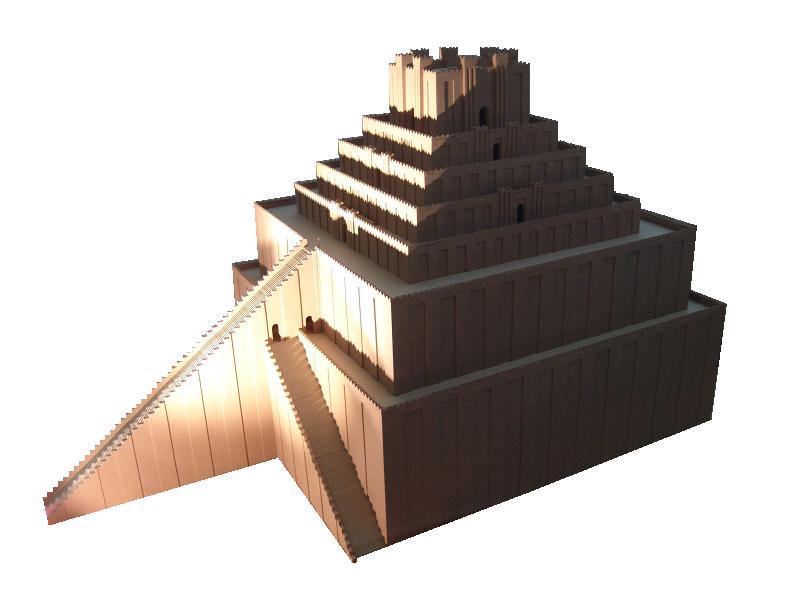
The Tower of Babel narrative is not spun from nothing. Its most plausible referent is Etemenanki, "House the Foundation of Heaven and Earth," the seven-stage ziggurat dedicated to Marduk in central Babylon. Robert Koldewey of the Deutsche Orient-Gesellschaft excavated it between 1899 and 1917 and reconstructed dimensions of roughly 91 meters by 91 meters at the base, with an estimated 91 meters in height at peak phase. Andrew R. George, Professor of Babylonian at SOAS, University of London, has published the standard scholarly survey arguing that the biblical Tower of Babel narrative reflects an Israelite encounter with Etemenanki, whether direct (during the Babylonian exile) or by way of cultural transmission.[29] A real architectural feature underlies the biblical narrative, anchored in a specific Mesopotamian temple-tower tradition.
The Hebrew narrative as theological polemic
Genesis 11 turns on a deliberate pun. The Babylonians called their city Bāb-ilim, "Gate of God," in Akkadian. The Hebrew narrator called it Bābel and grounded the wordplay on the Hebrew verb balal (בָּלַל), "to confuse, mingle, mix."[30] The wordplay is polemic: Yahweh confounds the Babylonian imperial gateway-to-heaven and exposes it as confusion. Read this way, Genesis 11 is less a modern-history account of how all human languages began than an Israelite theological response to Mesopotamian imperial cosmology, a polemic against the temple-tower system that anchored Babylonian religion. Jeffrey M. Bradshaw and David J. Larsen's In God's Image and Likeness 2: Enoch, Noah, and the Tower of Babel (Eborn Books and Interpreter Foundation, 2014) reads Genesis 11 in conversation with the Sumerian Enmerkar and the Lord of Aratta and Akkadian flood and tower traditions.[31]
Walker Wright's anti-Babel polemic reading of Ether
The most directly relevant 2024 scholarship on the Jaredite anchor is Walker Wright, "The Man with No Name: The Story of the Brother of Jared as an Anti-Babel Polemic," Interpreter 62 (2024): 319–333.[32] Wright argues that Moroni's opening of Ether deliberately presents the Brother of Jared as the theological inversion of Nimrod and Babel:
| Babel (Genesis 11) | Brother of Jared (Ether 1, 3, 6) |
|---|---|
| Babelites sought to "make us a name" (Gen 11:4) | The Brother of Jared remains unnamed in the entire text, "unworthy before thee" (Ether 3:2) |
| Nimrod was "a mighty hunter before the Lord" (Gen 10:9), against God | The Brother of Jared comes "before the Lord" with "exceeding faith" (Ether 3:9) |
| "The Lord did there confound the language of all the earth" (Gen 11:9) | "The Lord… did not confound" the Jaredites' language (Ether 1:35–37) |
| Babelites refused to fill the earth | Jaredites "spread upon the face of the land" (Ether 6:18), fulfilling the Edenic mandate |
| Tower with top reaching heaven (Gen 11:4) | Mount Shelem ascended "because of its exceeding height" (Ether 3:1) |
| Counterfeit gateway to God | Mount Shelem as genuine theophany site |
Moroni's account, on Wright's reading, is a deliberate polemical inversion of Genesis 11, the kind of sophisticated literary feature one would expect from authentic ancient text engaging a known narrative tradition, not from nineteenth-century rural-American fabrication. Hugh Nibley's World of the Jaredites (1952; Collected Works vol. 5, 1988) had earlier set the Jaredite "great tower" within a broader ancient Near Eastern context of imperial tower-temples (ziggurats, the Esagila tradition) distinct from the specific Genesis 11 reception history.[33] George A. Pierce's "The Tower of Babel, the Jaredites, and the Nature of God" (BYU Religious Studies Center, 2022) engages the Jaredite anchor question further.[34]
Ether 1:33's chronological specificity
The verse's "at the time the Lord confounded the language of the people" makes a chronologically specific claim that the linguistic record contradicts.[35] Grant the framework, grant the polemical-inversion reading, and the canonical text still positions the Jaredite migration contemporaneously with the language-confounding event. Three faithful readings address it.
The first is the Moroni-as-abridger reading. Ether is Moroni's abridgment of Mosiah's translation of the Jaredite record (Ether 1:1–2). The framing "at the time the Lord confounded the language of the people" is Moroni's interpretive overlay, locating an ancient Bronze Age migration within the framework Moroni knew from the brass plates. The historical core, a group migrating from Mesopotamia to the Americas, does not require that every framing detail read as literal modern-history report.
The second is the not-the-specific-Babel reading. The "great tower" of Ether 1 is an ancient Near Eastern temple-tower in the broader ziggurat tradition, not specifically the Genesis 11 Tower of Babel in its later reception form. Hugh Nibley made this case directly. Bronze Age Mesopotamia saw multiple major dynastic collapses with linguistic and political fragmentation: the Akkadian collapse around 2150 BC, the Gutian invasions, the Ur III collapse around 2000 BC. A Bronze Age trans-oceanic migration during one of these is consistent with the archaeological record.
The third is the anti-Babel polemic reading developed by Wright (2024). Here Moroni's framing is deliberately literary: it positions the Brother of Jared narrative as the theological inverse of the Babel narrative, with the Jaredites' linguistic preservation as the contrast to Babel's confusion. The chronological anchor, on this reading, is generic to the Babel narrative as a literary type rather than tied to a specific historical 2200 BC moment.
Each reading is coherent, and each is faithful. None of them needs the dating phrase in Ether 1:33 to be a report checked against Ussher's calendar, and each leaves the Book of Mormon's standing as ancient scripture intact. The question is not settled, and the phrase still carries interpretive pressure. What is under pressure is how one line in one verse should be read, not the Book of Mormon's claim to be an ancient record. Nothing the Church asks of a member depends on that phrase being a historical date. Confidence in the three readings tracks whatever confidence a reader already brings to the Book of Mormon as an ancient text.[36]
The global flood
The CES Letter's next entry is a single line: "Global flood: 4,500 years ago."[2:2] The argument is left unstated, and it runs on what the reader already assumes: that Latter-day Saint scripture and prophets require a global flood, that geology disproves a global flood, and so that Latter-day Saint scripture is false. The CES Letter quotes no Latter-day Saint leader on the flood. The case is built entirely on the reader's prior assumption.
What the geology establishes
A planet-covering flood ~2500 BC is geologically impossible, and the evidence converges from every direction. There is no global sedimentary layer dating to that period; the stratigraphic record runs continuously through the proposed flood date. There is no global ice-cap evidence of submersion; the Vostok and Greenland ice cores show a continuous record through it. There is no global extinction signature ~4500 BP; the Pleistocene-Holocene transition extinctions fall around 12,000 BP. There is no physical mechanism for sourcing or removing roughly 10²¹ kg of water in months; Earth's water budget is conserved on the relevant timescale. Continuous tree-ring dendrochronology from bristlecone pine extends to approximately 10,000 BP without interruption. Continuous varved lake sediment records, such as Lake Suigetsu in Japan, extend to approximately 50,000 BP without interruption. The CES Letter is right that a global flood ~4,500 years ago is geologically impossible. The faithful case runs through the Hebrew text and the doctrine-vs-opinion framework instead.
The Hebrew word eretz and ancient cosmology
The Hebrew word translated "earth" in Genesis 6–9 is eretz (אֶרֶץ), which appears more than 2,500 times in the Hebrew Bible. The standard lexicons (Brown-Driver-Briggs, Oxford 1907 and Hendrickson reprint 1996, and Koehler-Baumgartner's The Hebrew and Aramaic Lexicon of the Old Testament, Brill 1994–2000) list its semantic range as "earth" (the world as a whole), "land" (a country or territory), "ground" (soil, dust), and "the underworld."[30:1][37] The same word translates as "land of Egypt" or "land of Canaan" elsewhere in the Hebrew Bible. Reading eretz with a regional sense in Genesis 6–9 is not a distinctively Latter-day Saint move; it is basic Hebrew lexicography.
Ancient Israelite cosmology did not envision "the planet earth" in the modern sense. The Israelite cosmos was a flat earth under a firmament dome (raqia, רָקִיעַ), with waters above the firmament and waters under the earth.
John H. Walton's The Lost World of Genesis One (IVP Academic, 2009) is the standard non–Latter-day Saint scholarly treatment of this point and is cited extensively by faithful Latter-day Saint scholars including Ben Spackman, David E. Bokovoy, and Jeffrey M. Bradshaw.[38] David E. Bokovoy's Authoring the Old Testament: Genesis–Deuteronomy (Greg Kofford Books, 2014), by a faithful Latter-day Saint with a Brandeis PhD in Hebrew Bible, supplies the Hebrew-text grounding for eretz semantics from a Latter-day Saint–friendly angle.[39] Duane E. Jeffery's "Noah's Flood: Modern Scholarship and Mormon Traditions," Sunstone 134 (October 2004): 27–45, notes that the spherical-earth concept "did not appear in Jewish thought until the fourteenth or fifteenth century."[40] So when Genesis 6–9 says the flood covered "all the earth" (kol ha'aretz), the Iron Age Hebrew text is describing the known regional world; the planetary globe is a modern idea the writers did not have.
Nothing in the canonized flood texts requires the water to have covered the planet. The local-flood reading is the most philologically responsible reading of the Hebrew. To read "all the earth" in Genesis 6–9 as "all the planet" is to import modern cosmological assumptions into an ancient text. A regional catastrophic flood that devastated an entire ancient Near Eastern civilization, and seemed to its survivors to cover the whole visible world, would be described in exactly the language Genesis uses. The Black Sea hypothesis, set out in William Ryan and Walter Pitman's Noah's Flood (Simon & Schuster, 1998), proposes a catastrophic flooding event when rising Mediterranean waters breached the Bosporus shelf.[41] The hypothesis has been disputed within geology, and the literature has since gone both ways on the magnitude question. The broader case for catastrophic regional flooding as the substrate for ancient Near Eastern flood traditions holds regardless of how the specific Black Sea timing resolves.
The Mesopotamian flood traditions are independent of the biblical narrative and pre-date it.[42]
| Tradition | Approximate date | Language / recension |
|---|---|---|
| Atrahasis Epic | c. 1700 BC | Old Babylonian copies |
| Sumerian Flood Story / Eridu Genesis | c. 1600 BC | Sumerian |
| Epic of Gilgamesh, Tablet XI | c. 1200 BC | Standard Babylonian recension |
Each preserves a flood account in which a god-favored survivor builds a vessel, preserves humanity and animals, and re-establishes civilization after the waters recede. The structural parallels with Genesis 6–9 are extensive. The simplest reading is that the biblical flood narrative reflects a shared ancient Near Eastern memory of catastrophic regional flooding (events that, to the people who lived them, were world-ending) preserved across cultures in narrative form. Ben Spackman's "Let's talk about the flood. A lot." (February 2026) reads Genesis 6–9 as a cosmological un-creation/re-creation narrative, with Noah as a "new Adam" receiving the Genesis 9:1 "be fruitful and multiply" mandate that mirrors the original creation mandate.[43] The narrative's theological core (God's judgment, Noah's obedience, the post-flood covenant of Genesis 9, the rainbow as covenant sign) does not depend on planetary inundation.
The "baptism of the earth" teaching
Senior Latter-day Saint leaders taught a planet-covering flood from the pulpit.[44] Brigham Young (1860, Journal of Discourses 8:83) said: "This earth… has been baptized with water, will be baptized by fire and the Holy Ghost."[3:2] Orson Pratt (1880, Journal of Discourses 21:323) said: "A great flow of water came… sweeping away all wickedness and transgression — a similitude of baptism for the remission of sins."[4:2] John Taylor (1884, Journal of Discourses 26:74–75) said: "The earth was immersed… a period of baptism."[5:2] Joseph Fielding Smith (Doctrines of Salvation 2:320) said the flood was "the baptism of the earth, and that had to be by immersion."[45] He treated it as a literal global flood throughout his apostolic ministry and Church Presidency.[10:1] Bruce R. McConkie's Mormon Doctrine said belief in a global flood was required.[11:1]
That is two Church Presidents (Brigham Young, John Taylor), an apostle (Orson Pratt), a future Church President (Joseph Fielding Smith), and the most influential twentieth-century Latter-day Saint doctrinal compiler (McConkie) on the strong-global-flood side: close to a century of senior Latter-day Saint teaching.
None of that record is in dispute. The local-flood reading is inconsistent with what the Church functionally taught for most of its history. To accept it is to concede that multiple prophets were wrong on a positive claim about the geographical scope of a physical event. The framework can absorb that: the "baptism of the earth" teaching was never canonized, the 1931 First Presidency memorandum's instruction to leave geology to scientific research applies, and the 1909, 1910, 1925, and 1931 documents are the institutional position. Absorbing it still costs the faithful reader one plain sentence. Brigham Young, Orson Pratt, John Taylor, and Joseph Fielding Smith were factually wrong about how much of the world the water covered. The mistake stayed an opinion.
Paul Y. Hoskisson and Stephen O. Smoot, in "Was Noah's Flood the Baptism of the Earth?" (Let Us Reason Together, BYU Religious Studies Center and Deseret Book, 2016), offer the most sustained faithful engagement with the "baptism of the earth" tradition from the Latter-day Saint scholarly side.[46] Their argument has three moves: that the "baptism of the earth" language used by Brigham Young, Orson Pratt, and John Taylor has been over-read by modern commentators; that the earth is not sentient but quickened by God's Spirit, with the flood as symbolic cleansing from human sins rather than the earth's own sins; and that the earlier apostolic statements should be read as theological metaphor rather than as positive geographical-scope claims. Hoskisson and Smoot do not explicitly endorse a regional-flood reading. Their reframing removes the principal Latter-day Saint-source argument for a literal global flood without committing on the geographical-scope question.
The Latter-day Saint apostle and chemist John A. Widtsoe (PhD chemistry Universität Göttingen 1899, apostle 1921–1952) wrote in 1943 in his Evidences and Reconciliations (p. 127):
"The fact remains that the exact nature of the flood is not known. We set up assumptions, based upon our best knowledge, but can go no further."[47]
Widtsoe's position is the mid-twentieth-century apostolic articulation of the doctrine-vs-opinion framework, applied directly to the flood. The canonized scriptures on the flood (Genesis 6–9, Moses 7–8, Ether 13:2, Alma 10:22) are compatible with a regional reading on the most philologically responsible reading of the Hebrew text and the broader ancient Near Eastern context.
Adam-ondi-Ahman and D&C 116
Here the objection presses Joseph Smith's identification of Adam-ondi-Ahman in Daviess County, Missouri.[48] D&C 116, received 19 May 1838 at Spring Hill, Daviess County, Missouri, reads in full: "Spring Hill is named by the Lord Adam-ondi-Ahman, because, said he, it is the place where Adam shall come to visit his people, or the Ancient of Days shall sit, as spoken of by Daniel the prophet." Joseph Smith and other early Latter-day Saint leaders subsequently elaborated that Adam-ondi-Ahman was also the place where Adam offered sacrifice and gathered his posterity after the expulsion from the Garden of Eden, placing Adam's post-Eden residence in Missouri.[49] The critic's pressure runs like this. Put Adam in Missouri, then the flood, then Noah's vessel coming to rest near Ararat, and a planet-covering flood is what carries humanity from the one continent to the other. Make the flood regional and that transfer needs some other explanation, so the regional reading looks like it breaks the canonical chronology. As LDS Discussions puts it: "at what point does the framework just become ad hoc?"[44:1]
So the line between canonized text and later elaboration has to be drawn exactly. D&C 116 itself is twenty-eight words of canonized text identifying Spring Hill as Adam-ondi-Ahman, the future gathering place "where Adam shall come to visit his people." The Adam-as-having-resided-in-Missouri sequence is not in D&C 116. It is subsequent extrapolation: from D&C 116, from the Joseph Smith History pre-publication accounts (History of the Church (HC) 3:34–39), and from statements by Brigham Young integrating D&C 116 with traditional flood geography. All of it falls in the leader-opinion category, the same one the framework has been sorting all along. Three faithful reconciliations are live.
- Adam-ondi-Ahman as future eschatological site only: Spring Hill names the future gathering place where Adam "shall come" in the latter-day council described in Daniel 7, with the Brigham Young and HC elaborations being extrapolations rather than canonical claims.
- Adam-ondi-Ahman as Adam's relocated post-Eden site without a global flood mechanism: a regional flood in the ancient Near East could devastate Mesopotamian populations without requiring the entire human population of the planet to have been concentrated there, with the Adam-ondi-Ahman-to-Old-World migration being normal pre-flood human dispersal.
- Adam-ondi-Ahman as theological-prophetic identification: Joseph Smith's identification of Spring Hill is a prophetic act binding the Restoration in the Americas to the cosmic narrative of Adam's posterity, without committing to a specific reconstructable physical chronology.
The regional-flood reading does not reconcile cleanly with the simplest version of the Missouri-Adam tradition. Some chronological complexity is the price. What all three readings hold onto is the Restoration's core claims, alongside the regional reading that the Hebrew text and the geology both support.
Mormonr's 132-source review
Mormonr's "The Great Flood" Q&A at mormonr.org gathers 132 primary sources on Latter-day Saint leader teachings about the flood across the nineteenth, twentieth, and early twenty-first centuries.[50] Its conclusion: belief in a global flood is not required for orthodoxy. The aggregation sets the strong-global-flood statements (Brigham Young, Orson Pratt, John Taylor, Joseph Fielding Smith, McConkie) alongside the more cautious or explicitly regional ones (Brigham Young 1871 on geological timescales, Talmage 1931, Widtsoe 1943, the 1931 First Presidency memorandum, the contemporary scholarly consensus). It is the best single-page survey of the historical record.
Noah's Ark and bear speciation
The CES Letter's Ark entry is the longest of the four:
"Noah's Ark: Humans and animals having their origins from Noah's family and the animals contained in the ark 4,500 years ago. It is scientifically impossible, for example, for the bear to have evolved into several species (Sun Bear, Polar Bear, Grizzly Bear, etc.) from common ancestors from Noah's time just a few thousand years ago. There are a host of other impossibilities associated with Noah's Ark story claims."[2:3]
What the science establishes
The CES Letter is correct that bear species could not have diverged from a common ancestor within the last 4,500 years. Kutschera and colleagues (2014) date the modern Ursus genus radiation deep in the Plio-Pleistocene, with substantial inter-species gene flow.[51] Polar bears (Ursus maritimus) and brown bears (U. arctos) diverged roughly 150,000–500,000 years ago, far slower than the CES Letter's 4,500-year compressed timeline. Sun bears, spectacled bears, and giant pandas diverged earlier still. The "animal kinds with rapid post-Flood speciation" model (embraced by Henry M. Morris and the Institute for Creation Research, and continued by Answers in Genesis and similar Protestant young-earth-creationist organizations) argues that "kinds" (a creationist category built on the Hebrew word for "kind") underwent rapid post-Flood speciation to produce modern species diversity. Mainstream phylogenetics, biogeography, and the fossil record reject it. The Church itself has never endorsed it, and faithful Latter-day Saint scientists (Trent D. Stephens and D. Jeffrey Meldrum, Steven L. Peck, David H. Bailey, Ben Spackman) consistently reject it too.[52][53][54] The bear example is a real falsification of literal Protestant young-earth creationism. It reaches Latter-day Saint theology only if the young-earth frame is granted first, and nothing here grants it.
What Latter-day Saint scripture and the Church require
Latter-day Saint theology does not require the Henry Morris-style scientific-creationist model of the Ark. The Ark narrative's theological purpose (God's judgment, Noah's obedience, the post-flood covenant, the rainbow as covenant sign) does not require ursid speciation in 4,500 years. On a regional flood reading consistent with the Hebrew text, Noah preserved a representative collection of local livestock and wild animals from the ancient Near East's regional fauna, not every bear species on the planet. The genealogical statements in Genesis 9–10 are compatible with regional rather than planetary scope. The Ark model the bear argument refutes is a Protestant one the Church never adopted. The bear genetics lands on a claim the Latter-day Saint reader was never asked to defend.
The "discovery of Noah's Ark" claims of Bob Cornuke (BASE Institute), Ron Wyatt, Hagopian, Navarra, and others have been investigated by professional archaeologists and uniformly judged unfounded. The CES Letter does not rest on those claims, and neither does the faithful case. Both are beside the point; the answer here runs through the doctrine-vs-opinion framework and the regional-flood reading.
The age of the earth and the Bible Dictionary "4000 B.C."
For the age of the earth, the CES Letter quotes the 2017 Latter-day Saint Bible Dictionary entry "Chronology of the Old Testament": "4000 B.C. – Fall of Adam."[55] The unstated argument: this date sits in current Latter-day Saint scripture editions; modern radiometric dating puts the earth's age at 4.54 billion years; therefore Latter-day Saint scripture is off by a factor of roughly a million.
What the science establishes
The earth is approximately 4.54 ± 0.05 billion years old. Uranium-lead dating of zircon crystals establishes the figure (the Jack Hills, Australia, zircons examined in Wilde and colleagues' 2001 Nature paper) as does lead-lead isochron dating of meteorites, established by Clair Patterson's 1956 Geochimica et Cosmochimica Acta paper.[56][57] Independent confirmation comes from samarium-neodymium isotope ratios, ice cores from Vostok and Greenland, varved lake sediments, and dendrochronology, all converging on consistent old-earth ages. The CES Letter is right that the earth is far older than 6,000 years, and a faithful reader has no reason to deny it.
What canonized Latter-day Saint scripture actually says
The "4000 B.C." date is not in canonized Latter-day Saint scripture. It sits in the Bible Dictionary entry "Chronology of the Old Testament," and it derives from Archbishop James Ussher's 1650 Annales Veteris Testamenti, which calculated creation to 23 October 4004 BC at 6 PM by adding biblical genealogies. Seventeenth- and eighteenth-century publishers inserted Ussher's chronology into the margins of the King James Bible, and it was absorbed into Latter-day Saint reference materials when the 1979 Latter-day Saint edition of the King James Bible was prepared.[27:1] The Bible Dictionary's own introduction says so explicitly:
"Many of the entries draw on the encyclopedias and dictionaries that were part of the 1979 LDS edition of the Bible. … The items have been written by various scholars and are subject to reevaluation as new research or revelation comes to light. This dictionary is provided as a resource and is not intended as an official statement of Church doctrine."[58]
The Bible Dictionary disclaims its own doctrinal authority. The "4000 B.C." date is not a revealed date and has never been claimed as one. Brigham Young in 1871 explicitly accommodated geological timescales: "Whether [the Lord] made it in six days or in as many millions of years, is and will remain a matter of speculation in the minds of men unless he give revelation on the subject."[7:3]
Doctrine and Covenants 77:6–7 speaks of "the seven thousand years of [the earth's] continuance, or its temporal existence":
"Q. What are we to understand by the book which John saw, which was sealed on the back with seven seals?
A. We are to understand that it contains the revealed will, mysteries, and the works of God; the hidden things of his economy concerning this earth during the seven thousand years of its continuance, or its temporal existence."[59]
The Church's Doctrine and Covenants Student Manual (2017) clarifies: "Each seal represents 1,000 years of the earth's temporal existence."[60] The earlier 1989 manual was more explicit: "These seven thousand years do not include the period of our planet's creation and preparation as a dwelling place for man. They are limited to Earth's 'temporal existence.'" "Temporal existence" is the mortal-history period since the Fall, distinct from the eons of geological preparation. James E. Talmage's 1931 Tabernacle address drew exactly this distinction. For the CES Letter's argument to work, "temporal existence" has to mean the total existence of the planet, and neither the verse nor the manuals that teach it will carry that meaning.
The Bible Dictionary "4000 B.C." remains in print
Here the strongest objection is institutional, not scriptural: the Bible Dictionary's "4000 B.C." date is in the current Latter-day Saint editions of scripture (1979, 1981, 1995, 2013) and goes out to every member.[55:1] The Church has known since at least Brigham Young 1871 that this date is Ussher's chronology and is not revealed, yet it remains in the printed scriptures. The disclaimer sits in the dictionary's introduction; the "4000 B.C." date sits in the chronological tables. And a reader who turns to the chronological tables (which is what they are for) has not necessarily read the introduction's disclaimer first.
This is a real institutional inconsistency. The faithful response is the disclaimer plus the framework: the Bible Dictionary's own introduction states that entries are "not intended as an official statement of Church doctrine"; the 1931 First Presidency memorandum instructed general authorities to leave geology to scientific research; the 2016 Church History Topics page states that "the Church has no official position on the theory of evolution." Distributing a date incompatible with mainstream geology in a study aid that is not formally canonized but is bound with the scriptures is the kind of inconsistency the framework absorbs without fully resolving.[61] A note in the chronological tables flagging "4000 B.C." as Ussher's arithmetic rather than revealed doctrine would be a substantive improvement, and its absence is a fair thing to hold against the current edition.
Hominid species and Neanderthal DNA
Three of the science section's questions engage the hominid fossil record and Neanderthal DNA directly:
"1. 2 Nephi 2:22 and Alma 12:23-24 state there was no death of any kind (humans, all animals, birds, fish, dinosaurs, etc.) on this earth until the 'Fall of Adam,' which according to D&C 77:6-7 occurred about 7,000 years ago. It is scientifically established that there has been life and death on this planet for billions of years. How does the Church reconcile this? How do we explain the massive fossil evidence showing not only animal deaths but also the extinctions of over a dozen different Hominid species over the span of 250,000 years prior to Adam?"[2:4]
"2. If Adam and Eve are the first humans, how do we explain the dozen or so other Hominid species who lived and died 35,000 – 2.4 million years before Adam? When did those guys stop being human?"[2:5]
"3. Genetic science and testing has advanced significantly the past few decades. I was surprised to learn from results of my own genetic test that 1.6% of my DNA is Neanderthal. How does this fact fit with Mormon theology and doctrine that I am a literal descendant of a literal Adam and Eve from about 7,000 years ago? Where do the Neanderthals fit in? How do I have pre-Adamic Neanderthal DNA and Neanderthal blood circulating my veins when this species died off about 33,000 years before Adam and Eve?"[2:6]
The pre-Adamic-death theology in the first question, the evolutionary mechanism in the second, and the question of how Adam's body was formed all belong to the sister article Evolution and the Fall. What stays here is the fossil-hominid record and the Neanderthal DNA, and what canonized Latter-day Saint scripture and the Church require about the relationship between Adam and the biological hominid lineage.
What the science establishes
The fossil record of hominid species is well-established. Neanderthals (Homo neanderthalensis), Denisovans, Homo erectus, Homo heidelbergensis, Homo floresiensis, Australopithecus afarensis, Australopithecus africanus, Paranthropus boisei, and other hominid taxa are real species attested by fossil evidence, and in several cases by genetic evidence, predating any plausible 7,000-BP Adam date. The CES Letter is correct about the hominid fossil record.
The Neanderthal-DNA finding is well-established too. Richard E. Green and colleagues' "A Draft Sequence of the Neandertal Genome" (Science 328, 2010) established that non-African modern humans carry roughly 1–4% Neanderthal DNA, inherited through interbreeding around 50,000 BP.[62] Kay Prüfer and colleagues (Nature 505, 2014) and Fabrizio Mafessoni and colleagues (PNAS 117/26, 2020) refined the finding.[63][64] Current best estimates of non-African Neanderthal admixture run about 1.5–2.1%. Modern Asian and Oceanic populations, especially Melanesians and Aboriginal Australians, additionally carry roughly 4–6% Denisovan DNA, established by David Reich and colleagues (Nature 468, 2010).[65] The CES Letter's "1.6%" figure is consistent with current estimates and is real.
What canonized Latter-day Saint scripture and the Church require
The canonized Latter-day Saint scriptures affirm divine parentage of humans (Genesis 1:26–27; Moses 2:26–27; Abraham 4:26–27), the historicity of Adam and Eve, the reality of the Fall, and the Atonement of Jesus Christ. The 1909 First Presidency statement reaffirmed this core: humans are "literally the sons and daughters of Deity."[18:1] The 2016 New Era Q&A reaffirmed it in modern terms: "There were no spirit children of Heavenly Father on the earth before Adam and Eve were created."[9:5]
What the canonized scriptures do not specify is the biological mechanism by which Adam and Eve's bodies were formed. The 1910 Improvement Era editorial, First Presidency-approved, listed three possible explanations for the physical origin of Adam's body and endorsed none.[19:1] The 1931 First Presidency memorandum stated explicitly that "the doctrine of the existence of races of human beings prior to the fall of Adam was not a doctrine of the Church," meaning neither the affirmation nor the denial is binding doctrine.[6:4] President Spencer W. Kimball, in 1976, said: "We don't know exactly how their coming into this world happened."[66] The 2016 New Era Q&A: "The details of what happened on earth before Adam and Eve, including how their bodies were created, have not been revealed."[9:6] The relationship between Adam, the theological "first human," and the biological hominid lineage is an open question in current Latter-day Saint thought.
Four times across a century, in 1910, in 1931, in 1976, and again in 2016, the Church had occasion to settle how Adam's body was formed and what came before him, and four times it left the question open. How many times does the Church have to say it does not know before that answer counts as its position?
What the 1909 "first man of all men" phrase commits to
The 1909 First Presidency statement calls Adam "the first man of all men." This is a real doctrinal claim, and a reader applying the framework needs to know whether the phrase is binding doctrine or peripheral leader opinion. The article's position: the phrase is doctrinal. It is part of the institutional claim that Adam holds headship over the human family. But the framework reads it as covenantal headship rather than biological first-ness. Adam is the first man in the sense of being the first to receive the divine image, the first under accountability, the first under the plan of salvation, the first covenant-bearer of the human family. He is not the first biological organism in the Homo lineage. That lineage (Neanderthals, Denisovans, Homo erectus, anatomically modern humans before Adam) is biologically prior to but theologically distinct from the Adamic covenant line. This is the Stephens-Meldrum and Peck reading, and it is the most defensible reading of the 1909 phrase that both survives the Neanderthal-DNA findings and preserves the doctrinal core.
The skeptic presses that "covenantal first-ness" reads the 1909 phrase in a way its framers would not have recognized, on the grounds that they likely meant biological first-ness and reading it covenantally is retroactive reframing. As history, that is partly correct. But the 1910 Improvement Era editorial, five months after 1909 and First Presidency-approved, listed natural development from earlier organisms as one of three possible explanations for Adam's body without endorsing any; and the 1931 First Presidency memorandum negated pre-Adamic-death and pre-Adamites as Church doctrine. From 1910 onward the institutional documents have consistently preserved the question rather than committed to biological first-ness. The covenantal-headship reading is the framework's principled engagement with what the institutional record preserved as binding versus what individual framers may have intended.
Three faithful frameworks for the Adam-and-hominids question
Three faithful frameworks for the relationship between Adam and the hominid lineage are live in current Latter-day Saint scholarship.
The first is Adam as first biological Homo sapiens. Adam is placed at the emergence of anatomically modern humans, roughly 200,000 BP: far older than the Bible Dictionary's 4000 BC date, but consistent with the paleoanthropological emergence of Homo sapiens. This framework reads the 7,000-year temporal-existence framing as covenant-history rather than total-Adam-history, and accepts that earlier hominid species were biologically prior to but not theologically continuous with the Adamic line.
The second is Adam as first covenant-bearing human. Adam is the first to receive the divine image, the first under accountability, the first under the plan of salvation, the first to enter the covenant relationship, with biological hominid history (Neanderthals, Denisovans, anatomically modern humans before Adam) preceding. Trent D. Stephens and D. Jeffrey Meldrum, Evolution and Mormonism: A Quest for Understanding (Signature Books, 2001), by faithful BYU-Idaho/Idaho State University scientists, and Steven L. Peck, Evolving Faith: Wanderings of a Mormon Biologist (Maxwell Institute, 2015), by a BYU biology professor, have developed sustained faithful frameworks along these lines.[52:1][53:1] On this reading, the 1909 statement's "first man of all men" refers to covenantal headship rather than biological priority. Neanderthal DNA in modern humans is no problem here; it reflects the biological hominid history that preceded Adam's covenantal first-ness.
The third is Adam as agnostic on biological history. The Church affirms divine parentage and the Fall as theology while declining to commit on biological mechanism. This is the 2016 New Era "details have not been revealed" framework, stated explicitly. On this reading the Neanderthal-DNA-and-Adam question has a candid answer: we do not know exactly how the biological history relates to Adam, and the Church does not require us to commit to one specific reconciliation.
All three are live faithful options, and the reader is not required to pick one. The CES Letter's argument needs the canonized scriptures to have committed the Church to a single one of them, Adam as the first biological Homo sapiens about 7,000 years ago. That is the most literal reading on offer, and it is not the one the canonical Latter-day Saint sources require.
The faithful-scientist apostolic and lay tradition
The Quorum of the Twelve has repeatedly included trained scientists who saw no conflict between their faith and their disciplines. They are no token presence; they are a continuous century-and-a-quarter pattern.[67]
| Figure | Scientific career | Church service |
|---|---|---|
| James E. Talmage | Bachelor's degree from Lehigh (1891) with graduate coursework at Lehigh and Johns Hopkins; PhD in geology from Illinois Wesleyan University (1896); honorary PhD from Lehigh (1912); pioneering work on the Great Salt Lake | Apostle 1911–1933; authored Jesus the Christ and Articles of Faith; his 1931 Tabernacle address "The Earth and Man," affirming an ancient earth and death before the Fall, was Church-published in the Deseret News with First Presidency authorization[23:6] |
| John A. Widtsoe | PhD in chemistry from Universität Göttingen (1899); president of Utah State Agricultural College and then the University of Utah | Apostle 1921–1952; published Joseph Smith as Scientist (1908) and Evidences and Reconciliations (1943)[47:1] |
| Joseph F. Merrill | PhD in physics from Johns Hopkins (1899); pioneering work in engineering education; worked on radioactive decay measurement, the very physical phenomenon underlying the radiometric dating that establishes the earth's 4.5-billion-year age | Apostle 1931–1952 |
| Henry Eyring (1901–1981) | Berkeley PhD in chemistry (1927); Princeton faculty; University of Utah graduate dean; National Medal of Science 1966; Wolf Prize in Chemistry 1980 | The most visible Latter-day Saint scientific figure of the twentieth century[13:1] |
| Russell M. Nelson | Pioneering cardiothoracic surgeon; performed the first open-heart surgery in Utah (1955); co-developed the heart-lung bypass machine; his career depended on the same biology and chemistry that establish evolution and an ancient earth | Apostle 1984; Church President from January 2018 until his death in September 2025 |
| Richard G. Scott | Nuclear engineer under Admiral Hyman Rickover on the Navy's nuclear submarine reactor program | Apostle 1988–2015 |
The Church has consistently promoted scientists to its highest councils. Erich Robert Paul's Science, Religion, and Mormon Cosmology (University of Illinois Press, 1992), the definitive scholarly history of Latter-day Saint cosmological thinking, establishes the scientist-apostle tradition as a continuous nineteenth-, twentieth-, and twenty-first-century feature.[67:1] Terryl L. Givens's Wrestling the Angel: The Foundations of Mormon Thought (Oxford University Press, 2014) examines the foundational chapters on Latter-day Saint cosmology, the rejection of creatio ex nihilo, and the materialist ontology that underwrites Latter-day Saint science-faith integration.[68]
The Latter-day Saint tradition has theological resources for absorbing scientific findings that Protestant fundamentalism lacks. The Eighth Article of Faith ("We believe the Bible to be the word of God as far as it is translated correctly") rejects biblical inerrancy. D&C 1:24 makes revelation accommodate human capacity ("these commandments are of me, and were given unto my servants in their weakness, after the manner of their language"). D&C 131:7–8 rejects Platonic spirit-matter dualism ("there is no such thing as immaterial matter"). And the rejection of creatio ex nihilo in Joseph Smith's King Follett discourse aligns with a universe organized by a divine intelligence working with pre-existing matter.
BYU teaches evolution
The Church-funded flagship university teaches mainstream evolutionary biology as standard science. BYU's biology department has taught evolution since 1971, when Dr. Clayton White and Dr. Duane Jeffery launched the first undergraduate course in comparative evolutionary theory (Zoology 404).[69] Today the department runs one of the largest and most active graduate programs in phylogenetic systematics in the United States. Its faculty publish in Science, Nature, Molecular Biology and Evolution, and Paleobiology, treating evolutionary processes as established. The campus has an Eyring Science Center and a Talmage Building, named for the Church's two most prominent science-affirming apostles. BYU's Earth Science Museum holds tens of thousands of dinosaur specimens dated by radiometric methods that depend on millions of years.
The 1992 BYU Evolution Packet was approved by the BYU Board of Trustees (the First Presidency, members of the Quorum of the Twelve, and others) precisely because faculty were already teaching evolution and students needed clarity that this was permitted.[24:1] President Russell M. Nelson, at the 2015 BYU Life Sciences Building dedication, said:
"There is no conflict between science and religion. Conflict only arises from an incomplete knowledge of either science or religion, or both."[70]
A church that opposes evolution does not fund a university that teaches it. A church that requires young-earth creationism does not house a Life Sciences Building, staff it with evolutionary biologists, and have its prophet dedicate it with that statement. Steven L. Peck (BYU biology) published Evolving Faith: Wanderings of a Mormon Biologist with the Maxwell Institute in 2015, twelve essays integrating theistic evolution with Latter-day Saint theology.[53:2] Trent D. Stephens (BYU-Idaho) and D. Jeffrey Meldrum (Idaho State University) published Evolution and Mormonism: A Quest for Understanding with Signature Books in 2001.[52:2] David H. Bailey, a faithful Latter-day Saint PhD physicist at Lawrence Berkeley National Laboratory, argued in "Mormonism and the New Creationism" (Dialogue 35/4, 2002) that scientific creationism is theologically inappropriate for Latter-day Saints, refuting specific YEC claims and marshalling primary Latter-day Saint sources (Brigham Young 1871, Talmage 1931, B.H. Roberts on "six or eight thousand years … flies in the face of facts," Russell M. Nelson on creation periods).[54:1]
The 1871-to-2016 institutional consistency
The CES Letter's framing implicitly treats Church statements on science as reactive: older leaders defended young-earth creationism, then later leaders quietly retreated. The record shows something else: a consistent doctrine-vs-opinion distinction running through nineteenth-, twentieth-, and twenty-first-century Latter-day Saint history.
| Year | Source | What it established |
|---|---|---|
| 14 May 1871 | Brigham Young, Journal of Discourses 14:115–117 | Acknowledged that the earth might have been made "in as many millions of years," noted geologists "have good reason for their faith", thirty-eight years before the 1909 statement.[7:4] |
| November 1909 | First Presidency, "The Origin of Man" | Declared humans "literally the sons and daughters of Deity"; doctrinal claim about divine parentage, not biological mechanism.[18:2] |
| April 1910 | Improvement Era editorial (FP-approved) | Listed three possible explanations for Adam's body without endorsing any.[19:2] |
| September 1925 | First Presidency, "'Mormon' View of Evolution" | Reissued condensed 1909 doctrinal core; softened 1909 anti-science language; used "evolve" positively in regard to human progression toward godhood.[21:1] |
| 5 April 1931 | First Presidency memorandum | "Leave Geology, Biology, Archaeology and Anthropology … to scientific research." Negated both halves of the Joseph Fielding Smith–Roberts controversy as binding doctrine.[6:5] |
| 9 August 1931 | Talmage, "The Earth and Man" Tabernacle address | An apostle who was a PhD geologist affirmed death before the Fall and an ancient earth; Church-published with First Presidency authorization.[23:7] |
| 1943 | John A. Widtsoe, Evidences and Reconciliations, p. 127 | "The fact remains that the exact nature of the flood is not known."[47:2] |
| 1971 | BYU Zoology 404 launched (White and Jeffery) | First BYU comparative evolutionary theory course.[69:1] |
| March 1976 | Spencer W. Kimball, Ensign | "We don't know exactly how their coming into this world happened."[66:1] |
| 1992 | BYU Evolution Packet, Board-of-Trustees-approved | Compiled 1909/1910/1925/1931 statements + Encyclopedia of Mormonism "Evolution" for BYU faculty.[24:2] |
| 2015 | Russell M. Nelson, BYU Life Sciences Building dedication | "There is no conflict between science and religion."[70:1] |
| October 2016 | New Era Q&A on evolution | "The Church has no official position on the theory of evolution. Nothing has been revealed concerning evolution. The details of what happened on earth before Adam and Eve … have not been revealed."[9:7] |
| 2016 | Church History Topics, "Organic Evolution" | "The Church has no official position on the theory of evolution. Organic evolution … is a matter for scientific study."[8:2] |
The pattern across 145 years is consistent. Brigham Young's 1871 statement and the 2016 Church History Topics page substantively agree: the Church has no canonized position on creation mechanism, age of earth, or evolution. The CES Letter's "Church taught X, then walked it back" framing misreads 145 years of consistent doctrinal restraint.
The strongest critical objections
The framework absorbs three of the four numbered claims (the global flood, Noah's Ark and bear speciation, and the age-of-earth/Neanderthal-DNA cluster) because none is anchored in canonized Latter-day Saint scripture this directly. The Babel/Jaredite anchor in Ether 1:33 sits outside the framework as a canonized scriptural claim, engaged through three readings, none of which fully eliminates the pressure on the dating phrase. With that distinction in place, a sophisticated critic can press deeper. The objections that follow are not the CES Letter's actual arguments; they are the strongest versions a serious critic could build.
"The framework feels like a retrofit"
The first deeper objection: the framework feels built after the fact to absorb whatever today's science establishes. Map the pattern and it looks damning. An apostle teaches something with authority. A generation later the evidence runs the other way. A generation after that, the Church publishes that it has no official position. A generation after that, defenders point to the no-position statement as proof the original teaching was never binding. The clean sorting of doctrine from opinion, on this telling, only ever happens with hindsight.
The response is twofold. First, the framework was on paper before the findings it is accused of retreating from. Brigham Young's 1871 statement precedes every one of them; the 1931 First Presidency memorandum precedes the measurement of the earth's age by twenty-five years, the structure of DNA by twenty-two, and the Neanderthal genome by seventy-nine. The asymmetry has real force against the application of the framework to specific cases where individual leaders overclaimed; it has much less force against the existence of the framework, which is documentarily older than the findings it supposedly retreated before.
Second, the claims the framework treats as binding (divine parentage, the Fall, the Atonement, the historicity of Adam and Eve as covenant-bearers) have not moved across the 145-year chronology, while the peripheral leader-opinion territory (geographical scope of the flood, biological mechanism of Adam's body, age of the earth, literal versus polemical reading of Genesis 11) has. The framework's coherence depends on the core staying stable while the periphery stays open, and that is what the documentary record shows.
"Joseph Fielding Smith taught YEC as binding doctrine for forty years"
The second deeper objection is Joseph Fielding Smith's prolonged public advocacy of young-earth creationism, no pre-Adamic death, and a literal global flood across his apostolic ministry (1910–1970), his Church Presidency (1970–1972), and his books Man: His Origin and Destiny (Bookcraft, 1954) and Doctrines of Salvation (3 vols., compiled by Bruce R. McConkie, Bookcraft, 1954–1956).[10:2][45:1] Throughout, Smith presented his interpretation as the Church's doctrine rather than his personal view. Ben Spackman's 2024 doctoral dissertation documents this in detail: Smith insisted he merely read scripture plainly, yet rejected alternative readings as wrong.[28:1] Spackman's 2024 blog essay documents how Smith conflated personal interpretation with doctrine and how the 1931 First Presidency memorandum rejected his position behind closed doors.[71]
His son-in-law Bruce R. McConkie's Mormon Doctrine (1958, 2nd ed. 1966) carried the same line, treated by lay members as quasi-canonical despite documented institutional pushback. President David O. McKay convened a First Presidency review in 1959 and assigned Marion G. Romney and Mark E. Petersen to evaluate the book; their reports identified hundreds of problematic passages, and conditions were imposed for the 1966 second edition.
So the institution had operational tools to constrain individual leader teaching, and used them in the Mormon Doctrine review. What it did not do was issue a public counterweight on the science questions to match the audience that Man: His Origin and Destiny and Mormon Doctrine reached. Talmage's 1931 "Earth and Man" was the strongest such counterweight, and it stood as a single piece against forty years of Joseph Fielding Smith's prolific teaching.
That objection lands, and the record backs it. For most of the twentieth century, functional Latter-day Saint doctrine at the General Authority and lay levels included young-earth creationism, no pre-Adamic death, a literal global flood, and a literal Tower of Babel. The 1931 First Presidency memorandum was internal; most members never heard of it. This position was overclaimed by individual leaders, even though the institutional documents (1909/1910/1925/1931) had always preserved the open question. The institutional position never moved; what changed in the late twentieth century was that the Church recovered it. The broader question of when the doctrine-vs-opinion distinction does and does not absorb a teaching repeatedly reaffirmed from senior pulpits is treated at length in Anti-Intellectualism.
"The 2016 page is silent on flood, Babel, age of earth"
The third deeper objection: the 2016 Church History Topics page addresses evolution explicitly and stays silent on the flood, the Tower of Babel, and the age of the earth. The framework, on this charge, is applied unevenly, only where the science is most overwhelming.
The response is that the institutional pattern is to articulate the framework as questions become contested and as the institutional need to clarify rises. The 2016 evolution page exists because evolution was the most contested twentieth-century science-faith question for Latter-day Saints; the 1992 BYU Evolution Packet existed because BYU faculty were teaching evolution and needed clarity. Comparable clarifications on the flood, Babel, and age of earth exist in less centralized form: the 1931 First Presidency memorandum applies to all four questions; the Doctrine and Covenants Student Manual's "temporal existence" framing handles the age-of-earth question; Widtsoe's 1943 "exact nature of the flood is not known" handles the flood; the FAIR resources, Mormonr's "The Great Flood" Q&A, the Hoskisson and Smoot RSC chapter, and the Walker Wright Interpreter article handle the specific scholarly engagement.
The Church has not issued a centralized "no official position on the flood" page comparable to the evolution page, and that unevenness in institutional effort is real. But the underlying framework applies symmetrically. Geology is geology, archaeology is archaeology, anthropology is anthropology, and the 1931 memorandum's instruction to leave them all to scientific research applies to each.
"The continuing-revelation defense cuts both ways"
The fourth deeper objection is that invoking continuing revelation to handle past leader errors works in both directions. If a Church President can be wrong about pre-Adamic death and the global flood, questions he treated as revealed and binding, what else might a current Church President be wrong about? The skeptic version points to two specific reversals beyond the science questions: the race-and-priesthood ban (1852–1978), reversed by Official Declaration 2 and increasingly distanced from in the Church's 2013 "Race and the Priesthood" Gospel Topics Essay; and the framing of polygamy as essential to exaltation (1843–1890), substantially reframed in the 1890 Manifesto and through twentieth-century institutional distancing.
Both reversals are real. The race-and-priesthood ban was a temporal policy about who could exercise the priesthood and enter Latter-day Saint temples; it was not a doctrine of God's nature, the Atonement, the Fall, or human divine parentage. The 2013 Gospel Topics Essay disavows the racial theories advanced to justify the ban, including statements by Brigham Young, John Taylor, and other leaders, and places them in the same nineteenth-century leader-opinion territory as the "baptism of the earth" sermons.[72] The full case is treated in Priesthood and Temple Ban.
Polygamy's relationship to exaltation was likewise reframed under the 1890 Manifesto and subsequent institutional development; the canonized 1981 D&C 132 remains in the canon, but its application has shifted significantly. These shifts are theologically and pastorally significant, but they are reversals on policy and practice and on the application of doctrine, not on the existence of God, the divine parentage of humans, the reality of the Atonement, or the historicity of Adam and Eve.
The distinction is not invented for the occasion. The load-bearing core is what the canonized scriptures, the temple ordinances, the sacrament, the Articles of Faith, and the First Presidency declarations sustained as doctrine actually anchor. God exists; humans are His sons and daughters; Christ atoned for humanity; Joseph Smith was called as a prophet of the Restoration; the Book of Mormon is what it claims to be; Adam and Eve are historical covenant-bearers and the Fall is a real event; the priesthood was restored. These propositions have not moved across the 145-year chronology. The peripheral territory the framework absorbs is everything outside that core: the geographical scope of the flood, the biological mechanism of Adam's body, the age of the earth, the specific reading of Genesis 11, the racial theories advanced to justify the priesthood ban, the application of polygamy to exaltation. That territory has shifted substantially, and the framework absorbs the shifts as the kind of clarification continuing revelation is for.
The skeptic's natural reply is that this is too convenient, that every shift gets reframed as peripheral once it has happened. That reply cannot be answered in the present tense. The framework gives no member real-time certainty about which of today's teachings will turn out to be peripheral. It can only show that the core has been stable across the documented reversals, and that the core is the part the Church's claim to revealed truth actually depends on. If the core moved, the framework would be falsified.[73]
Course-correction as institutional strength
Every religious tradition that touches the physical world hits moments where older interpretations collide with new evidence. The real question is whether a tradition can course-correct without abandoning its core. Catholicism's reconciliation with heliocentrism took 359 years, from Galileo's 1633 trial to John Paul II's 1992 Vatican apology.[74] Protestant fundamentalism remains officially committed to young-earth creationism in many denominations: the Lutheran Church-Missouri Synod holds to literal six-day creation; Answers in Genesis treats young-earth as essential biblical fidelity. The Latter-day Saint Church carries none of those commitments. Its openness on the age of the earth (Brigham Young 1871, Talmage 1931, BYU 1992, "no official position" 2016) outpaces Catholicism's reconciliation with heliocentrism by a wide margin, and it sits far closer to the science than major branches of Protestant fundamentalism do.
The Church's ability to produce both James E. Talmage (advocate of an ancient earth, death before the Fall, pre-Adamic life) and Joseph Fielding Smith (young-earth creationism, no pre-Adamic death), and let both speak, is the signature of an institution that distinguishes revealed doctrine (binding) from individual interpretation (not binding). The 1931 First Presidency memorandum codified the distinction in writing. The 1992 BYU Evolution Packet codified it institutionally. The 2016 Church History Topics page codified it on the Church's official website.
Assessment
The CES Letter's argument fails on its own terms because it requires the doctrine-vs-opinion framework not to exist. The framework does exist, with documentary primary-source backing in 1871, 1909, 1910, 1925, 1931 (twice), 1992, 2015, and 2016 (twice). The claim that science has "discredited" the Church requires conflating individual leader opinion with binding doctrine, and that conflation does not survive contact with the record.
The ledger has two columns. On one side, the concessions are real: two Church Presidents, an apostle, and a future Church President were factually wrong about the geographical scope of the flood; the Bible Dictionary still prints a Ussher-derived date the Church has known was non-revealed since 1871; Joseph Fielding Smith taught young-earth creationism as binding doctrine for forty years against a single published counterweight; and the framework does its cleanest work in hindsight. On the other side, what the framework protects has not moved: divine parentage, the historicity of Adam and Eve as covenant-bearers, the Fall, the Atonement. The framework absorbs three of the four numbered claims (the global flood, Noah's Ark and bear speciation, and the age-of-earth/Neanderthal-DNA cluster), all of them leader-opinion territory. The Babel/Jaredite anchor in Ether 1:33 sits outside it as canonized scripture, engaged through three faithful readings (Moroni-as-abridger, not-the-specific-Babel, anti-Babel polemic), none of which makes the pressure on the dating phrase disappear. The peripheral territory was formally identified as outside the Church's doctrinal jurisdiction by 1931 at the latest. And the faithful-scientist tradition (Talmage, Widtsoe, Merrill, Eyring, Nelson, Scott) shows that Latter-day Saint theology has the resources to integrate scientific findings without collapsing.
A tradition that had locked young-earth creationism into its creed could not have produced Talmage's "Earth and Man" with First Presidency authorization, could not have written the 1931 memorandum, could not fund a Life Sciences Building and have its prophet dedicate it. Being wrong about the flood's geography and saying so, while the core claims hold steady, is not the framework breaking down. It is the framework working. The doctrine the Church canonized and the opinions individual leaders ventured were always two different things, and the science questions are simply where the difference shows most plainly.
Henry Eyring put the principle in one sentence: "Since the Gospel embraces all truth, there can never be any genuine contradictions between true science and true religion."[12:1] The CES Letter quoted it, then argued the opposite. The Restoration's scriptures, the 145-year institutional record, and the faithful-scientist tradition together show that the Eyring quote is the position the Church has actually held, not, as the argument needs, the position the Church would have had to abandon for the charge of "willful ignorance" to stick.
Runnells, CES Letter (2017), "Science," p. 111. ↩︎
Runnells, CES Letter (2017), "Science," nos. 1–4, pp. 110–111. ↩︎ ↩︎ ↩︎ ↩︎ ↩︎ ↩︎ ↩︎
Brigham Young, discourse, 12 June 1860, Journal of Discourses 8:83. "This earth … has been baptized with water, will be baptized by fire and the Holy Ghost." ↩︎ ↩︎ ↩︎
Orson Pratt, discourse, 1880, Journal of Discourses 21:323. The full passage reads: "a great flow of water came, the great deep was broken up, the windows of heaven were opened from on high, and the waters prevailed upon the face of the earth, sweeping away all wickedness and transgression—a similitude of baptism for the remission of sins." ↩︎ ↩︎ ↩︎
John Taylor, discourse, 30 November 1884, Journal of Discourses 26:74–75. "The earth was immersed … a period of baptism." ↩︎ ↩︎ ↩︎
First Presidency (Heber J. Grant, Anthony W. Ivins, Charles W. Nibley), memorandum to the Quorum of the Twelve, the First Council of Seventy, and the Presiding Bishopric, 5 April 1931. Quoted in William E. Evenson and Duane E. Jeffery, Mormonism and Evolution: The Authoritative LDS Statements (Salt Lake City: Greg Kofford Books, 2005), 75. Documentary history in Sherlock 1980 and Keller 1982. ↩︎ ↩︎ ↩︎ ↩︎ ↩︎ ↩︎
Brigham Young, discourse, 14 May 1871, Journal of Discourses 14:115–117. ↩︎ ↩︎ ↩︎ ↩︎ ↩︎
"Organic Evolution," Church History Topics, The Church of Jesus Christ of Latter-day Saints. https://www.churchofjesuschrist.org/study/history/topics/organic-evolution. ↩︎ ↩︎ ↩︎
"What does the Church believe about evolution?" New Era, October 2016. https://www.churchofjesuschrist.org/study/new-era/2016/10/to-the-point/what-does-the-church-believe-about-evolution. ↩︎ ↩︎ ↩︎ ↩︎ ↩︎ ↩︎ ↩︎ ↩︎
Joseph Fielding Smith, Man: His Origin and Destiny (Salt Lake City: Bookcraft, 1954). Explicit defense of young-earth creationism, no pre-Adamic death, global flood, and approximately 6,000-year earth as Church doctrine. ↩︎ ↩︎ ↩︎
Bruce R. McConkie, Mormon Doctrine (Salt Lake City: Bookcraft, 1958; 2nd ed., 1966). Treated belief in a global flood and young-earth creationism as required by the gospel. Mormon Doctrine was widely treated by lay members as quasi-canonical despite repeated First Presidency discomfort with it. ↩︎ ↩︎
Henry Eyring, The Faith of a Scientist (Salt Lake City: Bookcraft, 1967), 12, 31. Internet Archive scan: https://archive.org/details/faithofscientist0000eyri. ↩︎ ↩︎
Henry Eyring (1901–1981) — PhD chemistry Berkeley 1927; faculty Wisconsin (1930), Princeton (1931–1946), University of Utah graduate dean (1946–1966); National Medal of Science 1966; Wolf Prize in Chemistry 1980; approximately 600 scientific publications; namesake of the Eyring equation in chemical kinetics; father of President Henry B. Eyring. See FAIR scholar profile, https://www.fairlatterdaysaints.org/testimonies/scholars/henry-eyring; and "The Reconciliation of Faith and Science: Henry Eyring's Achievement," Dialogue: A Journal of Mormon Thought, https://www.dialoguejournal.com/articles/the-reconciliation-of-faith-and-science-henry-eyrings-achievement/. ↩︎ ↩︎
Doctrine and Covenants 93:36. ↩︎
Doctrine and Covenants 88:118. ↩︎
Doctrine and Covenants 130:18–19. ↩︎
Doctrine and Covenants 101:32–34. ↩︎
First Presidency (Joseph F. Smith, John R. Winder, Anthon H. Lund), "The Origin of Man," Improvement Era 13, no. 1 (November 1909): 75–81. Reprinted in Ensign, February 2002, https://www.churchofjesuschrist.org/study/ensign/2002/02/the-origin-of-man. ↩︎ ↩︎ ↩︎
"Priesthood Quorums' Table: Origin of Man," Improvement Era 13, no. 6 (April 1910): 570. Approved by the First Presidency. Reprinted in William E. Evenson and Duane E. Jeffery, Mormonism and Evolution: The Authoritative LDS Statements (Salt Lake City: Greg Kofford Books, 2005), 39–41. ↩︎ ↩︎ ↩︎
William E. Evenson and Duane E. Jeffery, Mormonism and Evolution: The Authoritative LDS Statements (Salt Lake City: Greg Kofford Books, 2005). The definitive primary-source compilation of First Presidency and Twelve statements 1909–1992 with scholarly commentary. The 1931 memorandum's full text and documentary context are at pp. 53–80; the 1909 statement at 13–37; the 1910 editorial at 39–41; the 1925 statement at 47–49. ↩︎
First Presidency (Heber J. Grant, Anthony W. Ivins, Charles W. Nibley), "'Mormon' View of Evolution," Improvement Era 28, no. 11 (September 1925): 1090–91. Reprinted in Evenson and Jeffery, Mormonism and Evolution, 47–49. ↩︎ ↩︎
Richard Sherlock, "'We Can See No Advantage to a Continuation of the Discussion': The Roberts/Smith/Talmage Affair," Dialogue: A Journal of Mormon Thought 13, no. 3 (Fall 1980): 63–78. https://scholarlypublishingcollective.org/uip/dial/article/13/3/63/244088/. Sherlock's earlier companion piece, "A Turbulent Spectrum: Mormon Reactions to the Darwinist Legacy," Journal of Mormon History 5 (1978): 33–59. The 1982 Dialogue sequel by Jeffrey E. Keller, "Discussion Continued: The Sequel to the Roberts/Smith/Talmage Affair," Dialogue 15, no. 1 (Spring 1982): 79–98, draws on Sterling Talmage's papers (the Talmage family preserved James E. Talmage's correspondence) and Heber J. Grant's diary to extend the documentary record of the 1931 affair. https://www.dialoguejournal.com/wp-content/uploads/sbi/articles/Dialogue_V15N01_81.pdf. ↩︎ ↩︎ ↩︎
James E. Talmage, "The Earth and Man," address delivered in the Salt Lake Tabernacle, 9 August 1931. Published in the Deseret News, 21 November 1931, with the imprimatur of the First Presidency. Reprinted as a Church pamphlet in 1931. Reprinted in The Instructor 100 (December 1965): 474–477. Online: https://interpreterfoundation.org/reprint-sm1-12-the-earth-and-man/. ↩︎ ↩︎ ↩︎ ↩︎ ↩︎ ↩︎ ↩︎ ↩︎
"Evolution and the Origin of Man," BYU Board of Trustees–approved packet, compiled by William E. Evenson, 1992. Distributed to BYU faculty. Includes the 1909, 1910, 1925, and 1931 First Presidency statements plus the Encyclopedia of Mormonism "Evolution" entry. https://biology.byu.edu/00000172-29e6-d079-ab7e-69efe5890000/byu-evolution-packet. ↩︎ ↩︎ ↩︎
William E. Evenson, "Evolution," in Encyclopedia of Mormonism, ed. Daniel H. Ludlow (New York: Macmillan, 1992). Online: https://eom.byu.edu/index.php/Evolution. ↩︎
Ether 1:33. ↩︎
James Ussher, Annales Veteris Testamenti, A Prima Mundi Origine Deducti (London, 1650), reverse-engineered the date of creation to 23 October 4004 BC at 6 PM by adding biblical genealogies. Ussher's chronology was inserted into King James Bible margins by seventeenth- and eighteenth-century publishers and absorbed into Latter-day Saint reference materials when the 1979 Latter-day Saint edition of the King James Bible was prepared. ↩︎ ↩︎
Ben Spackman, "'The Scientist is Wrong': Joseph Fielding Smith, George McCready Price, and the Ascent of Creationist Thought among Latter-day Saints in the Twentieth Century" (PhD diss., Claremont Graduate University, 2024). 300 pp., approximately 900 footnotes. ProQuest. Announcement: https://benspackman.com/2024/12/dissertation/. ↩︎ ↩︎
Andrew R. George, "The Tower of Babel: Archaeology, History and Cuneiform Texts," Archiv für Orientforschung 51 (2005/2006): 75–95. Note: this is George's focused historical-archaeological article, distinct from his cuneiform-text editions including The Babylonian Gilgamesh Epic (Oxford University Press, 2003). The Esagila Tablet (Louvre AO 6555) provides Babylonian dimensional and architectural details for Etemenanki; the Borsippa inscription of Nebuchadnezzar II describes the related Borsippa ziggurat Ezida and the rebuilding of Etemenanki. ↩︎
Francis Brown, S. R. Driver, and Charles A. Briggs, A Hebrew and English Lexicon of the Old Testament (Oxford: Clarendon Press, 1907; reprinted Peabody, MA: Hendrickson, 1996), s.v. eretz (אֶרֶץ) and balal (בָּלַל). ↩︎ ↩︎
Jeffrey M. Bradshaw and David J. Larsen, In God's Image and Likeness 2: Enoch, Noah, and the Tower of Babel (Salt Lake City: Eborn Books and Interpreter Foundation, 2014). Genesis 11 chapter online: https://interpreterfoundation.org/reprint-igil2-8-in-gods-image-and-likeness-2/. ↩︎
Walker Wright, "The Man with No Name: The Story of the Brother of Jared as an Anti-Babel Polemic," Interpreter: A Journal of Latter-day Saint Faith and Scholarship 62 (2024): 319–333. https://interpreterfoundation.org/journal/the-man-with-no-name-the-story-of-the-brother-of-jared-as-an-anti-babel-polemic. ↩︎
Hugh Nibley, Lehi in the Desert; The World of the Jaredites; There Were Jaredites, Collected Works of Hugh Nibley vol. 5, ed. John W. Welch (Salt Lake City: Deseret Book and FARMS, 1988). The World of the Jaredites originally published 1952. ↩︎
George A. Pierce, "The Tower of Babel, the Jaredites, and the Nature of God," in They Shall Grow Together: The Bible in the Book of Mormon, ed. Charles Swift and Nicholas J. Frederick (Provo: Religious Studies Center, BYU, 2022), 81–106. https://rsc.byu.edu/they-shall-grow-together/tower-babel-jaredites-nature-god. ↩︎
"The Book of Mormon and the Tower of Babel," LDS Discussions. https://www.ldsdiscussions.com/babel. ↩︎
Wright, Pierce, Bradshaw and Larsen, Bokovoy, and Spackman draw on mainstream Old Testament source-critical and ancient-Near-Eastern scholarship (Walton, Bokovoy on Hebrew text; George 2005 on Etemenanki; the Mesopotamian flood-and-tower tradition) but apply it within a framework that takes the Book of Mormon as authentic ancient scripture. A non-Latter-day Saint Old Testament scholar reading Ether 1 in isolation would not be obligated to reach Wright's anti-Babel polemic conclusion; mainstream OT scholarship outside the Latter-day Saint scriptural tradition would more naturally read Ether 1 as late literary borrowing or fabrication. The framework's response to the Babel/Jaredite anchor is intellectually serious given the prior commitment to the Book of Mormon; it does not aim to be persuasive to the reader who lacks that commitment. This is the same locating-honestly move the article applies to other faithful-scholarship cases. ↩︎
Ludwig Koehler and Walter Baumgartner, The Hebrew and Aramaic Lexicon of the Old Testament, ed. M.E.J. Richardson, 5 vols. (Leiden: Brill, 1994–2000), s.v. eretz. ↩︎
John H. Walton, The Lost World of Genesis One: Ancient Cosmology and the Origins Debate (Downers Grove, IL: IVP Academic, 2009). Note: distinct from Walton's The Lost World of Adam and Eve (IVP Academic, 2015), which addresses Genesis 2–3 anthropology rather than Genesis 1 cosmology. ↩︎
David E. Bokovoy, Authoring the Old Testament: Genesis–Deuteronomy (Salt Lake City: Greg Kofford Books, 2014). Bokovoy holds a PhD in Hebrew Bible from Brandeis University (2012). ↩︎
Duane E. Jeffery, "Noah's Flood: Modern Scholarship and Mormon Traditions," Sunstone 134 (October 2004): 27–45. https://sunstone.org/wp-content/uploads/sbi/articles/134-27-45.pdf. ↩︎
William Ryan and Walter Pitman, Noah's Flood: The New Scientific Discoveries About the Event That Changed History (New York: Simon & Schuster, 1998). The Black Sea hypothesis proposes a catastrophic flooding event when rising Mediterranean waters breached the Bosporus shelf, rapidly inundating the freshwater lake that occupied the Black Sea basin. Aksu and colleagues' 2002 joint Turkish-Canadian-Greek geological survey argued the breach was less catastrophic than Ryan and Pitman propose. ↩︎
Standard editions: William W. Hallo and K. Lawson Younger, eds., The Context of Scripture, vol. 1 (Leiden: Brill, 1997); Stephanie Dalley, Myths from Mesopotamia (Oxford University Press, 1989). The Atrahasis Epic is preserved in Old Babylonian copies c. 1700 BC; the Epic of Gilgamesh Tablet XI in the Standard Babylonian recension c. 1200 BC; the Sumerian Flood Story / Eridu Genesis c. 1600 BC. ↩︎
Ben Spackman, "Let's talk about the flood. A lot." (February 2026). https://benspackman.com/2026/02/lets-talk-about-the-flood/. ↩︎
"The Global Flood and the Book of Mormon, Abraham, and Moses," LDS Discussions. https://www.ldsdiscussions.com/flood. ↩︎ ↩︎
Joseph Fielding Smith, Doctrines of Salvation, 3 vols., compiled by Bruce R. McConkie (Salt Lake City: Bookcraft, 1954–1956), 2:320. "It was the baptism of the earth, and that had to be by immersion." ↩︎ ↩︎
Paul Y. Hoskisson and Stephen O. Smoot, "Was Noah's Flood the Baptism of the Earth?" in Let Us Reason Together: Essays in Honor of the Life's Work of Robert L. Millet, ed. J. Spencer Fluhman and Brent L. Top (Provo, UT: Religious Studies Center, BYU; Salt Lake City: Deseret Book, 2016), 163–188. https://rsc.byu.edu/let-us-reason-together/was-noahs-flood-baptism-earth. ↩︎
John A. Widtsoe, Evidences and Reconciliations (Salt Lake City: Bookcraft, 1943), 127. ↩︎ ↩︎ ↩︎
Doctrine and Covenants 116. Received 19 May 1838 at Spring Hill, Daviess County, Missouri. ↩︎
Joseph Smith, History of the Church, ed. B. H. Roberts, 7 vols. (Salt Lake City: Deseret Book, 1932–1951), 3:34–39. Brigham Young and other early leaders elaborated the Adam-Missouri tradition; for representative statements see Journal of Discourses 11:336 (Brigham Young, 26 August 1866) and Joseph Fielding Smith, Doctrines of Salvation 1:74–75. The post-Eden Missouri-Adam reconstruction is nineteenth-century leader extrapolation from D&C 116, not canonized scriptural statement. ↩︎
"The Great Flood," Mormonr Q&A. https://mormonr.org/qnas/rtnwb/the_great_flood. ↩︎
Verena E. Kutschera, Tobias Bidon, Frank Hailer, Julia L. Rodi, Steven R. Fain, and Axel Janke, "Bears in a Forest of Gene Trees: Phylogenetic Inference Is Complicated by Incomplete Lineage Sorting and Gene Flow," Molecular Biology and Evolution 31, no. 8 (August 2014): 2004–2017. DOI: https://doi.org/10.1093/molbev/msu186. ↩︎
Trent D. Stephens, D. Jeffrey Meldrum, with Forrest B. Peterson, Evolution and Mormonism: A Quest for Understanding (Salt Lake City: Signature Books, 2001). ↩︎ ↩︎ ↩︎
Steven L. Peck, Evolving Faith: Wanderings of a Mormon Biologist (Provo, UT: Maxwell Institute Publications, 2015). https://scholarsarchive.byu.edu/mi/31/. ↩︎ ↩︎ ↩︎
David H. Bailey, "Mormonism and the New Creationism," Dialogue: A Journal of Mormon Thought 35, no. 4 (Winter 2002): 39–59. https://www.dialoguejournal.com/articles/mormonism-and-the-new-creationism/. ↩︎ ↩︎
"Chronology of the Old Testament," Bible Dictionary, The Holy Bible (Salt Lake City: The Church of Jesus Christ of Latter-day Saints, 2013 edition; also 1979, 1981, 1995). https://www.churchofjesuschrist.org/study/scriptures/bd/chronology-of-the-old-testament. ↩︎ ↩︎
Simon A. Wilde, John W. Valley, William H. Peck, and Colin M. Graham, "Evidence from detrital zircons for the existence of continental crust and oceans on the Earth 4.4 Gyr ago," Nature 409 (11 January 2001): 175–178. ↩︎
Clair Patterson, "Age of meteorites and the Earth," Geochimica et Cosmochimica Acta 10 (1956): 230–237. ↩︎
"Introduction," Bible Dictionary, The Holy Bible (Salt Lake City: The Church of Jesus Christ of Latter-day Saints, 2013). Online: https://www.churchofjesuschrist.org/study/scriptures/bd/introduction. ↩︎
Doctrine and Covenants 77:6–7. ↩︎
Doctrine and Covenants Student Manual (Salt Lake City: The Church of Jesus Christ of Latter-day Saints, 2017), chapter 29 ("Doctrine and Covenants 77–80"). https://www.churchofjesuschrist.org/study/manual/doctrine-and-covenants-student-manual-2017/chapter-29-doctrine-and-covenants-77-80. ↩︎
Three factors explain why the date has remained in print despite the institutional knowledge that it is Ussher's chronology rather than revealed doctrine. Institutional inertia: the Bible Dictionary has been revised periodically — 1979 first edition, 2013 most recent revision — without the chronological tables being updated. The internal disclaimer: the introduction's "not intended as an official statement of Church doctrine" disclaimer is treated as carrying the weight needed without revising the tables themselves. Lack of triggering pressure: the 1992 BYU packet was triggered by faculty needing classroom clarity, the 2016 evolution page by the cumulative public weight of evolution findings; comparable institutional clarification on the chronological tables has not been triggered to the same degree. The framework has been applied unevenly and reactively, and the chronological tables are one instance. ↩︎
Richard E. Green et al., "A Draft Sequence of the Neandertal Genome," Science 328, no. 5979 (7 May 2010): 710–722. DOI: 10.1126/science.1188021. Methodology was shotgun sequencing of ancient bone DNA from three Neanderthal individuals (Vindija Cave, Croatia), compared with modern human reference genomes from five geographic regions. ↩︎
Kay Prüfer et al., "The Complete Genome Sequence of a Neanderthal from the Altai Mountains," Nature 505, no. 7481 (2 January 2014): 43–49. DOI: 10.1038/nature12886. Provided a high-coverage genome from Denisova Cave and refined admixture estimates. ↩︎
Fabrizio Mafessoni et al., "A High-Coverage Neandertal Genome from Chagyrskaya Cave," Proceedings of the National Academy of Sciences 117, no. 26 (2020): 15132–15136. Provided a second high-coverage genome. ↩︎
David Reich et al., "Genetic History of an Archaic Hominin Group from Denisova Cave in Siberia," Nature 468, no. 7327 (23 December 2010): 1053–1060. ↩︎
Spencer W. Kimball, "The Blessings and Responsibilities of Womanhood," Ensign, March 1976. "We don't know exactly how their coming into this world happened." ↩︎ ↩︎
Erich Robert Paul, Science, Religion, and Mormon Cosmology (Urbana, IL: University of Illinois Press, 1992). Definitive scholarly history of LDS cosmological thinking and the rise of LDS scientism (Roberts/Talmage/Widtsoe/Merrill). For apostolic-scientist biographical detail, see also FAIR's scholar profiles, https://www.fairlatterdaysaints.org/answers/Mormonism_and_science. ↩︎ ↩︎
Terryl L. Givens, Wrestling the Angel: The Foundations of Mormon Thought — Cosmos, God, Humanity (New York: Oxford University Press, 2014). ↩︎
"50 Years of Teaching Evolution at BYU," BYU Life Sciences Magazine. Course Zoology 404 / Comparative Evolutionary Theory launched fall 1971 by Dr. Clayton White and Dr. Duane Jeffery. ↩︎ ↩︎
Russell M. Nelson, remarks at the dedication of the BYU Life Sciences Building, 9 April 2015. Reported in Church News, 14 April 2015. ↩︎ ↩︎
Ben Spackman, "Joseph Fielding Smith, 2 Nephi 2:22, and Death Before the Fall in Church History" (February 2024). https://benspackman.com/2024/02/joseph-fielding-smith-death-before-the-fall-and-2-nephi-222/. ↩︎
"Race and the Priesthood," Gospel Topics Essays, The Church of Jesus Christ of Latter-day Saints (December 2013). https://www.churchofjesuschrist.org/study/manual/gospel-topics-essays/race-and-the-priesthood. The essay disavows the racial theories advanced by nineteenth- and early-twentieth-century Church leaders to justify the priesthood ban: "Today, the Church disavows the theories advanced in the past that black skin is a sign of divine disfavor or curse, or that it reflects unrighteous actions in a premortal life; that mixed-race marriages are a sin; or that blacks or people of any other race or ethnicity are inferior in any way to anyone else." ↩︎
The framework actually doing work means accepting the genuine epistemic cost of admitting that individual leaders have been wrong on positive claims (about the physical world, about race, about the application of polygamy) while preserving the core the Church's claim actually depends on. The peripheral reversals — the priesthood ban, the polygamy reframing, the YEC/no-pre-Adamic-death reversal — are real; the framework distinguishes them as not load-bearing; and the article carries this distinction without pretending the present-tense epistemic challenge of identifying which current teachings will turn out to be peripheral has been eliminated. ↩︎
The 1633 Galileo trial was formally addressed by Pope John Paul II in a 1992 statement acknowledging the Roman Catholic Church's misjudgment of Galileo. The 359-year reconciliation is the standard reference point for institutional course-correction on a scientific question. ↩︎