Evolution & the Fall
The claim:
"2 Nephi 2:22 and Alma 12:23-24 state there was no death of any kind (humans, all animals, birds, fish, dinosaurs, etc.) on this earth until the 'Fall of Adam,' which according to D&C 77:6-7 occurred about 7,000 years ago. It is scientifically established that there has been life and death on this planet for billions of years. How does the Church reconcile this?
How do we explain the massive fossil evidence showing not only animal deaths but also the extinctions of over a dozen different Hominid species over the span of 250,000 years prior to Adam?"[1]
"If Adam and Eve are the first humans, how do we explain the dozen or so other Hominid species who lived and died 35,000 – 2.4 million years before Adam? When did those guys stop being human?"[2]
"Genetic science and testing has advanced significantly the past few decades. I was surprised to learn from results of my own genetic test that 1.6% of my DNA is Neanderthal. How does this fact fit with Mormon theology and doctrine that I am a literal descendant of a literal Adam and Eve from about 7,000 years ago? Where do the Neanderthals fit in? How do I have pre-Adamic Neanderthal DNA and Neanderthal blood circulating my veins when this species died off about 33,000 years before Adam and Eve?"[3]
In 1931, the geologist-apostle James E. Talmage stood before the Saints in the Salt Lake Tabernacle and taught that the chalk and deep-sea limestones are full of the bones of animals that "lived and died, age after age, while the earth was yet unfit for human habitation."[4] He held a PhD in geology. He was speaking from the most authoritative pulpit in the Church, and when the First Presidency reviewed the address that November, they authorized its publication. And he was describing exactly the planet the CES Letter describes: one on which organisms lived and died for ages before the first human footprint.
That single fact unravels the argument before it starts. The CES Letter's three numbered questions work as one case: Restoration scripture, it runs, commits the Church to a 7,000-year-old earth, to no death of any organism before Adam, to no hominid species before him, and to Adam and Eve as literal genetic ancestors of all modern humans. The fossil record, paleoanthropology, and the Neanderthal genome falsify those commitments. So Restoration scripture is falsified, and faith on these questions becomes, in Runnells's framing of his Science section, "willful ignorance, not spiritual dedication."[5]
Every premise in that chain is false. The Church does not require a 7,000-year-old earth: Brigham Young in 1871, Talmage in 1931, Spencer W. Kimball in 1976, the 1992 BYU Evolution Packet, and the 2016 New Era Q&A all explicitly accommodate geological deep time.[6][4:1][7][8][9] It does not require an animal-deathless pre-Fall world; Talmage said the opposite from the pulpit, and the First Presidency's April 1931 decision, as recorded in Talmage's journal, declared the no-death-before-the-Fall conception to be "no doctrine of the Church."[10]
It does not require Adam and Eve to be the genetic ancestors of every living person; the 1909 First Presidency's "literal sons and daughters of Deity" language is about divine parentage in the premortal sense, not Y-chromosome inheritance.[11] And the reading that treats Adam as the first prophet and covenant-bearer, developed by Trent Stephens and D. Jeffrey Meldrum (2001), Steven L. Peck (2010, 2015), and Ben Spackman (multiple essays, 2017–2024), carries hominid pre-history and Neanderthal admixture without theological collapse.[12][13][14][15]
This article works through that theology directly. The doctrine-vs-opinion framework, the 1909/1925/1931 First Presidency apparatus, the Talmage 1931 "Earth and Man" address, the apostolic-scientist tradition, the Bible Dictionary's 4000 BC chronology, and the basic hominid-DNA data all get fuller treatment in the sister article, Discredited Claims; the ethnic-DNA-and-Book-of-Mormon question is handled in DNA. What stays here is the doctrinal core: pre-Adamic death and the three faithful readings of 2 Nephi 2:22 and Alma 12:23–24; Adam's creation and the covenantal-Adam framework; the Fall as a theological category; image-of-God anthropology; theistic evolution among Latter-day Saint scientists from Eyring to BYU's biology faculty; the pre-Adamite tradition from Pack and Roberts through Joseph Fielding Smith and McConkie; and the Restoration's eight theological resources for integrating evolution and faith.
What the science actually establishes
The CES Letter is correct on the science. Take it on its own terms first, then ask what the framework actually requires.
The fossil record establishes billions of years of biological death
The geological record establishes biological death long before any reasonable date for Adam. Radiometric dating of meteorites by Clair Patterson in 1956 placed the age of the earth at about 4.5 billion years.[16] Detrital zircons from Australia confirm continental crust and surface water on Earth at 4.4 billion years ago.[17] The fossil record contains microbial life from approximately 3.5 billion years ago, multicellular life from approximately 600 million years ago, the Cambrian radiation at approximately 540 million years ago, the dinosaurs from approximately 230 to 66 million years ago, and the mammalian radiation across the Cenozoic. Continuous tree-ring dendrochronology from bristlecone pine extends, without a break, to roughly 8,500 to 9,000 years BP (Before Present, the radiocarbon convention counting years back from 1950). Continuous varved (annually layered) lake-sediment records, such as Lake Suigetsu in Japan, run back to about 50,000 BP. The Vostok ice core preserves an unbroken atmospheric record across 420,000 years, and the Greenland cores (GISP2, NGRIP) add independent records reaching beyond 100,000 years.[18] Each method independently confirms that organisms have lived and died on this planet for far longer than 7,000 years. The science is not contested.
The hominid fossil record is real and well-established
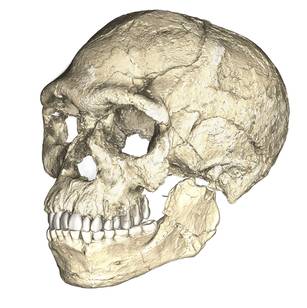
Australopithecus afarensis (Lucy) at approximately 3.2 million years ago. Homo habilis at approximately 2.4 to 1.4 million years ago. Homo erectus at approximately 1.9 million to 110,000 years ago. Homo heidelbergensis at approximately 700,000 to 200,000 years ago. Homo neanderthalensis at approximately 400,000 to 40,000 years ago. Homo floresiensis at approximately 100,000 to 50,000 years ago. The Denisovans, identified from a finger bone and tooth in Denisova Cave, Siberia, by David Reich and colleagues in 2010 and confirmed as a distinct archaic hominin lineage.[19] Anatomically modern Homo sapiens dating to approximately 315,000 years ago at Jebel Irhoud, Morocco: Jean-Jacques Hublin and colleagues' 2017 Nature paper that pushed the Homo sapiens origin date back roughly 100,000 years from prior consensus.[20] The Smithsonian Human Origins Program maintains accessible authoritative summaries of the entire hominid fossil record.[21]
The CES Letter's "dozen or so other Hominid species" framing is broadly accurate, with the precise number depending on taxonomic conventions. The hominid fossil record is not contested.
Neanderthal DNA in modern non-Africans is real, well-established science
Richard Green and colleagues' 2010 Science paper provided the first draft sequence of the Neanderthal genome and established 1–4% Neanderthal admixture in non-African modern humans.[22] Kay Prüfer and colleagues' 2014 Nature paper on the high-coverage Altai Neanderthal genome refined the estimates and characterized the admixture history.[23] Fabrizio Mafessoni and colleagues' 2020 PNAS paper on the Chagyrskaya Cave Neanderthal added a third high-coverage genome, enabling cross-individual comparison.[24] Sriram Sankararaman and colleagues' 2014 Nature paper mapped Neanderthal ancestry across the modern human genome.[25] Current scientific consensus places Neanderthal admixture in non-Africans at approximately 1.5 to 2.1%,[23:1] with Denisovan admixture additionally at 4 to 6% in Melanesian and Oceanian populations.[19:1] The 1.6% figure the CES Letter author cites from his personal genetic test is well within this range. Neanderthals went extinct approximately 40,000 years ago, meaning Neanderthal DNA in modern non-Africans entered the gene pool through interbreeding prior to extinction.
A literal 7,000-year-ago Adam who is the genetic ancestor of all modern humans does not work. Population genetics demands a much larger founding population for Homo sapiens, and a 7,000-year-old Adam cannot be the genetic source of the modern human genome. On this point the CES Letter is correct. So the faithful task is not to deny the science but to ask what the Restoration's scriptures and doctrines actually require, and to show that the science the CES Letter cites does not collide with the commitments that matter.
Further Reading
Authoritative scientific overviews: Smithsonian National Museum of Natural History Human Origins Program (humanorigins.si.edu); Hublin et al., "New fossils from Jebel Irhoud, Morocco and the pan-African origin of Homo sapiens," Nature 546, no. 7657 (8 June 2017): 289–292; Green et al., "A Draft Sequence of the Neandertal Genome," Science 328, no. 5979 (7 May 2010): 710–722; Prüfer et al., "The complete genome sequence of a Neanderthal from the Altai Mountains," Nature 505, no. 7481 (2 January 2014): 43–49.
What canonized Latter-day Saint scripture actually says
The CES Letter's argument depends on a particular reading of 2 Nephi 2:22, Alma 12:23–24, and Doctrine and Covenants (D&C) 77:6–7: a reading on which these verses commit the Church to no death of any organism before Adam, an Adam dated to roughly 6,000 to 7,000 years ago, and a 7,000-year-old planet. Read in its own canonical context, each verse supports something different.
2 Nephi 2:22 in context
The verse is part of Lehi's farewell discourse to his son Jacob (2 Nephi 2:11–25). Lehi's argument is theological: opposition is necessary in all things; without it, all things become "a compound in one," undifferentiated, without meaning, without agency.[26] God created Adam with both good and evil placed before him; the serpent ("an angel of God who had fallen from heaven") deceived Eve; and Adam's transgression introduced the conditions for human probation, agency, and joy.[27][28] The argument culminates at verse 25: "Adam fell that men might be; and men are, that they might have joy."[29]
The verse the CES Letter cites, verse 22, sits in the middle of this argument as a counterfactual: if Adam had not transgressed, Lehi tells Jacob, then certain things would have remained as they were. The full text reads:
"And now, behold, if Adam had not transgressed he would not have fallen, but he would have remained in the garden of Eden. And all things which were created must have remained in the same state in which they were after they were created; and they must have remained forever, and had no end."[30]
The geographic locator "in the garden of Eden" is canonized text. It is the basis for reading the verse as describing what would have remained in the Garden, the paradisiacal pre-Fall state, rather than the absolute condition of the planet outside the Garden. FAIR surveys it among the primary faithful readings.[31] Lehi does not say, in verse 22, that no organism died anywhere on Earth before the Fall.
The verse also sits inside a theological argument, not a biological one. Verse 22 exists to set up verse 25: the Fall was theologically necessary for humanity to have joy. Reading it as a freestanding claim about pre-Adamic biospheric biology mistakes a theological premise for a scientific datum. Brant A. Gardner's verse-by-verse commentary reads Lehi's argument within a Mesoamerican-setting cosmology, the paradisiacal Edenic state contrasted with mortal post-Fall conditions, and notes the geographic specificity of "the garden of Eden" in the discourse.[32] Terryl Givens's 2nd Nephi: A Brief Theological Introduction (Maxwell Institute, 2020), James E. Faulconer's The Book of Mormon Made Harder (Maxwell Institute, 2014), and Grant Hardy's Annotated Book of Mormon (Oxford, 2023) develop the same method: Lehi's "compound in one" discourse is structural theology, not modern concordist history (scripture harmonized with science).[33][34][35] Reading 2 Nephi 2:22 as a "scientific" report on planetary biology, Ben Spackman argues, asks more of the verse than it can give: Lehi is interpreting Genesis through a sixth-century BC lens, and readers then interpret his interpretation. The verse is discourse, not data.[36]
Alma 12:23–24 in context
Alma 12 is Alma's response to Antionah's challenge about the cherubim guarding the way to the tree of life (Alma 12:21).[37] Alma's argument is structurally counterfactual:
"And now behold, I say unto you that if it had been possible for Adam to have partaken of the fruit of the tree of life at that time, there would have been no death, and the word would have been void, making God a liar, for he said: If thou eat thou shalt surely die."[38]
"And we see that death comes upon mankind, yea, the death which has been spoken of by Amulek, which is the temporal death; nevertheless there was a space granted unto man in which he might repent; therefore this life became a probationary state; a time to prepare to meet God."[39]
Verse 23's "no death" clause is counterfactual within a post-Fall scenario in which Adam takes the tree of life. It is not a freestanding claim that no death existed before the Fall. Alma's point is that if Adam had eaten of the tree of life after his transgression, no death would have come; the cherubim were placed to prevent that outcome, so that the prophesied "thou shalt surely die" would hold. Verse 24 then describes the actual state: death comes upon mankind as the "temporal death" that makes mortality a probationary time for repentance.
The CES Letter says Alma 12:23–24 "state there was no death of any kind on this earth until the Fall of Adam." That misreads the conditional. The "no death" of verse 23 is not a stipulated past condition; it is the consequent of an unfulfilled hypothetical. Gardner's commentary on Alma 12 reads the discourse through Mesoamerican temple typology (tree of life as temple symbol, mortality as probationary state, the Atonement as the sacrificial-temple completion) and never extracts a "no biological death before the Fall" claim from it.[40]
D&C 77:6–7 in context
D&C 77:6–7 belongs to a set of clarifying questions about the Book of Revelation. Section 77 reports that the sealed book John saw concerns "this earth during the seven thousand years of its continuance, or its temporal existence."[41] The verses describe the era since the Fall, the period of human probation and the unfolding of the plan of salvation, not the planet's geological age.
Talmage stated the underlying principle in the 1931 address:
"The opening chapters of Genesis and scriptures related thereto were never intended as a text-book of geology, archaeology, earth-science, or man-science. Holy scripture will endure, whereas the conceptions of men change with new discoveries."[4:2]
The Church-published 2017 Doctrine and Covenants Student Manual does nothing to unsettle that reading of D&C 77: its commentary repeats the per-seal frame and never treats the verses as a date for the planet.[42] Each seal corresponds to 1,000 years of temporal existence, the era of God's temporal dealings with humanity, distinct from the planet's geological age. The verse simply does not date the planet to 7,000 years.
Key Point
2 Nephi 2:22 says: "if Adam had not transgressed he would not have fallen, but he would have remained in the garden of Eden." Alma 12:23 says: "if it had been possible for Adam to have partaken of the fruit of the tree of life at that time, there would have been no death." D&C 77:6–7 says: "the seven thousand years of [the earth's] temporal existence." Each verse contains qualifying language the CES Letter omits from its quotations. None of the three verses, in its canonical context, makes the universal-no-pre-Adamic-death-of-any-organism claim the CES Letter assigns to "the Church."
Three faithful interpretations of "no death before the Fall"
The CES Letter's claim 1 collapses three distinct faithful readings of "no death before the Fall" into a single rigid universal-no-death reading, then falsifies that one reading. Each of these three readings is held by serious faithful Latter-day Saint scholars and (in some cases) apostles. None requires the universal-no-pre-Adamic-death-of-any-organism reading the CES Letter assumes is the only faithful option.
The Garden-only reading
The Garden-only reading takes 2 Nephi 2:22's geographical locator at face value: the stasis of verse 22 belongs to the Garden, not to the planet outside it. What verse 22 describes is the pre-Fall paradisiacal state of Eden: Adam and Eve in their pre-transgression condition, where there was no death and where they would have had no children.[31:1] Outside the Garden, the natural world ran under whatever conditions God's creative work had established. Animal death, plant death, predation, decay: none of these are negated by 2 Nephi 2:22 read on its own terms.
This reading is grammatically natural. The competing reading has to import an absolute claim ("no death on this earth before the Fall") that the text never makes. The CES Letter's quotation drops the "garden of Eden" qualifier from the rhetorical setup, then treats the trimmed passage as committing the Church to no-death-anywhere. That omission is the move that manufactures the conflict.
The current Gospel Principles manual (2009/2011 edition) focuses narrowly on Adam and Eve's pre-Fall state in Eden ("they would have had no children"), consistent with this reading.[43] FAIR's "Death before the Fall of Adam and Eve" page surveys the Garden-only reading as one of the primary faithful frames.[31:2]
The human-only reading
The human-only reading takes the Fall's introduction of mortality as applying to humans, covenant-bearing beings, not to the mortality of all biological organisms. The Fall introduces human mortality, the spiritual and physical separation from God that the Atonement addresses, not the death of dinosaurs or trilobites.
This reading has explicit recent apostolic articulation. Elder Jeffrey R. Holland's April 2015 General Conference address "Where Justice, Love, and Mercy Meet" describes the pre-Fall Edenic state as one "where there was neither human death nor future family."[44] Holland specified human death; he did not extend the no-death claim to all pre-Adamic biological life. The 2016 New Era Q&A on evolution uses identical language: Adam and Eve "lived alone in a paradisiacal setting where there was neither human death nor future family."[9:1] That is the most recent institutional articulation of the question, and it is explicitly human-only.
It also has earlier apostolic backing. After Joseph Fielding Smith (JFS) objected to the acceptance of an old earth in J. Reuben Clark's October 1946 conference address, Clark, Counselor in the First Presidency from 1933 to 1961, drafted a reply: "I think when we use death in this connection, that is as of the time when death came into the world, that its application might normally be applied to humans." The draft is marked unsent in the archives; even so, it preserves a sitting Counselor in the First Presidency disagreeing in writing with JFS's universal-no-death reading.[45]
The most direct apostolic affirmation of pre-Adamic animal death is James E. Talmage's "The Earth and Man" address, delivered 9 August 1931, reviewed with Talmage by the First Presidency on 17 November, published with their authorization in the Deseret News four days later, and reprinted as a Church pamphlet:
"The whole series of chalk deposits and many of our deep-sea limestones contain the skeletal remains of animals. These lived and died, age after age, while the earth was yet unfit for human habitation."[4:3]
An apostle who held a PhD in geology, addressing the Latter-day Saint people from the Tabernacle pulpit, in an address the First Presidency went over with him and authorized for publication, taught that animals lived and died across the geological eons before humans inhabited the earth. Holland's 2015 "human death" formulation is the apostolic refinement: the Fall's mortality applies to humans, and even then, on the covenantal-Adam reading developed below, in the covenantal sense. Talmage's address was not a placid consensus statement; it was a deliberate intervention in an active internal dispute, authorized without being final.[46] The address is core sister-article material in Discredited Claims.
The temporal-existence reading
The temporal-existence reading takes D&C 77:6–7's "seven thousand years of [the earth's] temporal existence" as the era since the Fall, human probation and the plan of salvation in operation, not as a statement of the planet's age.[41:1] The Doctrine and Covenants Student Manual (2017) uses the same per-seal arithmetic: "Each seal represents 1,000 years of the earth's temporal existence."[42:1]
The broader principle goes back to Brigham Young. On 14 May 1871, in a discourse printed in the Journal of Discourses (JD) at 14:114–118, he took up the geological case for an ancient earth, and early in the discourse he summarized the geologists' position sympathetically:
"You take, for instance, our geologists, and they tell us that this earth has been in existence for thousands and millions of years. They think, and they have good reason for their faith, that their researches and investigations enable them to demonstrate that this earth has been in existence as long as they assert it has."[6:1]
Deeper into the discourse, he declined to fix either the method or the duration of creation as doctrine:
"[W]hether the Lord found the earth empty and void, whether he made it out of nothing or out of the rude elements; or whether he made it in six days or in as many millions of years, is and will remain a matter of speculation in the minds of men unless he give revelation on the subject."[6:2]
The year was 1871. Patterson's meteorite dating, which put the earth's age at about 4.5 billion years, lay eighty-five years ahead, and a Church President had already granted geology its "thousands and millions of years."
Why the three readings matter together
The three readings are not mutually exclusive. Serious faithful scholars often hold them in combination. Talmage held something close to all three at once: Garden-only paradisiacal Eden, human-only covenant mortality, and the temporal-existence reading of D&C 77. Stephens and Meldrum hold a human-only-plus-temporal-existence combination with a theistic-evolutionary mechanism. What the CES Letter assumes is that the only faithful reading available is the rigid no-death-of-any-organism reading associated with Joseph Fielding Smith and Bruce R. McConkie. That assumption is simply false. The Church's institutional position from 1909 through 2016 leaves all three readings open and rejects only the imposition of any one as binding doctrine.
Two 1931 texts directly negate the CES Letter's premise. The First Presidency's April memorandum instructed the general authorities:
"Upon the fundamental doctrines of the Church we are all agreed. … Leave geology, biology, archaeology and anthropology, no one of which has to do with the salvation of the souls of mankind, to scientific research, while we magnify our calling in the realm of the Church."[47]
And James E. Talmage's journal for 7 April 1931 records the decision the First Presidency announced to the assembled general authorities that morning:
"The decision reached by the First Presidency, and announced to this morning's assembly, was in answer to a specific question that obviously the doctrine of the existence of races of human beings upon the earth prior to the fall of Adam was not a doctrine of the Church; and, further, that the conception embodied in the belief of many to the effect that there were no such Preadamite races, and that there was no death upon the earth prior to Adam's fall is likewise declared to be no doctrine of the Church."[10:1]
Why hold the Church to a doctrine its own governing body disavowed in writing? The memorandum, for its part, leaves the empirical disciplines to the scientists. The framework's documentary continuity from 1871 through 1909, 1910, 1925, 1931, 1992, and 2016 is traced in detail in Discredited Claims.
Adam's creation and the covenantal-Adam framework
The deeper question is not whether animals died before the Fall. Talmage settled that one. It is how Adam relates to the hominid lineage the CES Letter cites, a lineage in which Homo sapiens alone had already existed for some 309,000 years by any plausible date for Adam. That is where the covenantal-Adam framework does its work.
What the 1909 First Presidency statement actually claims
Joseph F. Smith's First Presidency, with counselors John R. Winder and Anthon H. Lund, issued "The Origin of Man" through the Improvement Era in November 1909.[11:1] Its claims sort into four: (a) divine parentage of humans ("All men and women are in the similitude of the universal Father and Mother, and are literally the sons and daughters of Deity"), (b) Adam's headship over the human family, (c) "Adam was 'the first man of all men,'" and (d) animal-to-human evolution as "the theories of men." On biological mechanism it is hostile-leaning rather than strictly silent: it proclaims man "the direct and lineal offspring of Deity," and of the proposal that the original human being was "a development from lower orders of the animal creation" it says, "These, however, are the theories of men"; yet it never commits to a specific mechanism. Five months later, the 1910 Improvement Era editorial reopened what 1909 had framed defensively, treating a natural evolutionary origin for Adam's body as one live possibility among three. The 1909 statement's doctrinal core is divine parentage and Adam's covenant headship, not a particular biological mechanism.
That April 1910 editorial, in the "Priesthood Quorums' Table" feature under Joseph F. Smith's editorship and titled "Origin of Man," posed the question whether the first parents' bodies "evolved in natural processes to present perfection," were "transplanted from another sphere," or were "born here in mortality, as other mortals have been," and it endorsed none of the three.[48] It appeared anonymously rather than over First Presidency signatures, so it is best read as an editorial under Joseph F. Smith's editorship rather than a signed declaration. Even at that lighter weight, it is real evidence that the 1909 statement was not understood at the time as a closed door against evolutionary mechanism. Evenson and Jeffery reprint it whole in Mormonism and Evolution: The Authoritative LDS Statements (Greg Kofford Books, 2005).[49]
The 1925 First Presidency statement, "'Mormon' View of Evolution," reissued 1909's divine-parentage core, dropped the "theories of men" material, and kept the closing line about the offspring of celestial parentage "evolving into a God."[50] Throughout, the institutional position has separated what the Church teaches positively (Adam as real historical covenant-bearer, divine parentage of humans) from what it leaves open (the biological mechanism of Adam's body).
President Spencer W. Kimball articulated the institutional agnosticism on mechanism directly in 1976: "We don't know exactly how their coming into this world happened."[7:1] The 2016 New Era Q&A opens with the position itself: "The Church has no official position on the theory of evolution. Organic evolution… is a matter for scientific study."[9:2] The same paragraph continues: "Nothing has been revealed concerning evolution. Though the details of what happened on earth before Adam and Eve, including how their bodies were created, have not been revealed, our teachings regarding man's origin are clear and come from revelation."[9:3] The Church History Topics page on "Organic Evolution" makes the institutional weight explicit, reporting that the 2016 youth-magazine articles "reiterated" that position.[51]
The Adam-as-first-covenant-bearer reading
The reading turns on a single distinction: (a) Adam as the first biological Homo sapiens, a taxonomic-historical claim, versus (b) Adam as the first covenant-bearing prophet, the first spirit child of God placed in mortality, the first to enter the covenant-Eden-and-Fall narrative arc that founds the plan of salvation, a theological-typological claim.
Reading (a) requires Adam at roughly 6,000 years ago, taxonomically distinct from prior hominids. Paleoanthropology falsifies it: Hublin et al. 2017's Jebel Irhoud finding places anatomically modern Homo sapiens at about 315,000 BP, some 309,000 years before any credible date for Adam.[20:1]
Reading (b) is consistent with hominid pre-history, Homo sapiens at 315,000 BP, Neanderthal admixture in modern non-Africans, and every empirical claim the CES Letter makes, because Adam's role is covenantal, not taxonomic. Adam is the first to receive the spirit-image-of-God in the covenant sense, the first to enter the plan of salvation as a covenant-bearer, the first prophet on Earth. Other hominid species, including Homo sapiens populations preceding Adam, may have existed biologically; the covenant-bearing role, the role 1909 is articulating, begins with Adam.
The 2016 New Era Q&A makes this explicit: "There were no spirit children of Heavenly Father on the earth before Adam and Eve were created."[9:4] The operative claim is Adam as first spirit-bearer, not Adam as first biological organism. Pre-Adamic hominids could have existed biologically without being "human" in the spirit-bearing covenant sense.
The fullest articulation comes from Trent D. Stephens (Idaho State University biology emeritus) and D. Jeffrey Meldrum (Idaho State University anatomy and anthropology), with Forrest B. Peterson, in Evolution and Mormonism: A Quest for Understanding (Signature Books, 2001), the most thorough faithful integration of evolutionary biology with the Restoration theology of Adam, the Fall, and the Atonement.[12:1] Their framework runs this way. God created life through evolutionary processes. Adam and Eve really lived, the first beings to receive a fully divine spirit and become covenant-bearers. Pre-Adamic hominids are biologically continuous with Adam, theologically distinct. The Fall is a covenantal event introducing covenant-mortality, not the biological mortality of all organisms. And the Atonement applies to covenant-bearers (Adam and his descendants) and, on the universal-scope reading of 2 Nephi 9:21, to all of God's children.
Steven L. Peck, a BYU biology professor, develops a complementary proposal in "Crawling Out of the Primordial Soup: A Step toward the Emergence of an LDS Theology Compatible with Organic Evolution," Dialogue 43, no. 1 (Spring 2010): 1–36.[13:1] He identifies Adam and Eve as "the first of Heavenly Father's spirit children to be linked to one of these biological machines." The Fall is the participatory union of premortal spirit with evolved body, the moment "conscious experience enters the world." Adam is a historical figure, "real living persons," with no requirement that the universe lack pre-Adamic biological evolution. Peck's Evolving Faith: Wanderings of a Mormon Biologist (Maxwell Institute, 2015) develops the proposal across twelve essays.[14:1] A Maxwell Institute imprint is Church-affiliated scholarly publishing, not an institutional doctrinal endorsement on the order of a First Presidency declaration or the Board-of-Trustees-approved Evolution Packet. But it does establish that BYU's scholarly publishing arm has actively printed scholarship framing Adam as historical-and-evolutionarily-emergent, without retraction.
Matthew Roper's "Premortal Existence of a 'First Man' Suggested in the Book of Job" reads Job 15:7–9's "Are you the firstborn of the human race? Were you brought forth before the hills?" (NRSV, as quoted by Roper) as preserving an ancient Near Eastern conceptualization of a premortal first man, supporting the Adam-as-first-spirit-child-on-Earth framework.[52] Ben Spackman's "Genesis and Evolution: A BYU Guest Lecture" (September 2018) engages the image-of-God anthropology question in its ancient Near Eastern context.[53]
The covenantal-Adam reading preserves the 1909 statement's theological force without requiring biological-taxonomic primacy. It is consistent with the 1910 Improvement Era editorial's explicit listing of natural development as one of three possible explanations for Adam's body, the 1925 statement's softened anti-evolution language, the 1931 memorandum's negation of pre-Adamites and no-pre-Adamic-death as binding doctrines, the Holland 2015 "no human death" formulation, and the 2016 New Era Q&A's "no spirit children of Heavenly Father on the earth before Adam and Eve were created." What the phrase itself sounded like in 1909 is a separate matter. A reader of that November's Improvement Era, with no covenantal framework in hand, would have taken "first man of all men" as a statement about biology, and the covenantal sense is a later interpretive shift: defensible, supported by the documentary trajectory, but a shift.[54]
The Hublin 2017 / Holland 2015 stress point
A careful reader will notice a real interpretive tension between Holland's April 2015 "neither human death nor future family" formulation and Hublin et al. 2017's Jebel Irhoud finding of Homo sapiens at approximately 315,000 BP.[44:1][20:2] If "human" in Holland's formulation means "biological Homo sapiens," then a population of Homo sapiens not dying for approximately 309,000 years before Adam is biologically impossible.
The faithful reading takes "human" in Holland's formulation as the covenantal-spiritual category, not the biological-Homo sapiens category. Holland's "no human death" applies to covenant-bearing humans, Adam and Eve in their pre-transgression Edenic state. Pre-Adamic Homo sapiens, on this reading, are biologically human but not in the covenant-bearing category Holland describes. This reading is the covenantal-Adam framework applied to Holland's sentence, consistent with Talmage's affirmation of pre-Adamic animal death and with the broader documentary trajectory. Holland's address by itself, abstracted from that framework, does not compel the covenantal reading: "Where Justice, Love, and Mercy Meet" is structurally an Atonement sermon, and a reader unfamiliar with the covenantal-versus-biological distinction would naturally hear "human" biologically.[55] The framework absorbs the tension; absorbing a tension is not the same as resolving it.
The pre-Adamic moral-status question
A deeper question follows: what was the moral status of pre-Adamic Homo sapiens, and of Neanderthals, given admixture? The question fans out at once: whether they were moral agents, whether they had the spirit-image-of-God, whether, if so, they stood subject to the Fall in some pre-Adamic mode, and, if not, in what sense they were image-bearing at all.
The framework's response is that these questions are open. The 2016 New Era Q&A states it directly: "Nothing has been revealed concerning evolution."[9:5] The 1931 First Presidency memorandum directs general authorities to "leave geology, biology, archaeology and anthropology, no one of which has to do with the salvation of the souls of mankind, to scientific research."[47:1] These are precisely the empirical-biological questions the Church has explicitly declined to close.
The Stephens-Meldrum-Peck-Spackman framework offers possible answers within that open space. Pre-Adamic Homo sapiens were biologically human but theologically pre-covenant: not sin-capable in the covenantal sense, analogous to little children, who in LDS theology are "not capable of committing sin" and stand outside the law of accountability (Moroni 8:8).[56] Christ's atonement reaches all of God's children; 2 Nephi 9:21 extends it to "all men" and "every living creature," with the "family of Adam" framing readable as the covenant family or the broader divine family.[57] The framework separates cognitive-moral capacity (which pre-Adamic Homo sapiens may well have had, given cave art, intentional burial, and tool culture) from covenantal-moral capacity (which it holds began with Adam). The Moroni 8:8 analogy is a theological extension, defensible within the framework but doing conceptual work the reader should see, and the underlying question is genuinely underdeveloped in the scholarly tradition.[58]
The framework's negative claim, that pre-Adamic life is not a binding doctrinal position either way, is institutional and explicit. Its positive claim, that pre-Adamic Homo sapiens were sin-naive biological humans rather than covenant-bearers, is scholarly and individual: argued by those scholars, but not canonized anywhere. So there is no definitive faithful answer on the moral status of pre-Adamic Homo sapiens, only the framework's commitment to leaving the question open, and a scholarly tradition exploring possible answers inside that opening. The Neanderthal question runs the same way. Faithful answers stay open, in step with the 2016 New Era: "Nothing has been revealed."
The Fall as theology, not biology
Everything turns on the Fall's category. It is a theological category: the introduction of human mortality and of a separation from God only the Atonement can close. It is not a biological category, the introduction of organism-level death into the biosphere on a particular date. Once the Fall is read theologically, the CES Letter's apparent collapse of the framework simply dissolves. Evolution does not disrupt the theology. It does not speak to it.
What the Fall actually does in the plan of salvation
The Fall teaches three things in Latter-day Saint doctrine, none of which depend on biological mechanism:
- Humanity exists in a mortal, fallen state: separated from God's presence, subject to physical death, and subject to spiritual death until reconciled through Christ.
- This was no accident but part of God's plan. 2 Nephi 2:25's "Adam fell that men might be; and men are, that they might have joy" frames the Fall as purposeful, planned, and necessary for the plan of salvation.[29:1]
- The Atonement of Jesus Christ overcomes the Fall, restoring humanity to God's presence (overcoming spiritual death) and granting resurrection (overcoming physical death).
None of the three requires a dated Fall, a mechanism behind Adam's body, or an absence of animal death before roughly 4000 BC. The theology works whether Adam's body was shaped from the dust in a moment or whether God guided billions of years of biological development toward two beings prepared to bear the divine image, receive premortal spirits, enter Eden, and make a choice. Tad R. Callister's The Infinite Atonement (Deseret Book, 2000) frames the Fall as introducing physical mortality for God's children and spiritual separation from his presence, both addressable through Christ's atonement.[59] The Fall makes the Atonement necessary; the Atonement makes the Fall purposeful.
2 Nephi 2:25: the Fall is purposeful, not accidental
2 Nephi 2:25 is the central Restoration teaching about the Fall:
"Adam fell that men might be; and men are, that they might have joy."[29:2]
In Latter-day Saint doctrine the Fall is part of the divine architecture for human becoming, not a tragedy God reluctantly accommodates. That is theologically more sophisticated than Protestant young-earth creationism's "Adam screwed up" framing, and it is wholly consistent with God using long evolutionary processes to prepare bodies capable of bearing premortal spirits. The purposefulness of the Fall does not depend on its mechanism. The current Gospel Principles manual (2009/2011 edition), chapter 6, frames its no-death language inside Adam and Eve's Eden state ("In this state, 'they would have had no children' … There was no death."), a scope note about the Garden, not a claim about the planet.[43:1] The institutional articulation is narrower than the fundamentalist no-pre-Adamic-death reading, not broader.
The plan of salvation framework
The spine of Restoration theology is the plan of salvation: premortal existence → mortal probation (entered through the Fall) → death → resurrection (made possible through the Atonement) → judgment → eternal kingdoms. None of its components depends on the mechanism by which Adam's body came into being. Truman G. Madsen's Eternal Man (Deseret Book, 1966) sets out the premortal-existence framework that distinguishes Latter-day Saint anthropology from creedal Christianity: humans exist as spirit children of God before mortality; mortality is a probationary state; the Fall introduces its conditions; the Atonement enables passage through it.[60]
Adam S. Miller's Letters to a Young Mormon, 2nd ed. (Maxwell Institute, 2018), pitches the same faith-and-science integration to young-adult readers, its science chapter treating evolution and an old earth as compatible with the Restoration's theology.[61] The Fall is a theological event introducing the conditions for mortal probation; how Adam's body came into being is a question the Restoration leaves open.
Image-of-God anthropology
The CES Letter's claim 2 challenges the "first humans" framing for Adam by asking how Adam can be "the first man" if a dozen hominid species lived and died 35,000 to 2.4 million years before him. The challenge presupposes that "human" must mean "biological Homo sapiens" or "biological member of Homo." The Restoration's image-of-God anthropology supports a different reading.
Divine parentage, not morphology
The central anthropological commitment of the 1909 statement is divine parentage: humans are "literally the sons and daughters of Deity," "in the similitude of the universal Father and Mother."[11:2] That is a claim about spiritual genealogy, humans bearing the divine image because they are spirit children of God, not a claim about biological taxonomy. The statement does not require Adam's body to have a particular morphology, or Adam to be the first organism with Homo sapiens anatomy, or prior hominid species to have never existed. It says humans are literally the spirit children of God, that Adam is the first to bear that role on Earth in the covenant-Eden-and-Fall narrative, and that the Fall introduces the conditions for human probation.
Premortal existence (Abraham 3:21–28; D&C 138) reframes "what is a human?" as a question about spirit-bearing identity rather than biological form.[62][63] A person's eternal identity is not the biology; it is the premortal spirit. The 2016 New Era Q&A makes the point: "There were no spirit children of Heavenly Father on the earth before Adam and Eve were created."[9:6] The operative claim is spirit-bearing primacy, not biological primacy.
"First human" as covenantal claim
The Adam-as-first-prophet-and-covenant-bearer reading handles claim 2 directly. "When did those guys stop being human?" trades on the biological-Homo sapiens reading of "human." The Church's actual teaching, articulated through the 2016 New Era Q&A, is the covenantal reading: pre-Adamic hominids may have existed biologically; "human" in the doctrinal-spirit-bearing sense begins with Adam.
FAIR's "Adam and Eve as Historical Figures" hub identifies four faithful readings, all preserving historical Adam: (1) the first humans, (2) the first priesthood-holding patriarch among existing humans, (3) the first of God's spirit children among other human-like beings, (4) Adam and Eve with bodies "that are the product of organic evolutionary processes."[64] The fourth reading is explicitly organic-evolutionary. FAIR is the most-trafficked Latter-day Saint apologetics platform; this is institutional evidence of the framework's flexibility.
Christian cross-tradition perspective
The covenantal-Adam reading has analogs across the broader Christian theistic-evolution conversation. John H. Walton's The Lost World of Adam and Eve (IVP Academic, 2015) is the most-cited evangelical parallel: Walton accepts evolutionary biology and reads Adam as a real historical priestly figure whose theological role is what carries the doctrine.[65] Peter Enns's The Evolution of Adam (Brazos, 2012) argues for an archetypal Adam, a reading incompatible with the Restoration's literal-historical Adam and cited here only to show the breadth of the conversation, not as an ally.[66] Denis O. Lamoureux's Evolutionary Creation (Wipf & Stock, 2008) is a comprehensive Christian evolutionary-creation treatment.[67] William Lane Craig's In Quest of the Historical Adam (Eerdmans, 2021) develops an Adam-as-Homo heidelbergensis thesis.[68] BioLogos, founded by Francis Collins, is the leading Christian science-faith integration site.[69]
The Catholic Church accepts evolution. Pope Pius XII's 1950 Humani Generis permitted research on evolution "in as far as it inquires into the origin of the human body as coming from pre-existent and living matter - for the Catholic faith obliges us to hold that souls are immediately created by God."[70] The structure parallels the Latter-day Saint framework: bodies through evolutionary processes, souls created by God. Pope John Paul II's 1996 Message to the Pontifical Academy of Sciences accepted evolution as "more than a hypothesis." Mainline Protestant denominations (Anglican, Presbyterian, Methodist, ELCA Lutheran) accept it too. Evangelical Protestant fundamentalism opposes it at significant cost.
The strongest evangelical theistic-evolution positions (Walton, Lamoureux, Craig, BioLogos) each have to do significant interpretive work to reconcile evolutionary biology with Genesis 1–3, because the evangelical tradition has historically committed to forms of biblical inerrancy that strict modern-historical readings of Genesis put under pressure.[71] The Restoration's framework needs no such renegotiation. The 8th Article of Faith already qualifies biblical authority ("as far as it is translated correctly"); continuing revelation already establishes that knowledge develops over time; the doctrine-vs-opinion framework already separates binding doctrine from individual leader interpretation; and premortal-existence anthropology already locates "what is a human?" in the spirit-bearing category rather than the biological one. Catholicism sits closest to the Restoration in structural parallel. The Restoration is not the only Christian framework that integrates theistic evolution, but it is one that does so without that hermeneutical cost.
The pre-Adamite tradition's twentieth-century history
The pre-Adamite question (were there hominids or human-like beings before Adam?) has been actively engaged within faithful Latter-day Saint scholarship and leadership for over a century. The CES Letter's argument depends on the reader believing the Church has consistently taught no pre-Adamites and no pre-Adamic death. The actual record is messier, and more interesting.
Frederick J. Pack and the early-twentieth-century engagement
Frederick J. Pack, a University of Utah geology professor, published a series in the Improvement Era in the early 1920s arguing the geological evidence for an ancient earth and engaging the pre-Adamite question from a faithful-scientist perspective.[72] The Sterling B. Talmage corpus (gathered as Can Science Be Faith-Promoting?, edited by Stan Larson, Blue Ribbon Books, 2001) preserves the 1934–36 essays of Apostle James E. Talmage's geologist son, plus 27 letters to and from his father, John A. Widtsoe, Joseph Fielding Smith, and Heber J. Grant. The substantive faithful-scientist case for an ancient earth and pre-Adamic life was already on paper in the 1930s.[73]
B.H. Roberts and The Truth, the Way, the Life
B.H. Roberts, Senior President of the Seventy and one of the most accomplished Latter-day Saint theologians of the early twentieth century, completed The Truth, the Way, the Life: An Elementary Treatise on Theology between 1928 and 1933 as a systematic theology meant for use as a Church manual.[74] A reading committee drawn from the Council of the Twelve reviewed the manuscript, and the First Presidency declined to publish it because of Roberts's chapters on pre-Adamites and old-earth geology. Roberts argued that the geological evidence required an ancient earth and that pre-Adamic intelligent beings were consistent with the Restoration; they simply weren't covenant-bearing in the Adamic sense.
That an apostolic-level systematic theology arguing for pre-Adamites was finished in 1928–1933 is direct evidence that the position was a serious faithful option for Church leaders during the very period Joseph Fielding Smith was hardlining the opposite line. The 1931 First Presidency memorandum negated both sides at once: neither pre-Adamites nor no-pre-Adamic-death is binding doctrine. It was a deliberate move to depressurize a real internal dispute, not a one-sided ruling. Richard Sherlock's "'We Can See No Advantage to a Continuation of the Discussion': The Roberts/Smith/Talmage Affair" reconstructs that 1928–1931 dispute; Jeffrey E. Keller's sequel carries the story forward from Sterling Talmage's papers and the Heber J. Grant diary.[75]
Joseph Fielding Smith, Man: His Origin and Destiny (1954)
Joseph Fielding Smith was an apostle from 1910, Counselor in the First Presidency from 1965 to 1970, and Church President from 1970 to 1972: sixty-two years in senior Church leadership. Man: His Origin and Destiny (Bookcraft, 1954) is his fullest book-length statement of the combined no-pre-Adamic-death, no-pre-Adamites, young-earth-creationism position.[76] In it he presents these positions as revealed truth: not as personal opinion, not as one apostle's reading among others, but as the doctrine of the Church.
JFS cited the Seventh-day Adventist creationist George McCready Price as a "scientific" authority for his position. Ben Spackman's 2023 documentation of that borrowing shows JFS's anti-evolution science was substantially imported from the same Protestant-fundamentalist creationist sources that drove the Scopes-era movement.[77] Spackman's 2024 Claremont Graduate University dissertation is the definitive scholarly treatment of how JFS brought Protestant fundamentalist creationism into Latter-day Saint popular doctrine across the mid-twentieth century. The hardlining was not the consistent traditional position; it was a mid-century shift, shaped by Protestant fundamentalist hermeneutics.[78]
The "the Church never canonized this" defense is technically true. The 1931 First Presidency memorandum, which JFS himself received, had already negated his position as Church doctrine 23 years before Man: His Origin and Destiny appeared. JFS went on teaching his personal interpretation, and the institutional framework went on rejecting it as binding. The 1992 BYU Evolution Packet, assembled and Board-of-Trustees-approved 20 years after his death, reissues the First Presidency's own documentary framework, not his reading.[8:1]
Still, the asymmetry is not comfortable. JFS taught his position from senior leadership for sixty-two years; his writings remain in print at Deseret Book.[79] The reliability of "prophetic teaching" has to distinguish two things: sustained doctrinal commitments expressed through canon, First Presidency declarations, and the framework apparatus, versus individual leader interpretations on questions the Church has not closed. The Church itself works that distinction at length in Anti-Intellectualism and in earlier doctrinal-reversal episodes such as Adam-God. Man: His Origin and Destiny falls squarely in the second category; the CES Letter's argument requires it to be in the first.
Bruce R. McConkie, Mormon Doctrine (1958, 1966)
For forty years, from 1958 into the 1990s, Bruce R. McConkie's Mormon Doctrine (Bookcraft, 1958; 2nd ed. 1966) was the most-distributed Latter-day Saint reference work outside canonized scripture.[80] Its entries hardlined no pre-Adamic death, no pre-Adamites, and the universal application of 2 Nephi 2:22 to all biological organisms. For most lay Latter-day Saints across that era, the functional doctrine was young-earth creationism (YEC) plus no-pre-Adamic-death, even though the institutional documents (1909/1910/1925/1931/1992) had always kept the question open.
The point is not that Mormon Doctrine shaped lay theology for forty years (it plainly did) but that it was never officially endorsed by the First Presidency. At President McKay's direction, apostles Marion G. Romney and Mark E. Petersen reviewed the book in 1959 and reported critically, Petersen recommending 1,067 corrections;[81] conditions were imposed for the 1966 second edition; the First Presidency's discomfort was preserved in the record. The 1992 BYU Evolution Packet, approved by the Board of Trustees that includes the First Presidency, reissues the same First Presidency framework rather than the McConkie reading. The institutional framework has steadily corrected the functional doctrine. By 2016, the Church's official position is unambiguous, and it contradicts McConkie directly.
Theistic evolution among Latter-day Saint scientists
The Restoration has a continuous tradition of faithful scientists who have integrated mainstream science, evolutionary biology and an ancient earth included, with their faith. The CES Letter quotes Henry Eyring as its section-opening epigraph, then proceeds as though the framework Eyring articulated does not exist. It does. The apostolic-scientist tradition is developed in detail in the sister article, Discredited Claims; the pieces that belong specifically to evolution and the Fall are Eyring's theological framework, the cross-generational pattern, BYU's biology program, and David O. McKay's editorial actions during the years JFS was publishing Man: His Origin and Destiny.
Henry Eyring's framework, not just credentials
Henry Eyring (1901–1981) was the Latter-day Saint Church's most visible twentieth-century scientific figure: PhD chemistry Berkeley 1927; Princeton faculty 1931–1946; graduate dean at the University of Utah 1946–1966; National Medal of Science 1966; Wolf Prize in Chemistry 1980; Priestley Medal 1975; National Academy of Sciences (1945); president of the American Chemical Society (1963); president of the AAAS (1965); over 600 scientific articles; namesake of the Eyring equation in chemical kinetics.[82] Eyring was a devoted Latter-day Saint; President Henry B. Eyring of the First Presidency is his son. Eyring himself accepted an ancient earth, evolutionary biology, and theistic evolution.
Eyring's The Faith of a Scientist (Bookcraft, 1967) and Reflections of a Scientist (Bookcraft, 1983) explicitly addressed organic evolution, age of the earth, and the truth-from-any-source posture that the CES Letter quotes.[83][84] The articulation:
"For me there has been no serious difficulty in reconciling the principles of true science with the principles of true religion, for both are concerned with the eternal verities of the Universe."[83:1]
"There is no conflict in the mind of God, but often there is conflict in the minds of men."[83:2]
"In this Church, you only have to believe the truth. Find out what the truth is!"[83:3]
"Since the Gospel embraces all truth, there can never be any genuine contradictions between true science and true religion… I am obliged, as a Latter-day Saint, to believe whatever is true, regardless of the source."[83:4]
This is not grudging tolerance of evolution because the Church takes no position. Eyring's claim is that the Restoration's epistemology actively requires the integration of all truth from any source. The CES Letter's epigraph is a faithful statement of the framework Joseph Smith's revelations established. The cross-generational arc matters too: Henry Eyring Sr.'s son, Henry B. Eyring, currently serves as First Counselor in the First Presidency. A National Medal of Science recipient raised a son who now sits in that body. The Eyring tradition of theistic evolution is institutional, and it reaches into current senior Church leadership.
David O. McKay, contemporaneous with JFS
David O. McKay was Church President from 1951 to 1970, the very years Joseph Fielding Smith published Man: His Origin and Destiny (1954). McKay's editorial actions in that window are a key data point for what the institutional position actually was, as against JFS's personal view. As editor of The Instructor, Ben Spackman documents, McKay approved Bertrand Harrison's 1965 article "The Relatedness of Living Things," which presented evolution as compatible with faith and used the spirit-versus-body distinction the Stephens-Meldrum framework develops.[85] And McKay's February 1957 letter to University of Utah geologist William Lee Stokes stated it outright: "On the subject of organic evolution the Church has officially taken no position."[86] The sitting Church President, during the Man: His Origin and Destiny era, was more accommodating than the loudest individual voices.
Spackman's annotation of the 2022 Church History Topics page adds a further detail: the Encyclopedia of Mormonism "Evolution" entry's famous line, "the scriptures tell why man was created, but they do not tell how," was ghost-written by then-Counselor Gordon B. Hinckley, who became Church President in 1995.[87] The formulation that locates evolution outside the Church's doctrinal jurisdiction came from a future Church President.
Russell M. Nelson: a Church President who was a surgeon
Russell M. Nelson (pioneering cardiothoracic surgeon, performer of Utah's first successful open-heart operation in November 1955, apostle from 1984, and Church President from January 2018 until his death in September 2025)[88] depended through his whole career on the very biology and chemistry that underwrite evolution and an ancient earth. Cardiac biology, surgical anatomy, pharmacology: all of it rests on the modern evolutionary synthesis. At the dedication of the BYU Life Sciences Building on 9 April 2015, he said:
"There is no conflict between science and religion. Conflict only arises from an incomplete knowledge of either science or religion, or both. … All truth is part of the gospel of Jesus Christ. Whether truth comes from a scientific laboratory or by revelation from the Lord, it is compatible."[89]
A future Church President, dedicating a Life Sciences Building in 2015, stated the Restoration's epistemology in modern form. Dieter F. Uchtdorf's October 2014 General Conference address opened on the same note, using changing scientific understanding (the Milky Way once thought to be the only galaxy, then modern cosmology) to illustrate how revelation works alongside science.[90]
BYU's evolutionary biology program
BYU is the Church's flagship university, fully Church-funded, with the First Presidency and members of the Quorum of the Twelve serving on its Board of Trustees. BYU teaches mainstream evolutionary biology, and teaches it as standard science.
Drs. Clayton White and Duane Jeffery launched BYU's first undergraduate evolution course (Zoology 404: Comparative Evolutionary Theory) in fall 1971.[91] The launch was triggered by an institutional embarrassment: reviewing dental-school applications, White noticed that "a top dental school was rejecting every BYU applicant," and a phone call traced the problem to BYU's curriculum. He remembers that school's administrator explaining that if BYU didn't teach evolution, "we're not even sure that your students are well grounded in the life sciences and biology."[91:1] The course filled completely its first semester. The Church-funded university had to teach evolution to meet the standard of mainstream science education. The Church-funded university did teach evolution. There has been no retreat across fifty-five years.
Approval for the 1992 BYU Evolution Packet came from the BYU Board of Trustees, whose membership includes the First Presidency and members of the Quorum of the Twelve.[8:2] The packet gathers the 1909 "Origin of Man" statement, the First Presidency's December 1910 "Words in Season" message, the 1925 "'Mormon' View of Evolution" statement, and the Encyclopedia of Mormonism "Evolution" entry, which itself carries the authorized excerpt from the 1931 First Presidency minutes. That body, the First Presidency included, formally institutionalized the doctrine-vs-opinion framework. BYU's own Life Sciences Magazine reports that its evolutionary biology faculty between 1997 and 2021 secured 112 NSF grants ($20.5M), 40 additional grants ($3.5M from funders including USDA, NIH, and the Bureau of Land Management), and 934 papers across 8 faculty members.[91:2] The Church-funded flagship university runs one of the country's most active evolutionary biology research programs, has for fifty-five years, and shows no sign of contracting.
The broader faithful-scientist tradition
The unbroken faithful-scientist tradition includes James E. Talmage (geology PhD, Illinois Wesleyan 1896), John A. Widtsoe (chemistry PhD, Göttingen 1899), Henry Eyring Sr. (chemistry PhD, Berkeley 1927), Sterling Talmage (geology), Frederick J. Pack (geology PhD), Trent Stephens (biology), D. Jeffrey Meldrum (anatomy/anthropology), Steven Peck (biology), Kent Condie (geology and geochemistry), David Bailey (mathematics), and William Evenson (physics).[92] These are not isolated outliers; they are the institutional tradition. The apostolic-scientist roster (Talmage, Widtsoe, Merrill, Eyring, Nelson, Scott) and the broader faithful-scientist tradition are developed in detail in Discredited Claims.
Further Reading
Major faithful-scholar treatments of evolution and the Fall: Trent D. Stephens and D. Jeffrey Meldrum with Forrest B. Peterson, Evolution and Mormonism: A Quest for Understanding (Signature Books, 2001); Steven L. Peck, "Crawling Out of the Primordial Soup," Dialogue 43/1 (2010), and Evolving Faith (Maxwell Institute, 2015); Ben Spackman's evolution essays at benspackman.com/category/evolution/ including "Evolution and the Fall" (2017), "Mormon Said It, I Believe It, That Settles It?" (2017), "President J. Reuben Clark: Some Death Before the Fall" (2022), and "Joseph Fielding Smith and Creationist Claims to Scientific Authority" (2023); William E. Evenson and Duane E. Jeffery, Mormonism and Evolution: The Authoritative LDS Statements (Greg Kofford Books, 2005); the BYU Evolution Packet at biology.byu.edu; the 2016 New Era Q&A "What does the Church believe about evolution?" at churchofjesuschrist.org; and David H. Bailey, Jeffrey M. Bradshaw, John S. Lewis, Gregory L. Smith, and Michael R. Stark eds., Science and Mormonism: Cosmos, Earth, and Man (Interpreter Foundation, 2016).
Eight Restoration theological resources for evolution-faith integration
The Restoration possesses eight distinct theological resources for evolution-faith integration that fundamentalist Protestantism lacks. These are not retrofit; they are intrinsic to the Restoration's foundational scriptures and doctrines. The integration that costs Protestant fundamentalism so much (defending YEC against geology, biology, and paleoanthropology) costs the Restoration nothing, because the Restoration's distinctive doctrines are already theistic-evolution-compatible.
First, continuing revelation. The 9th Article of Faith ("We believe all that God has revealed, all that He does now reveal, and we believe that He will yet reveal many great and important things pertaining to the Kingdom of God") assumes the trajectory of religious knowledge is additive over time, not a static deposit threatened by new findings.[93] The Restoration is structurally open to ongoing revelation, including information that may at first seem contrary, because revelation is progressive rather than fixed. That is what lets the framework absorb evolution and pre-Adamic death without collapsing. Russell M. Nelson put it plainly in the October 2021 General Conference: "The Restoration is a process, not an event, and will continue until the Lord comes again."[94]
Second, premortal existence. Abraham 3:21–28 and D&C 138 establish that the human spirit existed before the body.[62:1][63:1] Biology cannot touch this. "First human" becomes a theological question, the first to receive a premortal spirit and enter covenant, not a biological one. The 2016 New Era Q&A puts it to work: "There were no spirit children of Heavenly Father on the earth before Adam and Eve were created."[9:7] Adam as first spirit-bearer is the operative claim, and the timing of his spirit-reception is invisible to paleoanthropology, because the spirit-bearing transition is theological, not biological, and need not leave a fossil.
Third, material spirit. D&C 131:7–8: "There is no such thing as immaterial matter. All spirit is matter, but it is more fine or pure, and can only be discerned by purer eyes."[95] Spirit is finer matter, not immaterial substance. This grounds the unity of physical and spiritual without forcing biology to do all the explanatory work.
Fourth, image of God as parental kinship. The 1909 First Presidency: humans are "literally the sons and daughters of Deity"[11:3], a claim about divine parentage, not about a particular biological form. The Restoration's image-of-God anthropology is about kinship to Heavenly Father (Romans 8:16–17; Acts 17:28–29), a theological-genealogical claim, not a morphological one.
Fifth, covenantal-not-biological Adam. The covenantal-Adam framework: Adam is the first to receive a premortal spirit and enter covenant accountability.[12:2][13:2] The Fall is a covenantal event introducing covenant-mortality, not a biological event introducing organism-level death. Pre-Adamic hominids existed biologically but were not covenant-bearers in the spirit-receiving sense.
Sixth, the doctrine-vs-opinion framework. The 1909, 1910, 1925, and 1931 First Presidency documents; the 1992 BYU Evolution Packet; the 2016 Church History Topics page; the 2016 New Era Q&A all preserve the institutional distinction between binding doctrine and individual leader opinion on the physical world. The framework is documentarily continuous across 145 years and is developed in detail in Discredited Claims.
Seventh, the 8th Article of Faith's qualified biblical authority. "We believe the Bible to be the word of God as far as it is translated correctly."[96] The qualifier explicitly rejects the inerrancy commitment that locks Protestant fundamentalism into young-earth creationism. It opens room to read Genesis 1–11 as ancient Near Eastern theological literature rather than a modern-history textbook, the hermeneutic resource on which the Restoration's evolution-Fall integration runs.
Eighth, the Fall as purposeful covenantal event. 2 Nephi 2:25's "Adam fell that men might be; and men are, that they might have joy" makes the Fall purposeful, planned, and necessary, theologically richer than a Fall that is merely a catastrophe God salvaged.[29:3] A Fall that purposeful is fully consistent with God using long evolutionary processes; the purpose does not hang on the mechanism.
Together these eight establish that theistic evolution is consistent with the Restoration's theological architecture, not merely tolerated by it. The CES Letter's framing has the Restoration defensively ceding ground to evolution. The record runs the other way. The foundational scriptures, premortal-existence anthropology, image-of-God ontology, materialist metaphysics, doctrine-vs-opinion framework, faithful-scientist apostolic tradition, and BYU's mainstream-science biology program together let the Restoration absorb theistic evolution without the hermeneutical renegotiation evangelicals have to undertake. Not because it retreated from a creationist stance, but because Joseph Smith's revelations carried resources that anticipated this kind of integration from the start.
Key Point
The Restoration's epistemological framework actively commends scientific inquiry. D&C 93:36 identifies the deity by the attribute of intelligence: "The glory of God is intelligence, or, in other words, light and truth."[97] D&C 88:118 commends learning by "study and faith": "seek ye out of the best books words of wisdom; seek learning, even by study and also by faith."[98] D&C 130:18–19 declares that "whatever principle of intelligence we attain unto in this life, it will rise with us in the resurrection."[99] D&C 101:32–34 anticipates eschatological convergence: at Christ's coming, "he shall reveal all things… things of the earth, by which it was made, and the purpose and the end thereof."[100] The deity Latter-day Saints worship is identified by cognitive virtue. Knowledge gained in mortality persists eschatologically. The Restoration's revelations anticipate the convergence of revealed and discovered truth; they do not treat them as separate magisteria.
Engaging the steelman
A careful critic will not be satisfied by the framework's elegance. Three objections deserve direct engagement: the retrospective-rescue charge, the asymmetric institutional response, and the Atonement-Fall-Adam chain.
The retrospective doctrine-vs-opinion concern
Critics argue: the Church only says it has no official position on evolution because the science became overwhelming, and the framework's "always open" language is a retrospective rescue. For most of the twentieth century, the functional doctrine for many lay Latter-day Saints was YEC plus no-pre-Adamic-death.
The fair answer concedes part of this. The framework did exist institutionally throughout the twentieth century, and Brigham Young's 1871 JD statement predates even 1909, but its circulation among lay members was limited until the 1990s and 2010s. The defense never was "the Church has always taught this." It is that the framework existed institutionally, was articulated now and then by senior leaders (Talmage 1931, Kimball 1976, McKay's editorial actions, Hinckley's Encyclopedia of Mormonism entry, Eyring's books), and progressively won over time. By 2016, it is the explicit institutional position. The Discredited Claims sister article develops this asymmetry in further detail.
The asymmetric institutional response
The 1931 memorandum's "neither side" framing was real, but it did not produce equal-weight teaching. JFS kept teaching his position publicly; B.H. Roberts's The Truth, the Way, the Life was finished by 1928 and unpublished for 66 years. Mormon Doctrine circulated everywhere; the 1909/1910/1925/1931 framework documents sat in the archive. The institutional position was preserved, but its circulation was lopsided. And the framework has progressively won out. The 1928–1933 Roberts manuscript suppressed in 1933 was published in 1994. The trajectory of the framework's articulation runs consistently toward the open-on-mechanism, theistic-evolution-compatible reading.
The Atonement-Fall-Adam logical chain
The deepest theological challenge: the Atonement requires the Fall; the Fall requires Adam's transgression; Adam's transgression introduces sin into the human family (the canonical reading from Romans 5 and 1 Corinthians 15, reinforced by 2 Nephi 2 and Alma 12); if Adam's transgression introduces sin, then before Adam's transgression either (a) there was no human family before Adam, or (b) the pre-Adamic human family was sin-naive.[101][102]
Take (a): the entire pre-Adamic biological-human history drops out of the theological framework, and the Church must place Adam at roughly 6,000 years ago as the first Homo sapiens. That contradicts paleoanthropology.
Take (b): there was a population of Homo sapiens for some 300,000 years before Adam, biologically human but morally sin-naive. This is the framework's preferred reading (Stephens-Meldrum, Peck, Spackman). Pre-Adamic Homo sapiens were biological humans but not covenant-bearing humans, not sin-capable in the covenantal sense, on the Moroni 8:8 analogy.[56:1] Adam is the first covenant-bearer. The Atonement, as before, reaches covenant-bearers and, on 2 Nephi 9:21's universal reading, all of God's children.
The framework's answer to the moral-status question is the least worked-out part of the proposal. The Stephens-Meldrum and Spackman positions sketch possible answers, but no formal-institutional document canonizes them: the negative claim stays institutional, the positive one stays individual scholarship. So the framework holds the question open. The question is not resolved in faith's favor; it stays open, and the framework is robust enough to keep working while it does.
Assessment
The CES Letter's argument rests on three premises: (1) Restoration scripture and doctrine commit the Church to no death of any organism before Adam, roughly 7,000 years ago; (2) the fossil record, paleoanthropology, and Neanderthal genetics falsify that commitment; (3) therefore Restoration scripture is falsified. Premise (2) is granted on its own terms; the science is real and uncontested. Premise (1) is where the case fails.
Premise (1) collapses three distinct categories the Church has consistently maintained as distinct: (a) what canonized scripture actually claims (read in canonical context); (b) what individual leaders have taught (Joseph Fielding Smith, Bruce R. McConkie); (c) what the Church has formally adopted as binding doctrine. The CES Letter reads the three as one. The Church itself, since at least Brigham Young's 1871 articulation and most explicitly in the 1931 First Presidency memorandum, has treated them as three. The 1931 First Presidency decision explicitly negates the CES Letter's framing claim that "no death before the Fall" is Church doctrine. The 2016 New Era Q&A states the institutional position in four words: "Nothing has been revealed."[9:8]
Within the framework, three faithful readings of "no death before the Fall" (Garden-only, human-only, temporal-existence) are each grounded in canonical text and each consistent with the science. The Adam-as-first-covenant-bearer reading handles the pre-Adamic hominid record and the Neanderthal genome with every covenantal commitment intact. The Restoration's eight theological resources let theistic evolution be integrated with its doctrine of scripture untouched.
That answers the CES Letter's three hardest questions directly. The dozen hominid species before Adam, the 315,000-year Homo sapiens record, the Neanderthal DNA in the author's own genome: none of it bears on a commitment the Church actually holds, because "human" in the doctrinally binding sense is a covenantal category, not a taxonomic one, and the Fall is a theological event, not a dated biological one.
The framework does not eliminate every difficulty. The 1909 statement's "first man of all men" language requires a covenantal rather than biological-taxonomic reading, which the framework supports but does not force. Holland's 2015 "no human death" creates real tension with Hublin 2017's Homo sapiens dating; the covenantal reading of "human" resolves it only for a reader already committed to the covenantal-versus-biological distinction. The pre-Adamic moral-status question is genuinely open, and it is unfinished. JFS's Man: His Origin and Destiny (1954) and McConkie's Mormon Doctrine (1958, 1966) circulated widely as functional doctrine for many twentieth-century Latter-day Saints even though neither was canonized, and the framework's institutional preservation and its real availability to lay members were two different things for most of that century. Each is a real concession.
What the framework does establish, against the CES Letter, is that the commitments that actually carry the Restoration (divine parentage, Adam and Eve as historical covenant-bearers, the Fall as a theological event introducing the conditions for human probation, the Atonement as universal in scope) are compatible with mainstream evolutionary biology, paleoanthropology, and genetics. The Church has consistently held these apart from speculative leader opinion about the physical world. And the faithful-scientist tradition (Talmage, Widtsoe, Eyring, Stephens, Meldrum, Peck, BYU's biology faculty since 1971) shows the integration is not merely possible but has been practiced for over a century.
That is why the Eyring sentence the CES Letter opens its Science section with ("Since the Gospel embraces all truth, there can never be any genuine contradictions between true science and true religion… I am obliged, as a Latter-day Saint, to believe whatever is true, regardless of the source"[83:5]) is not a problem for the faithful position. It is the faithful position. Russell M. Nelson said the same thing in 2015: "There is no conflict between science and religion. Conflict only arises from an incomplete knowledge of either science or religion, or both."[89:1] The CES Letter quotes the Restoration's actual view, then spends the section arguing against a view the Restoration does not hold.
Return to the Tabernacle in 1931. When an apostle with a geology PhD told the Saints that animals "lived and died, age after age, while the earth was yet unfit for human habitation," in an address the First Presidency then reviewed and authorized for publication, he was not surrendering doctrine to science. He was reading scripture and the rock record together and finding no quarrel between them. What the CES Letter offers as a refutation, the ancient earth, the succession of hominid species, the archaic DNA in living genomes, is the same record he was reading. The deep time and the ages of pre-Adamic death were squarely in Talmage's view in 1931; the hominid census and the sequenced genome came to light in the decades after, and they lengthen that record without changing what it shows. The Restoration's actual commitments come through intact: divine parentage, a historical Adam and Eve who bear the covenant, a purposeful Fall, a universal Atonement.
Some questions in this cluster stay open, and they have been kept in plain view here: what the moral status of pre-Adamic Homo sapiens was, how literally to hear Holland's "human death." On those, the most accurate Latter-day Saint answer is still "Nothing has been revealed," held without strain because no part of the framework rests on how they come out. And underneath the open questions sits something the Book of Mormon settles cleanly: not the earth's age or the making of Adam's body, on which it is silent, but the meaning of the Fall itself: "Adam fell that men might be; and men are, that they might have joy." That is a covenantal Adam, and a covenantal Adam is precisely the one the fossils, the hominids, and the genome leave standing. The wider positive case for the book is made across the Book of Mormon section; here it is enough that the evidence the CES Letter musters answers a question the doctrine never asked.
Runnells, CES Letter (2017), "Science," no. 1, p. 111. ↩︎
Runnells, CES Letter (2017), "Science," no. 2, p. 111. ↩︎
Runnells, CES Letter (2017), "Science," no. 3, p. 111. ↩︎
James E. Talmage, "The Earth and Man," address delivered in the Salt Lake Tabernacle, 9 August 1931. Published in the Deseret News, 21 November 1931, after the First Presidency reviewed the address with Talmage and authorized its publication (Talmage journal, 17 November 1931, per Sherlock 1980, 73; Grant journal, 17 November 1931, per Keller 1982, 87–88). Reprinted as a Church pamphlet in 1931. Reprinted in The Instructor 100, no. 12 (December 1965): 474–477, continued in 101, no. 1 (January 1966): 9–15. Online: https://interpreterfoundation.org/reprint-sm1-12-the-earth-and-man/. ↩︎ ↩︎ ↩︎ ↩︎
Runnells, CES Letter (2017), "Science," p. 111. ↩︎
Brigham Young, discourse, 14 May 1871, Journal of Discourses 14:114–118 (the quoted geological/age-of-earth material at 14:115–116). ↩︎ ↩︎ ↩︎
Spencer W. Kimball, "The Blessings and Responsibilities of Womanhood," Ensign, March 1976. https://www.churchofjesuschrist.org/study/ensign/1976/03/the-blessings-and-responsibilities-of-womanhood. "We don't know exactly how their coming into this world happened." ↩︎ ↩︎
"Evolution and the Origin of Man," BYU packet, approved by the Board of Trustees, June 1992; William E. Evenson, then dean of the College of Physical and Mathematical Sciences, played a role in compiling it. Contains the 1909 "Origin of Man" statement, the 17 December 1910 "Words in Season" First Presidency message, the 1925 "'Mormon' View of Evolution" statement, and the Encyclopedia of Mormonism "Evolution" entry, which includes an authorized excerpt from the 1931 First Presidency minutes. https://biology.byu.edu/00000172-29e6-d079-ab7e-69efe5890000/byu-evolution-packet. ↩︎ ↩︎ ↩︎
"What does the Church believe about evolution?" New Era, October 2016. https://www.churchofjesuschrist.org/study/new-era/2016/10/to-the-point/what-does-the-church-believe-about-evolution. ↩︎ ↩︎ ↩︎ ↩︎ ↩︎ ↩︎ ↩︎ ↩︎ ↩︎
James E. Talmage, personal journal, 7 April 1931 (29:42), Archives and Manuscripts, Harold B. Lee Library, Brigham Young University, as quoted in FAIR, "Death before the Fall of Adam and Eve," https://www.fairlatterdaysaints.org/answers/Death_before_the_Fall_of_Adam_and_Eve. Talmage's same-day record of the First Presidency's announced decision; corroborated in Sherlock 1980, 71, and in Trent D. Stephens and D. Jeffrey Meldrum, Evolution and Mormonism (Signature Books, 2001), 65. ↩︎ ↩︎
First Presidency (Joseph F. Smith, John R. Winder, Anthon H. Lund), "The Origin of Man," Improvement Era 13, no. 1 (November 1909): 75–81. Reprinted in Ensign, February 2002, https://www.churchofjesuschrist.org/study/ensign/2002/02/the-origin-of-man. ↩︎ ↩︎ ↩︎ ↩︎
Trent D. Stephens and D. Jeffrey Meldrum, with Forrest B. Peterson, Evolution and Mormonism: A Quest for Understanding (Salt Lake City: Signature Books, 2001). ↩︎ ↩︎ ↩︎
Steven L. Peck, "Crawling Out of the Primordial Soup: A Step toward the Emergence of an LDS Theology Compatible with Organic Evolution," Dialogue: A Journal of Mormon Thought 43, no. 1 (Spring 2010): 1–36. https://www.dialoguejournal.com/articles/crawling-out-of-the-primordial-soup-a-step-toward-the-emergence-of-an-lds-theology-compatible-with-organic-evolution-2/. ↩︎ ↩︎ ↩︎
Steven L. Peck, Evolving Faith: Wanderings of a Mormon Biologist (Provo, UT: Maxwell Institute Publications, 2015). https://mi.byu.edu/evolving-faith. ↩︎ ↩︎
Ben Spackman, "Evolution and the Fall" (28 August 2017). https://benspackman.com/2017/08/evolution-and-the-fall/. Full corpus of Spackman evolution essays: https://benspackman.com/category/evolution/. ↩︎
Clair Patterson, "Age of meteorites and the Earth," Geochimica et Cosmochimica Acta 10 (1956): 230–237. Patterson's own published figure was 4.55 ± 0.07 billion years; the modern refined value is approximately 4.54 billion. ↩︎
Simon A. Wilde, John W. Valley, William H. Peck, and Colin M. Graham, "Evidence from detrital zircons for the existence of continental crust and oceans on the Earth 4.4 Gyr ago," Nature 409 (11 January 2001): 175–178. ↩︎
Vostok ice core: J. R. Petit et al., "Climate and atmospheric history of the past 420,000 years from the Vostok ice core, Antarctica," Nature 399 (1999): 429–436. The Greenland cores reach shorter spans (NGRIP ~123,000 years, GISP2 ~110,000); only Antarctica's EPICA Dome C core reaches further, ~800,000 years. The fully anchored bristlecone-pine tree-ring chronology extends approximately 8,500–9,000 years; varved (annually layered) lake sediment records — Lake Suigetsu, Japan — extend to approximately 50,000 BP without interruption. ↩︎
David Reich et al., "Genetic history of an archaic hominin group from Denisova Cave in Siberia," Nature 468, no. 7327 (23 December 2010): 1053–1060. https://www.nature.com/articles/nature09710. ↩︎ ↩︎
Jean-Jacques Hublin et al., "New fossils from Jebel Irhoud, Morocco and the pan-African origin of Homo sapiens," Nature 546, no. 7657 (8 June 2017): 289–292. https://www.nature.com/articles/nature22336. The 2017 Jebel Irhoud finding pushed anatomically modern Homo sapiens origins back to approximately 315,000 years ago. See also Chris Stringer and Julia Galway-Witham, "On the origin of our species," Nature 546 (2017): 212–214. ↩︎ ↩︎ ↩︎
Smithsonian National Museum of Natural History Human Origins Program, "Our species arose at least 300,000 years ago," https://humanorigins.si.edu/research/whats-hot-human-origins/our-species-arose-least-300000-years-ago; "Ancient DNA and Neanderthals," https://humanorigins.si.edu/evidence/genetics/ancient-dna-and-neanderthals. ↩︎
Richard E. Green et al., "A Draft Sequence of the Neandertal Genome," Science 328, no. 5979 (7 May 2010): 710–722. DOI: 10.1126/science.1188021. ↩︎
Kay Prüfer et al., "The complete genome sequence of a Neanderthal from the Altai Mountains," Nature 505, no. 7481 (2 January 2014): 43–49. DOI: 10.1038/nature12886. The paper estimates "the proportion of Neandertal-derived DNA in people outside Africa is 1.5–2.1%." ↩︎ ↩︎
Fabrizio Mafessoni et al., "A high-coverage Neandertal genome from Chagyrskaya Cave," Proceedings of the National Academy of Sciences 117, no. 26 (2020): 15132–15136. https://www.pnas.org/doi/10.1073/pnas.2004944117. ↩︎
Sriram Sankararaman et al., "The genomic landscape of Neanderthal ancestry in present-day humans," Nature 507, no. 7492 (2014): 354–357. https://www.nature.com/articles/nature12961. ↩︎
2 Nephi 2:11; the opposition argument runs through verse 13. Lehi: "For it must needs be, that there is an opposition in all things. … righteousness could not be brought to pass, neither wickedness, neither holiness nor misery, neither good nor bad. Wherefore, all things must needs be a compound in one." ↩︎
2 Nephi 2:14–19. Lehi recounts the creation, the Fall, and the role of the serpent. ↩︎
2 Nephi 2:20–21. The state of mankind after the Fall and the days of probation. ↩︎
2 Nephi 2:22. ↩︎
"Death before the Fall of Adam and Eve," FAIR. https://www.fairlatterdaysaints.org/answers/Death_before_the_Fall_of_Adam_and_Eve. The page surveys the Garden-only, human-only, and temporal-existence readings as the primary faithful frames. ↩︎ ↩︎ ↩︎
Brant A. Gardner, Second Witness: Analytical and Contextual Commentary on the Book of Mormon, Volume 2 — Second Nephi through Jacob (Salt Lake City: Greg Kofford Books, 2007). Verse-by-verse commentary on 2 Nephi 2:22. ↩︎
Terryl Givens, 2nd Nephi: A Brief Theological Introduction (Provo, UT: Maxwell Institute, 2020). https://mi.byu.edu/2nd-nephi. The Institute's description names among Givens's emphases "the necessity of oppositional strife and of agency wisely employed." ↩︎
James E. Faulconer, The Book of Mormon Made Harder: Scripture Study Questions (Provo, UT: Maxwell Institute, 2014). https://scholarsarchive.byu.edu/mi/16/. ↩︎
Grant Hardy, ed., The Annotated Book of Mormon (Oxford: Oxford University Press, 2023). The first fully annotated academic edition of the Book of Mormon. Annotations on 2 Nephi 2 contextualize the Lehi-Adam-Eden material within Lehi's broader theological discourse. ↩︎
Ben Spackman, "Mormon Said It, I Believe It, That Settles It?" (January 2017). https://benspackman.com/2017/01/mormon-said-believe-settles/. ↩︎
Alma 12:21. Antionah: "What does the scripture mean, which saith that God placed cherubim and a flaming sword on the east of the garden of Eden, lest our first parents should enter and partake of the fruit of the tree of life, and live forever?" ↩︎
Alma 12:23. ↩︎
Alma 12:24. ↩︎
Brant A. Gardner, Second Witness: Analytical and Contextual Commentary on the Book of Mormon, Volume 4 — Alma (Salt Lake City: Greg Kofford Books, 2007). Verse-by-verse commentary on Alma 12. ↩︎
Doctrine and Covenants Student Manual (Salt Lake City: The Church of Jesus Christ of Latter-day Saints, 2017), chapter 29 ("Doctrine and Covenants 77–80"). https://www.churchofjesuschrist.org/study/manual/doctrine-and-covenants-student-manual-2017/chapter-29-doctrine-and-covenants-77-80. ↩︎ ↩︎
Gospel Principles (Salt Lake City: The Church of Jesus Christ of Latter-day Saints, 2009; revised 2011), chapter 6, "The Fall of Adam and Eve." https://www.churchofjesuschrist.org/study/manual/gospel-principles/chapter-6-the-fall-of-adam-and-eve. ↩︎ ↩︎
Jeffrey R. Holland, "Where Justice, Love, and Mercy Meet," April 2015 General Conference. https://www.churchofjesuschrist.org/study/general-conference/2015/04/where-justice-love-and-mercy-meet. Holland describes pre-Fall Eden as "a paradisiacal setting where there was neither human death nor future family." ↩︎ ↩︎
Ben Spackman, "President J. Reuben Clark: Some Death Before the Fall" (August 2022). https://benspackman.com/2022/08/president-j-reuben-clark-some-death-before-the-fall/. Documents Clark's correspondence with Joseph Fielding Smith. ↩︎
Talmage 1931 was an intervention in an active internal dispute — Joseph Fielding Smith hardlining no-pre-Adamites and no-pre-Adamic-death, B.H. Roberts's The Truth, the Way, the Life manuscript pushing the opposite direction, the 1931 First Presidency memorandum (April 1931) directing both sides to stand down, and the Talmage address (9 August 1931) as the public-facing complement to the internal memorandum. JFS objected to Talmage's address privately and continued teaching the no-pre-Adamic-death position until his death in 1972; the First Presidency did not publicly side with Talmage against JFS, but on 17 November 1931 they went over the address with him and authorized its publication (Grant journal, per Keller 1982, 87–88; Sherlock 1980, 73). So Talmage 1931 was authorized, in the concrete form of reviewed-and-approved publication in the Church's newspaper and as a pamphlet, without being consensus-closing; a 1935 First Presidency letter even asserted the sermon had gone out over the Twelve's objections, an account Keller notes disagrees with Grant's own journal and Rudger Clawson's official report (Keller 1982, 90–91). The article treats the address as documentary evidence that the institutional Church in 1931 did not require the JFS reading and permitted an apostolic geologist to publicly affirm pre-Adamic animal death — not as a closed-the-question declaration. ↩︎
First Presidency, Memorandum to General Authorities, April 1931, 6–7, as quoted in FAIR, "Adam and Eve as historical figures" (§ First Presidency statement, 1931), https://www.fairlatterdaysaints.org/answers/Adam_and_Eve_as_historical_figures; cf. James E. Talmage journal, 7 April 1931 (29:42), Archives and Manuscripts, Harold B. Lee Library, Brigham Young University. Documentary history in Sherlock 1980 and Keller 1982. ↩︎ ↩︎
"Priesthood Quorums' Table: Origin of Man," Improvement Era 13, no. 6 (April 1910): 570. Published anonymously in the Priesthood Quorums' Table feature under the editorship of Joseph F. Smith. Reprinted in William E. Evenson and Duane E. Jeffery, Mormonism and Evolution: The Authoritative LDS Statements (Salt Lake City: Greg Kofford Books, 2005). Evenson and Jeffery treat the editorial as authoritative; recent scholarship has questioned whether it carries formal First Presidency declaratory weight and treats it instead as an Improvement Era editorial published under First Presidency editorship. ↩︎
William E. Evenson and Duane E. Jeffery, Mormonism and Evolution: The Authoritative LDS Statements (Salt Lake City: Greg Kofford Books, 2005). The definitive primary-source compilation of First Presidency and Twelve statements 1909–1992 with scholarly commentary. The "leave geology" memorandum excerpt is quoted at p. 38 of the 2006 Kofford printing. ↩︎
First Presidency (Heber J. Grant, Anthony W. Ivins, Charles W. Nibley), "'Mormon' View of Evolution," Improvement Era 28, no. 11 (September 1925): 1090–91. Reprinted in Evenson and Jeffery, Mormonism and Evolution. ↩︎
"Organic Evolution," Church History Topics, The Church of Jesus Christ of Latter-day Saints. https://www.churchofjesuschrist.org/study/history/topics/organic-evolution. ↩︎
Matthew Roper, "Premortal existence of a 'First Man' suggested in the book of Job," Maxwell Institute (Willes Center). https://mi.byu.edu/premortal-existence-book-of-job/. Roper draws on Dexter Callender's reading of Job 15:7–9 as preserving an ancient Near Eastern conceptualization of a premortal first man whose primacy is wisdom-bearing rather than strictly chronological. ↩︎
Ben Spackman, "Genesis and Evolution: A BYU Guest Lecture" (September 2018). https://benspackman.com/2018/09/genesis-and-evolution-a-guest-lecture/. ↩︎
A reader of the 1909 Improvement Era without the covenantal-theology framework — and most LDS readers from 1909 to roughly the 2000s — would naturally hear "first man of all men" as a biological-taxonomic claim about Adam being the first organism with human anatomy. The covenantal reading is therefore a retrospective interpretive shift — defensible, internally coherent, supported by the documentary trajectory from 1909 through the 2016 New Era, but a shift. The article holds the covenantal reading is the better reading and the one the institutional framework requires. ↩︎
Holland's project in "Where Justice, Love, and Mercy Meet" is to articulate why the Atonement was needed — what state of human existence created the requirement for Christ's redemptive work. The "neither human death nor future family" phrase appears within Holland's articulation of what kind of probationary state required the Atonement: Adam and Eve in their pre-transgression Edenic state were not yet in the conditions of mortality the Atonement addresses; the Fall introduced those conditions; the Atonement responds to them. Holland's "human" in that sentence-level context is plausibly doing salvation-history work — engaging the Eden-Atonement narrative arc rather than making a biological-categorical claim about what species can die. A reader committed to the covenantal-Adam framework will read Holland's "human death" as covenant-mortality in the salvation-history sense; a reader unfamiliar with the framework would naturally read "human" biologically. Two faithful readings can handle the tension: the first dates Adam much earlier (coincident with the appearance of anatomically modern humans at approximately 315,000 BP) — preserving a biological reading of "human" but contradicting canonical genealogies; the second takes "human" in Holland's formulation as the covenantal-spiritual category. The article holds the second reading is the better one, while acknowledging the framework's reading requires prior commitment to the covenantal-vs-biological distinction. ↩︎
Moroni 8:8. "Listen to the words of Christ, your Redeemer, your Lord and your God. Behold, I came into the world not to call the righteous but sinners to repentance; the whole need no physician, but they that are sick; wherefore, little children are whole, for they are not capable of committing sin." ↩︎ ↩︎
2 Nephi 9:21. "And he cometh into the world that he may save all men if they will hearken unto his voice; for behold, he suffereth the pains of all men, yea, the pains of every living creature, both men, women, and children, who belong to the family of Adam." ↩︎
Moroni 8:8 is, exegetically, about infants — beings under the age of accountability who have not yet developed moral capacity. Pre-Adamic Homo sapiens, by every indication of the archaeological record (cave art at 40,000+ BP, intentional burial, tool culture, pigment use, symbolic cognition), had moral capacity in the cognitive-behavioral sense. Calling them "like little children" is a theological move, not a clean exegetical handoff. The framework distinguishes between cognitive-moral capacity and covenantal-moral capacity; what pre-Adamic Homo sapiens lacked, on the framework's reading, is not cognitive moral capacity but the covenantal accountability that comes with spirit-bearing-covenant-mediator status. The framework owes the reader the harder question — what exactly is the difference between cognitive-moral capacity and covenantal-moral capacity? — and that answer is genuinely underdeveloped in the scholarly tradition. The article does not pretend Moroni 8:8 is a clean exegetical fit; it is a theological extension, defensible within the framework, but the framework does conceptual work here the reader should be aware of. ↩︎
Tad R. Callister, The Infinite Atonement (Salt Lake City: Deseret Book, 2000). ↩︎
Truman G. Madsen, Eternal Man (Salt Lake City: Deseret Book, 1966). ↩︎
Adam S. Miller, Letters to a Young Mormon, 2nd ed. (Provo, UT: Maxwell Institute, 2018). https://mi.byu.edu/letters-to-a-young-mormon-2nd-edition. ↩︎
"Adam and Eve as Historical Figures," FAIR. https://www.fairlatterdaysaints.org/answers/Adam_and_Eve_as_historical_figures. ↩︎
John H. Walton, The Lost World of Adam and Eve: Genesis 2–3 and the Human Origins Debate (Downers Grove, IL: IVP Academic, 2015). Note: distinct from Walton's The Lost World of Genesis One (IVP Academic, 2009), which addresses Genesis 1 cosmology. ↩︎
Peter Enns, The Evolution of Adam: What the Bible Does and Doesn't Say about Human Origins (Grand Rapids, MI: Brazos Press, 2012). ↩︎
Denis O. Lamoureux, Evolutionary Creation: A Christian Approach to Evolution (Eugene, OR: Wipf & Stock, 2008). ↩︎
William Lane Craig, In Quest of the Historical Adam: A Biblical and Scientific Exploration (Grand Rapids, MI: Eerdmans, 2021). ↩︎
BioLogos Foundation, "What is Evolutionary Creation?" https://biologos.org/common-questions/what-is-evolutionary-creation. Founded by Francis Collins. ↩︎
Pope Pius XII, Humani Generis, 12 August 1950. Vatican: https://www.vatican.va/content/pius-xii/en/encyclicals/documents/hf_p-xii_enc_12081950_humani-generis.html. Pope John Paul II, "Message to the Pontifical Academy of Sciences," 22 October 1996. ↩︎
Walton reads Genesis 1 as ancient Near Eastern functional cosmology rather than material cosmology — the locus classicus is The Lost World of Genesis One (IVP Academic, 2009), with The Lost World of Adam and Eve (2015) extending the functional-cosmology reading to Genesis 2–3. Lamoureux accepts ancient-science-in-the-text and treats Genesis's cosmological details as accommodation. Craig dates Adam to Homo heidelbergensis, between 750,000 and 1,000,000 years ago per the publisher's description. Each is a defensible reading; each requires the evangelical reader to renegotiate what biblical inerrancy commits them to. The Restoration's framework does not require this renegotiation because the 8th Article of Faith already qualifies biblical authority and continuing revelation already establishes that knowledge develops over time. ↩︎
Frederick J. Pack — University of Utah geology professor — published a series of articles in the Improvement Era in the early 1920s engaging the pre-Adamite question and the geological evidence for an ancient earth from a faithful-scientist perspective. Pack's role in the early-twentieth-century Latter-day Saint scientist conversation is documented in Erich Robert Paul, Science, Religion, and Mormon Cosmology (Urbana, IL: University of Illinois Press, 1992). The specific Improvement Era essay citations require manual archive research; this article cites Pack's broader role rather than committing to a specific issue without verification. ↩︎
Sterling B. Talmage, Can Science Be Faith-Promoting?, ed. Stan Larson (Salt Lake City: Blue Ribbon Books, 2001). Includes Sterling Talmage's 1934–1936 essays plus 27 letters to and from James E. Talmage, John A. Widtsoe, Joseph Fielding Smith, and Heber J. Grant. ↩︎
B. H. Roberts, The Truth, the Way, the Life: An Elementary Treatise on Theology, ed. Stan Larson (San Francisco: Smith Research Associates, 1994). Roberts completed the manuscript between 1928 and 1933; a reading committee of members of the Council of the Twelve reviewed it, and the First Presidency declined to publish it. ↩︎
Richard Sherlock, "'We Can See No Advantage to a Continuation of the Discussion': The Roberts/Smith/Talmage Affair," Dialogue: A Journal of Mormon Thought 13, no. 3 (Fall 1980): 63–78. https://scholarlypublishingcollective.org/uip/dial/article/13/3/63/244088/. Sherlock's earlier companion piece, "A Turbulent Spectrum: Mormon Reactions to the Darwinist Legacy," Journal of Mormon History 5 (1978): 33–59. The 1982 Dialogue sequel by Jeffrey E. Keller, "Discussion Continued: The Sequel to the Roberts/Smith/Talmage Affair," Dialogue 15, no. 1 (Spring 1982): 79–98, draws on Sterling Talmage's papers and Heber J. Grant's diary. ↩︎
Joseph Fielding Smith, Man: His Origin and Destiny (Salt Lake City: Bookcraft, 1954). Explicit defense of young-earth creationism, no pre-Adamic death, global flood, and approximately 6,000-year earth as Church doctrine. ↩︎
Ben Spackman, "But I Have Better Grounds: Joseph Fielding Smith and Creationist Claims to Scientific Authority" (April 2023). https://benspackman.com/2023/04/but-i-have-better-grounds-joseph-fielding-smith-and-creationist-claims-to-scientific-authority-video-and-notes/. Documents JFS's borrowing from Seventh-day Adventist creationist George McCready Price. ↩︎
Ben Spackman, "'The Scientist is Wrong': Joseph Fielding Smith, George McCready Price, and the Ascent of Creationist Thought among Latter-day Saints in the Twentieth Century" (PhD diss., Claremont Graduate University, 2024). 300 pp., approximately 900 footnotes. ProQuest. Announcement: https://benspackman.com/2024/12/dissertation/. ↩︎
Joseph Fielding Smith treated young-earth creationism and no-pre-Adamic-death as revealed doctrine across sixty-two years of senior leadership and was Church President 1970–1972. His writings remain in print at Deseret Book. McConkie's Mormon Doctrine hardlined the same positions and was for forty years (1958–1990s) the most-distributed Latter-day Saint reference work outside canonized scripture. For most lay members in the McKay-through-Benson era, what they were taught from manuals and parents was effectively young-earth creationism plus no-pre-Adamic-death. ↩︎
Bruce R. McConkie, Mormon Doctrine (Salt Lake City: Bookcraft, 1958; 2nd ed., 1966). Treated belief in young-earth creationism, no pre-Adamic death, and a global flood as required by the gospel. Mormon Doctrine was widely treated by lay members as quasi-canonical despite repeated First Presidency discomfort with it. ↩︎
Gregory A. Prince and Wm. Robert Wright, David O. McKay and the Rise of Modern Mormonism (Salt Lake City: University of Utah Press, 2005). The standard account of the 1959 reviews (Romney's written report of 28 January 1959 and Petersen's oral report recommending 1,067 corrections, both reviews assigned by McKay) and of the conditions imposed on the 1966 second edition. ↩︎
Henry Eyring (1901–1981) — PhD chemistry Berkeley 1927; postdoctoral research at Wisconsin (1927–1929); Princeton faculty (1931–1946); University of Utah graduate dean (1946–1966; end year not on the FAIR profile, cf. Henry J. Eyring, Mormon Scientist); National Medal of Science 1966; Wolf Prize in Chemistry 1980; Priestley Medal 1975; National Academy of Sciences (1945); president, American Chemical Society (1963); president, AAAS (1965); more than six hundred scientific articles by FAIR's biographical reckoning; namesake of the Eyring equation in chemical kinetics; father of President Henry B. Eyring of the First Presidency. See FAIR scholar profile, https://www.fairlatterdaysaints.org/testimonies/scholars/henry-eyring; Henry J. Eyring, Mormon Scientist: The Life and Faith of Henry Eyring (Salt Lake City: Deseret Book, 2007). ↩︎
Henry Eyring, The Faith of a Scientist (Salt Lake City: Bookcraft, 1967), 13, 31, 41, 60, 105–106. Internet Archive scan: https://archive.org/details/faithofscientist0000eyri. ↩︎ ↩︎ ↩︎ ↩︎ ↩︎ ↩︎
Henry Eyring, Reflections of a Scientist (Salt Lake City: Bookcraft, 1983). ↩︎
Ben Spackman, "David O. McKay on Evolution and Reading Genesis" (June 2016). https://benspackman.com/2016/06/david-o-mckay-on-evolution-and-reading-genesis/. Documents McKay's editorial approval, as Instructor editor, of Bertrand Harrison's 1965 article "The Relatedness of Living Things." ↩︎
William Lee Stokes, "An Official Position," Dialogue: A Journal of Mormon Thought 12, no. 4 (Winter 1979): 90–92. Reproduces in facsimile President David O. McKay's 15 February 1957 letter to Stokes: "On the subject of organic evolution the Church has officially taken no position." ↩︎
Ben Spackman, "The new Church History evolution topic essay, with commentary" (June 2022). https://benspackman.com/2022/06/an-annotated-version-of-the-new-church-history-evolution-topic/. Spackman's annotation specifies that the Encyclopedia of Mormonism "Evolution" entry's formulation "the scriptures tell why man was created, but they do not tell how" was ghost-written by Gordon B. Hinckley, then a counselor in the First Presidency (the entry is bylined William E. Evenson). ↩︎
Church News, 12 October 2015, https://www.thechurchnews.com/2015/10/12/23213496/president-nelson-honored-as-a-pioneer-of-heart-surgery/: "In November 1955, he made medical history when he performed Utah's first successful open heart operation." ↩︎
Russell M. Nelson, remarks at the dedication of the BYU Life Sciences Building, 9 April 2015. Reported in Church News, 14 April 2015. https://www.thechurchnews.com/2015/4/14/23212914/elder-nelson-dedicates-life-sciences-building-there-is-no-conflict-between-science-and-religion/. ↩︎ ↩︎
Dieter F. Uchtdorf, "Receiving a Testimony of Light and Truth," October 2014 General Conference. https://www.churchofjesuschrist.org/study/general-conference/2014/10/receiving-a-testimony-of-light-and-truth. ↩︎
"50 Years of Teaching Evolution at BYU," BYU Life Sciences Magazine. https://lifesciences.byu.edu/magazine/50-years-of-teaching-evolution-at-byu. Course Zoology 404 / Comparative Evolutionary Theory launched fall 1971 by Dr. Clayton White and Dr. Duane Jeffery; 1997–2021 grant and publication statistics for the BYU evolutionary biology faculty. ↩︎ ↩︎ ↩︎
Erich Robert Paul, Science, Religion, and Mormon Cosmology (Urbana, IL: University of Illinois Press, 1992). Definitive scholarly history of LDS cosmological thinking and the rise of LDS scientism (Roberts/Talmage/Widtsoe/Merrill). For apostolic-scientist biographical detail, see also FAIR's scholar profiles, https://www.fairlatterdaysaints.org/answers/Mormonism_and_science. ↩︎
9th Article of Faith. Pearl of Great Price, The Articles of Faith, no. 9. ↩︎
Russell M. Nelson, "The Temple and Your Spiritual Foundation," October 2021 General Conference. https://www.churchofjesuschrist.org/study/general-conference/2021/10/47nelson. "The Restoration is a process, not an event, and will continue until the Lord comes again." ↩︎
Doctrine and Covenants 131:7–8. ↩︎
8th Article of Faith. Pearl of Great Price, The Articles of Faith, no. 8. ↩︎
Doctrine and Covenants 93:36. ↩︎
Doctrine and Covenants 88:118. ↩︎
Doctrine and Covenants 130:18–19. ↩︎
Doctrine and Covenants 101:32–34. ↩︎
Romans 5:12–21. Paul's Adam-Christ typology. ↩︎
1 Corinthians 15:21–22. "For since by man came death, by man came also the resurrection of the dead. For as in Adam all die, even so in Christ shall all be made alive." ↩︎