Failed Revelations
The claim:
"Joseph Smith received a revelation, through the peep stone in his hat, to send Hiram Page and Oliver Cowdery to Toronto, Canada for the sole purpose of selling the copyright of the Book of Mormon, which is another concern in itself (why would God command to sell the copyright to His word?). The mission failed and the prophet was asked why his revelation was wrong.
Joseph decided to inquire of the Lord regarding the question. Book of Mormon witness David Whitmer testified:
'…and behold the following revelation came through the stone: "Some revelations are of God; and some revelations are of man: and some revelations are of the devil." So we see that the revelation to go to Toronto and sell the copy-right was not of God, but was of the devil or of the heart of man.'
— An Address to All Believers in Christ, p.31
How are we supposed to know what revelations are from God, from the devil, or from the heart of man if even the Prophet Joseph Smith couldn't tell?"[1]
The CES Letter caps the failed-revelation item with the rhetorical thesis the rest of the argument depends on:
"Are we now expected to not only figure out when a prophet is speaking as a prophet and not as a man while also trying to figure out whether our answers to prayer are from God, from the devil, or from ourselves?"[2]
Four steps carry the charge from a failed sales trip to a failed prophet:
- A revelation through the seer stone ordered the Book of Mormon's copyright carried to Canada and sold, a strange errand for God to assign in the first place.
- The mission failed, so the revelation failed.
- Asked to explain, Joseph answered (in David Whitmer's telling) that some revelations come from God, some from men, and some from the devil.
- If the prophet himself could not tell which was which, no revelation, his or anyone's, can be trusted.
Taken together, they turn revelation into guesswork, with the prophet guessing no better than anyone else.
The actual text of the Canadian copyright revelation does not say what the CES Letter's version says. In 2009, the Joseph Smith Papers published Revelation Book 1, and that text became readable for the first time. The grant is conditional: sell the copyright "if the people harden not their hearts." That clause, present in the manuscript text and independently confirmed by a man who was on the trip, is the clause the CES Letter's account leaves out.
In other words, the named exhibit is reconstructed from a single hostile source written 57 years after the fact, while the primary document says something the argument never engages. (The seer stone the CES Letter calls a "peep stone" is treated in the Book of Mormon Translation section.)
That is the small story. The large story is the last sentence of the CES Letter's section, which is where the real work happens. The Canadian copyright trip is only the named exhibit; the rhetorical force runs both directions through the CES Letter: outward into the Prophets section (Adam-God, blood atonement, the priesthood ban, Mark Hofmann) and back into the spiritual-witness epistemology the rest of the section attacks.[3] Critics outside the CES Letter community state the standard at full strength. Any close-dated, unconditional, specific prophecy that fails disqualifies the prophet's claim, and a single such failure suffices.[4][5]
The standard is borrowed from Deuteronomy 18:22. Critics typically apply it strictly to Joseph Smith while reserving conditional readings for biblical prophecies, and applied that strictly it would also have to confront Jonah's unfulfilled Nineveh prophecy, Hezekiah's same-day reprieve, Nathan's same-night corrective revelation, and Christ's explicit disclaimer of knowing the Second Coming's timing.[6] The biblical canon contains the very mechanisms (conditionality, reprieve, correction, disclaimer) that the standard would disqualify if it were applied flatly. The framework Joseph canonized in 1831 says the same thing the biblical canon does, and it says it before the alleged failures occurred.
Follow that thread: name what the CES Letter gets right, engage the strongest critical version rather than the rhetorical one Runnells offers, walk through the specific cases, concede the hard residue, and read all of it against that 1831 framework.
What the CES Letter gets right
Several claims in this section have real merit.
The Canadian copyright trip happened, and it failed in its commercial objective. In early 1830, the four men the revelation named (Hiram Page, Oliver Cowdery, Joseph Knight Sr., and Josiah Stowell) made the trip to Kingston, Upper Canada, to sell the right to print the Book of Mormon in the British provinces. They returned without a buyer.[7] That factual core is documented and undisputed.
Some version of "Joseph addressed the apparent failure" almost certainly happened. Whether Joseph said the exact words David Whitmer attributed to him 57 years later is a separate question, but pretending nothing was said about the unmet revelation isn't credible. Hiram Page's 1848 letter records his own reflection on the trip: "by the above we may learn how a revelation may be received and the person receiving it not be benefited" (spelling modernized).[8] Some pastoral conversation about the failed mission did occur. The disagreement is over what kind of conversation it was.
The two-tier discernment problem is real. Discernment is required at the level of "is this prophet speaking as a prophet here?" and at the level of "is this impression in my own heart from God?" Pretending it isn't would be a strawman. The framework's answer is yes on both counts, and it specifies how. The second tier is taken up separately in Reliability of Spiritual Witnesses; the focus here is the first.
The institutional articulation of prophetic fallibility lagged the doctrine, and by more than apologetic accounts usually concede. D&C 1:24-28, in the Doctrine and Covenants (D&C), the Latter-day Saint book of canonized modern revelations, was received November 1, 1831, before any of the alleged "failures" the CES Letter and its critical heirs cite. But the Church's cultural and taught assumption that prophets were close to inerrant ran ahead of the doctrine for roughly 150 years. Brigham Young preached in 1870 that his approved discourses were "as good Scripture as is couched in this Bible," and that wasn't a fringe statement.[9][10] Patrick Q. Mason likes to repeat a quip that captures the mismatch: "Catholics teach that the Pope is infallible, but nobody believes it. Mormons teach that their prophet is fallible, but nobody believes it."[11]
The post-1976 First Presidency and apostolic statements made the framework more explicit as the documentary record forced more explicit articulation; they represent a real shift in emphasis, even if not in foundational doctrine.[12][13][14][15] The defensible position holds the foundational framework (D&C 1, 9, 21) as the doctrinal core while admitting the cultural lag was real and substantial.
Some specific prophecies didn't pan out the way critics summarize them. Across the broader critical canon, not just the CES Letter, there are unfulfilled or partially-fulfilled prophecies a faithful reader has to engage. The Independence temple "in this generation" (D&C 84:4-5). The 1841 apostolic calling on Hyrum (D&C 124:15-19, 91-96), with strong long-arc ministry language, given to a man who died at Carthage three and a half years later. The 1843 prediction that the U.S. government would be "broken up." These require specific engagement, not waving away, and the sections below give it.
The Deuteronomic test: why the Bible itself doesn't apply it strictly
The cleanest version of the critical case isn't in the CES Letter. It's in J. Warner Wallace's Cold Case Christianity and in the Institute for Religious Research's "Failed Prophecies of Joseph Smith," both of which apply Deuteronomy 18:22 as a strict, mechanical test:
"When a prophet speaketh in the name of the Lord, if the thing follow not, nor come to pass, that is the thing which the Lord hath not spoken, but the prophet hath spoken it presumptuously…"[16]
Wallace's framework: a prophet must be evaluated against "close-dated, unconditional prophecies," and any single such failure disqualifies the claim.[4:1] On this reading, the apologist who appeals to "conditional language" or "generation = dispensation" is making a move that is itself unfalsifiable. If any failed prophecy can be reinterpreted via conditionality after the fact, no prophetic claim can ever be falsified, and the framework's claim to be testable is empty.
The argument is forceful. It also doesn't survive contact with the biblical record.
Jonah and Nineveh
The book of Jonah is a four-chapter refutation of the strict reading. The prophet announces, with no conditional clause, "Yet forty days, and Nineveh shall be overthrown" (Jonah 3:4).[17] Forty days passed. Nineveh was not overthrown. The biblical text presents this as successful prophecy. Jonah's frustration in chapter 4 is precisely that God relented, which the narrative treats as the right outcome. Jeremiah 18 supplies the framework explicitly:
"At what instant I shall speak concerning a nation, and concerning a kingdom, to pluck up, and to pull down, and to destroy it; If that nation, against whom I have pronounced, turn from their evil, I will repent of the evil that I thought to do unto them."[18]
Conditionality is built into prophecy as a category in the biblical canon. The strict test, applied to Jonah by the standard critics apply to Joseph Smith, would disqualify Jonah. The biblical text disqualifies the standard, not the prophet.
Hezekiah and Isaiah
In 2 Kings 20:1-6 and Isaiah 38, Isaiah delivers an unconditional message to Hezekiah: "Set thine house in order; for thou shalt die, and not live." Hezekiah prays. Isaiah returns the same day with a corrective revelation: fifteen years are added.[19] The first prophecy did not come to pass. The text does not declare Isaiah a false prophet.
Nathan and David
In 2 Samuel 7:3-5, Nathan tells David to build the temple, then receives a corrective revelation that same night reversing the instruction.[20] The first answer was wrong. Nathan remained the prophet of Israel.
Christ on the Second Coming
Even setting aside the Old Testament prophets, Christ Himself made the most explicit statement on prophetic limitation in scripture: "But of that day and that hour knoweth no man, no, not the angels which are in heaven, neither the Son, but the Father" (Mark 13:32).[6:1] On the specific question of when the Second Coming would occur, the Son of God disclaimed knowledge. If the standard is that real prophets know everything they prophesy about with no limitation, the standard disqualifies Christ as well.
What the biblical evidence implies, and where the analogy strains
| Standard | What it requires | What happens when applied to the Bible |
|---|---|---|
| Strict Deuteronomic (Wallace, IRR) | Every close-dated prophecy must come true exactly as stated | Confronts Jonah's unfulfilled Nineveh prophecy, Isaiah-Hezekiah, Nathan; confronts Christ's Mark 13:32 disclaimer |
| Conditional, contextual, communicated through human servants | Prophecies of judgment can be averted by repentance; prophecies of blessing can be forfeited by disobedience; revelation operates through human language and circumstance | Survives contact with the biblical text as written |
The biblical canon doesn't apply the strict test internally. It applies a more contextual standard, one that allows for conditionality, repentance, human limitation, and ongoing correction. That's the standard Joseph Smith inherited and explicitly canonized.
Key Point
The biblical canon does not apply the strict Deuteronomic test internally. It applies a contextual standard, conditional and accommodating human limitation, which is the same standard Latter-day Saint scripture canonized in D&C 1:24-28. The disanalogy: the biblical mechanisms (conditional clauses, corrective revelations, explicit disclaimers) operate textually within each prophecy, while the LDS framework supplies the mechanism institutionally, which leaves the apologetic with case-by-case work the biblical examples never needed.[21]
D&C 1:24-28: the 1831 framework
The most important fact about prophetic fallibility in the Latter-day Saint canon is that the framework was canonized before the alleged failures the CES Letter and its critical heirs cite. The Lord's preface to the Doctrine and Covenants (D&C 1, received November 1, 1831) explicitly anticipates errant servants speaking through human limitation, names a correction mechanism, and builds in iterative growth.
"Behold, I am God and have spoken it; these commandments are of me, and were given unto my servants in their weakness, after the manner of their language, that they might come to understanding.
"And inasmuch as they erred it might be made known;
"And inasmuch as they sought wisdom they might be instructed;
"And inasmuch as they sinned they might be chastened, that they might repent;
"And inasmuch as they were humble they might be made strong, and blessed from on high, and receive knowledge from time to time."[22]
What this passage does:
- Affirms the source. The commandments are God's ("these commandments are of me").
- Acknowledges the channel. They came through human servants.
- Acknowledges weakness. Those servants worked "in their weakness."
- Acknowledges human language. Revelation comes "after the manner of their language," conditioned by the prophet's own vocabulary, framing, and historical context.
- Anticipates error. "Inasmuch as they erred it might be made known."
- Specifies a correction process. When they sought wisdom they would be instructed; when they sinned they would be chastened; when they were humble they would be strengthened.
- Builds in iteration. "Receive knowledge from time to time."
The framework critics treat as a post-hoc apologetic (prophets are fallible, revelation comes through imperfect men, expect course correction) is not post-hoc. It is scripture dictated in 1831 and canonized with the first Doctrine and Covenants, positioned as the Lord's preface to the entire D&C, and it predates almost every "failed" prophecy in the critical catalog. Joseph understood his own revelations as conditioned by his weakness and his language from the beginning.
Pair it with D&C 9:7-9 (April 1829), the discernment process given to Oliver Cowdery before the Book of Mormon was even published:
"Behold, you have not understood; you have supposed that I would give it unto you, when you took no thought save it was to ask me. But, behold, I say unto you, that you must study it out in your mind; then you must ask me if it be right… But if it be not right you shall have no such feelings, but you shall have a stupor of thought…"[23]
Study first. Then ask. The cognitive work precedes the spiritual confirmation, and the framework predicts a negative signal, a stupor of thought, when the seeker proposes something wrong.
And Articles of Faith 9 (March 1842): "We believe all that God has revealed, all that He does now reveal, and we believe that He will yet reveal many great and important things pertaining to the Kingdom of God."[24] The framework anticipates ongoing revelation, including correction of earlier teaching as new light comes.
Key Point
D&C 1:24-28 (received November 1, 1831) explicitly anticipates that the Lord's servants will speak "in their weakness, after the manner of their language" and that "inasmuch as they erred it might be made known." The framework critics deploy as if it were a post-hoc apologetic is the framework Joseph himself canonized, before most of the "failed" prophecies the CES Letter and its critical heirs cite. The CES Letter's implicit standard ("real revelation would be perfect") is the standard Joseph's own scripture explicitly disavows.
"A prophet was a prophet only when he was acting as such"
The classic Latter-day Saint articulation of prophet-as-fallible-man comes from a private conversation on February 8, 1843. A visiting brother and sister from Michigan had remarked that "a prophet is always a prophet." History of the Church 5:265 records Joseph's reply: "I told them that a prophet was a prophet only when he was acting as such."[25]
Related statements are sometimes confused with this one. "I do not want you to think that I am very righteous, for I am not" comes from a May 21, 1843 discourse;[26] to the Relief Society on August 31, 1842, he had said that "the wrong that I do is through the frailty of human nature, like other men. No man lives without fault";[27] and in July 1843, he told a congregation, "I am subject to like passions as other men, like the prophets of olden times."[28] The "I never told you I was perfect" line, History of the Church 6:366, comes from May 12, 1844, six weeks before Joseph's death.[29] The statements articulate the same theology; the dates and contexts are distinct, and getting them right matters when citing primary sources.
Joseph's framework was clear: he claimed prophetic authority on canonized revelation but explicitly disclaimed personal perfection or constant prophetic inspiration. Brigham Young, in 1858, put the same point flatly: "Can a Prophet or an Apostle be mistaken? Do not ask me any such question, for I will acknowledge that all the time, but I do not acknowledge that I designedly lead this people astray one hair's breadth from the truth…"[30]
The ongoing pattern of leader statements
The cultural assumption of prophetic near-inerrancy may have lagged the doctrine, but the doctrinal articulation has been continuous. MormonR, a research project of the B.H. Roberts Foundation, hosts a "Prophetic Fallibility" Q&A whose statements table runs from 1843 to 2020: Joseph Smith, Brigham Young, George Q. Cannon, Lorenzo Snow, Charles W. Penrose, J. Reuben Clark, Joseph Fielding Smith, Bruce R. McConkie, Harold B. Lee, James E. Faust, Robert D. Hales, Dieter F. Uchtdorf, Dallin H. Oaks.[31]
A representative sampling:
"We can tell when the speakers are 'moved upon by the Holy Ghost' only when we, ourselves, are 'moved upon by the Holy Ghost.'" — J. Reuben Clark Jr., "When Are the Writings or Sermons of Church Leaders Entitled to the Claim of Scripture?" (address to seminary and institute personnel, BYU, July 7, 1954)[32]
"If I should say something which is contrary to that which is written and approved by the Church generally, no one is under obligation to accept it." — Joseph Fielding Smith, Doctrines of Salvation (1954-56)[33]
"[T]here have been times when members or leaders in the Church have simply made mistakes. There may have been things said or done that were not in harmony with our values, principles, or doctrine." — Dieter F. Uchtdorf, "Come, Join with Us" (October 2013)[14:1]
These aren't post-1976 inventions. The 1954 Clark address is widely cited as the touchstone for the modern articulation, and Clark quoted Joseph's 1843 "acting as such" statement within it.
Further Reading
For a comprehensive aggregator of leader statements affirming fallibility from 1843 to 2020, see MormonR's "Prophetic Fallibility" Q&A. For the foundational treatment, see J. Reuben Clark Jr., "When Are the Writings or Sermons of Church Leaders Entitled to the Claim of Scripture?" (address to seminary and institute personnel, BYU, July 7, 1954; Church News, July 31, 1954; reprinted in Dialogue 12, no. 2 [1979]: 68-81). For the contemporary academic articulation, see Patrick Q. Mason, Can I Trust and Sustain Fallible Leaders? (Faith Matters Substack, April 2025) and Ben Spackman, "Acting as a Man" and Other Less-than-Useful Frameworks for Talking About Prophets (April 2023).
The Canadian copyright revelation: the named exhibit
The CES Letter names exactly one "failed revelation" in this section: the Canadian copyright trip. The whole argument rests on an 1887 secondhand account by David Whitmer, written 57 years after the event by a man who had been excommunicated for 49 years and who didn't go on the trip. The 2009 publication of the actual revelation manuscript, together with the 1848 letter from Hiram Page, who did go, collapses most of the argument's central claims.
What was actually being negotiated
The standard scholarly treatment is Stephen K. Ehat's "Securing the Prophet's Copyright in the Book of Mormon," BYU Studies Quarterly 50/2 (2011): 5-70, the definitive work on the legal and historical context.[7:1] Ehat's central arguments:
The trip was a sensible commercial response to a real legal threat. In January 1830, printer Abner Cole began publishing extensive Book of Mormon excerpts in The Reflector (Palmyra) under the pseudonym "Obadiah Dogberry" (a mocking parody, the Book of Pukei, followed that summer). Joseph confronted Cole on January 3, 1830 and secured arbitration that established his prepublication common-law copyright. But the episode exposed an ongoing piracy threat, including the threat of British/Canadian piracy under separate jurisdiction.[7:2][34]
Selling a Canadian copyright was legally plausible under 1814 British copyright law. The British Copyright Act (54 Geo. 3, c. 156) extended Statute-of-Anne protections throughout British dominions. Section 4 prohibited unauthorized printing in any part of British dominions. Securing copyright in the four British Canadian provinces was a distinct market under separate legal jurisdiction from the U.S.[7:3]
Kingston, not Toronto, was the correct venue. Kingston was a major commercial and publishing hub on Lake Ontario (Ehat identifies at least three Kingston publishers who printed and published at least thirty books and pamphlets between 1814 and 1830), and in 1829-30 no local statute governed copyright in Upper Canada or any of the other three provinces; the applicable law was the imperial statute of 1814 described above.
The CES Letter's "Toronto" comes from Whitmer's 1887 account; the primary documents and Hiram Page's 1848 eyewitness letter both say Kingston, reached by crossing some fifty miles of frozen Lake Ontario (the trip likely happened January-March 1830 while the lake was frozen). Page's own letter adds a wrinkle: at Kingston the party was told that rights business of that kind was done at "little York" (today's Toronto), which may be how Toronto entered later retellings.[7:4][8:1]
What was being sold was not "God's word." Sarah Allen's J.K. Rowling analogy clarifies the point: intellectual-property rights were retained; printing and publishing licenses for distinct markets were what was being negotiated. Authors regularly sell foreign-rights licenses without "selling" the underlying work.[35]
The conditional clause the CES Letter omits
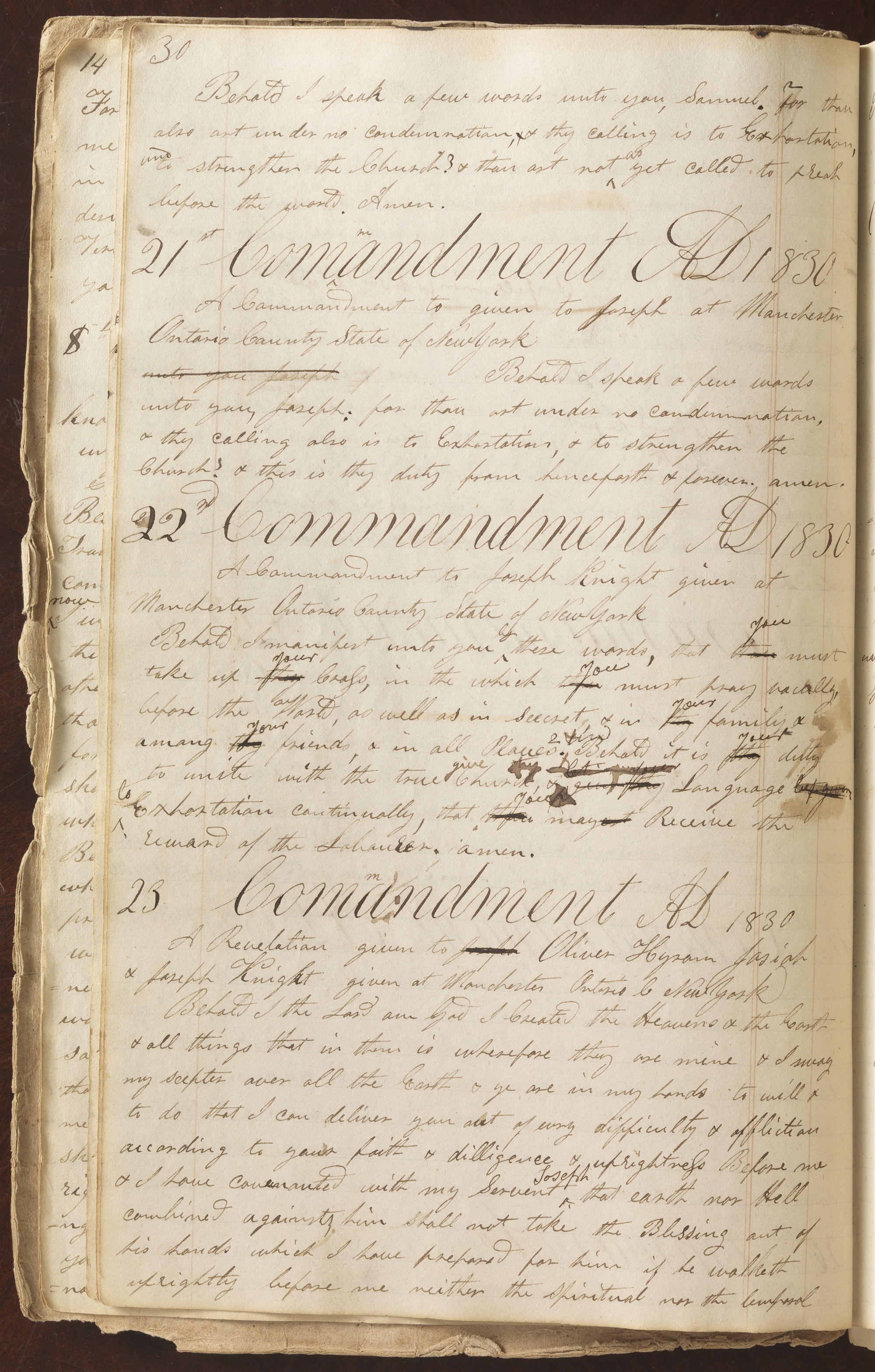
The 2009 Joseph Smith Papers publication of Revelation Book 1 made the actual manuscript text of the revelation publicly available for the first time. It contains explicit conditional language:
"I grant unto my servant a privilege that he may sell a copyright through you — speaking after the manner of men — for the four provinces, if the people harden not their hearts against the enticings of my spirit and my word; for behold, it lieth in themselves to their condemnation or to their salvation."[36]
The CES Letter quotes the revelation as if it were an unconditional command. The manuscript text contains "if the people harden not their hearts" right in the operative clause. The conditional reading isn't post-hoc apologetics; it's documentary.
A sharper skeptic will press the obvious objection: the trip happened. If the revelation was always provisional, why send four men across a frozen lake in the dead of winter at all? The trip itself was the test. Joseph couldn't know in January whether the people would harden their hearts; the conditional clause specified that whether the sale happened depended on a condition that could only be evaluated by attempting the sale. The conditional clause is the frame in which the failure becomes interpretable, not a post-trip excuse.
Hiram Page vs. David Whitmer: the source asymmetry
The CES Letter's source for the entire account is David Whitmer, An Address to All Believers in Christ (Richmond, MO: David Whitmer, 1887), p. 31. Whitmer wrote 57 years post-event. He had been excommunicated for 49 years. He was not on the Canadian trip. He is the sole source for the "Some revelations are of God; some of men; some of the devil" attribution, and he says they went to Toronto when the primary documents say Kingston.[37]
The other firsthand account, which the CES Letter does not cite, quote, or mention, is Hiram Page's letter to William McLellin, dated February 2, 1848 (typescript, Church History Library; printed in Dan Vogel's Early Mormon Documents 5:257-59).[8:2] Page was on the trip. He wrote 18 years post-event, 39 years before Whitmer wrote his Address. He wrote to McLellin, who by 1848 was hostile to Joseph, so he had no orthodoxy incentive to embellish. Page wrote:
"We were to go to Kingston where we were to sell [a copyright] if they would not harden their hearts… But when we got there, there was no purchaser neither were they authorized at Kingston to buy rights for the provence…"[8:3]
Page confirmed the conditional clause from inside the trip, and he drew a lesson from it rather than an indictment: "by the above we may learn how a revelation may be received and the person receiving it not be benefited" (spelling modernized). Page also addressed the broader question of plates-witness reliability and refused to retract; in a separate letter of May 30, 1847, he wrote: "It would be doing injustice to myself… to say that my mind was so treacherous that I had forgotten what I saw." His son Philander confirmed his father remained "true and faithful to his testimony of the divinity of the Book of Mormon until the very last."[8:4][38]
| Account | Date written | Distance from event | Was present? | Includes conditional clause? | City named | Tone |
|---|---|---|---|---|---|---|
| Hiram Page (letter to McLellin) | 1848 | 18 years | Yes | Yes | Kingston | Reflective; faith intact |
| David Whitmer (Address) | 1887 | 57 years | No | No | Toronto | Hostile: "not of God, but…of the devil" |
By every standard critics typically apply to historical sources (eyewitness primacy, contemporaneity, internal consistency, motive analysis), Page is the stronger source. The CES Letter quotes only Whitmer. Why does the case rest on the man who stayed home?
The Bradley suppression argument: exclusion from the 1833 Book of Commandments and the 1835 D&C
The strongest scholarly version of the critic's case isn't the CES Letter's; it's Don Bradley's. Bradley argues that the manuscript shows editorial deletions of the Kingston and copyright references, and that the revelation is unique among the revelations recorded in the manuscript Book of Commandments and Revelations (Revelation Book 1) in never reaching print: it appeared in neither the 1833 Book of Commandments nor the 1835 Doctrine and Covenants. Bradley reads the pattern as suppression, and the document compilation posted by Mormonism Research Ministry (MRM), an evangelical ministry critical of Latter-day Saint truth claims, gives his reading the last word: the revelation was excluded because it had failed.[39]
The exclusion is real, and two readings of it are coherent. A suppression reading: the revelation embarrassed the early Church and was edited as damage control, with the conditional clause inserted later. A restricted-context reading: the revelation was specific to a single 1830 legal situation and was never intended for general membership instruction. The manuscript chronology favors the second. John Whitmer's circa-March-1831 transcription preserves the conditional clause, and Hiram Page's 1848 letter confirms it from inside the trip, so the conditional reading was in the documentary record by March 1831, and Page's independent memory of the revelation's terms reaches back to the trip itself.[7:5] The exclusion-from-canon is data with more than one reading. The restricted-context reading is the more probable one, but the suppression reading is a coherent alternative a thoughtful skeptic can hold.
"Some revelations are of God; some of men; some of the devil"
Even if Joseph said this (and the only attribution is Whitmer, 57 years later), the framework it describes is not the admission of fraud the CES Letter treats it as. Latter-day Saint scripture had taught the same epistemic situation since 1829:
- D&C 9:7-9: revelation requires study first; some impressions yield a "stupor of thought" indicating they're wrong.[23:1]
- D&C 50:17-23: "by what shall ye know that they are of God?", explicit instruction in discerning the source of impressions.[40]
- D&C 129: tests for distinguishing angelic visitation from deception.[41]
- Moroni 7:13-17: "every thing which inviteth and enticeth to do good… is inspired of God"; the contrasting impressions are "of the devil."[42]
- 1 John 4:1: "Believe not every spirit, but try the spirits whether they are of God."[43]
That some impressions are divine, some human, and some adversarial is the standard Latter-day Saint discernment doctrine. Whitmer's attributed quote, if accurate, describes the standard situation honestly. It isn't Joseph admitting fraud. It's Joseph naming the operating reality every seeker faces, which is the same reality Latter-day Saint scripture had taught from the beginning. The CES Letter's treatment of the line as "even the Prophet couldn't tell" works only if the reader assumes the framework requires perfect, automatic discernment. The framework explicitly disclaims that. Boyd K. Packer's "The Candle of the Lord" (1983), which the CES Letter quotes, teaches discernment as a developable skill, not as proof the system fails.[44]
Further Reading
The definitive scholarly treatment of the Canadian copyright revelation is Stephen K. Ehat, Securing the Prophet's Copyright in the Book of Mormon: Historical and Legal Context for the So-Called Canadian Copyright Revelation, BYU Studies Quarterly 50/2 (2011): 5-70. The primary-source manuscript text is at Joseph Smith Papers, "Revelation, circa Early 1830". Lay-accessible treatment: Doctrine and Covenants Central, Why Did Joseph Smith Attempt to Secure the Book of Mormon Copyright in Canada? Companion: Sarah Allen, The CES Letter Rebuttal, Part 39.
D&C 87: the Civil War prophecy
The Civil War prophecy is the strongest single fulfilled-prophecy case in the Doctrine and Covenants. The CES Letter doesn't mention it. Critics outside the CES Letter (MRM, and IRR, the Institute for Religious Research) acknowledge it but argue it was either an "obvious 1832 prediction" or a post-hoc claim. Both arguments fail on the documentary record.
The text
D&C 87:1-4, dated December 25, 1832, scribed by Frederick G. Williams, recorded in Revelation Book 2 in early 1833:
"Verily, thus saith the Lord concerning the wars that will shortly come to pass, beginning at the rebellion of South Carolina, which will eventually terminate in the death and misery of many souls;
"And the time will come that war will be poured out upon all nations, beginning at this place.
"For behold, the Southern States shall be divided against the Northern States, and the Southern States will call on other nations, even the nation of Great Britain, as it is called, and they shall also call upon other nations, in order to defend themselves against other nations; and then war shall be poured out upon all nations.
"And it shall come to pass, after many days, slaves shall rise up against their masters, who shall be marshaled and disciplined for war."[45]
What the prophecy specified: strong fulfillments and partial residue
| Prediction | What happened | Assessment |
|---|---|---|
| War "beginning at the rebellion of South Carolina" | Fort Sumter, Charleston Harbor, South Carolina, April 12, 1861 | Strong fulfillment. The starting state, named 28 years in advance |
| Southern States divided against Northern States | South Carolina seceded December 20, 1860; eleven states formed the Confederacy by 1861 | Strong fulfillment. The geographic axis of the war |
| Southern States will call on Great Britain | Confederate diplomats (James Mason, John Slidell) actively sought British recognition; "King Cotton" diplomacy depended on it; the Trent Affair (November 1861) brought the Union and Britain to the edge of war; British shipyards built Confederate commerce raiders (the Alabama most notoriously); the postwar Geneva Arbitration cost Britain $15.5 million in damages | Partial. The Confederacy did call on Britain; Britain did not enter the war. The natural reading of "war shall be poured out upon all nations" is that war is poured out, not that diplomacy is attempted; that didn't happen. Apologetic readings extend the global war language to WWI and WWII, but that extension is a stretch. |
| Slaves shall rise up against their masters, marshaled for war | Roughly 179,000 Black soldiers served in the Union Army (United States Colored Troops, USCT), with another 19,000 in the Union Navy;[46] the Underground Railroad and contraband flight accelerated through the war | Partial at best. "Rise up against their masters" reads most naturally as armed slave insurrection within the South, and that mostly didn't materialize at the level the prophecy implies. During the war, enslaved people overwhelmingly fled to Union lines (contraband) or enlisted in USCT regiments (fighting for the Union army, often against their former masters, but not in the form of widespread internal slave insurrection). Apologists count USCT enlistment as fulfillment; critics correctly note that the natural reading of "rise up" is insurrection, which didn't happen at scale. |
| Death and misery of many souls | At least 620,000 military dead (long-standard figure; recent scholarship including Hacker 2011 revises the military total upward, with some estimates near 750,000)[47], more American casualties than every other American war combined until Vietnam | Strong fulfillment. The scale predicted |
Why the "obvious 1832 prediction" charge fails
The 1832 Nullification Crisis was contemporary. South Carolina's nullification convention met November 1832; Andrew Jackson responded December 10, 1832 with his famous proclamation. Critics (MRM) cite a Painesville Telegraph article from December 21, 1832 (reprinting a New York Courier and Enquirer piece), four days before D&C 87, as evidence that secession was publicly discussed in Joseph's region.[48] But the Nullification Crisis resolved peacefully by early 1833. Congress passed the Compromise Tariff in March 1833; South Carolina backed down. If Joseph had been reading newspapers and gambling on imminent war, he picked the wrong outcome.
Twenty-eight years later, it was Fort Sumter (South Carolina again, the same starting state Joseph had named) that triggered the war.
Scott C. Esplin's chapter in Civil War Saints (BYU Religious Studies Center, 2012), the definitive scholarly treatment, documents the publication history before fulfillment.[49] The prophecy was not canonized in the 1835 D&C; it was left out of that edition. It was first officially published in 1851 in the Pearl of Great Price (Liverpool edition, F. D. Richards), and it entered the canon only in 1876-1880. Orson Pratt printed the first newspaper account of the text in The Seer (April 1854) and had carried a manuscript copy and preached from it since his youth. Pratt later testified:
"I had a manuscript copy of this revelation, which I carried in my pocket, and I was in the habit of reading it to the people among whom I traveled and preached."[49:1]
Pratt recalled that audiences dismissed the prophecy: "the Union was too strong to be broken." A month after Fort Sumter, the Philadelphia Sunday Mercury (May 5, 1861) reprinted the prophecy under the headline "A Mormon Prophecy," closing with the question "Have we not had a prophet among us?" and acknowledging it had been "published at Liverpool, in 1851."[49:2] That document forecloses the post-hoc-publication theory.
The residue that remains
D&C 87:2-6 also predicts war "poured out upon all nations" and famine, plague, and earthquake until "consumption decreed hath made full end of all nations." Extending this to WWI and WWII (90+ years later) is one available apologetic reading, but it's a stretch: the natural reading ties the global war directly to the South Carolina rebellion, and the global-war element didn't unfold in that immediate timeframe. Esplin documents how later leaders reinterpreted and de-emphasized the prophecy's global portion, including the 1919 clash in which James E. Talmage called applying it to the League of Nations an "unwise and unwarranted misapplication of Scripture."[49:3]
The fair assessment is that D&C 87 rests on four strong elements (Fort Sumter starting state named 28 years in advance; Confederate diplomacy with Britain; death and misery of many souls; war "poured out upon all nations" if read as the long arc of nineteenth- and twentieth-century warfare) and two weak ones (slaves rising up at insurrection scale; full British entry into the war).[50] It is a strong case, not a slam-dunk. But the strong elements (South Carolina specifically named as the war's starting state, pre-fulfillment publication in 1851, the Philadelphia Sunday Mercury reprint immediately after Fort Sumter) are not dismissible.
Further Reading
For the definitive scholarly treatment, see Scott C. Esplin, Have We Not Had a Prophet Among Us?: Joseph Smith's Civil War Prophecy, in Civil War Saints, ed. Kenneth L. Alford (Provo, UT: Religious Studies Center, BYU, 2012). The primary-source manuscript is at Joseph Smith Papers, "Revelation, 25 December 1832 [D&C 87]". The Steven C. Harper "mainly descriptive, not prescriptive" frame is in Doctrine and Covenants Central, Historical Context and Background of D&C 87.
D&C 118:4-5: the Twelve at Far West, April 26, 1839
This is the catalog's "fulfilled exactly under hostile conditions" case. The prophecy named a specific date, a specific place, and a specific commission, and it was widely expected to fail, because mobs in Missouri were actively trying to prevent its fulfillment.
The revelation
D&C 118:4-5, dated July 8, 1838, given at Far West, Missouri:
"And next spring let them depart to go over the great waters, and there promulgate my gospel, the fulness thereof, and bear record of my name.
"Let them take leave of my saints in the city of Far West, on the twenty-sixth day of April next, on the building-spot of my house, saith the Lord."[51]
Specific date (April 26, 1839). Specific city (Far West). Specific building lot (the temple lot). Specific commission (mission to England).
Why fulfillment looked impossible
By April 1839, eight months after the revelation:
- Thomas B. Marsh, President of the Twelve, had apostatized in October 1838.
- David W. Patten, an apostle, had been killed at the Battle of Crooked River, October 25, 1838.
- Joseph Smith was imprisoned at Liberty Jail.
- Governor Boggs's Extermination Order (October 27, 1838) made Mormon presence in Missouri illegal.
- The Saints had been driven from Far West and were refugees in Quincy, Illinois, 200 miles east.
- Captain Samuel Bogart and Missouri mobs had explicitly vowed to murder any of the Twelve who appeared at Far West to fulfill the revelation. Wilford Woodruff later recalled the threat in a discourse: "The Missourians had sworn by all the gods of eternity that if every other revelation given through Joseph Smith were fulfilled, that should not be, for the day and date being given they declared that it should fail."[52]
The hostile witnesses were tracking the calendar date, intending to use the prophecy as a trap.
What happened on April 26, 1839
Brigham Young led a group of the Twelve back into Missouri clandestinely. They arrived at the Far West temple lot before dawn. About twenty-five Saints gathered secretly. Alpheus Cutler laid a cornerstone. Wilford Woodruff and George A. Smith were ordained apostles to fill vacancies (Woodruff was one of the four named in D&C 118:6; Smith filled the vacancy left by Thomas B. Marsh's apostasy). The Twelve sang "Adam-ondi-Ahman," prayed, and departed for England, as commanded, on the date commanded, from the spot commanded, despite explicit mob threats to prevent it.[53][54]
The British mission of 1839-1841 produced thousands of converts, funded the Nauvoo period of the Church, and launched the international expansion that built the modern Church.
This case is hard to dismiss precisely because the prophecy was made under public conditions (in 1838, with a year's notice) and the hostile witnesses were watching for it to fail. The Missourians had singled out this revelation as the one that would fail. Why is it the one that came true to the day, on the named spot? The fulfillment isn't post-hoc retrofitting; the mob's expectations are part of the documentary record.
Further Reading
Susan Easton Black, Insight on D&C 118 (BYU RSC; canonical PDF currently has an SSL certificate issue). Working alternative: Scripture Central, How Did Brigham Young and the Apostles Fulfill Prophecy in 1839?
D&C 84:4-5: the Independence temple "in this generation"
This is the hardest single case in the catalog.
The text
D&C 84:1-5, dated September 22-23, 1832:
"Verily this is the word of the Lord, that the city New Jerusalem shall be built by the gathering of the saints, beginning at this place, even the place of the temple, which temple shall be reared in this generation.
"For verily this generation shall not all pass away until an house shall be built unto the Lord, and a cloud shall rest upon it, which cloud shall be even the glory of the Lord, which shall fill the house."[55]
194 years later, no Latter-day Saint temple has been built on the dedicated plot. The dedication site itself, roughly two and a half acres, has been owned since the 1860s-70s by the Church of Christ (Temple Lot), a small Restoration denomination; Community of Christ, formerly the Reorganized LDS Church (RLDS), the church led by Joseph Smith III after 1860, owns surrounding parcels and dedicated its own temple nearby in 1994. The Latter-day Saints have not built on the dedicated plot.[56]
What the case requires
Three faithful responses are available, each with its own cost:
1. The D&C 124:49-51 principle, applied to the Independence case. Just over seven years after the 1833 expulsion from Jackson County, Joseph received a revelation in Nauvoo (January 19, 1841) that establishes a general principle relevant to the Independence temple situation:
"Verily, verily, I say unto you, that when I give a commandment to any of the sons of men to do a work unto my name, and those sons of men go with all their might and with all they have to perform that work, and cease not their diligence, and their enemies come upon them and hinder them from performing that work, behold, it behooveth me to require that work no more at the hands of those sons of men, but to accept of their offerings…
"Therefore, for this cause have I accepted the offerings of those whom I commanded to build up a city and a house unto my name, in Jackson county, Missouri, and were hindered by their enemies, saith the Lord your God."[57]
D&C 124:49-50 establishes a general principle ("when I give a commandment… and their enemies come upon them and hinder them"); verse 51 applies it to Jackson County offerings ("for this cause have I accepted the offerings of those whom I commanded to build up a city and a house unto my name, in Jackson county, Missouri, and were hindered by their enemies"). Verse 51 does name Jackson County specifically, which makes the application more than a critic-imagined interpolation. The retrospective application from D&C 84:5 to D&C 124:49-51 still requires interpretive work: verse 51 accepts "the offerings" but doesn't explicitly say "the temple in this generation prophecy is hereby released." That difference is real, and the application isn't fully explicit.[58]
2. The "generation = dispensation" reading. Joseph Fielding Smith in Doctrines of Salvation (1954-56) and the 2017 D&C Student Manual treat "generation" in this context as referring to the dispensation of the fulness of times rather than a fixed 30-50 year span.[59][60] Latter-day Saint tradition has consistently read "generation" in some prophetic contexts as dispensational rather than chronological, and Joseph Smith himself reinterpreted Christ's "this generation" prophecy (Matthew 24:34) along similar lines in his inspired Bible revision, the Joseph Smith Translation (JST) of 1830-1833.
The cost is real: the dispensation reading is post-hoc. Wallace reports that the 1890 D&C printing carried a footnote glossing "generation" ("a generation does not all pass away in one hundred years"), since dropped from later editions, and reads the deletion as institutional discomfort with the interpretive maneuver.[4:2] The text of D&C 84:5 doesn't contain a conditional clause; the dispensation reading is an interpretive overlay, not a documentary feature. It's defensible as one available reading. It isn't unilaterally compelling.
3. The promise of eventual fulfillment. Latter-day Saint tradition continues to hold the Independence prophecy as one to be fulfilled in the future. The Church owns property in Independence (the Visitor's Center), maintains the Liberty Jail Memorial, preserves the Far West historic site, and continues to teach that the New Jerusalem temple will eventually be built. The expectation is that the fulfillment will happen, but on no fixed timeframe. The cost: "wait long enough" is a structurally weaker apologetic than "the conditional clause is in the manuscript text."
What this case concedes
| What's hard | What's available | The verdict |
|---|---|---|
| 194 years and no temple on the dedicated plot | D&C 124:49-51 release; dispensation reading; future fulfillment | All three are real responses; none is free of cost |
| The "generation" reading as "dispensation" is post-hoc | Same | One available reading, adopted after the fact |
| Wallace's report of an 1890 footnote glossing "generation," later dropped | Institutional articulations sometimes change as the canonical framework develops | The deletion is data; the data has more than one reading |
What the failed-revelations catalog never reaches is the Book of Mormon itself; that harder problem belongs to the critic, and the close of this article takes it up.
D&C 124:15-19, 91-96: Hyrum's apostolic calling
This case sits just behind the Independence temple in difficulty. Two clarifications first. The relevant verses are D&C 124:15-19 and 91-96, not the "D&C 124:90-95" range some critical catalogs cite (verse 90 sits in the William Law material; Hyrum's blessing enters at v. 91). And the case is best framed not as "Hyrum's protection" but as Hyrum's apostolic-and-patriarchal calling: the verses do not contain an Isaiah 54:17 "no weapon formed against thee shall prosper" clause. They contain something different: language about Hyrum's "name being had in honorable remembrance from generation to generation, forever and ever," with strong implications about Hyrum being a "prophet, seer, and revelator" alongside Joseph.
So the critic's point isn't "the protection promise failed," because there isn't an explicit protection promise in these verses. The point is sharper than that. The calling described in vv. 91-96 (Hyrum standing alongside Joseph as prophet, seer, and revelator, holding the patriarchal keys, with his name preserved through generations) was given in January 1841, and Hyrum was killed at Carthage on June 27, 1844, three years and five months later. The calling sounds like it should have unfolded over decades of ministry, not three and a half years.
The actual verses
D&C 124:15-19, dated January 19, 1841:
"And again, verily I say unto you, blessed is my servant Hyrum Smith; for I, the Lord, love him because of the integrity of his heart, and because he loveth that which is right before me, saith the Lord."[61]
(Verses 16-17 turn to John C. Bennett; vv. 18-19 are about Lyman Wight, with v. 19 referencing David Patten, Edward Partridge, and Joseph Smith Sr. as already received unto the Lord.)
D&C 124:91-96, the apostolic-calling material:
"And again, verily I say unto you, let my servant William [Law] be appointed, ordained, and anointed, as counselor unto my servant Joseph, in the room of my servant Hyrum, that my servant Hyrum may take the office of Priesthood and Patriarch, which was appointed unto him by his father, by blessing and also by right;
"That from henceforth he shall hold the keys of the patriarchal blessings upon the heads of all my people…
"And from this time forth I appoint unto him that he may be a prophet, and a seer, and a revelator unto my church, as well as my servant Joseph;
"That he may act in concert also with my servant Joseph…
"That my servant Hyrum may bear record of the things which I shall show unto him, that his name may be had in honorable remembrance from generation to generation, forever and ever."[62]
The two readings the case actually requires
Two readings are available.
Apostolic-calling-not-life-extension. Many scriptural callings include language about the called person's witness, name, and ministry without specifying a particular life-span. Paul received apostolic calls and powerful blessing language; Paul was eventually executed by Rome. Stephen was called as a witness and stoned to death shortly thereafter. Christian tradition reads martyrdom as fulfillment of apostolic mission rather than its abortion. On this reading, Hyrum's calling was real, Hyrum's keys were genuinely conferred, and the "name had in honorable remembrance from generation to generation" promise has been fulfilled in the literal sense: Hyrum's name is held in honorable remembrance in Latter-day Saint memory and worship 185 years later. The patriarchal-keys-and-priesthood elements transferred through Hyrum to subsequent generations. The calling was fulfilled in the apostolic-witness register, not the long-mortal-ministry register.
Conditional on circumstances the framework doesn't enumerate. All canonical blessings operate within the larger framework of agency, persecution, and the Lord's purposes. Even unconditional-sounding blessings can yield to circumstances the recipient doesn't control. Hyrum wasn't murdered for failing to fulfill the conditions of D&C 124:91-96; he was murdered because mob violence overtook the Carthage Jail.
The apologetic reading is defensible. It isn't unilaterally compelling: apologetic accounts that import Isaiah 54:17 into D&C 124's reading are interpolating language the actual verses don't contain. The steadiest framing is the one Joseph articulated as he rode to Carthage:
"I am going like a lamb to the slaughter; but I am calm as a summer's morning; I have a conscience void of offense towards God, and towards all men. I shall die innocent, and it shall yet be said of me — he was murdered in cold blood."[63]
Joseph went to Carthage knowing he was going to die. The framework that produces "going like a lamb to the slaughter" is the same framework that produces D&C 124's blessing language for Hyrum. Joseph's reading of his own circumstance, and Hyrum's, was apparently martyrdom-fulfilling-mission, not life-preservation.[64]
The Stephen A. Douglas prophecy
The Stephen Douglas case is the political-history exhibit, with elements of strength and elements critics correctly press.
The setting
May 18, 1843. Joseph Smith dined at Carthage, Illinois, with Stephen A. Douglas, an Illinois state-court judge who would become a U.S. Senator (1847), Democratic presidential nominee (1860), and one of the most consequential figures in 1850s American politics. Joseph predicted to Douglas that he would "aspire to the Presidency of the United States" and warned: "if you ever turn your hand against me or the Latter-day Saints, you will feel the weight of the hand of the Almighty upon you."[65]
The contemporary record is in William Clayton's journal entry of that date. The same Clayton entry records the government-overthrow prophecy treated later in this article.
The outcome
| Prediction | What happened |
|---|---|
| Douglas would aspire to the presidency | Democratic nominee, 1860; serious contender in 1856 |
| Douglas would turn against the Saints | June 12, 1857 Springfield speech declaring that if reports from Utah proved true, it would become "the duty of Congress to apply the knife and cut out this loathsome, disgusting ulcer";[66] supported federal action against Utah; the Utah War followed within months |
| If he turned, he would feel "the weight of the hand of the Almighty" | 1860 election: Lincoln won 180 electoral votes; Douglas received 12 (carrying Missouri and three of New Jersey's seven electoral votes). Death June 3, 1861, at age 48, of typhoid fever, exhausted by the campaign. |
What the case actually shows, and what critics correctly note
The pre-1860 publication chronology is real and matters: FAIR (Faithful Answers, Informed Responses), a volunteer Latter-day Saint apologetics organization, documents Deseret News September 24, 1856 and Millennial Star February 1859, both before Douglas's 1860 run.[67] The post-hoc-publication charge is weakened by these publications.
A skeptic correctly notes that not all elements of the prophecy carry equal evidentiary weight. By 1843, Douglas was already a state-court judge with rising political prospects in the Democratic Party. Predicting Douglas would "aspire to the presidency" had high prior probability. The specific element ("weight of the hand of the Almighty") is vague enough to count as fulfilled by any political setback. Douglas did turn against the Saints (the 1857 Springfield speech is documented), and Douglas did lose decisively in 1860 and die in 1861. But attributing the loss-and-death sequence to a divine curse is one interpretation among others, and a skeptic can fairly hold that the political fracture (the Democratic Party splitting between Douglas and Breckinridge over slavery) is the proximate cause.
The fair framing: the Douglas case has real publication chronology in its favor (the 1856-1859 publications predate the 1860 events), but the predictive content mixes elements of high prior probability with elements that are vaguer. D&C 87's Civil War prediction is stronger as a standalone fulfilled-prophecy case than the Douglas case is. The Douglas case adds weight to the cumulative argument; it isn't decisive on its own.
The Rocky Mountain prophecy
The Rocky Mountain prophecy is documented by multiple witnesses across the pre-1844, pre-1847, and later record. The CES Letter doesn't mention it. Critics charge that the prophecy was first recorded in Anson Call's circa-1854 statement, after the 1847 arrival in the Salt Lake Valley; the FAIR response and the Scripture Central KnoWhy document earlier and independent witnesses.
Pre-1844 documented statements
| Date | Source | What was recorded |
|---|---|---|
| Feb 15, 1831 | Richard W. Cummins, letter to Gen. William Clark of the U.S. Office of Indian Affairs (hostile-neutral external witness) | Reports the missionaries saying that "if you refuse, then they will go to the Rocky Mountains" |
| April 11, 1831 | Thomas B. and Eliza Marsh, letter to the Abbotts | The Saints may yet "take our march… to the shining mountains which [are] 1500 or 2000 miles west" |
| May 7, 1831 | D&C 49 / Joseph teaching | "Zion shall flourish upon the hills and rejoice upon the mountains" |
| November 3, 1831 | D&C 133 | Gathering in "barren deserts" within "everlasting hills" |
| April 1834 | Wilford Woodruff (journal entry of October 5, 1884, recalling April 1834) | Joseph's Kirtland "first testimony… of filling the Rocky Mountains with the Saints of God" |
| August 6, 1842 | Anson Call statement (recorded circa 1854) | Joseph standing on a Mississippi riverbank, prophesies the Saints will "go to the Rocky Mountains" and become "a mighty people in the midst of the mountains" |
| 1842 | Times and Seasons | Missionary report references members willing to go west if Joseph commanded |
| July 1842 | Oliver Olney letter (hostile/apostate source) | Joseph planned to go "as far as the Rocky Mountains" with followers |
| June 22, 1844 (5 days before martyrdom) | William Bryan Pace, autobiography (late reminiscence; Pace was about twelve in 1844) | Final prophecy about gathering "many people into the fastness of the Rocky Mountains" |
Multiple witnesses later recorded versions of the prophecy: Wilford Woodruff, Anson Call, William Bryan Pace, Benjamin F. Johnson, Wandle Mace, John Taylor, Bathsheba W. Smith, and others, with Brigham Young appealing to it in sermon recollections of the 1860s.[68][69]
The Tanners' forgery charge collapses
Sandra and Jerald Tanner argued the Rocky Mountain prophecy was fabricated post-1847 to manufacture prophetic credentials. They cited a Davis Bitton article as their authority. Bitton's actual conclusion contradicts the Tanner reading: he explicitly rejects the "later invention of the Utah Mormons" thesis, concluding instead that the prophecy "probably had a basis in an actual statement" by Joseph Smith.[70] FAIR documents the Tanners' misappropriation of Bitton's work.
Even hostile historian Dale Morgan (not a Latter-day Saint, a secular historian of the American West, working in the 1940s-1950s with no apologetic motive) concluded that the evidence for Joseph's western intentions was sufficient to "demolish once and for all" any argument that he didn't entertain that purpose.[71]
The fulfillment
Brigham Young entered the Salt Lake Valley July 24, 1847. Within three years, Saints had founded settlements throughout the Wasatch Front. Within fifty years, Utah had been admitted to the Union (1896) and the Saints had built temples, cities, and a thriving economy "in the midst of the mountains," exactly as predicted.
Further Reading
For the strongest treatment of the Rocky Mountain prophecy and the Tanners' citation of Davis Bitton, see FAIR, Joseph Smith's Rocky Mountain prophecy. For the lay-accessible version, see Scripture Central, Why Did the Saints Move to the Rocky Mountains?
The Carthage death prophecies, and Willard Richards's protection
The cluster of prophecies surrounding Joseph's death at Carthage is hard to dismiss naturalistically because the prophecies were specific, multiple, and recorded before fulfillment by independent witnesses.
Joseph's own death prophecies
October 1843: "I prophesy they never will have power to kill me till my work is accomplished, and I am ready to die."[72]
June 22, 1844 (five days before death). Joseph's own narrative in History of the Church records his words to Stephen Markham: if he and Hyrum were ever taken again, "we should be massacred, or I was not a prophet of God."[73]
June 24, 1844. Riding to Carthage to surrender, Joseph said: "I am going like a lamb to the slaughter; but I am calm as a summer's morning; I have a conscience void of offense towards God, and towards all men. I shall die innocent, and it shall yet be said of me — he was murdered in cold blood."[63:1]
The Willard Richards Carthage protection prophecy
In 1843, Joseph reportedly told Willard Richards that bullets "would fly around him like hail, and he should see his friends fall on the right and on the left, but that there should not be a hole in his garment." On June 27, 1844, Richards stood in the same room as Joseph, Hyrum, and John Taylor at Carthage Jail. Joseph and Hyrum were killed. Taylor was hit by four balls and grievously wounded. Richards walked out unscathed with only a clipped earlobe: the only man in the room not shot, preserved precisely as predicted.[74]
The Dan Jones Welsh-mission prophecy
On the night before the martyrdom (June 26, 1844), after Dan Jones said that, engaged in such a cause, he did not think "that death would have many terrors," Joseph whispered: "You will yet see Wales, and fulfill the mission appointed you before you die."[75] The next morning Jones was sent out on errands, the guard refused to readmit him, and by midday he had been dispatched to Quincy with a letter for the lawyer O. H. Browning, escaping Carthage hours before the attack. He survived, saw Wales, founded the Welsh-language Latter-day Saint press, and converted thousands.
Why this cluster matters
Death prophecies are rare in Christianity. Christ's own predictions of His Passion (Mark 8:31, 9:31, 10:33-34) are treated by Christian readers as demonstrations of divine foreknowledge. Joseph's predictions of his own death (multiple, witnessed, recorded before fulfillment) function in the same evidential register. They aren't selection effects: Joseph kept saying he was going to be killed, and then he was killed, in exactly the way he predicted (taken captive a second time after a betrayal). The CES Letter passes over this record entirely.
D&C 121:7-9: the Liberty Jail vindication
This revelation was received in March 1839, while Joseph languished in Liberty Jail under conditions calculated to break him.
The context
By March 1839, from the Liberty Jail vantage point: the Church was scattered, broken, refugees in Quincy, Illinois. Joseph faced capital charges (treason). The federal government had refused to intervene. Several of the Twelve had apostatized (Marsh, McLellin, Hyde, Boynton). The Saints had been expelled from three states in eight years.
The prophecy
"My son, peace be unto thy soul; thine adversity and thine afflictions shall be but a small moment;
"And then, if thou endure it well, God shall exalt thee on high; thou shalt triumph over all thy foes."[76]
The fulfillment
| Timeframe | What happened |
|---|---|
| Within one month | Joseph escaped (or was permitted to escape) on April 16, 1839; reunited with family in Quincy |
| Within five years | Nauvoo built (one of the largest cities in Illinois); the British mission completed; the temple endowment instituted; Joseph ran for U.S. President |
| Within a decade | Saints crossed the plains, settled the Great Basin, began building Zion in the mountains |
| By the present | Nearly 18 million members worldwide; Joseph's name "had for good and evil" in scores of languages; the most thoroughly documented religious-textual corpus of the modern era |
How literally to read "triumph over all thy foes" is a fair question, and the record is mixed. Boggs (the Extermination Order governor) survived the 1842 attempt on his life, served in the Missouri state senate from 1842 to 1846, and finished his days in California; Thomas Sharp, acquitted in 1845, went on to a long Hancock County career as an editor, lawyer, and schoolteacher, and died in Carthage in 1894. Joseph's enemies did not meet cinematic ends. What did happen is that the cause they represented lost: the Saints the Extermination Order was written to expel built a commonwealth in the mountains, the order itself was formally rescinded by Governor Christopher S. "Kit" Bond in 1976, and the church Boggs and Sharp fought outlived every institution arrayed against it in 1839.[77]
Measured against 1839 plausibility, the prophecy is staggering.
Other failed-revelation cases: briefer treatment
The broader critical canon (MRM, IRR, LDS Discussions, Cold Case Christianity, Wikipedia's neutral catalog) names several additional cases the cumulative-case argument rests on. Each requires a brief engagement.
The U.S. government to be "utterly overthrown and wasted" (May 18, 1843)
History of the Church 5:394:
"I prophesy in the name of the Lord God of Israel, unless the United States redress the wrongs committed upon the Saints in the state of Missouri and punish the crimes committed by her officers that in a few years the government will be utterly overthrown and wasted, and there will not be so much as a potsherd left…"[78]
The U.S. government persists 183 years later. Apologetic readings: B.H. Roberts treats Missouri's wartime devastation, the Whig collapse, and the Civil War constitutional reformations as partial fulfillment.[79] Some apologists treat the prophecy as conditional on the government failing to redress Missouri grievances, a condition the explicit "unless" language in History of the Church 5:394 supports. The "broken up" language hasn't fulfilled in any meaningful literal sense. The conditional reading is available (the "unless" is in the original utterance), but the strict literal reading isn't. The conditional reading does real work here, and the case stays hard even so.
Lilburn Boggs assassination prophecy
In some critical catalogs, Joseph is said to have prophesied in 1841 that Boggs (the Missouri governor who issued the Extermination Order) would be violently killed within a year. Boggs was shot on May 6, 1842 but survived; he died of natural causes in 1860. Two issues. The primary-source attribution for the prophecy in this specific form is contested: there is no contemporaneous canonical or first-person record of Joseph making this exact prediction in 1841, and the attribution comes from later accounts of variable reliability. And even taking the alleged prophecy at face value, the outcome (Boggs shot but survived) is partial. The fair categorization is a tier-3 source case (contested attribution, no clean primary source), not a strong case in either direction. It can't be leaned on as fulfilled prophecy, and the critic can't lean on it as failed prophecy.
Thomas B. Marsh "to be exalted" (D&C 112)
Conditional on faithfulness. Marsh apostatized in 1838; conditions not met. Restored in 1857 as a re-baptized member; he died in Ogden.[80]
David W. Patten's spring 1839 mission (D&C 114)
Patten died at the Battle of Crooked River October 25, 1838, six months before the prophesied mission was to begin. The text of D&C 114:1 directs Patten by name to "settle up all his business as soon as he possibly can, and make a disposition of his merchandise, that he may perform a mission unto me next spring, in company with others, even twelve including himself." The naming is specific. The timing is specific. There is no conditional clause.
Patten was an apostle who died defending the Saints at Crooked River, not a betrayer or a deviant. Comparing his case to Judas is theologically forced and is the wrong frame. A cleaner comparison is Stephen, called as a witness by the Apostles in Acts 6 and stoned to death shortly thereafter. Even that comparison strains, because Stephen's calling didn't include a specific timetable that his death precluded; D&C 114's "next spring" mission did.
The available faithful reading is that D&C 114 issued a calling, and the calling's "next spring" component was conditional on Patten's continued life, a conditioning that isn't in the text but is implicit in the framework that callings depend on their recipient's mortal availability to fulfill them.
The calling itself (one of the Twelve) was real and conferred. When Patten died, the Twelve's spring 1839 mission still happened, led by Brigham Young, who succeeded to the role D&C 114 had positioned Patten for. A skeptic correctly notes that "implicit conditioning that isn't in the text" is exactly the kind of move charged as unfalsifiable apologetic. This is one of the harder cases in the catalog; the apologetic reading is available, but it requires reading "perform a mission unto me next spring" through the lens of the Twelve's collective mission rather than Patten's individual fulfillment.
The 56-year second coming (1835, Kirtland; restated 1843)
Joseph said Christ would not come before Joseph reached age 85: a denial of imminence, not an affirmation of fulfillment in 1890. The 1835 statement is in History of the Church 2:182 (February 14, 1835, the Kirtland meeting at which the Twelve were appointed), and it is the fifty-six-years wording this subsection's name comes from: Joseph spoke of "the coming of the Lord, which was nigh — even fifty-six years should wind up the scene."[81]
Two further statements came in April 1843, amid the Millerite date-setting excitement then at its height. D&C 130:14-17 (April 2, 1843) records Joseph's report of a voice saying: "Joseph, my son, if thou livest until thou art eighty-five years old, thou shalt see the face of the Son of Man; therefore let this suffice, and trouble me no more on this matter."[82]
Four days later, in general conference (April 6, 1843; History of the Church 5:336), he put it this way: "I prophesy in the name of the Lord God, and let it be written — the Son of Man will not come in the clouds of heaven till I am eighty-five years old." His own frame in the same entry is hedged, not predictive: "I was left to draw my own conclusions concerning this; and I took the liberty to conclude that if I did live to that time, He would make His appearance. But I do not say whether He will make his appearance or I shall go where He is."[81:1]
The conditional structure is explicit in the D&C 130 wording ("if thou livest"), and the April 6 hedging frame makes the same point in Joseph's own voice. Read against the date-setting movements of the day, the statements function as denials of imminence: Joseph was telling the Saints not to expect the Second Coming on anyone's near-term calendar. A skeptic can still fairly note that a Saint who took the fifty-six-years or eighty-five-years statements at face value would have expected the Second Coming around 1890-91, and some late-nineteenth-century Saints did hold that expectation.[81:2]
Kirtland Safety Society "as good as gold" (1837)
The bank failed. Apologetic: optimistic statement, not formal revelation; Brigham Young eventually redeemed scrip for gold in Utah.[83] This is a tier-3 case, the statement being informal optimism rather than canonized revelation.
The Salem treasure (D&C 111, August 1836)
No treasure found. The revelation itself reframes the trip: D&C 111:1-2 explicitly state the Lord's purposes and turn the failed-treasure mission into a future-Salem-conversion blessing. A skeptic correctly notes that this is the apologetic move where the failed mission gets reframed as the success, exactly the kind of move critics call revelation-rescue. D&C 111 is in the canon and did reframe the trip's purpose at the time it was given, not after the fact, which makes the redirection documentary rather than post-hoc apologetic. But the redirection itself is data critics will read as the framework adapting to apparent failure.
The "moon inhabitants" prophecy
Third-hand 1881 journal entry, not contemporary; lunar habitability was mainstream 1830s-1850s science (William Herschel; the "Great Moon Hoax" of 1835). Not a formal revelation. This is a tier-3 source case.
Relief Society "queens shall pay you respect" (April 28, 1842)
Conditional: Joseph explicitly said "if you will be pure"; Relief Society was suspended in 1844; conditions not met. The framework allows for forfeiture of conditional blessings by disobedience (the Jeremiah 18 framework), which is why the case is most naturally read as the conditional-blessing-pattern rather than as a failed prediction.
What survives filtering
When the cumulative critical catalog is filtered for formal revelation in unconditional form with primary-source attribution, the list shrinks substantially. The hardest residue is:
- Independence temple "in this generation" (D&C 84:4-5): engaged above.
- D&C 124:15-19, 91-96, Hyrum's apostolic calling: engaged above.
- The 1843 government-overthrow prophecy: the "unless" is in the original utterance, which gives the conditional reading documentary footing; partial fulfillment is available; the literal "broken up" hasn't happened.
The framework's response on each is partial but coherent. Independence temple: D&C 124:49-51 release; dispensation reading; future fulfillment. Hyrum: apostolic-calling reading. Government overthrow: explicit conditional language in original; partial fulfillment via Missouri devastation and Civil War constitutional reformation. None is fully comfortable. None is ad-hoc.
Genre-collapse: what kinds of prophetic speech act exist
The CES Letter's argument depends on collapsing categories of Latter-day Saint speech-act into a single bucket called "doctrine." Brigham's Adam-God sermon, Joseph Fielding Smith's moon-travel speculation, the Independence temple commandment, the Civil War prophecy, and the Canadian copyright revelation are all treated as the same kind of thing. The Church's framework distinguishes them.
| Speech-act category | Example | Authority level |
|---|---|---|
| Canonized revelation | D&C 87 (Civil War); D&C 84 (Independence temple); D&C 121 (Liberty Jail) | Standard Works: binding doctrine |
| Official Declaration sustained by Church | OD 1 (Manifesto); OD 2 (1978 priesthood revelation) | Binding doctrine |
| Uncanonized revelation in manuscript | Canadian copyright revelation (Revelation Book 1, 1830) | Genuine revelation; never canonized |
| Pulpit sermon by President | Brigham Young on Adam-God (1852-1873) | Sermon; not canonized; subject to D&C 26:2 common consent |
| Personal opinion / speculation | Joseph Fielding Smith on moon travel (1962) | Personal opinion |
| Informal optimistic statement | "Kirtland Safety Society notes as good as gold" | Not formal revelation |
The formal framework, canonized in D&C 26:2 (1830, common consent), D&C 28:13 (1830, "all things must be done in order"), and D&C 107:27 (1835, First Presidency and Twelve must be unanimous), and articulated repeatedly across leader statements from J. Reuben Clark 1954 forward, distinguishes these categories explicitly.[84][85][32:1]
The CES Letter's "yesterday's doctrine is today's false doctrine" refrain has force only if a pulpit sermon, a private speculation, and a canonized revelation all count as the same kind of thing. The framework distinguishing canonized scripture from sermons from personal opinions has been continuous in the Latter-day Saint canon since 1830. It isn't a 20th-century apologetic invention.
The framework's categories were canonized in the 1830s, but its applications (which specific speeches count as which category) have often been retrospective. Brigham's Adam-God sermons were preached from the pulpit and understood by some Saints as binding doctrine (Eliza R. Snow set them to verse); they were only categorized as non-canonical after they became theologically inconvenient. Joseph Fielding Smith's pre-Apollo moon-travel speculation was solidified as "personal opinion" after the moon landings made it indefensible. Critics correctly call this out as one face of the post-hoc-justification charge. The answer from inside the framework is that it provides categories that have to be applied to specific cases through canonical mechanisms (common consent; First Presidency-Twelve unanimity; the Standard Works), and application requires judgment.
The cases the CES Letter most aggressively raises are addressed in dedicated articles: Adam-God (Brigham preached it as revelation; senior apostles resisted it in his lifetime, and Joseph F. Smith formally classified it as non-binding in 1897); blood atonement (the rhetorical peak in the 1856-57 Reformation that was walked back four months later by the same prophet who preached it); the priesthood and temple ban (the 126-year deviation from Joseph's racial inclusivity that was lifted in 1978 and whose justifying theories were disavowed in 2013); and Mark Hofmann (the forger whose documents fooled the FBI, the Library of Congress, and Kenneth Rendell alongside the Brethren).
Engaging the academic case
The CES Letter's version of the failed-revelations argument is not the strongest one. The academic version is sharper: Wallace's strict Deuteronomic test, the conditional-language critique as a moving target, the fallibility framework as post-hoc, the ratio question. Answer that version, and the CES Letter's version falls with it.
The conditional-language move as moving target, and what falsifiability looks like here
Critic claim: the apologist who appeals to "conditional language" or "generation = dispensation" is making an unfalsifiable move. If any failed prophecy can be reinterpreted via conditionality after the fact, no prophetic claim can ever be falsified.
Response: Wallace is partially right. The conditional, dispensation, and release moves can be applied unfalsifiably, and when they're applied uniformly across every difficult case, they degenerate into the universal solvent the critic is calling out.
What rescues the response is that the applications here are constrained differently by the documentary record. The Canadian copyright conditional is documentary: the "if the people harden not their hearts" clause is in the manuscript text and confirmed by Hiram Page's 1848 letter, not retrofitted. The Independence-temple D&C 124:49-51 application is canonical-principle-applied-to-named-case: verse 51 names Jackson County, so the application isn't free-floating. The Hyrum apostolic-calling reading is an interpretive overlay on calling-language that is, admittedly, one of several available readings. The speech-act categories (D&C 26:2, 28:13, 107:27) are institutional, and where they cut against the apologetic (Adam-God being the hardest case), the framework has real explaining to do.
Each move could in principle be falsified by different evidence: a manuscript without the conditional clause; a temple actually built before the expulsion; Hyrum's name forgotten; a teaching unanimously sustained by the First Presidency and later repudiated. The apologetic positions here are falsifiable in principle, even when they aren't falsifiable on the single test Wallace proposes. The conditional-language move is not a universal solvent applied to every difficult case; it's a documentary feature of some cases, a constrained canonical application in others, and an interpretive overlay in still others. Those are different things, and they have to be kept distinct.
The fallibility framework as moving target
Critic claim: the Latter-day Saint framework's articulation of fallibility has become more explicit as the documentary record forced more explicit articulation. The post-1976 cycle (Christofferson 2012, Andersen 2012, Uchtdorf 2013, Oaks 2018) is suspicious for that reason.
Response: the foundational framework was canonized in the 1830s. D&C 1:24-28 (November 1, 1831). D&C 9:7-9 (April 1829). D&C 21:1-5 (April 6, 1830, on receiving Joseph's words "as if from mine own mouth, in all patience and faith"). D&C 26:2 (1830, common consent). D&C 28:13 (1830, "all things in order"). D&C 107:27 (1835, First Presidency-Twelve unanimity). The 20th-century articulations clarified the framework; they did not invent it. Joseph's own "a prophet was a prophet only when he was acting as such" (February 8, 1843) is pre-Brigham and pre-Adam-God.
That said, the cultural-doctrinal mismatch is real. Brigham Young in October 1870 told the Saints that his discourses, when "copied and approved by me," should be regarded as "as good Scripture as is couched in this Bible."[9:1] That's a strong-form claim. Joseph Fielding Smith in the mid-20th century treated his own Doctrines of Salvation as authoritative. The cultural assumption of near-inerrancy ran ahead of the doctrinal articulation through long stretches. Mason's quip about nobody believing the prophet is fallible points at the same gap. The doctrinal framework was always there; the cultural absorption lagged.
Spackman: "speaking as a man" itself is a less-than-useful framework
Ben Spackman's April 2023 essay "Acting as a Man and Other Less-than-Useful Frameworks for Talking About Prophets" makes the most theologically sophisticated critique of the apologetic move from inside the Latter-day Saint scholarly community.[86] Spackman argues that the "prophet/man" distinction is "too neat, too siloed, too binary in its on/off." Borrowing from Kenton Sparks, he frames prophetic communication as "God's Word in human words," not pure divine dictation. Prophets are not "friction-free conduit[s] for a perfection of divine knowledge"; they communicate through their historical, cultural, and linguistic contexts.
This is the most theologically serious version of the moving-target charge. It accepts that the binary is too clean and reframes prophetic communication as integrated, with full divine authority running through full human limitation, neither switched-off nor switched-on. Spackman is right that the binary is inadequate, and the framework's canonical resources (D&C 1:24, "in their weakness, after the manner of their language") were already saying something close to what Spackman articulates more carefully. Joseph wasn't claiming friction-free conduit status. He was claiming prophetic authority through human limitation. That's the framework D&C 1 canonized.
The fulfillment ratio argument
Critic claim: even if some prophecies fulfilled, the ratio doesn't favor the apologetic. The apologist counts maybe 15-20 strong cases; critical catalogs claim 20-30+ alleged failures. Even if 60% fulfilled, 40% failed, and Deuteronomy 18:22 doesn't admit a 60% threshold.
Response: three observations.
The ratio argument requires the strict Deuteronomic standard, which the Bible itself doesn't apply consistently. Critics don't apply the same standard to Jonah (whose Nineveh prophecy didn't come true), to Isaiah (whose Babylon-as-eternal-ruin imagery hasn't fulfilled), or to Christ's own statement on the Second Coming. The strict ratio standard is selective.
Most "failed" prophecies in the critical canon fail on source-tier or category grounds. The moon inhabitants: 1881 third-hand hearsay. The Salem treasure: D&C 111 itself reframes the trip's success. The Kirtland Safety Society "as good as gold": informal optimism, not formal revelation. Patten's mission: a calling, not a deterministic prophecy. Marsh's exaltation: explicitly conditional in D&C 112. Apply the same three filters (formal, unconditional, primary-source), and most of the catalog drops out.
The hardest residue (Independence temple, government overthrown, Hyrum's calling in D&C 124) survives filtering and remains hard. The framework's response on each is partial but coherent. The ratio argument doesn't dissolve the cumulative case, but it does require taking the residue seriously.
The cumulative case: what Joseph's prophetic identity actually rests on
The CES Letter's strategy is to isolate weak cases (Canadian copyright, generalized "failed revelations") and treat them as decisive. Cumulative-evidence epistemology says the question is the pattern. Joseph's prophetic identity rests on multiple independent lines:
The Book of Mormon. Dictated in roughly 60 working days (Welch counts 57 to 63), with no substantive revisions, no whistleblowers among multiple eyewitnesses, and no naturalistic account that has held up.[87] It carries ancient features Joseph could not have known: chiasmus (an inverted A-B-B-A literary parallelism characteristic of ancient Hebrew texts), Hebraisms (Hebrew grammatical patterns surfacing awkwardly in the English), geographical details now corroborated such as the Nahom altars in Yemen, and Hebrew names like Sariah and Alma now attested in ancient Near Eastern sources. The text itself is treated at length under Book of Mormon, and the people who handled the plates under Witnesses.
The Restoration's doctrinal architecture. In a few short years, much of it before age 30, Joseph produced a doctrinal system of unprecedented coherence and theological richness: premortal life, eternal families, gradual progression, the Three Degrees of Glory, the Plan of Salvation, modern temples, the priesthood structure, vicarious work for the dead.
Specific fulfilled prophecies engaged above. D&C 87 (Civil War, South Carolina specifically named, 28 years before Fort Sumter, published 1851 in the Pearl of Great Price); D&C 118:4-5 (the Twelve at Far West, fulfilled exactly under hostile conditions on the named date); D&C 121:7-9 (Liberty Jail vindication); the Stephen Douglas prophecy; the Rocky Mountain prophecy (multiple witnesses); Joseph's own death prophecies; Willard Richards's Carthage protection.
Joseph's name "had for good and evil among all nations" (Joseph Smith—History 1:33, Moroni's 1823 statement). Implausible in 1823: Joseph was a 17-year-old farm boy in upstate New York. By the present, his name is known in scores of languages and his religious movement has nearly 18 million adherents worldwide.
The Wentworth Letter prophecies (March 1842). "[T]he truth of God will go forth boldly, nobly, and independent till it has penetrated every continent, visited every clime, swept every country, and sounded in every ear." In 1842, the Church had perhaps 20,000 members but had already begun missions to Britain (1837), Canada, and other parts of the eastern U.S. Predicting global penetration in 1842 was visionary, though not out of nothing: the missionary trajectory was already in motion. The "every continent" prediction has nonetheless been quantitatively verified, and the scope goes substantially beyond what 1842's reach would have warranted as straight-line extrapolation.[88]
The pattern matters more than any single case. Cumulative-evidence epistemology cuts both ways: the skeptic also has a cumulative case (failed prophecies, Book of Abraham translation issues, polygamy concealment, First Vision account discrepancies), each engaged in its own article on this site. Candor about the one requires candor about the other. The CES Letter's strategy of isolating the Canadian copyright revelation and treating it as decisive is selective in the bad sense: it ignores both the documentary record on the named exhibit and the rest of the prophetic record.
What stands at the center: the Book of Mormon as the prophet-test
Joseph Smith's prophetic identity does not rest primarily on the Independence temple commandment, on the apostolic-calling language for Hyrum in D&C 124, or even on the Civil War prophecy.
It rests primarily on the Book of Mormon.
The Book of Mormon is the test. If it is what it claims to be (an ancient record dictated in roughly 60 working days, with no substantive revisions, witnessed by men who never recanted), then Joseph was a prophet, full stop. Failed-revelations arguments at the periphery don't dissolve the central case.
The Independence temple in 194 years is hard. Hyrum's apostolic-calling language is hard. The 1843 government-overthrow prophecy hasn't fulfilled literally. These are real residues, named plainly above. But each of those exhibits is a gap in the record: a thing the documentary trail doesn't deliver. The Book of Mormon stands at the opposite pole: a thing the documentary trail does deliver, an artifact whose production has no naturalistic account that survives examination. The CES Letter's failed-revelations argument tries to defeat the prophet by pressing on the gaps while leaving the object on the table untouched. Cumulative evidence doesn't work that way.
Bottom-line assessment
The CES Letter names exactly one "failed revelation," the Canadian copyright trip, and uses it as the wedge for a broader cumulative case against prophetic reliability. The named exhibit collapses on three fronts: the manuscript text (the conditional clause is in the 1830 revelation Joseph dictated), the eyewitness record (Hiram Page wrote 18 years post-event from inside the trip and confirms the conditional reading; David Whitmer wrote 57 years post-event from outside it and doesn't), and the historical-legal context (Ehat 2011 establishes the trip was a sensible commercial response to the Cole piracy crisis).
The broader cumulative case the CES Letter wants the reader to internalize (prophets receive revelations, those revelations sometimes don't pan out, therefore the prophets are not what they claim) runs into the framework Joseph put into scripture in 1831. D&C 1's preface has the Lord's servants speaking "in their weakness, after the manner of their language," with error anticipated and correction built in, and it was on the books before most of the catalog's alleged failures occurred.
Filter the failed-revelation catalog for formal revelation in unconditional form with primary-source attribution, and the residue is small. Independence temple "in this generation." Hyrum's calling in D&C 124:15-19, 91-96. The 1843 government-overthrow prophecy. The framework's response on each is partial but coherent: the D&C 124:49-51 release mechanism (acknowledging it doesn't name Independence specifically and the application is interpretive); the apostolic-calling-and-honorable-remembrance reading for Hyrum; the explicit conditional language in the original utterance for the government-overthrow case. None sits easy.
Against that residue stand the fulfilled cases traced above, and at the center of them the Book of Mormon.
The CES Letter's two-tier discernment punchline (are we now expected to figure out when a prophet is speaking as a prophet, and whether our answers to prayer are from God, from the devil, or from ourselves?) asks a question the framework has always answered in the affirmative: yes, at both levels, with a method attached. D&C 9:7-9 specifies the discernment process. Moroni 7:13-17 names the criterion. 1 John 4:1 commands the test. The framework anticipates the situation, names the method, and treats discernment as a developable skill. The CES Letter's question only sounds devastating if the reader assumes the answer is no, and the framework's resources show why the answer is yes.
The Latter-day Saint framework is harder to operate in real time than in retrospect. The quip Mason repeats (Latter-day Saints teach prophetic fallibility, and few internalize it) names the cultural-doctrinal gap. But operated with open eyes, the framework produces a coherent reading: a prophet operates in human language and weakness; revelation is sometimes specific and sometimes conditional; the Church distinguishes Standard-Works canon from sermons from personal opinions; some commandments are released when external circumstances prevent obedience; some prophecies fulfill in unexpected ways; some remain to be fulfilled; and the framework was anticipating all of this from D&C 1:24 onward.
That reading doesn't make the failed-revelation problem disappear. It places the problem in a coherent theological frame that critics can disagree with but cannot honestly call ad-hoc. And the document the CES Letter's argument never opens is the one that began this article: a manuscript whose words say something the critic's summary leaves out. Open the larger document, the Book of Mormon itself, and the same thing happens on a much larger scale. The text is in plain view, its production undisputed, its naturalistic explanation still missing. The failed-revelations argument leaves that document closed, and a closed document defeats no one.
Runnells, CES Letter (2017), "Testimony & Spiritual Witness," no. 4, pp. 76-77. ↩︎
Runnells, CES Letter (2017), "Testimony & Spiritual Witness," p. 77 (rhetorical question closing the no. 4 discussion). ↩︎
Runnells, CES Letter (2017), "Prophets," pp. 61-69. The "Prophets" section raises related concerns about changing doctrines and prophetic fallibility, including Adam-God theory, blood atonement, the priesthood ban, and Mark Hofmann. ↩︎
J. Warner Wallace, "Can We Trust the Prophecies of Joseph Smith?" Cold Case Christianity. https://coldcasechristianity.com/writings/can-we-trust-the-prophecies-of-joseph-smith/ Wallace develops the strict-Deuteronomic test and applies it to specific Joseph Smith prophecies, including the Independence temple in this generation. ↩︎ ↩︎ ↩︎
Institute for Religious Research, "Failed Prophecies of Joseph Smith." https://mit.irr.org/failed-prophecies-of-joseph-smith Compiles a seven-prophecy catalog as a cumulative-case argument. ↩︎
Mark 13:32 (KJV): "But of that day and that hour knoweth no man, no, not the angels which are in heaven, neither the Son, but the Father." On the question of the Second Coming's timing, the Son of God explicitly disclaimed knowledge. ↩︎ ↩︎
Stephen K. Ehat, "'Securing' the Prophet's Copyright in the Book of Mormon: Historical and Legal Context for the So-Called Canadian Copyright Revelation," BYU Studies Quarterly 50, no. 2 (2011): 5-70. Definitive scholarly treatment. Demonstrates legal plausibility under 1814 British copyright law (54 Geo. 3, c. 156), establishes Kingston (not Toronto) as the correct venue, reconstructs the full revelation text from manuscript sources, and documents the January 1830 Abner Cole piracy crisis as motivating context. https://byustudies.byu.edu/article/securing-the-prophets-copyright-in-the-book-of-mormon-historical-and-legal-context-for-the-so-called-canadian-copyright-revelation ↩︎ ↩︎ ↩︎ ↩︎ ↩︎ ↩︎
Hiram Page to William E. McLellin, February 2, 1848 (typescript, Church History Library, MS 9090); printed in Dan Vogel, ed., Early Mormon Documents (Salt Lake City: Signature Books, 2003), 5:257-59, and quoted in the Joseph Smith Papers introduction to "Revelation, circa Early 1830" and in Scripture Central, KnoWhy 556. Page, a participant in the Canadian copyright trip, confirms the conditional clause ("if they would not harden their hearts") from inside the trip and reflects that "we may learn how a revelation may be received and the person receiving it not be benefited" (spelling modernized; the manuscript reads "revlation… receving… benafited"). His separate letter of May 30, 1847 (in Larry E. Morris, ed., A Documentary History of the Book of Mormon [New York: Oxford University Press, 2019], 428) defends his plates testimony: "to say that my mind was so treacherous that I had forgotten what I saw." ↩︎ ↩︎ ↩︎ ↩︎ ↩︎
Brigham Young, "Texts for Preaching Upon at Conference," October 6, 1870, Journal of Discourses 13:264. The wider passage records Brigham's view that when his discourses "are copied and approved by me they are as good Scripture as is couched in this Bible." A version of the more famous paraphrase ("I have never yet preached a sermon… that they may not call scripture") circulates in apologetic and critical literature with various volume citations; the verifiable Brigham source for the substantive claim is the October 6, 1870 discourse at JD 13:261-268. ↩︎ ↩︎
Joseph Fielding Smith in the mid-twentieth century treated his own Doctrines of Salvation as authoritative. For long stretches of LDS history, the taught expectation of prophetic reliability was higher than what the canonical framework strictly required, and members absorbed that higher expectation. The CES Letter and its critical heirs are working from this higher-expectation cultural framing — and that framing was genuinely taught. The modern articulations represent a course correction, not just a clarification of what was always equally emphasized. ↩︎
Patrick Q. Mason, "Can I Trust and Sustain Fallible Leaders?" Faith Matters Substack, April 2025. https://www.faithmatters.org/p/can-i-trust-and-sustain-fallible-dc3 The Catholics/Mormons line is a quip Mason relates in Planted and in the Faith Matters conversation, not a sentence he authored. Mason (Utah State, Arrington Chair) develops the three-functions framework (servants, messengers, witnesses) and the "we don't look to the prophets, we look through them to Jesus Christ, who is the real object of our worship" formulation. ↩︎
D. Todd Christofferson, "The Doctrine of Christ," April 2012 General Conference. "[N]ot every statement made by a Church leader, past or present, necessarily constitutes doctrine." https://www.churchofjesuschrist.org/study/general-conference/2012/04/the-doctrine-of-christ ↩︎
Neil L. Andersen, "Trial of Your Faith," October 2012 General Conference. "The doctrine is taught by all 15 members of the First Presidency and Quorum of the Twelve. It is not hidden in an obscure paragraph of one talk." https://www.churchofjesuschrist.org/study/general-conference/2012/10/trial-of-your-faith ↩︎
Dieter F. Uchtdorf, "Come, Join with Us," October 2013 General Conference. "[T]here have been times when members or leaders in the Church have simply made mistakes. There may have been things said or done that were not in harmony with our values, principles, or doctrine." https://www.churchofjesuschrist.org/study/general-conference/2013/10/come-join-with-us ↩︎ ↩︎
Dallin H. Oaks, "Truth and the Plan," October 2018 General Conference; cf. Oaks's earlier discussions of "the process of approval by other apostles and prophets" as the mechanism by which individual teachings become doctrine. ↩︎
Deuteronomy 18:21-22 (KJV). ↩︎
Jonah 3:4: "Yet forty days, and Nineveh shall be overthrown." The Nineveh prophecy is unconditional in its surface form; the city repented (Jonah 3:5-10) and the destruction was averted. Jonah remained the prophet of Israel. ↩︎
Jeremiah 18:7-10 (KJV). The canonical biblical framework for conditional prophecy. Prophecies of judgment can be averted by repentance; prophecies of blessing can be forfeited by disobedience. The full passage continues: "And at what instant I shall speak concerning a nation, and concerning a kingdom, to build and to plant it; If it do evil in my sight, that it obey not my voice, then I will repent of the good, wherewith I said I would benefit them." ↩︎
2 Kings 20:1-6; Isaiah 38. Isaiah delivered an unconditional message ("thou shalt die"); Hezekiah prayed; Isaiah returned the same day with a corrective revelation extending Hezekiah's life by fifteen years. ↩︎
2 Samuel 7:3-5. Nathan first told David to build the temple; received corrective revelation that same night reversing the instruction. ↩︎
The disanalogy a careful skeptic will press: in the biblical cases, the conditioning mechanism is textual and explicit — Jonah operates within Jeremiah 18's conditional framework; Hezekiah's reprieve is a same-day corrective revelation; Nathan's correction is a same-night reversal; Christ's Mark 13:32 is an explicit disclaimer rather than a failed prediction. In each instance the mechanism that handles the apparent failure is built into the text itself. The Joseph Smith cases mostly lack that textual mechanism — D&C 84:4-5 has no conditional clause; the D&C 124:49-51 release came eight years later and is generic. What the framework supplies instead is an institutional mechanism — D&C 1:24-28's "in their weakness, after the manner of their language," plus D&C 9:7-9 and Joseph's "a prophet was a prophet only when he was acting as such." That is a real difference in kind, and it requires the apologetic to do additional case-by-case work the biblical examples didn't have to do. The biblical material disqualifies the strict Deuteronomic standard as the Bible's own internal standard; it doesn't prove the apologetic readings of D&C 84, D&C 124, or the 1843 government-overthrow prophecy are correct. Those readings have to be supported on their own merits. ↩︎
Doctrine and Covenants 1:24-28. The Lord's preface to the D&C, received November 1, 1831 — before most of the alleged "failed prophecies" critics cite. Anticipates errant servants speaking through human limitation, names a correction mechanism, builds in iterative growth. ↩︎
Doctrine and Covenants 9:7-9. Given to Oliver Cowdery in April 1829, before the Book of Mormon was published. Establishes study-then-ask discernment process and the "stupor of thought" negative signal. ↩︎ ↩︎
Articles of Faith 1:9 (March 1842). "We believe all that God has revealed, all that He does now reveal, and we believe that He will yet reveal many great and important things pertaining to the Kingdom of God." ↩︎
Joseph Smith, remark to visitors from Michigan, February 8, 1843. History of the Church 5:265: "This morning, I read German, and visited with a brother and sister from Michigan, who thought that 'a prophet is always a prophet;' but I told them that a prophet was a prophet only when he was acting as such." The contemporaneous Joseph Smith Papers journal entry for the same day records the exchange in compressed form ("A Prophet is not always a Prophet"). The classic Latter-day Saint articulation of prophet-as-fallible-man — distinct from the frailty statements and the May 12, 1844 "I never told you I was perfect" statement; see the adjoining notes. ↩︎
Joseph Smith, discourse, May 21, 1843 (on 2 Peter 1). History of the Church 5:401: "I do not want you to think that I am very righteous, for I am not." ↩︎
Joseph Smith, discourse to the Relief Society, August 31, 1842. History of the Church 5:140: "the wrong that I do is through the frailty of human nature, like other men. No man lives without fault." ↩︎
Joseph Smith, remarks, July 23, 1843. History of the Church 5:516: "I am subject to like passions as other men, like the prophets of olden times." ↩︎
Joseph Smith, discourse, May 12, 1844 (six weeks before martyrdom). History of the Church 6:366: "I never told you I was perfect; but there is no error in the revelations which I have taught." ↩︎
Brigham Young, remarks at a special council, Salt Lake City Tabernacle, March 21, 1858, in A Series of Instructions and Remarks by President Brigham Young at a Special Council (Salt Lake City, 1858), cf. pp. 13-14; reprinted in Richard S. Van Wagoner, ed., The Complete Discourses of Brigham Young, 3:1418: "Can a Prophet or an Apostle be mistaken? Do not ask me any such question, for I will acknowledge that all the time, but I do not acknowledge that I designedly lead this people astray one hair's breadth from the truth… so may you." ↩︎
MormonR, "Prophetic Fallibility" Q&A. https://mormonr.org/qnas/vhBxbh/prophetic_fallibility Its statements table collects two dozen leader statements from 1843 to 2020 affirming prophetic fallibility, including Joseph Smith, Brigham Young, George Q. Cannon, Lorenzo Snow, Charles W. Penrose, J. Reuben Clark, Joseph Fielding Smith, Bruce R. McConkie, Harold B. Lee, James E. Faust, Robert D. Hales, Dieter F. Uchtdorf, Dallin H. Oaks. ↩︎
J. Reuben Clark Jr., "When Are the Writings or Sermons of Church Leaders Entitled to the Claim of Scripture?" Address to seminary and institute personnel, BYU, July 7, 1954. Published in Church News, July 31, 1954 (cf. pp. 9-10); reprinted in Dialogue: A Journal of Mormon Thought 12, no. 2 (Summer 1979): 68-81 (the sentence quoted above is at p. 68). https://www.dialoguejournal.com/wp-content/uploads/sbi/articles/Dialogue_V12N02_70.pdf The touchstone for the modern articulation of the "moved upon by the Holy Ghost" criterion. ↩︎ ↩︎
Joseph Fielding Smith, Doctrines of Salvation, comp. Bruce R. McConkie (Salt Lake City: Bookcraft, 1954-56), 1:323-24 (cf.; e-text page scheme): "If I should say something which is contrary to that which is written and approved by the Church generally, no one is under obligation to accept it. Everything that I say and everything that any other person says must square itself with that which the Lord has revealed, or it should be rejected." ↩︎
"Why Did Joseph Smith Attempt to Secure the Book of Mormon Copyright in Canada?" Scripture Central KnoWhy. https://scripturecentral.org/knowhy/why-did-joseph-smith-attempt-to-secure-the-book-of-mormon-copyright-in-canada Companion lay-accessible treatment of Ehat's argument. ↩︎
Sarah Allen, "The CES Letter Rebuttal, Part 39," FAIR Blog, December 31, 2021. https://www.fairlatterdaysaints.org/blog/2021/12/31/the-ces-letter-rebuttal-part-39 Develops the J.K. Rowling intellectual-property/printing-rights analogy and identifies four credibility issues with Whitmer's 1887 account. ↩︎
"Revelation, circa Early 1830," Revelation Book 1, pp. 30-31, Joseph Smith Papers. First published in Robin Scott Jensen, Robert J. Woodford, and Steven C. Harper, eds., Revelations and Translations: Manuscript Revelation Books, Facsimile Edition, vol. 1 (Salt Lake City: Church Historian's Press, 2009). The conditional clause ("if the people harden not their hearts") is in the 1830 manuscript text, not added later. Text quoted with spelling and punctuation modernized, following Stephen O. Smoot and Brian C. Passantino, eds., "A Revelation to Secure the Copyright of the Book of Mormon," in Joseph Smith's Uncanonized Revelations (Religious Studies Center, BYU), 33-35; the manuscript reads "privelige… enticeings." https://www.josephsmithpapers.org/paper-summary/revelation-circa-early-1830/1 ↩︎
David Whitmer, An Address to All Believers in Christ (Richmond, MO: David Whitmer, 1887), 31. Written 57 years post-event, 49 years post-excommunication. Whitmer was not a participant in the Canadian trip. He is the sole source for the "Some revelations are of God; some of men; some of the devil" attribution and for the "Toronto" geographical error. (The Address's own wording is "some revelations are of men"; the CES Letter's quotation renders it "of man.") ↩︎
Scripture Central, "Why Did Hiram Page Remain Faithful to the Book of Mormon?" https://scripturecentral.org/knowhy/why-did-hiram-page-remain-faithful-to-the-book-of-mormon Documents Page's continued testimony of the Book of Mormon plates, his May 30, 1847 letter defending it, and the September 1888 interview in which his son Philander affirmed that his father remained "true and faithful to his testimony of the divinity of the Book of Mormon until the very last" (Larry E. Morris, ed., A Documentary History of the Book of Mormon [New York: Oxford University Press, 2019], 446). ↩︎
Mormonism Research Ministry, "The Attempt to Sell the Book of Mormon Copyright," https://mrm.org/attempt-to-sell-copyright A documents compilation (posted by Aaron Shafovaloff, 2008) presenting the JSP transcript, the Hiram Page 1848 letter, Whitmer's 1887 account, and an extended Don Bradley analysis. Bradley argues that the manuscript shows editorial deletions of the Kingston and copyright references and that "[t]his revelation was never published, even though every other revelation in the BCR was" (the manuscript Book of Commandments and Revelations, Revelation Book 1). The compilation's arrangement leaves Bradley's reading as the counterweight to Page. ↩︎
Doctrine and Covenants 50:17-23. "He that preacheth and he that receiveth, understand one another, and both are edified and rejoice together. And that which doth not edify is not of God, and is darkness." ↩︎
Doctrine and Covenants 129. Tests for distinguishing angels from devils. ↩︎
Moroni 7:13-17. "[E]very thing which inviteth and enticeth to do good, and to love God, and to serve him, is inspired of God." ↩︎
1 John 4:1 (KJV): "[B]elieve not every spirit, but try the spirits whether they are of God: because many false prophets are gone out into the world." ↩︎
Boyd K. Packer, "The Candle of the Lord," Ensign, January 1983. The talk teaches discernment as a developable skill, not as evidence the spiritual system fails. https://www.churchofjesuschrist.org/study/ensign/1983/01/the-candle-of-the-lord ↩︎
Doctrine and Covenants 87:1-4. Dated December 25, 1832; scribed by Frederick G. Williams; recorded in Revelation Book 2 in early 1833. Joseph Smith Papers, "Revelation, 25 December 1832 [D&C 87]." https://www.josephsmithpapers.org/paper-summary/revelation-25-december-1832-dc-87/1 ↩︎
National Archives, "Black Soldiers in the U.S. Military During the Civil War" (educator resources): roughly 179,000 Black soldiers served in the U.S. Army and another 19,000 in the Navy. https://www.archives.gov/education/lessons/blacks-civil-war Cf. National Park Service, "Civil War Facts," which counts 178,975 United States Colored Troops soldiers. ↩︎
J. David Hacker, "A Census-Based Count of the Civil War Dead," Civil War History 57, no. 4 (2011): 307-348. Hacker's revised estimate puts Civil War military dead at approximately 750,000 (high end of his confidence interval), substantially above the long-standard 620,000 figure derived from late nineteenth-century calculations. ↩︎
Mormonism Research Ministry, "Did Joseph Smith Correctly Predict the American Civil War?" https://mrm.org/civil-war Documents the Painesville Telegraph "The Crisis" article (December 21, 1832) as the strongest version of the "obvious 1832 prediction" charge. ↩︎
Scott C. Esplin, "'Have We Not Had a Prophet Among Us?': Joseph Smith's Civil War Prophecy," in Kenneth L. Alford, ed., Civil War Saints (Provo, UT: Religious Studies Center, BYU, 2012). https://rsc.byu.edu/civil-war-saints/have-we-not-had-prophet-among-us-joseph-smiths-civil-war-prophecy The author is Scott C. Esplin (BYU Religion professor) — not to be confused with Ronald K. Esplin, a different historian. Documents the 1832 Nullification Crisis context, the 1851 Pearl of Great Price publication, Orson Pratt's manuscript copy and Seer printing, and the Philadelphia Sunday Mercury May 5, 1861 reprint, headlined "A Mormon Prophecy" and closing with the question "Have we not had a prophet among us?" ↩︎ ↩︎ ↩︎ ↩︎
The major antebellum slave revolts (Nat Turner 1831, Vesey 1822) predate D&C 87; the dating matters for the slave-rising-up element. Esplin documents how later leaders reinterpreted and de-emphasized the prophecy's global portion (including the 1919 clash in which James E. Talmage called applying it to the League of Nations an "unwise and unwarranted misapplication of Scripture") and treats D&C 87:6 as future-oriented; Joseph himself confirmed the revelation at Ramus on April 2, 1843 (D&C 130:12-13). The "all nations / full end / direct British involvement / level of slave insurrections" elements are partial-at-best, with the global-war and slave-insurrection elements being the weakest parts of the prophecy. The "obvious 1832 prediction" charge nonetheless fails on the chronology because the 1832 Nullification Crisis resolved peacefully by early 1833; if Joseph had been pattern-matching headlines, the prediction's specific starting state would not have held when the crisis defused — but it did hold, 28 years later, at Fort Sumter. ↩︎
Doctrine and Covenants 118:4-5. Dated July 8, 1838, given at Far West, Missouri. The revelation specified the date (April 26, 1839), location (Far West temple lot), and commission (mission to England) for the Twelve's departure. ↩︎
Wilford Woodruff, discourse, in Journal of Discourses 13:159: "The Missourians had sworn by all the gods of eternity that if every other revelation given through Joseph Smith were fulfilled, that should not be, for the day and date being given they declared that it should fail." Quoted in Scripture Central, "How Did Brigham Young and the Apostles Fulfill Prophecy in 1839?" ↩︎
Susan Easton Black, Insight on D&C 118: April 26, 1839, Religious Studies Center, BYU. (The canonical PDF at archive.bookofmormoncentral.org has an expired SSL certificate as of July 2026; the Scripture Central KnoWhy at https://scripturecentral.org/knowhy/how-did-brigham-young-and-the-apostles-fulfill-prophecy-in-1839 covers the same fulfillment with full citations.) Documents the clandestine April 26, 1839 fulfillment under hostile conditions. ↩︎
Scripture Central, "How Did Brigham Young and the Apostles Fulfill Prophecy in 1839?" https://scripturecentral.org/knowhy/how-did-brigham-young-and-the-apostles-fulfill-prophecy-in-1839 Lay-accessible treatment of the D&C 118:4-5 fulfillment. ↩︎
Doctrine and Covenants 84:1-5. Dated September 22-23, 1832. ↩︎
R. Jean Addams, "Reclaiming the Temple Lot in the Center Place of Zion," Mormon Historical Studies: the Hedrickite Church of Christ (Temple Lot) reacquired the dedication site beginning with three lot purchases between August and December 1867 and completed the eight contiguous lots (about two and a half acres) on November 5, 1877; the church has held the parcel since. Community of Christ, "Temple Tour," https://cofchrist.org/temple-tour/ ("This Temple was formally dedicated in 1994"). ↩︎
Doctrine and Covenants 124:49-51. Dated January 19, 1841. The canonical apologetic resolution mechanism: when commanded people give full diligence and enemies prevent the work, the commandment is no longer required. ↩︎
A careful read of this passage matters. The faithful reading: the principle of vv. 49-50 plus the Jackson County application of v. 51 together provide a canonical mechanism that the Independence temple commandment fell under — the Saints were hindered by enemies, they had given offerings (lives, property, labor), and the Lord accepted those offerings. The release reading is retrospective. The September 1832 prophecy as stated didn't include a release clause; the release principle came in January 1841. A critic can fairly ask whether D&C 124's principle was always going to be invoked once the timeline stretched, or whether it was a real release of a real commandment that had been frustrated by external enemies. The text of D&C 124:51 — naming Jackson County and accepting the offerings of those commanded and hindered — supports the second reading. A hardened skeptic can still hold the first reading: the principle is general, and applying it to D&C 84:5's "this generation" language requires the apologetic to take "generation" plus "release" together as the resolution mechanism, neither element of which is explicit in D&C 84:4-5 itself. That's "natural application" of a canonized principle, not "explicit textual release of the original prophecy." ↩︎
Joseph Fielding Smith, Doctrines of Salvation (Salt Lake City: Bookcraft, 1954-56), 1:142. Treats "this generation" as referring to the dispensation of the fulness of times rather than a fixed 30-50 year span. ↩︎
Doctrine and Covenants Student Manual, 2017 edition, Chapter 31, "Doctrine and Covenants 84." https://www.churchofjesuschrist.org/study/manual/doctrine-and-covenants-student-manual-2017/chapter-31-doctrine-and-covenants-84 The official Church teaching on D&C 84:4-5 documents that the Saints were driven from Jackson County by the end of 1833 and confirms D&C 124:49-51 addresses the unfulfilled commandment. ↩︎
Doctrine and Covenants 124:15. The general blessing on Hyrum's integrity, dated January 19, 1841 — part of the same revelation that contains the temple-release principle in vv. 49-51 and the patriarchal-keys language in vv. 91-96. Verses 16-19 turn to John C. Bennett (vv. 16-17), Lyman Wight (v. 18), and a reference to the already-deceased David Patten, Edward Partridge, and Joseph Smith Sr. (v. 19). Hyrum was killed at Carthage Jail on June 27, 1844 — three years and five months after the revelation. (Some critical catalogs reference "D&C 124:90-95" for this material; verse 90 sits in the William Law counselor material, with Hyrum's blessing entering at verse 91. Bennett appears at vv. 16-17.) The general blessing language for integrity ("blessed is my servant Hyrum Smith for the integrity of his heart") echoes Old Testament covenant blessings that readers naturally interpret as including a long, fruitful life. The historical reality (Hyrum killed at Carthage) doesn't fit the natural reading. ↩︎
Doctrine and Covenants 124:91-96. The patriarchal-keys-and-prophet-seer-revelator material for Hyrum, designating William Law as counselor "in the room of" Hyrum so Hyrum could take the office of Patriarch. The "name had in honorable remembrance from generation to generation, forever and ever" language in v. 96 is the operative honor-and-remembrance promise. Some apologetic accounts have framed this case as "Hyrum's protection" by analogy to Isaiah 54:17, but the verses do not contain the "no weapon formed against thee shall prosper" clause. They contain calling-language. The case the article must engage is the calling-language-and-long-arc-ministry case, not a literal physical-protection promise. ↩︎
Doctrine and Covenants 135:4 (John Taylor's account of the martyrdom, canonized 1844), as printed in History of the Church 6:630. Taylor dates the statement to "when Joseph went to Carthage to deliver himself up to the pretended requirements of the law, two or three days previous to his assassination," i.e., the June 24, 1844 ride to Carthage. The on-the-road record at History of the Church 6:555 gives the variant "toward God and toward all men. If they take my life I shall die an innocent man, and my blood shall cry from the ground for vengeance." ↩︎ ↩︎
A skeptic can fairly note the alternative reading: Joseph could have said "lamb to the slaughter" because he sensed the long-arc apostolic ministry described in 1841 was about to end short, and he was articulating his acceptance of an unanticipated outcome rather than reporting what he and Hyrum had always understood the blessings to mean. That alternative reading is available. The apologetic reading is also available. Neither is unilaterally compelling. The text doesn't contain an explicit "no weapon formed against thee" clause — apologetic accounts that import Isaiah 54:17 into D&C 124's reading are interpolating language the actual verses don't contain. What the text does contain is calling-language that describes a long-arc ministry. The two readings rest on different assumptions about how blessing-and-calling language operates in scripture. ↩︎
William Clayton's Journal, May 18, 1843. The contemporary record of Joseph's prophecy to Stephen A. Douglas. Cf. Joseph Smith Papers, "JS's Prophecy about Stephen Douglas." https://www.josephsmithpapers.org/event/jss-prophecy-about-stephen-douglas Cf. Joseph Smith Papers, History, 1838-1856, volume D-1, pp. 1552-1553. ↩︎
Daily Missouri Republican (St. Louis), June 18, 1857, reporting Stephen A. Douglas's June 12, 1857 Springfield speech: "When the authentic evidence shall arrive, if it shall establish the facts which are believed to exist, it will become the duty of Congress to apply the knife and cut out this loathsome, disgusting ulcer. (Applause.)" As transcribed in "The Mormon Cancer, 1 of 2: Mountain Meadows Massacre," Juvenile Instructor (blog). https://juvenileinstructor.org/the-mormon-cancer-1-of-2-mountain-meadows-massacre/ ↩︎
FAIR, "Government to be overthrown and wasted," documenting the Stephen A. Douglas prophecy and pre-1860 publication history. Deseret News September 24, 1856; Millennial Star February 1859. https://www.fairlatterdaysaints.org/answers/Joseph_Smith/Alleged_false_prophecies/Government_to_be_overthrown_and_wasted ↩︎
FAIR, "Joseph Smith's Rocky Mountain prophecy." https://www.fairlatterdaysaints.org/answers/Joseph_Smith's_Rocky_Mountain_prophecy Carries Wilford Woodruff's journal entry of October 5, 1884 recalling Joseph's April 1834 Kirtland statement, the Anson Call account (via Tullidge), the Dale Morgan assessment, and corroborating witnesses including Benjamin F. Johnson, Wandle Mace, John Taylor, and Bathsheba W. Smith. ↩︎
Scripture Central, "Why Did the Saints Move to the Rocky Mountains?" https://scripturecentral.org/knowhy/why-did-the-saints-move-to-the-rocky-mountains Sources the Richard W. Cummins letter of February 15, 1831 (William Clark Papers, Kansas Historical Society), the Thomas B. and Eliza Marsh letter of April 11, 1831, the circa-1854 dating of the Anson Call statement (MS 364, Church History Library), and the William Bryan Pace autobiography for the June 22, 1844 statement. ↩︎
FAIR, "Forged Rocky Mountain prophecy / Tanners' use of sources." https://www.fairlatterdaysaints.org/answers/Joseph_Smith/Alleged_false_prophecies/Forged_Rocky_Mountain_prophecy/Tanners_use_of_sources Documents Davis Bitton's actual conclusion — that the prophecy "probably had a basis in an actual statement" — contradicting the Tanners' citation of his work. ↩︎
Dale Morgan to S. A. Burgess, 1942 correspondence, in John Phillip Walker, ed., Dale Morgan on Early Mormonism: Correspondence and a New History (Salt Lake City: Signature Books, 1986), 38, as quoted in FAIR, "Joseph Smith's Rocky Mountain prophecy." Morgan, a non-Latter-day Saint historian of the American West, judged the accumulating documents sufficient to "demolish once and for all" the claim that Joseph never entertained a western move, while staying softer on the prophecy itself ("I am by no means disposed to doubt it"). ↩︎
Joseph Smith, October 1843 statement. History of the Church 6:58: "I prophesy they never will have power to kill me till my work is accomplished, and I am ready to die." Cited in Saints Unscripted, "Prophecies of Joseph Smith." ↩︎
History of the Church 6:546 (June 22, 1844). Joseph's own direct narrative records the statement to Stephen Markham: "we should be massacred, or I was not a prophet of God." (B. H. Roberts's note at the passage: "Here the direct narrative of the Prophet ends.") ↩︎
History of the Church 6:619; Willard Richards's journal entry, June 27, 1844. The bullets-flying-around prophecy and its hours-later fulfillment with multiple witnesses present. Saints Unscripted, "Prophecies of Joseph Smith," documents the bullet-and-garment prophecy in its lay-accessible form. ↩︎
Joseph Smith to Dan Jones, night of June 26, 1844. History of the Church 6:601: "You will yet see Wales, and fulfill the mission appointed you before you die." The June 27 record (History of the Church 6:602-614) shows Jones sent out on errands in the morning, refused readmission by the guard, and dispatched to Quincy with a letter for the lawyer O. H. Browning around midday, hours before the attack. ↩︎
Doctrine and Covenants 121:7-9. Received March 1839, Liberty Jail, Missouri. The vindication prophecy delivered to Joseph in the depth of the Missouri persecution. Joseph Smith Papers, "Letter to the Church and Edward Partridge, 20 March 1839" (portions canonized as D&C 121 in the 1876 edition). ↩︎
Joseph Smith Papers, Biographical Directory: "Boggs, Lilburn Williams" (served in the Missouri state senate 1842-1846; migrated to Sonoma in 1846 and moved to the Napa Valley in 1852, where he died in 1860), https://www.josephsmithpapers.org/person/lilburn-williams-boggs; and "Sharp, Thomas Coke" (indicted for the murders of Joseph and Hyrum Smith in 1844 and later acquitted; teacher, lawyer, newspaper editor and publisher; died at Carthage in 1894), https://www.josephsmithpapers.org/person/thomas-coke-sharp ↩︎
History of the Church 5:394, May 18, 1843, at Carthage, from William Clayton's journal record; the same dinner conversation carries the Stephen A. Douglas prophecy. The "unless the United States redress the wrongs" language is in the original utterance, supplying explicit conditional structure that critics' "broken up as a government" framing typically omits. ↩︎
FAIR, "Government to be overthrown and wasted." https://www.fairlatterdaysaints.org/answers/Joseph_Smith/Alleged_false_prophecies/Government_to_be_overthrown_and_wasted Documents partial fulfillment via Missouri's Civil War devastation, the Whig collapse, the constitutional reformation post-Civil War, and the de facto government transformation between 1843 and the present. ↩︎
FAIR, "Joseph Smith/Alleged false prophecies/Thomas B. Marsh to be 'exalted.'" https://www.fairlatterdaysaints.org/answers/Joseph_Smith/Alleged_false_prophecies/Thomas_B._Marsh_to_be_"exalted" Marsh's exaltation in D&C 112 was conditional on faithfulness; Marsh apostatized in 1838. On the 1857 return, see Church History Topics, "Thomas B. Marsh," and Revelations in Context, "The Faith and Fall of Thomas Marsh" (both at churchofjesuschrist.org). ↩︎
History of the Church 5:336 (April 6, 1843, general conference) for the quoted eighty-five-years wording ("I prophesy in the name of the Lord God, and let it be written — the Son of Man will not come in the clouds of heaven till I am eighty-five years old") and its hedging frame; History of the Church 2:182 (February 14, 1835, the Kirtland meeting appointing the Twelve) for the fifty-six-years statement. Read in context, these function as denials of imminence framed against contemporary date-setting movements (especially the Millerite expectation in 1830s-40s revivalism). A skeptic can fairly note that a Latter-day Saint taking either statement at face value would have expected the Second Coming around 1890-91; that expectation was held within Latter-day Saint culture in the late nineteenth century. The "1890" framing as a positive date-set prediction is one available reading, but the contextual reading (denial-of-imminence) is the one Joseph's own hedging frame supports. ↩︎ ↩︎ ↩︎
Doctrine and Covenants 130:14-17 (April 2, 1843). The conditional D&C 130 framing ("Joseph, my son, if thou livest until thou art eighty-five years old, thou shalt see the face of the Son of Man") records Joseph's later reflection on the question. The 1843 D&C 130 record and the 1835 History of the Church statement are related but textually distinct. ↩︎
FAIR, "Alleged false prophecies of Joseph Smith" (Kirtland Safety Society section). https://www.fairlatterdaysaints.org/answers/Alleged_false_prophecies_of_Joseph_Smith "[T]his promise, ironically, eventually came true. Brigham Young redeemed Kirtland Safety Society scrip for gold in Utah," citing Marvin S. Hill, C. Keith Rooker, and Larry T. Wimmer, "The Kirtland Economy Revisited," BYU Studies 17, no. 4 (1977). ↩︎
Doctrine and Covenants 26:2: "All things shall be done by common consent in the church, by much prayer and faith." Canonized in 1830 — the foundational canonical principle for binding doctrine. ↩︎
Doctrine and Covenants 107:27. Canonized in 1835. Establishes that the First Presidency and Twelve must be unanimous for their decisions to carry the "same power or validity." ↩︎
Ben Spackman, "'Acting as a Man' and Other Less-than-Useful Frameworks for Talking About Prophets," April 2023. https://benspackman.com/2023/04/acting-as-a-man-and-other-less-than-useful-frameworks-for-talking-about-prophets/ LDS scholar's critique of the man-vs-prophet binary. Spackman draws on Kenton Sparks's framework: prophetic communication is "God's Word in human words" — full divine authority through full human limitation, neither switched-off nor switched-on. Spackman's call: move beyond "fallible" / "mistakes" defensive terminology and treat prophetic texts as genuinely human expressions containing divine authority. ↩︎
John W. Welch, "How Long Did It Take Joseph Smith to Translate the Book of Mormon?" Ensign, January 1988, calculates the dictation phase at "sixty-five or fewer working days" (mid-April through late June 1829). See also John W. Welch, "Timing the Translation of the Book of Mormon: 'Days [and Hours] Never to Be Forgotten,'" BYU Studies Quarterly 57, no. 4 (2018): 11-50, counting "a total of only 57 to 63 available full-time working days" and concluding the dictation took "not many more than the equivalent of about 60 actual working days" (p. 34). The total word count is 269,510. The broader period of the Book of Mormon's coming forth — from the 1823 Moroni visitation, through the lost 116 pages and other events, to the completed dictation in 1829 — extends across several years and remains debated. The full case is engaged in the Book of Mormon Translation section of this site. ↩︎
Joseph Smith, "Wentworth Letter" (March 1, 1842). Times and Seasons, March 1, 1842. The "no unhallowed hand" prophecy and the "every continent" promise are both in this letter. https://www.josephsmithpapers.org/paper-summary/church-history-1-march-1842/1 ↩︎