Credibility Concerns
The claim:
Before it says anything else about the eleven men, the CES Letter's Witnesses section declares them irrelevant, then spends twenty pages arguing that they cannot be trusted. The opening (p. 85):
"At the end of the day? It all doesn't matter. The Book of Mormon Witnesses and their testimonies of the gold plates are irrelevant... It doesn't matter because of this one simple fact: JOSEPH DID NOT USE THE GOLD PLATES FOR TRANSLATING THE BOOK OF MORMON."[1]
The opening dismissal is contradicted by the section's own length. Twenty pages of credibility attack establish that the witnesses do matter, enough that the case against them has to be made carefully. The numbered "Problems" at the end (pp. 101-105) gather the argument. The most cited:
"All of the Book of Mormon witnesses, except Martin Harris, were related by blood or marriage either to the Smiths or Whitmers... Mark Twain made light of this obvious problem: '...I could not feel more satisfied and at rest if the entire Whitmer family had testified.'"[2]
"Within eight years, all of the Three Witnesses were excommunicated from the Church. This is what Joseph Smith said about them in 1838: 'Such characters as... John Whitmer, David Whitmer, Oliver Cowdery, and Martin Harris, are too mean to mention; and we had liked to have forgotten them.'"[3]
The Martin Harris portrait (pp. 89-91) drives most of the character-attack volume:
"Martin Harris was anything but a skeptical witness. He was known by many of his peers as an unstable, gullible, and superstitious man... Before Harris became a Mormon, he had already changed his religion at least five times."[4]
The Stephen Burnett 1838 letter is the marquee contemporaneous citation (pp. 93-94):
"...when I came to hear Martin Harris state in public that he never saw the plates with his natural eyes only in vision or imagination, neither Oliver nor David & also that the eight witnesses never saw them & hesitated to sign that instrument for that reason..."[5]
One fact this portrait has to absorb comes from outside the Church entirely. In 1881, prominent non-Mormon residents of Richmond, Missouri, put their names publicly to David Whitmer's "undoubted truth and veracity."[6] They had no stake in the Book of Mormon. He had simply been their neighbor across some forty years, and they endorsed his honesty and the fact that he had never backed away from his testimony to the gold plates. No one who files him among "magical thinking, superstitious, inconsistent" men ever lived next door to him; these men had, for decades.
Hold that against the argument's actual structure. Stripped of rhetoric, it runs: the witnesses had folk-magic backgrounds; they were related; they were financially invested; they were excommunicated; therefore their testimony to the gold plates is unreliable. Each premise is largely true. The inference to unreliability is what does not survive engagement with the evidence: the physical-handling testimony of the Eight, the post-departure reaffirmations of the Three across fifty years, the corrective half of the Burnett letter the CES Letter omits, and the documentary work of Anderson 1981, Harper 2010 / 2015 / 2023, Jensen 2005, Black/Porter 2018, Morris 2019, and Rappleye/Smoot 2024.
Worth Acknowledging
Folk magic, seer stones, and divining rods belonged to these families' documented world. The family relationships are just as the CES Letter maps them: every witness but Harris tied to the Smiths or Whitmers by blood or marriage. All Three Witnesses were indeed excommunicated. Harris's later affiliations ran through several movements, a brief Strangite mission among them. Burnett's 1838 letter is authentic, contemporaneous, and written from inside the movement. Faithful scholarship contests none of it. The disagreement is whether the cumulative pattern entails fabrication, or whether the documentary record, fully presented, points the other way.
The Strang and Shaker comparisons, along with the deeper "spiritual eyes only" theological framework, have their own articles (see James Strang Comparison and Second Sight). This article focuses on character: money-digging, magical worldview, family relationships, post-1838 dissent, and the marquee Burnett-letter citation.
What the CES Letter gets right
The credibility argument earns its space by being partly true:
- Folk-magic worldviews. Folk magic, divining rods, seer stones, and treasure hunting were established practices in early-nineteenth-century rural America, and the Smith family, the Whitmer family, and Oliver Cowdery participated in that worldview to varying documented degrees. Joseph faced an 1826 "disorderly person" proceeding at South Bainbridge. Cowdery's "rod of nature" / "gift of Aaron" appears in the Book of Commandments and Doctrine and Covenants.[7]
- The Three Witnesses were not strangers to Joseph. Cowdery lived in the Whitmer home during the June 1829 event and married Elizabeth Ann Whitmer in December 1832. David Whitmer was a Whitmer family member. Martin Harris was Joseph's longtime financial backer.
- The Eight are largely Whitmers and Smiths. Four Whitmers, one Whitmer in-law (Hiram Page), and three Smiths (Joseph Sr., Hyrum, Samuel): all eight from two interrelated families.
- All Three Witnesses left the Church within eight years of publication. Harris in December 1837; Cowdery on April 12, 1838; Whitmer on April 13, 1838.[8] Joseph Smith called them "too mean to mention" in December 1838 from Liberty Jail. A June 1838 Far West letter signed by eighty-three Latter-day Saints, its drafting traditionally attributed to Sidney Rigdon, called Cowdery and Whitmer part of "a gang of counterfeiters, thieves, liars and blacklegs of the deepest dye."[9]
- Harris associated with multiple religious movements. Brief Parrish-Boynton affiliation in 1837-38; England trip with James Strang's movement in October 1846; association with William Smith, McLellin, Gladden Bishop; investigation of Shakerism. Returned to the LDS Church in 1870 and was rebaptized.[10]
- Burnett's 1838 letter is real and contemporaneous. Burnett wrote to Lyman E. Johnson on April 15, 1838. The letter is preserved in Joseph Smith Letterbook 2 and published in the Joseph Smith Papers. Burnett was a Mormon at the time, although disaffected; the page carrying the Harris quotation also carries his notice that he was leaving.[11]
- The harsh language is real. "Too mean to mention" is Joseph's. "Counterfeiters, thieves, liars and blacklegs" is the Far West letter's.
- Some "spiritual" framing exists in Whitmer's late-life accounts. His 1887 letter to Anthony Metcalf is genuine: "Of course we were in the spirit when we had the view."[12]
These concessions are the documentary floor. The disagreement is whether they deliver the conclusion the CES Letter draws.
Non-recantation across fifty years
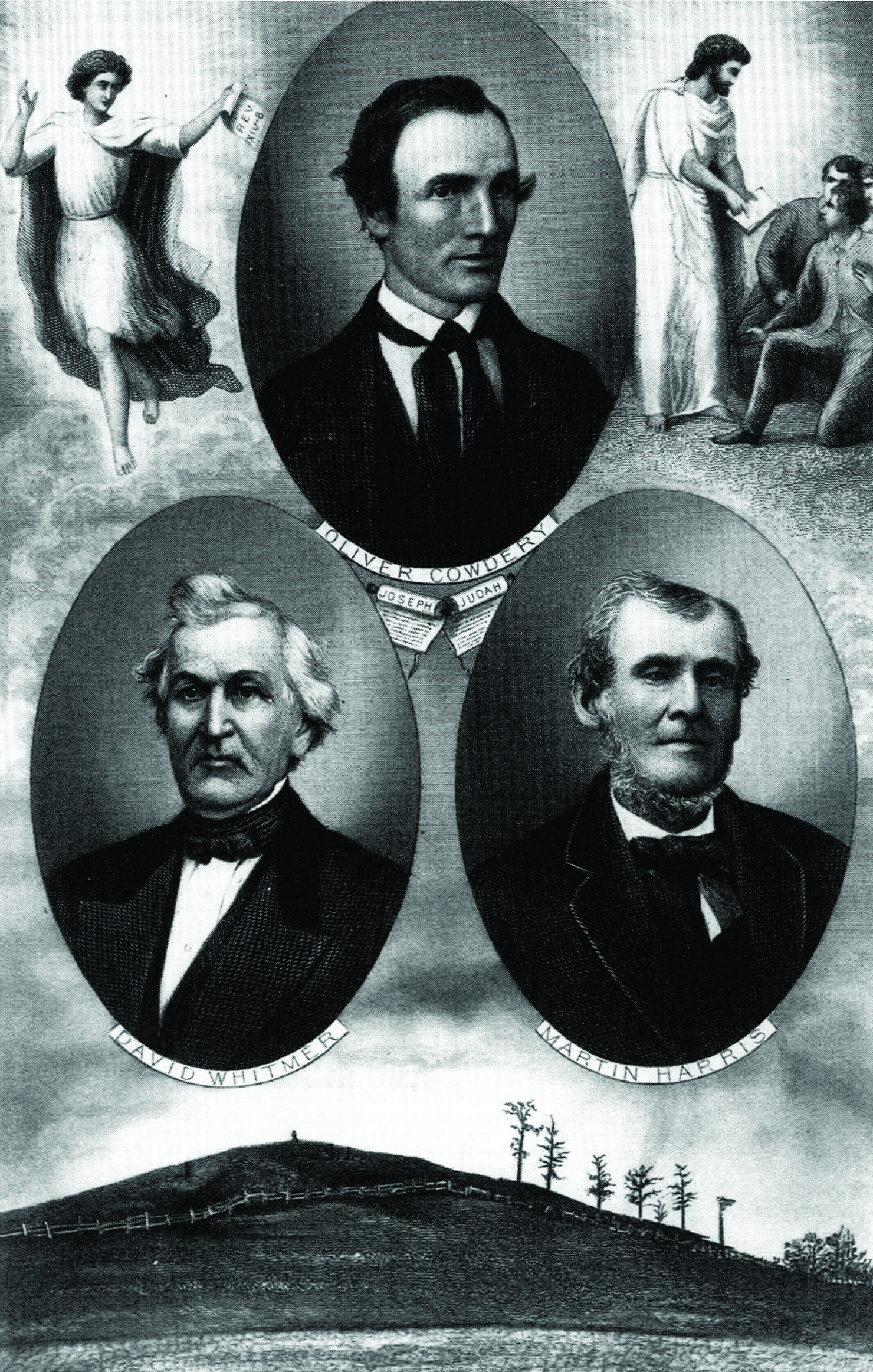
This is the argument the rest of the article hangs from, and it needs a precise statement. The claim is bounded:
- What the article claims: Across fifty years, eleven witnesses, multiple adversarial interrogations, and personal estrangement from Joseph Smith, no witness ever formally retracted the 1830 testimony.
- What the article does not claim: That every witness was continuously, actively affirming throughout every interval. There were periods of silence, periods of bitter institutional dissent, late-life statements that complicate the formal 1830 language for some witnesses, and Whitmer's eventual founding of a separate movement.
The bar is non-retraction, not continuous active affirmation. That bar matters because fabricators recant when the partnership dissolves. Recanting is the cheap, predictable way out, and people who saw something real do not take it, even when staying costs them. For fifty years, hostile and friendly interlocutors alike kept putting the question to the witnesses. The testimony of 1830 was never withdrawn.
Steven C. Harper, surveying the corpus, weighs the CES Letter's preferred sources against what he sums up as "the overwhelming preponderance of the evidence." He closes by asking why a reader would not "opt to believe in the direct statements of the witnesses" over late, hostile hearsay.[13] David Whitmer himself, as the last surviving Three Witness, declared in 1887:
"I also testify to the world, that neither Oliver Cowdery or Martin Harris ever at any time denied their testimony. They both died reaffirming the truth of the divine authenticity of the Book of Mormon."[14]
John Whitmer, who never returned to the LDS Church after his 1838 excommunication, wrote in 1876, forty years after his departure: "I have never heard that any one of the three, or eight witnesses ever denied the testimony that they have borne."[15] Hiram Page, also excommunicated in 1838, wrote to William E. McLellin in May 1847 rejecting any suggestion that memory had failed him. It would be unjust, Page said, "to say that I could know a thing to be true in 1830, and know the same thing to be false in 1847."[16]
Key Point
The bar is non-retraction. Eleven witnesses, fifty years, mob violence, hostile interrogations, excommunications: the published 1830 testimony was never formally withdrawn by any of the eleven. Many witnesses also produced affirmative restatements; the cumulative record is what no naturalistic theory accommodates. The claim is bounded (not "continuously active affirmation"), and that bounded claim is what the documentary record supports.
Cowdery's post-departure arc
Oliver Cowdery's career between his April 1838 excommunication and his March 1850 deathbed comes as close to a controlled experiment as the record supplies. Cowdery spent most of those twelve years practicing law in Ohio and Wisconsin. A lawyer's professional reputation depends on credibility. If Cowdery had wanted to deny the Book of Mormon, this was the period to do it. He never did. The reaffirmations span the period:
- 1846 letter to Phineas Young (private, pre-return).[17]
- October 1848 Kanesville reaffirmation, recorded by Reuben Miller. Cowdery returned to the Church and publicly testified at conference: "I wrote with my own pen the entire Book of Mormon (save a few pages) as it fell from the lips of the Prophet... I beheld with my eyes, and handled with my hands, the gold plates from which it was translated."[18]
- January 1849: snowbound two weeks at Samuel W. Richards's cabin, where Richards heard and later recorded his testimony.[19]
- March 3, 1850 deathbed in David Whitmer's home in Richmond, Missouri. Whitmer's later report: "Oliver never wavered in his testimony, and when he was on his death bed, I was there, with many of his friends, until he passed away. He bore the same testimony on his dying bed that he had always borne through life."[20] Whitmer put Cowdery's last words in print himself in 1887: "I was present at the death bed of Oliver Cowdery, and his last words were, 'Brother David, be true to your testimony to the Book of Mormon.'"[14:1]
For more on Cowdery's continuing affirmations and the post-excommunication arc, see Backdating & Retrofitting.
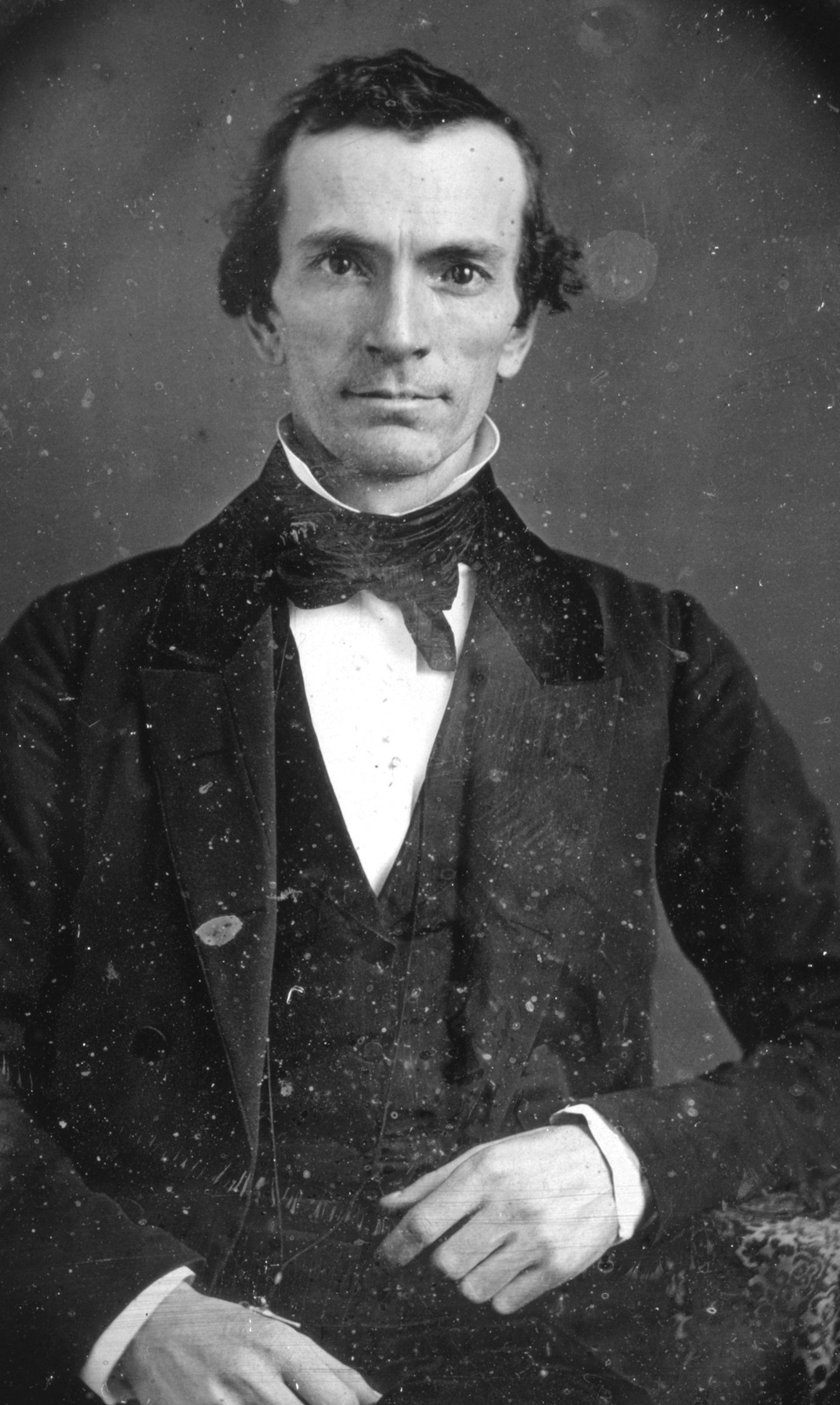
Whitmer's reaffirmation chain
David Whitmer's post-1838 life is, in some ways, the longest test of the three principal witnesses. He never returned to the LDS Church. He had no remaining incentive to protect Joseph Smith's reputation. He lived in Richmond, Missouri, as a respected businessman, repeatedly interviewed by journalists, lawyers, and historians for fifty years.
- 1861 graveside affirmation at Cowdery's grave, told to David H. Cannon at Cowdery's gravesite.[21]
- 1878 Orson Pratt and Joseph F. Smith interview (September 7–8), published in Millennial Star that December: Whitmer described seeing the plates "just as plain as I see this bed."[22]
- 1881 Proclamation (March 19, 1881), in direct response to John Murphy's published account of their 1880 conversation. Whitmer restates Murphy's charge, that "I, in a conversation with him last summer, denied my testimony as one of the three witnesses to the Book of Mormon," and answers it: "I have never at any time denied that testimony or any part thereof."[23]
- 1884 confrontation with hallucination claims: "No sir, I was not under any hallucination nor was I deceived. I saw with these eyes, I heard with these ears, I know whereof I speak."[24]
- 1885 James H. Moyle interview. Moyle, a young Mormon law graduate, questioned Whitmer for hours on June 28, 1885. His diary that night records the answer itself plainly: "Says he did see them and the angel and heard him speak." It also records how Whitmer framed the experience, "through the power of God," with Paul's vision as his analogy. Moyle's own reaction ran two ways: the line the CES Letter cites,[25] that the experience was "more spiritual than I anticipated," and, in the same entry, that he "was not fully satisfied with the explanation." Sixty years on, in a 1945 address, Moyle was still describing Whitmer's answer as "unequivocal," delivered "with unmistakeable clearness."[26]
- 1886 Nathan Tanner Jr. statement: Tanner reported Whitmer saying "he saw the plates and with his natural eyes" but had to be "prepared for it," and that the witnesses "were overshadowed by the power of God and a halo of brightness indescribable."[27]
- 1887 Address to All Believers in Christ. This is the document the CES Letter cites as evidence of Whitmer's apostasy. The Address is a roughly 75-page criticism of the Utah Church's later doctrinal developments. It is also, on the same pages, an unequivocal reaffirmation of the Book of Mormon: "I have never at any time denied that testimony or any part thereof."[14:2]
- 1887 letter to Anthony Metcalf (April 2, 1887).[12:1]
- January 22, 1888 deathbed, three days before his death. Whitmer called his family and his attending physician, Dr. George W. Buchanan, to his bedside and stated: "I want to say to you all that the Bible and the record of the Nephites (Book of Mormon) are true, so you can say that you have heard me bear my testimony on my death bed."[28]
There is a sharper version of the apostasy charge. In 1838, Whitmer reported a divine command to separate himself from among the Latter Day Saints,[14:3] and the CES Letter turns this into a reductio (reducing a position to absurdity): if Whitmer is reliable about voice-experiences, his 1838 voice should be credible too; if he is unreliable about the 1838 voice, his 1829 testimony is unstable either way. The dilemma is thinner than it looks. A witness can be reliable on direct sensory experience and mistaken on later interpretive judgment without the second canceling the first. Biblical writers routinely held some true beliefs and some false ones without their core testimony being invalidated. The CES Letter's structure requires perfect epistemic uniformity; the actual record requires only that Whitmer never withdrew the 1830 testimony. He never did. For deeper engagement with Whitmer's testimony evolution, see Late Appearance.
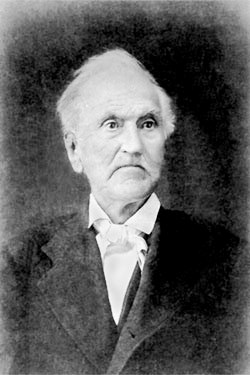
Harris's final act
Martin Harris's final years are catastrophic for the CES Letter's portrait of him. After thirty-three years of estrangement and religious experimentation, Harris returned to Utah in 1870 at age 87. Edward Stevenson of Salt Lake City was instrumental; Brigham Young proposed the subscription fund that paid Harris's way and was among its immediate contributors, giving twenty-five dollars toward the nearly two hundred dollars raised.[29] Harris was rebaptized and spent his remaining five years systematically reaffirming his testimony.
The chain of post-departure Harris reaffirmations:
- 1844 Parrish-Boynton group affirmation. When confronted by Kirtland dissenters who denied the Book of Mormon, Harris "bore testimony of its truth and said all would be damned if they rejected it."[30]
- 1846 Strangite mission to England. Treated separately below.
- 1855 Thomas Colburn account: Harris on Shakerism, "he tried the Shakers, but that would not do."[31]
- 1859 Joel Tiffany interview: "by the power of God I have seen [the plates]."[32]
- 1870 return to Utah: he bore testimony in the Salt Lake Tabernacle on September 4, and told a young visitor, William Waddoups, "with these eyes of mine ... I saw the angel of the Lord, and saw the plates and the Urim and Thummim and the sword of Laban."[33]
- 1875 deathbed, Clarkston, Utah. Harris gave the statement on July 9, 1875, and died the next day. Multi-sourced (Godfrey, Pilkington, Harris's son). Pilkington 1934 affidavit: "Just as sure as You see the Sun shining. Just as sure am I that I stood in The presence of an Angel of God."[34] Godfrey: "Had I been willing to have perjured myself and sworn falsely to the testimony I now bear, I could have been a rich man, but I could not have testified other than I have done and am now doing for these things are true."[35]
Harris's earlier financial conduct corroborates his sincerity. He mortgaged the homestead portion of his farm, about 150 of his 320 acres, to E. B. Grandin to secure the $3,000 printing of the Book of Mormon, and sold 151 acres in 1831 to clear the debt.[36] He tested Joseph Smith's translation by substituting a fake stone for the seer stone, and Joseph detected the switch; his own 1870 telling gives the motive, "to stop the mouths of fools, who had told him that the Prophet had learned those sentences and was merely repeating them."[37] He carried characters from the plates to Charles Anthon at Columbia for independent verification.[38] These look less like gullibility than due diligence followed by committed conviction.
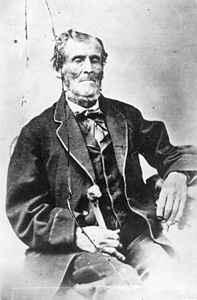
Comparison table: post-1838 reaffirmation timeline
The CES Letter's argument isolates the moment of departure from the forty years that follow.
| Year | Witness | Event |
|---|---|---|
| 1837 | Harris | Excommunicated, Kirtland |
| 1838 | Cowdery, Whitmer, J. Whitmer, Page | Excommunicated / cut off, Far West / Kirtland |
| 1838 | Hyrum Smith | Sally Parker letter: "two hands and two eyes" |
| 1839 | Hyrum Smith | After Liberty Jail: "I felt a determination to die, rather than deny" |
| 1839 | John Whitmer | Turley exchange at Far West: "I now say I handled those plates" |
| 1844 | Harris | Parrish-Boynton affirmation |
| 1844 | Hyrum Smith | Martyrdom at Carthage |
| 1846 | Cowdery | Letter to Phineas Young |
| 1846 | Harris | England mission for Strang: Book of Mormon affirmations to hostile LDS audiences (Birmingham) |
| 1847 | Hiram Page | Letter to McLellin: "know a thing to be true in 1830, and know the same thing to be false in 1847" |
| 1848 | Cowdery | Kanesville reaffirmation; rebaptism (Reuben Miller record) |
| 1849 | Cowdery | Testimony to Samuel W. Richards (recorded 1907) |
| 1850 | Cowdery | Deathbed in Whitmer's home: "Brother David, be true to your testimony to the Book of Mormon" |
| 1855 | Harris | Colburn account on Shakers |
| 1856 | Jacob Whitmer | Deathbed reaffirmation per son's 1888 statement |
| 1859 | Harris | Tiffany interview |
| 1861 | Whitmer | Cowdery's graveside, with David H. Cannon |
| 1870 | Harris | Return to Utah: Tabernacle testimony, Waddoups conversation, rebaptism |
| 1875 | Harris | Clarkston, UT deathbed (multi-source) |
| 1876 | John Whitmer | "I have never heard that any one of the three, or eight witnesses ever denied" |
| 1878 | John Whitmer | Poulson interview: physical dimensions, "as material as anything can be" |
| 1881 | Whitmer | Proclamation (printed leaflet): direct response to Murphy 1880 |
| 1884 | Whitmer | "I saw with these eyes, I heard with these ears" |
| 1885 | Whitmer | Moyle interview: "Says he did see them and the angel and heard him speak" |
| 1887 | Whitmer | Address to All Believers in Christ, affirms Book of Mormon while criticizing Utah Church |
| 1887 | Whitmer | Letter to Anthony Metcalf |
| 1888 | Whitmer | Deathbed, Richmond: "the Bible and the record of the Nephites are true" |
The table gathers twenty-four discrete reaffirmation events from primary sources across fifty post-1838 years, and it is a selection rather than a census. The CES Letter's they all left the Church framing requires the reader to look at the first row and skip the rest of the table.
The Stephen Burnett 1838 letter: Rappleye and Smoot 2024
The Burnett letter is the CES Letter's strongest contemporaneous citation. The argument runs: even if every other "spiritual eye" citation (Tucker 1867, Gilbert 1892, Clark 1842) is dismissed for being late, hostile, or thirdhand, Burnett survives because it is contemporary, insider, and direct.
The marquee scholarly response is Neal Rappleye and Stephen O. Smoot's "Stephen Burnett versus the Eight Witnesses: An Exercise in Mature Historical Thinking," Religious Educator 25/2 (2024). They apply Sweat and Alford's five-factor source-evaluation framework to Burnett's letter and rate it 3/10: "not a reliable source." Their conclusion is measured. Burnett is not reliable as a standalone source on the Eight, and his framing for Harris's words is best read against Harris's other lifetime statements. None of that amounts to "the Burnett letter has been debunked." It is a narrower claim, strong enough to move Burnett out from under the weight the CES Letter puts on him, without being a knockout. The argument runs along five lines.[39]
Line 1: Burnett is thirdhand on the Eight-Witnesses claim
Burnett is not a witness to the Eight Witnesses' experience. What he knows arrived through Harris, himself no member of the Eight; Burnett is relaying a report of a report. That is a thirdhand chain on the Eight-Witnesses claim. Two of the Eight (Christian and Peter Whitmer Jr.) were already dead when Burnett wrote, so direct refutation by them was impossible. The other six were alive. Burnett does not name a single one of them. Rappleye and Smoot summarize: to give "singular emphasis or preference to Burnett's thirdhand hearsay testimony over the direct, unambiguous testimonies of the Eight Witnesses themselves or those close to them (including immediate family) is nothing short of historiographical malpractice."[39:1]
Line 2: Burnett is openly polemical and announcing his own departure
The same letter calls Joseph Smith and Sidney Rigdon "notorious liars." The same letter announces Burnett's own departure on the same page where the Harris quotation appears. The letter is "infused with highly emotional, polemical language." Polemical context does not invalidate testimony, but it requires careful reading. Burnett wrote three weeks after publicly renouncing the Book of Mormon at the Stone Chapel in Kirtland; the letter is announcing that renunciation to a fellow disaffected Mormon, not reporting neutrally.[40]
Line 3: Burnett's specifics are contradicted by the Eight Witnesses' own statements
If Burnett's report were accurate, the Eight Witnesses would have said publicly that they "hesitated to sign" and "never saw" the plates. They said the opposite, in their own words, in writing, often within months of Burnett's letter:
- John Whitmer, 1836 (two years before Burnett's letter), in print, as departing editor: "to say that the book of Mormon is a revelation from God, I have no hesitancy; but with all confidence have signed my name to it as such," and "I have most assuredly seen the plates from whence the book of Mormon is translated, and that I have handled these plates."[41]
- John Whitmer, 1839 (a year after his excommunication), as one of eight men who confronted Theodore Turley at Far West: "I now say I handled those plates, there was fine engravings on both sides." In the same exchange he added that the plates "were shown to me by a supernatural power," and that he could not vouch for the translation because he could not read the original.[42]
- Hyrum Smith, 1838 (the same year), as Sally Parker reported hearing him: "He said he had but two hands and two eyes. He said he had seen the plates with his eyes and handled them with his hands."[43] The phrasing is pointed: a bare bodily inventory set against the "spiritual eyes" framing. It reads like an answer aimed squarely at the misreading Burnett is propagating. Hyrum is alive in 1838, hears the rumors, and meets them in plain language.
- Hyrum Smith, 1839, Times and Seasons: "I felt a determination to die, rather than deny the things which my eyes had seen, which my hands had handled."[44]
Samuel H. Smith, one of the Eight, was also the Church's first missionary. He owned a personal copy of the 1830 Book of Mormon in which his own name in the Eight Witnesses statement is "starred and underlined." He was, the authors infer, keeping his own witness statement ready to point out as he traveled.[45] Not the conduct of a man who "hesitated to sign."
Line 4: Burnett's letter contains its own internal correction
This is the line that does the most work. In the same paragraph where Burnett reports the alleged "spiritual eye" framing, he records:
"M Harris arose & said he was sorry for any man who rejected the Book of Mormon for he knew it was true, he said he had hefted the plates repeatedly in a box with only a tablecloth or a handkerchief over them, but he never saw them only as he saw a city through a mountain."[46]
Two readings sit on the literal grammar. The skeptic reads "city through a mountain" as Harris's entire manner of seeing, with "knew it was true" as testimony framing detached from any literal perception of uncovered plates. The faithful reading takes Harris to be distinguishing two phases of his involvement: testifying that the Book of Mormon is true (the "knew it was true" half), while explaining that during the translation period (the "city through a mountain" half) he handled covered plates without seeing them directly. Which reading fits Harris's other lifetime statements? The second. His accounts of the Three-Witnesses event (Tiffany 1859, the 1870 Tabernacle, the 1875 Clarkston deathbed) use unambiguous angel, voice, and uncovered-plates language; none uses "covered with a cloth" or "city through a mountain." That metaphor only makes contextual sense for the covered-plates translation period, when Harris was Joseph's financial backer, helped move and carry the plates while they remained covered, and explicitly could not look at them directly.[47]
So Harris stood up in the very meeting Burnett describes and pushed back. The CES Letter quotes the negative half of the letter and omits the corrective half. Read coherently, Burnett's own letter records two phases, the translation-period covered plates and the formal Three-Witnesses event, collapsed by Burnett (or his polemical framing) into a single "spiritual eye" headline.
Line 5: The "spiritual eye" reference, even taken at face value, refers to the pre-witness translation period
The full Harris quote describes covered plates: "he had hefted the plates repeatedly in a box with only a tablecloth or a handkerchief over them, but he never saw them only as he saw a city through a mountain." The alleged "spiritual eye" remark belongs to the translation stretch, those months of helping while the plates remained covered, not to the Three-Witnesses event of June 1829, with its angel, voice, and visible plates. Conflating the pre-witness translation period with the Three-Witnesses event is the dominant analytical error in the credibility-concerns argument. It recurs in the CES Letter's other "spiritual eye" citations (Tucker, Gilbert, Clark) and is engaged in detail in the Second Sight sister article.
Key Point
Burnett's 1838 letter is thirdhand hearsay from a hostile dissenter, written as he quit the movement himself. The letter is contradicted by the Eight Witnesses' own statements (John Whitmer 1836 and 1839, Hyrum Smith 1838 and 1839). Burnett's own letter contains Harris standing up in the same meeting to push back on the framing. Rappleye and Smoot 2024 rate Burnett 3/10, not reliable as a standalone source. The conclusion is bounded: Burnett does not carry the load the CES Letter places on it. Quoting Burnett uncritically is, in Rappleye and Smoot's phrase, "historiographical malpractice."[39:2]
Further Reading
For the most thorough scholarly engagement with the Burnett letter, see Neal Rappleye and Stephen O. Smoot, "Stephen Burnett versus the Eight Witnesses: An Exercise in Mature Historical Thinking," Religious Educator 25/2 (2024). For broader engagement with the witnesses under historical-criticism criteria, see Steven C. Harper, "Evaluating the Book of Mormon Witnesses," Religious Educator 11/2 (2010).
Martin Harris's "five religions"
The CES Letter's portrait of Martin Harris is built almost entirely from hostile sources. The "five religions" frame rests on a single early hostile source that Anderson identifies as a reductive label rather than a tally of five formal church memberships.[48] The post-Joseph affiliations are real enough: Strang, Bishop, Shakerism, William Smith, McLellin. But the actual record of what Harris said within each runs against the CES Letter's framing.
The "religious seeker" framing cuts both ways. It is consistent with sincerity (Harris testing every group's claim against the Book of Mormon as anchor) and with credulity (Harris disposed to find spiritual significance in religious gatherings, with a low threshold for accepting religious claims). Both fit some of the data. The sincerity reading is preferred for three specific reasons:
- Specificity. What Harris affirmed across affiliations was the Book of Mormon, not generic religious experience. He did not extend to Strang's plates, Bishop's plates, or Shaker testimony.
- Refusal to extend. The Strangite mission ended within two months precisely because Harris refused to preach Strangism while continuing to preach the Book of Mormon. A genuinely promiscuous religious seeker would not have kept preaching the Book of Mormon until his Strangite sponsors called the mission off.
- Fifty-year consistency. Harris's specifically Book-of-Mormon testimony appears across the entire 1837-1875 period in every documented source. Religious seekers with low thresholds typically drift; Harris's anchor never moved.
The contemporaneous record on Harris's specifically Book-of-Mormon affirmation across affiliations is unambiguous:
- Edward Bunker, 1844, recorded Harris bearing testimony to the Book of Mormon during his period of Shaker sympathy.
- Jeremiah Cooper, 1845, recorded the same.
- November 1850 journal entry (five years after the supposed Shaker preference) has Harris saying he "was one of the 3 Witnesses to the Book of Mormon and said he knew it was true, for he saw the plates and knew for himself."[49]
- Harris himself: "no man ever heard me in any way deny the truth of the Book of Mormon, the administration of the angel that showed me the plates."[49:1]
Anderson's framing summarizes the pattern: "Every affiliation of Martin Harris was with some Mormon group, except when he accepted some Shaker beliefs, a position not basically contrary to his testimony of the Book of Mormon."[49:2] The Strangite movement, Gladden Bishop's group, William Smith's group, and McLellin's group were all Restoration splinter groups, each presenting itself as the rightful heir of Joseph Smith's Restoration. Harris was investigating which post-1844 group preserved that Restoration most faithfully, not abandoning Mormonism for unrelated traditions.
The Strangite mission to England
Robin Scott Jensen's 2005 BYU Studies article, "A Witness in England: Martin Harris and the Strangite Mission," is the definitive engagement with the Strang affiliation. It documents that Harris's England trip with Strang lasted less than two months (October-December 1846), ended because Harris refused to preach Strangism. The audiences that heard him were not Strangite sympathizers; they were Latter-day Saint congregations with no patience for Strang's claims, and he affirmed the Book of Mormon to them anyway.[50]
At the LDS Birmingham branch conference, the members "with united voice informed him that they did not need his instructions." Asked whether he had put his name to the witness testimony, Harris answered: "I did; and that Book of Mormon is the Book of God. I know more about that book than any man living." (The recollection is Charles Derry's, later of the RLDS Church, relaying his wife's account.) In the street outside the same meeting, a crowd hoping Harris would hand them ammunition against Mormonism got George Mantle's long-remembered scene instead: "Do you know that is the sun shining on us? Because as sure as you know that, I know that Joseph Smith was a true prophet of God, and that he translated that book by the power of God." His missionary companion Lester Brooks decided to end Harris's mission; Harris was, in Jensen's words, "failing to testify of Strangism." The Millennial Star, the church paper Orson Hyde edited, observed that Harris seemed "afraid or ashamed of his profession as a Strangite."[50:1]
The CES Letter's point that Harris "went on a mission to England for" Strang is technically true and substantively misleading. Jensen's title, "A Witness in England," captures what Harris actually did during the trip.
Gladden Bishop and Shakerism
Bishop claimed plates and a Urim and Thummim. Harris signed a statement affirming Bishop's revelations; Anderson notes carefully that the statement does not affirm Bishop's plates as Book-of-Mormon-equivalents. Harris never claimed to have seen Bishop's plates the way he had seen the Book of Mormon plates.[48:1] On Shakerism, Harris investigated and decided against. Thomas Colburn's 1855 account: "he tried the Shakers, but that would not do." He never joined a Shaker community, never adopted celibacy, never signed Shaker testimony.[31:1]
The closer the CES Letter uses on the Shaker question is the 1884 Braden-Kelley debate quotation: Harris supposedly had "as much evidence for a Shaker book he had as for the Book of Mormon."[51] Clark Braden was a Disciples of Christ minister; Edmund L. Kelley was an RLDS Church leader, counselor to the presiding bishop and later Presiding Bishop. The debate took place nine years after Harris's death, which makes Braden's claim hostile-source thirdhand hearsay at decades' remove. Even the original report behind it (Phineas Young et al., 1844) is unclear about whether the Kirtland Mormons heard Harris say it directly or only secondhand.[49:3]
Worth Acknowledging
Harris did associate with multiple religious movements after 1837. He did go to England with Strang in 1846. The "religious seeker" framing is accurate. What it does not establish is that his testimony was psychologically promiscuous. The contemporaneous record across every affiliation shows him affirming the Book of Mormon alone and refusing to extend that affirmation to other groups' founding texts. Both the sincerity and the credulity readings of his seeking are textually possible; the sincerity reading is preferred for specificity, refusal-to-extend, and fifty-year consistency.
The Eight Witnesses' "we did handle with our hands"
The Eight Witnesses are the argument the CES Letter does not want to have. Their testimony is structurally different from the Three Witnesses', and the "magical worldview" / "spiritual eye" framing does not reach it.
The 1830 Eight-Witnesses statement, printed in every copy of every Book of Mormon since, establishes a structurally different claim:
"Be it known unto all nations, kindreds, tongues, and people, unto whom this work shall come, that Joseph Smith, Jr. the Author and Proprietor of this work, has shewn unto us the plates of which hath been spoken, which have the appearance of gold; and as many of the leaves as the said Smith has translated, we did handle with our hands; and we also saw the engravings thereon, all of which has the appearance of ancient work, and of curious workmanship. And this we bear record, with words of soberness, that the said Smith has shewn unto us, for we have seen and hefted, and know of a surety, that the said Smith has got the plates of which we have spoken."[52]
No angel. No heavenly voice. No vision. The statement's language is physical examination: "we did handle with our hands," "seen and hefted," "the engravings thereon." Steven C. Harper emphasizes that Joseph later "showed the plates to his father, to his brothers Hyrum and Samuel, and to several of David [Whitmer]'s brothers... each man handling the plates himself, each man later testifying that they saw the plates Joseph had, hefted them, and examined the engravings on them."[13:1] Daniel Peterson observes the Eight Witnesses' testimony is "stubbornly matter-of-fact" and "almost distinctly nonreligious in tone."[53]
The magical-worldview objection has a more serious form than the genetic fallacy alone. A serious skeptic following Quinn argues that 1820s rural treasure-seekers will interpret a metallic object after a religious framing-ritual through that ritual, generating visionary descriptions rather than forensic ones. The argument has real force against the Three Witnesses' language. It has much less against the Eight Witnesses', which is not the kind of description a folk-magic frame produces. The Eight describe specific dimensions, weight, ring configurations, and "as material as anything can be." That is not what the frame predicts.
The Anderson 2005 ten-statement catalog
Richard Lloyd Anderson's 2005 Journal of Book of Mormon Studies article, "Attempts to Redefine the Experience of the Eight Witnesses," documents ten statements, each from one of the Eight, describing physical handling. Not one of the ten reaches for "spiritual eye" or "in vision" language; all describe physical examination. Anderson's wider count: "42 instances when one of the Eight Witnesses restated his testimony."[54]
The sharpest attack on this catalog runs through the Turley report itself: John Whitmer's qualification that the plates "were shown to me by a supernatural power," which Vogel reads as visionary seeing. Anderson answers that the word "power" tracks Turley's preconception rather than the written testimony John was defending, "since John only indicates natural circumstances in other statements referring to the Eight Witnesses' group experience with the plates themselves."[54:1]
Selected accounts:
- John Whitmer, 1836: "I have most assuredly seen the plates from whence the book of Mormon is translated, and that I have handled these plates."[41:1]
- John Whitmer, 1878 (Poulson interview): The plates were "8 by 6 or 7 inches," "very heavy" (consistent with gold density), with "three rings, each one in the shape of a D," shown "uncovered into our hands." Asked directly, "Then they were a material substance?" Whitmer answered: "Yes, as material as anything can be."[55]
- Hyrum Smith, 1839 (written after his release from Liberty Jail, recounting it): "I felt a determination to die, rather than deny the things which my eyes had seen, which my hands had handled."[44:1]
- Hiram Page, 1847: rejected the suggestion of recantation outright: to claim he could "know a thing to be true in 1830, and know the same thing to be false in 1847" would, he wrote, be "doing injustice to myself, and to the work of God."[16:1]
- Jacob Whitmer, deathbed (per son's 1888 statement): "always faithful and true to his testimony to the Book of Mormon, and confirmed it on his death bed."[56]
- Samuel Smith (Daniel Tyler reminiscence): Samuel "knew his brother Joseph had the plates, for the prophet had shown them to him, and he had handled them and seen the engravings thereon."[57]
Anderson 2005 draws no response in the CES Letter; neither does any of the ten statements. The Eight figure in its pages only as shadows of the Three, when they figure at all. That asymmetry, between visionary language and forensic language, is the strongest empirical case for the witnesses, and it goes unanswered.
Household witnesses corroborate the artifact
Beyond the eleven formal witnesses, multiple Smith and Whitmer household members interacted with a heavy, plate-shaped object over months. Emma Smith's 1879 interview: "The plates often lay on the table without any attempt at concealment, wrapped in a small linen table cloth, which I had given him to fold them in. I once felt of the plates, as they thus lay on the table, tracing their outline and shape. They seemed to be pliable like thick paper, and would rustle with a metalic sound when the edges were moved by the thumb, as one does sometimes thumb the edges of a book."[58] William Smith "handled them and hefted them while wrapped in a tow frock and judged them to have weighed about sixty pounds."[53:1] He also described them as "a mixture of gold and copper, they were much heavier than stone, and very much heavier than wood." Sally Parker reported asking Lucy Mack Smith whether she had seen the plates: "no, it was not for her to see them, but she hefted and handled them." Joseph's sister Katharine, by her grandson's account, hefted the covered plates, "rippled her fingers up the edge of the plates and felt that they were separate metal plates and heard the tinkle of sound that they made." The household corroboration is non-formal but converges on the same physical artifact.[59]
Key Point
The Eight Witnesses' 1830 testimony uses physical-examination language: "we did handle with our hands... and we also saw the engravings thereon." The Anderson 2005 catalog of ten Eight-Witness statements documents physical handling uniformly. John Whitmer's 1878 Poulson interview specifies dimensions, three D-shaped rings, and "as material as anything can be." Hyrum Smith's 1838 "two hands and two eyes" was designed to counter the spiritual-eye misreading then in circulation. Folk-magic worldviews predict visionary descriptions; what the Eight say about the plates is forensic. That holds even where the same man reports visionary experience elsewhere: Hiram Page's 1847 letter refuses to deny both the plates he knew in 1830 and the angels he says appeared to him in a field, and he keeps them as separate testimonies. This is the asymmetry the CES Letter does not engage.
For the broader engagement with the "spiritual eyes" question and the scriptural framework, see Second Sight.
Family relationships: Mark Twain and the access argument
The CES Letter quotes Mark Twain's Roughing It (1872): "I could not feel more satisfied and at rest if the entire Whitmer family had testified."[60] The line is rhetorically effective, capturing the surface plausibility of the family-relationship objection.
The faithful response starts by granting the point. The Three Witnesses were not strangers to Joseph. The Eight Witnesses are 4 Whitmers + 1 Whitmer in-law (Hiram Page) + 3 Smiths. Anderson, Harper, Black, and Morris all concede the family relationships explicitly.
The standard critique of family witnesses is real. Family members share emotional investment in the outcome, face social and financial costs for dissent that strangers do not, and, at its sharpest, may have a coordinating interest in confirming a shared family narrative. Any fair framing has to accept the asymmetry: family relationships reduce independence in some respects while increasing access in others.
For the Eight Witnesses' physical-handling testimony, the access dimension dominates. A Whitmer brother is exactly the right witness for what happened in the Whitmer home: he can test the claim, day after day, over months. If the plates were a prop, someone in that tight circle would have eventually said so, especially after excommunication, mob violence, lawsuits, and decades of estrangement. Family members are the hardest people to deceive over a lifetime, and the Whitmer and Smith households had years to notice.
For the Three Witnesses' visionary experience, the family dimension is more contested. A skeptic will weight family loyalty more heavily here, and that weighting is not unreasonable. Two patterns push back on it, though. First, the Whitmer family's incentive structure after 1838 ran the other way: estranged from Joseph, stripped of institutional and financial standing, with every reason to recant publicly if they had been pressured into a false statement. None did. Second, the chain extends well beyond the eleven and across generations. Hyrum and Samuel held to their testimony through the Kirtland and Far West ruptures and to their deaths in 1844; alongside them sit Lucy Mack Smith's account, Joseph Sr.'s deathbed, Hiram Page's son's record, and Jacob Whitmer's son's record.[61] [56:1]
On the Oliver Cowdery "cousin" objection: the relationship was that of third or fourth cousins, distant enough that there is no evidence either man knew of the connection when they met. Lucy Mack Smith's account of Oliver's arrival in 1829 gives no indication of prior acquaintance.[62]
Worth Acknowledging
The CES Letter reports the family ties accurately. Family witnesses share emotional investment and face costs for dissent, a real reliability concern that does not disappear under cross-examination. They also have more access to test the claims, especially for the Eight Witnesses' observational testimony. Both dimensions are real. The post-departure reaffirmation pattern, where family loyalty cannot explain the Whitmers' four-decade estrangement from Joseph and yet never produced a denial, recovers some of what family ties cost without eliminating the concern entirely.
Money-digging and the magical worldview
The Smith family's documented treasure-seeking activity in 1820-1827 is real. The 1826 Bainbridge proceeding is documented. Cowdery's "rod of nature" / "gift of Aaron" appears in the Book of Commandments and Doctrine and Covenants. The folk-magic backgrounds are openly catalogued in the Joseph Smith Papers. The continuity between Joseph's pre-1827 seer-stone use and the Book of Mormon translation method is its own topic (see Seer Stones).
The CES Letter's argument runs from magical worldview to unreliable witness testimony. To work, it needs magical-worldview holders to confabulate physical objects, and the CES Letter never establishes that prediction. Quinn's actual argument, more sophisticated than the CES Letter's, is that folk-magic worldviews shape the interpretation of perceptual events, not that they manufacture perceptions of objects that aren't there. Even on Quinn's terms, the Eight Witnesses' specific empirical content (dimensions, weight, ring configurations, engravings) is the kind of content folk-magic interpretation does not generate.
Steven C. Harper's 2023 engagement
Steven C. Harper's 2023 BYU Studies Quarterly article, "Was Joseph Smith a Money Digger?", concedes Joseph engaged in treasure-seeking and faced the 1826 "disorderly person" proceeding at South Bainbridge.[63] [64] He argues the "money digger" label retrojects modern stigma onto practices that 1820s rural Americans did not separate sharply from religion. Treasure-seeking and prophetic vocation co-existed in the same families and communities. Mark Ashurst-McGee's master's thesis ("A Pathway to Prophethood") demonstrates how the Smith family's worldview was indistinguishable in form from their neighbors'.[65]
What the magical-worldview argument has to answer
First, money-digging was widespread in early-nineteenth-century rural America, not deviant or fringe.[63:1] The witnesses' folk-magic vocabulary is the vocabulary of their place and time.
Second, the witnesses' specific claims sit on a different epistemic level than their general worldview. Believing one's neighbor can find a buried object with a divining rod is a culturally inherited folk practice. Claiming to have personally hefted a heavy metal book in your own hands in your kitchen, in daylight, is a specific empirical claim about a specific physical object. Sharing the worldview did not blind the witnesses to ordinary reality.
Third, the CES Letter applies its standard selectively. If "this person believed in the supernatural" disqualifies their eyewitness testimony, then Paul on the road to Damascus is disqualified, the disciples seeing the resurrected Christ are disqualified, and most ancient religious history is inadmissible. The CES Letter does not propose that. It applies the standard only to witnesses it wants to dismiss. That is the fallacy of poisoning the well.
The 1826 Bainbridge proceeding in context
Faithful scholarship documents that:
- The proceeding was a preliminary examination, not a trial.
- Joseph was discharged.
- The complainant was Peter Bridgman, an anti-Mormon Methodist nephew of Stowell.
- Stowell himself (the alleged victim) testified favorably and joined the Church.
- Stowell remained faithful until 1844.[64:1]
This complicates the "disorderly person and an imposter" framing the CES Letter implies. Joseph was not convicted; the complainant was a hostile relative of the man Joseph had been working for; and that man, the alleged victim, joined the Church.
D. Michael Quinn's Early Mormonism and the Magic World View (Signature Books, 1998) is the major critical scholarly work on this question. Quinn's documentary case is largely accepted by faithful scholars. What Quinn's documentary case does not establish, and what faithful scholars (Bushman, Ashurst-McGee, Harper) dispute, is that the worldview makes the witness testimony unreliable. Bushman argues the magic worldview was "peripheral, not central" to Joseph's life and that the Smith family was primarily Biblical Christian.[66] [67]
Departure from the Church does not entail denial
The CES Letter's departure framing requires conflating institutional rupture with testimonial rupture. The witnesses themselves rejected that conflation, and the post-departure record contradicts the prediction the conflation requires.
A skeptic will press the structural fact: 3/3 of the Three Witnesses were excommunicated. The pattern is total, and the framework must accommodate it. It does, but through a specific structure: each rupture had documented institutional causes (Cowdery's land disputes, Whitmer's Missouri administration disputes, Harris's Kirtland Safety Society loss), and each witness explicitly distinguished his institutional disagreement from his testimony content.[68] None left because they no longer believed the Book of Mormon was what they had testified it was. Whitmer's Address (1887) is the clearest example: roughly 75 pages of complaint against the Church, while simultaneously affirming "I have never at any time denied that testimony or any part thereof."[14:4]
The post-departure record contradicts the "departure = denial" prediction:
- Cowdery returned in 1848 (Kanesville reaffirmation via Reuben Miller) and died affirming the testimony in 1850.
- Harris returned in 1870 and died affirming in 1875.
- Whitmer never returned but published the 1881 Proclamation (response to Murphy 1880), the 1887 Address (which contains affirmation), and died affirming in January 1888.
All three Three Witnesses ended their lives affirming. Two returned to the Church.
On Joseph and Sidney's harsh language: their authority is being asked to do different work in different places. Calling someone "mean" or "a counterfeiter" is a character claim that does not require the speaker to be a prophet to be made. Calling the Book of Mormon true is a testimony claim with different epistemic standards. The Far West letter is not a later reflection on the 1838 dissenter actions; it is one of them, written in June 1838 and printed by the U.S. Senate in February 1841. The "counterfeiters" charge was inflammatory rhetoric, not literal accusation.[9:1] Neither man ever repudiated the Book of Mormon.
The same June 1838 letter that expels them affirms them: "Oliver Cowdry and David Whitmier were among the principal of those who were the means of geathering us to this place by their testimony which they gave concerning the plates of the book of Mormon, that they were shown to them by an Angel which testimony we believe now as much as before you so scandalously disgraced it."[9:2] The document the CES Letter cites to impeach the witnesses affirms their testimony in the very act of expelling them.
Moyle, the young lawyer from the 1885 interview, made the observation: "If there had been fraud in this matter Joseph Smith would have cultivated those men and kept them with him at any cost." He did not. They left. They still affirmed.[69]
The cumulative case
The witnesses argument is at its most serious not in any single point but in the cumulative pattern. The academic version (Vogel, Quinn, Palmer, Marquardt) runs the eleven witnesses through five filters: family relations, magical worldview, post-1838 dissent, visionary framing, and (for Harris) religious-seeking pattern. This is more sophisticated than "they were duped." It asks the reader to evaluate the witnesses as a set rather than one at a time.
The reply is straightforward. The cumulative case has real purchase, but it does not reach the empirical core of the testimony.
It reaches the Three Witnesses' visionary framing more than the Eight Witnesses' physical handling. It reaches Harris's religious-seeking psychology more than his specific Book-of-Mormon affirmation. It reaches family ties more than post-departure reaffirmation. It reaches the magical worldview more than the testimonial content of physical examination.
It does not reach what the Eight attested: physical handling, weight, dimensions, and engravings, observational content that does not depend on magical thinking, family loyalty, or visionary state. It does not reach the post-1838 reaffirmation pattern, where the witnesses were outside Joseph's institutional reach. It does not reach the household-witness corroboration. It does not reach the absence of a single recantation across eleven witnesses over half a century.
The naturalistic theories
Hallucination cannot explain it. The evangelical philosopher Gary Habermas, writing of Christ's post-resurrection appearance to the eleven apostles, put the psychological point plainly: "Hallucinations are private events observed by one person alone. Two people cannot see the same hallucination, let alone eleven." Peterson notes the observation "applies remarkably well" to the Book of Mormon's own eleven witnesses.[53:2] The Three Witnesses experienced their event in two separate locations, and described the same content both times. The Eight Witnesses' experience occurred in broad daylight with technical detail. Hallucination cannot produce that level of cross-witness consistency about a physical artifact.
Conspiracy cannot explain it. A coordinated fraud involving eleven official witnesses plus household witnesses would have been "inconceivably difficult to keep such a conspiracy secret," especially when the conspirators included people who later became hostile to Joseph and would have benefited from breaking the conspiracy.[53:3] Cowdery damaged his legal reputation. Harris sold off nearly half his farm to cover the printing debt. Whitmer endured fifty years of journalists asking if he had been fooled. Hyrum and Samuel died early in the persecutions. People do not maintain fabricated stories when those stories cost them and pay them nothing.
Forged plates cannot explain it. Producing actual metal plates of the described weight (forty to sixty pounds by witness and household estimates) and dimensions would have required expert metalwork, and for that, as Peterson notes, "absolutely no evidence exists" anywhere in the witnesses' world.[53:4]
Even Dan Vogel concedes the witnesses were sincere. Vogel's Joseph Smith: The Making of a Prophet (Signature Books, 2004) argues a "pious fraud" thesis in which Joseph believed himself called to bring forth a sacred record by whatever means and the witnesses experienced something genuine within a visionary framework Joseph cultivated.[70] This is the most sophisticated naturalistic version, well past "they were duped," and itself a meaningful concession: the "they were lying" hypothesis has been largely abandoned by serious critics. Vogel's thesis has real intellectual content. It strains in two places. It does not by itself account for the Eight's specific empirical content (dimensions, weight, ring configurations, "as material as anything can be"), produced in 1830, before the Three's visionary framing was widely circulating in dissenter polemics. And it does not account for Whitmer's fifty-year non-Mormon Richmond record.[71]
H. Michael Marquardt has documented factual errors in Whitmer's 1887 publications (the number of elders at the April 6, 1830 organization, membership tallies at the first conferences, and, in a companion eight-page 1887 tract, the Book of Commandments printing account) and concludes that they "decrease our appreciation of David's recollections of the foundational years."[72] Marquardt himself draws the distinction that matters here: those errors are institutional history, and "David still remained true to his published testimony." The critique does not reach the Book-of-Mormon-affirmation portions, which are corroborated outside the Address entirely: Whitmer's 1881 Proclamation, his 1885 Moyle interview, and his 1888 deathbed.
The Richmond non-Mormon community testimony
The reaffirmation chain above documents what Whitmer himself said across fifty years. There is one further data point the cumulative critical case has the hardest time explaining: what Whitmer's non-Mormon neighbors said about him.
Whitmer lived in Richmond, Missouri, as a non-Mormon businessman from 1838 until his death in 1888, fifty years outside the LDS Church. In 1881, responding to John Murphy's published account implying Whitmer had backed away from his testimony, prominent non-Mormon residents of Richmond signed a public statement attesting to his "undoubted truth and veracity."[6:1] These were not co-religionists. They were ordinary neighbors, the bankers, judges, and merchants of the town, with no theological stake in the Book of Mormon. They simply knew the man. Forty-three years of daily acquaintance sat behind their signatures, and what they certified was narrow and personal: Whitmer was honest, and he had never wavered from his testimony.
This is the kind of evidence the "magical thinking, superstitious, inconsistent" framing does not survive. How did the man supposedly steeped in folk-magic credulity and psychological instability earn that kind of public vouching from a non-Mormon community over a four-decade residence? Whitmer's Richmond record is consistent with the Proclamation, the Moyle interview, the Metcalf letter, the Address, and the deathbed. The people best positioned to detect an inconsistency were his neighbors, and they detected none.
The cumulative critical case has to explain: the Three Witnesses' visionary experience, the Eight Witnesses' physical handling, the household witnesses, the post-1838 reaffirmations, the Cowdery and Harris returns, the absence of recantation across eleven witnesses over half a century, and Whitmer's fifty-year Richmond record. No single naturalistic theory does this work cleanly.
The witnesses' character is one piece of a larger picture, not a standalone proof. Their testimony is weight-bearing for the Book of Mormon's historicity within a wider case where multiple Restoration claims are independently contested. The article's claim is bounded: the witnesses' character objection, fairly examined, does not deliver the conclusion the CES Letter draws. That is not the same as saying the witnesses' credibility settles every Restoration question.
The Witnesses Initiative and the broader corpus
The Witnesses Initiative project (witnessesofthebookofmormon.org), produced by the Interpreter Foundation as a companion to the Witnesses (2021) film and Undaunted (2022) docudrama, is the most comprehensive online primary-source compilation. Anderson's foundational 1981 Investigating the Book of Mormon Witnesses collects the witnesses' statements across their lifetimes. Larry E. Morris's 2019 Oxford UP A Documentary History of the Book of Mormon compiles primary documents from 1823-1830, and his 2019 Dialogue article catalogs the household-witness corroboration. The CES Letter's witnesses section runs on roughly a dozen cited sources. Set that against the corpus it never engages: Anderson's book-length documentary study, five volumes of Vogel's Early Mormon Documents, Cook's interview compilation, and the modern periodical literature from Harper, Jensen, Black/Porter, Morris, and Rappleye/Smoot.[59:1] [73]
Further Reading
For comprehensive primary-source compilation, see the Witnesses of the Book of Mormon Initiative. For Steven C. Harper's overview, "The Eleven Witnesses" (RSC 2015) and "Evaluating the Book of Mormon Witnesses" (Religious Educator, 2010). For Larry E. Morris's catalog of physical-handling testimony, "Empirical Witnesses of the Gold Plates," Dialogue 52/2 (2019). For the Burnett-letter rebuttal, Neal Rappleye and Stephen O. Smoot, "Stephen Burnett versus the Eight Witnesses," Religious Educator 25/2 (2024).
Comparison: CES Letter framing vs. documentary record
| CES Letter framing | What the documentary record adds |
|---|---|
| "All three Three Witnesses excommunicated" (true) | All three returned to or affirmed the Book of Mormon. Two returned to the Church. The third reaffirmed in print and on his deathbed. |
| "Joseph called them too mean to mention" (true, 1838) | Joseph never recanted his witness to the divine choosing of the Three. Cowdery and Whitmer reaffirmed across 1846, 1848, 1850, 1861, 1881, 1885, 1887, 1888. |
| "Burnett 1838 letter: 'spiritual eye'" (real) | Thirdhand on the Eight; same letter contains Harris's correction; specifics contradicted by the Eight's own published statements; rated 3/10 by Rappleye/Smoot. |
| "Harris had five religions" (loose) | Anderson: every Harris affiliation was with some Mormon group except Shakerism. Across every affiliation he affirmed the Book of Mormon. Strangite mission ended in <2 months because he refused to preach Strangism. |
| Murphy 1880: the angel "had no appearance or shape" (real) | Whitmer's 1881 Proclamation directly responds to Murphy: "I have never at any time denied that testimony or any part thereof." |
| "Whitmer's 1887 Address: 1838 voice claim" (real) | Same Address affirms the Book of Mormon; the CES Letter's dilemma requires perfect epistemic uniformity that no biblical witness would survive. |
| "Eleven 19th century treasure diggers" (caricature) | The folk-magic record is concentrated on a few individuals; several of the Eight have little or no documented personal involvement. Eight-Witnesses testimony is observational physical examination, not visionary. |
| "Joseph influenced the 31 polygamy-denial witnesses, why not these 11?" (analogy) | Departures themselves disprove the "Joseph influenced them" theory; once outside Joseph's reach, they continued to affirm. |
| "Mark Twain: entire Whitmer family" (real) | Family witnesses lose independence but gain access. Family loyalty did not prevent the Whitmers' four-decade estrangement; what it never produced was a denial. |
The Book of Mormon as anchor
The witnesses' testimony does not stand alone. It is testimony about the Book of Mormon, and that book is itself the Restoration's most testable artifact: roughly 270,000 words, dictated across roughly sixty working days, with no substantive revision and no whistleblower, and an internal structure that has grown only better documented in the years since the witnesses died.[74]
The connection to the witnesses argument is specific. They are testifying about an object whose own properties give that testimony a target their character does not have to carry by itself. Strip the book of its internal complexity, its scholarly engagement, and its testable features, and the witnesses' character would be the only support left standing, and the cumulative critical case would have more room to work. But the book does have those properties. Its existence and structure are independent evidence the cumulative case must accommodate, and the witnesses' testimony in turn anchors that textual evidence to a specific historical event and a specific physical artifact. The two reinforce each other in a way the CES Letter's separation conceals. When the credibility argument gets hard, this is the data point no naturalistic theory has explained.
Assessment
The credibility argument the CES Letter makes is rhetorically effective and partly true. The witnesses had folk-magic backgrounds. The Three Witnesses were not strangers to Joseph. The Eight are largely Whitmers and Smiths. All three of the Three left the Church. Stephen Burnett wrote a real contemporaneous letter. Martin Harris associated with multiple religious movements. The "five religions" pattern, the family-relationship pattern, and the post-1838 dissent pattern are documented.
What the CES Letter does not engage is what fifty years of post-departure non-retraction, eleven witnesses, and the structural difference between the Three and the Eight do to its argument. The cumulative critical case has real purchase against the Three Witnesses' visionary framing; against the Eight Witnesses' empirical testimony it has none. The "departure equals denial" framing is a category error the witnesses themselves explicitly rejected. The Burnett 1838 letter, the marquee citation, is contradicted by Harris in the same paragraph and rated 3/10 by the most thorough scholarly engagement (Rappleye/Smoot 2024). Harris's "five religions" is consistent with religious-seeking that kept the Book of Mormon as its fixed point, including during the Strangite mission, where his refusal to preach Strangism ended the mission. Whitmer's fifty-year non-Mormon Richmond life produced a community testimony to his honesty that the portrait cannot absorb.
The witnesses' character objection, fairly examined, is real but bounded. The faithful position is not that the CES Letter's facts are wrong; it is that the inference the CES Letter draws does not survive contact with the broader documentary record. Anderson 1981 assembled the documentary record at book length; the CES Letter engages almost none of it. Harper 2010 / 2015 / 2023 develops the methodological framework. Jensen 2005 documents the Strangite mission as a Book-of-Mormon-affirmation event; Black/Porter 2018 develops the comprehensive Harris biography; Morris 2019 catalogs household-witness corroboration; Rappleye/Smoot 2024 reassesses the Burnett letter as evidentiary foundation. None of this scholarship is engaged by the CES Letter.
Lay the broader corpus out and the difficulties do not go away, but the credibility holds.
The record itself is the exhibit. Between the excommunications and the last deathbed, the men the CES Letter says cannot be trusted kept answering the same question: Hyrum in Sally Parker's hearing in 1838 and in print in 1839; Harris to the Kirtland dissenters in 1844, in Birmingham in 1846, to Colburn in 1855, to Tiffany in 1859, in Salt Lake City in 1870, and at Clarkston to the end in 1875; Cowdery to Phineas Young in 1846, at Kanesville in 1848, to Samuel Richards in 1849, and on his deathbed in 1850; John Whitmer to Theodore Turley in 1839, and again in 1876 and 1878; Hiram Page in 1847; Jacob Whitmer at his death in 1856; David Whitmer in 1861, 1881, 1884, 1885, twice in 1887, and finally on January 22, 1888. Counting only the events tabulated above, that is twenty-four reaffirmations across fifty years. Nothing stands on the other side of the ledger. The one sentence unreliability should have produced, some version of "I take it back," is the sentence the record never contains.
Further Reading
- Richard Lloyd Anderson, Investigating the Book of Mormon Witnesses (Salt Lake City: Deseret Book, 1981): foundational scholarly defense.
- Steven C. Harper, "The Eleven Witnesses" in The Coming Forth of the Book of Mormon (RSC 2015).
- Steven C. Harper, "Evaluating the Book of Mormon Witnesses," Religious Educator 11/2 (2010).
- Steven C. Harper, "Was Joseph Smith a Money Digger?" BYU Studies Quarterly 62/4 (2023).
- Larry E. Morris, A Documentary History of the Book of Mormon (Oxford UP 2019).
- Larry E. Morris, "Empirical Witnesses of the Gold Plates," Dialogue 52/2 (2019).
- Robin Scott Jensen, "A Witness in England: Martin Harris and the Strangite Mission," BYU Studies 44/3 (2005).
- Susan Easton Black and Larry C. Porter, Martin Harris: Uncompromising Witness of the Book of Mormon (BYU RSC 2018): definitive 500-page Harris biography.
- Susan Easton Black and Larry C. Porter, "Martin Harris Comes to Utah, 1870," BYU Studies Quarterly 57/3 (2018).
- Neal Rappleye and Stephen O. Smoot, "Stephen Burnett versus the Eight Witnesses," Religious Educator 25/2 (2024).
- Daniel C. Peterson, "The Book of Mormon Witnesses and Their Challenge to Secularism," Interpreter 27 (2017).
- Witnesses of the Book of Mormon Initiative: comprehensive online primary-source compilation.
- Church History Topics, "Witnesses of the Book of Mormon": official Church position.
Runnells, CES Letter (2017), "Witnesses," p. 85. ↩︎
Runnells, CES Letter (2017), "Witnesses," "Problems" 2, pp. 101-102. ↩︎
Runnells, CES Letter (2017), "Witnesses," "Problems" 3, p. 102. ↩︎
Runnells, CES Letter (2017), "Witnesses," pp. 89-90. ↩︎
Runnells, CES Letter (2017), "Witnesses," pp. 93-94, citing Letter from Stephen Burnett to "Br. Johnson," April 15, 1838, in Joseph Smith Letterbook 2, pp. 64-66. ↩︎
"A Statement of Citizens of Richmond, Mo.," 1881, attached to the printings of Whitmer's Proclamation; reproduced in Vogel, Early Mormon Documents, 5:68-71. The Richmond Conservator's March 24, 1881 printing carried it with the editor's endorsement (Andrew Jenson, Historical Record 6 [1886]: 211). Prominent non-Mormon residents of Richmond, Missouri attested to Whitmer's "undoubted truth and veracity." ↩︎ ↩︎
"Revelation, April 1829-B [D&C 8]," Joseph Smith Papers. https://www.josephsmithpapers.org/paper-summary/revelation-april-1829-b-dc-8/1. The Joseph Smith Papers project openly catalogs the textual change between Book of Commandments 7:3 ("rod of nature") and Doctrine and Covenants 8 ("gift of Aaron"). For analysis, see Mark Ashurst-McGee, "A Pathway to Prophethood: Joseph Smith Junior as Rodsman, Village Seer, and Judeo-Christian Prophet" (master's thesis, Utah State University, 2000). https://digitalcommons.usu.edu/etd/6873/. ↩︎
Cowdery: Far West, MO, April 12, 1838. Whitmer: Far West, April 13, 1838. Harris: Kirtland, December 1837. See Anderson, Investigating the Book of Mormon Witnesses (1981), and Steven C. Harper, "The Eleven Witnesses," in The Coming Forth of the Book of Mormon (Provo, UT: Religious Studies Center, 2015). https://rsc.byu.edu/coming-forth-book-mormon/eleven-witnesses. ↩︎
"Letter to Oliver Cowdery and Others," Far West, MO, circa 17 June 1838, Joseph Smith Papers, https://www.josephsmithpapers.org/paper-summary/appendix-1-letter-to-oliver-cowdery-and-others-circa-17-june-1838/1. Signed by eighty-three Latter-day Saints; Sampson Avard testified that Sidney Rigdon drafted it, but the drafting attribution cannot be verified because the original is not extant. Printed in Document Containing the Correspondence, Orders, &c. in Relation to the Disturbances with the Mormons (Fayette, MO, 1841), 105, and by the U.S. Senate (Document 189, ordered printed February 15, 1841): "united with a gang of counterfeiters, thieves, liars and blacklegs of the deepest dye, to deceive, cheat and defraud the saints out of their property, by every art and stratagem which wickedness could invent." ↩︎ ↩︎ ↩︎
Susan Easton Black and Larry C. Porter, Martin Harris: Uncompromising Witness of the Book of Mormon (Provo, UT: Religious Studies Center / BYU, 2018) — definitive 500-page biography. Documents each post-1837 affiliation in detail. ↩︎
"Letter from Stephen Burnett, 15 April 1838," Joseph Smith Papers, in Joseph Smith Letterbook 2, pp. 64-66. https://www.josephsmithpapers.org/paper-summary/letterbook-2/69. ↩︎
David Whitmer, letter to Anthony Metcalf, April 2, 1887. Reproduced in Anthony Metcalf, Ten Years Before the Mast (Malad City, ID: 1888), 73–74; in Lyndon W. Cook, ed., David Whitmer Interviews: A Restoration Witness (Orem, UT: Grandin Book, 1991), 246–247. ↩︎ ↩︎
Steven C. Harper, "The Eleven Witnesses," in The Coming Forth of the Book of Mormon, ed. Dennis L. Largey, Andrew H. Hedges, John Hilton III, and Kerry Hull (Provo, UT: Religious Studies Center, 2015), 117-132. https://rsc.byu.edu/coming-forth-book-mormon/eleven-witnesses. Harper weighs the sources critics prefer against what he calls "the overwhelming preponderance of the evidence" (p. 128), and closes by asking why a reader would not "opt to believe in the direct statements of the witnesses." ↩︎ ↩︎
David Whitmer, An Address to All Believers in Christ (Richmond, MO: David Whitmer, 1887), 8. Available in full via Internet Archive: https://archive.org/details/addresstoallbeli00whit. The booklet runs approximately 75 printed pages (102-page archival scan includes covers and endpapers). Full sentence: "I also testify to the world, that neither Oliver Cowdery or Martin Harris ever at any time denied their testimony. They both died reaffirming the truth of the divine authenticity of the Book of Mormon." ↩︎ ↩︎ ↩︎ ↩︎ ↩︎
John Whitmer to Mark H. Forscutt, March 5, 1876, Whitmer Papers, Community of Christ Library-Archives; reproduced in Vogel, Early Mormon Documents, 5:242-243. Whitmer also wrote to Heman C. Smith in December 1876: "That testimony was, is, and will be true henceforth and forever." (EMD 5:244.) ↩︎
Hiram Page, letter to William E. McLellin, May 30, 1847. Cited in Larry E. Morris, A Documentary History of the Book of Mormon (New York: Oxford University Press, 2019), 421. Reproduced in Dan Vogel, ed., Early Mormon Documents (Salt Lake City: Signature Books, 2003), 5:255. ↩︎ ↩︎
Oliver Cowdery to Phineas Young, March 23, 1846 (Oliver Cowdery Collection, LDS Church Archives); printed in Vogel, Early Mormon Documents, 2:490-491. Discussed with the subsequent Cowdery-Phineas correspondence in Scott H. Faulring, "The Return of Oliver Cowdery," in Oliver Cowdery: Scribe, Elder, Witness, ed. John W. Welch and Larry E. Morris (Provo, UT: Neal A. Maxwell Institute, 2006), 321-362. ↩︎
Reuben Miller, journal, October 21, 1848. Miller recorded Cowdery's reaffirmation at Kanesville (Council Bluffs), Iowa. Cowdery was rebaptized November 12, 1848. Cited in Faulring, "The Return of Oliver Cowdery." ↩︎
Samuel W. Richards, handwritten statement, May 21, 1907 (Ms 3703, LDS Church Archives), recording his January 1849 interview with Cowdery. Cited in Faulring, "The Return of Oliver Cowdery." ↩︎
David Whitmer, quoted in Richard Lloyd Anderson, Investigating the Book of Mormon Witnesses (Salt Lake City: Deseret Book, 1981); quoted in Vogel, Early Mormon Documents, 5:105. Cowdery died March 3, 1850, in Whitmer's home in Richmond, Missouri. ↩︎
David Whitmer, statement to David H. Cannon at Cowdery's gravesite, 1861. Documented in Kenneth W. Godfrey, "David Whitmer and the Shaping of LDS History," in The Disciple as Witness, ed. Stephen D. Ricks et al. (Provo, UT: FARMS, 2000), p. 240. See also Sarah Allen's CES Letter rebuttal Part 43, https://www.fairlatterdaysaints.org/blog/2022/01/21/43. ↩︎
Orson Pratt and Joseph F. Smith interview with David Whitmer, September 7–8, 1878, published in Latter Day Saints Millennial Star 40, no. 49 (December 9, 1878): 771–774. Whitmer described seeing the plates "just as plain as I see this bed." ↩︎
David Whitmer, "A Proclamation," printed leaflet, Richmond, Mo., March 19, 1881, circulated with the appended attestation of twenty-two Richmond citizens; reprinted in the Richmond Conservator, March 24, 1881, and in Vogel, Early Mormon Documents, 5:68-69. ↩︎
David Whitmer, interview with Joseph Smith III, 1884, in Cook, David Whitmer Interviews, 134. Full statement: "No sir, I was not under any hallucination nor was I deceived. I saw with these eyes, I heard with these ears, I know whereof I speak." ↩︎
Runnells, CES Letter (2017), "Witnesses," pp. 91-92. ↩︎
James H. Moyle, diary, June 28, 1885, in Vogel, ed., Early Mormon Documents (Salt Lake City: Signature Books, 2003), 5:141 ("Says he did see them and the angel and heard him speak"; "I was not fully satisfied with the explanation. It was more spiritual than I anticipated."). Moyle's later characterization, "unequivocal … with unmistakeable clearness," is from his 1945 address, EMD 5:148-149 (Moyle, Memoirs, 444-47). ↩︎
Nathan Tanner Jr., statement, May 1886, in Cook, David Whitmer Interviews, 187. Tanner reported Whitmer saying "he saw the plates and with his natural eyes" but had to be "prepared for it" — that he and the other witnesses "were overshadowed by the power of God and a halo of brightness indescribable." ↩︎
"David Whitmer's Last Hours and Testimony," Latter Day Saints Millennial Star 50, no. 9 (Feb. 27, 1888): 139-140; see also B.H. Roberts, A New Witness for God (Salt Lake City: George Q. Cannon & Sons, 1895), 2:296. Whitmer's statement: "Now you must all be faithful in Christ. I want to say to you all that the Bible and the record of the Nephites (Book of Mormon) are true, so you can say that you have heard me bear my testimony on my death bed. All be faithful in Christ and your reward will be according to your works. God bless you all. My trust is in Christ forever, worlds without end. Amen." ↩︎
Susan Easton Black and Larry C. Porter, "Martin Harris Comes to Utah, 1870," BYU Studies Quarterly 57, no. 3 (2018): 143-164. Documents the 1870 return and the Tabernacle testimony. Edward Stevenson of Salt Lake City was instrumental in bringing Harris to Utah; Brigham Young proposed the subscription fund and gave twenty-five dollars toward the nearly two hundred dollars raised; Harris was rebaptized. ↩︎
The Parrish-Boynton 1844 affirmation is documented in Anderson, Investigating the Book of Mormon Witnesses (1981). ↩︎
Thomas Colburn account, 1855, recorded in St. Louis Luminary 1 (May 5, 1855): 94 (p. 2 of the issue). Colburn recorded Harris on Shakerism: "he tried the Shakers, but that would not do." Cited in Anderson, Investigating the Book of Mormon Witnesses (1981), and Black/Porter, Martin Harris (2018). ↩︎ ↩︎
Joel Tiffany, "Mormonism — No. II," Tiffany's Monthly 5, no. 4 (August 1859): 163–170. Reproduced in Vogel, Early Mormon Documents, 2:300-310. ↩︎
Susan Easton Black and Larry C. Porter, "Martin Harris Comes to Utah, 1870," BYU Studies Quarterly 57, no. 3 (2018): 143–164. Documents the 1870 return and testimony, including the Waddoups conversation (p. 160); Harris's Tabernacle remarks themselves went largely unrecorded. ↩︎
William Pilkington, sworn affidavit, May 19, 1934, recounting Harris's July 9, 1875 deathbed statement in Clarkston, Utah: "Just as sure as You see the Sun shining. Just as sure am I that I stood in The presence of an Angel of God." Pilkington was a young man who attended Harris in 1875. Reproduced in Daniel C. Peterson, "Tangible Restoration" (2006), 17-18; a related 1934 Pilkington statement, in different wording, is at the B.H. Roberts Foundation, and some secondary citations give an erroneous April 3, 1934 date. ↩︎
George Godfrey, "Testimony of Martin Harris," recounting Harris's deathbed statements, in Anderson, Investigating the Book of Mormon Witnesses (1981). Harris stated: "Had I been willing to have perjured myself and sworn falsely to the testimony I now bear, I could have been a rich man, but I could not have testified other than I have done and am now doing for these things are true." ↩︎
Susan Easton Black and Larry C. Porter, "'For the Sum of Three Thousand Dollars,'" Journal of Book of Mormon Studies 14, no. 2 (2005): 4-11, 66-67. https://scripturecentral.org/archive/periodicals/journal-article/-sum-three-thousand-dollars. Harris mortgaged the ~150-acre homestead portion of his 320-acre farm to E. B. Grandin to secure the $3,000 printing of the Book of Mormon; in April 1831 he sold 151 acres in a private sale to Thomas Lakey to satisfy the debt. ↩︎
Martin Harris, discourse of September 4, 1870, Salt Lake City, in Andrew Jenson, Historical Record 6 (1886): 216-217; see also Anderson, Investigating the Book of Mormon Witnesses (1981). ↩︎
Joseph Smith — History 1:63-65; for scholarly analysis, see Stanley B. Kimball, "The Anthon Transcript: People, Primary Sources, and Problems," BYU Studies 10, no. 3 (1970): 325–352. ↩︎
Neal Rappleye and Stephen O. Smoot, "Stephen Burnett versus the Eight Witnesses: An Exercise in Mature Historical Thinking," Religious Educator 25, no. 2 (2024). https://rsc.byu.edu/vol-25-no-2-2024/stephen-burnett-versus-eight-witnesses. The article applies Sweat and Alford's five-factor source-evaluation framework to Burnett's letter and rates it 3/10 — "not a reliable source." Rappleye and Smoot conclude: to give "singular emphasis or preference to Burnett's thirdhand hearsay testimony over the direct, unambiguous testimonies of the Eight Witnesses themselves or those close to them (including immediate family) is nothing short of historiographical malpractice." ↩︎ ↩︎ ↩︎
Stephen Burnett to "Br. Johnson," April 15, 1838, Joseph Smith Letterbook 2, pp. 64-66, Joseph Smith Papers. Burnett characterized Joseph Smith and Sidney Rigdon as "notorious liars" in the same letter. By April 1838 he had publicly denounced all revelation and announced his own departure from the Church. ↩︎
John Whitmer, "Address to the Patrons of the Latter Day Saints' Messenger and Advocate," Latter Day Saints' Messenger and Advocate 2, no. 6 (March 1836): 286-287. Whitmer wrote in the same address: "to say that the book of Mormon is a revelation from God, I have no hesitancy; but with all confidence have signed my name to it as such." Full quote: "I have most assuredly seen the plates from whence the book of Mormon is translated, and that I have handled these plates, and know of a surety that Joseph Smith, jr. has translated the book of Mormon by the gift and power of God." ↩︎ ↩︎
Theodore Turley, "Memorandums," 1845 (recording the April 1839 Far West exchange); reproduced in History of the Church 3:307-308 and Vogel, Early Mormon Documents, 5:240-241. Whitmer: "I now say I handled those plates, there was fine engravings on both sides. I handled them." He added that they "were shown to me by a supernatural power." ↩︎
Sally Parker to John Kempton, August 26, 1838. Quoted in Steven C. Harper, "The Eleven Witnesses," The Coming Forth of the Book of Mormon (Provo, UT: Religious Studies Center, 2015). Parker's letter reports what she heard Hyrum Smith say as "spiritual eyes" claims circulated: "He said he had but two hands and two eyes. He said he had seen the plates with his eyes and handled them with his hands." ↩︎
Hyrum Smith, "To the Saints Scattered Abroad," Times and Seasons 1 (1839): 23. Written in late 1839, after his release from Liberty Jail, recounting the imprisonment: "I thank God that I felt a determination to die, rather than deny the things which my eyes had seen, which my hands had handled." ↩︎ ↩︎
Samuel H. Smith's personal copy of the 1830 Book of Mormon, with his name starred and underlined in the Eight-Witnesses statement, is documented in Rappleye and Smoot, "Stephen Burnett versus the Eight Witnesses." A different copy, which Samuel gave to Phineas Young, is in Church custody (their n. 54). ↩︎
Stephen Burnett to "Br. Johnson," April 15, 1838, Joseph Smith Letterbook 2, p. 64. The full Harris correction passage: "M Harris arose & said he was sorry for any man who rejected the Book of Mormon for he knew it was true, he said he had hefted the plates repeatedly in a box with only a tablecloth or a handkerchief over them, but he never saw them only as he saw a city through a mountain." ↩︎
The two further reasons the faithful reading is preferred: (1) Emma Smith's 1879 interview[58:1] corroborates the covered-plates pattern during the translation period — the plates lay on a table wrapped in a "small linen table cloth," and Emma "felt of the plates, as they thus lay on the table, tracing their outline and shape," but they remained covered. Harris seeing covered plates "only as he saw a city through a mountain" makes coherent metaphorical sense for that context — he knew they were there but could not see them directly. For the Three-Witnesses event, where Harris consistently described uncovered plates in daylight with angelic display, the metaphor is incoherent. (2) Hyrum's 1838 "two hands and two eyes" answer, reported in Sally Parker's letter that August, is responding in real time to exactly this misreading. The "two hands and two eyes" phrasing only makes sense if a "spiritual eyes" framing was already circulating in dissenter polemics; Hyrum is correcting it within months of Burnett's letter, in plain language designed to be unmistakable. ↩︎
Richard Lloyd Anderson, Investigating the Book of Mormon Witnesses (Salt Lake City: Deseret Book, 1981). Anderson identifies the "five religions" frame as a hostile reductive label rather than five formal church memberships and concludes "every affiliation of Martin Harris was with some Mormon group" except Shakerism. ↩︎ ↩︎
FAIR, "Book of Mormon/Witnesses/Martin Harris had five religions after Mormonism." https://www.fairlatterdaysaints.org/answers/Book_of_Mormon/Witnesses/Martin_Harris_had_five_religions_after_Mormonism. Compiles Edward Bunker (1844), Jeremiah Cooper (1845), the November 1850 journal entry, Harris's "no man ever heard me in any way deny" statement. ↩︎ ↩︎ ↩︎ ↩︎
Robin Scott Jensen, "A Witness in England: Martin Harris and the Strangite Mission," BYU Studies 44, no. 3 (2005): 79-98. https://byustudies.byu.edu/article/a-witness-in-england-martin-harris-and-the-strangite-mission. Documents Harris's England trip with Strang (October-December 1846), the Birmingham affirmations, Lester Brooks's decision to end Harris's mission, and the broader pattern of Harris affirming the Book of Mormon while refusing to preach Strangism. ↩︎ ↩︎
Clark Braden and E. L. Kelley, Public Discussion of the Issues between the Reorganized Church of Jesus Christ of Latter Day Saints and the Church of Christ (Disciples) (1884), 173. The Harris claim is Braden's, reported at decades' remove: "as much evidence for a Shaker book he had as for the Book of Mormon." ↩︎
"The Testimony of Eight Witnesses," Book of Mormon (Palmyra: E.B. Grandin, 1830), [590]. The original 1830 published statement printed in every edition since. ↩︎
Daniel C. Peterson, "The Book of Mormon Witnesses and Their Challenge to Secularism," Interpreter: A Journal of Mormon Scripture 27 (2017): vii-xxviii. https://interpreterfoundation.org/journal/the-book-of-mormon-witnesses-and-their-challenge-to-secularism. Peterson develops the Habermas hallucination argument and engages the conspiracy and forged-plates theories systematically. ↩︎ ↩︎ ↩︎ ↩︎ ↩︎
Richard Lloyd Anderson, "Attempts to Redefine the Experience of the Eight Witnesses," Journal of Book of Mormon Studies 14, no. 1 (2005): 18-31, 125-127. https://scholarsarchive.byu.edu/jbms/vol14/iss1/4/. Anderson documents ten separate statements from the Eight Witnesses describing physical handling of the plates. ↩︎ ↩︎
P. Wilhelm Poulson, interview with John Whitmer, April 1878, Deseret Evening News, August 6, 1878 (citing Poulson's letter to the editors dated July 31, 1878; reprinted in the weekly Deseret News, August 14, 1878). Reproduced in Vogel, Early Mormon Documents, 5:247-249. Whitmer described the plates as "8 by 6 or 7 inches," "very heavy" (consistent with gold density), with "three rings, each one in the shape of a D"; when asked if the plates were "a material substance," Whitmer answered: "Yes, as material as anything can be." ↩︎
John C. Whitmer, quoted in Andrew Jenson's letter from Richmond to the Deseret News, September 13, 1888 (printed September 17, 1888, p. 2; reprinted Saints' Herald 35, October 13, 1888, 651). "My father, Jacob Whitmer, was always faithful and true to his testimony to the Book of Mormon, and confirmed it on his death bed." Quoted in FAIR, "Did Jacob Whitmer, one of the Eight Witnesses to the Book of Mormon, ever deny having seen the plates?" https://www.fairlatterdaysaints.org/answers/Question:_Did_Jacob_Whitmer,_one_of_the_Eight_Witnesses_to_the_Book_of_Mormon,_ever_deny_having_seen_the_plates%3F. ↩︎ ↩︎
Daniel Tyler reminiscence of Samuel Smith, in Anderson, Investigating the Book of Mormon Witnesses. Tyler recorded that Samuel "knew his brother Joseph had the plates, for the prophet had shown them to him, and he had handled them and seen the engravings thereon." ↩︎
Emma Smith, interview by Joseph Smith III, February 1879, published in Saints' Herald 26 (October 1, 1879): 289-290. Emma described feeling the covered plates on the table: they "seemed to be pliable like thick paper, and would rustle with a metalic sound when the edges were moved by the thumb, as one does sometimes thumb the edges of a book." ↩︎ ↩︎
Larry E. Morris, A Documentary History of the Book of Mormon (New York: Oxford University Press, 2019); Larry E. Morris, "Empirical Witnesses of the Gold Plates," Dialogue: A Journal of Mormon Thought 52, no. 2 (2019): 59-84. https://scripturecentral.org/archive/periodicals/journal-article/empirical-witnesses-gold-plates. ↩︎ ↩︎
Mark Twain, Roughing It (Hartford: American Publishing Company, 1872), 130. Twain's chapter on Mormonism is satirical; the "entire Whitmer family" line is offered as comedic dismissal. ↩︎
Andrew Jenson, Historical Record 7 (1888): 614, entry on Hiram Page; cited in Debunking-CESLetter, "Eight Witnesses Accounts." https://debunking-cesletter.com/witnesses-1/eight-witnesses-accounts/. Philander Page told Andrew Jenson in September 1888 that whenever his father had the opportunity to bear his testimony "he would always do so, and seemed to rejoice exceedingly in having been privileged to see the plates." ↩︎
Richard Lloyd Anderson, "The Conversion of Oliver Cowdery," in The Prophet Joseph: Essays on the Life and Mission of Joseph Smith, ed. Larry C. Porter et al. (Salt Lake City: Deseret Book, 1988); see also Larry E. Morris, "The Conversion of Oliver Cowdery," Journal of Book of Mormon Studies 16, no. 1 (2007): 4-17. ↩︎
Steven C. Harper, "Was Joseph Smith a Money Digger?" BYU Studies Quarterly 62, no. 4 (2023): 37-55. ↩︎ ↩︎
For analysis of the 1826 Bainbridge proceeding, see Wesley P. Walters, "Joseph Smith's Bainbridge, NY, Court Trials," Westminster Theological Journal 36 (Winter 1974): 123-155 (critical); Gordon A. Madsen, "Being Acquitted of a 'Disorderly Person' Charge in 1826," in Sustaining the Law: Joseph Smith's Legal Encounters, ed. Gordon A. Madsen, Jeffrey N. Walker, and John W. Welch (Provo, UT: BYU Studies, 2014), 71-92 (faithful); Anderson, Investigating the Book of Mormon Witnesses; Harper, "Was Joseph Smith a Money Digger?" (2023). ↩︎ ↩︎
Mark Ashurst-McGee, "A Pathway to Prophethood: Joseph Smith Junior as Rodsman, Village Seer, and Judeo-Christian Prophet" (master's thesis, Utah State University, 2000). https://digitalcommons.usu.edu/etd/6873/. ↩︎
Richard Lyman Bushman, Joseph Smith: Rough Stone Rolling (New York: Knopf, 2005), chapters on Joseph's early life and the magic worldview. ↩︎
D. Michael Quinn, Early Mormonism and the Magic World View, rev. ed. (Salt Lake City: Signature Books, 1998). https://www.signaturebooks.com/books/p/early-mormonism-and-the-magic-world-view. ↩︎
The 3/3 pattern is data the framework must accommodate. It is consistent with three men who experienced the same divine event and then disagreed with the same prophet's institutional decisions in three separate ways, rather than three men whose disagreement extended back through the 1829 testimony itself. Cowdery's, Whitmer's, and Harris's excommunications each have documented institutional histories independent of the 1829 event: Cowdery's land disputes in Far West; Whitmer's Missouri administration disputes; Harris's losses in the Kirtland Safety Society failure. The pattern is real but does not entail the reduction the CES Letter wants. ↩︎
James H. Moyle's observation, quoted in Daniel C. Peterson, "The Book of Mormon Witnesses and Their Challenge to Secularism," Interpreter 27 (2017). ↩︎
Dan Vogel, Joseph Smith: The Making of a Prophet (Salt Lake City: Signature Books, 2004). Vogel's "pious fraud" thesis: Joseph Smith believed himself called to bring forth a sacred record by whatever means and the witnesses experienced something genuine within a visionary framework Joseph cultivated. ↩︎
Vogel reads the Eight Witnesses' daylight handling either as a separate heightened-religious-experience event or as memory shaped by the Three Witnesses' framing. The first reading attributes another visionary event to the Eight, who themselves never described one. The second reading requires that the Eight Witnesses' specific empirical content (dimensions, weight, ring configurations, "as material as anything can be") was generated by post-hoc framing rather than direct examination — but the Eight produced their accounts in 1830, before the visionary framing of the Three was widely circulating in dissenter polemics, and individual Eight accounts continued specifying physical detail (Whitmer's 1878 Poulson interview, Hyrum's 1838-39 statements) under conditions where post-hoc framing would not predict such specificity. Vogel's thesis is the strongest skeptical reading; it does not by itself account for the Eight's empirical content or for Whitmer's fifty-year non-Mormon Richmond record. ↩︎
H. Michael Marquardt, "David Whitmer: His Evolving Beliefs and Recollections," in Scattering of the Saints: Schism within Mormonism, ed. Newell G. Bringhurst and John C. Hamer (Independence, MO: John Whitmer Books, 2007), 46-77. Documents factual errors in Whitmer's 1887 publications (the number of elders at the April 6, 1830 organization, membership tallies at the first conferences, and, in a companion eight-page 1887 tract, An Address to Believers in the Book of Mormon, the Book of Commandments printing account). Marquardt concludes that the errors "decrease our appreciation of David's recollections of the foundational years," while noting that "David still remained true to his published testimony." ↩︎
Witnesses of the Book of Mormon Initiative. https://witnessesofthebookofmormon.org/. Companion to the Witnesses (2021) film and Undaunted (2022) docudrama, produced by the Interpreter Foundation. See also project bibliography: https://witnessesofthebookofmormon.org/general/bibliography/. ↩︎
John W. Welch, "Timing the Translation of the Book of Mormon: 'Days [and Hours] Never to Be Forgotten,'" BYU Studies Quarterly 57, no. 4 (2018): 10-50. https://byustudies.byu.edu/article/timing-the-translation-of-the-book-of-mormon-days-and-hours-never-to-be-forgotten/. Welch calculates 57 to 63 available full-time working days between April 7 and June 30, 1829, and concludes the dictation took "not many more than the equivalent of about 60 actual working days." ↩︎