The First Vision's Late Appearance
The claim:
"Late appearance of claims: No one — including Joseph Smith's family members and the Saints — had ever heard about the first vision from twelve to twenty-two years after it supposedly occurred. The first and earliest written account of the first vision in Joseph Smith's journal was 12 years after the spring of 1820. There is absolutely no record of any claimed 'first vision' prior to this 1832 account."[1]
The CES Letter reinforces the argument with a selectively edited quote from BYU historian James B. Allen:
"There is little if any evidence, however, that by the early 1830's Joseph Smith was telling the story in public. At least if he were telling it, no one seemed to consider it important enough to have recorded it at the time, and no one was criticizing him for it."[2]
The CES Letter closes the section with a personal-betrayal frame: "I did not know of their contradictions or that the Church members did not know about a first vision until 12–22 years after it supposedly happened. I was unaware of these omissions in the mission field."[3] The intended conclusion is unmistakable. If the First Vision really happened in 1820, somebody, anybody, would have written it down before 1832 and missionaries would have led with it. The fact that they didn't, the argument runs, is evidence the vision was fabricated or back-dated.
The twelve and the twenty-two in the charge come from specific documents. Joseph left four firsthand accounts: a private history written in 1832, twelve years after the vision; an 1835 journal retelling; the canonical 1838 narrative; and the 1842 Wentworth Letter. The 1838 account was first published in 1842, twenty-two years after the event.
The story the CES Letter tells, twelve years of total silence, is contradicted by the document it is built on: in the 1832 history itself, Joseph describes telling people about the vision and finding no one who would believe him. The pre-1832 record is not silent either. On February 14, 1831, the Palmyra Reflector, a sheet that had been ridiculing the Mormons for months, printed a mocking report from its Ohio correspondent: Joseph, the missionaries affirmed, "had seen God frequently and personally."[4] The details are garbled. But what was a hostile local editor doing mocking Joseph Smith for a vision claim a full year before Joseph put anything about the vision on paper?
That single reference does not by itself win the argument, and the strongest critical versions of the late-appearance argument rest on hard observations rather than on the CES Letter's framing. The pre-1832 documentary trail for the First Vision is thin compared to the trail for Moroni and the Book of Mormon. The pre-1832 references that do exist are mostly hostile, fragmentary, and individually contestable. Robert Bowman of the Institute for Religious Research has published article-by-article rebuttals that have force on the details of every single one.[5] Oliver Cowdery's decision to skip the First Vision in the Church's first official history (the Messenger and Advocate letters of 1834–35) is a puzzle that available explanations do not fully resolve. And early missionary literature did not foreground the vision until the 1840s. A reader troubled by these patterns is responding to something real.
So the claim this article defends is a narrower one. The CES Letter's specific framing ("absolutely no record" before 1832, "no one had ever heard," Allen quoted at 1966 only, fabrication as the implied verdict) overstates what the surviving evidence will carry. But neither is the record a smoking gun for the critics: it is consistent with, and on most points more easily explained by, the Church's account than by crude fabrication. The more sophisticated gradual-development theses advanced by Marquardt and Walters, Vogel, and Palmer are harder to dismiss, and the article takes them up in the form their authors give them, not the version the CES Letter prints.
For how the four firsthand accounts compare to each other, and the longer treatment of the secondhand witnesses, see Multiple Accounts. For whether the differences between accounts constitute genuine contradictions, see Contradictions. This article focuses on the documentary timing question: what the surviving pre-1832 record actually contains, why the record looks the way it does, and whether the late institutional emphasis is best explained as fabrication, gradual narrative development, or normal religious-historical development of a genuine event.
The evidence trail before 1832
The CES Letter states that "there is absolutely no record of any claimed 'first vision' prior to this 1832 account." This is the most categorical empirical claim in the section, and the easiest to test against the archive. It is empirically false. Multiple pre-1832 references exist, most of them from hostile witnesses who had no motive to invent supernatural claims for their opponents. No one of them is a clean, unambiguous narrative of the 1820 grove theophany. What they share is a pattern: claims of divine communication surrounding Joseph, visions included, were circulating publicly in the late 1820s and early 1830s, in venues hostile and friendly, secular and religious.
The following table compiles the pre-1832 references in chronological order.
| Date | Source | What it reports | Type |
|---|---|---|---|
| 1827 (events from) | Joseph Capron affidavit (collected 1833, pub. 1834) | The Smiths made "the highest pretensions to piety and holy intercourse with Almighty God"[6] | Hostile neighbor |
| Apr 1830 | D&C 20:5–7 | "It was truly manifested unto this first elder that he had received a remission of his sins"[7] | Official Church document |
| Nov–Dec 1830 | Painesville Telegraph (Ohio) | Cowdery "pretends to have a divine mission, and to have seen and conversed with Angels"; Smith translating "by instruction from Angels"[8] | Non-LDS newspaper |
| Apr 1831 | Painesville Telegraph | Reprinted the Articles and Covenants (D&C 20)[9] | Non-LDS newspaper |
| Feb 14, 1831 | The Reflector (Palmyra) | Joseph "had seen God frequently and personally"[4:1] | Hostile newspaper |
A second cluster of references follows in 1832–33, composed after Joseph wrote his first account in summer 1832 but well before the canonical 1838 narrative. These do not predate the 1832 written account, but they extend the documentary trail backward from 1838 by half a decade:
| Date | Source | What it reports | Type |
|---|---|---|---|
| Mar 7, 1832 | Fredonia Censor | Missionaries teaching Joseph "had recourse to prayer" after "numerous divisions"[10] | Non-LDS newspaper |
| Summer 1832 | Joseph Smith's handwritten history | First written firsthand account of the vision[11] | Firsthand, private |
| Dec 6, 1832 | Ohio Atlas / Christian Watchman (B. Pixley) | Church members "conversed with Christ face to face"[12] | Non-LDS newspaper / minister |
| Mar 2, 1833 | Rev. Richmond Taggart letter | "Joe Smith… told them he had seen Jesus Christ and the Apostles and conversed with them"[13] | Non-LDS minister |
| Aug 10, 1833 | Missouri Intelligencer | "Personal intercourse with God and his angels"[14] | Non-LDS newspaper |
Robert Bowman of the Institute for Religious Research, the most sophisticated critical voice on the pre-1832 evidence, has been careful with his framing. He does not claim "absolutely no record." He describes the 1832 manuscript as "the earliest known undisputed account" of anything approximating what is today known as the First Vision.[15] That is a much stronger position than Runnells's, because it survives the production of the contestable references above. The cumulative evidence does not amount to an undisputed pre-1832 First Vision narrative. It does establish that vision claims attributed to Joseph were circulating publicly in the late 1820s and early 1830s, which makes the CES Letter's "absolutely no record" claim untenable.
Bowman has also leveled a broader source-handling charge against apologetic writing on this topic, claiming that "some notable LDS scholars and apologists engage in uncritical, inaccurate, and even dishonest use of sources to defend their belief in the First Vision."[5:1] The charge has merit on specific cases. The Mrs. Palmer / Martha Cox account, with its multi-step chain of custody from Mrs. Palmer's father (~1820) through Anna B. Palmer (~1890) to Martha Cox's 1928 recording, is unreliable; Truman Madsen acknowledged as much in 1969.[16] The "1829 Cowdery letter" sometimes cited as pre-Church evidence actually appeared in June–July 1830, after the Book of Mormon's publication. This article cites neither source, and that restraint is itself a response to Bowman: the apologetic case is stronger when it disciplines itself to evidence that survives careful chain-of-custody analysis.
Joseph Capron and the 1827 neighbor testimony
Joseph Capron lived near the Smith family in Manchester, New York. He signed a hostile affidavit in 1833 as part of the Hurlbut affidavit collection that E. D. Howe published the following year in Mormonism Unvailed. Capron mocked the Smiths for making "the highest pretensions to piety and holy intercourse with Almighty God."[6:1] The events the affidavit describes occurred in 1827.
The timing is what matters. By 1827, three years before any Church existed and nearly five years before Joseph wrote anything about the First Vision down, hostile neighbors were complaining that the Smiths claimed direct divine communication. This is pre-Church evidence of vision claims being publicly known, before any institutional motive could exist for fabricating them. By 1827, Joseph had received Moroni's visits (1823–1827) and was on the verge of receiving the plates (September 1827). Whatever the family was claiming, Capron's mockery places those claims in family and neighborhood knowledge before any institutional structure could shape them.
The phrase is vague. "Holy intercourse with Almighty God" does not specify a date, a grove, or a theophany. It could describe the First Vision, or Moroni's appearances, or the Smith family's well-documented folk-religious practices, or general spiritual claims the Smiths were making during their treasure-digging years. Robert Bowman is right that the affidavit cannot stand alone as proof of pre-1832 First Vision claims specifically.[17] A second concern is the Hurlbut collection itself: Donald Enders has published a scholarly analysis questioning the reliability of the entire corpus, in which selected statements were gathered from hostile neighbors with substantial interpretive editing by Hurlbut.[18]
Even so, the Smith family was widely understood by 1827 to be claiming direct divine experiences, and Capron's language fit theophany at least as comfortably as it fit ordinary religiosity.
The Painesville Telegraph (November 1830)
The Painesville Telegraph, a non-LDS Ohio newspaper edited by Eber D. Howe (later author of Mormonism Unvailed), began covering the missionaries who reached its neighborhood in late October 1830. Its November 16, 1830 notice reported a book "said to be translated from Egyptian Hieroglyphics, on metal plates, by one Smith, who was enabled to read the characters by instruction from Angels," and described Oliver Cowdery as one who "pretends to have a divine mission, and to have seen and conversed with Angels," preaching that the ordinances of the gospel had not "been regularly administered since the days of the Apostles" until Smith and Cowdery commenced the work. A letter the Telegraph printed on December 7, 1830 added that Cowdery was said to have "his commission directly from the God of Heaven."[8:1]
In April 1831 the Telegraph reprinted the Articles and Covenants of the Church (D&C 20), making D&C 20:5's "manifested… he had received a remission of his sins" language available to a non-Mormon Ohio readership before Joseph wrote his 1832 account.[9:1]
Weighed for the First Vision specifically, the figure making the "divine mission" claim is Cowdery, and the supernatural content is angels, translation by angelic instruction, and restored ordinances: the material this site treats under priesthood restoration, not a report of the 1820 grove theophany.
What the Telegraph contributes to the late-appearance question is the climate. Within seven months of the Church's organization, a hostile Ohio editor found the movement's public claims of divine commission and angelic contact prominent enough to report, and mocked them as pretensions rather than doubting anyone was making them. That is the environment in which the Reflector's February 1831 report about Joseph himself appeared.
The Palmyra Reflector (February 1831)
On February 14, 1831, editor Abner Cole's Palmyra Reflector printed the dispatch quoted at the top of this article. Cole's Painesville, Ohio correspondent had supplied the most pointed pre-1832 reference of all: "Smith (they affirmed) had seen God frequently and personally — Cowdery and his friends had frequent interviews with angels."[4:2]
If we can credit its underlying datum past Bowman's chain-of-custody objections, this is a hostile newspaper, published in Joseph's own region, reporting what Latter-day Saint missionaries themselves were teaching: the core claim that Joseph "had seen God" would only derive from accounts the missionaries were sharing.
Bowman has argued the critical case against the Reflector more capably than anyone, and his rebuttal has substantial force.
Bowman traces the source chain: Joseph Smith → Oliver Cowdery and his missionary companions → an unnamed correspondent → editor Abner Cole. He calls this "third- or fourth-hand."[19] He notes that the Reflector report is embedded with several other claims that are clearly false: the world ending in two or three years, New York "probably to be sunk," documents Joseph claimed were "signed by Christ himself." If the surrounding details are unreliable, why credit the central claim? And the phrase "frequently and personally" doesn't match Joseph's own claims. Joseph never claimed to have seen God repeatedly before 1831; he claimed one such pre-1831 vision, in 1820. Bowman concludes: "we are on safe ground in dismissing this report as historically unreliable."[19:1]
On the details, Bowman has the better of it. The Reflector should not be cited as accurate concerning the specifics of what Joseph claimed. "Frequently and personally" is wrong. The surrounding "world will end" claims are wrong. Treating the Reflector as a reliable witness to the 1820 event would be naive.
The reading that holds up separates two questions Bowman's argument tends to merge: whether the Reflector accurately describes the First Vision, and whether it establishes that some claim about Joseph having seen God was being preached in Mormon circles loudly enough for hostile observers to pick it up. On the first, the answer is no, for the reasons Bowman gives. On the second, the chain-of-custody argument is less decisive than it first appears. Hostile editors rarely manufacture ridiculous-on-their-face supernatural claims for their opponents; far more often they exaggerate or distort claims those opponents are already making. The Reflector fails as a witness to the content of what Joseph experienced. It probably succeeds, with appropriate humility, as a witness to the fact that vision claims were in public circulation.
That split is the article's standing approach to the contested pre-1832 references generally. Where Bowman wins on individual details, the article concedes. What it defends, more modestly, is the pattern: across multiple ambiguous-but-suggestive items, in venues hostile and friendly, theophanic claims were circulating publicly before the 1832 account was written. No single item is clean. The convergence of several of them, hostile witnesses included, is itself the evidential point.
D&C 20:5–7: the founding charter's embedded narrative
The Articles and Covenants of the Church, dated around April 1830 and presented to the membership for acceptance by common consent at the Church's first conference on June 9, 1830, contain a passage that some scholars have identified as a possible embedded reference to the First Vision:
"After it was truly manifested unto this first elder that he had received a remission of his sins, he was entangled again in the vanities of the world; But after repenting, and humbling himself sincerely, through faith, God ministered unto him by an holy angel…"[7:1]
The argument for treating this as a First Vision reference rests on the three-part narrative structure: (1) Joseph received a remission of his sins, matching the 1832 account's emphasis on personal forgiveness; (2) he was "entangled again in the vanities of the world," matching the intervening years between 1820 and 1823 that Joseph later described in JS-H 1:28; (3) God ministered through an angel, matching Moroni's September 1823 visit. Richard Lloyd Anderson noted in a 1996 Ensign article that "this aspect of the glorious event was recorded in the Doctrine and Covenants as a manifestation prior to that of Moroni (1823) that assured 'this first elder that he had received a remission of his sins.'"[20]
The text was dated April 1830, read and accepted by the voice of the first conference that June, and reprinted in the non-Mormon Painesville Telegraph in April 1831, all well before Joseph wrote his own 1832 account.
Bowman's linguistic counter-reading of D&C 20:5 is the strongest individual rebuttal he offers. Bowman has surveyed every use of "manifest" or "manifested" in the Doctrine and Covenants. In roughly twenty usages, only two, both from 1836, clearly refer to divine visitations. The dominant usage is inner spiritual conviction or assurance, not visionary theophany. He cites two close parallels: D&C 21:7–8 (received April 6, 1830, the same month as D&C 20:5) describes "manifestations" of the Comforter through inner witness, explicitly non-visionary; and D&C 20:37, the very next chapter, describes baptismal converts demonstrating remission of sins through their works, with no vision required. Bowman concludes that D&C 20:5 contains "nothing explicit about a vision and says nothing at all about a visitation by a divine being."[21]
This is a fair linguistic observation. "Manifested" in 1830 D&C usage is ambiguous. The three-part structure of remission, entanglement, and angelic ministry is compatible with the First Vision plus Moroni, but "spiritual conviction of forgiveness, then backsliding, then further divine intervention" is also a common Methodist conversion template of the period.
The defensible position on D&C 20:5 is narrower than apologetic writing has sometimes claimed. The passage is consistent with the First Vision narrative, and its three-part structure parallels the FV-then-Moroni sequence, but it does not constitute independent proof. Read alongside the other pre-1832 evidence, that structure becomes more suggestive than it would be alone. It should be cited as one strand of a cumulative case, nothing more.
The 1832–1833 newspaper cluster and Reverend Taggart's 1833 letter
The post-1832 newspaper cluster has independent evidential weight because it postdates the 1832 written account but predates the canonical 1838 narrative by half a decade. If the First Vision narrative crystallized only in 1838 (Brodie's revised thesis) or evolved gradually toward two-personage theology in the late 1830s (the Vogel-Palmer thesis), the 1832–33 cluster cuts against both, though less decisively than apologetic writing sometimes presents.
The Fredonia Censor (March 7, 1832) reported that Latter-day Saint missionaries were teaching that Joseph, "having repented of his sins… being in doubt what his duty was, he had recourse to prayer."[10:1] That arc of sin, religious doubt, and prayer matches the First Vision's 1832 account. The same description could fit Moroni's visit, but the convergence of "repented of his sins" (the 1832 account's central emphasis) with "being in doubt what his duty was" (the religious confusion of 1820) is closer to the First Vision (FV) than to Moroni.
The B. Pixley article in the Christian Watchman, republished in the Ohio Atlas on December 6, 1832, reported that Saints "profess to hold frequent converse with angels" and that Church members claimed to have "conversed with Christ face to face."[12:1] The Missouri Intelligencer (August 10, 1833) referenced "personal intercourse with God and his angels."[14:1]
None of the 1832–33 references says more than Rev. Richmond Taggart's letter. On March 2, 1833, Rev. Taggart wrote to Rev. Jonathan Goings in Cleveland: "Joe Smith the great Mormonosity was there and held forth, and among other things he told them he had seen Jesus Christ and the Apostles and conversed with them, and that he could perform miracles."[13:1] Taggart was a non-LDS minister writing privately to another non-LDS minister. The letter was not published. Its content cannot have been crafted for institutional purposes. It records what Taggart heard had been preached at a Mormon meeting in Newburg, Ohio (about six miles from Cleveland), some weeks before the date of the letter.
The reference to having "seen Jesus Christ" is an explicit claim of personal encounter with Christ, not merely an inner impression, five years before the canonical 1838 account. The detail about "the Apostles" does not match any canonical First Vision account, which may indicate garbled transmission or conflation with other teachings (such as priesthood restoration narratives involving Peter, James, and John). The core datum, Joseph claiming to have personally seen Jesus Christ, was circulating publicly in the upper Midwest by early 1833 at the latest.
A determined skeptic, following Marquardt and Walters, would press a different question about this 1830–1833 cluster. Why do all the hostile witnesses (1830 Painesville Telegraph, 1831 Reflector, 1832 Censor, 1833 Taggart) appear in this short window? The likeliest answer is that missionary preaching expanded dramatically after the Church's organization in April 1830, and hostile press coverage tracked it. That is consistent with the First Vision being orally circulated all along and only reaching the press once missionary preaching put Mormons in front of editors. But it is also consistent with Marquardt-Walters's reading, in which the preaching that emerged in 1830–1832 was new content, including new content about the First Vision. The clustering is real; it does not by itself adjudicate between these readings.
The Cowdery conundrum
The single hardest body of evidence for the apologetic case is Oliver Cowdery's 1834–35 letters to W. W. Phelps, published serially in the Latter Day Saints' Messenger and Advocate and constituting the Church's first official history.
In Letter III (December 1834), Cowdery carefully set up the First Vision narrative: religious excitement in Palmyra, the Smith family's involvement, a story arriving at "the 15th year of his life." Every reader would have expected Letter IV to describe the First Vision next. In Letter IV (February 1835), Cowdery did something remarkable. He moved the religious excitement from Joseph's 15th year to his 17th, calling the earlier date "an error in the type," and skipped the First Vision entirely, going directly to Moroni's September 1823 visit.[22]
Roger Nicholson's 2014 Interpreter article is the most thorough scholarly treatment of this puzzle.[22:1] Nicholson documents that Cowdery had access to Joseph's 1832 account (the textual parallels between Cowdery's Letter III and Joseph's 1832 history are too close for coincidence); that Joseph's December 1834 letter to Cowdery expressed concern about opponents misrepresenting him "in age, education, and stature," with an eight-week gap between Letters III and IV suggesting Joseph communicated new instructions during the interval; and that Letter IV contains oblique scriptural references some scholars read as coded allusions to the vision Cowdery declined to describe directly. Nicholson's conclusion: "Oliver appears to be doing what we would today call 'damage control.' … Oliver, it appears, knew more than he was allowed to write about at the time."
The disaffected-insider observation has limited but non-zero weight in the cumulative case. Both Oliver Cowdery and Frederick G. Williams later disaffected from the Church on bad terms, both had unrestricted access to the 1832 account (Williams having written part of it himself as scribe), and neither ever claimed Joseph had fabricated, invented, or embellished the First Vision narrative.[23] A skeptic working in the Vogel-Palmer tradition will rightly note that "fabrication" is the wrong target. Cowdery and Williams could honestly believe Joseph had a real spiritual experience that was later embellished; they would not need to claim "fabrication" to stay consistent with the gradual-development thesis. Their silence on fabrication therefore does not cleanly distinguish authenticity from gradual development.[24]
The point it earns is more modest. The CES Letter argument runs: no record of the FV before 1832, therefore the FV was likely invented. This is what David Hackett Fischer named the fallacy of negative proof, using silence as evidence of absence, and Steven Harper has identified it specifically in the late-appearance argument's structure.[25] Applied evenly, the same argument-from-silence produces a counter-inference: two of the three people best positioned to expose a fabrication never did, even after disaffection removed any institutional incentive to keep quiet. That rebuts the inference from silence to fabrication. It does not by itself establish historicity.
The available explanations reach only partway. The most common is that Joseph asked Cowdery not to describe the vision publicly at that time. There is a documented parallel pattern: D&C 110, the April 3, 1836 Kirtland Temple vision in which Christ, Moses, Elias, and Elijah appeared to Joseph and Oliver, was recorded in Joseph's journal at the time but not published until Deseret News printed it on November 6, 1852, a sixteen-year gap. Joseph never publicly mentioned the Kirtland Temple vision during his lifetime.[26] If Joseph followed this pattern with a vision Oliver shared with him, the First Vision, which he experienced alone at age fourteen, was if anything more likely to be held privately and shared selectively.
The parallel has limits, however. D&C 110 was a supplementary experience given to two already-prophesying Church leaders inside an existing temple. The First Vision was the founding theophany of the entire Restoration, and Cowdery's letters were specifically meant to establish the Church's origins. The parallel explains delayed publication of a sacred experience; it does not explain withholding from the Church's origin history the very narrative that history existed to establish. We do not fully understand Cowdery's reasoning.
What the Allen quote actually says
The CES Letter's appeal to James B. Allen's 1966 Dialogue article is the most rhetorically effective move in the entire late-appearance section. A BYU professor and Assistant Church Historian, presented as a credentialed insider witness, "admits" that no one was telling the First Vision in the 1830s. The CES Letter quotes Allen at some length and treats the quote as decisive.
Three pieces of context are omitted, and any of them by itself would change the reader's understanding.
Allen's full 1966 article affirms the First Vision's historicity. Allen was tracing how the First Vision's institutional significance developed gradually from a personal experience to a Church cornerstone. He was not arguing fabrication; he was arguing about the trajectory of emphasis. In the same article, Allen attributed the early non-emphasis to early Saints prioritizing Moroni and the Book of Mormon as missionary tools, because those fulfilled biblical prophecy (Revelation 14:6: "an angel… having the everlasting gospel"). The First Vision lacked comparable scriptural fulfillment.[27]
Allen revised his position in 1970, and the CES Letter ignores the revision entirely. In Improvement Era (April 1970), Allen wrote: "it can now be demonstrated that the Prophet described his experience to friends and acquaintances at least as early as 1831–32, and that he continued to do so in varying detail until the year of his death, 1844."[28] This is not a small revision. It is Allen withdrawing the very reading the CES Letter depends on, in light of new documentary work, including Paul Cheesman's 1965 publication of the 1832 account.
Allen revised his position again in 2012. His expanded chapter "Emergence of a Fundamental" in BYU's Exploring the First Vision engages the documentary record more fully, acknowledges the existence of "oblique" 1830s references, and frames the institutional trajectory as normal religious development.[29] In the same volume, Allen co-authored with John W. Welch a chapter concluding that "there is no doubt that the Prophet intended to convey the message that they were the Father and the Son" and that "the consensus of the First Vision accounts is that two personages appeared."[30]
The following table compares the three Allen formulations.
| 1966 article (CES Letter cites this) | 1970 update (CES Letter ignores) | 2012 expansion (CES Letter ignores) | |
|---|---|---|---|
| Empirical claim | "Little if any evidence" of public telling by early 1830s | Joseph "described his experience to friends and acquaintances at least as early as 1831–32" | Acknowledges "oblique" 1830s references |
| Scope | Contemporary journals and correspondence | Friends and acquaintances; oral circulation | Full documentary record including secondhand and indirect |
| Reason for non-emphasis | Saints emphasized Moroni and Book of Mormon | Same; Joseph shared more selectively in early years | Revelation 14:6 fulfillment by Moroni made him institutionally indispensable in a way the FV was not |
| Conclusion about historicity | Affirmed; institutional trajectory developed gradually | Affirmed; oral circulation predated written documentation | Affirmed; growing emphasis is normal institutional development, not fabrication |
The whole maneuver depends on freezing Allen's scholarship at 1966: before the 1832 account was widely available, before the pre-1832 references were systematically compiled, before memory studies offered a framework for understanding variation. Allen himself recognized that the empirical landscape had changed and revised his framing accordingly. The CES Letter ignores both revisions. The selective citation misrepresents the historian whose authority it invokes.
What survives Allen's revisions is more than the apologetic case sometimes acknowledges. His narrowly empirical claim, that "no contemporary journal or correspondence yet discovered mentions the story," is largely correct within its stated scope: there is no pre-1832 contemporary journal or correspondence that unambiguously describes the 1820 grove theophany. The pre-1832 references are mostly hostile (Capron, Reflector, Painesville Telegraph) or non-LDS (Taggart, Censor). The internal LDS record from the 1830s is essentially the 1832 private journal entry, the 1835 oral retelling captured in Joseph's journal, Cowdery's 1834–35 letters that skip the FV, Phelps's 1835 hymn (poetic and oblique), and Joseph Smith Sr.'s 1834 patriarchal blessing (brief and ambiguous).
The sister observation in the 1966 piece, that "no one seemed to consider it important enough to have recorded it at the time," survives partly intact. The hostile references are useful for showing that vision claims were circulating publicly; they are not evidence of LDS internal engagement with the narrative.
If the First Vision were as foundational as the canonical 1838 narrative represents it, why is the internal LDS record so thin during the 1830s?
- Joseph shared the experience selectively. The 1832 account itself says he "could find none that would believe the hevnly vision," and the 1838 account records the ridicule that followed.
- Moroni fit the missionary template better. Allen's 2012 chapter documents that Moroni and the Book of Mormon, fulfilling Revelation 14:6's prophecy of an angel restoring the everlasting gospel, were institutionally more useful in missionary work because they fit a scriptural-fulfillment template the First Vision did not. The vision's institutional priority was lower than Moroni's because of theological framing, not because the experience was lacking.
- No one was recording personal theophanies. The same culture that did not preserve detailed FV narratives also did not preserve detailed contemporaneous accounts of Moroni's specific visits, of the angelic restoration of priesthood (D&C 13, recorded only later), or of the sacred temple-pattern visions Joseph described.
Why Joseph waited to write it down
The CES Letter implies the twelve-year gap between the vision (1820) and the first written account (1832) is suspicious in itself. That argument depends on a modern documentary expectation, that real experiences get written down quickly, and the expectation fails against what we know about Joseph Smith specifically and frontier American religious life generally.
Joseph was barely literate in 1820. He described himself in his own 1832 history as "mearly instructid in reading writing and the ground rules of Arithmatic which const[it]uted my whole literary acquirements."[31] Years later he yearned for relief from "the little narrow prison… of paper pen and ink and a crooked broken scattered and imperfect language."[31:1] The 1832 manuscript itself confirms his self-assessment in its phonetic misspellings ("bennifit," "mearly"). Emma Smith later testified that Joseph in his early years "could neither write nor dictate a coherent and well-worded letter, let alone dictating a book like the Book of Mormon."[32] A barely-literate fourteen-year-old in 1820 frontier New York does not sit down and compose a written account of a private spiritual experience.
No record-keeping infrastructure existed before April 1830. There was no Church before April 6, 1830, and so no institutional expectation, infrastructure, or imperative to keep records. D&C 21:1, received the day the Church was organized, was the first commandment to keep records: "Behold, there shall be a record kept among you."[33] Even after that commandment, the development of historical infrastructure was slow. Dean Jessee's documentation:[34]
- By October 1839, only fifty-nine pages of the official history had been completed.
- November 1839: scribe James Mulholland died.
- August 1841: replacement scribe Robert B. Thompson died, having added only sixteen pages.
- December 1841: Willard Richards finally appointed; sustained progress began.
Joseph himself lamented in mid-1839: "Long imprisonments, vexatious and long continued Law Suits — The treachery of some of my Clerks; the death of others" had prevented adequate record-keeping.[31:2]
The literacy and infrastructure argument leaves an 1828–1832 gap. Joseph had scribes available from 1828 onward. Oliver Cowdery joined in April 1829. The Book of Mormon was dictated to scribes. The revelations now compiled in D&C were dictated to scribes throughout 1828–1832. The Articles and Covenants (D&C 20) was dictated by April 1830 and presented to the first conference that June. His lack of literacy did not stop him from documenting an enormous body of revelatory text through scribes during this window. So if he had a scribe available from 1828 and was actively dictating large volumes of religious text, why did he never dictate the First Vision?
1832 was the watershed for personal documentation across the board. The Joseph Smith Papers historical introduction to "History, circa Summer 1832" is explicit:
"During the first four years of Mormon record keeping (1828–1831), JS focused primarily on preserving his revelatory texts. The records surviving from the early period of his prophetic career are almost exclusively sacred texts, including the Book of Mormon manuscripts, JS's revision of the Bible, and his own contemporary revelations. Scriptural record keeping overshadowed personal and institutional record keeping. This focus changed in 1832, when JS began documenting his personal life in detail for the first time, both in his history and in the journal he began on 27 November 1832."[35]
What Joseph dictated to scribes in 1828–1832 was revelatory text: the Book of Mormon, the revelations now compiled in D&C, the Bible revision (JST). What he did not dictate in this period was anything from his personal life. The 1832 account is the first piece of personal-life documentation Joseph ever produced, of any kind. Its absence before 1832 is not selective silence about the First Vision. It is universal silence about everything in his personal life.
The deeper question is why Joseph's relationship to his own personal history changed in 1832. The likeliest answer is that his institutional confidence had grown, that the Church was established enough for personal history to matter to others, and that the consolidation of the Kirtland Church created demand for a foundational narrative. That concession is partly Vogel-Palmer-adjacent, granting that the framing of the First Vision did change between 1820 and 1832. What it does not concede is the gradual-development thesis's stronger claim that the content of the experience was being elaborated. The 1832 account itself describes the vision as having been shared orally before, and rejected by the listeners.
Telling people went badly. The 1832 account describes prior oral sharing of the vision and the disbelief it met: after the experience, Joseph wrote, he "could find none that would believe the hevnly vision nevertheless I pondered these things in my heart."[11:1] The 1838 account supplies the persecution: the encounter with the Methodist minister who "treated my communication not only lightly, but with great contempt, saying it was all of the devil, that there were no such things as visions or revelations in these days; that all such things had ceased with the apostles," followed by Joseph's Paul-Agrippa reflection that some said he was dishonest, "others said he was mad," and he was "ridiculed and reviled."[36]
A fourteen-year-old facing ridicule from clergy does not organize a press conference. He tells his mother, faces persecution, and stops talking about it widely, which is exactly the pattern the 1832 and 1838 accounts describe.
If hostile reception explains the early silence, something must explain why Joseph later (1832, 1835, 1838) started telling the story expansively. The answer concedes part of the development pattern. His institutional confidence grew, the FV's usefulness grew with it, and he moved from private to public framing as the Church matured. The framing shifted. What the 1832 account constrains is the separate claim that the theophanic event itself was being progressively constructed across these years. The 1832 account already contains the core theophany; what changed between 1832 and 1838 was the institutional packaging.
Key Point
The expectation that a fourteen-year-old boy in 1820 frontier New York should have produced a written record of a private spiritual experience reflects modern documentation standards, not 1820 frontier reality. The absence of a pre-1832 written account tells us about Joseph's literacy in 1820, the absence of Church record-keeping infrastructure before April 1830, the universal silence about every aspect of Joseph's personal life before 1832, and the hostile reception that discouraged public sharing. None of these factors is fully satisfying as a stand-alone answer to "why didn't Joseph dictate the FV during 1828–1832." Taken together, they make the timing explicable without requiring fabrication.
The pattern of recording sacred experiences privately before public sharing shows up elsewhere in Joseph's life, most clearly in D&C 110: recorded in his journal April 3, 1836, never publicly mentioned during his lifetime, not published until November 6, 1852.[26:1] A sixteen-year gap, with no public mention by the recipient.
A twelve-year gap is not unusual
The CES Letter treats the twelve-year delay between event and first written account as inherently suspicious. By that standard, every foundational religious experience in Western history faces the same question.
The telling parallel is Paul's conversion on the road to Damascus. It was more important to Christianity than any event except the Resurrection itself. Paul referenced his conversion in Galatians 1:11–17, 1 Corinthians 9:1, 1 Corinthians 15:8, and Philippians 3:4–14. The earliest of these (Galatians) is dated to roughly the late AD 40s, about fifteen years after the event in the mid-AD 30s. Paul never wrote a developed narrative of the conversion in his own letters; what he gave was incidental references. The three full narrative accounts in Acts (chapters 9, 22, and 26) were composed decades after the event, by Luke not Paul, and disagree on key details:
- Acts 9:7 vs. 22:9: did the companions hear the voice or not?
- Acts 9: companions remained standing; Acts 26: all fell to the ground.
- Acts 22: Ananias delivered the divine commission; Acts 26: Jesus directly delivered it.
No serious biblical scholar treats the fifteen-year publication gap or the variations between the three narratives as evidence Paul fabricated the experience.[37] The same standard applied evenly to Joseph Smith would not produce the conclusion the CES Letter draws.
A skeptical reader will note an important disanalogy. Paul's earliest written reference (Galatians) was a public letter circulated to congregations; Joseph's earliest written reference (the 1832 account) was a private journal entry that did not circulate. Joseph's earliest publicly circulating account is the 1838 narrative, first published in Times and Seasons in 1842, twenty-two years after the event. The "twelve-year gap" is the gap between event and private writing; the gap between event and public writing is twenty-two years.
The parallel still holds at the level it actually claims: production, not publication. Paul produced his earliest written reference about fifteen years after his experience; Joseph produced his twelve years after. That Paul's happened to appear in a public letter and Joseph's in a private journal is incidental to the question of why a delay would occur at all.
The broader 19th-century context strengthens the parallel. D. Michael Quinn, a critical historian whose later work was hostile to many Church truth claims, observed that "his delay until 1842 in publishing the account of the first vision echoes the actions of Protestant ministers of his time who waited decades to describe their personal visions of deity."[38] Charles Finney's October 10, 1821 conversion experience was published in his posthumous Memoirs in 1876, fifty-five years later. The Burned-Over District, the revival-swept region of upstate New York where Joseph grew up, is full of decades-long publication delays for personal religious experiences. Quinn's concession on this narrow point matters precisely because he had no apologetic interest in defending the late-appearance pattern.
Joseph Smith himself drew the Paul comparison directly. He wrote in JS-H 1:24 that "I felt much like Paul, when he made his defense before King Agrippa, and related the account of the vision he had when he saw a light, and heard a voice; but still there were but few who believed him; some said he was dishonest, others said he was mad… But all this did not destroy the reality of his vision."[36:1] He appears to have had Acts 26:8 in mind, Paul's defense before Agrippa: "Why should it be thought a thing incredible with you, that God should raise the dead?"
The parallel is not perfect. Paul was converting to an existing movement; Joseph was founding a new religion whose central legitimacy claim involved direct divine contact. The stakes of documentation differ. But the core principle holds: a twelve-year gap between event and first written record, and a longer gap to public publication, is well within nineteenth-century norms for documenting religious experience, even for events later considered foundational.
The fabrication thesis and its problems
The scholarly case for First Vision fabrication came in stages, and the stages disagree with one another about what Joseph did:
| Thesis | Year | Core claim | Joseph in this telling |
|---|---|---|---|
| Fawn Brodie, No Man Knows My History | 1945 (rev. 1971) | Joseph concocted the vision "when the need arose for a magnificent tradition," around 1838 after the Kirtland banking crisis[25:1] | A conscious inventor |
| H. Michael Marquardt and Wesley P. Walters, Inventing Mormonism | 1994 | No 1820 Palmyra revival can be documented; the narrative was not in place in 1820 and developed with Joseph's theology[39] | A narrative builder working backward |
| Grant Palmer, An Insider's View of Mormon Origins | 2002 | "Relatively simple" spiritual impressions later "enhanced" into physical theophanies[40] | Self-deceived rather than dishonest |
| Dan Vogel, Joseph Smith: The Making of a Prophet | 2004 | A genuine but modest 1820–21 awakening, elaborated as Joseph's theology matured[41] | A sincere visionary whose accounts grew |
Brodie's collapse. Brodie wrote before the 1832 and 1835 accounts were widely available to scholars. When those documents surfaced in the 1960s, her dating fell apart: the 1832 account predated her proposed date of fabrication by six years. Steven Harper has documented her revision: she "did not change her assumptions when she revised her biography" but "simply substituted 1830 for 1834" in the sentence proposing when the invention occurred.[25:2] This is a textbook unfalsifiable claim, reformulated to absorb contradicting evidence rather than reconsidered in light of it. Nobody now defends Brodie's original form of the argument, but its skeleton still turns up in popular criticism, the CES Letter included.
The Marquardt-Walters revival argument. Inventing Mormonism is the most direct intellectual ancestor of the CES Letter's late-appearance argument: "the story of Mormon origins has been rewritten to a point where only fragments remain of the original."[39:1] Its core empirical claim is that the relevant ecumenical revival is the well-documented 1824–25 event, and that FV-related materials cluster from 1830 onward, parallel to Joseph's theological maturation, a clustering best explained as late narrative development.
Walters's earlier 1967 Journal of the Evangelical Theological Society article advanced the same case: the 1838 account's language of "great multitudes united themselves to the different religious parties" fits the 1824–25 revival, not any documented 1820 event.[42] Joseph's sister Sophronia joined the Palmyra Presbyterian Church in March 1825, and William Smith and Lucy Mack Smith both placed the family's Presbyterian affiliation after his brother Alvin's death (November 19, 1823). The 1838 account places the family Presbyterian affiliation in 1820. This is a real tension.
The Contradictions article addresses the revival timing in detail; for late-appearance purposes, the relevant point is that Richard L. Anderson, Milton V. Backman, Larry Porter, and Steven Harper have established documented revival activity in the broader Palmyra region for 1818–1820: the 1818 camp meeting in Aurora Seager's diary, the July 1819 Genesee Conference at Vienna, the June 1820 camp meeting with approximately 1,000 attendees, Methodist Genesee District membership growth of about twenty-four percent in 1817–1819, and George Lane's documented 1819–1820 circuit travel.[43] But Walters's narrower point, that the 1824–25 revival fits the 1838 dramatic language better than any single 1820 event does, is harder to dismiss.
Vogel's development thesis. Vogel does not argue that Joseph fabricated the First Vision out of whole cloth. He argues that Joseph experienced a genuine but modest religious awakening around 1820–21, perhaps a Methodist-style born-again conversion with visionary elements but not a full theophany, and that the accounts evolved as his theology matured. Vogel tracks that evolution from modalism (early Book of Mormon passages) through binitarianism (Lectures on Faith) to social trinitarianism (Nauvoo). The First Vision accounts evolved in parallel: 1832 (one being / "the Lord," personal forgiveness focus, ambiguous on personages) → 1835 (two personages plus angels, Robert Matthews context shaping the retelling) → 1838 (institutional founding narrative, James 1:5 as trigger, named Personages, Satanic opposition).[41:1]
Vogel's sharpest specific point is the motive contradiction between 1832 ("I knew there was no society or denomination that was built upon the gospel") and 1838 ("It had never entered into my heart that all were wrong"), a tension the Contradictions article addresses in detail.
Palmer's variant. Palmer offers a related but distinct articulation: Joseph's early experiences were "relatively simple" spiritual impressions later "enhanced" into physical theophanies.[40:1] In this telling Joseph never lies; an experience he sincerely had gained substance with each retelling until it had become a theophany.
The Vogel-Palmer thesis is far more difficult to refute than crude Brodie fabrication. It does not cast Joseph as a calculating fraud. It allows for genuine spiritual experience and gradual narrative development through ordinary human memory processes. That is the version this article engages. Vogel and Palmer grant that the 1832 account contains visionary content; what they argue is that the content evolves in framing, detail, and theological elaboration between 1832 and 1838. They do not argue that the 1832 account is a Methodist conviction of forgiveness with no theophanic content at all. The next two sections take up what the 1832 and 1835 accounts can and cannot do against this carefully stated form of the gradual-development thesis.
The 1832 account: what it constrains, and what it does not
The 1832 First Vision account is the linchpin of both the critical and the apologetic case. The CES Letter cites it as evidence of late fabrication: twelve years after the spring of 1820, the first written record finally appeared. Read on its own terms, though, the 1832 account places real constraints on the gradual-development thesis. Not enough to refute it, but enough that the thesis's defenders must locate the development somewhere narrower than the article-by-article criticism sometimes implies.
Physical features of the manuscript. The 1832 account is the only First Vision account with portions in Joseph's own handwriting. Frederick G. Williams wrote the opening; Joseph took over the pen partway through and wrote the First Vision passage himself.[11:2] The manuscript shows phonetic misspellings ("bennifit," "mearly") consistent with Joseph's documented limited literacy. The manuscript even preserves a correction in Joseph's own hand: he first wrote "fire" to describe what he saw, then immediately crossed it out and wrote "light" above it: "a piller of fire light above the brightness of the sun at noon day."[44] This is composition in progress, not a rehearsed script.
Genre and circulation. The account is unfinished. Dean Jessee documents that the 1832 narrative was "abruptly discontinued, evidently when a new plan for the history was conceived."[31:3] The three leaves of the 1832 account were physically excised from the letterbook for decades and reunited around 1965; the document is now housed (rebound) in Joseph Smith Letterbook 1. It was never circulated, never published in Joseph's lifetime, and not made publicly available until 1965, when Paul Cheesman's BYU master's thesis brought it to scholarly attention and Jerald and Sandra Tanner independently printed it (using Cheesman's transcript) in Joseph Smith's Strange Account of the First Vision.[45] Dean Jessee published the authoritative scholarly transcription in BYU Studies in 1969. For 137 years, the document existed but was not in general scholarly circulation.
Content. Christ's words to Joseph in the 1832 account focus on personal forgiveness:
"the Lord opened the heavens upon me and I saw the Lord and he spake unto me saying Joseph my son thy sins are forgiven thee. go thy way walk in my statutes and keep my commandments… I am the Lord of glory I was crucifyed for the world that all those who believe on my name may have Eternal life."[11:3]
Joseph then describes the result: "my soul was filled with love and for many days I could rejoice with great Joy and the Lord was with me but could find none that would believe the hevnly vision nevertheless I pondered these things in my heart."
A man fabricating a founding myth for his church would lead with institutional authority: a divine commission, a declaration that every existing church was wrong and he had been chosen to restore the truth. The 1832 account contains neither. There is no "join none of them" commission. No divine charge to begin a Restoration. No formal institutional language. It is a private, unfinished, partly-autograph confession of personal sin and divine forgiveness, focused on a convicted teenager's experience of being forgiven by the crucified Christ. Pearl of Great Price Central puts the observation directly: "none surpasses this earliest known account at revealing what it meant personally to young Joseph Smith."[44:1]
Steven Harper's framing captures the texture: "This is the most raw of all Joseph's accounts. Here he, literally with his own pen for much of the document, poured his experience onto the pages…"[46]
The 1832 account places real constraints on the fabrication thesis, but not to the same degree on every version of it.
A Brodie-style crude fabricator producing a founding myth in 1832 would not write a private journal entry about personal anguish over sin. He would write something institutionally useful: a divine commission, an authority transfer, a public-facing narrative. The 1832 account answers to none of these.
The Vogel-Palmer thesis is harder to dismiss. Vogel and Palmer do not predict that the 1832 account should be a Methodist conviction of forgiveness with no theophanic content. They predict it should be the earliest stage of an evolving narrative: partly developed, more theophanic than a pure inner conviction but less developed than the 1838 canon. In many ways the account fits that prediction. Its "the Lord opened the heavens upon me, and I saw the Lord" language is at minimum ambiguous on the personage question (Allen and Welch read it as Father-then-Son in two stages; Vogel reads it as a generic singular Lord). Its theology is less elaborated than the 1838 canon. Its institutional framing is absent.
What the 1832 account does constrain is the strongest version of the thesis, the version that locates the development in the core theophanic event itself. The account already contains a pillar of light (Joseph corrected from "fire"), the Lord opening the heavens, the Lord appearing personally and speaking, an "I am the Lord of glory I was crucifyed for the world" identification by the speaking personage, and explicit reference to prior oral sharing that found no believers. These are not pure inner-conviction features. The account is more theophanic than the simplest possible Vogel-Palmer prediction would expect, though not so much more that the gradual-development thesis collapses.
What changes between 1832 and 1838 is institutional framing, dialogue specifics, the personage-count language, the "join none of them" commission, the James 1:5 trigger, the Satanic opposition, and the Church-formation framing. The 1832 account makes that version of gradual development harder to sustain and pushes the thesis toward a narrower form, and that narrower form is what serious critics like Vogel actually argue.[47]
Key Point
The 1832 account's very existence refutes the CES Letter's specific claim that "no one had ever heard" about the vision before that date. The account itself references prior oral sharing and the disbelief that followed: Joseph wrote that he "could find none that would believe the hevnly vision."[11:4] If Joseph had told people about the vision and been disbelieved, which the 1832 document explicitly says, then the claim that "no one… had ever heard" about it for twelve years is false on the terms of the very document Runnells cites as evidence. This is the article's most direct answer to Runnells's specific framing, even where the article concedes that more sophisticated critics like Vogel and Palmer can absorb the 1832 account into their own frameworks.
For the broader question of how the 1832 account should be read on the personage question, whether it supports the two-stage Allen-Welch reading or whether Vogel's singular-Lord reading is more linguistically defensible, see Multiple Accounts and Contradictions. This article's narrower point is that the 1832 account constrains what kind of development thesis the surviving evidence will support, not that it forecloses development theses entirely.
The 1835 account and the limits of the anti-embellishment argument
The Vogel-Palmer gradual-development thesis predicts that Joseph's accounts should grow progressively grander over time, from a simple spiritual impression toward a full theophany of two named Personages. The 1835 account complicates that prediction in some respects, though the effect is easy to overstate.
| Account | Year | Beings described |
|---|---|---|
| 1832 (firsthand) | 1832 | "the Lord opened the heavens upon me and I saw the Lord" |
| 1835 (firsthand) | 1835 | "a personage" then "another personage" + "many angels" |
| 1838 (firsthand) | 1838 | "Two Personages," one introducing the other as "My Beloved Son"; no angels |
| 1842 (firsthand) | 1842 | "Two glorious personages who exactly resembled each other" |
The 1835 account, recorded by Warren Parrish from Joseph's narration to Robert Matthews ("Joshua the Jewish Minister") on November 9, 1835, includes "many angels in this vision."[48] The 1838 account drops the angels entirely. A simple linear-embellishment thesis predicts that details should accumulate over time as the narrative grows more dramatic. Instead, the 1835 account has a detail the 1838 account removes. As Steven Harper put it: "Even later accounts do not continue to become longer, more detailed, or elaborate."[46:1]
The 1835 account also describes two personages three years before the canonical 1838 version. The Palmer-style argument that the vision evolved from one being to two between 1832 and 1838 has to absorb the fact that the two-personage narrative is already in place by 1835, in a casual oral retelling to a visiting stranger rather than a public document.
The four firsthand accounts are not the same kind of document, and that confounds the comparison. The 1832 account is a private, partly-autograph journal entry. The 1835 telling is a casual oral retelling captured in Joseph's journal by a scribe. The 1838 account is a formal institutional history written under Church direction during the Missouri persecutions. The 1842 Wentworth Letter is a public introduction crafted for a non-Mormon newspaper editor.
Genre alone predicts that the casual 1835 retelling will carry incidental details (like "many angels") that the formal 1838 history will strip out, not because they weaken the theophany but because they complicate it: an unexplained angelic chorus invites questions the narrative never stops to answer. A reader of the 1838 account is meant to focus on the Father and the Son, not on an unspecified angelic crowd. Dropping "many angels" looks at least as much like institutional editing as like memory's natural fluctuation.
A second possibility: the 1835 "many angels" may reflect conflation with Joseph's broader Kirtland-era visionary context rather than a peripheral detail of the 1820 event. The 1835 account was given just months before D&C 110 (April 3, 1836), during a period in which Joseph was retelling visionary experiences expansively. Robert Matthews ("Joshua the Jewish Minister") was a stranger who provoked an extended autobiographical retelling. The "many angels" detail may be Joseph's 1835 framing of the cumulative visionary record bleeding into a single retelling. If that is the right reading, dropping "many angels" in 1838 is institutional sharpening (returning the narrative to its 1820-specific core), not anti-embellishment evidence per se.
The 1835 → 1838 detail-drop is therefore confounded by genre and possibly by conflation. With those confounds in view, the 1835 evidence claims less: the account's variation is consistent with genuine memory and counts against simple linear embellishment, but it is not a clean refutation of any sophisticated gradual-development thesis.
What the 1835 account establishes more cleanly, without the genre confound, is the timing question. The two-personage version is in place by November 1835, recorded contemporaneously by a scribe in Joseph's own journal, three years before the canonical 1838 account. The development thesis can absorb this (1835 is itself part of the development period, not before it), but it places a constraint: the two-personage version is not a Missouri-era construction of 1838. It is at minimum a Kirtland-era construction of 1835. On the widest Vogel-Palmer dating, the development runs from 1832 to 1838; the 1835 account compresses the window to 1832–1835.
Family testimony
Joseph's family members testified about the First Vision, and their testimony includes details that are difficult to explain under the strongest gradual-development thesis. The case for family testimony is more limited than apologetic writing sometimes acknowledges.
William Smith and George Lane. The family evidence that can actually be tested against archives begins with William Smith's identification of George Lane as the influential Methodist preacher associated with Joseph's spiritual concerns and the recommendation of James 1:5. William's account, given in William Smith on Mormonism (1883) and the 1893 E. C. Briggs interview, names Lane and gives specific details: Lane recommended James 1:5, Lane was active in the religious excitement, Joseph attended camp meetings.[49] Lane's name does not appear in the canonical 1838 First Vision account. William could not have derived this detail from absorbing the published narrative.
Larry C. Porter's 2012 archival research, published in BYU's Exploring the First Vision, independently verified Lane's circuit assignments near the Smith farm. Porter documented:[50]
- July 2, 1819: Lane received as Presiding Elder of the Susquehanna District at the Methodist Genesee Conference, held at Vienna (now Phelps), Ontario County, New York, about fifteen miles southeast of the Smith farm.
- July 1820: Lane attended the Lundy's Lane conference in Niagara (July 20–26, 1820). Porter argued that Lane likely passed through the greater Palmyra-Manchester vicinity en route to Niagara, given typical Methodist circuit travel patterns documented for that period, though he conceded that "present records do not specify Lane's itinerary or exact route of travel to and from Niagara."
- 1820 itinerant preaching: Benajah Williams's 1820 diary records Lane preaching about "Gods method in bringing about Reffermations" on the nearby Ridgeway circuit (a Methodist source separate from Porter's chapter).[43:1]
- 1824–25: Lane served as presiding elder of the Ontario District during the second documented Palmyra revival.
The 1824–25 Ontario District placement creates a chronological tension with the 1820 First Vision dating that critics have pressed (this is part of the Marquardt-Walters revival-timing case). But the relevant point for the late-appearance question is that William identified Lane decades before Porter's research independently confirmed Lane's presence near Palmyra in 1819–1820. This is a falsifiable detail.
A careful skeptic, however, will press a reconstruction question. William's William Smith on Mormonism was published in 1883, the E. C. Briggs interview in 1893. Methodist conference records confirming Lane's circuit travel were in print in church-internal sources during the 19th century, not secret in 1883. Could William have picked up Lane's name from those sources rather than from family memory of the 1820 event? He frequently conflated the First Vision with Moroni's visit (this article concedes as much elsewhere); his testimony may be reconstructed rather than pristine.
The reconstruction hypothesis is real. It also has limits. Porter's specific timing detail (Lane's 1820 traverse from the July 1819 Genesee Conference at Vienna toward the July 1820 Lundy's Lane conference in Niagara, passing through the Palmyra-Manchester vicinity) was not recoverable from general 19th-century Methodist publications. It required archival reconstruction from conference minutes and Benajah Williams's 1820 diary. William's identification of Lane is consistent with genuine family memory. It is also consistent with William assembling a plausible-sounding identification from general knowledge of the regional Methodist landscape. The detail is suggestive, not airtight.
Lucy Mack Smith and Wandle Mace. Wandle Mace's autobiography (recorded 1845, documenting an 1839 interview) records Lucy Mack Smith describing "the time the Angels first visited him" when Joseph was "about fourteen years old," with Lucy identifying the personages as God and Jesus Christ.[51] In Mace's later expanded recollection, Lucy described Joseph's "glorious vision of the Father and the Son, when the father said to him as he pointed to his companion, 'This is my beloved Son, hear Him.'"[52] Lucy embedded the First Vision in a broader pattern of family spiritual experience: Joseph Smith Sr.'s prophetic dreams, Lucy's grove prayers, the family's daily scripture study. Kyle Walker characterizes the vision in her framing as "the missing piece that would secure her husband's salvation."[53]
Katharine Smith Salisbury. Joseph's sister Katharine told her children and grandchildren that Joseph saw "two bright lights coming down from above; when they were close to him he saw that they were heavenly messengers." She told her son Frederick that Joseph "would teach the family" about "heavenly messages which he had received from God and his Son."[53:1] Kyle Walker's research on Katharine's accounts identifies details absent from the canonical narrative, including Sophronia Smith's persecution-era illness at age seventeen and the Methodist minister's wider dissemination of Joseph's vision claim among other ministers, increasing the family's persecution.[51:1]
Family testimony has serious limitations. Lucy's history was dictated in 1844–45, twenty-four years after the events; the Mace 1845 entry documents an 1839 interview, and it is itself secondhand. Katharine's recorded accounts came in the 1870s through 1900, half a century or more after the events. By the time most family members were on record, the 1838 canonical account had been published and institutionalized, making it impossible to fully separate independent memory from absorbed narrative. William frequently conflated the First Vision with Moroni's visit, suggesting reconstructed rather than pristine recall. And family members had obvious personal incentives to corroborate Joseph's account, not because they were lying, but because their testimony cannot function as fully independent confirmation.
The case for family testimony rests not on its independence (it lacks that) but on the falsifiable details that could not have come from absorbing the canonical narrative. William's identification of George Lane is the clearest such detail, independently verified by Porter's archival reconstruction of Lane's 1819–1820 circuit travel, though even there the reconstruction hypothesis is not airtight. Katharine's account of Sophronia's persecution-era illness is unique and not in the canonical narrative. Lucy's framing of the vision within family spiritual history is consistent with independent oral transmission, though that framing reflects her dictated history's overall design. The family record does not stand alone as primary evidence. It belongs in the cumulative case with appropriate weight.
The fabrication thesis predicts that family testimony should derive from the published canonical account. The actual record contains details the canonical account does not provide: William's George Lane (independently verified, though subject to reconstruction caveats), Katharine's Sophronia illness, the wider-dissemination detail, Lucy's contextual embedding in family spiritual history. The case is not airtight, but the family record positively favors authentic oral transmission over absorbed-canon hypotheses.
Kyle Walker's research on recently identified Smith family sources concludes that the family knew elements of the First Vision much earlier than previously believed and that Joseph shared experiences beyond his brief initial conversation with his mother.[51:2]
Additional corroborating evidence before 1838
Beyond the hostile-witness pre-1832 references, the 1832 account itself, and the family testimony, several pre-1838 documents provide indirect textual evidence that the First Vision narrative was active in Joseph's thinking and the early Church's discourse before the canonical 1838 account was composed. None of these is dispositive on its own, and the limitations matter as much as the contributions.
Joseph Smith Sr.'s patriarchal blessing (December 9, 1834). Three days after Joseph Sr. was ordained patriarch, he gathered the family and gave individual blessings. To his son Joseph Jr. he said:
"The Lord thy God has called thee by name out of the heavens: thou hast heard his voice from on high from time to time, even in thy youth."[54]
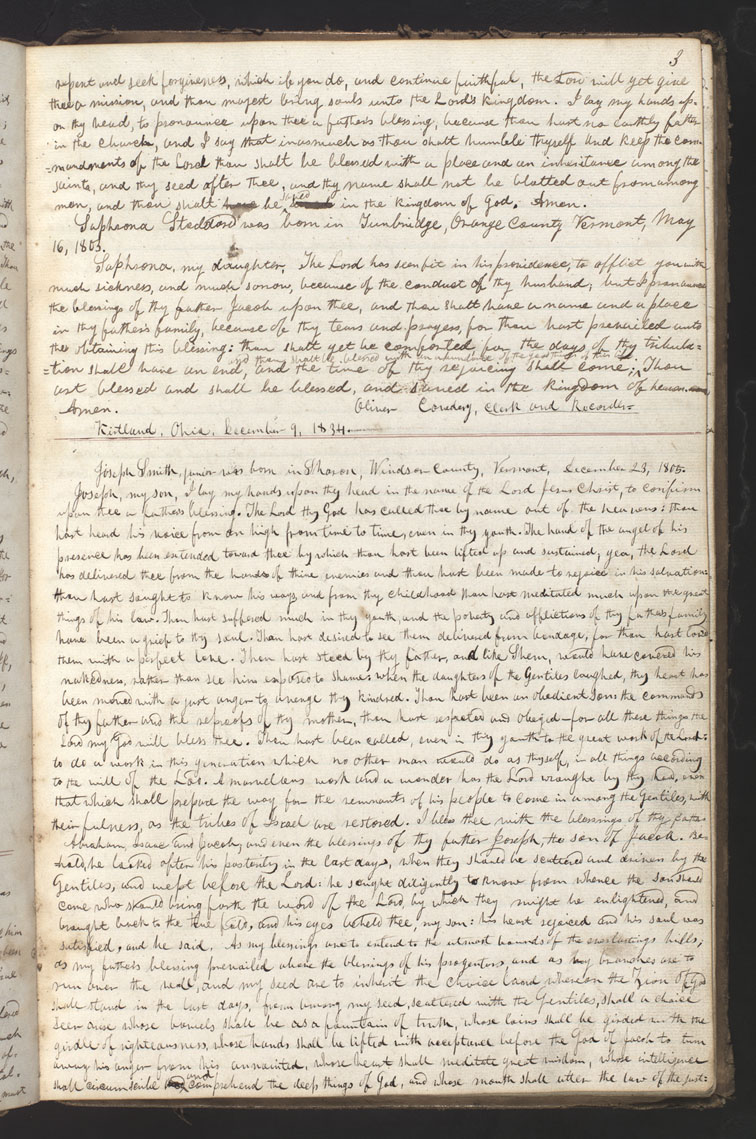
The language ("called thee by name out of the heavens" and "heard his voice from on high from time to time, even in thy youth") describes some form of theophanic encounter in youth, not merely inner spiritual impression. The blessing was given in December 1834, almost simultaneously with Cowdery's Messenger and Advocate Letter III (the FV setup that Letter IV declined to deliver) and four years before the canonical 1838 account, then recorded by Cowdery in the Patriarchal Blessing Book in September 1835. The Joseph Smith Papers editorial annotation explicitly links the "voice from on high… in thy youth" language to Joseph's 1832 history.[54:1]
The limit on it is the same as before. The blessing's language is ambiguous in ways comparable to D&C 20:5's "manifested": "from time to time" could describe Moroni's visits (1823, 1824, 1825, 1826, 1827), the receipt of the Book of Mormon plates (1828), the 1820 visionary experience, dreams, impressions, or any other contact. The blessing is consistent with the apologetic reading of cumulative pre-1838 family knowledge of theophanic experience in Joseph's youth. It is not unambiguous proof of FV-specific knowledge. It belongs in the cumulative case at the same evidentiary weight the article gives D&C 20:5, neither more nor less.
W. W. Phelps's hymn "Now We'll Sing with One Accord" (October 1835). Phelps published his hymn in the Latter Day Saints' Messenger and Advocate in October 1835 and the Church reprinted it the following year as Hymn no. 26 in A Collection of Sacred Hymns. The relevant verse:
"When the world in darkness lay, / Lo! he sought the better way, / And he heard the Savior say, / 'Go and prune my vineyard, son!'"[55]
A hymn is not a private journal entry. It presupposes that the congregation singing the lyrics knows what they describe. Phelps was setting a known narrative to verse for use by Saints who already understood it. The hymn was sung in Latter-day Saint congregations from 1835 onward. This places First-Vision-adjacent narrative elements in congregational worship by October 1835, three years before the 1838 canonical account.
"Go and prune my vineyard, son" is not in any First Vision account; it is closer to Jacob 5 (the allegory of the olive tree) or to broader missionary commission language. The verse's general framing ("when the world in darkness lay," "he sought the better way," he heard the Savior's voice) is FV-adjacent and consistent with the FV narrative being known among the Saints. The fair reading is that the hymn places FV-adjacent theophanic language, Joseph hearing the Savior's voice in early life, in congregational worship by 1835, without placing a specifically FV-canon narrative there.
JST Psalm 14 and JST John (1832–33). Walker Wright and Don Bradley's 2022 BYU Studies Quarterly article argues that Joseph's translation of Psalm 14 (early 1833) and his JST revisions to John 1:18 and 1 John 4:12 (mid-1832 to mid-1833) provide indirect textual evidence that the FV narrative was active in Joseph's thinking before the canonical account.[56] JST John 1:18 reads: "And no man hath seen God at any time, except he hath born record of the son," defending the proposition that humans can see God under specific conditions, the implicit theological prerequisite for the First Vision claim.
Wright and Bradley extended the analysis in a 2024 Deseret News essay arguing that "already by 1831–1832, Joseph Smith's translation of John 1:18 and 1 John 4:12 intimates that he connected his First Vision with the idea of seeing God the Father and of God the Father bearing witness of the Son."[57]
Edward Stevenson's 1834 Pontiac, Michigan reminiscence, properly weighted. Edward Stevenson, then a fourteen-year-old in Pontiac, Michigan, recalled hearing Joseph testify of the First Vision when Joseph visited the local branch in 1834 with his father, Oliver Cowdery, David Whitmer, and Martin Harris. Stevenson recorded:
"In that same year, 1834, in the midst of many large congregations, the Prophet testified with great power concerning the visit of the Father and the Son, and the conversation he had with them. Never before did I feel such power as was manifested on these occasions…"[58]
He did not record this until 1893, fifty-nine years after the events, in his self-published Reminiscences of Joseph the Prophet. The same memory-science cautions that apply to the late Smith-family testimony apply to him with full force. He was a teenager at the time, and his recollection accumulated decades of intervening experience in a Church that institutionalized the two-personage version.
Properly weighted, Stevenson shows only that in 1893 an aging eyewitness believed he remembered hearing Joseph preach the two-personage version in 1834. His recollection is consistent with the 1835 firsthand journal account that already places the two-personage narrative in Joseph's preaching three years before the canonical 1838 account. It cannot stand alone as primary evidence. It is late corroboration, not contemporaneous documentation.
Don Bradley's contextual fit test
Don Bradley's 2013 FAIR Conference presentation "The Original Context of the First Vision Narrative: 1820s or 1830s?" applies a contextual test to the question of when the First Vision narrative actually developed.[59] The test is straightforward. An 1830s fabricator addressing 1830s authority crises would craft a narrative designed to address those problems: ecclesiastical legitimacy, divine commission, authority restoration, institutional founding. Instead the First Vision narrative is embedded in details specific to 1820 frontier New York, not to 1830s Mormon circumstances. Bradley identified four contextual anchors.
1. Community religious context. Joseph's 1838 account describes "unusual excitement on the subject of religion" beginning with the Methodists. Bradley notes that Methodist revivals were "too common to be considered news," which makes their absence from specific Palmyra newspapers insignificant. The documented record for 1818–1820 includes Aurora Seager's diary record of the 1818 Palmyra Methodist camp meeting; the July 1819 Methodist Genesee Conference at Vienna (~12 miles from the Smith farm), with approximately 100 preachers from western New York, northern Pennsylvania, and southern Canada; regional Methodist membership growth of approximately 24% in the Genesee District in 1817–1819; the June 1820 Palmyra-area camp meeting with approximately 1,000 attendees; and George Lane's documented 1819–1820 circuit travel.[43:2] That specificity to 1818–1820 conditions is documented in Methodist conference minutes and contemporary diaries, not in any source Joseph could have consulted in 1838.
2. Economic hardship. Joseph described himself in the 1838 account as "doomed to the necessity of obtaining a scanty maintenance by his daily labor." Bradley identified three converging disasters behind that description, all specific to 1815–1819: Joseph Sr.'s swindled inheritance (well documented in family sources); Mount Tambora's 1815 eruption, the largest volcanic event in modern history, which caused the 1816 "Year Without a Summer" and consequent crop failures across upstate New York; and the 1819 Panic, which triggered widespread foreclosures near Palmyra.[60] Gillen D'Arcy Wood's Tambora: The Eruption That Changed the World (Princeton 2014) documents the climatological event behind the Smith family's hardship.
The link between Joseph's "scanty maintenance" language and Tambora-driven 1815–1819 hardship requires real lived experience of those conditions, not retroactive 1838 invention.
3. Family religious culture. Joseph Sr. as a religious "Seeker" (rejecting established churches but championing restoration ideals); Lucy's grove prayers; the family's daily scripture study and vocal prayer; Joseph's aunt Lovisa's Christological visions in family memory. That culture made Joseph's account of his first vocal prayer in a grove entirely plausible. A fabricator would not need to invent this background, and neither would a fabricator naturally produce contextual specificity matching documented family religious practice from a decade earlier.
4. Seasonal farm labor. Joseph mentioned retrieving his ax from where he had been clearing timber when his brother Alvin called him to dinner. Bradley: "felling trees… was undertaken from late fall through early spring, concluding… by the end of April." Spring land-clearing matches the Smith family's documented seasonal labor on their Palmyra property. The detail is specific and unnecessary; a fabricator inventing a vision narrative would have no reason to include it, and no reason to get it right if he did.
Bradley's key insight is the cumulative one. Any one anchor might be coincidence. Together, the four describe a narrative assembled from 1820 materials: adolescent religious confusion, family economic hardship rooted in 1815–1819 conditions, family religious culture, and spring land-clearing. Its contextual fit is to 1820, not to 1830s institutional needs. A fabricator working backward would have emphasized authority and commission, not adolescent confusion and an ax left in a tree stump.
Memory science and the late-appearance argument
Steven Harper's First Vision: Memory and Mormon Origins (Oxford University Press, 2019), winner of the Harvey B. Black and Smith-Petit Best Book awards, is the definitive scholarly application of cognitive memory research to the First Vision accounts.[61] Robert Rees's 2017 Interpreter article extends the analysis with cognitive neuroscience.[62] Their findings bear directly on the late-appearance argument, though the evidence has to be weighted carefully, because memory science can be enlisted by both sides and proves nothing by itself. For the broader memory-science framework as it bears on variation across the nine accounts, see Multiple Accounts §How memory actually works; for the variation-pattern question as it bears on specific contradictions, see Contradictions.
Flashbulb memory: high confidence, variable detail. Modern research on "flashbulb memories," vivid recollections of emotionally intense events, shows they are paradoxically among the most variable. People feel certain about their recollections of dramatic events, yet studies show the details shift over time. Ulric Neisser and Nicole Harsch's foundational 1992 study of Challenger disaster memories found that twenty-five percent of participants scored zero on accuracy when their 1986 recollections were compared to fresh records 2.5 years later, and yet they expressed high confidence.[63] Famous documented examples of false flashbulb memories include George W. Bush's recollection of seeing the first plane hit on 9/11; Hillary Clinton's Bosnia sniper-fire claim; Ronald Reagan's account of helping liberate concentration camps; Mitt Romney's MLK march; and Brian Williams's Iraq helicopter incident. None of these are conscious lies; all are documented behavior of flashbulb memories.
Rees's framing:
"Memories are constructed, not remembered — or at least are a combination of remembered facts and largely unconscious invention; at any given moment we are not likely to be able to distinguish between the two."[62:1]
"Every context will alter the nature of what is recalled."
Dramatic, emotionally powerful events create "flashbulb memories" — among our "most unstable and unreliable remembrances."
This predicts exactly the pattern seen in Joseph's accounts: high confidence, consistent core elements, variable peripheral details. Harper identifies seven elements that remain stable across all firsthand and secondhand accounts:[61:1]
- Joseph was young.
- He was troubled by religious confusion.
- He went to pray alone.
- Divine light appeared.
- Heavenly being(s) appeared.
- He was told existing churches were wrong.
- He was persecuted when he told others.
Variable peripheral detail combined with a stable core is what genuine flashbulb memory looks like.
Fabricated stories tend to become more fixed. Harper documents that fabricated stories tend to become more fixed over time as the teller works from a rehearsed script, while genuine recollections show natural variation as different audiences and contexts draw out different details.[61:2] Joseph's accounts show the latter pattern, the 1835 account's "many angels" (dropped in 1838) included. Embellishment requires details to accumulate; instead they fluctuate.
The fallacy of negative proof. Harper has identified the specific historiographical fallacy the late-appearance argument relies on. David Hackett Fischer named it the "fallacy of the negative proof," using silence as evidence of absence. Harper applies it directly to Walters's late-development methodology and to the broader late-appearance pattern.[25:3] The argument that "no surviving pre-1832 written FV documentation → therefore the FV did not exist before 1832" is structurally identical to that fallacy. Silence in the documentary record is consistent with several scenarios, including (a) the event did not happen, (b) the event happened but documentation was not produced for the reasons documented above, or (c) the event happened and documentation was produced but did not survive. Treating (a) as the only option that explains the silence is logically invalid.
Where memory science has limits. It applies most cleanly to short-term fabrication research (forensic studies of alibi construction). Long-term narrative development over decades is less established empirically. Memory science supports the variation pattern being consistent with genuine memory; it does not by itself definitively rule out gradual enhancement of a real-but-modest experience over many years (the Vogel-Palmer thesis). The harder argument against gradual enhancement of the core event is the 1832 account's already-theophanic content, present at the earliest written account rather than added later. Memory science is one input to a cumulative case, not a stand-alone proof.
Harper's hermeneutic-of-suspicion-versus-trust framework, the interpretive lens a reader brings to the evidence, supplies the cleanest methodological framing.[64] A reader who begins with the assumption that the vision could not have happened will interpret all the evidence through that filter, reinterpreting new findings to fit existing assumptions rather than reconsidering them. A reader who remains "open to historical possibilities" accounts for normal human memory patterns. Harper applies the framework in both directions: "The danger of closed-mindedness is as real for believers as it is for skeptics." His bottom line: "Believing or not believing… is ultimately a conscious, individual decision," and that decision reveals "much more about the subjective judgments of its maker than it does about the veracity of the claims Joseph made in historical documents."
From personal memory to collective memory
The CES Letter's related claim, that the First Vision "does not appear to have been widely taught to members of the Church until the 1840s, more than a decade after the Church was founded," is partly true. The institutional consolidation of the First Vision as a Church cornerstone took decades. The relevant question is whether that slow consolidation is best explained as fabrication or as normal religious-historical development.
The trajectory:
- 1820: The vision occurs.
- 1832: Joseph writes his first account, never circulated.
- 1834–35: Cowdery's Messenger and Advocate letters describe Joseph's history but skip the First Vision.
- 1835: Joseph tells the vision orally to Robert Matthews; Phelps publishes "Now We'll Sing with One Accord."
- 1838: Joseph composes the canonical account during the Missouri persecutions; first publicly serialized in Times and Seasons beginning March 15, 1842 (the History of the Church serialized installments, 1842–46).
- 1840: Orson Pratt publishes An Interesting Account of Several Remarkable Visions in Edinburgh, the first published full firsthand narrative.
- March 1, 1842: Joseph publishes the Wentworth Letter (a separate firsthand account) in Times and Seasons 3:706–707, written for John Wentworth of the Chicago Democrat.
- 1849: Pratt first uses "first vision" as a specific theological term in Millennial Star (vol. 11, no. 20, October 15, 1849, p. 310).
- 1851: Pearl of Great Price published in Liverpool by Franklin D. Richards.
- 1880: Pearl of Great Price canonized as scripture.
- 1890s–present: First Vision becomes increasingly central to Latter-day Saint identity, culminating in Hinckley's "all or nothing" framing.[65]
Sixty years from personal experience to canonized scripture. The CES Letter treats this as suspicious. Scholars who specialize in religious history treat it as normal. As Petersen and Harper summarize in The Eye of Faith: "Consolidating collective memory is a process that takes place over decades, not an event like the vision itself."[65:1]
Allen's 2012 expanded chapter explains the structural mechanism. Early Latter-day Saints prioritized Moroni's visit and the Book of Mormon as missionary tools because those fulfilled biblical prophecy, specifically Revelation 14:6 ("an angel… having the everlasting gospel"). The First Vision lacked comparable scriptural fulfillment. Orson Pratt's 1848 formulation made this explicit: "John testifies that when the everlasting gospel is restored to the earth it shall be by an angel. Mr. Smith testifies that it was restored by an angel, and in no other way."[29:1]
Moroni and the Book of Mormon fulfilled biblical prophecy in a way that made stronger missionary arguments; the First Vision, a personal experience without parallel scriptural-prophecy fulfillment, was simply less useful in 1830s missionary preaching. That is a theological-priority explanation for the late institutional emphasis, not a late-fabrication explanation. Allen also noted that early converts found "little, if any, discomfort with the concept of God" because LDS Godhead theology was not yet sharply distinct from Trinitarian Christianity in the 1830s, which made the First Vision less doctrinally urgent for missionary purposes than it would later become.
Richard E. Bennett's 2020 BYU Studies Quarterly article "Not the First but the Second" argues that "the vision of Moroni overshadowed [the First Vision] in importance for almost one hundred years," while defending the FV's genuineness and acknowledging the late-prominence pattern.[66] The trajectory from peripheral (1830s–1880s) to all-or-nothing (1890s–present) is what Steven Harper traces in detail in his 2020 BYUSQ article "Raising the Stakes: How Joseph Smith's First Vision Became All or Nothing."[67] Harper's central methodological point is that the late-appearance argument assumes, implicitly, that current prominence should match original prominence. That assumption is unfounded: many religious traditions show slow institutional consolidation of foundational events, and slow consolidation does not entail late fabrication.
A fabricator producing an institutional founding myth in 1838 would emphasize the institutional weight from day one. The actual pattern, gradual emphasis growth across decades as the founding narrative shifted from "Moroni/Book of Mormon" toward "First Vision" with the Church's evolving theological needs, is ordinary institutional behavior.
"This trajectory is normal religious history" is by itself only a negative argument: it refutes the inference from late prominence to late fabrication without establishing the FV's authenticity. The positive case rests on the content of the 1832 account, the pre-1832 hostile witnesses, the family corroboration, the indirect textual evidence, and Bradley's contextual fit test, not on the institutional-trajectory observation alone.
A documentary record that is rich but qualified
Steven Harper has called the First Vision "the best-documented theophany in history."[46:2] Harper himself frames the claim tentatively ("may be"), and it deserves cautious handling. The superlative is contestable, particularly against modern Marian apparitions like Fatima (1917), which had contemporaneous records from multiple independent eyewitnesses. The proper comparison set is not Moses's burning bush; ancient theophanies have thin documentation because of survival bias, not because their original reception was less attentive. It is other 19th-century claimed religious experiences whose recipients are identifiable. Against that set, the First Vision's documentary record is adequate for historical investigation rather than uniquely rich.
What the record does contain:
The four firsthand accounts by Joseph Smith himself: 1832, 1835 (recorded by scribe Warren Parrish), 1838 (the canonical account; first publicly serialized in Times and Seasons 1842 ff.), and 1842 (the Wentworth Letter).
Five contemporary secondhand accounts by people who heard Joseph tell the story: Orson Pratt 1840 (An Interesting Account, Edinburgh), Orson Hyde 1842 (Ein Ruf aus der Wüste, German pamphlet, Frankfurt am Main), Levi Richards 1843 (Nauvoo journal), David Nye White August 1843 (Pittsburgh newspaper interview, published September 15, 1843), Alexander Neibaur 1844 (journal).[68]
Additional secondhand reminiscences recorded later, with full caveats about their late date: Joseph Curtis 1835, Edward Stevenson 1834 (recollected 1893), Mary Isabella Horne 1837, Zebedee Coltrin's 1883 recollections of 1832–33 teaching.
Multiple hostile-witness pre-1832 references, as documented above (Capron, Painesville Telegraph, Reflector, Articles and Covenants reprint), each individually contestable, cumulatively suggestive.
Indirect textual evidence: Joseph Smith Sr.'s patriarchal blessing (1834), Phelps's hymn (1835), JST Psalm 14 and JST John (1832–33), with the appropriate caveats stated above on each.
Family testimony with at least one falsifiable detail (William's George Lane), subject to Porter's archival corroboration and to the reconstruction-hypothesis caveats.
Caveats: the four firsthand accounts are all from Joseph Smith himself, so "well-documented" should not be confused with "independently attested by multiple witnesses to the original event." The secondhand accounts are from followers, not independent observers; they show that whenever Joseph told the story in any developed form he described two personages, but they are no independent check on what happened in 1820. The hostile-witness pre-1832 references are fragmentary, and Bowman is right that none is an undisputed, unambiguous narrative of the 1820 event. None of these caveats reduces the record to "thin." But neither does it support the grandest apologetic superlatives. "Rich but qualified" is the better description: adequate for historical investigation, suggestive in its patterns, not airtight on individual items.
The critics' best case
The late-appearance argument is not a smoking gun, and it does not prove fabrication. But six of its observations are solid, and the serious critics (Bowman, Vogel, Marquardt and Walters) state them better than the CES Letter does.
The pre-1832 documentary trail runs thinner than for comparable Restoration events. The trail for Moroni and the Book of Mormon (1823 onward) is much richer than the trail for the First Vision (1820 onward). Some of this is explained by the Revelation 14:6 framework, in which Moroni's visit fulfilled scriptural prophecy where the FV did not, but the differential is real.
The pre-1832 references are individually contestable. Bowman has pressed this case article-by-article, and pressed it well. The Capron affidavit is vague. The Reflector report is third- or fourth-hand and embedded with falsehoods. D&C 20:5's "manifested" is linguistically ambiguous. No single pre-1832 reference is a clean, unambiguous narrative of the 1820 grove theophany. The article's defended position is that across the partial-evidence items (the Capron 1827 timing, the Reflector's underlying datum of public preaching, D&C 20:5's three-part structure, the 1832–33 newspaper cluster) a pattern of theophanic claims circulating publicly emerges.
The Cowdery conundrum is not fully resolved. Oliver had access to Joseph's 1832 account and chose not to describe the FV in the Church's first official history. The "Joseph asked him not to" explanation is plausible but raises its own question about why Joseph would suppress the founding theophany from the founding-history document. The disaffected-insider silence (Cowdery and Williams later disaffected without claiming fabrication) is a methodological note against the CES Letter's framing, not affirmative evidence of authenticity. None of this is dispositive.
Early missionary literature did not foreground the First Vision. Alexander Campbell's Delusions (1832) and E. D. Howe's Mormonism Unvailed (1834) attack Joseph extensively but do not engage a First Vision claim. Parley P. Pratt's 1837 Voice of Warning, a 200-page missionary tract, does not mention the FV.[69] If Joseph had been telling the FV with 1838-quality detail and missionaries had been leading with it, hostile critics would have engaged it. The silence of the polemical literature is the sturdiest of the critical observations.
The shift from personal-forgiveness narrative (1832) to institutional-founding narrative (1838) is real. This does not necessarily indicate fabrication; memory science provides a framework for understanding why the same event is remembered with different emphases in different contexts. But the more sophisticated critical position (Vogel, Palmer, Marquardt-Walters) is that gradual development of a real-but-modest experience, rather than crude invention, explains the documentary pattern. That thesis is harder to dismiss than the cruder "fabrication" claim. The 1832 account's already-theophanic content creates significant problems for the development thesis at its most ambitious, though it does not refute the narrower form Vogel and Palmer actually argue.
Family testimony came decades later. By the time most family members were on record, the canonical narrative was already published and institutionalized. William's identification of George Lane is independently verifiable and compelling, though the reconstruction hypothesis is not fully foreclosed. Other family details are more difficult to separate from absorbed narrative.
The positive case
The evidence does not merely defend against the late-appearance argument. Cumulatively, it builds a positive case for the First Vision's authenticity that no version of the fabrication thesis adequately accounts for, though each piece of it arrives with its own caveat.
The 1832 account is the wrong artifact for the theory. A founding myth written for institutional use would carry a summons from heaven, a chain of authority, a story built to be published. Instead the earliest written account is a private, unfinished, unpublished, partly-autograph confession of personal sin and divine forgiveness, with phonetic misspellings, a crossed-out "fire" replaced with "light," housed in a letterbook for 137 years until a 1965 BYU master's thesis brought it to scholarly attention. Both Brodie's crude fabrication thesis and the more ambitious versions of Vogel-Palmer gradual enhancement predict a different starting point than what the 1832 account actually contains.
The 1835 account places the two-personage narrative in 1835. The 1835 firsthand journal account, recorded contemporaneously, places two personages in Joseph's preaching three years before the canonical 1838 account. The development thesis can absorb 1835 (it falls within the development window), but it constrains the timeline: Vogel-Palmer cannot locate the two-personage construction in the late 1830s Missouri-era institutional context. The construction, if it is a construction, is at minimum a 1832–1835 process.
The hostile witnesses corroborate oral circulation. Between 1827 and 1833, hostile neighbors, newspapers, and ministers reported that Joseph and his followers were claiming direct divine encounters. Hostile witnesses do not hand their opponents miracles. Whatever these sources got wrong in their details, and Bowman is right that they got many details wrong, they confirm that some claim of theophanic experience was circulating orally before Joseph wrote it down. The CES Letter's claim that "no one had ever heard" before 1832 is contradicted by the very record it appeals to. The 1832 account itself describes prior oral sharing and disbelief, which means the document Runnells cites as evidence of late appearance refutes its own framing.
The narrative fits the 1820s. Don Bradley's contextual analysis shows the First Vision narrative embedded in 1820s conditions (Methodist regional revivals, 1815–1819 Tambora-driven economic hardship, family religious culture, spring land-clearing) rather than in 1830s institutional needs. None of those anchors would occur to a myth-maker whose problems were ecclesiastical legitimacy and divine commission.
The 1832 watershed for personal documentation explains the timing. Joseph's universal silence about his personal life before 1832, confirmed by the Joseph Smith Papers historical introduction to the 1832 history, places the FV documentation inside his broader pattern. The FV is not selectively missing from pre-1832 records; everything personal is. The 1832 account appeared precisely when Joseph first turned to personal history of any kind.
William Smith's identification of George Lane is independently verifiable. Lane is documented in Methodist conference minutes for 1819–1820 in the right places at roughly the right time. William named Lane decades before Larry Porter's archival research confirmed Lane's circuit assignments. This is a falsifiable family-corroboration detail that absorbed-canon hypotheses struggle to produce, though William could in principle have assembled the name from Methodist print sources.
Pre-1838 corroborating evidence beyond hostile witnesses. Joseph Smith Sr.'s December 1834 patriarchal blessing describing Joseph hearing God's voice "from on high… in thy youth" (with the linguistic ambiguity caveat); Phelps's 1835 congregational hymn placing FV-adjacent theophanic language in worship (with the "prune my vineyard" specifics caveat); JST Psalm 14 and JST John (1832–33) defending the theological prerequisite for seeing God; Edward Stevenson's late-recalled Pontiac 1834 testimony (with the fifty-nine-year recording-gap caveat). Each invites its own challenge. Cumulatively, they contribute to the case that First Vision narrative elements were active in the public record before the canonical 1838 account.
The gap is historically normal. Paul's Damascus road experience went undocumented in writing for roughly fifteen years, and no serious biblical scholar treats that gap as evidence of fabrication. D. Michael Quinn, a critical historian, observed that Joseph's documentary delay echoes the actions of contemporary Protestant ministers who waited decades to publish their visions of deity. The twelve-year gap between event and private writing (and the twenty-two-year gap to public publication) is consistent with nineteenth-century American religious documentation patterns.
The documentary record is adequate for historical investigation. Four firsthand accounts from the recipient, five contemporary secondhand accounts, additional reminiscences (with caveats), hostile-witness attestation predating the first written record, family corroboration with at least one independently verifiable detail, indirect textual evidence in Joseph's scriptural revisions and hymnody, and Joseph Smith Sr.'s blessing. This is not a thin record by any reasonable historical standard, even if it is not the "best-documented theophany in history" superlative apologetic writing has sometimes claimed.
Institutions consolidate founding stories slowly. A fabricator would have made the vision central from the start. The actual emphasis grew at the pace institutions move, tracking the Church's missionary needs and theological articulation as they evolved.
The disaffected-insider methodological note. Cowdery and Williams, both of whom had access to the 1832 account, both later disaffected, neither ever claimed Joseph fabricated the First Vision narrative. Applied evenly, the same methodology that drives the late-appearance argument does not produce the one-way conclusion the CES Letter draws.
Assessment
The CES Letter's late-appearance argument begins with a significant overstatement, "absolutely no record" before 1832 when multiple pre-1832 references exist, hostile ones included; it sustains itself through selectively edited quotation (Allen frozen in 1966 even though he revised his framing in 1970 and again in 2012); and it arrives at an implied conclusion, fabrication, that the cumulative evidence does not support.
The documentary record before 1832 is thin beside what exists for Moroni's visit or the Book of Mormon. The pre-1832 references are fragmentary, and Robert Bowman has published a detailed rebuttal of each. The Cowdery conundrum is not fully resolved. Early missionary literature did not lead with the First Vision, and the silence of polemical literature like Campbell's Delusions and Howe's Mormonism Unvailed is a real critical observation. The shift from personal-forgiveness emphasis (1832) to institutional-founding emphasis (1838) is real. The Vogel-Palmer gradual-development thesis is harder to refute than crude fabrication claims, and the article has tried to engage the version its proponents actually defend rather than the strawman the CES Letter often presents.
But the record is not empty, and its absences are narrower than the charge requires. Hostile witnesses were reporting that Joseph claimed to have "seen God" before he wrote anything down. Family members recalled details the canonical narrative does not contain, particularly William Smith's identification of George Lane, whose 1819–1820 circuit travel Methodist conference records confirmed decades after William named him. The 1832 watershed for personal documentation places the FV's documentary timing inside Joseph's universal pattern of personal-life silence before 1832 and personal-life recording after. And Don Bradley's contextual fit test shows the narrative's anchoring details (Tambora-driven economic hardship, Methodist Genesee Conference activity, spring land-clearing, family religious culture) are specific to 1820 conditions in ways no 1830s fabricator would naturally produce.
The 1832 account itself is the article's strongest single positive evidence. Its content (private, unfinished, partly autograph, focused on personal sin and divine forgiveness, with the "fire" struck through for "light") is the wrong kind of document for crude fabrication, and a Brodie-style fabricator would not lead with personal anguish. The version of the Vogel-Palmer thesis that locates the development in the core theophanic event itself has to absorb the fact that the 1832 account already contains divine appearance, divine speech, and divine forgiveness. The 1835 account's "many angels," dropped in 1838, is consistent with ordinary memory fluctuation. The accounts vary the way memory science predicts genuine memory varies: stable core elements, fluctuating peripheral details.
The twelve-year gap between event and first written record is historically normal, and the twenty-two-year gap to public publication is similarly within nineteenth-century norms. Paul's gap was longer; Charles Finney's was longer still; Quinn observed that Joseph's delay matched contemporary Protestant ministers' patterns. The expectation that a barely-literate fourteen-year-old on the American frontier in 1820 should have produced a written record of a private spiritual experience reflects modern documentation standards, not historical norms.
The late-appearance argument asks a fair question: why does the documentary trail look the way it does? It looks the way we should expect for a genuine, deeply personal experience that was shared orally before it was written down, that was private before it was institutional, that was documented by a man who lacked the literacy, infrastructure, and motivation to produce a formal written account until 1832 (the same year he first turned to personal history of any kind), and whose institutional emphasis grew gradually as the Church's missionary needs and theological articulation matured. The evidence does not require fabrication, even in its more sophisticated gradual-development variants. It is better explained by the ordinary processes of memory, documentation, and institutional development.
A thoughtful reader who finds individual elements troubling (the Cowdery omission, the early-missionary silence, the ambiguity of D&C 20:5, the late date of family testimony) is not being unreasonable, and the article does not claim those difficulties have all been resolved. What it claims is that the cumulative weight of evidence (the 1832 account's content and physical features, the pre-1832 hostile witnesses, the family corroboration, the indirect textual evidence, Bradley's contextual fit test, the disaffected-insider note, and the normal pattern of slow institutional consolidation) supports the historicity of something extraordinary happening to Joseph in 1820. The companion articles on Contradictions and Multiple Accounts carry the rest of that case.
The CES Letter's claim is that "no one… had ever heard" of the First Vision for twelve to twenty-two years. The earliest record we have of it answers that claim in Joseph's own hand. He did not write that he kept the experience to himself. He wrote that he told people and was not believed: "and the Lord was with me but could find none that would believe the hevnly vision nevertheless I pondered these things in my heart."[11:5] The document the CES Letter holds up as proof that no one had heard is itself the record of people hearing, and disbelieving. The trail before 1832 is thin, and parts of it stay hard. But the single document at the center of the charge already contains its own refutation.
Further Reading
- First Vision Accounts (Gospel Topics Essay)
- Accounts of the First Vision (Joseph Smith Papers)
- History, circa Summer 1832 (Joseph Smith Papers, the 1832 account)
- The 1832 First Vision Account (Pearl of Great Price Central)
- Exploring the First Vision, Religious Studies Center, BYU (the foundational scholarly volume; includes Allen-Welch, Allen "Emergence of a Fundamental," Jessee, Porter, Harper "Evaluating Three Arguments," Bradley)
- Steven C. Harper, First Vision: Memory and Mormon Origins (Oxford University Press, 2019), the definitive scholarly monograph
- Forming a Collective Memory of the First Vision (The Eye of Faith, RSC)
- The Cowdery Conundrum, Roger Nicholson, Interpreter (2014)
Runnells, CES Letter (2017), "First Vision," no. 3, p. 34. The CES Letter also states: "Despite the emphasis placed on it now, the first vision does not appear to have been widely taught to members of the Church until the 1840s, more than a decade after the Church was founded, and 20 years after it allegedly occurred." ↩︎
Runnells, CES Letter (2017), "First Vision," p. 34, quoting James B. Allen, "The Significance of Joseph Smith's 'First Vision' in Mormon Thought," Dialogue: A Journal of Mormon Thought 1, no. 3 (Autumn 1966): 29–45. ↩︎
Runnells, CES Letter (2017), "First Vision," p. 35. ↩︎
The Reflector (Palmyra, NY), vol. 2, no. 13 (February 14, 1831), p. 102. The quoted sentence sits in the report of "Our Painesville correspondent" that editor Abner Cole printed under the heading "Book of Mormon" within the "Gold Bible, No. 4" installment: "Smith (they affirmed) had seen God frequently and personally — Cowdery and his friends had frequent interviews with angels." Dan Vogel, ed., Early Mormon Documents 2 (Salt Lake City: Signature Books, 1998), 223–250, reproduces the Reflector's Gold Bible essay series but omits the correspondent's report. ↩︎ ↩︎ ↩︎
Robert M. Bowman Jr., "Alleged Early References to the First Vision," Institute for Religious Research. https://mit.irr.org/alleged-early-references-first-vision. Aggregator hub for Bowman's article-by-article rebuttals of pre-1832 evidence claims, including the "uncritical, inaccurate, and even dishonest use of sources" charge against apologetic writing on this topic. ↩︎ ↩︎
Joseph Capron affidavit, collected by D.P. Hurlbut (1833), in Eber D. Howe, Mormonism Unvailed (Painesville, OH: 1834), 259. Capron was a neighbor of the Smiths; his affidavit references the family's "highest pretensions to piety and holy intercourse with Almighty God." ↩︎ ↩︎
Doctrine and Covenants 20:5–7. Dated circa April 1830; presented and accepted by common consent at the Church's first conference, June 9, 1830 (Joseph Smith Papers, "Articles and Covenants, circa April 1830 [D&C 20]," historical introduction); reprinted in the non-Mormon Painesville Telegraph, April 19, 1831. ↩︎ ↩︎
"The Golden Bible," Painesville Telegraph (Painesville, OH), November 16, 1830: the Book of Mormon "said to be translated from Egyptian Hieroglyphics, on metal plates, by one Smith, who was enabled to read the characters by instruction from Angels"; "The name of the person here, who pretends to have a divine mission, and to have seen and conversed with Angels, is Cowdray [Oliver Cowdery]." A letter printed December 7, 1830 added that Cowdery "has his commission directly from the God of Heaven." Excerpted in Dan Vogel, ed., Early Mormon Documents 2 (Salt Lake City: Signature Books, 1998), 508 (Nov. 16), 508–509 (Dec. 7), in the "Oliver Cowdery Addendum." The Cowdery portion of the November 16 text is transcribed at FAIR: https://www.fairlatterdaysaints.org/evidences/Source:Painesville_Telegraph:16_Nov_1830:Cowdery_pretends_to_have_a_divine_mission_and_conversed_with_angels ↩︎ ↩︎
Painesville Telegraph, April 19, 1831, reprinting the Articles and Covenants of the Church of Christ (D&C 20). ↩︎ ↩︎
Fredonia Censor (Fredonia, NY), March 7, 1832. Missionaries teaching that Joseph, "having repented of his sins... being in doubt what his duty was, he had recourse to prayer." ↩︎ ↩︎
Joseph Smith, History, circa Summer 1832, pp. 1–3, Joseph Smith Papers. https://www.josephsmithpapers.org/paper-summary/history-circa-summer-1832/1. Composed between July 20 and September 22, 1832; partly in Joseph's own hand and partly in Frederick G. Williams's hand. Housed in Joseph Smith Letterbook 1. ↩︎ ↩︎ ↩︎ ↩︎ ↩︎ ↩︎
B. Pixley, "Mormonism," Christian Watchman, republished in Ohio Atlas and Elyria Advertiser, December 6, 1832. References Saints professing to "hold frequent converse with angels" and Church members claiming to have "conversed with Christ face to face." Compiled in Sarah Allen, "Letter For My Wife Rebuttal, Part 2: The First Vision [A]," FAIR, February 2, 2023. https://www.fairlatterdaysaints.org/blog/2023/02/02/lfmw-rebuttal-part-2-the-early-church-the-first-vision-a ↩︎ ↩︎
Rev. Richmond Taggart, letter to Rev. Jonathan Goings, March 2, 1833. "Joe Smith... told them he had seen Jesus Christ and the Apostles and conversed with them, and that he could perform miracles." Compiled in FAIR, "Events after the First Vision." https://www.fairlatterdaysaints.org/answers/Events_after_the_First_Vision ↩︎ ↩︎
Missouri Intelligencer, August 10, 1833. Referenced in Sarah Allen, "Letter For My Wife Rebuttal, Part 2: The First Vision [A]," FAIR, February 2, 2023. ↩︎ ↩︎
Bowman, "Alleged Early References." Bowman characterizes the 1832 manuscript as "the earliest known undisputed account" of the First Vision; the article's framing here paraphrases Bowman's overall position rather than presenting verbatim text. ↩︎
Truman G. Madsen, acknowledgment cited in Robert M. Bowman Jr., "Mrs. Palmer and the First Vision: Doing Research Mormon Apologists Won't Do," robertbowman.net, April 24, 2020 (originally published at IRR). Madsen's 1969 acknowledgment: "we do not know enough about it to rely on its complete authenticity"; the account was "apparently not in her words but someone else's (unknown) who recorded it." https://robertbowman.net/2020/04/24/mrs-palmer-and-the-first-vision-doing-research-mormon-apologists-wont-do/ ↩︎
Bowman, "Alleged Early References to the First Vision," IRR, https://mit.irr.org/alleged-early-references-first-vision. Bowman's hub article does not address the Capron affidavit specifically; it surveys other pre-1832 references (the 1830 Reflector satire, D&C 20:5, the 1831 Reflector article, and the 1832 Fredonia Censor). The Bowman position attributed here on Capron is inferred from his broader pre-1832 source-handling framework, applied to the vagueness of "highest pretensions to piety and holy intercourse with Almighty God" — not from an article-specific Bowman rebuttal of Capron. ↩︎
Donald L. Enders, "Can the 1834 Affidavits Attacking the Smith Family Be Trusted?" Scripture Central / Book of Mormon Central archive. Enders raises reliability concerns about the entire Hurlbut affidavit corpus. ↩︎
Robert M. Bowman Jr., "The First Rumor: The 1831 Palmyra Reflector and the First Vision," Institute for Religious Research. Bowman argues "we are on safe ground in dismissing this report as historically unreliable," characterizing the information as "third- or fourth-hand" and "imbedded with several other claims from the same source that Mormons must agree are either unreliable or untrue." https://mit.irr.org/first-rumor-1831-palmyra-reflector-and-first-vision ↩︎ ↩︎
Richard Lloyd Anderson, "Joseph Smith's Testimony of the First Vision," Ensign (April 1996). https://www.churchofjesuschrist.org/study/ensign/1996/04/joseph-smiths-testimony-of-the-first-vision. Anderson notes that "this aspect of the glorious event was recorded in the Doctrine and Covenants as a manifestation prior to that of Moroni (1823) that assured 'this first elder that he had received a remission of his sins'" (referring to D&C 20:5). ↩︎
Robert M. Bowman Jr., "Truly Manifested: Does D&C 20:5 Refer to the First Vision?" Institute for Religious Research. Bowman argues "manifested" typically means inner spiritual confirmation in D&C usage, citing D&C 20:37 and D&C 21:7–8 as parallel non-visionary uses. https://mit.irr.org/truly-manifested-does-dc-205-refer-first-vision ↩︎
Roger Nicholson, "The Cowdery Conundrum: Oliver's Aborted Attempt to Describe Joseph Smith's First Vision in 1834 and 1835," Interpreter: A Journal of Mormon Scripture 8 (2014): 27–44. https://interpreterfoundation.org/journal/the-cowdery-conundrum-olivers-aborted-attempt-to-describe-joseph-smiths-first-vision-in-1834-and-1835/. Nicholson documents Cowdery's access to Joseph's 1832 account, the December 1834 Joseph-to-Cowdery letter expressing concern about historical accuracy, the eight-week gap between Letters III and IV, and the oblique scriptural references in Letter IV. ↩︎ ↩︎
Cowdery's later affidavit (1838) and his post-Church writings: Cowdery never claimed Joseph fabricated the First Vision. Frederick G. Williams reconciled with the Church before his death in 1842 and never claimed fabrication. See Richard Lloyd Anderson, "Oliver Cowdery: Cooperator with Joseph Smith," in Investigating the Book of Mormon Witnesses (Salt Lake City: Deseret Book, 1981); and Frederick G. Williams biographical material in JSP. ↩︎
Cowdery's later affidavit (1838) reaffirmed his Book of Mormon witness specifically; he did not affirm or deny the FV in his post-disaffection writings. Williams reconciled with the Church before his death in 1842, giving him institutional reasons not to attack Joseph's narrative in his final years. And neither man could verify what happened in 1820 — they could only verify that Joseph wrote the 1832 account in 1832, and that nothing they later learned moved them to call the underlying narrative a fabrication. This is a low evidentiary bar and the article weights it accordingly. ↩︎
Steven C. Harper, "Evaluating Three Arguments Against Joseph Smith's First Vision," in Exploring the First Vision, ed. Samuel Alonzo Dodge and Steven C. Harper (Provo, UT: Religious Studies Center, BYU, 2012). https://rsc.byu.edu/exploring-first-vision/evaluating-three-arguments-against-joseph-smiths-first-vision. Harper identifies the "fallacy of negative proof" (citing David Hackett Fischer) in the late-appearance methodology and documents Brodie's revised dating when the 1832 account surfaced. ↩︎ ↩︎ ↩︎ ↩︎
D&C 110, April 3, 1836. First published in Deseret News, November 6, 1852 — a sixteen-year gap. Joseph never publicly mentioned the Kirtland Temple vision during his lifetime. See Trever Anderson, "Doctrine and Covenants Section 110: From Vision to Canonization," MA thesis, BYU, 2010. ↩︎ ↩︎
James B. Allen, "The Significance of Joseph Smith's 'First Vision' in Mormon Thought," Dialogue: A Journal of Mormon Thought 1, no. 3 (Autumn 1966): 29–45. Allen's foundational article. https://www.dialoguejournal.com/wp-content/uploads/sbi/articles/Dialogue_V01N03_31s.pdf ↩︎
James B. Allen, "Eight Contemporary Accounts of Joseph Smith's First Vision — What Do We Learn from Them?" Improvement Era 73, no. 4 (April 1970): 4–13 (article body ends p. 11, with footnotes through p. 13). Allen wrote: "it can now be demonstrated that the Prophet described his experience to friends and acquaintances at least as early as 1831–32, and that he continued to do so in varying detail until the year of his death, 1844." ↩︎
James B. Allen, "Emergence of a Fundamental: The Expanding Role of Joseph Smith's First Vision in Mormon Religious Thought," in Exploring the First Vision, ed. Samuel Alonzo Dodge and Steven C. Harper (Provo, UT: Religious Studies Center, BYU, 2012). https://rsc.byu.edu/exploring-first-vision/expanding-role-joseph-smiths-first-vision-mormon-religious-thought. Originally published in Journal of Mormon History 7 (1980): 43–61. ↩︎ ↩︎
James B. Allen and John W. Welch, "The Appearance of the Father and the Son to Joseph Smith in 1820," in Exploring the First Vision, ed. Samuel Alonzo Dodge and Steven C. Harper (Provo, UT: Religious Studies Center, BYU, 2012), 41–89, with the "consensus" passage at p. 73. https://rsc.byu.edu/exploring-first-vision/appearance-father-son-joseph-smith-1820 ↩︎
Dean C. Jessee, "The Earliest Documented Accounts of Joseph Smith's First Vision," in Exploring the First Vision, ed. Samuel Alonzo Dodge and Steven C. Harper (Provo, UT: Religious Studies Center, BYU, 2012), 1–40. https://rsc.byu.edu/exploring-first-vision/earliest-documented-accounts-joseph-smiths-first-vision. Jessee discusses Joseph's literacy, the "abrupt discontinuance" of the 1832 narrative, and the deaths of scribes Mulholland and Thompson. ↩︎ ↩︎ ↩︎ ↩︎
Emma Smith, interview with Joseph Smith III, "Last Testimony of Sister Emma," The Saints' Herald 26, no. 19 (October 1, 1879): 289–290. ↩︎
"D&C 21 — Historical Context and Background," D&C Central. https://doctrineandcovenantscentral.org/historical-context/dc-21/. Discusses the April 6, 1830 commandment to keep records as the foundation of LDS record-keeping infrastructure. ↩︎
Jessee, "Earliest Documented Accounts." James Mulholland died November 3, 1839; Robert B. Thompson died August 27, 1841. See also JSP, History, circa June 1839 – circa 1841 [Draft 2], historical introduction. ↩︎
Joseph Smith Papers, "History, circa Summer 1832," Historical Introduction. "During the first four years of Mormon record keeping (1828–1831), JS focused primarily on preserving his revelatory texts. The records surviving from the early period of his prophetic career are almost exclusively sacred texts, including the Book of Mormon manuscripts, JS's revision of the Bible, and his own contemporary revelations. Scriptural record keeping overshadowed personal and institutional record keeping. This focus changed in 1832, when JS began documenting his personal life in detail for the first time, both in his history and in the journal he began on 27 November 1832." https://www.josephsmithpapers.org/paper-summary/history-circa-summer-1832/2 ↩︎
Joseph Smith, History, circa June 1839 – circa 1841 [Draft 2] (canonical 1838 account), Joseph Smith Papers. https://www.josephsmithpapers.org/paper-summary/history-circa-june-1839-circa-1841-draft-2/1 ↩︎ ↩︎
"Why Are There Different Accounts of Paul's Conversion?" Scripture Central KnoWhy. https://scripturecentral.org/knowhy/why-are-there-different-accounts-of-pauls-conversion. Discusses the variations between Acts 9, 22, and 26 and the principle that "the Lord speaketh unto men according to their language, unto their understanding" (2 Nephi 31:3). ↩︎
D. Michael Quinn, The Mormon Hierarchy: Origins of Power (Salt Lake City: Signature Books, 1994), ch. 1. Quinn: "His delay until 1842 in publishing the account of the first vision echoes the actions of Protestant ministers of his time who waited decades to describe their personal visions of deity." Cited in "Late Appearance / Early Evidence of the First Vision," Debunking-CESLetter, https://debunking-cesletter.com/first-vision-1/early-evidence-of-the-first-vision/. ↩︎
H. Michael Marquardt and Wesley P. Walters, Inventing Mormonism: Tradition and the Historical Record (Salt Lake City: Signature Books, 1994; reprint 2005). https://www.signaturebooks.com/books/p/inventing-mormonism. The foundational scholarly version of the late-development thesis. ↩︎ ↩︎
Grant Palmer, An Insider's View of Mormon Origins (Salt Lake City: Signature Books, 2002). Palmer argues Joseph's early experiences were "relatively simple" spiritual impressions later "enhanced" into physical theophanies. ↩︎ ↩︎
Dan Vogel, Joseph Smith: The Making of a Prophet (Salt Lake City: Signature Books, 2004). Vogel tracks theological evolution from modalism through binitarianism to social trinitarianism and argues the First Vision accounts evolved in parallel: 1832 (one being / "the Lord," personal forgiveness focus, ambiguous on personages) → 1835 (two personages plus angels) → 1838 (institutional founding narrative). ↩︎ ↩︎
Wesley P. Walters, "New Light on Mormon Origins from the Palmyra Revival," Journal of the Evangelical Theological Society 10, no. 4 (1967): 227–244. https://etsjets.org/wp-content/uploads/2013/05/files_JETS-PDFs_10_10-4_BETS_10_4_227-244_Walters.pdf. Walters's original argument that the relevant ecumenical revival is 1824–25, not 1820. ↩︎
Milton V. Backman Jr., Joseph Smith's First Vision: Confirming Evidences and Contemporary Accounts, 2nd ed. (Salt Lake City: Bookcraft, 1980; original 1971). Backman's documentation of regional revival activity 1818–1820, including the 1818 Palmyra camp meeting, the 1819 Genesee Conference at Vienna, and the June 1820 camp meeting. See also Pearl of Great Price Central, "Religious Excitement near Palmyra, New York, 1816–1820," https://pearlofgreatpricecentral.org/religious-excitement-near-palmyra-new-york-1816-1820/. ↩︎ ↩︎ ↩︎
"The 1832 First Vision Account," Pearl of Great Price Central. https://pearlofgreatpricecentral.org/the-1832-first-vision-account/. Documents the manuscript's physical features, including the "fire" → "light" correction and the partial autograph; framing of the account as personal rather than institutional. ↩︎ ↩︎
Paul R. Cheesman, "An Analysis of the Accounts Relating Joseph Smith's Early Visions," MA thesis, BYU, 1965. The 1832 account first surfaced publicly in 1965 through Cheesman's thesis; Jerald and Sandra Tanner independently printed Cheesman's transcript later that same year as Joseph Smith's Strange Account of the First Vision (Salt Lake City: Modern Microfilm Co., 1965). Dean Jessee then published the authoritative scholarly transcription in BYU Studies 9, no. 3 (1969): 275–294. ↩︎
Steven C. Harper, "Four Accounts and Three Critiques of Joseph Smith's First Vision," FAIR Conference, August 4, 2011. https://www.fairlatterdaysaints.org/conference_home/august-2011/four-accounts-and-three-critiques-of-joseph-smiths-first-vision. Harper's "most raw of all Joseph's accounts" framing and his tentative "best-documented theophany" claim. ↩︎ ↩︎ ↩︎
The article's pre-V2.2 elaboration on this point noted that the question of whether what changes between 1832 and 1838 is best called "details" or "core" is precisely what is contested — apologetic writing tends to call them details; the gradual-development thesis treats them as core to what we mean by "the First Vision narrative." Engaging Vogel-Palmer at the level they actually argue is harder work than engaging the strawman, but it is the work the article has to do. ↩︎
Joseph Smith, Journal, 9–11 November 1835, pp. 23–24, Joseph Smith Papers. https://www.josephsmithpapers.org/paper-summary/journal-1835-1836/24 ↩︎
William Smith, William Smith on Mormonism (Lamoni, IA: Herald Steam Book and Job Printing Office, 1883), available digitally at archive.org; William Smith interview with E. C. Briggs (1893). Cited in Larry C. Porter, "Reverend George Lane," 2012. ↩︎
Larry C. Porter, "Rev. George Lane: Good 'Gifts,' Much 'Grace,' and Marked 'Usefulness,'" in Exploring the First Vision, ed. Samuel Alonzo Dodge and Steven C. Harper (Provo, UT: Religious Studies Center, BYU, 2012). https://rsc.byu.edu/exploring-first-vision/reverend-george-lane-good-gifts-much-grace-marked-usefulness. Porter's archival research on Lane's Methodist circuit assignments 1819–1825. ↩︎
Kyle R. Walker, "First Vision Accounts: New Sources from the Smith Family," interview at FromTheDesk. https://www.fromthedesk.org/first-vision-smith-family-accounts-kyle-walker/. Walker's research on newly identified Smith family sources including Sophronia's persecution-era illness and the Methodist minister's wider dissemination of Joseph's vision claim. Walker's underlying scholarly publications, including his work on Katharine Smith Salisbury, are the primary sources behind this interview-format presentation. ↩︎ ↩︎ ↩︎
FAIR, "Lucy Mack Smith / History," citing the Wandle Mace autobiography (recorded 1845). https://www.fairlatterdaysaints.org/answers/Lucy_Mack_Smith/History. The "1839 interview" reconstruction comes from Kyle R. Walker's research on Mace's contacts with the Smith family (per
[^Walker]); FAIR itself does not specify 1839 on this page. ↩︎"How Did Joseph Smith's Family Testify of the First Vision?" Scripture Central KnoWhy #772, January 14, 2025. https://scripturecentral.org/knowhy/how-did-joseph-smith-s-family-testify-of-the-first-vision ↩︎ ↩︎
Blessing from Joseph Smith Sr., 9 December 1834, Joseph Smith Papers. https://www.josephsmithpapers.org/paper-summary/blessing-from-joseph-smith-sr-9-december-1834/1. Recorded by Oliver Cowdery in the Patriarchal Blessing Book in September 1835. The JSP editorial annotation links the "voice from on high… in thy youth" language to Joseph's 1832 history. ↩︎ ↩︎
W. W. Phelps, "Now We'll Sing with One Accord," Latter Day Saints' Messenger and Advocate (October 1835); reprinted in A Collection of Sacred Hymns (Kirtland, OH, 1836), hymn no. 26. ↩︎
Walker Wright and Don Bradley, "'None That Doeth Good': Early Evidence of the First Vision in JST Psalm 14," BYU Studies Quarterly 61, no. 3 (2022): 123–140. https://scholarsarchive.byu.edu/byusq/vol61/iss3/6/. Argues that Joseph's translation of Psalm 14 (early 1833) and JST revisions to John 1:18 and 1 John 4:12 (1832–33) provide indirect textual evidence for First Vision elements predating the 1838 canonical account. ↩︎
Don Bradley and Walker Wright, "An overlooked text supporting Joseph Smith's First Vision consistency," Deseret News, April 13, 2024. Argues: "Already by 1831–1832, Joseph Smith's translation of John 1:18 and 1 John 4:12 intimates that he connected his First Vision with the idea of seeing God the Father and of God the Father bearing witness of the Son. … These supposedly late-developed elements of the First Vision may actually predate even the 'earliest' First Vision account." ↩︎
Edward Stevenson, Reminiscences of Joseph, the Prophet (Salt Lake City: 1893). Available at Project Gutenberg: https://www.gutenberg.org/files/54337/54337-h/54337-h.htm. Stevenson explicitly notes the recording-vs-event gap: "I first saw him in 1834 at Pontiac and the impression made upon my mind by him at that time causes me now much pleasure in presenting the picture to his many friends... although nearly sixty years have since passed away." See also "Edward Stevenson Account of The First Vision 1890's," LDS Scripture Teachings, January 2017, https://www.ldsscriptureteachings.org/2017/01/edward-stevenson-account-of-the-first-vision-1890s/. ↩︎
Don Bradley, "The Original Context of the First Vision Narrative: 1820s or 1830s," FAIR Conference, August 2013. https://www.fairlatterdaysaints.org/conference_home/august-2013/the-original-context-of-the-first-vision-narrative-1820s-or-1830s. Bradley's four-anchor contextual fit test. ↩︎
Gillen D'Arcy Wood, Tambora: The Eruption That Changed the World (Princeton: Princeton University Press, 2014). The 1815 eruption caused the 1816 "Year Without a Summer," contributing to crop failures and economic hardship in upstate New York. Bradley discusses the connection in his FAIR 2013 presentation. ↩︎
Steven C. Harper, First Vision: Memory and Mormon Origins (New York: Oxford University Press, 2019). Winner of the Harvey B. Black and Smith-Petit Best Book awards. The definitive scholarly monograph applying memory studies to the First Vision accounts. ↩︎ ↩︎ ↩︎
Robert A. Rees, "Looking Deeper into Joseph Smith's First Vision: Imagery, Cognitive Neuroscience, and the Construction of Memory," Interpreter: A Journal of Mormon Scripture 25 (2017): 67–80. https://interpreterfoundation.org/journal/looking-deeper-into-joseph-smiths-first-vision-imagery-cognitive-neuroscience-and-the-construction-of-memory/ ↩︎ ↩︎
Ulric Neisser and Nicole Harsch, "Phantom Flashbulbs: False Recollections of Hearing the News about Challenger," in Affect and Accuracy in Recall, ed. Eugene Winograd and Ulric Neisser (Cambridge: Cambridge University Press, 1992), 9–31. Foundational empirical study of flashbulb memory variability. ↩︎
Steven C. Harper, "Suspicion or Trust: Reading the Accounts of Joseph Smith's First Vision," in No Weapon Shall Prosper, ed. Robert L. Millet (Provo, UT: Religious Studies Center, BYU, 2011), 63–75. https://rsc.byu.edu/no-weapon-shall-prosper/suspicion-trust-reading-accounts-joseph-smiths-first-vision. Harper's hermeneutic-of-suspicion-versus-trust framework. ↩︎
Elise Petersen and Steven C. Harper, "Forming a Collective Memory of the First Vision," in The Eye of Faith: Essays in Honor of Richard O. Cowan, ed. Kenneth L. Alford and Richard E. Bennett (Provo, UT: Religious Studies Center, BYU; Salt Lake City: Deseret Book, 2015). https://rsc.byu.edu/eye-faith/forming-collective-memory-first-vision. The essay documents the 1820–1880 consolidation timeline; Orson Pratt published An Interesting Account of Several Remarkable Visions in Edinburgh in 1840, and first used "first vision" as a specific term in an 1849 Millennial Star article ("Are the Father and the Son Two Distinct Persons?" vol. 11, no. 20, 15 October 1849, p. 310). ↩︎ ↩︎
Richard E. Bennett, "Not the First but the Second: A Reassessment of the First Vision in the Course of Joseph Smith's Mormon Origins," BYU Studies Quarterly 59, no. 2 (2020). https://scholarsarchive.byu.edu/byusq/vol59/iss2/12/. Argues that Moroni's vision overshadowed the FV in importance "for almost one hundred years" while defending FV genuineness. ↩︎
Steven C. Harper, "Raising the Stakes: How Joseph Smith's First Vision Became All or Nothing," BYU Studies Quarterly 59, no. 2 (2020). https://scholarsarchive.byu.edu/byusq/vol59/iss2/. Traces the FV's rise from peripheral (1830s–1880s) to all-or-nothing (1890s–present). ↩︎
"Secondhand Accounts of the First Vision," Pearl of Great Price Central. https://pearlofgreatpricecentral.org/secondhand-accounts-of-the-first-vision/. Documents the five contemporary secondhand accounts (Pratt 1840, Hyde 1842, Richards 1843, White 1843, Neibaur 1844) and additional later reminiscences. ↩︎
Parley P. Pratt, A Voice of Warning, and Instruction to All People, Containing a Declaration of the Faith and Doctrine of the Church of the Latter Day Saints, Commonly Called Mormons (New York: W. Sandford, 1837). The 1837 first edition does not include the First Vision narrative; it foregrounds Book of Mormon prophecy fulfillment, Restoration of the Gospel through angelic ministry (Moroni), and the doctrines preceding the Second Coming. https://archive.org/details/AVoiceOfWarning ↩︎