Contradictions
The claim:
"There are at least 4 different first vision accounts by Joseph Smith... This is in direct contradiction to his 1832 first vision account... Who appears to him? Depending upon the account, a spirit, an angel, two angels, Jesus, many angels or the Father and the Son appear to him – are all over the place... The dates/his ages: The 1832 account states Joseph was 15-years-old while the other accounts state he was 14-years-old when he had the vision."[1]
In its First Vision section, the CES Letter alleges six contradictions across Joseph Smith's accounts of the vision:[2]
- His age when it happened (15 in the 1832 account, 14 in the others)
- Who appeared (the descriptions range from a spirit or an angel to the Father and the Son)
- Why he prayed (to be forgiven of his sins, or to learn which church to join)
- Whether the religious revival Joseph described as the backdrop of his prayer actually happened in 1820
- When his family joined the Presbyterian church
- Whether his theology of the Godhead evolved after the vision rather than flowing from it
Delivered as rapid-fire bullets, the six together read as overwhelming; no single one is developed far enough to test on its own.
The headline discrepancy dissolves at the manuscript: the one age that disagrees is written in a scribe's hand, not Joseph's. Frederick G. Williams wrote "in the 16th year of my age" above the line of the 1832 history; every account preserving Joseph's own words puts the age at fourteen; and even taken at face value the inserted phrase means fifteen, not sixteen. Much of the list thins the same way under inspection: seven of the nine surviving accounts describe two personages and no account names a different one, and the tellings do not grow with time, since the casual 1835 account carries more detail than the formal 1838 history that followed it. Not every item thins: the accounts of why Joseph prayed collide outright, and the Lectures on Faith describe the Father in words hard to square with an embodied vision.
One distinction has to come before the bullets. A contradiction requires one account to deny what another affirms. An omission, saying less about the same event, is not the same thing. The CES Letter conflates the two throughout the section,[3] treating every detail absent from the shorter 1832 account (no two beings explicitly named, no Satanic attack, no "which church" question) as if it were a positive denial. That conflation is what inflates "contradictions" from a handful of textual tensions into a long list that feels unanswerable. Some of the CES Letter's objections are genuine tensions, not mere omissions; the sections below mark which is which.
For why multiple accounts exist, what memory science predicts about variation, and how the variation pattern compares to other accepted theophanies, see Multiple Accounts. For the claim that nobody knew about the vision until 1832, see Late Appearance. This article focuses on the alleged contradictions themselves, plus the strongest scholarly version of the underlying argument: the theological-development thesis advanced by Vogel, Larson, and Alexander.[4]
The age question: 14 or 15?
The 1832 account contains the phrase "in the 16th year of my age." Every other account says 14 or "about fourteen." The CES Letter presents this as a factual discrepancy undermining reliability.[5]
That phrase, again, was not written by Joseph Smith. Dean C. Jessee's 1969 BYU Studies article, the foundational study of the early First Vision documents, first published the manuscript with the phrase printed as an interlinear insertion; the Joseph Smith Papers transcript identifies the inserting hand as that of scribe Frederick G. Williams, not Joseph.[6][7] The Joseph Smith Papers description of the 1832 history calls this document "the only narrative of the foundational spiritual events of JS's early life that includes his own handwriting," which implies that other portions, this phrase among them, are not. The manuscript page is publicly available on Joseph Smith Papers; Williams's smaller insertion sits above the line in Joseph's running text.[7:1]
| Account | Year | Age Given | Written By |
|---|---|---|---|
| 1832 | 1832 | "16th year of my age" | Frederick G. Williams (interlinear insertion) |
| 1835 | 1835 | About 14 | Warren Parrish (scribe), from Joseph's dictation |
| 1838 | 1838 | 14 (spring 1820) | Multiple scribes, from Joseph's dictation |
| 1842 | 1842 | "About fourteen years of age" | Joseph Smith / scribes |
| Orson Pratt (1840) | 1840 | 14–15 | Secondhand |
| David Nye White (1843) | 1843 | About 14 | Secondhand |
Every account where Joseph's own words are clearly preserved, whether firsthand dictation or interview, says 14. The single outlier is a scribal insertion in someone else's hand.[8]
And even taken at face value, the Williams insertion does not say what it appears to say. "In the 16th year of my age" means age 15, not 16, because a person's sixteenth year of life begins on the fifteenth birthday. For a vision in early spring 1820 (Joseph turned 14 on December 23, 1819), age 15 is about a one-year divergence from "about 14 years old," not a dramatic discrepancy.[8:1] The 1832 account's own internal chronology is consistent with age 14–15 throughout: it describes spiritual concerns "from the age of twelve years to fifteen," culminating in the vision.[7:2]
Key Point
The age discrepancy is not Joseph contradicting himself. It is a scribal insertion by Frederick G. Williams that every subsequent firsthand account contradicts. Remove the Williams insertion and the firsthand record is consistent. (The secondhand 1843 White interview gives "about 14"; the 1840 Pratt account gives a 14–15 range and is downstream of Joseph's own retellings.)
One being or two?
The CES Letter's centerpiece textual claim is that the 1832 account contains "no mention of two beings."[9] Read in isolation, the account does describe a vision in which only "the Lord" speaks, identifying himself as the crucified Christ:
"the Lord opened the heavens upon me and I saw the Lord and he spake unto me saying Joseph my son thy sins are forgiven thee… behold I am the Lord of glory I was crucifyed for the world."[7:3]
There is no explicit Father, no introduction, no "This is my beloved Son, Hear him." On a natural first reading, the 1832 account looks like a vision of Christ alone.
That absence is the core textual exhibit for the embellishment thesis, and it is the omission with the most explaining to do. If the 1820 vision had shown Joseph two beings, why would the Father be missing from his first attempt to write it down, a private journal with nobody to simplify for? The two-being readings of the 1832 wording, laid out below, are plausible, but they take interpretive work; nobody's first pass through the text produces them. The Church's Gospel Topics Essay acknowledges that the 1832 account "may have concentrated on Jesus Christ, the bearer of forgiveness," conceding that the bare text reads most naturally as one being.[10]
So the question is not whether the 1832 text is natural on a one-being reading. It is. The question is whether the surrounding evidence favors omission or invention. Several lines of evidence point toward omission, each with its caveats.
The embellishment thesis predicts steady growth. The data shows the opposite, with a genre caveat. If Joseph were inflating the story over time, details should accumulate with each retelling. The 1835 account, recorded by Warren Parrish from Joseph's narration to Robert Matthews ("Joshua the Jewish Minister") on November 9, 1835, includes a detail the 1838 account drops entirely: "many angels in this vision."[11]
| Account | Year | Beings described |
|---|---|---|
| 1832 (firsthand) | 1832 | "the Lord opened the heavens upon me and I saw the Lord": ambiguous |
| 1835 (firsthand) | 1835 | Two personages + "many angels" |
| 1838 (firsthand) | 1838 | "two personages": Father introduces Son; no angels |
| 1842 (firsthand) | 1842 | "Two glorious personages who exactly resembled each other" |
The 1835 account, three years before the canonical 1838 version, is the more elaborate of the two. Steven Harper put the point sharply: "Even later accounts do not continue to become longer, more detailed, or elaborate."[12] If the story grew with each telling, why does the official history say less than the casual telling that preceded it?
A skeptic will press here, and fairly. The four firsthand accounts are not the same genre. The 1832 is a private, partly handwritten journal entry; the 1835 is a casual oral retelling to a visiting stranger; the 1838 is a formal institutional history written during the Missouri persecutions; the 1842 is a public newspaper introduction. Genre alone predicts that a casual oral retelling will carry incidental details (like "many angels") that a formal history strips out. But even granting the confound, the direction still runs the wrong way for the critic: the 1838 account's institutional posture predicts inflation, not deflation. A fabricator producing a foundational Church-formation narrative had every incentive to elevate the scene, not to quietly drop the angels. The genre confound moves "many angels then dropped" from a clean refutation down to a moderate counter-indicator. It does not erase the force of the data.
D&C 76 predates the 1832 account by six months and explicitly describes two separate beings. On February 16, 1832, six months before Joseph wrote the 1832 First Vision history, Joseph and Sidney Rigdon recorded a vision later canonized as D&C 76 in the Doctrine and Covenants (D&C), the Latter-day Saint book of canonized modern revelations. The text places the Son explicitly at the Father's right hand:
"And we beheld the glory of the Son, on the right hand of the Father, and received of his fulness."[13] "For we saw him, even on the right hand of God; and we heard the voice bearing record that he is the Only Begotten of the Father."[14]
If Joseph's theology in early 1832 had been modalist (one God appearing in different modes rather than distinct persons), D&C 76 should not exist in this form. The scope here is narrower than the strongest apologetic framing. D&C 76 documents that distinct-personage theology was already in Joseph's recorded discourse by February 1832; it does not by itself settle what was experienced in 1820. A skeptic can argue the section reflects Sidney Rigdon's Campbellite vocabulary, and even if it reflects Joseph's solo theology, it proves his beliefs in 1832, not his 1820 experience. What it does establish is enough to weaken the simplest version of the development thesis, the one in which Joseph was uniformly modalist until some later turn: if there was a turn, it had already happened by early 1832.[15]
Pre-1833 LDS scripture is not uniformly modalist. Ari Bruening and David Paulsen's 2001 FARMS Review of Books article counted eighty-three passages distinguishing members of the Godhead in Joseph's revelations recorded before mid-May 1833 alone, and found the Book of Mormon's own witness runs the same direction by a wide margin.[16] The broader pre-1833 pattern includes Moses 4:2–4 (1830), depicting a three-way conversation between the Father, the Son, and Satan; 3 Nephi 11:7, the Father's voice testifying of the Son; 3 Nephi 17:15–17, the Son praying to the Father; 3 Nephi 11:25, baptism in the names of three distinct persons; and 3 Nephi 19:23, Jesus praying to the Father as a distinct being. Crucially, the Book of Mormon and the Moses material were dictated before Joseph met Rigdon in December 1830, so the Rigdon-vocabulary objection that applies to D&C 76 does not reach them. Barry Bickmore's 2023 BYU Studies Quarterly article reinforced the analysis, noting that a modalist interpretation of early LDS theology "directly contradicts" the three-way conversation of Moses 4:2–4.[17]
Again, these passages prove less than advertised. The serious scholarly version of the development thesis (Alexander 1980, Vogel 2004) does not argue Joseph was a strict modalist; it argues his theology trajected from something closer to traditional Christianity toward distinctive embodied-God claims. Most of these passages distinguish Father, Son, and Holy Ghost in language fully compatible with social trinitarianism, the position widely held by Joseph's Protestant peers, in which Father and Son are distinct persons sharing one divine nature. The 83 passages refute uniform modalism. They do not, by themselves, distinguish pre-1833 LDS theology from social trinitarianism, and the steelman thesis can absorb most of them.
What goes beyond social trinitarianism, and what Joseph's Protestant peers would not have affirmed, is the explicit claim that the Father has a tangible body of flesh and bones (eventually canonized in D&C 130:22, April 1843) and the literal narrative of the Father physically introducing the Son to a fourteen-year-old in 1820. The development thesis is principally a claim about those features. See Godhead Changes for the parallel discussion of Book of Mormon textual changes (1830 vs. 1837 editions) and the same Alexander/Vogel/Larson development thesis applied to Book of Mormon Christology.
Joseph's translation revisions in 1831–1833 are consistent with embodied-God theology, though they do not by themselves prove it. Joseph's New Testament Revision 2 manuscript (April 1831 to July 1832), part of the Joseph Smith Translation (JST), his 1830–1833 inspired revision of the Bible, included a revision to John 4 in which the KJV verse "God is a Spirit: and they that worship him must worship him in spirit and in truth" became "For unto such hath God promised his Spirit. And they who worship him, must worship in spirit and in truth" (now printed as JST John 4:26).[18] Don Bradley and Walker Wright's 2024 Deseret News article documented Joseph's revisions to John 1:18 and 1 John 4:12, completed by 1831–1833, before the 1832 First Vision account, that already connect the First Vision with seeing God the Father and with the Father bearing witness of the Son. Their revised JST John 1:18 reads: "And no man hath seen God at any time, except he hath born record of the son." They concluded: "These supposedly late-developed elements of the First Vision may actually predate even the 'earliest' First Vision account."[19] An earlier 2022 BYU Studies Quarterly article by Wright and Bradley on JST Psalm 14 made a similar argument about the JST's textual evidence for First Vision elements predating 1832.[20]
Here too, the JST evidence supports a narrower claim than apologists sometimes make of it. The JST John 4 change does not assert "God has a body." It removes the most common KJV proof-text for divine incorporeality and replaces it with a syntactic restructuring about God promising his Spirit, language consistent with embodied-God theology but not proof that Joseph held that view by 1832. The JST John 1:18 change ("except he hath born record of the son") is more affirmative, presupposing some form of distinction. Bradley and Wright's argument is that the JST is consistent with the developed First Vision narrative, not that it proves the narrative was already in place. That narrower claim is what the textual evidence actually supports.
A textual case for two beings within the 1832 account. James B. Allen and John W. Welch proposed a two-stage reading in their 2012 chapter for the BYU Religious Studies Center's (RSC) Exploring the First Vision volume. The 1832 phrasing has two clauses: "the Lord opened the heavens upon me" (first action: the Father opens the vision) and "and I saw the Lord and he spake unto me" (second action: the Son delivers the message). Allen and Welch concluded that nothing in the 1832 account precludes the possibility that two beings were present (p. 73).[21] The two-stage structure parallels the 1835 account's sequential description of "a personage" appearing, then "another personage" like the first.[11:1] See Multiple Accounts §The one-being-versus-two question for the fuller textual treatment of the nine-account pattern.
Seven of nine accounts describe two personages. The 1835 journal, the 1838 canonical history, the 1842 Wentworth Letter, and four of the five contemporary secondhand accounts (Pratt 1840, Hyde 1842, White 1843, Neibaur 1844) describe two divine beings; the fifth, Levi Richards's brief 1843 journal note, records the Lord's answer without describing who appeared.[22] The 1832 account is the outlier in emphasis. Allen and Welch concluded that "the consensus of the First Vision accounts is that two personages appeared" and that "there is no doubt that the Prophet intended to convey the message that they were the Father and the Son."[21:1] The five contemporary secondhand accounts, though, all derive ultimately from Joseph Smith. They are not independent witnesses to the 1820 event. They show Joseph consistently described two personages whenever he gave a developed account; they cannot independently corroborate what happened in 1820.
Independent witnesses are evidence for embodied-God theology by the 1830s, but not directly for the First Vision narrative. Truman Coe, a hostile non-Mormon Presbyterian minister in Kirtland, wrote in the Ohio Observer (1836) that Mormons "believe that the true God is a material being, composed of body and parts; and that when the Creator formed Adam in his own image, he made him about the size and shape of God himself."[23] This places embodied-God theology in Mormon teaching by 1836, two years before the 1838 First Vision account was written. Zebedee Coltrin's reminiscence, recorded much later in the Salt Lake School of the Prophets minutes (October 11, 1883) and recalling events from 1832–33, describes Joseph teaching that the brethren had "seen both the Father and the Son and know that they exist and that they are two separate personages."[24]
Coe and Coltrin also prove a narrower point than they are often asked to. Coe is reporting on general LDS theology in 1836 ("Mormons believe X"), not on a specific First Vision claim, so he establishes that embodied-God theology was being publicly taught by 1836 but not that the 1838 narrative was already public. Coltrin's testimony has the further difficulty that it was recorded in 1883, fifty years after the events it describes; the same memory science the article relies on elsewhere predicts that decades-later recall of peripheral details is unreliable, and Coltrin should be weighed accordingly. What Coe and Coltrin together establish is that embodied-God theology was being publicly taught well before 1838 and recalled by aging eyewitnesses as having been taught in 1832–33. They limit how late the theology could have developed. They do not foreclose late development of the narrative.
The 1832 account, read in isolation, does not require two beings. Read alongside D&C 76 (six months earlier, separate Father and Son), the 1835 account (more elaborate than 1838 even granting the genre confound), the JST revisions (1831–1833, removing the strongest incorporeality proof-text), Coltrin (1883 recollection of 1832–33), Coe (1836, embodied God), and seven corroborating accounts deriving from a single source, it looks more like a personal-conversion narrative emphasizing Christ's words of forgiveness than like the original baseline a fabricator would later expand. The case is cumulative rather than decisive.
Forgiveness or which church to join?
Unlike the age question or the one-being-or-two question, this one is not an omission that audience or emphasis can explain. It is two positive claims that pull in opposite directions, and this time the CES Letter's charge lands.
The 1832 account: Joseph wrote that by searching the scriptures he found that mankind did not come unto the Lord, but that "they had apostatised from the true and liveing faith and there was no society or denomination that built upon the gospel of Jesus Christ as recorded in the new testament." He had already concluded all churches were wrong. His primary stated purpose in praying was to seek forgiveness of sins.[7:4]
The 1838 account: "My object in going to enquire of the Lord was to know which of all the sects was right, that I might know which to join." Then the crucial parenthetical: "(for at this time it had never entered into my heart that all were wrong)."[25]
The CES Letter draws the obvious conclusion: "This is in direct contradiction to his 1832 first vision account."[26]
This is the one place in the list where two accounts assert opposites. The 1832 history states that Joseph had concluded, before he prayed, that the churches had apostatized; the 1838 parenthetical states that, at the time, the idea "had never entered into [his] heart." These are not differences of emphasis.
Four mitigations are commonly offered. Each helps explain how the forgiveness motive and the church-seeking motive could coexist in Joseph's spiritual life; the parenthetical's negation is a harder target.
Methodist conversion culture intertwined the two motives. Christopher Jones's 2011 Journal of Mormon History article documented that early 19th-century Methodist conversion narratives treated seeking personal forgiveness and identifying the true church as intertwined dimensions of the same spiritual crisis. Within Methodism, "conversion and the attendant forgiveness of sins and subsequent regeneration were intimately linked to the decision to unite with the Methodist Church."[27] FAIR's summary of the same point: "The two concerns rode in tandem, not in competition."[28] You could not properly obtain forgiveness outside the true church; the two questions were not alternative inquiries but two faces of one problem. In his open-access companion piece (Juvenile Instructor, January 2008), Jones contrasted Joseph's unhedged "I knew it" certainty with the cautious "seemed to me" language evangelical converts used to describe their visionary encounters: Charles Finney's vision "seemed to me a reality," Hugh Bourne's "[i]t seemed as is [sic] Jesus Christ embraced me in his arms." Joseph's certainty marked his account as different from typical evangelical conversion narratives.[29] What this argument shows is that the coexistence of forgiveness-seeking and church-seeking is unsurprising. It does not touch the negation in the 1838 parenthetical. See Multiple Accounts §How memory actually works for the broader memory-science context.
The Joseph Smith Papers podcast Episode 2 ("What Was to Be Done") synthesizes this with primary sources. Steven Harper observed of the 1832 account's Joseph: "He's desperate for forgiveness, so he's looking for it, and the further he looks, the more confusing it is because of the competing theologies of salvation." Spencer McBride noted that Joseph first asked "how he could be saved" before questioning which church was correct. Christopher Jones described the Methodist "mourners' bench" technique at camp meetings, where participants reported "visions of angels and of God and of other divine beings" and that Jesus would "appear to them, forgive them of their sins."[30]
The 1832 account itself contains both motives. Joseph wrote in 1832 about both the apostasy of the churches and his personal conviction of sin. The 1832 text is a two-motive account, weighted toward forgiveness:[7:5]
| 1832 motive | Quoted text |
|---|---|
| Apostasy / church concern | "no society or denomination that built upon the gospel of Jesus Christ" |
| Personal forgiveness | "convicted of my sins"; "thy sins are forgiven thee" |
Richard Bushman captured the both-motives pattern back in 1969, in "The First Vision Story Revived": "In all accounts of his early religious experiences, for example, Joseph mentions the search for the true church and a desire for forgiveness. In some accounts he emphasizes one, in some the other."[31] If both motives appear in the 1832 account, they cannot be exclusive. But Bushman is addressing which motive Joseph emphasizes, not whether Joseph already knew all churches were wrong. The 1832 account says he did; the 1838 parenthetical says he did not yet. Bushman does not directly answer the negation problem.
The "entered into my heart" reading. FAIR (Faithful Answers, Informed Responses), a volunteer Latter-day Saint apologetics organization, argues that the phrase "entered into my heart" carries "a specific meaning in Joseph's religious vocabulary": Joseph "used similar language elsewhere to describe moments of spiritual certainty rather than mere intellectual consideration."[28:1] The 1832 account describes a multi-year process of seeking ("from the age of twelve years to fifteen"), and FAIR reads that study as producing doubt rather than a verdict: it "had led him to doubt the adequacy of the denominations he knew—but not to certainty about what he should do instead." On this reading, the 1838 parenthetical denies a settled conviction, not a passing conclusion. It is one possible reading. But the more natural reading of "it had never entered into my heart" is the plain one, that the idea itself was new; taking the phrase to deny only settled conviction requires interpretive work the text does not invite. Of the four mitigations, this is the only one that engages the negation itself rather than the coexistence question, and it is also the most strained as a reading of the 1838 text.
Audience-driven framing. Harper's memory science framework predicts the kind of variation Joseph's accounts display. People who recall significant experiences emphasize different aspects depending on audience and current circumstances. A private 1832 journal entry naturally emphasizes internal spiritual anguish; an 1838 institutional history written during the Missouri persecutions naturally emphasizes the church-formation question.[32] This addresses emphasis shifts, not why Joseph would write a parenthetical that positively contradicts his earlier conclusion.
The strongest critical version (Larson 2014, Vogel 2004). Stan Larson's 2014 Dialogue article, the most recent substantial restatement of the embellishment thesis, frames the motive change as deliberate narrative restructuring: "In the 1832 account Joseph's concern is not what church he should join, because he had already reached the conclusion that none was correct."[33] Dan Vogel's 2004 biography characterizes the two purposes as "diametrically opposed" and reads the 1838 reframing as institutional restructuring to fit Church origins.[34]
Three of the four mitigations (Methodist culture, both-motives in 1832, audience emphasis) explain coexistence rather than negation. Only the "entered into my heart" reading directly engages the parenthetical, and even that asks the phrase to mean less than it says. None of the mitigations closes the gap. What they do is weaken the leap from two disagreeing texts to a fabricated vision. A multi-year process of religious seeking, captured in two retellings written six years apart for different audiences, can plausibly produce a parenthetical that simplifies the earlier intellectual landscape without that simplification being evidence of fabrication. But it remains a simplification, not a precise harmonization. The right response is not to claim the tension is gone; it is to weigh it against the cumulative evidence in the rest of the article.
The 1820 revival: did it happen?
The CES Letter, citing FAIR selectively, concludes: "Contrary to Joseph's account, the historical record shows that there was no revival in Palmyra, New York in 1820. … There was one in 1817 and there was another in 1824."[35]
This argument originates with Wesley Walters's 1967 article in the Journal of the Evangelical Theological Society, which searched Methodist, Baptist, and Presbyterian membership records for Palmyra and found no significant 1820 spike. Walters concluded that Joseph backdated the vision.[36] Six decades of subsequent scholarship has substantially revised this picture, none of which the CES Letter engages.
Walters searched the wrong geographic unit. Joseph never claimed a revival occurred in Palmyra village. The 1838 account specifies "an unusual excitement on the subject of religion" in "the whole district of Country."[25:1] In 1820, a Methodist "district" was a regional administrative unit covering many towns. Steven Harper, citing David Hackett Fischer, identified two logical problems in Walters's argument. The first is the fallacy of negative proof: "an attempt to sustain a factual proposition merely by negative evidence," declaring "there is no evidence" and then "affirm[ing] or assum[ing] that not-X is the case." The second is the fallacy of irrelevant proof: searching the wrong jurisdiction. Harper concluded that Walters's thesis "no longer seems tenable or defensible" in light of subsequently discovered Methodist diaries documenting "religious excitement in Joseph's district" during 1819–1820.[37]
The documentary record for 1818–1820 regional religious activity is substantial:
| Date | Event | Source |
|---|---|---|
| 1816–1817 | Presbyterian revival in Palmyra (nearly doubled membership) | Bushman, Rough Stone Rolling (2005), 36[38] |
| June 1818 | Methodist camp meeting on Palmyra outskirts; Bishop Robert Roberts, one of the three bishops of the Methodist Church, attending; ~1,000–2,000 attendees; Aurora Seager journal: "On the 19th [Friday] I attended a camp-meeting at Palmyra…about twenty were baptized; forty united with the [Methodist] Church" | Anderson 2012; Aurora Seager Diary[39] |
| July 1819 | Methodist Genesee Annual Conference at Phelps/Vienna (~12 miles southeast of Palmyra); ~100 preachers from western NY, northern PA, southern Canada; George Lane documented in attendance, and Porter infers Lane's travel to the July 1820 conference would have brought him back through the vicinity | Anderson 2012; Backman 1969; Porter 2012[40][41] |
| 1819–1820 | Genesee District Methodist membership grew from 4,888 to 6,068 in 1819, "a 24 percent increase in one year" (Anderson); 2,256 Methodists added across western New York in 1820, "the largest annual increase reported by this group for that region of America" (Backman) | Anderson 2012; Backman 1969[40:1] |
| February 1820 | Geneva Presbytery: 200 new members reported in regional Presbyterian growth | Bushman, "First Vision Story Revived" (2012)[42] |
| June 28, 1820 | Palmyra Register reported camp meeting "held in this vicinity"; July 5 follow-up described grog shops near the campground | Palmyra Register; Quinn 2006[43] |
| July 1820 | Benajah Williams diary: Ridgeway circuit camp meetings, Rev. George Lane preaching about "Gods method in bringing about Reffermations" | Benajah Williams Diary, Church History Library[44] |
For the pre-1832 documentary trail of references to Joseph having "seen God," independent of the revival timing question, see Late Appearance §The evidence trail before 1832.
Two non-Mormon recollections corroborate the atmosphere. Orsamus Turner, a Palmyra resident, recalled Joseph "catching a spark of Methodism in the camp meeting, away down in the woods, on the Vienna road" and becoming "a very passable exhorter in evening meetings," placing this in the 1819–1820 period.[45] Sarepta Marsh Baker remembered the revival as a "religious cyclone which swept over the whole region round about."[46]
D. Michael Quinn's 2006 Dialogue article documented a June 1820 Palmyra camp meeting and answered the Walters objection built on property records, that Methodists "did not acquire their property in Palmyra 'on the Vienna Road' until July 7th, 1821." Quinn observed that this objection is irrelevant because Methodists "rarely (if ever) owned the forested land" used for camp meetings; they secured temporary permission from landowners.[43:1] Richard Bushman's 2012 Exploring the First Vision chapter tallied the revival locations reported by Backman and Walters: roughly 19 documented locations in 1819–1820 versus 12 in 1824, undermining Walters's claim that only 1824–1825 matched Joseph's account.[42:1]
D. Todd Christofferson summarized the scholarly state in 2013: "With today's greater access to original sources, including the Palmyra Register newspaper, there is ample evidence of religious revivals in the area during 1820 and some years prior."[47]
A stronger version of Walters's argument survives the geography correction, though. What the record documents for 1819–1820 is real but spread across a region; the 1824–25 Palmyra revival, by contrast, was concentrated in the village, ran through several denominations at once, and left large local social effects. The 1838 account's imagery (the "great multitudes," the Methodist minister's contempt, the comparison to Paul, the sects competing for converts) reads more like that later event than like anything documented for 1819–1820. On this version the claim is not that nothing happened in 1820; it is that the texture of the 1838 telling may be borrowed from later memory, with the 1820 experience underneath it still real.
The most plausible answer is memory conflation. Quinn's framing: Joseph "merged the two revivals, combined two different kinds of family conversions, and dated this multi-year conflation as 1820. While this is partially inaccurate, I see it as streamlining his narrative, not as an example of fraudulent invention."[43:2] What this concedes, and what the stronger version of the argument correctly identifies, is that the 1838 narrative imagery is not a precise record of 1820. Joseph most likely conflated memories from across a multi-year period of religious excitement (1818–1825). The 1832 account's gradualist framing ("from the age of twelve years to fifteen") fits that: a multi-year description, not a single dramatic revival event. A fabricator backdating to 1820 would describe a single dramatic revival; Joseph described years of seeking. The 1838 account's compressed dramatic language, layered atop a multi-year process, can plausibly draw on memories from across the 1818–1825 window. That does not require the underlying experience to be invented, and it does not let us claim the 1838 imagery is purely a record of 1820. Conflation is what the evidence supports.
Presbyterian membership timing
The CES Letter cites William Smith and Lucy Mack Smith as testifying that the family joined Presbyterianism "after Alvin's death in November 1823," three years after Joseph's claim in the 1838 account.[48]
The 1838 account uses specific language: "My Fathers family were proselyted to the Presbyterian faith and four of them joined that Church, Namely, My Mother Lucy, My Brothers Hyrum, Samuel Harrison, and my Sister Soph[r]onia."[25:2] The question is when this proselyting occurred and what it meant.
The evidence is mixed.
Evidence pointing to 1820. Lucy Mack Smith's history records that after her early baptism she "continued to read the Bible as formerly until my eldest son had attained his twenty-second year." Alvin was born February 11, 1798, and turned twenty-two in February 1820. Richard Bushman's 1987 study reads Lucy's phrase as placing the change in that year ("Alvin was twenty-two in 1820"), and Rough Stone Rolling places Lucy's Presbyterian affiliation in the aftermath of the 1816–17 revival.[38:1][49] In some interviews, William Smith stated that his mother and siblings "were members of the Presbyterian church" during the period of the First Vision, which is the 1820 reading. Presbyterian clergyman Benjamin Stockton conducted Alvin's funeral in November 1823, suggesting prior family Presbyterian affiliation, though Stockton may have been called simply as the most prominent or available local clergyman rather than as the family's denominational minister.[49:1]
Evidence pointing to 1823–24. Lucy's autobiography also describes Alvin's funeral by Stockton, then describes a subsequent "great revival in religion," a sequencing some scholars read as placing deeper Presbyterian involvement after Alvin's death. Some William Smith interviews can be read as supporting 1823–24. The 1824–25 Palmyra revival is independently documented.[49:2]
The "proselyted" language matters. The 1838 account says "were proselyted to the Presbyterian faith," language describing attraction and religious interest, not necessarily formal enrollment. In early 19th-century frontier religion, attending services, expressing interest, attending revivals, and formally joining a congregation were typically separate stages, often years apart. Joseph's language can describe an earlier attraction phase (1820) without contradicting later evidence of formal joining (1823–24).
Lost records limit certainty. The relevant Palmyra Presbyterian membership records are not extant. Richard Bushman's summary, quoted on FAIR's page: "Unfortunately, the Presbyterian records that could confirm this date are lost."[49:3] No surviving record either lists or excludes the Smiths during this period. John G. Turner's 2020 BYU Studies Quarterly article publishes the sermon notes of Jesse Townsend, a Palmyra Presbyterian minister whose ministry overlapped the relevant period: primary-source material future research may use to refine the timing question, though not yet resolving it.[50]
The circumstantial evidence (Lucy's "twenty-second year" reference, William's variable interview testimony, the Stockton funeral hint, the "proselyted" language) admits multiple readings, and claiming confidence in either direction overstates what the surviving record permits. On current evidence the question stays open.
The theological development thesis
The CES Letter raises the strongest version of the contradiction argument as a one-line rhetorical question: "Why did Joseph hold a Trinitarian view of the Godhead, as shown previously with the Book of Mormon, if he clearly saw that the Father and Son were separate embodied beings in the official first vision?"[51]
The full scholarly version is the theological-development thesis, articulated by Thomas G. Alexander (1980), Dan Vogel (2004), Grant Palmer (2002), and most recently Stan Larson (2014). It is more sophisticated than "Joseph fabricated the vision." Its claim is that the First Vision accounts evolved in parallel with Joseph's evolving Godhead theology: from something closer to Trinitarianism (early Book of Mormon language) to a two-personage view (Lectures on Faith) to full embodied separateness (Nauvoo). The 1832 account (one being explicit) maps to an earlier phase; the 1835 (two personages plus angels) to an intermediate phase; the 1838 (two distinct embodied beings, Father introducing Son) to mature Nauvoo theology. The accounts track the theology, and the critic reads this correlation as evidence that the accounts were shaped by the theology rather than the other way around.[52][34:1][53][33:1] See Multiple Accounts §The Trinitarian Godhead question for the parallel framing of the same thesis from the comparative-accounts angle.
Larson's 2014 article restates the thesis, citing Hartt Wixom's earlier observation that "only Christ is mentioned in the first account, while both Christ and God are referred to" in the other accounts.[33:2] This is a more rigorous version of Runnells's question.
The correlation, though, is partial, and its strongest features are explained at least as well by audience-driven emphasis plus memory reconstruction with theological influence. That evidence is laid out in "One being or two" above: D&C 76 (six months before the 1832 account, separate Father and Son), the eighty-three distinct-personage passages in the pre-1833 revelations, plus the Book of Mormon's separate witness, the 1831–1833 JST revisions, the 1835 account's two personages while the Lectures were canonical, Coltrin and Coe. What it cumulatively shows is that the development thesis cannot start from a strict-modalism baseline; the pre-1833 textual record, from the Book of Mormon through D&C 76, contradicts that. The thesis still has work to do. It just cannot do it from a starting point of strict modalism.
What the thesis can still claim is trajectory: embodied-God theology, the literal Father-introducing-Son visionary narrative, and the institutional framing all clearly became more elaborate between 1820 and 1838. The strongest residual point for the trajectory reading is the Lectures on Faith Lecture 5 problem, treated next.
The Lectures on Faith problem
The theological-development thesis has a specific focal point that deserves separate treatment: Lecture 5 of the Lectures on Faith (winter 1834–35).
Lecture 5, in its primary text from BYU Religious Studies Center's edition, teaches:
"There are two personages who constitute the great, matchless, governing, and supreme power over all things, by whom all things were created and made."[54] The Father is "a personage of spirit, glory, and power, possessing all perfection and fulness."[54:1] The Son is "a personage of tabernacle, made or fashioned like unto man."[54:2]
In the Q&A:
"How many personages are there in the Godhead?" Answer: "Two: the Father and Son."[54:3]
The problem is direct. If Joseph saw two embodied beings standing above him in 1820, why would he authorize the publication of a doctrinal statement only fourteen years later teaching that the Father is "a personage of spirit"? The phrase appears to describe incorporeality, contradicting an embodied theophany.
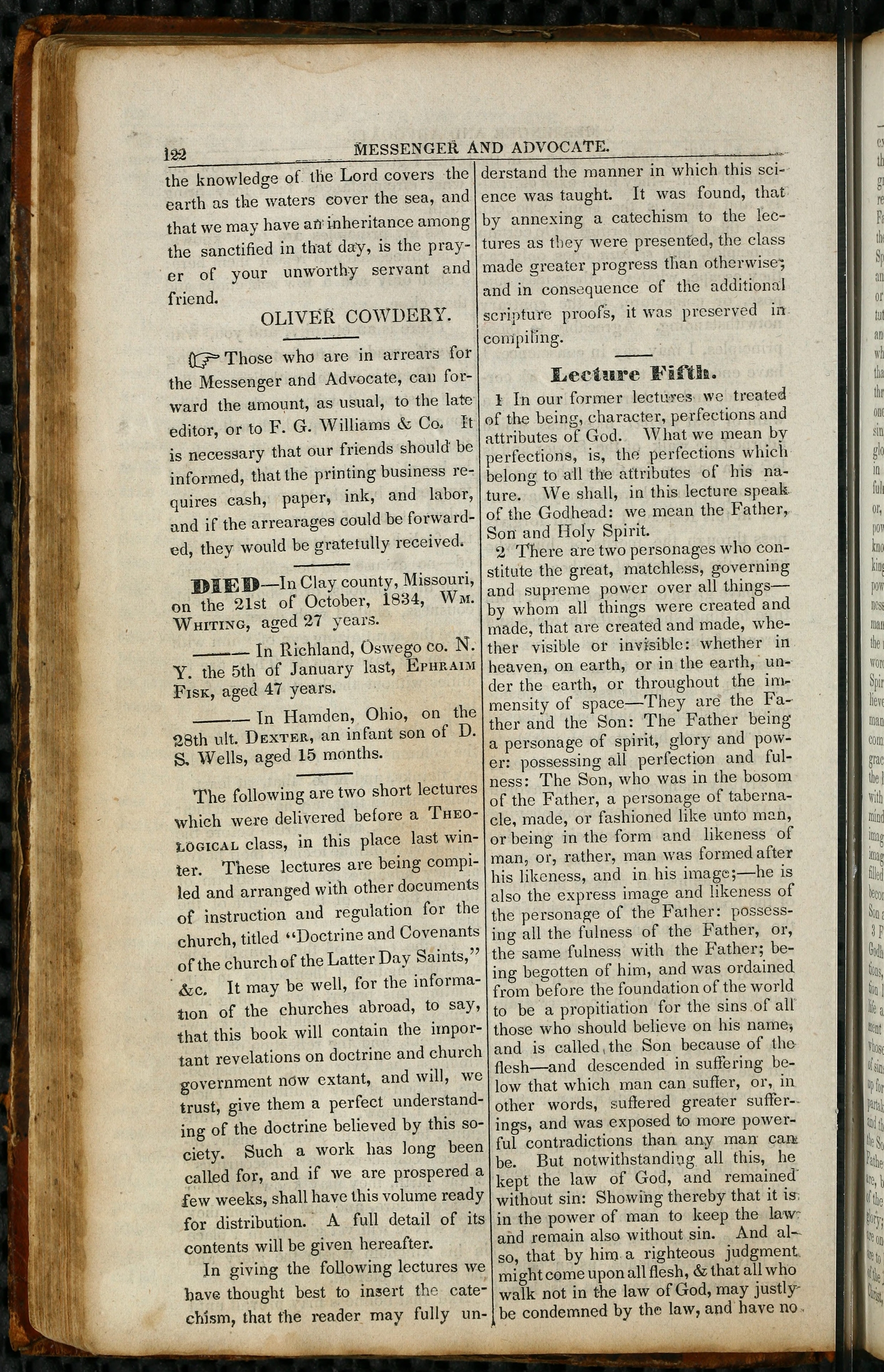
The Lecture 5 problem is the closest thing the development thesis has to a documentary smoking gun. It is not a hostile source or an inference; it is canonized scripture (1835–1921) produced under Joseph's oversight, and it calls the Father "a personage of spirit" three years after the 1832 account and three years before the 1838 account. The standard responses (authorship, semantic range, incremental revelation, coexistence) each mitigate the problem; none of them eliminates it entirely.
Authorship: Rigdon's heavy involvement. The authorship evidence leans mostly toward Sidney Rigdon, with one exception that lands on the lecture at issue. Alan J. Phipps's 1977 linguistic analysis found that "Sidney Rigdon's use of function words corresponded very closely with that in Lectures One and Seven," while "Joseph Smith's use of function words matched closely those in Lecture Five." Larsen and Rencher's 1982 statistical stylometry produced convergent results: "Our conclusions largely support [Phipps's] results, with some differences."[55] In Dahl's summary, both studies concluded that Rigdon was "heavily involved" and that Smith "was probably the author of Lecture 2." Noel B. Reynolds's 2005 Journal of Mormon History article argued more strongly that Rigdon authored the Lectures with no significant input from Joseph Smith: on his reading of the authorship studies, "not a single lecture can be confidently attributed to Joseph Smith."[56] A four-person committee (Joseph Smith, Oliver Cowdery, Sidney Rigdon, Frederick G. Williams) was formally appointed September 24, 1834 "to arrange the items of the doctrine of Jesus Christ, for the government of the Church of Latter-day Saints."[55:1]
The authorship argument mitigates the problem, but not evenly. For Lectures One and Seven, the function-word data points to Rigdon; for Lecture 5 itself, Phipps's data matched Joseph, and only Reynolds's more sweeping thesis keeps the phrase out of Joseph's hand entirely. The defense is thinnest on the one lecture it exists to cover. Whoever drafted the language, Joseph approved the Lectures for publication as part of the 1835 Doctrine and Covenants. He was actively teaching them in the School of the Prophets. As Hyrum Andrus's summary, quoted approvingly by Dahl, puts it: "there can be no doubt that the theological ideas which they contain came from Joseph Smith." And President John Taylor, also quoted by Dahl, maintained the materials were "published with the sanction and approval of the Prophet Joseph Smith."[55:2] The mitigation therefore costs something on either branch. If Reynolds is right, Joseph let incorporeality language he did not write stand as canon under his own authority for the remaining nine years of his life. If Phipps is right, much of that language was Joseph's own. Either branch is partly what the development thesis predicts.
Semantic range of "personage of spirit." Robert L. Millet's chapter "The Supreme Power over All Things" in the BYU RSC volume on the Lectures presented three readings of the phrase.[57]
- Incremental knowledge. Millet acknowledges this as possible: "We cannot avoid the possible conclusion that Joseph Smith simply did not understand the corporeal or physical nature of God at the time the Lectures on Faith were delivered in the winter of 1834–35." Millet does not endorse this reading; he notes it as one logical option.
- Divine attributes. "This may well be intended more as a description of God's divine nature — a statement regarding his exalted and glorified status — than of his physical being." The complete phrase reads "personage of spirit, glory, and power": qualities, not ontological category.
- Resurrected/spiritual body. Bruce R. McConkie, quoted by Millet: "A personage of spirit, as here used and as distinguished from the spirit children of the Father, is a resurrected personage. Resurrected bodies, as contrasted with mortal bodies, are in fact spiritual bodies" (citing 1 Corinthians 15:44; D&C 88:27; Alma 11:45).[57:1]
The D&C 130:22 internal-tension problem significantly weakens the semantic-range argument. D&C 130:22 (April 1843) explicitly distinguishes between having a body and being a personage of Spirit:
"The Father has a body of flesh and bones as tangible as man's; the Son also; but the Holy Ghost has not a body of flesh and bones, but is a personage of Spirit."[58]
The same phrase, "personage of Spirit," describes the Holy Ghost in D&C 130:22 (clearly incorporeal in this verse) and the Father in Lecture 5 (purportedly "resurrected/embodied" per Millet's third reading). If "personage of spirit" in Lecture 5 means "resurrected physical body," then D&C 130:22's contrast becomes incoherent: the Holy Ghost in 130:22 is being distinguished by its lack of a body, and the same formulation in Lecture 5 cannot mean the opposite. Millet's first reading, incremental knowledge, is the reading that best fits what Lecture 5's language most plausibly meant in 1835. FAIR's response concedes the development in its dating: the exact nature of the relationship among the Father, the Son, and the Spirit "was not explicitly stated until 1843."[59]
Coexistence with the 1835 First Vision account. The 1835 First Vision journal (November 9, 1835) describes "a personage" appearing, then "another personage soon appeard like unto the first," recorded after Lecture 5 was delivered.[11:2] The 1835 text uses "personage," not "embodied personage" or "physical personage"; reading "physical" into it is an interpretive move, not a textual fact. What the 1835 account does establish is that Joseph was narrating two distinct personages while the Lectures were canonical, which complicates any reading of Lecture 5 in which Joseph held to a single divine being. It does not prove the 1835 personages were embodied in the D&C 130:22 sense; the development thesis can fully accommodate "two non-embodied personages by 1835, embodied Father by 1843."
The 1921 decanonization. The committee that prepared the 1921 edition, George F. Richards (chair), Anthony W. Ivins, Melvin J. Ballard, James E. Talmage, John A. Widtsoe, Joseph Fielding Smith, removed the Lectures from the Doctrine and Covenants. The edition's explanation: the Lectures "were never presented nor accepted by the Church as being otherwise than theological lectures or lessons."[60] Committee member Joseph Fielding Smith later gave the fuller reasons: the Lectures were "not complete as to their teachings regarding the Godhead" and "were not received as revelations by the Prophet Joseph Smith." The 1921 removal is institutional acknowledgment that the Lectures contained preliminary theology refined by subsequent revelation. A Church that takes ongoing revelation seriously has no reason to treat 1834-era teaching as the final word; the removal fits that self-understanding. It is also acknowledgment that what was canonized in 1835 differed from what is canonized now.
Independent embodied-God witnesses. Coltrin's 1883 reminiscence recalling 1832–33 and Coe's Ohio Observer letter (1836) both attest that Joseph and the Saints were teaching some form of embodied-or-distinct-personage theology before, during, and after the Lectures' canonical period.[24:1][23:1] If embodied-God theology was being taught publicly in 1832–36, then the contemporary reading of "personage of spirit" cannot have been simple, strict incorporeality. The Coltrin caveat (1883 recollection, fifty-year memory gap) and the Coe caveat (general theology, not specific First Vision narrative) limit how much weight these witnesses can bear, but they suggest the phrase was understood differently in its 1830s context than its modern critical reading would have it.
The cumulative concession. The four mitigations are subtractive, not additive: each requires giving up something. By 1835, Joseph (a) approved publication of language that, on its most natural and most internally consistent canonical reading, strongly suggests incorporeality, (b) was teaching the Lectures personally in the School of the Prophets, (c) accepted them as authoritative until his death, with no revision under his leadership, and (d) operated alongside Rigdon-influenced theological vocabulary that took years to fully replace. This is what theological development looks like in practice. The four mitigations describe what theological development should be expected to look like: preliminary language, gradual refinement, eventual replacement. The believing position can hold that doctrinal understanding, like all gospel knowledge, is given "line upon line." The Lecture 5 problem outlasts all four mitigations. The cumulative evidence (D&C 76, the 1835 account, the JST revisions, Coltrin, Coe, Bruening and Paulsen) prevents the Lectures from bearing the full weight the development thesis places on them. It does not make the tension go away.
The "who appeared" variation
The CES Letter packs the entire who-appeared objection into one catalog sentence: "Depending upon the account, a spirit, an angel, two angels, Jesus, many angels or the Father and the Son appear to him – are all over the place."[61]
The list is a misleading conflation: it strings together every term that has ever appeared in any telling at any level of reliability (formal accounts and casual asides, secondhand reports, even descriptions of other people's visions) into a single breathless run, as if these descriptions were equivalent. Separated by source, the list comes apart.
Firsthand accounts (Joseph's own words or dictation):
| Account | Year | Who appears |
|---|---|---|
| 1832 history | 1832 | "the Lord" (ambiguous on number, see analysis above) |
| 1835 journal | 1835 | Two personages + "many angels in this vision" |
| 1838 history | 1838 | "two personages": Father introduces Son |
| 1842 Wentworth Letter | 1842 | "Two glorious personages who exactly resembled each other" |
Contemporary secondhand accounts (others reporting what Joseph told them):
| Account | Year | Who appears |
|---|---|---|
| Orson Pratt (Edinburgh) | 1840 | Two personages identified as Father and Son |
| Orson Hyde (Frankfurt) | 1842 | Two glorious personages |
| Levi Richards (Nauvoo) | 1843 | No appearance description; records the answer "that none of them were right… & that the Everlasting covena[n]t was broken" |
| David Nye White | 1843 | Sequential appearance of two beings |
| Alexander Neibaur | 1844 | Two personages, one with physical description ("blue eyes") |
Counting both tables, seven of the nine describe two personages, and no account puts a different number in their place. The 1832 account is ambiguous, not contradictory, and Richards's note describes no visitor at all.[22:1] The same caveat as before applies: the five all derive ultimately from Joseph, so they confirm the consistency of his telling, not the 1820 event itself.
The "a spirit, an angel" language in the CES Letter's list does not come from any of Joseph's firsthand accounts. It comes from casual oral references and from secondhand reports about other people. On November 14, 1835, five days after his detailed account to Robert Matthews, Joseph described to Erastus Holmes "the first visitation of Angels."[62] "Angels" here is informal language for heavenly visitors, the same way the Old Testament uses malak loosely for both Yahweh-figures and ordinary angels. It is not a theological claim that the personages were ontologically angels rather than divine. The Palmyra Reflector's "Cowdery and his friends had frequent interviews with angels" describes Cowdery, not Joseph. (The same paragraph also stated that Smith "had seen God frequently and personally," a claim explored in detail in Late Appearance, which notes the "frequently" formulation is implausibly broad and likely garbled in transmission.) The 1835 "many angels" is a single account describing both the two personages and surrounding angels, not a competing claim that there were only angels.[11:3]
Key Point
Distinguish firsthand from secondhand, and formal from casual, and the "all over the place" characterization collapses. Three of four firsthand accounts explicitly describe two personages. Four of the five contemporary secondhand accounts agree, and the fifth describes no one at all rather than someone else; all five, though, derive from Joseph, not from independent observation. The only outlier with any content is the 1832 account's ambiguous "the Lord", an omission, not a denial.
A pattern no fabricator would produce
Look past the individual claims to the pattern as a whole. The accounts display characteristics consistent with genuine memory and harder to explain on a deliberate-fabrication hypothesis. For an extended treatment of the pattern across all nine accounts plus comparative theophanies, see Multiple Accounts.
Fabricated stories tend to become more fixed; genuine memories vary naturally. Daniel Schacter's foundational research on flashbulb memories (vivid recollections of dramatic, emotional events) established that such memories are stable in core gist but variable in peripheral details.[63] Steven Harper applied this framework comprehensively in First Vision: Memory and Mormon Origins (Oxford University Press, 2019), the definitive scholarly monograph on the subject.[32:1] Robert A. Rees's 2017 Interpreter article applied Schacter's framework directly to the First Vision, tracking imagery shifts across accounts:[64]
1832 account: "the word 'mind' occurs three times and 'heart' five times" (p. 70) — emotional/spiritual emphasis. 1835 account: "no mention of 'heart' at all," focus on "mind" — cognitive emphasis. 1838 account: "references to both mind (four times) and heart (five times)" — balanced.
The pattern tracks audience: the 1832 (private journal, audience of self) emphasizes the emotional and spiritual; 1835 (oral retelling to a stranger, recorded by Parrish) emphasizes the cognitive; 1838 (institutional history) balances both. Genuine memory adapts to context; fabrication tends not to.
The 1832 account's content is consistent with private spiritual reflection, not institutional founding rhetoric. The 1832 account is private, unfinished, partly in Joseph's own handwriting, and focused on personal anguish over sin. Joseph crossed out "fire" and replaced it with "light" mid-composition, a visible self-correction in the manuscript. The narrative center is personal forgiveness, not institutional commission: no "join none of them," no priesthood promise, no prophetic call. Just a young man receiving Christ's assurance of forgiveness for his sins.[7:6] This is not direct evidence against the development thesis; the thesis predicts exactly that the 1832 account would lack institutional content and that institutional content would develop later. What the 1832 shape weighs heavily against is the cruder "Joseph invented the whole thing" hypothesis. The personal-conversion content is a strong argument against blanket fabrication, a much weaker one against gradual development.
Hostile witnesses confirm the basic claim circulated before 1832. The pre-1832 documentary trail (developed in Late Appearance) contains hostile-witness references to Joseph's claim of having "seen God": the Palmyra Reflector (February 14, 1831), Joseph Capron's affidavit describing the Smiths' "holy intercourse with Almighty God" (events 1827, collected 1833), the Painesville Telegraph (November–December 1830).[65] Hostile witnesses do not invent claims for their opponents. This shows the basic claim, Joseph Smith said he had seen God, was circulating orally before any of the firsthand accounts compared in this article were written. These witnesses confirm the basic claim, not the specifics of the 1838 narrative; the development thesis can fully accept that Joseph claimed to have seen God in 1820 while still arguing that the narrative details accumulated between 1820 and 1838.
Idiosyncratic sensory details. The accounts contain mundane details no fabricator would naturally include. Alexander Neibaur (1844) recorded Joseph describing "light complexion blue eyes a piece of white cloth drawn over his shoulders his right arm bear."[66] David Nye White (1843) preserved Joseph going to pray near "the stump where I had stuck my axe when I had quit work."[67] Orson Pratt (1840) recorded Joseph describing the light intensity such that he "expected to have seen the leaves and boughs of the trees consumed."[68] These details are theologically irrelevant: no doctrine depends on Christ's eye color, on an axe in a stump, or on burning leaves. They are the sort of particulars that stick to a real morning. The same memory science predicts peripheral details can also be unreliable, so they are weak positive evidence for genuine experience rather than proof of it. Still, vivid peripheral details are more characteristic of concrete recollection than of rhetorical narrative construction.
No public denial from Joseph's inner circle. None of Joseph's scribes, family members, or close associates, including those who later left the Church bitterly (Oliver Cowdery, David Whitmer, Martin Harris, Frederick G. Williams), ever publicly claimed the First Vision was fabricated. The argument has limits. The First Vision was not a central public teaching in the early Church, the 1832 account was unpublished, and the canonical 1838 narrative did not become widely taught until the 1840s, so the absence of whistleblower testimony is not strong evidence on its own; there was relatively little to whistleblow about in the early years. But the absence is still notable for individuals like Cowdery, Whitmer, and McLellin who actively worked to discredit Joseph after leaving and produced detailed criticisms of his other claims. Frederick G. Williams was the very scribe who interlinearly inserted "in the 16th year of my age" into the 1832 account. He had access to the document. He was excommunicated in March 1839, was restored to fellowship in April 1840, and died in 1842. Estranged or reconciled, he never claimed the account was invented or embellished. The argument is not that silence proves the First Vision happened; it is that the absence of attack from those best positioned to expose a fabrication is a modest evidential point in the right direction.[69]
The strongest critical case, weighed
The CES Letter's framing of the contradiction argument is bullet-list maximalism. The strongest scholarly version is the theological-development thesis advanced by Alexander, Vogel, Palmer, and Larson: the First Vision accounts are not simply variations in audience-driven memory but narratives shaped by Joseph's evolving theology.[52:1][34:2][53:1][33:3]
The thesis identifies a real correlation. Across the four firsthand accounts, the institutional and ecclesiological elements (which church, family Presbyterian affiliation, persecution, Methodist minister, Paul comparison) appear and grow more elaborate over time, while the personal-spiritual elements (forgiveness as central theme, "thy sins are forgiven thee") attenuate. The Vogel-Larson reading: this is what theological reframing looks like, not what natural memory variation produces.
The correlation is real, but it has an alternative explanation: the variation reflects audience-driven emphasis (private journal vs. institutional history vs. newspaper introduction) plus memory reconstruction shaped by Joseph's theological framework at each retelling. Both readings explain the direction of variation. Where they diverge is on what the variation means: whether the accounts are recording an experience with audience-shaped emphasis, or constructing a narrative shaped by current theology.
Five data points, and the scope each one actually bears:
- The 1832 account already contains both motives. This complicates a clean development reading in which 1832 is "pre-development," forgiveness-only. It fits the alternative reading, and at minimum the thesis has to treat both-motives-in-1832 as a datum to explain, not a feature added later.[7:7]
- The 1835 account's "many angels" then 1838 drops them. Genre confound applies (1835 = casual oral; 1838 = formal institutional), but the institutional posture of 1838 predicts inflation, not deflation. This is moderate counter-evidence to a controlled-embellishment hypothesis.[11:4]
- D&C 76 (February 1832) and the JST revisions (1831–1833). Show distinct-personage / non-incorporeal theology already in place by early 1832. The development thesis can absorb these; what they constrain is the starting point of the development trajectory, not whether a trajectory existed.[13:1][19:1]
- The 1832 account's content shape. Personal-conversion focused, not institutional. This cuts hard against blanket fabrication. It is a much weaker argument against the gradual-development thesis, which predicts exactly this shape for the earliest account.[7:8]
- The hostile-witness trail before 1832. Confirms the basic claim "Joseph said he saw God" was circulating orally by 1830–31. It does not confirm the specific narrative content of the 1838 account. The development thesis is consistent with "the basic claim was in place; the narrative details developed."[65:1]
These data points do not prove the development thesis wrong. They reduce its uniqueness: the alternative reading explains the directional pattern at least as well, while better fitting the both-motives-in-1832 and 1835/1838 detail-divergence anomalies. The thesis remains a coherent reading of the evidence.
After the five data points, the development thesis's residual case is Lecture 5 of the Lectures on Faith. The phrase "personage of spirit" applied to the Father, the D&C 130:22 internal-tension problem, the 1921 decanonization, and the published-under-Joseph's-authority status leave the believing position with its least finished answer here. The mitigations (Rigdon's authorship, semantic range, incremental revelation, coexistence with the 1835 account, Coltrin and Coe witnesses) reduce its weight without eliminating it. The Lecture 5 problem is real, and the available answers are partial.
Assessment
The CES Letter presents variation between First Vision accounts as self-evidently damning. Its method is accumulation: list enough differences (age, beings, motive, revival, Presbyterian timing, theology) and the cumulative weight overwhelms the reader before any single point can be evaluated. Slowing down relieves the pressure, but it does not, on every point, eliminate the difficulty.
Taken one at a time, the picture is mixed, but mixed in a particular direction. The objections sort into three uneven piles.
Some objections are clean. The age "discrepancy" is a scribal insertion by Frederick G. Williams in the 1832 account; every other firsthand account agrees on 14, and even the Williams insertion means age 15, not 16. The "all over the place" framing on who appeared collapses once firsthand and secondhand accounts are distinguished from casual references and from references to other people's experiences. Seven of nine accounts describe two personages, and neither of the other two names a different number, with the caveat that all five secondhand accounts derive from Joseph and are not independent witnesses.
Some objections have substantial but not airtight responses. The one-vs-two-beings question is substantially answered by D&C 76, the JST revisions, and the seven corroborating accounts, with the qualifier that the 1835/1838 anti-embellishment argument is partly confounded by genre, and the 1832 text by itself does not compel two beings. The 1820 revival is documented by camp meeting records, denominational growth, newspaper reports, contemporary diaries, and non-Mormon witnesses, but the 1838 description's "great multitudes" scale fits 1824–25 better, and memory conflation across a multi-year revival period is the most parsimonious explanation. The theological-development thesis finds a real correlation between Joseph's evolving theology and the elaboration of First Vision content, but the alternative reading (audience-driven emphasis plus memory reconstruction) explains the same correlation while handling the two anomalies better: both motives already in the 1832 text, and the 1835 account carrying more detail than the 1838.
Some objections are genuinely unresolved. The motive question (whether the 1832 statement that Joseph already concluded the churches had apostatized contradicts the 1838 parenthetical "for at this time it had never entered into my heart that all were wrong") is the list's one true collision, and three of four mitigations address coexistence rather than negation. The Presbyterian timing question, given the lost relevant Palmyra Presbyterian records, cannot be confidently resolved in either direction. And the Lectures on Faith Lecture 5 "personage of spirit" problem stands on canonized text rather than inference, with answers that are partial. That last item is the one the believing reader should sit with rather than explain away; it is named here, in its own section and in this ledger, precisely because it is not solved.
What the CES Letter never addresses is what the variation pattern means structurally. Memory science predicts that genuine recollections of emotional events keep the gist stable while peripheral details adjust to audience and context. A fabricated story, with no memory behind it, tends instead to become more uniform with each retelling. The First Vision accounts display the genuine-memory pattern more closely than the fabrication pattern.[32:2][64:1]
The First Vision is what Steven Harper has suggested "may be the best-documented theophany in history", a phrase that announces its own limits: best documented next to ancient and biblical theophanies, and documented by nine accounts that all trace to one man.[12:1] Nine surviving accounts: four firsthand, five secondhand and not independent. Hostile-witness references to the basic claim before the first written account. A variation pattern that tracks audience-driven emphasis and matches what flashbulb memory research predicts. Pre-1838 hostile-witness confirmation of embodied-God theology (Coe 1836). And an 1832 account whose content shape makes blanket fabrication very difficult.
The evidence does not require every objection to be resolved. The motive question, the Lectures on Faith Lecture 5 problem, the Presbyterian timing all remain unsettled. The surviving record shows a variation pattern more consistent with genuine experience recalled across different contexts than with progressive fabrication or theological reshaping, and a set of critical alternatives that each fail to account for significant portions of the data.
What stands at the end is not a cleanly harmonized record. It is a fourteen-year-old's claim, held to the end of his life: four firsthand tellings that vary where memory varies and hold where memory holds.
Further Reading
- Gospel Topics Essay: "First Vision Accounts"
- Joseph Smith Papers: "Primary Accounts of Joseph Smith's First Vision of Deity"
- Steven C. Harper, First Vision: Memory and Mormon Origins (Oxford University Press, 2019)
- BYU Religious Studies Center: Exploring the First Vision, ed. Dodge and Harper (2012)
- Joseph Smith Papers Podcast: "The First Vision" (eight-episode documentary, 2020)
Runnells, CES Letter (2017), "First Vision," pp. 32–35. ↩︎
Runnells, CES Letter (2017), "First Vision," pp. 33–35. The motive contradiction is developed as claim 2 on p. 33; the remaining objections appear under "4. Other problems:" as five brief bullets on pp. 34–35 (the revival and Presbyterian-timing objections share one bullet). ↩︎
Runnells, CES Letter (2017), "First Vision," pp. 32–35. The CES Letter's First Vision section uses an accumulation strategy across these four pages. ↩︎
For the developed scholarly version of the contradiction argument, see Stan Larson, "Another Look at Joseph Smith's First Vision," Dialogue: A Journal of Mormon Thought 47, no. 2 (Summer 2014): 37–62, https://www.dialoguejournal.com/articles/another-look-at-joseph-smiths-first-vision/; Dan Vogel, Joseph Smith: The Making of a Prophet (Salt Lake City: Signature Books, 2004); Thomas G. Alexander, "The Reconstruction of Mormon Doctrine: From Joseph Smith to Progressive Theology," Sunstone 5 (July–August 1980): 24–33, https://sunstone.org/wp-content/uploads/sbi/articles/115-15-29.pdf; the linked PDF is Sunstone's 1999 reprint (paginated 15–29). ↩︎
Runnells, CES Letter (2017), "First Vision," pp. 33–34. The 1832 account is quoted on p. 33; the age claim is restated on p. 34. ↩︎
Dean C. Jessee, "The Early Accounts of Joseph Smith's First Vision," BYU Studies 9, no. 3 (1969): 275–294, https://scholarsarchive.byu.edu/byusq/vol9/iss3/4/. Jessee's transcription prints "in the 16th year of my age" as an interlinear insertion; the identification of the inserting hand as Frederick G. Williams's is the Joseph Smith Papers editors' (JSP apparatus note: "Insertion in the handwriting of Frederick G. Williams."). ↩︎
Joseph Smith, History, circa Summer 1832, pp. 1–3, Joseph Smith Papers, https://www.josephsmithpapers.org/paper-summary/history-circa-summer-1832/1. The JSP historical introduction identifies the 1832 history as "the only narrative of the foundational spiritual events of JS's early life that includes his own handwriting." ↩︎ ↩︎ ↩︎ ↩︎ ↩︎ ↩︎ ↩︎ ↩︎ ↩︎
Pearl of Great Price Central, "How Old Was Joseph Smith at the Time of the First Vision?" https://pearlofgreatpricecentral.org/how-old-was-joseph-smith-at-the-time-of-the-first-vision/ ↩︎ ↩︎
Runnells, CES Letter (2017), "First Vision," p. 33. ↩︎
"First Vision Accounts," Gospel Topics Essays, The Church of Jesus Christ of Latter-day Saints (November 2013), https://www.churchofjesuschrist.org/study/manual/gospel-topics-essays/first-vision-accounts?lang=eng ↩︎
Joseph Smith, Journal, 9–11 November 1835, pp. 23–24, Joseph Smith Papers, https://www.josephsmithpapers.org/paper-summary/journal-1835-1836/24. Recorded by Warren Parrish from Joseph's narration to Robert Matthews ("Joshua the Jewish Minister"). The First Vision narrative begins on page 23. ↩︎ ↩︎ ↩︎ ↩︎ ↩︎
Steven C. Harper, "Four Accounts and Three Critiques of Joseph Smith's First Vision," FAIR Conference, August 4, 2011, https://www.fairlatterdaysaints.org/conference_home/august-2011/four-accounts-and-three-critiques-of-joseph-smiths-first-vision ↩︎ ↩︎
Doctrine and Covenants 76:20 (February 16, 1832): "And we beheld the glory of the Son, on the right hand of the Father, and received of his fulness." ↩︎ ↩︎
Doctrine and Covenants 76:23: "For we saw him, even on the right hand of God; and we heard the voice bearing record that he is the Only Begotten of the Father." ↩︎
The standard apologetic framing — "if Joseph already held two-personage theology and did not foreground that theology when writing the 1832 account, that restraint is itself evidence that he was reporting recollection rather than projection" — overstates the inference. Genre conventions matter: a private journal entry about personal anguish over sin would naturally emphasize Christ's words of forgiveness, regardless of the writer's broader theology. A critic can additionally argue D&C 76 came from a vision Joseph received jointly with Sidney Rigdon, whose Campbellite theological vocabulary may have shaped the recorded language — and even if D&C 76 reflects Joseph's own 1832 theology, it proves his current beliefs in early 1832, not what he experienced in 1820. The narrower honest claim about D&C 76 in this article: D&C 76 documents that distinct-personage theology was already in Joseph's recorded discourse by February 1832, but it does not by itself settle what was experienced in 1820. The Bruening-Paulsen evidence in the next section is the harder data point, because most of those passages come from material Joseph dictated alone before he met Rigdon. ↩︎
Ari D. Bruening and David L. Paulsen, "The Development of the Mormon Understanding of God: Early Mormon Modalism and Other Myths," FARMS Review of Books 13, no. 2 (2001): 109–169, https://scholarsarchive.byu.edu/msr/vol13/iss2/13/. The eighty-three antimodalist passages are counted in Joseph Smith's pre-May-1833 revelations (Book of Commandments and material later in the 1835 Doctrine and Covenants); the Book of Mormon is analyzed separately (p. 114). The article's central thesis is that pre-1833 LDS theology was not uniformly modalist. Note: the classification of all 83 passages as unambiguously anti-modalist is itself a scholarly judgment; many are better described as compatible with social trinitarianism rather than as distinctively post-trinitarian. ↩︎
Barry Robert Bickmore, "'Show Them unto No Man': Part 1. Esoteric Teachings and the Problem of Early Latter-day Saint Doctrinal History," BYU Studies Quarterly 62, no. 1 (2023): 29–60, https://byustudies.byu.edu/article/show-them-unto-no-man. (Part 2, in 62, no. 2, at https://byustudies.byu.edu/article/show-them-unto-no-man-2, carries the "directly contradicts" discussion, printed p. 118.) Bickmore argues that interpretations reading early LDS theology as modalism are difficult to sustain given Moses 4:2–4's three-way conversation between the Father, the Son, and Satan. ↩︎
Joseph Smith Translation, manuscript revision to John 4:24, completed within the New Testament Revision 2 manuscript (April 1831 to July 1832; see Joseph Smith Papers, "New Testament Revision 2," https://www.josephsmithpapers.org/paper-summary/new-testament-revision-2/1). The KJV reads "God is a Spirit"; the JST revision reads "For unto such hath God promised his Spirit. And they who worship him, must worship in spirit and in truth," now printed as JST John 4:26 (https://www.churchofjesuschrist.org/study/scriptures/jst/jst-john/4?lang=eng). See also Thomas A. Wayment, The Complete Joseph Smith Translation of the New Testament (Salt Lake City: Deseret Book, 2005). The change removes the most common KJV proof-text for divine incorporeality but does not by itself assert embodiment. ↩︎
Don Bradley and Walker Wright, "An overlooked text supporting Joseph Smith's First Vision consistency," Deseret News, April 13, 2024, https://www.deseret.com/faith/2024/04/13/joseph-smith-first-vision-accounts/. Bradley and Wright argue that the JST revisions "provide evidence that these supposedly late-developed elements of the First Vision may actually predate even the 'earliest' First Vision account": "Already by 1831–1832, Joseph Smith's translation of John 1:18 and 1 John 4:12 intimates that he connected his First Vision with the idea of seeing God the Father and of God the Father bearing witness of the Son." ↩︎ ↩︎
Walker Wright and Don Bradley, "'None That Doeth Good': Early Evidence of the First Vision in JST Psalm 14," BYU Studies Quarterly 61, no. 3 (2022): 123–140, https://scholarsarchive.byu.edu/byusq/vol61/iss3/6/ ↩︎
James B. Allen and John W. Welch, "The Appearance of the Father and the Son to Joseph Smith in 1820," in Exploring the First Vision, ed. Samuel Alonzo Dodge and Steven C. Harper (Provo, UT: Religious Studies Center, BYU, 2012), 41–89, https://rsc.byu.edu/exploring-first-vision/appearance-father-son-joseph-smith-1820. Verified phrase: "Thus, nothing precludes the possibility that two beings were present" (p. 73). Other in-text references: "coherent, credible, and more consistent than some people have surmised" (p. 65); "feelings and emotions" (p. 69). ↩︎ ↩︎
Pearl of Great Price Central, "Secondhand Accounts of the First Vision," https://pearlofgreatpricecentral.org/secondhand-accounts-of-the-first-vision/. The five contemporary secondhand accounts are Pratt 1840, Hyde 1842, Richards 1843, White 1843, and Neibaur 1844. All derive ultimately from Joseph Smith and are not independent witnesses to the 1820 event. ↩︎ ↩︎
Truman Coe, letter published in Ohio Observer, August 11, 1836; canonical secondary citation in Milton V. Backman Jr., "Truman Coe's 1836 Description of Mormonism," BYU Studies 17, no. 3 (1977): 347–355, https://byustudies.byu.edu/article/truman-coes-1836-description-of-mormonism/. Coe was a hostile non-Mormon Presbyterian minister in Kirtland reporting on general LDS theology, not on a specific First Vision claim. ↩︎ ↩︎
Joseph Smith's statement as recalled by Zebedee Coltrin, Salt Lake City School of the Prophets Minute Book, October 11, 1883, describing an appearance in the Kirtland School of the Prophets about two or three weeks after its January 1833 opening. The original minute book is held at the Church History Library and is not freely available online; the statement is transcribed at "Zebedee Coltrin (1804–1887)," Early Mormonism, https://earlymormonism.com/zebedee-coltrin-1804-1887/. The fifty-year gap between the 1832–33 events and Coltrin's 1883 reminiscence should be weighed alongside the standard memory-reliability caveats the article applies elsewhere. ↩︎ ↩︎
Joseph Smith, History, 1838–1856, vol. A-1, pp. 1–3, Joseph Smith Papers, https://www.josephsmithpapers.org/paper-summary/history-1838-1856-volume-a-1-23-december-1805-30-august-1834/3. Later canonized in Joseph Smith—History 1:1–26, Pearl of Great Price. ↩︎ ↩︎ ↩︎
Runnells, CES Letter (2017), "First Vision," p. 33. ↩︎
Christopher C. Jones, "The Power and Form of Godliness: Methodist Conversion Narratives and Joseph Smith's First Vision," Journal of Mormon History 37, no. 2 (Spring 2011): 88–114, https://digitalcommons.usu.edu/mormonhistory/vol37/iss2/1/. Jones argues that in Methodist conversion culture, seeking forgiveness of sins and identifying the true church were intertwined dimensions of the same spiritual crisis; the JSTOR-paywalled article is summarized in FAIR's secondary citation at https://www.fairlatterdaysaints.org/answers/Joseph_Smith's_First_Vision/Contradiction_about_knowing_all_churches_were_wrong ↩︎
FAIR, "Contradiction about knowing all churches were wrong," https://www.fairlatterdaysaints.org/answers/Joseph_Smith's_First_Vision/Contradiction_about_knowing_all_churches_were_wrong ↩︎ ↩︎
Christopher C. Jones, "The First Vision and the 'Qualifying Eye of Faith,'" Juvenile Instructor, January 17, 2008, https://juvenileinstructor.org/the-first-vision-and-the-qualifying-eye-of-faith/. Jones, quoting historian Susan Juster: "Evangelicals were very careful in the language they used to describe their visionary experiences." Jones contrasts Charles Finney's "seemed to me a reality" and Hugh Bourne's "[i]t seemed as is [sic] Jesus Christ embraced me in his arms" with Joseph's unhedged "I knew it, and I knew that God knew it, and I could not deny it." ↩︎
"The First Vision: A Joseph Smith Papers Podcast," Episode 2 ("What Was to Be Done"), January 2020, https://www.josephsmithpapers.org/articles/the-first-vision-podcast-episode-2-transcript. Steven Harper, Christopher Jones, and Spencer McBride discuss the motive question, James 1:5, and the Methodist mourners' bench tradition. ↩︎
Richard L. Bushman, "The First Vision Story Revived," Dialogue: A Journal of Mormon Thought 4, no. 1 (Spring 1969): 82–93, at 83; reprinted in Exploring the First Vision, ed. Dodge and Harper (Provo, UT: BYU Religious Studies Center, 2012). This characterization of Joseph's both-motives pattern is widely cited in the apologetic literature as the standard formulation of the both-motives view. ↩︎
Steven C. Harper, First Vision: Memory and Mormon Origins (New York: Oxford University Press, 2019). The definitive scholarly monograph applying memory science to the First Vision accounts. ↩︎ ↩︎ ↩︎
Stan Larson, "Another Look at Joseph Smith's First Vision," Dialogue: A Journal of Mormon Thought 47, no. 2 (Summer 2014): 37–62, https://www.dialoguejournal.com/articles/another-look-at-joseph-smiths-first-vision/. The "only Christ is mentioned in the first account, while both Christ and God are referred to" formulation is Hartt Wixom's, which Larson reproduces and engages — Larson writes: "Hartt Wixom admits that a problem in the different accounts of the First Vision is that 'only Christ is mentioned in the first account, while both Christ and God are referred to' in the other accounts." Larson also documents that the three leaves of the 1832 account were excised from Joseph's letterbook (Larson dates the separation window to approximately 1930–1965) and were back with the letterbook by 1965. ↩︎ ↩︎ ↩︎ ↩︎
Dan Vogel, Joseph Smith: The Making of a Prophet (Salt Lake City: Signature Books, 2004). The most influential modern critical biography. ↩︎ ↩︎ ↩︎
Runnells, CES Letter (2017), "First Vision," pp. 34–35. ↩︎
Wesley P. Walters, "New Light on Mormon Origins from the Palmyra (N.Y.) Revival," Journal of the Evangelical Theological Society 10, no. 4 (1967): 227–244, https://etsjets.org/wp-content/uploads/2013/05/files_JETS-PDFs_10_10-4_BETS_10_4_227-244_Walters.pdf ↩︎
Steven C. Harper, "Evaluating Three Arguments Against Joseph Smith's First Vision," in Exploring the First Vision, ed. Samuel Alonzo Dodge and Steven C. Harper (Provo, UT: BYU Religious Studies Center, 2012), https://rsc.byu.edu/exploring-first-vision/evaluating-three-arguments-against-joseph-smiths-first-vision. Harper cites David Hackett Fischer's Historians' Fallacies for the definition of the fallacy of negative proof. ↩︎
Richard L. Bushman, Joseph Smith: Rough Stone Rolling (New York: Knopf, 2005), 36–37 (the 1816–17 Palmyra Presbyterian revival, which "nearly doubled the number of Palmyra Presbyterians," p. 36; Lucy's affiliation discussed pp. 36–37). Lucy's "twenty-second year" phrasing is her own (Lucy Mack Smith, Biographical Sketches, 1853, 48–49), quoted with the Alvin computation in Richard L. Bushman, Joseph Smith and the Beginnings of Mormonism (1987), 53, as excerpted on FAIR's Lucy Mack Smith page. ↩︎ ↩︎
Richard Lloyd Anderson, "Joseph Smith's Accuracy on the First Vision Setting: The Pivotal 1818 Palmyra Camp Meeting," in Exploring the First Vision, ed. Dodge and Harper (2012), https://rsc.byu.edu/exploring-first-vision/joseph-smiths-accuracy-first-vision-setting-pivotal-1818-palmyra-camp-meeting. Anderson cites Aurora Seager's diary entry for the June 1818 Palmyra camp meeting. ↩︎
Milton V. Backman Jr., "Awakenings in the Burned-Over District: New Light on the Historical Setting of the First Vision," BYU Studies 9, no. 3 (1969): 301–320, https://scholarsarchive.byu.edu/byusq/vol9/iss3/7/. The Genesee District membership figures are derived from Methodist conference records summarized by Backman; subsequent scholarship including Anderson 2012 cites slightly different starting figures depending on regional categorization. ↩︎ ↩︎
Larry C. Porter, "Reverend George Lane: Good 'Gifts,' Much 'Grace,' and Marked 'Usefulness,'" in Exploring the First Vision, ed. Dodge and Harper (2012), https://rsc.byu.edu/exploring-first-vision/reverend-george-lane-good-gifts-much-grace-marked-usefulness ↩︎
Richard L. Bushman, "The First Vision Story Revived," in Exploring the First Vision, ed. Dodge and Harper (2012), https://rsc.byu.edu/exploring-first-vision/first-vision-story-revived. Bushman's lists of revival locations total roughly 19 for 1819–1820 (two of them listed as prospects) versus 12 for 1824; the totals are sums over his lists rather than figures he states. ↩︎ ↩︎
D. Michael Quinn, "Joseph Smith's Experience of a Methodist 'Camp-Meeting' in 1820," Dialogue: A Journal of Mormon Thought, Dialogue Paperless E-Paper #3 (2006), https://www.dialoguejournal.com/articles/joseph-smiths-experience-of-a-methodist-camp-meeting-in-1820/. Quinn documented a June 28, 1820 Palmyra Register report of a death at "a camp-meeting which was held in this vicinity" and dismissed Walters's "Methodists did not own property until 1821" objection as irrelevant since Methodists "rarely (if ever) owned the forested land" used for camp meetings. Quinn proposed memory conflation as the most parsimonious explanation: Joseph "merged the two revivals … While this is partially inaccurate, I see it as streamlining his narrative, not as an example of fraudulent invention." ↩︎ ↩︎ ↩︎
Benajah Williams Diary, July 1820, Church History Library. Williams, a Methodist itinerant preacher, recorded camp meetings on the Ridgeway circuit (~28 miles from Palmyra) where Rev. George Lane preached "on Gods method in bringing about Reffermations." ↩︎
Orsamus Turner, History of the Pioneer Settlement of Phelps and Gorham's Purchase (Rochester, NY: William Alling, 1851), 214. ↩︎
Sarepta Marsh Baker reminiscence (1880s), quoted in Milton V. Backman Jr., "Awakenings in the Burned-Over District: New Light on the Historical Setting of the First Vision," reprinted in Exploring the First Vision, ed. Dodge and Harper (2012), https://rsc.byu.edu/exploring-first-vision/awakenings-burned-over-district-new-light-historical-setting-first-vision. ↩︎
D. Todd Christofferson, "The Prophet Joseph Smith" (BYU–Idaho devotional, September 24, 2013), transcript at https://www2.byui.edu/Presentations/Transcripts/Devotionals/2013_9_24_Christofferson.htm. The quoted sentence appears in the address's notes and reads "…during 1820 and some years prior." ↩︎
Runnells, CES Letter (2017), "First Vision," p. 35. ↩︎
FAIR, "Lucy Mack Smith / Religious Affiliations," https://www.fairlatterdaysaints.org/answers/Lucy_Mack_Smith/Religious_affiliations. The page quotes Bushman: "Unfortunately, the Presbyterian records that could confirm this date are lost." FAIR addresses the broader gap in surviving Palmyra Presbyterian records that could resolve the timing of Smith family affiliation. ↩︎ ↩︎ ↩︎ ↩︎
John G. Turner, "Sermon Notes of Jesse Townsend, a Presbyterian Minister in Palmyra, New York," BYU Studies Quarterly 59, no. 2 (2020), https://scholarsarchive.byu.edu/byusq/vol59/iss2/16/. Turner publishes the sermon notes of a Palmyra Presbyterian minister whose ministry overlapped the Smith family's religious-seeking period. ↩︎
Runnells, CES Letter (2017), "First Vision," p. 35. ↩︎
Thomas G. Alexander, "The Reconstruction of Mormon Doctrine: From Joseph Smith to Progressive Theology," Sunstone 5 (July–August 1980): 24–33, https://sunstone.org/wp-content/uploads/sbi/articles/115-15-29.pdf; the linked PDF is Sunstone's 1999 reprint (paginated 15–29). The foundational article launching the modern theological-development thesis. ↩︎ ↩︎
Grant Palmer, An Insider's View of Mormon Origins (Salt Lake City: Signature Books, 2002). Palmer popularized Vogel's argument in accessible form, arguing Joseph's early religious experiences were "relatively simple" spiritual impressions later "enhanced" into physical theophanies. ↩︎ ↩︎
Lectures on Faith, Lecture 5, in Doctrine and Covenants (1835 edition). Primary text via BYU Religious Studies Center, https://rsc.byu.edu/lectures-faith-historical-perspective/lecture-5 ↩︎ ↩︎ ↩︎ ↩︎
Larry E. Dahl, "Authorship and History of the Lectures on Faith," in The Lectures on Faith in Historical Perspective, ed. Larry E. Dahl and Charles D. Tate Jr. (Provo, UT: Religious Studies Center, BYU, 1990), https://rsc.byu.edu/lectures-faith-historical-perspective/authorship-history-lectures-faith. Dahl summarizes Phipps 1977 ("Sidney Rigdon's use of function words corresponded very closely with that in Lectures One and Seven") and Larsen-Rencher 1982 ("Our conclusions largely support his results, with some differences") and quotes Hyrum Andrus ("there can be no doubt that the theological ideas which they contain came from Joseph Smith") and President John Taylor (the materials were "published with the sanction and approval of the Prophet Joseph Smith"). ↩︎ ↩︎ ↩︎
Noel B. Reynolds, "The Case for Sidney Rigdon as Author of the Lectures on Faith," Journal of Mormon History 31, no. 3 (2005): 1–41, https://scholarsarchive.byu.edu/facpub/1480/. Reynolds's sentence in full (printed p. 7): "According to these studies, not a single lecture can be confidently attributed to Joseph Smith." ↩︎
Robert L. Millet, "The Supreme Power over All Things: The Doctrine of the Godhead in the Lectures on Faith," in The Lectures on Faith in Historical Perspective, ed. Dahl and Tate (1990), 221–40, https://rsc.byu.edu/lectures-faith-historical-perspective/discussion-lecture-5. Millet presents three readings of "personage of spirit" and quotes Bruce R. McConkie: "A personage of spirit, as here used and as distinguished from the spirit children of the Father, is a resurrected personage" (print p. 227; cf. the RSC web edition, which is unpaginated). ↩︎ ↩︎
Doctrine and Covenants 130:22 (April 1843): "The Father has a body of flesh and bones as tangible as man's; the Son also; but the Holy Ghost has not a body of flesh and bones, but is a personage of Spirit." ↩︎
FAIR, "Lecture of Faith 5 teaches the Father is 'a personage of spirit,'" https://www.fairlatterdaysaints.org/answers/Mormonism_and_the_nature_of_God/God_is_a_Spirit/Lecture_of_Faith_5_teaches_the_Father_is_"a_personage_of_spirit" ↩︎
Richard S. Van Wagoner, Steven C. Walker, and Allen D. Roberts, "The 'Lectures on Faith': A Case Study in Decanonization," Dialogue: A Journal of Mormon Thought 20, no. 3 (Fall 1987): 71–77, https://www.dialoguejournal.com/articles/the-lectures-on-faith-a-case-study-in-decanonization-3/. The 1921 committee included George F. Richards (chair), Anthony W. Ivins, Melvin J. Ballard, James E. Talmage, John A. Widtsoe, and Joseph Fielding Smith. The "not complete" and "not received as revelations" explanations are Joseph Fielding Smith's (a committee member), as recorded in the 1940 Fitzgerald account quoted by Van Wagoner, Walker, and Roberts. ↩︎
Runnells, CES Letter (2017), "First Vision," p. 34. ↩︎
Joseph Smith, Journal entry for November 14, 1835, Joseph Smith Papers, https://www.josephsmithpapers.org/paper-summary/journal-1835-1836/38. Joseph mentioned "the first visitation of Angels" to Erastus Holmes five days after his detailed November 9 account to Robert Matthews. ↩︎
Daniel L. Schacter, The Seven Sins of Memory: How the Mind Forgets and Remembers (Boston: Houghton Mifflin, 2001). Foundational treatment of flashbulb memory. ↩︎
Robert A. Rees, "Looking Deeper into Joseph Smith's First Vision: Imagery, Cognitive Neuroscience, and the Construction of Memory," Interpreter: A Journal of Mormon Scripture 25 (2017): 67–80, https://interpreterfoundation.org/journal/looking-deeper-into-joseph-smiths-first-vision-imagery-cognitive-neuroscience-and-the-construction-of-memory/. Rees gives real-world examples of dramatic flashbulb memory failure: George W. Bush on 9/11, Hillary Clinton on Bosnia sniper fire, Ronald Reagan on liberating concentration camps. ↩︎ ↩︎
For full treatment of pre-1832 hostile-witness references — including the Palmyra Reflector (February 14, 1831), Joseph Capron's affidavit (events 1827, collected 1833), the Painesville Telegraph (November–December 1830), and D&C 20:5 (April 1830) — see Late Appearance. The Reflector's full statement reads "Smith (they affirmed) had seen God frequently and personally — Cowdery and his friends had frequent interviews with angels"; the "frequently" formulation is implausibly broad for Joseph's actual claims and likely reflects garbling in the chain of transmission from missionaries through several hands to editor Abner Cole. Bowman of the Institute for Religious Research considers the report unreliable as a description of the FV; what it confirms is the basic claim "Joseph said he had seen God" was circulating publicly by 1831. ↩︎ ↩︎
Alexander Neibaur, journal entry, May 24, 1844, Joseph Smith Papers, https://www.josephsmithpapers.org/paper-summary/alexander-neibaur-journal-24-may-1844-extract/1. The last known account recorded during Joseph's lifetime, one month before his death. ↩︎
David Nye White interview with Joseph Smith, August 29, 1843, published in Pittsburgh Weekly Gazette, September 15, 1843; Joseph Smith Papers, https://www.josephsmithpapers.org/paper-summary/interview-29-august-1843-extract/1 ↩︎
Orson Pratt, An Interesting Account of Several Remarkable Visions (Edinburgh, 1840), in Joseph Smith Papers, https://www.josephsmithpapers.org/paper-summary/appendix-orson-pratt-an-interesting-account-of-several-remarkable-visions-1840/1 ↩︎
Jerry Winder, "What Did Joseph Smith's Family Know About the First Vision?" interview with Kyle R. Walker, FromTheDesk (June 15, 2022), https://www.fromthedesk.org/first-vision-smith-family-accounts-kyle-walker/. The general absence of public denial of the First Vision from Joseph's inner circle — including Frederick G. Williams, who was the very scribe who interlinearly inserted "in the 16th year of my age" into the 1832 account — is noted in the standard apologetic literature; argument from silence weighed accordingly given the FV's relatively limited public role until the 1840s. Williams's excommunication (March 1839), restoration to fellowship (April 1840), and death (October 1842) per his Joseph Smith Papers biographical entry, https://www.josephsmithpapers.org/person/frederick-granger-williams. ↩︎