Multiple Accounts of the First Vision
The claim:
"There are at least 4 different first vision accounts by Joseph Smith, which the Church admits in its November 2013 First Vision Accounts essay: 1832 HANDWRITTEN ACCOUNT • TWO 1835 ACCOUNTS • 1838 ACCOUNT (OFFICIAL VERSION) • 1842 ACCOUNT… Who appears to him? Depending upon the account, a spirit, an angel, two angels, Jesus, many angels or the Father and the Son appear to him – are all over the place."[1]
Start with what five different people independently wrote down. Each had heard Joseph tell the story of his vision, and each preserved a small detail Joseph never recorded in any of his own accounts. Orson Pratt, writing in 1840, noted that the light was so intense Joseph expected to see the leaves and boughs of the trees consumed. David Nye White, a non-Mormon newspaper editor who interviewed Joseph in 1843, recorded that Joseph had gone first to the stump where he had stuck his axe when he quit work. Alexander Neibaur, a German-Jewish convert writing on May 24, 1844, barely a month before Joseph was killed, set down a physical description: a light complexion, blue eyes, a piece of white cloth drawn over the shoulders. None of these details advances any doctrine. None is dramatic enough to help a missionary. They are the kind of incidental particular that genuine memories accumulate and invented stories rarely bother with, and they survive in five separate hands.
That distribution is the thing the CES Letter's framing leaves out. The section opens with President Hinckley's epigraph: "Our whole strength rests on the validity of that [first] vision. It either occurred or it did not occur. If it did not, then this work is a fraud,"[2] and then treats the existence of multiple accounts as the lead evidence that it did not: there are at least four different versions, the descriptions of who appeared are "all over the place," and the Church "admits" the variation only in its Gospel Topics Essay on the First Vision accounts.[3]
Three things answer that. The count is wrong: there are nine accounts, not four, and the larger denominator changes how a single outlier looks. The variation is patterned in a way fabrication does not produce: a consistent core across all nine accounts, with peripheral details that drift the way memory science says genuine recollection drifts. And the strongest critical reading is not Runnells's "Joseph made it up" but Vogel and Palmer's gradual-development thesis, which this article takes on directly.
For the specific contradictions the CES Letter alleges (the age question, the motive question, the revival timing, the Presbyterian timing, the Lectures on Faith problem, the Trinitarian Godhead question), see Contradictions. For the documentary-timing question, "no one had ever heard of the First Vision until 12–22 years later," see Late Appearance. This page focuses on the comparative framework that holds those individual claims together.
Nine accounts, not four
The CES Letter's enumeration begins by inflating the count and ends by suppressing the denominator. "TWO 1835 ACCOUNTS" splits a single November 9, 1835 detailed retelling, preserved in Joseph's journal in Warren Parrish's hand, from a one-paragraph passing reference Joseph made to Erastus Holmes five days later. Both describe the same event, and the November 14 Holmes reference is best read as a brief summary of the November 9 narration, not an independent account.[4][5] The standard historiographic count is four firsthand accounts (1832, 1835, 1838, 1842) and five contemporary secondhand accounts (Pratt 1840, Hyde 1842, Levi Richards 1843, David Nye White 1843, Neibaur 1844).[6] Nine in total. Why does an enumeration careful enough to split one retelling in two stop before it reaches the other five?
That suppressed denominator matters because the claim "the 1832 account doesn't mention two beings" carries different weight inside a record of four accounts than inside a record of nine. One outlier in four is 25 percent of the record; one outlier in nine is 11 percent. And even 11 percent overstates it: the 1832 account, as the sections below work out, is not a contradiction of two beings but an omission compatible with more than one reading.
The Church's Gospel Topics Essay on First Vision Accounts (2013; current version 2016) is the source the CES Letter cites for "the Church admits" framing. The essay itself frames the variation differently:
"The various accounts of the First Vision tell a consistent story, though naturally they differ in emphasis and detail. Historians expect that when an individual retells an experience in multiple settings to different audiences over many years, each account will emphasize various aspects of the experience and contain unique details."[7]
The "admits" framing is doing rhetorical work. The Church did not concede the existence of multiple accounts under duress. It published a scholarly survey of the same nine accounts professional historians have studied since Paul Cheesman published the 1832 account in his 1965 BYU MA thesis.[8] The 1832 manuscript was first given an authoritative scholarly transcription by Dean C. Jessee in BYU Studies in 1969, and the Joseph Smith Papers Project released high-resolution images of all four firsthand accounts beginning in the 2000s.[9] Calling that ordinary scholarly transparency a "confession" is what makes the framing rhetorically effective, but it does not survive contact with the publication record.
Steven C. Harper, the leading LDS scholar on the First Vision, has written that Joseph's vision "may be the best-documented theophany [vision of deity] in history."[10] The qualified "may be" matters. Modern Marian apparitions like Fatima 1917 have contemporaneous records from multiple independent eyewitnesses; all nine of Joseph's accounts derive from a single source, Joseph himself, so they are not independent witnesses to 1820 but records of what he said about the event between 1832 and 1844. Even so, set against the 19th-century comparison class, nine accounts make the First Vision adequately documented for historical investigation and richer than the typical 19th-century vision claim.[11] The record holds more accounts than survive for any biblical theophany: Moses at the burning bush has one (Exodus 3); Isaiah's temple vision has one (Isaiah 6); Ezekiel's chariot vision has one (Ezekiel 1); Paul's Damascus Road experience has three Acts narratives plus four epistolary references.[12] That is the rich documentary record Harper's phrasing actually claims.
The publication history of the 1832 account further complicates the "admits" framing. The 1832 manuscript was physically excised from Joseph Smith Letterbook 1 sometime in the mid-twentieth century and stored separately; the leaves had certainly been removed by 1965, when they were described as "cut out," and that same year Paul Cheesman published a typescript of the account in his BYU master's thesis (a Tanner publication followed, also in 1965).[13][8:1] Jessee's 1969 BYU Studies article provided the authoritative transcription.[9:1] The leaves were not physically reattached to the letterbook until the 1990s, long after the text had been in scholarly circulation for three decades.[13:1] By the 2000s, all four firsthand accounts were freely available through the Joseph Smith Papers website. None of this trajectory fits the "concealment-then-confession" structure the CES Letter's framing implies.
What the four firsthand accounts say
The four firsthand accounts differ in length, audience, occasion, and detail. That is exactly the variation pattern Bushman, Harper, and the Gospel Topics Essay all describe as expected when one person retells the same significant experience to different audiences over twelve years.
| 1832 | 1835 | 1838 | 1842 Wentworth Letter | |
|---|---|---|---|---|
| Document type | Private journal, partly autograph | Journal entry from oral retelling | Official Church history, eventually canonized | Letter to non-Mormon newspaper editor |
| Audience | Self / private | Visiting stranger (Robert Matthews) | Church and posterity | Non-member public |
| Length on the vision | ~300 words | ~300 words | ~1,500 words | ~150 words |
| Age | "16th year" (Williams insertion) | "About 14" | Spring 1820 / "between fourteen and fifteen" | "About fourteen years of age" |
| Beings described | "The Lord opened the heavens upon me and I saw the Lord" | "a personage… another personage soon appeard like unto the first" + "many angels" | "Two Personages"; Father introduces Son | "Two glorious personages who exactly resembled each other" |
| Satan / darkness | Not mentioned | Tongue swollen; noise behind walking | Thick darkness; tongue bound | Not mentioned |
| Motive emphasis | Forgiveness + apostasy concern | "Knew not who was right or who was wrong" | "Which of all the sects was right" | Religious confusion |
| Message | "Thy sins are forgiven thee"; "I am the Lord of glory" | "Thy sins are forgiven thee"; "Jesus Christ is the son of God" | "I must join none of them"; fullness to come | Not joining any church; fullness to come |
| Unique features | Personal-forgiveness focus; partly autograph; fire→light correction | "Many angels"; Satan/darkness debut; explicit two personages | Specific dialogue; Methodist minister; Paul-Agrippa parallel; institutional framing | Most concise; paired with Articles of Faith |
The 1832 account is the only firsthand account written partly in Joseph's own handwriting. Frederick G. Williams wrote the opening prospectus and biographical introduction; Joseph took over the pen partway through and wrote the First Vision passage himself. The autobiography is unfinished; Jessee's analysis describes it as "abruptly discontinued, evidently when a new plan for the history was conceived."[14] The three leaves were physically excised from Joseph Smith Letterbook 1 and stored separately, made accessible to Cheesman in 1965, authoritatively transcribed by Jessee in 1969, and physically reattached to the letterbook in the 1990s.[9:2][13:2]
The text is quoted here as the Joseph Smith Papers transcribe it. Angle brackets mark words inserted above the line, and strikethrough marks words canceled in the manuscript. Square brackets mark letters or words supplied by an editor, and in quotations from printed sources they also mark a letter whose case has been changed to fit the sentence. Shorter later quotations read the manuscripts clean, without the apparatus, and cancellations Joseph immediately rewrote are not marked.
"At about the age of twelve years my mind become seriously imprest with regard to the all importent concerns for the wellfare of my immortal Soul… thus from the age of twelve years to fifteen I pondered many things in my heart concerning the sittuation of the world of mankind the contentions and divi[si]ons the wicke[d]ness and abominations and the darkness which pervaded the
of theminds of mankind my mind become excedingly distressed for I become convicted of my sins and by searching the scriptures I found thatmand<mankind> did not come unto the Lord but that they had apostatised from the true and liveing faith and there was no society or denomination that built upon the gospel of Jesus Christ as recorded in the new testament and I felt to mourn for my own sins and for the sins of the world…"[15]
The passage then turns from those years of preparation to the moment itself.
"…and while in <the> attitude of calling upon the Lord <in the 16th year of my age> a piller of
firelight above the brightness of the sun at noon day come down from above and rested upon me and I was filled with the spirit of god and the <Lord> opened the heavens upon me and I saw the Lord and he spake unto me saying Joseph <my son> thy sins are forgiven thee. go thy <way> walk in my statutes and keep my commandments behold I am the Lord of glory I was crucifyed for the world that all those who believe on my name may have Eternal life… my soul was filled with love and for many days I could rejoice with great Joy and the Lord was with me but [I] could find none that would believe the hevnly vision nevertheless I pondered these things in my heart…"[15:1]
Two of those markings carry weight. The fire→light correction is in Joseph's own handwriting: he wrote "fire," struck it, and wrote "light" above the line. The "16th year of my age" insertion is not his. The Joseph Smith Papers footnote that phrase as an "[i]nsertion in the handwriting of Frederick G. Williams."[15:2] Both details matter for what follows.
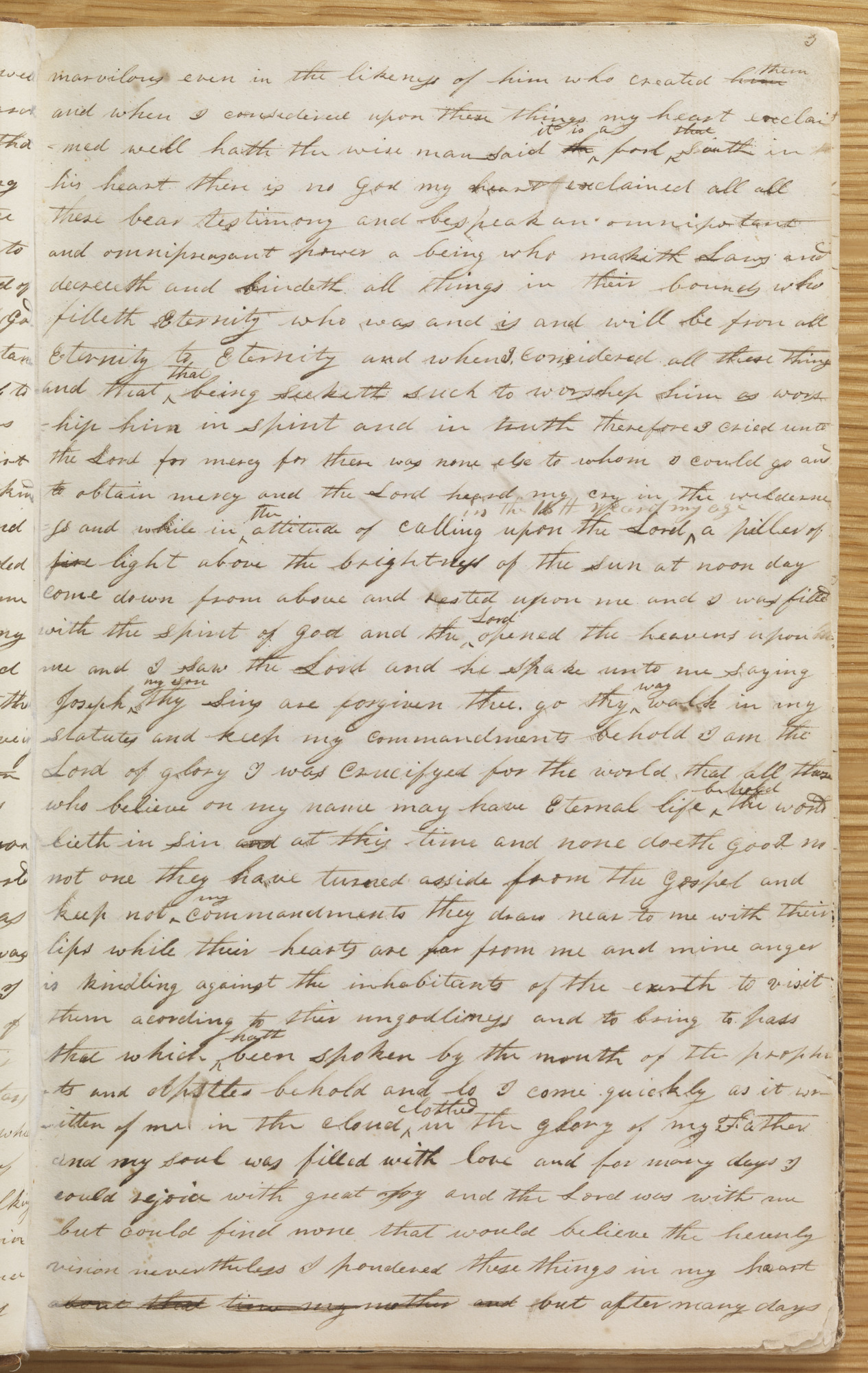
The 1835 account records Joseph's narration on November 9, 1835 to a visitor at Kirtland: Robert Matthews, the itinerant preacher then calling himself "Joshua the Jewish minister." Joseph's description was written down at the time, and Warren Parrish later copied it into Joseph's journal, where it survives in Parrish's hand:
"being wrought up in my mind, respecting the subject of religion and looking
upon<at> the different systems taught the children of men, I knew not who was right or who was wrong… I retired to the silent grove and bowd down before the Lord… I made a fruitless attempt to pray, my toung seemed to be swolen in my mouth, so that I could not utter, I heard a noise behind me like some person walking towards me, <I> strove again to pray, but could not, the noise of walking seemed to draw nearer, I sprung up on my feet, and looked around, but saw no person… I kneeled again my mouth was opened and my toung liberated, and I called on the Lord in mighty prayer, a pillar of fire appeared above my head, it presently rested down upon <me>, and filled me with joy unspeakable, a personage appeard in the midst, of this pillar of flame which was spread all around, and yet nothing consumed, another personage soon appeard like unto the first, he said unto me thy sins are forgiven thee, he testifyed unto me that Jesus Christ is the son of God; <and I saw many angels in this vision> I was about 14. years old when I received this first communication;"[4:1]
The 1835 account is significant for three reasons. First, it explicitly describes "a personage" plus "another personage soon appeard like unto the first": two personages, three years before the canonical 1838 narrative was written. Second, it includes the Satan/darkness elements (tongue swollen, noise behind walking) that the CES Letter describes as missing from the 1832 account, as if they were 1838 inventions. They are not. They appear in 1835. Third, it includes the interlinear "many angels in this vision" detail that the 1838 and 1842 accounts drop, a pattern that matters for the embellishment thesis (treated below).
The 1838 account was composed during the Missouri persecutions period, dictated to multiple scribes, eventually canonized as Joseph Smith—History (Pearl of Great Price, 1880), and first publicly serialized in Times and Seasons beginning March 15, 1842.[16] It is the longest firsthand account by an order of magnitude and contains the canonical narrative most members of the Church learned: religious excitement among Methodists, Baptists, and Presbyterians; Joseph's father's family being "proselyted to the Presbyterian faith," with four of them joining that church, "namely, my mother, Lucy; my brothers Hyrum and Samuel Harrison; and my sister Sophronia"; Joseph's reading of James 1:5; the grove; "[t]hick darkness gathered around me"; the pillar of light; "two Personages, whose brightness and glory defy all description"; the Father introducing the Son ("This is My Beloved Son. Hear Him!"); the answer that "I must join none of them"; the Methodist minister who treated Joseph's communication "not only lightly, but with great contempt"; and the Paul-Agrippa parallel ("I have thought since, that I felt much like Paul, when he made his defense before King Agrippa").
The 1842 Wentworth Letter was composed for John Wentworth, editor of the Chicago Democrat, in response to a request for a brief Church history. Joseph wrote it for non-Mormon newspaper publication and paired it with the Articles of Faith. The First Vision section is concise:
"I was enwrapped in a heavenly vision and saw two glorious personages who exactly resembled each other in features, and likeness, surrounded with a brilliant light which eclipsed the sun at noon-day. They told me that all religious denominations were believing in incorrect doctrines, and that none of them was acknowledged of God as his church and kingdom."[17]
The four firsthand accounts span a decade and were written for four different audiences in four different genres. Their differences, and their convergences, are what the rest of this article is about.
The five secondhand accounts
The CES Letter omits the secondhand accounts entirely. They matter for two reasons. First, they extend the documentary record forward and outward: recorded by five different listeners in five different settings, including a skeptical non-Mormon newspaper editor with no apologetic motive. Second, their contents include incidental, theologically irrelevant peripheral details that anchor the accounts to specific moments and people. The pattern of detail-distribution across the five secondhand accounts is itself evidential.
![Title page of Orson Pratt's 1840 Edinburgh pamphlet, 'A[n] Interesting Account of Several Remarkable Visions,' the earliest published narrative of the First Vision.](/assets/ma-secondhand-titlepage.DYEXaTRb.jpg)
Orson Pratt (1840), A[n] Interesting Account of Several Remarkable Visions, was published in Edinburgh as a 31-page missionary pamphlet, the earliest published full firsthand-derived narrative of the First Vision. Pratt described "two glorious personages, who exactly resembled each other in their features or likeness." He included a vivid sensory detail not present in any firsthand account: the light was so intense that Joseph "expected to have seen the leaves and boughs of the trees consumed."[18]
Orson Hyde (1842), Ein Ruf aus der Wüste ("A Cry out of the Wilderness"), published in Frankfurt, was the first foreign-language First Vision narrative. Hyde used Pratt's account as his primary source but added one important detail: after Joseph knelt, "the adversary" filled his mind with "doubts" and brought to mind "all manner of inappropriate images to prevent him from obtaining the object of his endeavors."[19] The "inappropriate images" detail is psychologically realistic. Distraction during prayer is a universal experience, and it is the kind of texture a fabricator inventing missionary copy would not bother to add.
Levi Richards (June 11, 1843) recorded in his journal an account of Joseph's discourse at a Nauvoo temple meeting following Elder George Adams's sermon on apostasy. Richards wrote that Joseph "bore testimony to the same," then captured him emphasizing that "none of them were right, that they were all wrong, & that the Everlasting covena[n]t was broken."[20] The "Everlasting covenant was broken" formulation is unique to this account: evidence Joseph adapted his retellings to the immediate context, here the preceding sermon's apostasy discussion, which is the natural behavior of someone working from genuine memory rather than a fixed script.
David Nye White (Pittsburgh Weekly Gazette, September 15, 1843) is the most evidentially significant secondhand account. White was a senior non-Mormon Pittsburgh newspaper editor who interviewed Joseph at Nauvoo and published his account in the Pittsburgh Weekly Gazette on September 15, 1843. White printed Joseph's recollection in the first person: he "went to the stump where I had stuck my axe when I had quit work, and I kneeled down, and prayed."[21] The axe-in-stump detail is incidental, geographically specific, theologically irrelevant, and serves no narrative purpose. It is exactly the kind of spatial anchor that genuine memories of significant events typically include and that fabricated narratives leave out. White was an outsider, a non-member journalist; he had no investment in Joseph's claims and no theological motive to invent the axe.
Alexander Neibaur (May 24, 1844) recorded the last known retelling, one month before Joseph's death. Neibaur was a German-Jewish convert who had studied dentistry at the University of Berlin. His journal entry contains the only physical description of the divine personage: "light complexion blue eyes a piece of white cloth drawn over his shoulders his right arm bear." Neibaur also recorded Joseph's recollection of the Methodist revival cultural context: Joseph "wanted to feel & shout like the Rest but could feel nothing."[22]
The "blue eyes" detail does nothing to advance Joseph's theological claims. It is theologically inert, perhaps even theologically odd, given that classical Christian iconography of Christ tends toward Mediterranean rather than Northern European features. It is a specific, idiosyncratic, sensory detail of the kind memory researchers identify as a marker of genuine episodic memory. The "wanted to feel and shout but could feel nothing" detail is similarly authentic: it captures the psychological texture of a sensitive young person at a Methodist revival, unable to manufacture the spiritual response his peers were exhibiting.
These five details (burning leaves, distracting images during prayer, "everlasting covenant broken," axe in stump, blue eyes/white cloth) are exactly the kind of uninventable particulars that anchor genuine memories. What would blue eyes buy a fabricator? They are the residue of genuine remembering: the specific, the incidental, the sensory.
A fabricator inventing five different oral accounts to give to five different listeners would not produce this distribution. He would tell the same story each time. The pattern of unique, uninventable particulars across five secondhand accounts is positive evidence of genuine oral tradition rather than rehearsed narrative. A critic might object that the secondhand recorders themselves invented the details, but this requires the supposition that five different recorders, in five different settings, with no apparent collusion, all happened to invent specific incidental details that none of them had any motive to add. The detail-distribution argument gets stronger the more recorders are involved, not weaker.
Seven core elements consistent across the accounts
What stands behind the variation is a stable core. Set the nine accounts side by side and seven elements recur across the firsthand and contemporary secondhand records:
- Joseph was young.
- He was troubled by religious confusion.
- He went to pray alone.
- Divine light appeared.
- Heavenly being(s) appeared.
- He was told existing churches were wrong.
- He was persecuted when he told others.
The matrix below shows which of the nine accounts confirm each core element.
| Core element | 1832 | 1835 | 1838 | 1842 | Pratt 1840 | Hyde 1842 | Richards 1843 | White 1843 | Neibaur 1844 |
|---|---|---|---|---|---|---|---|---|---|
| Young age | Yes (12–15) | Yes (~14) | Yes (~14) | Yes (~14) | Yes | Yes (15th year) | Yes (a youth) | Yes (~14) | Not specified |
| Religious confusion | Yes | Yes | Yes | Yes | Yes | Yes | Yes | Yes | Yes |
| Prayed alone | Yes (grove) | Yes (silent grove) | Yes (grove) | Yes | Yes | Yes | Yes | Yes (grove) | Yes |
| Divine light | Yes (pillar of light) | Yes (pillar of fire) | Yes (pillar of light) | Yes (brilliant light) | Yes (intense light) | Yes | Implied | Yes | Yes |
| Heavenly being(s) | Yes ("the Lord") | Yes (two personages + many angels) | Yes (two Personages) | Yes (two personages) | Yes (two personages) | Yes (two beings) | Implied (received answer) | Yes (two beings) | Yes (two personages) |
| Churches in error | Yes ("apostatized") | Yes | Yes | Yes | Yes | Yes | Yes ("Everlasting covenant broken") | Yes | Yes |
| Subsequent persecution | Yes ("found none that would believe") | Implied | Yes | Implied | Yes | Yes | Implied | Implied | Yes |
The pattern is a stable core with a variable periphery. Different accounts foreground different details. The 1835 has many angels and Satan/darkness; the 1838 has the Methodist minister and the Father introducing the Son; the Neibaur 1844 has blue eyes. But all nine include the seven core elements, or strongly imply them given genre constraints. This is what genuine memory of a significant event looks like across multiple retellings, and it is not what a memorized fabrication looks like.
The one-being-versus-two question
The CES Letter's most rhetorically effective single sentence is the "all over the place" catalog: "Who appears to him? Depending upon the account, a spirit, an angel, two angels, Jesus, many angels or the Father and the Son appear to him – are all over the place."[1:1] The catalog stitches every term that has ever surfaced in any account or reference of any reliability into a single breathless list: formal accounts, casual references, secondhand reports, hostile newspaper paraphrases, even references to other people's visions. Disaggregating it collapses most of the rhetorical force.
"A spirit" does not appear in any of Joseph's four firsthand accounts. The phrase derives from the Painesville Telegraph (1830) or Reflector (1831) hostile newspaper reports, neither of which Joseph wrote, and at least the Reflector contains substantial garbled details that even careful critics like Robert Bowman dismiss as historically unreliable.[23] "An angel" and "two angels" derive partly from the Reflector's formulation that "Cowdery and his friends had frequent interviews with angels" (describing Cowdery, not Joseph), and partly from the November 14, 1835 Erastus Holmes reference ("first visitation of Angels"), which is Joseph's own informal language for heavenly visitors and refers to the same November 9, 1835 event captured in detail by Parrish, not a separate vision.[5:1] "Jesus" describes the 1832 account, which uniquely identifies the speaking personage as Christ. "Many angels" is the 1835 account's interlinear addition, but the 1835 account places "many angels" alongside two personages, not instead of them. "The Father and the Son" describes the 1835, 1838, and 1842 firsthand accounts and all five contemporary secondhand accounts.
| Source | Joseph's own firsthand? | Describes who | Notes |
|---|---|---|---|
| 1832 firsthand | Yes (partly autograph) | "the Lord" | Speaking personage identifies as crucified Christ |
| 1835 firsthand | Yes (Joseph's journal, Parrish scribe) | "a personage… another personage" + "many angels" | Two personages explicit |
| 1838 firsthand | Yes (Joseph's dictation) | "Two Personages" | Father introduces Son |
| 1842 firsthand (Wentworth) | Yes (Joseph's authorship) | "Two glorious personages" | Concise summary |
| Pratt 1840 secondhand | No | "Two glorious personages" | Edinburgh missionary pamphlet |
| Hyde 1842 secondhand | No | Two beings | German pamphlet |
| Richards 1843 secondhand | No | Not specified | Nauvoo temple meeting; answer recorded, no beings described |
| White 1843 secondhand | No | Two beings | Pittsburgh Weekly Gazette |
| Neibaur 1844 secondhand | No | Two personages | Last known retelling |
| Painesville Telegraph (1830) | No (hostile newspaper) | divine visions | Generic phrase; wording here is a summary, not a verified quotation |
| Reflector (1831) | No (hostile newspaper) | "Smith… seen God frequently and personally; Cowdery and his friends had frequent interviews with angels" | Bowman: garbled, "frequently" doesn't match Joseph |
| Erastus Holmes (Nov 14, 1835)[5:2] | Yes (Joseph's brief mention) | "first visitation of Angels" | Same event as Nov 9; informal language |
Seven of nine direct accounts of Joseph's vision describe two personages; the 1832 account is ambiguous; the Levi Richards entry preserves the answer but describes no personages; and the "spirit," "angels," and "two angels" entries in the CES Letter's catalog turn out to describe either hostile newspaper paraphrases of garbled content, references to other people's experiences, or the same event under a different informal label. The "all over the place" framing requires inflating the count by treating these unequal sources as equivalent. Weighted by reliability, the catalog resolves to a single, repeated answer: two personages.
That said, on its most natural reading and taken by itself, the 1832 account does not require two beings. The text uses "the Lord" twice ("the Lord opened the heavens upon me and I saw the Lord and he spake unto me"). The being who speaks identifies himself as the crucified Christ. The account gives no explicit Father and no introduction; the "This is my beloved Son. Hear him!" formula is absent. The CES Letter reasonably treats this as the strongest textual argument for one being. The Church's own Gospel Topics Essay grants the ambiguity directly. It says the 1832 account "can be read to refer to one or two personages," that "[i]f read to refer to one heavenly being, it would likely be to the personage who forgave his sins," and that the account "may have concentrated on Jesus Christ, the bearer of forgiveness."[7:1] That is one branch of an explicitly conditional reading, and the essay lays out the two-being branch in the very next paragraph. The branch exists at all because the 1832 text does not settle the question on its face. That ambiguity is where the embellishment thesis bites hardest: if Joseph had already seen two beings in 1820, the Father's absence from the 1832 text needs an explanation, and the usual appeal to audience does not reach a document Joseph kept for himself.
The case that the 1832 account does describe two beings, or is at least fully compatible with two, is cumulative. It consists of four strands.
The Allen-Welch two-stage reading. James B. Allen and John W. Welch proposed in their 2012 chapter for the BYU Religious Studies Center volume Exploring the First Vision that the 1832 narrative "actually suggests that the vision progressed in two stages": first, Joseph "was filled with the spirit of god and the <Lord> opened the heavens upon me," and second, he "saw the Lord and he spake unto me."[24] They are careful about what the first stage proves: "Though not explicitly stated, the initial mention of the Spirit of God and the Lord may have reference to the presence of God the Father and his opening of this vision, since it is clear in all the other accounts that the vision was opened by God who then introduced his Son." Their supporting argument is textual rather than thematic. Joseph first wrote "with the spirit of god and the opened the heavens," apparently intending "and he opened the heavens," then inserted "Lord" as the simplest correction, "although one that created an ambiguity." And a single title can cover both beings: "if David could use the word 'Lord' in Psalm 110:1, 'The Lord said unto my Lord,' to refer first to the Father and then to the Son (see Mark 12:36), so could Joseph." Elsewhere in the chapter they state the conclusion flatly: "There is no doubt that the Prophet intended to convey the message that they were the Father and the Son."
The two-stage reading is one possible reading. It requires interpretive work the text does not directly invite. A reader approaching it with the canonical 1838 account in mind reads "the Lord opened the heavens… I saw the Lord" as compressed shorthand for two beings; a reader approaching with one-being priors reads the same words as one being. The text itself is genuinely ambiguous, and ambiguity is not denial. The CES Letter treats the omission of explicit two-personage language as a denial of two personages. Allen and Welch show that this is a logical error. What they cannot show is that the 1832 text requires two beings on its face.
D&C 76 (February 16, 1832) predates the 1832 history by six months. Joseph and Sidney Rigdon recorded a joint vision in February 1832 that places the Son explicitly at the Father's right hand:
"And we beheld the glory of the Son, on the right hand of the Father, and received of his fulness."[25] "For we saw him, even on the right hand of God; and we heard the voice bearing record that he is the Only Begotten of the Father—"[26]
If Joseph's theology in early 1832 had collapsed the Father and the Son into a single being, D&C 76 should not exist in this form. D&C 76 establishes that distinct-personage theology was already in the recorded canonical discourse by February 1832, six months before the 1832 First Vision history was composed.[27] See Contradictions §One being or two? for the fuller treatment of D&C 76's evidential scope.
Pre-1833 LDS scripture, most of it pre-Rigdon, is not uniformly modalist (that is, it does not collapse the Father and Son into a single being appearing in different modes). Ari Bruening and David Paulsen's 2001 FARMS Review of Books article runs two separate counts, and it matters to keep them apart. On the early revelations: "The revelations received by Joseph before 14 May 1833 and collected in the Book of Commandments and the first edition of the Doctrine and Covenants are decisively trinitarian. We have found eighty-three such antimodalist passages," grouped into six categories, and they add that they "cannot find a single passage from these revelations that fits a modalistic model better than an antimodalist one."[28] The Book of Mormon they count separately, and that count carries the pre-Rigdon point more directly: of "approximately eighteen hundred references to God in the Book of Mormon," only six (plus two more later changed) are the modalist-sounding passages critics rely on. Setting the evidentially neutral references aside, they conclude that "the ratio of antimodalist passages to modalist passages in the first edition of the Book of Mormon is at least 20 to 1." Their Book of Moses reading rests on the same kind of material, including the three-way exchange among the Father, the Son, and Satan at Moses 4:1–3 (1830). The Book of Mormon was dictated in 1829–30 and the Book of Moses begun in 1830, before Joseph ever met Rigdon (Rigdon arrived at Joseph's home in December 1830). Joseph's solo, pre-Rigdon dictated material already distinguishes the Father and the Son in language independent of Rigdon's vocabulary. The simplest "Joseph was modalist before he saw the Father" version of the critical case is not viable on this textual record.[29]
Joseph's 1831–1833 JST revisions are consistent with embodied-God theology. Walker Wright and Don Bradley's 2022 BYU Studies Quarterly article on JST Psalm 14, and a 2024 Deseret News essay extending the analysis to JST John 1:18 and 1 John 4:12, document Joseph's pre-1832 textual revisions that qualify the apparent absoluteness of "no man hath seen God" by adding conditions under which the Father may be seen.[30][31] JST Psalm 14:1, completed in early 1833, within months of the 1832 First Vision history, reads: "The fool hath said in his heart, There is no man that hath seen God, because he sheweth him self not unto us, therefore there is no God." JST John 1:18 reads: "<And> no man hath seen God at any time, except he hath born record of the son." Wright and Bradley argue that Joseph's revisions to the Johannine passages on seeing God the Father add the very conditions on which the First Vision could occur. On their reading of JST John 1:18, "God the Father can be seen, with the proviso that he always bears record of the Son to those privileged to see him," which is what Joseph would later describe happening: he "heard the Father bear 'record of the Son.'" They date the two Johannine changes between fall 1831 and March 1832, several months before Joseph's earliest recorded First Vision account. The JST changes are consistent with embodied-God theology and the vision's distinct-personage narrative; they do not by themselves prove Joseph's 1820 experience included an explicit Father introducing an explicit Son. But they do establish that the textual elements of the canonical narrative were not late inventions of the 1838 account.
The cumulative case for two beings rests on these four strands together: Allen-Welch's two-stage reading of the 1832 text; D&C 76's pre-1832 distinction of the Father and the Son; Bruening-Paulsen's 83 anti-modalist passages in the pre-May-1833 revelations, together with their 20-to-1 ratio in the Book of Mormon; and the Wright-Bradley JST evidence. None of them alone makes the case airtight. Together, they establish that the 1832 account, while ambiguous in isolation, is fully compatible with two beings and that the strongest versions of the strict-modalism critical reading are not viable on the textual record.
The 1835 firsthand account was written during the Lectures on Faith period, when Joseph was contemporaneously teaching that the Father is "a personage of spirit, glory and power: possessing all perfection and fulness" and the Son "a personage of tabernacle, made, or fashioned like unto man" (Lecture 5). It explicitly describes two personages.[32] If Joseph were going to encode the two-being theology he was teaching at that moment into a vision narrative, the 1835 account would not contain "another personage soon appeard like unto the first." It does. This is a problem the simplest versions of the theological-development thesis must address. See Contradictions §The Lectures on Faith problem for the fuller treatment.
The motive question
The CES Letter calls the difference between the 1832 and 1838 motive descriptions a "direct contradiction":
"In the 1832 account, Joseph wrote that before praying he knew there was no true or living faith or denomination upon the earth as built by Jesus Christ in the New Testament. His primary purpose in going to prayer was to seek forgiveness for his sins… This is in direct contradiction to his 1832 first vision account."[33]
Unlike the age question (resolved by the Williams insertion) or the who-appeared question (resolved by the seven-of-nine pattern), the motive question is not an omission that can be explained by audience or emphasis. Each account stakes a positive claim, and the two claims strain against each other.
The 1832 account: Joseph wrote that "by searching the scriptures I found that mankind did not come unto the Lord but that they had apostatised from the true and liveing faith and there was no society or denomination that built upon the gospel of Jesus Christ as recorded in the new testament." He had already concluded all churches were wrong before praying. His primary stated motive was to seek forgiveness of sins.[15:3]
The 1838 account: "My object in going to enquire of the Lord was to know which of all the sects was right, that I might know which to join." Then the parenthetical: "(for at this time it had never entered into my heart that all were wrong)."[16:1]
Dan Vogel reads this difference as two accounts presenting diametrically opposed purposes: not differences of emphasis but positive claims about Joseph's intellectual state at the moment of prayer that contradict each other. His own summary of the 1832 account, as Stan Larson quotes it, is that "the experience emerges as a personal epiphany in which Jesus appeared, forgave Joseph's sins, and declared that the sinful world would soon be destroyed."[34][35] That reading leaves no room for a church-seeking motive, and it has substantial force. Not all of that force dissolves.
What softens the inference from "the texts disagree" to "Joseph fabricated the vision" is the recognition that Joseph's accounts span twelve years and that what he described in 1832 was a multi-year process: "from the age of twelve years to fifteen I pondered many things in my heart concerning the sittuation of the world of mankind." The 1832 account itself contains both motives, apostasy concern and personal forgiveness, though it weights forgiveness heavily. Christopher Jones's 2011 Journal of Mormon History article documented that early 19th-century Methodist conversion narratives treated personal forgiveness and identifying the true church as intertwined dimensions of the same spiritual crisis.[36] Methodists in particular, Jones writes, "drew a more direct connection between their conversion to Christ and their conversion to Methodism. In the Methodist mind, conversion and the attendant forgiveness of sins and subsequent regeneration were intimately linked to the decision to unite with the Methodist Church." Bushman captured the both-motives pattern in his 1969 Dialogue article (and reiterated it in Rough Stone Rolling): "In all accounts of his early religious experiences, for example, Joseph mentions the search for the true church and a desire for forgiveness. In some accounts he emphasizes one, in some the other."[37]
The motive question is treated in detail in Contradictions §Forgiveness or which church to join?. For the comparative-accounts framework, the takeaway is narrower. The mitigations just described explain how forgiveness-seeking and church-seeking could move together in one spiritual life; what none of them directly resolves is the negation in the 1838 parenthetical.[38] That residual tension is real, and it is where Vogel's opposed-purposes framing is hardest for the apologetic case to absorb cleanly. The more careful claim, that the variation reflects a multi-year process narrated to different audiences across a decade, is plausible but partial. The 1838 parenthetical, on its most natural reading, says something the 1832 account contradicts, and a reader who notices that is right to notice it.
The age "discrepancy": Williams's insertion
The CES Letter presents the age difference between the 1832 account ("16th year of my age") and the other accounts ("about 14") as a factual discrepancy undermining reliability:
"The dates/his ages: The 1832 account states Joseph was 15-years-old while the other accounts state he was 14-years-old when he had the vision."[39]
The phrase "in the 16th year of my age" is not in Joseph's hand at all. It was written above the line in another hand, and the Joseph Smith Papers identify that hand as Frederick G. Williams's. The same edition describes the 1832 history as "the only narrative of the foundational spiritual events of JS's early life that includes his own handwriting," which leaves the other portions, including this phrase, outside Joseph's hand.[15:4]
| Account | Year | Age Given | Written By |
|---|---|---|---|
| 1832 | 1832 | "16th year of my age" | Frederick G. Williams (interlinear insertion) |
| 1835 | 1835 | About 14 | Warren Parrish (scribe), from Joseph's dictation |
| 1838 | 1838 | 14 (spring 1820) | Multiple scribes, from Joseph's dictation |
| 1842 | 1842 | "About fourteen years of age" | Joseph Smith / scribes |
| Pratt 1840 | 1840 | 14–15 | Secondhand |
| White 1843 | 1843 | About 14 | Secondhand |
Wherever Joseph's own words survive, dictated firsthand or given in interview, the age is 14. The lone exception is the interlinear phrase, in a hand not Joseph's. The CES Letter omits this manuscript detail entirely, and since the Williams insertion is documented in the Joseph Smith Papers description of the 1832 history (a source the CES Letter cites repeatedly for other purposes), the omission is not ignorance of the underlying scholarship.
Even if the Williams insertion were taken at face value, the age gap is not what it appears. "In the 16th year of my age" means age 15, not 16, on the inclusive counting standard of nineteenth-century usage: the sixteenth year of a person's life opens at the fifteenth birthday and closes at the sixteenth. Given a vision in the early spring of 1820, and Joseph turning 14 on December 23, 1819, age 15 is within a year of "about 14 years old": a modest divergence, not a dramatic one. Nothing inside the 1832 account fights that reading: its own timeline of spiritual concern runs "from the age of twelve years to fifteen," with the vision as the endpoint.[15:5]
The age question is treated in fuller depth in Contradictions §The age question. One fact suffices here: the "age 14 vs. age 15" variation is not a Joseph-against-himself discrepancy but a scribal insertion that every other account contradicts.
Paul's Damascus Road: a scriptural parallel
The CES Letter treats variation across multiple accounts of the same vision of deity as evidence of fabrication. The same logic, applied to scripture, would damage the New Testament. Paul's Damascus Road conversion is recorded three times in Acts (chapters 9, 22, and 26) and referenced in Paul's epistles (Galatians 1, 1 Corinthians 9, 15, and 2 Corinthians 11). The variations across these accounts are substantial:
| Detail | Acts 9 | Acts 22 | Acts 26 |
|---|---|---|---|
| Time of day | Not specified | "about noon" (22:6) | "At midday" (26:13) |
| Companions heard the voice? | Yes (9:7) | No, "heard not the voice" (22:9) | Not specified |
| Companions saw the light? | Not specified | Yes (22:9) | Yes (26:13) |
| Who fell to the ground? | Only Paul (9:4) | Paul (22:7) | "We were all fallen to the earth" (26:14) |
| Christ's instructions | Brief: go to Damascus, wait | Brief: go to Damascus, wait | Full commission given directly by Jesus (26:16–18); no Ananias |
| Ananias's role | Central; baptizes Paul | Central; baptizes Paul | Not mentioned at all |
| Post-Damascus events | Go to Damascus, wait | Go to Damascus, wait | Full commission given directly by Jesus |
John A. Tvedtnes's 2012 Interpreter article systematically catalogued the Paul-Joseph parallel and concluded: "Indeed, there are fewer differences between the various accounts of Joseph Smith's first vision than between the five different accounts of Paul's first vision and his trip to Damascus."[40] The five he counts are the three Acts narratives (9:1–30; 22:5–21; 26:12–20) plus Galatians 1:11–24 and 2 Corinthians 11:32–33, the last of these being Paul's own account of his escape from Damascus.
Two caveats. First, all three Acts accounts were written by Luke, not Paul; they represent one author's retellings, not the subject varying his own account. Second, the types of variation are not identical. Paul's variations primarily concern companions' perceptions (did they hear the voice? see the light? fall down?), while the most contested variation in Joseph's accounts concerns who appeared. The parallel is not airtight.
What the parallel does establish is that variation across multiple accounts of the same vision of deity is normal in scriptural tradition and is not, by itself, evidence of fabrication. Joseph himself drew this parallel directly. In the 1838 account he wrote: "I have thought since, that I felt much like Paul, when he made his defense before King Agrippa, and related the account of the vision he had when he saw a light, and heard a voice… So it was with me. I had actually seen a light, and in the midst of that light I saw two Personages, and they did in reality speak to me."[41] Christian biblical scholars universally treat Acts 9, 22, and 26 as genuine variant retellings of the same authentic experience, with the variations explained by audience and rhetorical purpose. The same interpretive charity, applied to Joseph's accounts, dissolves the rhetorical force of "different versions = fabrication."
A parallel scriptural case appears within the Book of Mormon itself. Alma the Younger's conversion is recounted three times: Mosiah 27:8–37 (King Mosiah's record), Alma 36:4–26 (Alma's reflection to his eldest son), and Alma 38:6–8 (Alma's account to his second son). The accounts vary in tone, structure, and detail. Mosiah 27 is spontaneous and emotional; Alma 36 is reflective, structured around a central turning point; Alma 38 is practical and didactic. Yet the same distinctive vocabulary runs through all three, and the way it shifts is itself instructive. "Born of God" appears in every one, and Alma 36:5 and Alma 38:6 carry it in a near-identical sentence: "if I had not been born of God I should not have known these things." The thunder image recurs in all three, but the wording moves: an angel who "spake as it were with a voice of thunder" in Mosiah 27:11, "the voice of thunder" in Alma 36:7, and "his voice was as thunder" in Alma 38:7. "Gall of bitterness" carries Mosiah 27:29 and Alma 36:18; the shorter account to the second son reaches for different words for the same three days, "the most bitter pain and anguish of soul."[42] John W. Welch's explanation is straightforward: Alma had retold this story often enough that a particular set of words and phrases had become habitual to him.[43] Variation in detail; consistency in core. The pattern Joseph's accounts display is the pattern the Book of Mormon itself anticipates.
How memory actually works
The CES Letter's implicit theory of memory is that genuine recollection produces identical retellings across decades. Modern cognitive psychology has produced a substantial empirical literature showing this is wrong. Genuine memories of vivid, emotionally significant events show consistent core details with substantial variation in peripheral details across retellings, and this is precisely the pattern Joseph's nine accounts display.
The empirical literature begins with Roger Brown and James Kulik's 1977 Cognition article that coined the term "flashbulb memory."[44] Their analogy was photographic, and what it claims is narrower than it first sounds. Such a memory, they wrote, has a "live quality that is almost perceptual": it "is very like a photograph that indiscriminately preserves the scene in which each of us found himself when the flashbulb was fired" (p. 74). The comparison is to indiscriminate capture, not to accuracy, and their study contained no test of accuracy at all. Subsequent research supplied that test and substantially revised the framing. Ulric Neisser and Nicole Harsch's 1992 Challenger study was the first major demonstration that flashbulb memories are inconsistent: 25% of participants scored an accuracy of zero when their 1986 accounts of hearing about the Challenger explosion were checked against fresh records 2.5 years later, yet they expressed high confidence in the inaccurate memories.[45] Jennifer Talarico and David Rubin's 2003 Duke 9/11 study found that "confidence, not consistency, characterizes flashbulb memories": emotional and ordinary memories decline at comparable rates, but participants are more confident about the emotional ones despite no greater accuracy.[46] William Hirst and colleagues' 2009 study of N>3000 participants across seven cities, measured at one week, eleven months, and 35 months after 9/11, found that participants gave consistent answers about their flashbulb memories "only 63% of the time, on average" at eleven months, with further decay after that: people misremember some aspect of their own 9/11 experience roughly 40 percent of the time.[47] The 2015 ten-year follow-up established that forgetting levels off after year one, which supports the stability of significant-event memories beyond the initial decline.[48]
The pattern this literature documents is consistent: people vividly recall the core of major emotional events (where they were, what they were doing, the emotional tenor) while peripheral details (specific words, sequence of secondary events, identification of specific people) drift across retellings. False high-confidence flashbulb memories are common, including in well-known public examples: George W. Bush's memory of watching the first plane strike on 9/11 on television before entering the classroom (impossible, since no footage of the first plane was available before the second plane hit), Hillary Clinton's claim of landing in Bosnia "under sniper fire," Ronald Reagan's claim to have been present at the liberation of a Nazi concentration camp (he never left the United States during World War II), and Brian Williams's Iraq helicopter incident.[49] These public figures were not lying. They had constructed false flashbulb memories that they sincerely believed.
Robert A. Rees applied this literature directly to the First Vision in his 2017 Interpreter article. Rees performed a quantitative content analysis of mind/heart language across the four firsthand accounts and found a pattern consistent with cognitive-science predictions:[50]
- 1832 account: "mind" appears three times, "heart" five times, with "mind" associated with "darkness" and "distress" and "heart" with "considers" and "exclaims." Emotional/spiritual emphasis.
- 1835 account: "no mention of 'heart' at all"; cognitive emphasis. Joseph is "wrought up" and "perplexed" in his mind, speaks of "a realizing sense," and searches for "information" with a "fixed determination."
- 1838 account: "references to both mind (four times) and heart (five times)," balanced, and "leans more heavily on reason and ratiocination."
The shift across accounts is not the linear inflation an embellishment thesis predicts. It is the audience-driven and context-driven variability that flashbulb-memory research predicts for genuine recollection. Rees summarizes the underlying science in his own words, hedge included:
"Cognitive neuroscientists have found that, by and large, memories are constructed, not remembered — or at least are a combination of remembered facts and largely unconscious invention; at any given moment we are not likely to be able to distinguish between the two."[50:1]
He then turns to Israel Rosenfield, who argues that memory is always constructed and that the circumstances surrounding an event shape what is recalled:
"Recollection is a kind of perception, … and every context will alter the nature of what is recalled."[50:2]
Rees concluded: "Joseph's varied remembrances of what transpired in the Sacred Grove appear to be the result of such a phenomenon: he was surprised, astonished, and likely even shocked by an overwhelmingly dramatic encounter with the forces of both darkness and light."[50:3]
Steven Harper's First Vision: Memory and Mormon Origins (Oxford University Press, 2019), winner of the Harvey B. and Susan Easton Black Award and the Smith-Petit Best Book Award, applies the same memory framework systematically.[51] The line he returns to throughout is Bushman's, written in 1969:
"One would expect variations in the simplest and truest story."[37:1]
The incentive argument runs in the opposite direction from the fabrication charge. Someone protecting an invented story has every reason to keep it word-perfect, because each retelling is another chance to be caught contradicting the last. Joseph's accounts vary instead, and Harper's book reads that variation as the working of memory rather than the seam of an invention.
The primary memory-science literature (Brown-Kulik, Neisser-Harsch, Talarico-Rubin, Hirst) and its LDS scholarly application (Rees, Harper) converge on the same conclusion. Critics frame variation as evidence of guilt. Memory science establishes the opposite: variation across retellings of the same event is the fingerprint of genuine recall. Underneath the CES Letter's argument sits the assumption that authentic recollection produces identical retellings. That assumption has been empirically falsified for fifty years. The pattern of Joseph Smith's nine accounts (consistent core, variable periphery, audience-shaped emphasis) is precisely the pattern flashbulb-memory research predicts for an authentic dramatic experience.
The late-appearance question
The CES Letter's third major argument is documentary timing: "No one - including Joseph Smith's family members and the Saints – had ever heard about the first vision from twelve to twenty-two years after it supposedly occurred."[52] The argument is serious, and the comparative-accounts framework is not the place to litigate it in detail.
Briefly: pre-1832 hostile newspapers (the Painesville Telegraph in November 1830, the Reflector in February 1831) and D&C 20:5–7 (April 1830) establish that vision claims attributed to Joseph were circulating publicly before the 1832 written account, and a 1832–33 cluster of references including the Fredonia Censor, Christian Watchman, and Rev. Richmond Taggart's March 1833 letter extends that trail through the years on either side of it. The Joseph Capron affidavit corroborates the neighborhood side of the record: Hurlbut collected it in 1833 and Howe published it in 1834, but what it describes is the Smith family claiming "holy intercourse with Almighty God" back in 1827, three years before any Church existed to supply a motive.[53] Joseph's family (William, Lucy, Katharine) left corroborating testimony of the vision, with real limits on its independence; Joseph Sr.'s December 1834 patriarchal blessing adds an oblique early allusion. Allen's 1966 quote that the CES Letter freezes is one Allen himself revised in 1970 ("it can now be demonstrated that the Prophet described his experience to friends and acquaintances at least as early as 1831–32") and again in 2012.[54]
The pre-1832 documentary trail is thinner than the parallel record for the Book of Mormon or Moroni's visit. Robert Bowman (Institute for Religious Research) has answered the specific pre-1832 references one article at a time, and on the particulars of each item his rebuttals are hard to answer. But the pattern of multiple ambiguous-but-suggestive references, including hostile witnesses with no motive to invent claims for their opponents, is itself the evidential point. The 1832 account itself (private, partly autograph, unfinished, focused on personal forgiveness) is the strongest single piece of evidence against any blanket-fabrication thesis: this is not what fabrication produces.
Within the late-appearance items, the Cowdery conundrum is the piece the apologetic case has not resolved. Oliver Cowdery, Joseph's first scribe and a man with full access to the 1832 account, set up the First Vision narrative in Letter III of the Messenger and Advocate (December 1834), then in Letter IV (February 1835) "corrected" Joseph's age and skipped directly to Moroni's 1823 visit. The standard apologetic explanation appeals to the D&C 110 parallel: Joseph's April 1836 Kirtland Temple vision was recorded privately and not published until 1852, sixteen years later. But the parallel has limits. D&C 110 was supplementary, while the First Vision was the founding event of the Restoration that the Messenger and Advocate letters were specifically meant to establish. This item has no resolution within the multiple-accounts framework. See Late Appearance §The Cowdery conundrum for the fuller treatment.
For the full pre-1832 documentary trail, Cowdery's omission of the vision from the 1834–35 Messenger and Advocate letters, Allen's three formulations (1966, 1970, 2012), the Bowman rebuttals, and why the institutional emphasis on the First Vision consolidated slowly, see Late Appearance. Even granting the late-appearance argument at full strength, the cumulative case from the 1832 account's content shape, the family corroboration, and the pre-1832 hostile-witness pattern is not as one-sided as the CES Letter's "absolutely no record" framing suggests.
The 1820 revival
The CES Letter, citing FAIR selectively, claims: "Contrary to Joseph's account, the historical record shows that there was no revival in Palmyra, New York in 1820."[55]
This argument originates with Wesley Walters's 1967 article in the Bulletin of the Evangelical Theological Society. Walters checked the Methodist, Baptist, and Presbyterian membership rolls for Palmyra and turned up no significant 1820 spike. Nearly six decades of scholarship since have substantially revised that picture.[56] Richard Lloyd Anderson documented a Methodist camp meeting at Palmyra in June 1818, attended by Bishop Robert Roberts and recorded in itinerant Aurora Seager's journal; Anderson estimates cumulative weekend attendance at "about two thousand."[57] Milton Backman's membership figures for western New York, the region Joseph's account calls "the whole district of country," show Methodist increases of 2,154 in 1818 and 2,256 in 1820, the latter "the largest annual increase reported by this group for that region of America." On the Presbyterian side, 1,513 of the 2,250 New York converts in 1819, more than 67 percent, came from the Burned-over District.[58] Steven Harper's research adds two further items, and they rest on two different diaries. The first fixes a single event. A Palmyra newspaper and the diary of an unnamed Methodist minister together confirm a weekend camp meeting at Palmyra in June 1820, at which "about twenty people were baptized and forty became Methodists." The second establishes the wider pattern. The diaries of the Methodist itinerant Benajah Williams, a separate source, show preachers working Joseph's district throughout these years.[59]
That evidence confirms substantial religious excitement in 1819–1820: camp meetings, denominational growth, newspaper reports, contemporary diaries. What it leaves open is fit. The 1838 account's "great multitudes" language, with Presbyterians, Methodists, and Baptists in active denominational competition, fits the scale and texture of the 1824–25 Palmyra revival better than anything documented in 1819–1820: the earlier activity is real but regional and diffuse, while the 1824–25 event was concentrated, multi-denominational, and produced large-scale local social effects. Marquardt and Walters's Inventing Mormonism (1994) built this case on Smith family timing evidence: William Smith and Lucy Mack Smith placed the family's Presbyterian affiliation after Alvin's death in November 1823; Sophronia Smith's documented entry into the Palmyra Presbyterian Church appears to follow the 1824–25 revival; the 1838 account places the family affiliation in the 1820 excitement.[60]
At its strongest, Walters's argument targets the 1838 narrative rather than the 1820 excitement. The account's specific imagery (Methodist minister contempt, Paul comparison, denominational competition, the family's Presbyterian affiliation) maps better to 1824–25 than to 1819–1820, which would suggest that later memory retrofitted the 1838 narrative even if the underlying 1820 experience is real.
The most candid apologetic response is D. Michael Quinn's 2006 Dialogue framing. Quinn's own summary: Joseph "merged the two revivals, combined two different kinds of family conversions, and dated this multi-year conflation as 1820. While this is partially inaccurate, I see it as streamlining his narrative, not as an example of fraudulent invention."[61] The distinction he is drawing carries the weight, and it is the distinction between conflating circumstances that really happened and inventing events that never did. What memory conflation does not eliminate is the residual problem that even if the underlying 1820 experience is real, the 1838 imagery may draw on memories from across the 1818–1825 window. See Contradictions §The 1820 revival for the full treatment.
The Trinitarian Godhead question
The CES Letter's final argument in the First Vision section is that Joseph's pre-1838 theology was Trinitarian, which would be inconsistent with the canonical 1838 account's distinct-personage narrative:
"Why did Joseph hold a Trinitarian view of the Godhead, as shown previously with the Book of Mormon, if he clearly saw that the Father and Son were separate embodied beings in the official first vision?"[62]
The Bruening-Paulsen findings and the D&C 76 timing (treated above) refute the simplest version of this claim. Brant Gardner's social-trinitarianism framework provides the more nuanced response: most of the 83 anti-modalist passages Bruening-Paulsen find in the early revelations distinguish the Father and the Son in language a social trinitarian of Joseph's era could sign without hesitation, since that Protestant mainstream already held the Father and the Son to be distinct persons within one shared divine nature.[63] The 83 passages rule out uniform modalism; on their own they cannot separate pre-1833 LDS theology from that consensus. The break comes at the two claims Joseph's peers would never have signed: an embodied Father whose body of flesh and bones, "as tangible as man's," was canonized as D&C 130:22 in April 1843, and a vision narrative in which the Father personally presents the Son to a boy of fourteen in 1820.
At its core, the development thesis is a claim about embodied separateness and the visionary narrative, not about whether the Father and the Son are distinct persons. In its most careful form (Alexander 1980, Vogel 2004, Larson 2014) it is best engaged at this layer, not at the strawman "Joseph was a strict modalist" layer.[64][34:1][35:1] For the 1830 vs. 1837 Book of Mormon textual changes and the same development thesis applied to the book's Christology, see Godhead Changes. For Contradictions's direct engagement with Alexander, Vogel, and Larson, see Contradictions §The theological development thesis; for the fuller treatment of how D&C 76 timing and Bruening-Paulsen interact with the development thesis, see Contradictions §One being or two?.
The critical case the CES Letter does not make
The CES Letter's First Vision section is rhetorically strong on first encounter and weakens substantially under disaggregation. But the most formidable versions of the critical case do not appear in its First Vision section at all. Runnells cites the Gospel Topics Essay and Allen 1966; he does not engage Vogel 2004, Palmer 2002, Marquardt-Walters 1994, Brodie 1945, or Larson 2014, the more sophisticated scholarly versions. Those are the versions a faithful answer has to meet.
Brodie's late-fabrication thesis (1945) is more hedged than its usual quotation suggests. Her first explanation is a dream: the vision "was probably the elaboration of some half-remembered dream stimulated by the early revival excitement and reinforced by the rich folklore of visions circulating in his neighborhood." Invention is her second alternative: "Or it may have been sheer invention, created some time after 1830 when the need arose for a magnificent tradition to cancel out the stories of his fortune-telling and money-digging."[65] The 1830 in that sentence belongs to the second edition. The 1945 first edition read 1834, and Steven Harper's reading of the revision is unsparing. Brodie, he writes, "did not change her assumptions when she revised her biography of Joseph after the 1832 and 1835 accounts were discovered and published. She did not reconsider her interpretation in the light of evidence that showed Joseph had written and spoken openly of the vision on more than one occasion earlier than 1838. Rather, with characteristic insinuation, she simply substituted 1830 for 1834 in this sentence about the vision."[59:1] Harper reads her original thesis as dating the fabrication to the wake of an 1837 banking crisis, which is consistent with what she actually wrote: "some time after 1834" sets a floor rather than a date, and 1837 sits inside it. The datable claim moved; the framework behind it did not. But the structure of her argument, variation across accounts read as fabrication's signature, persists in popular critical writing, and the CES Letter's First Vision section is essentially that structure applied to the post-1965 documentary record. The structure itself fails for the reason memory science establishes: variation across retellings of significant events is the empirical signature of genuine recollection, not of fabrication.
Marquardt and Walters (1994) argued that the story of Mormon origins has been rewritten to the point where only fragments of the original remain.[60:1] They placed the documentary trail of vision-related materials clustering from 1830 onward, parallel to Joseph's theological maturation in the early 1830s. Their case rests heavily on the revival-timing question and the Presbyterian timing question, both treated in detail in Contradictions. For comparative-accounts purposes, what matters is that Marquardt-Walters provides the temporal frame the development thesis builds on.
Vogel and Palmer (2002, 2004) build the case on a different footing altogether: Joseph experienced a genuine but modest religious awakening around 1820–21, perhaps a Methodist-style born-again conversion, possibly with visionary elements but not a full vision of deity, and the accounts evolved as his theology matured.[34:2][66] This is not crude fabrication. It allows for genuine spiritual experience and gradual narrative development through ordinary human memory.
Vogel's three strongest specific arguments in the cross-account framework:
The opposed-purposes argument (the motive question): the 1832 statement and the 1838 parenthetical do not merely emphasize different motives but make positive claims about Joseph's intellectual state at the time of prayer that contradict each other. (Treated above; see Contradictions for full engagement.)
Theological evolution thesis: the accounts track Joseph's theological development from one-being emphasis (1832) through two-personage explicit (1835, 1838) to mature embodied-God theology (D&C 130:22, 1843). Vogel reads this as evidence that the theology came first and the accounts were bent to fit it.
The 1832 account as preserving the original experience closest to what actually happened: Vogel does not argue the 1832 account is fabricated. He argues it preserves the original modest religious experience, which the later accounts elaborate. The 1838 account is the fully developed narrative.
Palmer's variation is similar: Joseph's early experiences were relatively simple spiritual impressions that later developed into physical visions of deity. Palmer's framework allows Joseph to be sincere but mistaken, the experience growing in his memory and retellings rather than through deliberate fraud.[66:1]
This is the hardest version of the critical case to refute. It does not require Joseph to have been a manipulative master strategist. Stan Larson's 2014 Dialogue article is the most recent substantial scholarly restatement of this thesis.[35:2] Larson reformulates the motive contradiction directly: in his reading, the 1832 account establishes that Joseph's concern at the moment of prayer was not which church to join, because he had already concluded that none was correct. That makes the 1838 parenthetical's "had never entered into my heart that all were wrong" a positive contradiction rather than an emphasis difference.
Memory science constrains the apologetic response as much as it helps it. If memory naturally reconstructs over time, no historian can confidently declare that the Father and the Son appeared exactly as the 1838 account describes. What it supports is more limited: something extraordinary happened, and the variation pattern is consistent with genuine experience; it does not prove that any single retelling preserves 1820 in precise detail.
What the apologetic case can defend, after granting the Vogel-Palmer reading its full force, are the considerations the next section develops.
What survives the steelman engagement
The case for the First Vision's historicity does not rest on any single argument. It rests on the cumulative weight of features the variation pattern displays, features that fabrication and gradual development do not produce, or produce poorly.
The 1832 account's content shape weighs heavily against crude fabrication. A fabricator producing a founding vision narrative would write a polished, finished, public-facing document: written entirely in his own hand to maximize personal credit, foregrounding institutional implications (which church, divine authority, founding event), and internally consistent with the canonical version. The 1832 account is none of those. It is private (never published in Joseph's lifetime; written into a personal letterbook), unfinished (the autobiography breaks off mid-narrative), partly handwritten (Joseph took the pen for the most personal portions), focused on personal sin and forgiveness rather than institutional claims, and self-effacing about Joseph's role ("convicted of my sins"). The forgiveness narrative ("thy sins are forgiven thee. Go thy way walk in my statutes and keep my commandments") is not a founding charter. It is what one would expect from someone retelling a personal religious experience for himself, not from someone constructing institutional capital. (Against the gradual-development thesis this argument has less bite, since that thesis expects the earliest account to look exactly this way; against blanket fabrication it cuts hard.)
The 1832 → 1835 → 1838 detail-divergence pattern partially defeats the embellishment thesis. The 1835 account adds "many angels" that the 1838 and 1842 accounts drop. Steven Harper formulated the point sharply, and against Brodie's second-edition thesis directly: "But even later accounts do not continue to become longer, more detailed, or elaborate. Rather, these accounts return to sounding like Joseph's earlier, less-developed accounts."[10:1] Fabricators add. Embellishers inflate. The embellishment thesis predicts each retelling will be more elaborate than the last. The 1835 account adds a piece of supernatural spectacle (many angels) that the canonical version subsequently subtracts.
Two pushbacks complicate this. First, a genre confound: the 1835 is a casual oral retelling captured in journal form, while the 1838 is a formal institutional history. Stripping out incidental details ("many angels") is exactly what formalization does. Second, a conflation hypothesis the gradual-development thesis can absorb: the 1835 "many angels" may not be a peripheral detail of the 1820 event at all but a bleed-through from Joseph's broader Kirtland-era visionary context (the 1836 Kirtland Temple visions including D&C 110, the recurring "many angels" imagery in 1830s revelations). These pushbacks move "1835 angels then 1838 drops" from a clean refutation to a moderate counter-indicator. The narrower claim that survives both: the trajectory across the firsthand accounts is not steadily upward. A fabricator producing institutional history in 1838 would have every incentive to elevate the account, not deflate it. Dropping "many angels" cuts against the institutional interest a fabricator would have. The accounts do not show the steady dramatic accumulation a controlled embellishment hypothesis predicts.
The cross-account stable core is what flashbulb memory predicts for genuine experience. Seven elements (young, religious confusion, prayed alone, divine light, divine being(s), churches in error, persecution) present or strongly implied across all nine accounts. The variable-periphery pattern in the secondary details (axe in stump, blue eyes, burning leaves, "everlasting covenant broken," distracting images during prayer) is precisely what cognitive-science research describes for genuine recollection of significant events. This is much harder for the gradual-development thesis to absorb than for blanket fabrication: gradual development would predict the core details to drift across accounts as the narrative crystallized, with peripheral details staying stable in each retelling. The actual pattern is the opposite. Core stable, periphery variable, which is the empirical signature of genuine memory.
Idiosyncratic peripheral details across the secondhand accounts are positive evidence of oral tradition. Neibaur's "blue eyes" (1844), White's axe-in-stump (1843), Pratt's burning leaves (1840), Hyde's distracting images (1842), Richards's "Everlasting covenant was broken" (1843). Theologically irrelevant; the texture of recollection. Their distribution across multiple recorders in multiple settings is itself the evidential point.
Pre-1833 distinct-personage textual evidence constrains the starting point of any development trajectory. Bruening-Paulsen's 83 passages in the pre-May-1833 revelations and their 20-to-1 Book of Mormon ratio, JST Psalm 14 (Wright-Bradley 2022), JST John 1:18 (Bradley-Wright 2024), D&C 76 (February 1832). These do not by themselves prove the 1820 experience included an explicit Father introducing an explicit Son. They establish that the theological preconditions for the canonical narrative, a distinct Father and Son, the Father bearing record of the Son, the Father's voice being heard, were already in Joseph's published material before the 1832 written account. A strictly modalist Joseph is not what the pre-1832 record shows.
Bradley's contextual fit test. The 1838 account is embedded in details specific to 1820 frontier New York: 1815–1819 economic conditions including the Tambora-induced "year without a summer" leading to the Smith family's relocation to Palmyra; Smith family religious culture (Joseph Sr.'s visions, Lucy's spiritual seeking); spring land-clearing season (matching the axe-in-stump detail); regional Methodist context (Aurora Seager 1818, George Lane 1820). A 1830s fabricator addressing 1830s authority crises would not produce contextual specificity matching documented 1815–1820 conditions. See Late Appearance §Don Bradley's contextual fit test for the fuller treatment.
The institutional consolidation trajectory is normal religious history. Sixty years from personal experience (1820) to canonized scripture (1880) is what genuine institutional development looks like for a foundational event. Gradual emphasis, slow institutional uptake, multiple parallel accounts in different genres: that is ordinary religious history, not the immediate canonical narrative or the late wholesale invention the simplest critical version predicts.
The Paul/Damascus and Alma the Younger parallels. Multiple accounts of foundational visions is the scriptural norm, not an anomaly. Read Joseph's nine accounts with the charity Christian scholars give Paul's three, and "different versions = fabrication" loses its force.
The cumulative case, once the Vogel-Palmer reading is given its due: the data fits genuine experience-with-variable-retelling better than crude fabrication; it is consistent with gradual development at the narrative level while rejecting strict-modalism versions of theological development; the motive question's textual tension is real and unresolved by mitigations that address coexistence rather than negation; and the pattern of nine accounts with stable core and variable periphery, including idiosyncratic peripheral details across multiple secondhand recorders, fits what genuine memory of an extraordinary experience produces and does not fit what fabrication produces.
Hermeneutics of trust and suspicion
Steven Harper's most distinctive methodological contribution is identifying that interpretations of the First Vision depend on the interpreter's starting assumptions. He labels this the hermeneutic of trust versus the hermeneutic of suspicion:[67]
"Suspicious interpreters decide that Joseph is unreliable, perhaps even scheming. Trusting interpreters decide that the variability in the accounts makes sense in terms of the particular ways Joseph remembered and related the experience and the diverse settings and circumstances in which his accounts were communicated, recorded, and transmitted."
Harper acknowledges the framework cuts both ways:
"The danger of closed-mindedness is as real for believers as it is for skeptics."[67:1]
"Some believers quickly become skeptics when they learn of the accounts and find that their assumptions are not supported by the historical record."[67:2]
The framework is not a tiebreaker. A hermeneutic of trust that reads all evidence as confirming the prior is functionally indistinguishable from confirmation bias; the same critique applies in reverse. What the framework does is force the reader to recognize that the same documentary record supports two opposite conclusions depending on the interpretive frame brought to it. The defensible move is to lay out what each hermeneutic produces from the same evidence, not to declare "trust wins." Readers must weigh which interpretation requires fewer extra moves to absorb the data, and the empirical features the previous section catalogs are the constraints either reading must address.[68]
Assessment
The CES Letter's First Vision section opens with the President Hinckley epigraph: "Our whole strength rests on the validity of that [first] vision. It either occurred or it did not occur. If it did not, then this work is a fraud." Hinckley's framing is correct as far as it goes. The historicity of the First Vision is the foundation of the Restoration narrative. But the test he proposes is one the comparative documentary record can actually engage, and the argument from multiple accounts is not, on inspection, the fraud signature the CES Letter presents. It is what genuine memory of an extraordinary experience, retold across twelve years to four different audiences and recorded by five different secondhand witnesses, looks like.
The apologetic case is partial, and the limits are specific. Read in isolation, the 1832 text does not force a two-being reading; the case for two beings depends on cumulative evidence. The 1835/1838 anti-embellishment argument is partially confounded by genre and lands as a counter-indicator rather than a refutation. The motive question is a textual tension the mitigations soften without resolving. Memory science is a double-edged tool here: it supports variation as consistent with genuine experience, but it also caps what any single retelling can be taken to establish about 1820. The "best-documented theophany" claim is rhetorically overweighted, and Harper's "may be" qualifier matters. The Cowdery conundrum is still the unresolved item in the apologetic case.
The defensible claim is also narrower than the boldest apologetic framing. No single item carries it. What carries it is the accumulation: the 1832 account's confessional content shape, the detail-divergence pattern across the firsthand accounts, the cross-account stable core fitting flashbulb-memory predictions, the idiosyncratic peripheral details across multiple secondhand accounts, the pre-1833 distinct-personage textual evidence, the Bradley contextual fit test, and the Paul/Damascus and Alma the Younger scriptural parallels.
This does not produce certainty. The Vogel-Palmer development thesis cannot be conclusively refuted. The motive question's residual textual tension is real. The Cowdery omission is unresolved. What the cumulative case does support is that the data fits a genuine experience, variably retold, better than crude fabrication; that gradual narrative development is constrained by the pre-1833 textual evidence and the 1832 account's content shape; and that the variation pattern itself is what cognitive psychology predicts for genuine memory of an extraordinary event.
The Hinckley test stands. The First Vision either occurred or it did not. The comparative documentary record, weighed across all nine accounts and twelve years, is consistent with its having occurred, and on balance is more easily explained that way than any other.
Return, then, to where this started: five people who had heard Joseph tell the story, each writing down something he never wrote himself. Leaves the light seemed about to consume. An axe left in a stump. Blue eyes and a white cloth. Not one of those details serves a doctrine or a missionary or an institution. They are the kind of thing memory keeps and invention forgets, and they survive in five separate hands across four years, the last set down a month before Joseph died. Behind them stand the seven elements every account carries or clearly implies, and behind that an 1832 text too private and too unfinished to have been built for effect.
The shape of the whole record, once it is laid out: a steady core, peripheral details that drift the way genuine recollection drifts, and a scatter of incidental particulars no fabricator would think to plant. It is not a tidy record, and the hard places stay hard. But it reads like memory, not manufacture, and the longer one looks at the nine accounts together, the more that reading is the one the evidence keeps pointing back to.
Further Reading
- "First Vision Accounts," Gospel Topics Essays, the Church's own scholarly survey of the four firsthand accounts.
- Joseph Smith Papers, "Accounts of Joseph Smith's First Vision", primary documents for all four firsthand accounts.
- Steven C. Harper, First Vision: Memory and Mormon Origins (Oxford University Press, 2019).
- Steven C. Harper, "Suspicion or Trust: Reading the Accounts of Joseph Smith's First Vision," BYU Religious Studies Center.
- John A. Tvedtnes, "Variants in the Stories of the First Vision of Joseph Smith and the Apostle Paul," Interpreter 2 (2012).
- Robert A. Rees, "Looking Deeper into Joseph Smith's First Vision: Imagery, Cognitive Neuroscience, and the Construction of Memory," Interpreter 25 (2017).
- James B. Allen and John W. Welch, "The Appearance of the Father and the Son to Joseph Smith in 1820," BYU Religious Studies Center, 2012.
- Walker Wright and Don Bradley, "'None That Doeth Good': Early Evidence of the First Vision in JST Psalm 14," BYU Studies Quarterly 61, no. 3 (2022).
- Pearl of Great Price Central, "Did Both the Father and the Son Appear?" and "Secondhand Accounts of the First Vision."
Runnells, CES Letter (2017), "First Vision," p. 33. The bullet-list catalog of who appeared is from p. 34, item 4. ↩︎ ↩︎
Runnells, CES Letter (2017), "First Vision," p. 32, citing Gordon B. Hinckley, The Marvelous Foundation of Our Faith (Salt Lake City: Deseret Book, 2002), 4. ↩︎
Runnells, CES Letter (2017), "First Vision," p. 33. The word "admits" appears once in the section, in the sentence citing the First Vision Accounts essay; "admission" does not appear. ↩︎
Joseph Smith, Journal, 9–11 November 1835, pp. 23–24, Joseph Smith Papers. https://www.josephsmithpapers.org/paper-summary/journal-1835-1836/23 (this document's URL segments run one ahead of the manuscript page numbers, so manuscript pp. 23–24 are served at segments 24 and 25). ↩︎ ↩︎
Joseph Smith, Journal, 14 November 1835. Joseph briefly mentioned to Erastus Holmes "the first visitation of Angels which was when I was about 14, years old" — one paragraph long, best read as a passing summary of the November 9 detailed retelling, not an independent account. ↩︎ ↩︎ ↩︎
Pearl of Great Price Central, "Secondhand Accounts of the First Vision." https://pearlofgreatpricecentral.org/secondhand-accounts-of-the-first-vision/ ↩︎
"First Vision Accounts," Gospel Topics Essays, The Church of Jesus Christ of Latter-day Saints (2013; the page as currently served carries a 2016 citation line and 2016 publication metadata). https://www.churchofjesuschrist.org/study/manual/gospel-topics-essays/first-vision-accounts?lang=eng ↩︎ ↩︎
Paul R. Cheesman, "An Analysis of the Accounts Relating Joseph Smith's Early Visions" (master's thesis, Brigham Young University, 1965). ↩︎ ↩︎
Dean C. Jessee, "The Early Accounts of Joseph Smith's First Vision," BYU Studies 9, no. 3 (1969): 275–294. https://scholarsarchive.byu.edu/byusq/vol9/iss3/4/ ↩︎ ↩︎ ↩︎
Steven C. Harper, "Four Accounts and Three Critiques of Joseph Smith's First Vision," FAIR Conference, August 2011. https://www.fairlatterdaysaints.org/conference_home/august-2011/four-accounts-and-three-critiques-of-joseph-smiths-first-vision ↩︎ ↩︎
Charles Grandison Finney, Memoirs of Rev. Charles G. Finney, Written by Himself (New York: Fleming H. Revell Co., 1876). Finney's 1821 conversion experience in the woods near Adams, New York was published fifty-five years after the event with no contemporaneous documentary trail. Christopher C. Jones cites the Memoirs for the observation that Finney, "the noted Presbyterian preacher and revivalist," "experienced a visionary conversion in a secluded grove that closely parallels Joseph Smith's experience": Journal of Mormon History 37, no. 2 (2011): 109 and 109n79. ↩︎
Paul's Damascus Road conversion is recorded in Acts 9, Acts 22, and Acts 26. Paul references the conversion in Galatians 1:15–17, 1 Corinthians 9:1, 1 Corinthians 15:8, and 2 Corinthians 11:32–33, the last of which recounts his escape from Damascus rather than the vision itself. ↩︎
Joseph Smith Papers source note for "History, circa Summer 1832" reports that "these excisions took place in the mid-twentieth century" and that the three leaves "certainly had been removed by 1965, when they were described as 'cut out,' although they were archived together with the letterbook." The same note reports that the leaves "were still detached when they were photographed for a 1984 publication" and "were reattached by 2000, when scanned images that show them as such were made by the Church Archives." A 25 February 2001 register of the Joseph Smith Collection states the leaves were "reattached in the 1990s" as part of a broader conservation effort in which the entire volume was rebound. https://www.josephsmithpapers.org/paper-summary/history-circa-summer-1832/source-note ↩︎ ↩︎ ↩︎
Dean C. Jessee, "The Earliest Documented Accounts of Joseph Smith's First Vision," in Exploring the First Vision, ed. Samuel Alonzo Dodge and Steven C. Harper (Provo, UT: Religious Studies Center, BYU, 2012). https://rsc.byu.edu/exploring-first-vision/earliest-documented-accounts-joseph-smiths-first-vision ↩︎
Joseph Smith, "History, circa Summer 1832," pp. 1–3, Joseph Smith Papers. The First Vision passage is on p. 3: https://www.josephsmithpapers.org/paper-summary/history-circa-summer-1832/3 ↩︎ ↩︎ ↩︎ ↩︎ ↩︎ ↩︎
Joseph Smith, History, 1838–1856, vol. A-1, pp. 2–3, Joseph Smith Papers, https://www.josephsmithpapers.org/paper-summary/history-1838-1856-volume-a-1-23-december-1805-30-august-1834/3. Later canonized in Joseph Smith—History 1:1–26, Pearl of Great Price. ↩︎ ↩︎
Joseph Smith, "Church History," Times and Seasons 3 (March 1, 1842): 706–707, Joseph Smith Papers. https://www.josephsmithpapers.org/paper-summary/church-history-1-march-1842/1 ↩︎
Orson Pratt, A[n] Interesting Account of Several Remarkable Visions (Edinburgh, 1840), Joseph Smith Papers. https://www.josephsmithpapers.org/paper-summary/appendix-orson-pratt-an-interesting-account-of-several-remarkable-visions-1840/1 ↩︎
Orson Hyde, Ein Ruf aus der Wüste (Frankfurt, 1842), Joseph Smith Papers. https://www.josephsmithpapers.org/paper-summary/orson-hyde-ein-ruf-aus-der-wste-a-cry-out-of-the-wilderness-1842-extract-english-translation/1 ↩︎
Levi Richards, Journal, June 11, 1843; quoted in Pearl of Great Price Central, "Secondhand Accounts of the First Vision." ↩︎
"The Prairies, Nauvoo, Joe Smith, the Temple, the Mormons, &c.," Pittsburgh (PA) Weekly Gazette, September 15, 1843, vol. 58, no. 51, [3], reporting David Nye White's interview with Joseph Smith at Nauvoo on August 29, 1843. ↩︎
Alexander Neibaur, Journal, May 24, 1844, in BYU Religious Studies Center, "Contextual Background for Joseph Smith's Last Known Recounting of the First Vision." https://rsc.byu.edu/joseph-smith-his-first-vision/contextual-background-joseph-smiths-last-known-recounting-first-vision ↩︎
Robert M. Bowman Jr., Institute for Religious Research, on the Reflector and pre-1832 references. Bowman traces the source chain (Joseph → Cowdery → unnamed correspondent → editor Cole) and notes embedded falsehoods (world ending soon, New York to be sunk) that undermine the report's reliability. He concludes "we are on safe ground in dismissing this report as historically unreliable." https://mit.irr.org/first-rumor-1831-palmyra-reflector-and-first-vision ↩︎
James B. Allen and John W. Welch, "The Appearance of the Father and the Son to Joseph Smith in 1820," in Exploring the First Vision, ed. Dodge and Harper (Provo: BYU Religious Studies Center, 2012). https://rsc.byu.edu/exploring-first-vision/appearance-father-son-joseph-smith-1820 ↩︎
Doctrine and Covenants 76:20. ↩︎
Doctrine and Covenants 76:23. ↩︎
A careful reader will press back on two distinct points. First, D&C 76 came from a vision Joseph received jointly with Sidney Rigdon, whose Campbellite theological vocabulary may have shaped the recorded language of D&C 76. Second, even if D&C 76 reflects Joseph's own 1832 theology, it proves Joseph's current beliefs in early 1832, not what he experienced in 1820. Both points are fair. The weight-bearing argument that distinct-personage theology was already in Joseph's discourse before Rigdon must therefore rest on Joseph's solo dictations — Bruening-Paulsen's survey of pre-Rigdon material and the Wright-Bradley JST evidence — not on D&C 76 considered alone. What D&C 76 does establish, more narrowly, is that distinct-personage theology — whether Joseph's or Joseph-and-Rigdon's joint formulation — was already in the recorded canonical discourse by February 1832. ↩︎
Ari D. Bruening and David L. Paulsen, "The Development of the Mormon Understanding of God: Early Mormon Modalism and Other Myths," FARMS Review of Books 13, no. 2 (2001): 109–169. https://scholarsarchive.byu.edu/msr/vol13/iss2/13/ ↩︎
The Bruening-Paulsen passages refute uniform modalism. They do not by themselves distinguish pre-1833 LDS theology from social trinitarianism (the position widely held by Joseph's Protestant peers, in which the Father and the Son are distinct persons sharing one divine nature). The development thesis can absorb most of the 83 passages: it can grant that distinct-personage theology was in place by 1830 while still arguing that the embodied separateness claim (canonized in D&C 130:22, April 1843) and the literal narrative of the Father physically introducing the Son to a fourteen-year-old developed later. What Bruening-Paulsen do show is that the simplest "Joseph was modalist before he saw the Father" version of the critical case is not viable on the textual record. The Father-Son distinction was already in Joseph's published material from 1830 forward. ↩︎
Walker Wright and Don Bradley, "'None That Doeth Good': Early Evidence of the First Vision in JST Psalm 14," BYU Studies Quarterly 61, no. 3 (2022): 123–140, https://scholarsarchive.byu.edu/byusq/vol61/iss3/6/. Argues that Joseph's translation of Psalm 14 (dated by the authors to January or February 1833) and his JST revisions to John 1:18 and 1 John 4:12 (dated respectively between fall 1831 and February 16, 1832, and between February 16 and March 24, 1832) provide indirect textual evidence for First Vision elements predating the 1838 canonical account. ↩︎
Don Bradley and Walker Wright, "An overlooked text supporting Joseph Smith's First Vision consistency," Deseret News, April 13, 2024, https://www.deseret.com/faith/2024/04/13/joseph-smith-first-vision-accounts/. Bradley and Wright argue that Joseph's Bible revisions "provide evidence that these supposedly late-developed elements of the First Vision may actually predate even the 'earliest' First Vision account," because "[a]lready by 1831-1832, Joseph Smith's translation of John 1:18 and 1 John 4:12 intimates that he connected his First Vision with the idea of seeing God the Father and of God the Father bearing witness of the Son." ↩︎
Lectures on Faith, Lecture 5, in Doctrine and Covenants of the Church of the Latter Day Saints (Kirtland, OH: F. G. Williams, 1835). The lecture describes the Father as "a personage of spirit, glory and power" and the Son as "a personage of tabernacle, made, or fashioned like unto man." Critics read this as evidence Joseph held a two-being-but-non-embodied theology at the time of the 1835 First Vision retelling that should preclude the 1835 account's "another personage" formulation. The 1835 account contains "another personage" anyway. The semantic range of "personage of spirit" is itself contested. ↩︎
Runnells, CES Letter (2017), "First Vision," p. 33, item 2. The ellipsis stands in for the CES Letter's own block quotations of the 1832 and 1838 accounts, both of which the article quotes below from the manuscripts. ↩︎
Dan Vogel, Joseph Smith: The Making of a Prophet (Salt Lake City: Signature Books, 2004). Vogel treats the 1832 and 1838 motive descriptions as opposed rather than complementary. The characterization here rests on summaries of Vogel's argument; the Vogel sentence quoted above is quoted from him by Stan Larson, "Another Look at Joseph Smith's First Vision," Dialogue 47, no. 2 (Summer 2014): 44 n. 18. ↩︎ ↩︎ ↩︎
Stan Larson, "Another Look at Joseph Smith's First Vision," Dialogue: A Journal of Mormon Thought 47, no. 2 (Summer 2014): 37–62. The most recent substantial scholarly restatement of the embellishment thesis. ↩︎ ↩︎ ↩︎
Christopher C. Jones, "The Power and Form of Godliness: Methodist Conversion Narratives and Joseph Smith's First Vision," Journal of Mormon History 37, no. 2 (Spring 2011): 88–114. ↩︎
Richard L. Bushman, "The First Vision Story Revived," Dialogue: A Journal of Mormon Thought 4, no. 1 (Spring 1969): 82–93. Reprinted in Exploring the First Vision (BYU Religious Studies Center, 2012). https://rsc.byu.edu/exploring-first-vision/first-vision-story-revived ↩︎ ↩︎
One mitigation does attempt to address the negation directly: the temporal reading, which treats "at this time" as referring to a specific moment within Joseph's multi-year spiritual process rather than his settled view. On this reading, the apostasy conclusion described in the 1832 account had not yet crystallized at the moment Joseph prayed in the grove, even though the underlying spiritual concern was years in formation. This reading is strained — it requires "had never entered into my heart" to mean "had not yet become a fixed conviction" rather than the natural reading "had not occurred to me as an idea" — and it conflicts with the 1832 account's own chronology of years of accumulating concern by age 12–15. The temporal reading is the only mitigation that attempts the negation directly, and it is honest to note both that it attempts the negation and that it does so without strong textual support. ↩︎
Runnells, CES Letter (2017), "First Vision," p. 34, item 4 second bullet. ↩︎
John A. Tvedtnes, "Variants in the Stories of the First Vision of Joseph Smith and the Apostle Paul," Interpreter: A Journal of Mormon Scripture 2, no. 1 (2012): 73–86. https://interpreterfoundation.org/journal/variants-in-the-stories-of-the-first-vision-of-joseph-smith-and-the-apostle-paul ↩︎
Joseph Smith—History 1:24–25, Pearl of Great Price. ↩︎
Scripture Central KnoWhy #471, "Why Are There Multiple Accounts of Joseph Smith's and Alma's Visions?" https://scripturecentral.org/knowhy/why-are-there-multiple-accounts-of-joseph-smiths-and-almas-visions ↩︎
John W. Welch, "Three Accounts of Alma's Conversion," in Reexploring the Book of Mormon, ed. John W. Welch (Salt Lake City: Deseret Book / FARMS, 1992), 150–153. Welch's argument is summarized here rather than quoted; the chapter was not available for byte-level verification. ↩︎
Roger Brown and James Kulik, "Flashbulb Memories," Cognition 5, no. 1 (1977): 73–99. Their analogy, at p. 74, is that such a memory "is very like a photograph that indiscriminately preserves the scene in which each of us found himself when the flashbulb was fired." The comparison is to indiscriminate capture rather than to accuracy; the 1977 study included no accuracy check. ↩︎
Ulric Neisser and Nicole Harsch, "Phantom Flashbulbs: False Recollections of Hearing the News about Challenger," in Affect and Accuracy in Recall: Studies of 'Flashbulb' Memories, ed. Eugene Winograd and Ulric Neisser (Cambridge: Cambridge University Press, 1992), 9–31. ↩︎
Jennifer M. Talarico and David C. Rubin, "Confidence, Not Consistency, Characterizes Flashbulb Memories," Psychological Science 14, no. 5 (2003): 455–461. ↩︎
William Hirst et al., "Long-Term Memory for the Terrorist Attack of September 11: Flashbulb Memories, Event Memories, and the Factors That Influence Their Retention," Journal of Experimental Psychology: General 138, no. 2 (2009): 161–176. ↩︎
William Hirst et al., "A Ten-Year Follow-Up of a Study of Memory for the Attack of September 11, 2001: Flashbulb Memories and Memories for Flashbulb Events," Journal of Experimental Psychology: General 144, no. 3 (2015): 604–623. ↩︎
George W. Bush's false 9/11 memory is discussed in Daniel L. Greenberg, "President Bush's false [flashbulb] memory of 9/11/01," Applied Cognitive Psychology 18, no. 3 (2004): 363–370, https://doi.org/10.1002/acp.1016. Robert A. Rees, "Looking Deeper into Joseph Smith's First Vision," Interpreter 25 (2017): 67–80, collects the same set: Bush's misremembered account of hearing the 9/11 news, Hillary Clinton's assertion that she came under sniper fire at Tuzla, Bosnia in 1996, Ronald Reagan's false remembrance that he was present at the liberation of a concentration camp, and Brian Williams's misremembrance of the Iraq helicopter incident. (Sources differ on which camp Reagan named, so none is given here.) ↩︎
Robert A. Rees, "Looking Deeper into Joseph Smith's First Vision: Imagery, Cognitive Neuroscience, and the Construction of Memory," Interpreter: A Journal of Mormon Scripture 25 (2017): 67–80. https://interpreterfoundation.org/journal/looking-deeper-into-joseph-smiths-first-vision-imagery-cognitive-neuroscience-and-the-construction-of-memory/ ↩︎ ↩︎ ↩︎ ↩︎
Steven C. Harper, First Vision: Memory and Mormon Origins (New York: Oxford University Press, 2019). Winner of the Harvey B. and Susan Easton Black Award (Mormon History Association) and the Smith-Petit Best Book Award (John Whitmer Historical Association). https://global.oup.com/academic/product/first-vision-9780199329472 ↩︎
Runnells, CES Letter (2017), "First Vision," p. 34, item 3. ↩︎
For the full pre-1832 documentary trail, including the Capron affidavit (collected 1833, describing 1827), the Painesville Telegraph and Reflector references, D&C 20:5–7, the Fredonia Censor (March 1832), the Christian Watchman (December 1832), and Rev. Richmond Taggart's letter (March 1833), see Late Appearance §The evidence trail before 1832. Robert Bowman of the Institute for Religious Research has published article-by-article rebuttals to specific items that have force on most details; what survives is the cumulative pattern of multiple ambiguous-but-suggestive items, including hostile witness presence with no motive to invent claims. Bowman's strongest specific argument concerns D&C 20:5. The passages in D&C 20 and 21 are the only places in LDS scripture pairing any form of "manifest" with "remission of sins," and of the many scriptural references to the remission of sins, "not once is it connected with a visionary experience"; Bowman concludes that Joseph was "most likely not referring to a visionary experience" but to an inner witness that his sins were forgiven. That restricts what the pre-1832 documentary trail can support and pushes more weight onto the cumulative pattern. https://mit.irr.org/truly-manifested-does-dc-205-refer-first-vision ↩︎
James B. Allen, "Eight Contemporary Accounts of Joseph Smith's First Vision: What Do We Learn from Them?" Improvement Era (April 1970), 6. ↩︎
Runnells, CES Letter (2017), "First Vision," p. 34, item 4 fourth bullet. ↩︎
Wesley P. Walters, "New Light on Mormon Origins from Palmyra (N.Y.) Revival," Bulletin of the Evangelical Theological Society 10, no. 4 (Fall 1967): 227–244. The familiar title "New Light on Mormon Origins from the Palmyra Revival" belongs to the 1969 Dialogue reprint; the 1967 printing carries the form given here. ↩︎
Richard Lloyd Anderson, "Joseph Smith's Accuracy on the First Vision Setting: The Pivotal 1818 Palmyra Camp Meeting," in Exploring the First Vision, ed. Dodge and Harper (Provo: BYU Religious Studies Center, 2012). https://rsc.byu.edu/exploring-first-vision/joseph-smiths-accuracy-first-vision-setting-pivotal-1818-palmyra-camp-meeting ↩︎
Milton V. Backman Jr., "Awakenings in the Burned-over District: New Light on the Historical Setting of the First Vision," BYU Studies 9, no. 3 (1969): 301–320. https://byustudies.byu.edu/article/awakenings-in-the-burned-over-district-new-light-on-the-historical-setting-of-the-first-vision ↩︎
Steven C. Harper, "Evaluating Three Arguments Against Joseph Smith's First Vision," in Exploring the First Vision, ed. Dodge and Harper (Provo: BYU Religious Studies Center, 2012). https://rsc.byu.edu/exploring-first-vision/evaluating-three-arguments-against-joseph-smiths-first-vision ↩︎ ↩︎
H. Michael Marquardt and Wesley P. Walters, Inventing Mormonism: Tradition and the Historical Record, 2nd ed. (Salt Lake City: Smith Research Associates / Signature Books, 1994; reprint 2005). Their thesis is summarized here rather than quoted; the book was not available for byte-level verification. ↩︎ ↩︎
D. Michael Quinn, "Joseph Smith's Experience of a Methodist 'Camp-Meeting' in 1820," Dialogue: A Journal of Mormon Thought, Paperless E-Paper #3, December 20, 2006 (so dated in Steven Harper's citations; the reachable artifact's running head reads "VERSION OF JULY, 12 2006"). ↩︎
Runnells, CES Letter (2017), "First Vision," p. 35, item 4 last bullet. ↩︎
The social-trinitarianism framework used here, distinguishing distinct-personage theology compatible with social trinitarianism (the Father and the Son distinct persons sharing one divine nature) from embodied-separateness claims that go beyond it, is summarized from Brant A. Gardner's writings rather than quoted from any single work; no specific Gardner text is cited. See FAIR author hub: https://www.fairlatterdaysaints.org/authors/gardner-brant ↩︎
Thomas G. Alexander, "The Reconstruction of Mormon Doctrine: From Joseph Smith to Progressive Theology," Sunstone 5, no. 4 (July–August 1980): 24–33. ↩︎
Fawn M. Brodie, No Man Knows My History: The Life of Joseph Smith, 2nd ed. (New York: Knopf, 1971; orig. 1945). https://ia801204.us.archive.org/12/items/NoManKnowsMyHistory/No Man Knows My History.pdf. The sentence quoted here is the second edition's; the 1945 first edition dated the possible invention to some time after 1834. Brodie's own supplement acknowledges Jessee's 1969 publication of the earlier accounts. ↩︎
Grant H. Palmer, An Insider's View of Mormon Origins (Salt Lake City: Signature Books, 2002). https://archive.org/details/insidersviewofmo0000palm. Palmer's framework is summarized here rather than quoted; the volume is lending-restricted and its text could not be verified directly. ↩︎ ↩︎
Steven C. Harper, "Suspicion or Trust: Reading the Accounts of Joseph Smith's First Vision," in No Weapon Shall Prosper: New Light on Sensitive Issues, ed. Robert L. Millet (Provo: BYU Religious Studies Center, 2011). https://rsc.byu.edu/no-weapon-shall-prosper/suspicion-trust-reading-accounts-joseph-smiths-first-vision ↩︎ ↩︎ ↩︎
A hermeneutic of suspicion can in principle reframe each empirical feature the article cites — the variation pattern (by contesting the cognitive-psychology literature's application), the 1832 content shape (by reading the confessional, unfinished, partly-autograph features as strategic plausible-deniability moves), the pre-1832 theological preconditions (by treating Bruening-Paulsen and Wright-Bradley as evidence of theological development that does not entail experiential visionary memory), and the secondhand peripheral details (by treating them as the recorders' own confabulations). Each reframing is logically possible. What each requires is an additional supposition: that the cognitive-psychology literature does not apply in this case, that a teenager-into-young-man Joseph in 1832 had already anticipated future institutional needs sufficiently to engineer a private autobiography for later deployment, that five different recorders in five different settings independently confabulated idiosyncratic details that match each other's incidental-detail distributions. Readers must weigh whether the cumulative reframing required is more or less parsimonious than the reading of "Joseph wrote a private spiritual reflection in 1832, told different versions of his vision to different audiences across twelve years, and was reasonably remembered by five different listeners who each captured an incidental detail." ↩︎