The Priesthood Restoration's Late Appearance
The claim:
A single epigraph, set alone on the title page, opens the CES Letter's Priesthood Restoration section:
"The late appearance of these accounts raises the possibility of later fabrication." – LDS Historian and Scholar Richard Bushman, Rough Stone Rolling, p. 75[1]
That sentence frames everything that follows. Of the section's numbered claims, this article takes up three: the first, the second, and the sixth. They read:
"Like the first vision story, none of the members of the Church or Joseph Smith's family had ever heard prior to 1832 about a priesthood restoration from John the Baptist or Peter, James, and John. Although the priesthood is now taught to have been restored in 1829, Joseph and Oliver made no such claim until 1832, if that. Even in 1832, there were no claims of a restoration of the priesthood (just a 'reception' of the priesthood) and there certainly was no specific claims of John the Baptist, Peter, James, and John. Like the first vision accounts, the story later got more elaborate and bold with specific claims of miraculous visitations from resurrected John the Baptist, Peter, James, and John."[2]
"David Whitmer, one of the witnesses to the Book of Mormon, had this to say about the Priesthood restoration: 'I never heard that an Angel had ordained Joseph and Oliver to the Aaronic Priesthood until the year 1834[,] [183]5, or [183]6 – in Ohio…I do not believe that John the Baptist ever ordained Joseph and Oliver…'"[3]
"IF PETER, JAMES, AND JOHN ORDAINED JOSEPH SMITH TO THE MELCHIZEDEK PRIESTHOOD IN 1829, WHY DID LYMAN WIGHT ORDAIN JOSEPH SMITH TO THE MELCHIZEDEK PRIESTHOOD AGAIN IN 1831?"[4]
Restated without the quotation marks, the three claims are:
- Nobody in the Church, and nobody in Joseph Smith's family, heard anything before 1832 about a priesthood restored through John the Baptist or through Peter, James, and John, with the story later growing bolder and more detailed (the CES Letter's claim 1).
- David Whitmer, a Three Witness, said in 1885 that no one told him of an angel ordaining Joseph and Oliver until the mid-1830s, adding that in his view John the Baptist never ordained them at all (claim 2).
- If Joseph already held the Melchizedek priesthood from Peter, James, and John in 1829, Lyman Wight had no reason to ordain him to it a second time in June 1831 (claim 6).
The three amount to a single charge: the priesthood story was put together after the fact, with the angels, the names, and the dates supplied as the Church came to need them.
Take that last question first, because the document it rests on is on the table. The June 1831 conference minutes are public, and they record the order of the ordinations. Joseph Smith ordained Lyman Wight (along with four others) to the high priesthood. Then Wight ordained Joseph. The CES Letter quotes the second half of that exchange and leaves out the first. A man who could ordain Wight before Wight ordained him in turn is not obviously a man scrambling to acquire authority he lacked. Three times in this section the CES Letter quotes its strongest source and stops short of the answer that same source gives, twice in Bushman and once in the minutes it cites.
The section gets its facts largely right. The detailed published narrative naming John the Baptist and Peter, James, and John does first appear in print in Oliver Cowdery's Messenger and Advocate letters of 1834-35. The 1833 Book of Commandments contains no narrative account of either priesthood restoration. David Whitmer did make late-life statements challenging the priesthood-restoration narrative; those statements are real, in Whitmer's own published words, and a serious response cannot wave him off as a hostile outsider, because Whitmer was a Three Witness, and Latter-day Saints still quote his Book of Mormon testimony. The first explicitly documented "high priesthood" ordination event in contemporaneous Church records is the June 1831 conference. And measured against the First Vision (four firsthand accounts in Joseph's lifetime) and the Book of Mormon (588 pages of public textual artifact, eleven witnesses, and multiple scribes), the documentary trail for the priesthood restoration is genuinely thinner.
Each of those concessions is real. None of them adds up to fabrication, and the reason is the cumulative pattern that emerges when all of it is held together.
Bushman's actual paragraph
That epigraph does most of the rhetorical work in the section. It turns Richard Bushman, a Latter-day Saint historian and a believer, into the section's lead witness for a fabrication thesis.
What Bushman actually wrote on page 75 of Rough Stone Rolling reverses itself within the same paragraph the CES Letter quotes. Bushman raises the late-appearance observation in order to test the fabrication hypothesis and rule it out:
"Did Joseph add the stories of angels to embellish his early history and make himself more of a visionary? If so, he made little of the occurrence."[5]
Bushman then notes that Cowdery, not Joseph, "was the first to recount the story of John's appearance," and that when Joseph did tell it, the account "circulated without fanfare, more like a refurbished memory than a triumphant announcement." Earlier in the same discussion he had already supplied the explanation: Joseph's "reticence may have shown a fear of disbelief," the same reticence that had kept him from telling his mother about the First Vision and from speaking to his father about Moroni until he was commanded to.[5:1]
The line the CES Letter quotes, "the late appearance of these accounts raises the possibility of later fabrication," is Bushman naming a hypothesis in order to evaluate it. The same paragraph evaluates and rejects it. Stop the quote where the CES Letter stops it, and a careful scholar entertaining a question becomes a witness for the prosecution.
This pattern is not isolated to the epigraph. The Bushman block quote the CES Letter sets under its June 1831 question also stops one sentence before Bushman offers his own resolution; the June 1831 section below returns to it.
Key Point
Bushman's Rough Stone Rolling p. 75 paragraph raises the fabrication question and then answers it in the negative: Joseph "made little of the occurrence," Cowdery rather than Joseph told the story first, and Bushman traces Joseph's reticence to a fear of disbelief rather than to invention. The CES Letter's epigraph cuts the question loose from its answer.[5:2]
The 1832 history names both priesthoods
The CES Letter, following Bushman's "glancing reference at best" framing, treats Joseph's 1832 history as essentially empty on priesthood, "just a 'reception' of the priesthood," in the CES Letter's own gloss.[2:1] The actual document tells a more specific story.
The 1832 history was most likely written between July 20 and September 22, 1832, partly in Joseph's own hand and partly in the hand of scribe Frederick G. Williams. It is preserved in Joseph Smith Letterbook 1 and fully imaged at the Joseph Smith Papers.[6] The document was never completed. Only six pages survive, and the body of the history breaks off well before the priesthood-restoration narrative would have been told. What does survive is the prospectus paragraph, where Joseph identifies what he considered the four cardinal events of the Restoration:
"firstly he receiving the testamony from on high seccondly the ministering of Angels thirdly the reception of the holy Priesthood by the ministring of—Aangels to adminster the letter of the Gospel—the Law and commandments as they were given unto him—and the ordinencs, forthly a confirmation and reception of the high Priesthood after the holy order of the son of the living God"[6:1]
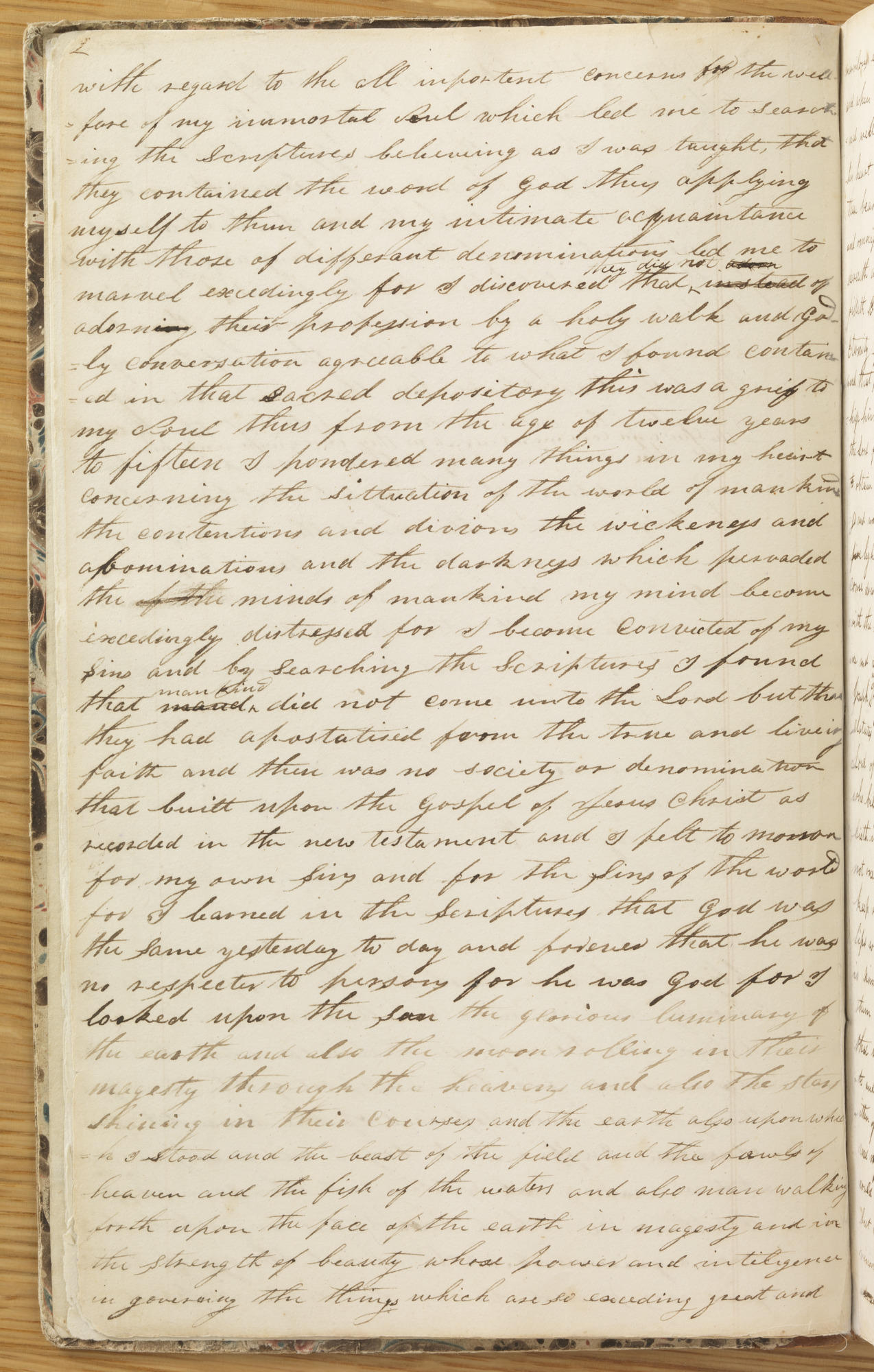
Two distinct priesthood events. The "reception of the holy Priesthood by the ministring of Aangels" maps onto what was later named the Aaronic Priesthood. The "confirmation and reception of the high Priesthood after the holy order of the son of the living God" maps onto what was later named the Melchizedek Priesthood. Both are attributed to angelic ministry. Both predate the 1834-35 Cowdery letters by two years.
Bushman's quoted excerpt in the CES Letter, through which Runnells gets his characterization of the 1832 history, preserves only the first phrase ("reception of the holy Priesthood by the ministering of angels to administer the letter of the Gospel") and omits the second ("a confirmation and reception of the high Priesthood after the holy order of the son of the living God").[2:2] With both phrases included, the 1832 history is not a "glancing" reference but a structured listing of two distinct angelic conferrals, exactly the structure later canonized in the Doctrine and Covenants (D&C) at sections 27 and 107. Without the second phrase, the 1832 history looks like a single passing mention.
| What the 1832 history says | What the CES Letter quotes (via Bushman) |
|---|---|
| "the reception of the holy Priesthood by the ministring of—Aangels to adminster the letter of the Gospel" | "reception of the holy Priesthood by the ministering of angels to administer the letter of the Gospel" |
| "a confirmation and reception of the high Priesthood after the holy order of the son of the living God" | [omitted] |
The sister article on backdating and retrofitting develops the broader 1832 history treatment, including the connection to D&C 27's expansion, the procedural framework Joseph canonized in November 1831 for revising revelations, and the structured trail of pre-1835 documents that already presupposed priesthood-tier authority. For the late-appearance question specifically, the load-bearing point is narrower: the 1832 history names both priesthoods explicitly, traces both to angelic ministry, and the second phrase is absent from the CES Letter's excerpt entirely.
Key Point
The 1832 history's prospectus sets out two separate priesthood conferrals, each by angelic ministry: the "holy Priesthood" that administers the letter of the Gospel, and a high priesthood "after the holy order of the son of the living God." The CES Letter's Bushman-mediated excerpt preserves only the first. With the second restored, the 1832 history is the earliest extant document attesting both priesthoods, at least three years before the alleged 1835 fabrication.[6:2]
David Whitmer: the testimony evolution
Claim 2 is structurally simple. David Whitmer was a Three Witness, and Whitmer said in 1885 he never heard about angelic ordination until 1834-36. The claim's full strength lives in that one sentence, and so does its full weakness, because the documentary record contains a great deal more David Whitmer than the single 1885 sentence.
Whitmer lived from January 1805 to January 1888. He left an archive of statements about priesthood across more than fifty years.
| Year | Event | Whitmer's relation to priesthood |
|---|---|---|
| 1829-1830 | One of the Three Witnesses; baptized; present at Church organization. | Affirmed Book of Mormon; ordained an elder.[7] |
| October 1831 | Ordained "to the high priesthood (the office of high priest) by Oliver Cowdery." | Accepted the office of high priest under ordained authority.[8] |
| July 1834 | Ordained by Joseph Smith "to be a leader, or a prophet to this Church": designated as Joseph's successor. | Accepted designation as Joseph's potential successor.[9] |
| April 1838 | Excommunicated. | Outside the Church but did not denounce the priesthood-restoration narrative. |
| September 1847 | Wrote to Oliver Cowdery: "we have established, or commenced to establish the church of Christ again, by laying aside our dead works, and being re-ordained to our former offices of President and Counsellor, as formerly… Jacob and Hiram have been ordained High Priests." | Actively organizing a priesthood-structured church with high priests in 1847.[10] |
| 1861 | At Oliver Cowdery's gravesite, told David H. Cannon he had heard Cowdery declare that "Peter, James, and John laid their hands and conferred the Holy Melchizedek Priesthood." | Affirmed apostolic conferral of Melchizedek priesthood, twenty-six years before the Address.[11] |
| 1869 | William McLellin records that Whitmer "still firmly holds to his appointment under the hands of Joseph Smith" and "laid his hands upon me, and reordained or confirmed upon me all the Authority which I ever held legally in the 'church of Christ'." | Whitmer in 1869 reordaining William McLellin under his own claimed priesthood authority.[12] |
| 1875-76 | Baptized his nephew John C. Whitmer in September 1875, ordained him an elder in January 1876, and the same month John C. was designated "First Elder." | Founded a priesthood-structured splinter church.[13] |
| 1881 | Issued a Proclamation on March 19 that began his explicit rejection of the office of high priest. | Theological reversal beginning.[14] |
| January 1885 | Gurley interview: "I never heard that an Angel had ordained Joseph and Oliver to the Aaronic priesthood until the year 1834[,] [183]5. or [183]6—in Ohio…" | Late-life denial.[15] |
| April 1887 | Published An Address to All Believers in Christ, drafted by John J. Snyder by dictation. | Full repudiation of the priesthood hierarchy and most post-1829 revelations.[16] |
The 1885-87 statements the CES Letter cites are real. They are also the last decade of an eighty-three-year life in which Whitmer accepted ordination as a high priest in 1831, was designated as Joseph's possible successor in 1834, organized a priesthood-structured "Church of Christ" in 1847, reordained William McLellin under his claimed authority in 1869, and founded the Whitmerite Church of Christ with priesthood offices in 1875-76.
The 1861 graveside affirmation
The single most significant counter-document in the late-appearance debate is also the one the CES Letter does not engage. In 1861, at Oliver Cowdery's gravesite in Richmond, Missouri, twenty-six years before An Address to All Believers in Christ, David Whitmer told David H. Cannon (a Latter-day Saint) that he had heard Oliver Cowdery declare:
"I know the Gospel to be true and upon this head has Peter, James, and John laid their hands and conferred the Holy Melchizedek Priesthood."[11:1]
Kenneth W. Godfrey, in his scholarly chapter on Whitmer's shaping of Latter-day Saint history, documents the encounter and weighs it:
"While the historicity of the restoration of priesthood authority is complex and the documentation not nearly as clear as we would prefer, certainly David Whitmer's testimony that casts doubt on the appearance of John the Baptist and Peter, James, and John should not be accepted as true, especially in light of what he told Cannon."[11:2]
Godfrey concedes the documentation is thinner than ideal, and still concludes that the late-life Whitmer denial cannot bear the weight critics put on it once the 1861 graveside affirmation is in evidence. Sarah Allen's FAIR rebuttal of the CES Letter (Part 43) confirms the encounter from the same Cannon source.[17]
The 1861 testimony is significant counter-evidence, and it is also a report of another man's words: Whitmer recalling in 1861, thirty-two years after the 1829 events themselves, something Cowdery had told him years before. It also involves a different priesthood from the one the 1885 denial is about, conferred by different angels (Melchizedek vs. Aaronic).[18] Which David Whitmer speaks for the record, the one at Cowdery's grave in 1861 or the one dictating the Address in 1887? There was a time, well past his 1838 excommunication, when he publicly affirmed apostolic priesthood conferral, and the unequivocal denial belongs to the last decade of his life rather than to a stable settled view. That makes the 1861 affirmation one entry in a Whitmer-evolution sequence (1847, 1861, 1869, 1875-76, then the 1881-87 reversal), not a single decisive counter to the Address.
Key Point
At Oliver Cowdery's grave in 1861, witnessed by David H. Cannon, David Whitmer affirmed that Peter, James, and John "laid their hands and conferred the Holy Melchizedek Priesthood." This is twenty-six years before his 1887 Address and twenty-three years past his excommunication. The CES Letter cites only Whitmer's late-life denial; the 1861 Whitmer is also Whitmer.[11:3]
What's actually in the Address
The document the CES Letter relies on, Whitmer's An Address to All Believers in Christ of April 1887, is a roughly 75-page booklet, drafted by John J. Snyder rather than by Whitmer directly.
H. Michael Marquardt's chapter on Whitmer's evolving beliefs catalogues factual errors across the two tracts Whitmer published in 1887:
- In the companion eight-page tract, An Address to Believers in the Book of Mormon, Whitmer claimed the Book of Commandments was "finished complete" before the press was destroyed. Marquardt's response is that the printing plainly was not finished. Whitmer was in Jackson County at the time and may not have known what had been arranged at the press, and surviving Book of Commandments manuscript in the handwriting of his brother John shows that further revelations were still to be added when the mob destroyed the press on July 20, 1833.[19]
- Whitmer claimed that six elders existed before April 6, 1830, and listed Samuel and Hyrum Smith among them. The minutes of the first conference record Hyrum as a priest and Samuel as ordained an elder only at that conference. On Marquardt's reconstruction the first two elders were Joseph and Oliver, who ordained each other on April 6; the other four were evidently ordained later in April and received their licenses at the June conference in Fayette.[20]
- Whitmer claimed the Church had "about seventy members" before April 6, 1830. The minutes of the first conference, held June 9, 1830, record twenty-seven members. Marquardt's reading is that Whitmer "may have been thinking about" the Fayette conference held near the end of September 1830, where the membership stood at sixty-two.[20:1]
These errors do not, by themselves, prove that Whitmer is wrong about whether he heard certain priesthood narratives in 1834-36. Administrative-detail errors and narrative-recall claims are different categories of testimony. What the errors do establish is that Whitmer's 1887 retrospective reconstruction of the early Church is theologically motivated and not careful. He is looking backward from a developed splinter theology to a "pure church" that did not exist as he describes it.
The factual errors trace partly to the Address's production. Snyder admitted he himself wrote the text from notes taken as Whitmer dictated, then read it back to him, with "constant changing (on my part)" and rereading, until it suited him.[21] The Address is not a clean transcription. It is a document Snyder shaped through iterative editing, reflecting an eighty-two-year-old man's theology after fifty years outside the Utah Church. That mediation matters when the Address is treated as the definitive Whitmer testimony, which is how the CES Letter uses it.
Marquardt's framing is direct:
"By the end of his life, David had become fully active again as a believer in the restored Church of Christ and the Book of Mormon. As the years went on, Whitmer pushed his views about the pure church further and further back. By the time he dictated his final address, David had ceased to consider his seven years of faithful Church service in Ohio and Missouri worthwhile."[22]
The "restored Church of Christ" there is the denomination Whitmer himself founded, not the Church he left in 1838. Whitmer's 1887 position is theologically motivated, drafted by an editorial mediator, and the platform of a denomination Whitmer founded in 1875-76. It is one Whitmer voice (a real one, from a Three Witness), and not the only Whitmer voice the record holds. The broader question of how to weigh Whitmer's late-life statements against his decades of prior testimony is treated in the witnesses' credibility concerns article, which works through the same evidentiary problem for every one of the eleven witnesses.
What Whitmer didn't deny
Even in the 1885 Gurley interview the CES Letter cites, Whitmer affirmed that "Joseph ordained Oliver Cowdery to be an Elder, and Oliver ordained Joseph to be an Elder in the Church of Christ" in 1829.[23] He acknowledged the fact of 1829 ordinations. What he denied was the angelic source. His 1887 Address makes the same theological objection explicit: he rejected the office of high priest, the angelic-ordination narrative, and most of Joseph's post-June-1829 revelations as a coherent theological package.
So the historical fact of 1829 priesthood transmission is not contested even in Whitmer's late-life statements. What is contested is its source.
Further Reading
For the full Whitmer evolution timeline, see Kenneth W. Godfrey, "David Whitmer and the Shaping of Latter-day Saint History," in Stephen D. Ricks, Donald W. Parry, and Andrew H. Hedges, eds., The Disciple as Witness: Essays on Latter-day Saint History and Doctrine in Honor of Richard Lloyd Anderson (FARMS, 2000), 223-256, and H. Michael Marquardt, "David Whitmer: His Evolving Beliefs and Recollections," in Newell G. Bringhurst and John C. Hamer, eds., Scattering of the Saints: Schism within Mormonism (John Whitmer Books, 2007), 46-77. Sarah Allen's FAIR Blog Part 43 (January 21, 2022) corroborates the 1861 graveside encounter.
Cowdery's continuing affirmation
If the priesthood-restoration narrative crystallized between 1832 and 1835, as both the popularized fabrication thesis and the academic developmental hypothesis claim in different forms, Oliver Cowdery's continuing affirmation across a decade of post-excommunication estrangement is the heaviest counterweight to the strong fabrication reading.
Cowdery was excommunicated in April 1838 and stayed out of the Church for the next ten years. He had every motive to recant any priesthood-restoration story Joseph had asked him to support. Across that decade and after, in private letters, in personal testimony to friends, in public meeting, Cowdery never recanted.
Cowdery's October 1834 Messenger and Advocate Letter I, the first published narrative of the Aaronic Priesthood restoration, is treated in the backdating article. For the late-appearance question, three later documents from across his decade of post-excommunication estrangement bear directly.
In a private letter to Phineas Young dated March 23, 1846, written to Brigham Young's brother during Cowdery's decade-long estrangement, Cowdery referenced standing "in the presence of John, with our departed brother Joseph, to receive the Lesser Priesthood—and in the presence of Peter, to receive the Greater…"[24] The letter names John the Baptist (lesser priesthood) and Peter (greater priesthood) by office and function, in language that presupposes both ordination events.
On October 21, 1848, at the Kanesville, Iowa conference where Cowdery sought readmission, in a public testimony recorded by Reuben Miller, Cowdery declared:
"I was present with Joseph when an holy angel from God came down from heaven and conferred, or restored, the Aaronic Priesthood and said at the same time that it should remain upon the earth while the earth stands… I was also present with Joseph when the Melchisedek Priesthood was conferred by the holy angels of God, which we then confirmed on each other, by the will and commandment of God."[25]
In a letter to Samuel W. Richards dated January 13, 1849, Cowdery wrote that "John the Baptist, holding the keys of the Aaronic Priesthood; Peter, James, and John, holding the keys of the Melchizedek Priesthood, have… ministered."[26] Who, less than two years from his death in March 1850, is still vouching for a story the fabrication thesis says he helped make up?
The CES Letter's compressed fabrication thesis requires Cowdery to have been a co-conspirator. That reading does not survive Cowdery's continuing affirmation across ten years of estrangement, in private correspondence with confidants who had no theological motive to support him, in public testimony to a Church that had humiliated him.
The academic developmental hypothesis (Vogel) is harder to answer, because it does not need Cowdery to be a co-conspirator. Vogel argues Cowdery sincerely participated in religious experiences whose specific narrative crystallized over time, and that Cowdery's continuing affirmation reflects sincere belief in the crystallized narrative rather than pristine recall of a specific 1829 event. Vogel's reading is logically coherent. But Cowdery's testimony does not just survive estrangement; it holds its shape across three separate documents. The 1846 letter to Phineas Young names John and Peter by office, the lesser priesthood and the greater. The 1848 Kanesville testimony describes both conferrals without naming the figures, the Aaronic by "an holy angel" and the Melchizedek by "the holy angels of God." The 1849 letter to Samuel Richards names all four and pairs each with the priesthood whose keys he held. The three carry the same office structure the canonical narrative would later codify, written across the last four years of a decade-long estrangement. That narrows the versions of the developmental hypothesis that remain coherent.[27]
The choice between the developmental-with-shared-sincere-belief reading (Vogel) and the historical-event reading (the canonical narrative) does not turn on Cowdery alone. It turns on the broader pattern: the upstream Book of Mormon evidence, the pre-1832 documentary trail, the persecution chronology, and the convergence of independent hostile-press reporting with the internal record from Joseph, Cowdery, and Hiram Page.
The June 1831 conference and the Lyman Wight question
Claim 6 is the second of the two passages where the CES Letter quotes Bushman raising a question and stops the quote one sentence before Bushman's own answer. The headline question:
"IF PETER, JAMES, AND JOHN ORDAINED JOSEPH SMITH TO THE MELCHIZEDEK PRIESTHOOD IN 1829, WHY DID LYMAN WIGHT ORDAIN JOSEPH SMITH TO THE MELCHIZEDEK PRIESTHOOD AGAIN IN 1831?"[4:1]
The supporting Bushman block quote (RSR pp. 157-158):
"During the turbulent meeting, Joseph ordained five men to the high priesthood, and Lyman Wight ordained eighteen others, including Joseph. The ordinations to the high priesthood marked a milestone in Mormon ecclesiology. Until that time, the word 'priesthood,' although it appeared in the Book of Mormon, had not been used in Mormon sermonizing or modern revelations. Later accounts applied the term retroactively, but the June 1831 conference marked its first appearance in contemporary records…
The Melchizedek Priesthood, Mormons now believe, had been bestowed a year or two earlier with the visit of Peter, James, and John. If so, why did contemporaries say the high priesthood was given for the first time in June 1831? Joseph Smith himself was ordained to this 'high priesthood' by Lyman Wight. If Joseph was already an elder and apostle, what was the necessity of being ordained again?"[4:2]
The CES Letter quotes those two questions. The next sentence Bushman writes, the sentence the CES Letter omits, is Bushman's own answer:
"The usual explanation is that Joseph meant to say 'high priest,' one of the offices in the Melchizedek Priesthood, not 'high priesthood.'"[28]
Bushman poses the puzzle in order to walk the reader through its standard resolution; the CES Letter carries the puzzle across and leaves the resolution behind.
What the minutes actually say
The June 3-4, 1831 conference minutes are available in full at the Joseph Smith Papers.[29] They record the order of ordinations.
| Step | Who ordains | Who is ordained |
|---|---|---|
| 1 | Joseph Smith Jr. | Lyman Wight, John Murdock, Reynolds Cahoon, Harvey Whitlock, Hyrum Smith |
| 2 | Lyman Wight | Parley P. Pratt, Thomas B. Marsh, Isaac Morley, Edward Partridge, Joseph Wakefield, Martin Harris, Ezra Thayer, Ezra Booth, John Corrill, Samuel H. Smith, Solomon Hancock, Simeon Carter, Wheeler Baldwin, Jacob Scott, Joseph Smith Sr., John Whitmer (sixteen in all) |
| 3 | Lyman Wight | Joseph Smith Jr. and Sidney Rigdon |
| 4 | Lyman Wight | John Corrill and Isaac Morley as assistants to the Bishop |
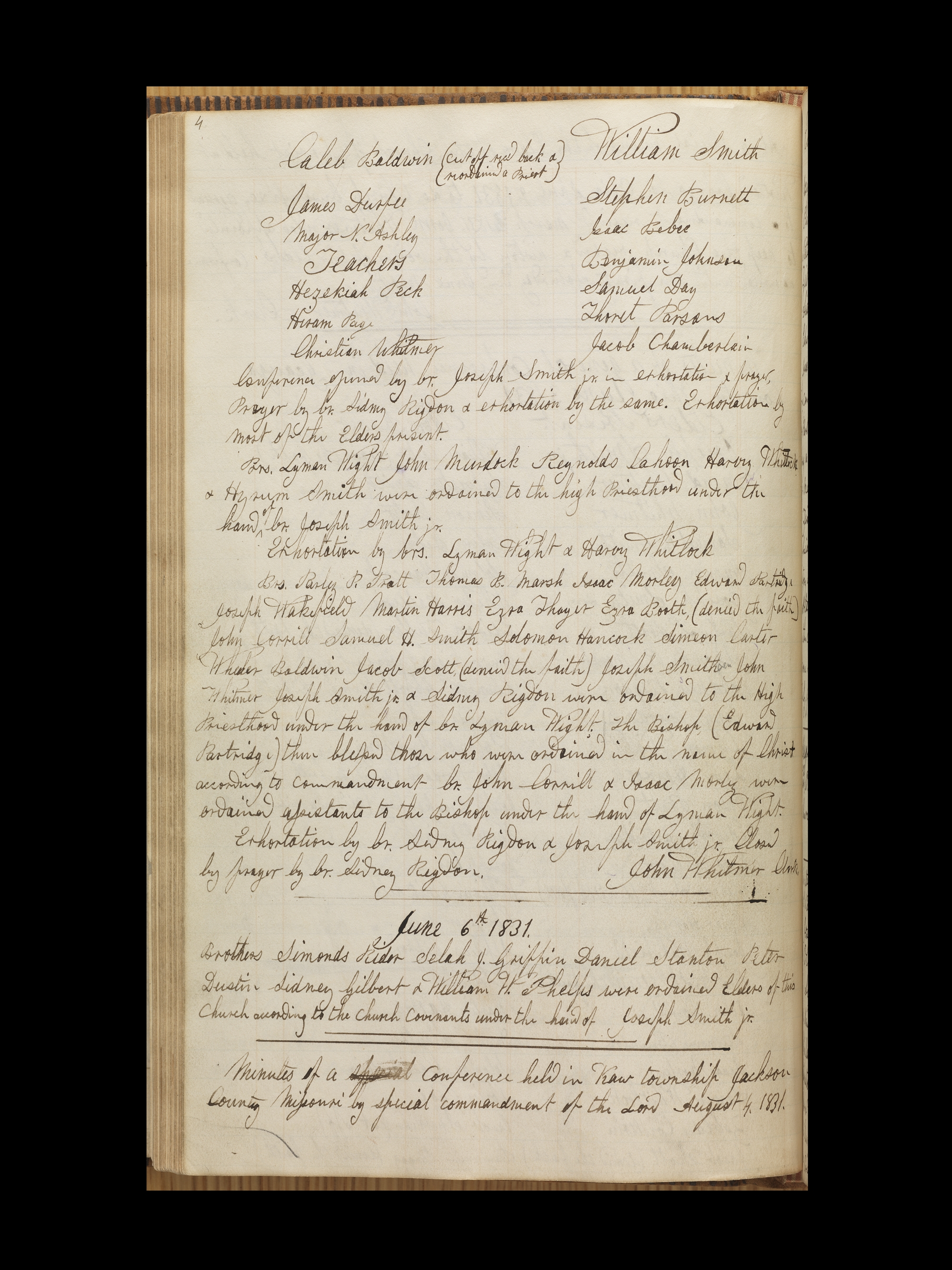
Joseph ordains Wight first. Then Wight ordains Joseph. The CES Letter quotes only the second half of the sequence, "Joseph Smith jr. & Sidney Rigdon were ordained to the High Priesthood under the hand of br. Lyman Wight."[4:3] [29:1] The first half, Joseph ordaining Wight, is omitted.
The order suggests a Joseph who already held priesthood authority sufficient to ordain Wight before Wight ordained him in turn. By itself it is not dispositive against a developmental reading. A Vogel-style critic can reasonably reply that Joseph could have claimed the high priesthood at the conference itself, with the Joseph→Wight→Joseph sequence then functioning as institutional reciprocal confirmation.[30] The order argument is therefore one piece of cumulative evidence rather than a knockout. The weight of the argument rests on the broader pre-1831 documentary trail: Cowdery's June 1829 letter to Hyrum Smith using apostolic-calling language, the 1830 Articles and Covenants describing Joseph as "ordained an apostle of Jesus Christ," the November 1830 Painesville Telegraph coverage of Cowdery claiming to have "conversed with Angels" and reporting that ordinances had not been "regularly administered since the days of the Apostles," and the 1832 history's own listing of two distinct angelic priesthood conferrals. The order at June 1831 is consistent with what that broader trail attests.
Mutual ordinations were not unusual in early Restoration practice. Joseph and Oliver baptized each other on May 15, 1829, after each was ordained to the Aaronic priesthood, and the reciprocity there is not treated as evidence of fraud. The mutual pattern at June 1831, with Joseph initiating, is documented Church practice.
The office-vs-priesthood reading
Bushman's resolution, that Joseph was ordained to the office of high priest within an already-existing Melchizedek priesthood, is supported by Joseph's own later teaching, by contemporary and later witnesses, and by the architecture canonized in D&C 107.
In 1841, Joseph Smith stated:
"All priesthood is Melchizedek; but there are different portions or degrees of it."[31]
This is Joseph's own articulation of the office-vs-priesthood distinction, on the record more than a century and a half before the CES Letter was written. The CES Letter never engages the distinction; it stops Bushman's quote one sentence short of it. "All priesthood is Melchizedek" means a single priesthood containing offices and degrees. "Ordained to the high priesthood" in the language of June 1831 means ordained to one of the offices that exists within the priesthood Joseph already held.
D&C 107, in the 1835 Doctrine and Covenants, codifies the architecture:
"There are, in the church, two priesthoods… The Melchizedek Priesthood holds the right of presidency, and has power and authority over all the offices in the church…"[32]
D&C 107:1 names the two priesthoods. D&C 107:8 subordinates every office in the church to the Melchizedek priesthood. The structural distinction (priesthood as the underlying authority, offices as functional positions within it) is canonical from 1835.
Contemporary and later witnesses alike describe the ordinations in office-vs-priesthood language. Ezra Booth, in an October 1831 letter written within months of the conference, described the participants as ordained to "the High Priesthood, or the order of Milchesidec," language that names Melchizedek priesthood explicitly while using the office terminology of "High Priesthood."[33] Parley P. Pratt, recalling the period in his 1874 autobiography, wrote that "the office of an Elder is the same in a certain degree, but not in the fulness." Both elder and high priest are within the Melchizedek priesthood, the difference being degree rather than kind.[33:1]
John S. Thompson's 2024 Interpreter article develops a composite-restoration model in detail. Thompson's central thesis:
"restoring Melchizedek priesthood was no singular event but a restoration patchwork of portions and degrees represented by the various priestly orders."[33:2]
Thompson organizes his evidence by priestly order rather than by chronology, working through the apostle, the elder, the high priest, and what he calls the "High Priest Made Sure." Each order, on his account, is "necessary and has a unique role in the complete construction of a kingdom of God," and "one portion did have to come first and open the way for all the other parts and degrees."[33:3]
On Thompson's reading, the June 1831 "first" is the first conferral of the office of high priest as an organizational structure, not the first conferral of the priesthood itself. The terminology was being introduced; the underlying authority had been claimed and exercised since 1829.
The Book of Mormon, published in March 1830 (fifteen months before the June 1831 conference), already contained extensive priesthood theology. Alma 13 discusses "high priests after the holy order" of God at length. Mosiah 18:17 describes baptismal authority. Alma 4:20 describes Alma confining himself "wholly to the high priesthood of the holy order of God."[34] The conceptual framework (high priests, holy order, Melchizedek-pattern priesthood) was canonical in the Book of Mormon before any ordination was performed in the organized Church.
Corrill and the mixed witness record
The office-vs-priesthood reading does face contemporary contestation, and its strongest counter-witness is a faithful one.
John Corrill, a faithful contemporary who attended the June 1831 conference and remained in the Church through the Missouri period, wrote in his 1839 A Brief History of the Church of Christ of Latter Day Saints:
"The Malchisedec priesthood was then for the first time introduced, and conferred on several of the elders."[35]
Corrill is not a hostile critic. He wrote his history eight years after the conference, and its tone is measured rather than polemical. He was, though, already on his way out of the Church when he wrote it: the title page announces "the Reasons of the Author for Leaving the Church," and in March 1839, he and other dissenters were formally excommunicated in absentia. Corrill is the strongest pro-developmental witness from inside the founding generation, and the faithful position has to live with that.
On the terminology, the witness record is mixed. Pratt's 1874 autobiography, Booth's October 1831 letter, Joseph's 1841 statement, the Book of Mormon's prior priesthood theology, and D&C 107's 1835 codification collectively favor the office-vs-priesthood reading. Corrill's 1839 phrasing supports the developmental reading. The 1831 minutes themselves are interpretive: they say "ordained to the High Priesthood" without making the office-vs-priesthood distinction explicit. Corrill cannot be neutralized, and the faithful reading does not need him to be. What it needs is that contemporary terminology in the early 1830s was unstable. Church History Topics concedes as much on its Melchizedek Priesthood page, noting that early members "did not use the terms Aaronic Priesthood or Melchizedek Priesthood to describe the authority they received" and that the instruction published in the 1835 Doctrine and Covenants "provided the terminology still in use today." Corrill's 1839 framing reflects that instability rather than disqualifying evidence about substance.[36]
Bushman locates the same instability in the vocabulary itself. Writing about the June 1831 conference, he observes that up to that point "[t]he term 'authority' frequently appeared, but not 'priesthood,'" and that the word's absence "may have been because of its generally negative associations for radical Protestants in Joseph's time." Priesthood "was associated with Roman Catholicism and the old regimes of Europe," and the radical tradition many Mormon converts came from "denounced priesthood as popish." Bushman then goes further than vocabulary. Joseph, he suggests, "may not have realized that elders were part of the Melchizedek Priesthood already and were being ordained to the office of high priest rather than receiving the powers of the high priesthood," so that, in Bushman's phrase, "experience may have outrun comprehension."[37]
On Bushman's reading the men may not have grasped the structure they were already operating inside. That concedes more than vocabulary, and the question still comes back to a distinction between attesting substance and attesting precise terminology. The substance of priesthood-restoration claims (apostolic authority, angelic ministration) is well attested before June 1831, even granting Corrill. The record is mixed on what the men called it; it is not mixed on whether claims of restored authority were already in circulation.
Further Reading
Michael Hubbard MacKay, Prophetic Authority: Democratic Hierarchy and the Mormon Priesthood (University of Illinois Press, 2020). The most thorough recent academic monograph on Joseph Smith's priesthood claims, by a former Joseph Smith Papers historian. Engages Quinn, Prince, and Vogel directly.
Engaging the developmental hypothesis
The CES Letter is a popular rendering of an academically respectable critical hypothesis. The academic version, advanced by Dan Vogel (Joseph Smith: The Making of a Prophet, 2004), D. Michael Quinn (Origins of Power, 1994), and Grant Palmer (An Insider's View of Mormon Origins, 2002), is subtler than the CES Letter's compressed version.[38] [39] [40]
Stated at its strongest, and in our words, the academic case runs:
Joseph and Oliver did claim divine authority and angelic encounters from 1830 forward, and hostile newspaper sources confirm this, as does the April 1830 Articles and Covenants describing them as "ordained an apostle." The substance of priesthood-restoration claims was documented from 1830-1831. But the specific narrative (John the Baptist conferring the Aaronic priesthood on May 15, 1829, in Harmony, Pennsylvania; Peter, James, and John conferring the Melchizedek priesthood between Harmony and Colesville some weeks later; named historical figures, specific dates, identifiable locations) does not appear in any contemporary record before Cowdery's 1834-35 Messenger and Advocate letters. Between the 1830-1831 substance-claims and the 1834-35 detailed narrative, the Church underwent significant ecclesiological development: the June 1831 conference introduced the office of high priest; D&C 84 (September 1832) first articulated the two-priesthood structure; the 1835 D&C 107 codified the architecture. The developmental hypothesis: priesthood concepts were claimed in 1829-1830 in substance; the specific narrative with named figures crystallized between 1832 and 1835 as the Church needed clearer ecclesiological foundations.
This is not a fabrication-by-conscious-deception framing. Vogel's thesis is psychobiographical: Joseph genuinely believed he had received divine commissions, and the narrative crystallized in his mind and in the Church's institutional memory as the events were retold and re-experienced.[41] What crystallized was the specific who/when/where/what attribution. The "fabrication" framing is the popularized version; the academic version is "developmental crystallization with sincere belief."
The faithful response has three parts.
The faithful position concedes the developmental observation and contests only the inference from observation to fabrication. Vogel's empirical claim, that the named-figures content (John the Baptist; Peter, James, John) is not documentarily attested before the 1834-35 Cowdery letters, is correct. We grant it. Vogel's interpretive claim that this supports developmental crystallization is one reading; the canonical-narrative reading is another. The choice turns on broader context, not on the developmental observation itself.
Even granting some developmental crystallization, the core event is supported by pre-1832 evidence. The argument is not that the canonical 1838-39 narrative emerged ex nihilo in 1834. The argument is that an angelic-ordination event (or events) occurred in 1829-1830, was attested in substance in the 1830-1831 hostile-witness sources and the 1830 Articles and Covenants, was outlined in the 1832 history's prospectus listing two priesthood events, and was published in detail in the 1834-35 Cowdery letters. The "crystallization" between 1832 and 1835 is consistent with this: religious experience that is real but takes time to articulate clearly, especially when the vocabulary of "priesthood" is foreign to frontier Protestant audiences and the institutional structures that will later organize the experience are themselves still developing.
The priesthood restoration's documentary trail is the thinnest of the three, behind the First Vision's and the Book of Mormon's. The Book of Mormon production has multiple scribes (Cowdery primarily, Emma Smith, Martin Harris, Reuben Hale, John Whitmer), eleven witnesses, Egbert Grandin's printing operation, hostile-witness Abner Cole's 1830 plagiarism episode, Lucy Mack Smith's recollections, and 269,510 words of integrated literary text. Four written accounts of the First Vision survive from Joseph's lifetime (1832, 1835, 1838, 1842), plus secondary contemporary references. The priesthood-restoration narrative has Joseph's 1832 history prospectus (brief, never narrated in body), Cowdery's 1834-35 letters (the first detailed published account), the 1838-39 history (the canonical JS-H account), D&C 27 (1835 expansion), Hiram Page's 1847-48 letters to William McLellin, scattered sermon references, and patriarchal-blessing-book entries. The trail is thinner. The faithful response is not to inflate it but to (a) note that the substance is attested across multiple genres pre-1834, (b) note that the persecution chronology bounds the publication delay, and (c) anchor the case in the broader documentary record of the Restoration rather than asking the priesthood-restoration trail to carry weight it cannot.
The First Vision parallel and the persecution chronology
The CES Letter explicitly draws the First Vision parallel: "Like the first vision story, none of the members of the Church or Joseph Smith's family had ever heard prior to 1832 about a priesthood restoration."[2:3] The parallel is real, but it favors the faithful reading rather than the CES Letter's.
| Event | Event date | First written account | First public publication |
|---|---|---|---|
| First Vision | Spring 1820 | 1832 (Joseph's own history) | 1842 (Times and Seasons) |
| Aaronic Priesthood restoration | May 15, 1829 | 1832 (Joseph's own history, prospectus) | 1834 (Cowdery's Messenger and Advocate) |
| Melchizedek Priesthood restoration | Late May/June 1829 | 1832 (Joseph's own history, prospectus) | 1835 (D&C 27 expansion) |
The First Vision has a twelve-year gap to first written record (1820 → 1832) and a twenty-two-year gap to first publication (1820 → 1842). The priesthood restoration has a three-year gap to first written record (1829 → 1832) and a five-to-six-year gap to first detailed publication (1829 → 1834-35).
The parallel is an availability argument rather than a disqualification argument. The substantive defense, that documentary delay between religious experience and detailed written record is the typical pattern rather than a marker of fabrication, is available in both cases, and the parallel disqualifies neither. The First Vision documentary record is itself widely treated as developmental: Vogel, Palmer, and (in narrower form) faithful scholars including Steven Harper acknowledge that the First Vision crystallized across the 1832, 1835, 1838-39, and 1842 accounts, with shifting theological emphasis between accounts. (The sister-section article on the First Vision's own late-appearance question works through that parallel case in detail.) Sophisticated critics apply the developmental reading to the First Vision too. The parallel puts the two narratives on the same footing: the defense that developmental records are consistent with sincere underlying experience covers both. The priesthood-restoration narrative is not uniquely vulnerable to the developmental observation.
That defense is the memory-studies framework Steven C. Harper develops in First Vision: Memory and Mormon Origins (Oxford University Press, 2019). Harper applies memory-studies scholarship to the First Vision documentary record and argues that delay between religious experience and written documentation is the norm rather than evidence of fabrication.[42] Stephen C. Taysom's review in the BYU Mormon Studies Review describes Harper as applying memory studies to examine how historical narratives are constructed, treating documentary delay as something the framework can address without dismissing accounts as unreliable.[43]
The framework applies to the priesthood-restoration narrative directly. People do not write down their most consequential religious experiences in real time. They process those experiences over years, often only producing written accounts when prompted by some external occasion: a question, a controversy, a request, an institutional need. Joseph wrote his first known religious autobiography in 1832, twelve years after the First Vision. He included priesthood reception as one of four cardinal events. The 1834-35 Cowdery letters were prompted in part by W. W. Phelps's letters in the Messenger and Advocate and the institutional need to defend the Restoration narrative against developing critics. The 1838-39 history was begun under direct mob pressure in Far West.
Against critics who already accept the developmental reading of the First Vision (Vogel, Palmer, Quinn), the parallel does not independently establish either narrative as authentic; it shows symmetry. What breaks the symmetry lies outside the parallel: Cowdery's continuing affirmation, the persecution chronology, the documentary trail before 1832, and, upstream of everything, the Book of Mormon itself.
Further Reading
Steven C. Harper, First Vision: Memory and Mormon Origins (Oxford University Press, 2019). The most rigorous academic treatment of why momentous religious experiences are typically recorded years after the event. The same memory-studies framework that justifies the First Vision's documentary delay justifies the priesthood-restoration narrative's documentary delay.
The persecution chronology
Joseph's own contemporary explanation for the documentary delay is preserved in the 1838-39 history (later canonized as Joseph Smith—History 1:74):
"In the meantime we were forced to keep secret the circumstances of our having been baptized, and having received this priesthood; owing to a spirit of persecution which had already manifested itself in the neighborhood."[44]
The persecution chronology is documented:
- March 1830: Book of Mormon publication. E. B. Grandin's print run encountered immediate hostile response in Palmyra. Joseph and Oliver concealed their movements.
- April-June 1830: Church organization in Fayette. Joseph charged with being "a disorderly person" in June 1830.[45]
- November 16, 1830: Painesville Telegraph hostile coverage begins under editor Eber D. Howe (later co-author of Mormonism Unvailed, 1834).[46]
- March 24, 1832: Joseph and Sidney Rigdon tarred and feathered at the Johnson farm in Hiram, Ohio. Joseph's adopted son Joseph Murdock Smith took cold during the attack and died days later, on March 29, from measles and possibly that exposure.[47]
- July 20, 1833: Anti-Mormon mob destroyed W. W. Phelps's printing press in Independence, Missouri. The Book of Commandments was being printed at the time; the print run was interrupted.[48]
- November 1833 / October 1838: Saints expelled from Jackson County; Boggs's "extermination order" issued.[49] [50]
The Saints did not have a stable Church organ between July 1833 (press destruction) and October 1834 (Messenger and Advocate launch). Cowdery's October 1834 publication of the priesthood-restoration narrative is the first opportunity the Saints had to publish a detailed account in a Church newspaper. Church History Topics grants the persecution context outright in its account of the Aaronic Priesthood restoration, describing Smith and Cowdery as initially reticent to share details of their experience "owing to a spirit of persecution" in the area.[51]
The persecution defense is bounded. It explains why the priesthood-restoration narrative was not publicly published until 1834-35, but it does not fully explain why the specific narrative was not narrated to insiders before that point, and Whitmer's 1885 statement is precisely about insider knowledge. The faithful response to insider-narrative emergence leans on the memory-studies framework (Harper), the genre distinction between revelations and histories, and the gradual articulation of religious experience under conditions where the vocabulary itself ("priesthood") was foreign to frontier Protestantism.[52]
Key Point
The persecution chronology does real but bounded work. It explains why no detailed account was published before October 1834, since the Saints had no Church newspaper between the July 1833 destruction of the press and the Messenger and Advocate launch. It does not by itself explain why the specific narrative went untold to insiders before that point, and that question rests on the memory-studies framework and the cumulative documentary pattern.[48:1] [51:1]
The pre-1832 documentary trail
The CES Letter's claim 1 is sweeping: "none of the members of the Church or Joseph Smith's family had ever heard prior to 1832 about a priesthood restoration."[2:4] The strict version of that claim is empirically false. The substance of priesthood-restoration claims is documented across multiple genres before 1832.
The backdating article develops the pre-1832 documentary trail in detail; the summary version follows, with cross-references for full primary-source treatment:
June 14, 1829: Oliver Cowdery's letter to Hyrum Smith from Fayette, NY, written before the Book of Mormon was published and before the Church was organized. The letter quotes language closely paralleling D&C 18 (the June 1829 revelation describing Cowdery in apostolic-calling terms). A Joseph Smith Papers editorial annotation on that revelation notes that this language "could be evidence that the ordination of JS and Oliver Cowdery to the apostleship took place before this revelation."[53] The fabrication thesis would have to push the start of the alleged retrofit back to June 1829, before the Book of Mormon was published.
June 1829: D&C 18 revelation describes Cowdery and Whitmer as "called even with that same calling" as Paul the apostle. Published in the 1833 Book of Commandments.[54]
1829: Cowdery's Articles of the Church of Christ manuscript describes him as "an Apostle of Jesus Christ by the will of God the Father & the Lord Jesus Christ." The self-description presupposes an ordination Cowdery believed he had already received, months before the Church existed to confer one.[55]
April 6, 1830: Articles and Covenants (the document modernized as D&C 20:2-3) describes Joseph as "called of God and ordained an apostle of Jesus Christ, an elder of the church," and Oliver Cowdery as "also called of God an apostle of Jesus Christ, an elder of the church, and ordained under his hand." Presented to the membership at the first Church conference on June 9, 1830, where the minutes record it "recieved by unanimous voice of the whole congregation," and published in the 1833 Book of Commandments as chapter 24.[56]
November 16, 1830: Painesville Telegraph (Eber D. Howe, editor) reported Oliver Cowdery "pretends to have a divine mission, and to have seen and conversed with Angels," and that Cowdery and his associates claimed ordinances had not "been regularly administered since the days of the Apostles," a position that requires the angelic-restoration framework to make sense. Hostile, contemporary, external, and more than a year ahead of the 1832 cutoff the CES Letter claims.[46:1]
December 7, 1830, Painesville Telegraph follow-up: Cowdery claimed "his commission directly from the God of Heaven" and "credentials, written and signed by the hand of Jesus Christ."[57]
February 14, 1831, Palmyra Reflector: "Jo Smith had now received a commission from God"; "Cowdery and his friends had frequent interviews with angels."[58]
Summer 1832: Joseph's earliest extant history names two distinct priesthood events, both attributed to angelic ministry, in the prospectus paragraph (treated above).[6:3]
These documents collectively establish that the substance of priesthood-restoration claims (apostolic authority, angelic ministration, restoration of authority lost since the days of the Apostles) was in the documentary record from June 1829 forward, including in hostile-witness sources who had every motive to expose contradictions. The CES Letter's strict "none had heard" framing requires dismissing every entry above. It cannot, because the entries are dated, attributable, and (in the case of the Painesville Telegraph reports) preserved in non-LDS newspaper archives.
The fair concession is that the pre-1832 trail attests the substance of priesthood-restoration claims (angelic authority, apostolic ordination, restoration since the Apostles) without yet attesting the specific named figures (John the Baptist, Peter, James, John) by name. The named identifications first appear in print in the 1834-35 Cowdery letters and the 1835 D&C 27 expansion. So the academic version of the developmental hypothesis (Vogel, Quinn, Palmer) survives the pre-1832 trail in narrowed form: even granting that generic angelic-authority claims were already in circulation in 1830, the specific named-figures content crystallized between 1832 and 1835. What does not survive the pre-1832 trail is the CES Letter's stronger claim that the priesthood-restoration narrative as a whole was a late fabrication.
Hiram Page
Hiram Page, one of the Eight Witnesses and present at the Church's organization on April 6, 1830, was by 1847 estranged from the Utah Church and corresponding with William E. McLellin. Writing on May 30, 1847, he refused to let the distance touch what he had seen. It would be "doing injustice to myself, and to the work of God of the last days, to say that I could know a thing to be true in 1830, and know the same thing to be false in 1847." Denying these testimonies would be "treating the God of heaven with contempt," and among them he counted "those holy Angels who came and showed themselves to me as I was walking through the field."[59]
The following March, answering McLellin's questions about priesthood directly, he wrote:
"in the beginning we find the first ordinations were by Peter James and John they ordained Joseph and Oliver; to what priesthood were they ordained; the answer must be to the Holy priesthood or the office of an elder or an apostle which is an additional grace added to the office of an elder these offices Oliver received from those holy messengers before the 6th of April 1830."[60]
Page's evidence has to be weighed with the same care. The ordination statement is from 1848, nineteen years after the events. He was responding to McLellin's queries during McLellin's church-organizing project, not writing unprompted. By 1848, the canonical narrative had been published in Cowdery's letters (1834-35) and Joseph's history (1838-39), so Page's correspondence is consistent with the canonical narrative as he had received it rather than a strictly independent recollection. The fuller context sharpens rather than blunts the point: Page produces the apostolic-ordination fact in the middle of an argument against the office of high priest, insisting that "the highest officer in the church is an elder" and that in the beginning "there was no high priests."[60:1] He was estranged from the Utah Church, writing to another estranged former leader, arguing against the very office the Utah Church had built out, and still standing by the claim that Peter, James, and John ordained Joseph and Oliver before April 6, 1830. Page is a corroborating witness from inside the founding generation, post-estrangement; he is not strictly independent of the canonical narrative.
What the framework anticipates
The standard the CES Letter applies, that documentary delay implies fabrication, is one Joseph's own canonized scripture explicitly disclaimed before the alleged elaboration occurred.
D&C 1, received November 1, 1831, sits at the front of the Doctrine and Covenants as the Lord's preface to the volume. Verses 24-28 establish a framework for revelation:
"Behold, I am God and have spoken it; these commandments are of me, and were given unto my servants in their weakness, after the manner of their language, that they might come to understanding. And inasmuch as they erred it might be made known; And inasmuch as they sought wisdom they might be instructed; And inasmuch as they sinned they might be chastened, that they might repent; And inasmuch as they were humble they might be made strong, and blessed from on high, and receive knowledge from time to time."[61]
The framework affirms divine origin ("these commandments are of me") and acknowledges a human channel ("given unto my servants in their weakness, after the manner of their language"). It anticipates error ("inasmuch as they erred it might be made known"). It builds in iterative correction. And it does this before the 1834-35 Cowdery letters, before the 1835 D&C 27 expansion, before the 1838-39 history's full narrative. The framework critics treat as post-hoc apologetics (that prophets are fallible, that revelation comes through imperfect channels, that course correction is normal) is canonized scripture from 1831.
The same framework runs through the failed-revelations treatment of D&C 1 and through the adam-god treatment of canonization as the prospective test for whether a teaching becomes binding doctrine. Across the Restoration's foundational narratives (the First Vision, the Book of Mormon translation, the priesthood-restoration sequence), the documentary pattern is the same: events occur, are reflected on privately, are written about partially, and are published in fuller form when external occasions prompt it. The framework does not require the priesthood-restoration narrative to have emerged whole in 1829. It anticipates that it would not.
Bottom-line assessment
The priesthood-restoration narrative did emerge in detailed published form between 1832 and 1835. The record is thinner than the Book of Mormon's or the First Vision's. The June 1831 conference is interpretively contested. David Whitmer's 1887 dissent is real, and it is from a Three Witness whose Book of Mormon testimony Latter-day Saints rightly cite. None of these facts is in dispute.
The CES Letter's case, that the narrative was a late fabrication, requires more than these facts establish. It requires Bushman to be quoted to the question and not the answer; Whitmer to be quoted in 1887 and not in 1861; the June 1831 minutes to be quoted in the second half and not the first; the 1832 history to be quoted in the first phrase and not the second; the 1830 hostile newspapers, the 1830 Articles and Covenants, Hiram Page's 1847-48 letters, Cowdery's continuing affirmation across his post-excommunication decade, and the persecution chronology that bounds the publication delay to be omitted entirely.
What stands when those omissions are restored: a documentary record that attests the substance of priesthood-restoration claims from 1829-1830; a persecution chronology that bounds the publication delay (without fully resolving the question of insider-narrative emergence); a memory-studies framework (Harper) that explains why religious experience is typically recorded years after the event; a 1861 Whitmer graveside affirmation that, weighed alongside his 1847 priesthood-structured leadership and his 1869 reordination of William McLellin, places his 1885-87 reversal as the last decade of an evolving testimony rather than a settled view; an office-vs-priesthood resolution Bushman himself proposed for the June 1831 minutes (with the witnesses divided on terminology, including Corrill's pro-developmental 1839 phrasing); and a Cowdery testimony arc across decades of varied institutional relationship that the simplified fabrication thesis cannot accommodate, and that narrows how the academic developmental hypothesis can be run.
So the faithful position claims less ground than the canonical telling does, and it stands up where the CES Letter's does not: the documentary trail really is thinner than what the other foundational Restoration claims can show; the developmental crystallization of detailed narrative between 1832 and 1835 is real and consistent with religious experience that takes time to articulate; the CES Letter's stronger claim of fabrication cannot be sustained against the sources it left out; and the cumulative pattern favors the canonical narrative.
Notice, finally, where David Whitmer, the CES Letter's own lead human source, points once you read past his last decade. The Letter quotes him in his final years, when he had already founded a rival church of his own and was busy pushing his "pure church" further and further back into a past the records do not show. Set that decade against the rest of the archive. In 1861, at Oliver Cowdery's graveside in Richmond, Whitmer repeated to a visiting Latter-day Saint what he had once heard Cowdery say: that the Melchizedek priesthood came by the hands of Peter, James, and John. In 1848, at Kanesville, Cowdery stood before a congregation that had watched him leave and affirmed both restorations. In 1841, Joseph had already supplied the distinction that answers the June 1831 puzzle: "all priesthood is Melchizedek; but there are different portions or degrees of it."
Underneath the whole dispute sits the book Whitmer watched being dictated at his father's farm in Fayette in 1829 and defended for the fifty-nine years that followed, the last decade of them spent doubting nearly everything else about the Restoration. The documentary record on priesthood restoration says what it says, and it favors the canonical narrative once the omitted evidence is restored. The larger question, the one that outlived every estrangement in this story, is where that book came from, and the men in the best position to answer it gave the same answer right up to the end.
Runnells, CES Letter (2017), "Priesthood Restoration," section epigraph, p. 80. The epigraph is set apart on the section title page, before the numbered claims begin. ↩︎
Runnells, CES Letter (2017), "Priesthood Restoration," no. 1, p. 81. Includes the Bushman Rough Stone Rolling p. 75 block quote, which calls the 1832 history's priesthood mention "a glancing reference at best" and ends "The late appearance of these accounts raises the possibility of later fabrication." and the closing rhetorical question "Why did it take 3 plus years for Joseph or Oliver to tell members of the Church about the restoration of the priesthood under the hands of John the Baptist and Peter, James, and John?" ↩︎ ↩︎ ↩︎ ↩︎ ↩︎
Runnells, CES Letter (2017), "Priesthood Restoration," no. 2, p. 81. The CES Letter cites Early Mormon Documents, 5:137, which is the David Whitmer interview by Zenas H. Gurley Jr., January 14, 1885. ↩︎
Runnells, CES Letter (2017), "Priesthood Restoration," no. 6, pp. 83-84. Includes the Bushman Rough Stone Rolling pp. 157-158 block quote ending "If Joseph was already an elder and apostle, what was the necessity of being ordained again?" and the headline question, which the CES Letter sets in all-capital display type: "IF PETER, JAMES, AND JOHN ORDAINED JOSEPH SMITH TO THE MELCHIZEDEK PRIESTHOOD IN 1829, WHY DID LYMAN WIGHT ORDAIN JOSEPH SMITH TO THE MELCHIZEDEK PRIESTHOOD AGAIN IN 1831?" The emphasis inside the block quote is the CES Letter's, which prints "(emphasis added)" beneath it; the emphasized run begins at "why did contemporaries…" and continues through "…being ordained again?" The CES Letter sets the block quote in italic display type and marks its added emphasis by switching to upright roman; the bold here renders that emphasis. ↩︎ ↩︎ ↩︎ ↩︎
Richard Lyman Bushman, Joseph Smith: Rough Stone Rolling (New York: Knopf, 2005; Vintage paperback 2007), 75. The full p. 75 paragraph reverses itself within the same passage the CES Letter quotes. Bushman had already tied Joseph's silence about the First Vision to his mother and about Moroni to his father to the same trait: "His reticence may have shown a fear of disbelief." After raising the "possibility of later fabrication," Bushman writes: "Did Joseph add the stories of angels to embellish his early history and make himself more of a visionary? If so, he made little of the occurrence." He continues: "Cowdery was the first to recount the story of John's appearance, not Joseph himself"; the account "circulated without fanfare, more like a refurbished memory than a triumphant announcement." The priesthood-vocabulary discussion and the "experience may have outrun comprehension" line belong to pp. 157-159, not to this paragraph, and are cited separately below. ↩︎ ↩︎ ↩︎
"History, circa Summer 1832," Joseph Smith Papers. https://www.josephsmithpapers.org/paper-summary/history-circa-summer-1832/2. Manuscript in Joseph Smith Letterbook 1, most likely written between July 20 and September 22, 1832, partly in Joseph Smith's own hand and partly in the hand of scribe Frederick G. Williams. The history is six pages long and breaks off mid-narrative. The prospectus paragraph identifies four cardinal events of the Restoration including "the reception of the holy Priesthood by the ministring of—Aangels to adminster the letter of the Gospel" and "a confirmation and reception of the high Priesthood after the holy order of the son of the living God." Where the body quotes this passage, the bold on the second phrase is emphasis added; the manuscript has no emphasis. ↩︎ ↩︎ ↩︎ ↩︎
H. Michael Marquardt, "David Whitmer: His Evolving Beliefs and Recollections," in Newell G. Bringhurst and John C. Hamer, eds., Scattering of the Saints: Schism within Mormonism (Independence, MO: John Whitmer Books, 2007), 46-77. Marquardt provides the documentary timeline of Whitmer's beliefs and recollections from 1829 through 1888. Page citations here and in the notes below are to the author's own PDF of the chapter, separately typeset and paginated as chapter 6 of his Church History Essays (2013), printed pp. 127-155: https://user.xmission.com/~research/mormonpdf/6davidwhitmer.pdf. ↩︎
Marquardt, "David Whitmer," PDF 128. Documents Whitmer's October 1831 ordination "to the high priesthood (the office of high priest) by Oliver Cowdery." ↩︎
Marquardt, "David Whitmer," PDF 130. Documents Whitmer's July 1834 ordination "to be a leader, or a prophet to this Church" by Joseph Smith — designation as Joseph's potential successor. The conference minutes Marquardt quotes give the month only, not a day. ↩︎
Marquardt, "David Whitmer," PDF 135-136. Whitmer's September 8, 1847 letter to Oliver Cowdery: "we have established, or commenced to establish the church of Christ again, by laying aside our dead works, and being re-ordained to our former offices of President and Counsellor, as formerly… Jacob and Hiram have been ordained High Priests." In the body table, the bold on the last clause is emphasis added; the letter has no emphasis. ↩︎
Kenneth W. Godfrey, "David Whitmer and the Shaping of Latter-day Saint History," in Stephen D. Ricks, Donald W. Parry, and Andrew H. Hedges, eds., The Disciple as Witness: Essays on Latter-day Saint History and Doctrine in Honor of Richard Lloyd Anderson (Provo, UT: Foundation for Ancient Research and Mormon Studies, 2000), 223-256. Godfrey reports the David H. Cannon graveside encounter at Oliver Cowdery's grave in Richmond, Missouri, in 1861: "Whitmer declared that he had heard Oliver say, 'I know the Gospel to be true and upon this head has Peter, James, and John laid their hands and conferred the Holy Melchizedek Priesthood.'" His assessment follows two sentences later in the same paragraph: "While the historicity of the restoration of priesthood authority is complex and the documentation not nearly as clear as we would prefer, certainly David Whitmer's testimony that casts doubt on the appearance of John the Baptist and Peter, James, and John should not be accepted as true, especially in light of what he told Cannon." (The copy consulted is reflowed and unpaginated; cf. the chapter at 223-256.) Confirmation in Sarah Allen, "The CES Letter Rebuttal, Part 43," FAIR Blog, January 21, 2022. ↩︎ ↩︎ ↩︎ ↩︎
Marquardt, "David Whitmer," PDF 143. William McLellin's 1869 visit to Whitmer (Marquardt's n. 49 cites a McLellin letter fragment circa May 1869): Whitmer "still firmly holds to his appointment under the hands of Joseph Smith" and "laid his hands upon me, and reordained or confirmed upon me all the Authority which I ever held legally in the 'church of Christ.'" ↩︎
Marquardt, "David Whitmer," PDF 143. "On 15 September 1875, David baptized his forty-year-old nephew, John C. Whitmer, the son of David's brother Jacob… On 28 January 1876, David ordained John C. an Elder and the same month, John C. was designated the 'First Elder' of the church." ↩︎
Marquardt, "David Whitmer," PDF 144-145. "On 19 March 1881, he issued a leaflet titled A Proclamation that reiterated his firm testimony of the Book of Mormon and the original organization of the Church of Christ while strongly condemning polygamy and other innovations." The leaflet reads in part: "As to the High Priesthood, Jesus Christ himself is the Last Great High Priest, this too after the order of Melchisedec, as I understand the Holy Scriptures." ↩︎
David Whitmer, interview by Zenas H. Gurley Jr., January 14, 1885. Published in Dan Vogel, ed., Early Mormon Documents 5 (Salt Lake City: Signature Books, 2003), 137. Manuscript in LDS Church History Library. The interview is the source the CES Letter cites for claim 2. ↩︎
David Whitmer, An Address to All Believers in Christ (Richmond, MO: David Whitmer, 1887). The colophon is dated as printed, "Richmond, Mo., April 1st, 1887." Internet Archive: https://archive.org/details/addresstoallbeli00whit. Marquardt describes it as a 75-page booklet; the last numbered page of the printed text is 76, and the Internet Archive scan runs to 102 images. ↩︎
Sarah Allen, "The CES Letter Rebuttal, Part 43," FAIR Blog, January 21, 2022. https://www.fairlatterdaysaints.org/blog/2022/01/21/43. Confirms the 1861 David H. Cannon graveside encounter and analyzes Whitmer's late-life statements within the broader documentary record. ↩︎
The 1861 statement is not Whitmer's first-person testimony of priesthood reception; it is Whitmer reporting in 1861 what Cowdery had said to him at some earlier point — documentary recall of another person's statement, given at a thirty-two-year remove from the underlying 1829 events. In 1861 Whitmer was also inside a priesthood-structured framework he would later abandon (he had been organizing a "Church of Christ" with high priests since 1847), so affirming Cowdery's claim of apostolic conferral was internally consistent with his then-theology. And the two statements are not strictly identical: the 1861 statement is about Melchizedek conferral by Peter, James, and John; the 1885 statement is specifically about whether an Angel had ordained Joseph and Oliver to the Aaronic Priesthood. Different priesthood, different angels. None of this neutralizes the 1861 affirmation; it locates it precisely. ↩︎
Marquardt, "David Whitmer," PDF 146 and n. 66. Whitmer's claim that the Book of Commandments was "finished complete" appears in the eight-page companion tract An Address to Believers in the Book of Mormon (Richmond, MO: David Whitmer, 1887), dated April 1, 1887, not in An Address to All Believers in Christ. Marquardt's corrective: "While Whitmer insisted that the printing of the Book of Commandments in Independence was finished it is evident that this was not the case. David was in Jackson County at the time and may not have known the arrangement made at the press for the book. In fact some of the surviving manuscript for the Book of Commandments, in the handwriting of his brother John, was in possession of the Whitmer family. They showed that addition [sic] revelatory messages were to be added to the Book of Commandments." ↩︎
Marquardt, "David Whitmer," PDF 148-149. On the elders: Whitmer "listed himself among the six elders ordained. His list also included Samuel and Hyrum Smith," but, Marquardt writes, "his recollection in this regard is faulty since the minutes of the first church conference record that Hyrum was a priest," and the same minutes indicate that Samuel was ordained an elder only at that conference. Marquardt's reconstruction: "The first two elders were Joseph Smith and Oliver Cowdery, who ordained each other at Manchester on 6 April. The other four elders—Peter Whitmer, David Whitmer, John Whitmer, and Ziba Peterson—all from Fayette, were evidently ordained in April and received their licenses at the June conference in Fayette." On the membership: "David remembered that there were 'about seventy members' before 6 April, but it appears that he may have been thinking about the conference held in Fayette near the end of September 1830… The minutes record only twenty-seven members at the time of the first conference, while the membership as of the September conference [was] sixty-two." ↩︎ ↩︎
Marquardt, "David Whitmer," PDF 147. John J. Snyder's admission that he himself drafted the Address by dictation: "The address was produced by David Whitmer dictating; to me notes as we proceeded, and I would go to my room and write out from his notes on the subject he was on, and return to his home and read it to him, and by constant changing (on my part) and reading and rereading to him, I would finally get it to suit him." ↩︎
Marquardt, "David Whitmer," PDF 153. "By the end of his life, David had become fully active again as a believer in the restored Church of Christ and the Book of Mormon. As the years went on, Whitmer pushed his views about the pure church further and further back. By the time he dictated his final address, David had ceased to consider his seven years of faithful Church service in Ohio and Missouri worthwhile." ↩︎
David Whitmer, interview by Zenas H. Gurley Jr., January 14, 1885, in Dan Vogel, ed., Early Mormon Documents 5 (Salt Lake City: Signature Books, 2003), 137. The relevant exchange is reproduced and analyzed in Sarah Allen, "The CES Letter Rebuttal, Part 43," FAIR Blog, January 21, 2022, https://www.fairlatterdaysaints.org/blog/2022/01/21/43, citing Whitmer: "Joseph ordained Oliver Cowdery to be an Elder, and Oliver ordained Joseph to be an Elder in the Church of Christ." Allen notes that Whitmer affirmed the fact of 1829 ordinations even while disputing their angelic source. ↩︎
Oliver Cowdery to Phineas H. Young, March 23, 1846. Original in the Church History Library, MS 2646. Published in Ronald G. Watt, "Had You Stood in the Presence of Peter," Ensign, February 1977, 78-79. https://scripturecentral.org/archive/periodicals/magazine-article/had-you-stood-presence-peter-letter-oliver-cowdery-phineas-young-1846. Cowdery to Young: "I have been sensitive on this subject, I admit; but I ought to be so—you would be, under the circumstances, had you stood in the presence of John, with our departed brother Joseph, to receive the Lesser Priesthood—and in the presence of Peter, to receive the Greater, and looked down through time, and witnessed the effects these two must produce,—you would feel what you have never felt." The dashes are set tight in the source; where the body quotes the passage, the ellipsis elides "and looked down through time, and witnessed the effects these two must produce." ↩︎
Reuben Miller's record of Oliver Cowdery's October 21, 1848 testimony at the Kanesville, Iowa conference where Cowdery sought readmission to the Church; he was rebaptized weeks later. Published in Richard Lloyd Anderson, "Reuben Miller, Recorder of Oliver Cowdery's Reaffirmations," BYU Studies 8, no. 3 (1968): 277-93. https://byustudies.byu.edu/article/reuben-miller-recorder-of-oliver-cowderys-reaffirmations/. Miller's record contains Cowdery's explicit affirmation of both Aaronic and Melchizedek priesthood restorations. ↩︎
Oliver Cowdery to Samuel W. Richards, January 13, 1849. Quoted in Steven C. Harper, "Oliver Cowdery as Second Witness of Priesthood Restoration," in Alexander L. Baugh, ed., Days Never to Be Forgotten: Oliver Cowdery (Provo: Religious Studies Center, BYU, 2009), 73-89, at 85-86. https://rsc.byu.edu/days-never-be-forgotten-oliver-cowdery/oliver-cowdery-second-witness-priesthood-restoration. Cowdery to Richards: "John the Baptist, holding the keys of the Aaronic Priesthood; Peter, James, and John, holding the keys of the Melchizedek Priesthood, have… ministered for those who shall be heirs of salvation, and with these administrations ordained men to the same Priesthood." The ellipsis is Harper's own, printed in his block quote without disclosure of the elided words. Harper's n. 41 cites the letter as published in the Deseret Evening News, March 22, 1884, 2. ↩︎
Vogel's developmental reading is logically coherent in the abstract but has to explain a particular pattern: the named-figures content (John the Baptist; Peter, James, John) and the office structure (lesser/greater, Aaronic/Melchizedek) survive across Cowdery's 1846 letter to Phineas Young (John and Peter, by office), his 1848 Kanesville testimony recorded by Reuben Miller (both conferrals, figures unnamed), and his 1849 letter to Samuel W. Richards (all four named) — three documents written across the last four years of Cowdery's life, in the middle and at the end of a decade-long estrangement from the institutional Church. If the named-figures content crystallized in Joseph's mind between 1832 and 1835, it had to crystallize in Cowdery's mind too, in parallel, in such a way that both men afterward sustained the crystallized narrative through long separation and into post-estrangement correspondence with audiences (Phineas Young, Samuel Richards, the Reuben Miller assembly at Kanesville) who had no shared theological motive to police the wording. That is a more demanding claim than the simple developmental observation; it requires the developmental crystallization to have been a fully shared experience that both men afterward stabilized independently. The reading can still be made — it is logically coherent — but the cumulative Cowdery pattern constrains how it must be specified. ↩︎
Bushman, Rough Stone Rolling, 158. The sentence the CES Letter omits, immediately following the block quote it cites: "The usual explanation is that Joseph meant to say 'high priest,' one of the offices in the Melchizedek Priesthood, not 'high priesthood.'" Bushman frames the office-vs-priesthood reading as the standard scholarly resolution. ↩︎
"Minutes, circa 3-4 June 1831," Joseph Smith Papers. https://www.josephsmithpapers.org/paper-summary/minutes-circa-3-4-june-1831/2. The minutes record the order of ordinations: Joseph Smith Jr. ordains Lyman Wight, John Murdock, Reynolds Cahoon, Harvey Whitlock, and Hyrum Smith to the high priesthood; sixteen others are then ordained under Wight's hand, with Joseph Smith Jr. and Sidney Rigdon last, "under the hand of br. Lyman Wight"; John Corrill and Isaac Morley are ordained as assistants to the Bishop under Lyman Wight's hand. The minutes record the sixteen and the closing pair in a single entry with a single ordainer, which is the count Bushman renders as "eighteen others, including Joseph." ↩︎ ↩︎
A developmental critic can reasonably reply that Joseph could have claimed the high priesthood at the June 1831 conference itself — perhaps via a revelation announced at the conference, perhaps in a prior session that day — and that the order Joseph→Wight→Joseph→others is consistent with: (a) Joseph received high priesthood at the conference, (b) ordained Wight, (c) was then ordained "back" by Wight as institutional reciprocal confirmation. The bootstrapping reading survives if priesthood was claimed at the June 1831 conference; the order argument cuts only against later-still claims. So the order argument is one piece of cumulative evidence against the strong bootstrapping reading rather than a knockout. Its weight depends on combining it with the broader pre-1831 documentary trail summarized in the body. ↩︎
Joseph Smith, "All priesthood is Melchizedek; but there are different portions or degrees of it," as given in Joseph Fielding Smith, comp., Teachings of the Prophet Joseph Smith (the familiar spelling quoted here) and in History of the Church. The underlying primary record is "Discourse, 5 January 1841, as Reported by William Clayton," 5, Joseph Smith Papers. Accessible discussion, printing the sentence with the manuscript spelling "Melchizedeck" and dating it to "a sermon given in 1841," in John S. Thompson, "Restoring Melchizedek Priesthood," Interpreter: A Journal of Latter-day Saint Faith and Scholarship 62 (2024): 272. ↩︎
Doctrine and Covenants 107:1, 8. First published in the 1835 Doctrine and Covenants. "There are, in the church, two priesthoods, namely, the Melchizedek and Aaronic, including the Levitical Priesthood… The Melchizedek Priesthood holds the right of presidency, and has power and authority over all the offices in the church in all ages of the world…" ↩︎
John S. Thompson, "Restoring Melchizedek Priesthood," Interpreter: A Journal of Latter-day Saint Faith and Scholarship 62 (2024): 263-318. https://journal.interpreterfoundation.org/restoring-melchizedek-priesthood/. Thompson summarizes his thesis at p. 274: "restoring Melchizedek priesthood was no singular event but a restoration patchwork of portions and degrees represented by the various priestly orders. Each is necessary and has a unique role in the complete construction of a kingdom of God. However, one portion did have to come first and open the way for all the other parts and degrees." He organizes the article by priestly order rather than by chronology, under the section headings "The Melchizedek Priesthood in the Wilderness for Establishing a Kingdom (Apostle)" (274), "The Melchizedek Priesthood in the Church for Confirming a Kingdom (Elder)" (282), "The Melchizedek Priesthood for Ruling a Kingdom (High Priest)" (289), and "Elijah and the Melchizedek Priesthood for Ruling a Kingdom (High Priest Made Sure)" (294). At p. 290 he quotes Parley P. Pratt's 1874 autobiography distinguishing the elder office from the high priest office ("the office of an Elder is the same in a certain degree, but not in the fulness") and Ezra Booth's October 1831 letter describing the June 1831 ordinations as conferral of "the High Priesthood, or the order of Milchesidec." ↩︎ ↩︎ ↩︎ ↩︎
Book of Mormon (1830 first edition). Alma 13 develops "high priests after the holy order of God" extensively (especially Alma 13:1-20). Mosiah 18:17 describes baptismal authority. Alma 4:20 describes Alma confining himself "wholly to the high priesthood of the holy order of God." 3 Nephi 11:25 and 12:1 describe Nephite apostolic authority. The structural distinction between elder/apostle and high priest is canonical in the Book of Mormon, published March 1830 — fifteen months before the June 1831 conference. ↩︎
John Corrill, A Brief History of the Church of Christ of Latter Day Saints (St. Louis: published by the author, 1839), 18. Joseph Smith Papers: https://www.josephsmithpapers.org/paper-summary/john-corrill-a-brief-history-of-the-church-of-christ-of-latter-day-saints-1839/16. Corrill describes the June 1831 event: "The Malchisedec priesthood was then for the first time introduced, and conferred on several of the elders." Corrill is a faithful contemporary at the June 1831 conference. His 1839 framing supports the developmental reading that the June 1831 event was the first introduction of Melchizedek priesthood as a category, in tension with the office-vs-priesthood reading. ↩︎
"Restoration of the Melchizedek Priesthood," Church History Topics, churchofjesuschrist.org. https://www.churchofjesuschrist.org/study/history/topics/restoration-of-the-melchizedek-priesthood. "During the first few years after the Church was organized, Joseph Smith and other early members of the Church did not use the terms Aaronic Priesthood or Melchizedek Priesthood to describe the authority they received. Their understanding of priesthood developed over time and with the aid of continued revelation… revelations to Joseph Smith between 1831 and 1835 established various priesthood offices and clarified terminology." And: "An instruction on the priesthood published in the 1835 Doctrine and Covenants provided the terminology still in use today to describe the Melchizedek Priesthood." The companion page on the Aaronic Priesthood makes no terminology claim; its only 1835 statement concerns offices. ↩︎
Bushman, Rough Stone Rolling, 157-159, in the discussion of the June 1831 conference. On the vocabulary (157-158): "The term 'authority' frequently appeared, but not 'priesthood.' The absence of the word to this point may have been because of its generally negative associations for radical Protestants in Joseph's time. Priesthood was associated with Roman Catholicism and the old regimes of Europe. The radical religious tradition from which many Mormon converts came denounced priesthood as popish, emphasizing preaching rather than sacraments administered by priests." On comprehension (158-159): "Joseph may not have realized that elders were part of the Melchizedek Priesthood already and were being ordained to the office of high priest rather than receiving the powers of the high priesthood… In this case, experience may have outrun comprehension." ↩︎
Dan Vogel, Joseph Smith: The Making of a Prophet (Salt Lake City: Signature Books, 2004). 715 pp. The most thorough developmental-hypothesis monograph. Argues priesthood-restoration narrative crystallized between 1829 and 1835 from earlier substance-claims, not as conscious fraud but as religious experience whose specific contours emerged from retrospective theological need. ↩︎
D. Michael Quinn, The Mormon Hierarchy: Origins of Power (Salt Lake City: Signature Books, 1994). Treats priesthood structure as gradual institutional development. Engages many of the same primary sources from a critical-developmental angle. ↩︎
Grant H. Palmer, An Insider's View of Mormon Origins (Salt Lake City: Signature Books, 2002). Standard critical anchor. Includes a chapter directly arguing the priesthood-restoration narrative was constructed retroactively. The Palmer sentence critics quote most: "Accounts of angelic ordinations from John the Baptist and Peter, James, and John are in none of the journals, diaries, letters, or printed matter until the mid-1830s." ↩︎
Vogel, Joseph Smith: The Making of a Prophet, especially chapters on the 1829-1835 period. Vogel's psychobiographical framing: Joseph genuinely believed he had received divine commissions; the narrative crystallized in his mind and in the Church's institutional memory as the events were retold and re-experienced. Vogel does not allege conscious fraud. ↩︎
Steven C. Harper, First Vision: Memory and Mormon Origins (Oxford: Oxford University Press, 2019). Memory-studies framework explaining why religious experiences are typically recorded years after the event. Harper applies the framework to the First Vision documentary timeline (1820 event, 1832 first written, 1842 first published). ↩︎
Stephen C. Taysom, review of Steven C. Harper, First Vision: Memory and Mormon Origins, Mormon Studies Review 9, no. 1 (2022), Article 22. https://scholarsarchive.byu.edu/msr2/vol9/iss1/22/. Taysom describes Harper as applying memory studies to examine how historical narratives are constructed, treating documentary delay as something the framework can address without dismissing accounts as unreliable. ↩︎
"History, 1838-1856, Volume A-1," p. 18, Joseph Smith Papers. https://www.josephsmithpapers.org/paper-summary/history-1838-1856-volume-a-1-23-december-1805-30-august-1834/24. The manuscript reads: "In the meantime we were forced to keep secret the circumstances of our having been baptized, and having received this priesthood; owing to a spirit of persecution which had already manifested itself in the neighborhood." The canonized form at Joseph Smith—History 1:74 reverses the clause order and reads "having received the Priesthood"; the body quotes the manuscript. ↩︎
"Joseph Smith Documents from June 1830 through November 1830," Joseph Smith Papers. https://www.josephsmithpapers.org/the-papers/documents/jsp-d-1. Documents Joseph's June 1830 trial in South Bainbridge as "a disorderly person" and other early legal and social pressures the early Saints encountered. ↩︎
"The Golden Bible," Painesville Telegraph, November 16, 1830, 3. Eber D. Howe, editor (later co-author of Mormonism Unvailed, 1834). Excerpted in Dan Vogel, ed., Early Mormon Documents 2 (Salt Lake City: Signature Books, 1998), 508, as item 3 of the "Oliver Cowdery Addendum." Transcript at FAIR: https://www.fairlatterdaysaints.org/evidences/Source:Painesville_Telegraph:16_Nov_1830:Cowdery_pretends_to_have_a_divine_mission_and_conversed_with_angels. Reports that "the person here, who pretends to have a divine mission, and to have seen and conversed with Angels, is Cowdray," and that he "holds forth that the ordinances of the gospel, have not been regularly administered since the days of the Apostles, till the said Smith and himself commenced the work." ↩︎ ↩︎
"History, 1838-1856, Volume A-1," pp. 205 and 209, Joseph Smith Papers. https://www.josephsmithpapers.org/paper-summary/history-1838-1856-volume-a-1-23-december-1805-30-august-1834/211 (the March 1832 mob attack on Joseph Smith and Sidney Rigdon at the Johnson farm in Hiram, Ohio) and https://www.josephsmithpapers.org/paper-summary/history-1838-1856-volume-a-1-23-december-1805-30-august-1834/215 ("During the mob one of the twins received a severe cold, and continued to grow worse till friday, and died"). The Joseph Smith Papers biographical entry for Joseph Murdock Smith (April 30, 1831 to March 29, 1832) gives the cause as "measles and possibly from exposure to cold air during attack on JS six days earlier." https://www.josephsmithpapers.org/person/joseph-murdock-smith. Counted back from the March 29 death, the person entry's "six days earlier" would place the attack on March 23, where the History's chronology gives March 24; neither source resolves the difference, and the body's "days later" leaves it open. ↩︎
"Letter from John Whitmer, 29 July 1833," and contemporary accounts of the July 20, 1833 destruction of W. W. Phelps's printing press in Independence, Missouri. The Book of Commandments was being printed at the time. "Book of Commandments, 1833," editorial introduction, Joseph Smith Papers. https://www.josephsmithpapers.org/paper-summary/book-of-commandments-1833/1. ↩︎ ↩︎
"Letter to Vienna Jaques, 4 September 1833," written after the July 1833 destruction of the press and before the November expulsion, and contemporary documents of the 1833 Jackson County expulsions. Joseph Smith Papers. https://www.josephsmithpapers.org/the-papers/documents. ↩︎
Missouri Executive Order 44, October 27, 1838. Governor Lilburn W. Boggs: Mormons "must be exterminated or driven from the State if necessary for the public peace." Order rescinded by Governor Christopher S. Bond in 1976.. ↩︎
"Restoration of the Aaronic Priesthood," Church History Topics, churchofjesuschrist.org. https://www.churchofjesuschrist.org/study/history/topics/restoration-of-the-aaronic-priesthood. The page treats the persecution explanation as documentary fact: "Joseph Smith later explained that at first, he and Cowdery were reticent to share details of their experience 'owing to a spirit of persecution' in the area." It also notes that "a newspaper not affiliated with the Church reported Cowdery's claim of receiving a commission from angelic visitors just months after the publication of the Book of Mormon." ↩︎ ↩︎
Hostile newspaper coverage from late 1830 establishes that priesthood-restoration claims (in substance: angelic authority, apostolic ordination, restoration of authority since the Apostles) were being discussed externally as well as internally, which weakens any strict "secret" framing — the early Saints' reticence was about detailed narrative and insider naming, not about whether outsiders knew claims were being made. The genre distinction also matters: Joseph's revelations were committed to writing and circulated from 1828 onward, but his historical writing (where the named-figures narrative would naturally appear) did not begin until the 1832 history. The memory-studies framework Steven Harper develops accommodates exactly this pattern — significant religious experience is processed privately, articulated partially in early-stage writing, and consolidated into detailed narrative only when external occasions prompt it. The persecution chronology bounds the publication delay; the memory-studies framework and the genre-distinction explain the insider-narrative delay; together they account for the documentary pattern without dissolving the developmental observation. The faithful position holds them in tension rather than collapsing one into the other. ↩︎
Oliver Cowdery to Hyrum Smith, June 14, 1829. Larry C. Porter, "The Restoration of the Aaronic and Melchizedek Priesthoods," Ensign, December 1996, https://www.churchofjesuschrist.org/study/ensign/1996/12/the-restoration-of-the-aaronic-and-melchizedek-priesthoods, writes of it: "The letter contains wording very parallel to section 18 of the Doctrine and Covenants. A comparison strongly suggests that Oliver was quoting and referring to the revelation." Cf. Larry C. Porter, "Dating the Restoration of the Melchizedek Priesthood," in Robert L. Millet and Kent P. Jackson, eds., Studies in Scripture, Vol. 1: The Doctrine and Covenants (Salt Lake City: Deseret Book, 1989), 110-122. See also "Revelation, June 1829-B [D&C 18]," Joseph Smith Papers. https://www.josephsmithpapers.org/paper-summary/revelation-june-1829-b-dc-18/2. ↩︎
Doctrine and Covenants 18 (June 1829). Published in the 1833 Book of Commandments. "I speak unto you, even as unto Paul mine apostle, for you are called even with that same calling with which he was called." A Joseph Smith Papers transcript annotation on page 2, hung on that clause, notes that the language "could be evidence that the ordination of JS and Oliver Cowdery to the apostleship took place before this revelation." https://www.josephsmithpapers.org/paper-summary/revelation-june-1829-b-dc-18/2. ↩︎
Appendix 3: "Articles of the Church of Christ," June 1829, Joseph Smith Papers. https://www.josephsmithpapers.org/paper-summary/appendix-3-articles-of-the-church-of-christ-june-1829/3. Cowdery's 1829 manuscript describes him as "an Apostle of Jesus Christ by the will of God the Father & the Lord Jesus Christ," the ampersand as written in the manuscript. This document, written months before April 1830, presupposes apostolic ordination. ↩︎
"Articles and Covenants, circa April 1830 [D&C 20]," Joseph Smith Papers. https://www.josephsmithpapers.org/paper-summary/articles-and-covenants-circa-april-1830-dc-20/1. The manuscript reads: "which commandments were given to Joseph Smith, jun. who was called of God and ordained an apostle of Jesus Christ, an elder of the church, and also to Oliver Cowdery, who was also called of God an apostle of Jesus Christ, an elder of the church, and ordained under his hand." The modern text at D&C 20:2-3 reads "the first elder of this church" and "the second elder of this church"; the 1830 manuscript has "an elder of the church" for both men, and the only occurrence of "the first elder" is in the next sentence. The Joseph Smith Papers editorial introduction records that the document was presented for approval at the first conference of the church, on June 9, 1830, and that the minutes of that meeting read, "Articles and Covenants read by Joseph Smith jr. and recieved by unanimous voice of the whole congregation"; the same introduction identifies its 1833 printing as Book of Commandments chapter 24. ↩︎
Painesville Telegraph, December 7, 1830. Excerpted in Dan Vogel, ed., Early Mormon Documents 2 (Salt Lake City: Signature Books, 1998), 508-509, as item 4 of the "Oliver Cowdery Addendum." Reports that "Mr. Oliver Cowdry has his commission directly from the God of Heaven" and "that he has credentials, written and signed by the hand of Jesus Christ, with whom he has personally conversed." ↩︎
"Book of Mormon," The Reflector (Palmyra, NY) 2, no. 13 (February 14, 1831): 102. Editor Abner Cole, writing as "Obadiah Dogberry." The article opens "Our Painesville correspondent informs us…" and reports "that Jo Smith had now received a commission from God" and that "Cowdery and his friends had frequent interviews with angels." Facsimile and Brigham Young University's typed transcription: https://contentdm.lib.byu.edu/digital/collection/BOMP/id/544/. Early Mormon Documents 2 reprints the paper's "Gold Bible" essay series at 223-250 but not this correspondent report. ↩︎
Hiram Page to William E. McLellin, "Ray County, Mo., May 30, '47," printed in Ensign of Liberty 1, no. 4 (January 1848): 63. McLellin printed the letter with his own elision marks ("* * *"). Its subject is the name of Christ, Zion's redemption, Page's office of high priest, his continuing witness of the Book of Mormon and of the angels, and the winding up of wickedness; it contains no priesthood-restoration narrative. Scan of the full run: https://archive.org/details/EnsignOfLiberty18471849. ↩︎
Hiram Page to William E. McLellin, March 4, 1848, retained copy, quoted in Marquardt, "David Whitmer," PDF 139-140 (Marquardt's n. 39). Page: "in the beginning we find the first ordinations were by Peter James and John they ordained Joseph and Oliver; to what priesthood were they ordained; the answer must be to the Holy priesthood or the office of an elder or an apostle which is an additional grace added to the office of an elder these offices Oliver received from those holy messengers before the 6th of April 1830; an elder can ordain a deacon, teacher priest or elder but he can not ordain a high priest but by special commandment and in the beginning there was no high priests; then we see that the highest officer in the church is an elder and what is done by the authority the high priest in the church of Christ is not acceptable with God." Marquardt discloses that "Hiram Page's letters contain many spelling errors" and that "the text of the letters has been standardized for easier reading," so the wording above is as given in Marquardt. His apparatus locates the Page-McLellin correspondence as retained copies; the adjacent ones he cites are held at the Community of Christ Library-Archives. ↩︎ ↩︎
Doctrine and Covenants 1:24-28. Received November 1, 1831. Published in the 1835 Doctrine and Covenants as the Lord's preface to the volume. "Behold, I am God and have spoken it; these commandments are of me, and were given unto my servants in their weakness, after the manner of their language, that they might come to understanding. And inasmuch as they erred it might be made known." ↩︎